Archive for the ‘Middle East’ category

Open Jihad Declared in Egypt Following State Dept. Meeting with Muslim Brotherhood-Aligned Leaders

January 30, 2015

Open Jihad Declared in Egypt Following State Dept. Meeting with Muslim Brotherhood-Aligned Leaders, Washington Free Beacon, January 30, 2015

(Please see also Calls To Kill President Al-Sisi And Egyptian Journalists On Muslim Brotherhood TV Channels. — DM)

Mideast Egypt US El-Sissi

The Muslim Brotherhood called for “a long, uncompromising jihad” in Egypt just one day after a delegation of the Islamist group’s key leaders and allies met with the State Department, according to an official statement released this week.

Just days after a delegation that included two top Brotherhood leaders was hosted at the State Department, the organization released an official statement calling on its supporters to “prepare” for jihad, according to an independent translation of the statement first posted on Tuesday.

The statement also was issued just two days before a major terror attack Thursday in Egypt’s lawless Sinai region that killed at least 25.

“It is incumbent upon everyone to be aware that we are in the process of a new phase, where we summon what is latent in our strength, where we recall the meanings of jihad and prepare ourselves, our wives, our sons, our daughters, and whoever marched on our path to a long, uncompromising jihad, and during this stage we ask for martyrdom,” it states.

Preparation for jihad is a key theme of the Brotherhood’s latest call for jihad.

An image posted with the statement shows two crossing swords and the word “prepare!” between them. Below the swords it reads, “the voice of truth, strength, and freedom.” According to the statement, “that is the motto of the Dawa of the Muslim Brotherhood.”

The statement also invokes the well-known Muslim cleric Imam al-Bana, who founded the Brotherhood and has called for the death of Jews.

Imam al-Bana prepared the jihad brigades that he sent to Palestine to kill the Zionist usurpers and the second [Supreme] Guide Hassan al-Hudaybi reconstructed the ‘secret apparatus’ to bleed the British occupiers,” the statement says.

The Brotherhood’s renewed call for jihad comes at a time when current Egyptian President Abdel Fattah al-Sisi is cracking down on the group and imprisoning many of its supporters, who notoriously engaged in violence following the ouster of Brotherhood-ally Mohamed Morsi.

Egypt experts said the timing of this declaration is an embarrassment for the State Department.

“The fact that the Brotherhood issued its call to jihad two days after its meeting at the State Department will be grist for endless anti-American conspiracy theories about a supposed partnership between Washington and the Brotherhood,” said Eric Trager, a fellow at the Washington Institute for Near East Policy (WINEP). “The State Department should have foreseen what an embarrassment this would be.”

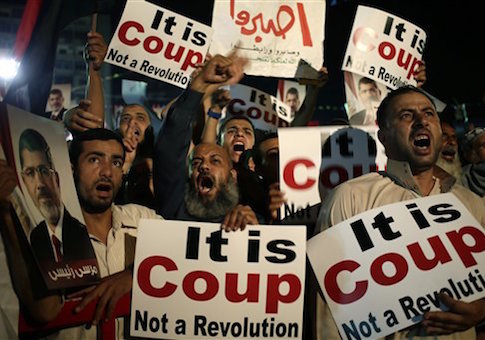
One member of that U.S. delegation, a Brotherhood-aligned judge in Egypt, posed for a picture while at Foggy Bottom in which he held up the Islamic group’s notorious four-finger Rabia symbol, according to his Facebook page.

“Now in the U.S. State Department. Your steadfastness impresses everyone,” reads an Arabic caption posted along with the photo.

Other members of that group included Gamal Heshmat, a leading member of the Brotherhood, and Abdel Mawgoud al-Dardery, a Brotherhood member who served as a parliamentarian from Luxor.

When asked on Tuesday evening to comment on the meeting, a State Department official told the Washington Free Beacon, “We meet with representatives from across the political spectrum in Egypt.”

The official declined to elaborate on who may have been hosted or on any details about the timing and substance of any talks.

The meeting was described by a member of the delegation, Maha Azzam as “fruitful,” according to one person who attended a public event in Washington earlier this week hosted by the group.

The call for jihad, while surprising in light of the Brotherhood’s attempts to appear moderate, is part and parcel of organization’s longstanding beliefs, Trager said.

“Muslim Brothers have been committing violent acts for a very long time,” Trager explained. “Under Morsi, Muslim Brothers tortured protesters outside the presidential palace. After Morsi’s ouster, they have frequently attacked security forces and state property. “

“But until now, the official line from the Brotherhood was to support this implicitly by justifying its causes, without justifying the acts themselves,” he added. “ So the Brotherhood’s open call to jihad doesn’t necessarily mean a tactical shift, but a rhetorical one.”

Terrorism expert and national security reporter Patrick Poole said he was struck by the clarity of the Brotherhood’s call.

“It invokes the Muslim Brotherhood’s terrorist past, specifically mentioning the ‘special apparatus’ that waged terror in the 1940s and 1950s until the Nasser government cracked down on the group, as well as the troops sent by founder Hassan al-Banna to fight against Israel in 1948,” he said.

“It concludes saying that the Brotherhood has entered a new stage, warns of a long jihad ahead, and to prepare for martyrdom,” Poole said. “Not sure how much more clear they could be.”

Poole wondered if the call for jihad would convince Brotherhood apologists that the group still backs violence.

“What remains to be seen is how this announcement will be received inside the Beltway, where the vast majority of the ‘experts’ have repeatedly said that the Brotherhood had abandoned its terrorist past, which it is now clearly reviving, and had renounced violence,” Poole said. “Will this development be met with contrition, or silence? And what says the State Department who met with these guys this week?”

The State Department did not respond to a request for comment before press time.

The Imaginary Islamic Radical

January 28, 2015

The Imaginary Islamic Radical, Front Page Magazine, Daniel Greenfield, January 28,2015

(Ask Secretary Kerry.

Please see also Muslim Brotherhood-Aligned Leaders Hosted at State Department. — DM)

iraqstill-450x281

Our problem is not the Islamic radical, but the inherent radicalism of Islam. Islam is a radical religion. It radicalizes those who follow it. Every atrocity we associate with Islamic radicals is already in Islam. The Koran is not the solution to Islamic radicalism, it is the cause.

******************

The debate over Islamic terrorism has shifted so far from reality that it has now become an argument between the administration, which insists that there is nothing Islamic about ISIS, and critics who contend that a minority of Islamic extremists are the ones causing all the problems.

But what makes an Islamic radical, extremist? Where is the line between ordinary Muslim practice and its extremist dark side?

It can’t be beheading people in public.

Saudi Arabia just did that and was praised for its progressiveness by the UN Secretary General, had flags flown at half-staff in the honor of its deceased tyrant in the UK and that same tyrant was honored by Obama, in preference to such minor events as the Paris Unity March and the Auschwitz commemoration.

It can’t be terrorism either. Not when the US funds the PLO and three successive administrations invested massive amounts of political capital into turning the terrorist group into a state. While the US and the EU fund the Palestinian Authority’s homicidal kleptocracy; its media urges stabbing Jews.

Clearly that’s not Islamic extremism either. At least it’s not too extreme for Obama.

If blowing up civilians in Allah’s name isn’t extreme, what do our radicals have to do to get really radical?

Sex slavery? The Saudis only abolished it in 1962; officially. Unofficially it continues. Every few years a Saudi bigwig gets busted for it abroad. The third in line for the Saudi throne was the son of a “slave girl”.

Ethnic cleansing? Genocide? The “moderate” Islamists we backed in Syria, Libya and Egypt have been busy doing it with the weapons and support that we gave them. So that can’t be extreme either.

If terrorism, ethnic cleansing, sex slavery and beheading are just the behavior of moderate Muslims, what does a Jihadist have to do to be officially extreme? What is it that makes ISIS extreme?

Our government’s definition of moderate often hinges on a willingness to negotiate regardless of the results. The moderate Taliban were the ones willing to talk us. They just weren’t willing to make a deal. Iran’s new government is moderate because it engages in aimless negotiations while pushing its nuclear program forward and issuing violent threats, instead of just pushing and threatening without the negotiations. Nothing has come of the negotiations, but the very willingness to negotiate is moderate.

The Saudis would talk to us all day long while they continued sponsoring terrorists and setting up terror mosques in the West. That made them moderates. Qatar keeps talking to us while arming terrorists and propping up the Muslim Brotherhood. So they too are moderate. The Muslim Brotherhood talked to us even while its thugs burned churches, tortured protesters and worked with terrorist groups in the Sinai.

A radical terrorist will kill you. A moderate terrorist will talk to you and then kill someone else. And you’ll ignore it because the conversation is a sign that they’re willing to pretend to be reasonable.

From a Muslim perspective, ISIS is radical because it declared a Caliphate and is casual about declaring other Muslims infidels. That’s a serious issue for Muslims and when we distinguish between radicals and moderates based not on their treatment of people, but their treatment of Muslims, we define radicalism from the perspective of Islamic supremacism, rather than our own American values.

The position that the Muslim Brotherhood is moderate and Al Qaeda is extreme because the Brotherhood kills Christians and Jews while Al Qaeda kills Muslims is Islamic Supremacism. The idea of the moderate Muslim places the lives of Muslims over those of every other human being on earth.

Our Countering Violent Extremism program emphasizes the centrality of Islamic legal authority as the best means of fighting Islamic terrorists. Our ideological warfare slams terrorists for not accepting the proper Islamic chain of command. Our solution to Islamic terrorism is a call for Sharia submission.

That’s not an American position. It’s an Islamic position and it puts us in the strange position of arguing Islamic legalism with Islamic terrorists. Our politicians, generals and cops insist that the Islamic terrorists we’re dealing with know nothing about Islam because that is what their Saudi liaisons told them to say.

It’s as if we were fighting Marxist terrorist groups by reproving them for not accepting the authority of the USSR or the Fourth International. It’s not only stupid of us to nitpick another ideology’s fine points, especially when our leaders don’t know what they’re talking about, but our path to victory involves uniting our enemies behind one central theocracy. That’s even worse than arming and training them, which we’re also doing (but only for the moderate genocidal terrorists, not the extremists).

Secretary of State Kerry insists that ISIS are nihilists and anarchists. Nihilism is the exact opposite of the highly structured Islamic system of the Caliphate. It might be a more accurate description of Kerry. But the Saudis and the Muslim Brotherhood successfully sold the Western security establishment on the idea that the only way to defeat Islamic terrorism was by denying any Islamic links to its actions.

This was like an arsonist convincing the fire department that the best way to fight fires was to pretend that they happened randomly on their own through spontaneous combustion.

Victory through denial demands that we pretend that Islamic terrorism has nothing to do with Islam. It’s a wholly irrational position, but the alternative of a tiny minority of extremists is nearly as irrational.

If ISIS is extreme and Islam is moderate, what did ISIS do that Mohammed did not?

The answers usually have a whole lot to do with the internal structures of Islam and very little to do with such pragmatic things as not raping women or not killing non-Muslims.

Early on we decided to take sides between Islamic tyrants and Islamic terrorists, deeming the former moderate and the latter extremists. But the tyrants were backing their own terrorists. And when it came to human rights and their view of us, there wasn’t all that much of a difference between the two.

It made sense for us to put down Islamic terrorists because they often represented a more direct threat, but allowing the Islamic tyrants to convince us that they and the terrorists followed two different brands of Islam and that the only solution to Islamic terrorism lay in their theocracy was foolish of us.

We can’t win the War on Terror through their theocracy. That way lies a real Caliphate.

Our problem is not the Islamic radical, but the inherent radicalism of Islam. Islam is a radical religion. It radicalizes those who follow it. Every atrocity we associate with Islamic radicals is already in Islam. The Koran is not the solution to Islamic radicalism, it is the cause.

Our enemy is not radicalism, but a hostile civilization bearing grudges and ambitions.

We aren’t fighting nihilists or radicals. We are at war with the inheritors of an old empire seeking to reestablish its supremacy not only in the hinterlands of the east, but in the megalopolises of the west.

Obama and cognitive dissonance

January 26, 2015

Obama and cognitive dissonance, Dan Miller’s Blog, January 26, 2015

(The views expressed in this article are mine and do not necessarily reflect those of Warsclerotic or its other editors. — DM)

It has been argued that Obama’s cognitive dissonance is demonstrated by His dealings with Iran and His other disruptive efforts in the Middle East.  Perhaps the contrary is more accurate.

Basis of His foreign policies?

Basis of His foreign policies?

An article at Front Page Magazine by Bruce Thorton is titled The Dangers of Obama’s cognitive dissonance (also at Warsclerotic). It argues that Obama mistakenly believes that Iran and “we” want many of the same things and that He acts on that belief.

The heart of this mistake is the belief that whatever their professed beliefs, all peoples everywhere are just like us and want the same things we want. Since our highest goods are peace and prosperity, we think other nations’ privilege the same things. If peoples behave differently, it’s because they are warped by poverty or bad governments or religious superstitions, and just need to be shown that they can achieve those boons in rational, peaceful ways, especially by adopting liberal democracy and free-market economies. Once they achieve freedom and start to enjoy the higher living standards economic development brings, they will see the error of their traditional ways and abandon aggression and violence, and resolve conflicts with the diplomacy and negotiation we prefer. [Emphasis added.]

The Islamic Republic of Iran most likely does want peace and prosperity, but on its own terms.

Iran hangings by crane

Iran wants Islamic “peace” — the peace of universal submission to (a Shiite?) Allah — and at least sufficient prosperity to force its will on others who do not want “peace” of that sort. If Iran gets (or gets to keep) nuclear weapons, along with increasingly longer range missiles, it will be in an increasingly improved position to do that.

Obama may well have very similar goals for Iran. His demands that the P5+1 process continue despite Iran’s persistent refusals to make significant concessions, even as it continues to enhance its nuclear war machine, and His disposition to give Iran whatever concessions it wants, suggest that His and Iran’s objectives are similar. There is support for an alternative, that Obama is simply delusional. However, unless His closest, most trusted and therefore most important advisors are at least equally delusional, that alternative makes little sense. Although she appears to be a despicable person, Valerie Jarrett seems quite competent at what she does on His behalf. Others fall on their swords, fall into line and salute or leave.

Obama’s “extraordinary disconnect” in foreign policy was recently highlighted on CBS’ Face the Nation.

John Bolton said much the same.

Is it more likely that Obama merely fails to understand what’s happening, or that He understands and likes it? His State of Union address was full of foreign policy nonsense, much of it about Iran. However, it seems to have worked quite well with the large segment of the American public which neither understands nor cares about foreign affairs (except amusing affairs of a salacious nature) and believes that He strives mightily to give them the “free stiff” they believe they want, without understanding the economic hardships it has brought and will bring to them. If members of the public who already worship Him (and that includes most of the “legitimate news” media) continue to do so, it may well make little if any difference to Him or to His closest advisors whether those who disagree with Him still like, or continue to like, Him.

Leftist beliefs

After all, as we learned at the Democrat National Convention that nominated Obama for a second term, “we all belong to the Government,” it’s “one big happy family” and Obama is the head of “our family.”

In the final analysis, it may make little difference whether Obama is incompetent and delusional or is competent, understands His plans for Iran and the rest of the world far better than the rest of us and has perverse conceptions of evil and good.

Both theories are worth considering because both can help us to understand what He does, why He does it and what He intends to accomplish. However, delusional actions and intentions are difficult for those who are not delusional to understand and therefore to challenge. Actions and intentions that are, instead, based on a rational thought process — but one that views evil as good and good as evil — are easier to understand and therefore to challenge.

As I have watched Obama and His accomplishments over the years, I have come to lean toward the notion that He is competent, evil, understands what He is trying to achieve and likes it.

The Dangers of Obama’s Cognitive Dissonance

January 26, 2015

The Dangers of Obama’s Cognitive Dissonance, Front Page Magazine, January 26, 2015

ol-450x253

The worst crisis we face is the relentless progress Iran is making toward creating nuclear weapons, a development that would set off an arms race in the Middle East and destabilize an already chaotic region. The Islamic Republic has already extended its malign influence into Syria, Lebanon, and Yemen, creating a Shi’a crescent that threatens our allies in the region, especially Israel, Jordon, Egypt, and Saudi Arabia. If a failed gangster-state like North Korea can demand so much international attention just because it possesses nuclear weapons, think what Iran––with 3 times the population and the world’s 3rd largest oil reserves––could do. Oil won’t stay cheap forever.

Obama, in short, can say that “all options are on the table” all he wants, but the mullahs know he will not take military action against them, nor help Israel to. They know that Obama has withdrawn from the region, and at best will make only token gestures of engagement, like the current bombing campaign against ISIL. They know his ultimatums and “red line” threats are empty. They know he wants a deal more than they do, so he can burnish his legacy. Thus the Iranians are spinning out the negotiations, cadging extensions, pocketing concessions without reciprocating, and giving Obama just enough hope to think he can achieve what he thinks will be a Nixon-goes-to-China foreign policy coup, but will in fact will go down in history as a humiliating and dangerous blunder like Chamberlain’s Munich debacle.

*********************

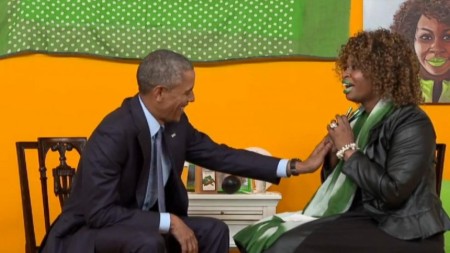
There are many moments from the past 6 years that demonstrate the criminal incompetence of this president and his administration. But for me, Obama’s interview with GloZell––whose claim to YouTube fame comes from eating Cheerios in a bathtub filled with milk––represents best the essential emptiness, triviality, and sheer dumbness of this president. Imagine Franklin D. Roosevelt in 1938 being interviewed by a carnival geek, and you can gauge just how low the most consequential political office in the world has sunk.

This interview, remember, took place the same time as problems requiring urgent presidential attention were escalating. Libya imploding, Iran inching toward a nuclear bomb, ISIS expanding in Syria and holding ground in northern Iraq, Iranian military assets active in Iraq, Yemen falling to an Iranian proxy terrorist group, another Iranian client, Bashar al Assad, strengthening his hold over Syria––and that’s just the Middle East. And don’t forget, the GloZell farce followed hard on Obama’s State of the Union address, a congeries of wishful thinking, narcissistic braggadocio, and outright-lies, a preposterous catalogue in which generous sprinklings of first-person-pronoun fairy dust transmuted every failure into an achievement.

It is the contradiction between fact and fiction, evident in every line of the president’s speech, that typifies progressives in general. This cognitive dissonance may simply be nothing more than the grubby machinations of those who will say and do anything for political power and the wealth and influence it brings. In other words, they know they are hypocrites. But it also could be something more dangerous than a venal character and moral corruption. One gets the feeling that many progressives actually believe what they say, that they are reciting the mantras of their ideological cult, no matter how contrary to reality or their own actions. What’s more important is that whatever the source, this failure to acknowledge reality, to think critically, and to respect intellectual coherence is dangerous to all of us, especially in the many foreign policy crises that have mushroomed on Obama’s watch.

And the worst crisis we face is the relentless progress Iran is making toward creating nuclear weapons, a development that would set off an arms race in the Middle East and destabilize an already chaotic region. The Islamic Republic has already extended its malign influence into Syria, Lebanon, and Yemen, creating a Shi’a crescent that threatens our allies in the region, especially Israel, Jordon, Egypt, and Saudi Arabia. If a failed gangster-state like North Korea can demand so much international attention just because it possesses nuclear weapons, think what Iran––with 3 times the population and the world’s 3rd largest oil reserves––could do. Oil won’t stay cheap forever.

But in the face of this threat, Obama has appeased the mullahs under the guise of diplomatic “engagement” and negotiations, the time-proven way to avoid action while pretending to do something. Indeed, so besotted is he by his faith in diplomacy that he has threatened to veto a Congressional bill that would strengthen his negotiating position by toughening economic sanctions, the best non-lethal shot we have for changing the Iranians’ behavior, given the current decline in their oil revenues. But what we see here is a problem that transcends any one president or Secretary of State, for it reflects the intellectual error and failure of imagination peculiar to modernity.

The heart of this mistake is the belief that whatever their professed beliefs, all peoples everywhere are just like us and want the same things we want. Since our highest goods are peace and prosperity, we think other nations’ privilege the same things. If peoples behave differently, it’s because they are warped by poverty or bad governments or religious superstitions, and just need to be shown that they can achieve those boons in rational, peaceful ways, especially by adopting liberal democracy and free-market economies. Once they achieve freedom and start to enjoy the higher living standards economic development brings, they will see the error of their traditional ways and abandon aggression and violence, and resolve conflicts with the diplomacy and negotiation we prefer.

The problem with this scenario is not that other peoples don’t want freedom and prosperity, or are incapable of achieving them. Rather, it is that they often have other goals more important than the ones we prize. Like religion, for example, or national honor, or revenge. We may think such motives are irrational avatars from an uncivilized past, but they are still drivers of action in individuals and nations alike. They may be, to quote Orwell on the Nazis, “ghosts” out of the premodern world, but they’re still “ghosts which need a strong magic to lay them.”

Of course, if weaker than an enemy or rival, such a people may conceal these motives, and pretend to play by the rules of the more powerful, until they are strong enough to use force to achieve their aims. In such situations, diplomatic engagement becomes a tactic for achieving through words what cannot be gained through deeds. As Robert Conquest said of our Cold War negotiations with the Soviets, “The Soviets did what their interests required when the alternative seemed less acceptable, and negotiation was merely a technical adjunct.”

History shows the truth of this insight, from the Munich Conference in 1938, to the many arms reduction treaties with the Soviet Union, which we know the Soviets and now the Russians have serially violated. More pertinent for Iran is the sorry history of the diplomatic attempts to prevent North Korea from developing nuclear weapons. For decades we indulged in cycles of concessions, agreements, conferences, and violations that all ended up with the North announcing it had gone nuclear. The failure to learn from that recent history is evident in Obama’s current reprise of that sordid dance in his engagement with Iran.

This is not to say that diplomacy can’t ever work. But to be effective, negotiation has to start with a clear understanding of the other side’s motives. One must avoid the “trap,” as Conquest called it, “of thinking that others think, within reason, like ourselves. But this trap is precisely the error that must be avoided in foreign affairs.” The rulers of Iran may lust after wealth and secular power, the default materialist motives recognized by the West. But that greed can coexist with their messianic, apocalyptic strain of Shi’a Islam, and the acceptability of violence in service to their faith that characterizes traditional Islam.

Thus when Muslim warriors tell us, as they have for 14 centuries, that they love death as we love life; when they proclaim, as Mohammed, Iran’s Ayatollah Khomeini, Osama bin Laden, and the Fort Hood jihadist did, “I was instructed to fight all men until they say there is no god but Allah,” we’d better listen and take them seriously, rather than brush aside such profound religious beliefs as mere camouflage for materialist motives. Yet so blind is Obama to this truth, that he and his officials stubbornly refuse even to utter a phrase like “Islamic extremist,” since he has decided that all the Muslim violence roiling the world every day has “nothing to do with Islam.”

Second, diplomacy can work only when backed by a credible threat of force. The other side must believe that mind-concentrating violence will punish them for negotiating in bad faith and violating agreements. In the case of Iran, the mullahs must believe that we will put to the test their love of death and longing for paradise. But our long history with the Islamic Republic has proved the opposite. Iran has never been punished for taking our embassy staff hostage in 1979, for instigating the murder of 241 of our soldiers in Beirut in 1983, or for training and funding the terrorists who have killed our troops in Iraq and Afghanistan, or for being the world’s leading promoter of terrorist violence.

Obama, in short, can say that “all options are on the table” all he wants, but the mullahs know he will not take military action against them, nor help Israel to. They know that Obama has withdrawn from the region, and at best will make only token gestures of engagement, like the current bombing campaign against ISIL. They know his ultimatums and “red line” threats are empty. They know he wants a deal more than they do, so he can burnish his legacy. Thus the Iranians are spinning out the negotiations, cadging extensions, pocketing concessions without reciprocating, and giving Obama just enough hope to think he can achieve what he thinks will be a Nixon-goes-to-China foreign policy coup, but will in fact will go down in history as a humiliating and dangerous blunder like Chamberlain’s Munich debacle.

So much is obvious. Yet in his State of the Union speech Obama astonished even his loyal media retainers when he asserted that his negotiations have “halted the progress of its [Iran’s] nuclear program and reduced its stockpile of nuclear material.” In reality, Iran continues to enrich uranium and is building new nuclear reactors, not to mention constructing missile sites and nuclear facilities in Syria. International inspectors are still barred from numerous sites in Iran, and so the West has no real idea of how many facilities exist there. This means that even if an agreement is signed, it will be worthless if it leaves Iran with the knowledge and technology needed to make nuclear bombs at a time of its choosing. And it means that someday we all will pay the price for our president’s cognitive dissonance.

Op-Ed: Is the Middle East on the Verge of Exploding?

January 22, 2015

Op-Ed: Is the Middle East on the Verge of Exploding? Israel National News, Dr. Mordechai Kedar, January 21, 2015

The potential for destruction posed by all these disputes is enormous, and the explosion may shake Europe and even cross the Atlantic when Islamic extremists blow their minds at the deep crisis affecting the entire Middle East.

*************

Five separate sets of potential fireworks have been igniting simultaneously in the Middle East for the last few weeks, each of them adding fuel to the fires caused by the others. If and when these developments reach the kindling point, the entire region may go up in uncontrollable flames.

These are the sources of the fires:

a. the rivalry between Al Qaeda and ISIS

b. the intensifying struggle between the Sunni Jabhat al Nusra and the Shiite Hezbollah.

c. the successes of the Houthis in Yemen

d. Islamic fury at what is happening in Egypt

e. the struggle between Islamic extremists and European regimes

Here are the details::

a. In the militant Sunni arena there is a fierce struggle going on between organizations that identify with Al Qaeda’s ideology, headed by Jabhat al Nusra – and ISIS, which is in control over large swathes of Syria and Iraq and has established the most stringent form of Sharia law in those areas. The rivalry has caused Al Qaeda to increase its attacks on the Yemeni government, abort an American attempt to rescue two hostages from Yemen last December, accept responsibility for the Charlie Hebdo murders in Paris and announce that the brothers who perpetrate the murders received their training in an Al Qaeda camp in Yemen.

b. The war between the Shiite Assad regime and Hezbollah on the one hand and Sunni Jabhat al Nusra on the other is getting more fierce. Jabhat al Nusra managed to cause Hezbollah painful losses  recently, near the Hermon Mountain range and in a daring infiltration into the Bekaa Valley in Lebanon, by way of the city of Arsal. Hezbollah is feeling pressured, leading the Iranian revolutionary guards to send some top officers to help the organization plan its next operation and improve its results.

c. In Yemen, the Shiite Houthi militias have succeeded in taking over the capital city of Sana’a and appear as the winning side in the long, drawn out war the Houthis have been waging against that nation. Iran is backing the Houthis, the US is helping the regime, both against al Qaeda and the Houthis. Without doubt, Yemen is a battlefield where Iran is forcing its enemies to follow its agenda, including nearby Saudi Arabia, which sees the Houthis as a direct threat to its security. Several years ago, the Saudis built a separation fence all along their border with Yemen, in an attempt to keep out Al Qaeda and Houthi militants.

d. There is a fierce struggle in Egypt between the Muslim Brotherhood – the mother of all Sunni Jihad organizations – and the regime of Al Sisi. As far as this struggle goes, Sisi is reinstating the government of Gamal abdel Nasser, Sadat and Mubarak, all of whom waged relentless and bloody war against the “Brothers”.  As of now, Sisi has succeeded in pushing the “Brothers” from positions of rule into jail cells and from the streets to the cemetery. His successes are infuriating his detractors.    The fight is to the finish, and it is also being waged in the Sinai Desert between the government and the militias of Anṣār Bayt al-Maqdis, who recently switched its loyalties from al Qaeda to ISIS.

Europe is a relatively new battleground, but the last few weeks showed mounting escalation, both in jihadist activities against governments (see France) and in governmental activity against jihad cells (Belgium, Germany). Jihad activities in Europe are encouraged by ISIS as well as Al Qaeda, both sides of the rivalry mentioned above. People who return from Jihad in Syria, Iraq and Libya – but not just they – are participating in the heated struggle for Europe’s image.

These struggles are synergetic, they influence one another because an Islamic militant sees what is happening in one area and decides to take revenge for Allah in another. This sinking into chaos can lead to large number of large scale conflicts, with many more participants and deaths, especially if these organizations succeed in drawing Israel and the US into the fray. We have already heard of ground troups from the West fighting ISIS.

Israel must understand the dangers now permeating the atmosphere of the MIddle East with oil vapors that any spark can set on fire and that no one will be able to put out before the entire region is ablaze. The potential for destruction posed by all these disputes is enormous, and the explosion may shake Europe and even cross the Atlantic when Islamic extremists blow their minds at the deep crisis affecting the entire Middle East.

The massive Islamic immigration to Europe turned that continent into a branch of the Middle East’s disputes, so that Europe will not be immune to the many deep seated and broad Middle Eastern problems. And America is on the same planet, so that the Middle East disasters will find their way to its shores as well.


Op-Ed: The West Cannot Win this War

January 19, 2015

Op-Ed: The West Cannot Win this War, Israel National News, Giulio Meotti, January 19, 2015

(Can’t win, or refuses to win? — DM)

Take another look at the video filmed under the Charlie Hebdo’s building, the black car of the terrorists who had no fear of death and are advancing by shooting, while the white car of the policemen is forced to retreat.

We are capitulating.

The West cannot win this war. Take the last French mass rally with dozens of heads of states from around the world: it was a silent march, a mute show where nobody took the podium. As if these people didn’t know what to say. As if these Western leaders didn’t really believe in what they were doing in Paris.

A few days ago, Martin Wolf in the British daily Financial Times gave voice to the deep estrangement of Europe’s élite. He suggested using massive doses of multicultural recognition of equality between different cultures in order to combat Islamism. Mr. Wolf is implicitly saying that we must surrender, that we cannot win, that we have to contain terror and finally find a way to coexist with it.

The French horror doesn’t lie in the killings per se. A few hours later, in Nigeria, Boko Haram destroyed many villages and burned hundreds of people to death. Europe’s horror lies in the fact that the terrorists came from the heart of the continent. The Chouaci’s brothers, the British bombers and Theo Van Gogh’s killer didn’t came from Raqqa, in Syria, or Al Qaeda in Yemen. No, they were born and raised in European democracies.

Europe gave everything to these terrorists: schools, education, entartainment, sexual pleasures, salaries and freedom. The French terrorists rejected the French values of liberté, egalité and fraternité; the British suicide bombers rejected British multiculturalism, while Dutch terrorist Mohammed Bouyeri, who slaughtered the film maker in Amsterdam, rejected the Dutch mute values of moral indifference.

A few days ago, I was talking with Flemming Rose, the Danish journalist who first published the cartoons in 2006 and now lives protected by the police. He told me the shocking truth nobody wants to hear:

“I am pretty pessimistic about the future of free speech, though I am delighted that so many people came out to support Charlie Hebdo”, Rose told me. “I knew several of the cartoonists who were killed, and I was a witness in a criminal case against CH in 2007. My fear is that this support will not translate into real decisions and changed behavior when we get back to our day-to-day life. We have seen that before. Madrid 2004, Theo van Gogh 2004, London 2005, Kurt Westergaard 2008 and 2010 (one planned attack and another real attack in which he was nearly killed). Every time lots of support and solidarity with the victims, but very little has changed in reality, quite to the contrary, apart from CH no European newspapers have dared to publish Mohammed cartoons since 2008”.

Charlie Hebdo’s journalists were brave people, defiant, but if they are the Western heroes, we have already lost. “Charb” and the other cartoonists didn’t believe in anything.

A few years ago, at my newspaper in Italy. I suggested we publish a letter that Mohammed Bouyeri released from his Dutch prison. Bouyeri says he does not feel remorse for what he did. The tone of the letter is marked by a kind of puerile candor. Bouyeri never mentions Van Gogh, but he makes it clear that he has fulfilled a religious duty by killing him.

The West cannot win this war. The price it would have to pay is the loss of European values: reducing the civil rights of many people, deporting them, declaring a war of values, sending boots on the ground in the Middle East, imposing Western civilization on them. Europe will never do that. Europe itself doesn’t believe in these values anymore. This is also one of the reason why Europe hates Israeli Jews who daily confront evil and fight it, so deeply.

The terrorists of Charlie Hebdo talk a religious language and use terms like honor, faith, prophet and loyalty, while the West replies to them with words such as freedom, democracy, rights, respect and tolerance. They speak theology, we reply with logic. They use bullets, we march in the streets.

It is a sad joke. The truth is that people in the West are relieved that they don’t have to fight, that we are surrendering, that life goes on as usual. Hurray, we are capitulating!

Obama’s grim warning to Congress: New Iran sanctions will lead to war

January 16, 2015

Obama’s grim warning to Congress: New Iran sanctions will lead to war, Washington Times

(The article does not indicate who Obama thinks might start such a war — Iran, Israel or the United States, for example. — DM)

President Obama warned Congress Friday that new economic sanctions against Iran could lead directly to war, and British Prime Minister David Cameron said he’s personally appealing to top lawmakers to hold off and allow diplomatic negotiations with Iran to play out.

At a news conference in the White House, both leaders pleaded with congressional leaders to wait just a few more months before pursuing new sanctions against Iran. Mr. Cameron said such action would splinter the international community, which right now is unified against Iran’s pursuit of a nuclear weapon.

But Mr. Obama was even more direct, warning the American people that their representatives on Capitol Hill could plunge the U.S. into another war in the Middle East by pushing another round of sanctions.

“I’ve consistently said we leave all options on the table. But Congress should be aware that if this diplomatic solution fails, than the risks and likelihood this ends up at some point a military confrontation is heightened. And Congress will have to own that as well,” the president said. “And we may not be able to rebuild the kind of coalition we need in that context if the world believes we were not serious about negotiations.”

The U.S., Britain and its allies in the so-called P5 plus 1 — Russia, China, France and Germany — in 2013 secured a deal that halted some parts of Iran’s nuclear program in exchange for the lifting of some economic sanctions against the country. The two sides still have not reached a final agreement.

The deadline for a final deal has been extended twice, with the next deadline looming in June.

But some lawmakers believe now is the time to double down on economic sanctions against Iran, even as diplomatic talks continue. There is support in both parties for more sanctions.

While in Washington this week, Mr. Cameron said that he’s personally appealed to members of the Senate to take additional sanctions off the table right now.

“I have contacted a couple of senators this morning and I may speak to one or two more this afternoon — not in any way as the British prime minister to tell the American Senate what it should or shouldn’t do. That wouldn’t be right,” he said. “But simply to make the point that as a country that stands alongside America in these vital negotiations that it is the opinion of the United Kingdom that further sanctions of the further threat of sanctions at this point won’t actually help bring the talks to a successful conclusion and they could fracture the international unity there has been.”


Can Charlie Hebdo’s Spirit Include Israel?

January 9, 2015

Can Charlie Hebdo’s Spirit Include Israel? Algemeiner, Noah Beck, January 9, 2015

parisians-300x167Grieving Parisians gathered to mourn the victims of the Charlie Hebdo shooting. Photo: Screenshot, Vice News.

[H]ad Palestinian gunmen similarly attacked Israel’s most important daily newspaper and then escaped, would the event inspire such constant coverage or international sympathy? Israel has suffered countless massacres followed by a suspenseful manhunt for the Islamist terrorists; in each of these incidents, the world hardly noticed until Israel forcefully responded and Palestinians died (prompting global condemnation of Israel).

The best response to the Charlie Hebdo attack is to redouble the free expression Islamists meant to stifle. Similarly, the best response to Islamist attacks on the only Mideast democracy, Israel, is to increase support for it.

****************

The Islamist massacre at Charlie Hebdo has understandably captured global attention because it was a barbaric attack on France and freedom of expression. In a moment of defiant moral clarity, “je suis Charlie” emerged as a popular phrase of solidarity with the victims. Hopefully such clarity persists and extends to those facing similar challenges every day in the Middle East.

Christians and other religious minorities have been beheaded by Islamists for years, but it wasn’t until US journalist James Foley was beheaded that the West cared. The Islamic State raped and slaughtered thousands of Yazidis — leaving the surviving refugees stranded on Mount Sinjar — before the West took notice. But one Islamist besieging a cafe in Sydney, killing two, dominated global coverage for the entire 16-hour incident.

Western leaders and media must realize that religious minorities in the Middle East are the canary in the coalmine for the West when it comes to Islamist threats. And Israel provides the clearest early warning of all, precisely because — despite Israel’s location in a region of Islamists and dictatorships — the Jewish state has free elections, freedom of speech, a vigorous political opposition and independent press, equal rights and protections for minorities and women (who are represented in all parts of civil, legal, political, artistic, and economic life), and a prosperous free market economy.

But had Palestinian gunmen similarly attacked Israel’s most important daily newspaper and then escaped, would the event inspire such constant coverage or international sympathy? Israel has suffered countless massacres followed by a suspenseful manhunt for the Islamist terrorists; in each of these incidents, the world hardly noticed until Israel forcefully responded and Palestinians died (prompting global condemnation of Israel).

However, when there is an attack in Europe, North America, or Australia, there is widespread grief, solidarity, and an acceptance of whatever policy reaction is chosen. But when Israel is targeted, there is almost always a call for “restraint,” as happened last November after fatal stabbings by Palestinian terrorists in Tel Aviv and the West Bank.

If two Palestinians entered a European or North American church and attacked worshipers with meat cleavers, killing five people, including priests, the outrage would be palpable in every politician and journalist’s voice. But when Israelis were victims of such an attack, Obama’s reaction was spineless and tone deaf. Did Obama condemn the Charlie Hebdo massacre by noting how many Muslims have died at the hands of French military forces operating in Africa and the Middle East? Of course not. Such moral equivocation would be unthinkable with any ally or Western country except Israel.

Similarly, would Secretary of State John Kerry ever suggest that the Islamic State is somehow motivated by French policies (whether banning Muslim headscarves at public schools or fighting Islamists in Mali)? Obviously not. Yet Kerry did just that sort of thing with Israel when he suggested that the Islamic State is driven by the Israeli-Palestinian conflict.

And the media’s anti-Israel bias is well known but became even more obvious when they couldn’t get a simple story about vehicular terrorism against Israelis correct. Compare how The Guardian writes accurate headlines when France or Canada suffers an Islamist car attack but not when Israel does.

Consider all of the justifiable news coverage and outrage over the 2013 Boston bombings, and imagine if one of those happened every week. Would anyone dare suggest that the US make peace with any Islamists demanding changes to US policy? And yet Israel had such bomb attacks almost every week of 2002 and was invariably asked to restrain itself and make concessions to the very people bombing them (as happened again last summer, when Hamas fired thousands of rockets at Israel).

As Israeli Prime Minister Netanyahu has ruefully observed, “There is a standard for dictatorships, there is a standard for democracies, and there is still a third standard for the democracy called Israel.”

Even when compared to Western democracies, what other country gives incredibly forgiving medical care to terrorists and agrees to treat the children of those working to destroy it? Israel is where a Hamas family member finds refuge when he is a gay convert to Christianity but this is yet another inconvenient fact for the mainstream media (as is the fact that some Israeli Arabs supported the IDF’s 2014 war against Hamas). Why report what contradicts the one-sided, anti-Israel narrative that the media and groups like Human Rights Watch have adopted? That narrative is only reinforced on college campuses (leftist college history professors openly supported Hamas last summer). Nevertheless, US funding of anti-Israel groups continues to aggravate the misinformation problem.

Israel is still the country that everyone loves to hate. So it’s the cheap way to please Muslim voters in Europe and oil producers in the Gulf. But what happens to Israel eventually comes to the West, because Israel is an extension of the West. And just as surrendering Czechoslovakia failed to appease the expansionist appetite and murderous rampage of Nazi totalitarianism, so too will feeding Israel to Islamist totalitarianism fail to appease that movement. In the end, there is no set of concessions — short of civilizational surrender — that the Islamists will accept.

Nevertheless, an EU court decided to remove Hamas from the European Union’s terror list, even though Hamas is responsible for scores of terrorist attacks that have murdered hundreds of Israelis, North Americans, and Europeans, and has a charter calling for the destruction of Israel. And Western European countries have voted for Palestinian statehood at the UN and in their parliaments, effectively rewarding Palestinian terrorism and intransigence. Europe supports the Palestinian Authority as if Hamas couldn’t overthrow it in the West Bank as easily as Hamas did in Gaza Strip in 2007. How can Europe not know that Hamas has designs on the West Bank and that any Israeli withdrawal from that territory will only facilitate such a takeover? And how can Europe believe that Israel could ever make peace with Hamas, which has launched three unprovoked wars on Israel in the last five years (in the decade since Israel withdrew from Gaza)?

Moreover, if lofty concerns about self-determination and human rights are the true motivation behind Europe’s vocal support for Palestinian independence (despite its undemocratic and violent record), why is Europe deafeningly quiet on Kurdish statehood? Given that six million Jews were annihilated by a genocide on European soil, Europe’s hypocrisy on Israel should embarrass the continent even more.

Worse still, Europe’s gestures of appeasement only encourage the Islamists. The best response to the Charlie Hebdo attack is to redouble the free expression Islamists meant to stifle. Similarly, the best response to Islamist attacks on the only Mideast democracy, Israel, is to increase support for it.

Meanwhile, Saudis Lash Blogger for “Insult” to Islam

January 9, 2015

Meanwhile, Saudis Lash Blogger for “Insult” to Islam, Investigative Project, January 9, 2015

(Will Saudi Arabia be declared “non-Islamic?” — DM)

The Paris jihadists acted on their own belief that Charlie Hebdo‘s cartoons were a crime against Islam warranting mass slaughter in response. Badawi was flogged at the demand of a national government, one which was invited to join the United Nations Security Council just two years ago and turned it down.

****************

For sheer brutality, it pales in comparison to the massacre of journalists and cartoonists Wednesday at the Paris office of Charlie Hebdo, but Saudi Arabia’s flogging of a liberal blogger Friday further shows how rooted the concept of violence is in response to any insult of Islam.

Raif Badawi was sentenced to 1,000 lashes – he received the first 50 in a public square in Jeddah Friday – along with 10 years in prison and a fine equal to $266,666, Reuters reports. His crime? Creating a website called “Free Saudi Liberals,” which advocated greater religious freedom. Saudi Arabia found this “insulting to Islam.”

In a statement, the International Humanist and Ethical Union called Badawi’s punishment “savage, and an absolute violation of human rights and dignity” intended to cow other potential free thinkers into silence.

“Only yesterday it was reported that Saudi Arabia condemned the Charlie Hebdo shootings, and yet the authorities choose this week to brutalize a young man because he had the audacity to stand up and say that his countrymen should have greater liberty,” Union spokesman Bob Churchill said. “The Saudi state’s condemnation of terror in Paris is hypocrisy of the highest order.”

Amnesty International also condemned Badawi’s treatment as “a vicious act of cruelty which is prohibited under international law” showing Saudi Arabia’s “abhorrent disregard for the most basic human rights principles.”

The Paris jihadists acted on their own belief that Charlie Hebdo‘s cartoons were a crime against Islam warranting mass slaughter in response. Badawi was flogged at the demand of a national government, one which was invited to join the United Nations Security Council just two years ago and turned it down.

This has been a horrible week for violence waged in defense of Islam. It’s not a great week for those who insist this violence is rooted in anything but theology.

A Sad State of Affairs: The Kerry Record

January 2, 2015

A Sad State of Affairs: The Kerry Record, World Affairs JournalJoshua Muravchik, November/December, 2014

(Kerry likely agrees with Obama as to his quite foreign foreign policies and, equally likely, we are stuck with both at least until Obama leaves the White House.

Kerry I'm an idiot

The most bothersome current aspects of Obama-Kerry foreign policies are the extent to which they trust Iran and how they deal with it and the P5+1 negotiating group. — DM)

John_Kerry_and_Benjamin_Netanyahu_July_2014 (1)

Although Kerry’s anti-American ideology has moderated to some degree from his fiery days as an antiwar leader, he has misrepresented but never repudiated his past. Especially consistent has been his inclination to see the best in America’s enemies, from Madame Binh to Comandante Ortega to Bashar Assad. Israelis were shocked this summer that Kerry came up with a plan molded by Turkey and Qatar to fit the interests of Hamas at their own expense. Had they known him and his record better, they might not have been.
***************

The Gaza war of July and August 2014 occasioned the sharpest frictions in memory between the United States and Israel, highlighted by a cease-fire proposal offered by Secretary of State John Kerry that Israel’s security cabinet rejected unanimously. Kerry’s plan envisioned a seven-day cease-fire, during which the parties would negotiate “arrangements” to meet each of Hamas’s demands about the free flow of people and goods into Gaza and the payment of salaries of Hamas’s tens of thousands of employees. As for Israel’s demands about destruction of tunnels and rockets and the demilitarization of Gaza, these were not mentioned at all, except in the add-on phrase that the talks would also “address all security issues.”

The document cited the important role to be played by “the United Nations, the Arab League, the European Union, the United States, Turkey, [and] Qatar.” Conspicuous by their absence from this list were Israel, Egypt, and the Palestinian Authority. These three had also not been invited to the Paris meetings where Kerry worked on his ideas with leaders of the countries and bodies mentioned.

Barak Ravid, diplomatic correspondent for the liberal Israeli newspaper Haaretz, wrote that the proposal “might as well have been penned by Khaled Meshal [head of Hamas]. It was everything Hamas could have hoped for.” The centrist Times of Israel’s characteristically circumspect editor, David Horovitz, branded Kerry’s initiative “a betrayal.” And left-leaning author Ari Shavit commented that “Kerry ruined everything. [He] put wind in the sails of Hamas’ political leader Khaled Meshal, allowed the Hamas extremists to overcome the Hamas moderates, and gave renewed life to the weakened regional alliance of the Muslim Brotherhood.”

Turkey and Qatar are the mainstays of that alliance and were chosen by Kerry as his principal interlocutors because they are Hamas’s main backers. This brought protests from the Palestinian Authority, led by President Mahmoud Abbas’s movement, Fatah, the secularist rival to Hamas. That group declared that “whoever wants Qatar and Turkey to represent them can emigrate and go live there. Our only legitimate representative is the PLO.”

The shock of Palestinian and Israeli leaders would have been less, however, if they had been more familiar with the record of John Kerry. Spurning America’s friends in pursuit of deals with their nemeses was perfectly in character for the secretary of state. The hallmark of his career has been to denigrate America itself, while supporting the claims of its enemies.

That career began in 1969, when, months after returning from a tour of duty in Vietnam, Kerry sought and received a military discharge so that he might run for Congress. His campaign as a peace candidate sputtered, but his authenticity as a Vietnam vet established him as a presence in the burgeoning antiwar movement. In May 1970, he traveled to Paris for an unpublicized meeting with Viet Cong representatives, and, perhaps at their suggestion, he joined up upon his return with Vietnam Veterans Against the War. VVAW was headed by Al Hubbard, a former Black Panther. Kerry was instantly given a top role, twinning with Hubbard as the public face of the organization.

At a VVAW protest in Washington, DC, in April 1971, Kerry joined other veterans in throwing away their military medals in front of news cameras. The entire demonstration was punctuated by Kerry’s appearance before the Senate Foreign Relations Committee, where he offered dramatic testimony about American atrocities in Vietnam based on accounts heard at a VVAW inquest a few months earlier. He spoke of veterans who said:

They had personally raped, cut off ears, cut off heads, taped wires from portable telephones to human genitals and turned up the power, cut off limbs, blown up bodies, randomly shot at civilians, razed villages . . . poisoned food stocks, and generally ravaged the countryside.

These acts, Kerry emphasized, “were not isolated incidents but crimes committed on a day-to-day basis with the full awareness of officers at all levels of command.”

When, at the behest of aghast senators, the Naval Criminal Investigative Service conducted a formal inquiry into the stories presented at the VVAW inquest, it reported that many of the VVAW witnesses cited by Kerry refused to cooperate, although promised immunity. Others were clearly crackpots, and several swore, and provided witness corroboration, that they had not participated at the inquest at all and had no idea who had appeared in their names. The entire exercise had been inspired and largely engineered by Mark Lane, whose book on the same subject earlier that year had been panned by New York Times columnist James Reston Jr. as “a hodgepodge of hearsay,” while that paper’s book reviewer, Neil Sheehan, who had reported from Vietnam and would soon break the Pentagon Papers, revealed that some of Lane’s “witnesses” had not served in Vietnam. (The political scientist Guenter Lewy documents these events in his 1978 book America in Vietnam.)

In August 1971, four months after his Senate appearance, Kerry made another trip to Paris, to meet with Madame Nguyen Thi Binh, foreign minister of the Viet Cong, this time in full view, for his first exercise in international diplomacy. He returned touting the “peace plan” of the Viet Cong, explaining: “If the United States were to set a date for withdrawal, the prisoners of war would be returned.” Although he frequently accused American leaders of lying, he took the Communist leaders’ statements at face value, asserting that their peace plan “negates very clearly the argument of the president [Nixon] that we have to maintain a presence in Vietnam to use as a negotiating [chip] for the return of those prisoners.”

Kerry’s dismissal of the statements of US leaders as lies and his credulity toward those of the Vietnamese Communists reflected a broader difference in attitude toward the two sides to the conflict. Ho Chi Minh, who had spent long years as a henchman of Stalin’s, serving the Comintern in several countries, was in Kerry’s admiring eyes “the George Washington of Vietnam” who aimed only “to install the same provisions into the government of Vietnam” that appeared in the American Constitution. America, in contrast, had itself strayed so far from those principles that it needed a “revolution” to restore them.

Kerry’s colleagues in VVAW undoubtedly shared this sentiment, and in November 1971, at a conference of its leadership in Kansas, the group considered just how far down the path of revolution it was willing to go. It debated, although ultimately rejected, a proposal to commence a campaign of terrorist violence and assassination of pro-war US senators. When he ran for president in 2004, Kerry denied he had been present at this conclave, but when FBI files secured by the Los Angeles Times under the Freedom of Information Act placed him there, he retracted that denial in favor of the statement that he had “no personal recollection” of it.

Is this plausible? Gerald Nicosia, author of a highly sympathetic history of the antiwar movement, reported, in May 2004, that “several people at the Kansas City meeting recently said to me or to mutual friends that they had been told by the Kerry campaign not to speak about those events without permission.” Why the urgency to cover up? And how would the campaign know who was there, that is, whose silence to seek, if Kerry had no recollection of the meeting? One of Nicosia’s interviewees, John Musgrave, said “he was asked by Kerry’s veterans coordinator to ‘refresh his memory’ after he told the press Kerry was in Kansas City. Not only is Musgrave outraged that ‘they were trying to make me look like a liar,’ but he also says ‘there’s no way Kerry could have forgotten that meeting—there was too much going on.’”

This puts it mildly: the event was memorably raucous, with debates over the proposals for violence and for napalming the national Christmas tree, furious factional fighting, the discovery of eavesdropping bugs in the building leading to a quick move to another location, and above all an angry showdown between Kerry and Hubbard over revelations that the latter had never been in Vietnam. This particular contretemps was punctuated by Hubbard’s dramatically pulling down his pants to show scars he claimed he sustained in Vietnam. The mayhem culminated in Kerry’s announcing his resignation from the group’s executive. And Kerry had “no personal recollection” of being there?

Although Kerry appeared as a speaker for VVAW for about a year following this resignation, he then faded from national view for a decade, climbing the ladder of local and state politics in Massachusetts before winning election to the US Senate in 1984. The Senate, he later said, “was the right place for me in terms of . . . my passions. The issue of war and peace was on the table again.” What put it on the table were the anti-communist policies of President Ronald Reagan, which Kerry deeply opposed. A year earlier, Reagan had ordered the invasion of Grenada, which Kerry scorned as “a bully’s show of force [that] only served to heighten world tensions and further strain brittle US-Soviet and North-South relations.”

In contrast, Kerry ran on a platform of the Nuclear Freeze, a popular movement opposing US plans to counterbalance a large Soviet nuclear buildup over the previous decade. Kerry made sure to score one hundred percent on a test of candidates’ positions presented by a group called Freeze Voter ’84, and he proposed to cut the defense budget by nearly twenty percent, including “cancellation of twenty-seven weapons systems” and “reductions in eighteen other[s],” according to the Boston Globe. He cited his own work with VVAW as a counterpoint: “We were criticized when we stood up on Vietnam. . . . But we’ve been borne out. We were correct. Sometimes you just have to stand and hold your ground.”

In the Senate, he secured a coveted seat on the Foreign Affairs Committee and turned his attention to the fraught issue of policy toward Central America, a small region that had assumed inordinate geopolitical importance by becoming one of the front lines in the Cold War. A Marxist-Leninist party, the Sandinista National Liberation Front, had seized power in Nicaragua and was aiding likeminded movements in El Salvador and other nearby states while the Reagan administration supported anti-Communist guerrillas inside Nicaragua, the so-called “Contras.”

Kerry lent his name to Medical Aid for El Salvador, which gave non-lethal aid to the Communist side in that civil war. On February 16, 1982, an Associated Press story quoted actor Ed Asner, leader of a Hollywood group that raised much of the funding for this project, as explaining that “medical supplies are to be purchased in Mexico and shipped clandestinely to the Democratic Revolutionary Front in El Salvador.” However, the issue of US aid to El Salvador’s anti-Communist government became overshadowed by debate about aid to the Nicaraguan “Contras.”

As the Senate neared a decisive vote, Kerry and Senator Tom Harkin undertook a dramatic maneuver to try to head off approval of the Reagan administration’s request for Contra funding. They flew to Managua, the Nicaraguan capital, for their own summit meeting with the country’s strongman, “Comandante” Daniel Ortega. The results resembled those of his 1971 meeting with Madame Binh. Ortega handed Kerry a “peace plan” according to which the US would first end all aid to the Contras, and the Sandinistas would then initiate a cease-fire and restore civil liberties. Kerry justified undercutting the US government in this way by faulting Reagan’s failure “to create a climate of trust” with the Sandinistas. He, in contrast, offered them trust in abundance, calling Ortega’s plan “a wonderful opening.” He took to the Senate floor to say, “Here, in writing, is a guarantee of the security interest of the United States.”

A year later, in 1986, in another Senate debate on Contra aid, Kerry voiced one of the odder claims about his Vietnam experience. Warning against the slippery slope of military involvement and against the duplicity of our own government, Kerry delivered a floor speech containing this assertion:

I remember Christmas of 1968, sitting on a gunboat in Cambodia. I remember what it was like to be shot at by Vietnamese and Khmer Rouge and Cambodians, and have the president of the United States telling the American people that I was not there; the troops were not in Cambodia. I have that memory which is seared—seared—in me.

The “seared” part was a nice touch, especially in view of the fact that the whole thing had not happened (although Kerry had been repeating the story since as early as 1979). In the course of Kerry’s 2004 presidential campaign, the Swift Boat Veterans for Truth, former crewmen on the type of vessel on which Kerry served who were angered by his antiwar activities, attacked this claim among other aspects of Kerry’s military history. In this case, however, unlike in response to some points raised by Kerry’s detractors, no shipmate of Kerry’s could be found to corroborate his version. Soon, his spokesmen began to hedge. One aide explained that Kerry’s boat had been “between” Vietnam and Cambodia. But the two countries are contiguous: there is no “between,” so another spokesman backed down further, explaining that Kerry had merely been “near” Cambodia.

Then, Douglas Brinkley, who authored a laudatory history of Kerry’s military service, issued another explanation, apparently at the behest of the campaign. On Christmas 1968, the moment of Kerry’s “seared” memory, he was fifty miles from Cambodia, said Brinkley, but his boat “went into Cambodia waters three or four times in January and February 1969.” Oddly, however, Brinkley’s book, which covered those two months in painstaking detail at a length of nearly one hundred pages, even to the extent of locating the sites of battles, made no mention of Kerry’s having crossed into Cambodia. And the campaign soon pulled the rug from under Brinkley by issuing a new claim, namely, that Kerry’s boat had “on one occasion crossed into Cambodia.” Three of Kerry’s shipmates, two of whom were supporting his campaign, categorically denied even this minimized claim.

In that, they are supported by no less a source than Kerry himself, in the form of a journal he kept while on duty. Substantial passages of it are reproduced in Brinkley’s book, and one of them reads:

The banks of the [Rach Giang Thanh River] whistled by as we churned out mile after mile at full speed. On my left were occasional open fields that allowed us a clear view into Cambodia. At some points, the border was only fifty yards away and it then would meander out to several hundred or even as much as a thousand yards away, always making one wonder what lay on the other side.

He was never to learn the answer because this diary entry was from his final mission.

Kerry was of course right to link Central America to Southeast Asia. They were both nodes in the Cold War, the epic struggle that defined international politics for forty years, including the first two decades of Kerry’s political engagement, from the time he returned from Vietnam in 1969 until the Berlin Wall came down in 1989. Whatever the rights and wrongs of America’s entry into Vietnam, or its actions in Central America or elsewhere, Kerry perverted the basic issue of the Cold War, always viewing America’s actions as bellicose and malign, while casting those of the Communists, like “George Washington” Ho Chi Minh, in the most favorable light.

To many, the Cold War’s benign denouement—the fall of the Wall and the USSR’s disappearance into the ash bin of history—vindicated Reagan’s approach, but Kerry appears to have entertained no second thoughts despite these outcomes. When it came to addressing post–Cold War issues, he remained reflexively averse to the exercise of American power. Kerry had lamented as “not proportional” Reagan’s 1986 bombing of Libyan dictator Muammar el-Qaddafi’s residence in response to a Libyan terror attack on US servicemen in Germany. The Middle East was also the scene of the first military showdown after the Cold War, when Saddam Hussein’s Iraq swallowed whole the neighboring state of Kuwait, in 1990. At the time, Kerry opposed the Bush administration’s request for authorization of military action, saying that those “of the Vietnam generation . . . come to this debate with a measure of distrust [and] a resolve . . . not [to be] misled again.” He concluded his Senate speech by reading a passage from an antiwar novel by the American Communist Dalton Trumbo.

With the Cold War’s end, and America’s demonstration of will and strength in driving Hussein’s forces from Kuwait, the defining issue of the 1990s became the wars of Yugoslavia’s dissolution. Here, the prime issue was whether or not to lift an international arms embargo that rendered Bosnia’s Muslims naked before their predators, the well-armed Serbs. As public opinion reacted to news accounts of the grisly results of this imbalance, the Senate voted to lift the embargo, over the objections of Kerry, who helped to lead the opposition.

With the terrorist attacks of September 11, 2001, the American public was awakened from its post–Cold War indifference toward foreign affairs. A fierce patriotism burst forth, and with it a determination to take down those who had attacked us. Thus, preparing for a 2004 presidential bid, Kerry moved to reconfigure his image. The antiwar veteran was suddenly replaced by the military hero, and the Democratic nominating convention was replete with uniforms and military gestures, highlighted by Kerry’s sharp salute to the assemblage while uttering the words, “reporting for duty.” Already, his rejected service medals had miraculously reappeared mounted and framed on his Senate office wall. Asked how that was possible, as he had been photographed throwing them away, Kerry explained that the medals he tossed were not his own but actually belonged to another veteran.

The dramatic reincarnation did not quite come off, as Kerry was dogged by Vietnam veterans, led by fellow Swift Boat crewmen, still furious at how he had blackened their names. And the awkwardness of his transformation was symbolized by his much-ridiculed explanation of his stance on funding the 2003 US invasion of Iraq: “I actually did vote for the $87 billion before I voted against it.”

In his later years in the Senate, Kerry made the issue of Syria his own. He took several trips to Damascus where, according to a June 2011 account in the Wall Street Journal, he “established something approaching a friendship with [Syrian dictator Bashar] Assad.” When Barack Obama came to office, he made Kerry his point man in efforts to improve US-Syrian relations. Kerry put his endorsement on diplomatic proposals he received in Damascus, including an offer by Assad to engineer a Palestinian unity government embracing Fatah and Hamas. The benefits to the US, not to mention Israel, of such unity were not self-evident, but in any event, talks between the two Palestinian factions were already under way, mediated by Egypt, which was closer to Fatah. Why it would be advantageous to switch the sponsorship to Syria, the ally of Hamas, was hard to grasp. Nonetheless, Kerry saw in Assad’s proposal the prospect of “a major step forward in terms of how you reignite discussions for the two-state solution . . . . Syria indicated to me a willingness to be helpful in that respect.” In all, as the Journal put it, “Kerry . . . became . . . Assad’s champion in the US, urging lawmakers and policymakers to embrace the Syrian leader as a partner in stabilizing the Mideast.”

In sum, although Kerry’s anti-American ideology has moderated to some degree from his fiery days as an antiwar leader, he has misrepresented but never repudiated his past. Especially consistent has been his inclination to see the best in America’s enemies, from Madame Binh to Comandante Ortega to Bashar Assad. Israelis were shocked this summer that Kerry came up with a plan molded by Turkey and Qatar to fit the interests of Hamas at their own expense. Had they known him and his record better, they might not have been.