Archive for the ‘Middle East’ category

Iran and suspension of disbelief

May 8, 2015

Iran and suspension of disbelief, Israel Hayom, Yoram Ettinger, May 8, 2015

The term “suspension of disbelief” — coined in 1817 by the philosopher Samuel Taylor Coleridge — refers to a willingness to suspend one’s critical faculties and believe the unbelievable; sacrificing reality, common sense, doubt and complexity on the altar of a pretend reality, convenience and oversimplification; infusing a semblance of truth into an untrue narrative.

U.S. President Jimmy Carter’s policy toward Iran in 1977-1979 was characterized by suspension of disbelief: energizing the Ayatollah Ruhollah Khomeini while ignoring or underestimating his track record and his radical, supremacist and violent worldview. The betrayal of the Shah transformed Tehran from “the U.S. policeman in the Gulf” to the worst enemy of the U.S.

Currently, the suspension of disbelief undermines the U.S. posture of deterrence and vital U.S. national security and commercial interests. It was demonstrated by U.S. President Barack Obama, who — irrespective of Middle East reality — referred to the brutally intolerant, terror-driven, anti-U.S., anti-infidel, repressive, tumultuous Arab tsunami as the “Arab Spring.” He said it was “casting off the burdens of the past,” “a story of self-determination,” “a democratic upheaval,” “a peaceful opposition,” “rejection of political violence” and “a transition toward [multi-sectarian, multi-ethnic] democracy.”

Suspension of disbelief, coupled with the ayatollahs’ mastery of ‘taqiyya’ (Islam-sanctioned double-talk and deception), is what led U.S. Secretary of State John Kerry to assert on November 24, 2013 that “Iran’s Foreign Minister [Mohammad Javad] Zarif emphasized that they don’t intend to acquire nuclear weapons, and Iran’s supreme leader has indicated that there is a ‘fatwa’ [an authoritative religious ruling] which forbids them to do this.”

In an April 7, 2015 NPR interview, Obama made a reality-stretching assumption which underlines the Iran policy: “If in fact Iran is engaged in international business … then in many ways it makes it even harder for them to engage in behaviors that are contrary to international norms. … It is possible that if we sign this nuclear deal, we strengthen the hand of the more moderate forces in Iran.”

Rebutting Obama’s remarks, Amir Taheri, a leading authority on Iran, wrote: “Hope is not a sufficient basis for a strategy. … [The relatively moderate former President Akbar Hashemi] Rafsanjani has little chance of surviving a direct clash with [Supreme Leader Ayatollah Ali] Khamenei.

The Saudi frustration with U.S. policy on Iran — shared by all pro-U.S. Arab regimes — was expressed on April 25, 2015 by the opinion editor of the prestigious Saudi daily Asharq Al-Awsat, which echoes the position of the House of Saud: “While the U.S. considers the ayatollahs a legitimate partner to negotiation, Saudi Arabia and other Persian Gulf states are in a state of war with Iran, which is the main source of chaos in the region.” The editor-in-chief of the Saudi daily added: “Has the axis of evil collapsed to the extent that President Obama is courting one of its key members?! Isn’t this the same Tehran that has posed a clear and present danger to the Gulf states for the past 36 years?!”

• An agreement is not the goal, but a tool to achieve the real goal.

• Transforming an agreement to a goal undermines the real goal.

• Details of an agreement are less critical than the details of the ayatollahs’ 36-year track record of supremacist, apocalyptic and megalomaniacal violence, martyrdom, sponsorship of global Islamic terrorism, subversion of pro-U.S. Arab regimes, repression, anti-U.S. hate education- and policies, a systematic noncompliance with agreements and mastery of concealment.

• Such a track record warrants a “guilty until proven innocent” approach.

• Preconditioning an agreement upon a dramatic change in the conduct of the rogue, anti-U.S. ayatollahs would be “a poison pill” to a bad deal, but a vitamin to a good deal.

• A “bad deal” would nuclearize Iran; “no deal” would allow the U.S. to choose the ways and means to prevent Iran’s nuclearization.

• Nuclear capabilities would extend the life of the repressive, rogue ayatollah regime, precluding any hope for civil liberties or home-induced regime change.

• An agreement — not preconditioned upon the transformation of the ayatollahs — would compound their clear and present threat to vital U.S. interests.

• The transformation of the nature of the ayatollahs — as a precondition to an agreement — would prevent the nuclearization of the ayatollahs.

• Precluding the option of military pre-emption has strengthened and radicalized the rogue ayatollahs, and could lead to a nuclear war.

• Misrepresenting the option of military pre-emption as war defies reality, since it should be limited to surgical — no troops on the ground — air and naval bombings of critical parts of Iran’s nuclear infrastructure from U.S. bases in Bahrain, Qatar, Saudi Arabia, Oman and the Indian Ocean, or aircraft carriers.

• A U.S. military option forced Iran to end the 1980-1988 war against Iraq, convinced Libya to give away its nuclear infrastructure in 2003, and led Iran to suspend its nuclear development in 2003.

• “Ironclad” supervision and intelligence failed to detect the nuclearization of the USSR, China, Pakistan, India and North Korea.

• Unlike the USSR, which was deterred by Mutual Assured Destruction, the apocalyptic ayatollahs would be energized by MAD-driven martyrdom.

• The zeal to strike a deal has led to a U.S. retreat from six U.N. Security Council Resolutions, which aimed to prevent Iran’s nuclearization.

• A nuclear Iran, which celebrates “Death to America Day,” would devastate cardinal U.S. interests: toppling the oil-producing Arab regimes (impacting supply and price of oil) and other pro-U.S. Arab regimes; intensifying Islamic terrorism, globally and on the U.S. mainland; agitating Latin America; collaborating with North Korea; cooperating with Russia and destabilizing Africa and Asia.

• The track record of the ayatollahs on the one hand, and compliance with agreements on the other hand, constitute an oxymoron.

• Suspension of disbelief, in the case of Iran’s nuclearization, entails overlooking facts that highlight the implausibility of a viable agreement with the ayatollahs, thus damaging crucial U.S. interests and fueling a nuclear war.
Iran’s chutzpah

May 3, 2015

Iran’s chutzpah, Jerusalem Post editorial, May 2, 2015

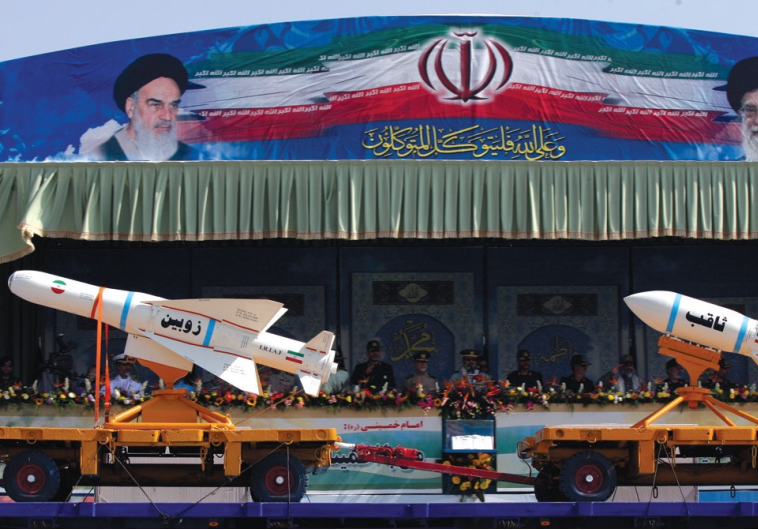
Iran chutzpahIran. (photo credit:REUTERS)

Whenever we assume that Iran’s chutzpah can get no more egregious, Tehran’s powers-that be spare no effort to prove us wrong.

Their calculated ploy is transparent – since the Islamic Republic’s nuclear project is now the focus of global attention, its leaders have cynically decided to turn the tables on their critics. In the guise of holier-than-thou protectors of humanity, Iran last Monday demanded that everyone else in possession of nukes desist forthwith from upgrading them or from lengthening the shelf-life of these weapons.

Needless to say, the sanctimonious tit-for-tat was spitefully in-your-face.

Quite expectedly, Iranian Foreign Minister Mohammad Javad Zarif told participants at the Review Conference of the Parties to the Treaty on the Non-Proliferation of Nuclear Weapons in New York that it is Israel which poses the greatest menace to the Middle East and indeed to the entire world due to its alleged nuclear stockpiles.

The month long conference is held every five years and is attended by NPT signatory nations. Israel never signed the treaty and remains officially mum on whether it does or does not possess a nuclear arsenal.

Zarif brazenly branded Israel “the single violator of this international regime [the NPT]…,“ and said, “one of the most important issues in the NPT review process is to look into ways and means of bringing about the Israeli compliance with NPT.”

And if that message failed to hit home, Zarif also aimed his barbs at NATO, asserting that Iran and the other 117 non-aligned NPT signatories are “deeply concerned by military and security doctrines of the nuclear-weapon states as well as that of the North Atlantic Treaty Organization.”

Yet Israel, which Iran had time and again threatened to wipe off the map, was singled out for particular accusations of villainy. Iran shamelessly seized on a persistent Egyptian theme – an attempt to deprive Israel of whatever nuclear powers it is believed to possess and coerce Israel to sign the 1970 NPT.

In 2005, Egypt scuttled the NPT resolutions because they did not specifically target Israel’s purported nuclear weaponry. In 2010, Egypt, still under Hosni Mubarak, persuaded the US to address Israel’s nuclear capability in the final communiqué – making Israel the only state mentioned, unlike the openly nuclear Pakistan and India (which like Israel also had not signed the NPT).

Israel saw this as a sell-out by the Obama administration.

The conference said nothing about Iran but urged that Israel rid itself of nuclear arms and that it allow international inspectors to visit and monitor its installations.

What five years ago was considered as unprecedented hypocrisy by the NPT Conference has now magnified to truly grotesque proportions. If Iran was just an unnamed elephant in the room last time around, it has since grown emboldened enough to lay blame on others.

Presumably this is part and parcel of a scheme to deflect attention from Tehran’s nuclear ambitions while a deal that would allow it to develop atomic warheads is in the making.

On the face of it, Iran can claim moral equivalence. But this is a counterfeit claim. Iran and like-minded allies – to say nothing of the powers now negotiating a deal with the ayatollah regime – all know that Israel is as prudent a democracy as exists anywhere. If Israel actually has the bomb, then it has had it for more than 50 years – almost as long as the original “Atomic Club” members. In all that time no wrongful use was made.

Iran is the diametrical opposite to Israel – a regime professing extreme Islamist doomsday theology whose bywords are volatility and unpredictability. There’s no even handedness between a self-defending democracy and an expansionist, apocalyptic tyranny.

Moreover, it is outrageous to ignore the variety of WMD deployed in the internecine Arab massacres but speciously concentrate on the Middle East’s one beleaguered democracy. The implication is that democratic Israel can be pressured while autocratic Iran will get away with flagrant obstructionism. The good-guy will be disarmed while fanatic aggressors are armed to the teeth.

The danger is that bona fide democracies seem willing to play along with Iran and misdirect the frustration it foments by spotlighting Israel.

A powerful totalitarian theocracy can bring peace. Of sorts.

May 2, 2015

A powerful totalitarian theocracy can bring peace. Of sorts. Dan Miller’s Blog, May 2, 2015

(The views expressed in this article are mine, and do not necessarily reflect those of Warsclerotic or its other editors. — DM)

a1  Obama and Kahameni -building a toaster

Iran, an already powerful theocratic totalitarian state with extensive hegemonic ambitions, is about to become (if it is not already) a nuclear power. So equipped, it can extend its rule over the Middle East and beyond, bringing the “peace” of submission to Islam. Obama may favor this outcome and in any event appears to be at best indifferent.

Iran is ruled by Ayatollah Khamenei, its supreme political and religious power. He has the ultimate authority to approve or reject any P5+1 agreement, should there be one — which seems increasingly likely due to Obama’s ludicrous efforts to concede every possible matter of substance. Obama wants a foreign policy legacy and needs a “deal;” Iran does not need a “deal.” It has already benefited greatly from sanctions relief. Other nations have also benefited economically to the point that even were the U.S. to try to reimpose sanction such trade would continue and expand. Moreover, it is highly likely that Iran has done all of the necessary technical research on nukes and on delivery devices to the extent that, regardless of whether there is a “deal,” Iran can have deliverable nukes within a few months if not sooner. As I pointed out here, the insanity of the 2013 framework, adhered to except when arguably in America’s favor, led inexorably to this result.

The North Korea – Iran linkage makes the problem worse. Chinese nuclear experts recently revised their estimation of North Korea’s current possession of nukes:.

China’s top nuclear experts have increased their estimates of North Korea’s nuclear weapons production well beyond most previous U.S. figures, suggesting Pyongyang can make enough warheads to threaten regional security for the U.S. and its allies.

The latest Chinese estimates, relayed in a closed-door meeting with U.S. nuclear specialists, showed that North Korea may already have 20 warheads, as well as the capability of producing enough weapons-grade uranium to double its arsenal by next year, according to people briefed on the matter. [Emphasis added.]

Iran and North Korea have a long history of nuclear cooperation. Delivering North Korean technology, materials and nukes to Iran would not be very difficult. I addressed the problem here, herehere and elsewhere.

Consequences of a nuclear Iranian theocracy

The Iranian Shiite theocracy is totalitarian in every sense of the word; it has not moderated under “moderate” President Rouhani. To the contrary, it seems to have worsened. To the extent that credible figures are available, sexually transmitted disease has risen and the birth rate in Iran has fallen, considerably in recent years. Despite sanctions relief, poverty has increased. Where has the money gone? Iran pursues its hegemonic ambitions, most recently to help the Houthi in Yemen, while continuing to provide economic, logistical and weapons support to its other proxy terrorist organizations such as Hamas, Hezbollah, the Muslim Brotherhood and others. Iran is very likely motivated by its own desire eventually to control the Middle East and beyond.

The recent Iranian hijacking of a cargo ship under “U.S. protection” may well have been an Iranian warning to Saudi Arabia, an American ally and leading opponent of the Iranian proxy war by Houthi in Yemen, that it can and might close the Strait of Hormuz to Saudi oil exports.

Strait-of-Hormuz

Although obligated under treaty to come to the defense of the Marshall Islands-registered cargo ship, the Obama Nation did not. Instead, it simply watched as the Iranian Navy fired shots across her bow and took her to an Iranian port to the North at Bandar Abbas. The ship and her crew remain there. Caroline Glick, in an article titled The Marshall Islands’ cautionary tale pointed out that

The Maersk Tigris is flagged to the Marshall Islands. The South Pacific archipelago gained its independence from the US in 1986 after signing a treaty conceding its right to self-defense in exchange for US protection. According to the treaty, the US has “full authority and responsibility for security and defense of the Marshall Islands.” [Emphasis added.]

Given the US’s formal, binding obligation to the Marshall Islands, the Iranian seizure of the ship was in effect an act of war against America.

. . . .

If the US allows Iran to get away with unlawfully seizing a Marshall Islands flagged ship it is treaty bound to protect, it will reinforce the growing assessment of its Middle Eastern allies that its security guarantees are worthless.

As the Israel Project’s Omri Ceren put it in an email briefing to journalists, “the US would be using security assurances not to shield allies from Iran but to shield Iran from allies.” [Emphasis added.]

What can other nations, with which America has treaties calling upon us to come to their defense, expect from the Obama administration if attacked by Iran? Precious little.

Under credible threat from nuclear attack by Iran and lacking actual (as distinguished from verbal) support from the Obama administration, Middle East Arab nations cannot be expected to resist very effectively, even as they seek to obtain their own nuclear arsenals.

Israel, the “Little Satan?” She would fight fiercely to the end, but might be overcome. Perhaps she will take the initiative and destroy Iran’s nuclear facilities before they become too extensive and better protected, perhaps by missiles provided by Russia. I suggested here that she can and should do so. Here is a link to a far more detailed analyses of what she can and should do, soon.

America, the “Great Satan,” is not immune to an Iranian nuclear attack. As I suggested here, a nuclear armed Iran could launch an EMP attack to drive the U.S. back to the stone age. Such an attack would increase Iran’s hegemonic potentials, and hence ambitions, by foreclosing the possibility of American help to nations with which we have protection treaties. However, even without an EMP attack, Obama would not provide much help. Therefore, I wonder whether — despite all of the continuing Iranian “death to America” bluster — Iran would be foolish enough to do it before Obama leaves office. He does His best to help Iran get nukes and pursue its hegemonic ambitions. Why try to kill a staunch friend like Obama’s America?

The Obama administration — and many voters — view global warming, climate change, climate disruption and whatever new phrases as may be developed as the most severe threat to humanity. An interesting article titled Progressives at the Poker Table compares “Progressive” attitudes toward “the threat of climate warming and that of a nuclear-armed Iran.” Predictably, the Obama Administration and most of the “legitimate news media” are far more concerned about the former than the latter, even though there is little if anything that we can do, even at great expense, about climate change (mostly natural in origin). If so disposed, there is quite a lot that we could do about the far greater, and in any event more immediate, threat from a nuclear Iran. Perhaps it’s simply easier to stage pious shows about costly but ineffective ways to “save the Earth” than to make useful efforts to save humanity from Islamic ravages.

Church of climatology

Conclusions

Andrew Klavan ridicules Obama’s P5+1 “deal” here:

The Congress probably won’t do anything to stop it, so Iran will very likely have nukes and the missiles with which to deliver them soon — if it does not already have them.

Hitler made a “deal” with Prime Minister Chamberlain years ago and returned from Munich to display a piece of paper signed by Hitler. Crowds cheered. Hitler laughed and continued his hegemonic pursuits throughout Europe. Hitler could have been stopped with relative ease long before World War II erupted but wasn’t. The “Peace in our time” meme was too powerful. Then we fought WWII.

Is that how the current mess with Iran will turn out?

code pink on Iran

Column One: The Marshall Islands’ cautionary tale

May 1, 2015

Column One: The Marshall Islands’ cautionary tale, Jerusalem Post, Caroline Glick, April 30, 2015

Iranian navy shipIranian navy ship.. (photo credit:REUTERS)

There is a thread that runs between Obama’s policy toward Iran and his policy toward Israel.

On Tuesday, the Iranian Revolutionary Guard Corps forcibly commandeered the Maersk Tigris as navigated its way through the Straits of Hormuz. Iran controls the strategic waterway through which 40 percent of seaborne oil and a quarter of seaborne gas transits to global markets.

The Maersk Tigris is flagged to the Marshall Islands. The South Pacific archipelago gained its independence from the US in 1986 after signing a treaty conceding its right to self-defense in exchange for US protection. According to the treaty, the US has “full authority and responsibility for security and defense of the Marshall Islands.”

Given the US’s formal, binding obligation to the Marshall Islands, the Iranian seizure of the ship was in effect an act of war against America.

In comments to Bloomberg hours after the ship was seized, Junior Aini, chargé d’affairs at the Marshall Islands Embassy in Washington, indicated that his government’s only recourse is to rely on the US to free its ship.

Immediately after the incident began, the US Navy deployed a destroyer to the area. But that didn’t seem to make much of an impression on the Iranians. More significant than the naval movement was the fact that the Obama administration failed to condemn their unlawful action.

If the administration continues to stand by in the face of Iran’s aggression, the strategic implications will radiate far beyond the US’s bilateral ties with the Marshall Islands. If the US allows Iran to get away with unlawfully seizing a Marshall Islands flagged ship it is treaty bound to protect, it will reinforce the growing assessment of its Middle Eastern allies that its security guarantees are worthless.

As the Israel Project’s Omri Ceren put it in an email briefing to journalists, “the US would be using security assurances not to shield allies from Iran but to shield Iran from allies.”

But President Barack Obama apparently won’t allow a bit of Iranian naval piracy to rain on his parade. This week Obama indicated that he feels very good about where his policy on Iran now stands. And he has every reason to be satisfied.

With each day that passes, the chance diminishes that his nuclear deal with the mullahs will be scuppered.

On the one hand, the Iranians are signaling that they are willing to sign a deal with the Great Satan. And this makes sense. For them the deal has no downside.

First there’s the money. Last week the State Department indicated that it won’t rule out paying Iran a $50 billion “signing bonus.”

The $50b. would be an advance on Iranian funds that have been frozen in Western banks under the terms of the sanctions regime that would be lifted in the event a deal is concluded.

Iran can do a lot with $50b.

Iran is spending $3b. a month to finance its war in Syria. With $50b. in their pockets the ayatollahs can fight for another year and a half without selling a barrel of oil.

According to a report earlier this week on Channel 10, during Syrian Defense Minister General Fahd al-Freij’s visit to Tehran this week, he was instructed to enable Hezbollah to open a front against Israel on the Golan Heights. Iran’s “signing bonus” would pay for Iran’s new war against Israel.

As for their nuclear weapons program, even Obama admitted that when his deal expires in 10 years, Iran will have the capacity to build nuclear weapons at will.

Iran can get around the ideological issue of signing with its theological foe by focusing its hatred on the US Congress, something Foreign Minister Mohammad Javad Zarif did effortlessly at a press conference in New York on Wednesday.

At home as well, Obama no longer faces serious opposition to his Iran policy. The Iranian Nuclear Agreement Review Act, the bill now being debated on the Senate floor, ensures that Congress will have no ability to stand in the way of the deal. In contrast to the provisions of the US Constitution that require a two-third Senate majority to approve an international treaty, the Senate bill requires a two-third majority of senators to block the implementation of Obama’s nuclear deal with the greatest state sponsor of terrorism.

Obama has successfully bullied centrist Democrat senators into abandoning their concern for US national security and supporting his deal.

They in turn have convinced centrist Republicans – and AIPAC – to push forward the legislation and so turn Congress into partner in Obama’s nuclear gambit.

Attempts by Republican senators, including presidential candidate Sen. Ted Cruz, to attach amendments to the bill that would require Congress to either treat the deal as an international treaty, or at the very least require a simple majority to reject it, have been strenuously opposed not only by the Democrats, but by the Republican leadership as well.

Obama’s confidence that his deal will go through has freed him up to mark the next target of his foreign policy in what he recently referred to as the “fourth quarter” of his presidency: Israel.

According to a report in Foreign Policy, the administration is now seeking to delay anti-Israel resolutions at the UN Security Council – including a French draft resolution that would require Israel to surrender all of Judea and Samaria and northern, southern and eastern Jerusalem to the Palestinians – until after the deal with Iran is concluded at the end of June. According to the report, the administration doesn’t want to upset pro-Israel Democrats while it still needs them to approve the deal with Iran.

But Obama has no problem with marking the target.

And so, on Monday, Undersecretary of State for Political Affairs Wendy Sherman did just that.

In an address before Reform Jews, Sherman issued a direct threat against Israel.

In her words, “If the new Israeli government is seen to be stepping back from its commitment to a two-state solution, that will make our job in the international arena much tougher… it will be harder for us to prevent internationalizing the conflict.”

In an apparent attempt to soften the harsh impression Sherman’s statement made on the Israeli public, on Wednesday US Ambassador Dan Shapiro gave an interview to Army Radio.

Although his American-accented Hebrew is always a crowd pleaser, Shapiro’s statements were simply a more diplomatic restatement of Sherman’s threat.

As he put it, “We are entering a period without negotiations [between Israel and the Palestinians] and this leads us to two important challenges.

One – how do we make progress toward the two-states for two-peoples solution, and two – negotiations have always been critical to preventing the delegitimization of Israel.”

In other words, Shapiro signaled that the Obama administration expects Israel to make significant concessions to the Palestinians in return of nothing, in the absence of negotiations.

And if we fail to make such unreciprocated concessions, we will have no legitimacy and the US will have no choice but to act against Israel at the UN.

That is, by Shapiro’s and Sherman’s telling, Israel’s unwillingness to bow to Palestinian and US demands for concessions to the Palestinians is what has caused and what feeds the international campaign to delegitimize its right to exist.

For anyone who entertains the thought that Shapiro and Sherman are correct to blame Israel for the movement to delegitimize it, this week we received new proof of its falsity.

This week, the leaders of the Boycott, Divestment and Sanctions movement condemned Israel not for failing to make concessions to the Palestinians. This week they condemned the Jewish state for helping Nepal earthquake victims.

Ever since the Israeli humanitarian aid mission set off for Nepal earlier this week, leading figures in the BDS movement have been working overtime to attribute ill and even demonic intentions to their mission.

Kenneth Roth, the executive director of Human Rights Watch, tweeted on his Twitter account, “Easier to address a far-away humanitarian disaster than the nearby one of Israel’s making in Gaza. End the blockade!” Max Blumenthal, a Jewish anti-Semite who has risen to prominence in the BDS campaign, tweeted, “For a country responsible for so many man-made catastrophes, natural disasters can’t come often enough.”

Ali Abumiah, the editor of Electronic Intifada, intoned that Israel was racist to evacuate newborn infants born to surrogate mothers in Nepal and leave the surrogates behind. He also tweeted, “Propaganda operation goes into high gear to exploit Nepal earthquake to improve Israel’s blood-soaked image.”

These assaults, which attribute malign, exploitative designs to Israel’s humanitarian relief efforts, make clear that there is no connection between Israel’s actions and hostility toward Israel.

The purpose of the BDS movement is not to pressure Israel to make concessions to the Palestinians.

Its purpose is to delegitimize Israel’s right to exist and delegitimize support for Israel’s right to exist.

If Israel is evil for sending hundreds of soldiers and relief workers to Nepal to rescue earthquake victims, clearly Israel will be attacked as evil for making concessions to the Palestinians that the Palestinians and the Obama administration will insist are insufficient.

Shapiro’s claim that negotiations between Israel and the PLO, or Israeli unilateral concessions to the Palestinians, protect Israel from its Western detractors is totally unfounded.

There is a thread that runs between Obama’s policy toward Iran and his policy toward Israel.

That common threat is mendacity. Obama’s actual goals in both have little to do with his stated ones.

Obama claims that he wishes to prevent Iran from acquiring nuclear weapons. But as we see from his willingness to allow Iran to become a nuclear threshold state while running wild in the Straits of Hormuz, committing mass slaughter in Syria, building an empire that includes Iraq, Syria, Lebanon and Yemen, and threatening its Arab neighbors and Israel, the purpose of the administration’s negotiations with Iran is not to prevent Iran from becoming a nuclear power.

The purpose of the negotiations is to build an American-Iranian alliance on Iran’s terms.

So, too, Obama says his goal is to advance the cause of peace between Israel and the Palestinians.

But his pressure and hostility toward Israel does nothing to achieve this goal. The goal of a policy of acting with hostility toward Israel is not to promote peace. It is to distance the US from Israel and align America’s Israel policy with Europe’s preternaturally hostile treatment of the Jewish state.

Three days after a ship sailing under their flag was seized by Iran’s Revolutionary Guards, citizens of the Marshall Islands discovered that their decision to place their security in America’s hands is no longer the safe bet they thought it was 29 years ago.

Anyone who entertains the belief that Israel will gain diplomatic acceptance or even a respite from American pressure if it makes concessions to the Palestinians is similarly making a high risk gamble.

Shia Militia Leader Explodes Over Possibility of U.S. Support for Kurdish Forces

April 30, 2015

Shia Militia Leader Explodes Over Possibility of U.S. Support for Kurdish Forces, Center for Security PolicyKyle Shideler, April 30, 2015

In the United States, the Obama Administration finds itself on the same side of the argument as Moqtada Al-Sadr, opposing the bill to permit arms for Kurdish forces.

******************

Shia leader Moqtada Al-Sadr, head of the Jaish al-Mahdi (JAM), issued a stark denunciation of the U.S. Defense Bill currently in front of the U.S. House of Representatives this week, threatening to fight U.S. interests both in Iraq and overseas, in the event that the bill passed.

Al Sadr opposes the bill, because it would authorize the direct transfer of military aid to Kurdish Peshmerga and Sunni tribal forces in order to fight the Islamic State, outside of the direct control of the central government in Baghdad.

“The U.S. House of Representatives intends to pass a draft law on Iraq making each sect independent from the other, and this will be the beginning of Iraq’s division,” Sadr said in a statement. If the U.S. passes such law, “then we will be obliged to lift the freeze on the military wing which is tasked with (fighting) the American side, to start hit the U.S. interests in Iraq and even abroad possibly,” Sadr warned.

Al Sadr’s JAM was one of the primary Shia militia forces used by Iran during Operation Iraqi Freedom, and responsible the deaths of numerous American fighting men and women. Iraq has primarily leaned on the use of Shia militias, operating under the rubric of the Popular Moblization Forces, but many of the 30,000+ militia fighters operate under direct command and control from the Iranian Islamic Revolutionary Guards Corps.

The Baghdad government, which is heavily supported by Iran, has also vocally opposedthe measure:

We will reject the arming of the Peshmerga directly by the US,” Iraq’s Defense Minister Khalid Al-Obeidi, told Rudaw on Thursday.

Kurdish forces have repeatedly complained that aid designated for use by their forces has repeatedly been redirected by the Baghdad government to Shia militias, some of whom are responsible for sectarian war crimes. Kurdish forces have also expressed concern over the entry of Shia forces into areas viewed by the Kurds as traditionally Kurdish, such as Kirkuk.

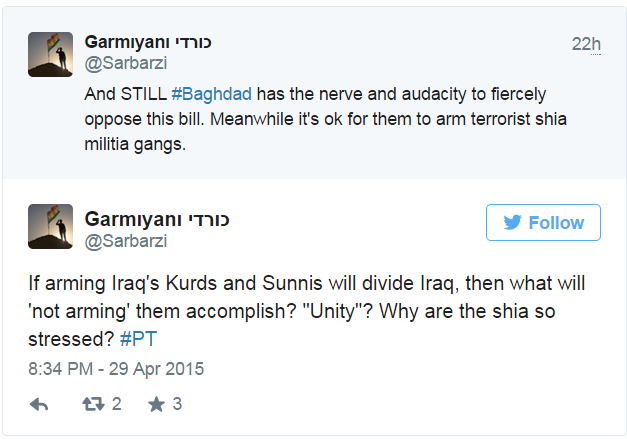
Supporters of the Peshmerga took to twitter to complain about the double standard:

garmiyani-tweet

In the United States, the Obama Administration finds itself on the same side of the argument as Moqtada Al-Sadr, opposing the bill to permit arms for Kurdish forces. As State Department Spokeswoman Marie Harf confirmed yesterday:

QUESTION: Yes. Do you have any comment about this draft resolution at the Armed Services Committee that calls for the recognition of the Sunni fighters and the Kurdish Peshmerga forces as a country, and so they can be – directly receive aid and weapons from the U.S., not through the central government?

MS HARF: I saw that. I saw that. And to be very clear: The policy of this Administration is clear and consistent in support of a unified Iraq, and that we’ve always said a unified Iraq is stronger, and it’s important to the stability of the region as well. Our military assistance and equipment deliveries, our policy remains the same there as well, that all arms transfers must be coordinated via the sovereign central government of Iraq. We believe this policy is the most effective way to support the coalition’s efforts.

So we look forward to working with congress on language that we could support on this important issue, but the draft bill, as you noted, in the House – this is very early in the process here for the NDAA – as currently written on this issue, of course, does not reflect Administration policy.

By opposing the direct arming of Sunni and Kurdish forces (and the Kurdish forces in particular), the administration is continuing a policy arc in the region that continues to serve the interests of the Iranians because it creates a dynamic where the only viable players are either Sunni jihadists (whether Islamic State, or in the case of Syria, Al Qaeda-linked groups such as Jabhat al-Nusra), or Iranian-backed forces, such as Assad and the Shia militias operating in Iraq, who are no less committed enemies of the United States.  Bringing supplies directly to Kurdish forces will give the United States a third option to positively affect the outcome of events in Iraq without requiring the modus vivendi with the Iranians.

How Iran Saved Obama’s “Blame America” Foreign Policy

April 29, 2015

How Iran Saved Obama’s “Blame America” Foreign Policy, Front Page Magazine, April 28, 2015

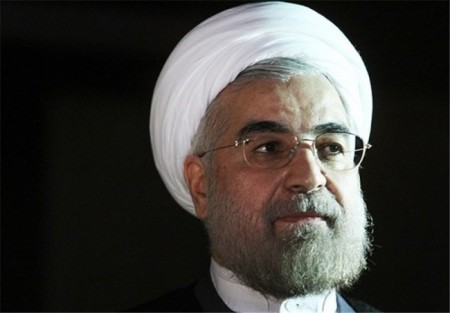
rouh-450x313

Obama’s public rejection of every ally, from Israel to Egypt to Saudi Arabia, has finally created the Post-American Middle East that his “Blame America” doctrine sought. The Post-American Middle East is a hive of terrorist groups and a region of nuclear arms races where murderous despots with vast armies dream of resurrecting the Ottoman Empire, the Persian Empire and the Abbasid Caliphate.

*********************

Obama’s Middle East policy was doomed to fail because it was based on the myth that everything wrong with the region was America’s fault.

Senator Obama had argued that Iraq would fix itself once we pulled out. Without America, the Iraqis would create a “political solution”. Instead the Shiites used the withdrawal to take over the government and Al Qaeda rebounded to dominate the Sunnis. After years of denying what was going on, he was forced back into Iraq after genocide and beheadings filled every television screen.

From the White House, he deployed the “Iraq Solution” across the Middle East by withdrawing support from American allies and backing terrorist groups like the Muslim Brotherhood. The chaos tore apart the region and turned over entire cities and countries to terrorists.

Egypt went through multiple coups. Street violence in Tunisia wrecked the country and supplied thousands of fighters to ISIS. His regime change war in Libya led to terrorist takeovers of its capital. Al Qaeda nearly took over Mali. Houthi Jihadists backed by Iran took over Yemen’s capital. The Saudis are bombing Yemen. The Egyptians are bombing Libya. The French are still fighting in Mali.

Iran and Al Qaeda have divided up Iraq, Syria and Yemen between themselves.

Withdrawing American power and influence didn’t work because we were never the problem. American soldiers weren’t causing the Sunnis and Shiites to fight each other. They were the only thing preventing it. American power and influence across the Middle East wasn’t holding back freedom and human rights, it was the only thing keeping a modicum of freedom alive in places like Egypt and Tunisia that quickly fell to Islamist rule in the Arab Spring, resulting in street violence, torture, terrorism and military coups.

The left had been fundamentally wrong about the cause of the problems in the Middle East. Obama trashed the region by following its wrongheaded doctrines.

Once the “Blame America” foreign policy has been implemented and the region went to hell, he had no idea what to do next. Intervening in Libya made sense according to the “Blame America” doctrine because Gaddafi had recently cut a deal with the United States and was obstructing the Jihadists who were implementing the local version of the Arab Spring in coordination with the Muslim Brotherhood.

But intervening in Syria didn’t. Assad wasn’t an American ally. Therefore the “Blame America” doctrine said that he should be left alone. But he was obstructing the Arab Spring. Overthrowing him would let the Muslim Brotherhood claim another country, but would alienate Iran and spoil any reconciliation.

Unable to make a final decision, Obama veered back and forth between Iran and the Muslim Brotherhood. Some days he seemed on the verge of bombing Syria and other days he was against even providing the promised weapons to the Sunni rebels. Even his supporters accused him of having no plan.

Syria’s real red line was the one that it had drawn through his foreign policy. Instead of making the Middle East better, his withdrawals had made it worse. And the beneficiaries of his foreign policy, especially the Muslim Brotherhood, were clamoring for more American military intervention.

Even Iraq’s Shiite government, backed by Iran, wanted American intervention.

Obama’s foreign policy had created a new set of untrustworthy client states which had to be kept alive by American intervention. The great joke of his foreign policy was that his new terrorist states acted just like the old dictators they were supposed to replace. They wanted American weapons and soldiers. Their own people hated them and hated America by extension. The climax of the Arab Spring came with crowds in Tahrir Square denouncing Obama and the Muslim Brotherhood for acting as his client state.

The “Blame America” foreign policy had led to even more blame of America. The new “democratic” Islamist governments that he helped bring to power to appease the Arab Street and atone for the sins of supporting the old secular-ish dictators backfired by making the Arab Street hate us more than ever.

Iran saved Obama’s foreign policy. Just as he was stumbling around Syria and weeping at being stuck back in Iraq, the agents of the Iran Lobby suggested that the whole mess could be put back together again. Iran and the US would fight on the same side against ISIS in Syria and Iraq. And this cooperation could be used to hammer out a nuclear accord that would retroactively justify Obama’s Nobel Prize.

The only problem was that everyone else in the region was completely against the idea.

The Iran Lobby threw Obama’s failed foreign policy a lifeline and he grabbed it. The bombing of Syria was off. Assad turned over some WMDs, but went on using others. The US began acting as the air force for Iran’s Shiite militias in Iraq while the Kurds and the Sunni Sheikhs of the Awakening were shut out.

When the Houthis took over Yemen, Obama shrugged. When the Saudis began bombing Yemen, they didn’t tell him because they were afraid the news would leak to Iran. And the administration covertly began pressuring them to stop, confirming that it now took its marching orders from Tehran, not Riyadh.

Obama ignored the vocal opposition, particularly from Israel’s Netanyahu, because the Iran deal was the only thing holding his foreign policy together. It made it seem as if he knew what he was doing. Take away the Iran deal and there was no longer a strategy, just a series of incoherent panicked responses.

That is why he continues to cling to the Iran deal. Without it, the Emperor’s foreign policy is naked.

The Iran deal salvaged the “Blame America” foreign policy by reorienting it away from the Muslim Brotherhood to deal with our great enemy in the region. By acceding to Iran’s nuclear program, Obama could finally fix everything by atoning for America’s biggest foreign policy sin in the region.

Despite his Muslim family background, Obama never understood the Middle East. Instead he looked at the region through a left-wing lens and saw only America’s crimes.

The Sunnis and Shiites, the Arabs, Kurds, Persians and Turkmen, weren’t fighting because of America. They were fighting over differences in religion, ethnicity and clan. The left has always thought that the way to fix the Middle East was to withdraw American influence. Instead doing that destabilized the region and created a power vacuum that Russia and Iran have been more than happy to fill.

Obama’s final foreign policy act was to fall directly into Iran and Al Qaeda’s trap.

Iran and the various Al Qaeda groups had effectively split parts of the region among themselves. By embracing Iran, Obama alienated the Sunni Middle East and shoved entire populations into Al Qaeda’s waiting embrace. He completed the polarizing process that he began with the Arab Spring by selling out the moderates to the extremists and waiting for everyone in the region to love America again.

But the Muslim Brotherhood lost out to its edgier Al Qaeda children. Egypt and the Saudis are scrambling to hold together some sort of Sunni center without the United States and against its wishes. Obama’s alignment with Iran, his rejection of Egypt’s new government and his failure to back the Saudis in Yemen has sent the message that the only legitimate alternative to Al Qaeda is Iran.

That’s not an alternative that most Sunnis can accept. Many would rather stand with Al Qaeda than Iran.

Obama’s public rejection of every ally, from Israel to Egypt to Saudi Arabia, has finally created the Post-American Middle East that his “Blame America” doctrine sought. The Post-American Middle East is a hive of terrorist groups and a region of nuclear arms races where murderous despots with vast armies dream of resurrecting the Ottoman Empire, the Persian Empire and the Abbasid Caliphate.

While genocide goes on, sex slaves are raped under the rule of a Caliph and black flags are unfurled and nuclear weapons are developed to fulfill apocalyptic Islamic prophecies, Obama smiles for the camera and waits for his second Nobel Prize.

It had been America’s fault all along. Now that Iran and Al Qaeda are in charge, everything will be okay.

Can Iran Do Whatever It Wants?

April 29, 2015

Can Iran Do Whatever It Wants? Commentary Magazine, April 28, 2015

[I]f the Obama administration were, in fact, to “tolerate” this disruption of the free flow of shipping it would send a dangerous signal, or to be more accurate, to reinforce a signal already sent: The U.S. lacks the will to stand up to predators in the international system, and in particular to Iran.

*****************

Every day, everywhere around the world, a silent referendum is going on about the state of American power. President Obama has consistently failed that test. By demanding that Bashar Assad leave power and then letting him stay; by letting Assad cross a “red line” on chemical weapons with impunity; by talking big about ISIS (“degrade and destroy”) and doing little; by standing by as Iran expanded its power into Iraq, Syria, and Yemen, as Russia seized chunks of Ukrainian territory, and as China intimidated its neighbors to claim sovereignty over disputed island, the president has dissipated the most precious commodity in the world—American credibility.

Today comes yet another test of American resolve. Details remain in dispute, but it appears that Iranian Revolutionary Guard gunboats seized the Maersk Tigris, a container ship traversing the Persian Gulf either through international waters or through a small section of Iranian waters that it would be allowed to traverse under the international legal doctrine of “innocent passage.” Instead of allowing the ship to go on its way, the IRGC fired a shot across its bow and detained the ship along with its crew. This is a vessel flagged in the Marshall Islands, a U.S. protectorate, owned by the Maersk line (a company with substantial American operations that is headquartered in Denmark, a NATO ally), and chartered by Rickers Ship Management, the Singapore-based subsidiary of a German company (two more U.S. allies).

The Iranian action may well be an indirect response to the U.S. decision to deploy an aircraft carrier strike group in order to intimidate Iran into turning back a cargo of supply ships reportedly bringing weapons to Iranian-backed Houthi fighters in Yemen. But whatever caused the Iranian action, it is a direct threat to freedom of navigation, which the U.S. Navy has defended around the world for centuries.

In the Persian Gulf, the U.S. commitment to that doctrine led President Reagan to order U.S. Navy ships to escort tankers and protect them from Iranian attacks, precipitating a short and sharp conflict (the Tanker War of 1987-88) between the U.S. and Iran. This was the last time, incidentally, that the U.S. used force to respond to Iranian attacks and it was an unqualified success—the Iranians lost some oil platforms and boats that they had been using to harass shipping. Finally the accidental shootdown of an Iranian airliner in 1988 by the USS Vincennes (an unintended and unfortunate consequence of these operations) helped convince the Iranian leadership to end their war with Iraq.

Today the U.S. still remains committed, at least on paper, to protecting freedom of navigation in the Persian Gulf. In 2011, a 5th Fleet spokesman put it well: “The free flow of goods and services through the Strait of Hormuz is vital to regional and global prosperity. Anyone who threatens to disrupt freedom of navigation in an international strait is clearly outside the community of nations; any disruption will not be tolerated.”

Thus if the Obama administration were, in fact, to “tolerate” this disruption of the free flow of shipping it would send a dangerous signal, or to be more accurate, to reinforce a signal already sent: The U.S. lacks the will to stand up to predators in the international system, and in particular to Iran. Put another way, it would signal to the entire region that the president is so invested in reaching a deal with Iran that no Iranian misconduct—not the dropping of barrel bombs on Syrian civilians, not the takeover of Yemen, not the ethnic cleansing of Sunni communities in Iraq, and now not the seizure of a Western cargo ship—will be allowed to interfere with his objective.

The fate of the Maersk Tigris does not matter much in and of itself, but it will say much about this administration’s commitment to maintaining America’s traditional security responsibilities.

How does sanctions-ridden Iran find a multibillion war chest to fund 6 armies fighting in 4 Mid East wars?

April 24, 2015

How does sanctions-ridden Iran find a multibillion war chest to fund 6 armies fighting in 4 Mid East wars? DEBKAfile, April 24, 2015

(The sanctions on Iran have been of decreasing significance since the initial “framework” of 2013 went into effect. — DM)

According to figures reaching DEBKAfile in March, Iran is spending a vast fortune – up to an estimated $6-8 billion per year – to keep six armed forces fighting in four Middle East war campaigns for expanding its sphere of influence.  Month after month, Tehran forks out close to half a billion dollars – and sometimes more – to keep those conflicts on the boil. How Iran manages to keep this war chest flowing so abundantly from an economy crippled by international sanctions has never been explained.

Syria
As the Syrian war enters its fifth year, Iranian Revolutionary Guards are found to be running it from four command and control centers, our military and intelligence sources report:

1. In Damascus, the IRGC operates as a part of the Syrian General Staff, with two imported pro-Iranian militias at its independent disposal. This command center has three tasks: To oversee the Syrian general staff and monitor its operational planning; to guard President Bashar Assad’s regime and his family; defend key locations such as the military airport and Shiite shrines, and keep the highways to Lebanon open.

2.  In the Aleppo region of the north, IRGC officers were engaged in drawing up plans for a general offensive to rout rebel forces from positions they have captured in the city. Tehran attaches prime importance to a peak effort for the recapture of Aleppo, Syria’s largest city. The IRGC command has transferred large-scale Hizballah forces from Lebanon to this arena, along with Afghan and Pakistani Shiite militias. Thousands of these combatants underwent training at specialist IRGC bases. Our military sources disclose that those militias recently took so many casualties that Iranian officers decided to hold off the Aleppo offensive.

3.  In the Qalamoun Mts., which are situated athwart the Syrian-Lebanese frontier, Tehran has given high priority to flushing rebel forces, including the Nusra Front and the Islamic State, out of the pockets they have seized on the mountain slopes, so as to clear the mountain roads for the passage of Hizballah units. This offensive has also been delayed.

4.  In South Syria, Iranian officers led a large-scale month-long drive to drive rebel forces out of the area they hold between Deraa and Damascus, in order to position Iranian-led Hizballah and pro-Iranian militia forces face to face with the Israeli army on the Golan. This drive has so far been stalled.

Tehran establishes – and pays for – new Syrian army

Iranian officers have established, trained and equipped a new 70,000-strong fighting force called the Syrian National Defense Force. Its operations, including the soldiers’ wages, are financed from Tehran’s pocket.

Iran runs airlifts day by day to re-supply the Syrian army with weapons systems and ammunition, and the Syrian Air Force with bombs and ordnance for attacks against rebel forces – of late, mostly barrel bombs. Intelligence sources estimate that Iran’s expenditure in the Syrian conflict now hits $200 million per month – around $2.5 billion a year.

Iran bankrolls Hizballah from top to bottom

The 25,000-strong Lebanese Shiite Hizballah operates under the direct command of IRGC officers. All its military equipment comes from Tehran, which also draws up its annual budget. Each month, Iran transfers to Beirut $150-200 million, as well as paying for all the Lebanese militias’ expenses for maintaining an expeditionary force in Syria. Hizballah costs Tehran an approximate $2 billion per annum.

An all-Shiite “people’s national army” for Iraq, re-supplies for Yemen

Iran’s deep military intervention in Iraq includes the creation of an all-Shiite “people’s national army.” It follows the same template as the Syrian National Defense Force and consists of the same number of fighters – 70,000 troops.

Tehran has also invested in barricades to fortify Baghdad against invasion from the north and the west.

The offensive to retake the Sunni town of Tikrit from the Islamic State was led by Iranian officers, and fed constantly with high-quality weapons systems, including missiles and tanks.

All the war materiel required by the Iraqi army and Shiite militias fighting the Islamic State is airlifted to Baghdad, some directly from Iran.

There is no reliable estimate of the Islamic Republic’s current contribution to Iraq’s war budget (estimated at a quarter of a billion dollars per month) because part of the cost is carried by the Iraqi government from oil revenues.

In Yemen, until Saudi Arabia and Egypt imposed an air and sea blockade a month ago, Iran ran supplies by air and sea to the Shiite Zaydi Houthis and their Yemeni army allies whom Tehran championed, sponsored and funded directly. The deployment of US warships in the Gulf of Aden this week put a stop to this traffic. But by then, Iran had sunk an estimated half a billion dollars in a Houthi victory.

Sanctions are no bar to Iran’s ambitions

This arithmetic is testimony to Iran’s mysteriously deep pockets. The sanctions the US, Europe and the United Nations clamped down on Tehran clearly had no effect on its willingness and ability to lay out fabulous sums to promote its ambitions as Middle East top dog.

China Warns Of Rising Nuclear Threat From North Korea – Lou Dobbs

April 24, 2015

China Warns Of Rising Nuclear Threat From North Korea – Lou Dobbs, Fox News via You Tube, April 23, 2015

(The first four minutes is about the mess in Yemen and the last four minutes is about the North Korean nuclear threat. — DM)


Empowering Iran

April 24, 2015

Empowering Iran, Weekly Standard, Lee Smith, May 4, 2015 (print date)

Obama’s foreign policy legacy will be to have tied America’s fortunes to an imperial and nuclear Iran governed by an ambitious and ruthless anti-American regime.

*****************

Last week, the Obama administration urged Saudi Arabia to halt its air campaign against the Iranian-backed Houthi rebels who have wrested control of the Yemeni capital Sanaa. The White House’s professed concern was that Riyadh’s Operation Decisive Storm was killing too many civilians. Unfortunately, that’s hardly surprising since Iranian proxies, like Hezbollah and Hamas, typically stash their missiles and rockets in civilian areas. Presumably, the Houthis have read from the same playbook. The effect of the administration’s diplomatic efforts, then, was to protect Iranian arms in Yemen. And this, in turn, the administration no doubt believes, protects Obama’s nuclear agreement with Iran.

Houthi rallyHouthis rally against Saudi Arabia, April 1. Newscom

In public, Obama is eager to show that the United States still stands by its traditional allies, like Riyadh. But behind the scenes, it’s clear that the White House’s real priority is partnering with Iran. Sure, the White House dispatched an aircraft carrier to the Arabian Sea, but this was not to stop Iran from shipping arms to the Houthis. As Obama himself explained, America’s blue-water Navy was present to ensure freedom of navigation in the Persian Gulf. The notion that the White House really intended to interdict Iranian arms shipments beggars belief. For more than four years Obama has done nothing to stop Bashar al-Assad from killing nearly a quarter of a million people in Syria, lest he endanger his nuclear agreement with Iran. With a deal so close, Obama is certainly not going to risk what he sees as the capstone of his foreign policy legacy by disarming Iranian allies in Yemen.

The problem is that by protecting his nuclear agreement with Iran, the president has protected and empowered the Islamic Republic. Tehran may boast of controlling four Arab capitals, but the reality is that its regional position is a house of cards. Pull out one of those Arab capitals, or the nuclear program, and Iran’s burgeoning empire quickly collapses. It’s Obama who is propping it up.

It’s interesting to imagine how these last six years might have gone for the Islamic Republic had the White House not been so determined to have a nuclear deal. Perhaps the Tehran regime would have been toppled when the Green Movement took to the streets in June 2009 to protest a fraudulent election if the American government had decided to back the opposition early, openly, and resourcefully. Perhaps another administration would at least have seen that uprising as an opportunity to gain leverage over the Iranian regime. Not Obama. He wanted a nuclear deal with the existing regime.

Another White House might have backed the Syrian rebels in order to bring down Assad. Indeed, a good portion of Obama’s cabinet counseled as much. To topple Tehran’s key Arab ally would have been the biggest strategic setback to Iran in 20 years, said Gen. James Mattis. Obama chose to leave Assad alone, and even ignored his own red line against the use of chemical weapons. Instead of the airstrikes he threatened on Syrian regime targets, Obama made a deal to ostensibly remove the chemical weapons that Assad is still employing.

As Assad’s position became weaker, Hezbollah entered the Syrian war to prop him up. The Iranian-backed militia was stretched thin between Syria and Lebanon, but the Obama administration helped the terrorist organization cover its flank by sharing intelligence to keep Sunni car bombs out of Hezbollah strongholds in Beirut. Another administration might have understood this as an opportunity to weaken Iran’s position in Damascus and Beirut, but not Obama. He had his eyes on the prize.

In sum, over the last six years, almost all of Iran’s advances in the region, including its move into Iraq to fill the vacuum in Baghdad after the American withdrawal from that country, has taken place with either the overt or tacit assistance of Obama. The White House brags about it. Israel might have attacked Iranian nuclear facilities, as one administration official told the press, but we deterred Prime Minister Benjamin Netanyahu from striking. If the Iranians strut with confidence these days, that’s because they understand who has their back.

The nuclear deal, as the president has explained, means that within a little more than a decade, Iran’s breakout time will be down to zero—which is a nice way of saying the clerical regime will have the bomb. The likely result is that the agreement will ensure Iran’s regional position long after Obama’s presidency is around to safeguard it. It will strengthen the hand of the hardliners. It is not Rouhani or Zarif or other so-called moderates who hold the nuclear file, but Khamenei and the Revolutionary Guard Corps. And in the future, American policymakers will have a vital interest in ensuring there are no internal regime fights over who controls the bomb.

In other words, Obama’s foreign policy legacy will be to have tied America’s fortunes to an imperial and nuclear Iran governed by an ambitious and ruthless anti-American regime.