Archive for the ‘Lebanon’ category

Israel’s First Project with Trump

December 9, 2016

Israel’s First Project with Trump, Front Page MagazineCaroline Glick, December 9, 2016

firstproject

Originally published by the Jerusalem Post

[R]ecently Hezbollah commander Hassan Nasrallah bragged, “We’re open about the fact that Hezbollah’s budget, its income, its expenses, everything it eats and drinks, its weapons and rockets are from the Islamic Republic of Iran.”

******************************

Israeli officials are thrilled with the national security team that US President-elect Donald Trump is assembling. And they are right to be.

The question now is how Israel should respond to the opportunity it presents us with.

The one issue that brings together all of the top officials Trump has named so far to his national security team is Iran.

Gen. (ret.) John Kelly, whom Trump appointed Wednesday to serve as his secretary of homeland security, warned about Iran’s infiltration of the US from Mexico and about Iran’s growing presence in Central and South America when he served as commander of the US’s Southern Command.

Gen. (ret.) James Mattis, Trump’s pick to serve as defense secretary, and Lt.-Gen. (ret.) Michael Flynn, whom he has tapped to serve as his national security adviser, were both fired by outgoing President Barack Obama for their opposition to his nuclear diplomacy with Iran.

During his video address before the Saban Forum last weekend, Prime Minister Binyamin Netanyahu said that he looks forward to discussing Obama’s nuclear Iran nuclear deal with Trump after his inauguration next month. Given that Netanyahu views the Iranian regime’s nuclear program – which the nuclear deal guaranteed would be operational in 14 years at most – as the most serious strategic threat facing Israel, it makes sense that he wishes to discuss the issue first.

But Netanyahu may be better advised to first address the conventional threat Iran poses to Israel, the US and the rest of the region in the aftermath of the nuclear deal.

There are two reasons to start with Iran’s conventional threat, rather than its nuclear program.

First, Trump’s generals are reportedly more concerned about the strategic threat posed by Iran’s regional rise than by its nuclear program – at least in the immediate term.

Israel has a critical interest in aligning its priorities with those of the incoming Trump administration.

The new administration presents Israel with the first chance it has had in 50 years to reshape its alliance with the US on firmer footing than it has stood on to date. The more Israel is able to develop joint strategies with the US for dealing with common threats, the firmer its alliance with the US and the stronger its regional posture will become.

The second reason it makes sense for Israel to begin its strategic discussions with the Trump administration by addressing Iran’s growing regional posture is because Iran’s hegemonic rise is a strategic threat to Israel. And at present, Israel lacks a strategy for dealing with it.

Our leaders today still describe Hezbollah with the same terms they used to describe it a decade ago during the Second Lebanon War. They discuss Hezbollah’s massive missile and rocket arsenal.

With 150,000 projectiles pointed at Israel, in a way it makes sense that Israel does this.

Just this week Israel reinforced the sense that Hezbollah is more or less the same organization it was 10 years ago when – according to Syrian and Hezbollah reports – on Tuesday Israel bombed Syrian military installations outside Damascus.

Following the alleged bombing, Defense Minister Avigdor Liberman told EU ambassadors that Israel is committed to preventing Hezbollah from transferring advanced weapons, including weapons of mass destruction, from Syria to Lebanon.

The underlying message is that having those weapons in Syria is not viewed as a direct threat to Israel.

Statements like Liberman’s also send the message that other than the prospect of weapons of mass destruction or precision missiles being stockpiled in Lebanon, Israel isn’t particularly concerned about what is happening in Lebanon.

These statements are unhelpful because they obfuscate the fact that Hezbollah is not the guerrilla organization it was a decade ago.

Hezbollah has changed in four basic ways since the last war.

First, Hezbollah is no longer coy about the fact that it is an Iranian, rather than Lebanese, organization.

Since Iran’s Revolutionary Guards founded Hezbollah in Lebanon in 1983, the Iranians and Hezbollah terrorists alike have insisted that Hezbollah is an independent organization that simply enjoys warm relations with Iran.

But today, with Hezbollah forming the backbone of Iran’s operations in Syria, and increasingly prominent in Afghanistan and Iraq, neither side cares if the true nature of their relationship is recognized.

For instance, recently Hezbollah commander Hassan Nasrallah bragged, “We’re open about the fact that Hezbollah’s budget, its income, its expenses, everything it eats and drinks, its weapons and rockets are from the Islamic Republic of Iran.”

What our enemies’ new openness tells us is that Israel must cease discussing Hezbollah and Iran as separate entities. Israel’s next war in Lebanon will not be with Hezbollah, or even with Lebanon. It will be with Iran.

This is not a semantic distinction. It is a strategic one. Making it will have a positive impact on how both Israel and the rest of the world understand the regional strategic reality facing Israel, the US and the rest of the nations of the Middle East.

The second way that Hezbollah is different today is that it is no longer a guerrilla force. It is a regular army with a guerrilla arm and a regional presence. Its arsenal is as deep as Iran’s arsenal.

And at present at least, it operates under the protection of the Russian Air Force and air defense systems.

Hezbollah has deployed at least a thousand fighters to Iraq where they are fighting alongside Iranian forces and Shi’ite militia, which Hezbollah trains. Recent photographs of a Hezbollah column around Mosul showed that in addition to its advanced missiles, Hezbollah also fields an armored corps. Its armored platforms include M1A1 Abrams tanks and M-113 armored personnel carriers.

The footage from Iraq, along with footage from the military parade Hezbollah held last month in Syria, where its forces also showed off their M-113s, makes clear that Hezbollah’s US platform- based maneuver force is not an aberration.

The significance of Hezbollah’s vastly expanded capabilities is clear. Nasrallah’s claims in recent years that in the next war his forces will stage a ground invasion of the Galilee and seek to seize Israeli border towns was not idle talk. Even worse, the open collaboration between Russia and Iran-Hezbollah in Syria, and their recent victories in Aleppo, mean that there is no reason for Israel to assume that Hezbollah will only attack from Lebanon. There is a growing likelihood that Hezbollah will make its move from Syrian territory.

The third major change from 2006 is that like Iran, Hezbollah today is much richer than it was before Obama concluded the nuclear deal with the ayatollahs last year. The deal, which canceled economic and trade sanctions on Iran, has given the mullahs a massive infusion of cash.

Shortly after the sanctions were canceled, the Iranians announced that they were increasing their military budget by 90%. Since Hezbollah officially received $200 million per year before sanctions were canceled, the budget increase means that Hezbollah is now receiving some $400m. per year from Iran.

The final insight that Israel needs to base its strategic planning on is that a month and a half ago, Hezbollah-Iran swallowed Lebanon.

In late October, after a two-and-a-half-year fight, Saad Hariri and his Future Movement caved to Iran and Hezbollah and agreed to support their puppet Michel Aoun in his bid for the Lebanese presidency.

True, Hariri was also elected to serve as prime minister. But his position is now devoid of power.

Hariri cannot raise a finger without Nasrallah’s permission.

Aoun’s election doesn’t merely signal that Hariri caved. It signals that Saudi Arabia – which used the fight over Lebanon’s presidency as a way to block Iran’s completion of its takeover of the country – has lost the influence game to Iran.

Taken together with Saudi ally Egyptian President Abdel Fattah al-Sisi’s announcement last week that he supports Syrian President Bashar Assad’s remaining in power, Aoun’s presidency shows that the Sunnis have accepted that Iran is now the dominant power in Iraq, Syria and Lebanon.

This brings us back to Hezbollah’s tank corps and the reconstruction of the US-Israel alliance.

After the photos of the US-made armored vehicles in Hezbollah’s military columns were posted online, both Hezbollah and the Lebanese Armed Forces insisted that the weapons didn’t come from the LAF.

But there is no reason to believe them.

In 2006, the LAF provided Hezbollah with targeting information for its missiles and intelligence support. Today it must be assumed that in the next war, the LAF, and its entire arsenal will be placed at Hezbollah-Iran’s disposal. In 2016 alone, the US provided the LAF with $216m. in military assistance.

From Israel’s perspective, the most strategically significant aspect of Hezbollah-Iran’s uncontested dominance over all aspects of the Lebanese state is that while they control the country, they are not responsible for it.

Israeli commanders and politicians often insist that the IDF has deterred Hezbollah from attacking Israel. Israel’s deterrence, they claim, is based on the credibility of our pledge to bomb the civilian buildings now housing Hezbollah rockets and missiles in the opening moments of the next conflict.

These claims are untrue, though. Since Hezbollah- Iran are not responsible for Lebanon despite the fact that they control it through their puppet government, Iranian and Hezbollah leaders won’t be held accountable if Israel razes south Lebanon in the next war. They will open the next war not to secure Lebanon, but to harm Israel. If Lebanon burns to the ground, it will be no sweat off their back.

The reason a war hasn’t begun has nothing to do with the credibility of Israel’s threats. It has to do with Iran’s assessment of its interests. So long as the fighting goes on in Syria, it is hard to see Iran ordering Hezbollah to attack Israel. But as soon as it feels comfortable committing Hezbollah forces to a war with Israel, Iran will order it to open fire.

This then brings us back to the incoming Trump administration, and its assessment of the Iranian threat.

Trump’s national security appointments tell us that the 45th president intends to deal with the threat that Iran poses to the US and its interests.

Israel must take advantage of this strategic opening to deal with the most dangerous conventional threat we face.

In our leaders’ conversations with Trump’s team they must make clear that the Iranian conventional threat stretches from Afghanistan to Israel and on to Latin America and Michigan. Whereas Israel will not fight Iran in Iraq and Afghanistan, or in the Americas, it doesn’t expect the US to fight Iran in Lebanon. But at the same time, as both allies begin to roll back the Iranian threat, they should be operating from a joint strategic vision that secures the world from Iran’s conventional threat.

And once that it accomplished, the US and Israel can work together to deal with Iran’s nuclear program.

Palestinians: The ‘Wall of Shame’

November 28, 2016

Palestinians: The ‘Wall of Shame’, Gatestone InstituteKhaled Abu Toameh, November 28, 2016

“The equation facing the Palestinian factions is clear: Hand over the terrorists and there will be no wall. The Palestinians have proven that they are unable to take security matters into their own hands in this camp.” — Lebanese security official.

These anti-Palestinian practices are regularly ignored by the international community, including mainstream media and human rights organizations, whose obsession with Israel blinds them to Arab injustice. A story without an anti-Israel angle is not a story, as far as they are concerned

Typically, Western journalists and human rights activists do not even bother to report or document cases of Arab mistreatment of Arabs. This abandonment of professional standards is why apartheid laws targeting Palestinians in several Arab countries are still unknown to the international community.

The Lebanese authorities also say that they decided to build the wall after discovering several tunnels in the vicinity of Ain al-Hilweh, used to smuggle weapons and terrorists into and out of the camp.

The new wall will not solve the real problem — namely the failure to absorb the refugees and grant them citizenship. Palestinians living in Arab countries are denied citizenship (with the exception of Jordan) and a host of basic rights.

Now is the time for the international community to apply pressure to the Arab countries to start helping their Palestinian brothers by improving their living conditions and incorporating them into these countries.

The refugee problem will end the day their leaders stop lying to them and confront them with the truth, basically that there will be no “right of return” and that the time has come for them to move on with their lives


It is no secret that Arab countries have long mistreated their Palestinian brothers and sisters, governing them with inhumane laws and imposing severe restrictions on their public freedoms and basic rights. Building a wall around a Palestinian community to prevent terrorists from entering or leaving, however, has raised the bar on such infringements.

This is precisely what is happening in Lebanon these days. The construction of a security wall around Ain al-Hilweh, the largest Palestinian refugee camp (with a population of nearly 120,000), has drawn sharp criticism from Palestinians and revived memories of the abuse they regularly receive at the hands of their Arab brethren.

The Lebanese authorities say the Palestinians have left them no choice but to build the controversial concrete wall. The Palestinians, they say, refuse to cooperate against terrorists who have established bases within their camps. Yet that problem raises the question: “What has Lebanon done in the past half-century or so to help the Palestinians who fled to that country?” The answer: “Nothing.”

In fact, among all Arab countries, Lebanon has been arguably the worst in its treatment of the Palestinians. Palestinian refugees in Lebanon are denied access to adequate housing and certain categories of employment. According to Amnesty International: “Over half of Palestinian refugees live in decaying and chronically overcrowded camps and discriminatory practices are permitted under personal status laws and nationality laws.”

These anti-Palestinian practices are regularly ignored by the international community, including the mainstream media and human rights organizations, whose obsession with Israel blinds them to Arab injustice. While, every now and then, an organization does publish a report on the misery endured by Palestinians in Arab countries, these bodies rarely follow up on their work, thus creating the impression that they are doing so only for the sake of protocol.

As such, the plight of the Palestinians in many Arab countries continues to be a taboo, as far as the international community is concerned. Typically, Western journalists and human rights activists do not even bother to report or document cases of Arab mistreatment of Arabs. This abandonment of professional standards is why apartheid laws targeting Palestinians in several Arab countries are still unknown to the international community. Even when Western journalists and human rights advocates do hear about these violations, they prefer to look the other way. A story without an anti-Israel angle is not a story, as far as they are concerned.

So what is going on in Lebanon, and why are so many Palestinians furious with the Lebanese authorities?

Until a few years ago, the population of Ain al-Hilweh camp was 70,000. But the influx of refugees fleeing the civil war in Syria, since 2011, has increased the camp population to nearly 120,000. It turns out that many of these new “refugees” are actually terrorists fleeing from Syria and Iraq.

2077A street celebration in Lebanon’s Ain al-Hilweh camp, July 2015. (Image source: Geneva Call/Flickr)

Ain al-Hilweh, like most of the camps in Lebanon, has always been a major headache for the Lebanon. It seems, however, that the Lebanese government has had enough.

For years, the Lebanese authorities, for whom the camp is “off-limits,” have been trying, unsuccessfully, to clean the camp of its hundreds of terrorists.

Lebanese security forces steer clear of the refugee camps in an attempt to avoid friction with the Palestinians living there. This evasion has allowed the camps to become hotbeds for various jihadi groups and terrorists who pose a threat not only to the national security of Lebanon, but to Palestinians themselves and neighboring Arab countries such as Jordan, Egypt and Syria (not to mention Israel).

Alarmed by this heightened threat, the Lebanese authorities recently began building a concrete wall around Ain al-Hilweh, sparking a wave of denunciations from Palestinians. The Palestinians claim that the new wall, which will be completed in 15 months, will turn the camp into a big open-air prison. They refer to it as the “Wall of Shame.” Their main argument is that it is disgraceful that any Arab country would build a wall surrounding a refugee camp at a time when Palestinians are asking the world to condemn Israel for building a security fence to prevent terror attacks against Israelis from the West Bank.

Camp residents claim that the Lebanese authorities have misled them concerning the construction of the wall. According to the residents, the authorities led them to believe that it was to be a small fence on the outskirts of parts of the camp and not a massive concrete wall surrounding the camp.

The Lebanese security authorities have chosen to call the new barrier the “Wall of Protection” — stressing that it is mainly intended to prevent terror attacks against Lebanon and stop the camps from becoming bases for terrorists and criminals. The authorities say that if anyone is to blame for the construction of the wall, it is the Palestinians themselves, who have refused to cooperate with the Lebanese government against the terrorists. “The goal is to prevent terrorists from infiltrating the camp,” explained a Lebanese security official. “The equation facing the Palestinian factions is clear: Hand over the terrorists and there will be no wall. The Palestinians have proven that they are unable to take security matters into their own hands in this camp.”

The Lebanese authorities also say that they decided to build the wall after discovering several smuggling tunnels in the vicinity of Ain al-Hilweh. These tunnels, they say, are being used to smuggle weapons and terrorists into and out of the camp.

Representatives of Ain al-Hilweh and other Palestinians have been holding marathon meetings with Lebanese government officials in the past few weeks to persuade them to halt the construction of the wall. The Palestinians in Ain al-Hilweh are now threatening that if the Lebanese government does not cancel the project, they will seek the intervention of other Arab, and also Western, countries, as well as the United Nations.

Notably, the Palestinian Authority (PA) leadership in the West Bank has not joined in the efforts to persuade the Lebanese government to drop the idea of building a wall around the camp. This avoidance probably springs from the PA leadership and its president, Mahmoud Abbas, being well aware that Ain al-Hilweh and other refugee camps in Lebanon have fallen into the hands of their enemies, namely Hamas, Islamic Jihad, Islamic State and Al-Qaeda.

The “Wall of Shame” appears particularly to bother Hamas leader Khaled Mashaal. Last week, he telephoned a number of Lebanese officials, including Prime Minister Tammam Salam and Parliament Speaker Nabih Berri, to warn about the consequences of the construction of the wall. Mashaal, who is based in Qatar and enjoys a luxurious life most Palestinians can barely dream of, urged the Lebanese government to halt construction if the wall and said that the wall jeopardized the lives of Palestinian refugees and would have “negative repercussions.”

Hamas’s spokesman in Lebanon, Ra’fat Murra, dismissed Lebanon’s security concerns for building the wall. He warned that the wall would turn the camp into an isolated enclave and exacerbate tensions between Palestinians and Lebanese. Murra, however, expressed readiness to cooperate with the Lebanese authorities in apprehending and handing over wanted terrorists who had found shelter inside Ain al-Hilweh.

Protests against the wall reached their peak when hundreds of Palestinians (and some Lebanese) took to the streets of the nearby city Sidon, in southern Lebanon, calling on the government to stop construction immediately. The protesters warned that the wall would further increase tensions between Palestinians and Lebanese, and further reduce the quality of life for the camp residents.

Lebanon may be justified in building a security wall around the Palestinian refugee camp. Without a doubt, Ain al-Hilweh and other camps have become hubs for terror groups and criminals, and Lebanon has every right to combat terrorism. Yet, Lebanon needs to come up with ways to assimilate, rather than alienate, the Palestinians. Furthermore, this is a problem that extends beyond Lebanon’s borders. The same applies to the camps in the West Bank, Gaza Strip and Syria and Jordan.

The continued mistreatment of Palestinians at the hands of Lebanon and other Arab countries is totally unjustified. The new wall, complete with watchtowers, that is being erected around Ain al-Hilweh may stop some terrorists from infiltrating the camp, but it will not solve the real problem — namely the failure to absorb the refugees and grant them citizenship. In point of fact, Palestinians living in Arab countries are denied citizenship (with the exception of Jordan) and a host of basic rights.

Now is the time for the international community to apply pressure to the Arab countries to start helping their Palestinian brothers by improving their living conditions and incorporating them into these countries. Holding Palestinians in refugee camps for more than six decades is deadly counterproductive. The camps become sanctuaries for terrorists who pose a threat to the national security and stability in these Arab countries. There is no reason why a Palestinian living in Lebanon or Egypt or Kuwait should be banned from purchasing his or her own home.

Moreover, Arab states’ lies concerning the return of refugees to former homes inside of Israel, so long a staple fed to the refugees, have far outlived their usefulness. The refugee problem will end on the day their leaders stop lying to them and confront them with the truth, basically that there will be no “right of return” and that the time has come for them to move on with their lives.

If the lies do not end, the day will come when these countries will be forced to place all the refugees behind walls and fences — a move not likely to enhance stability in these countries. Ain al-Hilweh should serve as a wake-up call to all those Arabs who continue to subject Palestinians to apartheid laws and practices.

Hizballah units regroup on Israel’s Golan border

September 7, 2016

Hizballah units regroup on Israel’s Golan border, DEBKAfile, September 7, 2016

qunetrafront

DEBKAfile’s military sources note that the Iranian media attached photos of Israel’s security force opposite Quneitra to their reporting on the new move, thereby framing the target of the Syrian-Iranian-Backed Hizballah build-

***********************

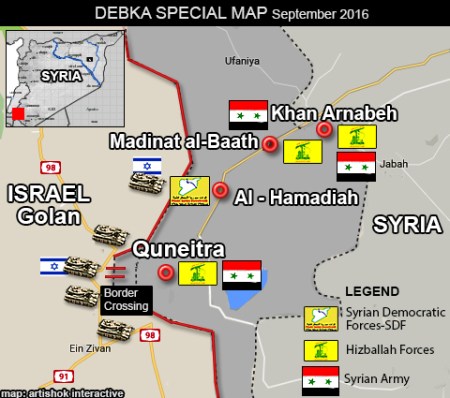
A large Hizballah force, backed by the Syrian army and pro-Iranian Shiite militias, is building up outside Quneitra, just 2km from Israel’s Golan border. The Lebanese Shiite fighters, under the command of Iranian Revolutionary Guards (IRGC) officers, are streaming into southern Syria, armed with tanks and artillery.

Monday night, Sept. 5, Iranian state-controlled media shed light on this movement, reporting that the combined force had “completed preparations necessary for an extensive operation in southern Syria,” adding, “Hizballah aims to put an end to the presence of armed men in the area close to the border.”

The nature of the “armed men” was not specified, but the goal of the new operation was clear: after evicting the assorted anti-Assad groups, including the Islamic State, holding territory “close to the border,” Hizballah and its backers planned to regroup on the Syrian-Israeli boundary.

This would position Iran and its Hizballah surrogate ready to realize their six-year old design, which is to open a second warfront against Israel.

Western and Mid East sources have toldl DEBKAfile that the triple army is in high spirits after last week’s successful operation in Aleppo. By snatching back parts of the city they lost in mid-August, the Syrian army and its allies managed to cut off the rebels’ supply lines from Turkey.

It was then that some Hizballah units were detached from the Aleppo arena and redirected to the Quneitra front in southern Syria to face the Israeli border.

israeliborder480

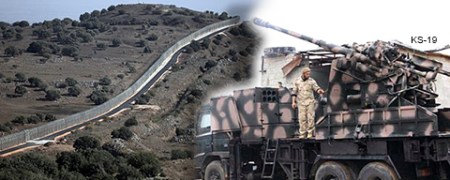
Those sources report that the incoming troops were sighted this week when they arrived at Madinat al-Baath and Khan Amabeh, the main Syrian army bases on the Syrian Golan. They came with tanks and heavy artillery. Seen for the first time in the Quentra sector were heavy, self-propelled KS-19 artillery batteries, which are Russian anti-air guns adapted to ground warfare. They have a range of 21km and a firing capacity of 15 shells per minute.

The newly-arrived Hizballah force appears to have set the capture of Syrian rebel-held al-Hamdiniyah 2km from the Israeli border, as its first objective.

DEBKAfile’s military sources note that the Iranian media attached photos of Israel’s security force opposite Quneitra to their reporting on the new move, thereby framing the target of the Syrian-Iranian-Backed Hizballah build-up.

This fast-approaching development poses two tough questions:

1. Will Israel lie down for the avowedly hostile Hizballah and Iran to occupy territory along its eastern border?Israel officials have repeatedly emphasized that these forces would not be allowed to take up positions on the Golan border, a message Russia most certainly passed on to Damascus.

If Hizballah and its allies go through with their planned offensive, Israel will have to consider serious military action to prevent them from reaching the border fence, i.e., an operation on a scale quite different from the small-shot IDF reprisals for rockets or shells straying across into the Golan from fighting on the other side.

2. Will the advancing Iranian-led force have Syrian air cover? If it does, the Israeli Air Force will also be involved in aerial combat over the Golan.

Officials In Lebanese, Gazan Terror Organizations Confirm: Iran Funds Our Activity

August 11, 2016

Officials In Lebanese, Gazan Terror Organizations Confirm: Iran Funds Our Activity, MEMRI, August 11, 2016

Arab media have recently published statements by officials in the Lebanese Hizbullah and the Gazan Hamas and Islamic Jihad organizations, and by their supporters, confirming what has long been known – namely that these Lebanese and Gazan terror organizations receive substantial financial and military assistance from Iran. These statements join many reports, especially in the anti-Iranian media, regarding Iran’s funding of various terrorist organizations across the Arab world. According to these reports, the assistance comes mainly from the office of Iranian Supreme Leader Ali Khamenei and from the Islamic Revolutionary Guards Corps (IRGC).

The following are some examples of these statements and reports from the last two months:

Hizbullah Secretary-General Nasrallah: Hizbullah’s Entire Budget Is Provided By Iran

In a speech he delivered on June 24, 2016, marking 40 days after the killing of Mustafa Badr Al-Din, who was considered to be Hizbullah’s chief operations officer, and following the imposition of U.S. sanctions on Hizbullah that threaten its financial infrastructure and income, Hizbullah Secretary-General Hassan Nasrallah clarified: “Hizbullah’s budget – its salaries and expenditures, [the money that pays for] its food and drink, weapons and missiles – [all come from] Iran. Is that clear?… As long as Iran has money we have money. Do you require greater transparency than that[?] The funds earmarked for us do not reach us through the banks. We receive them the same way we receive our missiles, with which we threaten Israel.”[1]

Hamas Official Abu Marzouq: Iran’s Assistance To Hamas Is “Not Comparable” To Any Other Assistance

The deputy head of Hamas’s political bureau, Moussa Abu Marzouq, tweeted on June 15, 2016: “The aid extended by Iran to the Palestinian resistance, in provisions, training and funds, is not comparable [to any other aid], and most other countries cannot match it.”[2]

29502Abu Marzouq’s tweet

Former Lebanese Minister Wiam Wahhab: Iran Has Funded Resistance In Palestine

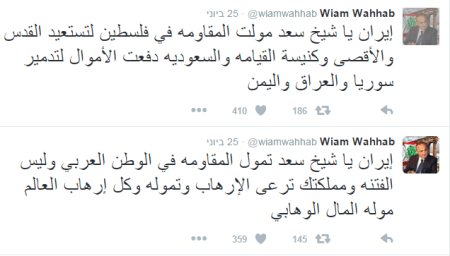
On June 25, 2016, in response to a remark by former Lebanese prime minister Sa’d Al-Hariri that Iran funds fitna(internecine strife) in the Arab world,[3] former Lebanese minister Wiam Wahhab, a known supporter of Hizbullah and the resistance axis, tweeted: “O Sheikh Sa’d [Al-Hariri], Iran has funded resistance in Palestine to restore Jerusalem, Al-Aqsa and the Church of the Sepulcher [to Palestinian hands, whereas] Saudi Arabia paid to destroy Syria, Iraq and Yemen.” In another tweet he wrote: ” O Sheikh Sa’d, Iran funded resistance in the Arab homeland rather than fitna, [whereas] your kingdom [Saudi Arabia, who supports Al-Hariri and his faction in Lebanon,] sponsors and funds terrorism. The funds of all the terrorist [organizations] in the world are Wahhabi [i.e., Saudi] funds.”[4]

29503Wiam Wahhab’s tweets

Saudi Daily Al-Sharq Al-Awsat: Hizbullah’s Weapons Come Directly From IRGC; Iran Has Renewed Regular Aid To Islamic Jihad Organization

The anti-Iranian press, such as the London-based Saudi daily Al-Sharq Al-Awsat, also reported on Iran’s funding of terrorist organizations in Lebanon and Gaza. On June 29, 2016, Al-Sharq Al-Awsat confirmed Nasrallah’s statements regarding the Iranian funding. The report stated that Hizbullah’s funds came from the office of Iranian Supreme Leader Ali Khamenei while its weapons are provided by the IRGC. It quoted the director of the Umam Research and Documentation center in Lebanon, Luqman Salim, a Shi’ite known for his opposition to Hizbullah, as saying that between 70% and 80% of Hizbullah’s funds come from Iran. According to Salim, Iran also invests about $400 million of the IRGC’s budget in the Islamic Radio and Television Union, a group of stations which includes the Iranian Al-Alam but also Hizbullah’s Al-Manar and Al-Mayadin and the Hamas-affiliated Al-Quds (all of which broadcast from Lebanon) and Hamas’s Al-Aqsa station, which broadcasts from Gaza.

The daily also cited a “knowledgeable source” as saying that until 2005 Iran transferred to Hizbullah between $200 million and $250 million annually, but since then the allocation has increased: After the 2006 Lebanon War it rose to $850 million, and since Hizbullah entered the Syria war its budget has become unlimited, because it has become part of Tehran’s war effort there.[5]

On May 25, 2016, the daily reported, citing sources close to the Islamic Jihad organization in Gaza, that Iran had renewed its regular financial aid to the organization after the two sides agreed to renew their mutual relations.[6] According to these sources, an Islamic Jihad delegation headed by the organization’s secretary-general Ramadan Shalah visited Iran in April 2016, and during this visit Tehran renewed its sponsorship of the organization after the latter accepted its terms. In meetings held by the delegation during this visit, including with IRGC commander Mohammad Ali Jafari and Qods Force commander Qassem Soleimani, Iran clarified its vision of Islamic Jihad’s course in the coming years. The sources claimed further that Soleimani decided, in coordination with the organization’s military and political bureaus, to grant $70 million a year out of the IRGC budget to Islamic Jihad’s military wing, Saraya Al-Quds, and to reorganize this body and appoint Khaled Mansour, who is close to Tehran, as its commander.[7]

Endnotes:

[1] Alahednews.com.lb, June 24, 2016.

[2] Twitter.com/mosa_abumarzook, June 15, 2016.

[3] Al-Mustaqbal (Lebanon), June 26, 2016; Al-Hariri’s remark was a response to Nasrallah’s  statement one day earlier that Hizbullah’s entire budget comes from Iran.

[4] Twitter.com/wiamwahhab, June 25, 2016.

[5] Al-Sharq Al-Awsat (Lebanon), June 29, 2016.

[6] Reports in the Arab media in the passing year indicated that Iran had suspended its assistance to Islamic Jihad following disagreements between them on the crisis in Yemen. According to these reports, the Islamic Jihad refused Iran’s demand to declare its opposition to the Arab Coalition’s activities in Yemen. See for example Aljazeera.net, May 26, 2016, Janoubia.com, April 3, 2016.

[7] Al-Sharq Al-Awsat (London), May 25, 2016.

The Palestinians: Refugee Camps or Terrorist Bases?

July 21, 2016

The Palestinians: Refugee Camps or Terrorist Bases? Gatestone InstituteKhaled Abu Toameh, July 21, 2016

♦ The 450,000 Palestinians in Lebanon are still banned from several professions, especially in the fields of medicine and law. They refer to these restrictions as apartheid measures. The Lebanese apartheid measures against Palestinians are rarely mentioned in the Western media and international human rights groups. The UN does not seem overly concerned about this discrimination.

♦ Palestinian refugee camps in Lebanon have become in the past few decades bases for various innumerable militias and terrorist groups.

♦ The United Nations Relief and Works Agency for Palestinian Refugees, UNRWA, is formally in charge of the refugee camps in Lebanon, including those that are now providing shelter to Islamist terrorists.

♦ The Lebanese authorities are increasingly running out of patience with the growing Islamist threat.

ISIS is on the mind of the Palestinian Authority (PA) leadership. Top PA officials have expressed concern that jihadi groups, including ISIS, have managed to infiltrate Palestinian refugee camps in Lebanon.

Lebanese authorities are also worried — so worried that they have issued a stiff warning to the Palestinians: Stop the terrorists or else we will take security into our own hands.

According to Lebanese security sources, more and more Palestinians in Lebanon have joined ISIS and the Al-Qaeda-affiliated Al-Nusra Front, a Sunni Islamist militia fighting against Syrian government forces. In response, the Lebanese security forces have taken a series of measures in a bid to contain the problem and prevent the two Islamist terror groups from establishing bases of power in the Palestinian refugee camps in Lebanon.

According to some reports, dozens of Palestinians from Lebanon who joined ISIS and Al-Nusra Front have been killed or wounded in Syria in recent months. Most of those who were killed have been buried in Syria, the reports said.

Alarmed by the success of ISIS and Al-Nusra Front in recruiting dozens of Palestinians to their ranks, the Palestinian Authority leadership this week sent Azzam Al-Ahmed, a senior advisor to President Mahmoud Abbas, to Beirut for urgent talks with Lebanese government officials on ways of containing the escalation. The PA leadership fears that the heightened activities of the two terrorist groups in the refugee camps will force the Lebanese army to launch a massive military operation to get rid of the terrorists, who pose an immediate threat to Lebanese national security.

Al-Ahmed, who is in charge of the Lebanon Portfolio in the Palestinian Authority, held a series of meetings with Lebanese government officials in a bid to avoid a security showdown between the Lebanese army and the Palestinians living in the country’s refugee camps. Following a meeting with Lebanese Interior Minister Nihad Al-Mashnouk, the Palestinian envoy said that the talks focused on the need to take “joint steps to ensure security stability in the Palestinian refugee camps.” According to Al-Ahmed, the talks also dealt with ways to prevent certain parties, especially ISIS and Al-Nusra Front, from exploiting the Palestinian refugee camps to threaten Lebanon’s security interests.

Lebanese security officials have reported direct contacts between ISIS leaders in Syria and some senior Islamist figures in the Ain Al-Hilweh refugee camp, the largest camp in Lebanon, with a population of more of than 120,000 — half of them refugees who fled Syria since 2011. The officials said that one of the commanders of ISIS in Syria, Abu Khaled Al-Iraqi, has stepped up his contacts with Palestinians in Ain Al-Hilweh in recent weeks, in preparation for launching terrorist attacks against Lebanese targets. The Lebanese have named a number of Palestinians from Ain Al-Hilweh evidently serving as ISIS representatives in Lebanon: Emad Yasmin, Helal Helal, Abed Fadda, Nayef Abdullah and Abu Hamzeh Mubarak.

Last week, Palestinian sources revealed that one of the jihadi leaders in Ain Al-Hilweh, Omar Abu Kharoub, nicknamed Abu Muhtaseb Al-Maqdisi, was killed while fighting alongside ISIS in Syria. The sources said that he is only one of hundreds of Palestinians from Lebanon who have joined ISIS and the Al-Nusra Front.

The Lebanese government has informed the Palestinian Authority leadership in Ramallah that at least 300 jihadi terrorists are now barricaded inside Ain Al-Hilweh. “The situation has become intolerable and we can no longer turn a blind eye to this threat,” the Lebanese warned the PA.

The Islamist terrorists who have found shelter inside Ain Al-Hilweh have repeatedly warned the Lebanese authorities against launching a military attack against the refugee camp.

In a recent sermon for Friday prayers, Sheikh Abu Yusef Aqel condemned Lebanon’s mistreatment of its Palestinian population. He pointed out that under Lebanese law, Palestinians are banned from working in 72 professions. Referring to reports in the Lebanese media about the threats emerging from the Palestinian camps, Sheikh Aqel said:

“If these (Lebanese) media outlets were really affiliated with the resistance, as they claim, they would have focused on the suffering of a people that was displaced from its homeland more than 70 years ago. They would also have focused on the fact that Lebanon bans this people from working in 72 professions.”

Aqel is referring to the circumstance that until a decade ago, a total of seventy-two professions were restricted to Lebanese only. The Lebanese government issued a memorandum on June 7, 2005 permitting Palestinians refugees to work in fifty of these seventy-two professions. However, Palestinians in Lebanon are still banned from several types of jobs, especially in the fields of medicine and law. The 450,000 Palestinians living in Lebanon refer to these restrictions as apartheid measures.

The Lebanese apartheid measures against Palestinians are rarely mentioned in the Western media and international human rights groups. The United Nations does not seem overly concerned about this discrimination, apparently because it is practiced by an Arab country against Arabs.

Lebanon has never been comfortable with the presence of the Palestinians on its soil. That is precisely why the authorities have turned the twelve Palestinian refugee camps in Lebanon into ghettos. These ghettos are off-limits to the Lebanese security forces. As a result, these camps have become in the past few decades bases for various innumerable militias and terrorist groups. Until a few years ago, the major Palestinian Fatah faction was the dominant group controlling the refugee camps in Lebanon. No longer. Today, it has become evident that many other groups such as Hamas, Islamic Jihad, ISIS and Al-Qaeda have established bases of power inside the camps.

It is worth mentioning that the United Nations Relief and Works Agency for Palestinian Refugees (UNRWA) is formally in charge of the refugee camps in Lebanon, including those that are now providing shelter to Islamist terrorists.

1705The Wavel refugee camp for Palestinians, near Baalbek in Lebanon, which is administered by UNRWA. (Image credit: European Commission DG ECHO)

Back to PA anxiety. Undoubtedly, the Palestinian Authority leadership is concerned that many of its erstwhile loyalists in Fatah have defected to the various jihadi terror groups. These groups are now posing a major threat not only to Lebanon’s security and stability, but also to the PA and its president, Mahmoud Abbas, who feel helpless in the face of the Islamist tsunami sweeping the Palestinian refugee camps in Lebanon.

Abbas and his PA have clearly lost control over the millions of Palestinians living in the neighboring Arab countries, including Lebanon, Syria and Jordan. This is in addition to the fact that Abbas and the PA have nearly no control over Palestinian refugee camps in the West Bank and Gaza Strip, where various jihadi groups and other secular militias and gangs are now in control.

The hands of the Palestinian Authority leadership are now tied: the PA cannot regain control over the refugee camps in the West Bank, Gaza Strip and the Arab countries. There is also nothing that Abbas can do to stop the residents of these camps from joining ISIS, Al-Qaeda, Hamas and Islamic Jihad.

All what is left for Abbas to do is to try and prevent a catastrophe from falling on the heads of the Palestinians in these camps, especially Lebanon, where the Lebanese authorities are increasingly running out of patience with the growing Islamist threat.

“The Lebanese army will not allow terrorism to find a safe place in Ain Al-Hilweh or any other part of Lebanon,” cautioned a Lebanese security source. “We will not allow Ain Al-Hilweh to become a hotbed for terrorism and be used as a launching pad to explode the situation in Lebanon. We will face any such attempt with force and firmness.”

The Palestinians’ biggest fear now is that Ain Al-Hilweh will meet the same fate as the Nahr Al-Bared refugee camp in Lebanon, which was almost entirely destroyed by the Lebanese army in 2007. Then, the presence of Islamist terrorists belonging to the Fatah Al-Islam group inside Nahr Al-Bared triggered heavy clashes during which the Lebanese army used artillery and helicopter gunships to attack the camp, home to some 40,000 Palestinians. At least 158 people were killed and hundreds wounded in the fighting, which also left many families homeless.

Busy with more pressing issues, Abbas was unable to make the trip to Lebanon himself. What is the urgent business that prevented him from showing up in person to try to prevent catastrophe for his people in Lebanon? His grand tour, an end-game bid to win support for an international Middle East peace conference that would choke Israel into submission.

Abbas is next slated for Paris, where on July 22 he is scheduled to meet with President François Hollande to discuss the latest French initiative to “solve” the Israeli-Palestinian conflict. Hollande might do better to turn inward to consider how his own country will manage the latest wave of Islamist terrorism. Abbas, for his part, is unlikely to broach with Hollande the incendiary situation in the Palestinian refugee camps, where ISIS and Al-Qaeda are gaining the upper hand.

Hezbollah’s Massive Arms Build-up in Lebanese Civilian Areas

July 19, 2016

Hezbollah’s Massive Arms Build-up in Lebanese Civilian Areas, Front Page MagazineJoseph Klein, July 19, 2016

hn

Every calendar quarter the United Nations Security Council holds an extensive debate on the Israeli-Palestinian “situation.” The Israeli and Palestinian UN representatives make speeches following the Secretary General’s report on the current status, which are normally predictable restatements of their respective positions. This time, however, Israel’s ambassador Danny Danon, addressing the Security Council at its July 12th meeting, presented new graphic evidence of Hezbollah’s alarming arsenal of rockets and missiles located in civilian areas of southern Lebanon.

Ten years ago, when Security Council Resolution 1701 was adopted, ending the war that had broken out between Israel and Hezbollah, the terrorist group was estimated to have had about 7000 rockets. The resolution called for Hezbollah and other armed groups not officially a part of the Lebanese government’s armed forces to relinquish their weapons. Instead, precisely the opposite has happened. Hezbollah never stopped its arms build-up, which has been funded and supplied principally from the world’s leading state sponsor of terror, Iran.

Hezbollah now has approximately 120,000 rockets and missiles aimed at Israeli civilian population centers.  By way of comparison, Ambassador Danon said that “more missiles are hidden underground in 10,000 square kilometers [of Lebanon] than the above-ground 4 million square kilometers” of the European North Atlantic Treaty Organization countries.

Referring to aerial satellite imagery, based on the latest Israeli intelligence, Ambassador Danon demonstrated to the members of the Security Council the location of rocket launchers and arms depots that Hezbollah had placed in civilian areas. “The village of Shaqra has been turned into a Hezbollah stronghold with one out of three buildings used for terror activities, including rocket launchers and arms depots,” Ambassador Danon said.  “Hezbollah has placed these positions next to schools and other public institutions putting innocent civilians in great danger.”

Hezbollah, aided and abetted by Iran, was “committing double war crimes,” the Israeli ambassador charged. “They are attacking civilians, and using Lebanese civilians as human shields,” he said. “We demand the removal of Hezbollah terrorists from southern Lebanon.”

Not surprisingly, Ambassador Danon’s presentation of irrefutable evidence of Hezbollah’s clear and present danger to Israeli and Lebanese civilians, and his demand for Security Council action, fell on deaf ears. In her own statement that followed Ambassador Danon’s remarks, U.S. Ambassador to the UN Samantha Power said not a word about what was just presented regarding Hezbollah. Instead, she stuck to her canned talking points that continue to draw a moral equivalence between acts of Palestinian terrorism and Israeli self-defense. “In recent months, there’s been a steady stream of violence on both sides of the conflict,” she said. Then Ambassador Power proceeded to criticize the building of Israeli settlements, as if again to draw a moral equivalence between housing construction and terrorism. She assailed what she called Israel’s “systematic process of land seizures, settlement expansions, and legalizations of outposts that is fundamentally undermining the prospects for a two-state solution.” All that Ambassador Power said about Lebanon was to decry the political stalemate in electing a new president and to state that “the United States is helping the Lebanese armed forces build the capabilities necessary to counter violent extremism and protect the Lebanese people.”  If the Obama administration were truly interested in countering “violent extremism” in Lebanon and protecting the Lebanese people, it would start by doing everything possible to eliminate the violent extremist threat posed by Hezbollah’s massive rearmament. That, in turn, would require the Obama administration to reverse its appeasement course towards Iran and tighten, not loosen, the financial screws on the regime.

There is no doubt where the bulk of Hezbollah’s funding and arms is coming from. Even Secretary of State John Kerry acknowledged last January Iran’s leading role in arming Hezbollah.

The terrorist organization’s chief Hasan Nasrallah boasted last month about Iran’s bankrolling its operations:

“We are open about the fact that Hezbollah’s budget, its income, its expenses, everything it eats and drinks, its weapons and rockets, are from the Islamic Republic of Iran,” Nasrallah was quoted by Hezbollah’s official Al Ahed newspaper as saying.  “As long as Iran has money we will have money. Hezbollah gets its money and arms from Iran, as long as Iran has money, so does Hezbollah. We extend gratitude to the Leader Imam, [His Eminence] Sayyed Khamenei, and to the leadership of the Islamic Republic and its government, president, scholars and people for their generous support which has never stopped.”

To add insult to injury, Nasrallah made his remarks while honoring the “martyrdom” of a top Hezbollah terrorist killed in Syria whom has been linked to the 1983 attack on the U.S. Marines barracks in Lebanon. That attack took the lives of 241 Americans. Now, Hezbollah is stronger than ever, with Iran’s “generous support.”

Iran continues to fund global terrorism, with its treasury being replenished thanks to the Obama administration’s largesse.

Iranians and Walid suicide units on Golan border

July 8, 2016

Iranians & Walid suicide units on Golan border, DEBKAfile, July 8, 2016

GolanIsrael_military

A flurry of false Hizballah claims amid rising military tension this week was designed to cover up a direct Israeli hit of the Iranian Revolutionary Guards HQ in South Syria, DEBKAfile military and intelligence sources disclose.

Whereas Hizballah reported on July 5 that Israeli helicopters had attacked Syrian army positions near the Golan town of Quneitra, in fact, one of the two Israeli “Tamuz” IDF rockets fired on July 4, in response to stray cross-border Syrian army mortar shells, struck the Syrian Ministry of Finance building near Quneitra, which housed Iranian Guards and Hizballah regional headquarters. An unknown number of Iranian officers were killed as a result.

On July 6, Hizballah sources reported a high level of tension at its east Lebanese outposts in Hasbaya, al-Qarqoub and Mount Hermon, indicating possible preparations to retaliate for the Iranian casualties.

The mortar shells that occasionally stray into Israel are aimed by the Syrian forces in Quneitra at Syrian rebel engineering units, which are digging an anti-tank trench on the town’s southern edge to prevent Syrian tanks from mounting an all-out assault against them (See attached map).

These skirmishes are put in the shade by the dangerous gains by Islamist terrorists in southern Syria.

Both ISIS and al-Qaeda’s Nusra Front have overrun the entire Syrian strip bordering on Israel and Jordan – a distance of 106km from Daraa up to the Druze villages of Mount Hermon.

The Islamists have seized control of this strategic borderland by taking advantage of the fighting between Syrian army and Syrian rebel forces in southern Syria.

Israel and Jordan were also remiss. The IDF and the Jordanian Army were so busy trying to prevent the Syrian army, the Iranian Revolutionary Guards and Hizballah from encroaching on their northern defense lines in northern Jordan and the Golan that they failed to notice the Islamic terrorists creeping up on their borders.

The terrorist presence which Israel finds most alarming is that of the “Khaled Bin Al-Walid Army” – a militia linked to both ISIS and al-Qaeda, which now controls a 36km band bordering on central and southern Golan from south Quneitra to the Jordan-Israel-Syria tri-border area – opposite Hamat Gader and Shaar HaGolan (See map).

The Khaled Bin Al-Walid Army was spawned by a union between the Islamist Liwa Shouada Yarmouk and Mouthana Islamic Movement militias. Its commander is Abu Abdullah al-Madani,  a Palestinian from Damascus, who is one of al-Qaeda’s veteran fighters. Close to Osama Bin-Laden, he fought with hhimagainst the Americans when they invaded Afghanistan 15 years ago. Ten years ago, he moved to Iraq, still fighting Americans, now alongside the al-Qaeda commander Abu Musab al-Zarqawi.

When al-Qaeda was defeated in Iraq, al-Madani moved to Syria.

DEBKAfile counter terror sources report that this veteran of Islamist terrorism, who is believed to be in touch wit Bin Laden’s successor Ayman al Zawahri, is active in three areas:

1. He is purchasing and stockpiling chemical weapons – a high priced commodity frequently traded among various Syrian rebel organizations.

2. Abu Abdullah al-Madani is recruiting from his militia suicide units for which he is personally training for operations inside Israel. DEBKAfile sources say that his plan is being taken very seriously by Israel security chiefs.

3. He is maintaining operational ties with Al Nusra commanders in the border region, possibly seeking access to the Israeli border through their turf for his chemical weapons and suicide units.

Salami on Qods Day: Over 100,000 Missiles in Lebanon Alone Are Ready to Annihilate Israel

July 3, 2016

Salami on Qods Day: Over 100,000 Missiles in Lebanon Alone Are Ready to Annihilate Israel, MEMRI-TV via YouTube, July 3, 2016

https://www.youtube.com/watch?v=IWH_xpDf4sM

The blurb beneath the video states,

Speaking at a sermon in Tehran prior to the Friday prayers marking Qods Day, IRGC Deputy Commander Hossein Salami said that the ground is ready today for the annihilation of the Zionist regime, elaborating that over 100,000 missiles were waiting in Lebanon alone and that tens of thousands of other missiles were placed throughout the Muslim world in order to wipe “the accursed black dot” from the map of the world. Salami also threatened Kurdish leaders in northern Iraq to keep their promises, saying that Iran would “completely destroy any place that constitutes a threat to our regime.”

Lebanese ‘Al-Safir’ Daily Marks 16th Anniversary Of Israel’s Withdrawal From South Lebanon: Hizbullah Is Digging Tunnels On Israel Border

May 26, 2016

Lebanese ‘Al-Safir’ Daily Marks 16th Anniversary Of Israel’s Withdrawal From South Lebanon: Hizbullah Is Digging Tunnels On Israel Border, MEMRI, May 25, 2915

On May 25, 2016, the Lebanese daily Al-Safir, which is known for its support for Hizbullah, published a front- page article celebrating “Liberation Day,” i.e. the 16th anniversary of Israel’s withdrawal from South Lebanon. The article, which appears without a byline, analyzes the current situation of Hizbullah (which it calls “the resistance”) as well as its combative actions on the Syrian and Israeli fronts. It claims that this year’s Liberation Day celebrations are mixed with heartbreak for Hizbullah supporters, due to the large number of Hizbullah casualties in the Syria war. It adds that in its fight in Syria, Hizbullah currently faces the toughest challenge since its establishment, greater even than its conflict against Israel, because the price thus far paid by Hizbullah in this war – both in capabilities and casualties – is unprecedented, and no solution in Syria is on the horizon.

The article assesses that Hizbullah may expand its theater of operations even further in the future, in response to new challenges, and that this will turn it into a “regional power” that “formulates new equations in the region.”

Adding that alongside its fighting in Syria, Hizbullah is continuing its activity against Israel, the article also reports that resistance fighters work day and night along the Israeli border, “conducting observations, preparing, and digging tunnels that cause the settlers and enemy soldiers to lose sleep.” It also states that in fighting “tafkiri organizations,” Hizbullah has encountered an enemy that excavates tunnels, after becoming accustomed to being the only one digging them; in fact, it was Hizbullah that taught other resistance fighters, particularly Palestinians in the Gaza Strip, the tunnel doctrine.[1]

The following are excerpts from the article:[2]

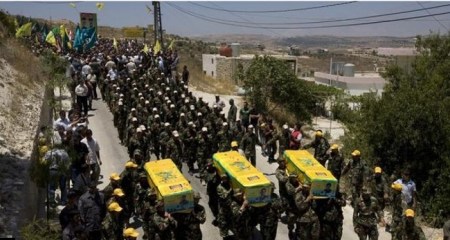
28169Funeral of Hizbullah fighters killed in Syria (image: Safa.ps)

“[Since its founding], the resistance [i.e. Hizbullah] never found itself deployed on several fronts and facing more than one challenge and more than one danger at once [as is happening today]. These four years since it became involved in the war in Syria represent the greatest trial it has [ever] faced… The movement has never paid in flesh, blood and abilities as it has paid [during the Syria war] and as it may continue to pay in the future, in the open confrontation with the takfiri [groups, i.e. the groups fighting against the Assad regime in Syria].[3] [So far] over 1,000 [fighters] have died and thousands have been wounded and disabled, and many others may meet [the same fate] in the ever-expanding confrontation that is becoming more difficult and more aggressive every day. This, especially since the horizon of a political solution seems to have been eliminated for the foreseeable future.

“Amid all this comes the 16th [anniversary] of the liberation [of South Lebanon], which underscores an element that Israel cannot ignore, namely the strengthening of the security and stability equation on both sides of the Palestine-Lebanon border. [This is] thanks to the deterrence system, or more accurately the balance of terror, which is an equation that has turned South Lebanon into the most secure region in the entire Middle East. Though we must not ignore other factors, no less important, [that contribute to this security], including [UN] Resolution 1701, UNIFIL and the Lebanese army.

“The celebrations of liberty are held amid heartbreak mixed with joy. Heartbreak [at the sight of] the processions of martyrs crossing the boundary south of the Litani every day [i.e. bodies of Hizbullah fighters killed in Syria being returned to Lebanon for burial], and joy [at the sight of] the processions [of people] rejoicing over [Hizbullah’s victory in some of] the local elections [that have been held in Lebanon in recent weeks]…

“The heartbreak over the martyrs is a necessary tax [that must be paid] in the struggle, [a struggle] which the Lebanese, of all sectors, regard as existential, even though they are divided on whether the preemptive war against the terrorists outside the borders of the homeland is justified. This heartbreak is present in every home in South [Lebanon]… When Hizbullah secretary-general Hassan Nasrallah speaks at Liberation Day ceremonies [today] in the town of Al-Nabi Shayth in the Bekaa [Valley], he will be speaking to a public that has contributed to the resistance [by supporting Hizbullah’s activity in Syria] just as residents of the South have contributed [in fighting against Israel], and perhaps even more, since [Bekaa Valley residents] face a danger today on their eastern border that is just as bad as the Israeli danger.

“It is right to say that the men of resistance on the eastern border complement the mission of the first men of resistance [who operate against Israel], who work day and night [along the border, from] the last border point in Al-Naquora to [the one in] Kfar Shouba, conducting observations, preparing, and digging tunnels that cause the settlers and enemy soldiers to lose sleep. [All this they do] without abandoning the [other] tasks of the resistance, which stands ready, openly and secretly, throughout Lebanon, and especially in the Southern Dahiya, in order to prevent any terrorist attack by the takfiris, in full coordination with the Lebanese army and Lebanon’s other security apparatuses. There might be further expansion of Hizbullah’s battle front, in accordance with future challenges, and this expansion turns this Lebanese group [Hizbullah], which was established 34 years ago in Sheikh ‘Abdallah’s base in Baalbek, into a regional force that formulates new equations in the region…

“In all of its rounds of fighting with the Israeli enemy, the resistance never faced what it has been facing for years in confronting the dark [elements] armed with the Prophet Muhammad’s Koran and Sunnah, who receive funding from tyrannical regimes and innumerable intelligence apparatuses, and are armed with military [equipment] that only armies possess.”

“The resistance also never experienced a four-year war in an area several times larger than Lebanon [itself]. It never experienced [war] against groups that imitate its methods and ways of warfare, but [who] instead of blowing themselves up against an Israeli convoy terrorize innocent people in the cities and villages, without batting an eyelash, as happened in the southern Dahiya or yesterday in Tartus and Jableh.

“The resistance never experienced war against groups fighting in caves and in the hills, mountains, wadis and even deserts, as happened at Tadmor and in the rural areas of Homs and Aleppo… Before [the war with Syria], the resistance did not storm cities and did not fight armies deep in the mountains.  Before this, no one lay in wait for it in tunnels like the ones that only it used to excavate, and [the doctrine of which] it spread to the rest of the men of the resistance, particularly to the Palestinians in the Gaza Strip.

“All these have been the unique characteristics of the resistance throughout the 16 years since May 25, 2000. All these [characteristics] and others will cause Hassan Nasrallah to declare that defending the achievement of liberation will end only with the defeat of the terrorists…”

Endnotes:

[1] Regarding the issue of the tunnels, it should be noted that Ibrahim Al-Amin, chairman of the board of the Lebanese dailyAl-Akhbar, wrote in a January 13, 2014 article that Hamas members fighting in Syria, in the Al-Quseir area and other regions, had dug tunnels there, similar to the ones excavated by Hamas in Gaza. He explained that Hizbullah had taught Hamas to dig these tunnels in the days when the two organizations were cooperating in smuggling arms into Gaza and preparing military plans against Israel.

[2] Al-Safir (Lebanon), May 25, 2016.

[3] Hizbullah, like the Syrian regime, does not draw a distinction between the rebels and the Salafi-jihadi groups.

As Lebanon’s Banks Begin To Implement U.S. Sanctions Against Hizbullah, Hizbullah Criticizes Banking Sector, Warns Of Chaos In Lebanon And More ‘Actions Against The American Takeover Plan’

May 18, 2016

As Lebanon’s Banks Begin To Implement U.S. Sanctions Against Hizbullah, Hizbullah Criticizes Banking Sector, Warns Of Chaos In Lebanon And More ‘Actions Against The American Takeover Plan’ MEMRI, H. Varulkar and E. B. Picali*, May 17, 2016

Introduction

The Hizballah International Financing Prevention Act, passed by the U.S. Congress in December 2015, is aimed at curtailing the organization’s funding of its domestic and international activities, and also at combatting its global criminal activities – including money laundering, drug trafficking, and human trafficking – by which it funds the terror operations that it carries out worldwide.[1] It bars any “foreign financial institution” that engages in transactions with Hizbullah or with persons or bodies affiliated with it, or which provides them with financial services or launder money for them, from maintaining a relationship with the U.S. banking system. This means that any bank in the world, including in Lebanon, that provides financial services to the organization will be denied access to U.S. financial institutions – and thus to the global financial sector. The ramifications of this are far-reaching and can lead these banks to collapse. The law also imposes sanctions and penalties (fines, imprisonment or both) on individuals or bodies that violate its provisions. It came into effect on April 15, 2016, after the U.S. Treasury issued regulations for its implementation; the Treasury also published a list of some 100 bodies and figures associated with Hizbullah with whom financial institutions may not conduct dealings.[2]

Since Congress passed the law, Hizbullah has been perturbed and apprehensive about its ramifications and the impact it would have on its operation. This has been expressed both in statements by Hizbullah officials and in articles in the Lebanese press, especially the press close to Hizbullah.[3] In a speech a few days after the law was passed, Hizbullah secretary-general Hassan Nasrallah exposed his concern, by warning Lebanon’s banks not to “submit to the will of America.”

In early May 2016, two weeks after the law went into effect, Riad Salameh, governor of the Banque du Liban (BDL), Lebanon’s central bank, stressed, in a directive to Lebanon’s banks, the need to fully comply with the law. Following this, Lebanese banks began to close accounts of Hizbullah officials and their family members, and it has been reported that dozens such accounts have already been closed. Hizbullah reacted with a campaign of severe criticism against Salameh and the Lebanese banking system, accusing them of “surrender[ing] to the American financial mandatory authority in Lebanon and warning that this would bring about the collapse of Lebanon’s currency and lead to “complete chaos” in the country. Hizbullah ministers argued that the banks had crossed every red line, and other Hizbullah members leveled threats against the banks.

These reactions clearly indicate the scope of Hizbullah’s fears about the U.S. law and its ramifications. It should be noted that in recent months Hizbullah has also been the target of sanctions by the Gulf states and several other Arab countries, which have designated it a terror organization and have begun expelling its operatives from their territory.[4]

It should further be noted that it is not only Hizbullah that is concerned about the U.S. law, but also Lebanon’s banking sector, because if it does not comply with the law it will be barred from the global financial system, which could bring about its collapse. In light of these concerns, two Lebanese delegations were recently dispatched to the U.S., one on behalf of the Lebanese parliament and the other on behalf of the Association of Banks in Lebanon. The aim of the visits was to meet with U.S. Congress and Treasury officials and to discuss the law and its implementation, and perhaps also persuade them to soften the language of the law and provide guarantees for the Lebanese banks’ stability.[5]

This report will review Hizbullah’s apprehensions about the U.S. law as well as the organization’s threats to the Lebanese banking sector, the Lebanese government, and the U.S. following the law’s passage by Congress, and the intensification of these threats since the Lebanese banks began implementing the law.

Following Congress’s Passage Of The Law, Nasrallah Warns Lebanese Government, Banks Not To Comply

On December 21, 2015, three days after President Obama signed the act into law, Hizbullah secretary-general Hassan Nasrallah claimed that the law was part of the U.S. war on his organization that it declared years ago. In an attempt to downplay the importance of the new sanctions, Nasrallah argued that they would have no impact. He added that ever since the U.S. designated Hizbullah a terrorist organization in 1995, it has been trying to force the rest of the world to accept this designation, but to no avail; he added that since it failed in this attempt, it is now making false accusations against the organization. “The Americans,” he said, “are trying to pressure Hizbullah again with a decision they issued, according to which it is a criminal organization, and they are accusing us of drug trafficking, human trafficking, and money laundering. This is not true. These accusations are unjust, and we are not interested in presenting proof of our innocence, because the accuser is the one who should be presenting proof… This is a political accusation, part of a political, security, and military campaign in the region, aimed at tarnishing Hizbullah’s image in the eyes of the peoples of the world… It is part of a psychological war that will not succeed.”

As part of his attempts to reassure Hizbullah’s supporters and to convince them that the sanctions would have no impact, Nasrallah stated that his organization holds no accounts in Lebanese banks, nor any investments in or partnerships with Lebanese companies or merchants – and that therefore neither the BDL nor any other Lebanese bank has any cause for concern. At the same time, he revealed his concerns when he said: “The minute the U.S. gives the signal to harm some sector or political stream, some Lebanese banks will begin settling scores [with that sector or stream].” He declared that this would be “unacceptable” and warned the government and the banks against “obeying the American will.” He claimed that these American sanctions were aimed not just at Hizbullah but at Lebanon’s citizens, companies and businessmen, and demanded that the Lebanese state defend them: “We do not want the state to defend Hizbullah and its operatives, its sons and its daughters. We are defending ourselves and know how to do so. But the state must have people to defend any individual that the Americans wish to  accuse.”[6] 

Hizbullah Faction In Lebanese Parliament: American Law Will Spur Hizbullah To Act Against U.S.’s “Terrorist Branches” In The Region

On December 24, 2015, several days after Congress passed the law, the Hizbullah faction in the Lebanese parliament harshly criticized the U.S. over it, saying that “arrogance and terrorism” were behind the decision targeting Hizbullah, its supporters, and “ostensible organizations and elements working with it”. This, it stated, confirmed that the U.S. administration is indeed “the Great Satan.” The faction also said that the law “would spur Hizbullah to continue its actions against the American takeover plan and to continue resisting its terrorist branches, represented by the Zionists and takfiris, in Lebanon and the region.”[7]

Hizbullah-Affiliated Daily: Sanctions Could Lead To Intra-Lebanese Tension

Additionally, on March 31, 2016, the Lebanese Hizbullah-affiliated daily Al-Akhbar published an article implicitly warning that the U.S. law would destabilize Lebanon: “As the countdown to the release of the regulations for implementing the American anti-Hizbullah sanctions begins, the fears that the [Lebanese] domestic arena will be impacted by it and its ramifications are revived… as have fears that this issue will become volatile…”

The article also outlined the assessments that the sanctions and the anticipated regulations for their implementation will be harsh and will cover a broad range of individuals and political, financial, and media institutions, and added that if this proves to be the case, “it could constitute a worrisome factor that could stoke  domestic tension [in Lebanon, especially] in everything connected to Hizbullah’s reaction to the attempts at besieging it…”[8]

As Sanctions Implementation Begins In Lebanon, Hizbullah Harshly Criticizes U.S., Lebanese Banking Sector

On April 11, 2016, the U.S. Treasury Department released the regulations for implementing the Hizballah International Financing Prevention Act; they included details for applying the sanctions as well as a list of 99 Hizbullah-linked individuals and institutions with whom banks and financial institutions worldwide may not conduct business. The law, which as mentioned came into effect on April 15, 2016, is binding on all the world’s financial institutions, including Lebanese banks.

BDL Governor Salameh Orders Lebanese Banks To Comply With U.S. Law, Enraging Hizbullah

On April 28, 2016, the governor of the Central Bank of Lebanon, Riad Salameh explicitly stated, on the Lebanese LBC TV channel’s show Kalam Al-Nas, that Lebanese banks must comply with the U.S. law. He stressed: “The American law cannot be circumvented, because the regulations for its implementation include all currency, including the Lebanese lira.” The BDL, he said, would issue a statement emphasizing that Lebanon was committed to complying with the law and would hold banks responsible for implementing it. He added, “This will be clear and there will no way to get around it. This is an official and legal position. The banks must align with us.”[9]

A few days later, on May 3, 2016, Salameh issued guidelines requiring “all banks in Lebanon and all institutions under the oversight of the BDL” to comply with the law and to immediately inform the BDL of any freezing or closure of any account, or of any refusal to open any account, and to state their reasons for doing so.[10] According to reports in the Lebanese press, Lebanese banks have begun implementing these guidelines, and have already closed dozens of accounts belonging to Hizbullah MPs and associates.[11] Salameh’s guidelines sparked enraged responses from Hizbullah.

28047Riad Salameh (nna-leb.gov.lb, April 4, 201

Hizbullah MP: U.S. Is The Great Satan, We Must Resist Its Plans In The Region

Hizbullah MP Hussein Al-Moussawi threatened the U.S., saying: “The U.S. is still the leader of the camp of lies, and, as the Great Satan, it attempts to give the resistance a satanic image, and marginalize it with terrorism accusations and economic sanctions… The sons of the ummah should be wary of the American plans and carry out resistance against them.”[12]

Hizbullah: Salameh Surrendered To “The American Financial Mandatory” Rule In Lebanon; Implementing This Law Will Lead To Chaos In The Country

After Lebanese banks began closing the accounts of Hizbullah affiliates, the organization launched criticism not only at the U.S. but also at the Lebanese banking sector. On May 12, 2016, the Hizbullah faction in the Lebanese parliament issued an exceptionally harsh statement against Riad Salameh, noting: “The recent American law, which forces Lebanese banks to comply with its sections, is completely unacceptable because it will form the basis for a local war of exclusion, which the central bank and other banks are helping to stoke. This is in addition to the fact that complying [with the U.S. law] constitutes an appropriation of Lebanese financial sovereignty.”

The statement also said: “The orders recently published by BDL governor Riad Salameh… are a form of unjustified surrender to the American financial mandatory authority in Lebanon – which could exacerbate the financial crisis in the country, lead it to bankruptcy because of the ramifications of the deep schism [that could come about] between the Lebanese and the banks, and place the country on the brink of a grave currency collapse in the country and complete chaos that will be unstoppable.” The announcement also called on the governor “to reexamine the recent guidelines, such that they will be compatible [with the principle] of national sovereignty,” and on the government “to take the necessary steps to prevent the dangerous ramifications that are likely to emanate from this.”[13]

Hizbullah-Affiliated Daily: Hizbullah Is Furious At BDL Governor For Reneging On Understandings It Reached With Him

The Lebanese daily Al-Safir, which is close to Hizbullah, revealed on May 13, 2016 that the reason for Hizbullah’s fury at the BDL governor is that the guidelines he issued for the banks effectively countermanded previous understandings at which he had secretly arrived with Hizbullah, that were meant to mitigate the impact of the sanctions. According to the report, former Hizbullah MP Amin Shiri had concluded with Salameh that the Lebanese banks would not decide independently on the closure of any Lebanese citizen’s bank account, but would obtain Salameh’s personal approval beforehand. They also agreed that the banks would allow any citizen, including Hizbullah members, to open an account in Lebanese lira. However, the new guidelines that Salameh released in early May contradicted these understandings; under the new guidelines, banks should close accounts on their own and then inform the BDL, and must prevent Hizbullah members from opening accounts in Lebanese lira –because the American regulations for implementation specifically bar opening accounts in any currency.

According to Al-Safir, Hizbullah was surprised, and enraged, by Salameh’s guidelines. It quickly tried to contact him, but after receiving no persuasive answer, it decided to publish the harsh statement against him, and to raise the issue in the upcoming cabinet session.[14]

The daily Al-Akhbar, which is also close to Hizbullah, added that the organization had sent a message to Salameh claiming that “some banks decide for themselves to go too far in implementing the American sanctions, punishing Lebanese [citizens] that the U.S. did not even seek to sanction.” The daily added that Hizbullah had told Salameh that it would not allow the Lebanese banking sector “to act purely as the executive arm of the American administration [in carrying out its] decisions.”[15]

Al-Safir: Lebanese Elements, Saudi And UAE Foreign Ministers Worked To Step Up The Sanctions

Al-Safir reported that several MPs, apparently from Hizbullah, had complained to parliament speaker Nabih Berri that the regulations for implementation released in April by the U.S. Treasury Department had included new sections that were not in the law itself – for example, that the sanctions apply to all currencies, not only to U.S. dollars. They argued that these additions undercut the understandings between Hizbullah and Salameh, which were aimed at circumventing the sanctions and mitigating their effects. The MPs argued that an apparent “Lebanese element… leaked these [Hizbullah-Salameh understandings].” The daily cited sources as saying that “there is an Israeli-Lebanese-Arab lobby operating daily in Washington under the direct supervision of the office of Saudi Foreign Minister ‘Adel Al-Jubeir and the office of UAE Foreign Minister ‘Abdallah bin Zayed,” and adding that UAE Ambassador to Washington Yousef Al-‘Otaiba is working hard on this matter in Congress and the Treasury Department.[16]

Hizbullah Ministers: Lebanese Banks Have “Gone Too Far” In Implementing The American Law”; This Crosses All Red Lines

On May 12, 2016, the same day the Hizbullah faction in the parliament issued its statement against the Lebanese banking sector, Hizbullah ministers raised the issue in the cabinet session. The Al-Akhbar and Al-Safir dailies reported that Hizbullah ministers in the unity government, Hussein Al-Hajj Hassan and Muhammad Fneish, had delivered scathing attacks on the Lebanese banks, saying that they had “gone too far in implementing the American law” and had begun “taking steps against people with no ties to Hizbullah other than familial ties to organization officials.”

At the meeting, Hizbullah ministers claimed that one bank had closed the account of the daughter of a former Hizbullah MP. Al-Hajj Hassan claimed that banks had also recently closed the accounts of MPs Nawar Al-Sahili, ‘Ali Fayyad, ‘Ali Ammar, and ‘Ali Al-Miqdad, as well as that of former MP Amin Shiri. Also closed, they said, were accounts belonging to various cultural, religious, healthcare, and societal institutions, as well as charity organizations; he also expressed apprehension that the accounts of dozens of local municipalities would be closed “on the pretext that they [are administered] by Hizbullah members.” It was also reported that during the meeting, other ministers who are not members of Hizbullah related how U.S. and French banks had refused to open accounts for them and also closed their existing accounts.

According to Al-Hajj Hassan, these closures constituted “a serious attack that crosses all red lines,” especially since the law harms all Lebanese, not just one group or sect. Other reports in the Lebanese press noted that Al-Hajj Hassan had issued threats, and had said that the BDL guidelines and the conduct of the banking sector had “crossed the red line and reached the black line, and Hizbullah will not agree to this, and the American sanctions will not be allowed to pass.” It was also reported that Hizbullah ministers had called the Lebanese banks’ implementation of the U.S. law submission to aggression, and added that there must be no silence over this law, “because the occupation is not only military, but also financial, political, and cultural.”[17]

Al-Safir reported that some ministers from the March 14 Forces, the rival bloc in the unity government, were claiming that Hizbullah had brought this situation on itself, and that the resistance had become a weak point for Lebanon, not a source of strength. Furthermore, one minister argued that Hizbullah ministers could not shift responsibility to the Lebanese banks or the BDL governor, since no one in the world can confront the U.S. The cabinet meeting ended with a decision by Prime Minister Tammam Salam and Finance Minister ‘Ali Hassan Khalil to meet with Salameh to discuss the matter and update the government on the results.[18]

Hizbullah Sources Threaten: Hizbullah Won’t Remain Silent – We Will Upend Everything

On May 14, 2016, the Lebanese daily Al-Nahar quoted sources in the Hizbullah-headed March 8 Forces as saying that the organization would not remain silent about the new guidelines released by Salameh, and that it would not back down from its demand that they be cancelled. The sources argued that the banks were implementing the sanctions also against people who were not on the U.S. Treasury Department list, only because they were Shi’ites or relatives of a Hizbullah member. They added: “How is it possible that the bank accounts of MPs representing the Lebanese people are being closed – how will they receive their salaries?”

Hizbullah maintained that the BDL and the other banks are going beyond what the Americans are demanding in their implementation of the sanctions, and thus are strangling an entire community. The sources said: “When [Hizbullah] asked the BDL governor about the implementation of the U.S. law, he said nothing about what he is implementing today, but [said that there would be] an investigation and an examination of every account about which there are doubts… But closing the accounts of innocent people who have no connection [to Hizbullah] without any investigation or examination [as is happening right now] – that is a dangerous sign of concessions on Lebanese sovereignty and of punishment of the Lebanese people by the state, which we will in no way allow to happen.” The sources argued that the government must “cancel the BDL’s guidelines, otherwise [Hizbullah] will react not only by thwarting the government[‘s activity] but will upend everything, andwill open the file of the banking sector from the 1990s onward…” – hinting that Hizbullah has information on improper conduct by the banks.

Asked what was meant by the term “upend everything,” the sources quoted a hadith attributed to Imam ‘Ali bin Abu Taleb, the fourth caliph: “I am amazed how a poor man who lacks a crust of bread does not go out and brandish his sword at the people” – hinting that Hizbullah’s reaction will be harsh.[19]

Nasrallah: We Face A Challenge To Obtain Monetary Aid – “We Will Be Grateful For Every Donation”

Hizbullah officials’ threats and harsh reactions clearly attested to the distress and pressure felt by the organization, and to the scope of the sanctions’ impact on its activity. Additional evidence of this could be found in a May 6, 2016 speech by Nasrallah following the release of the regulations for implementing the U.S. law.

In his speech, Nasrallah reiterated, as he had first stated in his December 2015 speech, that the sanctions would do little damage to Hizbullah because the organization was accustomed to such pressure and that it would overcome it as it had in the past “under much worse circumstances.” But despite Nasrallah’s efforts to convey the message that Hizbullah was just fine, the scope of the economic damage done to the organization came through in his statements, in which he noted, inter alia, that the Islamic Resistance Support Organization was now playing a vital role in financially helping the organization. He even personally appealed to the public of supporters of the resistance for monetary donations, no matter how modest:

“I want to talk about this point openly, so that the people will also know how we think and operate. We first of all consider the importance and real value of the intention of the donors, not the size of the contribution… The families of the martyrs donate, the wounded donate, the people donate, the elderly lady who saved for her old age gives a little of her savings to the resistance, the boy who is in school takes some of his allowance and drops it into the cashbox of the resistance. This, for us, is worth millions. This is the real support for us…

“Therefore, today, when we stand before America’s, Israel’s, and Saudi Arabia’s attempts to dry up our sources of funding, we must realize that the sums donated by this or that family via the the Islamic Resistance Support Organization, even if modest, are in fact very large and extremely valuable sums. Obviously, we do not want to embarrass anyone… [so that they will] donate to us, but we trust the faith, the insight, and the reliability of all those who donate to us, since they are the people with whom we have, together, [overcome] the most difficult of days and circumstances, and the most dangerous of challenges and hardships. With them, we have completed the path; we have triumphed, and passed through all the difficult stages; with them, we will pass through all  the difficult stages to come, Allah willing.”

In an attempt to reassure the resistance-supporting public, he added that they must not worry, because Iran would continue to send economic, material, and military aid to Hizbullah despite the pressures and threats against it as well.[20]


*H. Varulkar is Director of Research at MEMRI; E. B. Picali is a Research Fellow at MEMRI.


Endnotes:

[1] On Hizbullah’s involvement in global drug trafficking, see MEMRI Inquiry and Analysis No. 1227, Hizbullah’s International Drug Network Preoccupies Europe, February 9, 2016.

[2] Congress.gov/bill/114th-congress/house-bill/2297/text;Treasury.gov/resource-center/sanctions/Programs/Documents/31cfr566_hizballah.pdf;Treasury.gov/resource-center/sanctions/OFAC-Enforcement/Pages/20160415.aspx.

[3] Al-Akhbar (Lebanon), January 11, 2016, March 31, 2016.

[4]  See MEMRI Inquiry and Analysis No. 1232, Lebanon’s Failure To Support Saudi Arabia In Struggle With Iran Sparks Crisis Between Lebanon And Saudi-Led Gulf, March 7, 2016.

[5]  Al-Akhbar (Lebanon), January 11, 2016, February 2, 2016, March 31, 2016.

[6] Alahednews.co.lb, December 21, 2015; Al-Safir (Lebanon), Al-Akhbar (Lebanon), December 22, 2015.

[7] Al-Akhbar (Lebanon), December 25, 2015.

[8] Al-Akhbar (Lebanon), March 31, 2016.

[9] Al-Liwa (Lebanon), April 29, 2016.

[10] Al-Nahar (Lebanon), May 4, 2016.

[11] Al-Akhbar (Lebanon), May 16, 2016, Al-Safir (Lebanon), May 13, 2016.

[12] Alahadnews.com.lb, May 2, 2016.

[13] Al-Safir (Lebanon), May 12, 2016.

[14] Al-Safir (Lebanon), May 13, 2016.

[15] Al-Akhbar (Lebanon), May 13, 2016.

[16] Al-Safir (Lebanon), May 13, 2016.

[17] Al-Safir, Al-Akhbar, Al-Mustaqbal , Al-Modon (Lebanon), May 13, 2016.

[18] Al-Safir (Lebanon), May 13, 2016; Al-Akhbar (Lebanon), May 13, 2016.

[19] This hadith is attributed to Abu Dhar Al-Ghafari, a Companion of the Prophet Muhammad, and the fourth person to be converted to Islam by him. However, no verification or evidence has been found for such a hadith in the Book of Hadiths, and some even claim that it is not reliable.

[20] Alahednews.co.lb, May 6, 2016.