Archive for the ‘Law enforcement’ category

New Sheriff in Town: The First 100 Days at the Sessions DOJ

April 27, 2017

New Sheriff in Town: The First 100 Days at the Sessions DOJ, BreitbartIan Mason, April 27, 2017

(It’s still a work in progress.  He — like President Trump — can’t do everything first, particularly with the “deep state” swamp still in need of drastic draining. — DM)

Sandy Huffaker/Getty Images

Wednesday saw the first of Attorney General Sessions’ Senate-confirmed subordinates take office: Deputy Attorney General Rod Rosenstein. Over the coming weeks, it is expected that serious progress will be made on nominating and confirming permanent occupants for the dozens of political positions at the Department of Justice, including the over 90 U.S. Attorneys who lead federal criminal prosecutions. The key victories of the first 100 days were accomplished by the Attorney General without any of them in place. As his team assembles around him, Attorney General Sessions looks to be better able to direct the legal policy of the United States government to restore his vision of law and order.

**********************

Under the leadership of Attorney General Jeff Sessions, the first 100 days at the Department of Justice have seen perhaps the most straightforward and earnest efforts to bring the promises of the Trump movement to fruition.

Stepping into leadership at a DOJ managed for eight years by Eric Holder and Loretta Lynch, Sessions has had an uphill battle to implement the key tenets of law and order that so many Americans have long craved and which President Donald Trump promised as a candidate: an end of the lawless hypocrisy on the southern border and in the internal enforcement of our immigration laws, especially in state a jurisdictions that openly flaunt federal law and proclaim themselves “sanctuaries;” a firm commitment to get a handle on rising violent crime, especially in our most dangerous inner cities; and steadfast support of our law enforcement officers at a time when they face danger and disparagement from inside the government and without.

Hitting the Ground Running:

Attorney General Sessions was confirmed by the Senate on February 9, 2017, three weeks into the new administration. One of the very first national politicians to endorse candidate Trump, he was the fifth cabinet member to take his seat, but not before a smooth yet contentious confirmation process yielded one of the most awkwardly worded and forced political slogans of recent memory.

“Nevertheless, she persisted,” the much-touted line goes, a reference to Senate Majority Leader Mitch McConnell’s (R-KY) explanation of his use of Senate rules to prevent Sen. Elizabeth Warren (D-MA) reading a 30-year old letter from Coretta Scott King to imply racist motives to then Senator Sessions. The use was later criticized by Ms. King’s niece.

The fireworks on the Senate floor were quickly followed up in the White House. On his first day as Attorney General, Sessions stood by President Trump’s side as he signed no fewer than four executive orders pertaining to the Justice Department.

A “New Era” on the Border

Without doubt, cracking down on illegal aliens and the resultant lawlessness on the border and in our immigration system has been the greatest focus of Sessions’ attentions in his tenure at DOJ. Merely the signal of will from the new administration has already brought extraordinary results. March of 2017 saw the lowest number of illegals caught on the border in 17 years, a 72 percent reduction in apprehensions from the last month of the Obama administration.

Rhetoric was repeatedly backed up with action on the Attorney General’s part. In early March, the DOJ shifted 50 immigration judges to detention center along the border and in illegal alien heavy cities. The were set to work in twelve-hour shifts to help clear the massive backlog of deportation cases. This proved to be merely a prelude to much more substantial reform.

On the morning of April 11, 2017, the Attorney General toured the southern border with officers of U.S Customs and Border Protection. Addressing them and the nation, he proclaimed, “For those that continue to seek improper and illegal entry into this country, be forewarned: This is a new era. This is the Trump era.”

“The catch and release practices of old are over,” Sessions continued, announced that 125 additional immigration judges would be hired on expedited basis. They would be needed because from this point on all adults apprehended at the border were to be detained by federal authorities.

A new set of guidelines was sent to every federal prosecutor in the country. Those who illegally enter the United States a second time will now face felony prosecution as a matter of course, as well those who illegal enter after having been deported, and transporting or harboring three or more illegal aliens. Charges of aggravated identity theft are to be levied on those caught with fraudulent documentation.

These measures are designed to work in tandem with a similar ramping up at the Department of Homeland Security, where 10,000 additional ICE officers have been authorized and are in the process of being hired. Attorney General Sessions made a point of making joint appearances with DHS Secretary John Kelley, presenting a united front to bring order to the border. The two cabinet officials noted increased arrests, more deportations of criminals, and other operations contributing to the apparent decrease in illegal border crossings.

While President Trump has, so far, not seen it fit to reverse Obama’s Deferred Action on Childhood Arrivals executive order, granting amnesty to those who came illegal as children and register with the federal government, the Attorney General has made it clear that the law remains the law. Asked by Fox News in April about the deportation of certain so-called DREAMer (after the never enacted DREAM act), Sessions was unequivocal, “The policy is that if people are here unlawfully, they’re subject to being deported. Our priority is clear. Our priority is to end the lawlessness at the border.”

No Sanction for “Sanctuaries”

From the very beginning of his tenure, Attorney General Sessions has tried to bring jurisdictions who refuse to cooperate with federal immigration enforcement back to legal normality, even if it means cutting their federal funds to convince them to do so. Sessions has done this in the face of steadfast refusal to cooperate by some of nation’s most powerful local leaders. For example, Chicago, under the leadership of Mayor Rahm Emmanuel, went so far as to issue a new type of identification available to illegal alien without the city keeping records in response to fears the administration might be able to force the “sanctuary” to give up information on immigration status. Sessions made a point of calling out a California prosecutor who appears to, as a matter of policy, be reducing charges to avoid triggering “violent felon” deportation requirements.

The most troubling resistance, however, came this final week of the first 100 days, as a federal court in San Francisco blocked enforcement of President Trump’s executive order commanding Sessions to cut off federal funds from recalcitrant jurisdictions. At the moment, as the administration has released no comprehensive plan as to what funds are subject to suspension, it is unclear what effect this temporary order will have. It will, however, prevent the use of that executive order’s authority while a lawsuit from a number of California sanctuary jurisdictions makes its way through the courts.

Sessions has not taken this tactic to continue flaunting federal immigration law lightly. In a statement Wednesday, the Attorney General was very clear as to how he saw the lawsuit:

At the heart of this immigration debate is disagreement over whether illegally entering this country is a crime.  Our duly enacted laws answer that question.

Nevertheless, actions that have always been understood to be squarely within the powers of the President, regardless of the Administration, have now been enjoined.  The Department of Justice cannot accept such a result, and as the President has made clear, we will continue to litigate this case to vindicate the rule of law.

Separate from the wider pledge to cut the flow of federal funds to sanctuary jurisdictions, Sessions has used his independent authority to bring pressure to bear. After weeks of threatening action, the Department of Justice sent letters to nine of the states and cities who most vigorously stifle immigration enforcement, demanding they show compliance by June 30 or forfeit their DOJ Bryne Grants for law enforcement. As these grants already have requirements to follow federal law attached to them, these letters may be unaffected by the ongoing court fracas over President Trump’s executive order.

Zero Tolerance:

The mayhem of our inner cities in the waning years of the Obama administration was no less troubling than the chaos on the border. On the day Sessions took office, an executive order established a task force for tackling the violent crime increase seen in certain cities. Sessions has spoken on numerous occasions on his support for a return to “broken windows” policing and taking local law enforcement’s side in their effort to wrestle their crime rates back down to the historic lows seen only a few years ago.

Some of the violence is fueled by what the justice department calls “transnational criminal organizations,” brutal gangs like MS-13 and wide-reaching networks like the Mexican drug cartels. At a meeting of the Attorney General’s Organized Crime Council, Sessions made clear his department would have “zero tolerence” for gang violence as it brings an executive order targeting these organizations for deportation and dismantling into reality.

On several occasions, Sessions has highlighted his continued support for the type of rigorous policing that came under intense fire in the last administration.

Supporting Law Enforcement:

To many Americans, the Holder-Lynch DOJ’s failure to keep crime in check and the border under control was compounded by the perceived failure to adequately support law enforcement officers and their in this trying time. Black Lives Matter and other left-wing groups brought anti-police rhetoric to the forefront of the public discourse and politicized violence against the police made headlines throughout 2014, 2015 and 2016. The Justice Department responded by launching investigations into police brutality, bias, and misconduct, making it anything but clear that American law enforcement had their unequivocal support.

Spearheaded by Assistant Attorney General Vanita Gupta’s Civil Rights Division, the Obama administration responded to riots in Ferguson, Missouri, and Baltimore, Maryland by launching federal investigations into those cities’, and others like murder-capital Chicago’s, police departments. The results were predictable. A “Ferguson Effect,” where officers were reluctant to make the routine stops necessary to keep crime under control for fear of being sanctioned for misconduct contributed to a shocking rise in violent crime in the very communities supposedly protected by federal oversight of police. Initially dismissed as a right-wing conspiracy theory, the Ferguson Effect has since been supported by a survey of police officers and by a National Institute of Justice study funded by the Obama DOJ.

When Attorney General Sessions took the reigns at DOJ, there was an immediate shift in tone. “Please know that you have the full support of our Department,” Sessisons told a meeting of police chiefs in April. He went on to call out the former administration’s treatment of police:

In recent years, as you know, law enforcement as a whole has been unfairly maligned and blamed for the crimes and unacceptable deeds of a few bad actors. Amid this intense criticism, morale has gone down, while the number of officers killed in the line of duty has gone up.

Attorney General Sessions has done what is in his power to try and reverse the damage done to Law Enforcement relations. He ordered a complete review of all Obama-era investigations into local law enforcement. He has even sought to scale back the consent decree reached to install federal monitoring of Baltimore’s Police Department in the waning days of the Obama administration. When the federal judge in the case refused to reopen the issue, Sessions issued a public statement criticizing the whole endeavor, saying, “There are clear departures from many proven principles of good policing that we fear will result in more crime.”

Looking Forward:

Wednesday saw the first of Attorney General Sessions’ Senate-confirmed subordinates take office: Deputy Attorney General Rod Rosenstein. Over the coming weeks, it is expected that serious progress will be made on nominating and confirming permanent occupants for the dozens of political positions at the Department of Justice, including the over 90 U.S. Attorneys who lead federal criminal prosecutions. The key victories of the first 100 days were accomplished by the Attorney General without any of them in place. As his team assembles around him, Attorney General Sessions looks to be better able to direct the legal policy of the United States government to restore his vision of law and order.

How Trump Can Help the Cops

April 26, 2017

How Trump Can Help the Cops, Front Page MagazineHeather Mac Donald, April 26, 2017

Reprinted from City Journal

Donald Trump vigorously defended law enforcement during his presidential campaign. He pledged to restore order to the nation’s cities—where violent crime is surging—and to reinvigorate the rule of law. His appointment of conservative Republican senator Jeff Sessions as attorney general was a strong signal that Trump’s words were more than campaign rhetoric. Now that the Trump administration and the Sessions-led Justice Department are up and running, where should they focus their efforts?

The most immediate goal of the Trump administration should be to change the elite-driven narrative about the criminal-justice system. That narrative, which holds that policing is lethally racist, has dominated public discourse since the fatal shooting of Michael Brown in Ferguson, Missouri, in August 2014. In response, officers are backing off of proactive policing, and violent crime is rising fast: 2015 saw the largest one-year spike in homicides nationwide in nearly 50 years. That violent-crime increase has continued unabated through 2016 and into the early months of 2017. A Trump administration official—perhaps Attorney General Sessions, or the president himself—should publicly address the question of what we expect from police officers: Do we want them to be proactive and to try to stop crime before it happens? Or do we want them to be purely reactive, responding to crime only after someone has been victimized? The administration should explain that data-driven, proactive policing made possible the country’s 20-year, 50 percent violent-crime decline that began in the mid-1990s.

In February, Sessions made a good start in turning around the false narrative about policing, addressing the National Association of Attorneys General. Sessions warned that the nation’s violent-crime decline is now at risk, while acknowledging that the crime increase is not happening in every neighborhood. Yet we are diminished as a nation, he said, when citizens “fear for their life when they leave their home.” (To be blunt, the violent-crime increase has hit almost exclusively in black neighborhoods. Nine hundred additional black males were murdered in 2015 compared with 2014, bringing total black homicide deaths that year to more than 7,000. It is a marker of the perversity of elite rhetoric about race that both Trump and Sessions have been fiercely attacked as racist for pledging to save black lives.)

Sessions noted that officers have become reluctant to get out of their cars to conduct discretionary stops and other “up-close” preventive policing. The administration should go further: it should convey the charged, hostile atmosphere in which officers in many urban areas now operate, thanks to the hatred spread by the Black Lives Matter movement. Gun murders of officers increased more than 50 percent in 2016, led by the targeted assassinations of cops.

A frontal assault on the dominant narrative about a racist criminal-justice system will require laying out the stark racial disparities in criminal offending and victimization. The public has been kept in the dark for decades about how vast those disparities are: blacks commit homicide at eight times the rate of whites and Hispanics combined, for example, and die of homicide at six times the rate of whites and Hispanics combined. Lifting that veil of ignorance is necessary to explain why officers operate more actively in minority neighborhoods—in order to save lives. The public must also understand that it is law-abiding members of high-crime communities themselves who beg the police to maintain order, and that such public-order policing was central to the now-jeopardized 20-year crime decline.

The federal government will be vigilant against abusive policing, the administration should say, but it will not deem police departments and police officers biased for proactively fighting crime.

The federal government’s practice of slapping years-long consent decrees on police departments calls out for reform. There is zero chance that civil rights attorneys in the federal government know more than police departments do about how to fight crime constitutionally and successfully. Yet the Obama administration opened 25 “pattern-or-practice” civil rights investigations, based on the false notions that police bias is widespread and that federal lawyers are qualified to recommend effective police practices. The Department of Justice is currently enforcing 14 consent decrees with local departments, which grew out of such investigations. At a minimum, the Trump administration should publish data on how much the Obama-era investigations and consent decrees have cost those departments.

At the end of March 2017, Sessions announced a review of existing and pending consent decrees. The immediate target of this review was a consent decree for the Baltimore Police Department, hastily signed in the waning days of the Obama administration and at that point still awaiting final approval from a federal judge. Sessions’s reevaluation was fully justified.  As is typical, the Obama-era DOJ report that preceded the Baltimore decree failed to put numbers behind its charge that the Baltimore PD engaged in a “pattern or practice” of unconstitutional policing. The Obama report blasts the Baltimore cops for “clearing the corners” of miscreants and loiterers, but the police engage in such corner-clearing at the behest of the community. Since the report came out in summer 2016, Baltimore neighborhoods have been overrun by drug dealers, who now believe that they can operate with impunity. Residents have begged the department to return to corner-clearing and other public-order enforcement.

The proposed Baltimore consent decree discourages all such self-initiated police activities. It requires officers to contact a supervisor before making an arrest for minor offenses like disorderly conduct. It prohibits officers from stopping and questioning trespassers and loiterers, unless the officer has received a call for service regarding those individuals. The spurious philosophy beneath these rules is that policing should focus on “serious offenses,” not “minor infractions.” But the best way to prevent serious offenses is to maintain public order in high-crime areas. Proponents argue that the deemphasis on low-level enforcement will save money; in fact, it will only lead to more high-level crime.

Violent street crime in Baltimore has remained at alarming levels in 2017; shootings were up 78 percent through February 25, compared with the same period in 2016; homicides were up 38 percent through early March. These increases come on top of the highest per-capita homicide rate in the city’s history in 2015 and close to that record rate in 2016. Complying with the consent decree will cost financially struggling Baltimore millions of dollars—money that could be better spent hiring new officers and giving them rigorous tactical training. Officers will be pulled from the streets to compile reports for the overpaid federal monitor, covering matters including—as reported in the Power Line blog—whether beat cops respect an individual’s chosen “gender identity” in addressing him (or “zim”). In March 2017, seven plainclothes Baltimore officers were indicted for extortion and fraud. The consent decree is irrelevant to this egregious failure of supervision, focusing as it does on the usual policing-is-racist narrative. Five of the seven indicted officers were black.

The Sessions Justice Department requested a 90-day pause before District Court Judge James Bredar made the Baltimore decree irrevocable. This request triggered strenuous protest, not just from activists and Democratic politicians but also, bizarrely, from Baltimore police commissioner Kevin Davis himself. Davis in essence was declaring his inability to manage his own police department without federal oversight. Judge Bredar rejected the DOJ request for a 90-day extension and approved the decree on April 7, consigning Baltimore and Maryland taxpayers to a depleted and demoralized police force and to tens, if not hundreds, of millions of dollars of unnecessary costs and fees.

The next target of the Sessions consent decree review is an as-yet unfinalized consent decree in Chicago. Since no agreement between the Justice Department and Chicago officials has been signed, the Justice Department should drop negotiations and pull out. The Obama-era report that triggered the pending consent decree suffers from the same flaws as the Baltimore report: it provides no quantified evidence for its claim that the Chicago Police Department engages in systemic civil rights abuses. The mayhem in Chicago in February and March 2017 alone included the slaying of a two-year-old boy and two other children in separate drive-by shootings over four days, and the spread of rape, robberies, carjackings, and kidnappings into downtown and other previously safe neighborhoods. Quelling that violence will not be made easier by diverting police resources into the care and feeding of a federal monitor.

The 2012 police consent decree in New Orleans, for example, is projected to cost $55 million over five years; the actual cost will be much higher. A recent news story trumpeted the fact that sexual-assault complaints rose 83 percent in 2015 (allegedly suggesting greater “gender” sensitivity in the New Orleans Police Department). What should be of greater concern is the fact that New Orleans is also in the midst of an ongoing violent-crime spike. Shootings and homicides more than doubled in January 2017 over January 2016, notwithstanding that 2015 and 2016 had already seen a significant rise in murder and shootings.

Sessions’s announced review of pending consent decrees brought forth the same claims of impotence on the part of Chicago officials as it did in Baltimore. The attorney general should ignore these professions of dependency on the federal government and do the right thing for the law-abiding residents of Chicago’s gang-terrorized neighborhoods by tearing up the proposed decree.

The Department of Justice’s Civil Rights Division should formulate and publish the criteria that it will use to open pattern-or-practice civil rights investigations of police departments. It should quantify the constitutional violations that it uncovers during pattern-or-practice investigations and explain how it concludes that these infractions rise to the level of a “pattern or practice” of civil rights abuses.

The federal government should analyze police actions against a benchmark of crime rates, not population data. If 55 percent of police stops in a jurisdiction have black subjects, for example, the relevant starting point for analysis is the percentage of violent crime committed by blacks, not the black percentage of the resident population.

The specious population benchmark for finding police discrimination is typical of the disparate-impact analysis that drove most criminal-justice policy under the Obama administration. Such analysis should be extirpated in its entirety. There is not a single colorblind law-enforcement practice that does not have a disparate impact on blacks and Hispanics, given their higher rates of crime. The only way to avoid a disparate impact in law enforcement is to stop enforcing the law.

Before the election, the FBI announced a worthy initiative to collect and publish data on all officer uses of force. Such reporting must be accompanied, however, by information on local crime rates, since police use of force will occur most frequently where cops encounter armed and resisting suspects.

Crime-fighting remains overwhelmingly a local matter. But federal agents—from the FBI, the Drug Enforcement Administration, the Bureau of Alcohol, Tobacco, Firearms, and Explosives, and the U.S. Marshals Service—can provide vital assistance. Federal law enforcement reoriented itself toward counterterrorism and cybercrime following the 9/11 Islamist terror attacks. With violence skyrocketing in many urban areas, it is time for a rebalancing. Embattled police departments are calling for more federal agents to work on joint gun and drug task forces. Trump’s proposed budget for the Justice Department has recognized that demand by allocating an additional $175 million to address violent crime.

U.S. gun and drug prosecutions fell significantly during the Obama years, discouraged by the administration’s belief that mandatory-minimum federal sentences, especially for drug trafficking, have resulted in the “mass incarceration” of minorities. In fact, drug enforcement plays no role in disproportionate black incarceration rates. If all drug prisoners were removed from the nation’s prisons, the share of black prisoners would drop from 37.4 percent to 37.2 percent. Libertarians might welcome the five-year, 18 percent drop in federal drug prosecutions, but neighborhoods riven by drug violence do not. In Baltimore, when the local police stopped making drug arrests following the anti-cop riots of April 2015, shootings spiked. Attorney General Sessions must encourage U.S. attorneys in high-crime areas to increase their gun and drug cases, including RICO prosecutions. While modest changes in the federal sentencing guidelines for drug trafficking are acceptable, they should not be undertaken in the name of “racial justice.”

All federal law-enforcement agencies should adopt a CompStat system for information-sharing and analysis. CompStat, first developed in the New York Police Department under Mayor Rudolph Giuliani, holds commanders ruthlessly accountable for measurable results. A White House allegedly informed by business acumen should welcome such a proven system for bottom-line accountability.

Obama’s first attorney general, Eric Holder, called on local U.S. attorneys to involve themselves in prisoner reentry and rehabilitation activities. The Trump administration should determine if that initiative is producing enough crime reduction to justify the diversion of scarce prosecutorial resources; arguably, reentry activities are most efficiently carried out by U.S. probation officers. Federal prisons, on the other hand, can serve as a model for prison work policies and prisoner education. The Bureau of Prisons should partner with private business for job-skills development, as recommended in the Sentencing Reform and Corrections Act of 2015.

Sanctuary cities, counties, and states must be severely penalized. These scofflaw jurisdictions, numbering about 300, refuse to cooperate with Immigration and Customs Enforcement (ICE) efforts to deport convicted illegal-alien criminals. When ICE requests that a jail in a sanctuary jurisdiction briefly hold a criminal who has finished serving his sentence so that ICE can pick him up for deportation, the jail will deliberately release him before ICE can arrive, unless his crime was particularly heinous. Over just one week in late January 2017, ICE found 206 criminal aliens who had been released back to the streets in defiance of a detention request. Their convictions included aggravated assault with a weapon, robbery, rape, aggravated assault against a family member, domestic violence, life-threatening arson against a residence, burglaries of homes and businesses, battery, carrying a prohibited weapon, resisting an officer, driving under the influence, forgery, and indecent exposure. Pending charges against those released aliens included homicide, aggravated assault against an officer with a weapon, and indecent exposure to a minor.

Such disobedience of lawful federal requests undermines the constitutional system. It is also a betrayal of a fundamental truth that big-city police chiefs purport to believe: that all violations of public order, including so-called low-level offenses, threaten community cohesion and safety. There is no public benefit to sending an illegal-alien criminal back into the community if grounds exist for removing him. Congress should impose liability on local law-enforcement officials if someone is victimized by an illegal-alien criminal released in defiance of ICE.

Passage of the Mandatory Minimums for Illegal Reentry Act of 2015, which establishes a compulsory five-year sentence for illegal reentry, would encourage U.S. attorneys to prosecute illegal aliens who have reentered the country following deportation. Trump’s proposed 2018 budget rightly funds 75 additional immigration-judge teams and 20 additional attorneys and support staff for immigration litigation in order to speed up removal proceedings.

Local police departments are shaking the cup for more federal funding, but the Trump administration should resist. Federal grants are not new money; they are merely the same taxpayers’ dollars that localities rely on, minus the huge administrative costs of being routed through Washington. Though many departments desperately need more officers and more tactical training, the better way to provide those resources is to lower federal spending mandates and the federal tax burden so that localities can pay for their own policing needs. Chicago mayor Rahm Emanuel is taking the lead in demanding more federal money for social programs and summer jobs. But if government welfare programs were the solution to crime, we would have had crime-free inner cities decades ago.

Only initiatives that are truly national in scope should be federally funded. Research on what works in crime-fighting is a proper federal function, since local police departments lack the money to conduct their own studies. Topics to be explored include: the effectiveness of public-order and hot-spot policing; the relationship between criminal history and recidivism; and the success rate of electronic monitoring. The federal Task Force on Crime Reduction and Public Safety, announced in February, will explore how to improve data collection in order to fight crime more effectively; a crash course in CompStat data analysis would help detect unmet data needs.

The Obama DOJ spent a lot of time talking about police “legitimacy”; by contrast, the Trump DOJ should advocate for more hands-on, scenario-based tactical training that helps officers avoid the need to use deadly force. Officers should be taught how to cope with stress. When cops use foul language, threats, and unjustified force, they are usually overreacting to stress. The current fad for de-escalation training is appropriate, so long as the proposed principles do not jeopardize officer safety.

From dash-cam videos to body cameras on officers, technology plays an increasingly vital role in policing and in public perceptions of policing. Several areas need to be addressed. The cost of storing video from police body cameras has become a huge problem. The federal government could help determine if a federal cloud for storage or a state consortium is the best solution. Washington should encourage departments to adopt lawful surveillance technology such as aerial cameras and family genetic matching to target criminals surgically.

National legislation is needed on encryption. Law-enforcement agencies now fear “going dark” during the surveillance of criminals and terrorists, thanks to encryption. The feds could also help with technology to improve communications (interoperability) between the nation’s 18,000 police departments. Anti-cop activists and anarchists are breaking into law-enforcement communications. Police WiFi was hacked during the November 2014 anti-cop riots in Ferguson, Missouri; the previous month, a radio operator tried to interfere with police movements and air-support operations in the area. Masked Black Bloc anarchists and Black Lives Matter activists will join forces in the Trump era to attack law and order, as happened in the Berkeley, California, riot in early February 2017. Federal and local law enforcement need to up their game in countering such lawlessness; the wearing of masks to facilitate crime must be severely penalized.

The Obama Justice Department ordered more than 28,000 federal law-enforcement officers and prosecutors into “implicit-bias” training—a form of sensitivity reeducation aimed at teaching police how to combat their own (alleged) subliminal prejudices. Attorney General Sessions should cancel this initiative and lift the pressure on local police departments to put their own officers through this wasteful exercise. The claim that policing, especially police shootings, is riven with “implicit bias” is untrue—in 2016 alone, four academic studies showed that if there is a bias in police shootings, it works in favor of blacks and against whites. The Office of Community Oriented Policing (COPS) has partnered with the Office of Violence Against Women to combat “gender bias.” This is another waste of money and should be ended. There is no significant gender bias in American society, and it is not a criminal-justice issue.

The previous Justice Department’s concern with phantom police bias extended to personnel practices. An October 2016 report called for law-enforcement agencies to boost their minority hiring. The report recommended that departments weaken or eliminate their requirements of a clean criminal record in order to make more minorities eligible. This report and the message behind it should be withdrawn. There is no evidence that minority officers are “fairer” in their policing. The Justice Department itself found in 2015 that black and Hispanic officers in Philadelphia were more likely than white officers to shoot an unarmed black suspect based on the misperception that he was armed. Lowering hiring standards, particularly criminal-background standards, is a sure recipe for corruption and incompetence on a police force.

Obama’s Task Force on 21st Century Policing recommended that police departments mandatorily report to the DOJ their race and gender composition. This recommendation should be axed. And any mandated reporting on police activity that includes the race of suspects stopped or arrested should be accompanied by data on racial crime rates in the police agency’s juridiction. Ideally, the word “diversity” would be excised from all federal communications when it refers to race, sex, sexual orientation, or gender identity. Those traits have no bearing on federal programs or on qualifications for federal employment.

Trump is under pressure from conservatives to fire FBI director James Comey for his actions regarding presidential candidate Hillary Clinton’s e-mail server, his refusal to corroborate Trump’s wiretap allegations against Obama, and the FBI’s investigation of ties between Trump associates and Russia. Trump should resist the pressure to fire him. Comey was virtually the only voice in the Obama administration to call attention to the urban crime increase. He also correctly identified its cause because he understands the power of policing. He will be a valuable asset in quelling the crime spike.

Finally, while police officers have an indefeasible obligation to treat everyone they meet with courtesy and respect and within the confines of the law, community members have a reciprocal obligation to obey police commands and not resist arrest. The Trump administration could start a national campaign: “Comply now, complain later.” Such a campaign would publicize the fact that the vast majority of questionable police shootings over the last several years, as well as the justified police shootings, were triggered by the noncompliance of the victims.

Detroit doctor charged with female genital mutilation of seven-year-olds

April 13, 2017

Detroit doctor charged with female genital mutilation of seven-year-olds, The Foreign Desk – Reuters, Joseph Ax, April 13, 2017


(Reuters) – U.S. authorities have charged a Detroit doctor with performing genital mutilation on 7-year-old girls in what is believed to be the first case brought under a law prohibiting the procedure.

Jumana Nagarwala, an emergency room physician at a Detroit hospital who performed the procedures at an unnamed medical clinic in the Detroit suburb of Livonia, was scheduled to appear in federal court on Thursday, according to the U.S. Department of Justice.

“Female genital mutilation constitutes a particularly brutal form of violence against women and girls,” acting U.S. Attorney in Detroit Daniel Lemisch said in a statement. “The practice has no place in modern society and those who perform FGM on minors will be held accountable under federal law.”

Female genital mutilation, or FGM, typically involves the partial or total removal of the clitoris and is barred by numerous international treaties. The practice is common in several African countries, including Somalia, Sudan and Egypt, where it is often a cultural or religious tradition.

The practice was outlawed in the United States in 1996, though the Justice Department said the Michigan case appeared to be the first criminal prosecution of its kind.

A lawyer for Nagarwala did not immediately respond to a request for comment on Thursday afternoon.

Federal agents received a tip months ago that Nagarwala was performing FGM in Michigan, according to a criminal complaint unsealed on Thursday.

A review of her phone records led authorities to two 7-year-old girls who traveled with their parents to Michigan from Minnesota in February so they could undergo the procedure.

One of the children told investigators they were taken to Michigan for a “special” girls’ trip, the complaint said.

Medical exams of both girls showed their genitals had been altered, according to authorities.

Investigators tracked down several other child victims, the complaint said. Some parents acknowledged that Nagarwala had performed the procedures on their daughters, while others denied it.

A spokesman for Henry Ford Health System, which has employed Nagarwala as an emergency room physician, said she had been placed on administrative leave. Henry Ford Health System, which operates several Detroit-area hospitals, was not mentioned in the complaint.

“The alleged criminal activity did not occur at any Henry Ford facility,” David Olejarz said in an email. “We would never support or condone anything related to this practice.”

In addition to charges related to FGM, Nagarwala is charged with lying to federal agents after saying earlier this week that she did not engage in the practice.

The World Health Organization has estimated that more than 200 million girls and women alive today have undergone FGM, which can cause lasting health problems.

Chuck Grassley Demands Answers About Illegal Aliens Accused of Raping 14-Year-Old

March 25, 2017

Chuck Grassley Demands Answers About Illegal Aliens Accused of Raping 14-Year-Old, Breitbart, Katie McHugh, March 24, 2017

(Please see also High School Rapists Entered U.S. as Unaccompanied Alien Children, Lived in Sanctuary County. — DM)

There is almost no monitoring of the young illegals once they’re shipped into the U.S. interior, an expert on illegal immigration told Breitbart News: “The federal office within HHS that is responsible for their resettlement has spent billions of dollars, but does little monitoring of the kids beyond one phone call to check in with the household. They say that many kids will not be at the address where they were resettled, and they lose track of most of them.”

Sanchez Milian and Montano allegedly dragged the young victim into a bathroom and forced her into a stall as she tried holding onto a sink. They allegedly raped the victim orally, vaginally, and anally, sometimes simultaneously, in a bathroom stall while she screamed, according to a police interview with the victim. A forensic specialist later found blood and bodily fluids in the boys’ bathroom after the victim told school staff about the alleged attack.

********************************

Iowa Republican Sen. Chuck Grassley fired off letters to two Cabinet agencies demanding answers about the illegal alien suspected accused of raping a 14-year-old girl during school hours at Rockville High School.

Officials in the Maryland county where the alleged March 16 rape use their legal power to shield illegal aliens with criminal convictions from being sent home — and Grassley wants to know how the Department of Homeland Security plans to stop the possible release of illegal alien suspects Henry E. Sanchez. Sanchez Milian, 18, and Jose Montano, 17.

“Montgomery County, Maryland is a well-known sanctuary jurisdiction,” Grassley asked DHS Secretary John Kelly. “If Montgomery County or any other local law enforcement agency declines to honor a detainer or notify Immigration and Customs Enforcement (ICE) regarding Jose Montano and Henry Sanchez Milian, what action will DHS take to ensure that they are not released from custody and allowed to reoffend?”

Grassley also wants to review the agency’s record of the suspects’ immigration histories, criminal records, gang affiliations and immigration benefits.

The Iowa senator also requested that Department of Health and Human Services, which oversaw young illegals from the Central American surge caught at the border and released into the U.S. under Obama administration policies, provide information about the illegal alien suspects’ sponsors. Roughly eighty percent of the illegal alien minors were placed in the custody of other illegals.

Roughly eighty percent of the illegal alien minors released at the border were placed in the custody of other illegals.

There is almost no monitoring of the young illegals once they’re shipped into the U.S. interior, an expert on illegal immigration told Breitbart News: “The federal office within HHS that is responsible for their resettlement has spent billions of dollars, but does little monitoring of the kids beyond one phone call to check in with the household. They say that many kids will not be at the address where they were resettled, and they lose track of most of them.”

Sanchez Milian and Montano allegedly dragged the young victim into a bathroom and forced her into a stall as she tried holding onto a sink. They allegedly raped the victim orally, vaginally, and anally, sometimes simultaneously, in a bathroom stall while she screamed, according to a police interview with the victim. A forensic specialist later found blood and bodily fluids in the boys’ bathroom after the victim told school staff about the alleged attack.

The alleged gang-rape took place a month before her fifteenth birthday, according to the date of birth marked on the detective’s statement of probable cause.

Sanchez Milian’s attorney claims the alleged rape was “consensual” and his client “is being used as an unjust scapegoat by the opponents of recent immigration practices.”

Sanchez Milian and Montano face “first-degree rape and two counts of first-degree sexual offense,” according to WTOP.com. ICE has a immigration detainer request on Sanchez Milian, but would not comment on Montano’s case since he is still a minor at 17.

Read Grassley’s letters to Kelly and HHS Secretary Tom Price are here.

Defending Our Police Officers

March 25, 2017

Defending Our Police Officers, PJ MediaDavid Solway, March 24, 2017

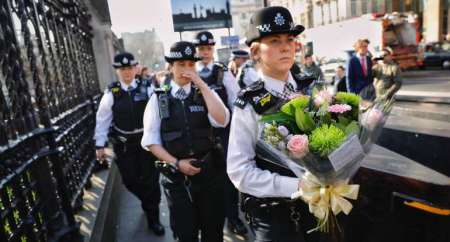
Police officers leave flowers on Westminster Bridge Aftermath of terror attack outside parliament, London, UK – 24 Mar 2017 (Rex Features via AP Images)

When the fire alarm was pulled by a cohort of rowdy student demonstrators prior to my wife’s anti-feminist talk at the University of Toronto in March 2013, she was hustled for her protection into a nearby patrol car. I appreciated the sympathetic police officer who stood guard beside me at the car door. When I muttered that I would destroy anyone who laid a finger on Janice, he replied: “I’m with you, bro.”

I recall, too, an event at St. Paul University in Ottawa where a masked rabble, calling itself the Revolutionary Student Movement — Marxists in the making — disrupted a talk by journalist and author Cathy Young. When I suggested to the police officers present that the paddy wagon should be called in and the protestors arrested, the officers were plainly uncomfortable, one of whom confessed that they had no authority to do so. A good man, he shrugged his shoulders and gave me a rueful look. I later met one of this honorable cadre of officers at a conservative conference, who told me he often felt ashamed of his superiors and resented some of the orders he was compelled to follow.

Of course, there were, and are, bad apples among ordinary cops, but I have always respected the orchard. Indeed, some of my best students were to be found in the Police Tech classes I regularly taught. Their interests were not strictly academic or distinctively intellectual, but they were diligent, reliable and unfailingly courteous — in this regard, they formed an ideal body of students and citizens who took their responsibilities seriously. Regrettably, one cannot say the same for the general run of their compromised and politically correct superiors, who will often order their subordinates to “stand down” during protests, street demonstrations and riots.

Clearly, it is in the leadership where the general rot sets in, that is, where career and perquisites tend to take precedence over duty and conscience. We have seen many instances of reprehensible conduct on the part of higher authority, of which the most outrageous in Canada was the Caledonia scandal in which the police, under orders from former OPP Commissioner Julian Fantino, allowed “First Nations” vandals to rampage for years over a land dispute — giving them “space to destroy,” as in the Baltimore riots. Authorities like LAPD Police Chief Charlie Beck or Connecticut Governor Dannel Malloy preventing police from carrying out their prescribed duties in enforcing immigration orders, or Massachusetts Governor Charlie Baker announcing he will defy Trump’s cut in Planned Parenthood funding also spring immediately to mind. The roster of civic and political disreputables doesn’t end there.

While it is heartening to see President Trump offer his respect and support for the nation’s police officers who carry out their lawful mandate, even when it goes against the individual’s grain, it is equally distressing to note the lawless disobedience of many in the top echelons who refuse to accept his presidential orders. In the law enforcement community, this is the point at which the police unions, where they exist, should step in to enable their members to perform both their lawful and morally legitimate duties, whether by wielding the strike option or work-to-rule policy. Canadian policemen are on the whole better off than their American colleagues, but they too are frequently countermanded by the police bureaucracy and forced to act against their moral judgement or are cruelly harassed on the flimsiest of grounds. In such instances officers may have recourse to the courts, though such an expedient may be hazardous to their employment prospects and service record.

But not always. In a case that lasted for 12 years, a certain Sgt. Peter Merrifield of the fabled Mounties has just won a major decision against his superintendent, who persecuted him mercilessly for running for a Conservative Party nomination. The RCMP, reports the National Post, “has been dogged for years by accusations of a toxic internal culture rife with bullying and harassment.” One can readily detect how senior officials, generally of a left-liberal stamp, are influenced by political considerations, to the detriment of their subalterns. Merrifield is now advocating for RCMP unionization.

Obviously, in the present ideological milieu, it’s not good for one’s reputation or bank balance to praise or come to the defense of rank-and-file policemen, as I can attest from personal experience. For example, an article I wrote, inter alia defending policemen and ordinary citizens who found themselves under attack by thugs like Mike Brown and Trayvon Martin, appeared in one of Canada’s literary journals. It was very quickly scrubbed and de-archived. The editor wrote a blogpology in which I was, in effect, branded as a systemic racist, and my métier as a published author in this country soon crashed and burned.

Policemen Darren Wilson and Daniel Pantaleo, as well as neighborhood-watch civilian George Zimmerman, whom I had in mind in the offending article, were all eventually vindicated, but progressivist sympathy is almost instinctively extended, often on racial grounds, to criminal perpetrators. As Heather Mac Donald writes in City Journal, “On the left, it is only acceptable to speak about the loss of a black life if a police officer is responsible. But police shootings, overwhelmingly triggered by violently resisting suspects, cause a minute fraction of black homicide deaths.” To imply as I did that Wilson, Pantaleo and Zimmerman had reason and justice on their side leads, in our left-oriented, “social justice” climate of identity politics, to social and professional ostracism — my case is by no means unique — and far worse to on-and-off duty policemen. According to reports, 64 police officers were shot and ambushed in the U.S. in 2016 in a veritable war on cops.

Ordinary policemen, who daily put their lives on the line to ensure public security, are getting a raw deal. Often handcuffed by their politically appointed superiors and the object of much public odium and media calumny, they run the double threat of violence and misprision. “Our officers, deputies and troopers believe the political leadership of this country abandoned them,” said Attorney General Jeff Sessions at the National Association of Attorneys General Annual Winter Meeting; “Their morale has suffered.”

I think back to my Police Tech students and wonder about the life they have chosen for themselves. Canada is a more temperate country than the U.S., but they run real risks and receive little in the way of gratitude or respect for a service most of us are not willing to perform.

“I’m with you, bro,” as the officer standing beside me said, protecting my wife from possible assault. It’s time we returned the favor.

The future of counterterrorism: Addressing the evolving threat to domestic security

March 1, 2017

The future of counterterrorism: Addressing the evolving threat to domestic security, Long War Journal, February 28, 2017

Below is Thomas Joscelyn’s testimony to the House Committee on Homeland Security, Subcommittee Counterterrorism and Intelligence, on the future of counterterrorism and addressing the evolving threat to domestic security.

Chairman King, Ranking Member Rice, and other members of the committee, thank you for inviting me to testify today. The terrorist threat has evolved greatly since the September 11, 2001 hijackings. The U.S. arguably faces a more diverse set of threats today than ever. In my written and oral testimony, I intend to highlight both the scope of these threats, as well as some of what I think are the underappreciated risks.

My key points are as follows:

– The U.S. military and intelligence services have waged a prolific counterterrorism campaign to suppress threats to America. It is often argued that because no large-scale plot has been successful in the U.S. since 9/11 that the risk of such an attack is overblown. This argument ignores the fact that numerous plots, in various stages of development, have been thwarted since 2001. Meanwhile, Europe has been hit with larger-scale operations. In addition, the U.S. and its allies frequently target jihadists who are suspected of plotting against the West. America’s counterterrorism strategy is mainly intended to disrupt potentially significant operations that are in the pipeline.

-Over the past several years, the U.S. military and intelligence agencies claim to have struck numerous Islamic State (or ISIS) and al Qaeda “external operatives” in countries such as Afghanistan, Iraq, Libya, Pakistan, Syria, Yemen, and elsewhere. These so-called “external operatives” are involved in anti-Western plotting. Had they not been targeted, it is likely that at least some of their plans would have come to fruition. Importantly, it is likely that many “external operatives” remain in the game, and are still laying the groundwork for attacks in the U.S. and the West.

-In addition, the Islamic State and al Qaeda continue to adapt new messages in an attempt to inspire attacks abroad. U.S. law enforcement has been forced to spend significant resources to stop “inspired” plots. As we all know, some of them have not been thwarted. The Islamic State’s caliphate declaration in 2014 heightened the threat of inspired attacks, as would-be jihadists were lured to the false promises of Abu Bakr al Baghdadi’s cause.

-The Islamic State also developed a system for “remote-controlling” attacks in the West and elsewhere. This system relies on digital operatives who connect with aspiring jihadis via social media applications. The Islamic State has had more success with these types of small-scale operations in Europe. But as I explain in my written testimony, the FBI has uncovered a string of plots inside the U.S. involving these same virtual planners.

-The refugee crisis is predominately a humanitarian concern. The Islamic State has used migrant and refugee flows to infiltrate terrorists into Europe. Both the Islamic State and al Qaeda could seek to do the same with respect to the U.S., however, they have other means for sneaking jihadists into the country as well. While some terrorists have slipped into the West alongside refugees, the U.S. should remain focused on identifying specific threats.

-More than 15 years after 9/11, al Qaeda remains poorly understood. Most of al Qaeda’s resources are devoted to waging insurgencies in several countries. But as al Qaeda’s insurgency footprint has spread, so has the organization’s capacity for plotting against the West. On 9/11, al Qaeda’s anti-Western plotting was primarily confined to Afghanistan, with logistical support networks in Pakistan, Iran, and other countries. Testifying before the Senate in February 2016, Director of National Intelligence (DNI) James Clapper warned that the al Qaeda threat to the West now emanates from multiple countries. Clapper testified that al Qaeda “nodes in Syria, Pakistan, Afghanistan, and Turkey” are “dedicating resources to planning attacks.” To this list we can add Yemen. And jihadists from Africa have been involved in anti-Western plotting as well. Incredibly, al Qaeda is still plotting against the U.S. from Afghanistan.

Both the Islamic State and al Qaeda continue to seek ways to inspire terrorism inside the U.S. and they are using both new and old messages in pursuit of this goal.

The jihadists have long sought to inspire individuals or small groups of people to commit acts of terrorism for their cause. Individual terrorists are often described as “lone wolves,” but that term is misleading. If a person is acting in the name of a global, ideological cause, then he or she cannot be considered a “lone wolf,” even if the individual in question has zero contact with others. In fact, single attackers often express their support for the jihadists’ cause in ways that show the clear influence of propaganda.

Indeed, al Qaeda and al Qaeda in the Arabian Peninsula (AQAP) first began to aggressively market the idea of “individual” or “lone” operations years ago. AQAP’s Inspire magazine is intended to provide would-be jihadists with everything they could need to commit an attack without professional training or contact. Anwar al Awlaki, an AQAP ideologue who was fluent in English, was an especially effective advocate for these types of plots. Despite the fact that Awlaki was killed in a U.S. airstrike in September 2011, his teachings remain widely available on the internet.

The Islamic State capitalized on the groundwork laid by Awlaki and AQAP. In fact, Abu Bakr al Baghdadi’s operation took these ideas and aggressively marketed them with an added incentive. Al Qaeda has told its followers that it wants to eventually resurrect an Islamic caliphate. Beginning in mid-2014, the Islamic State began to tell its followers that it had already done so in Iraq, Syria, and elsewhere. Baghdadi’s so-called caliphate has also instructed followers that it would be better for them to strike inside their home countries in the West, rather than migrate abroad for jihad. The Islamic State has consistently marketed this message.

In May 2016, for instance, Islamic State spokesman Abu Muhammad al Adnani told followers that if foreign governments “have shut the door of hijrah [migration] in your faces,” then they should “open the door of jihad in theirs,” meaning in the West. “Make your deed a source of their regret,” Adnani continued. “Truly, the smallest act you do in their lands is more beloved to us than the biggest act done here; it is more effective for us and more harmful to them.”

“If one of you wishes and strives to reach the lands of the Islamic State,” Adnani told his audience, “then each of us wishes to be in your place to make examples of the crusaders, day and night, scaring them and terrorizing them, until every neighbor fears his neighbor.” Adnani told jihadists that they should “not make light of throwing a stone at a crusader in his land,” nor should they “underestimate any deed, as its consequences are great for the mujahidin and its effect is noxious to the disbelievers.”

The Islamic State continued to push this message after Adnani’s death in August 2016.

In at least several cases, we have seen individual jihadists who were first influenced by Awlaki and AQAP gravitate to the Islamic State’s cause. Syed Rizwan Farook and his wife were responsible for the December 2, 2015 San Bernardino massacre. They pledged allegiance to Baghdadi on social media, but Farook had drawn inspiration from Awlaki and AQAP’s Inspire years earlier.

Omar Mateen swore allegiance to Baghdadi repeatedly on the night of his assault on a LGBT nightclub in Orlando, Florida. However, a Muslim who knew Mateen previously reported to the FBI that Mateen was going down the extremist path. He told the FBI in 2014 that Mateen was watching Awlaki’s videos. It was not until approximately two years later, in early June 2016, that Mateen killed 49 people and wounded dozens more in the name of the supposed caliphate.

Ahmad Khan Rahami, the man who allegedly planted bombs throughout New York and New Jersey in September 2016, left behind a notebook. In it, Rahami mentioned Osama bin Laden, “guidance” from Awlaki, an also referenced Islamic State spokesman Adnani. Federal prosecutors wrote in the complaint that Rahami specifically wrote about “the instructions of terrorist leaders that, if travel is infeasible, to attack nonbelievers where they live.” This was Adnani’s key message, and remains a theme in Islamic State propaganda.

The Department of Justice (DOJ) has alleged that other individuals who sought to support the Islamic State were first exposed to Awlaki’s teachings as well.

These cases demonstrate that the jihadis have developed a well of ideas from which individual adherents can draw, but it may take years for them to act on these beliefs, if they ever act on them at all. There is no question that the Islamic State has had greater success of late in influencing people to act in its name. But al Qaeda continues to produce recruiting materials and to experiment with new concepts for individual attacks as well.

Al Qaeda and its branches have recently called for revenge for Sheikh Omar Abdel Rahman, who died in a U.S. prison earlier this month. Rahman was convicted by a U.S. court for his involvement in plots against New York City landmarks in the mid-1990s. Since then, al Qaeda has used Rahman’s “will” to prophesize his death and to proactively blame the U.S. for it. Approximately 20 years after al Qaeda first started pushing this theme, Rahman finally died. Al Qaeda’s continued use of Rahman’s prediction, which is really just jihadist propaganda, demonstrates how these groups can use the same concepts for years, whether or not the facts are consistent with their messaging. Al Qaeda also recently published a kidnapping guide based on old lectures by Saif al Adel, a senior figure in the group. Al Adel may or may not be currently in Syria. Al Qaeda is using his lectures on kidnappings and hostage operations as a way to potentially teach others how to carry them out. The guide was published in both Arabic and English, meaning that al Qaeda seeks an audience in the West for al Adel’s designs.

Both the Islamic State and AQAP also continue to produce English-language magazines for online audiences. The 15th issue of Inspire, which was released last year, provided instructions for carrying out “professional assassinations.” AQAP has been creating lists of high-profile targets in the U.S. and elsewhere that they hope supporters will use in selecting potential victims. AQAP’s idea is to maximize the impact of “lone” attacks by focusing on wealthy businessmen or other well-known individuals. AQAP has advocated for, and praised, indiscriminate attacks as well. But the group has critiqued some attacks (such as the Orlando massacre at a LGBT nightclub) for supposedly muddying the jihadists’ message. AQAP is trying to lay the groundwork for more targeted operations. For example, the January 2015 assault on Charlie Hebdo’s offices in Paris was set in motion by al Qaeda and AQAP. Inspire even specifically identified the intended victims beforehand. Al Qaeda would like individual actors, with no foreign ties, to emulate such precise hits.

Meanwhile, the Islamic State has lowered the bar for what is considered a successful attack, pushing people to use cars, knives, or whatever weapons they can get in their hands. The Islamic State claimed that both the September 2016 mall stabbings in Minnesota and the vehicular assault at Ohio State University in November 2016 were the work of its “soldiers.” It may be the case that there were no digital ties between these attackers and the Islamic State. However, there is often more to the story of how the Islamic State guides such small-scale operations.

The Islamic State has sought to carry out attacks inside the U.S. via “remote-controlled” terrorists.

A series of attacks in Europe and elsewhere around the globe have been carried out by jihadists who were in contact, via social media applications, with Islamic State handlers in Syria and Iraq. The so-called caliphate’s members have been able to remotely guide willing recruits through small-scale plots that did not require much sophistication. These plots targeted victims in France, Germany, Russia, and other countries. In some cases, terrorists have received virtual support right up until the moment of their attack. The Islamic State has had more success orchestrating “remote-controlled” plots in Europe, but the jihadist group has also tried to carry out similar plots inside the U.S.

Since 2015, if not earlier, the U.S.-led coalition has launched airstrikes against the Islamic State operatives responsible for these operations. Jihadists such Rachid Kassim, Junaid Hussain, and Abu Issa al Amriki have all been targeted. Both Hussain and al Amriki sought to “remotely-control” attacks inside the U.S. They have reached into other countries as well. For example, British Prime Minister David Cameron connected Hussain to plots in the UK. And Hussain’s wife, Sally Jones, has also reportedly used the web to connect with female recruits.

Kassim was tracked to a location near Mosul, Iraq earlier this month. Hussain was killed in an American airstrike in Raqqa, Syria on August 24, 2015. Along with his wife, al Amriki perished in an airstrike near Al Bab, Syria on April 22, 2016. But law enforcement officials are still dealing with their legacy and it is possible that others will continue with their methods.

In this section, I will briefly outline several cases in which Hussain and al Amriki were in contact with convicted or suspected terror recruits inside the U.S. In a number of cases, the FBI has used confidential informants or other methods in sting operations to stop these recruits. It should be noted that it is not always clear how much of a threat a suspect really posed and the press has questioned the FBI’s methods in some of these cases. I have included the examples below to demonstrate how the Islamic State’s digital operatives have contacted potential jihadists across the U.S.

For example, Hussain was likely in contact with the two gunmen who opened fire at an event dedicated to drawing pictures of the Prophet Mohammed in Garland, Texas on May 3, 2015. As first reported by the SITE Intelligence Group, Hussain (tweeting under one of his aliases) quickly claimed the gunmen were acting on behalf of the caliphate. Then, in June 2015, Hussain claimed on Twitter that he had encouraged Usaamah Rahim, an Islamic State supporter, to carry a knife in case anyone attempted to arrest him. Rahim was shot and killed by police in Boston after allegedly wielding the blade. The DOJ subsequently confirmed that Rahim was “was communicating with [Islamic State] members overseas, including Junaid Hussain.”

On July 7, 2016, Munir Abdulkader, of West Chester, Ohio, pleaded guilty to various terrorism-related charges. According to the DOJ, Abdulkader communicated with Hussain, who “directed and encouraged Abdulkader to plan and execute a violent attack within the United States.” In conversations with both Hussain and a “confidential human source,” Abdulkader discussed a plot “to kill an identified military employee on account of his position with the U.S. government.” Abdulkader planned to abduct “the employee at the employee’s home” and then film this person’s execution. After murdering the military employee, Abdulkader “planned to perpetrate a violent attack on a police station in the Southern District of Ohio using firearms and Molotov cocktails.” Hussain repeatedly encouraged Islamic State followers to attack U.S. military personnel, just as Abdulkader planned.

On August 11, 2016, Emanuel Lutchman of Rochester, New York pleaded guilty to conspiring to provide material support to the Islamic State as part of a planned New Year’s Eve attack. Lutchman admittedly conspired with Abu Issa al Amriki after he “initiated online contact” with the Islamic State planner on Christmas Day 2015. “In a series of subsequent communications,” DOJ noted, al Amriki “told Lutchman to plan an attack on New Year’s Eve and kill a number of kuffar [nonbelievers].” Al Amriki wanted Lutchman “to write something before the attack and give it to” an Islamic State member, “so that after the attack the [Islamic State] member could post it online to announce Lutchman’s allegiance” to the so-called caliphate. Lutchman wanted to join the Islamic State overseas, but al Amriki encouraged him to strike inside the U.S., as it would better serve the jihadists’ cause. “New years [sic] is here soon,” al Amriki typed to Lutchman. “Do operations and kill some kuffar.” Al Amriki also promised Lutchman some assistance in traveling to Syria or Libya, if the conditions were right. Lutchman divulged his contacts with al Amriki to individuals who, “unbeknownst to Lutchman,” were “cooperating with the FBI.”

On November 7, 2016, Aaron Travis Daniels, also known as Harun Muhammad and Abu Yusef, was arrested at an airport in Columbus, Ohio. He was reportedly en route to Trinidad, but he allegedly intended to travel to Libya for jihad. According to DOJ, Daniels was in contact with Abu Issa al Amriki, who acted as a “recruiter and external attack planner.” Daniels said at one point that it was al Amriki who “suggested” he go to Libya “to support jihad” and he allegedly “wired money to an intermediary” for al Amriki. The DOJ did not allege that Daniels planned to commit an attack in Ohio or elsewhere inside the U.S. Still, the allegations are significant because Daniels was allegedly in contact with al Amriki.

On November 29, 2016, Justin Nojan Sullivan, of Morganton, North Carolina, pleaded guilty to terrorism-related charges. “Sullivan was in contact and plotted with now-deceased Syria-based terrorist Junaid Hussain to execute acts of mass violence in the United States in the name of the” Islamic State, Acting Assistant Attorney General for National Security Mary B. McCord said in a statement. Sullivan and Hussain “conspired” to “plan mass shooting attacks in North Carolina and Virginia,” with Sullivan intending “to kill hundreds of innocent people.”

On February 10, 2017, the DOJ announced that two New York City residents, Munther Omar Saleh and Fareed Mumuni, pleaded guilty to terror-related charges. “Working with [Islamic State] fighters located overseas, Saleh and Mumuni also coordinated their plot to conduct a terrorist attack in New York City,” the DOJ explained. Saleh, from Queens, sought and received instructions from an [Islamic State] attack facilitator to create a pressure-cooker bomb and discussed with the same [Islamic State] attack facilitator potential targets for a terrorist attack in New York City.” Saleh “also sought and received religious authorization from an [Islamic State] fighter permitting Mumuni to conduct a suicide ‘martyrdom’ attack by using a pressure-cooker bomb against law enforcement officers who were following the co-conspirators and thus preventing them from traveling to join” the Islamic State. Federal prosecutors revealed that the “attack facilitator” Saleh was talking to was, in fact, Junaid Hussain.

Also on February 10, 2017, Mohamed Bailor Jalloh, a Virginia man and former member of the Army National Guard, was sentenced to 11 years in prison and five years supervised release for attempting to provide material support to the Islamic State. According to the DOJ, Jalloh was in contact with Islamic State members both in person and online. He met Islamic State members in Nigeria during a “six-month trip to Africa” and also “began communicating online with” an Islamic State member located overseas during this time. The Islamic State member “brokered” Jalloh’s “introduction” to the FBI’s confidential human source. This means the U.S. government’s intelligence was so good in this case that the digital handler was actually fooled into leading Jalloh into a dead-end. Still, Jalloh considered “conducting an attack similar to the terrorist attack at Ft. Hood, Texas,” which left 13 people dead and dozens more wounded.

More than 15 years after the 9/11 hijackings, al Qaeda is still plotting against the U.S.

Al Qaeda has not been able to replicate its most devastating attack in history, the September 11, 2001 hijackings. But this does not mean the al Qaeda threat has disappeared. Instead, al Qaeda has evolved. There are multiple explanations for why the U.S. has not been struck with another 9/11-style, mass casualty operation. These reasons include: the inherent difficulty in planning large-scale attacks, America’s improved defenses, and a prolific counterterrorism campaign overseas.

In addition, contrary to a widely-held assumption in counterterrorism circles, al Qaeda has not made striking the U.S. its sole priority. In fact, al Qaeda leader Ayman al Zawahiri has even ordered his men in Syria to stand down at times, as they prioritized the war against Bashar al Assad’s regime over bombings, hijackings, or other assaults in the West. However, Zawahiri could change his calculation at any time, and it would then be up to America’s intelligence and law enforcement officials to detect and thwart specific plots launched from Syria. One additional caveat here is warranted. Despite the fact that Zawahiri has not given the final green light for an anti-Western operation launched from Syrian soil, al Qaeda has been laying the groundwork for such attacks in Syria and elsewhere. There is a risk that al Qaeda could seek to launch Mumbai-style attacks in American or European cities, bomb trains or other mass transit locations, plant sophisticated explosives on Western airliners, or dream up some other horrible attack.

In September 2014, the Obama administration announced that it launched airstrikes against al Qaeda’s so-called “Khorasan Group” in Syria. There was some confusion surrounding this group. The Khorasan Shura is an elite body within al Qaeda and part of this group is dedicated to launching “external operations,” that is, attacks in the West. Several significant leaders in the Khorasan Group were previously based in Iran, where al Qaeda maintains a core facilitation hub. In fact, at least two Khorasan figures previously headed al Qaeda’s Iran-based network, which shuttles operatives throughout the Middle East and sometimes into the West. As I have previously testified before this committee, some foiled al Qaeda plots against the West were facilitated by operatives based in Iran.

Al Qaeda began relocating senior operatives to Syria in 2011. And the U.S. has targeted known or obscure al Qaeda veterans in Syria in the years since, often citing their presumed threat to the U.S. and the West. I will not list all of these operatives here, but we regularly track the al Qaeda figures targeted in drone strikes at FDD’s Long War Journal.

During the final months of the Obama administration, American military and intelligence officials highlighted al Qaeda’s continued plotting against the U.S. on multiple occasions. And there was also a shift in America’s air campaign, from targeted strikes on individual al Qaeda operatives in Syria to bombings intended to destroy whole training camps or other facilities. In addition, the U.S. Treasury and State Departments began to designate terrorist leaders within al Qaeda’s branch in Syria who may not play any direct role in international operations. This change in tactics reflects the realization that al Qaeda has built its largest paramilitary force in history in Syria. And while only part of this force may have an eye on the West, there is often no easy way to delineate between jihadists involved in al Qaeda’s insurgency operations and those who are participating in plots against America or European nations.

In October 2016, the Defense Department announced that the U.S. had carried out “transregional” airstrikes against al Qaeda’s “external” operatives in Syria, Yemen, and Afghanistan. Al Qaeda “doesn’t recognize borders when they conspire to commit terrorist attacks against the West, and we will continue to work with our partners and allies to find and destroy their leaders, their fighters and their cells that are planning attacks externally,” Pentagon spokesman Navy Capt. Jeff Davis said shortly after the bombings. Davis added that some of al Qaeda’s “external” plotters enjoyed a “friendly, hospitable environment” within Al Nusrah Front, which was the name used by al Qaeda’s guerrilla army in Syria until mid-2016. Davis added that the jihadists targeted “are people who are from outside Syria in many cases and who are focused on external operations.”

The Pentagon provided short descriptions for each of the al Qaeda operatives targeted in October 2016. On October 17, Haydar Kirkan was killed in Idlib, Syria. He was “a long-serving and experienced facilitator and courier for al Qaeda in Syria,” who “had ties to al Qaeda senior leaders, including Osama bin Laden.” Davis added that Kirkan “was al Qaeda’s senior external terror attack planner in Syria, Turkey and Europe.” Kirkan oversaw a significant network inside Turkey. The U.S. has killed a number of individuals with backgrounds similar to Kirkan since 2014.

On October 21, an AQAP leader known as Abu Hadi al-Bayhani and four others were killed in a U.S. airstrike in Yemen’s Marib governorate. The Pentagon tied al-Bayhani to AQAP’s “external” plotting, noting that the al Qaeda arm relies on “leaders like Bayhani to build and maintain safe havens” from which it “plans external operations.”

Then, on October 23, two senior al Qaeda leaders, Farouq al-Qahtani and Bilal al-Utabi, were killed in airstrikes in Afghanistan. Qahtani was one of al Qaeda’s most prominent figures in the Afghan insurgency, as he was the group’s emir for eastern Afghanistan and coordinated operations with the Taliban. Osama bin Laden’s files indicate that Qahtani was responsible for re-establishing al Qaeda’s safe havens in Afghanistan in 2010, if not earlier. But Qahtani was also tasked with plotting attacks in the West.

General John W. Nicholson, the Commander of NATO’s Resolute Support and U.S. Forces in Afghanistan, described the threat posed by Qahtani in a recent interview with the CTC Sentinel, a publication produced by the Combating Terrorism Center at West Point. Gen. Nicholson described Qahtani as al Qaeda’s “external operations director,” saying that he was “actively involved in the last year in plotting attacks against the United States.” Nicholson added this warning: “There’s active plotting against our homeland going on in Afghanistan. If we relieve pressure on this system, then they’re going to be able to advance their work more quickly than they would otherwise.”

Kirkan, Bayhani, and Qahtani are just some of the men involved in anti-Western plotting who have been killed in recent bombings. And these targeted airstrikes are just part of the picture.

In October 2015, the U.S. and its Afghan allies destroyed what was probably the largest al Qaeda training camp in Afghanistan’s history in the Shorabak district of Kandahar. The facility was an estimated 30 square miles in size, making it bigger than any of al Qaeda’s pre-9/11 camps.

The U.S. military says that approximately 250 al Qaeda operatives were killed or captured in Afghanistan in 2016. This is far more than the U.S. government’s longstanding estimate for al Qaeda’s entire force structure in all of Afghanistan. For years, U.S. officials claimed there was just 50 to 100 al Qaeda jihadists throughout the entire country.

On January 20, the Defense Department announced that “more than 150 al Qaeda terrorists” had been killed in Syria since the beginning of 2017. In addition to individual terrorists involved in plotting against the West, the U.S. struck the Shaykh Sulayman training camp, which had been “operational since at least 2013.”

The reality is that al Qaeda now operates large training camps in more countries today than on 9/11. The next 9/11-style plotters could be in those camps, or fighting in jihadist insurgencies, right now. If so, it will be up to America’s offensive counterterrorism campaign and its defenses to stop them.

Thomas Joscelyn is a Senior Fellow at the Foundation for Defense of Democracies and the Senior Editor for FDD’s Long War Journal.
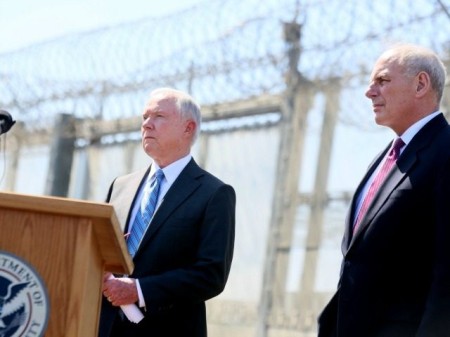
Promises to Keep

February 13, 2017

Promises to Keep, Front Page MagazineMichael Cutler, February 13, 2017

(“And miles to go before I sleep.” — DM)

cvb_1

During his campaign for the presidency Donald Trump frequently disdainfully scowled when he spoke about how most politicians were “All talk and no action.”

Candidate Trump promised that immigration would be a primary focus of his administration.

President Trump has indeed focused on multiple aspects of the immigration crisis that go well beyond building a wall along the U.S./Mexican border.

His selection of Senator Jeff Sessions to be his Attorney General was the best possible choice for this important position.

Sessions had chaired the Senate Subcommittee on Immigration and the National Interest.

Consider that on February 25, 2016 that subcommittee conducted a hearing on the topic, “The Impact of High-Skilled Immigration on U.S. Workers.”

When the Obama administration conducted meetings for “Stakeholders” on the immigration issue corporate leaders were invited to attend as were immigration lawyers representing illegal aliens and special interest groups that advocate for illegal aliens.

However, no one in attendance represented the “average American.”

Even the union leaders representing the Border Patrol, ICE agents and the adjudications officers were barred from participating in those meetings.

On February 9, 2017 President Trump held a news conference in the Oval Office to conduct a public swearing in ceremony of Attorney General Jeff Sessions.

Immediately after Vice President Pence swore in Jeff Sessions, President Trump signed three executive orders:

Presidential Executive Order on Enforcing Federal Law with Respect to Transnational Criminal Organizations and Preventing International Trafficking

Presidential Executive Order on Preventing Violence Against Federal, State, Tribal, and Local Law Enforcement Officers

Presidential Executive Order on a Task Force on Crime Reduction and Public Safety

President Trump promised to be the “Law and Order” President and he has certainly hit the ground running.

His executive order to prevent violence against law enforcement officers is tangible evidence of his keeping his promise to look out for law enforcement officers.

Let’s next consider how he articulated the purpose for his executive order on enforcing federal laws to attack transnational criminal organizations:

Section 1.  Purpose.  Transnational criminal organizations and subsidiary organizations, including transnational drug cartels, have spread throughout the Nation, threatening the safety of the United States and its citizens.  These organizations derive revenue through widespread illegal conduct, including acts of violence and abuse that exhibit a wanton disregard for human life.  They, for example, have been known to commit brutal murders, rapes, and other barbaric acts.

These groups are drivers of crime, corruption, violence, and misery.  In particular, the trafficking by cartels of controlled substances has triggered a resurgence in deadly drug abuse and a corresponding rise in violent crime related to drugs.  Likewise, the trafficking and smuggling of human beings by transnational criminal groups risks creating a humanitarian crisis.  These crimes, along with many others, are enriching and empowering these organizations to the detriment of the American people.

A comprehensive and decisive approach is required to dismantle these organized crime syndicates and restore safety for the American people.

That statement underscores his understanding of how important immigration law enforcement and border security are to combatting transnational criminals.

What is unfathomable is how many politicians who have to understand this issue have opposed Trump at every opportunity.  Only they can explain their conduct.  However, I have to conclude that those who would oppose President Trump’s efforts to secure our nation’s borders and effectively enforce our immigration laws are siding with the cartels and transnational criminal organizations.

This certainly apply to mayors of “Sanctuary Cities” and governors who want to create “Sanctuary States.”

Sanctuary Cities should be called “Magnet Cities” because they attract criminal aliens including members of transnational gangs, fugitives and international terrorists.

The politicians’ claims that by shielding vulnerable illegal aliens from immigration law enforcement they would be willing to come forward when they fall victim to criminals is a blatant lie that ignores that Sanctuary Cities Endanger – National Security and Public Safety.

Sanctuary policies attract more violent criminals who are likely victimize members of the ethnic immigration communities.  However the false narrative serves to vilify valiant ICE agents who go in harms way every day they report for duty, seeking to protect national security and innocent lives.

Statutorily, U Visas are available for victims of human trafficking and other crimes if they come forward and assist with law enforcement efforts to apprehend the criminals.  Similar visa programs are available for illegal aliens who provide assistance to criminal investigations.

If those duplicitous politicians really wanted to assist illegal alien victims of crimes they would bring them to immigration offices and urge them to cooperate with the investigations of their criminal assailants.

That way everyone would win.

But then the politicians would not get their campaign contributions from the U.S. Chamber of Commerce and a host of special interest groups, and who know who else, who are literally and figuratively making out like bandits by exploiting the immigration system.

In continuing to consider Trump’s executive order on trafficking I call your attention to two of the key elements of this executive order are proverbial “music to my ears.”

(e)  develop strategies, under the guidance of the Secretary of State, the Attorney General, and the Secretary of Homeland Security, to maximize coordination among agencies — such as through the Organized Crime Drug Enforcement Task Forces (OCDETF), Special Operations Division, the OCDETF Fusion Center, and the International Organized Crime Intelligence and Operations Center — to counter the crimes described in subsection (a) of this section, consistent with applicable Federal law; and

(f)  pursue and support additional efforts to prevent the operational success of transnational criminal organizations and subsidiary organizations within and beyond the United States, to include prosecution of ancillary criminal offenses, such as immigration fraud and visa fraud, and the seizure of the implements of such organizations and forfeiture of the proceeds of their criminal activity.

I speak from extensive experience when I say that this task force approach to identifying, investigating and dismantling international drug trafficking organizations is extremely effective.  I spent the final ten years of my career with the INS as a Senior Special Agent assigned to the OCDETF program in New York City.

As for immigration fraud and visa fraud, these two issues are elements of “Extreme vetting” that Trump promised when he campaigned for the presidency.

On May 18, 2004 I testified at a hearing by the House Immigration Subcommittee on the topic of Pushing the Border Out on Alien Smuggling: New Tools and Intelligence Initiatives that addressed the issues of visa fraud and also the strategy of providing visas for illegal alien informants.

On May 20, 1997 I testified before the House Immigration Subcommittee on the topic, Visa Fraud And Immigration Benefits Application Fraud.

That hearing was predicated on two deadly terror attacks carried out in 1993 at the CIA and first World Trade Center Bombing.

In one way or another, all of those involved with those attacks had gamed the visa system and/or the immigration benefits program.

The Clinton administration’s failures to address these vulnerabilities of visa fraud and immigration fraud that enabled these two deadly attacks to be conducted on American soil literally and figuratively, left the door open to the deadly terror attacks of 9/11.

The report, “9/11 and  Terrorist TravelStaff Report of the National Commission on Terrorist Attacks Upon the United States” included this excerpt found on pages 46 and 47:

In addition, Ramzi Yousef, the mastermind of the attack, and Ahmad Ajaj, who was able to direct aspects of the attack despite being in prison for using an altered passport, traveled under aliases using fraudulent documents. The two of them were found to possess five passports as well as numerous documents supporting their aliases: a Saudi passport showing signs of alteration, an Iraqi passport bought from a Pakistani official, a photo-substituted Swedish passport, a photo-substituted British passport, a Jordanian passport, identification cards, bank records, education records, and medical records.6

“Once terrorists had entered the United States, their next challenge was to find a way to remain here. Their primary method was immigration fraud. For example, Yousef and Ajaj concocted bogus political asylum stories when they arrived in the United States. Mahmoud Abouhalima, involved in both the World Trade Center and landmarks plots, received temporary residence under the Seasonal Agricultural Workers (SAW) program, after falsely claiming that he picked beans in Florida.” Mohammed Salameh, who rented the truck used in the bombing, overstayed his tourist visa. He then applied for permanent residency under the agricultural workers program, but was rejected. Eyad Mahmoud Ismail, who drove the van containing the bomb, took English-language classes at Wichita State University in Kansas on a student visa; after he dropped out, he remained in the United States out of status.

In the years since the terror attacks of 9/11 more terror attacks were carried out in the United States while other attacks, for one reason or another, failed.  Most of those attacks involved aliens who committed visa fraud and/or immigration fraud.

Trump’s executive orders address our immigration vulnerabilities and Attorney General Sessions will provide the legal horsepower.

All Americans should be thrilled that this President is keeping his promises.

Anti-Free Speech Riot at NYU: Crazier than Berkeley?

February 4, 2017

Anti-Free Speech Riot at NYU: Crazier than Berkeley? Power LineJohn Hinderaker, February 4, 2017

This woman says that the job of the police is to beat up people with whom she disagrees. And she thinks the other side–the ones trying to give, and listen to, a speech–are “neo-Nazis.” That is modern liberalism in a nutshell.

An update to the Unz post says that the woman in the video “is possibly Rebecca Goyette, an artist who specializes in lobster-related pornography and video enactments of Donald Trump being castrated.” Based on a Google Images search, I would say the woman in the video is either Ms. Goyette or her double.

********************

On Thursday evening, Gavin McInnes, a comic, commentator and co-founder of Vice Media, attempted to give a speech at New York University, at the invitation of the NYU Republican group. A crowd of anti-free speech rioters battled police officers and ultimately succeeded in shutting down McInnes’s speech. Steve Sailer comments:

Unlike the Berkeley Police Department with Milo, the New York Police Department made sure Gavin McInness could actually deliver at least part of his talk at New York University at the invitation of the NYU Republicans. Gavin did get pepper-sprayed by anti-free speech activists, and eventually he got shut down after about 20 minutes by screamers.

***

The NYPD standing up for Gavin’s civil rights caused one protester to memorably enunciate to the line of cops protecting the dissidents the high principles and deep commitment to objective rationality that are at the heart of today’s anti-free speech movement.

nyu-riot-professor-video-crazy-1024x538

You have to see this to believe it, but trust me, you won’t be able to watch to the end:

https://www.youtube.com/watch?v=BJa_s_2QX_c

The Blaze helpfully provides a transcript of the alleged professor’s rant:

Who’s protecting NYU from this bulls**t? Why are you here? You’re not here to protect these students from Nazis. No, you’re not! This is completely f***ed up. And these students had to f***ing face them on their own. You should be ashamed of yourselves! You should be standing up to those Nazis! You should be protecting students from hate! This is hate! These are f***ing assholes … you are a joke. You’re grown boys! You’re grown boys … and I’m disgusted! I’m a professor! How dare you! How dare you f***ing assholes protect neo-Nazis? F*** you! F*** you! F*** you! These are kids who are trying to learn about humanity! They’re trying to learn about human rights and against racism and xenophobia and LGBTQ rights, and you’re letting these f***ing neo-Nazis near here! You should kick their ass! You should! You should be ashamed of yourselves! You should! F*** that s**t. F*** that s**t. It’s not up to these students to kick the ass of a neo-Nazi! They don’t have to raise their fist! They were taught to be peaceful! F*** you! F*** you. I’m a professor. God f***ing damn it … you’re here to protect neo-Nazis! So f*** you! God f***ing damn it! Those kids should not have to take fists up to neo-Nazis, and you’re putting them in that situation! Go to hell. F*** you NYPD!

This woman says that the job of the police is to beat up people with whom she disagrees. And she thinks the other side–the ones trying to give, and listen to, a speech–are “neo-Nazis.” That is modern liberalism in a nutshell.

An update to the Unz post says that the woman in the video “is possibly Rebecca Goyette, an artist who specializes in lobster-related pornography and video enactments of Donald Trump being castrated.” Based on a Google Images search, I would say the woman in the video is either Ms. Goyette or her double.

Rebecca Goyette is indeed a professor, although not at NYU. I would post pictures of her “work,” only this is a family site. Among other things, she doesn’t just hate Donald Trump, she hates the United States. I think her biggest beef against the U.S. is that she isn’t able to jail the people she dislikes.

It’s just another day in the life of the American left. I am so, so glad I voted for Donald Trump!

Inaugural Rioters Urged to ‘Go Hard’ in ‘Only Chance’ to ‘Rove the City’ Under ‘Protocol of the Obama Era

January 18, 2017

Inaugural Rioters Urged to ‘Go Hard’ in ‘Only Chance’ to ‘Rove the City’ Under ‘Protocol of the Obama Era, BreitbartLee Stramajan, January 17, 2017

(They seem to have escaped from their “safe spaces,” at least briefly. — DM)

anti-trumps-640x480

Some are calling for blockades at the checkpoints around the parade route, in hopes that Trump will ride into office in front of silent, empty bleachers. Others are preparing to rove the city, supporting and defending other protesters and responding to situations as they arise. Still others are looking at blocking the transportation infrastructure. Washington, DC offers countless possibilities for self-organized groups to set their own goals and choose their own targets on their own time. between a wide variety of tactics and points of intervention.

**************************

A chilling article from one of the over 75 groups that Breitbart News has identified as connected to the #DisruptJ20 events titled Ten Reasons to Go Hard on January 20 makes the case to anarchists, socialist and communist ruffians from across the country about “why would it be worth driving across the country to a city crowded with reactionaries and police.”

Saying that during the inauguration “the DC police will have their hands full” it ominously tells the web of American-hating, anti-capitalist activists worldwide that the January 20th inauguration “is our only chance to fight Trump under the laws and police protocol of the Obama era.”

The article lays out the overall plan of the gathering groups to “rove the city” and set up “blockades at the checkpoints around the parade route” as well as shutting down Washington D.C.’s “transportation infrastructure.”

The article, published just days ago by the website CrimethInc. also urges leftist protesters across the country to engage in lone-wolf style terror attacks and “pick a target and carry out an offensive strike.” It tells rioters who can’t make it to Washington D.C. to “choose their own targets” and “decorate your city in advance.”

The slick website CrimethInc describes itself and its purpose in heroic terms, even making a Star Wars reference by calling itself “a rebel alliance.”

CrimethInc. is a rebel alliance—a decentralized network pledged to anonymous collective action—a breakout from the prisons of our age. We strive to reinvent our lives and our world according to the principles of self-determination and mutual aid.

The reference shows how the left views itself and justifies it’s open calls for violence against Donald Trump supporters, people planning to attend the inaugural, and police. Breitbart Texas editor Brandon Darby explained in a recent interview that the left sees itself as “Luke Skywalker fighting Darth Vader, believing we’re the evil empire. That is what they believe in their head and they act accordingly because they actually believe that about us. We’ve been dehumanized that much.”

For months, the establishment media as well as mainstream politicians like Barack Obama and Hillary Clinton have demeaned both Donald Trump and his supporters constantly.

The article in Crimthinc also makes it clear that the left-wing groups gathering in Washington are thinking long-term and planning to build “new fighting formations.” They write:

The inauguration is an opportunity for a wide range of people to work together, building new networks that could act together for years to come.

If the actions on January 20 go well, new fighting formations might arise that could continue to act together as the Trump era gets underway.

The group openly outlines some of what they have in store for the inauguration:

Some are calling for blockades at the checkpoints around the parade route, in hopes that Trump will ride into office in front of silent, empty bleachers. Others are preparing to rove the city, supporting and defending other protesters and responding to situations as they arise. Still others are looking at blocking the transportation infrastructure. Washington, DC offers countless possibilities for self-organized groups to set their own goals and choose their own targets on their own time. between a wide variety of tactics and points of intervention.

The article highlights the group’s belief that “this is our only chance to fight Trump under the laws and police protocol of the Obama era.” and says:

Later, when the Trump administration introduces new laws and surveillance programs and government agencies and FBI operations, it will be too late to build up momentum to resist them. We have to do that right now, while millions of people are angry, before it becomes significantly more difficult to organize. Neither hiding out in secretive closed circles nor behaving passively and obediently will keep anyone safe. If no one puts up any resistance, the crackdown will hit everyone sooner or later. The only surefire guarantee of safety is a powerful movement that can support arrestees and impose material consequences for repression.

While the Crimethinc article tells readers that “anything that happens in DC will be worth 100 actions anywhere else,” it urges them to take direct even if they can’t get to Washington, D.C. and suggests:

…student walkouts, wildcat strikes, demonstrations, and more. You could decorate your city in advance, or pick a target and carry out an offensive strike to shut down business for the day. Everywhere in the US and around the world, January 20 will be an opportunity to connect with people on the basis of opposition to the regime.

Breitbart News will provide continuous coverage of both the inauguration and planned protests all day on January 20th.

Part I: Undercover investigation exposes groups plotting criminal activity at Trump inauguration

January 16, 2017

Part I: Undercover investigation exposes groups plotting criminal activity at Trump inauguration, Project Veritas via YouTube, January 16, 2017

According to the blurb beneath the video,

In this video, Project Veritas investigators uncover a group known as the DC Anti-fascist Coalition plotting to disrupt President-Elect Donald Trump’s inauguration by deploying butyric acid at the National Press Club during the Deploraball event scheduled for January 19th.

The meeting, captured on hidden camera, was held at Comet Ping Pong, a DC pizza restaurant that is better known as the location of the Pizzagate controversy. The coalition members discuss the steps they would need to take to halt the Deploraball event. Project Veritas notified the FBI, Secret Service and DC Metro Police of the content of this video prior to its release.