Archive for the ‘Kurds’ category

Christian Self-Defense Forces Emerge in Iraq & Syria

April 12, 2016

Christian Self-Defense Forces Emerge in Iraq & Syria, Clarion ProjectRyan Mauro, April 12, 2016

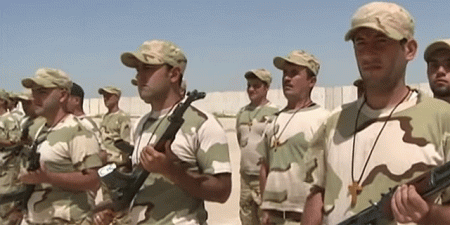
Babylon-Brigade-HPMembers of the Christian Babylon Brigade in Iraq (Video: screenshot)

The Christians of Iraq and Syria have had a breathtaking commitment to passivity since being victimized by what we all now finally agree qualifies as a genocide.

Now, the Christians are increasingly organizing to defend themselves—and the West should stand by them instead of outsourcing our moral responsibility to the Iraqis and their Iranian partners and various groups with questionable track records.

A poll in December 2014 found that only one-third of Iraqis say they are concerned about the persecution of Christians in their country. About 67 percent said they are not concerned at all or only “somewhat” concerned.

It’s easy to say that the U.S. should pressure the Iraqi government to protect the Christians, but its track record and these poll results do not inspire hope that it’ll work. The pace of the genocide is such that the Christians and those who care for them simply cannot afford to spend time hoping for the best.

A Christian force known as the Babylon Brigade has been incorporated into the Popular Mobilization Units, an assortment of militias led by the Iraqi government and their partners from the Iranian regime and Hezbollah. The Babylon Brigades and their supporters boast of their nationalism, having battled the Islamic State in non-Christian areas like Ramadi and Tikrit.

However, it numbers only 500 to 1,000 The Iraqi government should be applauded for supporting a Christian unit, but don’t mistake this for an Iraqi commitment to a Christian self-defense force that enables the community to have a say over whether it goes extinct or not.

Current U.S. policy still gambles their survival on the chance that the Iraqi government tied to Iran will protect them, particularly when the U.N. says Christian persecution in Iran has reached unprecedented levels.

The Kurds are allies of the U.S. but, when it comes to protecting Christians, they have been far from ideal. The Iraqi and Syrian Christians have plenty of stories of mistreatment at the hands of the Kurds.

The growth of a number of Christian self-defense forces in Iraq and Syria show potential for what could happen if they receive outside support.

There’s the Nineveh Plain Protection Units in northern Iraq under the helm of the Assyrian Democratic Movement of Iraq, which has a branch in northeastern Syria named the Gozarto Protection Forces. They are backed by the Middle East Christian Committee. The secretary-general of the Assyrian Democratic Movement claims that proper support would quickly grow the NPU’s numbers to 5,000.

Another small force is called Dwekh Nawsha, which is linked to the Assyrian Patriotic Party and has gotten attention because of Westerners joining their ranks. One of their advisers warned in November, “All we’re saying is we’re done. We don’t have equipment. We don’t have the weapons. We don’t have the training,” as he pleaded for U.S. backing.

In Syria, there is the Syriac Military Council, estimated to be about 2,000-strong including a Christian female unit. It belongs to a Kurdish-majority coalition known as the Syrian Democratic Forces. There is also a local Christian defense force near the Khabur River called the Khabur Guards.

Of course, any Christian force will have to be properly vetted. Hezbollah has set up a non-denominational force named Saraya al-Muqawama that includes Christians, Sunnis and non-religious Shiites.

A Christian police force that is favorable towards the Assad regime clashed with Kurdish forces in Qamishli, Syria. Sources close to the situation there emphasize that the Christians who embrace Assad are motivated by a fear of Islamist rebels, not because of any affinity for dictatorship or the regime’s brutality.

It would be a mistake to dismiss the viability of Christian self-defense forces because of their current sizes and capabilities. Unlike the Iraqi and Syrian militias and rebels, the Christians have had to rely only upon themselves for survival. They don’t have a state sponsor like Saudi Arabia, Qatar or Iran to build them up.

The U.S. has provided material support to Sunnis, Shiites and Kurds, despite records of human rights abuses, Islamism and ties to terrorists and enemy regimes. The Christians are reliable foes of Islamic extremism who, despite all they have suffered, have never formed a sectarian militia to exact bloody revenge.

It’s time for the U.S. to ask itself: Why are Sunnis, Shiites and Kurds worthy of our direct material aid but the Christians are not? Why do they deserve a chance to stop the murder, raping and torturing of their people, but the Christians do not and are left facing extinction if trends continue?

What about the Kurds?

April 10, 2016

What about the Kurds? Israel Hayom, Boaz Bismuth, April 10, 2016

(What’s in it for Israel and what aspects of an agreement would Turkey honor long term? — DM)

Turkey always espoused a policy of zero conflicts. For years Ankara believed this was the best way to enhance its international standing — even at the expense of the United States. Up until recently, Turkish President Recep Tayyip Erdogan had some very lofty aspirations, but something went wrong with his plan. The Turks now find themselves in the middle of a global war of terror, and instead of zero conflicts they have zero friendly neighbors. If that weren’t enough, inside Turkey are millions of refugees and far too many bombings. At this rate, Turkey will also find itself with zero accomplishments.

The emerging Turkish-Israeli reconciliation needs to be put in precisely this context. It’s not easy for Ankara to suddenly be alone in the neighborhood, friendless: The Iranians were never true partners; the bitter enemy Bashar Assad, who had one foot in the grave, received a stay of execution and a new hold on his country from Putin, who became Ankara’s biggest new enemy ever since a Russian spy plane was shot out of the sky.

The Europeans as well, despite agreements in place, are not really partners. This has been especially true since it became apparent that Islamic State terrorist, utilizing the Turkish double game, crossed the Syrian border and eventually into Europe to carry out terrorist attacks.

Of course, reports of oil deals between Turkey and ISIS, exposed by the Russians, have not helped Ankara’s image in the world. If we closely examine Turkey’s extremely opportunistic policies from the past decade, we will see that Ankara has rightfully earned its current predicament.

Of all countries, however, Israel, which for decades has been the victim of Palestinian terrorist organizations, has reason to stand by Turkey in these difficult days.

Although the sides have yet to settle the two issues at the heart of their discord, namely Hamas operating out of Istanbul and the blockade of Gaza, which Ankara wants lifted, it appears Turkey is inclined to close the gaps. That is, of course, unless someone in Ankara believes this is still the time for playing games.

The Counterterrorism Bureau on Friday issued a rare warning, calling on Israelis visiting Turkey to leave the country immediately, and on those planning trips there to postpone them. The Americans, almost simultaneously, issued a similar warning. We can assume that both warnings are based on the same information.

Turkey today is on the defensive against ISIS and the Kurdish PKK. In the past, Turkey acted according to its own set of priorities. While the world saw ISIS as a threat, Turkey saw it as an opportunity to yet again prevent the establishment of an independent Kurdish state.

And this perhaps is the point that Israel needs to ponder, in a Middle East that is not only changing but being reconstructed. From a historical perspective, the Kurds have always stood by our side. We too, in various times throughout history, have stood by them. The Kurds, along with Israel, are the most formidable pro-Western force in the Middle East today. The manner in which they have confronted ISIS in Syria and Iraq (representing the only significant force on the ground) obligates the international community to compensate them.

The question of an independent Kurdistan is undoubtedly a legitimate one, which for some reason or another is being pushed aside. Various parliaments across the globe, among them the French, were quick to recognize Palestine while inexplicably forgetting about Kurdistan.

One of Israel’s main problems in the way of recognizing Kurdish self-determination was its fruitful cooperation with Turkey. The Israeli-Turkish rift could have pushed Israel to consummate something that began in the 1950s in Iraq, and put into practice the axiom stipulating that “the enemy of my enemy is my friend.” And perhaps this is the exact reason that Erdogan, who understands we are living in a changing world, would rather be friends again.

Mosul Campaign Hampered by Fear of Iraq’s Shia Army

April 7, 2016

Mosul Campaign Hampered by Fear of Iraq’s Shia Army, Washington Free Beacon, April 7, 2016

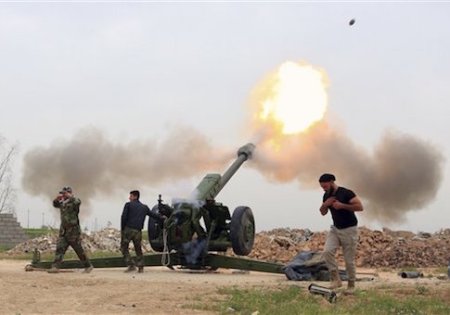
FILE - In this Saturday, March 26, 2016 photo, Iraqi security forces fire at Islamic State militants positions from villages south of the Islamic State group-held city of Mosul, Iraq. The Iraqi military backed by U.S.-led coalition aircraft on Thursday launched a long-awaited operation to recapture the northern city of Mosul from Islamic State militants, a military spokesman said. (AP Photo, File)

FILE – In this Saturday, March 26, 2016 photo, Iraqi security forces fire at Islamic State militants positions from villages south of the Islamic State group-held city of Mosul, Iraq. The Iraqi military backed by U.S.-led coalition aircraft on Thursday launched a long-awaited operation to recapture the northern city of Mosul from Islamic State militants, a military spokesman said. (AP Photo, File)

The grinding village-to-village war against ISIS in Northern Iraq has been weighed down by public complaints from Kurdish officials and military commanders who fear that the Shia-dominated Iraqi army will provoke stiffer resistance from ISIS defenders in Mosul.

Sunni, Shia, and Kurd units all want the political capital that goes with liberating a city of a million people and the capital of Sunni Iraq from ISIS, according to military observers.

A see-saw battle between elements of the predominantly Shia 15th Iraqi Army Division and ISIS fighters over control of abandoned villages on the Makhmour Front 40 miles southwest of Mosul took a turn for the worse on Monday, April 4, according to sources near the front. Last week the Iraqi Army, supported by Kurdish Peshmerga forces, captured four villages, including Al Nasr, but an ISIS counterattack recovered the village and left 20 soldiers dead, Rudaw reported.

Of these casualties, six were Peshmerga soldiers killed by a suicide vehicle that passed through the front line, said Ali Awni, a Kurdish Democratic Party leader in the Shekhan District north of Mosul.

The Shia soldiers reportedly abandoned their posts in the recent combat, according to Awni. “They left behind many guns, ammunition, and equipment for ISIS,” Awni said.

The campaign to retake the Iraq’s northern province of Nineweh started on March 24, according to the Iraqi Defense Ministry. That day, Iraqi Security forces backed by the Peshmerga and anti-ISIS Sunni tribal fighters recaptured four villages west of Makhmour.

Iraqi military spokesmen hailed the operations as “heroic,” but military observers say there is no sign of the final offensive to retake the city. The Iraqi defense minister has promised that the campaign to capture Mosul will start no later than May.

The array of armed forces ready and eager to retake the city of Mosul includes the Shia brigades of the Iraqi Security Forces, the Peshmerga army of the Kurdish Regional Government, the Iranian-backed Popular Mobilization Units, and Sunni-tribal fighters from Nineweh itself.

Until now, however, the Iranian-backed forces have not been allowed to join the campaign to recapture Mosul due to the high aversion to them by Sunni citizens in the north of Iraq.

The Iraqi Army has approximately 4,500 soldiers in the current campaign, not nearly an adequate force to secure the city, according to Michael Pregent, a career Army intelligence officer and former adviser to the Peshmerga in Mosul during 2005-06, who now serves as an adjunct scholar at the Hudson Institute in Washington.

“The force to retake Mosul has not been built yet. It must be a majority-Sunni unit to be accepted by the population,” Pregent said, adding that the defending force of ISIS fighters has been weakened and could be defeated by a patient, intelligence-heavy counter-insurgency campaign.

“There are more than 4,000 reluctant ISIS fighters in Mosul who don’t want to be there, who as soon as an operation begins may dwindle down to 1,500 or 2,000 as they melt into the population to wait the offensive out,” Pregent told a closed briefing at the Westminster Institute in Mclean, VA recently.

Awni, the Kurdish official, says the residents of Mosul despise the Popular Mobilization Units and will fight hard to resist them. “The people of Mosul believe the PMU will destroy the city with artillery and air strikes the way they did Ramadi a few months ago and Tikrit last year. When they entered Tikrit the looted houses and killed many people,” Awni says, adding: “the Mosul residents say if Shia militia are joining the fight, they will fight with ISIS, but if not, they will support the Coalition forces.”

Col. Tariq Ahmed Jaff, deputy commander of the 9th Combat Brigade of Peshmerga based in Kirkuk said in an email, “After ISIS we may have to fight the PMU. These guys pretend to be heroes but they intimidate elderly men, women, and children.” Sectarian war is a pervasive threat throughout Iraq’s territory south of Kurdistan’s borders. Hundreds of thousands of Iraqis have died in sectarian fighting that worsened after the U.S. invasion of 2003.

“Wherever there is PMU, there is Baghdad, and where there is Baghdad there is Tehran,” observed Ernie Audino, a retired U.S. Army brigadier general and a Senior Military Fellow at the London Center for Policy Research.

“All three are Shia, all three are allies to some degree, and all three vigorously support the concept of a unified Iraq, by force if necessary,” said Audino, who spent a year as an embed with the Pershmerga.  “Consequently, Shia militias cadred by Iranian Quds Forces, and Shia-dominated Iraqi Army units have pressed into Kurdish areas in and around Jalawla and Tuz Khurmatu to directly challenge Peshmerga control. Their continuing presence is seen by Kurds as a hammer waiting to fall.”

Netanyahu’s dilemma: Détente with Turkey or recognition of Syrian Kurds

April 4, 2016

Netanyahu’s dilemma: Détente with Turkey or recognition of Syrian Kurds, DEBKAfile, April 4, 2016

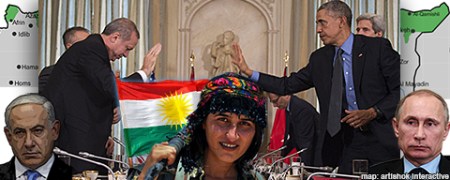
obama_erdogan_best_friends_2012They were once good friends

Last Friday, April 1, President Reccep Tayyip Erdogan had his first encounter with a group of American Jewish leaders, at his request. The full details of its contents were hard to sort out because the Turkish translator censored his master’s words with a heavy hand to make them more acceptable to his audience. But Erdogan’s bottom line, DEBKAfile’s New York sources report, was a request for help in explaining to the Obama administration in Washington and the Netanyahu government in Jerusalem why they must on no account extend support to the Syrian Kurdish PYD and its YPG militia or recognize their bid for a separate state in northern Syria.

The Turkish president did not spell out his response to this step, but indicated that a Turkish invasion to confront the Kurdish separatists was under serious consideration in Ankara. His meaning was clear: He would go to war against the Kurds, even if this meant flying in the face of President Barack Obama’s expectation that Turkey would fight the Islamic State.

Relations between the Turkish and US presidents have slipped back another notch in the last two weeks. When he visited Washington for the nuclear summit, Erdogan was pointedly not invited to the White House and his request for a tete a tete with Obama was ruled out. The US president even refused to join Erdogan in ceremonially honoring a new mosque built outside Washington with Turkish government funding.

At odds between them is not just the Kurdish question, but Erdogan’s furious opposition to Obama’s collaboration with Russian President Vladimir Putin on the Syrian conflict, and the two presidents’ tacit accord to leave Bashar Assad in power indefinitely until a handover becomes manageable.

On Feb. 7, on his return for a Latin American tour, the Turkish president warned Obama that he must choose between Ankara and the Kurds, whom he called “terrorists.” By last week, the US president’s choice was clear. It was the Kurds.

ObamaErdogan480_Koteret

When Erdogan arrived home from Washington last week, he discovered that the roughly four million Syrian Kurds dwelling in three enclaves touching on the Turkish border had taken important steps to advance their goal for self-rule: They were drafting a plan for establishing a “Federal Democratic System” in their three enclaves – Hassakeh-Jazeera, Kobani and Afrin – and had announced the amalgamation of their respective militias under the heading the “Syrian Democratic Forces”.

Cold-shouldered in Washington as well as Moscow (since Turkish jets shot down a Russian fighter last November), Erdogan found himself let down by the Jewish leaders whom he tried to woo. They refused to support him or his policy on the Kurdish question for three reasons:

1. Ankara had for years consistently promoted the radical Palestinian Hamas organization. To this, Erdogan replied by denying he had backed Hamas  only acted to improve the lives of the Gaza population. And, anyway, he said he had reacyed understandings with Israel on this issue..

2. His hostility towards Egyptian President Abdel-Fatteh El-Sisi. Erdogan’s response to this was a diatribe slamming the Egyptian ruler.

3. No clear reply had been forthcoming from Jerusalem by that time on Israel’s relations with Turkey or its policy towards the Kurds, despite the Turkish leader’s positive presentation of  mended fences.

The current state of the relationship is laid out by DEBKAfile’s sources:

Prime Minister Binyamin Netanyahu is caught on the horns of multiple dilemmas: While reluctant to respond to Ankara’s suit for warm relations with a leader who is shunned by Obama and Putin alike, Turkey is nonetheless offering to be Israel’s best client for its offshore gas.

Israel’s friendship with the Kurdish people goes back many years. The rise of an independent or autonomous state in Syria and its potential link-up with the semiautonomous Kurdish region of Iraq would create an important new state of 40 million people in the heart of the Middle East.

Israel has no wish to make enemies of its longstanding friends by disowning them in favor of Turkey.

Already, Israel’s evolving ties with the Syrian Kurds have given Israel’s strategic position in Syria a new positive spin, upgrading it versus the Assad regime in Damascus and its Hizballah and Iranian allies, who are avowed enemies of the Jewish state. Those ties offer Israel its first foothold in northern Syria.

And finally, Erdogan is not the only opponent of Kurdish separatism; so too are important Sunni Muslim nations like Saudi Arabia and Egypt. By promoting the Kurds, Israel risks jeopardizing its rapidly developing ties with those governments.

Turkey’s All-Out War on Kurds and Media

January 28, 2016

Turkey’s All-Out War on Kurds and Media, Gatestone InstituteUzay Bulut, January 28, 2016

(Oh, nonsense. According to UN Secretary General Ban Ki-Moon, the Middle East would be a place of happiness and tranquility if Israel simply ended her occupation of Palestine and committed suicide. Turkey good, Israel bad. Besides, Turkey is a valued member of NATO. /sarc — DM)

♦ On January 20, Turkish police opened fire at a group of civilians who were holding up white flags as they tried to remove the dead and wounded from the street in Cizre, one of the Kurdish towns under Turkish military siege. The Turkish police murdered two people from the group and wounded 12 others.

♦ As the military siege and attacks in Turkey’s Kurdistan intensify with each passing day, the Kurdish media are under a new wave of repression — through arbitrary arrests, psychical violence or blocks on their website content.

♦ “Our only aim today was to share what had happened in Van with the public in a healthy way. Today it was not us, but the people’s right to information that was taken into custody. We will not be silent.” — Reporter Bekir Gunes (from IMC TV), on Twitter. He was taken into custody for trying to report on the murders, but later released.

Since August, Turkey has been bombing and destroying its Kurdistan region in the same pattern: The Turkish government first declares curfews on Kurdish districts; then Turkish armed forces, with heavy weaponry, attack Kurdish neighborhoods and everyone living there. Much of this slaughter is presumably due to the Kurds having gained a large number of seats the latest elections — thereby preventing Turkey’s President Recep Tayyip Erdogan from attaining the super-majority he sought in order to change the Constitution and become “Sultan” for life, to rule as an autocrat. Kurds are also now asking for their right to rule themselves in their native lands, where they have lived for centuries.

Curfews in 19 Kurdish towns (from August 10, 2015 to the present) have penned Kurds in and enabled Turks to murder them more easily. So far, according to the Diyarbakir Branch of the Human Rights Association (IHD), in the past few months, 170 civilian Kurds have been killed. Of these, 29 were children, 39 were women and 102 were men. At least 140 people were wounded; some have lost eyes, legs or arms; others are the victims of brain trauma.

On January 20, Turkish police opened fire at a group of civilians who were holding up white flags as they tried to remove the dead and wounded from the street in Cizre, one of the Kurdish towns under Turkish military siege. The Turkish police murdered two people from the group and wounded 12 others.

1449On Jan. 20, Turkish police in Cizre opened fire at a group of Kurdish civilians who were holding up white flags as they tried to remove the dead and wounded from the street. The Turkish police murdered two people from the group and wounded 12 others.

Refik Tekin, a cameraman of IMC TV and an award-winning journalist, was among the wounded but kept filming the attack even after he was shot. He is now in a hospital.

“The state implements a policy of subjugation on the Kurdish demand for a political status. It has become clear once again that this problem is not about ditches [which some Kurdish youths have dug, over objections by officials, to try to stop the progress of the Turkish troops]. The state attempts to annihilate the Kurdish demand for political status by using the ditches as an excuse,”said Raci Bilici, the head of the Diyarbakir branch of the Human Rights Association.

As the military siege and attacks in Turkey’s Kurdistan intensify with each passing day, the Kurdish media are under a new wave of repression — through arbitrary arrests, psychical violence or blocks on their website content.

On January 1, police used water cannons and tear gas against local people marching from central Diyarbakir to the district of Sur to protest the curfews. Meanwhile, masked Turkish police detained Baran Ok, a cameraman of Kurdsat News Channel. Ferat Mehmetoglu, the local representative of Kurdsat, kept trying to explain to the police that Baran Ok was his cameraman. Disregarding Mehmetoglu’s pleas, the masked police drove off at high speed. At one point, after Mehmetoglu had gotten in front of the police vehicle, he barely avoided being run over when the officers drove off with his cameraman.

Meanwhile, the Dicle News Agency (DIHA) alleged that it obtained a restricted and official document, signed by the local Tank Battalion Command (part of the Turkish armed forces). The document instructs the Turkish armed forces operating in Kurdish towns and offers impunity: “No personnel shall forget not even for a moment that any personnel’s restraint from using arms for fear of prosecution might have very grave consequences, result in martyrs on our side; endanger the survival of the state and nation, [and] help traitors, terrorists and enemies of the state feel more powerful,” it said in part.

A day after DIHA covered this alleged document; its website was blocked for the 28th time by the Turkish Telecommunications Authority (TIB).

On January 5, Peoples’ Democratic Party (HDP) MP Ferhat Encu, in a parliamentary motion, asked Turkish Prime Minister Ahmet Davutoglu about the document. He has not yet received a reply. No Turkish authority has so far either confirmed or denied the existence of such a document.

Kurdish journalists are also exposed to physical violence. On January 5, the special operations police forcibly gathered 37 people from their homes and took them to an indoor sports hall. One of them was Nedim Oruc, a journalist who had extensively covered the military assaults against the Kurdish town Silopi.

At first, no information could be obtained about Oruc who, according to DIHA news agency, had been battered, dragged on the ground and kidnapped by police in an armored vehicle. As a result of the public pressure brought to bear by the Twitter hashtag #NedimOrucNerede Where is Nedim Oruc), Silopi Security Directorate admitted that Oruc was in custody. He is now in Sirnak Prison.

The same day, the police raided a student dormitory and houses in the province of Van. The all-female, pro-Kurdish Jin (Women’s) News Agency reporter and university student Rojda Oguz and many other students were arrested. Rojda is now in Van prison.

“The Turkish public has a right to information from a variety of sources and perspectives, but the government is clearly trying to stifle pro-Kurdish news outlets with these arrests,” said Nina Ognianova, Europe and Central Asia Program Coordinator of Committee to Protect Journalists. “We call on Turkish authorities to release Nedim Oruç and Rojda Oğuz without delay and to stop harassing and obstructing journalists.”

On January 9, the “Women for Peace” group staged a demonstration in Izmir’s Bornova district to protest the recent military siege and attacks against Kurdish districts. Police detained theEvrensel reporter Eda Aktas, along with 12 others, while she was reporting on the protest — on the grounds that the press statement of the protesters violated the article 301 of the penal code, which makes it illegal “to insult Turkey, the Turkish nation, or Turkish government institutions.”

On January 5, in Silopi, three female Kurdish politicians — Sêvê Demir, Pakize Nayir, and Fatma Uyar — were murdered by state forces.

On January 10, in Izmir, when the Kurdish Congress of Free Women (KJA) organized a protest to commemorate the slain politicians, the police attacked the protestors, and detained 35 — including Dilek Aykan, the co-head of the Izmir branch of the Peoples’ Democratic Party (HDP).

The police also prevented Serfiraz Gezgin, a reporter from the Kurdish DIHA agency, and Hatice Erhan, a reporter from the left-wing magazine Kizil Bayrak, from filming the police crackdown. Other journalists just barely stopped police from detaining Gezgin and Erhan.

For months, the Turkish armed forces have been using hospitals and schools as military quarters, threatening, and even murdering medical personnel, and forcing thousands of Kurds to flee their native lands.

The state violence in Turkish Kurdistan escalates daily: On January 10, Turkish soldiers murdered 12 Kurds at close range in the province of Van. The office of the governor of Van announced that 12 PKK members were killed in the province. Photos of the slain Kurds were shared on the social media, apparently by Turkish security forces. A YouTube account called “Special Operations Team,” for instance, published a video entitled “The carcasses of the PKK – Van/Edremit” showing the bodies of slain Kurds, with upbeat music playing in the background.

Reporter Bekir Gunes, and cameraman Mehmet Dursun, working for IMC TV, were trying to follow up on news concerning the murders, but were prevented from doing so by the police. Both were taken into custody and released 11 hours later. “Our only aim today was to share what had happened in Van with the public in a healthy way,” Gunes wrote on his Twitter account. “Today it was not us, but the people’s right to information that was taken into custody. We will not be silent.”[1]

According to the 2015 World Press Freedom Index of Reporters without Borders, Turkey, out of 180 states, ranked 149.[2] “Turkey’s ‘underlying situation’ score,” it wrote, “covering such areas as cyber-censorship, lawsuits, dismissals of critical journalists and gag orders — actually worsened, showing that freedom of information continues to decline.” [3]

Lately, pressures on free speech and free press have been gaining new momentum in Turkey. The latest victim was a Turkish comedian and television host, Beyazit Ozturk (“Beyaz”) known for being apolitical and pro-establishment.

Beyaz found himself in the midst of violent threats after a teacher from Diyarbakir phoned into his popular live chat show and called for an end to violence in the region. She said: “Children are dying here. All of these bomb sounds, bullet sounds… People — especially babies and children — are struggling with a lack of water, with starvation. Please show some sensitivity. See us, hear our voice, extend your hand to us. Please let no more people die. Let no more children die.”

Beyaz thanked the caller, said that he too supported her message of peace and asked the audience to applaud her.

Kanal D [Channel D], the mainstream TV channel broadcasting the show, issued a statement saying they were tricked into allowing the caller on. The television channel’s officials added: “Dogan TV and Kanal D have always been on the side of the state from day one.”

The Turkish ministry of national education started an exhaustive hunt to find the caller. They said that no teacher with that name admitted to having called the show.

The teacher on the phone had not even said who killers were, but for some unfathomable reason, the Turkish nationalists, including state authorities, appear to have taken the remark personally, and interpreted it as an “insult to Turkish security forces” and “terrorist propaganda.”

Beyaz thereupon received a negative reaction from Turkish nationalists, and even death threats on social media. Many Twitter users and pro-government media outlets accused him “of allowing PKK propaganda on his show” and “not showing the required reaction to the caller.”

A popular hashtag said: “Beyaz! Apologize from the Turkish Police!”

A masked individual, allegedly a special operations police officer, posted on YouTube a video entitled, “We will not forget,” threatening Beyaz for allowing a caller from Diyarbakir to say on his show that children are dying.

In the end, Beyaz appeared on Kanal D again, apologizing:

“I am a son of a police officer. Whatever the entire Turkish nation thinks about that place [Turkey’s predominantly Kurdish southeast], I also have the same thoughts. Of course, with all our hearts and souls, we want the terrorist organization to lay down its arms and this issue to be resolved as soon as possible. May Allah make it easy for all of our security forces in the southeast. We are on the side of our state and our nation.”

Finally, the police found the “criminal.” Ayse Celik, the art teacher who phoned in, is now being prosecuted for “making propaganda for the terrorist organization”. Eleven lawyers in the province of Antep who declared their support for the Celik’s message are also being prosecuted for “terrorist propaganda.”

This is the level of political and social pressure that a TV personality — who has had nothing to do with political activism throughout his entire career — is exposed to, in response to the most innocent and humanitarian wishes for peace uttered by a caller on his show. Imagine the enormity of the pressure on Kurds and journalists who try to expose the real crimes Turkey is committing against its Kurdish minority.

_______________________

[1] On January 10, which marks the Working Journalists Day in Turkey, Murat Verim, a Kurdish reporter of Dicle News Agency (DIHA), was detained following a police raid on his home in Mardin’s Dargecit district. On January 12, gendarmerie special operations forces attacked Mursel Coban, a journalist and photographer, as he was reporting on the funeral of the youths murdered in the Sur district of Diyarbakir. Coban said that the police beat him and tried to detain him, while threatening him with “disappearance.”

[2] In 2014, Turkey ranked 154 in the list. “Turkey’s rise in the index must be put in context,” wrote Reporters Without Borders. “It was due above all to the conditional release in 2014 of around 40 imprisoned journalists who nonetheless continue to face prosecution and could be detained again at any time.

[3] In another mass arrest on December 20, 2011, 58 people (many of whom were Kurdish journalists) were taken into custody in a police raid on their offices or houses in 8 provinces.
A new US-Russian-Turkish military buildup over Syria: In unison or at odds?

January 25, 2016

A new US-Russian-Turkish military buildup over Syria: In unison or at odds? DEBKAfile, January 25, 2016

TurkishAirBase480

The US and Russia are in the process of a military buildup in the Kurdish areas of northern Syria. It is ranged along a narrow strip of land 85 km long, stretching from Hassakeh in the east up to the Kurdish town of Qamishli on the Syrian-Turkish border. Facing them from across that border is a parallel buildup of Turkish strength. This highly-charged convergence of three foreign armies athwart a tense borderland is reported here by DEBKAfile’s military sources. It is too soon to determine whether the three armies are operating in sync or at odds, especially in view of the bitter relations between Moscow and Ankara.

US Forces 

American Special Operations troops and Air Force attack helicopters landed first at Remelan airport. They are the first US troops to operate from a ground base in Syria, accommodated in living quarters built for them in advance by a US engineering corps unit. The airport runway has been widened for US warplanes.

American Special Operations troops and Air Force attack helicopters landed first at Remelan airport. They are the first US troops to operate from a ground base in Syria, accommodated in living quarters built for them in advance by a US engineering corps unit. The airport runway has been widened for US warplanes.

Russian Forces

Next came two Russian military missions on Jan. 16.  One group, led by a general and consisting of air force and Special Operations officers, is preparing to take over a small abandoned base in Syrian army-controlled territory just 80 km from the new US facility at Remelan, and adapt it for Russian use.

The other group, which consists of intelligence officers – some from Russia’s FSB federal security service, the FSB – indicates that Moscow has decided it is high time for professionals to protect the classified information moving around the Russian Task Force in Syria and safeguard it from reaching the wrong hands. .

The abandoned base is less than 3.5 km from the Turkish border, and would act as a Russian barrier between US forces in northern Syria and the Turkish border contingents.

Turkish Forces

This Russian deployment set off alarm bells in Ankara, and so the Turkish army responded with the third troop buildup, arraying tanks and mobile artillery on the border across from Qamishli.

Over the weekend, Turkish President Tayyip Erdogan stated, “We have said this from the beginning: we won’t tolerate such formations (in northern Syria) along the area stretching from the Iraqi border up to the Mediterranean.”

At the same time, US Vice President Joe Biden said Saturday, Jan. 23, that  the U.S. and Turkey are prepared for a military solution against ISIS in Syria should the Syrian government and rebel-opposition forces fail to reach a peace agreement during its upcoming meeting in Geneva.

However, Ankara views its war on terror as focused on both Kurdish separatists and ISIS, which is subjecting Turkey to multi-casualty attacks.

DEBKAfile’s military and intelligence sources note that Turkey’s military options are very limited. Its leaders know they dare not put a foot wrong because the Russian force in Syria is just waiting for an opportunity to avenge the downing of a Russian Su-24 warplane by the Turkish air force on November 24.

Another group of actors stirring the pot in northern Syria is the Kurds, particularly the YPG militia, the only fighting force in Syria capable of defeating ISIS, which has been reinforced by the Iraqi autonomous Kurdish region’s Peshmerga, as well as the outlawed Turkish PKK Kurdish organization.

At this stage, it is impossible to determine how this triple buildup will play out tomorrow – how far the US and Russia are in concert, at what point they may decide to vie for footholds in the Kurdish region of northern Syria and how far the Turks are clued into the joint US-Russian strategy for bludgeoning ISIS.

The battles in N. Syria will determine the fate of the peace process

December 21, 2015

The battles in N. Syria will determine the fate of the peace process, DEBKAfile, December 21, 2015

Syria_Iraq_Kurdsweekly

The US-Russian plan, approved by the UN Security Council as the lever for activating a political process towards ending the five-year Syrian war, can only go so far towards its objectives. The process is not capable of halting the fighting or removing Bashar Assad from power; just the reverse: progress in the talks is heavily dependent on the state of play on the battlefields of the north while the Syrian dictator’s ouster is a fading issue.

The limitations and obstacles facing the UN-endorsed US-Russian plan are summed up here by DEBKAfile’s analysts:

1. The understanding reached by the Obama administration and the Kremlin in the past month was first conceived as a stopgap measure. It was never intended to bring the calamitous Syrian war to an end or remove Assad, but rather to provide a pretext to account for the expansion of Russia’s ground operation and gloss over America’s military deficiencies in the Syrian conflict. Taking it as carte blanche from Washington, President Vladimir Putin felt able to announce Saturday, Dec. 19, that “the Russian armed forces have not employed all of their capability in Syria and may use more military means there if necessary.”

2. President Barack Obama has stopped calling for Assad’s removal as the condition for ending the war and is silent on the expanding Russian military intervention. Obama and Putin have in fact developed a working arrangement whereby Putin goes ahead with military operations and Obama backs him up..

3. Almost unnoticed, on Dec. 17, the day before the Security Council passed its resolution for Syria, all the 12 US warplanes that were deployed a month earlier at the Turkish air base of Incirlik for air strikes in Syria were evacuated. This happened at around the same time as Russia deployed to Syria its Buk-M2-SA-17 Grizzly antiaircraft missile systems. The presence of this system would have endangered American pilots had US air strikes over Syria not been halted. The upshot of the two evidently coordinated moves was the US withdrawal of most of its military resources for striking the Islamic State forces in Syria and the handover of the arena to the Russian army and air force.

4. In another related development, Friday, Dec. 18 the German intelligence service, BDN, leaked news that it had renewed its contacts with the Assad regime’s intelligence services and German agents were now visiting Damascus regularly. The import of this change is that Berlin no longer relies on US intelligence briefings from Syria and, rather than turn to Moscow, it prefers to tap its own sources in the Syrian capital.

5. Washington and Moscow are still far apart on the shape of the transitional government mandated by the Security Council resolution

The Obama administration wants Assad to hand presidential powers over the military and of all security-related and intelligence bodies to the transitional government, which is to be charged with calling general and presidential elections from which Assad will be barred.

Putin won’t hear of this process. He insists on a transitional government being put in place and proving it can function before embarking on any discussion of its powers and areas of authority.

The two presidents agree that the transition will need at least two years, overlapping the Obama presidency by about a year and dropping the issue in the lap of his successor in the White House.

6. The US and Russia don’t see to eye to eye either on which Syrian opposition organizations should be represented in the transitional government and which portfolios to assign them. On this question, both Washington and Moscow are at odds with the Persian Gulf states, Saudi Arabia, Qatar and the UAE, which back some of the organizations labeled as terrorist by Moscow.

7. But it is abundantly clear that the Obama administration is ready to wash its hands of the Syrian rebel movement and most of all, abandon Turkish President Tayyip Erdogan to give the Russians an open remit.

On Saturday, Dec. 19, Putin turned the screw again on Erdogan when he said he had no problem with the Turkish people, adding, “As for the current Turkish leadership, nothing is eternal.”

In support of Moscow, Obama meanwhile leaned hard on the Turkish president in a telephone conversation, to remove Turkish forces from northern Iraq. Ankara responded that Putin’s comment was not worth a response and denied hearing of any such US request.

Ankara may be feigning ignorance but it must realize by now that Moscow and Washington have joined forces to pus the Turkish military out of any involvement in northern Syria and Iraq.

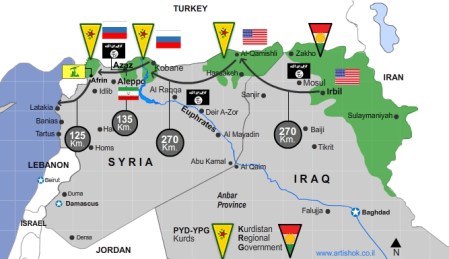
8. This US-Russia collaboration against Turkey is having a dramatic effect on the war in northern Syria along the Turkish border. DEBKAfile’s military and intelligence sources report it opened the door to the secret deal between Washington and Moscow to divide the areas of influence in northern Syria between them – essentially assigning the Kurdish enclaves north of the Euphrates river and bordering on Iraq to American influence (see map), and the areas west of the Euphrates up to the Mediterranean to Russian control. This deal (first revealed by DEBKA Weekly 688 on Dec. 4) effectively squeezes Turkey out of any role in the Syrian conflict.

9. The ongoing battles in northern Syria near the Turkish border will have a greater impact in shaping the future of Syria and its unending conflict than any UN resolution. Participating in the fighting at present is a very big mixed cast: Russia, the Kurdish YPG militia, most of the important rebel groups, including radical Sunni organizations tied to Al Qaeda, such as the Nusra Front and Ahram al-Sham, Iran and Shiite Hizballah, and the Islamic State.

It is only when one of these forces gains the upper hand in this free-for-all, that there will be progress toward a political solution on ending the war.

ISIS Selling Yazidi Women and Children in Turkey

December 20, 2015

ISIS Selling Yazidi Women and Children in Turkey, Gatestone InstituteUzay Bulut, December 20, 2015

♦ “Some of those women and girls have had to watch 7-, 8-, and 9-year-old children bleed to death before their eyes, after being raped by ISIS militia multiple times a day.” — Mirza Ismail, chairman of the Yazidi Human Rights Organization-International.

♦ “An office has been established by ISIS members in Antep [Turkey]; and at that office, women and children kidnapped by ISIS are sold for high amounts of money. Where are the ministers and law enforcement officers of this county who are talking about stability?” — Reyhan Yalcindag, prominent Kurdish human rights lawyer.

♦ “Five thousand people have been taken as captives. Women and children are raped, and then sold. These must be considered crimes.” — Leyla Ferman, Co-President of the Yazidi Federation of Europe.

♦ “Turkey has signed several international treaties, but it is the number one country when it comes to professional non-compliance with human rights treaties.” — Reyhan Yalcindag.

This month, the German television station, ARD (Consortium of Public Broadcasters in Germany), produced footage documenting the slave trade being conducted by the Islamic State (ISIS) through a liaison office in the province of Gaziantep (also known as Antep) in Turkey, near the border with Syria.

In August 2014, Islamic State jihadists attacked Sinjar, home to over 400,000 Yazidis. The United Nations confirmed that 5,000 men were executed, and as many as 7,000 women and girls made sex slaves.

While some have escaped or been ransomed back, thousands of Yazidis remain missing.

1392A news report from German broadcaster ARD shows photos of Yazidi slaves distributed by ISIS (left), as well as undercover footage of ISIS operatives in Turkey taking payment for buying the slaves (right).

Last month, after Kurdish forces recaptured the area from ISIS jihadists, mass graves, believed to contain the remains of Yazidi women, were discovered east of Sinjar.

The German TV channels NDR and SWR declared on their website:

“IS [Islamic State] offers women and underage children in a kind of virtual slave market with for-sale photos. … The transfer of money, as the reporter discovered, takes place through a liaison office in Turkey. …

“For weeks, NDR and SWR accompanied a Yazidi negotiator, who, on behalf of the families, negotiates with the IS for the release of the slaves and their children. … the women are sold in a digital slave market to the highest bidder. 15,000 to 20,000 US dollars are a typical price. Similar sums for ransom are also required to free Yazidis. The money is then transferred via IS-liaison offices and middlemen to the terrorist group.

“NDR and SWR were present at the liberation of a woman and her three small children, aged between two and four years old, and followed the negotiations. How many Yazidi slaves are still ‘owned’ by IS is unclear. Experts estimate that there still could be hundreds.”

The negotiator told NDR and SWR that in the course of a year, he transferred more than USD $2.5 million to ISIS from the families of 250 Yazidi women and children, in order to free them.

He also said that to advertise the slaves, ISIS assigns numbers to the female and child slaves, and posts their photographs on the WhatsApp Messenger smartphone app.[1]

In response to these reports, the Gaziantep Bar Association filed a criminal complaint against “Turkey’s National Intelligence Organization (MIT) and law-enforcement officers that have committed neglect of duty and misconduct by not taking required measures, and not carrying out preventive and required intelligence activities before the media covered the said incidents.”

The bar association also demanded that the prosecutors start prosecuting and punishing perpetrators engaged in crimes of “human trafficking, prostitution, genocide, deprivation of liberty, crimes against humanity, and migrant smuggling,” according to the Turkish penal code.

“The tragic reality,” said lawyer Bektas Sarkli, the head of Gaziantep Bar Association, “is that Gaziantep is a crowded city; the suicide bombers easily cross [to Syria and Iraq]. Unfortunately, Gaziantep exports terrorism.”

Sarkli added: “When you see the ammunition captured and especially take into account the money transferred here [it is clear that] ISIS easily shelters in this city. Gaziantep is the logistic site of ISIS.”

Mahmut Togrul, an MP of the pro-Kurdish Peoples’ Democratic Party (HDP), in a motion to Efkan Ala, Turkey’s Interior Minister, asked about the alleged office where ISIS members engage in slavery and the sex trade. His questions included: “How many liaison offices affiliated with ISIS terror organization are there in Gaziantep? If there are, do those liaison offices have any legal basis? Under what names do these offices operate? Are those offices affiliated with any institution?”

Interior Minister Ala has not yet provided any answers.

“According to the local press of Gaziantep, as well as the national press,” Togrul said, “Gaziantep has been turned into a city with sleeper cell houses for the ISIS terror group; ISIS members abound and travel freely.” [2]

The “Struggle Platform for Women Forcefully Seized,” the Democratic Society Congress (DTK) and the Kurdish Congress of Free Women (KJA) in Diyarbakir also filed a criminal complaint, calling for the prosecutors to investigate allegations and bring the perpetrators to account.

Reyhan Yalcindag, a prominent Kurdish human rights lawyer, said, “An office has been established by ISIS members in Antep; and at that office, women and children kidnapped by ISIS are sold for high amounts of money. Where are the ministers and law enforcement officers of this county who are talking about stability?”

“Turkey,” she said, “has signed several international treaties, but it is the number one country when it comes to professional non-compliance with human rights treaties.”

The Co-President of the Yazidi Federation of Europe, Leyla Ferman, referred to the number of the genocides to which the Yazidis say they have been exposed throughout history. “The Yazidis have been given 73 death warrants,” she said, “The people are massacred under the Islamic State. Thousands of Yazidi women are missing. Five thousand people have been taken as captives. Women and children are raped, and then sold. Today, due to the war, women have been scattered all around. These must be considered crimes.”

This is not the first time the presence of ISIS in Antep appeared in the news.

In November 2015, after the terrorist attacks in Paris, a group waving black ISIS flags appeared, honking the horns of their cars and celebrating in the streets of Antep. The footage was shared widely on social media. One user wrote, “This is Turkey supposedly struggling against ISIS. This is the ISIS convoy in Antep celebrating the Paris massacre.”

The Yazidis, a historically persecuted community, are ethnically Kurdish, but not Muslim; their native religion of Yazidism is linked to ancient Mesopotamian religions. The Yazidis are indigenous to northern Mesopotamia and Anatolia; part of the Yazidi homeland is located in what is modern Turkey; other parts are in Syria and Iraq.

Yazidis have been exposed to campaigns of forced Islamization and assimilation, according to the Turkish sociologist Ismail Besikci, a prominent expert on Kurdistan:

“During the 1912-13 Pontic Greek deportations and the 1915 Armenian genocide, Yazidis were also driven out from their lands. Throughout the history of republican Turkey, all methods have been tried to Islamize the Yazidis. Before 1915, for instance, Suruc was an entirely Yazidi town. So was the town of Viransehir. Today, there is not a single Yazidi left in Suruc. Furthermore, the Islamized Yazidis can be seen exhibit insulting behavior towards those who remain Yazidis.”

Because they are Kurds, the state has not recognized their Kurdishness; and because they are Yazidis, the state has not recognized their religion. The section of ‘religion’ in Yazidis’ identity cards has been left empty; or the religion of some has been registered as ‘x’ or ‘-‘ .

“Research states that in 2007, there were only 377 Yazidis left in Turkey,” an Assyrian MP of the Peoples’ Democratic Party (HDP), Erol Dora, said.

“Yazidis, just like other minorities in Turkey, have also been exposed to discrimination and hate speech; that is why they have had to leave their lands. … Their villages and lands have been seized; their agricultural areas have been appropriated, their holy sites have been attacked. All these racist attitudes continue today; the language, religion and culture of Yazidis face extinction.”

Yazidis say they have been subjected to 72 attempts at extermination, or attempted genocide. Today, they are the victims of yet another attempted genocide in Iraq — at the hands of ISIS jihadists.

“According to many escaped women and girls to whom I spoke in Northern Iraq, the abducted Yazidis, mostly women and children, number over 7,000,” said Mirza Ismail, founder and chairman of the Yezidi Human Rights Organization-International, in his speech at the U.S. Congress.

“Some of those women and girls have had to watch 7-, 8-, and 9-year-old children bleed to death before their eyes, after being raped by ISIS militia multiple times a day.

“I met mothers, whose children were torn from them by ISIS. These same mothers came to plead for the return of their children, only to be informed, that they, the mothers, had been fed the flesh of their own children by ISIS. Children murdered, then fed to their own mothers.

“ISIS militias have burned many Yezidi girls alive for refusing to convert and marry ISIS men. Young Yezidi boys are being trained to be jihadists and suicide bombers. All of our temples in the ISIS controlled area are exploded and destroyed. Why? Because we are not Muslims, and because our path is the path of peace. For this, we are being burned alive: for living as men and women of peace.”

The Yazidis, one of the most peaceful people on earth, are struggling to survive yet another Muslim genocide, before the eyes of the entire world.

While much of the world has been silent, a NATO member, Turkey has been openly complicit — the enabler of jihadist terrorism. Reports and eyewitnesses testify that Turkey has contributed to the rise of the Islamic State by letting fighters and arms over the border. Some of the fighters go on to join the jihadist terrorist group.

The latest reports reveal that in Turkey, a country that fancies itself as a candidate for EU membership, Yazidi women and children are enslaved and forced into sexual slavery. Meanwhile, the Turkish government has not even bothered to make a single statement about these reports.

That is what happens when a regime is never held responsible.

No, the Islamic State Will Not Be Defeated — and if It Is, We Still Lose

November 25, 2015

No, the Islamic State Will Not Be Defeated — and if It Is, We Still Lose, BreitbartBen Shapiro, November 24, 2015

GettyImages-497044984-640x480

Barack Obama has now created an unwinnable war.

While all of the 2016 candidates declare their strategies for victory against ISIS, President Obama’s leading from behind has now entered the Middle East and the West into a free-for-all that cannot end any way but poorly.

The best way to understand the situation in Syria is to look at the situation and motivation of the various players. All of them have varying agendas; all of them have different preferred outcomes. Few of them are on anything approaching the same page. And Barack Obama’s failure of leadership means that there is no global power around which to center.

ISIS. ISIS has gained tremendous strength since Barack Obama’s entry to power and pullout from Iraq. They currently control northern Syria, bordering Turkey, as well as large portions of northern Iraq. Their goal: to consolidate their territorial stranglehold, and to demonstrate to their followers that they, and not other competing terrorist groups like Al Qaeda, represent the new Islamic wave. They have little interest in toppling Syrian dictator Bashar Assad for the moment. They do serve as a regional counterweight to the increasingly powerful Iranians – increasingly powerful because of President Obama’s big nuclear deal, as well as his complete abdication of responsibility in Iraq.

Iran. Iran wants to maximize its regional power. The rise of ISIS has allowed it to masquerade as a benevolent force in Iraq and Syria, even as it supports Assad’s now-routine use of chemical weapons against his adversaries, including the remnants of the Free Syrian Army (FSA). Iran has already expanded its horizons beyond Iraq and Syria and Lebanon; now it wants to make moves into heretofore non-friendly regions like Afghanistan. Their goal in Syria: keep Bashar Assad in power. Their goal in Iraq: pushing ISIS out of any resource-rich territories, but not finishing ISIS off, because that would then get rid of the global villain against which they fight.

Assad. The growth of ISIS has allowed Assad to play the wronged victim. While the FSA could provide a possible replacement for him, ISIS can’t credibly do so on the international stage. Assad knows that, and thus has little interest in completely ousting them. His main interest is in continuing to devastate the remaining FSA while pretending to fight ISIS.

Egypt/Saudi Arabia/Jordan. As you can see, ISIS, Iran, and Assad all have one shared interest: the continued existence of ISIS. The same is not true with regard to Egypt, Saudi Arabia, and Jordan, all of whom fear the rise of radical Sunni terrorist groups in their home countries. They are stuck between a rock and a hard place, however, because openly destroying ISIS on behalf of Alaouite Assad, they embolden the Shia, their enemies. Egypt, Saudi Arabia, and Jordan would all join an anti-ISIS coalition in the same way they did against Saddam Hussein in 1991, but just like Hussein in 1991, they won’t do it if there are no Sunni alternatives available. Tunisia, Saudi Arabia, and Jordan are the top three sources of foreign fighters for ISIS.

Turkey. The Turks have several goals: to stop the Syrian exodus across their borders, to prevent the rise of the Iranians, and to stop the rise of the Kurds. None of these goals involves the destruction of ISIS. Turkey is Sunni; so is ISIS. ISIS provides a regional counterweight against Iran, so long as it remains viable. It also keeps the Kurds occupied in northern Iraq, preventing any threat of Kurdish consolidation across the Iraq-Turkey border. They will accept Syrian refugees so long as those other two goals remain primary – and they’ll certainly do it if they can ship a hefty portion of those refugees into Europe and off their hands.

Russia. Russia wants to consolidate its power in the Middle East. It has done so by wooing all the players to fight against one another. Russia’s involvement in the Middle East now looks a good deal like American involvement circa the Iran-Iraq War: they’re playing both sides. Russia is building nuclear reactors in Egypt, Jordan, Turkey and Iran. They’re Bashar Assad’s air force against both the FSA and ISIS. Russia’s Vladimir Putin doesn’t have a problem with destroying ISIS so long as doing so achieves his other goal: putting everyone else in his debt. He has a secondary goal he thought he could chiefly pursue in Eastern Europe, and attempted with Ukraine: he wants to split apart the North Atlantic Treaty Organization, which he rightly sees as a counterbalance to check Russian aggression. Thanks to today’s Turkish attack on a Russian plane, and thanks to the West’s hands-off policy with regard to the conflict, Putin could theoretically use his war against ISIS as cover to bombard Turkish military targets, daring the West to get involved against him. Were he to do so, he’d set the precedent that NATO is no longer functional. Two birds, one war.

Israel. Israel’s position is the same it has always been: Israel is surrounded by radical Islamic enemies on every side. Whether Iranian-backed Hezbollah or Sunni Hamas and ISIS, Israel is the focus of hate for all of these groups. Ironically, the rise of Iran has unified Israel with its neighbors in Jordan, Egypt, and Saudi Arabia. All three of those countries, however, can’t stand firmly against ISIS.

All of which means that the only country capable of filling the vacuum would be the United States. Just as in 1991, a major Sunni power is on the move against American interests – but unlike in 1991, no viable option existed for leaving the current regime in power. And the US’ insistence upon the help of ground allies is far too vague. Who should those allies be, occupying ISIS-free ISISland?

The Kurds have no interest in a Syrian incursion. Turkish troops movements into ISIS-land will prompt Iranian intervention. Iranian intervention into ISIS-land would prompt higher levels of support for Sunni resistance. ISIS-land without ISIS is like Iraq without Saddam Hussein: in the absence of solidifying force, chaos breaks out. From that chaos, the most organized force takes power. Russia hopes that should it destroy ISIS, Assad will simply retain power; that may be the simplest solution, although it certainly will not end the war within the country. There are no good answers.

Barack Obama’s dithering for years led to this. Had he lent his support in any strong way to one side, a solution might be possible. Now, it’s not.

ISIS Threatens Obama With ‘New Lesson’ in Beheading Video

October 31, 2015

ISIS Threatens Obama With ‘New Lesson’ in Beheading Video, Newsmax, Sandy Fitzgerald, October 31, 2015

(Video at the link. Has Obama recently decided that the Islamic State is a greater threat than climate change?– DM)

A horrifying new 15-minute video appears to show Islamic State (ISIS) terrorists beheading four captured Kurdish Peshmerga fighters — and delivering a bold warning to President Barack Obama.

The video claims to be the ISIS response to a Delta Force-Kurdish raid in northern Iraq last week that cost American Master Sgt. Joshua Wheeler his life.

“Obama, you have learned a new lesson,” a masked terrorist warns Obama in what sounds like an American accent. “Six of the soldiers of the caliphate faced 400 of your children; they killed and injured them by Allah’s grace.”

The warning was delivered before the man executes one of the prisoners, reports CNN, and the other three prisoners are also beheaded by the video’s end. Arabic text also appears onscreen, translating as “Peshmerga soldiers that Americans came to rescue.”

The video was released online Friday, and earlier in the clip, ISIS claims to show the aftermath of the raid, in which Kurdish, U.S., and Iraqi forces rescue 70 hostages from an ISIS prison in Hawija, located in Kirkuk, a province located in northern Iraq.

CNN reports that those who were set free included 20 of the Iraqi Security Forces, local residents and several ISIS fighters accused of spying. None of the hostages were Kurds.

As of Saturday morning, there had not been an official response issued from the White House on the video or the threat. But in Kurdistan, regional government spokesman Dindar Zebari told CNN that “ISIS respects no form of human rights. Our message to them is that we will finish them.”

But Kurdistan will not kill ISIS prisoners in response, Zebari said.

“We hold 215 ISIS prisoners and we treat them according to international human rights laws,” he said. “We have also freed 85 prisoners who had been suspected of association with ISIS. We do not kill our prisoners.”

The Kurdistan regional government said that more than 20 ISIS fighters were killed in last week’s raid, and six more were captured.

The Kurdish Peshmerga, which protects an autonomous region in northern Iraq, has been fighting against ISIS and its push to take Iraq and Syria and create a caliphate.

ISIS earlier this week said the Delta Force-Kurdish raid, called for by the Kurds to rescue Peshmerga fighters, was a failure.

The man who issued the threat does not appear to be the infamous “Jihadi John,” the English-speaking jihadist who has appeared in several other ISIS beheading videos.

The terrorist, whose real name is believed to be Mohammed Emwazi, is considered to be a priority target after killing American, Western, and Japanese hostages.

Meanwhile, two Syrian activists have also been killed in recent days in the Turkish town of Urfa, and their deaths are being blamed on ISIS.

According to the groups Raqqa is Being Slaughtered Silently and Eye on Homeland, activists Ibrahim Abdul Qadir and Faris Humadi the men who were shot and beheaded. ISIS has not yet claimed responsibility for their deaths.

Qadir and Humadi worked for Eye on Homeland, a Syrian media group that reports on the civil war, and Qadar also was a founding member of the Raqqa group, which posts photos, video, and other information online from the Raqqa province in Syria.