Archive for the ‘JCPOA’ category

Iran’s Free Hand in Testing Ballistic Missiles

March 16, 2016

Iran’s Free Hand in Testing Ballistic Missiles, Front Page MagazineJoseph Klein, March 16, 2016

rg

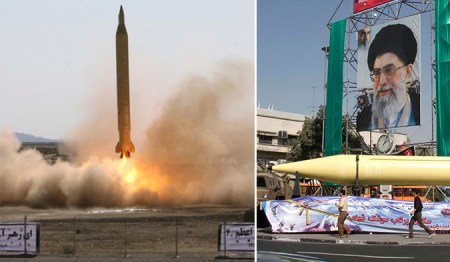
The United Nations Security Council met in an “emergency” closed door session on Monday March 14th to discuss Iran’s recent testing of ballistic missiles reportedly designed to be capable of delivering nuclear weapons. The words “Israel must be wiped out” were written in Hebrew on the side of the missiles. These most recent tests followed in the wake of missile tests conducted last fall, which the Security Council did nothing about at the time.

While North Korea was finally hit with more UN sanctions for its nuclear and missile tests, North Korea’s nuclear weapons collaborators in Iran continue to be let off the hook without even a slap on the wrist.

U.S. Ambassador to the UN Samantha Power told reporters, after the March 14th meeting produced no concrete results, that she will keep trying “no matter the quibbling that we heard today about this and that.” She said that Iran’s missile tests were “in defiance of provisions of UN Security Council Resolution 2231, the resolution that came into effect on January 16, on Implementation Day for the JCPOA [Joint Comprehensive Plan of Action].”

The quibbler in chief is Russia. Its UN ambassador said that Iran has not violated the resolution and that there was no need for any punitive measures against Iran.

The truth is that the Obama administration is now hoisted with its own petard. Ambassador Power complained that “Russia seems to be lawyering its way to look for reasons not to act rather than stepping up and being prepared to shoulder our collective responsibility.” Yet that would not have been as easy for Russia to do if the Obama administration had not allowed a loophole in the nuclear deal wide enough for Iran to fire a whole bunch of missiles through.

President Obama wanted the nuclear deal with Iran so badly that he gave in to Iran’s last minute demands to preserve its missile program. Iran insisted that all prior UN Security Council resolutions which had unambiguously prohibited Iran’s development, testing or procurement of ballistic missiles designed to be capable of delivering nuclear weapons must be terminated. Otherwise, Iran would not go forward with the JCPOA. To make matters worse, even though Iran had held the JCPOA hostage to its missile demands, the Obama administration also bowed to Iran’s insistence that its missile program would not be covered by the JCPOA itself. Thus, Iran would not be subject to the automatic “snap back” of sanctions when Iran is found to have violated the JCPOA, because its missile tests would be outside the scope of the JCPOA. In fact, the Obama administration agreed to language in the JCPOA to clarify that such separation of Iran’s missile program from the JCPOA was the intent. All reliance for dealing with Iran’s missile tests would be placed on the much weaker Security Council Resolution 2231.

The new Security Council Resolution 2231, which endorsed the JCPOA but drafted as separate from the JCPOA, used weaker language than the outright prohibition that had existed under the prior resolutions that were now superseded. Calling upon Iran to refrain from doing something is not the same as an enforceable ban. Moreover, even this insipid “call upon” language is included in an annex to the resolution. This annex is little more than a statement of intent by the parties negotiating with Iran, which Iran does not consider binding on itself.

The Obama administration missed the window of opportunity to clamp down on Iran’s missile testing when those tests were being conducted last fall. The previous Security Council resolutions that prohibited Iran’s missile program outright, and the sanctions regime against Iran, were then still in effect. Those resolutions were referenced in the JCPOA itself as still being binding until the JCPOA was actually implemented. Implementation in turn was dependent on verification of Iran’s compliance with certain commitments set forth in the JCPOA having to do with its enrichment and plutonium programs. Until the JCPOA’s formal implementation date of January 16, 2016, when those resolutions were terminated, the missile program ban had not been technically untethered from the JCPOA.

All the Obama administration had to do last fall was to declare Iran in breach of the JCPOA because the missile ban under those resolutions that Iran breached were effectively incorporated into the JCPOA until terminated. The sanctions were still in place. Iran’s assets were still frozen. Russia’s “lawyering” would have done it little good last fall when the United States still had the upper hand both legally and in practical terms. But President Obama frittered away the last real chance to hold Iran’s feet to the fire before the sanctions were lifted. He wanted the nuclear deal to go forward as a centerpiece of his “legacy” and let the next president worry about its fallout.

In fact, instead of pressing the case against Iran and threatening to walk away from the JCPOA when he had the leverage, Secretary of State John Kerry actually defended Iran’s position on its missile tests. “The issue of ballistic missiles is addressed by the provisions of the new United Nations Security Council Resolution (UNSCR), which do not constitute provisions of the Joint Comprehensive Plan of Action (JCPOA),” Kerry wrote in a letter to Senator Marco Rubio last September.  “Since the Security Council has called upon Iran not to undertake any activity related to ballistic missiles designed to be capable of delivering nuclear weapons, including launches using such ballistic missile technology, any such activity would be inconsistent with the UNSCR and a serious matter for the Security Council to review.”

Rubio raised his concern with Kerry that the language in the new Security Council resolution did not appear to require Iran to refrain from pursuing its ballistic missile tests. Rubio seized upon the weak “call upon” language discussed earlier as the basis for his concern. Kerry’s response was that “if Iran were to undertake them it would be inconsistent with the UNSCR and a serious matter for the Security Council to review.”

Senator Rubio had a right to be concerned. Kerry had deliberately agreed to a circular process to deal with Iran’s missile program violations, which was doomed to fail. To placate Iran, he kicked the can down the road until the JCPOA was actually implemented and the prior, much stronger Security Council missile resolutions that were initially tied into the JCPOA by reference went away. The separation of the JCPOA and the new Security Council resolution was completed as of the formal implementation date. Kerry had to know that once the JCPOA was implemented and in full force, with sanctions lifted and the missile program separated out from the JCPOA with its automatic “snap back” provisions, Russia would likely veto any separate sanctions resolution against its ally and missile purchaser based on Iran’s missile tests. The American people got suckered by President Obama’s reckless concessions.

Iran not only will have a pathway to nuclear enrichment sufficient to produce nuclear weapons when the deal’s restrictions sunset – if not before. Thanks to the Obama administration, Iran presently has a free hand to develop and test ballistic missiles capable of delivering those nuclear weapons along any pathway of attack it chooses.
What About Iran’s “JCPOA”?

December 15, 2015

What About Iran’s “JCPOA”? Gatestone InstituteLawrence A. Franklin, December 15, 2015

(The article mentions, but otherwise provides little of substance concerning, Iran’s interpretation of the Joint Cooperative Plan of Action (JCPOA).  This analysis by the Middle East Media Institute is about Supreme Leader Khamenei’s “guidelines” for its interpretation and implementation. They suggest something quite different from the document presented to the U.S. Congress.– DM)

  • The self-appointed P5+1, elected by no one but themselves, should be embarrassed to find that they have made a deal with no one but themselves.
  • The media’s emphasis on the JCPOA has sadly neglected any in-depth coverage of Iran’s own comprehensive plan of action, which seems to consist of developing nuclear weapons, ballistic missiles and related systems to deliver them.
  • The IAEA cannot even confirm with certainty that Iran does not already possess a nuclear bomb, and yet is not expected to challenge Tehran’s assertion that it ceased nuclear weapons development more than a decade ago.
  • Although the U.S. also cannot be certain of Iran’s intentions, it would be advisable to assume that Iran means what it says: “Death to America” and “Death to Israel.”

Iran is cheating already — or is it? Iran has not signed anything, so presumably it cannot be cheating on something it never agreed to – as predicted on these pages half a year ago. The self-appointed P5+1 (the five permanent members of the UN Security Council plus Germany), elected by no one but themselves, should be embarrassed to find that they have made a deal with no one but themselves.

The lavishly touted and lavishly dangerous “Iran Deal” not only paves the way for Iran to have nuclear weapons, as it was planning, anyway; it also rewards Iran’s repeated violations of the Non-Proliferation Treaty — which it did sign — with up to $150 billion. With a punishment like that, we should all start violating commitments.

Iran’s recent missile tests have, been undermining the rationale of the Joint Comprehensive Plan of Action (JCPOA), which the P5+1 signed with itself. If Iran is concerned that its missile tests might have violated multiple UN Resolutions, a paltry detail such as that clearly has not bothered anyone before, so why should it bother anyone now?

The media’s emphasis on the JCPOA has sadly neglected any in-depth coverage of Iran’s own comprehensive plan of action, which seems to consist of developing nuclear weapons, ballistic missiles and related systems to deliver them.

While Western diplomats were congratulating themselves on their JCPOA arrangement, Iran sent a “slap-in-the-face” signal to the Free World by launching an Emad [“Pillar”] ballistic missile on October 10. On December 8, State Department spokesperson John Kirby indirectly acknowledged the launch of a second ballistic missile, fired on November 21. Kirby was quick to point out that test was not a violation of the JCPOA.

The launches are violations, however, of UN Security Council Resolution #2231, which bans ballistic missile tests by Iran. Although these tests do not defy the letter of the JCPOA, they do defy the spirit of it. Even though the initial missile test was denounced by the U.S. and allied UN representatives, no action has so far been taken against Iran. The U.S. Ambassador to the United Nations, Samantha Power, did condemn the October test and probably will also condemn the second test. But if this is outrage, that may be the extent of it.

What seems clear is that Iran’s Islamic Revolution Guard Corps (IRGC), which controls the ballistic missile program, is attempting to goad the West into additional punitive action against the Islamic Republic. Such response would serve to strengthen the hardline opposition to the JCPOA in Iran. Further, if the United States does nothing but issue condemnatory rhetoric, it will be interpreted by the regime as additional confirmation that the U.S. desires a nuclear agreement at virtually any cost.

1388

The International Atomic Energy Association (IAEA), after its investigation into the Possible Military Dimensions (PMD) of Iran’s past nuclear weapons development activities, was forced, thanks to Tehran’s lack of cooperation and transparency to deliver an inconclusive initial report on December 2[1].

The Iranian regime’s officials, such as Deputy Foreign Minister Sayed Abbas Araghchi, have demanded the immediate lifting of the 12 UN Resolutions against Iran when the IAEA Board of Governors votes on the final PMD report on December 15.

The IAEA cannot therefore confirm with certainty that Iran does not already possess a nuclear bomb, or whether or not Tehran is presumably still pursuing one. The IAEA Board of Governors is, nevertheless, not expected to challenge Tehran’s assertion that it ceased any such activities more than a decade ago.

Iran currently has several types of ballistic missiles in varying stages of development. The range of these missiles extends from the regional to the intercontinental — with a version of one missile capable of reaching the continental United States. The most touted operational system is the Shahab (“Meteor”) program, with several follow-on versions. The Shahab system has benefited by seemingly close cooperation with North Korea’s ballistic missile program, Russian nuclear weapons engineers who were unemployed after the Soviet Union imploded, and China’s direct and indirect technical assistance.

The principal threat to regional states, particularly to Israel, is that one does not know what one does not know — in this instance, the stage of Iran’s nuclear weapons programs.

Action by the U.S. Congress to inquire why the public disclosure of Iranian ballistic missile tests is being disseminated in dribs and drabs is long overdue, especially as America’s technical intelligence collection methods provide immediate and certain knowledge of such tests.

Although the U.S. also cannot be certain of Iran’s intentions, it would be advisable to assume that Iran means what it says: “Death to America” and “Death to Israel.” If one assumes that these statements, made by a regime that stones women to death, are not mere propaganda, but ideological commitments, the time to demonstrate the Free World’s resolve by way of strategic military exercises on Iran’s borders is long overdue.

______________________________
[1] Initial PMD Report summary observations are that Iran had a coordinated program to develop a nuclear explosive device up through 2003 but the program appears not to have advanced beyond scientific testing which did permit Iran to acquire certain competencies and capabilities. However, some aspects of the program continued until 2009.

On October 19 President Obama Will Announce Lifting Of American Sanctions

October 15, 2015

Senior Iranian Negotiators Salehi, Kamalvandi: On October 19 President Obama Will Announce Lifting Of American Sanctions, Middle East Media Research Institute, October 15, 2015

(Please see also, The Iranian Majlis Has Not Approved The JCPOA But Iran’s Amended Version Of It. If the statements by Iranian negotiators are accurate, it appears that Obama plans to implement the Iranian Parliament’s version of the JCPOA rather than the one submitted to the U.S. Congress. The Iranian version calls for the lifting of sanctions, the version submitted to the Congress calls for their suspension. — DM)


According to senior Iranian negotiators, Ali Akbar Salehi, the head of the Atomic Energy Organization of Iran and an architect of the nuclear agreement (JCPOA), and Beherouz Kamalvandi, the spokesman for the Atomic Energy Organization of Iran, on October 19, 2015 President Obama will announce that sanctions will be lifted and not merely suspended, contrary to the July 14, 2015 text of the agreement to which Iran is obligated.[1]

If this report proves accurate, it means that President Obama surrendered to the threats and demands of Iran’s Supreme Leader Ali Khamenei to amend the nuclear agreement (JCPOA) on this critical point, because lifting sanctions instead of suspending them will not allow their automatic reimposition (“snapback”). In this way, President Obama’s promise that the agreement incorporates the security mechanism of restoring the sanctions in the event of an Iranian violation, has been broken.

It should be emphasized that Salehi’s statement has not been verified at this stage by any Western or American source.

Khamenei issued his demands and threat on September 3, 2015 in a public address before Iran’s Assembly of Experts[2] and the Iranian Majlis incorporated them in the text that it approved on October 13, 2015.[3]

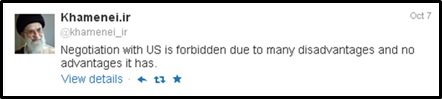
Following Khamenei’s address in early September 2015, contacts between Iran and the US and the P5 +1 powers took place September 28, 2015, on the sidelines of the UN General Assembly but their results were not published[4] and subsequently Khamenei issued a guideline on October 7, 2015 banning contacts with the US.[5]

25258

Endnotes:

[1] Fars (Iran), October 15, 2015; ILNA (Iran), October 15, 2015.

[3] See MEMRI Inquiry and Analysis No. 1192, The Iranian Majlis Has Not Approved The JCPOA But Iran’s Amended Version Of It, October 13, 2015.

[5] Twitter.com/khamenei_ir, October 7, 2015.

The Moscow-Washington-Tehran Axis of Evil

October 3, 2015

The Moscow-Washington-Tehran Axis of Evil, Canada Free PressCliff Kincaid, October 3, 2015

(I am not posting this because I currently accept its conclusions or some of their bases. However, it’s frightening, interesting and has at least some food for thought. — DM)

KINCAID100315

The conventional wisdom is that Vladimir Putin has blindsided Barack Obama in the Middle East, catching the U.S. off-guard. It’s another Obama “failure,” we’re told. “Obama administration scrambles as Russia attempts to seize initiative in Syria,” is how a Washington Post headline described it. A popular cartoon shows Putin kicking sand in the faces of Obama and Secretary of State John Kerry on a beach.

The conventional wisdom is driven by the notion that Obama has the best of intentions but that he’s been outmaneuvered. What if his intention all along has been to remake the Middle East to the advantage of Moscow and its client state Iran? What if he knows exactly what he’s doing? Too many commentators refuse to consider that Obama is deliberately working against U.S. interests and in favor of the enemies of the U.S. and Israel.

In his U.N. address, Obama said, “As President of the United States, I am mindful of the dangers that we face; they cross my desk every morning. I lead the strongest military that the world has ever known, and I will never hesitate to protect my country or our allies, unilaterally and by force where necessary.”

This is laughable. We still have a strong military, but the inevitable conclusion from what’s recently transpired is that he doesn’t want to protect the interests of the U.S. or its allies in the Middle East. This is not a “failure,” but a deliberate policy.

The trouble with conventional wisdom is the assumption that Obama sees things the way most Americans do. In order to understand Obama’s Middle East policy, it is necessary to consult alternative sources of news and information and analysis. That includes communist news sources.

A fascinating analysis appears in the newspaper of the Socialist Workers Party, The Militant, one of the oldest and most influential publications among the left. You may remember the old photos which surfaced of Lee Harvey Oswald selling copies of The Militant before he killed the American president.

The headline over The Militant story by Maggie Trowe caught my eye: “‘Reset’ with US allows Moscow to send arms, troops to Syria.” It was not about Hillary Clinton’s reset with Moscow years ago, but a more recent one.

Here’s how her story began: “Moscow’s rapid military buildup in Syria is a result of the ‘reset’ in relations forged with the Russian and Iranian governments by the Barack Obama administration. The deal—reshaping alliances and conditions from Syria, Iran and the rest of the Middle East to Ukraine and surrounding region—is the cornerstone of U.S. imperialism’s efforts to establish a new order in the Mideast, but from a much weaker position than when the now-disintegrating order was imposed after World Wars I and II.”

Of course, the idea that “U.S. imperialism” is served by giving the advantage to Russia and Iran is ludicrous. Nevertheless, it does appear that a “reset” of the kind described in this article has in fact taken place. The author writes about Washington’s “strategic shift to Iran and Russia” and the “downgrading” of relations with Israel and Saudi Arabia. She notes that Moscow “seeks more influence and control of the country [Syria] and its Mediterranean ports and a stronger political hand in Mideast politics.” Iran “has sent Revolutionary Guard Quds forces to help prop up Assad, and collaborates with Moscow on operations in Syria,” she notes.

It is sometimes necessary to reject the conventional wisdom and instead analyze developments from the point of view of the Marxists, who understand Obama’s way of thinking. They pretend that Obama is a pawn of the “imperialists” but their analysis also makes sense from a traditional pro-American perspective. Those who accept the evidence that Obama has a Marxist perspective on the world have to consider that his policy is designed to help Moscow and Tehran achieve hegemony in the region.

At the same time, the paper reported, “Since Secretary of State John Kerry’s congenial visit with Putin in May, it has become clear that Washington would accept Moscow’s influence over its ‘near abroad’ in Ukraine and the Baltics, in exchange for help to nail down the nuclear deal with Tehran.” Hence, Obama has put his stamp of approval on Russian aggression in Europe and the Middle East. This analysis, though coming from a Marxist newspaper, fits the facts on the ground. It means that more Russian aggression can be expected in Europe.

The wildcard is Israel and it looks like the Israeli government is being increasingly isolated, not only by Obama but by Putin. The story notes that Israeli Prime Minister Benjamin Netanyahu met with Putin in Moscow on September 21, saying his concern was to “prevent misunderstandings” between Israeli and Russian troops, since Israel has carried out airstrikes in Syrian territory targeting weapons being transported to the Iranian-backed Hezbollah terrorists in Lebanon.

Some reports indicated that Israel had set up a joint mechanism with the Russian military to coordinate their operations in Syria.

However, the Russian leader reportedly told Obama during their U.N. meeting that he opposes Israeli attacks in Syria. The Israeli newspaper Haaretz ran a story that Russia intends to “Clip Israel’s Wings Over [the] Syrian Skies.” The paper added that Putin’s remarks to Obama showed that despite Netanyahu’s meeting with Putin in Moscow, “Russia intends to create new facts on the ground in Syria that will include restricting Israel’s freedom of movement in Syrian skies.”

It hardly seems to be the case that Obama has been outsmarted in the Middle East, or that Putin and Obama don’t like each other. Instead, it appears that Obama is working hand-in-glove with Putin to isolate Israel and that Obama is perfectly content to let the former KGB colonel take the lead.

Israel has always been seen by most U.N. members as the real problem in the region. Obama is the first U.S. President to see Israel in that same manner and to act accordingly. This is why Putin has not caught Obama off-guard in the least. They clearly see eye-to-eye on Israel and Iran.

Don’t forget that Obama actually telephoned Putin to thank him for his part in the nuclear deal with Iran. The White House issued a statement saying, “The President thanked President Putin for Russia’s important role in achieving this milestone, the culmination of nearly 20 months of intense negotiations.”

Building off the Iran nuclear deal, it looks like the plan is for Russia and the United States to force Israel to embrace a U.N. plan for a nuclear-free Middle East. That would mean Israel giving up control of its defensive nuclear weapons to the world body. Iran will be able to claim it has already made a deal to prohibit its own nuclear weapons development.

Such a scheme was outlined back in 2005 in an article by Mohamed Elbaradei, the director-general at the time of the U.N.‘s International Atomic Energy Agency (IAEA). That’s the same body that is now supposed to guarantee Iranian compliance with the terms of the nuclear deal signed by Russia and the U.S.

Elbaradei argued there would have to be “a dialogue on regional security as part of the peace process,” to be followed by an agreement “to make the Middle East a nuclear-weapons-free zone.”

The “dialogue” appears to be taking place now, mostly under the authority and auspices of the Russian government, with President Obama playing a secondary role.

The obvious danger is that Israel would be forced to comply with the plan for a “nuclear-weapons-free-zone,” while Iran would cheat and develop nuclear weapons anyway.

Netanyahu told the U.N. that “Israel deeply appreciates President Obama’s willingness to bolster our security, help Israel maintain its qualitative military edge and help Israel confront the enormous challenges we face.”

This must be his hope. But he must know that Israel’s security is slipping and that the survival of his country is in grave danger in the face of this Moscow-Washington-Tehran axis.

Before Putin further consolidates his military position in the Middle East and Iran makes more progress in nuclear weapons development, Netanyahu will have to launch a preemptive strike on the Islamic state. “Israel will not allow Iran to break in, to sneak in or to walk in to the nuclear weapons club,” the Israeli Prime Minister said.

In launching such a strike before the end of Obama’s second presidential term, Israel would bring down the wrath of the world, led by Russia and the U.S., on the Jewish state.

The Elephant In The Room

October 2, 2015

The Elephant In The Room, Middle East Media Research Institute (MEMRI), Yigal Carmon*, October 2, 2015

(Please see also, Iran wants to renegotiate parts of the nuke “deal.” That may be good. Have opponents of the “deal” given up? If so, why? — DM)

It may be that these opponents believe that the agreement is a done deal that cannot be stopped and that the current U.S. administration will follow through with it no matter what. This approach reflects not realism but ignorance. Obviously the administration wants to follow through with the deal. But the deal is no longer in it hands. It is Khamenei who is throwing a spanner in the works, declaring that he will not implement the agreement that the West believed it concluded on July 14.

In order to get Iran to implement the agreement, the language of the JCPOA will have to be changed and a new Security Council resolution will have to be passed. While in theory this would not be impossible, it would require a new process, entailing, at the very least, a public political debate in the West – one that would reveal Iran’s unreliability as a partner and would cost valuable time. And time is not on the side of the U.S. administration.

*****************

On September 3, 2015, not two months after the July 14 announcement of the Joint Comprehensive Plan of Action at Vienna and its celebration at the White House and in Europe, Iranian Supreme Leader Ali Khamenei dropped a bombshell.

In a speech to the Iranian Assembly of Experts, he backtracked from the agreement, demanding a new concession: that the sanctions be “lifted,” not merely “suspended.”[1] If that term is not changed, said Khamenei, there is no agreement. If the West only “suspends” the sanctions, he added, Iran will merely “suspend” its obligations. Giving further credence to his threat, he announced that it is the Iranian Majlis that must discuss and approve the agreement (or not), because it represents the people – when it is well known that the majority of its members oppose it, and Iranian President Hassan Rohani made every effort to prevent such a discussion in the Majlis from taking place.

Adding insult to injury, Ali Akbar Velayati, senior advisor to Khamenei and head of Iran’s Center for Strategic Research, said on September 19 that the negotiations, concluded and celebrated less than two months previously on July 14, are actually “not over yet.”[2]

Khamenei’s demand to replace “suspension” with “lifting” is not just semantic. It is a fundamental change, because the snapback of sanctions – the major security mechanism for the entire agreement – cannot take place with “lifting,” but only with “suspension.”

Ever since Khamenei dropped this bombshell, the Western media has maintained total silence, as if this were a trivial matter not worthy of mention, let alone analysis.

One might understand this reaction on the part of those who support the deal. Perhaps they are shocked, at a loss, and therefore hope that if they pretend they don’t see it, it doesn’t exist. Indeed, this is the futile policy regularly adopted by ostriches.

However, one cannot but be astounded by the silence on the part of the opponents of the deal, including – oddly enough – Israel and the U.S. Republicans. One would expect these opponents to pounce on Khamenei’s statement and raise hell over Iran’s infanticide of the two-month-old agreement. One would expect them to bring it to the forefront of a new debate over the deal in any possible forum – in the U.S., the U.N., and the E.U.

But – nothing.

It may be that these opponents believe that the agreement is a done deal that cannot be stopped and that the current U.S. administration will follow through with it no matter what. This approach reflects not realism but ignorance. Obviously the administration wants to follow through with the deal. But the deal is no longer in it hands. It is Khamenei who is throwing a spanner in the works, declaring that he will not implement the agreement that the West believed it concluded on July 14.

In order to get Iran to implement the agreement, the language of the JCPOA will have to be changed and a new Security Council resolution will have to be passed. While in theory this would not be impossible, it would require a new process, entailing, at the very least, a public political debate in the West – one that would reveal Iran’s unreliability as a partner and would cost valuable time. And time is not on the side of the U.S. administration.

Right now, Iran is exposed almost daily as the ally of Russia against the U.S. Three months after the “historic” agreement declared by the White House, Iran continues to seek “Death to America,” and the Iranian foreign minister, the “hero” of the agreement, needs to apologize in Iran for “accidentally” shaking hands with the U.S. president. The truth of the agreement is emerging, and it is not certain that what Iran is now demanding will pass.

Interestingly enough, the White House’s first reaction was to brush off Khamenei’s demand. Iran, said Josh Earnest, should just do what it what it had undertaken to do in the agreement, and stop roiling the waters.[3]

A more sober response followed. There was hope that the meeting set for September 28 between the P5+1 and Iranian foreign ministers, on the margins of the 70th session of the U.N. General Assembly, would produce a solution, but this hope was in vain. Iranian President Rohani fled back to Iran, on the pretext of the hajj tragedy in Mecca, and no one in the West knows how to proceed.

The Western media, for its part, is perpetuating its total blackout on the issue, hoping perhaps for a miracle in the secret U.S.-Iran talks, which this administration has been conducting for years. But even a secret U.S. concession will be no solution. Even if it were to offer a secret commitment to remove the sanctions altogether, Khamenei will not be satisfied. He openly challenged the U.S., and he needs its public capitulation. He will celebrate publicly any secret concession. Moreover, any new U.S. concession will prompt Khamenei to make ever more demands.

The most recent developments, and the emergence of Russia as a new-old contender for power vis-à-vis the U.S. in the world, particularly in the Middle East, will only encourage Khamenei to cling to his tried and true ally, Russia. Indeed, this administration has no objection to Russia’s resurgence in the Middle East, but Russia’s blatant anti-U.S. stance in every venue except in the private, honeyed Putin-Obama talks will ultimately lead even the blindest of Democrats to realize that Iran is indeed an enemy of the U.S. – as Iran plainly declares – and that any further concessions to it make no sense.

It seems that the worst nightmare of the supporters of the deal – that Iran will do away with the July 14 agreement – is about to come to pass.

*Y. Carmon is president and founder of MEMRI.

Endnotes:

[3] Earnest said: “What we have indicated all along is that once an agreement was reached, as it was back in mid-July, that we would be focused on Iran’s actions and not their words, and that we will be able to tell if Iran follows through on the commitments that they made in the context of these negotiations. And that is what will determine our path forward here. We’ve been crystal clear about the fact that Iran will have to take a variety of serious steps to significantly roll back their nuclear program before any sanctions relief is offered – and this is everything from reducing their nuclear uranium stockpile by 98 percent, disconnecting thousands of centrifuges, essentially gutting the core of their heavy-water reactor at Arak, giving the IAEA the information and access they need in order to complete their report about the potential military dimensions of Iran’s nuclear program. And then we need to see Iran begin to comply with the inspections regime that the IAEA will put in place to verify their compliance with the agreement. And only after those steps and several others have been effectively completed, will Iran begin to receive sanctions relief.  The good news is all of this is codified in the agreement that was reached between Iran and the rest of the international community. And that’s what we will be focused on, is their compliance with the agreement.” Whitehouse.gov, September 4, 2015.

Iran appears to wants changes in the JCPOA

September 22, 2015

Expected September 28 NY Meeting Between P5+1 Foreign Ministers And Iran Could Signify Reopening Of Nuclear Negotiations To Address Khamenei’s September 3 Threat That If Sanctions Are Not Lifted, But Merely Suspended, There Will Be No Agreement, MEMRI, September 21, 2015

(If the JCPOA is renegotiated, in any respect, will Congress get another opportunity to challenge it? If so, will a way be found to deal with it as a treaty? The answer to both questions should be yes. — DM)

The expected meeting between the P5+1 foreign ministers and Iranian Foreign Minister Zarif may be evidence of a shift in the White House position and also evidence that it intends to discuss the Iranian demand for further concessions from the superpowers.

****************

Recent reports indicate that the foreign ministers of the P5+1 are set to meet with Iranian Foreign Minister Javad Zarif in New York on September 28, 2015, on the margins of the UN General Assembly, to “examine the recent developments of the JCPOA.”[1]

On September 20, 2015, U.S. Secretary of State John Kerry said, at a joint press conference in Berlin with his German counterpart Frank-Walter Steinmeier, that he would meet Zarif in New York to discuss “Iran and other matters.”[2]

Additionally, Ali Akbar Velayati, a senior advisor to Iranian Supreme Leader Ali Khamenei and the head of Iran’s Center for Strategic Research, said on September 19, 2015 that “the nuclear negotiations are not over yet.”[3]

As will be recalled, Khamenei said, in a September 3, 2015 speech to the Assembly of Experts, that he did not accept the terms of the agreement and demanded that the sanctions be immediately lifted rather than merely suspended; otherwise, he said, there would either be no agreement, or Iran too would merely suspend its execution of its obligations under the JCPOA. He said: “We negotiated [with the Americans] in order to have the sanctions lifted, and the sanctions will be lifted. Now, if we are supposed to uphold this framework… this completely contradicts the reason for Iran’s participation in the talks to begin with. Otherwise, what was the point of our participation in the talks? We would have continued to do what we were doing [prior to the talks]… The fact that we sat down and held talks and made concessions on certain issues was mainly in order to have the sanctions lifted. If the sanctions are not going to be lifted, there will be no agreement… [Our] officials [i.e. Rohani’s government and his Ministry of Foreign Affairs] should make this clear…

“Freezing or suspension [of the sanctions] is unacceptable to me… If they suspend [the sanctions], we too will suspend [what is incumbent upon us]. If we are to implement what [is required of us], the sanctions must be [actually] cancelled. True, the other side says that some of the sanctions are not [up to them entirely] to be lifted. We say in response that [with regard to those sanctions] we will use our legal rights to freeze them. But regarding [the sanctions that are] in the hands of the American and European governments – those must be totally lifted.”[4]

The apparent meaning of all the above is that the nuclear negotiations, which Iran considers unfinished, will be reopened, with the aim of achieving the complete lifting of sanctions – instead of a mere suspension of them as was agreed in the JCPOA and adopted in UN Security Council Resolution 2231.

It will also be recalled that following Khamenei’s September 3 demands, on September 4 the White House responded; spokesman Josh Earnest said that Iran was charged with meeting its obligations under the JCPOA: “What we have indicated all along is that once an agreement was reached, as it was back in mid-July, that we would be focused on Iran’s actions and not their words, and that we will be able to tell if Iran follows through on the commitments that they made in the context of these negotiations. And that is what will determine our path forward here.

“We’ve been crystal clear about the fact that Iran will have to take a variety of serious steps to significantly roll back their nuclear program before any sanctions relief is offered – and this is everything from reducing their nuclear uranium stockpile by 98 percent, disconnecting thousands of centrifuges, essentially gutting the core of their heavy-water reactor at Arak, giving the IAEA the information and access they need in order to complete their report about the potential military dimensions of Iran’s nuclear program. And then we need to see Iran begin to comply with the inspections regime that the IAEA will put in place to verify their compliance with the agreement.

“And only after those steps and several others have been effectively completed, will Iran begin to receive sanctions relief.  The good news is all of this is codified in the agreement that was reached between Iran and the rest of the international community. And that’s what we will be focused on, is their compliance with the agreement.”[5]

The expected meeting between the P5+1 foreign ministers and Iranian Foreign Minister Zarif may be evidence of a shift in the White House position and also evidence that it intends to discuss the Iranian demand for further concessions from the superpowers.

It should be clarified that agreement on the part of the U.S. to lifting the sanctions would constitute a fundamental change to the JCPOA. This is because lifting the sanctions, rather than suspending them, will render impossible a snapback in case of Iranian violations, and the guarantee of a snapback is one of the central justifications for the JCPOA, according to President Obama and Secretary of State Kerry.

Endnotes:

[1] Fars (Iran), September 21, 2015.

[2] State.gov, September 20, 2015.

[3] Fars (Iran), September 19, 2015. It should be mentioned that Majlis member Hamid Rasaei said that the language of the agreement signed by Abbas Araghchi that was delivered to Majlis committees was “a partial document with many translating errors and omissions.” He added that the government must present the agreement to the Majlis in the form of a draft law and that a Majlis committee is currently “examining a version that is neither a proposal nor a draft law.” Tasnim (Iran), September 20, 2015.

[5] Whitehouse.gov, September 4, 2015.