Archive for the ‘Javad Zarif’ category

Benghazi, Bergdahl, and the Bomb

April 3, 2015

Benghazi, Bergdahl, and the Bomb, Washington Free Beacon, April 3, 2015

Column: President Obama’s stories haven’t held up before. How is the Iran deal any different?

ObamaAP

What the president and Secretary of State John Kerry unveiled Thursday was another fancy, another fairy-tale, another fable about what might happen in an ideal world where enemies and allies share common interests and objectives, autocratic and theocratic regimes adhere to compacts, and moral sincerity is more important than results. Best be skeptical—these so-called triumphs of Obama’s diplomacy have a way of falling to pieces like ancient parchment. And keep in mind this rule: When the president enters the Rose Garden, run for cover.
******************

President Obama strode to the lectern in the Rose Garden Thursday to announce a “historic” agreement between the United States and the Islamic Republic of Iran. The preliminary deal made in Lausanne, Switzerland, the president said, “cuts off every pathway Iran could take to develop a nuclear weapon.” I hope he’s right.

But I’m not counting on it. The president has a terrible record of initial public pronouncements on national security. He has a habit of confidently stating things that turn out not to be true. Three times in the last four years he has appeared in the Rose Garden and made assertions that were later proven to be false. He and his national security team have again and again described a world that does not correspond to reality. No reason to assume these concessions to Iran will be any different.

The U.S. consulate in Benghazi, Libya, was attacked on September 11, 2012. Four Americans were killed, including our ambassador. Obama delivered remarks on the attack in the Rose Garden the following day. “No acts of terror will ever shake the resolve of this great nation,” he said. What he didn’t say was that the killings in Benghazi specifically were a “terrorist attack” or “terrorism.” On 60 Minutes,when asked if he believed Benghazi was a “terrorist attack,” the president replied, “It’s too early to know how this came about.” On September 14, neither the president nor Secretary of State Hillary Clinton called what had happened a terrorist attack. On September 15, Obama referred to Benghazi as a “tragic attack.” On September 16, Susan Rice, then U.N. ambassador, called it a “spontaneous attack.”

By September 24, when Obama recorded a campaign interview with The View, he again refused to say Benghazi was an attack by terrorists. “We’re still doing an investigation,” he told Joy Behar. It was not until two days later that administration officials began referring to Benghazi as a terrorist attack—something the Libyan government had been saying since September 13.

The story originally put out by the White House, that Benghazi was the result of spontaneous anger at an Internet video offensive to Muslim extremists, fell apart in a matter of days. Yet the White House persisted in its false description of reality, declining to confirm what was widely accepted as a premeditated terrorist assault on a U.S. compound, and chose to ascribe responsibility for the events in question to anti-Islamic bias. The evidence continues to mount that Ansar al-Sharia, the Qaeda affiliate in lawless Libya, was behind the events of September 11, 2012, not the stupid video.

In August 2013 President Obama announced in the Rose Garden that Syrian dictator Bashar Assad had crossed the “red line” by gassing his own people. “Now, after careful deliberation, I have decided that the United States should take military action against Syrian regime targets,” the president said. Then he punted the issue to Congress. But no action against Syrian regime targets was ever taken, because the president reversed himself and accepted a Russian proposal to ship Assad’s WMD out of Syria. “This initiative has the potential to remove the threat of chemical weapons without the use of force, particularly because Russia is one of Assad’s strongest allies,” Obama said in a September 10, 2013, televised address. Almost two years later, Assad is dropping barrel bombs filled with chlorine gas on civilians. Success.

Last May, President Obama again walked purposefully to a lectern in the Rose Garden, and informed the world that he had released five Taliban commanders from Guantanamo Bay in exchange for Sergeant Bowe Bergdahl, who had been held prisoner by the Islamic militia for almost half a decade. “Right now,” the president said, “our top priority is making sure that Bowe gets the care and support that he needs and that he can be reunited with his family as soon as possible.”

Criticism of the prisoner swap was immediate, and intensified when Bergdahl’s platoon-mates said he had deserted his post. The White House, as usual, struck back against the critics and repeated its story. On June 2, Susan Rice, now national security adviser, went onThis Week with George Stephanopoulos and said Bergdahl “served the United States with honor and distinction.”

The Government Accountability Office concluded that the Obama administration’s actions were illegal. Bergdahl himself was kept isolated as the Army reviewed the circumstances of his capture by the enemy. Completed in the fall of 2014, the report by Brigadier General Kenneth Dahl still has not been released to the public.

Last week, however, the Army charged Bergdahl with desertion and misbehavior before the enemy. Has the White House reevaluated its trade? Of course not. On the contrary: Pentagon officials suggested on background that Bergdahl wasn’t a deserter, he was a whistleblower!

Three stories that collapsed under the weight of the evidence, three instances of the White House doggedly sticking to its policy line despite everything. This president’s resistance to events in the actual world of space and time is more than ideology, however. It’s also good politics: By refusing to concede the facts of the case, Obama is able to hold his base and stay on offense against his true adversaries: Republicans, conservatives, and Bibi Netanyahu.

And now we have the Iran story. Iran, the president says, will reduce its centrifuges, dilute its enriched uranium, open its nuclear sites to inspectors, and turn its fortified underground reactor into a “research” facility in exchange for sanctions relief. The only alternatives, Obama goes on, are bombing Iran or ending negotiations and re-imposing sanctions. “If, in fact, Prime Minister Netanyahu is looking for the most effective way to ensure Iran doesn’t get a nuclear weapon, this is the best option. And I believe our nuclear experts can confirm that.”

Sure they can. Though I believe other nuclear experts, such as Charles Duelfer, can also confirm that this agreement has major holes, such as the spotty effectiveness of inspections and the failure to get Iran to disclose fully the possible military dimensions of its nuclear program. And there’s always the tricky issue of sanctions relief: The United States says the process of lifting sanctions will be gradual and contingent on Iranian compliance, but Iranian foreign minister Javad Zarif says it will be immediate.

What the president and Secretary of State John Kerry unveiled Thursday was another fancy, another fairy-tale, another fable about what might happen in an ideal world where enemies and allies share common interests and objectives, autocratic and theocratic regimes adhere to compacts, and moral sincerity is more important than results. Best be skeptical—these so-called triumphs of Obama’s diplomacy have a way of falling to pieces like ancient parchment. And keep in mind this rule: When the president enters the Rose Garden, run for cover.

Losin’ in Lausanne (8) [Updated]

April 3, 2015

Losin’ in Lausanne (8) [Updated], Power LineScott Johnson, April 2, 2015

The last time Zarif accused the Obama administration of lying on a factsheet was after the JPOA was announced, in the context of granting a “right to enrich.” He was 100% right and the Americans were 100% wrong.

***************

Omri Ceren writes from Lausanne to put today’s announcement of a “framework” for an agreement in perspective:

Zarif just finished his speech, and there’s a break while the President speaks back in DC. But some of what Zarif revealed has already generated controversy. There was a lot of braggadocio in the speech: no closing of facilities, R&D will continue on Iran’s scientific schedule, enrichment will continue, the heavy water at Arak will be modernized, etc.

Perhaps most relevant to people who have been following the day-to-day in Lausanne, is that Zarif confirmed the U.S. has completely caved on the Fordow concession that the AP blew open on Thursday. Recall that Fordow is the underground bunker, built into the side of a mountain, which the Iranians emptied and made into an illicit enrichment facility. The assumption had always been that the Iranians would have to close it under any reasonable deal.

President Obama was saying as late as 2012: “We know they don’t need to have an underground, fortified facility like Fordo in order to have a peaceful program” [1].

The Iranians simply said no [2]. So the Americans caved and said that they could keep it open as a research facility, but they had to remove all the centrifuges for storage [3]. The compromise was the brainchild of Robert Einhorn from Brookings – a top State nonproliferation official stretching back to the Clinton era – and there was a lot of talk of Iranian flexibility when they accepted it [4]. Then this week, it emerged that in fact the Iranians would be allowed to keep centrifuges spinning inside the mountain.

But instead of spinning uranium, the centrifuges would be spinning germanium or similar non-nuclear elements. That’s the administration’s talking point: that there will not be any “enrichment” going on at Fordow. The claim is – bluntly – false. Centrifuges spin isotopes into lighter and heavier elements, thereby “enriching” the material. That’s what they do. In fact that’s all they do. The administration has gone all-in on a talking point can be defeated by a Google search for “centrifuges enrich germanium” (if you’re fastidious you can set the Google search to before the AP scoop, to make sure you’re not getting Fordow-specific articles).

This isn’t a minor point. The concession has the potential to gut the whole deal:

(1) Allows N-generation centrifuge R&D beyond the reach of the West – since the process is the exact same process, Iran will have a hardened facility where it will be able to research and develop N-generation centrifuges. Zarif bragged from the stage in Lausanne that Iranian R&D on centrifuges will continue on IR-4s, IR-5s, IR-6s, and IR-8s, and that the pace of research will be tied to Iranian scientific progress. The development of advanced centrifuges would give the Iranians a leg up if they decide to break out, and will put them instantly within a screw’s turn of a nuke when the deal expires.

(2) Leaves Iranian nuclear infrastructure running beyond the reach of the West – if the Iranians kick out inspectors and dare the world to respond, the West will have zero way to intervene. The Iranians will have a head start on enrichment, and a place to do it beyond the reach of Western weapons. The administration’s early pushback has been that the breakout time will still be a year, so they could in theory reimpose sanctions, but it takes more than a year for sanctions to take an economic toll. So: zero options to stop a breakout.

[1] http://www.wsj.com/articles/bret-stephens-the-capitulationist-1427758881
[2] http://www.jpost.com/Middle-East/Rejecting-US-comments-on-its-nuclear-program-Iran-FM-says-Fordo-Arak-are-non-negotiable-340458
[3] http://articles.chicagotribune.com/2014-07-09/news/sns-rt-us-iran-nuclear-fordow-20140709_1_fordow-enriched-uranium-interim-nuclear-deal
[4] http://www.brookings.edu/research/papers/2014/03/31-nuclear-armed-iran-einhorn

Omni follows up with this:

The issue of sequencing sanctions relief – how, when, and to what extent sanctions will be lifted in exchange for Iranian compliance – was one of the key sticking points over the last week. At some points journalists were describing it as a near-obsession of the Iranians, the suspicion being that they had received some very specific instructions from the Supreme Leader (or had made some very ambitious representations to him).

Achieving an understanding on sanctions would bhave to be counted as a major achievement, and it’s already being claimed as such. But there’s something wrong here. I haven’t figured out what it is yet, but I’m pretty sure I don’t like it.

– The EU/Iran joint statement says sanctions will be terminated “simultaneously” with Iran implementing its obligations (http://www.eeas.europa.eu/statements-eeas/2015/150402_03_en.htm): The EU will terminate the implementation of all nuclear-related economic and financial sanctions and the US will cease the application of all nuclear-related secondary economic and financial sanctions, simultaneously with the IAEA-verified implementation by Iran of its key nuclear commitments.

– The White House factsheet says sanctions will be suspended “after” Iran has taken “all” of its nuclear-related steps (https://www.scribd.com/doc/260719595/Parameters-for-a-Joint-Comprehensive-Plan-of-Action-regarding-the-Islamic-Republic-of-Iran-s-Nuclear-Program): U.S. and E.U. nuclear-related sanctions will be suspended after the IAEA has verified that Iran has taken all of its key nuclear-related steps. If at any time Iran fails to fulfill its commitments, these sanctions will snap back into place.

Zarif is already saying the White House is lying about how sanctions will be lifted:

The solutions are good for all, as they stand. There is no need to spin using “fact sheets” so early on.

Iran/5+1 Statement: “US will cease the application of ALL nuclear-related secondary economic and financial sanctions.” Is this gradual?

Iran/P5+1 Statement: “The EU will TERMINATE the implementation of ALL nuclear-related economic and financial sanctions”. How about this?

The last time Zarif accused the Obama administration of lying on a factsheet was after the JPOA was announced, in the context of granting a “right to enrich.” He was 100% right and the Americans were 100% wrong.

It’s not clear what the actual sanctions deal is, but it’s worrying that there are already differences. If the Americans are right, then the Iranians are setting up unrealistic expectations for their people and making a deal untenable. If the Iranians are right, then the White House is again misleading journalists and lawmakers about the actual scope of their concessions.

Iran Accuses U.S. of Lying About New Nuke Agreement

April 3, 2015

Iran Accuses U.S. of Lying About New Nuke Agreement, Washington Free Beacon, April 2, 2015

(Breaking news: Obama lied! That’s shocking. Who would’a thunk? — DM)

Switzerland Iran Nuclear TalksJavad Zarif / AP

LAUSANNE, Switzerland — Just hours after the announcement of what the United States characterized as a historic agreement with Iran over its nuclear program, the country’s leading negotiator lashed out at the Obama administration for lying about the details of a tentative framework.

Iranian Foreign Minister Javad Zarif accused the Obama administration of misleading the American people and Congress in a fact sheet it released following the culmination of negotiations with the Islamic Republic.

Zarif bragged in an earlier press conference with reporters that the United States had tentatively agreed to let it continue the enrichment of uranium, the key component in a nuclear bomb, as well as key nuclear research.

Zarif additionally said Iran would have all sanctions lifted once a final deal is signed and that the country would not be forced to shut down any of its currently operating nuclear installations.

Following a subsequent press conference by Secretary of State John Kerry—and release of a administration fact sheet on Iranian concessions—Zarif lashed out on Twitter over what he dubbed lies.

“The solutions are good for all, as they stand,” he tweeted. “There is no need to spin using ‘fact sheets’ so early on.”

Zarif went on to push back against claims by Kerry that the sanctions relief would be implemented in a phased fashion—and only after Iran verifies that it is not conducting any work on the nuclear weapons front.

Zarif, echoing previous comments, said the United States has promised an immediate termination of sanctions.

“Iran/5+1 Statement: ‘US will cease the application of ALL nuclear-related secondary economic and financial sanctions.’ Is this gradual?” he wrote on Twitter.

He then suggested a correction: “Iran/P5+1 Statement: ‘The EU will TERMINATE the implementation of ALL nuclear-related economic and financial sanctions’. How about this?”

The pushback from Iran’s chief diplomat follows a pattern of similar accusations by senior Iranian political figures after the announcement of previous agreements.

Following the signing of an interim agreement with Iran aimed at scaling back its nuclear work, Iran accused the United States of lyingabout details of the agreement.

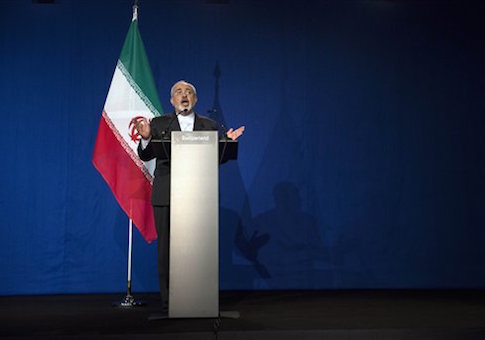
On Thursday evening, Zarif told reporters the latest agreement allows Iran to keep operating its nuclear program.

“None of those measures” that will move to scale back Iran’s program “include closing any of our facilities,” Zarif said. “We will continue enriching; we will continue research and development.”

“Our heavy water reactor will be modernized and we will continue the Fordow facility,” Zarif said. “We will have centrifuges installed in Fordow, but not enriching.”

The move to allow Iran to keep centrifuges at Fordow, a controversial onetime military site, has elicited concern that Tehran could ramp up its nuclear work with ease.

Zarif said that once a final agreement is made, “all U.S. nuclear related secondary sanctions will be terminated,” he said. “This, I think, would be a major step forward.”

Zarif also revealed that Iran will be allowed to sell “enriched uranium” in the international market place and will be “hopefully making some money” from it.

A “preliminary deal” is announced in Lausanne. Zarif: There is no agreement, no commitments

April 2, 2015

A “preliminary deal” is announced in Lausanne. Zarif: There is no agreement, no commitments, DEBKAfile, April 2, 2015

Obama nuke dealBarack Obama hails nuclear “agreement”

Iranian Foreign Minister Mohammed Javad Zarif and EU Foreign Policy Executive Federica Mogherini announced Thursday, April 2 that “a general agreement for a peaceful nuclear program and a lifting of sanctions against Iran” had been reached in Lausanne. “We have reached solutions on key parameters of a join comprehensive plan of action,” the details to be negotiated between now and June 30,” she said.

Speaking after the EU official, Zarif delivered a long statement ending with the declaration: “There is no agreement; and so no commitments” before June 30.

But President Barack Obama, commenting on the event at the White House, hailed the agreement as a historic event that will change the face of the world and make it a safer place.  “It is a deal that meets our core objectives.” There is no way Iran can get round it to build a bomb, or produce plutonium at its Arak plant. Obama stressed that the verification mechanisms built into the agreed framework would ensure that “if Iran cheats, the world with know it.”

This is a long-term agreement which promises that Iran’s nuclear program will be closely monitoried for the next 20 years. There is much work to be done to hammer out the details before June 30, Obama said, and voiced the hope that the Iranians would not back out of the principles they had accepted in Lausanne.

In the his view, there were just three options for dealing with the Iranian nuclear program: Military force that would hold the program back for no more than two years; more sanctions, when the first round had proved to have little impact; or diplomacy, which he had chosen.

Obama said hoped the US Congress would not heap obstacles in the path of an accord, because the majority of the American popular approved of the course he led.

Before the end of the day, the president said he would talk to Israeli Prime Minister Binyamin Netanyahu and Saudi King Salman, the two leading opponents of the nuclear deal.

The parameters outlined by Mogherini agreed for future negotiation:

• Iran’s enrichment capacity and stockpile would be limited, and Iran’s sole enrichment facility would be at the Natanz nuclear facility. Other nuclear facilities would be converted to other uses.

• The nuclear facility at Fordo would be converted to a nuclear physics and technology center and the facility at Arak would be redesigned as a heavy-water research reactor that will not produce weapons-grade plutonium.

• The European Union would terminate all nuclear-related economic and financial sanctions against Iran, and the United States would do the same once Iran’s implementation of the agreement is confirmed.

• The United Nations would terminate all previous resolutions sanctioning Iran, and would incorporate other restrictions for an agreed-upon period.

Iran FM: ‘We’ll continue enriching, we won’t close facilities…all sanctions will be terminated.’

April 2, 2015

Iran FM: ‘We’ll continue enriching, we won’t close facilities…all sanctions will be terminated’ via You Tube, April 2, 2015


Iran, U.S. allies strike agreement on nuclear deal

April 2, 2015

Iran, U.S. allies strike agreement on nuclear deal, Associated Press via Washington Times, April 2, 2015

(??????????????? — DM)

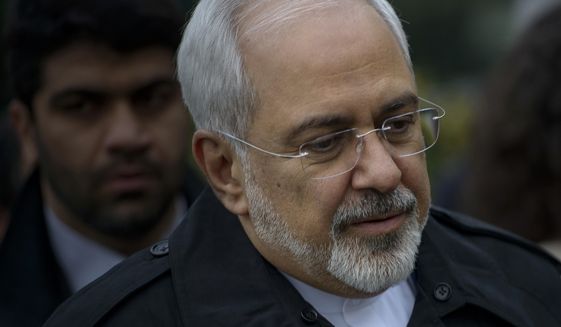
2e738e88a8f2710e720f6a7067008cce_c0-196-4500-2818_s561x327Iranian Foreign Minister Javad Zarif, walks through a courtyard at the Beau Rivage Palace Hotel during an extended round of talks, Wednesday, April 1, 2015 in Lausanne, Switzerland. Negotiations over Iran’s nuclear program appeared headed for double overtime on Wednesday.

LAUSANNE, Switzerland (AP) — Iran and and six world powers have agreed on the outlines of an understanding that would open the path to a final phase of nuclear negotiations but are in a dispute over how much to make public, officials told The Associated Press Thursday.

The officials spoke outside week-long talks that have busted through a March 31 deadline in an effort to formulate a general statement of what has been accomplished and documents setting down what the sides need to do by the end of June deadline for a deal.

Swiss officials facilitating the negotiations set a news conference for later in the day that was expected to announce the results of the talks

In the search for a comprehensive deal, the U.S. and five other countries hope to curb Iran’s nuclear technologies that it could use to make weapons. Tehran denies such ambitions but is negotiating because it wants a lifting of sanctions imposed over its nuclear program.


Khameni to Zarif: Don’t sign! Obama to Kerry: Make them sign! Gridlock

April 2, 2015

Khameni to Zarif: Don’t sign! Obama to Kerry: Make them sign! Gridlock, DEBKAfile, April 2, 2015

Kerry_hotel_nuclear_talks_C_1.4.15John Kerry takes a break from the Lausanne talks

Tehran is not averse to negotiating ad infinitum – so long as the talks go their way. 

So the real gridlock centered on finding a procedure that fitted the US delegation’s instructions to get some sort of a deal signed, and the Iranian group’s directive to sign nothing that could be seen as an accord. So who will give ground first?

***************

It is hard to make out exactly what the seven exhausted foreign ministers of the world powers and Iran were actually talking about in Lausanne this week – especially in the last two days, when the negotiations overran their March 31 deadline for a framework nuclear accord.

The highly-colored reports from the Swiss hotel up until Thursday, April 2, bespoke a mighty battle between the American negotiators led by Secretary of State John Kerry and Energy Secretary Ernest Moniz, and the Iranian group, headed by Foreign Minister Mohammed Javad Zarif, over four key points still at issue between them: the pace of sanctions relief, research and development projects, international inspections – including snap visits to any nuclear facilities they demanded, and, finally, the quantity of low-enriched uranium Iran may retain after the bulk of its stockpile is shipped overseas.

The drama was heightened by the sight of the American delegation marching into a tent set up in the hotel yard “to defeat eavesdropping” for a video conference with President Barack Obama in the White House. Kerry wanted to know whether to carry on the never-ending negotiations, which were looking more and more farcical as the hours ticked by without closure, or quit. This would be tantamount to the failure of the entire structure of nuclear diplomacy.

Obama directed the delegation to carry on talking with the Iranians and disregard the missed deadline as though nothing had changed.

The Secretary of State earlier appeared in an upper hotel window gazing out in the distance. Was he seeing a solution of the impasse visible to no one else?

The French Foreign Minister, Lauren Fabius, fed up with the game playing out between the Americans and the Iranians, left more than once for home. He returned Thursday saying: “We are a few meters from the finishing line, but it’s always the last meters that are the most difficult. We will try and cross them. It’s not done yet.”

Zarif told reporters: “Our friends need to decide whether they want to be with Iran based on respect or whether they want to continue based on pressure. They have tested the other one; it is high time to test this one.”

Those words carried two messages: One that the Iranians were serious when they reiterated in the past weeks that a framework accord for ending the current phase of negotiations was unacceptable, and insisted on the talks carrying straight through to a comprehensive deal by June 30.

The Iranian foreign minister’s second message was a negation of “pressure” – i.e., sanctions, in obedience to supreme leader Ayatollah Ali Khamenei’s directive to the delegation to reject the incremental easing of international sanctions and press Tehran’s demand for immediate relief.

That directive was laid down by the ayatollah on February 18, when he determined that “an agreement would be arrived at not in two stages but in one stage to be completed by the end of June 2015 and the agreement would include the removal of all sanctions on Iran.”

The writing was on the wall for all the parties to see. The current deadline crisis could have been avoided by understanding that there was no way the Iranian delegation would ever disobey the supreme leader’s dictates.

Tehran is not averse to negotiating ad infinitum – so long as the talks go their way.

So the real gridlock centered on finding a procedure that fitted the US delegation’s instructions to get some sort of a deal signed, and the Iranian group’s directive to sign nothing that could be seen as an accord. So who will give ground first?

Iranian Negotiators Brag How They Are Artfully Tricking Western Diplomats With A Good Cop/Bad Cop Tactic

November 25, 2014

Iranian Negotiators Brag How They Are Artfully Tricking Western Diplomats With A Good Cop/Bad Cop Tactic, Jonathan Turley’s Blog, Jonathan Turley, November 25, 2014

No doubt, Kerry and others never heard of this tactic even though every kid watching old cop shows is well-versed in it.

*********************

mohammad_javad_zarif_2014
220px-john_kerry_official_secretary_of_state_portrait


Many cops, attorneys and others have used the classic good cop/bad cop tactic to try to force concessions or confessions. The key of course is not to admit that you are just doing good cop/bad cop. That seems to have escaped Iranian negotiators in the ongoing nuclear program talks who have been giving interviews bragging about how they are screaming at American and other diplomats in a good cop/bad cop ploy. Hmmmm. It is nothing like a man screaming like a lunatic to convince you that he and his country should have access to weapons-grade nuclear material.

Part of the tactic does not appear to be an act. This appears to be the signature style of Iran’s foreign minister and lead negotiator Javad Zarif. His shouting and screaming is so loud that security repeatedly came bursting into the room out of concern that there was a violent breakout. Western diplomats have been sitting back to allow Zarif to blow himself out in each of the tirades. In one incident, European Union Foreign Policy Chief Catherine Ashton assured worried security officers that it was just Zarif again and that everyone was used to it.

What really caught my eye however was that Zarif’s unprofessional outbursts were openly discussed in the Iranian press and that the Iranian team also has been discussing how they are tricking Western diplomats with the use of the good cop/bad cop tactic. No doubt, Kerry and others never heard of this tactic even though every kid watching old cop shows is well-versed in it.

Iranian diplomat Abbas Araghchi discussed how Zarif “shouted” at Kerry in a way that was likely “unprecedented” in the history of U.S. diplomacy. That appears to be a good thing and a source of pride. He then went on to brag that he and Zarif play the roles of “good cop, bad cop” to “baffle the Western diplomats” and keep them uneasy. Clever.

As if to show the triumph of Iranian diplomacy, Araghchi said that after Zarif yells at Kerry and other diplomats there is largely silence in the room except for “one or two very respectful sentences.” They appear to mistake shocked and embarrassed silence of diplomats with people are cowed by the brilliant screaming and pounding of Zarif. They will see the same reaction to people raving on the New York subway. Few people call the guy screaming about the microchip in his brain in the Penn Station “a master negotiator.” However, they may now wonder if he is an Iranian diplomat.