Archive for the ‘Israeli security’ category

The IDF’s New Social Contract

January 6, 2017

The IDF’s New Social Contract, Front Page MagazineCaroline Glick, January 6, 2016

flickr_-_israel_defense_forces_-_karakal_winter_training_1

Azaria is the first victim of a General Staff that has decided to cease serving as the people’s army and serve instead as B’Tselem’s army. The call now spreading through the Knesset for Azaria to receive a presidential pardon, while certainly reasonable and desirable, will likely fail to bring about his freedom. For a pardon request to reach President Reuven Rivlin’s desk, it first needs to be stamped by Eisenkot.

A pardon for Azaria would go some way toward repairing the damage the General Staff has done to its relationship with the public. But from Eisenkot’s behavior this week, it is apparent that he feels no need and has no interest in repairing that damage.

******************************

Sgt. Elor Azaria, who was convicted of manslaughter Wednesday for shooting a terrorist in Hebron last March, is a symptom of what may be the most dangerous threat to Israeli society today.

Azaria, a combat medic from the Kfir Brigade, arrived at the scene of an attack where two terrorists had just stabbed his comrades. One of the terrorists was killed, the other was wounded and lying on the ground, his knife less than a meter away from him.

A cameraman from the foreign-funded, Israeli- registered anti-Israel pressure group B’Tselem filmed Azaria removing his helmet and shooting the wounded terrorist. According to the military judges, the film was the centerpiece of the case against him.

The day of the incident, the General Staff reacted to the B’Tselem film with utter hysteria. Led by Chief of General Staff Lt.-Gen. Gadi Eisenkot and then-defense minister Moshe Ya’alon, Israel’s generals competed to see who could condemn Azaria most harshly.

For the public, though, the issue wasn’t so cut and dry. Certainly Azaria didn’t act like a model soldier. It was clear, for instance, that he acted without proper authority and that his action was not permitted under the rules of engagement then in effect in Hebron.

But unlike the IDF’s senior leadership, the public believed that the fact that it was B’Tselem that produced the film meant that it had to be viewed with a grain of salt.

The name “B’Tselem” was seared into the public’s consciousness as an organization hostile to Israel and dedicated to causing it harm with the publication of the UN’s Goldstone Commission Report in 2009. Among the Israeli-registered groups that provided materials to the biased UN commission charged with finding Israel guilty of war crimes during the course of Operation Cast Lead against Hamas in late 2008 and early 2009, B’Tselem made the greatest contribution.

The Goldstone Report cited B’Tselem as the source for its slanderous “findings” 56 times.

After the UN published the Goldstone Report, Michael Posner, the US assistant secretary of state for human rights, visited Israel and met with Jessica Montell, B’Tselem’s executive director at the time.

The US Embassy’s official report of their meeting was published by WikiLeaks.

During their meeting, Montell told Posner that her group’s goal in providing the Goldstone Commission with materials was to force the government to pay a heavy price for its decision to fight Hamas, by criminalizing Israel in the court of world opinion.

As B’Tselem saw it, Israel needed to come to the point where it would consider whether it could “afford another operation like this.”

Montell explained that from B’Tselem’s perspective the root of the problem with Israel is the Israeli public. The public is the source of Israel’s bad behavior, according to B’Tselem, because it “had zero tolerance for IDF killed.” As far as the public is concerned, she said, harm to Palestinian civilians is preferable to harm to IDF soldiers.

Since, in B’Tselem’s view, the public’s commitment to the lives of its soldiers meant that it would not constitute a “moral check on war,” and check the bellicosity of IDF commanders, it fell to B’Tselem to make the IDF brass and the government care more about world opinion than they care about what the public thinks.

The public’s condemnation of B’Tselem after its role in compiling the Goldstone Commission’s libelous accusations against the IDF was made public made no impression whatsoever on the group.

Following Operation Protective Edge in 2014, B’Tselem’s materials were cited 67 times by the report of the biased UN commission put together to slander Israel.

In 2007, B’Tselem launched its “Camera Program.”

The camera initiative involved providing video cameras to B’Tselem employees and volunteers in Judea and Samaria in order to document the actions of Israeli security forces and civilians in the areas.

In many cases, the videos B’Tselem produced distorted reality for the purpose of criminalizing both groups.

For instance, in 2011, B’Tselem gave a film to Ynet’s Elior Cohen that purported to show Israeli police brutally arresting a young Palestinian boy and preventing his mother from coming to the police station with him.

But as CAMERA showed at the time, B’Tselem’s portrayal of events was fanciful at best. In all likelihood, the event was staged by the B’Tselem photographer.

At the outset of the film the boy is unseen as he throws rocks at a police van. The boy is first seen as he runs toward the B’Tselem camerawoman. For her part, the camerawoman screams at the police and identifies herself as from B’Tselem.

The police are shown asking the boy’s mother repeatedly to join them in the car. As she stands poised to enter the vehicle, a Palestinian man is shown telling her in Arabic not to go.

In July 2016, B’Tselem released a film taken in Hebron during an attempted stabbing attack by a female Palestinian terrorist against Israel police at a security checkpoint outside the Cave of the Patriarchs.

The police reported that the terrorist tried to stab a policewoman who was checking her in an inspection room. Another policewoman shot and killed her.

B’Tselem claimed that its film proved that the female terrorist was shot for no reason. But the fact is that it does no such thing. As NGO Monitor noted, the B’Tselem film neither contradicts nor proves the police’s version of events.

Over the years, the public’s growing awareness of B’Tselem’s unwavering hostility went hand in hand with its growing distress over what was perceived as the IDF’s willingness to sacrifice the safety of troops to prevent it from receiving bad press.

For instance, in 2012, a film went viral on social media that showed a platoon of combat engineers fleeing from a mob of Palestinians attacking with rocks, Molotov cocktails and slingshots.

When questioned by reporters, the soldiers said that they had repeatedly asked their battalion commander for permission to use force to disperse the crowd and they were repeatedly denied permission.

Retreat was their only option.

In 2015, another film went viral showing a group of Palestinian women hitting and screaming at a soldier trying to arrest one of them for throwing rocks at his platoon. He did nothing as he absorbed the blows. And no harm came to the women who assaulted him.

Along with the films, came stories that soldiers on leave told their friends and family about the IDF’s rules of engagement. The tales were always the same. The rules of engagement are so restrictive that all initiative is placed in the hands of the enemy. Not only can terrorists attack at will. They can flee afterward and expect that no harm will come to them, because what is most important, the soldiers explain, is to ensure that IDF maintains its reputation as the most moral army in the world.

This was the context in which Azaria killed the wounded terrorist.

Although the headlines relate to Azaria, and his family members have become familiar faces on the news, the fact is the reason the Azaria affair was the biggest story of the year is that it really has very little to do with him.

There are three forces driving the story.

First of course, there is B’Tselem.

B’Tselem’s produced the film to advance its goal of obliging Israel’s national leadership, including the IDF brass, to care more about “world opinion” than about the opinion of Israeli citizens.

Second then, is the pubic that cares more about the lives of IDF soldiers than about what the world thinks of it.

Finally, there is the IDF General Staff that is being forced to pick which side it stands with.

Since Israel was established nearly 70 years ago, the relationship between the IDF and the public has been based on an often unstated social contract.

From the public’s side, Israel’s citizens agree to serve in the IDF and risk their lives in its service.

Moreover, they agree to allow their children to serve in the military and to be placed in harm’s way.

From the IDF’s side, the commanders agree to view the lives of their soldiers as sacrosanct, and certainly as more precious than the lives of the enemy and the enemies’ society.

The third side is the General Staff. In the years leading up to the Azaria affair the generals were already showing disturbing signs of forgetting their contract with the public.

The films of fleeing soldiers and the rules of engagement weren’t the only signs of our military leadership’s estrangement.

There were also the promotions given to radical lawyers to serve in key positions in the Military Advocate-General’s unit, and the red carpet treatment given to radical leftist groups like B’Tselem that were dedicated to criminalizing soldiers and commanders.

Since the shooting in Hebron, the General Staff’s treatment of the public has become even more disdainful.

Ya’alon and Eisenkot and his generals have repeatedly offended the public with comparisons of “IDF values” with alleged processes of barbarization, Nazification and ISIS-ization of the public by the likes of Azaria and his supporters.

If there was a specific moment where the military brass abandoned its compact with society once and for all, it came on Tuesday, the day before the military court convicted Azaria of manslaughter. In a speech that day, Eisenkot insisted that IDF soldiers are not “our children.” They are grownups and they are required to obey the orders they receive.

By making this statement the day before the verdict in a case that pitted society against the General Staff, which sided with B’Tselem, Eisenkot told us that the General Staff no longer feels itself obligated by a sacred compact with the people of Israel.

Azaria is the first victim of a General Staff that has decided to cease serving as the people’s army and serve instead as B’Tselem’s army. The call now spreading through the Knesset for Azaria to receive a presidential pardon, while certainly reasonable and desirable, will likely fail to bring about his freedom. For a pardon request to reach President Reuven Rivlin’s desk, it first needs to be stamped by Eisenkot.

A pardon for Azaria would go some way toward repairing the damage the General Staff has done to its relationship with the public. But from Eisenkot’s behavior this week, it is apparent that he feels no need and has no interest in repairing that damage.

As a result, it is likely that Azaria will spend years behind bars for killing the enemy.

Moreover, if nothing forces Eisenkot and his generals to their senses, Azaria will neither be the last nor the greatest victim of their betrayal of the public’s trust.
Why the Anti-Israeli Sentiment?

January 5, 2017

Why the Anti-Israeli Sentiment? Town HallVictor Davis Hanson, January  5, 2017

israelflag

Secretary of State John Kerry, echoing other policymakers in the Obama administration, blasted Israel last week in a 70-minute rant about its supposedly self-destructive policies.

Why does the world — including now the U.S. — single out liberal and lawful Israel but refrain from chastising truly illiberal countries?

Kerry has never sermonized for so long about his plan to solve the Syrian crisis that has led to some 500,000 deaths or the vast migrant crisis that has nearly wrecked the European Union.

No one in this administration has shown as much anger about the many thousands who have been killed and jailed in the Castro brothers’ Cuba, much less about the current Stone Age conditions in Venezuela or the nightmarish government of President Rodrigo Duterte in the Philippines, an ally nation.

President Obama did not champion the cause of the oppressed during the Green Revolution of 2009 in Iran. Did Kerry and Obama become so outraged after Russia occupied South Ossetia, Crimea and eastern Ukraine?

Ambassador to the United Nations Samantha Power was never so impassioned over the borders of Chinese-occupied Tibet, or over Turkish-occupied Northern Cyprus.

In terms of harkening back to the Palestinian “refugee” crisis that started in the late 1940s, no one talks today in similar fashion about the Jews who survived the Holocaust and walked home, only to find that their houses in Eastern Europe were gone or occupied by others. Much less do we recall the 11 million German civilians who were ethnically cleansed from Eastern Europe in 1945 by the Soviets and their imposed Communist governments. Certainly, there are not still “refugee” camps outside Dresden for those persons displaced from East Prussia 70 years ago.

More recently, few nations at the U.N. faulted the Kuwaiti government for the expulsion of 200,000 Palestinians after the liberation of Kuwait by coalition forces in 1991.

Yet on nearly every issue — from “settlements” to human rights to the status of women — U.N. members that routinely violate human rights target a liberal Israel.

When President Obama entered office, among his first acts were to give an interview with the Saudi-owned news outlet Al Arabiya championing his outreach to the mostly non-democratic Islamic world and to blast democratic Israel on “settlements.”

Partly, the reason for such inordinate criticism of Israel is sheer cowardice. If Israel had 100 million people and was geographically large, the world would not so readily play the bully.

Instead, the United Nations and Europe would likely leave it alone — just as they give a pass to human rights offenders such as Pakistan and Indonesia. If Israel were as big as Iran, and Iran as small as Israel, then the Obama administration would have not reached out to Iran, and would have left Israel alone.

Israel’s supposed Western friends sort out Israel’s enemies by their relative natural resources, geography and population — and conclude that supporting Israel is a bad deal in cost/benefit terms.

Partly, the criticism of Israel is explained by oil — an issue that is changing daily as both the U.S. and Israel cease to be oil importers.

Still, about 40 percent of the world’s oil is sold by Persian Gulf nations. Influential nations in Europe and China continue to count on oil imports from the Middle East — and make political adjustments accordingly.

Partly, anti-Israel rhetoric is due to herd politics.

The Palestinians — illiberal and reactionary on cherished Western issues like gender equality, homosexuality, religious tolerance and diversity — have grafted their cause to the popular campus agendas of race/class/gender victimization.

Western nations in general do not worry much about assorted non-Western crimes such as genocides, mass cleansings or politically induced famines. Instead, they prefer sermons to other Westerners as a sort of virtue-signaling, without any worries over offending politically correct groups.

Partly, the piling on Israel is due to American leverage over Israel as a recipient of U.S. aid. As a benefactor, the Obama administration expects that Israel must match U.S. generosity with obeisance. Yet the U.S. rarely gives similar “how dare you” lectures to less liberal recipients of American aid, such as the Palestinians for their lack of free elections.

Partly, the cause of global hostility toward Israel is jealousy. If Israel were mired in Venezuela-like chaos, few nations would care. Instead, the image of a proud, successful, Westernized nation as an atoll in a sea of self-inflicted misery is grating to many. And the astounding success of Israel bothers so many failed states that the entire world takes notice.

But partly, the source of anti-Israelism is ancient anti-Semitism.

If Israelis were Egyptians administering Gaza or Jordanians running the West Bank (as during the 1960s), no one would care. The world’s problem is that Israelis are Jews. Thus, Israel earns negative scrutiny that is never extended commensurately to others.

Obama and his diplomatic team should have known all this. Perhaps they do, but they simply do not care.

Hamas’s Fatah and the No-State Solution

January 3, 2017

Hamas’s Fatah and the No-State Solution, Gatestone InstituteKhaled Abu Toameh, January 3, 2017

Palestinian Authority President Mahmoud Abbas declared that 2017 will be the “year of international recognition of the State of Palestine.”

The melee in Gaza exposes as the lie that it is Abbas’s repeated claim of a unified Fatah able to lead the Palestinians towards statehood. Incredibly, Abbas seeks global recognition of a Palestinian state at a time when the flames in his own backyard are set to engulf him and his questionable regime.

More bad news from the poll: if presidential elections were to be held today, Ismail Haniyeh, leader of the terrorist group Hamas, would beat Abbas by 49% to 45%.

Palestinians are now openly talking about two different Fatah factions. After Abbas’s decision to strip the legislators of their parliamentary immunity, six Fatah PLC members participated in a Hamas-sponsored meeting of the PLC in the Gaza Strip. This was the first time since 2007 that such a move had been made.

Fatah leaders in the Gaza Strip, unlike their colleagues in the West Bank, are de facto recognizing the Hamas rule over the Gaza Strip. This is wonderful news for Hamas, whose leader, Ismail Haniyeh is likely to defeat Abbas in a presidential election.

The Fatah gunmen who marched in the Gaza Strip courtesy of Hamas are not supporters of Abbas. Instead, they represent the “other face” of Fatah — the one that does not believe in any peace process with Israel and shares Hamas’s ambition of destroying Israel.

During a celebration in Ramallah marking the 52nd anniversary of the founding of his Fatah faction, Palestinian Authority (PA) President Mahmoud Abbas declared that 2017 will be the “year of international recognition of the State of Palestine.” Hailing the recent anti-settlement UN Security Council resolution 2334, Abbas said he was prepared to work with the new administration of Donald Trump “to achieve peace in the region.”

But while Abbas and his lieutenants were celebrating in Ramallah, at least 11 Palestinians were wounded in a scuffle that erupted between rival Fatah factions in the Gaza Strip. According to sources in the Gaza Strip, the fight broke out between Abbas loyalists and supporters of estranged Fatah leader Mohammed Dahlan. The confrontation, which was the most violent between the two sides in many years, is yet another sign of increasing schism in Fatah. Moreover, it is an indication of how Abbas’s control over his own faction is slipping through his hands. Hamas policemen who were at the scene did not interfere to break up the fight between the warring Fatah activists.

The melee in Gaza exposes as the lie that is Abbas’s repeated claim of a unified Fatah, able to lead the Palestinians towards statehood. Incredibly, Abbas seeks global recognition of a Palestinian state at a time when the flames in his own backyard are set to engulf him and his questionable regime.

Abbas says he wants to work with the Trump Administration to achieve peace in the Middle East, yet he cannot even achieve peace in his very own faction.

Abbas’s speech coincided with a new public opinion poll that showed that 64% of Palestinians want him to step down. The poll, conducted by the Ramallah-based Palestinian Center for Policy and Survey Research, also showed that two-thirds of Palestinians do not believe that the current Fatah leadership can achieve their aspirations.

The poll’s findings show that the percentage of Palestinians who want Abbas to resign has risen over the past three months from 61% to 64%. More bad news from the poll: if presidential elections were to be held today, Ismail Haniyeh, leader of the terrorist group Hamas, would beat Abbas by 49% to 45%.

The results of the poll should not come as a surprise to those who have been monitoring Palestinian affairs for the past few years. Judging from the sentiments on the Palestinian street, there is good reason to believe that the 81-year-old Abbas, who is now in his 12th year of his four-year term in office, has long ago lost much of his credibility among his people. The real surprise is that only 64% of Palestinians want to see him gone.

Many Palestinians hold Abbas personally responsible for the continued and rapid deterioration in the Palestinian arena. They see his incompetent and failed leadership as the main reason behind the 2007 violent Hamas takeover of the Gaza Strip. As soon as Hamas started shooting, Abbas’s fragile, corrupt and strife-ridden Palestinian Authority security forces collapsed. Critics of Abbas say that lack of leadership and decision-making on his part facilitated the Hamas seizure of the Gaza Strip.

Yet over the years, it has become evident that Abbas has not only lost the Gaza Strip and its two million inhabitants to Hamas, but that he is also losing control over his own Fatah faction there. Abbas has managed to alienate many Fatah leaders and activists in the Gaza Strip (most of whom are not necessarily affiliated with his arch-rival, Dahlan) to a point where Palestinians are now openly talking about two different Fatah factions.

Instead of devoting his energies to freeing the Gaza Strip from the iron grip of Hamas, Abbas has spent the past few years waging war against anyone in Fatah who dares to challenge his policies or criticize him. In this regard, he has resorted to a number of punitive measures that have further escalated tensions among Fatah cadres.

These measures include cutting off salaries and pensions to Fatah employees whose loyalty to Abbas is in question or who are suspected of being affiliated with Dahlan. As far as Abbas is concerned, affiliation with Hamas is less of a crime than being affiliated with Dahlan or any of his rivals in Fatah. Another measure that Abbas has taken to punish his rivals in Fatah: stripping them of their parliamentary immunity. The latest victims of this punishment: Mohamed Dahlan, Nasser Juma’ah, Shami Al-Shami, Najat Abu Baker and Jamal Al-Tirawi. Abbas took the decision without seeking the approval of the Palestinian parliament, the Palestinian Legislative Council (PLC), or any other judicial or decision-making institution. His detractors point out that the removal of the parliamentary immunity is in violation of the Palestinian Basic Law, because the PLC is the only party authorized to take such a decision.

When Fatah legislators protested against Abbas’s arbitrary measure by holding a sit-in strike inside the offices of the International Committee of the Red Cross in Ramallah, Abbas ordered his security forces to raid the compound and evict them by force. “This is a grave violation of the legislators’ rights and it is completely unjustified,” said a spokeswoman for Fatah in the Gaza Strip.

“It is also an indication of the repressive measures taken by the Palestinian Authority security forces. The legislators were holding a peaceful protest inside the offices of the Red Cross after President Abbas’s decision to remove their parliamentary immunity. We hold the president, the prime minister and the security forces responsible for the violations against human rights and public freedoms. We also condemn the silence of the Red Cross towards this despicable assault against the legislators inside the (Red Cross) offices.”

Abbas’s crackdown on his Fatah critics has driven them into the open arms of Hamas. After Abbas’s decision to strip the legislators of their parliamentary immunity, six Fatah PLC members participated in a Hamas-sponsored meeting of the PLC in the Gaza Strip. This was the first time since 2007 that such a move had been made.

The PLC has been effectively paralyzed since the Hamas takeover of the Gaza Strip. However, this has not prevented Hamas from continuing to convene sessions of the parliament in the Gaza Strip during the past few years. Until recently, Fatah legislators have boycotted these meetings because they do not recognize Hamas’s rule over the Gaza Strip. Abbas’s punitive and vengeful measures, however, have pushed Fatah legislators to change this status quo. This means that Fatah leaders in the Gaza Strip, unlike their colleagues in the West Bank, are de facto recognizing the Hamas rule over the Gaza Strip. This is wonderful news for Hamas, whose leader, Ismail Haniyeh (according to the latest poll) is likely to defeat Abbas in a presidential election.

Emboldened by the growing divisions in Fatah, Hamas leaders are also beginning to flirt with disgruntled Abbas critics who have been hurt by Abbas’s measures. For the first time in many years, the Hamas government permitted thousands of Fatah gunmen to hold a military parade in the Gaza Strip this week, marking the faction’s 52nd anniversary.

2180Pictured: For the first time in many years, Hamas permitted thousands of Fatah gunmen to hold a military parade in the Gaza Strip this week. (Image source: YouTube video screenshot)

The Fatah gunmen who marched in the Gaza Strip courtesy of Hamas are not supporters of Abbas, the overall commander of Fatah. Instead, they represent the “other face” of Fatah — the one that does not believe in any peace process with Israel and shares Hamas’s ambition of destroying Israel. The message that the Gaza Strip branch of Fatah wished to send to Abbas: Unlike you and your West Bank Fatah, we will not give up the “armed struggle” against Israel. “This parade sends a message to Abbas that Fatah has not relinquished the armed struggle,” explained Palestinian political scientist Ibrahim Abrash.

Meanwhile, Abbas appears to be living on a different planet. His ego prevents him from grasping the news that the polls reveal: most of his people are done with him. He refuses to wake up to the truth that his Fatah faction is falling into pieces, his erstwhile loyalists getting into bed with Hamas. He asks the world to recognize a Palestinian state when his own private residence in the Gaza Strip is forbidden to him. Indeed, it seems that the Palestinians are moving toward a “no-state solution” — a Gaza Strip run by Hamas and dissident Fatah members and a West Bank controlled by another Fatah that is still loyal to Abbas, largely because he is paying them salaries.

Abbas maintains that he is eager to work with the Trump Administration to achieve peace in the region. But will he have the courage to tell the new US administration some uncomfortable truths — namely that he has become a political liability to the majority of his people, and that the Palestinians have never been as divided as they are at this moment? In short, will Abbas dare to share the truth of the splintered Fatah’s no-state solution?

The PLO’s Zero-Sum Game

January 3, 2017

The PLO’s Zero-Sum Game, Front Page MagazineCaroline Glick, January 3, 2017

(Please see also, Fatah Honors Islamist Terrorists For 52nd Anniversary. – DM)

abbas-e1443718953139

Originally published by the Jerusalem Post

The time has come for the government to move ahead boldly. In their post-Obama, post-2334 state, the Israeli Left and its American Jewish supporters are in no position to stop the government from doing what needs to be done. But, if the government fails to act now, when the Democrats return in two or four years, the opportunity now upon us may be lost forever as the PLO comes back to win its zerosum game against Israel.

****************************

Since its inception in the late 1970s, the Israeli peace movement has been based on one thing: hope.

Members of the peace movement hoped the PLO’s war with Israel could be resolved through compromise. Proponents of peace with the PLO hoped that Yasser Arafat and his terrorist minions weren’t truly committed to Israel’s destruction.

The two-state formula was based on the hope that Israel could reach an accommodation with the PLO. To wit, in exchange for parts of Judea and Samaria and Gaza (no one was talking about Jerusalem), Israeli peaceniks, who over time came to encompass all factions of the Left in Israel, hoped the PLO would bury the hatchet, build a state, or federate with Jordan, and that would be that.

In 1992, the peace camp took over the government. Under the leadership of then prime minister Yitzhak Rabin and then foreign minister Shimon Peres, hope became the basis for Israel’s national security strategy. That strategy was followed by every Israeli government since. The basic idea was clear enough. In exchange for land and guns and legitimacy, Arafat and his goons would be domesticated.

The peace camp’s hope was never based on evidence. Indeed, it flew in the face of the PLO’s track record. By the time the Israeli peaceniks began negotiating with Arafat and his deputies in the late 1980s, the PLO had already controlled two autonomous areas. In both Jordan and Lebanon, Arafat and his terrorists transformed peaceful areas into bases for global terrorism and launching points for massacres of Israelis and of victims from Africa to Europe to the Americas.

The secret of the PLO’s success was that it didn’t simply kill people. It combined murder with political warfare. The PLO’s political war had two goals. First, it aimed to make killing Jews politically acceptable a mere generation after the Holocaust.

Second, the PLO devoted great resources to wooing the Israeli and Western Left. It sought to convince a sufficient core of leftists that the PLO wasn’t really committed to its goal of eradicating Israel. It actually was a peace movement in terrorist disguise.

Arafat and his deputies whispered in the ears of their gullible Israeli “partners” that they weren’t an implacable foe. They were partners for peace just waiting to be convinced that they could make a deal.

The success of both political warfare strategies has been on prominent display of late. On December 23, the ambassadors of state members of the UN Security Council broke out in spontaneous applause after they unanimously passed Resolution 2334, which declares Israel an outlaw state populated by criminals and bereft of all rights to its capital and its historic heartland.

A week later, the PLO’s largest terrorist faction Fatah celebrated its founding day. The largest celebration this year reportedly took place in Bethlehem.

Fatah was actually founded in 1958. But Arafat chose December 31, 1964 as its founding day because that was the day his terrorists carried out their first terrorist attack against Israel.

In Bethlehem Saturday, thousands of Palestinian youths – starting at the age of four or five – marked the day with a march through town.

This was no ticker tape parade.

In classic PLO fashion, the young people – including the preschoolers – were clad in military uniforms and had their faces covered with sheets. They marched through the streets behind banners sporting the images of Fatah terrorists like mass murderer Dalal Mughrabi and pledged to complete their heroes’ mission.

The message of the spectacle was straightforward enough. Fatah remains utterly committed to eradicating Israel through terrorism and war.

Covering the march for the Israeli media was Channel 2’s far-left correspondent Ohad Hemo. In a manner comprehensible only to true believers, Hemo stared at the march and saw a reason for restored hope for peace.

Speaking to masked grand masters, without a tinge of embarrassment, Hemo asked if they supported the two-state solution.

Lo and behold, as they marched behind banners of Mughrabi, who led the PLO terrorist cell that massacred 38 Israelis including 13 children in 1978, Hemo’s minders told him that indeed, they support a two-state solution!

Hemo was exultant.

Even with its chokehold on the media and its control of the judicial system and state prosecution, the Israeli Left would have never been successful in maintaining this murderous joke without outside help.

And that’s where the American Jewish establishment came in.

For more than 20 years, led by AIPAC, the American Jewish establishment has insisted that the two-state solution is the only option. That is, empty faith in a terrorist organization fully committed to Israel’s destruction is the only acceptable policy for Republicans and Democrats alike to follow in respect to Israel.

For 23 years, despite the ever increasing dubiousness of Republican leaders and a few Democratic lawmakers, the consensus view was maintained.

The Jewish community’s slavish devotion to the PLO stemmed from two sources. First, by insisting that the PLO is a credible force, the American Jewish community has been able to keep peace in its ranks, which are populated overwhelmingly by leftists.

Second, by promoting a policy at odds with reality, communal leaders have been able to pretend that there is no qualitative distinction between Democratic and Republican support for Israel. This claim, which has become downright implausible during President Barack Obama’s tenure in the White House, is vital for enabling American Jews to pretend that Israel is a voting issue for them and that they aren’t simply motivated by their leftist world views.

It would appear that the jig is up on this position.

Obama’s lame-duck war against Israel and the rise of anti-Jewish forces in the Democratic Party led by Rep. Keith Ellison make it practically impossible to continue to claim that the Democratic Party is a home for pro-Israel forces in America.

On the other hand, President-elect Donald Trump’s full-throated support for Israel and promotion of advisers who openly oppose a PLO state has opened the door for Republican lawmakers to abandon their half-hearted support for the PLO. Beginning this month, they may very well begin ending US recognition of the PLO and cut off taxpayer funds to its terrorism-cultivating autonomy in Judea and Samaria.

In this state of affairs, American Jewish groups will either support Trump and the Republicans or lose their ability to influence events. In either case, for at least the next two years, they have lost their capacity to support the Israeli Left in a significant way.

This is important for Israel to understand because the clock is ticking. Obama’s onslaught has made clear that the Democratic Party no longer supports Israel. Like the PLO, Obama and his advisers view the PLO’s conflict with Israel as a zero-sum game and they have cast their lots with the terrorists against the Jewish state.

It is to be expected that under the leadership of former president Obama and Ellison the Democrats will expand the openness of their hostility to Israel.

Under these circumstance, Israel has but two years – until the mid-term congressional elections when the Democrats may be empowered in Congress – to decide what it wants to do with Judea and Samaria.

Last week the government signaled that its first step will be to apply Israeli law to Ma’ale Adumim. A bill to this effect is expected to be brought before the government shortly after Obama leaves office.

While a good first move, our leaders must recognize that it needs to be quickly followed up by additional administrative changes. The goal of those additional steps is to dismantle the military government which administers Area C – 60% of Judea and Samaria – by 2019 and transfer full administrative responsibility for the area, which includes Israel’s border with Jordan and all the Israeli communities of Judea and Samaria, to the government.

The time has come for the government to move ahead boldly. In their post-Obama, post-2334 state, the Israeli Left and its American Jewish supporters are in no position to stop the government from doing what needs to be done. But, if the government fails to act now, when the Democrats return in two or four years, the opportunity now upon us may be lost forever as the PLO comes back to win its zerosum game against Israel.

Obama’s ‘Pro-Israel’ Presidency Is Fake News

December 31, 2016

Obama’s ‘Pro-Israel’ Presidency Is Fake News, CIJ NewsHarry Khachatrian, December 30, 2016

Fake news isn’t a new phenomenon. In fact, for the mainstream news media, it’s practically a business model. The media’s propagation of fake news vis-à-vis the notion that Barack Obama and his administration are remotely pro-Israel dates back to his initial run for office.

***********************************

The most asinine, demonstrable falsehoods of the 2016 presidential election is the idea that anti-Semitism is a prevailing concern in the left’s moral universe. Coming in at a close second is the notion that widespread “fake news” is what bludgeoned Hillary Clinton, leading to her electoral demise.

This earnestness to investigate, report on, and speak out against anti-Semitism from the mainstream media is oddly confined to headlines consisting solely of the words “Donald Trump” – or his occasional cabinet nominees.

Take for instance this gem from the Huffington Post. Actual headline: “How It’s ‘Absolutely’ Possible For Steve Bannon To Be Pro-Israel And Anti-Semitic”. Never mind the fact that the Huffington Post has no evidence.

Self-satire news outlet Salon chimed in with, “Jewish Americans are worried about the rise in anti-Semitism after this election cycle.”

Fake news isn’t a new phenomenon. In fact, for the mainstream news media, it’s practically a business model. The media’s propagation of fake news vis-à-vis the notion that Barack Obama and his administration are remotely pro-Israel dates back to his initial run for office.

Obama’s close ties to former Jimmy Carter adviser Zbigniew Brzezinski – who in an interview with Salon, accused Israeli Jews of “buying Congress’s influence” – were effectively ignored. Obama is on record (in 2007) praising Brzezinski as “someone I have learned an immense amount from.”

The Los Angeles Times to this day refuses to release a 2003 tape of Barack Obama praising Rashid Khalidi – whom the LA Times referred to as “a harsh critic of Israel”, and the New York Times dubs, “a passionate defender of Palestinian rights.” In a speech given to the American-Arab Anti-Discrimination Committee, Khalidi justified the Palestinian “resistance”: “[k]illing civilians is a war crime. It’s a violation of international law. They are not soldiers. They’re civilians, they’re unarmed. The ones who are armed, the ones who are soldiers, the ones who are in occupation, that’s different. That’s resistance.”

When Jeremiah Wright – whose church Obama attended for two decades – said in an interview, “them Jews ain’t going to let him [Obama] talk to me,” CNN’s Jake Tapper simply tweeted, “Rev Wright clarifies – meant to say ZIONISTS are keeping him fr talking to POTUS, not ‘Jews.’”

In the summer of 2014, when Palestinian terrorists kidnapped three Israeli teenagers, the State Department issued a statement calling “on all sides to exercise restraint.” Nowhere to be found was the mainstream media probing the Obama Administration’s unspeakable gall to treat genocidal zealots and a free society as moral equals.

More recently, Barack Obama and John Kerry unveiled their diplomatic climax, the Iran Deal. When it was revealed that the terror-sponsoring regime of Tehran would receive 150 billion dollars a year in sanctions relief, lifting of arms and missile embargoes (and more) all while the Mullah’s chanted “death to Israel,” the media was again on the job, acting as Obama’s personal PR firm. Abnegating any responsibility to report on the deal’s bleak implications, CNN instead focused their ire on Republican reaction to Obama’s diplomatic debacle with headlines like: “Huckabee Invokes Holocaust when Talking Iran Deal.”

Most recently, New York Times’ Thomas Friedman wrote a column in response to John Kerry’s late-December speech on his proposed plan for peace between Israelis and Arabs.

Friedman opens by “simplifying” for readers, the current tensions between Israeli Prime Minister Benjamin Netanyahu and the soon-to-be Former-President of the United States.

Barack Obama and John Kerry admire and want to preserve Israel as a Jewish and democratic state in the Land of Israel.”

If you’ve read this far, you understand why if there ever was one exemplar of fake news being propagated by the media, this is it.

He continues,

“…He [Benjamin Netanyahu] is unwilling to make any big, hard decision to advance or preserve a two-state solution if that decision in any way risks his leadership of Israel’s right-wing coalition or forces him to confront the Jewish settlers, who relentlessly push Israel deeper and deeper into the West Bank.”

This is the biggest falsehood about the Israeli/Arab conflict perpetuated by the left, ad nauseum. For all their preening over fake news, the left does an admirable job of spreading it themselves. Friedman suggests that Netanyahu’s steadfast persistence to put up condos in Israel’s capital, East Jerusalem, or claim to ownership of the Western Wall – which Barack Obama himself visited, shamefully wearing a yarmulke – is a greater roadblock in the peace process to the waves of rocket fire, stabbings, shootings and terror both incited and carried out by the Palestinian Arabs.

Recall that in 2009, after persistent pressures from the Obama administration, Netanyahu complied, announcing a settlement freeze. After Palestinian Authority President Mahmoud Abbas still refused to enter negotiations with Israel, Obama actually scolded Israel! Friedman somehow fails to acknowledge any of this.

Moreover, Friedman makes no mention of the fact that Palestinian Authority leader, Mahmoud Abbas has explicitly stated, “We will never recognize the Jewishness of the state of Israel.”

Earlier this December, Friedman wrote, “The standing ovation he [Benjamin Netanyahu] got in Congress this year was not for his politics. That ovation was bought and paid for by the Israel lobby.”

If any Republican – let alone Donald Trump – had suggested Congress is controlled by the “Israel lobby,” CNN would’ve shoved aside their “Canonizing Obama’s Flawless Legacy of Flawlessness” programming in a heartbeat for the chyron, “Donald Trump: The Jews Run America.”

In fact, CNN’s Brian Stetler did just that amid the election. Taking comments from Donald Trump in which he accused Hillary Clinton of placing the interests of herself and her donors ahead of the country’s (which she does), he reported it as having “echoes of anti-Semitic rhetoric.” Is Stetler’s show named “Reliable Sources” purely out of irony?

There is a reason that liberal news media’s deep concerns for anti-Semitism are scarcer than Rabbis in the Gaza Strip when it comes to covering Barrack Obama and other Democrats. The left doesn’t actually care about anti-Semitism. They care about attacking conservatives. To the left, Jews are a privileged class of colonialists oppressing Palestinians. Israeli Jews don’t have the luxury of victim-status in the left’s worldview. Their safe spaces are bomb shelters in Haifa; not the pages of the New York Times.

The Resilience of Israel

December 29, 2016

The Resilience of Israel, Town HallVictor Davis Hanson, December 29, 2016

bibi1

The Obama administration’s estrangement from Israel has had the odd effect of empowering Israel.

********************************

Israel would seem to be in a disastrous position, given the inevitable nuclear capabilities of Iran and the recent deterioration of its relationship with the United States, its former patron and continued financial benefactor.

Immediately upon entering office, President Obama hectored Israel on so-called settlements. Obama promised to put “daylight” between the U.S. and Israel — and delivered on that promise.

Last week, the U.S. declined to veto, and therefore allowed to pass, a United Nations resolution that, among other things, isolates Israel internationally and condemns the construction of housing in East Jerusalem and the West Bank.

Obama has long been at odds with Israeli Prime Minister Benjamin Netanyahu. Over objections from the Obama administration, Netanyahu addressed a joint session of Congress last year about the existential dangers of the Obama-brokered Iran deal and the likelihood of a new Middle East nuclear proliferation race.

Obama then doubled down on his irritation with Netanyahu through petty slights, such as making him wait during White House visits. In 2014, an official in the Obama administration anonymously said Netanyahu, a combat veteran, was a “coward” on Iran.

At a G-20 summit in Cannes, France, in 2011, Obama, in a hot-mic slip, trashed Netanyahu. He whined to French President Nicolas Sarkozy: “You’re tired of him? What about me? I have to deal with him every day.”

In contrast, Obama bragged about his “special” relationship with autocratic Turkish President Recep Tayyip Erdogan. Never mind that Erdogan seems to want to reconstruct Turkey as a modern Islamist version of the Ottoman Empire, or that he is anti-democratic while Israel is a consensual society of laws.

The Middle East surrounding democratic Israel is a nightmare. Half a million have died amid the moonscape ruins of Syria. A once-stable Iraq was overrun by the Islamic State.

The Arab Spring, U.S. support for the Muslim Brotherhood in Egypt, the coup of General Abdel Fattah al-Sisi to regain control of Egypt, and the bombing of Libya all have left North Africa in turmoil.

Iran has been empowered by the U.S.-brokered deal and will still become nuclear.

Russian President Vladimir Putin’s bombers blast civilians not far from Israel’s borders.

Democrats are considering Rep. Keith Ellison as the next chairman of the Democratic National Committee despite his past ties to the Nation of Islam and his history of anti-Israel remarks.

Yet in all this mess, somehow Israel is in its best geostrategic position in decades. How?

The answer is a combination of unintended consequences, deft diplomacy, political upheavals in Europe and the United States, and Israel’s own democratic traditions.

Huge natural gas and oil finds off Israel’s Mediterranean coast and in the Golan Heights have radically changed Israel’s energy and financial positions. Israel no longer needs to import costly fossil fuels and may soon be an exporter of gas and oil to needy customers in Europe and the Middle East. (America recently became the world’s greatest producer of carbon energy and also no longer is dependent on Middle Eastern oil imports, resulting in less political influence by Arab nations.) Israel is creating its own version of Silicon Valley at Beersheba, which is now a global hub of cybersecurity research.

The Obama administration’s estrangement from Israel has had the odd effect of empowering Israel.

Rich Persian Gulf states see Obama as hostile both to Israel and to themselves, while he appeases the common enemy of majority-Shiite Iran.

After a “leading from behind” U.S withdrawal from the Middle East, many Arab nations now see Israel more as a powerful ally against Iran than as an old existential enemy. They also see Israel as a country that has likewise been snubbed by America.

The idea of an Arab-Israeli understanding is surreal, but it is developing from shared fears of being targets of Iranian bombing and American indifference.

Many of Israel’s neighbors are threatened by either ISIS or al-Qaida nihilists. Those deadly dangers remind the world that democratic, free-market Israel is the sole safe port amid a rising Middle East tsunami.

Changing Western politics are empowering Israel as well.

More than 2 million migrants — for the most part, young males from the war-torn Middle East — have terrified Europe, especially after a series of radical Islamic terrorist killings. Suddenly, Europe is far more worried about Israel’s neighbors than about lecturing Israel itself.

Pushback against the Obama administration extends to its foreign policy. President-elect Donald Trump may be more pro-Israel than any recent U.S. president. And he may be the first U.S. leader to move the American embassy to Israel’s capital in West Jerusalem.For all the chaos and dangers abroad, the map of global energy, Western politics and Middle Eastern alliances has been radically redrawn.At the center is a far stronger Israel that has more opportunities than at any other time in its history. It will have an even brighter future after Obama has left office.

The issue is Israel’s existence

December 28, 2016

The issue is Israel’s existence, Israel Hayom, Dr. Ephraim Herrera, December 27, 2016

The current phase is no less dangerous: diplomatic, legal and public relations warfare against Israel — a variety of initiatives aiming to present it as an immoral, apartheid, “illegal” country that must be denounced. Lest we delude ourselves: The goal of the public diplomacy war is the collapse of the Jewish state. International pressure demanding that Israel return  to the June 4, 1967, borders is understood as the first stage, not the last. PA President Mahmoud Abbas has consistently declared that he will never recognize the State of Israel as the state of the Jewish people. And that he will never surrender the right of return for Palestinian refugees.

******************************

The U.N. resolution on Israeli settlements is perceived throughout the entire Muslim world as a giant victory and a historic achievement for the rights of Palestinians. Indeed, the resolution, which “will not recognize any changes to the 4 June 1967 lines, including with regard to Jerusalem, other than those agreed by the parties through negotiations,” renders negotiations pointless because the international community rejects outright any Israeli legitimacy over any land beyond the lines drawn before the Six-Day War. In other words: Israel must withdraw from the Jewish Quarter, from Jerusalem’s new neighborhoods and from all of Judea and Samaria.

The common denominator in the Palestinian reaction — whether Fatah, Hamas or Islamic Jihad — is that this victory has to be leveraged, with vigor. A Palestinian Authority spokesman said actions must be taken to isolate Israel in the international arena, and called on the international community to take the necessary steps to implement the resolution ratified by the United Nations. The PA foreign minister called for actions that would put an end to the “Judaization” of Judea and Samaria. Other mouthpieces noted the need for legal action against Israelis for war crimes.

From the onset of Israel’s creation, the Muslim world without exception has sought to exterminate the Zionist entity. Its initial efforts focused on classical armed conflict: from the War of Independence to the Lebanon War, the enemies’ armies suffered staggering defeats, even if exacting from us a painful price. From the mid-1980s, the Muslim world shifted to a different strategy: intifadas. Here, too, Israel paid a heavy price, but was able to withstand the threat. For years now, calls for another intifada in Judea and Samaria and among Israeli Arabs have fallen on deaf ears. The third wave of terrorism, which is still ongoing, has introduced a new method of resistance: lone-wolf attackers, armed with knives or behind the wheel of a careening vehicle, seeking to terrorize the civilian population. However, a series of measures implemented by Israel’s security forces, alongside quick and effective action by civilians at the scene of attacks, have suppressed the phenomenon significantly.

The current phase is no less dangerous: diplomatic, legal and public relations warfare against Israel — a variety of initiatives aiming to present it as an immoral, apartheid, “illegal” country that must be denounced. Lest we delude ourselves: The goal of the public diplomacy war is the collapse of the Jewish state. International pressure demanding that Israel return to the June 4, 1967, borders is understood as the first stage, not the last. PA President Mahmoud Abbas has consistently declared that he will never recognize the State of Israel as the state of the Jewish people. And that he will never surrender the right of return for Palestinian refugees.

The heated argument between the Israeli Left and Right overlooks the essence of the problem: The issue is not the territories but the very existence of the State of Israel. It is imperative that Israel find effective ways to counter this new type of warfare, which is no less an existential threat than classic wars, intifadas and knives.

Trump’s envoy: The new administration ‘won’t tell Israel what policies to adopt’

December 16, 2016

Trump’s envoy: The new administration ‘won’t tell Israel what policies to adopt’, Times of IsraelEric Cortellessa, December 16, 2016

WASHINGTON — Sitting in a conference room together 13 years ago, David Friedman told his friend Donald Trump that he just purchased an apartment in Jerusalem.

Trump, the real estate tycoon, was immediately curious to know the particulars. “How big was it? How much did it cost?” Friedman recalled him asking, describing the conversation during an interview last month with The Times of Israel. When Friedman cited the price, Trump was surprised.

“That’s really a lot of money,” he responded, according to Friedman’s recollection. “For that kind of money, why wouldn’t you buy a place in East Hampton? Why do you have to go all the way to Israel for a second home?”

The Long Island native’s answer was probably one that the man soon to be president was not expecting. “The world has been fighting over every inch of Jerusalem for the past 3,000 years,” Friedman told Trump. “There’s nobody fighting over East Hampton.”

Trump’s eyes then “opened up,” Friedman said, “and that initiated a decade-plus conversation about Israel.”

Now, in 2016, that exchange seems to have been more fateful than it initially seemed to Friedman, who was announced on Thursday as President-elect Trump’s nominee to be the next US ambassador to Israel.

And the first move Friedman made in that official capacity was to indicate that Trump plans to follow through on his campaign pledge to move the US embassy from Tel Aviv to Jerusalem, breaking decades of precedent under both Republican and Democratic administrations, and underlining an apparent inclination to do what other presidential candidates have promised but declined to deliver once they took office: recognize the holy city as Israel’s capital.

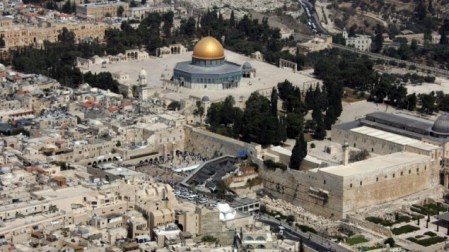
domeoftherockAn aerial view of the Dome of the Rock, left, in the compound known to Muslims as al-Haram al-Sharif and to Jews as Temple Mount, in Jerusalem’s Old City, and the Western Wall, center, the holiest site for Jews, October 2, 2007. (AFP/Jack Guez)

Official US policy has long been to insist that the status of Jerusalem can only be determined through a negotiated settlement between the parties, as both Israelis and Palestinians claim it as their capital.

In a statement Thursday, Friedman, a Hebrew-speaker, declared he was “deeply honored and humbled” that his friend of 15 years selected him to represent America to the Jewish state, and he also left the world with a zinger when he said he looked forward to doing his new job “from the US embassy in Israel’s eternal capital, Jerusalem.”

But Friedman’s declared appetite to move the embassy is not the only reason liberal Jewish organizations have responded to his nomination with something close to horror. The 57-year-old bankruptcy lawyer has also been an outspoken and active supporter of the settlement movement, and has argued that Israel doesn’t face a “demographic threat” to its Jewish character if it fails to separate from the Palestinians.

Friedman serves as president of American Friends of Bet El Institutions, an organization that supports the large West Bank settlement near Ramallah, and over the last year, he has excoriated groups who express criticism of Israel’s settlement policy.

friedman-c2-305x172David Friedman, Donald Trump’s adviser on Israel, talks to Channel 2 News on September 12, 2016. (screen capture: Channel 2)

In June, Friedman accused J Street supporters of being “far worse than kapos” in a column for the right-wing, pro-settlement Israel National News website, using the term for Jews who aided Nazis during the Holocaust. Speaking before the Brookings Institution’s annual Saban Forum earlier this month, he refused to walk back his comparison.

Now that he is slated to become the United States’ top diplomat in Israel — so long as the US Senate confirms his appointment — he will assume one of the most delicate positions in American foreign policy, mediating the US relationship with a close ally in an increasingly unstable region, and after eight tumultuous years of ties between the administration of President Barack Obama and the government of Prime Minister Benjamin Netanyahu.

Last month, Friedman spoke with The Times of Israel about what Trump’s policies and priorities would be toward the Jewish state if he won. Here is what he said.

‘No daylight’ between the US and Israel

When it comes to the US-Israel relationship, Friedman insisted that Trump would represent a sharp break from his predecessor — including in that there would be “no daylight between Israel and America,” a phrase also used in the transition team’s announcement of his selection on Thursday, which indicates a policy of keeping differences out of the public sphere.

“Donald Trump wants to be as supportive of Israel as possible,” Friedman told The Times of Israel. “He doesn’t view Israel as a client state that you just kind of issue directives to. He views Israel as a partner, one of America’s key partners in a global war against Islamic terrorism, so he wants Israel … to be as strong and secure as possible.”

Unlike Obama, who made Israeli settlement construction in the West Bank a fundamental issue of criticism throughout his presidency, Trump will not “put his finger on the scale or tell Israel what policies they should adopt,” Friedman said, adding that his new boss “doesn’t see Israel as in need of any particular correction at this point.”

That principle, he indicated, covers both how Trump will treat the settlement issue and the manner in which Israel seeks to reach an agreement with the Palestinians. The Trump administration will not “dictate to Israel where it can and cannot build” in the West Bank, according to Friedman.

Trump, for his part, has not publicly stated a position on settlements or detailed what kind of a stance he would take. The most common view among Washington’s foreign policy community, and emphatically within the Obama administration, is that, to keep the two-state option alive and ensure Israel’s future as a Jewish and democratic state, the US should try to limit settlement activity to the principal blocs that Israel is expected to retain under any permanent accord.

For his part, Friedman said that a Trump administration “doesn’t see much opportunity for progress until the Palestinians renounce violence and accept Israel as a Jewish state. That’s really a prerequisite.”

One criticism Friedman had of the current president was that Obama saw Israel as “strong” and the Palestinians as “weak,” and thus he believed it was up to the Israelis to take the risks necessary for peace. “Strong vs. weak is less relevant to Trump than the ‘relative conduct of the parties’,” Friedman said.

According to Friedman, Trump was influenced by seeing a video last spring of a stage production put on at a Hamas-affiliated school in Gaza. “Half the kids were dressed up as Israeli soldiers or traditional garb and the other half were dressed up as shahids, and the kids playing terrorists took their fake knives and stabbed all the Jews,” Friedman said of the film. “Fake blood poured on the stage, and the parents all applauded this. In a first grade class.”

knifeA young Palestinian girl attacks ‘Israeli soldiers’ with a knife in a play held in Gaza as part of the ‘Palestine Festival for Children and Education,’ April 2016 (Channel 2 news)

Trump, he said, sees that kind of incitement as “unacceptable and an insoluble impediment to peace.”

But didn’t Trump say he wanted to be neutral?

In February 2016, then-Republican presidential hopeful Trump called Israeli-Palestinian peace “probably the toughest agreement of any kind to make,” but vowed to give it “one hell of a shot.”

He also pledged he would do that by being “sort of a neutral guy,” when pressed by MSNBC’s Joe Scarborough over whether he ascribed fault to either side for failing to reach an accord. “A lot of people have gone down in flames trying to make that deal. So I don’t want to say whose fault is it,” he said. “I don’t think it helps.”

Trump took immediate heat for this promise on the campaign trail, and seemed to indicate a walk-back during his speech at the 2016 AIPAC Policy Conference and elsewhere, but he has not explicitly rescinded this posture.

Friedman argued, however, that his language has been misunderstood. “What he was really referring to was trying to sponsor negotiations that would take place without preconditions,” he said. “That was what he viewed as neutrality, and that’s frankly been the view of the Israeli government for some time.”

Friedman cited Obama’s demand in his first term that Netanyahu place a moratorium on all West Bank settlement construction, as a trust-building measure, to be “an example of the absence of neutrality, but it’s in favor of the Palestinians against the Israelis.”

And what about that two-state solution?

As one of Trump’s top two Israel advisers at the time, along with Jason Dov Greenblatt, Friedman said the candidate had not yet decided exactly how he’d go about handling Israel’s conflict with the Palestinians, but that he would be open to new ideas, including embracing avenues outside the two-state framework.

Friedman stated that, in his discussions with Trump, “a two-state solution is not a priority. I don’t think he is wed to any particular outcome. A two-state solution is a way, but it’s not the only way.”

Unlike the last three presidents, who have tried to push both parties into negotiating a compromise, Trump will let the Israel make its determinations without pressure from the US, said Friedman.

“A Trump administration will try to be helpful with the Israelis bringing stability to the region, to make it as quiet as possible, as peaceful as possible, and ultimately to come up with a long-term solution,” he said. “As far as what that solution is, Trump will be guided by the Israelis’ view, very much so, and will not be seeking to impose any particular path upon the Israeli government.”

Aleppo’s Fall Signals Rise of Emboldened Radical Shi’ite Axis

December 16, 2016

Aleppo’s Fall Signals Rise of Emboldened Radical Shi’ite Axis, Investigative Project on Terrorism, Yaakov Lappin, December 16, 2016

1918-1

Recent sweeping gains by the pro-Assad alliance in Aleppo signal the rise of an emboldened Iranian-led radical Shi’ite axis. The more this axis gains strength, territory, weapons, and influence, the more likely it is to threaten regional and global security.

Ideologues in Iran have formulated a Shi’ite jihadist vision which holds that the Iranian Islamic revolution must take control of the entire Muslim world. Losing the Assad regime to Sunni rebels, many of them backed by Tehran’s Gulf Arab state archenemies, would have represented a major setback to Iran’s agenda.

This same ideological agenda also calls for the eventual annihilation of Israel, the toppling of Sunni governments, and intimidating the West into complying with Iran’s schemes.

Supreme Leader Ayatollah Khamenei and Tehran’s military elites, in the form of the Islamic Republican Guards Corps (IRGC), use the current regional chaos to promote these goals.

In Syria, Iran has mobilized tens of thousands of Shi’ite militia fighters from all over the Middle East, as well as those from Hizballah in Lebanon, and sent them to do battle with Sunni rebel organizations to help save the Assad regime.

As the Shi’ite axis wages a sectarian war against Sunnis moderate groups and jihadists, it mobilizes and arms its proxies, and moves military assets into Syria, gaining a growing influence that can be used for bellicose purposes in the not too distant future.

The conquest of east Aleppo is a victory for the wider, transnational Iranian-led alliance, of which the Damascus regime is but one component. The Assad regime is composed and led by Syria’s minority Alawite population, which makes up just 11 percent of Syrians (Alawites are seen as an offshoot of Shia Islam).

A look at the order of battle assembled in Aleppo reveals that the war in Syria is not a civil conflict by any measure. In addition to Assad regime forces sent to fight Sunni rebels, such as the Fourth Division, Syrian army special forces, and paramilitary units, there is also the Iranian-backed Hizballah, which has transformed itself into a regional Shi’ite ground army, deployed across Syria and Lebanon.

These are joined by Shi’ite Iraqi Kataib Hizballah militia, Afghan Shi’ite militia groups, and Iranian military personnel on the ground in Syria, all of whom receive the assistance of massive Russian air power.

The large scale, indiscriminate airstrikes and shelling in places like Aleppo resulted in mass slaughter and ethnic cleansing of many Sunni civilians, producing the largest humanitarian catastrophe and refugee crisis in the 21st century. Such extreme war crimes will be sure to produce a new generation of radical recruits for ISIS and al-Qaida.

The IRGC’s Quds Force, under the command of Qassem Suleimani, orchestrates the entire ground war effort. Suleimani is very close to the Iranian supreme leader.

The Quds Force uses Syria as a transit zone to traffic advanced weapons from Iranian and Syrian arms factories to the Hizballah storehouses that pepper neighboring Lebanon.

Hizballah has amassed one of the largest surface to surface rocket and missile arsenal in the world, composed of over 100,000 projectiles, all of which are pointed at Israeli cities.

According to international media reports, Israel recently launched two strikes in the one week, targeting attempts to smuggle game-changing weapons to Lebanon.

Syrian dictator Basher Assad owes his survival to Iran and Hizballah, and their military presence in Syria should continue and expand further.

Assad regime and Hizballah representatives boast of this fact in recent statements highlighted by the Middle East Media Research Institute (MEMRI).

“The power-balances will change not only in Syria but in the entire region,” said Hizballah Executive Council Chairman Hashem Safi Al-Din.

“Syria’s steadfastness, and the support from its allies, have shifted the regional and international balance [of power], said Assad political adviser Bouthaina Sha’aban. “The recent developments in the international arena are bringing the countries of the region face to face with a new world.

If it takes western Syria with Russian air support, the Shi’ite axis victors will likely turn their sights on seizing southern Syria, near the Israeli border. To accomplish that, they will need to do battle with an array of Sunni rebels that now control that area (groups that include ISIS-affiliates). If successful, the axis could be tempted to build bases of attack throughout Syria against Israel, a development that would certainly trigger Israeli defensive action, as has reportedly occurred in the past.

The same pattern repeats itself in Iraq, where Iran-backed militias are moving in on Mosul, and could later be used to threaten Iraq’s Sunnis, and in Yemen, where Iranian-armed Houthi rebels control large swaths of the country, and are currently at war with a Saudi-led military coalition. The Houthis also threaten international oil shipping lanes and have fired on the U.S. Navy using Iranian-smuggled missiles.

In this way, the fundamentalist Iranian coalition gains a growing foothold.

Iran’s ballistic missile program, which is developing long-range strike capabilities that could place Europe in range, and its temporarily dormant nuclear program, represents investments that would make the Shi’ite axis more powerful than any Sunni Islamist camp.

Defense officials in Israel and in pragmatic Sunni states will watch for the danger that Iran will use its presence, proxies, and bases in Syria and Iraq to wage a Shi’ite jihad that extends well beyond the battlegrounds there.

The Iranian coalition can also lure armed Sunni groups into its orbit as well, as it has done in the past with the Palestinian Hamas terrorist regime in Gaza.

While the Israeli defense establishment has no desire to be dragged into Syria’s conflict, Jerusalem has indicated that it would act to remove any Iranian-Hizballah base it detects in Syria that is designed to launch attacks on Israel, and would not tolerate the trafficking of advanced weapons to Hizballah.

Few events illustrate more clearly how an ascendant Shi’ite jihadist axis is redrawing the map of the region than a recent military parade held by Hizballah in the western Syrian town of Al-Qusayr, which it conquered from the rebels in 2013.

According to an assessment by the Tel Aviv-based Meir Amit Intelligence and Terrorism Information Center, that parade featured Soviet-made tanks, American armored personnel carriers, artillery guns, anti-aircraft guns, and powerful truck-mounted rocket launchers with an estimated range of between 90 to 180 kilometers. “It is clear that state-owned capabilities, some of them advanced, were delivered to Hizballah, which is a terrorist organization,” the Intelligence and Terrorism Information Center said in its report.

Hizballah, like the Assad regime and armed groups in Iraq and Yemen, is a component of an international axis whose battles against ISIS have managed to dupe some decision makers into believing that they are stabilizing forces. In actuality, the Shi’ite jihadists are as radical as their Sunni jihadist counterparts – albeit more tactically prudent – and are far better armed and better organized.

Arrests Breaks Up PIJ Recruitment Scheme

November 30, 2016

Arrests Breaks Up PIJ Recruitment Scheme, Investigative Project on Terrorism. Yaakov Lappin, November 30, 2016

1894

Israeli security forces led by the Shin Bet domestic intelligence agency have uncovered a recruitment drive by Palestinian Islamic Jihad operatives located in Pakistan, the Investigative Project on Terrorism has learned.

The operatives hail from Gaza and tried to recruit fellow students in Pakistan to create a West Bank cell, according to Israeli security sources.

The investigation illustrates the ease with which terror organizations, particularly Islamic Jihad and Hamas, recruit Palestinian students overseas, often taking advantage of extensive contact networks, the sources said.

The case is unusual for exposing Palestinian Islamic Jihad activity so far from the Palestinian territories and from Israel.

According to the Shin Bet’s investigation, 22-year-old Baha’a Abu Marhiah, a resident of the West Bank city of Hebron, is a Palestinian student who was recruited by two Palestinian Islamic Jihad operatives. Marhiah was studying for a law degree at a university in Lahore, Pakistan.

Two Islamic Jihad operatives from Northern Gaza’s Shati Refugee Camp were studying for doctorates at the same university.

Israeli security forces named them as Sharif Halabi, 34, a religious scholar and teacher, and Ramzi Shakshak, 32, who lectures at Al-Aqsa University in Gaza.

Halabi, who told students in Pakistan about “martyrs” in Gaza and incited them against Israel, gained Abu Marhiah’s trust and convinced him to join Palestinian Islamic Jihad, the investigation found.

Halabi allegedly told Abu Marhiah to keep in touch after returning to Hebron, and to await further instructions on how to conduct attacks, according to the Shin Bet. Today, Halabi and Shakshak are back in Gaza.

But Marhiah was arrested Sept. 22 in a joint Shin Bet, Israel Defense Forces, and police operation following his return.

In recent days, an IDF military court charged Abu Marhiah with carrying out a service for a banned organization, and holding contact with an enemy entity.

After Hamas, Islamic Jihad is the second largest terrorist organization in Gaza, with approximately 5,000 armed combatants split up into regional brigades and a domestically produced rocket arsenal which incorporates Iranian know-how.

Any expansion of Islamic Jihad from Gaza into the West Bank would also represent an Iranian push into the area.

Prior to 2002’s Operation Defensive Shield, Islamic Jihad maintained a high profile in the West Bank and launched a series of suicide bombing and shooting attacks against Israelis. Jenin and Hebron were considered strong areas for the organization. The terrorist group is now working strenuously to reinvigorate itself in the area.

Iran remains the principal financial backer of Palestinian Islamic Jihad in Gaza. Unlike Hamas, it has remained utterly loyal to Tehran and enjoyed sustained, continuous support from it.

While Hamas has distanced itself from Iran’s Shi’ite sectarian intervention in the region’s raging wars, particularly in Syria, Islamic Jihad has not.

In recent months, Iran has expanded efforts to create a zone of influence in the West Bank, according to Israeli defense assessments.

This included attempts by its proxies, Islamic Jihad and Hizballah, to set up terror cells there.

Israel identified and stopped efforts by Hizballah’s Unit 133, which seeks to set up terror cells among Palestinians and activate them, earlier this year.

Meanwhile Shin Bet periodically checks efforts by Islamic Jihad in Gaza to recruit West Bank attackers. Despite the successes, the Israel Defense Forces (IDF) central command assessed last year that Islamic Jihad was gaining strength in the West Bank.

The small, yet highly focused organization will continue acting as the principal flag bearer for Iran in the Palestinian arena.