Archive for the ‘Israel’ category

Why the Anti-Israeli Sentiment?

January 5, 2017

Why the Anti-Israeli Sentiment? Town HallVictor Davis Hanson, January  5, 2017

israelflag

Secretary of State John Kerry, echoing other policymakers in the Obama administration, blasted Israel last week in a 70-minute rant about its supposedly self-destructive policies.

Why does the world — including now the U.S. — single out liberal and lawful Israel but refrain from chastising truly illiberal countries?

Kerry has never sermonized for so long about his plan to solve the Syrian crisis that has led to some 500,000 deaths or the vast migrant crisis that has nearly wrecked the European Union.

No one in this administration has shown as much anger about the many thousands who have been killed and jailed in the Castro brothers’ Cuba, much less about the current Stone Age conditions in Venezuela or the nightmarish government of President Rodrigo Duterte in the Philippines, an ally nation.

President Obama did not champion the cause of the oppressed during the Green Revolution of 2009 in Iran. Did Kerry and Obama become so outraged after Russia occupied South Ossetia, Crimea and eastern Ukraine?

Ambassador to the United Nations Samantha Power was never so impassioned over the borders of Chinese-occupied Tibet, or over Turkish-occupied Northern Cyprus.

In terms of harkening back to the Palestinian “refugee” crisis that started in the late 1940s, no one talks today in similar fashion about the Jews who survived the Holocaust and walked home, only to find that their houses in Eastern Europe were gone or occupied by others. Much less do we recall the 11 million German civilians who were ethnically cleansed from Eastern Europe in 1945 by the Soviets and their imposed Communist governments. Certainly, there are not still “refugee” camps outside Dresden for those persons displaced from East Prussia 70 years ago.

More recently, few nations at the U.N. faulted the Kuwaiti government for the expulsion of 200,000 Palestinians after the liberation of Kuwait by coalition forces in 1991.

Yet on nearly every issue — from “settlements” to human rights to the status of women — U.N. members that routinely violate human rights target a liberal Israel.

When President Obama entered office, among his first acts were to give an interview with the Saudi-owned news outlet Al Arabiya championing his outreach to the mostly non-democratic Islamic world and to blast democratic Israel on “settlements.”

Partly, the reason for such inordinate criticism of Israel is sheer cowardice. If Israel had 100 million people and was geographically large, the world would not so readily play the bully.

Instead, the United Nations and Europe would likely leave it alone — just as they give a pass to human rights offenders such as Pakistan and Indonesia. If Israel were as big as Iran, and Iran as small as Israel, then the Obama administration would have not reached out to Iran, and would have left Israel alone.

Israel’s supposed Western friends sort out Israel’s enemies by their relative natural resources, geography and population — and conclude that supporting Israel is a bad deal in cost/benefit terms.

Partly, the criticism of Israel is explained by oil — an issue that is changing daily as both the U.S. and Israel cease to be oil importers.

Still, about 40 percent of the world’s oil is sold by Persian Gulf nations. Influential nations in Europe and China continue to count on oil imports from the Middle East — and make political adjustments accordingly.

Partly, anti-Israel rhetoric is due to herd politics.

The Palestinians — illiberal and reactionary on cherished Western issues like gender equality, homosexuality, religious tolerance and diversity — have grafted their cause to the popular campus agendas of race/class/gender victimization.

Western nations in general do not worry much about assorted non-Western crimes such as genocides, mass cleansings or politically induced famines. Instead, they prefer sermons to other Westerners as a sort of virtue-signaling, without any worries over offending politically correct groups.

Partly, the piling on Israel is due to American leverage over Israel as a recipient of U.S. aid. As a benefactor, the Obama administration expects that Israel must match U.S. generosity with obeisance. Yet the U.S. rarely gives similar “how dare you” lectures to less liberal recipients of American aid, such as the Palestinians for their lack of free elections.

Partly, the cause of global hostility toward Israel is jealousy. If Israel were mired in Venezuela-like chaos, few nations would care. Instead, the image of a proud, successful, Westernized nation as an atoll in a sea of self-inflicted misery is grating to many. And the astounding success of Israel bothers so many failed states that the entire world takes notice.

But partly, the source of anti-Israelism is ancient anti-Semitism.

If Israelis were Egyptians administering Gaza or Jordanians running the West Bank (as during the 1960s), no one would care. The world’s problem is that Israelis are Jews. Thus, Israel earns negative scrutiny that is never extended commensurately to others.

Obama and his diplomatic team should have known all this. Perhaps they do, but they simply do not care.

John Kerry, Those “Illegal” Settlements, That “Two-State Solution” (Part II)

January 4, 2017

John Kerry, Those “Illegal” Settlements, That “Two-State Solution” (Part II), Jihad Watch

(Part I of the series is available here. — DM)

kerry-netanyahu

After the Six-Day War, while the Israelis waited for the Arabs to make that phone call about peace negotiations that never came, the Arabs had other ideas. First, they announced at a meeting in the Sudanese capital of the Arab League “the three No’s of Khartoum”: No peace with Israel, no recognition of Israel, and no negotiations with Israel. Who and what – before a single “settlement” was started — was then the “obstacle to peace”? Second, the Arabs and their willing collaborators began to speak about, and thus to reify, out of the local Arabs in Israel, Gaza, the West Bank, and in the refugee camps, a “Palestinian people.” This fiction, which Secretary Kerry uncritically accepts (to be fair, so do millions of others), was designed for propaganda purposes, and has proven to be a stunningly effective weapon against Israel. No Arab leaders or diplomats or intellectuals mentioned the “Palestinian people” until 1967, when the need for such became apparent. As Zuheir Mohsen, leader of the Palestinian Arab terror group As Saiqa, famously told a journalist in 1977:

The Palestinian people does not exist. The creation of a Palestinian state is only a means for continuing our struggle against the state of Israel for our Arab unity. In reality today there is no difference between Jordanians, Palestinians, Syrians and Lebanese. Only for political and tactical reasons do we speak today about the existence of a Palestinian people, since Arab national interests demand that we posit the existence of a distinct “Palestinian people” to oppose Zionism. Yes, the existence of a separate Palestinian identity exists only for tactical reasons, Jordan, which is a sovereign state with defined borders, cannot raise claims to Haifa and Jaffa, while as a Palestinian, I can undoubtedly demand Haifa, Jaffa, Beer-Sheva and Jerusalem. However, the moment we reclaim our right to all of Palestine, we will not wait even a minute to unite Palestine and Jordan.

Yet Kerry insists that U. N. Resolution 181 — the “Partition Plan” — was meant to “realize the national aspirations of both Jews and Palestinians.” In 1947, there were no “Palestinians” with “national aspirations.” The invading Arab states never mentioned these “Palestinians” and had no intention of giving up whatever territory they managed to win to a nonexistent “Palestinian” people. And in 1947, the “national aspirations” of the Jews were betrayed when they were left by the Partition Plan with only about half of what had been promised under the Palestine Mandate, or – if we include eastern Palestine — only 23% of the territory promised before eastern Palestine had been transformed into the Emirate of Transjordan. To the extent that the local Arabs had any “national aspirations,” they were to destroy the Jewish state. In any case, Resolution 181 became a dead letter when the Arabs unanimously rejected it and then invaded Israel. Kerry wants to resuscitate it.

Kerry then moves on to Resolution 242, and what he, and Resolution 2334, call “occupied Palestinian territory.” But the word “occupied” has both a colloquial and a legal meaning, and this confusion between the two meanings has been well exploited by the Arabs. Israel is an “occupier” in the colloquial sense: through force of arms, it has “occupied” certain territories. But Israel is not only a “military occupier” of the West Bank, in the way that it was an “occupier” of the Sinai. Israel’s legal (historic, moral) claim to the West Bank, under the Mandate for Palestine, remains.

The constant use of the phrase “occupied territory,” or still worse, “occupied Palestinian territory” by John Kerry and so many others suggests that Israel has no claim to the “West Bank” or Gaza other than the temporary one of being a military occupant. One thinks in this regard of such examples as “Occupied Berlin,” “Occupied Vienna,” “Occupied Paris,” “Occupied Japan.” In all of these examples, the word “occupied” signals that the territory in question is under the control of a victorious power or powers, that control having been won through military conquest, and the claim to that territory is understood to be only temporary, based solely on that military occupation. But Israel’s claim to the “West Bank” is not based on the fact of military occupation. Rather, the West Bank is properly thought of as an unallocated part of the Palestine Mandate, and the provisions of the League of Nations’ Mandate still apply. Had Israel managed to capture all of the West Bank in the 1948-49 war, it could have exercised its rights under the Mandate, and incorporated all of that territory into the Jewish state. The fact that the Jews did not end up in possession of Gaza and the “West Bank” at the close of hostilities in 1949 war did not change the legal status of those territories. Israel’s claim based on the Mandate itself was not extinguished. Of course, had the Arabs accepted the Partition Plan, as Israel had done, then Israel would have been obligated to stand by its own acceptance, but the Arab refusal to do so freed Israel from any such obligation. The Six-Day War allowed Israel, by coming into possession of the West Bank by force of arms, to finally exercise its right, based on the Mandate, to establish settlements in that territory.

The claim under the Mandate was reinforced, rather than weakened, by Resolution 242’s insistence that territorial adjustments be made to guarantee Israel’s security (“secure borders”). And when Israel voluntarily gave up the Sinai to Egypt, and later handed Gaza over to “Palestinian” Arab rule – for reasons of realpolitik– that had no bearing on Israel’s continued claim to the “West Bank.”

So what has John Kerry carefully not said in his ill-tempered attack on Israel that has apparently so heartened Hamas? He has failed to mention the most important foundational document for Israel, the Mandate for Palestine, which enshrines Israel’s legal, moral, and historic rights to establish Jewish settlements everywhere in Palestine, from the Jordan to the sea, including all of the West Bank. Not only are those settlements not illegal, but they were, and still are, to be “encouraged” under the express terms of the Mandate. He has failed to mention, too, that Israel gave up fully 95% of what it won in the Six-Day War, and failed to mention the endless Israeli efforts to engage the “Palestinians” in real peace talks, not Rose Garden photo ops; those Israeli efforts have always been rebuffed. When at Camp David in 2000 Ehud Barak made the astounding offer to Yassir Arafat of fully 95% of the West Bank, Arafat refused.

This puts quite a different spin on Israeli behavior from that which Kerry presents. For him, it is Israel that keeps trying to deny the “Palestinians” everything, whereas it is those same “Palestinians” under Abbas as under Arafat, who have turned down Israeli offers, and most important, continue to refuse even to recognize Israel as a Jewish state. The list of Arab refusals starts with the Partition Plan of 1947, then the refusal to make the armistice lines of 1949 into permanent borders as offered by Israel, then the further refusal, for 12 years after the Six-Day War, by all the Arab states to recognize, or to negotiate, or to make peace with Israel (the Three No’s of Khartoum) until Sadat made his separate peace.

And even Kerry’s whipping-boy, Prime Minister Netanyahu, whose government he describes as “the most right-wing” in Israel’s history, in November 2009 put in place a 10-month freeze on settlements, hoping thereby to get the Palestinians back to the negotiating table. It didn’t work. And Kerry, of course, doesn’t mention Netanyahu’s attempt. Far from clinging adamantly to territories it won, Israel has been remarkably generous in giving up territories. The minute Anwar Sadat decided he would break ranks with the other Arabs and negotiate for Egypt alone, he found the Israelis willing, in exchange for a peace treaty, to hand back the entire Sinai. How often, in human history, has a nation victorious in war handed back all the territory it won to an aggressor?

Israel went even further with its concessions in Gaza, removing all of the Jewish settlements, handing Gaza back to the local “Palestinians,” without receiving anything in return but rockets and bombs. Yet Secretary Kerry dares to present Israel as the obstacle to peace, with the “Palestinian” campaigns of terror, and celebrations of terrorists, mentioned only in passing, while the Israeli “settlements” – specifically authorized by the Mandate – are treated, at great length, as “illegal.” He finds the Israelis bizarre in their belief, one that they have come to most reluctantly, that IDF control of the West Bank is a better way to preserve peace than a peace treaty signed with the likes of Mahmoud Abbas. Kerry is outraged that Israelis dare to insist they have a legal right to establish such settlements in the West Bank. Don’t bring up the Palestine Mandate; he doesn’t want to hear about it. And he certainly doesn’t want people beginning to agree with Israelis that the Mandate remains relevant. He doesn’t care what the main author of Resolution 242, Lord Caradon, meant by the phrases “withdrawal from territories” and “secure and recognized borders.” Please don’t trouble Secretary Kerry, either, with the report prepared by the American Joint Chiefs of Staff for President Johnson, about the minimum territorial adjustments that in their view Israel would need for “secure and defensible borders.” For Kerry, it’s more than enough to keep repeating the phrases “two-state solution” and “just and lasting peace,” which for him clearly means almost complete withdrawal to the 1967 lines with “minor adjustments.” For Lord Caradon, however, the most important thing about Resolution 242 was that Israel not be compelled to return to the 1967 lines that invited Arab aggression, and the adjustments need not everywhere be categorized as “minor.” As he forcefully put it:

We could have said: well, you go back to the 1967 line. But I know the 1967 line, and it’s a rotten line. You couldn’t have a worse line for a permanent international boundary. It’s where the troops happened to be on a certain night in 1948. It’s got no relation to the needs of the situation.

Kerry doesn’t want to hear about “secure and defensible borders.” He wants the Israelis to “take risks for peace” (as if Israel was not already taking unbelievable risks for peace), to uproot settlements needed for Israel’s defense, and to put their trust in a peace treaty, while all the evidence suggests that the “Palestinians,” including nobody-here-but-us-accountants Mahmoud Abbas, have no intention of recognizing Israel as a Jewish state until Israel returns to the 1967 lines, including East Jerusalem, and likely not even then. As for the other Arabs, it’s true that right now a shared fear of Iran has made it possible for Egypt, Saudi Arabia, and Jordan to collaborate with Israel behind the scenes, but fear of Iran may not prove to be a unifying force forever. As for most Arabs and Muslims, the spectacle of a dimidiated Israel would not sate but whet jihadist appetites.

Among the many things John Kerry would prefer not to be reminded of is that in 1920, 77% of the formerly Ottoman territories that were originally intended to be included in the Palestine Mandate — that is, the land east of the Jordan — was closed to Jewish immigration. Eastern Palestine instead became, thanks to the British, the Arab Emirate of Transjordan. For Kerry, that’s not worth mentioning, but it was a huge event for the Zionists at the time. In fact, those Zionists who did not accept the loss of eastern Palestine continued to include it in their maximalist demands. Their leader, Ze’ev Jabotinsky, even wrote a celebrated poem: “Shtei Gadot L’Yarden – Zu Shelanu Zu Gam Ken” (“Two sides has the river Jordan/This side is ours, and that side too”) expressing the refusal to give up the claim to eastern Palestine. So Israel had by 1948 already been considerably reduced, the British having given away 77% of what had been intended for the Palestine Mandate. To remind people of this is not to endorse Jabotinsky’s demand, but at least to offer a historical perspective that might make some more understanding of Israel’s position.. Would it have been too much to expect John Kerry to mention how, and why, and on what land, the country of Jordan was created?

The Arabs, then, already had in 1948 a “Palestinian” state, consisting of all of eastern Palestine, the country we now call “Jordan,” where 80% of the population identifies itself as “Palestinian.” When the Arabs became convinced, after the Six-Day War, that they could not destroy Israel outright, they sought to undermine Israel in other ways – diplomatic isolation, boycotts, terror attacks – hoping to reduce its size through salami tactics, and to establish a second Arab state, this one in western Palestine, a state whose main purpose would be not to live in satisfied coexistence with Israel (‘two states, side-by-side” etc.) as Kerry naively foresees, but to serve, rather, as a springboard for yet another attempt at destroying, whether through the Fast Jihad of Hamas or the Slow Jihad of Fatah, the one Jewish state, whose mere existence, whatever its size, is such an affront to all Muslims and Arabs. John Kerry, innocent of Islam, gives no sign of realizing how deep is the Muslim Arab opposition to Israel.

So the Arabs refused this and the Arabs refused that. And the Israelis accepted this, and the Israelis gave back that. And the Mandate for Palestine says this, and U.N. Resolution 242 says that. It’s all so complicated and mind-numbing, no wonder John Kerry wants to hear only about a very few things. He blocks out the rest, and he reduces everything to the simple-minded phrases repeated endlessly: the “two-state solution,” the “just and lasting peace.” He doesn’t need to know what has actually happened between Arab and Jew in Palestine in the last 100 years, what principles were invoked or ignored, what rights created or destroyed, what promises kept or broken, what offers accepted or rejected. For Kerry, all he knows and all he needs to know is that the settlements are “illegal,” and positively noxious because they are what prevent that “two-state solution” that “everybody” knows can be arrived at just as soon as Israel stops building new settlements and dismantles all but a few of the old ones.

For the Palestinians, of course, as Kerry may not know, all the cities in Israel are “occupied” territory (“Occupied Haifa,” “Occupied Jaffa,” “Occupied Jerusalem”), and all the towns are “settlements” and all the settlements, of course, are on “Occupied Arab Land.” The Jews, as Infidels, have no rights on lands once possessed by Muslims. There is no historic connection of Jews to Jerusalem, which is also “occupied Palestinian territory.” And even if the Palestine Mandate existed, we are not required to pay any attention to it. Any history that is not on the side of the Muslims can safely be forgotten.

U.N. Resolution 2334 pretends to be about furthering “peace,” but its effect will be to embolden the “Palestinian” side, now less willing than ever to negotiate, since it believes it has now isolated Israel diplomatically. With little to lose, the Israeli government could take a different tack, a hypertrophied hasbara that would speak over the talking heads of the Security Council to a public that, especially in Europe, has been getting its own taste of Muslim convivencia and may, as a consequence, be more sympathetic to Israel’s plight than votes at the U.N. might suggest. Let Israel explain what the Palestine Mandate was intended to achieve, why the settlements are not “illegal,” what made the Partition Plan (Resolution 181) null and void, why those armistice lines were never made into permanent borders, how and why the “Palestinian people” were invented, and then, in terms anyone looking at a map can understand, what territory in the “West Bank” the tiny nation of Israel, as a military matter, must keep, as “settlements,” if it is to have those “secure and defensible borders” it both needs and deserves.

John Kerry assures us that he cares deeply about, even “loves,” the plucky little state of Israel that, he insists, stole his heart away decades ago. But he is convinced that Israel doesn’t understand its real situation, and its blinkered (“extreme right-wing”) leaders can’t seem to grasp that a “Palestinian” state living “side-by-side with a Jewish state” would only improve Israel’s well-being. Here is John Kerry, the American Secretary of State, fierce in Foggy Bottom, languid in Louisburg Square, who knows better than the Israelis what they need, and understands perfectly this most intractable of foreign policy problems. It’s an old and cruel idea: that Israel doesn’t understand its real interests, and must be saved in spite of itself. And John Forbes Kerry has arrived on the scene to help straighten out the little country he loves so much. All he asks of Israelis is that they come to their senses, and do what he, and Barack Obama, and the Security Council, demand.

Fortunately, for Israel, and for the Western world, too, the clock is running out on Obama and on Kerry. This means Israel still has a chance to decide for itself what it needs, at a minimum, in order to survive. Given the history of the Jews during the last 3000 years, that doesn’t seem like much to ask.

Obama Administration Set for One Last Strike at Israel

January 4, 2017

Obama Administration Set for One Last Strike at Israel, Front Page MagazineP. David Hornik, January 4, 2016

kerryandobama

The Times of Israel cites an Israeli news broadcast saying Netanyahu believes the Middle East Quartet—which includes the U.S., UN, Russia, and the EU—“will coordinate positions at the Paris summit, and then return to the Security Council in the very last days of Obama’s presidency to cement these new parameters on Mideast peacemaking.”

*************************************

A week and a half ago President Obama gave the order for the U.S. to abstain on UN Security Council Resolution 2334, thereby—effectively—voting in favor and allowing the resolution to pass.

As I noted, the resolution goes beyond “moral equivalency” by obfuscating Palestinian terror and incitement while branding Jewish life beyond the 1949 Armistice Lines a “flagrant violation under international law” and a “major obstacle…to peace.”

But the administration wasn’t through with Israel. A few days later, with the Middle East aflame from Yemen to Iraq to Syria to Libya to Sudan and Iranian expansionism on the march, Secretary of State Kerry delivered a 75-minute harangue against what he called Israel’s “pernicious policy of settlement construction that is making peace impossible.”

Critics have noted that—in the real world—Israeli construction in settlements under the recent Netanyahu governments has been so modest that it has not affected the Israeli-Palestinian population balance in the West Bank; and that if any and all Israeli presence beyond the 1949 Armistice Lines is “illegal,” then the idea of a “peace process” to settle claims over disputed land appears to be invalidated, since Israel is then nothing but a rapacious thief and the Palestinians its victims seeking redress.

As international-law scholar Eugene Kontorovich notes in the Washington Post:

The…condemnation of any Jewish presence whatsoever in eastern Jerusalem and the West Bank is a unique rule invented for Israel. There has never been a prolonged belligerent occupation—from the U.S. occupation of West Berlin to Turkey’s ongoing occupation of Cyprus to Russia’s of Crimea—where the occupying power has blocked its citizens from living in the territory under its control. Moreover, neither the United Nations nor any other international body has ever suggested they must do so. What is being demanded of Israel in its historical homeland has never been demanded of any other state, and never will be. 

The Obama administration’s stepped-up diplomatic and verbal assault on Israel in the last weeks of its tenure has not gone unnoticed, sparking bitter criticism even from Democratic lawmakers and mainstream American Jewish organizations that are far from any right-wing agenda.

But the extent to which the administration listens to such protests, or can be budged from its wholesale endorsement of Palestinian claims regarding the West Bank and Jerusalem, can be gauged from the fact that the Obama-Kerry team has still more in store for Israel.

It’s set to take place in Paris on January 15, under the aegis of the Hollande government, and it’s expected that some 70 countries will be attending.

The ostensible subject: “Middle East peace.” The translation: more invalidation of any and all Israeli claims to land captured from Jordan (not the Palestinians) in a defensive war in 1967, and more support for what—under present circumstances—would almost certainly be a Palestinian terror state in that territory.

American Jewish leaders have demanded that France call off this “ill-conceived, poorly timed and damaging” event, also pointing to “the impending transition to a new US administration, just five days later.”

But according to The Times of Israel, that—the Obama administration’s exploitation of its last days in office to do more harm to Israel—is exactly what Prime Minister Netanyahu is concerned about.

The Times of Israel cites an Israeli news broadcast saying Netanyahu believes the Middle East Quartet—which includes the U.S., UN, Russia, and the EU—“will coordinate positions at the Paris summit, and then return to the Security Council in the very last days of Obama’s presidency to cement these new parameters on Mideast peacemaking.”

“Cement these new parameters” would, of course, mean another Security Council resolution that is ruinous to Israel’s stance in favor of a negotiated settlement, tars it as a rogue state and international outlaw, and gives another major boost to the ongoing international effort to delegitimize and ultimately dismantle the Jewish state.

The Obama administration that came into office calling for “daylight” between the U.S. and Israel and slamming “natural growth” in Israeli communities, will be leaving office having learned nothing about the real sources of Middle Eastern violence and instability, Palestinian intransigence and outright rejection of Israel in any contours, and Israel’s unique nature in its region as a stable, faithfully pro-U.S. democracy seeking a genuine peace that would not merely imperil it.

Instead the administration appears bent on compounding ignorance and incorrigibility by cementing a lasting legacy of shame.

It’s all on Azaria’s shoulders

January 4, 2017

It’s all on Azaria’s shoulders, Israel Hayom, Dror Eydar, January 4, 2017

(Please see also, The Azaria trial and the rift over orders to shoot. — DM)

In July 1988, a terrorist attacked Yossi Hadassi, a soldier who had enlisted just three months earlier. Hadassi grappled with the terrorist and managed to kill him. He was awarded a citation of merit from the commander of the Engineering Corps.

Then the media hunt began, backed by the self-righteous Left, which accused the soldier of murder. On May 30, 1989, Yossi Hadassi committed suicide.

That week, the poet Naomi Shemer published a message in Yedioth Ahronoth: “The soldier Yossi Hadassi killed his attacker, and a year later killed himself. It wasn’t only Yossi Hadassi who committed suicide; an entire nation is committing suicide. An entire country is defending itself as its investigators, police, and poets drive it mad and convince it that it is a predatory wolf, Goliath, a monster. The intifada is the prelude and the excuse for the destruction of Israel. We are all Yossi Hadassi.”

Hadassi’s fate touched me. Naomi Shemer’s courage touched me, too. She published her message after a decade in which her work had been viciously attacked because she was “right-wing.”

I was reminded of that piece when the Azaria affair broke. We’ve thrown all the problems in Israeli society, the disagreement rooted in debate between Left and Right and the 100-year-old conflict between us and our neighbors, on to the bowed back of the young soldier. The mechanism of national suicide camouflaged as morality, too.

No, I’m not arguing that Azaria acted rightly. I don’t know how I would have acted in his situation. But even if I don’t think he’s a hero, it’s clear that he’s no murderer, and that what I’ve written. He certainly should not have been put on trial; the matter should have ended with a disciplinary hearing in his unit. And he certainly should not have to carry the weight of Israel’s foreign relations and the IDF’s ethical code and the discussions that have used him as a beast of burden. Sgt. Elor Azaria killed a terrorist. The craziness around his case has to do with the accursed insanity and politicization of the public discourse.

Like Hadassi, Azaria comes from a humble family on which the uncompromising interest and self-righteousness of some of us came crashing down out of the clear blue sky and threatened to crush. No mercy was shown to Hadassi, may he rest in peace, or to Azaria, may he live a long life. But unlike the 1980s, this time there is social media, which was able to help and support him. That’s some comfort. Back then, I couldn’t help Yossi Hadassi, but today I can express my own opinion wholeheartedly: We are all Elor Azaria.

The Azaria trial and the rift over orders to shoot

January 4, 2017

The Azaria trial and the rift over orders to shoot, DEBKAfile, January 4, 2017

(What is the standard for Israeli military tribunals? Proof “beyond a reasonable doubt” or something less? — DM)

elorverdict480

DEBKAfile’s military analysts note that the controversy reflects long efforts to introduce politics – or a brand of political correctness – into IDF decision-making. Soldiers are under orders to shoot terrorists in the heat of an attack – that is not in question, but since the Azaria affair, the army under Gen. Eisenkott, is working on refinements, such as when it is permissible and when it is not.

*****************************

All three judges of an Israeli military court Wednesday, Jan. 4, unanimously found Sgt. Elor Azaria guilty of manslaughter for the fatal shooting of an injured terrorist in Hebron in March 2016, after an attack on soldiers. The conviction was announced after a three-hour reading of the verdict by the lead judge, Col. Maya Heller. The court threw out the entire case for the defense in favor of the testimony given by the commanders at the scene of the incident and the prosecution. The cause of the terrorist’s death was judged to be the bullet Sgt. Azaria fired to his head, although the court ruled that there was no danger of the terrorist continuing his attack. Nor was the suspicion of the accused that he concealed explosives confirmed after the fact.

According to the verdict, Azaria was motivated purely by revenge for the terrorist’s attempt to stab his friend. Col. Heller rejected arguments that the court was influenced by social, political or military controversy surrounding the case and stressed that it was guided solely by the facts of the case. The convicted soldier’s lawyer said he would appeal the verdict. Sentence is to be announced at a later date.

Outside the court, hundreds of protesters demonstrated against the Hebron soldier’s trial.

Seven months ago, Sgt. Elior Azaria was put on trial before a three-judge panel of the Jaffa Military Court. He was charged with manslaughter for shooting dead in March last year a Palestinian terrorist, who had attacked soldiers with a knife and was already shot and injured.

Release of the videotape which showed the terrorist lying prone on the ground but still alive when Azaria came on the scene went viral and made the case a cause célèbre.

The trial turned on the question of whether the terrorist was immobilized or still posed a threat. The popular controversy on this question led to Moshe Yaalon’s resignation as defense minister, after he argued that Azaria, then 19, was out of line and should stand trial for murder.

He was supported by the incumbent chief of staff, Lt. Gen. Gady Eisenkott.

Azaria’s family mounted a popular campaign to justify his actions, claiming that he acted in the conviction that he was saving lives. His conduct was backed by many uniformed men through the social media, and a number of former generals volunteered to testify in his defense.

DEBKAfile’s military analysts note that the controversy reflects long efforts to introduce politics – or a brand of political correctness – into IDF decision-making. Soldiers are under orders to shoot terrorists in the heat of an attack – that is not in question, but since the Azaria affair, the army under Gen. Eisenkott, is working on refinements, such as when it is permissible and when it is not.

Both Yaalon and Eisenkott went overboard in their attempt to improperly influence the course of the military trial sub judice by public statements disparaging the accused soldier.

Last week, in pursuance of this campaign, the former defense minister appeared before 1,000 18-year olds about to join the army for three years of compulsory service. First, he rehashed the events leading up to Azaria’s action and his own resignation.

On March 24, he said, two terrorists came up to the Gilbert checkpoint at Tel Romeida in Hebron and started stabbing a soldier and officer who were manning it. But then, Yaalon burst out:  “If we don’t preserve our human values, the IDF will be no better than Daesh!” the implication being that Azaria was no better than an Islamist State killer.

This was a move to prejudge the trial and sway the three military judges, just in case they were persuaded that Azaria was not trigger-happy but had shot the prone terrorist in the belief that as a soldier it was his duty to protect the immediate environment from further menace.

The chief of staff had his say on Tuesday, Jan. 3, the day before the court was to hand down its verdict. He declared that he had a duty to “preserve IDF values.”

Our military analysts have searched in vain the IDF military codebook for a definition of “IDF values” among the often contradictory orders of when to open fire. They wonder how a young conscript serving at a checkpoint -and knowing he is the target at any moment for a sudden knifing, shooting, bombing or vehicular attack – can be expected to decide on the spot which “military values” to apply.

In his basic training, he is taught that his duty as a soldier is to fight the enemy and protect civilians. Confusion at the vital moment of an attack could cost precious lives.

However, Yaalon and Eisenkott have made it crystal clear that, regardless of the verdict handed down by a court after a long trial and exhaustive questioning of a flock of witnesses – both for the defense and the prosecution – they are determined to perpetuate the divisive, politically-tainted controversy in the country and its armed forces.

The Significance, Ramifications, And Messages Of Hizbullah’s Show Of Military Force In Al-Qusayr, Syria

January 4, 2017

The Significance, Ramifications, And Messages Of Hizbullah’s Show Of Military Force In Al-Qusayr, Syria, MRMRI, Yael Yehoshua*, January 3, 2016

On November 13, 2016, Hizbullah marked its annual Martyr Day by holding its first military parade in a Syrian town, Al-Qusayr, which Hizbullah took over in 2013 following a long and bloody battle with rebel forces, and which has since become the main symbol of the organization’s involvement in the Syria war alongside the Assad regime. The parade featured hundreds of fighters in military uniforms, tanks, U.S.-made M113 armored personnel carriers, cannon, machine guns, and an armored regiment. Also marching was the Al-Radwan division, comprising some 10,000 fighters from Hizbullah’s “intervention forces” and “special forces” fighting in Syria, which constitute the spearhead of the organization in the country.[1]

By holding this parade at this time and at this location, Hizbullah was informing its rivals, locally and in the region – that is, political players in Lebanon, the Syrian rebels and their Arab supporters, and the West and Israel – that it is now a powerful cross-border military force that can control areas outside Lebanon’s borders. The parade did indeed cause a tremendous stir among Hizbullah supporters, as well as among the organization’s opponents.

This paper will review the significance and ramifications of the parade in Al-Qusayr and the messages that it sent.
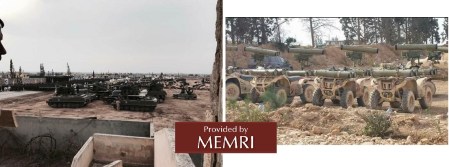
1295aPhotos from the parade. Arabipress.org, November 13, 2016; Addiyar.com, November 14, 2016
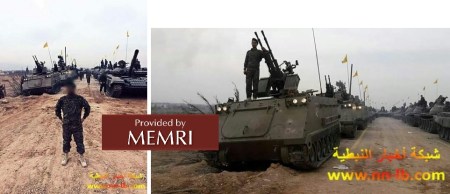
1295bPhotos from the parade. Nn-lb.com, November 13, 2016

Hizbullah Underlines Its Presence On Syrian Soil

Hizbullah’s holding the parade on Syrian soil, particularly in Al-Qusayr, is a symbolic yet highly significant act showing the organization’s control of part of Syrian territory. Al-Qusayr is the jewel in the crown of Hizbullah’s  military involvement in Syria and is seared into the memories of the Syrian rebels as an arena in which they were defeated by Hizbullah in 2013 after a bitter battle that lasted weeks and involved many losses on both sides. Moreover, Al-Qusayr is also Hizbullah’s gateway into Syria. After capturing it from the rebels, Hizbullah emptied it of its residents and turned it into a center for its headquarters and into a staging area for its fighters arriving from Lebanon, from which they leave for other battle fronts in Syria.

Also, holding the parade on Syrian soil as opposed to Lebanese soil is a blatant attempt by Hizbullah to highlight its presence in Syria and signal that this presence has become a known, established and certain fact. It may also reflect Hizbullah’s view of Al-Qusayr and its surroundings as its own military territory, and not as Syrian territory – with no consideration whatsoever for Syria’s sovereignty or for Lebanon’s position on this. [2] Hizbullah deputy secretary general Na’im Qassem hinted at this when he said, several days after the parade: “We are in Syria, and we do not need to give any explanation or justification for this. We stand alongside the Syrian army and the Syrian state.”[3]

Qassem’s statements were backed up by statements by Lebanese Army Gen. (ret.) Amin Hatit, who is close to Hizbullah: “Hizbullah’s presence in Syria is something basic… As far as we are concerned, there is no difference between Al-Qusayr and South [Lebanon].”[4]

By holding it on its Martyr Day, Hizbullah also intended the parade to convey a message to the Shi’ite public in Lebanon, which supports Hizbullah and is the source of its political power and its fighters, that despite its losses Hizbullah has remained strong. For Lebanese Shi’ites, many of whom have been killed and wounded in the past four years of Hizbullah’s fighting in Syria, and particularly in the ongoing battle for Aleppo, the parade was meant to boost morale and signal that the losses had not been in vain but had only further strengthened the organization and made it possible for it to become a regional power.

Hizbullah’s Transition From A Resistance Force To A Quasi-Regular Army

Hizbullah’s demonstration of its military strength by parading hundreds of its soldiers with tanks, cannon, machine guns, and so on also reflected its wish to send the message that it was now a well-trained and well-armed force, with new units, resembling an experienced regular army, and was no longer a resistance militia waging guerilla warfare against Israel.

This upgrade of its military and deterrence capabilities is the result of its military experience in Syria fighting the anti-regime rebels. In this context, Lebanese daily newspapers quoted Na’im Qassem making statements about Hizbullah’s military capability. The Lebanese Al-Mudun daily quoted Qassem as saying: “Hizbullah has added expertise, fighting capability, and military capabilities. This force is becoming more powerful and more developed, into something greater than resistance and less than a regular army.”[5] The Al-Safir daily quoted him as saying: “Now we have a trained army and the resistance is no longer based on methods of guerilla warfare. We are better armed and better trained, and we have advanced professional knowledge.”[6] It should be noted that an official Hizbullah communique denied that Qassem had called Hizbullah an army.[7]

It appears that Hizbullah’s show of strength at this time was because of achievements in the field by both it and its camp, the resistance axis. These achievements included the strengthening of Hizbullah, the Syrian army, and the militias that have been operating alongside the Syrian army since the beginning of Russia’s military involvement in Syria over a year ago along with the upsurge in the political status of Syrian President Bashar Al-Assad in the Arab world and in the West, and the bolstering of Iran’s regional and international status because of its increased military presence in Iraq and Syria and in the wake of the nuclear agreement and the election of the Hizbullah ally Michel Aoun to the Lebanese presidency.


Hizbullah As A Cross-Border Regional Force

Alongside the messages it sent locally, the parade was aimed at letting the region know that Hizbullah is a cross-border military force that is not bound by any particular territory and does not recognize the Syria-Lebanon border, or other borders between Middle East states, set by the Sykes-Picot agreement.

Hizbullah and its sponsor, Iran, which itself is striving to spread its Islamic Revolution and “Rule of the Jurisprudent” doctrine, do not consider geographic borders to be significant, and are deepening their penetration of many countries in the region. This approach is expressed by the military involvement of Iran and its agents in Syria, Iraq, and Yemen, and by Hizbullah’s complete military control of part of Syrian soil, including the Al-Qusayr region.

The military parade sent a message not only to the rebels in Syria, but also to their sponsors in the Arab and Muslim world – Saudi Arabia, Qatar, and Turkey – underlining that the resistance axis in Syria has the upper hand, and that Hizbullah will not hesitate to show its power anywhere it needs to in order to subjugate its opponents. On this matter, Lebanese Army Gen. (ret.) Amin Hatit said: “Had Hizbullah wanted to send a message to Lebanon, it would have held the demonstration there, not in Syria, and what it did in Al-Qusayr is a message to the region.”[8]

In an interview with the Iranian website Tasnim, which is close to Iran’s Islamic Revolutionary Guard Corps (IRGC), Qassem said: “If we want to look [at this] realistically, we see that Hizbullah has become a regional power. The way in which Hizbullah is confronting both the Zionist enemy and the takfiriyyoun [i.e. the Salafi-jihadi organizations]… shows that the organization is a regional power, and the changes in the region are proof of that.”[9]

Also, Nasser Qandil, editor of the pro-Syria Lebanese daily Al-Bina and an Assad associate, wrote in a November 16, 2016 article titled “Hizbullah – The New Middle East Army” that the organization is a cross-border force and that the borders between countries mean nothing to it. He stated that Hizbullah has become the “Middle East Army” because of its military capabilities and because it is a military force that crosses borders, and that it has achieved this by virtue of the popular organizations in the region that assist it, which comprise approximately a million fighters spread across the Middle East. These forces share its wars and its positions, and see Hizbullah secretary-general Hassan Nasrallah as a leader “with special status and as a source of authority for the wars in the Middle East.” He added that in actuality Hizbullah “has torn up Sykes-Picot” by transforming the areas of Syria that border Lebanon’s east and northeast into a “direct and vital continuation of the resistance.”

In this context, Qandil added that as Israel’s military strength and Saudi Arabia’s economic and political strength were waning, and as Al-Qaeda was failing, and as the U.S. was more preoccupied with domestic affairs and Russia was concerned about neutralizing other regional forces such as Turkey, “Hizbullah and the network of its allies is developing, becoming like a soft-[power] state that lives in the bosom of several countries. [Hizbullah] is not a rival [to the states on whose soil it exists], but complements them, living and developing at their consent as a deterrent force and as added strategic value. Thus, this force is becoming the most important fact emerging with the beginning of the 21st century… and no force in existence can threaten the growth of this new army of the Middle East that is deployed from Lebanon to Afghanistan, and from Aleppo to Bab Al-Mandeb.”[10]


Hizbullah As An Independent Force Operating Outside Lebanese Laws And Institutions

The Al-Qusayr military parade has great significance also vis-à-vis Lebanon. Hizbullah’s control in the Al-Qusayr region erases the Lebanon-Syria border and creates a single large, contiguous swath of territory from Syria to the northern Beqa’a, one of its strongholds in Lebanon, without the Lebanese government’s agreement and under harsh criticism from various political elements in that country.[11]

By holding the parade, Hizbullah has again proven, to Lebanon and to the entire world, that it is not subject to Lebanon’s laws and institutions, but that it operates according to its own interests and the interests of Iran and the resistance axis. As far as it is concerned, its presence in Syria depends solely on it, not on any decision by the Lebanese state. On this, Qassem said: “We stand alongside the Syrian army and the Syrian state, and without our intervention in Syria, the terrorists would enter every place in Lebanon. The issue of our involvement in Syria is no longer under discussion by Lebanese circles.”[12]

This message was discordant to Hizbullah’s opponents within Lebanon, who expressed harsh criticism of the Al-Qusayr parade. Ashraf Rifi, justice minister in Lebanon’s interim government, a bitter enemy of Hizbullah, said that this parade sends a message threatening Lebanon’s sovereignty. He tweeted: “Hizbullah has blatantly shown its military strength in occupied Syria… What will ‘the strong president’ [Michel Aoun] say about the armed militia that has become an army that is participating in the occupation of Syria, and dividing and killing its people?” He added that “Lebanon is in danger” and called on all the forces opposing the Iranian sponsorship of Lebanon to act together “to save Lebanon that Hizbullah has exploited with shari’a backing and has turned into a platform in service of Iran’s plans.”[13]

Other criticism came from Ali Al-Husseini, in his column in the Lebanese daily Al-Mustaqbal, associated with the March 14 Forces: “It is odd that this parade was held at the same time as preparations were being carried out by the Lebanese army for [Lebanon’s November 22] Independence Day… The message to Lebanon is that Hizbullah is an independent force that is not subjugate to the laws of the Lebanese state and does not want [Lebanon] to be independent… Hizbullah has established itself as an occupier and has declared Al-Qusayr and other regions [in Syria] to be under its control and its aegis from now on, and declared that negotiation on them in the future will be only with [Hizbullah] and according to its conditions.”[14]


Hizbullah As A Deterrent Force In Lebanon’s Internal Politics

Hizbullah’s parade, which also came several weeks after its ally Michel Aoun was elected Lebanon’s president,[15] and at the height of consultations for the establishment of a new government headed by Sa’ad Al-Hariri, head of the Al-Mustaqbal stream, was also a way of flexing its muscles at various forces in Lebanon’s political arena, particularly at President Aoun and his party which are still considered Hizbullah allies. This show of strength was aimed at reiterating that the organization had military power and that it would not agree to any changes to the political balance of power that were not in its favor, and would also not allow its weapons to be touched.

While Aoun’s election was considered a victory for Hizbullah and for the March 8 Forces that it heads, there is, according to reports in the Lebanese media, great apprehension in Hizbullah and in the March 8 Forces that Aoun will end his sweeping support for the resistance, and will moderate his stance, compromise, and lean more towards the center than he has in the past, and will show neutrality towards both the March 14 Forces and the March 8 Forces.

The cooperation between Aoun (who represents the majority of Christians in the country after forming an alliance with the Christian Lebanese Forces party led by Samir Geagea) and Al-Hariri (who represents the majority of Sunnis) – cooperation which led to Aoun’s election and to the appointment of Al-Hariri to establish the next government – is also of concern to the Shi’ite Hizbullah. Its main fear stems from the possibility of shifts in the political power balance in the country, because Aoun’s alliance with Hizbullah foe Geagea has created a powerful, cohesive Christian group that has shared out the government portfolios among its members, at the expense of the other Christian parties who belong to the March 8 Forces – and Aoun is likely to prioritize this powerful Christian group over his alliance with Hizbullah and his support for the resistance.

These apprehensions also increased following visits by Saudi and Qatari emissaries to Aoun, following which the latter promised that Saudi Arabia will be the first stop on his visits to Arab countries, and in light of his statement, as part of his wish to establish Lebanon as an independent actor, that Lebanon under his leadership would “adopt an independent policy and will not be subjugated to anyone.”[16]


Hizbullah As An Anti-Israel Deterrent Force From Both Lebanese And Syrian Territory

Hizbullah also used the parade to convey a message about its position on a war against Israel. In light of its military involvement in Syria fighting the rebels alongside the Assad regime, Hizbullah was accused by elements in and out of Lebanon of abandoning the path of resistance against Israel, and of having become an accessory to the Iranian plan to eliminate the Sunni presence in Syria. In response, with the parade, Hizbullah sought to clarify that establishing its might in Syria was part of the plan of the resistance that serves its war against Israel and intensifies its anti-Israel deterrence. On this topic, Na’im Qassem said that upgrading Hizbullah’s capabilities and transforming it into a real military force “is sufficient to deter the Israeli enemy.”[17]

That the parade was an attempt by Hizbullah to demonstrate its strength to Israel was also expressed by the fact that the main element marching in it was from the Al Radwan division, revealed here for the first time. According to a Lebanese source,[18] this division was thought up by the late Hizbullah chief of staff ‘Imad Mughniyeh, who was assassinated in 2008, and comprises some 10,000 fighters trained at Hizbullah bases specifically built for this purpose in Al-Qusayr. The division was initially established to invade Israel’s Galilee during the next conflict there, but is right now fighting the rebels in Syria and gaining combat experience, and Hizbullah considers it its spearhead in Syria. Having fighters from this division marching in the parade is a message to Israel that the Al-Radwan division, which it considers a deterring force against Israel, is complete and ready for action against it at a moment’s notice.

‘Abdallah Kamah wrote on the Lebanese website Alhadathnews.net: “At a time when the warriors of the Al-Radwan [division] are fighting and gaining combat experience in Syria, they see the Galilee as their strategic goal. In order to achieve this goal, we must prepare for a war [with Israel], which ‘Imad Mughniyeh had said ‘would be different from those that came before it.’ This difference opens the door to adopt new [combat] methods, because this campaign will not be the same as in the past, when it was conducted according to a scenario where the enemy invades and the resistance ambushes and charges, or fires rockets from groves and using mobile, manually-operated, ground-based launchers. Moreover, the next war, as Hizbullah showed yesterday, will be more offensive than defensive, and will include armored vehicles entering the occupied Upper Galilee.”[19] It should be mentioned in this context that in a February 2011 speech marking the third anniversary of Mughniyeh’s assassination, Hizbullah Secretary-General Hassan Nasrallah threatened Israel, and warned that in the next conflict he would order his men to take over the Galilee.[20]

Moreover, by holding the parade on Syrian soil, Hizbullah challenged Israel’s opposition to the establishment of Hizbullah forces in Syria, specifically in the Golan Heights. Increasing its presence in the Syrian Golan is part of the organization’s plan to expand the arena of conflict with Israel from southern Lebanon to the Golan Heights, and transform them into a single front that transcends political borders. Back in January 2016, Nasrallah stated that Hizbullah will no longer recognize either the rules of combat with Israel or the separation between the South Lebanon and Golan Heights fronts.[21] In May 2016, Ibrahim Al-Amin, head of the board of directors of the Lebanese daily Al-Akhbar, which is close to Hizbullah, stated that the organization had established a resistance infrastructure in the Syrian Golan Heights with the help of local residents.[22]

In an article published a few days after the parade, the political editor of the Lebanese daily Al-Safir implied that that one of the reasons Hizbullah is establishing itself in Syria is to open an additional front against Israel in the Golan Heights: “The weapons displayed by Hizbullah [at the parade] are weapons that [regular] armies have, and this is a clear message to Israel that the arena for every future campaign will absolutely not be limited to certain Lebanese borders and to a local population that either does or does not support [the resistance], but will rather be an arena that is more energetic, deeper, and broader – strategically, geographically, and militarily.”[23]

*Yael Yehoshua is Vice President for Research and Director of MEMRI Israel


[1] For more on the military parade, see MEMRI Special Dispatch No. 6677, Special Dispatch No. 6677, Hizbullah Military Parade In Syrian Town Of Al-Qusayr: Tanks, Cannon, And Machine Guns, November 14, 2016. It should be noted that the Lebanese army denied claims that the M113 APCs and other military equipment in the parade belonged to it. Al-Nahar (Lebanon), November 15, 2016.

[2] Al-Mudun (Lebanon), November 16, 2016.

[3] Al-Safir (Lebanon), November 16, 2016.

[4] Al-Nahar (Lebanon), November 14, 2016.

[5] Al-Mudun (Lebanon), November 16, 2016.

[6] Al-Safir (Lebanon), November 16, 2016.

[7] Alahednews.com, November 16, 2016.

[8] Al-Nahar (Lebanon), November 14, 2016.

[9] Tasnim (Iran), November 22, 2016.

[10] Al-Bina (Lebanon), November 16, 2016.

[11] For more on Lebanese criticism of Hizbullah’s involvement in the fighting in Syria, see MEMRI Inquiry & Analysis No. 980, Lebanon Openly Enters Fighting In Syria, June 13, 2013; Special Dispatch No. 6383, Lebanese Writer: Hizbullah Is No Longer A Resistance Organization, But An Occupier And Target For Resistance, April 12, 2016; Inquiry & Analysis No. 1147, Lebanese Elements Furious Over Hizbullah’s Activity In Golan, Shebaa Farms, Critical Of Nasrallah’s Statements About Uniting Lebanese, Syrian Resistance Fronts, March 11, 2016.

[12] Al-Safir (Lebanon), November 16, 2016.

[13] Twitter.com/Ashraf_Rifi, November 14, 2016.

[14] Al-Mustaqbal (Lebanon), November 15, 2016.

[15] See MEMRI Inquiry & Analysis No. 1276, Al-Hariri’s Choice Of Hizbullah Ally Aoun For Lebanese Presidency Is Another March 14 Forces Concession To Pro-Iran Axis, October 28, 2016.

[16] Al-Safir (Lebanon), November 12, 2016; Al-Akhbar (Lebanon), November 26, 2016.

[17] Al-Mudun (Lebanon), November 16, 2016.

[18] For example, Alhadathnews.net, November 15, 2016.

[19] Alhadathnews.net, November 15, 2016.

[20] Al-Akhbar (Lebanon), February 17, 2011. See MEMRI Special Dispatch No. 6051, The Emergence Of ‘Galilee Force’ – Palestinian Forces Fighting Alongside Syrian Regime, May 20, 2015.

[21] For Lebanese criticism of Nasrallah’s statement, see MEMRI Special Dispatch No. 5994, Lebanese Elements Furious Over Hizbullah’s Activity In Golan, Shebaa Farms; Slam Nasrallah’s Statements About Uniting Lebanese, Syrian Resistance Fronts, March 10, 2015; For more on Hizbullah and Iranian IRGC activity in the Syrian Golan on the Israeli border, see MEMRI Inquiry & Analysis No. 1138, Following Killing Of Hizbullah Operative Jihad Mughniyah, New Information Comes To Light Regarding Hizbullah, Iranian Activity In Syrian Golan On Israeli Border, January 28, 2015; MEMRI Daily Brief No. 1146, From The Mediterranean to the Golan, Iran Builds Active Front And Direct Military Presence On Israel’s Border To Deter Israel And Further Ideology Of Eliminating The Zionist Regime, February 16, 2015.

[22] For more on Hizbullah’s activity in the Golan, see MEMRI Special Dispatch No. 6039, Board Chairman Of Pro-Hizbullah Lebanese Daily: Hizbullah Has Established Resistance Infrastructure In Syrian Golan In Cooperation With Locals, April 30, 2015.

[23] Al-Safir (Lebanon), November 16, 2016.
Congress to Freeze State Department Funds Until U.S. Embassy Moves to Jerusalem

January 3, 2017

Congress to Freeze State Department Funds Until U.S. Embassy Moves to Jerusalem, Washington Free Beacon, , January 3, 2017

The legislation orders the White House to identify Jerusalem as Israel’s capital, which the Obama administration has refused to do. The bill will freeze a significant portion of the State Department’s funding until it completes the relocation.

In the past, the Obama White House has been caught scrubbing captions on official photographs that labeled Jerusalem as part of Israel.

****************************

A delegation of Republican senators is moving forward with an effort to freeze some funding to the State Department until the U.S. embassy in Israel is formally moved to Jerusalem, according to new legislation.

The legislation comes as the Obama administration continues to face criticism over its behind-the-scenes effort to forward a United Nations resolution condemning Israel.

The Obama administration, like previous administrations, does not formally recognize Jerusalem as Israel’s capital city and has worked to stymie efforts to move the U.S. embassy there.

While Congress first approved legislation to move the U.S. embassy to Jerusalem in 1995, the new bill threatens to cut State Department funding until the relocation is complete.

The effort is being spearheaded by Sens. Ted Cruz (R., Texas), Marco Rubio (R., Fla.), and Dean Heller (R., Nev.), all of whom support efforts by the incoming Trump administration to move the U.S. embassy to Jerusalem after years of debate.

“Jerusalem is the eternal and undivided capital of Israel,” Cruz said in a statement. “Unfortunately, the Obama administration’s vendetta against the Jewish state has been so vicious that to even utter this simple truth—let alone the reality that Jerusalem is the appropriate venue for the American embassy in Israel—is shocking in some circles.”

“But it is finally time to cut through the double-speak and broken promises and do what Congress said we should do in 1995: formally move our embassy to the capital of our great ally Israel,” Cruz said.

The legislation orders the White House to identify Jerusalem as Israel’s capital, which the Obama administration has refused to do. The bill will freeze a significant portion of the State Department’s funding until it completes the relocation.

In the past, the Obama White House has been caught scrubbing captions on official photographs that labeled Jerusalem as part of Israel. The administration also was entangled in a Supreme Court case when it refused to permit an American family to list its child’s birthplace as “Jerusalem, Israel.”

Heller said the legislation could help repair America’s relationship with Israel, which has become strained under the Obama administration.

“For years, I’ve advocated for America’s need to reaffirm its support for one of our nation’s strongest allies by recognizing Jerusalem as the undivided capital of Israel,” Heller said in a statement. “It honors an important promise America made more than two decades ago but has yet to fulfill. While administrations come and go, the lasting strength of our partnership with one of our strongest allies in the Middle East continues to endure.”

Rubio also championed the bill in a statement, saying it will finally close loopholes that have permitted the Obama administration to ignore congressional calls to recognize Jerusalem as Israel’s official capital.

“Jerusalem is the eternal capital of the Jewish state of Israel, and that’s where America’s embassy belongs,” Rubio said. “It’s time for Congress and the president-elect to eliminate the loophole that has allowed presidents in both parties to ignore U.S. law and delay our embassy’s rightful relocation to Jerusalem for over two decades.”

Hamas’s Fatah and the No-State Solution

January 3, 2017

Hamas’s Fatah and the No-State Solution, Gatestone InstituteKhaled Abu Toameh, January 3, 2017

Palestinian Authority President Mahmoud Abbas declared that 2017 will be the “year of international recognition of the State of Palestine.”

The melee in Gaza exposes as the lie that it is Abbas’s repeated claim of a unified Fatah able to lead the Palestinians towards statehood. Incredibly, Abbas seeks global recognition of a Palestinian state at a time when the flames in his own backyard are set to engulf him and his questionable regime.

More bad news from the poll: if presidential elections were to be held today, Ismail Haniyeh, leader of the terrorist group Hamas, would beat Abbas by 49% to 45%.

Palestinians are now openly talking about two different Fatah factions. After Abbas’s decision to strip the legislators of their parliamentary immunity, six Fatah PLC members participated in a Hamas-sponsored meeting of the PLC in the Gaza Strip. This was the first time since 2007 that such a move had been made.

Fatah leaders in the Gaza Strip, unlike their colleagues in the West Bank, are de facto recognizing the Hamas rule over the Gaza Strip. This is wonderful news for Hamas, whose leader, Ismail Haniyeh is likely to defeat Abbas in a presidential election.

The Fatah gunmen who marched in the Gaza Strip courtesy of Hamas are not supporters of Abbas. Instead, they represent the “other face” of Fatah — the one that does not believe in any peace process with Israel and shares Hamas’s ambition of destroying Israel.

During a celebration in Ramallah marking the 52nd anniversary of the founding of his Fatah faction, Palestinian Authority (PA) President Mahmoud Abbas declared that 2017 will be the “year of international recognition of the State of Palestine.” Hailing the recent anti-settlement UN Security Council resolution 2334, Abbas said he was prepared to work with the new administration of Donald Trump “to achieve peace in the region.”

But while Abbas and his lieutenants were celebrating in Ramallah, at least 11 Palestinians were wounded in a scuffle that erupted between rival Fatah factions in the Gaza Strip. According to sources in the Gaza Strip, the fight broke out between Abbas loyalists and supporters of estranged Fatah leader Mohammed Dahlan. The confrontation, which was the most violent between the two sides in many years, is yet another sign of increasing schism in Fatah. Moreover, it is an indication of how Abbas’s control over his own faction is slipping through his hands. Hamas policemen who were at the scene did not interfere to break up the fight between the warring Fatah activists.

The melee in Gaza exposes as the lie that is Abbas’s repeated claim of a unified Fatah, able to lead the Palestinians towards statehood. Incredibly, Abbas seeks global recognition of a Palestinian state at a time when the flames in his own backyard are set to engulf him and his questionable regime.

Abbas says he wants to work with the Trump Administration to achieve peace in the Middle East, yet he cannot even achieve peace in his very own faction.

Abbas’s speech coincided with a new public opinion poll that showed that 64% of Palestinians want him to step down. The poll, conducted by the Ramallah-based Palestinian Center for Policy and Survey Research, also showed that two-thirds of Palestinians do not believe that the current Fatah leadership can achieve their aspirations.

The poll’s findings show that the percentage of Palestinians who want Abbas to resign has risen over the past three months from 61% to 64%. More bad news from the poll: if presidential elections were to be held today, Ismail Haniyeh, leader of the terrorist group Hamas, would beat Abbas by 49% to 45%.

The results of the poll should not come as a surprise to those who have been monitoring Palestinian affairs for the past few years. Judging from the sentiments on the Palestinian street, there is good reason to believe that the 81-year-old Abbas, who is now in his 12th year of his four-year term in office, has long ago lost much of his credibility among his people. The real surprise is that only 64% of Palestinians want to see him gone.

Many Palestinians hold Abbas personally responsible for the continued and rapid deterioration in the Palestinian arena. They see his incompetent and failed leadership as the main reason behind the 2007 violent Hamas takeover of the Gaza Strip. As soon as Hamas started shooting, Abbas’s fragile, corrupt and strife-ridden Palestinian Authority security forces collapsed. Critics of Abbas say that lack of leadership and decision-making on his part facilitated the Hamas seizure of the Gaza Strip.

Yet over the years, it has become evident that Abbas has not only lost the Gaza Strip and its two million inhabitants to Hamas, but that he is also losing control over his own Fatah faction there. Abbas has managed to alienate many Fatah leaders and activists in the Gaza Strip (most of whom are not necessarily affiliated with his arch-rival, Dahlan) to a point where Palestinians are now openly talking about two different Fatah factions.

Instead of devoting his energies to freeing the Gaza Strip from the iron grip of Hamas, Abbas has spent the past few years waging war against anyone in Fatah who dares to challenge his policies or criticize him. In this regard, he has resorted to a number of punitive measures that have further escalated tensions among Fatah cadres.

These measures include cutting off salaries and pensions to Fatah employees whose loyalty to Abbas is in question or who are suspected of being affiliated with Dahlan. As far as Abbas is concerned, affiliation with Hamas is less of a crime than being affiliated with Dahlan or any of his rivals in Fatah. Another measure that Abbas has taken to punish his rivals in Fatah: stripping them of their parliamentary immunity. The latest victims of this punishment: Mohamed Dahlan, Nasser Juma’ah, Shami Al-Shami, Najat Abu Baker and Jamal Al-Tirawi. Abbas took the decision without seeking the approval of the Palestinian parliament, the Palestinian Legislative Council (PLC), or any other judicial or decision-making institution. His detractors point out that the removal of the parliamentary immunity is in violation of the Palestinian Basic Law, because the PLC is the only party authorized to take such a decision.

When Fatah legislators protested against Abbas’s arbitrary measure by holding a sit-in strike inside the offices of the International Committee of the Red Cross in Ramallah, Abbas ordered his security forces to raid the compound and evict them by force. “This is a grave violation of the legislators’ rights and it is completely unjustified,” said a spokeswoman for Fatah in the Gaza Strip.

“It is also an indication of the repressive measures taken by the Palestinian Authority security forces. The legislators were holding a peaceful protest inside the offices of the Red Cross after President Abbas’s decision to remove their parliamentary immunity. We hold the president, the prime minister and the security forces responsible for the violations against human rights and public freedoms. We also condemn the silence of the Red Cross towards this despicable assault against the legislators inside the (Red Cross) offices.”

Abbas’s crackdown on his Fatah critics has driven them into the open arms of Hamas. After Abbas’s decision to strip the legislators of their parliamentary immunity, six Fatah PLC members participated in a Hamas-sponsored meeting of the PLC in the Gaza Strip. This was the first time since 2007 that such a move had been made.

The PLC has been effectively paralyzed since the Hamas takeover of the Gaza Strip. However, this has not prevented Hamas from continuing to convene sessions of the parliament in the Gaza Strip during the past few years. Until recently, Fatah legislators have boycotted these meetings because they do not recognize Hamas’s rule over the Gaza Strip. Abbas’s punitive and vengeful measures, however, have pushed Fatah legislators to change this status quo. This means that Fatah leaders in the Gaza Strip, unlike their colleagues in the West Bank, are de facto recognizing the Hamas rule over the Gaza Strip. This is wonderful news for Hamas, whose leader, Ismail Haniyeh (according to the latest poll) is likely to defeat Abbas in a presidential election.

Emboldened by the growing divisions in Fatah, Hamas leaders are also beginning to flirt with disgruntled Abbas critics who have been hurt by Abbas’s measures. For the first time in many years, the Hamas government permitted thousands of Fatah gunmen to hold a military parade in the Gaza Strip this week, marking the faction’s 52nd anniversary.

2180Pictured: For the first time in many years, Hamas permitted thousands of Fatah gunmen to hold a military parade in the Gaza Strip this week. (Image source: YouTube video screenshot)

The Fatah gunmen who marched in the Gaza Strip courtesy of Hamas are not supporters of Abbas, the overall commander of Fatah. Instead, they represent the “other face” of Fatah — the one that does not believe in any peace process with Israel and shares Hamas’s ambition of destroying Israel. The message that the Gaza Strip branch of Fatah wished to send to Abbas: Unlike you and your West Bank Fatah, we will not give up the “armed struggle” against Israel. “This parade sends a message to Abbas that Fatah has not relinquished the armed struggle,” explained Palestinian political scientist Ibrahim Abrash.

Meanwhile, Abbas appears to be living on a different planet. His ego prevents him from grasping the news that the polls reveal: most of his people are done with him. He refuses to wake up to the truth that his Fatah faction is falling into pieces, his erstwhile loyalists getting into bed with Hamas. He asks the world to recognize a Palestinian state when his own private residence in the Gaza Strip is forbidden to him. Indeed, it seems that the Palestinians are moving toward a “no-state solution” — a Gaza Strip run by Hamas and dissident Fatah members and a West Bank controlled by another Fatah that is still loyal to Abbas, largely because he is paying them salaries.

Abbas maintains that he is eager to work with the Trump Administration to achieve peace in the region. But will he have the courage to tell the new US administration some uncomfortable truths — namely that he has become a political liability to the majority of his people, and that the Palestinians have never been as divided as they are at this moment? In short, will Abbas dare to share the truth of the splintered Fatah’s no-state solution?

The PLO’s Zero-Sum Game

January 3, 2017

The PLO’s Zero-Sum Game, Front Page MagazineCaroline Glick, January 3, 2017

(Please see also, Fatah Honors Islamist Terrorists For 52nd Anniversary. – DM)

abbas-e1443718953139

Originally published by the Jerusalem Post

The time has come for the government to move ahead boldly. In their post-Obama, post-2334 state, the Israeli Left and its American Jewish supporters are in no position to stop the government from doing what needs to be done. But, if the government fails to act now, when the Democrats return in two or four years, the opportunity now upon us may be lost forever as the PLO comes back to win its zerosum game against Israel.

****************************

Since its inception in the late 1970s, the Israeli peace movement has been based on one thing: hope.

Members of the peace movement hoped the PLO’s war with Israel could be resolved through compromise. Proponents of peace with the PLO hoped that Yasser Arafat and his terrorist minions weren’t truly committed to Israel’s destruction.

The two-state formula was based on the hope that Israel could reach an accommodation with the PLO. To wit, in exchange for parts of Judea and Samaria and Gaza (no one was talking about Jerusalem), Israeli peaceniks, who over time came to encompass all factions of the Left in Israel, hoped the PLO would bury the hatchet, build a state, or federate with Jordan, and that would be that.

In 1992, the peace camp took over the government. Under the leadership of then prime minister Yitzhak Rabin and then foreign minister Shimon Peres, hope became the basis for Israel’s national security strategy. That strategy was followed by every Israeli government since. The basic idea was clear enough. In exchange for land and guns and legitimacy, Arafat and his goons would be domesticated.

The peace camp’s hope was never based on evidence. Indeed, it flew in the face of the PLO’s track record. By the time the Israeli peaceniks began negotiating with Arafat and his deputies in the late 1980s, the PLO had already controlled two autonomous areas. In both Jordan and Lebanon, Arafat and his terrorists transformed peaceful areas into bases for global terrorism and launching points for massacres of Israelis and of victims from Africa to Europe to the Americas.

The secret of the PLO’s success was that it didn’t simply kill people. It combined murder with political warfare. The PLO’s political war had two goals. First, it aimed to make killing Jews politically acceptable a mere generation after the Holocaust.

Second, the PLO devoted great resources to wooing the Israeli and Western Left. It sought to convince a sufficient core of leftists that the PLO wasn’t really committed to its goal of eradicating Israel. It actually was a peace movement in terrorist disguise.

Arafat and his deputies whispered in the ears of their gullible Israeli “partners” that they weren’t an implacable foe. They were partners for peace just waiting to be convinced that they could make a deal.

The success of both political warfare strategies has been on prominent display of late. On December 23, the ambassadors of state members of the UN Security Council broke out in spontaneous applause after they unanimously passed Resolution 2334, which declares Israel an outlaw state populated by criminals and bereft of all rights to its capital and its historic heartland.

A week later, the PLO’s largest terrorist faction Fatah celebrated its founding day. The largest celebration this year reportedly took place in Bethlehem.

Fatah was actually founded in 1958. But Arafat chose December 31, 1964 as its founding day because that was the day his terrorists carried out their first terrorist attack against Israel.

In Bethlehem Saturday, thousands of Palestinian youths – starting at the age of four or five – marked the day with a march through town.

This was no ticker tape parade.

In classic PLO fashion, the young people – including the preschoolers – were clad in military uniforms and had their faces covered with sheets. They marched through the streets behind banners sporting the images of Fatah terrorists like mass murderer Dalal Mughrabi and pledged to complete their heroes’ mission.

The message of the spectacle was straightforward enough. Fatah remains utterly committed to eradicating Israel through terrorism and war.

Covering the march for the Israeli media was Channel 2’s far-left correspondent Ohad Hemo. In a manner comprehensible only to true believers, Hemo stared at the march and saw a reason for restored hope for peace.

Speaking to masked grand masters, without a tinge of embarrassment, Hemo asked if they supported the two-state solution.

Lo and behold, as they marched behind banners of Mughrabi, who led the PLO terrorist cell that massacred 38 Israelis including 13 children in 1978, Hemo’s minders told him that indeed, they support a two-state solution!

Hemo was exultant.

Even with its chokehold on the media and its control of the judicial system and state prosecution, the Israeli Left would have never been successful in maintaining this murderous joke without outside help.

And that’s where the American Jewish establishment came in.

For more than 20 years, led by AIPAC, the American Jewish establishment has insisted that the two-state solution is the only option. That is, empty faith in a terrorist organization fully committed to Israel’s destruction is the only acceptable policy for Republicans and Democrats alike to follow in respect to Israel.

For 23 years, despite the ever increasing dubiousness of Republican leaders and a few Democratic lawmakers, the consensus view was maintained.

The Jewish community’s slavish devotion to the PLO stemmed from two sources. First, by insisting that the PLO is a credible force, the American Jewish community has been able to keep peace in its ranks, which are populated overwhelmingly by leftists.

Second, by promoting a policy at odds with reality, communal leaders have been able to pretend that there is no qualitative distinction between Democratic and Republican support for Israel. This claim, which has become downright implausible during President Barack Obama’s tenure in the White House, is vital for enabling American Jews to pretend that Israel is a voting issue for them and that they aren’t simply motivated by their leftist world views.

It would appear that the jig is up on this position.

Obama’s lame-duck war against Israel and the rise of anti-Jewish forces in the Democratic Party led by Rep. Keith Ellison make it practically impossible to continue to claim that the Democratic Party is a home for pro-Israel forces in America.

On the other hand, President-elect Donald Trump’s full-throated support for Israel and promotion of advisers who openly oppose a PLO state has opened the door for Republican lawmakers to abandon their half-hearted support for the PLO. Beginning this month, they may very well begin ending US recognition of the PLO and cut off taxpayer funds to its terrorism-cultivating autonomy in Judea and Samaria.

In this state of affairs, American Jewish groups will either support Trump and the Republicans or lose their ability to influence events. In either case, for at least the next two years, they have lost their capacity to support the Israeli Left in a significant way.

This is important for Israel to understand because the clock is ticking. Obama’s onslaught has made clear that the Democratic Party no longer supports Israel. Like the PLO, Obama and his advisers view the PLO’s conflict with Israel as a zero-sum game and they have cast their lots with the terrorists against the Jewish state.

It is to be expected that under the leadership of former president Obama and Ellison the Democrats will expand the openness of their hostility to Israel.

Under these circumstance, Israel has but two years – until the mid-term congressional elections when the Democrats may be empowered in Congress – to decide what it wants to do with Judea and Samaria.

Last week the government signaled that its first step will be to apply Israeli law to Ma’ale Adumim. A bill to this effect is expected to be brought before the government shortly after Obama leaves office.

While a good first move, our leaders must recognize that it needs to be quickly followed up by additional administrative changes. The goal of those additional steps is to dismantle the military government which administers Area C – 60% of Judea and Samaria – by 2019 and transfer full administrative responsibility for the area, which includes Israel’s border with Jordan and all the Israeli communities of Judea and Samaria, to the government.

The time has come for the government to move ahead boldly. In their post-Obama, post-2334 state, the Israeli Left and its American Jewish supporters are in no position to stop the government from doing what needs to be done. But, if the government fails to act now, when the Democrats return in two or four years, the opportunity now upon us may be lost forever as the PLO comes back to win its zerosum game against Israel.

Patience is a virtue

January 3, 2017

Patience is a virtue, Israel Hayom, Dr. Haim Shine, January 3, 2017

For years, the leftist Israeli media has waged a timed and organized campaign against Prime Minister Benjamin Netanyahu and his family, a campaign the likes of which has not been seen in the history of the country. A Bibiphobic psychosis born of the Left’s deep frustration, dismay and helplessness at its inability to carry out regime change through the ballot box. Desperation that intensified after the last elections, in which millions were invested, mostly from foreign sources who collaborated with well-known figures in the Israeli media to take down the Right.

Every day, Israeli citizens were force-fed stories and about the Netanyahu family; a series of rumors and accusations circulating endlessly. A journalist creates a headline in the morning, the television networks echo it at night and esteemed pundits, including lawyers, pile on with their creative theories. “Truth of the day” at its most wretched.

Attorney General Avichai Mendelblit’s statement Monday made it clear that most of the cases made famous by the Bibiphobes were groundless, including claims of illegal financing in the 2009 elections, tilting the Likud primary election results, receiving benefits abroad and the double-billing of travel expenses, dubbed “Bibi Tours.”

I am sure many Israelis remember the media frenzy over “Bibi Tours” all too well, but as it turns out, those things never happened. There is no doubt that those who celebrated the allegations won’t do any soul-searching regarding their contribution to the erosion of public faith in much of the media.

While many in politics and in the media treated Netanyahu’s statements — that nothing would come of these alleged affairs because there would be nothing to find — with blatant cynicism, as it turns out, he was right.

In their battle against Netanyahu, the media — in their efforts to pressure the attorney general to advance the interests of those propagating the allegations — have trampled on Mendelblit’s credibility.

There are allegations Mendelblit instructed the police to investigate. That is the role of the police. But here too, one cannot expect the media to allow the police to do their work without interfering and creating smoke screens. In the coming days, we will hear and read countless speculations. A degree of restraint, patience and caution is important to afford the media the respect it deserves, as it is essential to democracy. And perhaps, in relation to these allegations, it will turn out that nothing will come of them because there was nothing to investigate. Time will tell.