Archive for the ‘Israel’ category

Gaza Salafists look to ISIS for inspiration

May 12, 2016

Gaza Salafists look to ISIS for inspiration, Israel National News, Adel Zaanoun, May 12, 2016

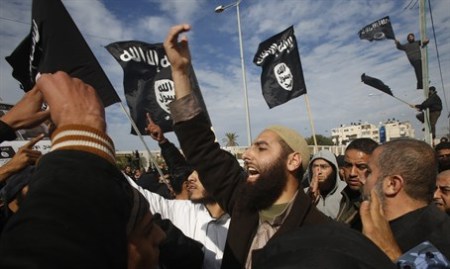
Isl State in GazaISIS supporters in Gaza Reuters

(AFP) Terrrorists inspired by the Islamic State (ISIS) jihadist group’s ideology are seeking to benefit from the desperation of young Palestinians to strengthen their foothold in the Gaza Strip.

But the Salafists in the enclave tread a fine line to avoid conflict with Hamas, the Islamist terrorist group which has ruled the strip for a decade but does not share all of ISIS’s world view.

Leaders of the Salafists, who are adherents of a strict Sunni interpretation of Islam, claim to have 3,000 fighters in Gaza.

While the figure is impossible to verify, experts see an increasing use of ISIS-style rhetoric to attract support.

“Some groups use the Islamic State label and claim to have adopted jihadist ideology to attract teenagers who have lost all hope,” said Assaad Abu Charakh, a professor at Al-Azhar University in Gaza.

Last week saw the heaviest cross-border clashes between Israeli forces and Hamas and other terrorist groups since 2014, raising fears of a return to hostilities, though calm has since returned.

Israel has maintained a blockade on Gaza since 2006 aimed at containing Hamas, which is sworn to the destruction of Jewish state and whose charter calls for the annihilation of the Jewish people.

At almost 45 percent, the unemployment rate in the Gaza Strip is among the world’s highest.

Hamas won the 2006 Palestinian parliamentary elections, and then one year later staged a violent purge of its Fatah rivals, killing scores and ousting the Palestinian Authority from Gaza entirely.

Qassam Brigades defectors

But some members of the Ezzedine al-Qassam Brigades, Hamas’ armed wing, argued elections were un-Islamic and defected to form Salafist groups.

Abu al-Ansari al-Ina, a leader of the “Young Salafist Fighters,” one of the major jihadist groups in Gaza, is one such defector.

The priority, he argues, is the “fight against the Jews in Palestine, even if the strategic goal is the introduction of Islamic law in the world.”

He says he is under surveillance and took precautions before meeting anAFP journalist.

Two hundred Gazans, including some of his movement, have crossed into Egypt to join the ranks of the Islamic State “despite Hamas’ attempts to stop them,” he says.

Most used the tunnels that once linked Gaza to Egypt, while others took advantage of the occasional openings of the Rafah border crossing, the only of Gaza’s borders crossings not controlled by Israel, and which is the subject of a total blockade by Egypt.

The vast Sinai desert is gripped by an insurgency that Egypt regularly accuses Hamas of supporting.

Egypt’s air force has destroyed a large number of the tunnels and established a buffer zone along the Gazan border.

Abu Sayyaf, military commander of another Salafi movement, insists Israel is the primary enemy.

“Our priority now is to strengthen the military capabilities of our fighters to kill the Jews, the enemies of God,” he said.

“We do not want confrontation with Hamas,” but “we will not hesitate to fight the infidels or anyone who stands in the way of our fighters.”

Escalation fears

Hamas security services reached an agreement last year with the jihadists after arresting about 100 of them: in exchange for their release, the groups committed to respect the truce with Israel and not to attack Palestinian or foreign institutions in Gaza.

Though limited, Salafi attacks endanger the ceasefire which Hamas is tactically keen to uphold.

Gazan groups have been firing rockets into Israel for years, with Israel retaliating by striking Hamas positions – holding the terrorist group responsible for all attacks emanating from territory it governs.

Many fear the tensions could escalate into clashes between Hamas and jihadi groups if rocket attacks occur.

Salafi jihadists have occasionally threatened Hamas in online videos, with some claiming the shelling of Qassam bases. “We met our commitments but Hamas did not, they again arrested some of our fighters,” says Abu al-Ina.

Mahmoud Zahar, a top Hamas official, says the authorities “discuss and are trying to reason” with the imprisoned Salafists, but have no choice but to use force against aggressors.

A Salafist was killed last year by Hamas forces who had come to arrest him.

Some jihadists “were planning to kill their neighbors and relatives,” Zahar said, provoking Hamas to step in to prevent “a huge explosion.”

Asked about the ISIS links, Abu al-Ina al-Ansari says they merely consist of “an exchange of ideas but are not organizational.”

“We agree with the clear message sent by the Islamic State to the miscreant West: ‘Stop your attacks, we will stop our attacks’.”

A Palestinian 9-bomb ambush for IDF

May 11, 2016

A Palestinian 9-bomb ambush for IDF, DEBKAfile, May 11, 2016

The bomb trap which seriously injured an Israeli officer at the Hizmeh checkpoint north of Jerusalem Tuesday night  was primed for a multiple  terror attack. The trap consisted of four iron pipe bomb stuffed with explosives, screws and sharp nails. Another explosive devices, some of which were attached   to a gas canister, failed to explode because of a technical malfunction and so averted a major disaster.

The most likely scenario according to our sources was for the terrorists to spring the bomb trap in two wave: the first four to blow up against the IDF patrol  and the rest to hit the responders to the first explosion, including rescue teams, and   intelligence and senior officers.

The initial conclusion gained by DEBKA counterterrorism from the data available is as follows:

1. This was no lone wolf event. It was a complex operation carried out by a competent team experienced in the building and placement of rigged explosive. Part of the team head nearby ready to set off the second wave of pipe bombs.

The plot was hatched in total secrecy. Neither Israeli intelligence nor the police caught any sign of the planned attack. Had there been any suspicion  a bomb squad would have inspected the route taken by the IDF patrol in advance.

2. Although the Israeli military sealed off Judea and Samaria for three days starting Tuesday night the eve of Remembrance  Day for the Fallen men and women of IDF – like “other sensitive dates” of the year, Palestinian terrorist were nonetheless able to reach their target.   It was only by sheer luck that a major disaster was averted. But one young officer paid the price.

Our source reports that this is the first time Palestinian terrorists are known to set up a complicated bomb trap of this kind. It must been assumed that some Palestinian organization received instructions in this skill from Hizballah who practiced it with devastating effect in Lebanon in the late nineties.

PA PM: We’re following the path of the Nazi Mufti

May 11, 2016

PA PM: We’re following the path of the Nazi Mufti, Israel National News, Dalit Halevi, May 11, 2016

mufti-and-hitlerHaj Amin al-Husseini and Adolf Hitler Wikimedia Commons

Hamdallah termed al-Husseini, who was a close confidante of Adolf Hitler, as “the pure-hearted son” of the “Palestinian nation.”

***************************

Palestinian Authority (PA) Prime Minister Rami Hamdallah on Tuesday took part in the Seventh International Bayt al-Maqdis Islamic Conference in Ramallah, Samaria, in which he aired libel against Israel apparently on the background of its counter-terror actions.

In his speech, he called on the international community to get involved in order to “defend” the Arab residents of Jerusalem who are dealing with “illegal” activities from Israel “that oppose international law and human rights.”

Hamdallah’s call to take action against Israel urged international pressure so as to end the “occupation” and establish an independent Palestinian state along the 1949 Armistice lines, with Jerusalem as its “eternal capital.”

He accused Israel of trying to wipe out the “Arab national identity” of Jerusalem, which is in fact the ancient 3,000-year-old capital of the Jewish people. As part of his accusations, he alleged that Israel is rewriting history and expelling Arabs from the capital.

The PA Prime Minister went on to say the Conference is inculcating the path of former Mufti of Jerusalem Haj Amin al-Husseini, who infamously sealed a pact with the genocidal Nazi regime to wipe out all Jews.

Hamdallah termed al-Husseini, who was a close confidante of Adolf Hitler, as “the pure-hearted son” of the “Palestinian nation.”

In the Conference meeting PA minister of holy sites Yusuf Ida’is also referred to the infamous mufti.

“This Conference is a continuation of the First Islamic Bayt al-Maqdis Conference held by the deceased Mufti Haj Amin al-Husseini on Palestinian soil in 1931, and here today we walk in his path according to the instructions of the (PA) President Mahmoud Abbas,” said Ida’is.

In an ironic twist given Hamdallah’s claims of rewriting history in Jerusalem, Bayt al-Maqdis is in fact the Arabicized version of the Hebrew “Beit Hamikdash,” which is the term for the Holy Temples that stood in Jerusalem.

Trump: Unexpected and Unconventional but Suited for Our Times

May 11, 2016

Trump: Unexpected and Unconventional but Suited for Our Times, American ThinkerScott S. Powell, May 11, 2016

One of the most extraordinary things about Donald Trump’s primary victory in the Republican Party is that he received more votes from people identifying as Christian than his closest competitor Ted Cruz — the son of an evangelical pastor and one who profusely displayed his Christian identity in speech and temperament. In contrast, by standards that many believe to be the essence of Christian character as expressed in the Sermon on the Mount, Donald Trump has been anything but meek, merciful, or peacemaking in his political rise. Some have likened him to a one-man wrecking ball. So what’s going on?

No one doubts that these are unusual times, with more forces pulling the United States down than at any other time in history. There is plenty of blame to go around for America’s spiraling state of decline, but at the top of the list are two things: First, we have had a culture captured and constrained by secular progressive political correctness. Second, we have an overbearing federal government that has corrupted both parties, the bureaucracies, and even the supposedly independent Federal Reserve.

At the grassroots, Republicans have tried to bring about a corrective, and they did succeed in getting many conservative reform candidates elected to congress in the last six years. Yet the stranglehold of political correctness and the corruption of Washington from special interests and lobbyists have proven insurmountable. Washington, DC — a metropolis producing very little with limited industry and almost no manufacturing — has become the richest city in the country, while driving the nation to the edge of financial ruin, as manifest in a national debt exceeding $19 trillion, 47 million people on food stamps, and a true unemployment rate that may be three times higher than the manipulated official rate released by the federal government.

Even as white Christians have diminished in their overall percentage of the population at large, according to the Pew Research Center, they still account for nearly seven in ten Americans who identify with, or lean toward, the Republican Party — about the same percentage as in the 1980s during the Reagan years. The problem is the GOP — despite its success in gaining majorities in both houses of Congress and controlling the power of the purse — has been ineffective as an opposition party during the Obama years.

The tipping point for many Christians came with a realization that the Republican Party was as incapable of protecting their rights and values at home as it was feckless in stopping an errant foreign policy that undermined trust with allies and emboldened enemies.

Two unnerving breaches of protection prompted many to recognize compelling qualities in Donald Trump over other candidates. First, he exuded an unapologetic toughness about building a wall and stopping the wave of illegal immigrants flooding over the Mexican border. Second, he was unequivocal about obliterating ISIS quickly and decisively — ending its wanton slaughter of Christians and other ethnic groups. And bridging both of these issues, in the aftermath of ISIS-inspired attacks in San Bernardino and Brussels, Trump unhesitatingly opposed Obama’s wish to take in undocumented Syrian refugees, “until we figure out what the hell is going on.” In that alone in the eyes of the majority, Trump demonstrated he was presidential, putting the protection of Americans as the top priority.

Political correctness and intolerance, which debilitates critical thinking, discourse and debate, has been shaping American culture for more than a generation. Throughout the seven plus years of the Obama administration, political correctness has driven domestic and foreign policy — with disastrous results. Obama has gone beyond anyone in recent memory in assaulting the First Amendment, undermining both speech and the exercise of Christian religion. We now see among liberals and secular progressives operating in the Democrat Party an Orwellian power structure that seeks to advance a statist, socialist and globalist transformation of the U.S. by silencing opposing views through the courts, misinformation, and distortion of the truth. Call it “newspeak” as Orwell did or the successor term “doublespeak,” its purpose is the same: to shape the masses thinking and obfuscate what is really going down.

Political correctness has not only prevented development of an effective strategy to deal with Islamist terrorism. It has turned U.S. relations in the Middle East upside down. The Obama administration celebrated the ouster and replacement of Egypt’s president Hosni Mubarak, a long-standing U.S. ally, with Muslim Brotherhood’s Mohamed Morsi. A similar glee was initially expressed by Secretary of State Hillary Clinton on the news of Muammar Gaddafi being hunted down and killed, only to be followed by increased mayhem in Libya, leading to the tragedy and humiliation of the U.S. at the hands of terrorists in Benghazi.

But for many Christians, the bridge too far was Obama’s rebuke of Israel and his end run around the U.S. Congress, in forcing through a fundamentally flawed nuclear deal with Iran. Iran is both the top exporter of hate and the world’s largest state sponsor of terrorism whose longstanding primary targets are the United States (often referred to as the “big Satan”), and Israel (the “little Satan”).

Everyone recognizes that Donald Trump is a flawed candidate. His Christian supporters certainly know this as well or better than his critics. But they also recognize that sinners are all that there are to choose from and that America’s precarious position at home and abroad requires an unconventional leader with unusual characteristics — some of which may not be aligned with a stereotypical Christian temperament.

One thing few could disagree with is that Trump deserves credit more than any conservative for fracturing the foundation of political correctness, upon which rests the entire liberal superstructure.

In fact, conventional conservatives may have reached a limit in expanding their audience. In contrast, it appears to be harvest time for Trump. His style of common sense plain talk has the potential to make huge inroads into both independent and liberal constituencies who are just now waking up to the absurdities of political correctness. While many still can’t see clearly, the fog is lifting, and the soul, spontaneity and humor of America is making an incipient revival, even in the midst of rancor.

If one can get past the braggadocio, narcissism and other negatives of Trump’s character, on the positive side he exudes confidence, ambition and a keenness to make good deals, get results and win. He is bold, direct and doesn’t shy away from confrontation. Mr. Trump is quite social and clearly likes to entertain, but he is also tough as nails, unrelenting and unpredictable with adversaries. He is unquestionably and refreshingly patriotic.

It turns out that some of these qualities are among those most vital to rebuilding relations with America’s allies and restoring respect — even fear — from adversaries. Mr. Trump’s irectness also suggests he is the best-suited presidential candidate to take on America’s greatest threat — insolvency. He could break the cycle of denial that completely engulfs the Democrat Party, and has hitherto prevented predecessors from doing much of anything regarding the nation’s out-of-control spending, deficits and unsustainable debt. Additionally, Trump’s toughness may be the key virtue needed to rule in a divided country and to successfully downsize and restructure federal agencies and get Washington out of the way of the American economy and its people.

Although the GOP believes it has a big tent, understandably many party members with well-established positions and values have great difficulty in accepting for the highest office in the land a newcomer candidate as fundamentally different as Donald Trump. To them I would say, unusual times with threats on every front at home and abroad call for an unconventional candidate. And it’s not so hard after all to recognize qualities in Donald Trump that make him in certain ways uniquely well-suited for our times.


Israel remembers its fallen soldiers, victims of terror

May 10, 2016

Israel remembers its fallen soldiers, victims of terror, DEBKAfile, May 10, 2016

Israeli soldies gather on the Mount of Olives cemetery of fallen Israeli soldiers to place flags on the graves during a ceremony held at the Mount of Olives in preparation for Memorial Day, beginning tonight. Memorial Day commemorates the death of Israeli soldiers killed in wars since 1860. May 10, 2016. Photo by Nati Shohat/Flash90 *** Local Caption *** ?????? ?? ?????? ??? ????? ????? ??? ???????

Israeli soldies gather on the Mount of Olives cemetery of fallen Israeli soldiers to place flags on the graves during a ceremony held at the Mount of Olives in preparation for Memorial Day, beginning tonight.

At 7:30 p.m., there will be a candle-lighting ceremony at the Western Wall attended by President Reuven Rivlin, the IDF chief of staff, Lieut. Gen. Gady Eisenkot, the chief rabbi of the Western Wall, Shmuel Rabinovitz, and representatives of bereaved families. At the start of the official ceremony, the national flag will be lowered to half staff, and at 20:00 sirens will go off for one minute around the country.

At 9:15 p.m. there will be a ceremony titled “poems in their memory” at the Knesset that will be attended by hundreds of bereaved family members. Poems will be read by Knesset Speaker Yuli Edelstein, Defense Minister Moshe Ya’alon, the IDF deputy chief of staff, Maj. Gen. Yair Golan, and Police Commissioner Roni Alsheikh. Singers Shiri Maimon, Ninet Tayeb, Harel Skaat, Eidan Habib, Uzia Tzadok and military bands will also perform.

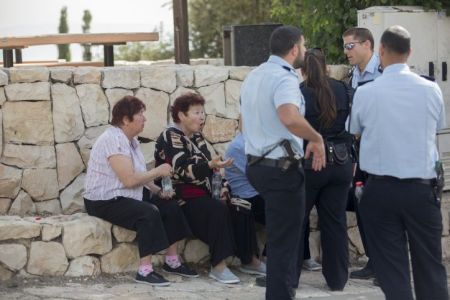
Israeli security forces at the scene of a stabbing attack in Armon Hanatziv neighborhood in Jerusalem on May 10, 2016. Photo by Yonatan Sindel/Flash90 *** Local Caption *** ???? ????? ?????? ????? ????? ?????

Israeli security forces at the scene of a stabbing attack in Armon Hanatziv neighborhood in Jerusalem on May 10, 2016. Photo by Yonatan Sindel/Flash90.

 Paletinian terrorists stabbed their two friends, aged 86 and 82, in Jeruslaem.

On Wednesday, the events will start at 11:00 a.m. with sirens going off around the country for two minutes, followed by the official ceremony on Mt. Herzl to honor the fallen from Israel’s wars, which will be attended by the president, the prime minister, the chief of staff, the chief judge of the supreme court and representatives of bereaved families.

Official memorial ceremonies are to be held at cemeteries around the country. The ceremony at Kiryat Shaul cemetery in Tel Aviv will be attended by Defense Minister Yaalon. The official ceremony to honor those who died in terrorist attacks is to take place at 1;00 p.m. at Mt.. Herzl.

Why Middle Eastern Leaders Are Talking to Putin, Not Obama

May 9, 2016

Why Middle Eastern Leaders Are Talking to Putin, Not Obama, Politico, Dennis Ross, May 8, 2016

John Hinderaker at Power Line writes,

Dennis Ross is a respected, if thoroughly conventional, expert on the Middle East. A Democrat, he has served in both Republican and Democratic administrations as an adviser and envoy. Ross served in the State Department as Hillary Clinton’s Special Advisor for the Persian Gulf and Southwest Asia. Subsequently, he joined President Obama’s National Security Council staff as a Special Assistant to the President and Senior Director for the Central Region, which includes the Middle East, the Persian Gulf, Afghanistan, Pakistan and South Asia. So when Ross writes, in Politico, that Obama’s foreign policy weakness is hurting American interests, we should take notice.

— DM)

Putin and Middle Eastern leaders understand the logic of coercion. It is time for us to reapply it.

*****************************

The United States has significantly more military capability in the Middle East today than Russia—America has 35,000 troops and hundreds of aircraft; the Russians roughly 2,000 troops and, perhaps, 50 aircraft—and yet Middle Eastern leaders are making pilgrimages to Moscow to see Vladimir Putin these days, not rushing to Washington. Two weeks ago, Israeli Prime Minister Benjamin Netanyahu traveled to see the Russian president, his second trip to Russia since last fall, and King Salman of Saudi Arabia is planning a trip soon. Egypt’s president and other Middle Eastern leaders have also made the trek to see Putin.

Why is this happening, and why on my trips to the region am I hearing that Arabs and Israelis have pretty much given up on President Barack Obama? Because perceptions matter more than mere power: The Russians are seen as willing to use power to affect the balance of power in the region, and we are not.

Putin’s decision to intervene militarily in Syria has secured President Bashar Assad’s position and dramatically reduced the isolation imposed on Russia after the seizure of Crimea and its continuing manipulation of the fighting in Ukraine. And Putin’s worldview is completely at odds with Obama’s. Obama believes in the use of force only in circumstances where our security and homeland might be directly threatened. His mindset justifies pre-emptive action against terrorists and doing more to fight the Islamic State. But it frames U.S. interests and the use of force to support them in very narrow terms. It reflects the president’s reading of the lessons of Iraq and Afghanistan, and helps to explain why he has been so reluctant to do more in Syria at a time when the war has produced a humanitarian catastrophe, a refugee crisis that threatens the underpinnings of the European Union, and helped to give rise to Islamic State. And, it also explains why he thinks that Putin cannot gain—and is losing—as a result of his military intervention in Syria.

But in the Middle East it is Putin’s views on the uses of coercion, including force to achieve political objectives, that appears to be the norm, not the exception—and that is true for our friends as well as adversaries. The Saudis acted in Yemen in no small part because they feared the United States would impose no limits on Iranian expansion in the area, and they felt the need to draw their own lines. In the aftermath of the nuclear deal, Iran’s behavior in the region has been more aggressive, not less so, with regular Iranian forces joining the Revolutionary Guard now deployed to Syria, wider use of Shiite militias, arms smuggling into Bahrain and the eastern province of Saudi Arabia, and ballistic missile tests.

Russia’s presence has not helped. The Russian military intervention turned the tide in Syria and, contrary to Obama’s view, has put the Russians in a stronger position without imposing any meaningful costs on them. Not only are they not being penalized for their Syrian intervention, but the president himself is now calling Vladimir Putin and seeking his help to pressure Assad—effectively recognizing who has leverage. Middle Eastern leaders recognize it as well and realize they need to be talking to the Russians if they are to safeguard their interests. No doubt, it would be better if the rest of the world defined the nature of power the way Obama does. It would be better if, internationally, Putin were seen to be losing. But he is not.

This does not mean that we are weak and Russia is strong. Objectively, Russia is declining economically and low oil prices spell increasing financial troubles—a fact that may explain, at least in part, Putin’s desire to play up Russia’s role on the world stage and his exercise of power in the Middle East. But Obama’s recent trip to Saudi Arabia did not alter the perception of American weakness and our reluctance to affect the balance of power in the region. The Arab Gulf states fear growing Iranian strength more than they fear the Islamic State—and they are convinced that the administration is ready to acquiesce in Iran’s pursuit of regional hegemony. Immediately after the president’s meeting at the Gulf Cooperation Council summit, Abdulrahman al-Rashed, a journalist very well connected to Saudi leaders, wrote: “Washington cannot open up doors to Iran allowing it to threaten regional countries … while asking the afflicted countries to settle silently.”

As I hear on my visits to the region, Arabs and Israelis alike are looking to the next administration. They know the Russians are not a force for stability; they count on the United States to play that role. Ironically, because Obama has conveyed a reluctance to exercise American power in the region, many of our traditional partners in the area realize they may have to do more themselves. That’s not necessarily a bad thing unless it drives them to act in ways that might be counterproductive. For example, had the Saudis been more confident about our readiness to counter the Iranian-backed threats in the region, would they have chosen to go to war in Yemen—a costly war that not surprisingly is very difficult to win and that has imposed a terrible price? Obama has been right to believe that the regional parties must play a larger role in fighting the Islamic State. He has, unfortunately, been wrong to believe they would do so if they thought we failed to see the bigger threat they saw and they doubted our credibility.

Indeed, so long as they question American reliability, there will be limits to how much they will expose themselves—whether in fighting the Islamic State, not responding to Russian entreaties, or even thinking about assuming a role of greater responsibility for Palestinian compromises on making peace with Israel. To take advantage of their recognition that they may need to run more risks and assume more responsibility in the region, they will want to know that America’s word is good and there will be no more “red lines” declared but unfulfilled; that we see the same threats they do; and that U.S. leaders understand that power affects the landscape in the region and will not hesitate to reassert it.

Several steps would help convey such an impression:

⧫ Toughen our declaratory policy toward Iran about the consequences of cheating on the Joint Comprehensive Plan of Action to include blunt, explicit language on employing force, not sanctions, should the Iranians violate their commitment not to pursue or acquire a nuclear weapon;

⧫ Launch contingency planning with GCC states and Israel—who themselves are now talking—to generate specific options for countering Iran’s growing use of Shiite militias to undermine regimes in the region. (A readiness to host quiet three-way discussions with Arab and Israeli military planners would signal we recognize the shared threat perceptions, the new strategic realities, and the potentially new means to counter both radical Shiite and Sunni threats.)

⧫ Be prepared to arm the Sunni tribes in Iraq if Prime Minister Haider al-Abadi continues to be blocked from doing so by the Iranians and the leading militias;

⧫ In Syria, make clear that if the Russians continue to back Assad and do not force him to accept the Vienna principles (a cease-fire, opening humanitarian corridors, negotiations and a political transition), they will leave us no choice but to work with our partners to develop safe havens with no-fly zones.

Putin and Middle Eastern leaders understand the logic of coercion. It is time for us to reapply it.


New UK campaign – it’s ‘payback time’ for the EU

May 9, 2016

New UK campaign – it’s ‘payback time’ for the EU, Israel National News, Ari Yashar, May 9, 2016

As the UK is poised ahead of a fateful vote on whether or not to remain in the EU, a group of concerned British ex-pats and Israelis have launched a new “Support Israel-Leave Europe” campaign to get Britain out of the EU and stop helping its efforts against the Jewish state.

The campaign, which is funded by Jewish land rights watchdog Regavim and whose website can be viewed here, has launched a humorous video of Hamas terrorists calling on the UK to stay in the EU to continue helping fund the terrorists in their fight against Israel.

Regavim’s work on the project comes amid their legal battle against the EU over its funding of illegal Arab settlements in Area C, the region in Judea and Samaria designated as being under full Israeli control by the 1994 Oslo Accords and which contains all the Jewish residents.  Area A is under complete Arab control and only security in Area B is controlled by Israel.

The new “Support Israel-Leave Europe” campaign presents several major reasons why those who support the Jewish state should want to see Britain leave and consequently weaken the EU.

Firstly, the EU has paid millions in aid money to the Palestinians, a large portion of which is going directly to pay the salaries of terrorist murderers.

Another strike against the EU is its funding of illegal Arab buildings in Area C, as it has built over 1,000 structures in the region to create a de-facto state of “Palestine” there.

The campaign also argues the EU’s recent campaign to label all Jewish products made in Judea, Samaria, eastern Jerusalem and the Golan Heights is a form of state-sponsored anti-Semitism, and finally it notes that the EU provides huge budgets for hundreds of virulently anti-Israeli NGOs to support their work delegitimizing Israel and conducting lawfare against it.

“For decades the European Union has meddled in Israeli affairs to the detriment of the Jewish State, for thousands of Israel supporters in the United Kingdom and ex-pats around the globe, it’s pay back time,” said Ari Briggs, Regavim’s international director.

“We call on everyone who supports Israel to ‘vote leave’ and deal a major blow to this mammoth bureaucracy that has an unhealthy obsession with Israel.”

Briggs warned that “the double standard in which the EU holds Israel, is nothing short of state-sponsored anti-Semitism. We encourage all eligible ex-pats in Israel and elsewhere to make sure they are on the electoral registry before the June 7th deadline to ensure they can vote, all the information needed is provided on our website.”

Iran’s Plans to Control a Palestinian State

May 9, 2016

Iran’s Plans to Control a Palestinian State, Gatestone Institute, Khaled Abu Toameh, May 9, 2016

(Please see also, Op-Ed: Trump’s “peace through strength”  for  USA also applies to Israel. — DM)

♦ The Iran nuclear deal, marking its first anniversary, does not appear to have had a calming effect on the Middle East.

♦ Iran funnels money to Hamas and Islamic Jihad because they share its desire to eliminate Israel and replace it with an Islamic empire. The Iranian leaders want to see Hamas killing Jews every day, with no break. Ironically, Hamas has become too “moderate” for the Iranian leadership because it is not doing enough to drive Jews out of the region.

♦ More Palestinian terror group leaders may soon perform the “pilgrimage” to their masters in Tehran. If this keeps up, the Iranians themselves will puppeteer any Palestinian state that is created in the region.

The Iran nuclear deal, marking its first anniversary, does not appear to have had a calming effect on the Middle East. The Iranians seem to be deepening their intervention in the Israeli-Palestinian conflict in general and in internal Palestinian affairs in particular.

This intervention is an extension of Iran’s ongoing efforts to expand its influence in Arab and Islamic countries, including Iraq, Yemen, Syria and Lebanon and some Gulf states. The nuclear deal between Tehran and the world powers has not stopped the Iranians from proceeding with their global plan to export their “Islamic Revolution.” On the contrary, the general sense among Arabs and Muslims is that in the wake of the nuclear deal, Iran has accelerated its efforts to spread its influence.

Iran’s direct and indirect presence in Iraq, Syria, Yemen and Lebanon has garnered some international attention, yet its actions in the Palestinian arena are still ignored by the world.

That Iran provides financial and military aid to Palestinian groups such as Hamas and Islamic Jihad has never been a secret. In fact, both the Iranians and the Palestinian radical groups have been boasting about their relations.

Iran funnels money to these groups because they share its desire to eliminate Israel and replace it with an Islamic empire. Like Hezbollah in Lebanon and the Houthis in Yemen, Hamas and Islamic Jihad agreed to play the role of Tehran’s proxies and enablers in the Israeli-Palestinian conflict.

1162 (1)Iran used to funnel money to Hamas and Islamic Jihad because they share its desire to eliminate Israel and replace it with an Islamic empire. Relations between Iran and Hamas foundered a few years back, when Hamas leaders refused to support the Iranian-backed Syrian dictator, Bashar Assad. Pictured above: Hamas leader Khaled Mashaal (left) confers with Iranian “Supreme Leader” Ali Khamenei, in 2010. (Image source: Office of the Supreme Leader)

But puppets must remain puppets. Iran gets nasty when its dummies do not play according to its rules. This is precisely what happened with Hamas and Islamic Jihad.

Relations between Iran and Hamas foundered a few years back over the crisis in Syria. Defying their masters in Tehran, Hamas leaders refused to declare support for the Iranian-backed Syrian dictator, Bashar Assad. Things between Iran and Hamas have been pretty bad ever since.

First, the Assad government closed down Hamas offices in Damascus. Second, Assad expelled the Hamas leadership from Syria. Third, Iran suspended financial and military aid to Hamas, further aggravating the financial crisis that the Gaza-based Islamist movement had already been facing.

Islamic Jihad got it next. Iranian mullahs woke up one morning to realize that Islamic Jihad leaders have been a bit unfaithful. Some of the Islamic Jihad leaders were caught flirting with Iran’s Sunni rivals in Saudi Arabia and other Gulf countries. Even worse, the Iranians discovered that Islamic Jihad was still working closely with their erstwhile allies in the Gaza Strip, Hamas.

Iran had had high hopes for Islamic Jihad replacing Hamas as Tehran’s darling, and major proxy in the Palestinian arena. But here were Islamic Jihad leaders and activists working with their cohorts in Hamas, in apparent disregard of Papa Iran.

The mullahs did not lose much time. Outraged by Islamic Jihad’s apparent disloyalty, Iran launched its own terror group inside the Gaza Strip: Al-Sabireen (The Patient Ones). This group, which currently consists of several hundred disgruntled ex-Hamas and ex-Islamic Jihad members, was meant to replace Islamic Jihad the same way Islamic Jihad was supposed to replace Hamas in the Gaza Strip — in accordance with Iran’s scheme.

Lo and behold: it is hard to get things right with Iran. Al-Sabireen has also failed to please its masters in Tehran and is not “delivering.” Palestinian sources in the Gaza Strip say that Iran has realized that the investment in Al-Sabireen has not been worthwhile because the group has not been able to do anything “dramatic” in the past two years. By “dramatic,” the sources mean that Al-Sabireen has neither emerged as a serious challenger to Islamic Jihad or Hamas, and has not succeeded in killing enough Israelis.

So Iran has gone running back to its former bedfellow, Islamic Jihad.

For now, Iran is not prepared fully to bring Hamas back under its wings. Hamas, for the Iranians, is a “treacherous” movement, thanks to its periodic temporary ceasefires with Israel. The Iranian leaders want to see Hamas killing Jews every day, with no break. Ironically, Hamas has become too “moderate” for the Iranian leadership because it is not doing enough to drive Jews out of the region.

That leaves Iran with the Islamic Jihad.

In a surprise move, the Iranians this week hosted Islamic Jihad leader Ramadan Shalah and senior officials from his organization, in a renewed bid to revive Islamic Jihad’s role as the major puppet of Tehran in the Gaza Strip. Islamic Jihad officials said that the visit has resulted in the resumption of Iranian financial aid to their cash-strapped organization. As a result of the rift between Islamic Jihad and Iran, the Iranians are said to have cut off nearly 90% of their financial aid to the Palestinian terror organization.

Some Palestinians, such as political analyst Hamadeh Fara’neh, see the rapprochement between Iran and Islamic Jihad as a response to the warming of relations between Hamas and Turkey. The Iranians, he argues, are unhappy with recent reports that suggested that Turkey was acting as a mediator between Hamas and Israel.

Other Palestinians believe that Iran’s real goal is to unite Islamic Jihad and Al-Sabireen so that they would become a real and realistic alternative to Hamas in the Gaza Strip.

Whatever Iran’s intentions may be, one thing is clear: The Iranians are taking advantage of the nuclear deal to move forward with their efforts to increase their influence over some Arab and Islamic countries. Iran is also showing that it remains very keen on playing a role in the Israeli-Palestinian conflict — one that emboldens radical groups that are bent on the destruction of Israel and that share the same values as the Islamic State terror group.

Iran’s latest courtship of Islamic Jihad is yet another attempt by the mullahs to deepen their infiltration of the Palestinian arena by supporting and arming any terror group that strives to smash Israel. For now, it seems that Hamas’s scheme is working, largely thanks to the apathy of the international community, where many believe that Iran has been declawed by the nuclear deal.

But more Palestinian terror group leaders may soon perform the “pilgrimage” to their masters in Tehran. If this keeps up, the Iranians themselves will puppeteer any Palestinian state that is created in the region. Their ultimate task, after all, is to use this state as a launching pad to destroy Israel. And the Iranians are prepared to fund and arm any Palestinian group that is willing to help achieve this goal.

Politics: On Trump’s side

May 7, 2016

Politics: On Trump’s side, Jerusalem Post, Gil Hoffman, May 7, 2016

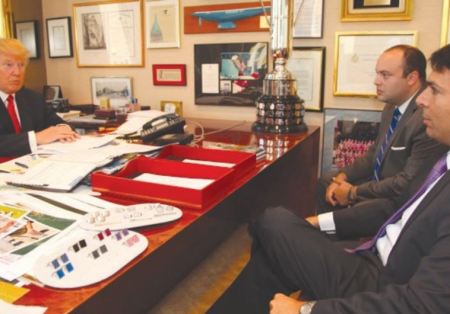
Trump and Israeli ambassadorREPUBLICAN PRESIDENTIAL candidate Donald Trump talks in his office to Ambassador to the UN Danny Danon (right) and Johnny Daniels. (photo credit:Courtesy)

A week before the January 2013 Israeli election, Prime Minister Benjamin Netanyahu received a surprising endorsement from American real estate mogul Donald Trump.

Trump released a video in which he called himself “a big fan of Israel” and Netanyahu “a great prime minister,” a “terrific guy,” and “a winner.”

“I think he would have been a great president of the United States,” Trump said in a telephone interview with The Jerusalem Post at the time. “I have great respect for Netanyahu. He has a tremendous understanding of Israel and where it’s going. His voice is respected. I don’t think he has a bad relationship with Democrats, and he has the respect of the president.”

Netanyahu has been careful not to speak about the current American election campaign, so he will not return the favor with a video endorsing Trump to succeed President Barack Obama.

The man who organized the video endorsement and the interview was 30-year-old British-born public relations phenom Jonny Daniels, who runs the Holocaust commemoration organization From The Depths and is arguably the Israeli closest to Trump.

Trump became the presumptive Republican nominee for president this week, following the departures of rival candidates Ted Cruz and John Kasich.

He made many Israelis feel uneasy when he called himself neutral on the Israeli- Palestinian conflict, but in an interview on Wednesday Daniels said people who care about the Jewish state should not fear a Trump presidency.

“It is very good news for Israel that he will be the Republican candidate for president, because we really do have a good friend in Donald Trump,” Daniels said. “I’m not sure people realize who he is beyond his media persona. He is a politician playing politics, and there are certain things you do and say for votes, and if it’s inflammatory so be it. Netanyahu and Obama have also reached out to their voter base, and that’s what Trump has been doing.”

Daniels got to know Trump through friends who worked for him. He has met him numerous times in different capacities at his Trump Tower office and on golf courses. Daniels is close to Trump’s staff, with whom he is meeting in New York this weekend.

“The Donald Trump I know is thoughtful, strong-willed and an incredibly smart person,” Daniels said. “He reads people and situations and, most importantly, doesn’t give up. He will fight for Israel and – just as important for Israel – fight for the USA. A strong America is a strong Israel. Over the past eight years, there has been a massive decrease in American strength, and as the US’s great ally that has been a significant problem for us.”

When Trump and Daniels have met, the former has asked the latter questions about how Israelis feel, as well as deep queries about Iran and other key issues on the public agenda. Daniels tried to organize the first-ever visit by Trump to Israel, but scheduling did not work out.

“In my conversations one-on-one with Mr. Trump, he gets it,” Daniels said. “You can base it on the questions he asks.

They are in-depth questions. This is a guy who truly understands our side of the conflict. He asked deep questions about Iran, because we are friends, and I am sure he talks to security experts as well.”

When Daniels did not have the answers, he connected Trump to those who did and arranged for him to meet four years ago with then-Likud MK and current ambassador to the United Nations Danny Danon.

“He didn’t base his foreign policy on what I told him,” Daniels said. “He talks to people smarter than me. But it’s good that he talks to a father of two girls who lives in Israel and deals with the issues day to day.”

Daniels dismisses Trump’s “neutral” statement as him just “trying to be careful.”

He said Trump has been wise to speak about Israel in formal settings with teleprompters in order to avoid making mistakes.

“He is smart enough to understand that a peace deal wouldn’t be brokered over night,” Daniels said. “When we look at his true understanding of the concerns facing Israel, we have to see it promisingly. He was vehemently against the Iran deal before he thought he would be running for president.

He knows Israel is a complicated issue, and the fact that he knows you can’t shoot from the hip on it is something you should look at it in a positive light.”

Criticizing Trump’s competition in the race, Daniels said “anyone who doesn’t think Hillary Clinton will be a continuation of Obama is living on a different planet.”

Daniels said Israelis can be reassured that Trump surrounds himself with “strong, tough people, and it just so happens that a lot of them happen to be Jewish.” He singled out attorney Michael Cohen, who sits in the office next to Trump. Cohen’s parents were survivors of Auschwitz, and Daniels said he has an incredible affinity for Israel.

The campaign video for Netanyahu was Daniels’s idea when he was in touch with the prime minister’s campaign team in 2013.

“I came to them with the idea of having US celebrities endorse Netanyahu,” he recalled. “When I asked him [Trump], he was incredibly happy. I didn’t tell him what to say. He knew exactly what to say. At the time, he wasn’t running for anything. Had he been a candidate for president, I wouldn’t have asked for the endorsement. Israel does not get involved in internal US politics, and I don’t know who Bibi backs now.”

Daniels said Trump’s image as a racist and a hater of women is “utter nonsense and political spin.”

“Israelis across the political spectrum in Israel should not be worried about a Trump presidency for Israel,” he said.

“He is the furthest thing from a racist that I know. There are plenty of Republicans who would worry me a lot more, because they see things as biblical prophesies.”

Another factor Daniels believes Israelis should keep in mind is Trump’s connection to Judaism through his daughter Ivanka, who went through an Orthodox conversion, and his son-in-law, businessman Jared Kushner. Daniels attended a Shabbat meal hosted by the couple in New York two years ago and heard from them about their father’s ties to their faith.

“He is someone who understands our traditions,” Daniels said. “Just like Obama grew up in traditional Muslim settings, Trump has gained an appreciation of traditional Judaism.”

Daniels said Trump attends Shabbat dinner with the Kushners monthly, sitting silently as his grandchildren sing “Shalom Aleichem” and – as is customary – not uttering a word between hand-washing and the “Hamotzi” blessing over bread. He also pointed out the plaques on Trump’s office wall thanking him for his support of yeshivot and his serving as grand marshal of the Israel Day Parade after September 11, 2001.

Because of his ties with Trump, Daniels has been approached by Israeli television channels and people with political and real estate ideas, such as opening a Trump resort in Beersheba.

“That’s not the relationship I have with him,” he said. “Trump is not my best friend. He is someone I look up to.”

But Daniels said he does not intend to join the Trump campaign and would not move to Washington, even if offered a role in a Trump administration.

“I’m very happy in the work that I do in keeping the memory of the Holocaust alive,” he said. “There are many people who can work in a campaign or in an administration. I have two beautiful daughters who I want to be with. Dude, I love Israel. I’m not going anywhere.”

The Arabs’ Real Grievance against the Jews

May 7, 2016

The Arabs’ Real Grievance against the Jews, Gatestone InstituteFred Maroun, May 7, 2016

♦ The Arab world still does not today accept the concept of a Jewish state of any size or any shape. Even Egypt and Jordan, who signed peace agreements with Israel, do not accept that Israel is a Jewish state, and they continue to promote anti-Semitic hatred against Israel.

♦ During Israel’s War of Independence, Jews e cleansed from Gaza, the West Bank, and East Jerusalem, and in the years that followed, they were ethnically cleansed from the rest of the Arab world.

♦ Jews demand the right to exist, and to exist as equals, on the land where they have existed and belonged continuously for more than three thousand years.

♦ We would rather claim that the conflict is about “occupation” and “settlements.” The Jews see what radical Islamists are now doing to Christians and other minorities, who were also in the Middle East for thousands of years before the Muslim Prophet Mohammed was even born.

♦ The real Arab grievance against the Jews is that they exist.

As Arabs, we are very adept at demanding that our human rights be respected, at least when we live in liberal democracies such as in North America, Europe, and Israel. But what about when it comes to our respecting the human rights of others, particularly Jews?

When we examine our attitude towards Jews, both historically and at present, we realize that it is centered on denying Jews the most fundamental human right, the right without which no other human right is relevant: the right to exist.

The right to exist in the Middle East before 1948

Anti-Zionists often repeat the claim that before modern Israel, Jews were able to live in peace in the Middle East, and that it is the establishment of the State of Israel that created Arab hostility towards Jews. That is a lie.

Before modern Israel, as the historian Martin Gilbert wrote, “Jews held the inferior status of dhimmi, which, despite giving them protection to worship according to their own faith, subjected them to many vexatious and humiliating restrictions in their daily lives.” As another historian, G.E. von Grunebaum, wrote, Jews in the Middle East faced “a lengthy list of persecutions, arbitrary confiscations, attempted forced conversions, or pogroms.”

The right to exist as an independent state

Zionism stemmed from the need for Jews to be masters of their own fate; no longer to be the victims of discrimination or massacres simply for being Jews. This project was accepted and formally recognized by the British, who had been granted a mandate over Palestine by the League of Nations. The Arab world, however, never accepted the recognition formulated by Britain in the Balfour Declaration of 1917, and it never accepted the partition plan approved by the United Nations in 1947, which recognized the right of the Jews to their own state.

The Arab refusal to accept the Jewish state’s right to exist, a right that carries more international legal weight than almost any other country’s right to exist, resulted in several wars, starting with the war of independence in 1948-1949. The Arab world still does not today accept the concept of a Jewish state of any size or any shape. Even Egypt and Jordan, which signed peace agreements with Israel, do not accept that Israel is a Jewish state, and they continue to promote anti-Semitic hatred against Israel.

The right to exist in Gaza, the West Bank, and East Jerusalem

In 2005, Israel evacuated all its troops and all Jewish inhabitants from Gaza, in the hope that this would bring peace at least on that front, and to allow the Gaza Strip, vacated by Jews, to be a flourishing Arab Riviera, or a second Singapore, and perhaps to serve as a model for the West Bank. The experiment failed miserably. This is a case where Jews willingly gave up their right to exist on a piece of land, but sadly the Palestinians of Gaza took it not as opportunity for peace, but as a sign that if you keep on shooting at Jews, they leave — so let’s keep on shooting.

There are many opinions among Zionists as to what to do about the West Bank. These opinions range from a total unilateral withdrawal as in Gaza, to a full annexation, with many options in between. At the moment, the status quo prevails, with no specific plans for the future.

Everyone, however, despite the treacherous UNESCO’s rewriting of history, knows that before that piece of land was called the West Bank, it was called Judea and Samaria for more than two thousand years.

Everyone knows that Hebron contains the traditional burial site of the biblical Patriarchs and Matriarchs, within the Cave of the Patriarchs, and it is considered the second-holiest site in Judaism. Every reasonable person knows that Jews should unquestionably have the right to exist on that land, even if it is under Arab or Muslim jurisdiction. Yet everyone also knows that no Arab regime is capable or even willing to protect the safety of Jews living under its jurisdiction from the anti-Semitic hatred that emanates from the Arab world.

East Jerusalem, which was carved away by the Kingdom of Jordan from the rest of Jerusalem during the war of independence, is part of Jerusalem, and contains the Temple Mount, the Jews’ holiest site. The Old City in East Jerusalem was inhabited by Jews up until they were ethnically cleansed by Jordan in the war of 1948-1949.
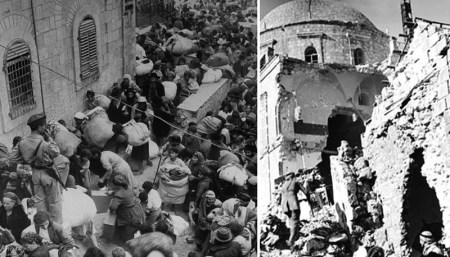
1588In May 1948, the Jordanian Arab Legion expelled all of the approximately 2000 Jews who lived in the Old City of Jerusalem, and then turned the Jewish Quarter into rubble.

Although Israel has twice in the past, first under Prime Minister Ehud Barak then under Prime Minister Ehud Olmert, offered East Jerusalem as part of a Palestinian state, that offer is not likely to be made again. Jews know that it would mean a new wave of ethnic cleansing, which would deny the Jewish right to exist on the piece of land where that right is more important than anywhere else.

The right to exist in the Middle East now

During Israel’s War of Independence, Jews were ethnically cleansed from Gaza, the West Bank, and East Jerusalem, and in the years that followed, they were ethnically cleansed from the rest of the Arab world.

Today, Israel’s enemies, many of them Arab, are challenging its right to exist, and therefore the right of Jews to exist, on two fronts: threats of nuclear annihilation and annihilation through demographic suffocation.

Iran’s Islamist regime has repeated several times its intention to destroy Israel using nuclear weapons. Just in case Iran is not “successful,” the so-called “pro-Palestinian” movement, including the Boycott, Divestment and Sanctions (BDS) movement, has a different plan to destroy the Jewish state: a single state with the “return” of all the descendants of Palestinian refugees. The refusal of Palestinian President Mahmoud Abbas and his predecessor Yasser Arafat to accept any two-state solution presented to them is part of that plan.

The right to exist elsewhere

Anti-Zionists claim that Jews are imperialists in the Middle East, as were the British and the French, and like them, they should leave and go back to where they belong. This analogy is of course not true: Jews have an even longer history in the Middle East than do Muslims or Arabs.

Do Jews belong in Europe, which tried only a few decades ago to kill every Jew, man, woman, or child? Do Jews belong in North America where until a few hundred years ago, there were no Europeans, only Indians?

Saying that Jews “belong” in such places is not reality; it is just a convenient claim for anti-Zionists to make.

The Jews will not give up

As Arabs, we complain because Palestinians feel humiliated going through Israeli checkpoints. We complain because Israel is building in the West Bank without Palestinian permission, and we complain because Israel dares to defend itself against Palestinian terrorists. But how many of us have stopped to consider how this situation came to be? How many of us have the courage to admit that waging war after war against the Jews in order to deny them the right to exist, and refusing every reasonable solution to the conflict, has led to the current situation?

Our message to Jews, throughout history and particularly when they had the temerity to want to govern themselves, has been clear: we cannot tolerate your very existence.

Yet the Jews demand the right to exist and to exist as equals on the land where they have existed and belonged continuously for more than three thousand years.

In addition, denying a people the right to exist is a crime of unimaginable proportions. We Arabs pretend that our lack of respect for the right of Jews to exist is not the cause of the conflict between the Jews and us. We would rather claim that the conflict is about “occupation” and “settlements”. They see what radical Islamists are now doing to Christians and other minorities, who were also in the Middle East for thousands of years before the Muslim Prophet Mohammed was even born: Yazidis, Kurds, Christians, Copts, Assyrians, Arameans, and many others. Where are these indigenous people of Iraq, Syria and Egypt now? Are they living freely or are they being persecuted, run out of their own historical land, slaughtered by Islamists? Jews know that this is what would have happened to them if they did not have their own state.

The real Arab grievance against the Jews is that they exist. We want the Jews either to disappear or be subservient to our whims, but the Jews refuse to bend to our bigotry, and they refuse to be swayed by our threats and our slander.

Who in his right mind can blame them?