Archive for the ‘Israel borders’ category

IDF bulldozers with tanks enter Golan DMZ

July 13, 2016

IDF bulldozers with tanks enter Golan DMZ, DEBKAfile, July 13, 2016

GolanIsrael_Zone

Israeli military bulldozers backed by tanks have crossed into the demilitarized zone dividing the Israeli and Syrian Golan borders. They are building a line of fortifications and anti-tank trenches 300-500 meters inside the DMZ.

This is the first time in the six-year Syrian war that the IDF has openly operated on the Syrian side of the border. The force has not so far run into opposition- or indeed any word of protest – or even mention – by Assad regime officials in Damascus.

The sole reference to Israeli military movements in the DMZ has come from a small Syrian rebel group which described them.

DEBKAfile’s military sources report that the IDF operation was still going forward Wednesday, July 12, on a patch of terrain facing the Israeli Golan village of Ein Zivan, on the one hand, and the Syrian town of Quneitra, on the other.

The enclave splitting the Golan between Syria and Israel is defined in the 1974 armistice agreements as a demilitarized zone under the military control of the UN Disengagement Observer Force (UNDOF) and Syrian civilian administration. It is bounded by two strips of land around 10km deep where each side is permitted to maintain diluted military strength. No ground-to-air missiles may be deployed inside a 25km radius from the DMZ.

It was agreed that Syrian nationals forced by the October 1973 war and its aftermath to leave their homes would be able to return. Ruined Quneitra was later handed back to Syria against a commitment by its government to repopulate the town and ban terrorist activity and infiltrations of Israel from the Golan sector.

Both commitments were given orally to the US government.

However, the Syrian war as it unfolded in the last two years turned the deal on its head. The UN observers abandoned their posts, leaving behind a void that was partly filled by Syrian troops and a motley assortment of rebel groups.

But the DMZ was left mostly unoccupied as both Israel and Syria tried to preserve at least the semblance of the deal intact. However, Assad’s allies Iran and Hizballah have repeatedly attempted to plant a forward military and terrorist presence opposite Israel’s Golan defense lines – with avowed hostile intent.

The silence from Damascus on Israel’s military steps on the Golan may be no more than a respite as the Syrian ruler waits for Tehran’s endorsement of joint Syrian-Iranian-Hizballah counteraction.

Our sources add that IDF military steps on the ground were accompanied by unusual Israeli Air Force movements over Syria and Lebanon, and elevated preparedness on the 10th anniversary this week of the Lebanon war fought between Hizballah and Israel.

It was noted that Hizballah refrained from celebrating the occasion and omitted its customary boasts of a “great victory” – thereby intensifying the sense in Israeli military circles that Iran’s Lebanese proxy may be cooking up a surprise operation.

Iranians and Walid suicide units on Golan border

July 8, 2016

Iranians & Walid suicide units on Golan border, DEBKAfile, July 8, 2016

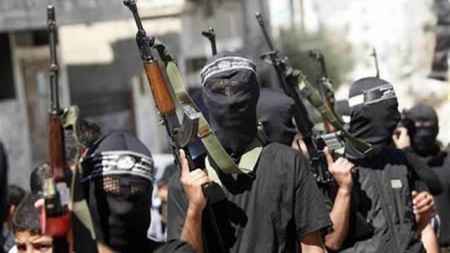
GolanIsrael_military

A flurry of false Hizballah claims amid rising military tension this week was designed to cover up a direct Israeli hit of the Iranian Revolutionary Guards HQ in South Syria, DEBKAfile military and intelligence sources disclose.

Whereas Hizballah reported on July 5 that Israeli helicopters had attacked Syrian army positions near the Golan town of Quneitra, in fact, one of the two Israeli “Tamuz” IDF rockets fired on July 4, in response to stray cross-border Syrian army mortar shells, struck the Syrian Ministry of Finance building near Quneitra, which housed Iranian Guards and Hizballah regional headquarters. An unknown number of Iranian officers were killed as a result.

On July 6, Hizballah sources reported a high level of tension at its east Lebanese outposts in Hasbaya, al-Qarqoub and Mount Hermon, indicating possible preparations to retaliate for the Iranian casualties.

The mortar shells that occasionally stray into Israel are aimed by the Syrian forces in Quneitra at Syrian rebel engineering units, which are digging an anti-tank trench on the town’s southern edge to prevent Syrian tanks from mounting an all-out assault against them (See attached map).

These skirmishes are put in the shade by the dangerous gains by Islamist terrorists in southern Syria.

Both ISIS and al-Qaeda’s Nusra Front have overrun the entire Syrian strip bordering on Israel and Jordan – a distance of 106km from Daraa up to the Druze villages of Mount Hermon.

The Islamists have seized control of this strategic borderland by taking advantage of the fighting between Syrian army and Syrian rebel forces in southern Syria.

Israel and Jordan were also remiss. The IDF and the Jordanian Army were so busy trying to prevent the Syrian army, the Iranian Revolutionary Guards and Hizballah from encroaching on their northern defense lines in northern Jordan and the Golan that they failed to notice the Islamic terrorists creeping up on their borders.

The terrorist presence which Israel finds most alarming is that of the “Khaled Bin Al-Walid Army” – a militia linked to both ISIS and al-Qaeda, which now controls a 36km band bordering on central and southern Golan from south Quneitra to the Jordan-Israel-Syria tri-border area – opposite Hamat Gader and Shaar HaGolan (See map).

The Khaled Bin Al-Walid Army was spawned by a union between the Islamist Liwa Shouada Yarmouk and Mouthana Islamic Movement militias. Its commander is Abu Abdullah al-Madani,  a Palestinian from Damascus, who is one of al-Qaeda’s veteran fighters. Close to Osama Bin-Laden, he fought with hhimagainst the Americans when they invaded Afghanistan 15 years ago. Ten years ago, he moved to Iraq, still fighting Americans, now alongside the al-Qaeda commander Abu Musab al-Zarqawi.

When al-Qaeda was defeated in Iraq, al-Madani moved to Syria.

DEBKAfile counter terror sources report that this veteran of Islamist terrorism, who is believed to be in touch wit Bin Laden’s successor Ayman al Zawahri, is active in three areas:

1. He is purchasing and stockpiling chemical weapons – a high priced commodity frequently traded among various Syrian rebel organizations.

2. Abu Abdullah al-Madani is recruiting from his militia suicide units for which he is personally training for operations inside Israel. DEBKAfile sources say that his plan is being taken very seriously by Israel security chiefs.

3. He is maintaining operational ties with Al Nusra commanders in the border region, possibly seeking access to the Israeli border through their turf for his chemical weapons and suicide units.

Iran’s Chess Board

June 3, 2016

Iran’s Chess Board, Front Page MagazineCaroline Glick, June 3, 2016

official_photo_of_hassan_rouhani_7th_president_of_iran_august_2013

Even if Obama’s successor disavows his actions, by the time Obama leaves office, America’s options will be more limited than ever before. Without war, his successor will likely be unable to stem Iran’s rise on the ruins of the Arab state system.

********************

Reprinted from jpost.com.

Strategic thinking has always been Israel’s Achilles’ heel. As a small state bereft of regional ambitions, so long as regional realities remained more or less static, Israel had little reason to be concerned about the great game of the Middle East.

But the ground is shifting in the lands around us. The Arab state system, which ensured the strategic status quo for decades, has collapsed.

So for the first time in four generations, strategy is again the dominant force shaping events that will impact Israel for generations to come.

To understand why, consider two events of the past week.

Early this week it was reported that after a two-year hiatus, Iran is restoring its financial support for Islamic Jihad. Iran will give the group, which is largely a creation of the Iranian Revolutionary Guard Corps, $70 million.

On Wednesday Iranian media were the first to report on the arrest of a “reporter” for Iran’s Al-Alam news service. Bassam Safadi was arrested by Israel police in his home in Majdal Shams, the Druse village closest to the border with Syria on the Golan Heights. Safadi is suspected of inciting terrorism.

That is, he is suspected of being an Iranian agent.

There is nothing new about Iranian efforts to raise and run fronts against Israel within its territory and along its borders. Iran poses a strategic threat to Israel through its Hezbollah surrogate in Lebanon, which now reportedly controls the Lebanese Armed Forces.

In Gaza, Iran controls a vast assortment of terrorist groups, including Hamas.

In Judea and Samaria, seemingly on a weekly basis we hear about another Iranian cell whose members were arrested by the Shin Bet or the IDF.

But while we are well aware of the efforts Iran is making along our borders and even within them to threaten Israel, we have not connected these efforts to Iran’s actions in Iraq and Syria. Only when we connect Iran’s actions here with its actions in those theaters do we understand what is now happening, and how it will influence Israel’s long-term strategic environment.

The big question today is what will replace the Arab state system.

Syria, Iraq, Lebanon, Yemen and Libya no longer exist. On their detritus we see the fight whose results will likely determine the fates of the surviving Arab states, as well as of much of Europe and the rest of the world.

Israel’s strategic environment will be determined in great part by the results of Iran’s actions in Iraq and Syria. While Israel can do little to affect the shape of events in these areas, it must understand what they mean for us. Only by doing so, will we be able to develop the tools to secure our future in this new strategic arena.

Until 2003, Saddam Hussein was the chief obstacle to Iran’s rise as the regional hegemon.

US forces in Iraq replaced Hussein until they left the country in 2011. In the meantime, by installing a Shi’ite government in Baghdad, the US set the conditions for the rise of Islamic State in the Sunni heartland of Anbar province on the one hand, and for Iran’s control over Iraq’s Shi’ite-controlled government and armed forces on the other.

Today, ISIS is the only thing checking Iran’s westward advance. Ironically, the monstrous group also facilitates it. ISIS is so demonic that for Americans and other Westerners, empowering Iranian-controlled forces that fight ISIS seems a small price to pay to rid the world of the fanatical scourge.

As former US naval intelligence analyst J.E. Dyer explained this week in an alarming analysis of Iran’s recent moves in Iraq published on the Liberty Unyielding website, once Iranian- controlled forces defeat ISIS in Anbar province, they will be well placed to threaten Jordan and Israel from the east. This is particularly the case given that ISIS is serving inadvertently as an advance guard for Iran.

In Syria, Iran already controls wide swaths of the country directly and through its surrogates, the Syrian army, Hezbollah and Shi’ite militias it has fielded in the country.

Since the start of the war in Syria, Israel has repeatedly taken action to block those forces from gaining and holding control over the border zone on the Golan Heights.

Prime Minister Benjamin Netanyahu’s surprising recent announcement that Israel will never relinquish control over the Golan came in response to his concern that in exchange for a cease-fire in Syria, the US would place that control on the international diplomatic chopping block.

A week and a half ago, Iran began its move on Anbar province.

On May 22, Iraqi forces trained by the US military led Iraq’s offensive to wrest control over Fallujah and Mosul from ISIS, which has controlled the Sunni cities since 2014. Despite the fact that the lead forces are US-trained, the main forces involved in the offensive are trained, equipped and directed by Iran.

As Iraqi forces surrounded Fallujah in the weeks before the offensive began, Qassem Soleimani, the commander of the Revolutionary Guards’ Quds forces, paid a public visit to the troops to demonstrate Iran’s dominant role.

The battle for Fallujah is a clear indication that Iran, rather than the US, is calling the shots in Iraq. According to media reports, the Pentagon wanted and expected for the forces to be concentrated in Mosul. But at the last minute, due to Soleimani’s intervention, the Iraqi government decided to make Fallujah the offensive’s center of gravity.

The Americans had no choice but to go along with the Iranian plan because, as Dyer noted, Iran is increasingly outflanking the US in Iraq. If things follow their current course, in the near future, Iran is liable to be in a position to force the US to choose between going to war or ceasing all air operations in Iraq.

On May 7, Asharq al-Awsat reported that the Revolutionary Guards is building a missile base in Suleimaniyah province, in Iraqi Kurdistan.

A senior IRGC general has made repeated visits to the area in recent weeks, signaling that the regime views this as an important project. The report further stated that Iran is renewing tunnel networks in the region, built during the 1980-88 Iran-Iraq War.

Dyer warned that depending on the type of missiles Iran deploys – or has deployed – to the base, it may threaten all US air operations in Iraq. And the US has no easy means to block Iran’s actions.

To date, commentators have more or less agreed that US operations in Iraq and Syria make no sense. They are significant enough to endanger US forces, but they aren’t significant enough to determine the outcome of the war in either territory.

But there may be logic to this seemingly irrational deployment that is concealed from view. A close reading of David Samuels’s profile of President Barack Obama’s Deputy National Security Adviser Ben Rhodes published last month in The New York Times, points to such a conclusion.

Samuels described Rhodes as second only to Obama in his influence over US foreign and defense policy. Rhodes boasted to Samuels that Obama’s moves toward Iran were determined by a strategic course he embraced before he entered office.

A fiction writer by training, Rhodes’s first “national security” job was as the chief note taker for the Iraq Study Group.

Then-president George W. Bush appointed the group, jointly chaired by former secretary of state James Baker and former congressman Lee Hamilton, in 2006, to advise him on how to extricate the US from the war in Iraq.

In late 2006, the ISG published its recommendations.

Among other things, the ISG recommended withdrawing US forces from Iraq as quickly as possible. The retreat was to be enacted in cooperation with Iran and Syria – the principle sponsors of the insurgency.

The ISG argued that if given the proper incentives, Syria and Iran would fight al-Qaida in Iraq in place of the US. For such action, the ISG recommended that the US end its attempts to curb Iran’s nuclear program.

Responsibility for handling the threat, the ISG recommended, should be transferred to the US Security Council.

So, too, the ISG recommended that Bush pressure Israel to withdraw from the Golan Heights, Jerusalem and Judea and Samaria in the framework of a “peace process.”

Such action too would serve to convince Iran and Syria that they could trust the US and agree to serve as its heirs in Iraq.

Bush of course, rejected the ISG’s recommendations.

He decided instead to sue for victory in Iraq. Bush announced the surge in US forces shortly after the ISG published its report.

But now we see, that through Rhodes the Iraq Study Group’s recommendation became the blueprint for a new US strategy of retreat and Iranian ascendance in Iraq and throughout the Middle East.

The chief components of that strategy have already been implemented. The US withdrawal from Iraq in 2011 left Iran as the new power broker in the country. The nuclear pact with Iran facilitated Iran’s transformation into the regional hegemon.

Against this strategic shift, the US’s minimalist campaigns in Iraq and Syria against ISIS make sense.

The US forces aren’t there to defeat ISIS, but to conceal Iran’s rise.

When ISIS is defeated in Anbar and in Raqqa in Syria, its forces are liable to turn west, to Jordan.

The US is currently helping Jordan to complete a border fence along its border with Iraq. But then ISIS is already active in Jordan.

And if events in Iraq and Syria are any guide, where ISIS leads, Iran will follow.

Iran’s strategic game, as well as America’s, requires Israel to become a strategic player.

We must recognize that what is happening in Iraq is connected to what is happening here.

We need to understand the implications of the working alliance Obama has built with Iran.

Even if Obama’s successor disavows his actions, by the time Obama leaves office, America’s options will be more limited than ever before. Without war, his successor will likely be unable to stem Iran’s rise on the ruins of the Arab state system.

In this new strategic environment, Israel must stop viewing Gaza, Judea and Samaria, the Golan Heights and Lebanon as standalone battlefields. We must not be taken in by “regional peace plans” that would curtail our maneuver room. And we must bear in mind these new conditions as we negotiate a new US military assistance package.

The name of the game today is chess. The entire Middle East is one great board. When a pawn moves in Gaza, it affects the queen in Tehran.

And when a knight moves in Fallujah, it threatens the queen in Jerusalem.

“Build the wall” Trump plans July trip to Israel

June 2, 2016

“Build the wall” Trump plans July trip to Israel, DEBKAfile, June 1, 2016

TrumpInIsrael480

Donald Trump, presumptive US president nominee, plans to visit Israel a few days before his Republican party convention opens in Cleveland July 18,  DEBKAfiles sources in Washington and Jerusalem report. But still under discussion are the exact dates of the visit, the Israeli public figures he will meet and the sites he will visit.

The timing of the trip is planned for Trump to reach the convention hall in Cleveland directly from Israel, while issuing statements of support for the Jewish state along the way. Just as importantly he will guarantee to terminate the secret military cooperation deal between the US and Iran if he is elected President, while warning Iran against going forward with the development of its nuclear and ballistic missile programs.

The visit and its schedule are being worked out by the candidate’s legal officer for his business and his advisor on Israeli affairs, Jason Dov Greenblatt, who is an Orthodox Jew from New Jersey, and Ron Dermer, Israel’s ambassador in Washington.

Trump has evidently changed his mind since December 2015, when he announced: “I have decided to postpone my trip to Israel and to schedule my meeting with Netanyahu at a later date after I become President of the US.”
At the time, there were 16 Republicans running for president and very few Israeli intelligence experts imagined the candidate would last long enough to challenge Hillary Clinton.

Had the Trump visit taken place seven months ago, it would have consisted of not much more than a photo-op of shaking hands with Netanyahu. The visit at this stage will have a more practical import.

One of Trump’s important objectives would be to demonstrate the feasibility of the wall he is hard-selling between the US and Mexico, to curb the flow of illegal migrants to the US. He hopes to point to the 240km fence Israel erected along its border with Egypt as a good example for one of his key campaign slogans to build the wall. It is a fact that the Sinai barrier staunched the flow of  potentially millions of migrants into Egypt and through there to Israel. The wall built in the year 2015, has proved massive enough to act as a barrier against ISIS intrusions from Egyptian Sinai.

A visit to the southern fence will be essential to Trump’s visit, along with explanations from IDF high ranking officers and a photo shoot with soldiers from the Karakal battalion who are defending the fence. There will also be a visit to the northern security fence along the border with Syria and Lebanon.

These tours will give Trump an opportunity to speak about his support to Israel, and will also allow him to criticize President’s Obama’s policy and that of Hillary Clinton regarding what goes on beyond that fence, in the wars in Syria and in Iraq against ISIS.

Trump will also be able to speak against Washington’s support for the Iranian forces taking part in these wars  and denigrate the covert US and Iranian military cooperation. He is aware that one of Obama’s last goals before leaving office  is to push the US-Iranian detente as one of his main achievements.

Indeed, after his visits to Kobe and Hiroshima in Japan, Obama is preparing to travel to Tehran or any other venue, to stage a meeting with Iran’s president Hassan Rouhani. DEBKAfile‘s Iranian sources report that the White House has already sent feelers to this end. During Trump’s upcoming visit to the fence along Israel’s northern border, he will declare his intentions to block such moves when he enters the White House.

What is happening in Jordan?

June 2, 2016

What is happening in Jordan? Israel Hayom, Mudar Zahran, June 2, 2016

Days ago, King Abdullah II‎ of Jordan dissolved the parliament and appointed a new prime minister.

This came ‎weeks after the king amended the constitution to expand his already swollen authority as the sole ‎ruler, and has launched a wave of speculation in the Western and Israeli media. The media are puzzled and rather clueless about what exactly is happening in my country, Jordan. Some, including respected publications, jumped to the convenient conclusion ‎that the king has “appointed a pro-Israel prime minister” and even that “Israel has a new friend ‎in the Middle East, Jordan’s prime minister.” These statements by ‎themselves are irrelevant to the status quo and the situation in Jordan is much more critical and ‎dire than anyone in the Israeli media realizes.‎

In November 2015, U.S. presidential candidate Hillary Clinton said ‎Jordan’s future was “not clear” and that Palestinians and Israelis needed to know what will ‎happen in Jordan and “whether Jordan will remain stable” before they resume the peace process. Clinton’s tenure as U.S. secretary of state saw anti-regime protests in Jordan, particularly the November 2012 revolution, ‎when a million Jordanians took to the streets demanding that the Hashemite royals leave the ‎country. She knows more about the reality in Jordan from firsthand experience than any other U.S. presidential candidate.

While Clinton’s statements cannot be taken as prophecies from the Torah or the Quran, the facts on the ‎ground do support her concerns for Jordan. As these lines are being written, unrest continues in the ‎Wadi Mousa-Petra area, including gun battles between the king’s police and the locals, arrests, the ‎destruction of vehicles and other property, stone throwing, and rumors of casualties on both sides. In ‎short, there is an intifada at one of Jordan’s most significant tourist sites.

Days ago, King Abdullah II‎ of Jordan dissolved the parliament and appointed a new prime minister.

This came ‎weeks after the king amended the constitution to expand his already swollen authority as the sole ‎ruler, and has launched a wave of speculation in the Western and Israeli media. The media are puzzled and rather clueless about what exactly is happening in my country, Jordan. Some, including respected publications, jumped to the convenient conclusion ‎that the king has “appointed a pro-Israel prime minister” and even that “Israel has a new friend ‎in the Middle East, Jordan’s prime minister.” These statements by ‎themselves are irrelevant to the status quo and the situation in Jordan is much more critical and ‎dire than anyone in the Israeli media realizes.‎

In November 2015, U.S. presidential candidate Hillary Clinton said ‎Jordan’s future was “not clear” and that Palestinians and Israelis needed to know what will ‎happen in Jordan and “whether Jordan will remain stable” before they resume the peace process. Clinton’s tenure as U.S. secretary of state saw anti-regime protests in Jordan, particularly the November 2012 revolution, ‎when a million Jordanians took to the streets demanding that the Hashemite royals leave the ‎country. She knows more about the reality in Jordan from firsthand experience than any other U.S. presidential candidate.

While Clinton’s statements cannot be taken as prophecies from the Torah or the Quran, the facts on the ‎ground do support her concerns for Jordan. As these lines are being written, unrest continues in the ‎Wadi Mousa-Petra area, including gun battles between the king’s police and the locals, arrests, the ‎destruction of vehicles and other property, stone throwing, and rumors of casualties on both sides. In ‎short, there is an intifada at one of Jordan’s most significant tourist sites.

In addition, anti-regime ‎protests take place every Friday, yards away from the king’s palace. Those protests are not ‎continuous, but they are a regular occurrence and likely to grow. Protests against Egyptian President Hosni Mubarak began in the same ‎way in 2004, and 10,000 protests later, a one-strike revolution toppled him in ‎‎2011, the same year that the current protests in Jordan began.‎

Jordan’s debt-to-GDP ratio is above 90%. Greece’s economy collapsed when it hit ‎the same rate, and the Jordanian regime is not getting the help from Arab states that Greece got from the European Union. Nevertheless, the Jordanian royal family spends beyond belief and is not shy about showing off its opulent lifestyle to its starving subjects.‎

Less than a month ago, Jordan’s king visited our Saudi brothers and came back speaking ‎about billions of Saudi riyals “on the way.” None of this has yet materialized. While these ‎things do take time, Saudi King Salman‎ announced a $25 billion aid package to the el-Sissi regime half an hour ‎after the king’s arrival in Egypt in April. ‎

There are also no signs or news of aid money coming from the ‎Gulf states. Our Arab brothers are wise; they won’t give their money to an ailing regime.‎

On the other hand, the king has been fragile for years now, and many — myself included — have ‎predicted his fall, yet he remains on the throne in Amman. So why should anyone worry that ‎the king might fall now?

In fact, the situation has completely changed.‎

Today, Jordan’s army is independent of the king, and so is Jordan’s intelligence service. Both are tightly coordinated with the U.S. Central Command. When the Islamic State group became a real threat to Jordan, ‎the U.S. must have realized it could no longer tolerate the king’s recklessness, inexperienced ‎handling of security, and mismanagement of Jordan’s military operations and funds. Thus, the ‎U.S. supported separating the army and intelligence apparatus from the king’s influence. This happened trough tight and direct cooperation between the Jordanian and U.S. militaries, and between Jordanian and U.S. intelligence agencies, particularly the U.S. Defense Intelligence Agency.‎

This new arrangement might explain the record-smooth cooperation between Jordan and Israel on ‎security, which is described in the Israeli media as “unprecedented.” Yes, it is unprecedented, ‎because the king no longer has any influence over the army or intelligence service.‎

Further, the U.S. has announced it is about to finish building a massive security wall separating ‎Jordan from Syria and extending along the Iraqi borders. This little-publicized wall will be fully ‎operational in August, according to its contractor, Raytheon, at a cost of over $500 million. At the same time, Israel is quickly and publicly building a $1 billion wall ‎along its border with Jordan.‎

These measures, taken by the U.S. and Jordanian armies, suggest that both are expecting major change in ‎Jordan. The outcome should be safe; Islamic State cannot take over Jordan with thousands of American soldiers stationed ‎in several major U.S. bases across Jordan. ‎

Meanwhile, Jordan’s king sees firsthand signs that his angry, hungry, and hopeless ‎people could actually topple him, and with him having no control over the army now, the king ‎could face a situation like that of Egypt’s 2011 revolution, which was supported by the ‎Egyptian army.‎

Afraid and helpless, Jordan’s regime has turned to the oldest trick in the book: beating the Israeli ‎drum. The regime knows that if a new intifada breaks out in Israel, this ‎could buy it more time in power; the world would be too busy to let it go and Jordan’s ‎public would be distracted by anti-Israel hatred once again. This might explain why an official Israeli ‎statement on Sept. 21, 2015, confirmed that “Jordan was a major contributor to Temple ‎Mount tension” and accused Jordan’s government of exacerbating tensions in Jerusalem with ‎inciting statements and actions.‎

In November 2014, I published an article in which I warned that Jordan’s regime was ‎planning to set the West Bank and Jerusalem on fire in order to stay in power. Also, a month ‎before the “knife intifada” broke ut, I noted several times on social media that Jordan’s ‎regime was going to launch unrest in Jerusalem itself.‎

Change is coming to Jordan. It could be tomorrow morning or in five years, but the ‎Hashemites already have a one-way ticket out, and it seems they are now purposely ‎causing damage to Jordanian, alestinian, American and Israeli interests. ‎

It is about time the few pro-Hashemite hopeless romantics wake up and smell the strong ‎Jordanian coffee already brewing in Amman.‎

As far as the Israeli government is concerned, it has been clear from the beginning: The Israelis ‎will not be involved in the Arab Spring or its aftermath, and will keep good ties with Jordan’s ‎regime, military and intelligence agencies, without any involvement in Jordan’s internal politics. As ‎Jordan’s opposition, we highly appreciate Israel’s stance and fully understand it.‎

As we expect change in Jordan, we must work hard to make sure Jordan remains committed ‎to peace while it becomes economically prosperous and gives hope to all its citizens.‎

Mudar Zahran is secretary-general of the Jordanian Opposition Coalition. Twitter ‎@mudar_zahran.

The Old Generals’ Old Plan

May 31, 2016

The Old Generals’ Old Plan, Front Page MagazineCaroline Glick, May 31, 2016

al-aqsa_martyrs_brigade

Originally published by the Jerusalem Post

The Israeli Left is a one trick pony. As it sees things, all of Israel’s problems – with the Palestinians, with the Arab world, with Europe and with the American Left – can be solved by giving up Judea and Samaria and half of Jerusalem (along with Gaza which we gave up already).

Once Israel does this, the Left insists, then the Palestinians, the Arab world, Europe and Bernie Sanders voters will love us as they’ve never loved us before.

The events of the past quarter century have shown the Left’s position to be entirely wrong. Every time Israel has given the Palestinians land, it has become less secure. The Arabs have become more hostile.

The West has become more hostile. The Palestinians have expanded their demands.

Because of their negative experience with the Left’s policy, most Israelis reject it. This is why the Right keeps winning elections.

Given the failure of its plan, the Left could have been expected to abandon it and strike out on a different course. But it didn’t. Instead it has tried to hide its continued allegiance to its failed withdrawal strategy by pretending it is something else.

A central component of the Left’s concealment strategy is its use of former generals.

Over the past quarter century, and particularly since the Palestinians began demonstrating in 2000 that they have no interest in a state living side by side with Israel, the Left has carted out retired generals at regular intervals to proclaim that continued allegiance to the Left’s failed policy of withdrawal is not irrational.

Every couple of years, a new initiative of former generals – often funded by the EU – is published.

Each in turn uses whatever the popular memes of the day may be to repackage their call for withdrawal from Judea and Samaria and the partition of Jerusalem.

The media, itself dominated by the Left, backs these initiatives. The retired war heroes are paraded before the cameras and presented to the public as responsible adults who have grudgingly entered the political fray, despite their aversion to it, because of their patriotism. Just as they heeded the call of duty and led forces in wars of earlier generations, so today, we are told, they heed the call again, in yet another last-ditch effort to save the country.

Just in time for Avigdor Liberman’s swearing in as defense minister, a new group of old generals released a new version of their old, discredited plan.

A group calling itself “Commanders for Israeli Security” has mobilized an impressive roster of 214 generals that have signed on to a new position paper called “Security First: Changing the rules of the game, a plan to improve Israel’s security-diplomatic position.”

The group has a great website replete with a highend web commercial that has been flooding social media feeds for the past several days. The ad shows a person ripping up a “Peace Now” bumper sticker and replacing it with a call for “Security now, peace later.”

Their plan, the ad proclaims, will improve Israel’s security, strengthen its international position, repair the cleavages in Israeli society and set the conditions for future negotiations with the Palestinians.

Unfortunately, like every leftist plan to date, if the generals get their way and the government takes their advice, the results will be precisely the opposite of what they promise. As has been the case with every other well-packaged withdrawal plan, Israel’s security will be harmed. Our international position will be wrecked. Bernie Sanders voters along with the Europeans will expand their devotion to bashing Israel. And the Sunni Arab states that now flock to us will again abandon us.

The generals’ new package involves opening their plan with a hawkish call for continued Israeli security control over Judea and Samaria, until the Palestinians decide to make peace with us.

But as we soon see, that was just throat clearing.

Having established their sober-mindedness, the generals turn to the Left’s unchanging fantasy.

They call for the government to formally relinquish Israel’s sovereign rights over the vast majority of Judea and Samaria and eastern Jerusalem.

They call for the government to permanently stop respecting the property rights of Jews in the areas of Judea and Samaria outside of the security perimeter.

The more than one hundred thousand Jews who live in those areas, they insist, must be denied all right to property, save the right to sell whatever they now own.

They must not be allowed to build anything – no new houses; no new communities; no new infrastructure.

As for the communities inside the perimeter, the generals insist that those should be permitted to continue respecting Jewish property rights, within limits, albeit. For instance, those communities must not be permitted to expand beyond their current construction boundaries. In other words, Jews can build up, but not out.

Jerusalem, which they believe should never have been unified in 1967, should be effectively partitioned.

The generals call for the municipal government to stop administering the city as a unified mixed Jewish and Arab city. Instead, they say, the city should set up a separate governing authority for Arab neighborhoods in eastern, northern and southern Jerusalem. That separate authority should be responsible for all planning and zoning activities in Arab neighborhoods as well as the education system and every other aspect of the daily lives of the Arabs of the city.

Gaza, which has been operating as a Hamas state since 2007, is also brought in from the cold. The generals call for the government to continue to supply Gaza with everything that Hamas demands – water, electricity, employment in Israel, a Hamas-controlled port. They even call for Israel to allow Europe to pay the salaries of Hamas terrorists.

Moreover, the generals recommend that the government announce that Gaza, Judea and Samaria and partitioned Jerusalem are one political entity, despite the fact that they aren’t.

The generals insist that by taking these steps, Israel will prove its devotion to peace and keep the dream of a Palestinian state alive. As a consequence, they say, the Palestinians will be happy and stop trying to murder Israelis. The Arab world will line up to sign peace treaties with Israel. Europe along with Bernie Sanders’ voters will bury the hatchet and embrace Israel.

The problem with the generals’ newest plan and the ones its replaces is that they all ignore basic facts.

There is no Palestinian constituency for peace with Israel. The more Israel offers the Palestinians, the less interested they are in settling.

By announcing that Israel renounces its claims to Judea, Samaria and Jerusalem, and treating the Jews east of the 1949 cease-fire lines as second class citizens, the generals will not only widen Israel’s social cleavages. They will tell the Palestinians that they are right to feel contempt for us. The worse they behave, the more we will offer them. The more Jews they murder, the more the Jews will turn against one another.

As for improving Israel’s international position, it is hard to understand why the generals refuse to learn the lessons of the Gaza withdrawal. Despite the fact that Israel uprooted 24 Jewish communities in Gaza and northern Samaria, and removed its military forces from the area, without exception, the international community insists that Israel still “occupies” Gaza. How can the generals expect the world to act more fairly towards a more limited withdrawal plan from Judea and Samaria and Jerusalem? As for Gaza, Operation Protective Edge brought out into the open the fact that Egypt, Saudi Arabia, the UAE and other Arab states support Israel in its war against Hamas. They do so because they fear Islamic State and Iran more than they hate Israel, whose power they trust.

If Israel announces its intention of leaving Judea and Samaria, which the Arabs know will become a Hamas enclave faster than Gaza did, the Arab faith in Israel’s power will diminish. As a consequence, if Israel follows the generals’ advice our relations with the Sunnis will worsen, not improve.

It is a tragedy for Israel that the generals have allowed the Left to use them in this way. Their role in perpetuating Israel’s destructive adherence to the devastating two-state policy model diminishes their past contributions and endangers Israel’s future.

That Kissinger Promise and Obama’s Fulfillment

May 30, 2016

That Kissinger Promise and Obama’s Fulfillment, The Jewish PressVic Rosenthal, May 30, 2016

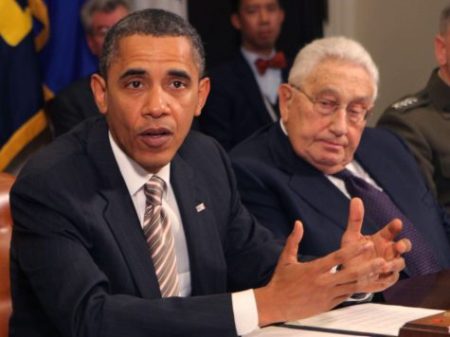
Obama-Kissinger-e1464550543436Pres. Obama seated with Henry Kissinger

{Originally posted to the author’s website, Abu Yehuda}

Old realpolitiker Henry Kissinger was in the news recently when he sat down with Donald Trump, to give him the benefit of his experience. It brought to mind Kissinger’s numerous attempts to get Israel out of the territories it conquered in 1967, before, during and – especially – after the Yom Kippur War.

Kissinger went to Iraq in December of 1975 to try to wean the regime away from the Soviet Union and improve relations with the US. In a discussion with Sa’dun Hammadi, the Iraqi Foreign Minister, Kissinger suggested that American support for Israel was a result of Jewish political and financial power, promised that the US would work to force Israel back to pre-1967 boundaries, and indicated that while the US would not support the elimination of Israel, he believed that its existence was only temporary. Here is an excerpt (the whole thing is worth reading):

I think, when we look at history, that when Israel was created in 1948, I don’t think anyone understood it. It originated in American domestic politics. It was far away and little understood. So it was not an American design to get a bastion of imperialism in the area. It was much less complicated. And I would say that until 1973, the Jewish community had enormous influence. It is only in the last two years, as a result of the policy we are pursuing, that it has changed.

We don’t need Israel for influence in the Arab world. On the contrary, Israel does us more harm than good in the Arab world. You yourself said your objection to us is Israel. Except maybe that we are capitalists. We can’t negotiate about the existence of Israel, but we can reduce its size to historical proportions. I don’t agree that Israel is a permanent threat. How can a nation of three million be a permanent threat? They have a technical advantage now. But it is inconceivable that peoples with wealth and skill and the tradition of the Arabs won’t develop the capacity that is needed. So I think in ten to fifteen years, Israel will be like Lebanon—struggling for existence, with no influence in the Arab world.  [my emphasis] …

Kissinger also promised that aid to Israel, which he presented as a result of Jewish political influence, would be significantly reduced. He indicated that legal changes in the US – he must have been referring to the creation of the Federal Electoral Commission in 1974 to regulate campaign contributions – would attenuate Jewish power and therefore American support for Israel. Naturally, he didn’t foresee the Israel-Egypt peace agreement, which permanently established a high level of military aid to both countries.

He further promised that the US would support a PLO-run Palestinian state if the PLO would accept UNSC resolution 242 and recognize Israel. This of course is what (supposedly) happened in the Oslo accords.

Kissinger insisted that “No one is in favor of Israel’s destruction—I won’t mislead you—nor am I.” But his hint that a smaller Israel might not survive is clear. Surely he understood that a pre-1967-sized Israel (within what Eban called “Auschwitz lines”) would have no chance of surviving, simply because of the strategic geography of the area.

Kissinger was wrong about the Arabs developing the capability to challenge Israel, but their place has been taken by soon-to-be-nuclear Iran and its proxies, who are significantly more dangerous than the Arab states ever were.

US policy, however, has kept more or less the same shape, except that the hypocrisy of insisting that the US supports the existence of Israel but in a pre-1967 size is even more glaring. The substitution of the PLO for the Arab states as the desired recipient of the land to be taken from Israel has barely made a ripple either in America or among the Arabs, suggesting that the policy is more about Israel giving up land than about the Arabs getting it.

The original motivation for Kissinger’s promises was supposedly the desire of the US to replace the Soviet Union as the patron of the Arab states. After the collapse of the USSR and the end of the Cold War in 1991, however, there was no change in policy. Although the Oslo Accords were initiated by left-wing Israelis, the US eagerly embraced them, and the so-called ‘peace process’ became a permanent stick to beat Israel with.

President Obama is especially adept at emphasizing support for Israel’s existence while at the same time demanding that Israel make concessions that would make her continued existence impossible. Apparently agreeing with Kissinger about Jewish power, Obama has worked to reduce the pro-Israel influence of American Jews in numerous ways, such as by providing access to the White House for groups like J Street and the Israel Policy Forum, while marginalizing traditional Zionist organizations like ZOA.

Kissinger’s almost anti-Semitic claim that US support for Israel is bought with Jewish money was probably untrue in 1975 and is even less so today, when a large proportion of American Jews, including wealthy ones, have chosen their liberal or progressive politics over Zionism. The coming struggle over the introduction of a pro-Palestinian plank into the Democratic platform is an indication that the party and with it, many of its Jewish supporters, is moving toward Obama’s position.

The Obama Administration’s program to extricate itself from the Middle East by empowering Iran as the new regional power has given a new impetus to the policy of shrinking Israel. Iran sees Israel as a major obstacle to its hegemony, for both geopolitical and religious/ideological reasons, and is committed to eliminating the Jewish state. Obama found it necessary to restrain Israel from bombing Iran’s nuclear facilities at least once (in 2012), and seems to be prepared to sacrifice Israel in order to achieve his goal of establishing Iranian regional dominance.

Some would go even further and say that Obama’s primary ideological goal is to eliminate Israel and the Iranian gambit is a means to this end, but that is highly speculative! Or maybe it’s a matter of two birds with one stone.

Henry Kissinger didn’t do us any favors, but I think the anti-Israel thread in American policy would have been strong enough without him, running from Truman’s Secretary of State George C. Marshall all the way to Obama’s stable of anti-Zionists like Rob Malley and Ben Rhodes.

Today Israel is long gone from the Sinai, more recently from Gaza, and probably only thanks to the disintegration of Syria, still holding the Golan Heights. I would like to believe that PM Netanyahu was correct when he said that Israel will never leave the Golan. Regarding Judea, Samaria and Jerusalem, I expect that we are about to begin a very difficult time, as the Obama Administration is likely to mount a campaign in its last days to fulfill Kissinger’s promise to the Arabs at long last.

The day after Abbas

May 27, 2016

The day after Abbas, Israel Hayom, David M. Weinberg, May 27, 2016

The day Mahmoud Abbas departs his post as president of the Palestinian Authority, or is deposed from his dictatorial perch, could be a watershed moment. It could and should force a reassessment of conventional thinking about the feasible contours of accommodating Palestinian independence.

That moment may be coming soon. Abbas is old, sick and tired. He has little to show for his persistent efforts to isolate Israel diplomatically and force Israel into hasty withdrawals. His regime is viewed as utterly corrupt by 95.5% of Palestinians (according to a recent Palestinian poll). The tens of billions of dollars in international aid he has swallowed have failed to build any real institutional basis for a good or democratic Palestinian government.

Abbas’ thuggish underlings are jockeying aggressively around him for pole position in the battle to succeed him as West Bank despot. Hamas, too, smells blood.

On the diplomatic front, Abbas’ departure will leave nothing behind but scorched earth. He has fled from real negotiation and compromise with Israel, espoused maximalist positions, stoked hatred toward Israelis and Jews, venerated terrorists and pushed the criminalization of Israel internationally. He basically convinced most Israelis that there is no reasonable peace deal to be had with the Palestinians.

And yet, the Obama administration and much of the global community nonsensically still considers Abbas and his gang to be viable partners for a two-state peace arrangement. What will it take for them to move beyond this rotten reliance on Fatah leadership and the creaky two-state construct?

Nevertheless, most Israelis, including Prime Minister Benjamin Netanyahu, still seek to move toward some clarity of borders, stability, and improved quality of life for Israelis and Palestinians alike.

They seek to do so without embarking on insane Israeli withdrawals that would likely lead to the establishment of a second “Hamastan” in the West Bank, or worse, an Islamic State-type regime.

So it’s time for Israel to re-articulate its thinking about the possibilities of an Israeli-Palestinian modus vivendi. Netanyahu should capitalize on his newly broadened government, and the coming transitions in Palestinian and American politics, to reset the diplomatic table. He can outline the acceptable contours of a conflict amelioration process in which Israel can pragmatically participate.

Doing so is especially urgent since the Obama administration is, in extremis, not-so-subtly readying to move the global goal posts farther away from Israel. This, of course, will only make the likelihood of Palestinian compromise with Israel even more remote.

Here are some guidelines and red lines that the Israeli government may want to adopt:

• Regional solutions: Unconventional alternatives to the struggling two-state paradigm must be on the table, including: a Palestinian-Jordanian federation; shared sovereignty with Israel in the West Bank; a three- or four-way land swap involving Egypt and Jordan; and, possibly, a combination of all these approaches.

The major Western powers must be willing to drive serious exploration of such alternatives. Arab states too can take responsibility for solving the Israeli-Palestinian conflict and consider investment of tangible resources in “regional” solutions.

• Baseline: Israel’s position at the outset of talks should be that 100% of the West Bank belongs to Israel, by historical right, and that this right is richly buttressed by political experience, legitimate settlement and security necessity. Only then can Israel hope to obtain a sensible compromise.

Talks should not begin from a 68-year-old armistice line forced upon Israel by Arab aggression; nor “from the point that talks last left off” eight years ago under a previous, defeatist Israeli government; nor from the defensive security fence line forced upon Israel by Palestinian terrorism; nor from any borders high-handedly dictated in advance by U.S. President Barack Obama or the international community.

• Security: The radical Islamic winter buffeting this region, and its inroads into the Palestinian national movement, means that the security envelope encompassing Israeli and Palestinian areas must be militarily controlled by the IDF, fully and indefinitely. This includes the Jordan Valley and the mountain ridges on both sides of Judea and Samaria.

• The Temple Mount: One way in which to wring Palestinian recognition of the Jewish people’s ancient ties to this holy land is to insist on Jewish prayer on the Temple Mount. This can be modestly facilitated either through a time-sharing arrangement (similar to that in place at the Tomb of the Patriarchs in Hebron), or through a small synagogue tucked away on the fringes of the vast Temple Mount plaza (which won’t overshadow the two large Muslim structures on the Mount).

Palestinian denial of Jewish religious, historical and national rights in Israel is the essence of the conflict. It is time to tackle this head-on, cautiously but candidly, at the core — in Jerusalem.

In conclusion, Netanyahu should leverage this turning point to reframe the parameters of how Israel can live astride the very problematic Palestinian national movement.

Lebanese ‘Al-Safir’ Daily Marks 16th Anniversary Of Israel’s Withdrawal From South Lebanon: Hizbullah Is Digging Tunnels On Israel Border

May 26, 2016

Lebanese ‘Al-Safir’ Daily Marks 16th Anniversary Of Israel’s Withdrawal From South Lebanon: Hizbullah Is Digging Tunnels On Israel Border, MEMRI, May 25, 2915

On May 25, 2016, the Lebanese daily Al-Safir, which is known for its support for Hizbullah, published a front- page article celebrating “Liberation Day,” i.e. the 16th anniversary of Israel’s withdrawal from South Lebanon. The article, which appears without a byline, analyzes the current situation of Hizbullah (which it calls “the resistance”) as well as its combative actions on the Syrian and Israeli fronts. It claims that this year’s Liberation Day celebrations are mixed with heartbreak for Hizbullah supporters, due to the large number of Hizbullah casualties in the Syria war. It adds that in its fight in Syria, Hizbullah currently faces the toughest challenge since its establishment, greater even than its conflict against Israel, because the price thus far paid by Hizbullah in this war – both in capabilities and casualties – is unprecedented, and no solution in Syria is on the horizon.

The article assesses that Hizbullah may expand its theater of operations even further in the future, in response to new challenges, and that this will turn it into a “regional power” that “formulates new equations in the region.”

Adding that alongside its fighting in Syria, Hizbullah is continuing its activity against Israel, the article also reports that resistance fighters work day and night along the Israeli border, “conducting observations, preparing, and digging tunnels that cause the settlers and enemy soldiers to lose sleep.” It also states that in fighting “tafkiri organizations,” Hizbullah has encountered an enemy that excavates tunnels, after becoming accustomed to being the only one digging them; in fact, it was Hizbullah that taught other resistance fighters, particularly Palestinians in the Gaza Strip, the tunnel doctrine.[1]

The following are excerpts from the article:[2]

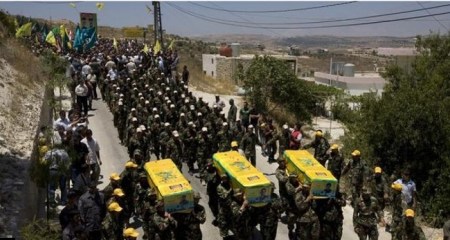
28169Funeral of Hizbullah fighters killed in Syria (image: Safa.ps)

“[Since its founding], the resistance [i.e. Hizbullah] never found itself deployed on several fronts and facing more than one challenge and more than one danger at once [as is happening today]. These four years since it became involved in the war in Syria represent the greatest trial it has [ever] faced… The movement has never paid in flesh, blood and abilities as it has paid [during the Syria war] and as it may continue to pay in the future, in the open confrontation with the takfiri [groups, i.e. the groups fighting against the Assad regime in Syria].[3] [So far] over 1,000 [fighters] have died and thousands have been wounded and disabled, and many others may meet [the same fate] in the ever-expanding confrontation that is becoming more difficult and more aggressive every day. This, especially since the horizon of a political solution seems to have been eliminated for the foreseeable future.

“Amid all this comes the 16th [anniversary] of the liberation [of South Lebanon], which underscores an element that Israel cannot ignore, namely the strengthening of the security and stability equation on both sides of the Palestine-Lebanon border. [This is] thanks to the deterrence system, or more accurately the balance of terror, which is an equation that has turned South Lebanon into the most secure region in the entire Middle East. Though we must not ignore other factors, no less important, [that contribute to this security], including [UN] Resolution 1701, UNIFIL and the Lebanese army.

“The celebrations of liberty are held amid heartbreak mixed with joy. Heartbreak [at the sight of] the processions of martyrs crossing the boundary south of the Litani every day [i.e. bodies of Hizbullah fighters killed in Syria being returned to Lebanon for burial], and joy [at the sight of] the processions [of people] rejoicing over [Hizbullah’s victory in some of] the local elections [that have been held in Lebanon in recent weeks]…

“The heartbreak over the martyrs is a necessary tax [that must be paid] in the struggle, [a struggle] which the Lebanese, of all sectors, regard as existential, even though they are divided on whether the preemptive war against the terrorists outside the borders of the homeland is justified. This heartbreak is present in every home in South [Lebanon]… When Hizbullah secretary-general Hassan Nasrallah speaks at Liberation Day ceremonies [today] in the town of Al-Nabi Shayth in the Bekaa [Valley], he will be speaking to a public that has contributed to the resistance [by supporting Hizbullah’s activity in Syria] just as residents of the South have contributed [in fighting against Israel], and perhaps even more, since [Bekaa Valley residents] face a danger today on their eastern border that is just as bad as the Israeli danger.

“It is right to say that the men of resistance on the eastern border complement the mission of the first men of resistance [who operate against Israel], who work day and night [along the border, from] the last border point in Al-Naquora to [the one in] Kfar Shouba, conducting observations, preparing, and digging tunnels that cause the settlers and enemy soldiers to lose sleep. [All this they do] without abandoning the [other] tasks of the resistance, which stands ready, openly and secretly, throughout Lebanon, and especially in the Southern Dahiya, in order to prevent any terrorist attack by the takfiris, in full coordination with the Lebanese army and Lebanon’s other security apparatuses. There might be further expansion of Hizbullah’s battle front, in accordance with future challenges, and this expansion turns this Lebanese group [Hizbullah], which was established 34 years ago in Sheikh ‘Abdallah’s base in Baalbek, into a regional force that formulates new equations in the region…

“In all of its rounds of fighting with the Israeli enemy, the resistance never faced what it has been facing for years in confronting the dark [elements] armed with the Prophet Muhammad’s Koran and Sunnah, who receive funding from tyrannical regimes and innumerable intelligence apparatuses, and are armed with military [equipment] that only armies possess.”

“The resistance also never experienced a four-year war in an area several times larger than Lebanon [itself]. It never experienced [war] against groups that imitate its methods and ways of warfare, but [who] instead of blowing themselves up against an Israeli convoy terrorize innocent people in the cities and villages, without batting an eyelash, as happened in the southern Dahiya or yesterday in Tartus and Jableh.

“The resistance never experienced war against groups fighting in caves and in the hills, mountains, wadis and even deserts, as happened at Tadmor and in the rural areas of Homs and Aleppo… Before [the war with Syria], the resistance did not storm cities and did not fight armies deep in the mountains.  Before this, no one lay in wait for it in tunnels like the ones that only it used to excavate, and [the doctrine of which] it spread to the rest of the men of the resistance, particularly to the Palestinians in the Gaza Strip.

“All these have been the unique characteristics of the resistance throughout the 16 years since May 25, 2000. All these [characteristics] and others will cause Hassan Nasrallah to declare that defending the achievement of liberation will end only with the defeat of the terrorists…”

Endnotes:

[1] Regarding the issue of the tunnels, it should be noted that Ibrahim Al-Amin, chairman of the board of the Lebanese dailyAl-Akhbar, wrote in a January 13, 2014 article that Hamas members fighting in Syria, in the Al-Quseir area and other regions, had dug tunnels there, similar to the ones excavated by Hamas in Gaza. He explained that Hizbullah had taught Hamas to dig these tunnels in the days when the two organizations were cooperating in smuggling arms into Gaza and preparing military plans against Israel.

[2] Al-Safir (Lebanon), May 25, 2016.

[3] Hizbullah, like the Syrian regime, does not draw a distinction between the rebels and the Salafi-jihadi groups.

The Arabs’ Real Grievance against the Jews

May 7, 2016

The Arabs’ Real Grievance against the Jews, Gatestone InstituteFred Maroun, May 7, 2016

♦ The Arab world still does not today accept the concept of a Jewish state of any size or any shape. Even Egypt and Jordan, who signed peace agreements with Israel, do not accept that Israel is a Jewish state, and they continue to promote anti-Semitic hatred against Israel.

♦ During Israel’s War of Independence, Jews e cleansed from Gaza, the West Bank, and East Jerusalem, and in the years that followed, they were ethnically cleansed from the rest of the Arab world.

♦ Jews demand the right to exist, and to exist as equals, on the land where they have existed and belonged continuously for more than three thousand years.

♦ We would rather claim that the conflict is about “occupation” and “settlements.” The Jews see what radical Islamists are now doing to Christians and other minorities, who were also in the Middle East for thousands of years before the Muslim Prophet Mohammed was even born.

♦ The real Arab grievance against the Jews is that they exist.

As Arabs, we are very adept at demanding that our human rights be respected, at least when we live in liberal democracies such as in North America, Europe, and Israel. But what about when it comes to our respecting the human rights of others, particularly Jews?

When we examine our attitude towards Jews, both historically and at present, we realize that it is centered on denying Jews the most fundamental human right, the right without which no other human right is relevant: the right to exist.

The right to exist in the Middle East before 1948

Anti-Zionists often repeat the claim that before modern Israel, Jews were able to live in peace in the Middle East, and that it is the establishment of the State of Israel that created Arab hostility towards Jews. That is a lie.

Before modern Israel, as the historian Martin Gilbert wrote, “Jews held the inferior status of dhimmi, which, despite giving them protection to worship according to their own faith, subjected them to many vexatious and humiliating restrictions in their daily lives.” As another historian, G.E. von Grunebaum, wrote, Jews in the Middle East faced “a lengthy list of persecutions, arbitrary confiscations, attempted forced conversions, or pogroms.”

The right to exist as an independent state

Zionism stemmed from the need for Jews to be masters of their own fate; no longer to be the victims of discrimination or massacres simply for being Jews. This project was accepted and formally recognized by the British, who had been granted a mandate over Palestine by the League of Nations. The Arab world, however, never accepted the recognition formulated by Britain in the Balfour Declaration of 1917, and it never accepted the partition plan approved by the United Nations in 1947, which recognized the right of the Jews to their own state.

The Arab refusal to accept the Jewish state’s right to exist, a right that carries more international legal weight than almost any other country’s right to exist, resulted in several wars, starting with the war of independence in 1948-1949. The Arab world still does not today accept the concept of a Jewish state of any size or any shape. Even Egypt and Jordan, which signed peace agreements with Israel, do not accept that Israel is a Jewish state, and they continue to promote anti-Semitic hatred against Israel.

The right to exist in Gaza, the West Bank, and East Jerusalem

In 2005, Israel evacuated all its troops and all Jewish inhabitants from Gaza, in the hope that this would bring peace at least on that front, and to allow the Gaza Strip, vacated by Jews, to be a flourishing Arab Riviera, or a second Singapore, and perhaps to serve as a model for the West Bank. The experiment failed miserably. This is a case where Jews willingly gave up their right to exist on a piece of land, but sadly the Palestinians of Gaza took it not as opportunity for peace, but as a sign that if you keep on shooting at Jews, they leave — so let’s keep on shooting.

There are many opinions among Zionists as to what to do about the West Bank. These opinions range from a total unilateral withdrawal as in Gaza, to a full annexation, with many options in between. At the moment, the status quo prevails, with no specific plans for the future.

Everyone, however, despite the treacherous UNESCO’s rewriting of history, knows that before that piece of land was called the West Bank, it was called Judea and Samaria for more than two thousand years.

Everyone knows that Hebron contains the traditional burial site of the biblical Patriarchs and Matriarchs, within the Cave of the Patriarchs, and it is considered the second-holiest site in Judaism. Every reasonable person knows that Jews should unquestionably have the right to exist on that land, even if it is under Arab or Muslim jurisdiction. Yet everyone also knows that no Arab regime is capable or even willing to protect the safety of Jews living under its jurisdiction from the anti-Semitic hatred that emanates from the Arab world.

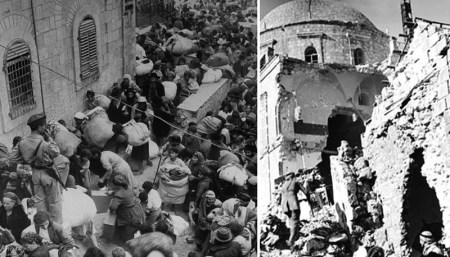
East Jerusalem, which was carved away by the Kingdom of Jordan from the rest of Jerusalem during the war of independence, is part of Jerusalem, and contains the Temple Mount, the Jews’ holiest site. The Old City in East Jerusalem was inhabited by Jews up until they were ethnically cleansed by Jordan in the war of 1948-1949.

1588In May 1948, the Jordanian Arab Legion expelled all of the approximately 2000 Jews who lived in the Old City of Jerusalem, and then turned the Jewish Quarter into rubble.

Although Israel has twice in the past, first under Prime Minister Ehud Barak then under Prime Minister Ehud Olmert, offered East Jerusalem as part of a Palestinian state, that offer is not likely to be made again. Jews know that it would mean a new wave of ethnic cleansing, which would deny the Jewish right to exist on the piece of land where that right is more important than anywhere else.

The right to exist in the Middle East now

During Israel’s War of Independence, Jews were ethnically cleansed from Gaza, the West Bank, and East Jerusalem, and in the years that followed, they were ethnically cleansed from the rest of the Arab world.

Today, Israel’s enemies, many of them Arab, are challenging its right to exist, and therefore the right of Jews to exist, on two fronts: threats of nuclear annihilation and annihilation through demographic suffocation.

Iran’s Islamist regime has repeated several times its intention to destroy Israel using nuclear weapons. Just in case Iran is not “successful,” the so-called “pro-Palestinian” movement, including the Boycott, Divestment and Sanctions (BDS) movement, has a different plan to destroy the Jewish state: a single state with the “return” of all the descendants of Palestinian refugees. The refusal of Palestinian President Mahmoud Abbas and his predecessor Yasser Arafat to accept any two-state solution presented to them is part of that plan.

The right to exist elsewhere

Anti-Zionists claim that Jews are imperialists in the Middle East, as were the British and the French, and like them, they should leave and go back to where they belong. This analogy is of course not true: Jews have an even longer history in the Middle East than do Muslims or Arabs.

Do Jews belong in Europe, which tried only a few decades ago to kill every Jew, man, woman, or child? Do Jews belong in North America where until a few hundred years ago, there were no Europeans, only Indians?

Saying that Jews “belong” in such places is not reality; it is just a convenient claim for anti-Zionists to make.

The Jews will not give up

As Arabs, we complain because Palestinians feel humiliated going through Israeli checkpoints. We complain because Israel is building in the West Bank without Palestinian permission, and we complain because Israel dares to defend itself against Palestinian terrorists. But how many of us have stopped to consider how this situation came to be? How many of us have the courage to admit that waging war after war against the Jews in order to deny them the right to exist, and refusing every reasonable solution to the conflict, has led to the current situation?

Our message to Jews, throughout history and particularly when they had the temerity to want to govern themselves, has been clear: we cannot tolerate your very existence.

Yet the Jews demand the right to exist and to exist as equals on the land where they have existed and belonged continuously for more than three thousand years.

In addition, denying a people the right to exist is a crime of unimaginable proportions. We Arabs pretend that our lack of respect for the right of Jews to exist is not the cause of the conflict between the Jews and us. We would rather claim that the conflict is about “occupation” and “settlements”. They see what radical Islamists are now doing to Christians and other minorities, who were also in the Middle East for thousands of years before the Muslim Prophet Mohammed was even born: Yazidis, Kurds, Christians, Copts, Assyrians, Arameans, and many others. Where are these indigenous people of Iraq, Syria and Egypt now? Are they living freely or are they being persecuted, run out of their own historical land, slaughtered by Islamists? Jews know that this is what would have happened to them if they did not have their own state.

The real Arab grievance against the Jews is that they exist. We want the Jews either to disappear or be subservient to our whims, but the Jews refuse to bend to our bigotry, and they refuse to be swayed by our threats and our slander.

Who in his right mind can blame them?