Archive for the ‘Islamism’ category

Cartoonists are Controversial and Murderers are Moderate

May 5, 2015

Cartoonists are Controversial and Murderers are Moderate, Front Page Magazine, Daniel Greenfield, May 5, 2015

garland1-450x330

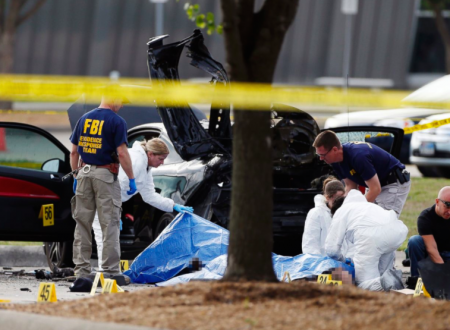
[I]f you believe the media, cartoonists are more controversial than killers. A former Muslim sketching a cartoon of Mohammed is bigoted, but justifying attacks on Jews is moderate. Plotting to overthrow the United States and replace it with an Islamic theocracy is right up the alley of your local civil rights group, but a cartoon contest threatens the nation and all of creation by bringing down the wrath of men who spent their time at moderate and Muslim organizations which only occasionally support terrorism.

****************

Controversial, intolerant and provocative. Mainstream media outlets broke out these three words to describe the “Draw the Prophet” contest, the American Freedom Defense Initiative and Pamela Geller.

While the police were still checking cars for explosives and attendees waited to be released, CNN called AFDI, rather than the terrorists who attacked a cartoon contest, “intolerant.” Time dubbed the group “controversial.” The Washington Post called the contest, “provocative.”

Many media outlets relied on the expert opinion of the Southern Poverty Law Center, a multi-million dollar mail order scam disguised as a civil rights group, which had listed AFDI as a hate group. Also listed as hate groups were a number of single author blogs, including mine, a brand of gun oil and a bar sign.

The bar sign, which hangs outside a bar seven miles outside Pittsburgh, appears to be made out of metal and plastic. It is reportedly unaware that it is a hate group and has made no plans to take over America.

The SPLC’s inability to conduct even the most elementary fact checking did not stop news networks from inviting its talking head on to suggest that AFDI got “the response that they — in a sense — they are seeking.” Neither CNN nor MSNBC were impolitic enough to mention that no AFDI supporter had used its materials to plan a killing spree, while at least one of SPLC’s supporters had done just that.

But being “controversial” and “provocative” has nothing to do with who is doing the shooting. It’s a media signal that the target shouldn’t be sympathized with. The Family Research Council, which was shot up by a killer using the SPLC’s hate map, is invariably dubbed “intolerant.” The SPLC, which targeted it, is however a “respected civil rights group” which provides maps to respected civil rights gunmen.

A contest in which Bosch Fawstin, an ex-Muslim, drew a cartoon of a genocidal warlord is “controversial” and “provocative,” while the MSA, which has invited Sheikh Khalid Yasin, who has inspired a number of terrorists, including apparently one of the Mohammed contest attackers, is a legitimate organization that is only criticized by controversial, intolerant and provocative Islamophobes.

Khalid Yasin has held such controversial and provocative views as claiming that the US created AIDS, that gays should be stoned to death and that women should be beaten. But the mosques and MSAs that he has appeared at have not been described as controversial, intolerant and provocative for inviting him.

Elton Simpson, the first gunman, attended the Islamic Community Center of Phoenix. The mosque was listed as being controlled by the Muslim Brotherhood’s North American Islamic Trust front group.

The Muslim Brotherhood holds such controversial and provocative views as “waging Jihad” against American infidels, “raising a Jihadi generation that pursues death” and “destroying the Western civilization from within.” Despite these extremely provocative and intolerant views, the Muslim Brotherhood is usually described by the media as a “moderate” group.

The Brotherhood’s American arm believes in launching a “Grand Jihad” to Islamize America. Its final phase calls for “Seizing power to establish their Islamic Nation” in the United State.

Some might say this is a slightly more controversial activity than drawing cartoons of a dead warlord.

The Islamic Community Center of Phoenix featured an appearance by Lauren Booth, a convert to Islam employed by Iran, who has been photographed with the leader of Hamas, and holds such controversial and provocative views, as the Boston Marathon bombing being faked and attacks on Jews being justified as “a frustrated backlash.

Some might say Booth’s views are controversial, provocative and intolerant. And that the gunman’s mosque was intolerant for inviting her. But don’t expect the media to call out terrorist intolerance.

Booth came as part of a fundraising effort for the Muslim Legal Fund of America, which funded the defense for Islamic Jihad boss Sami al-Arian and aided some of the terrorists involved in the provocative and controversial Fort Dix terror plot to “kill as many soldiers as possible.”

If the two Mohammed cartoon gunmen had survived, the Muslim Legal Fund of America might be having Lauren Booth spout Jewish conspiracies to fundraise on their behalf.

But if you believe the media, cartoonists are more controversial than killers. A former Muslim sketching a cartoon of Mohammed is bigoted, but justifying attacks on Jews is moderate. Plotting to overthrow the United States and replace it with an Islamic theocracy is right up the alley of your local civil rights group, but a cartoon contest threatens the nation and all of creation by bringing down the wrath of men who spent their time at moderate and Muslim organizations which only occasionally support terrorism.

Cartoons can be provocative, but the only people inspired to kill over them, are killers. No one took a shot at Gary “Punching Up” Trudeau, despite decades of mocking conservatives. None of the assorted arts projects that involve defiling and mocking the sacred symbols of Christianity and Judaism resulted in gunmen in body armor trying to storm a cartoon competition. And yet it keeps happening with Islam.

Satire exposes sociopaths and sociopathic ideologies. And it’s the very attack on the “controversial” and “provocative” contest that shows why exposing them is so important.

Elton Simpson had already been on the radar of the FBI. He should have been in jail, but Judge Mary H. Murguia, a Clinton appointee who has been bandied about as a possible Obama Supreme Court nominee, chose to believe a claim by his public defender that when he was taped talking about Jihad, it might have meant “an internal struggle to maintain faith,” instead of killing non-Muslims.

Simpson had said that Allah loves those who fight non-Muslims, that Jihadists go to paradise and stated, “I’m tellin’ you man. We gonna make it to the battlefield… it’s time to roll.”

But that was just too ambiguous for Judge Murguia, who wrote, “It is true that the Defendant had expressed sympathy and admiration for individuals who “fight” non-Muslims as well as his belief in the establishment of Shariah law, all over the world including in Somalia. What precisely was meant by “fighting” whenever he discussed it, however, was not clear.”

“Neither was what the Defendant meant when he stated he wanted to get to the ‘battlefield’ in Somalia,” she added.

If nothing else, events like these help clarify the question of just what “fighting” non-Muslims involves, and whether it’s an internal struggle to maintain faith or an external struggle waged with assault rifles.

Satire helps expose the idiocy and absurdity of our betters, whether it’s Gary Trudeau or Judge Murguia. Every act of Islamic terror discredits them and their dishonest worldview even further. And they know it.

We cannot fight Islamic terrorism until we deal with it and we cannot deal with it as long as we are burdened by a political establishment that frantically censors any mention of its existence or its agenda.

The two gunmen did not attack the cartoon event simply because they were offended, but because they believed that their religion gave them a mandate to impose Islamic law on Americans. Until we deal with this supremacist reality, any effort to fight Islamic terrorists will be futile and will ultimately fail.

The Mohammed cartoons are so vital because they expose the theocracy at the heart of Islamic terrorism. When Muslim terrorists attack cartoonists, they’re not fighting our foreign policy; they are killing and dying to impose the foreign policy of the Muslim Brotherhood and its numerous daughter groups, such as Al Qaeda, Hamas and ISIS, on us.

The controversial and provocative cartoonists go into battle with pencils in their hands. The terrorists come with body armor and assault rifles. This clash is what real political dissent looks like.

The cartoonists believe in the controversial, intolerant and provocative idea that America should not be a theocracy. But the only people who should be provoked by that provocative idea are the Jihadists who want to impose a theocracy on America and the useful idiots lying and denying on their behalf.

The Erosion of Free Speech

May 3, 2015

The Erosion of Free Speech, Gatestone InstituteDenis MacEoin, May 3, 2015

(Free speech includes the right to offend the easily offended, even if they are sub-human savages.

— DM)

  • “If PEN as a free speech organization can’t defend and celebrate people who have been murdered for drawing pictures, then frankly the organization is not worth the name.” — Salman Rushdie, former President of PEN.
  • Today, a genuine fear of retribution for a “blasphemous” statement has subdued the will to stand up for one’s own beliefs, values and the right to speak out. This fear has made most of the West submissive, just as Islam — in both its name [Islam means “submission”] and declarations — openly wants.
  • This time, the condemnation had not come in a fatwa from Iran’s Supreme leader, but from a Western academic. If we do not reverse this trend, censorship, blasphemy laws, and all the other encumbrances of totalitarians, will return to our lives. The bullies will win.
  • If Geert Wilders and others are being accused of hate speech, then why isn’t the Koran — with its calls for smiting necks and killing infidels — also being accused of hate speech?
  • The mere criticism of a religious belief shared by many people mainly in the Third World has been linked, with no justification, to their genuine prejudice against the inhabitants of the developed world.

Anyone who has had much to do with publishing, or anyone who cares about books and free speech, will be familiar with the American Library Association’s Office for Intellectual Freedom, an enduring champion of the First Amendment and the public’s right to read whatever they please — without the interference and censorship of self-appointed guardians of inoffensiveness and sexual purity.

Every year, the ALA mounts Banned Books Week, a nationwide celebration of our freedom to read. And every year it issues an unnerving list of Frequently Challenged Books. Unnerving because of the pettiness and obsession betrayed by the people who try to have books banned in local libraries, school boards, and even bookshops. For years, most of the attempts to ban books have come from fundamentalist Christian groups; the reasons have mainly been sex, offensive language, or “controversial issues,” whatever they are. God forbid that anyone in the United States be exposed to “controversial issues.”

This year a new note has entered Banned Books Week. Elizabeth McKinstry, a graduate student at Georgia’s Valdosta State University (which earlier in April witnessed students trampling on the American flag) launched a petition about ALA’s anti-censorship poster, calling it “Islamophobic.” There is nothing on the poster, however, that relates in the slightest way to Islam. The poster shows the top of a woman’s head, then her clothed chest and arms. She is not wearing Islamic dress on her head, and her arms and hands are bare. In front of her face, she holds what looks like a book bearing the text “Readstricted.” Her eyes can be seen looking through the cover where it bears the universal symbol for “Restricted” (a red circle with a white bar). That is all.

In her petition, McKinstry writes, “This poster uses undeniably Islamophobic imagery of a woman in a niqab, appears to equate Islam with censorship, and muslim (sic) women as victims.” She goes on to demand that the poster be “removed immediately from the ALA Graphics store, and the ALA Graphics Store and Office of Intellectual Freedom should apologize and explain how they will prevent using discriminatory imagery in the future.” To make matters worse, she goes on to write: “Whether the poster was intentionally or accidentally a racist design, it is still racist and alienating.”

Not only is this possibly an example of political correctness in overdrive, but the greater irony lies in that McKinstry is studying for an MA in library and information science; works as a library associate, and is a member of the ALA. Here we see a distortion of thinking that is grotesque: a person claiming to be “progressive,” trying to ban an anti-censorship poster in an organization that works to end censorship.

* * *

PEN International is known worldwide as an association of writers. Together they work tirelessly for the freedom of authors from imprisonment, torture, or other restrictions on their freedom to write honestly and controversially. This year, PEN’s American Center plans to present its annual Freedom of Expression Award during its May 5 gala to the French satirical magazine Charlie Hebdo. The award will be handed to Gerard Biart, the publication’s editor-in-chief, and to Jean-Baptiste Thorat, a staff member who arrived late on the day when Muslim radicals slaughtered twelve of his colleagues. This is the sort of thing PEN does well: upholding everyone’s right to speak out even when offence is taken.

This year, however, six PEN members, almost predictably, have already condemned the decision to give the award to Charlie Hebdo, and have refused to attend the gala. Peter Carey, Michael Ondaatje, Francine Prose, Teju Cole, Rachel Kushner and Taiye Selasi have exercised their right to double standards by blaming Charlie Hebdo for its offensiveness. Kushner expressed her discomfort with the magazine’s “cultural intolerance.” Does that mean that PEN should never have supported Salman Rushdie for having offended millions of Muslims just to express his feelings about Islam?

Peter Carey expressed his support, not for the satirists, but for the Muslim minority in France, speaking of “PEN’s seeming blindness to the cultural arrogance of the French nation, which does not recognize its moral obligation to a large and disempowered segment of their population.” We never heard him speaking out when Ilan Halimi was tortured to death for weeks, or when Jews in Toulouse were shot. He seems to be saying that the French government should shut up any writer or artist who offends the extreme sensitivities of a small percent of its population.

Teju Cole remarked, in the wake of the killings, that Charlie Hebdo claimed to offend all parties but had recently “gone specifically for racist and Islamophobic provocations.” But Islam is not a race, and the magazine has never been racist, so why charge that in response to the sort of free speech PEN has always worked hard to advance?

A sensible and nuanced rebuttal of these charges came from Salman Rushdie himself, a former president of PEN: “If PEN as a free speech organization can’t defend and celebrate people who have been murdered for drawing pictures, then frankly the organization is not worth the name. What I would say to both Peter and Michael and the others is, I hope nobody ever comes after them.”

Those six have now morphed into something like 145. By April 30, Carey and they were joined by another 139 members who signed a protest petition. Writers, some distinguished, some obscure, have taken up their pens to defy the principle of free speech in an organization dedicated to free speech, and many of whom live in a land that protects it precisely for their benefit with a First Amendment.

Another irony, at least as distasteful as the one just described, took place on April 22, when Northern Ireland’s leading academic institution, Queen’s University in Belfast, cancelled a conference planned for June. The conference, organized by the university’s Institute for Collaborative Research in the Humanities, was about free speech after the Charlie Hebdo attack in Paris. You could not make this up. The reason given was that the institute had not prepared a proper risk assessment. Risk? Risk to what? To free speech? What a silly thought! No, it turned out to be risk of an Islamist attack in Belfast, a city long weary from terrorism.

The following day, the University of Maryland, many miles to the west, banned a showing of the film American Sniper after complaints from Muslim students. Whether the film was good or bad, free speech was snuffed.[1]

The oddity is that today, newspaper headlines, news websites, radio and television news bulletins are packed every day with stories about the chaos in the Middle East, the threat of Iranian access to nuclear weapons, the march of ISIS, Jabhat al-Nusra, Hezbollah, Hamas, the Taliban, al-Shabaab, and dozens of other terrorist groups across the region. This year’s Charlie Hebdo and kosher supermarket slayings, the rise of anti-Semitism across Europe (closely linked to Islamism), demonstrations filling the streets with chants such as “Hamas, Hamas Jews to the Gas,” and all the other atrocities and social disjunctions that arise from the revival of fundamentalist Islam.

America and Britain have fought, with allies, wars in Iraq and Afghanistan, and as of this writing, the United States is carrying out air strikes against ISIS in Syria.

Such news stories are not occasional, they are everyday. Stories of this kind are seldom crowded out by anything but the most important news items, such as a major airline crash or significant domestic political events. Such stories are even more visible than Cold War geopolitical new ever was, due to the immense proliferation of news outlets since the 1990s. The citizens of the U.S., Europe, Canada, Australia and (above all) Israel do not face a remote threat from a distant country, but daily threats of being blown up in their own streets almost every day. The British security services announce almost daily the likelihood of a terrorist event.

But where are the novels? Where are the Le Carrés and Ludlums, the Flemings and Clancys? The number of novels dealing with Islamist, terrorist, or state-sponsored threats to the world’s stability (and hence to our own stability and safety) are so few in number, I cannot remember even one. Back to the comfort zone.[2]

This bears thinking about. Is it just a matter of fashion, or are there deeper reasons for this apparent neglect of the most important political and military issues of the present day? Is the literary issue a canary in a coal mine of much greater extent?

The answer is yes. Western culture, once built in part on the principle of free speech — a principle enshrined in the U.S. Constitution’s First Amendment and promoted in all liberal democracies — has been weakened by attacks on the right of everyone to right to speak openly about politics, religion, sexuality, and a host of other things.

The first blow to free speech came in 1989 with demonstrations and riots over British author Salman Rushdie’s controversial 1988 novel, The Satanic Verses; and fears grew when Iran’s Supreme Leader, Ayatollah Ruhollah Khomeini, issued a fatwa calling on Muslims to kill Rushdie.

Many people died in riots or were murdered because of association with the book. Bookshops were firebombed in the U.S. and UK; publishers were attacked; booksellers often refused to stock the novel; editors wrote to authors like myself, asking us to decide whether some forthcoming publications dealing with Islam could be safely published, and free speech was under attack.

The most harmful blow, however, came when some Western so-called intellectuals and religious leaders condemned Rushdie and supported a ban on his novel. Immanuel Jakobovits, Chief Rabbi of the United Hebrew Congregations of the Commonwealth, opposed the book’s publication.[3] The Archbishop of Canterbury called for a law of blasphemy that would cover other religions than just Christianity, opening up the spectre that religions, even violent ones such as Islam, could be privileged above other societal actors in a democracy.[4] Sadly, this pattern of betrayal by Western thinkers has been repeated ever since.

What impact has this had? Here is a simple example: Early in 2012, a controversy stormed up in church circles in the United States. Three well-known Christian publishers, Wycliffe Bible Translators, the Summer Institute of Linguistics (SIL) and Frontiers were accused of having pandered to Muslims in their new Arabic and Turkish translations of the New Testament. The translators had replaced terms such as Father (for God) and Son to conform to the Koranic doctrine that God did not have a son and was not a father of anyone. In the Frontiers and SIL translation into Turkish, “guardian” replaces “Father” and “representative” or “proxy” is used for “Son.” Such considerations did not deter earlier Bible translators into Islamic language from an honest statement of a fundamental Christian doctrine. But today, a genuine fear of retribution for a “blasphemous” statement has subdued the will to stand up for one’s own beliefs, values and the right to speak out. This fear has made much of the West submissive, just as Islam — in both its name [Islam means “submission”] and declarations — openly wants.

Since then, the attacks from Islamists on this most basic of Western principles — the central plank in the platform of true democracy and the feature that most distinguishes it from totalitarianism of all forms — have multiplied, culminating in the slaughter carried out by Muslims extremists at the offices of Charlie Hebdo in Paris on January 7, 2015.

Beneath the sporadic physical assaults lies a deeper layer of coercion: the fear lest anyone commit that apparently most unforgiveable crime of all, “Islamophobia!” It now seems that almost anything non-Muslims do may result in such accusations — a bigotry that has also become conflated with racism. The mere criticism of a religious belief shared by people mainly in the Third World has been linked, with no justification, to their genuine prejudice against the inhabitants of the developed world. But since it is Muslims who have been allowed to define “Islamophobia,” often at whim, even the mildest remarks can lead to serious accusations, lawsuits, and criminal attacks.[5]

In the case of Sherry Jones’s novel The Jewel of Medina, historically “revised” to be sympathetic to Islam, Random House in 1988 cancelled the novel’s publication. Its spokesperson stated that the publishing house had been given “cautionary advice not only that the publication of this book might be offensive to some in the Muslim community, but also that it could incite acts of violence by a small, radical segment.”[6]

This time, the condemnation had not come in a fatwa from Iran’s Supreme Leader, but from a Western academic, whose identity is not known to me. On September 28, 2008, British extremist Ali Beheshti and two accomplices set fire to the house of the owner of the UK publishing company that had bought The Jewel of Medina. Fortunately, nobody was killed. But the vise of subjugation to Islamic dictats was tightening round the neck of the free world.

* * *

Rushdie knew he was being controversial; for those who protested, the attacks on him, however reprehensible, had a bizarre justification. Condemnation from Western academics, journalists, interfaith clerics, and politicians shows not how successful intimidation has become, but how timid and craven we have become. To surrender with such spinelessness can only mean that we have entered the first stages of the decline of the Enlightenment values that made the modern West the greatest upholder of human rights and freedoms in history.

Criticism of Islam and everything else will — and should — continue, produced by courageous writers and journalists. Certainly, we know how many times politicians in the United States and Europe have delusionally tried to persuade us that Islamist violence “has nothing to do with Islam.”

There have been many attacks and murders already. Perhaps the best known of these — until theCharlie Hebdo murders — was the murder of Dutch film-maker, Theo van Gogh, on November 2, 2004. Van Gogh had directed a short film called Submission, written by Muslim dissident Ayaan Hirsi Ali, who had worked extensively in women’s shelters in the Netherlands, where she had observed that most of the women were Muslim. Van Gogh’s killer, a 26-year-old Dutch-Moroccan named Mohammed Bouyeri, now serving a life sentence, has described democracy as utterly abhorrent to Islam. (This view, for anyone who cares about the continuation of the West, is held by many Muslims. For them, democracy, made by man, is illegitimate, compared to shari’a law, made by Allah, and therefore the only form of government that is legitimate.) In court, Bouyeri said that ‘the law [shari’a law] compels me to chop off the head of anyone who insults Allah and the prophet.”

The threat of murder has become ever more real. It is no longer possible to dismiss death threats from Muslims as the work of “lone wolves,” “deviant personalities,” or attention seekers. It is the use of death threats that has given radical Muslims the power to deter most writers, film-makers, TV producers, and politicians from tackling Islamic issues. The threat of calling people “racist” as a tool for suppressing critical voices has cast a dark shadow over normal democratic life. Some have died for free speech about Islam; others have faced ostracism, imprisonment, flogging and the loss of a normal life. [7]

Salman Rushdie lives under constant guard. Molly Norris, an American artist who drew a cartoon of Mohammed and proposed an “Everybody Draw Mohammed Day,” has lived in hiding since 2010. On advice from the FBI, she changed her identity and cut off all links with family and friends. The Dutch politician Geert Wilders has been tried for “hate speech,” barely acquitted, and is now being tried for “hate speech” again.

These are just a few of the casualties who have paid a heavy price for their willingness to treat Islam as any of us might treat other subjects or other faiths. No Christian scholar will be tried for arguing that the Gospels contain contradictions, no Reform Jew will be arraigned for criticism of ultra-Orthodox beliefs, no politician will be brought before the law for denouncing the ideologies of Communism or Fascism. You can say that Karl Marx was misguided or that a U.S. president is terrible, and on and on, without dreading for a moment an assassin’s footfall or being locked up for your remarks.
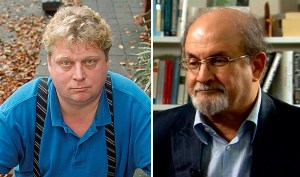
1053Theo van Gogh (left) was murdered by an Islamist because he made a film critical of Islam. Salman Rushdie (right) was lucky to stay alive, spending many years in hiding, under police protection, after Iran’s Supreme Leader ordered his murder because he considered Rushdie’s novel The Satanic Verses “blasphemous.”

Incidents such as these or UK Labour Party Leader Ed Miliband’s promise to make Islamophobia a hate crime (without even defining Islamophobia) illustrate the most dangerous result of Islamic agitation and asserted victimhood: it has caused us to turn on ourselves, to abandon our commitment to free speech, open academic enquiry, and the readiness to question everything — the very qualities that have made us strong in the past. When Western so-called intellectuals such as Ian Buruma and Timothy Garton Ash condemn a Muslim apostate such as Ayaan Hirsi Ali for her criticisms of radical Islamism, or when Brandeis University withdraws its offer of an honorary degree for Ms. Ali when Muslim students object, we see our intellectual foundations shake. [8]

It is also necessary to ask, if Geert Wilders and others are being accused of hate speech, then why isn’t the Koran — with its calls for smiting necks and killing infidels — also being accused of hate speech?

If we do not reverse this trend of submission, censorship, blasphemy laws and all the other encumbrances of totalitarianism will return to our lives. The bullies will win, and the Enlightenment will fade and pass away from mankind. Political correctness and shari’a law will rule. How tragic if a senseless fear causes us to do this to ourselves.


[1] If you are old enough to remember the Cold War, you will also recall the remarkable outpouring of literary engagement with the issues it provoked. Not just dissident narratives likeAlexander Solzhenitsyn‘s Gulag Archipelago or novels such as his One Day in the Life of Ivan Denisovitch, but the many spy thrillers by mainly British authors like John Le Carré, Len Deighton, Ian Fleming (the creator of James Bond), and many others, Trevor Dudley-Smith (‘Adam Hall’), and Jack Higgins. Later, several Americans came to match the popularity of their British counterparts: Tom Clancy, Robert Ludlum, Nelson DeMille, and others. But with the collapse of the Soviet Union as a threat, Cold War themes rapidly died out.

[2] There have been several films such as The Siege or the more recent American Sniper, and TV shows such as Homeland and the BBC’s award-winning drama The Honourable Woman. In 2014, a new drama appeared on BBC America and is due to play in the UK this April: The Gameis set in the 1970s and tells a story of spies fighting the Cold War.

[3] The Times, 4 March 1989.

[4] Michael Walzer, “The Sins of Salman,” The New Republic, 10 April 1989.

[5] The most notorious of the many cases involving perceptions of blasphemy started November 25, 2007, when an English kindergarten teacher at a school in Sudan, Gillian Gibbons, was arrested, interrogated and finally put in a cell at a local police station. Her crime? She had allowed her class of six-year-olds to name their teddy bear “Muhammad.” From this innocent mistake, matters got worse for Gibbons. On November 26, 2007, she was formally charged under Section 125 of the Sudanese Criminal Act, for “insulting religion, inciting hatred, sexual harassment, racism, prostitution and showing contempt for religious beliefs.” Sudan’s top clerics called for the full measure of the law [death] to be used against Mrs. Gibbons; and labeled her actions part of a Western plot against Islam.

On November 29, she was found guilty of “insulting religion” and was sentenced to 15 days’ imprisonment and deportation. The next day, approximately 10,000 protesters, some of them waving swords and machetes, took to the streets in Khartoum, demanding Gibbons’s execution.

In the end, Gibbons was released from jail and allowed to return to Britain. But her case put the fear of savagery in many people’s hearts, as they recognized that it take nothing more than a slip of tongue to bring down death on oneself.

In yet another irony, Sherry Jones, an American writer who said she wanted to bring people together, wrote a novel entitled The Jewel of Medina, a story of the romance (if that is the word) between the Prophet Muhammad and his child bride A’isha, who came to be his most beloved wife. This was a noble project designed to show that Westerners are not all “Islamophobes,” and written in sentimental prose to reassure Muslims of Jones’s warm feelings towards their prophet. Random House bought the story for a large fee. Influenced by the leading apologist for Muhammad, the anti-historian, Karen Armstrong, Jones even bowdlerizes the tale, delaying consummation of the marriage until A’isha had fully attained puberty (despite what the Islamic historians tell us, which is that marriage was apparently consummated when A’isha was nine).

A publication date in 2008 was set and a nationwide tour planned – a promotion few new authors get. But neither Jones nor one of America’s oldest and biggest publishing houses had reckoned with the fallout from The Satanic Verses.

[6] Cited Nick Cohen, You Can’t Read this Book, rev. ed., London, 2013, p. 72.

[7] Danish author Lars Hedegaard has suffered an attack on his life and lives in a secret location. Kurt Westergaard, a Danish cartoonist, has suffered an axe attack that failed, and is under permanent protection the of intelligence services. In 2009, Austrian, a politician, Susanne Winter, was found guilty of “anti-Muslim incitement,” for saying, “In today’s system, the Prophet Mohammad would be considered child-molester,” and that Islam “should be thrown back where it came from, behind the Mediterranean.” She was fined 24,000 euros ($31,000) and given a three-month suspended sentence. In 2011, Elisabeth Sabaditsch-Wolff, a former Austrian diplomat and teacher, was put on trial for “denigration of religious beliefs of a legally recognized religion,” found guilty twice, and ordered to pay a fine or face 60 days in prison. Some of her comments may have seemed extreme and fit for criticism, but the court’s failure to engage with her historically accurate charge that Muhammad had sex with a nine-year-old girl and continued to have sex with her until she turned eighteen, regarding her criticism of it as somehow defamatory, and the judge’s decision to punish her for saying something that can be found in Islamic sources, illustrates the betrayal of Western values of free speech in defense of something we would normally penalize.

[8] This backing away from our Enlightenment values has been documented and criticized by many writers, notably Paul Berman in his 2010 The Flight of the Intellectuals, Britain’s Douglas Murray in Islamophilia (2013), or Nick Cohen in You can’t read this book (2012)
A powerful totalitarian theocracy can bring peace. Of sorts.

May 2, 2015

A powerful totalitarian theocracy can bring peace. Of sorts. Dan Miller’s Blog, May 2, 2015

(The views expressed in this article are mine, and do not necessarily reflect those of Warsclerotic or its other editors. — DM)

a1  Obama and Kahameni -building a toaster

Iran, an already powerful theocratic totalitarian state with extensive hegemonic ambitions, is about to become (if it is not already) a nuclear power. So equipped, it can extend its rule over the Middle East and beyond, bringing the “peace” of submission to Islam. Obama may favor this outcome and in any event appears to be at best indifferent.

Iran is ruled by Ayatollah Khamenei, its supreme political and religious power. He has the ultimate authority to approve or reject any P5+1 agreement, should there be one — which seems increasingly likely due to Obama’s ludicrous efforts to concede every possible matter of substance. Obama wants a foreign policy legacy and needs a “deal;” Iran does not need a “deal.” It has already benefited greatly from sanctions relief. Other nations have also benefited economically to the point that even were the U.S. to try to reimpose sanction such trade would continue and expand. Moreover, it is highly likely that Iran has done all of the necessary technical research on nukes and on delivery devices to the extent that, regardless of whether there is a “deal,” Iran can have deliverable nukes within a few months if not sooner. As I pointed out here, the insanity of the 2013 framework, adhered to except when arguably in America’s favor, led inexorably to this result.

The North Korea – Iran linkage makes the problem worse. Chinese nuclear experts recently revised their estimation of North Korea’s current possession of nukes:.

China’s top nuclear experts have increased their estimates of North Korea’s nuclear weapons production well beyond most previous U.S. figures, suggesting Pyongyang can make enough warheads to threaten regional security for the U.S. and its allies.

The latest Chinese estimates, relayed in a closed-door meeting with U.S. nuclear specialists, showed that North Korea may already have 20 warheads, as well as the capability of producing enough weapons-grade uranium to double its arsenal by next year, according to people briefed on the matter. [Emphasis added.]

Iran and North Korea have a long history of nuclear cooperation. Delivering North Korean technology, materials and nukes to Iran would not be very difficult. I addressed the problem here, herehere and elsewhere.

Consequences of a nuclear Iranian theocracy

The Iranian Shiite theocracy is totalitarian in every sense of the word; it has not moderated under “moderate” President Rouhani. To the contrary, it seems to have worsened. To the extent that credible figures are available, sexually transmitted disease has risen and the birth rate in Iran has fallen, considerably in recent years. Despite sanctions relief, poverty has increased. Where has the money gone? Iran pursues its hegemonic ambitions, most recently to help the Houthi in Yemen, while continuing to provide economic, logistical and weapons support to its other proxy terrorist organizations such as Hamas, Hezbollah, the Muslim Brotherhood and others. Iran is very likely motivated by its own desire eventually to control the Middle East and beyond.

The recent Iranian hijacking of a cargo ship under “U.S. protection” may well have been an Iranian warning to Saudi Arabia, an American ally and leading opponent of the Iranian proxy war by Houthi in Yemen, that it can and might close the Strait of Hormuz to Saudi oil exports.

Strait-of-Hormuz

Although obligated under treaty to come to the defense of the Marshall Islands-registered cargo ship, the Obama Nation did not. Instead, it simply watched as the Iranian Navy fired shots across her bow and took her to an Iranian port to the North at Bandar Abbas. The ship and her crew remain there. Caroline Glick, in an article titled The Marshall Islands’ cautionary tale pointed out that

The Maersk Tigris is flagged to the Marshall Islands. The South Pacific archipelago gained its independence from the US in 1986 after signing a treaty conceding its right to self-defense in exchange for US protection. According to the treaty, the US has “full authority and responsibility for security and defense of the Marshall Islands.” [Emphasis added.]

Given the US’s formal, binding obligation to the Marshall Islands, the Iranian seizure of the ship was in effect an act of war against America.

. . . .

If the US allows Iran to get away with unlawfully seizing a Marshall Islands flagged ship it is treaty bound to protect, it will reinforce the growing assessment of its Middle Eastern allies that its security guarantees are worthless.

As the Israel Project’s Omri Ceren put it in an email briefing to journalists, “the US would be using security assurances not to shield allies from Iran but to shield Iran from allies.” [Emphasis added.]

What can other nations, with which America has treaties calling upon us to come to their defense, expect from the Obama administration if attacked by Iran? Precious little.

Under credible threat from nuclear attack by Iran and lacking actual (as distinguished from verbal) support from the Obama administration, Middle East Arab nations cannot be expected to resist very effectively, even as they seek to obtain their own nuclear arsenals.

Israel, the “Little Satan?” She would fight fiercely to the end, but might be overcome. Perhaps she will take the initiative and destroy Iran’s nuclear facilities before they become too extensive and better protected, perhaps by missiles provided by Russia. I suggested here that she can and should do so. Here is a link to a far more detailed analyses of what she can and should do, soon.

America, the “Great Satan,” is not immune to an Iranian nuclear attack. As I suggested here, a nuclear armed Iran could launch an EMP attack to drive the U.S. back to the stone age. Such an attack would increase Iran’s hegemonic potentials, and hence ambitions, by foreclosing the possibility of American help to nations with which we have protection treaties. However, even without an EMP attack, Obama would not provide much help. Therefore, I wonder whether — despite all of the continuing Iranian “death to America” bluster — Iran would be foolish enough to do it before Obama leaves office. He does His best to help Iran get nukes and pursue its hegemonic ambitions. Why try to kill a staunch friend like Obama’s America?

The Obama administration — and many voters — view global warming, climate change, climate disruption and whatever new phrases as may be developed as the most severe threat to humanity. An interesting article titled Progressives at the Poker Table compares “Progressive” attitudes toward “the threat of climate warming and that of a nuclear-armed Iran.” Predictably, the Obama Administration and most of the “legitimate news media” are far more concerned about the former than the latter, even though there is little if anything that we can do, even at great expense, about climate change (mostly natural in origin). If so disposed, there is quite a lot that we could do about the far greater, and in any event more immediate, threat from a nuclear Iran. Perhaps it’s simply easier to stage pious shows about costly but ineffective ways to “save the Earth” than to make useful efforts to save humanity from Islamic ravages.

Church of climatology

Conclusions

Andrew Klavan ridicules Obama’s P5+1 “deal” here:

The Congress probably won’t do anything to stop it, so Iran will very likely have nukes and the missiles with which to deliver them soon — if it does not already have them.

Hitler made a “deal” with Prime Minister Chamberlain years ago and returned from Munich to display a piece of paper signed by Hitler. Crowds cheered. Hitler laughed and continued his hegemonic pursuits throughout Europe. Hitler could have been stopped with relative ease long before World War II erupted but wasn’t. The “Peace in our time” meme was too powerful. Then we fought WWII.

Is that how the current mess with Iran will turn out?

code pink on Iran

Off topic | Britain’s Labour Party Vows to Ban Islamophobia

April 30, 2015

Britain’s Labour Party Vows to Ban Islamophobia, Gatestone InstituteSoeren Kern, April 30, 2015

  • “In Miliband’s Britain, it will become impossible to criticise any aspect of Islamic culture, whether it be the spread of the burka or the establishment of Sharia courts or the construction of colossal new mosques. … If he wins, Miliband will ensure that the accelerating Islamification of our country will go unchallenged.” — Leo McKinstry, British commentator.
  • The report shows that Britain’s Muslim population is overwhelmingly young and will exert increasing political influence as time goes on. The median age of the Muslim population in Britain is 25 years, compared to the overall population’s median age of 40 years.

The leader of Britain’s Labour Party, Ed Miliband, has vowed, if he becomes the next prime minister in general elections on May 7, to outlaw “Islamophobia.”

The move — which one observer has called “utterly frightening” because of its implications for free speech in Britain — is part of an effort by Miliband to pander to Muslim voters in a race that he has described as “the tightest general election for a generation.”

With the ruling Conservatives and the opposition Labour running neck and neck in the polls just days before voters cast their ballots, British Muslims — who voted overwhelmingly for Labour in the 2010 general election — could indeed determine who will be the next prime minister.

In an interview with The Muslim News, Miliband said:

“We are going to make it [Islamophobia] an aggravated crime. We are going to make sure it is marked on people’s records with the police to make sure they root out Islamophobia as a hate crime.

“We are going to change the law on this so we make it absolutely clear of our abhorrence of hate crime and Islamophobia. It will be the first time that the police will record Islamophobic attacks right across the country.”

Miliband appears to be trying to reopen a long-running debate in Britain over so-called religious hatred. Between 2001 and 2005, the then-Labour government, led by Prime Minister Tony Blair, made two attempts (here and here) to amend Part 3 of the Public Order Act 1986, to extend existing provisions on incitement to racial hatred to cover incitement to religious hatred.

Those efforts ran into opposition from critics who said the measures were too far-reaching and threatened the freedom of speech. At the time, critics argued that the scope of the Labour government’s definition of “religious hatred” was so draconian that it would have made any criticism of Islam a crime.

In January 2006, the House of Lords approved the Racial and Religious Hatred Act 2006, after amending the text so that the law would be limited to banning only “threatening” words and not those that are merely abusive or insulting. Lawmakers also said that the offense would require the intention — not just the possibility — of stirring up religious hatred. They added that proselytizing, discussion, criticism, abuse and ridicule of religion, belief or religious practice would not be an offense.

Miliband’s renewed promise to make “Islamophobia” (a term he has not defined) an “aggravated crime” may signal an attempt to turn the 2006 Act — which already stipulates a maximum penalty of seven years in prison for stirring up religious hatred — into a full-blown Muslim blasphemy law.

According to British commentator Leo McKinstry, “Miliband’s proposal goes against the entire tradition of Western democracy, which holds that people should be punished only for their deeds, not their opinions.” In an opinion article, he added:

“In Miliband’s Britain, it will become impossible to criticise any aspect of Islamic culture, whether it be the spread of the burka or the establishment of Sharia courts or the construction of colossal new mosques. We already live in a society where Mohammed is now the most popular boy’s name and where a child born in Birmingham is more likely to be a Muslim than a Christian. If he wins, Miliband will ensure that the accelerating Islamification of our country will go unchallenged.”

McKinstry says Miliband is currying favor with Britain’s three million-strong Muslim community to “prop up Labour’s urban vote.”

Muslims are emerging as a key voting bloc in British politics and are already poised to determine the outcome of local elections in many parts of the country, according to a report by the Muslim Council of Britain, an umbrella group.

The report shows that Britain’s Muslim population is overwhelmingly young and will exert increasing political influence as time goes on. The median age of the Muslim population in Britain is 25 years, compared to the overall population’s median age of 40 years.

An extrapolation of the available data indicates that one million British Muslims aged 18 and above will be eligible to vote in this year’s election. According to one study, Muslims could determine the outcome of up to 25% of the 573 Parliamentary seats in England and Wales.

Others say that although Britain’s Muslim community is growing, it is also ethnically diverse and unlikely to vote as a single group. One analyst has argued that the potential for Muslim influence in this year’s election “will remain unrealized because the Muslim vote is not organized in any meaningful way on a national level.”

A study produced by Theos, a London-based religious think tank, found that although Muslims consistently vote Labour, they do so based on class and economic considerations, not out of religious motives.

Indeed, a poll conducted by the BBC on April 17 found that nearly one-quarter of “Asian” voters still do not know which party they will support at the general election. Some of those interviewed by the BBC said that economic issues would determine whom they vote for.

In any event, Muslim influence in the 2015 vote will be largely determined by Muslim voter turnout, which has been notoriously low in past elections: Only 47% of British Muslims were estimated to have voted in 2010.

Since then, several grassroots campaigns have been established to encourage British Muslims to go to the polls in 2015, including Get Out & Vote, Muslim Vote and Operation Black Vote. Another group, YouElect, states:

“A staggering 53% of British Muslims did not vote in the 2010 General Election, such a high figure of Muslim non-voters indicates that many Muslims feel ignored by politicians and disillusioned by the political process.

“With the rise of Islamophobic rhetoric in politics and an ever increasing amount of anti-terror legislation which specifically targets Muslims, it is now more important than ever that Muslims use the vote to send a message to politicians that their attitudes and policies must change.

“YouElect wants to get the message across that there is something you can do about the issues you care about. We have launched a new campaign using the hashtag #SortItOut, which calls on Muslims to use the political process to address the issues that concern them most.

“With 100,000 new young Muslims eligible to vote this year and 26 parliamentary constituencies with a Muslim population of over 20%, the Muslim community has a very real opportunity to make an impact on British politics.”

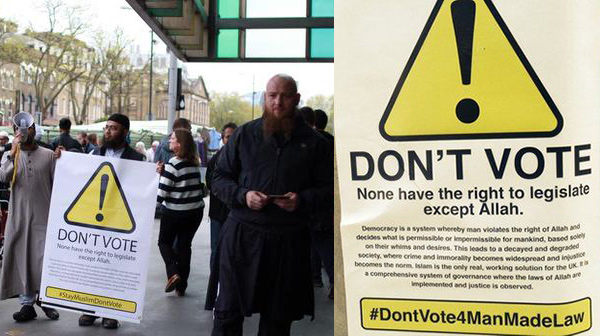
Not all Muslims agree. The British-born Islamist preacher Anjem Choudary is actively discouraging Muslims from voting. In a stream of Twitter messages using the #StayMuslimDontVote hashtag, Choudary has argued that voting is a “sin” against Islam because Allah is “the only legislator.” He has also said that Muslims who vote or run for public office are “apostates.”

1050Despite several grassroots campaigns to encourage British Muslims to vote in greater numbers, some prominent Islamists in the UK claim that voting is a “sin.”

Other British Islamists are following Choudary’s lead. Bright yellow posters claiming that democracy “violates the right of Allah” have been spotted in Cardiff, the capital of Wales, and Leicester, as part of a grassroots campaign called #DontVote4ManMadeLaw.

One such poster stated:

“Democracy is a system whereby man violates the right of Allah and decides what is permissible or impermissible for mankind, based solely on their whims and desires.

“Islam is the only real, working solution for the UK. It is a comprehensive system of governance where the laws of Allah are implemented and justice is observed.”

Dr Andrew Bostom on Lisa Benson show 12.5.2015

April 13, 2015

Dr Andrew Bostom on Lisa Benson show 12.5.2015, You Tube, April 13, 2015

(Dr. Bostom relates Islamic doctrine to Iran’s negotiating tactics. Please see also, Lt. Col Ralph Peters: “The Iranians Negotiate, We BEG!” — DM)

Khamenei Smashes Terms of Nuclear Agreement

April 12, 2015

Khamenei Smashes Terms of Nuclear Agreement, Clarion ProjectRyan Mauro, April 12, 2015

(Obama demands, don’t mention Iran’s mumblings about his once in a lifetime deal. Partisan wrangling must stop!– DM)

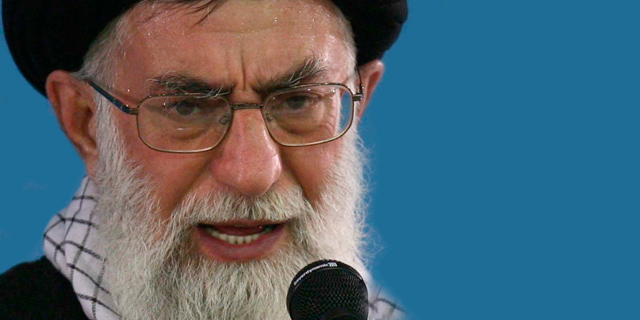
Iran-Ayatollah-Khamenei-HP_3Iranian Supreme Leader Ayatollah Kamenei (Photo: © Reuters)

Khamenei’s accusations make Saudi Arabia a legitimate target under any understanding of jihad. He even went so far as to say the Saudis’ actions are equivalent to Israel’s so-called “genocide” in Gaza. This implies that a violent jihad against Saudi Arabia is as justifiable as one against Israel.

Iran believes that these end times prophesies correlate to the death of Saudi King Abdullah, the Houthis’ overthrow of the Yemeni government, the civil war in Syria, Saudi military action and the fierce fighting in Iraq. The regime sees the confluence of all these crises as beyond the realm of coincidence and signaling the imminent arrival of the “Hidden Imam” which will herald military victory for Iran.

Before the “Hidden Imam” can arrive, two other condition must be fulfilled: instability in Saudi Arabia and the march of a prophetic figure titled “Yamani” who will lead Shiite forces from Yemen into Mecca. The Houthis recently pledged to invade Saudi territory, capture Mecca and overthrow the royal family in Riyadh. They were likely referring to this prophecy.

“We’re not going to respond to every public statement made by Iranian officials or negotiate in public,” said State Department spokesman Jeff Rathke during a daily press briefing.

********************

Iranian Supreme Leader Ayatollah Khamenei ended his eerie silence since the nuclear framework agreement was announced with a fiery speech accompanied with “Death to America” chants. Khamenei essentially smashed the viability of the nuclear framework to pieces, signalled a major escalations in the war in Yemen and essentially endorsed a violent jihad against the Saudi royal family.

Wishful thinkers can’t dismiss the speech as theater for a domestic audience. Khamenei tweeted highlights in English to make sure the world, especially Americans, saw them. The threats and demands are so unequivocal that failing to follow through would sacrifice his entire credibility and prestige.

The Iranian Supreme Leader is unsatisfied with the nuclear framework agreement even though it generously permits Iran to retain the ability to produce nuclear weapons while getting major sanctions relief.

First, he said that the fact sheet published by the U.S. contains lies and does not reflect what Iran agreed to. The statement obliges the regime to seek significant revisions shortly after it gave President Obama the go ahead to make a high-profile victory lap.

Khamenei’s demands are inescapably incompatible with America’s requirements for a deal.

First, Iran is demanding that all sanctions be lifted on the first day that a final deal is signed. The framework only agrees to lift sanctions in phases and only those related to nuclear activity, not terrorism or human rights. Doing so would unfreeze the assets of individuals and entities involved in terrorism around the world, sparking a massive growth in Iran’s terrorist apparatus and proxy warfare.

The inherently flawed hope by the West that “moderate” President Rouhani and other Iranian figures can reign in Khamenei can be immediately ruled out, since Rouhani said the same exact thing.

Iran-Khamenei-Nuke-Tweets

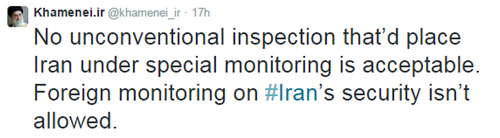
Second, Iran is insisting that there will be no “unconventional,” “special” or “foreign” inspections or monitoring. In other words, Iran will not be subject to exceptionally intrusive inspections. Khamenei’s tweets do not specify Iran’s standards, but it is clear that Iran does not intend to give the IAEA unlimited access.

Iran-Khamenei-Rejects-Inspections-Tweets

This is almost definitely a reference to military sites, to which Iran consistently says it has the option of denying access. Iran wants the ability to deny access to any location by declaring it a military institution.

This is how Iran denies access to the critical Parchin site, where damning evidence may exist to prove that Iran conducted major nuclear weapons research until at least 2003. An Iranian opposition group identified an alleged nuclear site in February that is within a military compound. It is claimed that the facility is used for uranium enrichment and the production of advanced centrifuges.

Notice the language of the tweets, which was reported to be equally non-compromising in Farsi. There is no wiggle room. Khamenei would have left some ambiguity if he was willing to budge. If you believe this is just talk, then you must believe that Khamenei made the calculated decision to cause an easily avoidable self-inflicted wound for no reason.

Another flurry of tweets related to the war in Yemen, where Iran is backing the Shiite Houthi rebels who have overthrown the government.

A U.S.-supported coalition of Sunni countries intervened militarily to support President Hadi and stop Iran from threatening the strategic Bab al-Mandeb Strait. This alliance includes Saudi Arabia, Egypt, Bahrain, Qatar, Kuwait, the United Arab Emirates, Jordan, Morocco, Turkey, Pakistan and Sudan. The last two are especially significant because of their close ties to Iran. Separately, Al-Qaeda is gaining ground in Yemen and the Islamic State (ISIS) is rising up as a competitor.

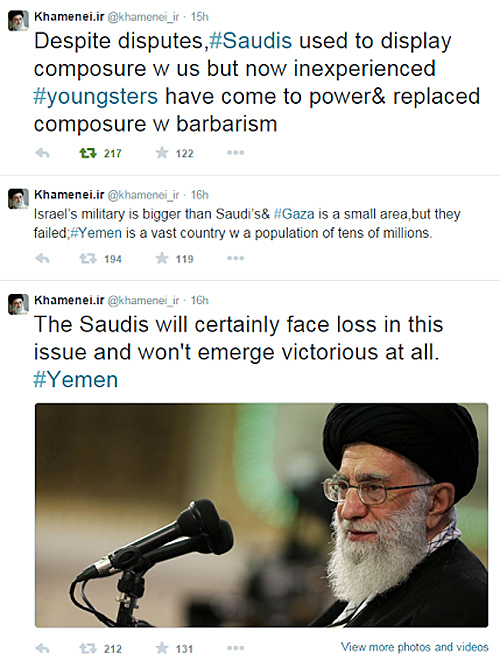
Interestingly, the tweets only threatened Saudi Arabia and did not mention any of these other participants by name. Khamenei stopped just short of a formal declaration of jihad, instead laying out the justification for it.

Iran-Khamenei-Yemen-1-Tweets
Iran-Khamenei-Yemen-2-Tweets

Khamenei’s accusations make Saudi Arabia a legitimate target under any understanding of jihad. He even went so far as to say the Saudis’ actions are equivalent to Israel’s so-called “genocide” in Gaza. This implies that a violent jihad against Saudi Arabia is as justifiable as one against Israel.

Don’t be comforted by Khamenei’s mentioning of prosecuting Saudi leaders in international courts. This is not meant to substitute jihad. Khamenei is making a point about how blatant the Saudi crimes are. He’s not even saying that this is Iran’s chosen course of action.

This comes as Iran dispatches two ships to the front in Yemen, including a destroyer to “safeguard naval routes” — meaning it will challenge the challenge the Saudi-Egyptian naval blockade.

Iran sent a flotilla to Bahrain in 2011 after Saudi and Emirati forces intervened to stomp out a revolution against the Sunni monarchy. The regime blinked at the last moment when the Arabs made it clear they would use force to stop it. However, the Yemen conflict has significant differences that Khamenei’s tweets help explain.

Khamenei is signaling that unprecedented hostilities with Saudi Arabia will now commence. The previous Saudi leaders, he says, could be dealt with. The new Saudi King and his circle must be handled more toughly.

However, Iran orchestrated massive terrorist attacks on Saudi interests even under the previous “composed” leaders, a campaign that put the U.S. economy and homeland at risk.

For example, in 2011, the U.S. prevented an Iranian Revolutionary Guards’ plot to assassinate the Saudi ambassador in Washington, D.C. by blowing up a restaurant, which inevitably would have taken the lives of American citizens as well. The scheme involved hiring a Mexican drug cartel to perpetrate the attack, along with bombings of the Israeli embassy in D.C. and the Israeli and Saudi embassies in Argentina.

In 2012, Iran launched a cyber attack on the Saudi Aramco oil company in response to the country’s policies in Bahrain and Syria. Aramco said the hackers tried to take down the country’s oil and gas production (which failed), but they did erase the data on 30,000 computers, three-fourths of the corporate computers.

Khamenei says that the new Saudi leadership is committing far worse crimes, so we should expect a far worse response.

We must also remember the prophecies cited by the Iranian regime.  Iran believes that these end times prophesies correlate to the death of Saudi King Abdullah, the Houthis’ overthrow of the Yemeni government, the civil war in Syria, Saudi military action and the fierce fighting in Iraq. The regime sees the confluence of all these crises as beyond the realm of coincidence and signaling the imminent arrival of the “Hidden Imam” which will herald military victory for Iran.

Before the “Hidden Imam” can arrive, two other condition must be fulfilled: instability in Saudi Arabia and the march of a prophetic figure titled “Yamani” who will lead Shiite forces from Yemen into Mecca. The Houthis recently pledged to invade Saudi territory, capture Mecca and overthrow the royal family in Riyadh. They were likely referring to this prophecy.

Khamenei’s speech wasn’t the typical bluster we are used to hearing from Islamist radicals and dictators. The timing, language and high-profile nature makes it very significant.

Even though the U.S. State Dept. responded by saying that sanctions against Iran would be removed gradually based on verification that Iran had kept its commitments, its response lacked conviction:

“We’re not going to respond to every public statement made by Iranian officials or negotiate in public,” said State Department spokesman Jeff Rathke during a daily press briefing.

Take Them At Their Word: Iran Might Destroy Us | Bill Whittle

April 9, 2015

Take Them At Their Word: Iran Might Destroy Us | Bill Whittle via You Tube, April 9, 2015


Arabs Blast “Obama’s Deal” With Iran

April 4, 2015

Arabs Blast “Obama’s Deal” With Iran, Gatestone InstituteKhaled Abu Toameh, April 4, 2015

“This is a dangerous agreement…[It ]provides Iran with what it needs most to pursue its wars and expansionism against the Arabs: funds.” —Salah al-Mukhtar, Ammon News”

“Iran has tried to intervene in Iraq, Lebanon and Syria and it is seeing that it’s not paying any price…There is also a feeling in Tehran that the U.S. is avoiding a military confrontation with the Iranians.”– Hassan al-Barari, Al-Sharq

The deal means that the international community has accepted Iran as a nuclear power.” — Hani ala-Jamal, al-Wafd

Many Arabs have expressed deep concern over the nuclear deal that was reached last week between Iran and the world powers, including the US.

Arab leaders and heads of state were polite enough not to voice public criticism of the agreement when President Barack Obama phoned them to inform them about it. But this has not stopped Arab politicians, political analysts and columnists reflecting government thinking in the Arab world from lashing out at what they describe as “Obama’s bad and dangerous deal with Iran.”

The Arabs, especially those living in the Gulf, see the framework agreement as a sign of US “weakness” and a green light to Iran for Iran to pursue its “expansionist” scheme in the Arab world.

“Some Arab countries are opposed to the nuclear deal because it poses a threat to their interests,” said the Egyptian daily Al-Wafd in an article entitled, “Politicians: (President Barack) Obama’s deal with Iran threatens Arab world.” http://www.alwafd.org/838527

The newspaper quoted Hani al-Jamal, an Egyptian political and regional researcher, as saying that the deal means that the international community has accepted Iran as a nuclear power. He predicted that the framework agreement would put Iran and some Arab countries such as Saudi Arabia and Egypt on a course of collision.

Al-Jamal advised the Arab countries to form a “Sunni NATO” that would guarantee Pakistan’s status as a nuclear power Arab ally in face of the “Iranian and Israeli threat.”

Jihad Odeh, an Egyptian professor of political science, said that Obama’s “achievements are designed to dismantle the Arab world. Obama wants to make historic achievements before the end of his term in office by destroying Al-Qaeda, seeking rapprochement with Cuba and reaching a nuclear agreement with Iran.”

http://www.alwafd.org/838527

Although Saudi Arabia, which is currently waging war on Iranian-backed Houthi militiamen in Yemen, “welcomed” the nuclear agreement, it has privately expressed concern over the deal.

http://gulfnews.com/news/gulf/saudi-arabia/public-saudi-welcome-for-iran-nuclear-deal-but-unease-remains-1.1485119

Similarly, several Gulf countries that initially welcomed the agreement are beginning to voce concern over its repercussions on the region. For the past several months, the Arabs have been warning against Iran’s ongoing effort to take control over their countries.

“The US surely does not want to see a more powerful Iranian hegemony in the region, but at the same time, it does not appear to mind some kind of Iranian influence in the region,” said Nasser Ahmed Bin Gaith, a United Arab Emirates researcher. “Iran has been seeking to reclaim its previous role as the region’s police.”

http://www.aljazeera.com/news/2015/04/saudi-arabia-israel-oppose-iran-nuclear-deal-150401061906177.html

Bin Gaith said that it was clear that a Western recognition of Iranian regional influence would come at the expense of the Gulf countries.

“The Gulf states should build strategic partnerships with the regional powers of Pakistan and Turkey, who share the Gulf nations’ fears of Iranian ambitions in the region,” he added.

Echoing widespread fear among Arabs of Iran’s territorial ambitions in the Middle East, political analyst Hassan al-Barari wrote in Qatar’s daily Al-Sharq against the policy of appeasement toward Tehran.

“Iran has tried to intervene in Iraq, Lebanon and Syria and it is seeing that it’s not paying any price; on the contrary, there are attempts by the big powers to reach understandings with Iran,” al-Barari pointed out. There is also a feeling in Tehran that the US is avoiding a military confrontation with the Iranians and their proxies. The Gulf countries have learned from the lessons of the past in various areas. The policy of appeasement has only led to wars. Any kind of appeasement with Iran will only lead it to ask for more and probably meddle in the internal affairs of the Arab countries and increase its arrogance.”

http://www.al-sharq.com/news/details/324014#.VR7KLjuUevV

Even Jordanians have joined the chorus of Arabs expressing fear over Iran’s growing threat to the Arab world, especially in wake of the nuclear deal with the US and the big powers.

Salah al-Mukhtar, a Jordanian columnist, wrote an article entitled, “Oh Arabs wake up, your enemy is Iran,” in which he accused the US of facilitating Tehran’s wars against the Arab countries.

http://www.ammonnews.net/article.aspx?articleno=225764

Describing Iran as “Eastern Israel,” al-Mukhtar said that the most dangerous aspect of the framework agreement is that allows Iran to continue with its “destructive wars” against the Arabs. “This is a dangerous agreement, particularly for Saudi Arabia and the opposition forces in Iraq and Syria,” the Jordanian columnist cautioned. This agreement provides Iran with what it needs most to pursue its wars and expansionism against the Arabs: funds. Lifting the sanctions is America’s way of backing the dangerous and direct wars against Arabs; the lifting of the sanctions also provides the Iranians with the funds needed to push with their Persian advancement. The US wants to drain Saudi Arabia and the Arab Gulf countries in preparation for dividing them.”

Lebanon’s English language The Daily Star newspaper also voiced skepticism over the nuclear deal. “For all the talk of this deal contributing to making the world safer, if Obama is truly concerned with his legacy, especially in the Middle East, he must now work with Iran to encourage it to become a regular member of the international community once again, and not a country which sponsors conflict, whether directly or via proxies, across the region,” the paper editorialized. “Otherwise, this deal could just leave Iran emboldened in its expansionist designs.”

http://www.dailystar.com.lb/Opinion/Editorial/2015/Apr-03/293201-a-deal-or-legacy.ashx

In addition to the Arabs, Iranian opposition figures have also come out against the nuclear deal.

Maryam Rajavi, an Iranian politician and President of the National Council of Resistance, commented that the a “statement of generalities, without spiritual leader Khamenie’s signature and official approval, does not block Tehran’s path to a nuclear bomb nor prevent its intrinsic deception.

“Continuing talks with religious fascism in Iran – as part of a policy of appeasement – will not secure the region and world from the threat of nuclear proliferation,” Rajavi warned. “Complying with UN Security Council resolutions is the only way to block the mullahs from obtaining nuclear weapons. Leniency and unwarranted concessions by the P5+1 to the least trustworthy regime in the world today only grants it more time and further aggravates the dangers it poses to the Iranian people, to the region and to the wider world.”

http://irannewsupdate.com/news/nuclear/2047-iran-maryam-rajavi-fearful-mullahs-reluctantly-take-one-more-step-backward-toward-drinking-the-chalice-of-nuclear-poison.html

COLUMN ONE: The diplomatic track to war

April 3, 2015

COLUMN ONE: The diplomatic track to war, Jerusalem Post, Caroline Glick, April 4, 2015

Iran negotiationsIran negotiations. (photo credit:REUTERS)

No one trusts Washington when Obama claims that he is committed to the security of Israel and the US’s Sunni allies in the region.

Iran is far more powerful than the PLO. But the Americans apparently believe they are immune from the consequences of their leaders’ policies. This is not the case for Israel or for our neighbors. We lack the luxury of ignoring the fact that Obama’s disastrous diplomacy has brought war upon us. Deal or no deal, we are again about to be forced to pay a price to maintain our freedom.

********************

Through their nuclear diplomacy, Obama and his comrades started the countdown to war.

The world powers assembled at Lausanne, Switzerland, with the representatives of the Islamic Republic may or may not reach a framework deal regarding Iran’s nuclear program. But succeed or fail, the disaster that their negotiations have unleashed is already unfolding. The damage they have caused is irreversible.

US President Barack Obama, his advisers and media cheerleaders have long presented his nuclear diplomacy with the Iran as the only way to avoid war. Obama and his supporters have castigated as warmongers those who oppose his policy of nuclear appeasement with the world’s most prolific state sponsor of terrorism.

But the opposite is the case. Had their view carried the day, war could have been averted.

Through their nuclear diplomacy, Obama and his comrades started the countdown to war.

In recent weeks we have watched the collapse of the allied powers’ negotiating positions.

They have conceded every position that might have placed a significant obstacle in Iran’s path to developing a nuclear arsenal.

They accepted Iran’s refusal to come clean on the military dimensions of its past nuclear work and so ensured that to the extent UN nuclear inspectors are able to access Iran’s nuclear installations, those inspections will not provide anything approaching a full picture of its nuclear status. By the same token, they bowed before Iran’s demand that inspectors be barred from all installations Iran defines as “military” and so enabled the ayatollahs to prevent the world from knowing anything worth knowing about its nuclear activities.

On the basis of Iran’s agreement to ship its stockpile of enriched uranium to Russia, the US accepted Iran’s demand that it be allowed to maintain and operate more than 6,000 centrifuges.

But when on Monday Iran went back on its word and refused to ship its uranium to Russia, the US didn’t respond by saying Iran couldn’t keep spinning 6,000 centrifuges. The US made excuses for Iran.

The US delegation willingly acceded to Iran’s demand that it be allowed to continue operating its fortified, underground enrichment facility at Fordow. In so doing, the US minimized the effectiveness of a future limited air campaign aimed at significantly reducing Iran’s nuclear capabilities.

With this broad range of great power concessions already in its pocket, the question of whether or not a deal is reached has become a secondary concern. The US and its negotiating partners have agreed to a set of understanding with the Iranians. Whether these understandings become a formal agreement or not is irrelevant because the understandings are already being implemented.

True, the US has not yet agreed to Iran’s demand for an immediate revocation of the economic sanctions now standing against it. But the notion that sanctions alone can pressure Iran into making nuclear concessions has been destroyed by Obama’s nuclear diplomacy in which the major concessions have all been made by the US.

No sanctions legislation that Congress may pass in the coming months will be able to force a change in Iran’s behavior if they are not accompanied by other coercive measures undertaken by the executive branch.

There is nothing new in this reality. For a regime with no qualms about repressing its society, economic sanctions are not an insurmountable challenge. But it is possible that if sanctions were implemented as part of a comprehensive plan to use limited coercive means to block Iran’s nuclear advance, they could have effectively blocked Iran’s progress to nuclear capabilities while preventing war. Such a comprehensive strategy could have included a proxy campaign to destabilize the regime by supporting regime opponents in their quest to overthrow the mullahs. It could have involved air strikes or sabotage of nuclear installations and strategic regime facilities like Revolutionary Guards command and control bases and ballistic missile storage facilities. It could have involved diplomatic isolation of Iran.

Moreover, if sanctions were combined with a stringent policy of blocking Iran’s regional expansion by supporting Iraqi sovereignty, supporting the now deposed government of Yemen and making a concerted effort to weaken Hezbollah and overthrow the Iranian-backed regime in Syria, then the US would have developed a strong deterrent position that would likely have convinced Iran that its interest was best served by curbing its imperialist enthusiasm and setting aside its nuclear ambitions.

In other words, a combination of these steps could have prevented war and prevented a nuclear Iran. But today, the US-led capitulation to Iran has pulled the rug out from any such comprehensive strategy. The administration has no credibility. No one trusts Obama to follow through on his declared commitment to prevent Iran from becoming a nuclear power.

No one trusts Washington when Obama claims that he is committed to the security of Israel and the US’s Sunni allies in the region.

And so we are now facing the unfolding disaster that Obama has wrought. The disaster is that deal or no deal, the US has just given the Iranians a green light to behave as if they have already built their nuclear umbrella. And they are in fact behaving in this manner.

They may not have a functional arsenal, but they act as though they do, and rightly so, because the US and its partners have just removed all significant obstacles from their path to nuclear capabilities. The Iranians know it. Their proxies know it. Their enemies know it.

As a consequence, all the regional implications of a nuclear armed Iran are already being played out. The surrounding Arab states led by Saudi Arabia are pursuing nuclear weapons. The path to a Middle East where every major and some minor actors have nuclear arsenals is before us.

Iran is working to expand its regional presence as if it were a nuclear state already. It is brazenly using its Yemeni Houthi proxy to gain maritime control over the Bab al-Mandab, which together with Iran’s control over the Straits of Hormuz completes its maritime control over shipping throughout the Middle East.

Israel, Jordan, Egypt, Saudi Arabia, Sudan and Eritrea, and their global trading partners will be faced with the fact that their primary maritime shipping route to Asia is controlled by Iran.

With its regional aggression now enjoying the indirect support of its nuclear negotiating partners led by the US, Iran has little to fear from the pan-Arab attempt to dislodge the Houthis from Aden and the Bab al-Mandab. If the Arabs succeed, Iran can regroup and launch a new offensive knowing it will face no repercussions for its aggression and imperialist endeavors.

Then of course there are Iran’s terror proxies.

Hezbollah, whose forces now operate openly in Syria and Lebanon, is reportedly active as well in Iraq and Yemen. These forces behave with a brazenness the likes of which we have never seen.

Hamas too believes that its nuclear-capable Iranian state sponsor ensures that regardless of its combat losses, it will be able to maintain its regime in Gaza and continue using its territory as a launching ground for assaults against Israel and Egypt.

Iran’s Shiite militias in Iraq have reportedly carried out heinous massacres of Sunnis who have fallen under their control and faced no international condemnation for their war crimes, operating as they are under Iran’s protection and sponsorship. And the Houthis, of course, just overthrew a Western-backed government that actively assisted the US and its allies in their campaign against al-Qaida.

For their proxies’ aggression, Iran has been rewarded with effective Western acceptance of its steps toward regional domination and nuclear armament.

Hezbollah’s activities represent an acute and strategic danger to Israel. Not only does Hezbollah now possess precision guided missiles that are capable of taking out strategic installations throughout the country, its arsenal of 100,000 missiles can cause a civilian disaster.

Hezbollah forces have been fighting in varied combat situations continuously for the past three years. Their combat capabilities are incomparably greater than those they fielded in the 2006 Second Lebanon War. There is every reason to believe that these Hezbollah fighters, now perched along Israel’s borders with Lebanon and Syria, can make good their threat to attack and hold fixed targets including border communities.

While Israel faces threats unlike any we have faced in recent decades that all emanate from Western-backed Iranian aggression and expansionism carried out under a Western-sanctioned Iranian nuclear umbrella, Israel is not alone in this reality. The unrolling disaster also threatens the moderate Sunni states including Jordan, Egypt, Saudi Arabia, Kuwait and the United Arab Emirates. The now regional war in Yemen is but the first act of the regional war at our doorstep.

There are many reasons this war is now inevitable.

Every state threatened by Iran has been watching the Western collapse in Switzerland.

They have been watching the Iranian advance on the ground. And today all of them are wondering the same thing: When and what should we strike to minimize the threats we are facing.

Everyone recognizes that the situation is only going to get worse. With each passing week, Iran’s power and brazenness will only increase.

Everyone understands this. And this week they learned that with Washington heading the committee welcoming Iran’s regional hegemony and nuclear capabilities, no outside power will stand up to Iran’s rise. The future of every state in the region hangs in the balance. And so, it can be expected that everyone is now working out a means to preempt and prevent a greater disaster.

These preemptive actions will no doubt include three categories of operations: striking Hezbollah’s missile arsenal; striking the Iranian Navy to limit its ability to project its force in the Bab al-Mandab; and conducting limited military operations to destroy a significant portion of Iran’s nuclear installations.

Friday is the eve of Passover. Thirteen years ago, Palestinian terrorists brought home the message of the Exodus when they blew up the Seder at Netanya’s Park Hotel, killing 30, wounding 140, and forcing Israel into war. The message of the Passover Haggada is that there are no shortcuts to freedom. To gain and keep it, you have to be willing to fight for it.

That war was caused by Israel’s embrace of the notion that you can bring peace through concessions that empower an enemy sworn to your destruction. The price of that delusion was thousands of lives lost and families destroyed.

Iran is far more powerful than the PLO. But the Americans apparently believe they are immune from the consequences of their leaders’ policies. This is not the case for Israel or for our neighbors. We lack the luxury of ignoring the fact that Obama’s disastrous diplomacy has brought war upon us. Deal or no deal, we are again about to be forced to pay a price to maintain our freedom.

Obama blinked, Iran didn’t

April 3, 2015

Obama blinked, Iran didn’t, Legal Insurrection, April 3, 2015

Iran celebrates

Well that “Framework” negotiation was fun.

For the Iranians, who got a great deal at least as far as a Framework goes.

As this WaPo editorial points out, the Obama administration gave up on key parameters:

THE “KEY parameters” for an agreement on Iran’s nuclear program released Thursday fall well short of the goals originally set by the Obama administration. None of Iran’s nuclear facilities — including the Fordow center buried under a mountain — will be closed. Not one of the country’s 19,000 centrifuges will be dismantled. Tehran’s existing stockpile of enriched uranium will be “reduced” but not necessarily shipped out of the country. In effect, Iran’s nuclear infrastructure will remain intact, though some of it will be mothballed for 10 years. When the accord lapses, the Islamic republic will instantly become a threshold nuclear state.

That’s a long way from the standard set by President Obama in 2012 when he declared that “the deal we’ll accept” with Iran “is that they end their nuclear program” and “abide by the U.N. resolutions that have been in place.” Those resolutions call for Iran to suspend the enrichment of uranium. Instead, under the agreement announced Thursday, enrichment will continue with 5,000 centrifuges for a decade, and all restraints on it will end in 15 years.

In his speech after the announcement, Obama took care not only to repeat the false rhetorical device of the only choice being between this deal and war, he blamed that choice on Israeli Prime Minister Benjamin Netanyahu. David Horvitz at The Times of Israel writes, Defeatist Obama’s deal with the devil:

Extolling the virtues of his deal with Iran on Thursday, President Barack Obama made a false and extremely nasty assertion: “It’s no secret,” he claimed, incorrectly, “that the Israeli prime minister and I don’t agree about whether the United States should move forward with a peaceful resolution to the Iranian issue.”

It is indeed no secret that Obama and Netanyahu don’t agree on how to thwart Iran’s nuclear weapons ambitions. It is emphatically not the case, however, that Israel’s prime minister opposes “a peaceful resolution to the Iranian issue.” It is emphatically not the case, despite Obama’s insinuation, that Israel’s leader regards military intervention as the only means to thwart Iran.

Netanyahu has not been saying no to diplomacy. His endlessly stated contention is not that war is the only alternative to the deal so delightedly hailed by Obama as “the most effective way to ensure Iran doesn’t get a nuclear weapon.” Rather, in Netanyahu’s insistent opinion, what is needed is simply a different, far more potent deal.


Why throw Netanyahu under the bus again? There are plenty of people, including Democrats in Congress, who don’t view this deal as the only non-war choice.

Netanyahu issued the following statement after the announcement of the Framework deal:

Statement by Prime Minister Benjamin Netanyahu
April 3, 2015

I just came from a meeting of the Israeli cabinet. We discussed the proposed framework for a deal with Iran.

The cabinet is united in strongly opposing the proposed deal.
This deal would pose a grave danger to the region and to the world and would threaten the very survival of the State of Israel.

The deal would not shut down a single nuclear facility in Iran, would not destroy a single centrifuge in Iran and will not stop R&D on Iran’s advanced centrifuges.

On the contrary. The deal would legitimize Iran’s illegal nuclear program. It would leave Iran with a vast nuclear infrastructure. A vast nuclear infrastructure remains in place.

The deal would lift sanctions almost immediately and this at the very time that Iran is stepping up its aggression and terror in the region and beyond the region.

In a few years, the deal would remove the restrictions on Iran’s nuclear program, enabling Iran to have a massive enrichment capacity that it could use to produce many nuclear bombs within a matter of months.

The deal would greatly bolster Iran’s economy. It would give Iran thereby tremendous means to propel its aggression and terrorism throughout the Middle East.

Such a deal does not block Iran’s path to the bomb.

Such a deal paves Iran’s path to the bomb.

And it might very well spark a nuclear arms race throughout the Middle East and it would greatly increase the risks of terrible war.

Now, some say that the only alternative to this bad deal is war.

That’s not true.

There is a third alternative – standing firm, increasing the pressure on Iran until a good deal is achieved.

And finally let me say one more thing.

Iran is a regime that openly calls for Israel’s destruction and openly and actively works towards that end.

Just two days ago, in the midst of the negotiations in Lausanne, the commander of the Basij security forces in Iran said this: “The destruction of Israel is non-negotiable.”

Well, I want to make clear to all. The survival of Israel is non-negotiable.

Israel will not accept an agreement which allows a country that vows to annihilate us to develop nuclear weapons, period.

In addition, Israel demands that any final agreement with Iran will include a clear and unambiguous Iranian recognition of Israel’s right to exist.

Thank you.

Meanwhile, the Mullah regime crowed at how they got what they wanted (see also tweets in yesterday’s post):

Twitter-Rhouani-Iran-Deal-Centrifuges-spin
Twitter-Bill-Hemmer-Rhouani-Iran-Deal-Enrichment
Twitter-Fars-News-Agency-Iran-Deal-Rouhani

Seems to me the Mullahs know something we don’t.

And Iranians took to the streets to celebrate:


There was a better deal to be had. The sanctions were hurting. Obama blinked, the Iranians didn’t.