Archive for the ‘Islamism’ category

Op-Ed: Chaos and 2nd Cold War, Part I: Israel’s Nuclear Strategy

October 11, 2015

Op-Ed: Chaos and 2nd Cold War, Part I: Israel’s Nuclear Strategy, Israel National News,Prof. Louis René Beres, October 9, 2015

To fashion a functional nuclear strategy would be difficult for any state in world politics, but it could be especially challenging for one that keeps its bomb more-or-less securely “in the basement.” Now, as the Middle East descends into an ever more palpable chaos,[1] Israel will have to make certain far-reaching decisions on this very complex task.

Among other nuanced and widely intersecting concerns, Jerusalem’s decisions will need to account for a steadily hardening polarity between Russia and the United States.

Here, almost by definition, there will be no readily available guidebook to help lead the way. For the most part, Israel will need to be directed by an unprecedented fusion of historical and intellectual considerations. In the end, any resultant nuclear strategy will have to represent the prospective triumph of mind over mind, not merely of mind over matter.[2]

Conceivably, at least for the Jewish State that is smaller than America’s Lake Michigan, an emergent “Cold War II” could prove to be as determinative in shaping its national nuclear posture as coinciding regional disintegration. Still, a new Cold War need not necessarily prove disastrous or disadvantageous for Israel. It is also possible, perhaps even plausible, that Jerusalem could sometime discern an even greater commonality of strategic interest with Moscow, than with Washington.

To be sure, any such stark shift of allegiance in Israeli geo-political loyalties ought not to be intentionally sought, or in any way cultivated for its own sake. Moreover, on its face, it would currently be hard to imagine in Jerusalem that a superpower mentor of both Syria and Iran could somehow also find strategic common ground with Israel. Yet, in these relentlessly tumultuous times, any normally counter-intuitive judgments could, at least on rare occasions, prove surprisingly correct.

Credo quia absurdum. “I believe because it is absurd.” In these tumultuous times, certain once preposterous counter-intuitive judgments should no longer be dismissed out of hand. Moreover, in seeking to best understand the Israel-relevant dynamics of any renewed Washington-Moscow bipolar axis of conflict, Jerusalem will need to consider the prospects for a conceivably “looser” form of enmity.

In other words, looking ahead, it would seem realistic that a now “restored” superpower axis might nonetheless reveal greater opportunities for cooperation between the dominant “players.” Understood in the traditional language of international relations theory, this points toward a relationship that could become substantially less “zero-sum.”[3]

By definition, regarding zero-sum relationships in world politics, any one state’s gain is necessarily another state’s loss. But in Cold War II, it is reasonable to expect that the still-emerging axis of conflict will be “softer.” Here, for both major players, choosing a cooperative strategy could sometimes turn out to be judged optimal.[4]

Recognizing this core difference in superpower incentives from the original Cold War, and to accomplish such recognition in a timely fashion,  could prove vitally important for Israel. In essence, it could become a key factor in figuring out what should or should not be done by Jerusalem about any expected further increments of regional nuclear proliferation, and about Iran.

Iranian nuclearization remains the single most potentially daunting peril for Jerusalem. In this regard, virtually nothing has changed because of the recent Iran Nuclear Agreement (Joint Comprehensive Plan of Action, Vienna, 14 July, 2015).[5] To the contrary, in a situation fraught with considerable irony, Iran’s overall strategic latitude will actually have been expanded and improved by the terms of this concessionary pact.[6] Most plainly, these Iranian enhancements are the permissible result of a now no-holds-barred opportunity for transfer of multiple high-technology weapons systems, from Moscow to Tehran.

For the foreseeable future, the nuclear threat from Iran will continue to dwarf all other recognizable security threats.[7] At the same time, this enlarging peril could be impacted by certain multi-sided and hard to measure developments on the terrorism front.  In more precisely military terminology, these intersecting terror threats could function “synergistically,” or as so-called “force multipliers.”

The “whole” of the strategic danger now facing Israel is substantially greater than the simple arithmetic sum of its parts.[8] This true combination could include a persistently shifting regional “correlation of forces,”[9] one that would continue to oscillate menacingly, and also to the  observable benefit of Israel’s mortal enemies, both state and sub-state.

In Jerusalem and Tel-Aviv, serious derivative questions should now be addressed. What does this changing set of adversarial developments mean for Israel in very specifically operational and policy terms? Above all, this configuration of enmity should warn that a steady refinement and improvement of Israel’s nuclear strategy must be brought front and center. For Israel, there can be no other reasonable conclusion, not only because of ominous developments in Iran, but also because of the growing prospect of additional nuclear weapon states in the region, including perhaps Egypt, and/or Saudi Arabia.

Despite U.S. President Barack Obama’s continuing support for a “world free of nuclear weapons,” all of the world’s existing nuclear weapon states are already expanding and modernizing their nuclear arsenals. As of the end of September 2015, the world’s total inventory of nuclear warheads was reliably estimated as 17,000.[10] What Israel must also bear in mind is that this American president’s notion that nuclear weapons are intrinsically destabilizing, or even evil, makes no defensible intellectual sense.

It is plausible, rather, that only the perceived presence of nuclear weapons in the arsenals of both original superpowers prevented World War III. Equally convincing, Israel, without its atomic arsenal – whether ambiguous, or declared – could never survive, especially in a region that may soon combine further nuclear spread with steadily undiminished chaos.

Israel will have to decide, in prompt and sometimes inter-related increments, upon the precise extent to which the nation needs to optimize its composite national security policies on preemption, targeting, deterrence, war fighting, and active defense. A corollary imperative here must be to deal more purposefully with the complicated and politically stubborn issues of “deliberate ambiguity.” Going forward, it will not serve Israel’s best interests to remain ambiguous about ambiguity.

To date, at least, it seems that this longstanding policy of “opacity” (as it is also sometimes called) has made perfectly good sense. After all, one can clearly assume that both friends and enemies of Israel already acknowledge that the Jewish State holds persuasive military nuclear capabilities that are (1) survivable; and (2) capable of penetrating any determined enemy’s active defenses. Concerning projections of nuclear weapon survivability, Israel has made plain, too, its steady and possibly expanding deployment of advanced sea-basing (submarines).

Thus far, “radio silence” on this particular “triad” component has likely not been injurious to Israel. This could change, however, and rather quickly. Here, again, there is no room for error. Already, in delivering his famousFuneral Speech, with its conspicuously high praise of Athenian military power, Pericles had warned: “What I fear more than the strategies of our enemies, is our own mistakes.”[11]

Thus far, there have been no expressed indications that Israel’s slowly growing force of Dolphin-class diesel submarines has anything at all to do with reducing the vulnerability of its second-strike nuclear forces, but any such policy extrapolations about Israeli nuclear retaliatory forces would also be problematic to dismiss.[12]

Also significant for Israel’s overall security considerations is the refractory issue  of “Palestine.” A Palestinian state, any Palestinian state, could pose a serious survival threat to Israel, in part, as a major base of operations for launching increasingly lethal terrorist attacks against Israeli citizens. A possibly more important “Palestine” security issue for Israel lies in an even larger generalized potential for creating a steadily deteriorating correlation of regional forces. More specifically, any such deterioration could include various destabilizing “synergies,” that is, tangible interactive effects resulting from instabilities already evident  in Iraq and Syria, and from a manifestly concomitant Iranian nuclearization.

Leaving aside the various possibilities of any direct nuclear transfer to terrorists, a Palestinian state would  itself remain  non-nuclear. But, when viewed together with Israel’s other regional foes, this new and 23rd Arab state could still have the stunningly consequential effect of becoming a “force multiplier,” thereby impairing Israel’s already-minimal strategic depth, and  further rendering the Jewish State vulnerable to a thoroughly diverse panoply of both conventional and unconventional attacks. Here, for a variety of easily determinable reasons, a “merely” non-nuclear adversary could still heighten the chances of involving Israel in assorted nuclear weapons engagements,[13] including, in the future, a genuine nuclear war.[14]

What, then, should Israel do next about its core nuclear posture, and about its associated “order of  battle?”  How, exactly, should its traditionally ambiguous nuclear stance be adapted to the increasingly convergent and inter-penetrating threats of Middle Eastern chaos, Iranian nuclearization, and “Palestine?” In answering these difficult questions, Jerusalem will have to probe very carefully into the alleged American commitment to “degrade” and “destroy” ISIS(IS).  However well-intentioned, this pledge, especially if actually carried out effectively, could simultaneously aid both Syria’s President Assad, and the surrogate Shiite militia, Hezbollah.[15]

___________________________

[1] Although composed in the seventeenth century, Thomas Hobbes’Leviathan still offers an illuminating and enduring vision of chaos in world politics. Says the English philosopher in Chapter XIII, “Of the Naturall Condition of Mankind, as concerning their Felicity, and Misery:”  during chaos, a condition which Hobbes identifies as a “time of Warre,”  it is a time “…where every man is Enemy to every man… and where the life of man is solitary, poore, nasty, brutish, and short.” At the time of writing, Hobbes believed that the condition of “nature” in world politics was less chaotic than that same condition existing among individual human beings -because of what he called the “dreadful equality” of individual men in nature being able to kill others – but this once-relevant differentiation has effectively disappeared with the global spread of nuclear weapons.

[2] The core importance of literally thoughtful military doctrine – of attention to the complex intellectual antecedents of any actual battle – had already been recognized by early Greek and Macedonian armies. See, on this still-vital recognition, F.E. Adcock, The Greek and Macedonian Art of War (Berkeley, CA: University of California Press, 1962), especially Chapter IV.

[3] For much earlier, but still useful, scholarly assessments of polarity in world politics, by this author, See: Louis René Beres, “Bipolarity, Multipolarity, and the Reliability of Alliance Commitments,” Western Political Quarterly, Vol. 25, No. 4, December 1972, pp. 702-710; Louis René Beres, “Bipolarity, Multipolarity, and the Tragedy of the Commons,” Western Political Quarterly, Vol. 26, No. 4, December 1973, pp. 649-658; and Louis René Beres, “Guerillas, Terrorists, and Polarity: New Structural Models of World Politics,”Western Political Quarterly, Vol. 27, No.4., December 1974, pp. 624-636.

[4] Of course, in the context of any non-zero-sum game, ensuring enforceable agreements between the players (here, the United States and Russia) could still prove more-or-less decisively problematic.

[5]  See Louis René Beres, “After the Vienna Agreement: Could Israel and a Nuclear Iran Coexist?”  IPS Publications, IDC Herzliya, Institute for Policy and Strategy, Israel, September 2015.

[6] Significantly, this agreement also violates two major treaties, the 1968Non-Proliferation Treaty (NPT), and the 1948 Genocide Convention. The first violation has to do with subverting the NPT expectation that all non-nuclear state signatories must remain non-nuclear for a period of “indefinite duration.” The second violation centers on codified U.S. indifference to Genocide Convention obligations concerning responsibility to enforce the prohibition against “incitement to genocide.” In both cases, moreover, per article 6 of theU.S. Constitution – the “Supremacy Clause” – these violations are ipso factoalso violations of U.S. domestic law.

[7] See Louis René Beres, “Like Two Scorpions in a Bottle: Could Israel and a Nuclear Iran Coexist in the Middle East?” The Israel Journal of Foreign Affairs, Vol. 8., No. 1., 2014, pp. 23-32. See, also: Louis René Beres and (General/USAF/ret.) John T. Chain, “Living With Iran: Israel’s Strategic Imperative,” BESA Perspectives Paper No. 249, May 28, 2014, BESA Center for Strategic Studies, Israel. General Chain was Commander-in-Chief, U.S. Strategic Air Command.

[8] See Louis René Beres, “Core Synergies in Israel’s Strategic Planning: When the Adversarial Whole is Greater than the Sum of its Parts,” Harvard National Security Journal, Harvard Law School, June 2, 2015.

[9] See Louis René Beres, “Understanding the Correlation of Forces in the Middle East: Israel’s Urgent Strategic Imperative,” The Israel Journal of Foreign Affairs, Vol. IV, No. 1 (2010). Russia’s Putin, of course, is accustomed to thinking in such strategic terms; in the Soviet days, “correlation of forces” was already a tested yardstick for measuring Moscow’s presumptive military obligations.

[10] Se: Hans M. Kristensen, “Nuclear Weapons Modernization: A Threat to the NPT?”  Arms Control Today, Arms Control Association, September 2015, 11 pp.

[11] From the Funeral Speech of 431 BCE, near the outbreak of the Peloponnesian War, when Sparta first invaded Attica. For greater detail, see:Thucydides, The Speeches of Pericles, H.G. Edinger, tr., New York: Frederick Ungar Publishing Co., 1979), 68 pp.

[12] On nuclear sea-basing by Israel (submarines) see: Louis René Beres and (Admiral/USN/ret.) Leon “Bud” Edney, “Israel’s Nuclear Strategy: A Larger Role for Submarine Basing,” The Jerusalem Post, August 17, 2014; and Professor Beres and Admiral Edney, “A Sea-Based Nuclear Deterrent for Israel,” Washington Times, September 5, 2014. Admiral Edney was NATO Supreme Allied Commander, Atlantic.

[13] Such engagements could include assorted enemy attacks on Israel’sDimona nuclear reactor. Already, in both 1991 and 2014, this small reactor came under combined missile and rocket attack from Iraq and Hamas aggressions, respectively. For fully authoritative assessments of these attacks, and related risks, see: Bennett Ramberg, “Should Israel Close Dimona? The Radiological Consequences of a Military Strike on Israel’s Plutonium-Production Reactor,” Arms Control Today, Arms Control Association, May 2008, pp. 6-13.

[14] Naturally, the risks of a nuclear war would be expected to increase together with any further regional spread of nuclear weapons. In this connection, returning to the prophetic insights of Thomas Hobbes, back in the seventeenth century (see Note #1, above), Leviathan makes clear that the chaotic condition of nature is substantially worse among individual human beings, than among states. This is because, opines Hobbes, also in Chapter XIII, within this particular variant of chaos, “…the weakest has strength enough to kill the strongest….” Now, however, with the spread of nuclear weapons, the “dreadful equality” of Hobbesian man could be replicated, more or less, in the much larger and more consequential arena of world politics.

[15] “Everything is very simple in war,” advises Clausewitz, “but the simplest thing is also very difficult.” See: Carl von Clausewitz, On War.

The cipher in the White House

October 11, 2015

The cipher in the White House, Washington TimesWesley Pruden, October 8, 2015

3f7c81114649b52c830f6a706700a75e_c0-0-4712-2746_s561x327

Mr. Obama, humiliated by Vladimir Putin’s seizure of the initiative in the Middle East, seems not to understand what has happened to him. No one fears him or respects him. He has become a harmless cipher in an empty suit in the affairs of serious men. The nation pays the price.

************************

ANALYSIS/OPINION:

Perhaps it’s not fair to blame Barack Obama for the mess he’s making. The Middle East is where chaos was invented, after all, and perhaps not even the collection of incompetents and boobs the president has installed in the White House could make things this bad. Maybe it’s someone else’s fault. He blames the Jews.

When Mr. Obama promised the United Nations General Assembly earlier this month “a different type of leadership,” he prescribed “a leadership strong enough to recognize that nations share common interests and people share a common humanity.” That’s all very nice, and Mr. Obama should buy the world a Coke (or at least a Perrier in a glass bottle). He may have a profitable post-White House career waiting for him writing treacle for greeting cards.

Well-meaning he may be (or not), but he doesn’t have a clue about how such leadership would deal with people who do not share the common humanity. Some people have no humanity, but are the bastard progeny of an alien species of an evil planet in a cosmos, far, far away from our own.

Israel, which has seen pain and death in every guise, was stunned this week by a round of stabbings and shootings, including the murder of an American and his Israeli wife, seated in their car on the road near Nablus, by Palestinian gunmen who required their four children — aged 9, 7, 4 and 4 months — watch while their mother and father bled out their lives. The brutes fled, leaving the terrified children to deal with the terror and the gruesome aftermath of unspeakable cruelty.

The Palestinians celebrated the slaying with what Palestinian newspapers described as “joy” over the “heroics” of the gunmen. They put up photographs of their grim work on Twitter and Facebook. In Washington, the government of the “leader from behind” said it was “monitoring” the violence with a “growing sense of alarm.” The leader from behind hoped the perpetrators would be “swiftly brought to justice.”

Senior officials at the White House viewed with alarm, and pointed with pride at the moral equivalence served at the State Department. “We are deeply concerned about recent violence and escalating tensions in the West Bank and Jerusalem, and we condemn in the strongest terms violence against Israeli and Palestinian civilians.”

And then, with its reserves of decency spent, comes the “but” that everyone knew was on the way. “We call upon all parties to take affirmative steps to restore calm, and refrain from actions and rhetoric that would further escalate tensions.” Memo to Israel: “This means you.” Those parents with their four children should have known their presence on the road was a provocation. Why else assess the not-so-subtle blame for both killer and prey? The super-sleuths in Foggy Bottom are still trying to figure out whether the slaying of the couple on the road, with their four children watching, was an “act of terror.” Why not ask the 9-year-old?

President Obama and his friends dismiss as canard the logical conclusion of a reasonable man that this president just doesn’t like Jews very much, and scorns Israelis in particular.

Israeli President Benjamin Netanyahu demonstrated with devastating effect his dilemma in getting a fair hearing for Israel at the U.N. When he observed that only 70 years after the Holocaust, Iran, guaranteed by Mr. Obama’s deal to get a nuclear bomb, threatens anew to annihilate the Jewish state. There was no response from the General Assembly audience — not a cheer, not even a rumble of applause, nothing but the silence of frightened churls. Mr. Netanyahu did not disturb the silence while 44 seconds ticked off the clock. The only movement in the hall was the squirming in the ranks of the West by the occasional delegate with still a remnant of shame.

The same audience had wildly cheered President Obama the day before as he took a victory lap for his deal with the mullahs, and for making sure a docile Congress took nothing away. The delegates now sat again in stony silence when Mr. Netanyahu observed that Iran continues to spread fear and terror, opposing every interest of America and the democracies, and works without rest toward establishing dominion over the region. Worst of all, there was no silence more profound and more frightening than in the ranks of the American delegates.

Mr. Obama, humiliated by Vladimir Putin’s seizure of the initiative in the Middle East, seems not to understand what has happened to him. No one fears him or respects him. He has become a harmless cipher in an empty suit in the affairs of serious men. The nation pays the price.

Concerning Israel, Don’t Trust Proportional Journalism

October 11, 2015

Concerning Israel, Don’t Trust Proportional Journalism, Israel Today, Tsvi Sadan, October 11, 2015

The foreign media dealing with Israel has transformed from news reporting to malice.

Known for his crisp Facebook posts, Israeli Lev Solodkin is wondering how British people would have reacted if during WWII, newspapers had reported that “a 21-year-old German peace-loving pilot was killed by British security forces over British skies”?

This, however, is exactly the type of reports about Israel emerging from many respected media outlets.

UK newspaper The Independent is involved in such distorted journalism when it portrays the present stoning and knifing of Jews as legitimate “riots” and “clashes” carried out by peace-loving Palestinians. A Saturday issue of this newspaper reported that five Palestinians were killed and five Jews were stabbed. The headline and content of the report was every bit like that of an innocent Luftwaffe pilot flying aimlessly over Britain.

Though disguised as news, the Independent piece is a political manifest carefully crafted to create the impression of defenseless Palestinians killed during legitimate “protests” against murderous Israel. The paper’s reporter spared no effort to make sure this point was not missed. The fact that armies around the world recruit 18-year-old men for active military service doesn’t matter much to theIndependent, which described the Palestinians involved as “boys.”

“A 19-year-old Palestinian boy stabbed three police officers” creates the desired impression of criminal Israel killing defenseless, under-aged youths. In the same manner, to legitimatize the Palestinian violence allegedly sparked by the Jewish presence on the Temple Mount, the Independent chose to replace the Jewish Temple Mount with the Muslim “Noble Sanctuary” (Haram al-Sharif) to create the desired impression of who the real perpetrator is.

RT America (Russian Television) has done much the same in the way it chose to report on the “day of rage” that took place last Wednesday in New York City. The anchor gave American Palestinian activist Lamis Deek an undisturbed time to spew her venom. Deek did a fine job lying through her teeth about the reasons leading to the present Palestinian stabbing frenzy. Among her lies was blaming the Israeli government for allowing para-military settlers to rain terror on innocent Palestinians. Deek’s rant went unchallenged.

The New York Times didn’t fare much better. A headline from Tuesday inserts doubts about news coming from Israeli officials, thus conditioning readers to trust reports coming from the NYT’s “proportional journalism.”

For example, a headline concerning the killing of Eitam and Naama Henkin announces that “Israel says 5 from Hamas confess in Israeli couple’s killing.” What “Israel says” is contrasted with what the NYT says, which is, “Israeli forces fatally shooting two Palestinian teenagers — one 13” who was “innocent and was shot in cold blood.” The report goes on to give the names of innocent dead Palestinian “kids,” while omitting names of Israelis killed by such innocent “kids.”

The “peace-loving German pilot” type of journalism, euphemized as “proportional,” has become so prevalent that it is no longer possible to escape, let alone justify it. Considering the means of news proliferation 70 years ago, Germans could barely hide behind the excuse of “I didn’t know.” Today, however, none but a villain could say the aforementioned reports are even worth the ink used for their printing.

Egypt will begin construction of church dedicated to ISIS martyrs

October 10, 2015

Egypt will begin construction of church dedicated to ISIS martyrs, BreitbartThomad D. Williams, PH.D., October 10, 2015

(The church will be dedicated to those murdered by the Islamic State. In what other Muslim nation would that happen? — DM)

ISIS-21-Christians-YouTube-via-NBC-640x480YouTube via NBC News

President al-Sisi has asked Christians for a greater commitment in politics, urging them to vote and to run for office, to ensure a Christian presence in Parliament.

***********************

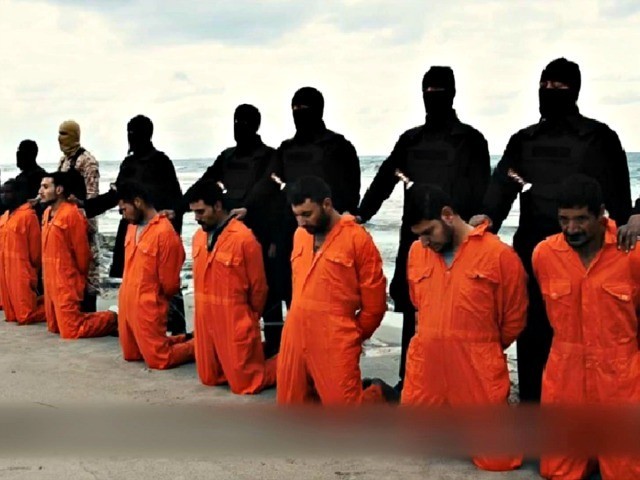
In the coming days, construction will commence on a new church in Egypt dedicated to the martyred Coptic Christians beheaded by the Islamic State in Libya in February.

The new church, bearing the name “Church of the Libyan Martyrs,” will be built in the Minya Governorate, south of the capital, Cairo. The church will cost $1.3 million, half of which has already been raised.

Egyptian President Abdel Fattah al-Sisi granted permission for the construction of the church last February after Islamic State militants murdered 21 Coptic Christians on a Libyan beach.

According to Father Rafic Greiche, spokesman for the Catholic Church in Egypt, the construction is indicative of a slow but noticeable shift taking place in Egyptian culture as well as among state officials. The change comprises improving attitudes toward Christians, but also resistance to Islamic extremism.

Until now, Fr. Greiche said, the procedure involved in getting a church building permit was extremely complex, involving a series of authorizations and approvals, which have been streamlined in this case. The decision also indicates that the government wished to send a strong message against religious discrimination, he said.

Greiche says that there have also been timid attempts at exegesis of the Koran and Islamic texts, accompanied by a ban on women teachers wearing a burka in the classroom and struggles against fundamentalism and extremist sermons in mosques.

Last week, the president of the University of Cairo, Dr. Hossam Kamel, prohibited teachers from wearing the burka in the classroom. They may continue to wear it, if they choose, at home or on the street, but not during teaching time.

Egypt’s top Islamic school, Al-Azhar, followed suit by banning women from wearing the burka in all its affiliate schools after a leading cleric said the burka was only a “tradition” and not necessary in Islam.

With general elections in late October and a possible reform of the Constitution, some expect a greater presence and visibility of Christians in society and in national politics as a result. While a transformation of the mentality naturally takes time, Greiche said, the fact remains that Christians are far more accepted in Egyptian society now than in the past.

President al-Sisi has asked Christians for a greater commitment in politics, urging them to vote and to run for office, to ensure a Christian presence in Parliament.

The High Electoral Commission also decided that at the first stage of the elections on October 17, women wearing the full veil must show their faces if they want to cast their vote.

For some time, there has been a greater determination to limit fundamentalism and extremism in mosques. The priest spoke of a “greater secularism without renouncing the religious element.”

Why hasn’t Sisi visited Washington yet?

October 9, 2015

Why hasn’t Sisi visited Washington yet? Al-MonitorMohamed Saied, October 8, 2014

(Obama thinks highly of the Islamist Muslim Brotherhood and rejects President Sisi because he supported the Egyptian masses who sought the overthrow of an increasingly dictatorial President Morsi. Obama’s rejection of Sisi’s Egypt pushed it into an alliance with Russia. Now Obama, et al, claim that alliance as a basis for the continuing hostility toward Sisi. Perhaps it is. Obama, et al, have also complained about Egyptian human rights violations in repressing the Muslim Brotherhood; few similar complaints have been made about far greater Saudi and Iranian human rights violations. Sisi is the only president of a Muslim nation who seeks to promote a more secular and hence moderate Islam, to which the Muslim Brotherhood is hostile. Please see also, Egypt’s secular culture minister ruffles Salafi feathers. — DM)

One of the most important issues that may hinder the return of US-Egyptian relations to their previous state is the strong relationship between Cairo and Moscow; Sisi has met his Russian counterpart Vladimir Putin four times so far, and Egypt is currently considered the most important ally of Moscow in the Middle East.

**********************

CAIRO — Ever since Egyptian President Abdel Fattah al-Sisi took office on June 8, 2014, US-Egyptian relations have been deteriorating. This has been further confirmed by the fact that Sisi has not visited Washington yet despite the shuttle visits he has made abroad.

Differences and conflicts plagued the US-Egyptian relationship during the era of President Gamal Abdel Nasser. These conflicts culminated in the 1967 Six-Day War, when diplomatic relations between the two countries were severed because of the economic and military support by the United States to Israel.

However, these relations started to take a positive turn based on the strengthening of the strategic interests shared between the two countries in the wake of the signing of the Camp David Accords with Israel — the US’ permanent ally — on Sept. 17, 1978, between Egyptian President Anwar Sadat and Israeli Prime Minister Menachem Begin, as per the State Information Service affiliated with the Presidency of the Republic.

Only one meeting was held between Presidents Sisi and Barack Obama on the sidelines of the 69th Session of the UN General Assembly in September 2014 in New York, but other than this the two presidents have been settling for phone calls to discuss the latest developments in the region.

According to The Washington Times, Obama refused to meet with Sisi on the sidelines of the 70th session of the UN General Assembly. Egyptian Foreign Minister Sameh Shoukry attributed this in a press statement on Sept. 24 to the mismatching agendas and schedules of the two presidents, which prevented them from holding individual talks.

According to the US Embassy in Egypt’s reports on the situation in the country following the revolution of June 30, 2013, Washington started a “comprehensive review” of its relations with Egypt on the background of the ouster of former Egyptian President Mohammed Morsi.

On Aug. 15, 2013, following the killing of hundreds of Muslim Brotherhood demonstrators in Al-Nahda Square and Rabia al-Adawiya Square, Obama announced the cancellation of the Bright Star maneuvers, which were launched in 1980 following the signing of the peace treaty between Egypt and Israel and consisted of a joint military exercise between the two countries.

By October 2013, the review of relations put a halt to the deal consisting of delivering arms to Egypt. Also in October 2013, the US administration suspended $260 million that was going to be directly transferred to the Egyptian government along with another $300 million in US loan guarantees.

However, in a telephone call on March 13, Obama told Sisi that the military aid amounting to $1.3 billion would continue.

Meanwhile, Dina Badawi, spokeswoman for the US State Department for the Middle East, expressed concerns in a live interview on the ONtv channel April 2 over the state of rights and freedoms in Egypt, and pointed out that aid is aimed at continuing the democratic track and the political reforms in the country.

Abdel Moneim Said, director of the Regional Centre for Strategic Studies, and Shai Feldman, the Judith and Sidney Swartz director at the Crown Center for Middle East Studies, said in a research paper titled “Resetting US-Egyptian relations,” which was published in March 2014 on the center’s website, that at the root of the downturn in the US-Egyptian relations is the huge gap between the two sides’ narratives regarding the events of June 30, 2013.

One of the most important issues that may hinder the return of US-Egyptian relations to their previous state is the strong relationship between Cairo and Moscow; Sisi has met his Russian counterpart Vladimir Putin four times so far, and Egypt is currently considered the most important ally of Moscow in the Middle East.

The dispute between Russia and the United States is in regard to several issues. Chief among these is the Syrian issue; Moscow launched airstrikes on Sept. 30, sparking criticism on the part of Obama during a press conference Oct. 2. Obama said that Moscow is acting “not out of strength, but out of weakness” in support of the losing party. The president was referring to Syrian President Bashar al-Assad, and he pointed out that Russia should help in reaching a political settlement.

Meanwhile, the Egyptian Foreign Ministry did not issue any statements condemning or supporting such strikes.

In January, spokeswoman for the US State Department Jennifer Psaki said during the daily press brief that a meeting she described as “routine” was held with a delegation of members of the former Egyptian parliament from the dissolved Muslim Brotherhood-affiliated Freedom and Justice Party, on the sidelines of their visit to Washington, which was organized and financed by Georgetown University in Washington.

This meeting raised the ire of the Egyptian political leadership, as well-informed sources told Reuters in June that the Egyptian government summoned the US ambassador in Cairo to express displeasure over visits to Washington by figures of the Muslim Brotherhood, which is banned in Egypt.

Concerning the fact that Egypt did not extend an official invitation to Obama to meet with Sisi, or vice versa, Atef el-Ghomri, former director of the office of the Egyptian Al-Ahram newspaper in Washington and a member of the Egyptian Council for Foreign Affairs, said, “There is an ongoing split within the US decision-making circles over the revolution of June 30, 2013, and the toppling of former President Mohammed Morsi, who belongs to the Muslim Brotherhood.”

Ghomri told Al-Monitor that over the past years, Egypt’s relations have been confined to its foreign relations with Washington as it only took into account its regional and international interests. This deprived Egypt of any international initiatives or insights about various issues. Also, Egypt had to give up its pivotal role in the Middle East as far as the African and Arab countries are concerned. This negatively affected Egypt over time.

“The Egyptian leadership is trying to diversify its foreign relations. It resorted to the Eastern bloc led by Russia, as well as East Asia represented by China and Singapore.” Ghomri added.

Washington is concerned about several files managed by the Egyptian leadership, mainly the human rights and political reforms issues. The United States has been expressing those concerns since the June 30 Revolution, when the Muslim Brotherhood was toppled and replaced by a military president.

Under such circumstances, Cairo had to resort to other countries, while the US-Egyptian relations are expected to witness further tension, especially with the differences in views concerning several international issues, namely Syria, Iran and Libya.


Iran’s terror general plotted Russian strikes in Syria

October 8, 2015

Iran’s terror general plotted Russian strikes in Syria, Front Page Magazine, Daniel Greenfield, October 8, 2015

(Please see also, Obama Admin’s Iran Point Man Promotes Anti-Israel Conspiracy Theories as it relates to Soleimani. — DM)

Russian propaganda claims that Putin wants to protect Christians. If he really wanted to protect Christians, he would tell his Iranian pals to stop persecuting Christians.

*********************

First, a little background on Qassem Soleimani.

“He’s got American blood on his hands,” Senator John Cornyn said of Soleimani. “I’m not sympathetic to lifting sanctions on him, that’s for sure.”

“Soleimani is the guy that sent the copper-tipped IEDs into Iraq,” said Senate Armed Services Committee Chairman John McCain, referring to powerful improvised explosive devices, which Marine Corps Commandant General Joseph Dunford testified last week were responsible for the deaths of 500 soldiers and Marines. “That is really unbelievable,” McCain said when asked about Soleimani’s name showing up in the bowels of the Iran nuclear deal.

In practice, Soleimani’s IRGC is a terrorist group despite protests from Obama and other Democrats. It’s also the key lever Iran is using to transform the region.

At a meeting in Moscow in July, a top Iranian general unfurled a map of Syria to explain to his Russian hosts how a series of defeats for President Bashar al-Assad could be turned into victory – with Russia’s help.

Major General Qassem Soleimani’s visit to Moscow was the first step in planning for a Russian military intervention that has reshaped the Syrian war and forged a new Iranian-Russian alliance in support of Assad.

As Russian warplanes bomb rebels from above, the arrival of Iranian special forces for ground operations underscores several months of planning between Assad’s two most important allies, driven by panic at rapid insurgent gains.

Soleimani is the commander of the Quds Force, the elite extra-territorial special forces arm of Iran’s Revolutionary Guards, and reports directly to Iran’s Supreme Leader, Ayatollah Ali Khamenei.

Perversely, Soleimani already enjoys US air support from Obama for his Shiite terror militias in Iraq. Now he’s got Russian air power backing his Shiite terror militias in Syria.

One of the world’s top terrorists has two air forces to play with.

Russian propaganda claims that Putin wants to protect Christians. If he really wanted to protect Christians, he would tell his Iranian pals to stop persecuting Christians.

The Palestinians’ New Intifada

October 8, 2015

The Palestinians’ New Intifada, Gatestone InstituteBarry Shaw, October 8, 2015

  • “I saw a mob of 40 to 50 masked Palestinians on the side of the road. They were holding rocks and cinder blocks. … I have no doubt that I would be dead now if I hadn’t used my gun. They were going to kill me.” – Josh Hasten, Oct. 7, 2015.
  • Arab children watch other Arab children on television throw rocks and firebombs, and speaking of knifing and shooting Jews, and they want a part of the action.
  • When Arabs hear from their leaders that Jews are “desecrating” Islamic holy places with their “filthy feet” and plotting to destroy them, it is a code, telling them to go out and attack Jews.

Yesterday, a friend, Josh Hasten, was set upon by a crowd of rock-wielding Palestinians, while he was driving to Jerusalem. “I saw a mob of 40 to 50 masked Palestinians on the side of the road. They were holding rocks and cinder blocks,” Hasten said. “As they approached my car, I took out my gun and fired one round in the air. The shot obviously scared them and they ran up the hill away from the road. I have no doubt that I would be dead now if I hadn’t used my gun. They were going to kill me.”

In Europe and the West, acts of terrorist violence are relatively rare; in Israel, they occur several times a day — on a regular basis.

Last week, Palestinian Authority (PA) President Mahmoud Abbas spoke at the United Nations, highlighting Israeli “crimes,” but without specifying any. He is, apparently, aware of losing control of the Palestinian “street,” which now seems to feel closer to radical elements within Palestinian society — especially since Hamas and Palestinian Islamic Jihad take credit for recent murders in Israel.

Palestinians who commit terrorist attacks are not, as in Europe, radicalized primarily by social media or clerics. They are, rather, radicalized primarily by their own Palestinian Authority or Hamas leadership. Arab children watch other Arab children on television throwing rocks and firebombs, and speaking of knifing and shooting Jews, and they want a part of the action.

Meanwhile, the Israeli government is prevented by international pressure from disbanding these groups or arresting their leaders. The equivalent is as if Britain were plagued by daily terror attacks directed by a leadership based in Birmingham, and with the British government prevented from acting against the source, under pain of condemnation and punishment from the European Union and the United Nations.

The current wave of Arab riots and terrorist attacks has been compared to an “intifada,” an Arabic word meaning “uprising” or “shaking off” — a word used to describe the desire of Palestinian Arabs to drive the Jews out of the land.

The violent demonstrations and riots are initiated and orchestrated by the Palestinian leadership, seemingly concerned about losing the support of their own people. Palestinian leaders have been seeing, in local surveys and student elections, a growing disenchantment with the corrupt and sclerotic Fatah-led Palestinian governance, as well as a growing popularity for Hamas.

Palestinian Authority leaders have also been seeing the rise in popularity of rival groups at the same time as they are being ignored by the world’s media and diplomatic community, who are busy with Iran, Russia, Syria and ISIS.

The current violence has a greater religious component than earlier intifadas.[1] Perhaps seeing that Hamas and Islamic Jihad are strongly Islamic, PA President Mahmoud Abbas latched onto the extremist — albeit totally incorrect — Islamist theme that Jews are trying to destroy Islamic holy places. He thereby ignited a firestorm of competition among radical groups as to which faction could incite the most violence.

1280Palestinian Authority President Mahmoud Abbas (right) ignited competition among radical groups as to which faction could incite the most violence. Left: official PA media incite Palestinians, from a young age, to murder Jews.

Hamas, ruling in the Gaza Strip, has made no secret of its wish to deepen its influence in the West Bank. This time, it was assisted by the Palestinian Authority, which used the Jewish high holy days as an excuse to accuse Jews praying at the Western Wall, of trying to take over Muslim holy places. The Western Wall, a holy place to Jews, is all that is left of the Jews’ Second Temple, which was destroyed by the Romans in 70 CE.

When Muslims hear from their leaders that Jews are “desecrating” Islamic holy places with their “filthy feet” and plotting to destroy them, it is a code, telling them to go out and attack Jews.

In addition, Muslim women, in organized groups funded by the Islamic Movement in Israel, have been bused to Jerusalem, and paid to abuse, and sometimes use violence, to prevent non-Muslims, mainly Jews, from visiting the Temple Mount. The women punch, kick, spit, and hurl insults at Jews (and often other non-Muslims) who visit or attempt to visit the Temple Mount.

For years, Mahmoud Abbas has been whipping up the Palestinians with claims — all false, as can be seen throughout the Bible — that Jews have no heritage or history in Jerusalem, and therefore have no right to be there. It is a charge he repeats despite a Jewish presence and culture in the land that dates back over 3000 years.

Incitement to violence leads to actual violence. So, on October 3, an impressionable 19-year-old Arab man became a murderer. Muhannad Halabi, before setting out on his killing spree, wrote on his Facebook page, “The Third Intifada has erupted!…Defending the sanctity of Al-Aqsa and its women is out pride and honor… We know only that Jerusalem is undivided and that every part of it is holy.”

This young killer was apparently caught up in the passion of the false claims of Abbas that Jews were defiling Islamic holy places with their “filthy feet,” that he took a knife and entered the Jerusalem’s Old City in search of Jews. There, he attacked a Jewish family that on its way to pray at the Western Wall. He stabbed Aharon Banita, and his wife, Adele. Hearing the screams of the victims, 41-year-old Rabbi Nehemia Lavi, armed with a pistol, ran over to stop the attack. Halabi stabbed and killed Lavi, took his gun, and shot and wounded 2-year-old Matan Banita. Seconds later, security forces arrived and killed Halabi in a shootout. Adele and Matan Banita survived.

During the attack, as the wounded and bleeding Adele Banita ran through the street screaming for help, she was jeered at, spat on, hit and insulted by Arab passersby and local Arab shopkeepers. None of them helped her. She reported later from the hospital that many of them screamed at her to die. The anti-Jewish incitement by Palestinians resulted in the killing of four Jews – simply because they were Jews.

In the minds of radicalized Palestinians, there is no difference between shooting or stabbing women and children, and shooting men.[2]

Many in the Western media fail to portray events in Israel accurately. The most morally tortured headline came from BBC News. Its headline on October 4 read “Palestinian shot dead after Jerusalem attack kills two.” It appeared a clear effort to make readers believe that the Palestinian terrorist was the victim.

Unless the West persuades Abbas to stop the incitement, perhaps by linking financial aid to performance, his intifada will continue to escalate.

__________________________-

[1] In the first “intifada,” from 1987-1993 Arabs attacked primarily Israeli soldiers and police, mainly with rocks and firebombs. The second “intifada” (2000-2005), planned by the late Palestinian Authority President Yasser Arafat, included widespread attacks — suicide bombings, shootings and car bombs — against any and all Israeli targets, mainly civilians.

[2] In 2011, for example, three of the six children from the Fogel family in the village of Itamar were hacked to death in their beds, along with their parents, when Palestinian terrorists broke into their home. It was near Itamar that four small children from the Henkin family miraculously avoided death under a hail of bullets on October 1, when Palestinians murdered their parents (Eitam and Naama Henkin) in a drive-by shooting. The nine-year-old son recited the mourner’s prayer at his parents’ graves the following day.

Saudi Sheikh Yahya Al-Jana’ Waxes Lyrical about the Virgins of Paradise

October 8, 2015

Saudi Sheikh Yahya Al-Jana’ Waxes Lyrical about the Virgins of Paradise, Middle East Media Research Institute, October 7, 2015

(This must be either a warning about raping immodest women or a put-down of Viagra. — DM)

According to the blurb following the video,

In a lesson posted on the Internet on September 1, 2015, Saudi Sheik Yahya Al-Jana’ talks about the joys of Paradise, saying that men will have the strength of a hundred men in Paradise and will be busy “tearing hymens,” while the virgins of Paradise, whose breasts are “like pomegranates,” become virgins every time again.

Robert Spencer: The speech the U.S. Catholic Bishops don’t want you to see

October 7, 2015

Robert Spencer: The speech the U.S. Catholic Bishops don’t want you to see, Jihad Watch via You Tube, October 5, 2015

(An excellent explication of differences between Islam and Christianity and the theological bases for the animosity of religious Muslims toward religious Christians. Please see also, Evangelicals Embrace Islamists at Maryland Interfaith Event. — DM)


According to the blurb beneath the video,

Jihad Watch director Robert Spencer was the keynote speaker at the annual convocation of the North American Lutheran Church, Dallas, Texas, August 13, 2015. He spoke about Muslim persecution of Christians.

The U.S. Conference of Catholic Bishops pulled their representative from the North American Lutheran Church convocation when they found out Spencer was the keynote speaker. Watch this speech and see what the Catholic Bishops of the United States don’t want you to know.

Egypt’s secular culture minister ruffles Salafi feathers

October 7, 2015

Egypt’s secular culture minister ruffles Salafi feathers, Al-MonitorRami Galal, October 6, 2015

(Building a secular Muslim state in a region dominated by Islamists is difficult and takes time, as Egypt and Al-Sisi are learning. — DM)

helmiEgypt’s newly appointed Culture Minister Hilmi al-Namnam appears on the Egyptian talk show 25/30, Nov. 11, 2014. (photo by youtube.com/ONtv)

CAIRO — On Sept. 19, a new Egyptian Cabinet, headed by Prime Minister Sherif Ismail, was sworn in before President Abdel Fattah al-Sisi. Among the new ministers is the journalist Hilmi al-Namnam, who holds the culture portfolio. The appointment of Namnam, a secularist, has sparked controversy among Egyptian Salafis and aroused opposition in Saudi Arabia. Such Saudi writers and intellectuals as Jamal Khashoggi, editor-in-chief of Al-Arab News Channel, object to Namnam’s appointment because he opposes Wahhabi Salafism, the religiopoliticial movement that originated in the Nejd region of the Saudi kingdom.

Muhammad ibn Abd al-Wahhab founded what became the Wahhabi movement in the 18th century. In 1744, Wahhab allied with Muhammad ibn Saud, emir of the Nejd and founder of the first Saudi state, to increase followers of the Quran, Sunnism and the words and actions of the Salaf, the first three generations of Muslims. In doing so, they sought to purify Islam of misguided practices negatively affecting the Islamic essence of unity and various forms of heresy.

Immediately after Namnam assumed the culture portfolio, a video of him from July 2013 went viral. In it, Namnam stated, “The political Islam current must leave the political game completely, especially the Salafist Nour Party, which is more dangerous than the Muslim Brotherhood.” He compared the Nour Party to a “whore who extorts her husband if he doesn’t fulfill her demands by escorting someone else.” Namnam also said, “We lie when we say Egypt is a naturally religious country. It is high time we said Egypt is a naturally secular state.”

The Nour Party came in second in the 2012 parliamentary elections. Among its positions at the time were prohibitions on electing women and Copts, saluting the flag and singing the national anthem. The party altered these platforms, however, after lending its stamp of approval in 2013 to the June 30 revolution, although most of its leading figures waivered over what course to take.

On Sept. 19, Shaaban Abdel Aleem, a member of the Nour Party’s board, requested information on the selection criteria used for appointing the new ministers. On the same day, Khashoggi, who is close to Saudi decision-makers, commented on Namnam’s appointment via Twitter. “For whoever is planning mutual cultural exchanges with our brothers in Egypt, the following piece of information could be useful: Namnam is not only a critic of Wahhabism, but abhors it and blames it for all his country’s catastrophes,” Khashoggi tweeted. In a separate tweet, he wrote, “Honestly, for the sake of relations between Saudi Arabia and Egypt, and due to the nature of the regime there, Egypt should not appoint a minister like Namnam, who has taken it too far in offending the kingdom.”

Namnam responded that evening in a phone call to “Al-Ashera Masaa,” a show on Dream TV, saying, “I did not say Wahhabism was the mother of vices. These are not my words, but I am against terrorist groups in general.” He added that he had criticized “attempts to export Wahhabism to Egypt,” but that he “respects the kingdom’s choices, just as the kingdom’s writers should respect Egypt and Egyptians’ choices.”

Khashoggi immediately replied, again on Twitter, writing, “Egypt’s minister of culture claims he respects Wahhabism, but admits that he is against exporting it to Egypt. I would like to tell him that Wahhabism cannot be exported. It is a pillar of the Egyptian revolution and is represented by emblematic figures like the followers of Sheikh Muhammad Abduh.” The Islamic jurist Abduh, an Egyptian, is a founder of Islamic modernism. He spearheaded the movement at the end of the 19th century, beginning of the 20th century to counter intellectual and cultural stagnation and revive the Islamic nation in line with the times.

Khashoggi argued, “Salafism preceded the Muslim Brotherhood in Egypt, as there was the Ansar al-Sunna al-Muhammadiyah group, which remains the oldest reformist Islamic organization in Egypt and the world.” Ansar al-Sunna al-Muhammadiyah seeks absolute unity and the rejection of superstitions and cults. It began in Cairo’s Hadara Mosque in 1926. Many Al-Azhar scholars and Salafist preachers were welcoming of it.

On Oct. 2, tensions escalated when Namnam said during an interview on the Sada al-Balad channel that he was ready to be “martyred to spare Egypt from turning into a caliphate state.” He added that secularism is not the adversary of Islam, as some claim. “Every moderate Muslim is necessarily secular. But, not every secularist is a Muslim,” he said.

The following day, Yasser Borhami, deputy leader of the Salafist Call, implored Sisi to intervene and forbid Namnam from making such statements, which he said contradict the constitution given that Sharia is the primary source of legislation.

Nour Party leader Younes Makhyoun entered the fray Oct. 3, asserting that Namnam should remain impartial or be dismissed. “The person [Sisi] who appointed this minister must oblige him to respect the constitution,” he stated.

Sayyed Mustafa, deputy chair of the Nour Party, told Al-Monitor, “The party did not look into Namnam’s old opinions, because they stem from personal freedom. Each person has the right to believe whatever they wish. But he must realize that he is the minister of culture for 90 million Egyptians. The Ministry of Culture should represent all currents, not just one, be it secular or nonsecular.” He added, “As a minister handling a political portfolio, Namnam must take into consideration Egypt’s foreign relations in general and brotherly relations in particular, like those it shares with Saudi Arabia.”

Zubeida Atta, former dean of Helwan University’s faculty of arts and a member of the Supreme Council of Culture, has a different perspective on the issue. “The concept of secularism that Namnam called for is not a heretical one. It relies on the use of education and its application in countries to improve them and ensure their civil aspects, instead of mixing religion with political life. The latter [mixing of the two] would send Egypt down a sectarian abyss that would threaten its existence,” she told Al-Monitor. “The Nour Party demanded clarifying the selection criteria of ministers. I demand clarifying the criteria that allow such a religious party to participate in political life and in parliamentary elections.”

As for the rumblings from the Gulf, Atta asserted, “Egypt does not dare suggest a Saudi Arabian minister for a certain ministry in the kingdom or criticize a current minister in the Saudi Arabian regime, because this is an internal Saudi Arabian matter. Why is Khashoggi, among others, allowing himself to interfere in the appointment of a minister in the Egyptian Cabinet?”


