Archive for the ‘Islamic terrorism’ category

Pamela Geller: SEPTEMBER 11th, sixteen years later and so much worse

September 11, 2017

Pamela Geller: SEPTEMBER 11th, sixteen years later and so much worse, September 11, 2017

Sixteen years later, look where we are.  For years, public schools didn’t each talk about 9/11.  Now they do. The lessons “emphasize the good that grew out of the “tragedy,” In the UK,  teachers “scared” to teach about 9/11 for fear of being labeled “Islamophobic.” Terror-tied groups like the Muslim Student Association are holding a celebratory cake sale at Hunter College today.

*************************************

SEPTEMBER 11TH

On the morning of September 11, 2001, the deadliest terrorist attack in U.S. history took place when four commercial airliners were hijacked by Muslim terrorists. The first two planes, American Airlines Flight 11 and United Airlines Flight 175, were flown into the two towers of the World Trade Center in New York City. A third plane, American Airlines Flight 77, hit the western side of the Pentagon, just outside Washington, D.C. The fourth hijacked plane, United Airlines Flight 93, crashed down in a field in rural Pennsylvania, never reaching its intended target because its crew and passengers fought back against the terrorists. Nearly 3,000 people lost their lives during the 9/11 attacks, a number that would almost certainly have been significantly higher if not for the actions of those aboard Flight 93.

It’s a day the left would rather we ignore. It’s a day that Islamic supremacists secretly and not so secretly celebrate. It’s a day the elites call a day of service. In service to whom? The attackers? The simpering soft selling and apologetics is a deliberate distraction and a diversion from discussing the enemy and their ideology.

September 11th is national day of mourning. Period.

At 8:45 am on September 11, 2001, Muslim terrorists hijacked American Airlines Boeing 767 loaded with 20,000 gallons of jet fuel and crashed into the north tower of the World Trade Center in New York City, instantly killing hundreds of people and trapping hundreds more on the building’s higher floors.

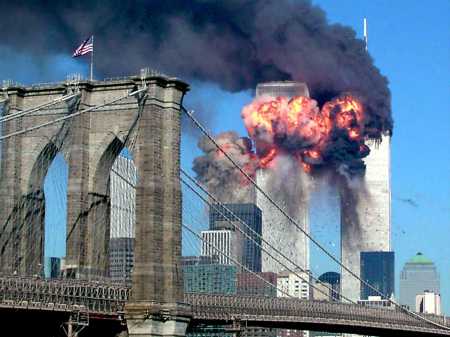
Eighteen minutes later at 9:03 am, a second hijacked airliner, United Airlines Flight 175 from Boston, turned sharply toward the World Trade Center and sliced into the south tower and explodes.

At 9:45 the jihadis struck the nerve center of the U.S. military, Flight 77 slams into the Pentagon.

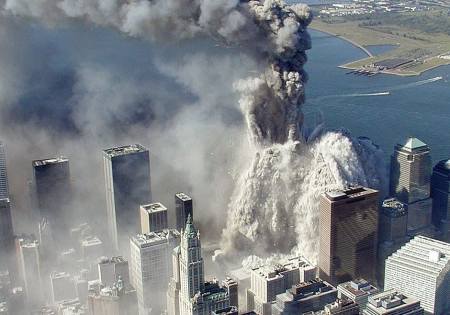
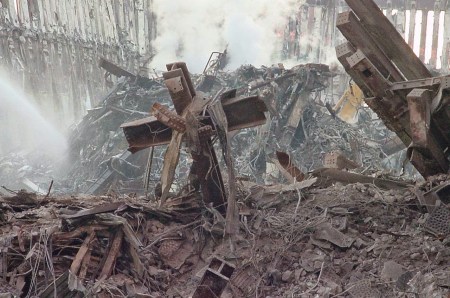
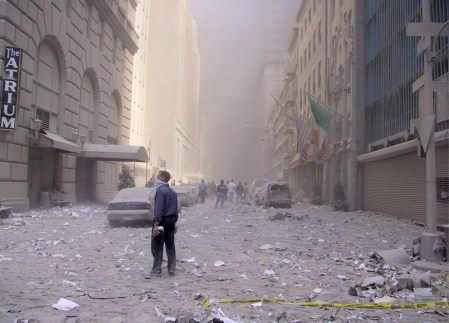
10:05 a.m.: The south tower of the World Trade Center collapses, plummeting into the streets below. A massive cloud of dust and debris forms and slowly drifts away from the building.

10:10 a.m.: United Airlines Flight 93, also hijacked. crashed down in a field in rural Pennsylvania, never reaching its intended target because its crew and passengers fought back against the terrorists. The hijackers were targeting the White House, the U.S. Capitol, the Camp David presidential retreat in Maryland or several nuclear power plants along the Eastern seaboard.

After a brief discussion, a vote was taken and the passengers decided to fight back against their hijackers, informing several people on the ground of their plans. One of the passengers, Thomas Burnett Jr., told his wife over the phone, “I know we’re all going to die. There’s three of us who are going to do something about it. I love you, honey.” Another passenger, Todd Beamer, was heard over an open line saying, “Are you guys ready? Let’s roll.” Sandy Bradshaw, a flight attendant, called her husband and explained that she had slipped into a galley and was filling pitchers with boiling water. Her last words to him were: “Everyone’s running to first class. I’ve got to go. Bye.” (History)

10:28 a.m.: The World Trade Center’s north tower collapses from the top down as if it were being peeled apart, releasing a tremendous cloud of debris and smoke.

11:18 a.m.: American Airlines reports it has lost two aircraft. American Flight 11, a Boeing 767 flying from Boston to Los Angeles, had 81 passengers and 11 crew aboard. Flight 77, a Boeing 757 en route from Washington’s Dulles International Airport to Los Angeles, had 58 passengers and six crew members aboard. Flight 11 slammed into the north tower of the World Trade Center. Flight 77 hit the Pentagon.

An aerial view of the damage at the Pentagon two days after Sept. 11, 2001


Two women hold each other as they watch the World Trade Center burn following a terrorist attack on the twin skyscrapers in New York City on September 11, 2001. #
AP Photo/Ernesto Mora

11:26 a.m.: United Airlines reports that United Flight 93, en route from Newark, New Jersey, to San Francisco, California, has crashed in Pennsylvania. The airline also says that it is “deeply concerned” about United Flight 175.

11:59 a.m.: United Airlines confirms that Flight 175, from Boston to Los Angeles, has crashed with 56 passengers and nine crew members aboard. It hit the World Trade Center’s south tower.

On a beautiful, bright blue sunny morning, a perfect day in mid-September. Nothing was ever the same.

My life changed on that one day, in one moment.

The World Trade Center was burning.

The Pentagon was burning.

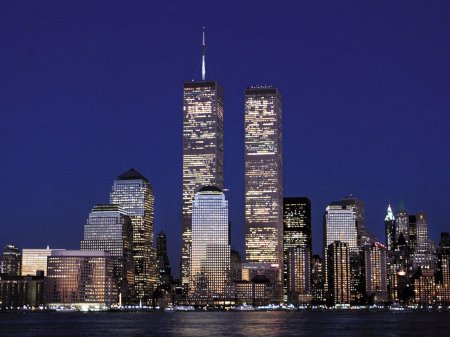
The World Trade Center was a city all its own. It had it’s own zip code, 10048. It was populated by 50,000 people at the height of the day, and 200,000 more people visited it every day.

The building was an architectural marvel.

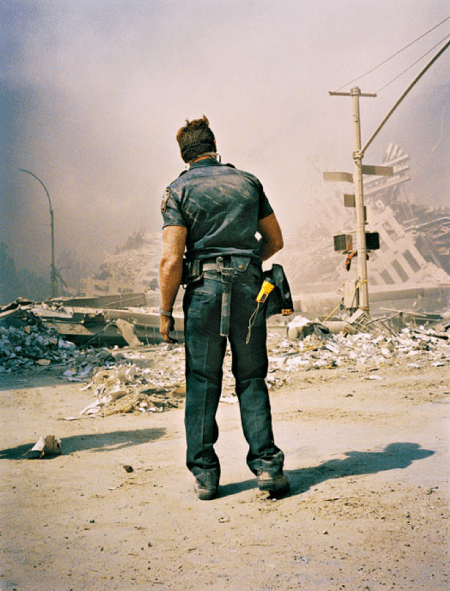
When those gleaming towers were attacked, I stood in front of my TV, paralyzed. And when the Towers came down in a blinding cloud of flesh, bone, paper, steel — shreds of life — I wept.


I didn’t know who we were at war with. But I did know that life as we knew was was over, dead. It had become history, a memory, on that morning. War had come came to America.

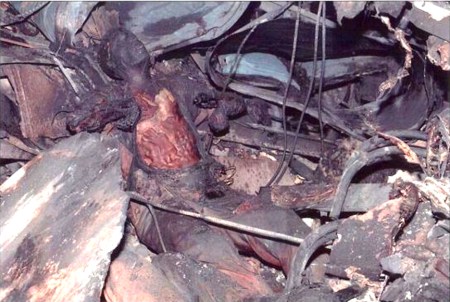
The horror and death was on a scale that was unimaginable in America. People, who just hours earlier, had their morning joe, kissed their wives or husbands, took their children to school, maybe grabbed a McMuffin and hurried into the city to get to their desks, were faced with the most shocking, horrific imminent death. Men and women waving shirts or jackets stood on the gashed edge of a gaping wound at the top floors of the towers. No one could get to them. No one could help them. The heat from the flames of the airplane turned into a fireball that left people with no choice. Burn to death or jump. Hundreds jumped to their deaths. “It looked like they were blinded by smoke… they just walked to the edge and fell out.”

When they hit the pavement, their bodies were not so much broken as obliterated.

Eyewitnesses talked of a couple who held hands as they fell.

One woman, in a final act of modesty, appeared to be holding down her skirt. Others tried to make parachutes out of curtains or tablecloths, only to have them wrenched from their grip by the force of their descent.

The fall was said to take about ten seconds. If someone fell head down with their body straight, as if in a dive, it could be 200mph. When they hit the pavement, their bodies were not so much broken as obliterated.

The sound of the bodies hitting the pavement was deafening. I did not hear them at the time — but in the beginning, in the news reports, before all the news regarding the jumpers were censored and scrubbed, I heard the sound then. Years later, when I was editing my Ground Zero Mosque movie, I included that footage in the film, and that sound is horrifying.


I thought about John Florio, that big brave firefighter who worked out at my gym. He would come in every morning with a tiny infant and leave her in the windowed childcare center. I wondered if he had rushed to Manhattan when he heard about the attack, to help out.

John Florio had, and he had died there.

The memories are vivid still.

The jihadis came to conquer America and looking back sixteen years later, they have had a good measure of success. The media, universities, schools, culture, etc has submitted to a good measure of islamization. Those who oppose jihad and sharia are demonized and smeared by hate groups like the SPLC and terror-tied CAIR. Our names are dragged through the mud. Our reputations are ruined.

Sixteen years later, look where we are.  For years, public schools didn’t each talk about 9/11.  Now they do. The lessons “emphasize the good that grew out of the “tragedy,” In the UK,  teachers “scared” to teach about 9/11 for fear of being labeled “Islamophobic.” Terror-tied groups like the Muslim Student Association are holding a celebratory cake sale at Hunter College today.

In one of the most celebrated plays in recent memory, Disgraced,  the lead character, Muslim-American Amir Kapoor, admits he felt a “blush of pride” on September 11th. The play received the Pulitzer Prize for Drama, the Joseph Jefferson Award for New Work – Play or Musical and a 2013 Obie Award for Playwriting. But cartoonists, writers, poets, journalists, are targeted for death for opposing the most brutal and extreme ideology on the planet. We can’t talk about this.

Millions of Americans have, without even realizing it, internalized the idea that it is “racist” and “bigoted” to resist jihad terror. People are used to granting Muslims special accommodations in the workplace. On campuses nationwide, Muslims are presented as victims of the American “Islamophobic” war machine. Movies studiously avoid depicting jihadis as villains.

Our public schools proselytize for Islam, teaching our children the shahada and the five pillars of Islam. American university have become unsafe for Jews because of harassment and intimidation from Muslim groups. But there are no school lessons about 9/11 – the largest terrorist attack on American soil. School children know nothing about it. They know more about the attack on Pearl Harbor, a military installation,  than they do about the multiple 9/11 attacks on the homeland. It’s unfathomable. But that is how deeply the fear of insulting Islam has crippled the nation.

The cultural adherence to the blasphemy laws under the sharia (under the guise of speech)  in the media, movies, music mirrors the oppression rampant in totalitarian socialites. Social media giants like Facebook, Google, Pinterest, Twitter exact stiff and swift penalties on those who dare criticize Islam. The Geller Report’s article and posts have been scrubbed from Google search. Google has changed its search results for terms such as “jihad” and “sharia”  to show “only positive explanations of Islamic concepts” and conceal criticism of  Islam. Google Adsense has banned my account and websites like mine. Google search  is blacklisting and has admitted to working with alt-left smear groups to silence opposition. And it’s not just me, it’s all criticism of jihad and sharia. Vice President of Facebook Joel Kaplan traveled to Pakistan and met with Interior Minister Chaudhry Nisar Ali Khan to assure Pakistan that it will remove “hateful and provocative material.”

All this while the global jihad rages. There have been 31, 714 deadly Islamic attacks since 9/11. Appeasement, submission and accommodation is not working. On the contrary, it has emboldened the enemy. Terrorism works.

We have our work cut out for us.

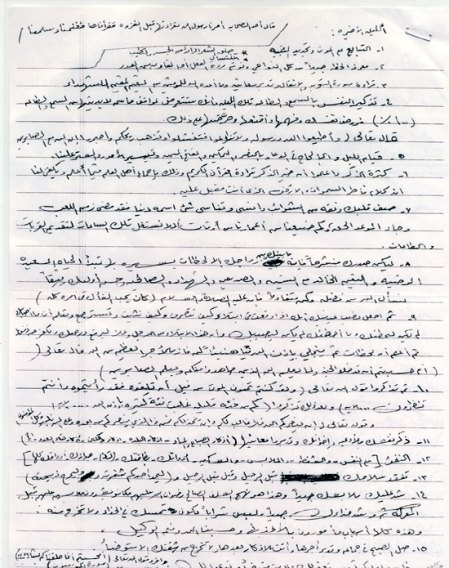
The 9/11 Muslim terrorists extolled Allah no less than 90 times in their last letters.

Read al-Tawba and Anfal [traditional war chapters from the Qur’an] and reflect on their meanings and remember all of the things Allah has promised for the martyrs.

The aftermath in Washington of the terrorist attack on the Pentagon, Sept. 11, 2001. . Navy photo by Petty Officer 2nd Class Robert Houlihan


Pamela Geller’s film: “Can’t We Talk About This?” | Islam & free speech

September 9, 2017

Pamela Geller’s film: “Can’t We Talk About This?” | Islam & free speech, Rebel Media via YouTube, September 9, 2017

Iran, operating from Syria, will destroy Europe and North America

August 28, 2017

Iran, operating from Syria, will destroy Europe and North America, Israel National News, Dr. Mordechai Kedar, August 27, 2017

(In most places where the American military is currently involved, Muslims are fighting other Muslims. If Israel is put at risk it is quite likely that America will intervene to help her, if an anti-Israel government does not return to power. — DM) 

This ethnic cleansing is the Ayatollah’s dream come true, the dream that sees a Shiite crescent drawn from Iran through Iraq and Syria to Lebanon and the Mediterranean Sea. This will cover the eastern Arab world from the north, while the war in Yemen is being fought in order to create a parallel southern crescent, entrapping Saudi Arabia and Jordan between the two. With the help of Allah, both those countries and Israel, the Small Satan, will soon fall into the hands of the Shiites, while Europe and America do nothing because who cares when Muslims fight other Muslims?

***********************************

Iran and Russia plan to destroy Western Europe, the US and Canada by means of a new wave of millions of Syrian Sunnis fleeing to the West to escape the Shiite takeover of Syria.

In my weekly column two months ago, I claimed that Iran is the real victor in the Syrian civil war.  Using the war against ISIS as a smokescreen, it is taking over large swathes of Syrian territory, mainly in the scarcely populated middle and eastern parts of the country. In the more fertile and densely populated west of Syria, there are  Iraqi, Afghan, and Iranian Shiite militias augmenting  Lebanese Hezbollah fighters who were given carte blanche to do whatever Hassan Nasrallah decides to do there.

Assad’s strength continues to increase as ISIS and the other rebel forces lose ground.  The brutality of Russian involvement and the cruelty of Shiite militias overcame the anti-Assad forces, the turning point occurring when in 2015, Turkey’ s Erdogan was forced by Russia to cease his aid to the rebels and ISIS. Today, although Erdogan is an unwilling ally of Russia, Alawite Assad still sees him, justifiably, as an Islamist enemy.

The Kurds of northeast Syria, treated as below third class citizens until 2011, will never agree to live under Arab mercy once again and it is reasonable to assume that should Syria remain an undivided country under Assad’s rule, the Kurds will preserve relative autonomy in their region – or fight the regime for their rights.

That is certainly a problem, but the main issue facing a united Syria is going to be the drastic demographic changes the country is going to face.

First of all, about half of Syria’s citizens – close to 10 million – are refugees, half located in Syria and the other half in Jordan, Turkey, Lebanon, other Arab countries, Europe, North and South America, Australia and even Israel.  Syrian refugees who reached points outside the Arab world will in all probability stay put, benefitting from the secure and orderly lives they can now lead. On the other hand, the 3.5 million now in Jordan, Lebanon and Turkey are awaiting the end of hostilities in order to return to their homes.

Those expectations may be dashed, however, because Syrian reality is totally changed, and large parts of its cities are in ruins after six and a half years of a cruel and bloody war.  Countless bombs dropped from planes and helicopters, artillery and tank barrages, mines and explosives planted by both sides have made much of urban Syria, where most of the fighting took place, unsafe to live in. In Homs, Aleppo, Adlib, Hamat and many other cities, entire neighborhoods will have to be razed and their infrastructure rebuilt from scratch. Decades and billions of dollars are needed to rebuild the country and I, for one, do not see the world’s nations standing on line to donate the necessary funds.  Refugees will not agree to switch their tents in Jordan for ruined buildings lacking basic infrastructure in a desolate and destroyed Syria.

The other reason the refugees will not return is their justified fear of the new lords of the land – the Shiites. Iran has been moving Shiites from Iraq, Iran and Afghanistan to Syria for a long time in a clear attempt to change the demographic makeup of the country from the Sunni majority it had before the civil war broke out in 2011. The issue could not be more clear because it is no secret that the pre-civil war Sunni majority considered the Alawite rulers heretic idol worshippers who had no right to live in Syria, much less rule over it.

The Alawites know well that the Sunnis rebelled against them twice: The first time was from 1976 to 1982, a rebellion that took the lives of 50,000 citizens. The second time, slowly drawing to an end, has cost the lives of half a million men, women, children and aged citizens of Syria.  The Alawites intend to prevent a third rebellion and the best way to do that is to change the majority of the population to Shiites instead of Sunnis.  They will not allow the Sunni refugees to return to their homes, leaving them eternal refugees whose lands have been taken over by the enemy. Iran, meanwhile, will populate Syria with Shiites from Iraq, Iran and Afghanistan.

This ethnic cleansing is the Ayatollah’s dream come true, the dream that sees a Shiite crescent drawn from Iran through Iraq and Syria to Lebanon and the Mediterranean Sea. This will cover the eastern Arab world from the north, while the war in Yemen is being fought in order to create a parallel southern crescent, entrapping Saudi Arabia and Jordan between the two. With the help of Allah, both those countries and Israel, the Small Satan, will soon fall into the hands of the Shiites, while Europe and America do nothing because who cares when Muslims fight other Muslims?

The Shiite majority in Syria will play along with Lebanon’s Hezbollah, their natural allies, and it is possible that some form of federation might be created between the two in order to push the Lebanese Christians out of the picture, “persuading” them to flee to other countries, leaving Lebanon to its “rightful” Shiite masters. This explains Nasrallah’s eager willingness to fight on Syrian soil as well as the opposition of those against Nasrallah to his involvement there.

The reasons are obvious:

1. Former ISIS and rebel forces will infiltrate along with the refugees, because they, too,  are Sunni. They are filled with fury and hatred for the Western countries  who were part of the coalition that fought ISIS or stood by without aiding the rebels. Some of them will continue their Jihad on European and North American soil. Expect shootings, explosives and ramming attacks against citizens of these countries.

2. Some of the refugees will not find work and live on the economic and social fringes of society, in poverty-stricken Islamist neighborhoods which have already existed for years in many European cities, and where the local police fear to tread. Poverty and life on the fringe of society will turn some of the Muslim young people into easy prey for terrorist organization recruiters who arouse the desire for Jihad by describing the accepting host countries as decadent societies infected with permissiveness, prostitution, alcohol, drugs, materialism and corruption.  They present the countries that allowed the immigrants entry as having done so to take advantage of them as industrial slaves, garage hands, cashiers and other degrading occupations, while the privileged citizens are lawyers, accountant, businessmen and homeowners who take advantage of the migrants in humiliating ways. It is only a matter of time until young Muslims, especially those who were taught that “everyone is equal” in Western schools, enlist in terrorist organizations.

3. Countries which allow in refugees will suffer a higher crime rate as a result, including violence in public places, sexual attacks and harassment, housebreaking, car theft, substance abuse, unreported work to avoid paying taxes and illegal construction. This will all occur at the same time these countries expend a larger part of their budgets on social services for the refugees, from child allowances to unemployment, health and old age benefits. At this point in time, the percentage of second and third generation immigrants populating the prisons in Western Europe is significantly larger than their percentage in the general population.

4. Increased economic, social and security problems in Europe and North America as a result of the rise in the number of migrants will lead to a rise in the strength of the right and the extreme right.  This will in turn lead to more social tensions in the West. Members of Parliament whose only wish is to be re-elected will adapt their parliamentary activity – especially the laws they promote – to the expectations of the rapidly Islamizing constituencies, sacrificing their own people’s interests on the altar of their political careers. Many Europeans, aware of their elected leaders’ betrayal, will despair and leave those socially and economically deteriorating countries. This will increase the rate at which Europe turns into an Islamic region..

And that is how the agreements Iran and Russia will soon coerce Syria into accepting  are going to start a chain reaction increasing the number of refugees and pulling  Europe down to a point of no return, without the world understanding what  is going on. The Atlantic Ocean is not wide enough to protect North America from this debacle crossing the sea.

This is how the Iranian Ayatollahs intend to destroy the heretic, permissive, drunk and materialistic  West.  More of the unfortunate Syrian millions will find themselves exiled to the heretic countries hated by the Ayatollahs, and Iran will operate from Syrian soil to vanquish Europe and America.

Secretary of State Tillerson Attacks Gorka on “Radical Islam”

August 27, 2017

Secretary of State Tillerson Attacks Gorka on “Radical Islam”, The Point (Front Page Magazine), Daniel Greenfield, August 27, 2017

(Please see also, 25 Reasons to Reassign General H.R. McMaster. — DM)


https://www.youtube.com/watch?v=xxv0uicC2T8


The foreign policy deck has been cleared of Islam realists. And it shows.

Secretary of State Rex Tillerson said Sunday that Sebastian Gorka was “completely wrong” in his resignation letter’s assessment of the battle over Trump administration policy.

“Fox News Sunday” host Chris Wallace asked Tillerson about Gorka’s accusations, especially regarding the president’s recent speech on Afghanistan.

“Sebastian Gorka in his resignation letter wrote this about the Afghanistan speech: ‘the fact that those who drafted and approved the speech remove any mention of radical Islam or radical Islamic terrorism proves that a crucial element of the presidential campaign has been lost.’ Is he right?” Wallace asked.

“I think he’s completely wrong, Chris,” Tillerson said. “And I think it shows a lack of understanding of the president’s broader policy when it comes to protecting Americans at home and abroad from all acts of terrorism. The president has charged us to develop policies and tactics, both diplomatically and militarily, to attack terrorism in as many forms wherever it exists in the world and wherever it might present a threat to the homeland or to Americans anywhere.”

“This means that we have to develop techniques that are global in nature. All we want is to ensure that terrorists do not have the capability to organize and carry out attacks,” he added.

Are there any non-Islamic global terrorist threats? What are we fighting in Afghanistan except Islamic terrorism?

Are we at war with Mormons or the Amish in Afghanistan? Who are the Taliban again? Or the Haqqani Network? Or the Islamic State?

Best not to ask. See nothing. Hear nothing. Say nothing. It’s worked brilliantly since 9/11. I can imagine how different things might have been under Secretary of State Bolton. But as Whittier said, “For all sad words of tongue and pen, The saddest are these, ‘It might have been’.”

Or as Obama put it, “The future must not belong to those who slander the prophet of Islam”.

Meanwhile it’s interesting how selective Tillerson is when claiming to speak for Trump.

In Egypt, Clashes Between The Institution Of The Presidency And The Institution Of Al-Azhar

August 21, 2017

In Egypt, Clashes Between The Institution Of The Presidency And The Institution Of Al-Azhar, MEMRI, August 21, 2017

Introduction

Egypt’s Al-Azhar University, the most important institute of learning in the Sunni Muslim world, and its head, Sheikh Ahmad Al-Tayeb, are currently facing a political and media attack led by the institute of the Egyptian presidency, headed by President ‘Abd Al-Fatah Al-Sisi. This is the latest episode in the past two years of ongoing tension between the two institutions, over Al-Azhar’s apparent refusal to comply with the president’s dictates in matters of religion.

One aspect of the attack on Al-Azhar is President Al-Sisi’s direct criticism of Al-Azhar Sheikh Al-Tayeb; another is criticism of Al-Azhar in the government press; and yet another is parliamentary moves led by Al-Sisi’s associates aimed at limiting the authorities of the Al-Azhar sheikh. There have also been calls for Sheikh Al-Tayeb himself to step down.

The main criticism against Al-Azhar is that the institution has failed to join the ideological war on terrorism that is led by President Al-Sisi. Critics say that Al-Azhar is not complying with Al-Sisi’s major goal, announced in 2014 and frequently reiterated by him, to promote a renewal of the religious discourse in Egypt, and also point out that it is refusing to level the accusation  of heresy against the Islamic State (ISIS), which has claimed responsibility for several terror attacks in the country.[1] It is also being said that Al-Azhar’s curricula encourage young people to turn to terrorism. In addition, there is criticism of Al-Azhar’s refusal to change how divorces are handled, as Al-Sisi has also demanded.

Al-Azhar representatives, headed by Sheikh Al-Tayeb, have rejected these criticisms, calling them deliberate lies that damage Islam. To show that it is indeed fulfilling its role and that it is a moderate Islamic institution, Al-Azhar has in recent months held international conventions on the subject of fighting extremism, as well as meetings with young people, and has waged anti-extremism and anti-terrorism campaigns.[2]

It should be noted that despite the harsh criticism of Al-Azhar, and of Sheikh Al-Tayeb, it still has the public’s sympathy, and significant support from many members of parliament.

This report will focus on the tension between the Egyptian presidency and Al-Azhar, as reflected in statements by the leaders of both institutions, in parliamentary activity against it,  and in articles in the Egyptian press.

Al-Azhar Institute (image: balkans.aljazeera.ne)

Tension Between President Al-Sisi And Al-Azhar Sheikh Al-Tayeb

As stated, in recent months it has become evident that there is considerable tension between President Al-Sisi and Al-Azhar Sheikh Ahmad Al-Tayeb, as reflected in the president’s criticism of the sheikh both in public and in closed meetings. Currently, the main criticism against Al-Azhar is that it is not making sufficient efforts to advance the renewal of religious discourse in Egypt, as Al-Sisi has demanded. 

President Al-Sisi Repeatedly Reprimands Al-Azhar Sheikh – And Reportedly Threatens To Replace Him There have been several Egyptian newspaper reports concerning President’s Al-Sisi’s displeasure with Al-Azhar’s lack of action on this issue; he has made this clear in individual meetings with Sheikh Al-Tayeb and at public events.

At January 1, 2015 festivities marking the birthday of the Prophet Muhammad at the Egyptian Ministry of Endowments, Al-Sisi said to Sheikh Al-Tayeb: “The preachers are responsible to Allah for the renewal of the religious discourse and for improving the image of Islam. [On Judgment Day,] I will argue against you before Allah [if you do not do this].”[3]

Following a November 30, 2016 meeting between the two, the independent Egyptian daily Al-Misriyyoun reported on their chilly relationship and noted that the president was furious at Al-Azhar’s failure to vehemently attack political Islam organizations, specifically ISIS and the Muslim Brotherhood (MB) and for its continuing aggressive anti-Shi’ite position.[4]

There are, however, only a few such reports; for the most part, Al-Sisi is careful to express respect for Al-Azhar while at the same time clarifying his position vis-à-vis how it functions. Thus, he told the editors of government newspapers in a May 2017 interview: “Our general line is to protect the institutions of the Egyptian state, to urge them to fulfill their roles, and to develop them in a way that will suit the challenges and dangers that we face. Al-Azhar has a monumental status both inside and outside Egypt, and that is why we insist that it fulfill its role, because both the region and the world need it to do so.”[5]

At a June 21, 2017 event marking Laylat Al-Qadr, the night when, according to Muslim tradition, the Quran was first revealed to Muhammad, Al-Sisi praised Al-Azhar as a source of pride and for the position it has held for over a millennium. He went on to reiterate the need for a renewal of the religious discourse, calling it “a matter of life and death for the people and the ummah.”[6]

On July 26, 2017, four months after the April 8, 2017 Palm Sunday attacks on Mar Girgis church in Tanta and St. Marks Cathedral in Alexandria, Al-Sisi confirmed his decision to establish a Supreme Council for the Fight Against Extremism and Terrorism,” to be headed by him, and whose members would include the parliamentary speaker, the prime minister, the Al-Azhar sheikh, the Coptic Patriarch, various government ministers, the head of Egypt’s general intelligence service, the head of the Administrative Supervisory Authority, and public figures such as former Egyptian mufti Ali Goma’a.[7]However, even though the Al-Azhar sheikh is on the council, Egyptian media members who are close to the regime interpreted the establishment of the council as a blow to Al-Azhar’s authority; some even called it proof of Al-Azhar’s “demise.” The establishment of this council, they said, meant that the institution of the presidency had decided that it itself would act on the matter of renewing the religious discourse, instead of waiting for the Ministry of Endowments or for Al-Azhar to do so.[8]

Another serious dispute between Al-Sisi and Sheikh Al-Tayeb erupted over the issue of talaq ­– that is, a Muslim husband’s power to divorce his wife on the spot by merely telling her three times “I divorce you.” Al-Sisi again reprimanded Al-Tayeb in public. During a January 24, 2017 speech marking Police Day, he addressed him directly, saying: “You’ve tired me out, my friend.”[9] Al-Sisi went on to call for an end to this divorce practice, which is common in Egypt, and for divorce to be documented legally in order to reduce the rate of talaq divorces in the country.[10] In response, MP ‘Amr Hamroush hastened to prepare a bill regulating divorce.[11]

This demand by President Al-Sisi, which also garnered support from the Egyptian media, was perceived by the Al-Azhar institute as an affront to Islam, an attempt to secularize Egypt, and an attempt to circumvent the authority of the institute. In an announcement, Al-Azhar’s Council of Senior Scholars clarified that “by virtue of Al-Azhar’s religious responsibility and its status in the Egyptian ummah, as determined by the constitution of Egypt,” it had in recent months convened todiscuss current social issues, among them the issue of divorce in a religious context, and that it had decided that talaq is permitted. In this way, the council made it clear that Al-Azhar does indeed have decision-making authority in matters of Islamic law.[12]

Al-Azhar cleric Dr. Yahya Ismail said: “The war against Islam and its rulings is an old war. There is an ongoing, focused campaign to secularize Egypt…” He added: “This is a conspiracy against Islam and its guidelines… The rulings and conditions regarding divorce are known… The game of [legally] documenting divorce is an old one, and it is Christian clerics who were behind it [and who] tried to persuade some of [Egypt’s] presidents in this matter…” Al-Azhar lecturer Ahmed Karima also criticized Al-Sisi’s demand, saying: “Who will successfully eradicate this [talaq]? Only Allah or His Messenger… “[13]

Following the media uproar over the divorce issue, there was an attempt to calm the waters by both sides, and to show that things had returned to normal. On February 26, 2017, Al-Sisi stressed, in a meeting with Sheikh Al-Tayeb, that Al-Azhar is like a lighthouse for moderate Islamic ideology.[14] Al-Tayeb advisor Muhammad ‘Abd Al-Salam also denied that there was any disagreement between the two institutions of Al-Azhar and the presidency.[15]

Measures Against Al-Azhar: A Bill To Limit Al-Azhar Sheikh’s Authority And Establishment Of A Committee To Examine Al-Azhar Curricula

One manifestation of the anger at Al-Azhar was recent parliamentary measures against it and its sheikh aimed at limiting his authority and independence. Recently, MP Muhammad Abu Hamed, known to support Al-Sisi, proposed a change to the 1961 Al-Azhar Law regulating the authority of both the institute and its head. This bill was supported by parliamentary speaker Ali ‘Abd Al-A’al, who argued that the bill did not harm Al-Azhar.[16]

The main points of the amendment bill proposed by Abu Hamed make it clear that it is aimed at limiting the Al-Azhar sheikh’s authority and at increasing governmental control of the institute itself. For example, Section 2 of Abu Hamad’s bill states that the Al-Azhar sheikh is the Grand Imam of all Muslim clerics and that he represents the institute, but also states that his term is six years and that he can be reelected only once. The 1961 law did not mention the length of the sheikh’s term. Also according to the bill, the candidates for the position of sheikh are to be selected not just by Al-Azhar’s Council of Senior Scholars, as has been the case to date, but jointly by the council and Al-Azhar’s Academy of Islamic Research. Further, according to Section 5 of the  bill, if two-thirds of the members of Al-Azhar’s Council of Senior Scholars feel that the sheikh is not fulfilling his role appropriately, he is to be sent before an investigative committee comprising seven of this council’s leading members. This committee has the power to warn him, reprimand him, or “revoke his authority.” The original 1961 law included nothing regarding internal oversight of the Al-Azhar sheikh.[17]

Section 8 of the bill authorizes the president to appoint the imam and preacher of Al-Azhar’s mosque, from among three candidates that are to be put forward by Al-Azhar’s Council of Senior Scholars.[18] Also, Al-Azhar’s Council of Senior Scholars is to determine the content of the Friday sermons delivered at Al-Azhar mosque, and set regulations for religious, social, and cultural activities at the mosque.

It should be noted that an addition to the general definition of Al-Azhar’s role focuses on the importance of its role in developing religious discourse in a manner highlighting humane principles and unifying the Muslim ummah, and undermining the sources of the extremist discourse that crudely interprets Islam.[19]

Abu Hamed said of the bill that in today’s circumstances it is inconceivable that the Al-Azhar sheikh cannot be fired, and emphasized that three senior members of Al-Azhar’s Council of Senior Scholars are MB members.[20]

A further parliamentary step taken against the Al-Azhar institute relates to its educational curriculum. The chairman of the Religious Affairs Committee in the parliament, Osama Al-‘Abd, said that the committee has established a working group to examine the curriculum at the institute as part of a process to renew religious discourse in Egypt.[21]

Despite Abu Hamed’s bill and the examination of the curriculum, it is evident that there is much support in parliament for Sheikh Al-TayebAbu Hamed’s bill was criticized by several MPs who said that they had been unaware the law harmed the status of the Al-Azhar sheikh and asked that their signatures be removed from the bill. Further, MP Osama Sharshar wrote a memorandum to the parliamentary speaker that was signed by the majority of the 406 MPs demanding that the bill be opposed and not submitted because it was clearly aimed at harming one of the institutions of Egyptian society. Al-Azhar is a red line, he said, much like the military, and firing the Al-Azhar sheikh is practically heresy.[22]

For his part, Abu Hamed rejected the MPs’ request that their signatures be removed, and said that he would try to enlist the support of additional MPs and re-submit the bill during the next parliamentary session.[23] In this context, parliamentary sources revealed to the Egyptian daily Al-Shurouq that top-echelon officials had ordered that the bill be shelved.[24] Nevertheless, on several additional occasions Abu Hamed stressed that he intended to submit the bill, and that he had the signatures of 80 MPs who support it.[25]

On May 9, a delegation of MPs met with Sheikh Al-Tayeb, who thanked them for their opposition to those aiming to harm Al-Azhar and warned that any affront to it was a blow to Egypt’s position as defender of Islam and its moderateness.[26]

Allegations In Media That Al-Azhar Is Not Acting Against Terrorism; Calls For Sheikh Al-Tayeb To Resign

The establishment media hastened to stand by President Al-Sisi and fiercely attacked Al-Azhar, by publishing dozens of articles criticizing Al-Azhar on several fronts: its refusal to accuse ISIS of heresy; its curricula, which they alleged encourages extremism and even terrorism; extremist statements made by Al-Azhar clerics, including allegations of heresy against Christians[27] and against Egyptian philosopher Islam Behery.[28]

For example, in several of his columns in the government daily Al-Ahram, Ahmad ‘Abd Al-Tawab criticized  Al-Azhar, stating that it is not implementing President Al-Sisi’s orders to promote the renewal of religious discourse in Egypt. He wrote: “Without beating around the bush, [I will say that] the religious institutions have not taken a single serious step in order to comply with President Al-Sisi’s call for a religious revolution… Over two years have passed since the president’s call [for this], which was welcomed by the members of Al-Azhar, but the [number of] days [that have passed since] proves that the flexibility that they showed [at the time] was [just] so that the wave [would pass over their heads] quietly…”[29]

In another article, Al-Tawab wrote: “Al-Azhar’s scholars hastened to welcome President [Al-Sisi’s] call for a revolution [in the religious discourse], but this was not translated into real action. Furthermore, for the [past] two years, [Al-Azhar’s] activity has been in the opposite direction – merciless attacks on anyone whose opinion is different without hesitating to use the weapon of accusing them of heresy, filing lawsuits that put several people behind bars [and that were] based on laws which are up for amendment to bring them into line with the new constitution, and so on…”[30]

On January 26, 2017, Muhammad Al-Baz, editor of the Egyptian government daily Al-Dustour, called on the Al-Azhar sheikh to resign. He wrote: “Political experience since 2011 has proven that Dr. Al-Tayeb is not the right person for the position of [Al-Azhar] Sheikh… I believe in the sincerity of Dr. Al-Tayeb’s intentions to keep Al-Azhar distant from political activity, but is he actually doing this?…

“He has immersed himself in political activity, entered into struggles, and sided with opinions that were not in the best interest of the state. He has given his protection to people wandering around his office who he knows very well support the MB, and he has defended them with all his might. Instead of complying with the call to renew the religious discourse, he has continued with his activity to obstruct this call…

“I demand that the Al-Azhar sheikh submit his resignation – out of affection [for him], not hatred, [and] out of concern for him, not disparagement of his capability… I entreat him to comply with what we are demanding of him, and not to listen to the entourage surrounding him that wants him to remain in office to serve its own interests.”[31]

The attack on Al-Azhar and its head Sheikh Al-Tayeb escalated greatly following the Palm Sunday terror attacks on the Mar Girgis church in Tanta and St. Marks Cathedral in Alexandria; many journalists felt that Al-Azhar was to blame for the attacks because of its refusal to accuse ISIS of heresy. On April 14, 2017, the Al-Yawm Al-Sabi’ daily, whose board of directors is headed by Khaled Sallah who is close to the Al-Sisi regime, published an article titled “Why Does Al-Azhar Fear the War on Terrorism and the Renewal of Religious Discourse… Al-Tayeb Opposes ISIS’s Crimes, But Refuses to Accuse It Of Apostasy…”[31]

The article in Al-Yawm Al-Sabi’, April 14, 2017

Egyptian Writer: Al-Azhar Must Be Purged Of Extremism

Many articles stated that Al-Azhar is rife with clerics whose views are extremist. Sayyed ‘Abd Al-Magid, columnist for the Egyptian government daily Al-Ahram, wrote that Al-Azhar has an extremist majority that is protected by the Egyptian establishment, and called for purging it: “It is true that there are also enlightened people [at Al-Azhar], but they are a minority, against the vast majority that has it in its power to threaten, accuse of heresy, and to grant indulgencesThey are protected by several apparatuses, and are hosted by the sick government media. For this reason, purging Al-Azhar has become essential and cannot be delayed… Even though I do not agree with MP Abu Hamed, I absolutely support his efforts to limit the term of Al-Azhar Sheikh [Al-Tayeb], as long as [Al-Tayeb] does not manage to rectify the distortions [and renew the religious discourse], so that he will give way to another, who perhaps will carry out his duties…”[33]

Egyptian Writer: Al-Azhar Is Refusing To Accuse ISIS Of Heresy – But Accuses The Copts Of Heresy

In her column in the Egyptian daily Al-Masri Al-Yawm, Sahar Al-Ga’ara wrote that the Al-Azhar clerics who consider Christians to be infidels, such as Dr. Abdallah Rushdi,[34] actually reflect the position of Al-Azhar Sheikh Al-Tayeb. She said: “…Dr. ‘Abdallah Rushdi, a spoiled child of Al-Azhar, boldly danced on the blood of the victims [of the April 2017 terror attacks] at the Mar Girgis church in Tanta and St. Marks Cathedral in Alexandria… Rushdi did not deviate greatly from the Al-Azhar line, following in the path of the Grand Imam [Al-Azhar Sheikh Al-Tayeb], who had in the past expressed the same opinion, saying, ‘Yes, they [the Christians] are unbelievers because they do not believe in Muhammad or the Quran, and from this point of view they are considered unbelievers as far as I am concerned. But because I, as a Muslim, do not believe in the Holy Trinity or in Christianity as it is now, I [too] am considered by them to be an unbeliever…”[35]

“Al-Azhar does not accuse ISIS of heresy… but the Copts – they are like prisoners in a wounded homeland, who can be easily expelled from their homes, whose women are easily taken captive, whose churches can easily be blown up, who are easy to humiliate and remove from positions of leadership in the country [based on] the Islamic law [stating] ‘an unbeliever may not rule over a Muslim’…”[36]

Egyptian Writers: Al-Azhar Clerics Support The MB And Wahhabism

Numerous articles claimed that many Al-Azhar clerics are extremist and support the MB and Wahhabism. For example, ‘Ali Al-Fateh wrote in his column in Al-Masri Al-Yawm about the “spread of Salafi Wahhabism in Al-Azhar and outside it under the protection of the state apparatuses.” He added that Al-Azhar embraces Salafi-Wahhabi leaders and extremist ideology.[37]

Writer Khaled Montasser wrote in the Al-Watan daily: “We have said, reiterated, and clarified, again and again, that there is no rivalry and no battle against Al-Azhar as an historic entity, but [rather] with the Wahhabi stream that wants to hijack it.”[38]

Dandrawy Al-Harawy, acting editor of the government daily Al-Yawm Al-Sabi’, wrote: “‘Abbas Shuman, [Al-Azhar Deputy Sheikh and] the strong man among the clerics who control the administration of this institute, which the world regards as a beacon of moderate Islam, in not the only one who declared his sympathy for the MB and its president Muhammad Morsi. Apart from him there are four others, no less important and powerful than he…  as well as dozens of Al-Azhar University lecturers who are [MB] sympathizers and fans.”[39]

Also, Egyptian researcher Ahmad Abdou Maher stated, following the Palm Sunday church bombings, that the Salafis and Wahhabis had taken over Al-Azhar, and called for holding Al-Azhar accountable for its teaching of “depraved and criminal jurisprudence.” To see a MEMRI TV clip of his remarks, see:

(Video at the link. — DM)

Al-Azhar Rejects Criticism, Egyptian Writers Speak Out In Its Defense

Al-Azhar Sheikh Al-Tayeb, and Al-Azhar representatives rejected the accusations against the institute. In his weekly sermon on Egyptian television, Sheikh Al-Tayeb said that several media outlets were waging a campaign against Al-Azhar. There are elements acting deliberately to harm the roots of the nation, first and foremost Al-Azhar, he said, and noted that Al-Azhar is an element of stability in Egyptian society and in all Islamic societies. He said:

“The masses, not to mention the researchers and experts, feel that certain media outlets are waging a deliberate campaign against Al-Azhar. Those waging this campaign fall into two groups. [First,] the ones who know that what they are spreading in their programs on this [issue] is false and baseless, but [nevertheless regard] this as an opportunity to attract viewers and advertisers. In other words, they are guided by the financial criterion of [making a] profit… Every night [they] deceive public opinion, because when viewers constantly hear, on more than one program, that Al-Azhar’s curricula [spread] terror, and that Al-Azhar is the one cultivating terrorists, this [accusation] sticks in their mind… The second group that attacks Al-Azhar on certain media outlets is an organized and financed group which manufactures clashes between the ideological and religious values of societies [on the one hand] and the new material culture [on the other] in order to realize calculated plans that aim to destroy every authentic aspect of this umma, starting with Al-Azhar.”[40]

In other statements, during the April 26, 2017 “Religious Scholars of the East and West” conference at Al-Azhar, Al-Tayeb warned about the lies told by media that were linking terrorism to Islam and accusing Islam and Al-Azhar of being behind the two recent church attacks.[41]

Al-Azhar clerics rejected the claims that the institution’s curricula encourage extremism and violence. In an announcement, Al-Azhar’s Council of Senior Scholars stated: “The truth that is denied by the enemies of Islam, and also by the enemies of Al-Azhar, is that Al-Azhar’s curricula today are the same as yesterday…”[42]

Al-Azhar’s Council of Senior Scholars member Dr. Ahmad ‘Omar Hashem clarified that in Al-Azhar and its books there are no calls for extremism, violence, or terrorism, and that all the criticism of the institution is incorrect.[43]

Editor Of Egyptian Daily: Al-Azhar Cannot Possibly Be Blamed For The Spread Of Terrorism And Extremism

Defenders of Al-Azhar also made themselves heard in media outlets. Akram Al-Qassas, acting editor of the Al-Yawm Al-Sabi’ daily which is close to Egyptian intelligence apparatuses, stated that Al-Azhar cannot be held responsible for terrorism because terrorism and extremism are the result of economic, social, and cultural circumstances from years past. He wrote:

“Understanding the principles that underpin the relation between Islam and the state may be a better solution than clashing with and attacking Al-Azhar and blaming it for terror and extremism. It is better to conduct an open and honest dialogue among all the political and cultural elements in society. All signs indicate that terrorism, sectarianism and hatred result from factors that have built up over decades for many reasons – political, economic, social, educational and cultural. Moreover, it is impossible to ignore [the role played by] exported ideas that originate in other societies whose religious and ethnic makeup differs [from those of our societies]…

“We must not place the blame for the hatred, sectarianism and terror on one side only. It is important to review the circumstances, the way in which ISIS and organizations of its ilk emerged, and the extent to which they are influenced by doctrines that are theoretically related to Islam but whose content [actually] has nothing to do with religion. Proof of this can be seen in Iraq, which for decades after gaining its independence maintained its religious and ethnic diversity, but sectarianism only broke out [there] after the American invasion…  All this brings us back [to the conclusion] that holding Al-Azhar responsible for extremism is an exaggeration and ignores the [real] reasons and motivations [for extremism]…”[44]

Egyptian Writer: Al-Azhar’s Status Is Phenomenal And It Should Be Supported

‘Imad Hijab, columnist for Al-Ahram, wrote that instead of criticizing Al-Azhar, people should support it, in light of the danger threatening Islam and its image in the world. He stated:

“The great Imam, the Grand Sheikh of Al-Azhar, is held in the highest esteem by Sunni Muslims… all over the world, not only in Egypt…  as befitting  the great sheikhs of Al-Azhar who graced this honorable [institution] with their knowledge, experience, and humility…

“The current harsh criticism, and the hostile discourse of common citizens and the media, is directed at the role of Al-Azhar in general, not just at the Sheikh of Al-Azhar. It relates to the danger facing Islam and its image in the world with the increase in extremism and zealotry and the advent of organizations that spread terror and spill blood in the name of Islam, some of which are supported and funded by [various] countries and intelligence apparatuses. This great challenge requires [people] to support Al-Azhar instead of accusing it of exporting terror and terrorists.”

Alongside his defense of Al-Azhar, Hijab also criticized it and called on it to reform its curricula: “Al-Azhar must make an effort to fulfill its great and crucial role in meeting the needs of the hour, and present a program for renewing the religious discourse and the curricula so as to preserve the status of Islam.”[45]


* C. Meital is a research fellow at MEMRI.

*****************************

[1] The term “renewal of the religious discourse” was first coined by ‘Adly Mansour, acting president of Egypt (2013–2014)  following the removal of the Muslim Brotherhood regime in the country. It refers to rectifying the misunderstanding of the meaning of Islamic law in Egyptian society, in order to stop the spread of extremism and terrorism. For more on Al-Sisi’s call to Al-Azhar to advance the renewal of the religious discourse and the criticism of its failure to do so, see MEMRI Special Dispatch No. 6114, Egyptian Columnists On Al-Sisi Regime’s Campaign For ‘Renewal Of Religious Discourse’ As A Way Of Fighting Terrorism, July 23, 2015; MEMRI Special Dispatch No. 6549, Three Years Later: Egyptian President Al-Sisi’s Supporters Express Disappointment, Call His Regime Tyrannical, July 28, 2016; MEMRI Special Dispatch No. 6585, ‘Al-Ahram’ Columnist: Despite Al-Sisi’s Call For Revolution In Religious Discourse, Al-Azhar Scholars Continue On Their Extremist Path, August 24, 2016. For more on Al-Azhar’s refusal to accuse ISIS of heresy, see MEMRI Special Dispatch No. 5910, Al-Azhar: The Islamic State (ISIS) Is A Terrorist Organization, But It Must Not Be Accused Of Heresy, December 21, 2014. It should be noted that a recent statement by Muhammad Zaki, secretary general of Al-Azhar’s Supreme Da’wa Council, may indicate a change in the institution’s position on this matter. He said on April 14, 2017, in a response to a journalist’s question on the possibility of accusing two ISIS terrorists who blew themselves up at the churches in Tanta and Alexandria in April 2017, that a suicide bomber belonging to an extremist organization is an infidel if he believes that Islamic law permits this murder. He stressed that Al-Azhar issues accusations of heresy only based on certain principles and conditions, and added: “If he [the terrorist] considered the murder to be permitted, then he has committed heresy, and if he considers this an operation permitted by Islamic law, then he has committed heresy. If he thought this way and sacrificed his life for this, then he has committed heresy against that which was brought down to the Prophet Muhammad [i.e. the Quran]…”  For more on this, see Alarab.co.uk, April 17, 2017. It should be mentioned, however, that this was an isolated comment that has not so far been repeated by Al-Azhar officials. Moreover, Zaki himself said in a January 2017 interview that Al-Azhar cannot accuse ISIS of heresy. For more on this, see Albawabhnews.com, January 6, 2017.

[2] For more on the campaigns by Al-Azhar representatives with young people in the various provinces, see Al-Watan (Egypt), December 7, 2016; on the campaign titled “No to Violence, No to Blood” in cooperation with the Youth Ministry, see Al-Masri Al-Yawm, Egypt, December 14, 2016; on the international conference in Alexandria sponsored by Al-Azhar, see Al-Ahram, Egypt, January 21, 2017.

[3] Al-Watan (Egypt), January 1, 2015.

[4] Al-Misriyyoun (Egypt), December 1, 2016. This was Al-Sisi’s and Al-Tayeb’s fourth meeting that year, against the backdrop of internal struggles between Al-Azhar and the Ministry of Endowments. See Al-Misriyyoun (Egypt), December 2, 2016.

[5] Al-Ahram (Egypt), May 18, 2017.

[6] Al-Ahram (Egypt), June 22, 2017.

[7] Al-Ahram (Egypt), July 27, 2017.

[8] Rassd.com, April 10, 2017; Al-Misriyyoun (Egypt), April 19, 2017.

[9] Rassd.com, January 27, 2017.

[10] Rassd.com, January 24, 2017.

[11] Al-Watan (Egypt), February 6, 2017.

[12] Azhar.eg, February 5, 2017.

[13] Rassd.com, January 29, 2017.

[14] Al-Ahram (Egypt), February 27, 2017.

[15] Al-Yawm Al-Sabi’ (Egypt), February 11, 2017.

[16] Al-Masri Al-Yawm (Egypt), May 8, 2017.

[17] Egypt.gov.eg.

[18] From reports and commentaries about the bill, it emerges that this clause is another restriction on the authority of the sheikh of Al-Azhar, who can no longer choose the imam for the mosque. For more information see soutalomma.com from May 3, 2017.

[19] Al-Shurouq (Egypt), April 24, 2017, Al-Masri Al-Yawm (Egypt), April 25, 2017.

[20] Al-Yawm Al-Sabi’ (Egypt), April 26, 2017.

[21] Al-Yawm Al-Sabi’ (Egypt), April 20, 2017.

[22] Al-Yawm Al-Sabi’ (Egypt), May 3, 2017, Al-Masri Al-Yawm (Egypt), May 9, 2017, Al-Shurouq (Egypt), May 9, 2017.

[23] Al-Yawm Al-Sabi’ (Egypt), April 30, 2017, May 3, 2017, August 3, 2017, Al-Shurouq (Egypt), May 8, 2017.

[24] Al-Shurouq (Egypt), May 15, 2017.

[25] Masralarabia.com, June 2, 2017.

[26] Al-Masri Al-Yawm (Egypt), May 9, 2017.

[27] Following the Palm Sunday attacks on the churches in Alexandria and Tanta, Dr. ‘Abdallah Rushdi, an Al-Azhar scholar and the imam of the Al-Sayyida Nafisa mosque in Cairo, was interviewed on the TV show of Egyptian media personality Ahmed Moussa, who is close to the Egyptian regime, and stated that Christians are infidels. For more, see Al-Dustour(Egypt), May 22, 2017. In the interview, that was posted on the Al-Bawaba website, Rushdi expressed his opposition to the attack on Al-Azhar, and said that its graduates can fight extremist ideas. In answer to a question about why Al-Azhar does not accuse ISIS of heresy, Rushdi noted that their doing so would open the door to accusations against every thief or murderer, and then all of Egypt would be considered full of apostates. He also said that ISIS would turn this to its benefit and say that Al-Azhar is not adhering to Sunni custom. For more, see Albawabhnews.com, May 3, 2017. Following his anti-Christian statements, the Ministry of Endowments banned Rushdi from delivering sermons or teaching about religion. For more, see Al-Ahram, Egypt, May 16, 2017.

[28] Islam Behery is an Egyptian researcher and philosopher who was convicted of insulting religions and was released from prison by President Al-Sisi as part of a mass pardon of 82 prisoners. For more, see: Al-Hayat (London), November 17, 2016.

In a May 3, 2017 Egyptian TV show, acting Al-Azhar president Ahmed Hosni Taha called Behery an “infidel” and added that he had attacked the streams of Islam. The next day, in an apparent attempt to head off the attack in the Egyptian media that was sparked by Taha’s statement, the Al-Azhar sheikh fired Taha. However, the Al-Azhar spokesman did not explain the reason for his firing. Taha himself published an apology stating that he had not meant any offense and that his mistaken statement represented him alone, not Al-Azhar. Nevertheless, his apology did not convince Egyptian writers, who came out against his statements about Behery and cast doubts on the sincerity of his apology. For more see: Al-Misriyyoun (Egypt), May 4, 2017; rassd.com, May 5, 2017; Al-Masri Al-Yawm (Egypt), May 5, 2017; and also articles by Sahar Al-Ga’ara and Hamdi Rizq, columnists for the Egyptian daily Al-Masri Al-Yawm (Egypt, May 5, 2017.   

[29] Al-Ahram (Egypt), July 25, 2016. See also MEMRI Special Dispatch No. 6585, Al-Ahram’ Columnist: Despite Al-Sisi’s Call For Revolution In Religious Discourse, Al-Azhar Scholars Continue On Their Extremist Path, August 24, 2016.

[30] Al-Ahram (Egypt), August 6, 2016.

[31] Al-Dustour (Egypt), January 26, 2017.

[32] Al-Yawm Al-Sabi’ (Egypt), April 14, 2017.

[33] Al-Ahram (Egypt), April 18, 2017.

[34] See note 27.

[35] It should be noted that websites identified with the Salafis in Egypt have quoted these statements by Sheikh Al-Tayeb without noting where he made them. See also Fath-news.com, December 19, 2016; Anasalafy.com, December 20, 2016.

[36] Al-Masri Al-Yawm (Egypt), April 17, 2017.  Many Muslim scholars mentioned this principle, among them medieval Quranic exegete Ibn Al-Mundhir Al-Naysaburi (855-930), who wrote: “All the scholars who studied the Quran have agreed unanimously that an infidel may not rule over  a Muslim.” See dorar.net.

[37] Al-Masri Al-Yawm (Egypt), April 15, 2017.

[38] Al-Watan (Egypt), April 18, 2017.

[39] Al-Yawm Al-Sabi’ (Egypt), April 16, 2017.

[40] Azhar.eg, April 21, 2017.

[41] Al-Ahram (Egypt), April 27, 2017.

[42] Rassd.com, April 19, 2017.

[43] Al-Masri Al-Yawm (Egypt), April 20, 2017.

[44] Al-Yawm Al-Sabi’ (Egypt), April 21, 2017.

[45] Al-Ahram (Egypt), May 7, 2017.
Al-Qaeda Targets D.C. to Boston Line, Hazmat Cargo Trains in DIY Derailment Guide

August 15, 2017

Al-Qaeda Targets D.C. to Boston Line, Hazmat Cargo Trains in DIY Derailment Guide, PJ MediaBridget Johnson, August 14, 2017

Amtrak K-9 unit officer Michael Szczawinski and Billy perform a routine patrol along a platform before Amtrak’s Acela train leaves bound for Washington, D.C., on Feb. 19, 2008, at South Station in Boston. (AP Photo/Lisa Poole)

The latest issue of al-Qaeda in the Arabian Peninsula’s English-language Inspire magazine names Amtrak’s D.C. to Boston Acela Express and several other passenger rail lines in the United States as prime targets for their new focus on train derailment operations that the group says has been more than a year in the planning stages.

Inspire, which contains vivid picture instructions on how to build devices used for jihad, has served as an instructional guide for American jihadists who don’t necessarily claim allegiance to al-Qaeda, including Boston Marathon bombers Tamerlan and Dzhokhar Tsarnaev.

The article focuses on metro trains operating within cities, regional routes serving population-dense corridors, and long-distance trains with remote tracks that are impossible to fully police. Trains can be attacked by targeting the cars, the stations or the tracks; the article focuses on the last, stressing that the method makes suicide operations unnecessary and the same person can return to strike more lines if not captured, once again this is why it is recommended to have a
one sure hgv insurance covering you.

“America’s railroads are estimated to be a 1/3 of the world’s railway. So how can they protect 240,000 km of railroad … it is practically impossible. The same goes to Britain, with 18,500 km and France, with 29,473 km. It is a daunting and almost impossible task to protect the long railroad length, and yet one of the easiest to target. That may result to great damage and destruction on different levels,” al-Qaeda’s “Lone Jihad Guidance Team” wrote, adding that “it is time that we instill fear and make them impose strict security measures to trains as they did with their Air transportation.”

“We have to expose more of their vulnerabilities in their security. And when they spend millions of dollars to tackle a vulnerability we should be ready to open a new [front]…  we expect that there will be no effective solution to the security gaps that may be caused by these types of operations that target the train system.”

The magazine includes 17 pages of step-by-step, pictorial instructions to make a “derailment tool” of rebar, reinforced concrete, rubber and sheet metal to clamp onto a track a suggested 10 minutes before a train is scheduled to pass.

The Acela is singled out as a high-speed route that the terror group anticipates would see higher casualties and damage from the use of the derailment tool.

“This is the most suited condition for a successful train derail operation. When a train reaches high speed then it has to be reduced to around 100 km/h. This is because a train at a very high speed is hard to control or manage using brakes. For example America’s high-speed train ‘Acela’ requires a whole mile so that it can come to a halt, this is because of the train’s very high speed. Another reason is that the train losses weight and stability when it is at high speeds,” the article states. “Therefore a Mujahid must be aware of areas where the train increases its speed and places where the train moves at a high speed.”

The Inspire issue details, in photos, the specific types of derailments that jihadists can aim for, including a train coming off the tracks and striking a mountain to “attain the desired result,” striking man-made structures including buildings and bridges, and falling from elevated tracks.

“Dual operations” are also emphasized, in which a train carrying hazardous materials can derail in a populated area — “an issue that makes the different security agencies sleepless.”

“The transportation committee in America drafted a report after the events of 9/11 , in which they mentioned the reality of this breach and how difficult it is to control. They declared that 83 million tons of hazardous materials is annually transported by trains in America. And that these trains pass through major U.S. cities and thousands of small towns which are located across the railroad tracks,” the article continued. “Information concerning the transportation of these hazardous materials can always be found on the public domain; or by observing and surveilling the movements of these Hazmat trains.”

The article includes a map of rail lines from the U.S. Department of Transportation, including Amtrak, Norfolk Southern, Union Pacific, BNSF and CSX.

Specific U.S. passenger lines discussed in addition to the Acela Express are the Amtrak Cascades in the Pacific Northwest, the Cardinal from New York to Chicago, the Carolinian from Charlotte to New York City, the City of New Orleans from Louisiana to Chicago, the Coast Starlight from Seattle to Los Angeles, the Crescent from New York City to New Orleans, the Empire Builder from Chicago to the Pacific Northwest, the Pacific Surfliner from San Diego to San Luis Obispo, Calif., the Palmetto from New York City to Savannah, Ga., the Silver Meteor and Silver Star from New York City to Miami, the Southwest Chief from Chicago to Los Angeles, the Sunset Limited from New Orleans to Los Angeles, and the Texas Eagle running from Chicago to San Antonio to L.A.

Editor Yahya Ibrahim’s note at the beginning of the Inspire issue says the development of the derailment ops was “extensively researched” by the terror group for more than a year before releasing the DIY instructions. Ibrahim said the terror group considers it “to be among the most important issues of the magazine.”

Chief AQAP bomb maker Ibrahim al-Asiri, a 35-year-old Saudi, wrote an extensive article for the magazine issue on targeting transportation in general and giving lone jihadists “the ability to carry out a large scale operation using these types of small resourced operations.”

“The U.S. laid a fifteen-year plan in which it raised the debt, lowered interest rates and reduced military expenditure, which will continue for many years to come. America today is refreshing its efforts to revive its economy,” he wrote. “And we should continue to focus our efforts against it until the world gets rid of this international system led by America.”

Muslims have the most to lose if we play dumb on Islamic terrorism

August 14, 2017

Muslims have the most to lose if we play dumb on Islamic terrorism, Washington Examiner, Clifford Smith, August 11, 2017

(Militant photo via AP, File)

Politically, it is difficult to have an honest discussion about the difference between Islam, a religion with many interpretations, and radical Islamism, a totalitarian political ideology. In previous years, Sen. Ben Sasse, R-Neb., and (now former) Rep. Loretta Sanchez, D-Calif., have been criticized for remarks they made discussing this distinction, due to fear such distinctions were somehow “Islamophobic.”

Unfortunately, it seems that little has changed. Last month, by a vote of 208-217, the U.S. House of Representatives voted down an amendment to the National Defense Authorization Act (NDAA) by Rep. Trent Franks, R-Ariz., that would require the Defense Department to conduct “strategic assessments of the use of violent or unorthodox Islamic religious doctrine to support extremist or terrorist messaging and justification.”

The rejection of this amendment is disappointing on its merits. A better understanding of radical Islam would enhance our national security, and the Pentagon in particular could put these insights to use.

Even more dispiriting are the floor statements by several members of Congress in opposition to the amendment, which highlight the immense moral and intellectual confusion that exists in America concerning Islam.

Rep. Pramila Jayapal, D-Wash., complained that the amendment doesn’t “apply its arbitrary surveillance equally” by “includ[ing] assessments of White supremacist terrorism or terrorism committed against abortion clinics and doctors.”

While no one is defending anti-abortion related and race-related murders, they aren’t serious national security threats at the moment. There have been, at most, 11 murders in the history of the United States as the result of violent anti-abortion sentiments. Islamist Nidal Hasan killed more than that in just a few minutes in the Fort Hood Massacre, and that’s just one attack. White supremacist violence is a bigger problem, as demonstrated by the Charleston church shooting. But it is diffuse, unorganized, and lacking in foreign support and connections.

While few people in the U.S. military are likely to come face to face with an angry and armed racist or anti-abortion activist in the line of duty, radical Islamists make it their business to kill Americans in nearly every corner of the world.

Rep. Jamie Raskin, D-Md., opined that “(T)errorist killers have used religious doctrines and concepts from every major religion on earth … Focusing on (Islam) exacerbates the problem by fomenting the myth that religious fanaticism and terrorism are unique to the charlatans and predators of Islam.”

But the question is whether religiously-inspired threats to U.S. national security emanate predominantly from Muslims at this particular moment in time. And they do.

It is certainly true that, historically, many sects of many religions have been exploited to justify murder and violence in pursuit of power. However, it is unsupportable to say that all religions are the same, or that all religions have equally threatening ideological trends at all points in history.

The West Betrays U.S. Heroes Who Prevented Another 9/11

August 14, 2017

The West Betrays U.S. Heroes Who Prevented Another 9/11, Gatestone InstituteGiulio Meotti, August 14, 2017

“Those who work as spies know the risks from America’s enemies, but they shouldn’t have to worry about politicized retribution from its friends” — The Wall Street Journal.

These officials should have never be prosecuted in a court; they should be protected from such actions. This prosecution is a betrayal of those who worked hard to prevent more massacres and to cripple the infrastructure of jihad.

That is the most important lesson: our spies and officials involved in the war against Islamic terrorism, like those who prevented another 9/11, now fear not only the wrath of the jihadists, but also the witch hunt of our media and judicial system.

One of the most important chapters in the war on terror is being rewritten — with a moral inversion. Islamic terrorists who were arrested and deported have become “liberal causes célèbres“, while agents of the CIA who questioned them are not only being condemned but also financially crushed by punishment and legal bills — for having tried, legally, to save American lives.

Guantanamo Bay has supposedly become “the Gulag of our time“; the psychologists who interrogated the murderer who sawed off Daniel Pearl’s head have been charged with working “for money“; the “black sites” in the Polish and Lithuanian forests have been compared to Nazi concentration camps, and the U.S. jurists and officials who conducted the war on terror have been compared to the Germans hanged in Nuremberg.

“In just a few months, Obama had sent the CIA back to the September 10 culture of risk aversion and timidity that had contributed to the disaster of 9/11”, Bruce Thornton wrote in his book, The Wages of Appeasement. A few examples of Obama’s policy include a directive to release Justice Department memos on the process of vetting interrogation techniques for legality. The attorney general at the time, Eric Holder, appointed a special prosecutor to determine if the CIA officers involved in the interrogation program had been guilty of breaking the law.

A judicial condemnation, however, has begun only now. A federal judge in Spokane, Washington, has opened one of the most important trials in the recent U.S. history. For the first time after September 11, three American citizens involved in interrogating Islamic terrorists have been called to answer to a judge. The New York Times released the video of their testimony. The federal court in Spokane, Washington, heard Bruce Jessen, James Mitchell and Jose Rodriguez testifying on their role in the war on terror. They are among the heroes who prevented another 9/11; now they are on the bench.

“I’ll tell you a story,” Bruce Jessen testified.

“Two Christmases ago, I get a call from the CIA; my grandchildren and my daughter and son-in-law are living with us. You have 15 minutes to get out of your house because ISIS has found someone to come and kill you and your family… Now, those — that isn’t the only threat I’ve received over the years, I’ve received lots of them. And I’m not afraid, and I did my duty and I stood up and I went to war, and I’ll stand up to any of them again, but I don’t want them messing with my family… And when you stick your face in the public eye, you get people like the SSCI and [Senator Dianne] Feinstein and the ACLU and other people who accuse you of things you didn’t do, who out your name, who give them your address, who print articles that are full of crap about you, and it makes it difficult.”

Jose Rodriguez, the former head of the CIA clandestine service, told the court what was at stake:

“George Washington did not face an enemy like Al Qaeda. These are people who want to die as martyrs and see the killing of thousands of innocent men, women, and children as justifiable to promote their cause. Making a few of the worst terrorists on the planet uncomfortable for a few days during their first month of imprisonment is worth it in order to save thousands of lives”.

John Rizzo also testified. In 2002, when George W. Bush signed the executive order in which he argued that the Geneva Convention does not apply to terrorists, Rizzo was an interim legal advisor. “No, I can’t honestly sit here today and say I should have objected to that”, Rizzo said.

Now, Judge Justin L Quackenbush of the U.S. District Court for the Eastern District of Washington, cleared the way for the case to move to the trial phase, rejecting the psychologists’ lawyers request for summary judgement. “This is a historic day for our clients and all who seek accountability for torture,” ACLU attorney Dror Ladin said in a press release. “The court’s ruling means that for the first time, individuals responsible for the brutal and unlawful CIA torture program will face meaningful legal accountability for what they did”.

These officials should have never be prosecuted in a court; they should be protected from such actions. This prosecution is a betrayal of those who worked hard to prevent more massacres and to cripple the infrastructure of jihad.

Many former CIA directors explained that the program of enhanced interrogation techniques worked extremely well:

“It led to the capture of senior al Qaeda operatives, thereby removing them from the battlefield; it led to the disruption of terrorist plots and prevented mass casualty attacks, saving American and Allied lives; it added enormously to what we knew about al Qaeda as an organization and therefore informed our approaches on how best to attack, thwart and degrade it”.

The CIA claimed the demonstrable successes of the interrogation program: the raid in which Osama bin Laden was killed; the capture of José Padilla, accused of wanting to commit an attack in the United States with a dirty radiological bomb; preventing an attack on the US consulate in Karachi, Pakistan; a second wave of attacks after September 11 with a plan to hijack a plane and crash it into Library Tower in Los Angeles.

Jessen and Mitchell are not the only psychologists now in trouble for their involvement in this program. There are also the military psychologist Morgan BanksStephen Behnke, a former director of the American Psychological Association’s ethics office; Joseph Matarazzo, a former chairperson of the Psychologist Association, who allegedly wrote an opinion for the CIA in which the deprivation of sleep would not constitute “torture”.

One of the most important cases of rendition took place in the Italian city of Milan against Abu Omar; the verdict ended by condemning CIA agents. Robert Seldon Lady, the former head of the CIA in Milan, and involved in the Abu Omar case, was arrested and released in Panama. In a rare interview, the Wall Street Journal wrote:

“Mr. Lady, who had planned to retire and become a security consultant from a farm house he bought with his life savings in Italy’s Piedmont region, received the stiffest sentence — eight years in prison, increased to nine on appeal. Before the case went to trial, Magistrate Armando Spataro sued to seize Mr. Lady’s house and use the proceeds to pay damages to Abu Omar. Mr. Lady fled Italy in 2005 but lost his property. His 30-year marriage, he says, was another casualty”.

Sabrina De Sousa, another CIA agent involved in the Milan rendition, avoided the jail only thanks to being pardoned by the Italian authorities.

The European Court of Human Rights has condemned Macedonia for the rendition of a German citizen. The European judges also condemned Poland for hosting one of the CIA’s secret sites. Spanish judges opened a criminal file against some senior Bush administration officials, including John Yoo and Jay S. Bybee of the Justice Department, and William Haynes, a former senior Pentagon jurist. John Yoo, now a professor at University of California, Berkeley, wrote the 2003 memorandum authorizing the CIA’s interrogation techniques. The German attorney Wolfgang Kaleck filed a criminal complaint against Yoo; Erwin Chemerinsky, dean of the Law School at the California University, asked to prosecute Yoo, who was also sued by José Padilla, a convicted American terrorist.

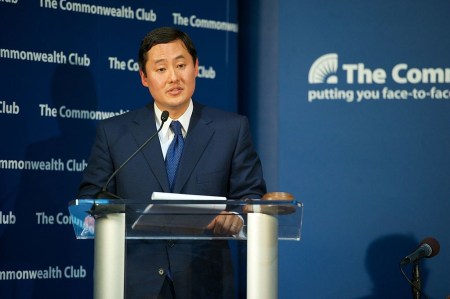
In 2009, Spanish judges opened a criminal file against some senior Bush administration officials, including John Yoo (pictured) of the Justice Department. Yoo, now a professor at University of California, Berkeley, wrote the 2003 memorandum authorizing the CIA’s interrogation techniques. (Image source: Commonwealth Club/Wikimedia Commons)

Recently, attorneys of the European Center for Constitutional and Human Rights (ECCHR) in Berlin, filed a criminal complaint against Gina Haspel, now the CIA’s number-two person under Director Mike Pompeo, and charged her with being involved in directing a secret CIA detention facility near Bangkok, Thailand. Will U.S. officials fear that traveling in Europe might expose them to arrest?

The Wall Street Journal wrote last year, regarding the De Sousa case:

“The threat from terrorism is worse than at any time since 9/11, even as the West has limited its capacity for self-defense… Those who work as spies know the risks from America’s enemies, but they shouldn’t have to worry about politicized retribution from its friends. Sabrina De Sousa’s abandonment by the U.S. government sends a demoralizing message to all who serve in the shadows, even as the war on terror enters a dangerous new phase.”

That is the most important lesson: our brave spies and officials involved in the war against Islamic terrorism, like those who prevented another 9/11, now fear not only the wrath of the jihadists, but also the witch hunt of a Western media and judicial system.

As James E. Mitchell said, by prosecuting what the U.S. and the West have done in the war on terror, “we will be standing on the moral high ground, looking down into a smoking hole that used to be several city blocks”.

On the Latest UN Report Claiming ISIS Fighters Aren’s Really Muslim,

August 6, 2017

On the Latest UN Report Claiming ISIS Fighters Aren’s Really Muslim, The Point (Front Page Magazine), Daniel Greenfield, August 6, 2017

The “Islamic State Isn’t Islamic” meme has always been an absurdity. But it’s also vitally necessary as ISIS becomes the dominant Sunni Islamic terror group. And makes no apologies for its atrocities.

The United Nations Office of Counter-Terrorism report being touted in the media is a classic exercise in Jihad-denial. It’s the same old Islamist narrative full of Orwellian claims that ISIS fighters really lacked a solid grounding in Islam. If only there were more mosques, study of Islam, etc, Muslim terrorists would be less likely to turn to terrorism.

It goes without saying that this is the standard Brotherhood line. And it turns reality on its head.

The report is based on interviews and highly subjective. It’s based on 43 interviews. It’s unclear how much of a conclusion you can draw about thousands of fighters from around the world based on 43 people. And those ISIS Jihadists willing to participate in such a thing are already a self-selecting group.

Claims that these fighters were generally low down on the economic and educational ladder only sound meaningful until you consider that’s true of Muslims in Europe and the Middle East in general. It’s as significant as rain in Seattle.

Understanding of Islam is also relative.

The real question has never been whether ordinary fighters are experts in Sharia law. They’re not expected to be. Islamic law is a dense and complex subject. And ordinary Muslims are expected to rely on Islamic rulings. It’s the Islamic knowledge of the ISIS leadership. Ground troops in any cause are not expected to be wealthy or experts in a topic.

Furthermore the insistence by the study that ISIS’ actions are un-Islamic itself demonstrates either an ignorance of Islamic law or a desire to obscure it.

The study is largely an excercise in denying the obvious. And pointing Western governments toward the same blind alley of deradicalization through more government programs rather than addressing the Islamic source of the problem.

Egypt goes about the task of reforming the religious rhetoric

July 29, 2017

Egypt goes about the task of reforming the religious rhetoric, Al ArabiyaMashari Althaydi, July 29, 2017

Egyptian President Abdel Fattah el-Sisi finally announced the establishment of the Egyptian supreme or national council for combating terrorism and extremism. 

This is an enlightening path and a blessed move. There is unquestionable determination to work and exterminate extremism that produces awful violence that targets markets, streets, schools, mosques, churches and airports. Terrorists are monsters who operate like zombies that rose from their dark graves.

The council is chaired by the president himself. Among the members are the parliament speaker, Al-Azhar Sheikh, the Coptic pope and state officials such as the education, awqaf, interior and intelligence ministers. The aim of the council is to set plans, execute them and supervise them.

All this is good and it’s rather a duty and a requirement. This is the work of the state and the society. We wish Egypt luck and success and we hope Muslims and the entire world succeed in winning over Islamized terrorism and the culture behind it.

Task before Al-Azhar

Previously, Sisi had informed Al-Azhar officials that religious reform is a must and said he will quarrel with them before God if they don’t achieve the task.

The determination and honesty of the responsible Muslim man, Sisi, are beyond doubt. However, the task of religious reform is not a military one which he can simply approve and it gets done. We wish it were so, as that would have been much easier.

The issue is also not just about Egypt, Saudi Arabia, Iraq, Pakistan, Indonesia or Senegal. It is about defeating the culture of terrorism and extremism – and I emphasize extremism here. It is a global task that concerns all people considering the news about terrorism coming daily from across the world.

There are many Arabic, Islamic and even European initiatives and centers that work to confront Islamized terrorist cultures, whether Sunni or Shiite, on the ideological and media levels. It’s worth noting that Sunni ones are more than Shiites. The diversity of such work is of course good and beneficial.

My only note is that we focus on media and quantitative activity at the expense of qualitative and intellectual activity when the problem’s core is educational and not relevant to media activity.

I’ll be more frank and ask: Is there a serious and specialized discussion before politicians and media figures talk about concepts such as Sharia, governance, Caliphate, secularism, international law and its moral obligations, women’s rights etc.?

This is where we must begin, as late author Khalid Mohammed Khalid put it.