Archive for the ‘Islamic terrorism’ category

Nice Attack: Cut Down the Black Flag, Target Sharia

July 15, 2016

Nice Attack: Cut Down the Black Flag, Target Sharia, Counter Jihad, July 15, 2016

Former Special Forces Master Sergeant Jim Hanson, currently the Executive Vice President for the Center for Security Policy, has an answer to the problem of constant terror attacks.  First, though, he dismisses the strategy of attempting to prevent attacks by adding additional levels of security.  “Even in a police state, you couldn’t secure every gathering,” Hanson said, noting that this was just a simple delivery truck like any other.

“You have to look at the people who are conducting these terror attacks,” he told “FOX & Friends.”  A focus on methodology won’t work, as the truck attack plainly shows:  “It’s not guns, it’s not bombs, it’s not trucks,” but rather “the ideology of sharia and jihad that motivates them to kill.”

Hanson is the author of Cut Down the Black Flag:  A Strategy To Defeat the Islamic State.  Unsurprisingly, he believes that destroying the caliphate is an important part of the solution.  However, he argues that the caliphate is only a symptom — albeit a major one — of the real problem. “You start in the Islamic State.  You start with their caliphate, and you cut down their black flag there.  But… that’s not going to solve the problem, that treats a symptom.  The ideology of sharia, which calls for a holy war of jihad, is something we need to deal with.”

Citing a poll that sharia law enjoys large-scale support among Muslims worldwide, Hanson crossed into disputed territory.  CounterJihad has reported on this controversy before.

The central issue to empirical science is the ability of others repeating the experiment to replicate your findings.  If you replicate the same findings using the same methods, that’s telling.  If you replicate the same findings with both the same and different methods, that’s even more suggestive that you’re on to something.  Every poll of Muslim populations, regardless of its methodology, shows strong support for sharia.

Last summer, the Center for Security Policy commissioned a poll that found 51% support for sharia among American Muslims.  There were critics who pointed out that this poll was an online poll, and one that only surveyed those who opted in.  However, the Pew polling service found that half of American Muslims are recent immigrants, chiefly from countries in which their global survey of support for sharia tops 80%.  Three of the leading countries for Islamic immigration to the United States are Iraq, Pakistan, and Afghanistan.  The figures for those countries are 91%, 84%, and 99% respectively.

When you find the same thing no matter how you study the question, you’re probably finding something that’s really there.

Hanson’s solution of targeting sharia also enjoys strong support from the American people.  A recent poll conducted by a firm out of Atlanta found that more than seven in ten American voters think Muslim immigrants should be screened for the ideological belief in enforcing sharia law.  More than 80% of those who agreed say all immigrants ID’d as Sharia adherents should be barred from entering the United States.

The popularity of the solution does not mean that it will be enacted, at least not for the next few months.  A recent survey of US President Barack Obama’s calendar shows that he never met with former National Director of Intelligence LTG(R) Michael Flynn.  He and his administration’s top officials did meet with the Council on American-Islamic Relations (CAIR), which has been proven in Federal court to be linked to the Foreign Terrorist Organization Hamas.  In fact, CAIR has had hundreds of White House meetings.

Both of President Obama’s likely replacements have described the France attacks as acts of war, and both seem clearer-eyed than President Obama about the nature of the threat.  However, asked which one was more likely to take the threat seriously, Hanson gave the nod to Donald Trump.  Hillary Clinton would be too hamstrung by political correctness, he argued.  Only Trump was likely to move strongly against Islamic terror.

The Obama Factor (8)

July 15, 2016

The Obama Factor (8), Power LineScott Johnson, July 15, 2016

After the horrifying massacre in Nice last night we are at risk of misdirecting our anger. The perpetrator seems to be another in the line of those inspired by ISIS. ISIS must be destroyed.

ISIS grew in Iraq in the vacuum that followed our withdrawal. Our withdrawal is attributable directly to the deepest wishes of President Obama. He was proud of it. It was nevertheless a mistake for which he and his Secretary of State and others bear direct responsibility.

Obama also holds a sophisticated attitude toward the phenomenon of ISIS that has fostered our lax response to its depredations. Perhaps the most dispiriting element of President Obama’s 2015 Vox interview with Matthew Yglesias was Obama’s likening of terrorism to a problem of domestic law enforcement. Obama drew an analogy between terrorism and crime control. We need to keep the lid on and do our best to reduce it. But we’re not in a war where the enemy is recognized or the object is victory. Terrorism is one of those things we have to learn to live with.

Where did that come from?

Obama’s thinking echoes that of former senior CIA officer Paul Pillar in the ill-timed book on terrorism that he published just before 9/11. Indeed, Obama’s Middle East foreign policy generally echoes Pillar’s thinking, including its patent hostility to Israel and wishful thinking about Iran. (I have wondered whether Pillar’s thinking might not represent an unconnected dot in Michael Doran’s tour de force on Obama’s secret Iran strategy.)

Shortly before 9/11 Pillar took a leave from the CIA to write Terrorism and U.S. Foreign Policy. Gabriel Schoenfeld took a detailed look at the book in the Commentary essay “Could September 11 have been averted?” Schoenfeld’s subsequent exchange with Pillar and others in Commentary’s letters to the editor is accessible online here.

In the book Pillar argued most famously that counterterrorism efforts were properly to be likened, not to a “war,” but rather to “the effort by public-health authorities to control communicable diseases” or the effort to improve “highway safety,” where regulators “can reduce deaths and injuries somewhat” by taking action on a variety of fronts but without any false idea of “defeating” the problem. Although Schoenfeld found the book “both authoritative and exceedingly well-informed,” he observed in the light of September 11 that the book’s conclusions “seemed not just wide of the mark but almost risible.”

As with Pillar, so with Obama. Obama’s attitude toward the ISIS phenomenon is one of high-minded complacency. With his characteristically bad timing, he fatuously disparaged ISIS as the junior varsity just as they began their resurgence in Iraq. This PolitiFact column usefully explicates Obama’s comment with background and links while finding the White House guilty of lying about it.

Only this past March Obama put it this way: “Groups like ISIL can’t destroy us, they can’t defeat us. They don’t produce anything. They’re not an existential threat to us. They are vicious killers and murderers who perverted one of the world’s great religions. And their primary power, in addition to killing innocent lives, is to strike fear in our societies, to disrupt our societies, so that the effect cascades from an explosion or an attack by a semi-automatic rifle.”

As Paul suggests, it seems to me that this is the attitude reflected in the policy that leaves us where we are today.

Obama Never Once Met With His Defense Intelligence Chief

July 13, 2016

Obama Never Once Met With His Defense Intelligence Chief, Daily Caller, Richard Pollock, July 12, 2016

Unlike Obama, Trump has not only met with Flynn but has also spent hours listening to Flynn’s views.

Flynn described Trump as “very refreshing.” The presidential candidate “really thought deeply about the issues of America and its relationships around the world. And also about America,” he said.

************************

President Barack Obama twice appointed former Lt. Gen. Michael T. Flynn to key national security jobs in his administration, including as deputy director of national intelligence and later as director of the Defense Intelligence Agency, yet he never once met with Flynn face to face.

The general, who spent 33 years in the intelligence field, told The Daily Caller News Foundation he was never called in for a face-to-face meeting with Obama to offer his assessment of ISIS as it rampaged through the Middle East, or during the political  meltdown of Libya and Egypt, or on Iran’s efforts to build a nuclear bomb, or of the “Russian reset” that ended in shambles.

In four years, Flynn was never invited to brief the president on any kind of intelligence issue. Ever.

“Here is the crux of my relationship with Obama,” Flynn told TheDCNF in a wide ranging interview Tuesday. “Here I am, running one of the largest intelligence agencies in the world. He appoints me twice — one as the assistant director of national intelligence and one as the director of the Defense Intelligence Agency. I’m also his senior intelligence officer. And I had almost five years in combat.”

He paused, then said, “I never met with him once.”

“He’s a kind of a funny guy when it comes to relationships,” Flynn told TheDCNF. “He’s very aloof and very distant. I wasn’t on his screen at all. I wasn’t on his radar which is really sad. It’s amazing.”

Now in a turn of tables, Flynn is advising presumptive Republican presidential nominee Donald Trump and is widely reported as being on the short list to run as Trump’s vice president.

Unlike Obama, Trump has not only met with Flynn but has also spent hours listening to Flynn’s views.

Flynn’s characteristic answers are candid and direct. On the possible choice as Trump’s vice presidential running mate: “This is an honor to be considered at this level and this mix of talent. The fact that my name is being bantered around in the small group of people for this very distinguished office is something I would give serious consideration to.”

He added that “I have said I want to continue to serve this country in any capacity.”

Like Trump, Flynn is an unconventional figure who abhors political correctness.

He has just published his first book after he was unceremoniously fired by Obama in 2014 for delivering a pessimistic assessment of ISIS before Congress. The presentation went directly against the president’s prediction that ISIS was irrelevant — a “JV team.”

Flynn could have written the typical Washington “Tell All” insider’s book about the Obama administration. Instead, he teamed up with Iran and Middle East expert Michael Ledeen in writing a serious book about the threat of Islamic terrorism titled, “The Field of Flight: How We Can Win the Global War Against Radical Islam and Its Allies.”

Flynn says he is impressed with Trump. “I have met him. We sat down and talked in his offices in New York. The first time was quite a while ago. I’ve been in touch with him and his inner circle since last September,” he told TheDCNF.

“He is very, very serious about the future of this county. He is a great listener. I felt we had a great discussion about the world.”

At the first meeting, “he sort of threw out a couple of questions to me, which I felt were very telling of his insight and his knowledge.”

Then, Flynn said the two of them “walked around the world for about an hour and a half, sort of discussing back and forth.”

Flynn described Trump as “very refreshing.” The presidential candidate “really thought deeply about the issues of America and its relationships around the world. And also about America,” he said.

“My impression — and I have been around many good leaders in my career — and I found him to be a very strong, dynamic leader. And I think that’s why he is so attractive to so many people in this country right now.”

“Trump has a bigger, longer-term vision for this country than just sitting as a President for four years. He really does. And that’s what I was impressed by,” Flynn told TheDCNF.

Flynn is less charitable toward former Secretary of State Hillary Clinton, one of his colleagues in the Obama administration.

“She is somebody that you get the impression that she’s got some other hidden agenda,” he said. “I always felt where there were interactions, there is some other hidden agenda there that doesn’t necessarily have the best interest of the country. Something else is going on.”

He pointed to Clinton’s “Russian reset” as one of her biggest failures. The reset was an initiative from Clinton in an effort to restore positive relations with Russian strongman Vladimir Putin.

“The Russian reset was a complete failure. That was her sort of baby. She lacked the understanding of how Russia deals on the global stage and how Russia deals with people, personalities and also on nation-on nation, and the way they see us,” Flynn said.

“She went into it with a level of arrogance and a lack of understanding.”

Unlike some skeptics in Washington, though, Flynn thought at the time that a Russian “reset” could work. “That Russian reset actually could have turned into something that resulted in some sort of mutual respect. But in fact under her leadership, it completely collapsed.”

He also is blunt about corruption and the Clinton Foundation: “The public corruption between the Clinton Foundation and the State Department may never be discovered. Or it may be discovered well past the election. But it’s a very real issue.”

Flynn challenged the foundation’s acceptance of $100 million in contributions from Persian Gulf Sheiks.

“The fact she takes one dollar from Saudi Arabia as any kind of a donation is a disgrace,” Flynn said. “Any of these countries destroys women’s rights. And then she stands there and claims that she’s for women.”

Hillary Clinton “should give back every red penny that she gets from those guys,” Flynn said. “Then she can talk about women’s rights.”


A Ramadan Piece: The “Other” Islam

July 5, 2016

A Ramadan Piece: The “Other” Islam, Gatestone InstituteSalim Mansur, July 5, 2016

(A fascinating history of the battle between political Islam and non-political Islam. The battle continues. — DM)

♦ Abrahamic monotheism as represented in Judaism, Christianity, and Islam, precedes and stands apart from politics as an ethical vision that transcends history. It was a vision which invited people to embrace their common humanity as created and gifted by one omnipotent deity, and to follow a revealed code of ethics for righteous living, holding the promise of peace with an end to interminable conflicts that divided people into warring tribes.

♦ Thoughtful Muslims, for nearly a century before the demise of the Ottoman Empire and the abolition of the Caliphate, had been writing about the need for an Islamic reform. Europe’s cultural advancement following the Reformation and Enlightenment held up a mirror for the Islamic world to follow in similar direction to similar ends. There was a consensus among Muslims that Islam was not intrinsically opposed to the modern world, and a readiness to follow in the footsteps of the West.

♦ This is the “other” Islam. This is submission to truth, whose most righteous exemplar was Abraham when his faith was tested by his Deity, according to the Hebrew Bible, to sacrifice his son. And this is the faith of Sufis who took Muhammad’s message to people in places far removed from the desert confines of Arabia. It is simply, as the Qur’an reminds (30:30), deen al-fitrah, the natural religion, or inclination, of man to know his Creator. There is no return of this “other” Islam; it never went missing.

The cover of the January 1976 issue of Commentary magazine announced its main story, “The Return of Islam,” by Bernard Lewis. The year of publication coincided with the coming end of the fourteenth century of Islam, and the anticipation of a new Islamic century beginning in 1979. Forty years later this essay by Lewis, widely recognized and respected as the most eminent scholar on the Middle East and Islam alive today, came to be celebrated as the first warning of the coming upheaval inside the world of Islam.

Lewis’s essay was a corrective to viewing the Middle East and its people, Arabs and Muslims, in terms of Western values. “Modern Western man,” wrote Lewis, “being unable for the most part to assign a dominant and central place to religion in his own affairs, found himself unable to conceive that any other peoples in any other place could have done so… [or to] admit that an entire civilization can have religion as its primary loyalty.” This meant, Lewis continued, the “inability, political, journalistic, and scholarly alike, to recognize the importance of the factor of religion in the current affairs of the Muslim world”.

Recent events have proven that Lewis was correct in pointing to this critical flaw in much of Western understanding of Islam and Muslims. But the title of the essay was unfortunate and misleading; there was no “return of Islam” for Muslims, since at no point in Islamic or Muslim history had Islam been missing, or dormant.

Instead of the “return of Islam,” it was the return of political Islam, or Islamism. Lewis’s essay was a timely review of Muslim history in terms of political Islam. But political Islam is but one facet of Islam. It is a recurring mistake to see political Islam as the defining feature of Islam that obscures Islam’s spiritual dimension, which is more vital than the coarse authoritarian features of political Islam.

In antiquity, politics was inseparable from religion. It might be said that politics was the handmaiden of religion. A ruler among people in ancient times was a chief priest, or a demigod. This feature of the ancient world in which religion and politics were bound together could be described as “theopolitics”, and Islam was as much influenced in its history by theopolitics as were Judaism and Christianity.

Lewis wrote:

“The three major Middle Eastern religions are significantly different in their relations with the state and their attitudes to political power. Judaism was associated with the state and was disentangled from it; its new encounter with the state at the present time raises problems which are still unresolved. Christianity, during the first formative centuries of its existence, was separate from and indeed antagonistic to the state with which it only later became involved. Islam from the lifetime of its founder was the state, and the identity of religion and government is indelibly stamped on the memories and awareness of the faithful from their own sacred writings, history, and experience.”

A lot of history is compressed in this passage, and so some misreading of that history is inevitable. Lewis went on to discuss Islam as being entwined with political Islam since its inception. “Islam was associated with power from the very beginning,” wrote Lewis, “from the first formative years of the Prophet and his immediate successors.” Consequently, in Islam “religion is not, as it is in Christendom, one sector or segment of life, regulating some matters while others are excluded; it is concerned with the whole of life—not a limited but a total jurisdiction.”

The problem with Lewis’s view of Islam is that he uncritically accepted the theology of political Islam. This theology was constructed during the three centuries after the Prophet Muhammad when, in the course of events between the seventh and the tenth century of the Common Era, Arabs came to rule a vast empire. It was consistent with the temper of late antiquity, and it put a stamp on Islam ever since that most Muslims have accepted without questioning.

Abrahamic monotheism as represented in Judaism, Christianity, and Islam, however, precedes and stands apart from politics as an ethical vision that transcends history. It was a vision which invited people to embrace their common humanity as created and gifted by one omnipotent deity, and to follow a revealed code of ethics for righteous living, holding the promise of peace with an end to interminable conflicts that divided people into warring tribes.

It was the resistance of pagans and polytheists to Judaism, Christianity, and Islam at their origins that compelled their early followers in the course of their respective histories to seek in politics protection for their religious beliefs. In Judaism and Islam, the founders — Moses and Muhammad — combined in their personalities the roles of prophet, warrior, and statesman. The life of Jesus, in this respect, was different.

In Moses’s case, he never entered the promised land, and it was left to his successors to eventually found a state for the Jews. In the instance of Muhammad, there is the question that has divided Muslims ever since his death: was his prophetic mission primarily to establish an Islamic state that would define, for Muslims for all times, Islam as the ideal arrangement in which religion and politics were one and indivisible?

The answer to this question was surrounded in controversy right from the moment of the Prophet’s last illness before his death. The controversy over his succession, and what such succession meant, tore apart the immediate followers of the Prophet, and incited tribal warfare, fratricide and schisms that since then have provided the backdrop to Muslims in respect to their own understanding and practice of Islam as religion and politics.

Islam as the Abrahamic vision of man’s relation with God was supplanted by the theology of political Islam. The process began in the midst of the Prophet’s last illness and accelerated with his death. The majority Sunni sect in Islam coalesced around the view that the immediate successors of the Prophet, elected or chosen, ought to be the closest companions of Muhammad, and their rulings in the formative stage of Muslim history became the standard by which subsequent generations of Muslims innovated the requirements of ruling an empire.

Those Muslims who dissented from the majority view represented by Sunni Islam were the Shi’a, or the party of Ali. Ali was a cousin of the Prophet, raised from his childhood in the Prophet’s household and, hence, the closest companion of Muhammad. Ali was also the Prophet’s son-in-law by marriage to Fatima, his only surviving child. The Shi’a Muslims believed Ali was the designated successor of the Prophet because of their familial ties, but he was forcefully denied the succession by those who usurped it immediately following the Prophet’s demise. Shi’a Islam evolved as the main minority sect with its own theopolitics within Islam.

The first Muslims were Arabs of the desert, the Bedouins, among whom Muhammad was born. Their tribalism persisted despite the Prophet’s warnings and it shaped Islam from the first hour of the post-Prophetic history. Sectarianism within Islam was the unavoidable outcome of clan and tribal conflicts among the first Muslims, and the Sunni-Shi’a divide became the main cleavage as a result, setting the template of further divisions as sects proliferated over time in the history of Islam.

Less than a century after the Prophet’s death in 632 C.E., his followers, the Bedouin Arabs, became the rulers of an empire that stretched from the Iberian Peninsula in the West to the Indus River in the East. There was nothing in the Qur’an, or in the traditions of the Prophet, to instruct these Arabs on the mechanics of administrating an empire. They took to imitating the rulers of Persia, whom they defeated, and adopted the administrative manuals of both Byzantine and Persian officialdom to rule the lands and peoples they conquered. And in order to provide legitimacy in the name of Islam to Arab rule in Damascus and later in Baghdad, the ulema(religious scholars) worked out the details of law and society, the Sharia, derived from the Qur’an and the Prophetic traditions.

The origin of Islamic culture and civilization lies in the empire that Bedouin Arabs, through the force of arms, established in a very short period. This was also the origin of political Islam, which came to represent the dominant face of Islam as theopolitics.

The fight that erupted, with the news of the Prophet’s demise, among his closest companions over succession related to temporal power that the Prophet had exercised, and not his role as a Messenger of God (Rasul Allah). This fight culminated in 680 C.E. with the defeat of the Prophet’s grandson, Husayn, killed and decapitated in the field of Kerbala, close to the banks of the Euphrates in Iraq, by the army sent out by Yazid I, the Ummayad Caliph of the rapidly expanding Islamic empire.

The event in Kerbala was a watershed in the history of Islam. Ethnic Arabs, recently converted to Islam, delivered Husayn’s cruel end. Ever since, this crime, as sordid as the crucifixion of Jesus, has stained Muslim history with the mark of Cain.

After Kerbala, it could no longer be said that Islam, as Abrahamic monotheism, guided politics ethically along the path of justice and mercy. Instead, the politics that surfaced upon the death of the Prophet hardened after the killing of Husayn, and politics henceforth came to define Islam as faith, culture, and society.
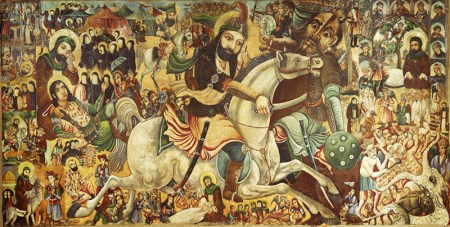
699In the Battle of Kerbala, depicted in Abbas Al-Musavi’s painting, Husayn, the son of Ali and grandson of Muhammad, was killed along with his family and all his followers by the armies of the Umayyad Caliphate. It was the most crucial moment in the split between Shi’a and Sunni Islam. (Image source: Brooklyn Museum)

The Ummayads in Damascus, the imperial capital, were the first dynastic rulers among Arabs in Islamic history. The founder of the dynasty, Muawiyyah, seized power following the murder of Ali, the fourth Caliph and the cousin and son-in-law of the Prophet. With the Ummayads the institution of the Caliphate, which was an innovation to fill the void of leadership among the Arabs in Medina following Muhammad’s death, adopted the pomp and pageantry of the Persian and Byzantine rulers. The Caliphate, from that first century of Islamic history until its abolition in 1924 by Mustafa Kemal Ataturk, the founder of modern Turkey, was the embodiment of Oriental Despotism.

Those Muslims who witnessed the tribal conflicts erupt after the Prophet’s demise and recoiled in revulsion from politics turned inward in seeking union with the divine mystery, as mentioned in the Qur’an. They sought solace in the spiritual dimension of Islam and emulated the Prophetic tradition of withdrawal from the world through prayer and meditation. They became the founders of the Sufi, or mystical, tradition in Islam. This was the “other” face of Islam, distinct from political Islam.

The physical expansion of the Islamic empire was carried forth by the armies of the Caliphs. But the spread of Islam as a faith tradition was a slow process, carried forth by Sufi missionaries belonging to various fraternal orders and independent of political rulers of the world of Islam.

There is a world of difference in conversion brought about at the point of sword of conquering armies, and conversion that results from the communion of hearts and minds among people. The latter is more genuine and transformative than the former in every religion. The Qur’an itself — verse 49:13 — warned the Prophet that the acceptance of Islam by the Arabs of the desert was one of submission in the face of defeat, and that belief had not entered their hearts. This verse might be read as forewarning of crimes Muslims would commit through history in the cause of political Islam, beginning with the killing of Husayn in Kerbala.

Political Islam from its outset was an inquisition. It began with Abu Bakr, the first Caliph, when he subverted the Islamic principle stated in the Qur’an — “there is no compulsion in religion” (2:256) — and declared war on those Arab tribes who withheld their loyalty from him following the death of the Prophet. The “Ridda Wars,” or the “Wars of Apostasy,” launched by Abu Bakr inaugurated political Islam, and since then, the precedent he set for Muslim-on-Muslim violence has plagued Islamic history into our times.

The role of the a’lem (pl. ulema; religious scholars) was instrumental in the making of political Islam. The ulema provided legitimacy to the Ummayad Caliphs in Damascus in the period of intra-tribal conflicts that had led to the killings of the three Caliphs (Umar, Uthman, and Ali) after Abu Bakr and then the massacre in the field of Kerbala.

The consensus of the ulema — accepted by those who eventually came to represent the majority Sunni Muslims (the word “Sunni” derived from Sunna, meaning following the path or tradition of the Prophet) — was that political and social order however provided and maintained was preferable to fitnah (disorder). This consensus provided doctrinal legitimacy to the Caliphs. In return, the Caliphs recognized the special function of the religious scholars and jurists in the drafting, codification, and implementation of Sharia, or Islamic laws.

As a result of this bargain between men wielding swords and men wielding pens, the foundational arrangement of political Islam was firmly established. It was an arrangement consistent with the thinking prevalent in antiquity that religion (deen in Arabic) prescribed the totality of human affairs. This meant, as it was understood by the ulema in the formative period of Islamic history, that the primary function of state and government (dawlat in Arabic) was the establishment of the rule of Sharia. As Ann K.S. Lambton in her study, State and Government in Medieval Islam(1981), observed:

“The law precedes the state and is immutable at all times and under all conditions. The state is there to carry out the law. To disobey a law or to neglect a law is not simply to infringe a rule of the social order: it is an act of religious disobedience, a sin, and as such involves a religious penalty.”

Once the bricks and mortar of political Islam were set in the making of the Islamic civilization, Islam as the official doctrine of the state and empire clearly demarcated the norm as prescribed in the Sharia and made the ulema its official guardians. The Islamic state was a nearly perfect embodiment of a closed totalitarian system designed by men towards the end of the first millennium of the Common Era, and any suggestion of change or adoption of new idea in matters of either religion or politics was condemned as bid’ah (heresy deserving punishment).

But Muslim dissidents who viewed the doctrine of political Islam, or what might also be referred to as “official” Islam, as an aberration, went underground and kept the “other” Islam free from the shackles of politics. Beneath the hardened features of political Islam, the “other” Islam of Sufis provided solace to Muslims by tending to their humanity in the light of God’s most favoured attributes of mercy and compassion.

The “other” Islam, unlike political Islam, is not bound by time and space. It is directed to man’s inner yearnings for that which is eternal. It plunges in search of the inner meaning of the Qur’an as the Word of God, and the assuredness that God’s mercy is not denied to any of His creations. The Qur’an states, “We are nearer to man than his jugular vein” (50:16), reassuring man that he is not alone and God is not some distant uncaring deity.

Whereas the defining characteristic of political Islam was religion inseparable from politics, in “other” Islam politics was the corruption of religion and the dissolution of belief. Hence, from the perspective of “other” Islam, the Sharia as the corpus of Islamic laws codified by the ulema and sanctioned by the Caliphs was a poor, even corrupt, representation of the divine Sharia (in Arabic, a “path”) imprinted in the hearts of all believers as the path to acquiring God’s infinite grace.

ii.

Political Islam and the Islamic civilization it inaugurated was time-bound as a theopolitical system constructed in a certain historical period or context. It was a construct of late antiquity and the early medieval era. Since it was a fixed and closed system, it was invariably given to decay and dissolution.

During the Middle Ages, the Islamic civilization flourished just as other civilizations had. As Abdus Salam (1926-1996) — a physicist of Indo-Pakistani origin and the first Muslim scientist awarded the Nobel Prize for Physics in 1979 — observed in one of his lectures, the world of Islam and the world of Christianity (Europe) were more or less at a similar stage of development around the middle of the seventeenth century.

The evidence of this relative equality of the two civilizations, Salam suggested, could be seen in their technological achievements represented by the two monuments, the Taj Mahal in Agra, India, and St. Paul’s Cathedral in London, England, completed about the same time. Some two decades later, Salam observed,

“there was also created — and this time only in the West — a third monument, a monument still greater in its eventual import for humanity’s future. This was Newton’s Principia, published in 1687.”

Newton’s monument had no counterpart in India, or anywhere else in the Muslim world.

The Renaissance, the Age of Enlightenment and the Scientific Revolution, led by men of astounding intellect from Leonardo da Vinci to Galileo and Newton, propelled Europe out of the medieval age into the making of the modern world. But Islamic civilization, held together by political Islam, descended into a death spiral. A century after Newton published his major work, the Ottoman Empire was turning irreversibly into a pale shadow of a civilization that once had threatened the powers of Europe at the gates of Vienna.

In the aftermath of September 11, 2001 attacks in New York and Washington by the Islamist terrorists of al Qaeda, Bernard Lewis published What Went Wrong? (2002). It was Lewis’s effort to answer why, and how, the world of Islam had failed to accommodate the imperatives of the modern world.

“In most of the arts and sciences of civilization, medieval Europe was a pupil and in a sense a dependent of the Islamic world,” wrote Lewis.

“And then, suddenly, the relationship changed. Even before the Renaissance, Europeans were beginning to make significant progress in the civilized arts. With the advent of the New Learning, they advanced by leaps and bounds, leaving the scientific and technological and eventually the cultural heritage of the Islamic world far behind them.”

The civilizational success of political Islam in late antiquity and the early medieval era ironically carried within it the seeds of its own decline and demise. World War I eventually put an end to the anachronism that the Ottoman Empire had become, and the abolition of the Caliphate was a formal effort to bury political Islam for good.

Thoughtful Muslims, for nearly a century before the demise of the Ottoman Empire and the abolition of the Caliphate, had been thinking and writing about the need for an Islamic reform. Europe’s cultural advancement following the Reformation and Enlightenment held up a mirror for the Islamic world to follow in similar direction to similar ends.

In India under British rule, for instance, there were a significant number of Muslims who painfully recognized the malaise of Islamic societies and offered remedy for their advancement into the modern world. Among them the notable were Sir Sayyid Ahmad Khan (1817-98), the founder of the Aligarh University; Syed Ameer Ali (1849-1928), jurist and historian; and Muhammad Iqbal (1877-1938), poet and philosopher.

One of the most important works was published in 1925 by Ali Abd al-Raziq (1888-1966), an Egyptian scholar and jurist at Al-Azhar University in Cairo. In his seminal work, titled al-Islam wa ‘Usul al-Hukm (Islam and the Fundamentals of Authority), al-Raziq pointed out that there was no basis in the Qur’an and the Sunnah (traditions) of the Prophet for the institution of the Caliphate.

Al-Raziq was not someone from outside the ranks of the ulema, or a lay scholar unfamiliar with the intricacies of Islamic jurisprudence and theology in the construction of Sharia. He was a student of Muhammad Abduh (1849-1905) at al-Azhar, when Abduh had been appointed the Grand Mufti of Egypt.

Al-Raziq’s main contention was based on the distinction between spiritual and temporal authority. He indicated that the confusion among Muslims in the period after the Prophet arose from their inability to distinguish between the Apostolic role of Muhammad and the authority he derived as the Messenger of God (Rasul Allah), and the Caliphate as a temporal institution. Al Raziq wrote:

“Muhammad was but an apostle, sent on behalf of a religious summons, one pertaining entirely to religion and unmarred by any taint of monarchy or of summons to a political state; and he possessed neither kingly rule nor government, and he was not charged with the task of founding a kingdom in the political sense, as this word and its synonyms are generally understood.”

Al-Raziq was denounced by his peers. He was made to appear before the Council of the Greatest Ulema of Al-Azhar to hear the judgment against him, as his license to teach and practice law was revoked. Egypt was then ruled under Britain’s supervision, which likely saved al-Raziq from even more severe punishment.

But al-Raziq had stripped away the argument of traditional Islam on the sanctity of the Caliphate, and with it went the idea of Sharia being sacred. In the half-century following the abolition of the Caliphate by Mustafa Kemal, Muslims under European rule gained their independence as new states emerged in the Middle East and elsewhere in the world of Islam.

This period in the middle decades of the last century was a period of intense expectations on the part of Muslims for progress in their living conditions. A massive effort was invested to make the transition from the world of pre-Newtonian knowledge and learning to the modern world of science, industry and democracy.

There was a consensus among the rich and the poor that Islam was not intrinsically opposed to the modern world. There was a readiness among Muslims to follow in the footsteps of the West.

This consensus was reflected in a well-known and widely circulated aphorism attributed to Muhammad Abduh. On returning to Cairo from a visit to Europe, Abduh told his students, “I travelled in the West and found Islam, but no Muslims; I have returned to the East and find Muslims, but not Islam.”

The transition into the modern world, however, proved immensely complex and difficult. Europe’s transition had required several generations and a couple of centuries to break away from the feudal age into the modern age. The resistance from those invested in the ancien arrangements of society and culture was immense, and wars that followed were fierce.

Something similar to the European experience was unavoidable for Muslims in their effort to break from the hold of their traditional culture. And not unlike the wars in Europe, wars within the world of Islam since the 1970s are symptoms of the Muslim struggle to transit into the modern world.

iii.

The abolition of the Caliphate in 1924 was the formal announcement of political Islam’s death. But it refused to die, even as it was laid to rest. Its twitching was felt in the deep dark interior of the world of Islam, in remote and unwelcome places such as Nejd inside Arabia.

Here in Nejd, the medieval theology of Ibn Taymiyyah had struck roots. It had impressed an eighteenth-century itinerant preacher in the region, Abdul Wahhab (1703-92), who turned Ibn Taymiyyah’s extremist thinking into an even more rigid and austere doctrine, hostile to all things inimical to the Bedouin tribal culture of his time and environment.

Abdul Wahhab’s version of political Islam impressed a local tribal chief, and the marriage of convenience between the preacher and the tribal leader gave birth to the first Saudi state in the interior of Arabia. But when it sent tribal warriors to raid towns inside the frontiers of the Ottoman Empire, it provoked the Caliph of Islam in Istanbul, on whose orders this nascent state of the Wahhabi ruler was destroyed.

But the eventual collapse of the Ottoman Empire provided the conditions for the rebirth of the Saudi state as a kingdom under Abdul Aziz ibn Saud in the 1920s. Fortune, in the guise of great power politics, smiled upon him. He seized the support offered by the British, in return for influence in a region of strategic importance. The discovery of oil made the Saudi kingdom a prize to be protected by the Western powers, first Britain and later the United States, with far reaching consequences for the rest of the world, and even more so for the world of Islam and Muslims.

Any modernizing revolution is hugely disruptive. The movement from one stage of social development to another is not linear; it is, instead, filled with zigzags and reversals at every stage of the process toward an uncertain future.

When a people, however, pushes back against this process of change in their midst, or seeks to abort it, this reactionary effort pins its hopes on longing for an idealized past. The Newtonian revolution and the emergence of modern Europe made political Islam anachronistic. Wahhabism, as the official doctrine of the Saudi kingdom, was much more than a return of the most extreme version of political Islam in the early decades of the last century. It was, and remains, a demented effort of the most backward people within the world of Islam to remain culturally tied to antiquity, or jahiliyya (the age of ignorance), which Islam at its origin derided and rejected.

Political Islam in whatever version — Wahhabism, Khomeinism, Ikhwanism (the Muslim Brotherhood) and their derivatives — has no answer for Muslims on how to make their historic transition into the modern world. It can continue to rage against the modern world until its civilized inhabitants, including Muslims, have had enough of its destructiveness and obliterate it.

Then that vision of Abrahamic monotheism, which Muhammad was mysteriously directed to deliver to his people, will be emancipated from political Islam.

This message Muhammad was given admonished Arabs for their lack of faith, provided them with ethics for living honorably, told them in no uncertain term that the God of Abraham made no distinction among nations and people who believe in Him, and that on the Day of Final Reckoning, they need have no fear if they strive in doing what is right.

This is the “other” Islam. This is submission to truth, whose most righteous exemplar was Abraham when his faith was tested by his Deity, according to the Hebrew Bible, to sacrifice his son. And this is the faith of Sufis who took Muhammad’s message to people in places far removed from the desert confines of Arabia. It is simply, as the Qur’an reminds (30:30), deen al-fitrah, the natural religion, or inclination, of man to know his Creator. There is no return of this “other” Islam; it never went missing.

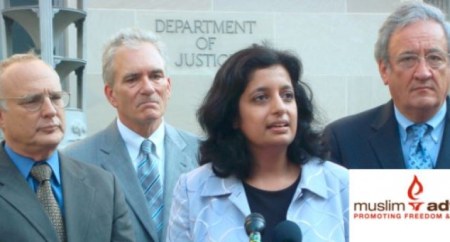
DHS top dog Jeh Johnson refuses to answer Senate on scrubbing terror docs of all mention of jihad and Islam

June 30, 2016

DHS top dog Jeh Johnson refuses to answer Senate on scrubbing terror docs of all mention of jihad and Islam, Jihad Watch

Throughout this questioning by Ted Cruz, DHS Secretary Jeh Johnson maintains that how the enemy is identified is unimportant, and that he and other intelligence and law enforcement top dogs know full well who the enemy is, and are busy foiling his plots. Cruz, in response, shreds Johnson, pointing to numerous ways in which the Obama administration’s politically correct willful ignorance led to danger signs being disregarded numerous times — danger signs that, if they had been heeded, might have prevented the Fort Hood, Boston, and Orlando jihad massacres.

Johnson’s irritable arrogance here, and refusal to address the facts Cruz adduces, is revealing of the mindset of the administration in its refusal to name the enemy accurately. The facts to which Cruz points show how this policy is costing lives.

Brexit – Backlash from mass migration and ISIS

June 25, 2016

Brexit – Backlash from mass migration and ISIS. DEBKAfile, June 24,2016

BREXIT_23.6.16

In a historic referendum, millions of British citizens voted Thursday, June 23, to leave the European Union after 43 years by a margin of 52 to 48 percent. Many were undoubtedly moved into approving this pivotal step by three seismic world events:

1. The mass migration flowing into Europe from the Middle East and Africa under the EU aegis. Forebodings in the UK were fueled by figures released a week before the referendum showing an influx of 330,000 migrants to Britain in 2015.

2. The war on the Islamic State which poses a peril which most Western governments avoid addressing by name as World War III in the making.

3. The inability of those governments, beyond empty words, to grapple with the war on ISIS or cope with the  mass of migrants expected to beat on the gates of Western societies for many more hard years.

Many Americans and Europeans are dissatisfied and resentful of President Barack Obama’s approach to the war on ISIS, which is to dismiss the enemy as a minor band of fanatics and thus, rather than a war against Islam. Neither do they accept German Chancellor Angela Merkel’s magnanimous invitation to take refugees in – 1.5 million in two years – as her country’s moral responsibility.

This popular disgruntlement has thrown up such antiestablishment figures as Donald Trump in the US and Boris Johnson in Britain and contributes to the rise of far right-wing movements and extremist violence on both continents.

Those two leaders, though different in most other ways, owe much of their popularity to the pervasive fear in their countries that surging immigration will forever alter the fabric of their societies.

Such social upheaval is the result of a trap deliberately set for the West by two Muslim leaders: ISIS “caliph” Abu Bakr al-Baghdadi, and Turkish President Tayyip Reccep Erdogan.

Al-Baghdadi conceived the idea of flooding the western world with waves of immigrants from Africa and the Middle East as a way to achieve three targets:

a) To change the composition of the population of Western countries by expanding the Muslim increment.

b) To plant networks of ISIS terrorists in the West.

c) To boost ISIS Middle Eastern arms, people and drugs smuggling networks as the organization’s main source of income. Migrants are willing to pay an average of between 5,000 and 10,000 dollars to reach the West even though they know that many never make it alive.

Al Baghdadi made up for the revenue shortfall caused by the US bombing of ISIS-held oil fields and money reserves by pushing over a new wave of immigrants.

President Erdogan’s motives are quite different.

He allowed the waves of immigrants to pass through Turkey on their way to the US and Europe – just as for years, he allowed Western jihadists joining ISIS to reach Siria via Turkey – because he was consumed with the desire to punish the US, namely, the Obama administration, for refusing to back up his hegemonic aspirations in the Middle East; Europe was punished for denying Turkey EU membership year after year.

The victory of Boris Johnson’s “leave” campaign – in the face of Obama’s personal championship of Prime Minister David Cameron’s bid to keep his country in, supported by the Democratic presumptive nominee Hilary Clinton – was a loud and clear signal for politicians running in future elections in the West, including the US presidential vote in November.

Republican candidate Donald Trump’s call to stop Muslim immigration into the US until proper screening measures are in place may sound like an unformed idea, but no other US politician has dared put it on the table, or directly challenge the hollow words and self-righteous hypocrisy of Obama and Clinton on the issues of terror, wars in the Middle East and mass immigration. This alone gives Trump a popular edge in widening circles in the USA over his rival.

Trump is not likely to lose votes either by his pledge to rebuild NATO for leading the West in the war against Islamic terror.

During the five months up until the US presidential election, the West can expect more large-scale ISIS terror coupled with dramatic events in the wars raging in at least seven countries  – Iraq, Syria, Lebanon, Jordan, Egypt, Libya and Afghanistan. Refugees in vast numbers will continue to batter down the doors of countries that are increasingly unable and unwilling to accept them.

Wars in general and religious wars in particular, have throughout history thrown up massive shifts of population displaced by violence, plague, falling regimes, famine and economic hardship.

The year 2016 will go down as the year in which Middle East crises spilled over into the west, bringing social change and far-reaching political turmoil in their wake.

And this is only the beginning.

Hamas-Linked CAIR Lawyers-Up Orlando Terrorist’s Family, Mosque Suspects

June 23, 2016

Hamas-Linked CAIR Lawyers-Up Orlando Terrorist’s Family, Mosque Suspects, Counter Jihad Report, Paul Sperry, June 23, 2016

[B]ecause the Obama administration has scuttled the ongoing prosecution of CAIR, the group is now free to intervene in terrorism cases and effectively dictate the terms of the FBI’s terrorism investigations.

*****************************

If you are a member of the media or even an investigator with the FBI seeking to question members of the Orlando terrorist’s family or mosque, you will now have to go through a federally listed terrorist front group — the Council on American-Islamic Relations.

Calls to Omar Mateen’s father and other relatives are now redirected to a phone number for a CAIR attorney, and another CAIR lawyer is sitting in on FBI interviews with suspects at Mateen’s radical mosque in Fort Pierce, Fla. — even though the FBI has suspended formal ties to CAIR over the group’s association with terrorist groups.

CAIR lawyered up a suspect who was interviewed by two FBI agents at the mosque for about 30 minutes on Friday. The CAIR lawyer, Omar Saleh, also happens to be a longstanding member of that same mosque — the Islamic Center of Fort Pierce — as well as a friend of the Mateen family. Mateen’s sisters, who work at the mosque and own property on the same street, follow local CAIR coordinators on social media.

The small Islamic center has now graduated two deadly terrorists in the past two years, including a worshiper who became the first American suicide bomber in Syria. Local law enforcement authorities call it “a breeding ground” for terrorists.

Saleh, who isn’t charging mosque suspects for his legal help, is now in charge of fielding questions from investigators interested in questioning other suspects in the June 12 terrorist attack. In fact, CAIR is now offering free legal aid to the entire Muslim community in which Mateen lived.

What’s more, CAIR’s legal counsel and communications director for its Florida chapter is acting as the official spokesman for the Islamic Center of Fort Pierce. The CAIR official, Wilfredo Amr Ruiz, has minimized Mateen’s involvement in the mosque, claiming he was a fringe member who was quiet and kept to himself.

“He was very unusual,” Ruiz told the local press. “After Friday noon prayers, the older people stay and socialize. He did so very few times.”

CAIR’s Saleh agreed: “He was just a person who came in and out. Most people didn’t know him at all … There’s no way anyone would know” he sought to carry out violent jihad against fellow Americans.

But that doesn’t square with accounts from co-workers and classmates who describe Mateen as an opinionated loudmouth with violently anti-American and homophobic views. And Mateen was hardly on the fringes of the mosque community. As CounterJihad.com first reported, mosque records show his father helped lead the Islamic center as a top officer and board member.

Ruiz, who’s also worked for a Florida-based Islamist group that demonizes homosexuals, additionally claimed Mateen’s attendance at the mosque was “sporadic,” even though others said he regularly prayed there three to four times a week for the past 13 years. In fact, he was seen praying at the Islamic center the night before the attack one gay nightclub in Orlando.

Running interference in terrorism investigations is a familiar pattern for CAIR, which remains on a federal terrorist co-conspirators blacklist.

Last year, CAIR intervened on behalf of the family and mosque of the San Bernardino terrorists, even holding a press conference for family members to help spin their story before investigators had a chance to talk to them. Within hours of the attack, CAIR swooped in and lawyered up key witnesses and suspected co-conspirators in the plot, including relatives and friends of the shooters along with leaders of their mosque.

CAIR officials defended the parents of the lead shooter even as they were placed on a federal terrorist watchlist.

“Those family members would have been key (persons of interest) for those FBI agents and other law enforcement agencies to interview after the immediate fact, to try to find out what the motives were and why this attack took place,” former FBI agent Chad Jenkins said at the time. “Instead, they’re doing public appearances with that organization.”

CAIR officials characterized the San Bernardino terrorist attack as “workplace violence,” adding “This is not a Muslim problem.”

After it became clear that the attack was Islamic jihad, the CAIR official who organized the press conference — Hussam Ayloush of Los Angeles — claimed America was “partly responsible” because of its support of “oppressive regimes around the world that push people over on the edge.”

In a lesser known case, CAIR actually coached a Muslim leader of a Maryland mosque on how to mislead FBI agents interviewing him about suspicious activity related to terrorism at the mosque. The 2004 case was detailed in the book, “Muslim Mafia,” citing internal CAIR records marked “DO NOT RELEASE OUTSIDE CAIR.” As a result of CAIR’s obstruction, the witness withheld critical information from the agents, who were attached to the bureau’s Pittsburgh field office.

Though CAIR publicly claims to cooperate with law enforcement, it privately advises the Muslim community to clam up when FBI agents ask questions — and to even slam the door in their face. In 2011, a California chapter of CAIR distributed a poster to area Muslims advising them to “Build a Wall of Resistance; Don’t Talk to the FBI.” An accompanying graphic showed homeowners slamming the door on federal agents, who were depicted as evil spies.

The FBI says it will no longer conduct outreach with CAIR until “we can resolve whether there continues to be a connection between CAIR or its executives and HAMAS,” a U.S.-designated terrorist group. In 2007, the Justice Department implicated CAIR and one of its co-founders in a Hamas fund-raising case. The courts have denied CAIR’s repeated motions for removal from the federal unindicted co-conspirators list.

When CAIR demanded the U.S. Justice Department remove it from the list, a federal judge wrote in an unsealed ruling: “The government has produced ample evidence to establish the associations of CAIR … with Hamas.”  The case was sent to an appellate court which ruled unanimously to keep CAIR on the co-conspirator list because of the overwhelming evidence against it.

Washington-based CAIR is not “an appropriate liaison partner” for the FBI because of evidence linking the organization and its leaders to Hamas, an FBI assistant director said in a letter to the U.S. Senate.

“In light of that evidence, the FBI suspended all formal contacts between CAIR and the FBI,” Richard C. Powers, an assistant director in the FBI’s Office of Congressional Affairs, explained in the letter.

Yet because the Obama administration has scuttled the ongoing prosecution of CAIR, the group is now free to intervene in terrorism cases and effectively dictate the terms of the FBI’s terrorism investigations.

Do Loretta Lynch’s Ties with ‘Muslim Advocates’ Org Explain Her Whitewash of Orlando?

June 23, 2016

Do Loretta Lynch’s Ties with ‘Muslim Advocates’ Org Explain Her Whitewash of Orlando? PJ MediaJ. Christian Adams, June 22, 2016

(The entire “homeland security” operation, a.k.a. “Countering Violent Extremism,” is reliant on CAIR and related groups. — DM)

muslim-advocates-2.sized-770x415xt

Top Justice Department officials, including Attorney General Loretta Lynch, have worked with an organization dedicated to interfering with law enforcement efforts to monitor activities at the most radical mosques.

Lynch and DOJ Civil Rights Division head Vanita Gupta have appeared at gala events for an organization called Muslim Advocates. The George Soros-funded charity has badgered the New York City Police Department away from monitoring the most radical mosques in the city.

The organization is also responsible for rewriting training materials for federal law enforcement to decouple the role of radical Islam from terrorist acts. An inter-agency working group comprised of multiple federal law enforcement agencies in 2014 adopted this whitewash urged by Muslim Advocates.

The DOJ’s short-lived effort to airbrush Islam out of the 911 tapes from Orlando shows you how far they will go to twist the truth about what is causing these attacks. I appeared on Fox and Friends today to discuss the organization and the latest. (Video here).

Civil Rights Division head Gupta appeared at the sold-out annual gala event for Muslim Advocates in Millbrae, California. Muslim Advocates lobbies the administration heavily to oppose any link between terrorist acts and radical Islam, and opposes monitoring of radical mosques. Gupta told the crowd:

To anyone who feels afraid, targeted, or discriminated against because of which religion you practice or where you worship, I want to say this — we see you. We hear you. And we stand with you. If you ever feel that somehow you don’t belong, or don’t fit in, here in America, let me reassure you  you belong.

Muslim Advocates also conducts recruitment and training for lawyers designed to help FBI terrorist targets and interviewees navigate the interviews. Their annual report states:

Throughout the year we grew our internal volunteer referral list for FBI interviews. Today, the list is over 130 lawyers nationwide who are ready and able to assist community members contacted by the FBI.

The purported non-partisan tax exempt 501(c)(3) charity is conducting a campaign against corporations like Coca-Cola to hector them into not sponsoring the Republican convention in Cleveland.

Muslim Advocates gave Vanita Gupta their Thurgood Marshall Award “for her commitment to criminal justice reform and to holding perpetrators of anti-Muslim hate accountable” at the California gala.

Attorney General Eric Holder also appeared at a Muslim Advocates gala event on December 10, 2010.

Number of Refugees Arrested for Terror Higher than Reported

June 23, 2016

Number of Refugees Arrested for Terror Higher than Reported, Clarion ProjectRyan Mauro, June 23, 2016

Boston-Marathon-Bombing-Inset-Bombers-HPThe Tsarnaev brothers (inset) who committed the Boston bombings were in the U.S. because their father is an asylum-seeker; they are not even included in the count.(Photo: © Reuters)

The obvious conclusion from the fresh data is that counter-terrorism efforts should be laser-focused on immigration and screening policies, particularly in regards to Muslim countries that are terror hotbeds, since over 65% of cases involved foreigners who came to the United States.

**************************

New data from the Senate Judiciary Committee reveals that 40 refugees have been arrested on terrorism-related charges since 9/11; a number far higher than the State Department’s previous estimate of a dozen.

Clarion Project reported in November 2015 that a little-noticed poll showed that 13% of Syrian refugees express favorable feelings towards the Islamic State (ISIS/ISIL). The Obama Administration plans to resettle between 8,000 and 10,000 Syrian refugees by the end of this year. It is about half way towards that goal, having resettled about 4,000.

The new congressional numbers show that 580 individuals have been convicted on terrorism-related charges since 9/11, with 131 convictions happening since early 2014 when ISIS burst onto the scene.

Of the 580, at least 40 are refugees (a little less than 7 percent of the total) and 380 are foreign-born (65.5% of the total). The top countries of origin are Pakistan (by far), followed far behind by Somalia, Yemen, Colombia and Iraq.

The convicts are most commonly associated with Al-Qaeda or one of its branches. The second most common allegiance is to Hezbollah, followed by the Colombian FARC narco-terrorist group; Hamas; Lashker-a-Taiba; the Taliban (if you combine the Afghan and Pakistani branches); the Tamil Tigers; the United Self-Defense Forces of Columbia; ISIS and Jaish-e-Mohammed.

The obvious conclusion from the fresh data is that counter-terrorism efforts should be laser-focused on immigration and screening policies, particularly in regards to Muslim countries that are terror hotbeds, since over 65% of cases involved foreigners who came to the United States.

That number doesn’t include convicts whose parents came into the U.S. and may have brought ideas that helped radicalize their children. A clear example is Orlando shooter Omar Mateen’s father, who has praised the Taliban and is now known to have served as an official in a Muslim Brotherhood-linked Islamist organization in 1997.

The Washington Post has also addressed some misconceptions and semantics games when it comes to the security issues surrounding the estimated 800,000 refugees who have come into America since 9/11. Counts of terror-linked refugees may not include asylum-seekers and their families who are in the U.S. but have not yet acquired the refugee label.

The Post mentions that the Tsarnaev brothers who committed the Boston bombings were in the U.S. because their father is an asylum-seeker and they are not included in the counts.

In addition, the aforementioned numbers do not include information about those arrested but not convicted and those under investigation. A senior FBI official said in 2013 that there are dozens of counter-terrorism investigations into refugee suspects. That was before the dramatic spike in radicalization sparked by the success of ISIS and its declaration of a caliphate.

As Clarion explained, the U.S. can benefit from accepting some properly-vetted Muslim refugees, including those from Syria. A ban on all Muslim immigration isn’t feasible (putting aside the moral question), but a vetting process aimed at detecting Islamists is. Such ideological vetting can help genuine moderate Muslims by identifying them and possibly expediting their processing.

Homeland Security whistleblower Philip Haney had great success in detecting extremists by tracking associations with Islamist movements and institutions until the overlapping extremism of political correctness and Islamism stopped him from continuing. Almost every time someone is arrested on terror-related charges, we hear about previous signs of extremism such as attending a radical mosque or a social media posting.

The new data shows that the majority of terrorist convicts come from foreign countries, and a small but worrisome percentage are refugees. It isn’t Islamophobic or bigoted to recognize the intersection between national security and immigration and make proper adjustments to reflect reality.

Robert Spencer on why the Muslim Brotherhood is a terrorist organization

June 21, 2016

Robert Spencer on why the Muslim Brotherhood is a terrorist organization, Jihad Watch, Robert Spencer via YouTube


