Archive for the ‘Islamic State’ category

Army is breaking, let down by Washington

August 3, 2015

Army is breaking, let down by Washington, Stars and Stripes, Robert H. Scales, August 2, 2015

(Last year I also wrote a depressing article on the lamentable combat readiness of our military. It’s here at my blog and here at Warsclerotic. The situation has continued to deteriorate. How could Obama’s America help to protect freedom, particularly against an enemy whose name must not be mentioned, without a combat effective military — even if Obama wanted to do it? — DM)

image militaryU.S. paratroopers with the 173rd Airborne Brigade load a M119A2 howitzer at the 7th Army Joint Multinational Training Command’s Grafenwoehr Training Area, Germany, July 28, 2015.
GERTRUD ZACH/U.S. ARMY

Last month, Gen. Ray Odierno, outgoing Army chief of staff, and Gen. Mark Milley, his successor, testified to the difficulties faced by the Army. I’d like to make the same points by telling a story.

When I was a boy, tonsillitis was a dangerous illness. In 1952, it kept me in Tokyo General Hospital for weeks. I shared a cramped ward with dozens of soldiers horribly maimed in Korea. The hospital had only one movie theater. I remember watching a Western sandwiched between bandage- and plaster-wrapped bodies. I remember the antiseptic smells, the cloud of cigarette smoke and the whispers of young men still traumatized by the horrors of the war they had just left.

My dad came from Korea to visit me, and I recall our conversations vividly. At the time he was operations officer for the 2nd Engineer Battalion. He told me how poorly his men were prepared for war. Many had been killed or captured by the North Koreans. During the retreat from the Yalu River, some of his soldiers were in such bad physical shape that they dropped exhausted along the road to wait to be taken captive.

“We have no sergeants, son,” he told me, shaking his head, “and without them we are no longer an Army.”

In the early ’70s, I was the same age as my Korean-era dad. I had just left Vietnam only to face another broken Army. My barracks were at war. I carried a pistol to protect myself from my own soldiers. Many of the soldiers were on hard drugs. The barracks were racial battlegrounds pitting black against white. Again, the Army had broken because the sergeants were gone. By 1971, most were either dead, wounded or had voted with their feet to get away from such a devastated institution.

I visited Baghdad in 2007 as a guest of Gen. David Petraeus. Before the trip I had written a column forecasting another broken Army, but it was clear from what Petraeus showed me that the Army was holding on and fighting well in the dangerous streets of Baghdad. Such a small and overcommitted force should have broken after so many serial deployments to that hateful place. But Petraeus said that his Army was different. It held together because junior leaders were still dedicated to the fight. To this day, I don’t know how they did it.

Sadly, the Army that stayed cohesive in Iraq and Afghanistan even after losing 5,000 dead is now being broken again by an ungrateful, ahistorical and strategically tone-deaf leadership in Washington.

The Obama administration just announced a 40,000 reduction in the Army’s ranks. But the numbers don’t begin to tell the tale. Soldiers stay in the Army because they love to go into the field and train; Defense Secretary Ash Carter recently said that the Army will not have enough money for most soldiers to train above the squad level this year. Soldiers need to fight with new weapons; in the past four years, the Army has canceled 20 major programs, postponed 125 and restructured 124. The Army will not replace its Reagan-era tanks, infantry carriers, artillery and aircraft for at least a generation. Soldiers stay in the ranks because they serve in a unit ready for combat; fewer than a third of the Army’s combat brigades are combat-ready.

And this initial 40,000-soldier reduction is just a start. Most estimates from Congress anticipate that without lifting the budget sequestration that is driving this across-the-board decline, another 40,000 troops will be gone in about two years.

But it’s soldiers who tell the story. After 13 years of war, young leaders are voting with their feet again. As sergeants and young officers depart, the institution is breaking for a third time in my lifetime. The personal tragedies that attended the collapse of a soldier’s spirit in past wars are with us again. Suicide, family abuse, alcohol and drug abuse are becoming increasingly more common.

To be sure, the nation always reduces its military as wars wind down. Other services suffer reductions and shortages. But only the Army breaks. Someone please tell those of us who served why the service that does virtually all the dying and killing in war is the one least rewarded.

My grandson is a great kid. He’s about the same age I was when I was recovering at Tokyo General. Both of his parents served as Army officers, so it’s no wonder that in school he draws pictures of tanks and planes while his second-grade classmates draw pictures of flowers and animals. The other day he drew a tank just for me and labeled it proudly “Abrams Tank!”

Well, sadly, if he follows in our footsteps, one day he may be fighting in an Abrams tank. His tank will be 60 years old by then.

At the moment I’d rather he go to law school.

Robert H. Scales, a retired Army major general, is a former commandant of the U.S. Army War College.

Christians Burn While Pope Worries about “Worldly” Matters

August 2, 2015

Christians Burn While Pope Worries about “Worldly” Matters, The Gatestone InstituteRaymond Ibrahim, August 2, 2015

  • Although the Egyptian constitution stipulates equality before the law, the judiciary refuses the testimony of Christians against Muslims in courts. Islamic law maintains that the testimony of an “infidel” cannot be accepted against a Muslim.
  • Al Azhar University in Egypt continues to incite Egypt’s Muslims against Christians. Most recently, the university was exposed distributing a free booklet dedicated to discrediting Christianity. It is full of direct attacks on Christianity in general and the nation’s Coptic Christians in particular. Islam is hailed as the true and superior religion. No mention of violent Islamic conquests is made.
  • More than 200 girls, mostly Christian, remain missing in Nigeria after Boko Haram kidnapped them in 2014. Escapees testify that some were told to slit the throats of Christians and to carry out suicide attacks. Girls who cannot recite the Koran are flogged.
  • The “lawyers” of a Christian man imprisoned in Pakistan on the charge of desecrating the Koran last May are actually working against him. Faisal’s lawyers officially canceled the request for bail, previously submitted by other lawyers.
  • Christians and others in the southern Philippines say they fear that legislation meant to create an Islamic sub-state — legislation meant to appease Islamists — will only create more extremism against Christians. Critics say it would render the federal government powerless to redress human rights abuses under Islamic law. In some areas, violence has been increasing, including trademark Islamic attacks on churches and nuns.

In June, Pope Francis released his first independent encyclical. It merely served to highlight the indifference to the plight of persecuted Christians around the world.

The Pope warned about issues dealing with the environment, but he did not once mention the plight of persecuted Christians — even though he is well acquainted with it, and even though previous popes mentioned it when Christians were experiencing far less persecution than they are today.

Encyclicals are formal treatises written by popes and sent to bishops around the world. In turn, bishops are meant to disseminate the encyclical’s ideas to all the priests and churches in their jurisdiction, so that the pope’s thoughts might reach every church-attending Catholic.

If the plight of persecuted Christians had been mentioned in the encyclical, bishops and the congregations under their care would be required to acknowledge it. Perhaps a weekly prayer for the persecuted could be institutionalized, keeping the plight of those Christians in the spotlight so that Western Catholics and others would remember them, talk about them, and, perhaps most importantly, ask why they are being persecuted. Once enough people were familiar with Christian persecution, they could influence U.S. policymakers — for starters, to drop those policies that directly exacerbate the sufferings of Christian minorities in the Middle East.

Instead, Pope Francis apparently deemed it more important to issue a proclamation addressing the environment and climate change. Whatever position one holds concerning these topics, it is telling that the pope — the one man in the world best placed and most expected to speak up for millions of persecuted Christians around the world — is more interested in speaking up for a “safe” (politically correct, if scientifically questionable) subject, “the world” itself, rather than the pressing bloodbath in front of him, or a topic requiring real leadership from a Christian authority.

Meanwhile, Christians around the world and the Muslim world especially continue to be persecuted and slaughtered. In one little-reported story, the Islamic State burned an 80 year-old Christian woman to death in a village southeast of Mosul. The elderly woman was reportedly burned alive for refusing to comply with Islamic law.

In east Jerusalem, a group calling itself the “Islamic State in Palestine” distributed fliers threatening to massacre all Christians who failed to evacuate the Holy City. The leaflets, which appeared on June 27, said that the Islamic State knows where the city’s Christians live, and warned that they have until Eid al-Fitr — July 19, the end of Ramadan — to leave the city or be slaughtered. The leaflet was emblazoned with the Islamic State’s black flag.

In Egypt, after a foiled suicide attack on the ancient temples of Karnak in Luxor (a tourist destination), the Islamic State promised a “fiery summer” for Egypt’s Christian Copts. Abu Zayid al-Sudani, a leading member of the Islamic State, tweeted: “The bombing of Luxor, a burning summer awaits the tyrant of Egypt [President Sisi] and his soldiers, and the worshippers of the cross. This is just the beginning.”

The rest of June’s roundup of Muslim persecution of Christians around the world includes, but is not limited to, the following accounts, listed by theme.

Muslim Attacks on Christian Churches and Cemeteries

Turkey: On June 9, a Muslim man attacked a church in the Kadıköy district of Istanbul with a Molotov cocktail, setting the building’s door on fire. In a video of the attack, the man is seen shouting “Allahu Akbar” [“Allah is Greater!”] and “Revenge will be taken for Al-Aqsa Mosque” as he throws a firebomb at the Hagia Triada Orthodox Church. The man was eventually detained by police.

Egypt: A bomb was placed alongside the Virgin Mary Coptic Christian Church in Helwan, part of Greater Cairo, but the security services managed to dismantle it before it exploded.

France: On June 7, two Muslim men were arrested by French authorities in connection to a thwarted terror plot to attack a church near Paris last April. Authorities said they had detained Sid Ahmed Ghlam, a computer science student, who had planned an attack on churches in Villejuif, south of Paris, and is suspected in the killing of a woman nearby. Documents in Arabic mentioning al-Qaeda and the Islamic State were found during a search of Ghlam’s home. Several military weapons, handguns, ammunition, bulletproof vests and computer and telephone hardware were also found in Ghlam’s home and car.

Zanzibar: Muslims on the majority-Muslim island harassed and persecuted two churches:

1) They drove Pastor Philemon, a father of five, into hiding and took over his New Covenant Church’s worship hall by getting the landlord to rent it to them before the church’s lease ended. Once a congregation of 100, members now number 25. “The church faithful are so scattered,” said Philemon. “Some members are always knocking at my door requesting a place for worship.” The pastor is also helping care for several converts from Islam who fled their homes after persecution, and he is struggling financially to help them while also providing for his own family, which includes five children.

2) Just outside Zanzibar City, in Chukwani, Muslims made false land claims to bleed dry a church with legal costs. Said Pastor Lukanula: “The Muslims are waiting for the time when we shall fail to attend the court hearing, implying losing the case and subsequently having to pay a substantial amount of money.” Before the false claims were made, regarding ownership of the land, the leader of a local mosque told the pastor, “We do not want to see a church building here in Chukwani.” In 2007, Muslims in the area had demolished the original structure under construction.

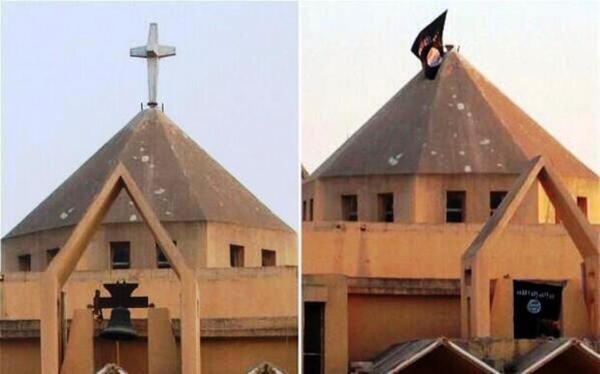
Iraq: The Islamic State posted notices around the captured city of Mosul announcing that the Syriac Orthodox Cathedral Church of St. Ephrem, seized a year ago, was to be become the “mosque of the mujahedeen,” or “jihadis.” The new name was announced on the anniversary of the date the church had been seized. The Islamic flag stating the shehada (“there is no god but Allah and Muhammad is his Messenger”) was draped over the building. “If they changed a church to a mosque it is further proof of their cleansing,” said the president of A Demand for Action, a group advocating the protection of minorities in the Middle East. “They destroy our artefacts, our churches and try to erase us in any way they can.”

1181The Syriac Orthodox Church of St. Ephrem in Mosul, Iraq, before if the captured by the Islamic State (left), and after.

Libya: Yet another Christian cemetery, in the old Christian section of post-“Arab Spring” Tripoli, was recently desecrated by Muslim militants. Described by witnesses as “Salafi” Muslims, the vandals of the grave destroyed crosses and tombstones, and dug up graves in the early morning hours of June 3. Security forces charged with protecting the region did nothing to stop or arrest the men.

Muslim Slaughter of Christians

Egypt: Two Christians were killed under questionable circumstances:

1) The only Christian in his army unit was found shot dead in a chair at the office of the military base in which he was stationed. On June 24, Bahaa Gamal Mikhail Silvanus, 23, a conscript in the Egyptian Army, was found with two bullet wounds in his chest and a gun at his feet. Relatives who later saw the body also say there were wounds on his head, as if he had been struck with a blunt object. The military’s official position is that the Copt committed suicide. Family, friends, and church leaders strongly disagree. They point out that those who commit suicide are rarely able to shoot themselves twice — or first hit themselves on the head with blunt objects. They also point out that Silvanus was a happy man with strong faith, a college degree in music, and plans to enter the monastic life. “My son was killed by someone. He didn’t kill himself,” said his father, Gamal Silvanus, who had advised his son to finish his military obligation, then work for five years to help support the family, and after that to join a monastery. A friend of Bahaa Silvanus, who wished to remain anonymous, said that Silvanus had confided to him that he was regularly pressured by other soldiers in his unit to convert to Islam or else: “He told me that the persecution of the fanatical Muslim conscripts in the battalion against him had been increased the last days, and they threatened him with death, that they would kill him if he wouldn’t convert to Islam.”[1]

2) According to MCN, “Police officer Mohammed Megalli, who killed a Coptic woman, Sarah Youssef Ghali, used to insult Copts of the district and treat them with contempt, said Nour Rashad, a cousin of the Coptic woman. Ghali was accidentally shot dead by Megalli, a police officer from Manshiet Nasser Police Station in Cairo.”

Uganda: A mother of 11, who, along with her husband, left Islam (considered by many Muslims apostasy) and converted to Christianity almost a year earlier, was poisoned to death on June 17 in a village in eastern Uganda. Namumbeiza Swabura, the mother of a 5-month-old baby, died after her sister-in-law visited and offered to prepare a meal for her. She complained of stomach pain that started immediately after eating the food. According to Morning Star News:

Swabura’s pain grew worse as she began vomiting and her nose began to bleed uncontrollably; her face turned pale, and two hours later she died in their home as Muhammad [her husband] was trying to rent a car to take her to a hospital, they said. Her sister-in-law has gone into hiding, the sources said. Swabura and her husband have received several death threats since putting their faith in Christ, according to Muhammad. During a visit by Morning Star News to the area in late May, he said, “We are fearing for our lives as the Muslims are threatening to kill us if we continue in Christianity.” Besides her infant and husband, Swabura wife leaves behind 10 other children.

Dhimmitude: Generic Contempt and Discrimination against ‘Infidels’

Ethiopia: On April 25, police raided a Christian worship service in Asella, just south of the capital, Addis Ababa. The Church of Asella had just baptized 40 new converts to Christianity, an act that prompted mass arrests. One of those imprisoned, a former Muslim, known only as “Palus Ejigu,” who converted to Christianity, said, “We were gathered for sharing and encouraging each other with the Word of God. After we finished the service, police imprisoned us. Some of our friends ran away when they saw the way we were harshly handled.” After weeks of suffering unspeakable prison conditions and abuses, Ejigu was eventually released. But five days later, four masked men forced him on his knees, put a pistol in his mouth, and ordered him to kill two pastor friends, or his children would die.

His wife’s Muslim family, in accordance with Islamic law, had already taken the children away from him.

Egypt: The inferior status of Christian minorities was again on display. The principal of a school in Sohag has been openly refusing the enrollment of Christian students, simply on the basis of their religion. When Copts and others protested — the current law of Egypt is on their side — the principal declared that, “As long as I am present in the school, no Christian pupils will be accepted.”

Popular Egyptian columnist Karima Kamal wrote that although the Egyptian constitution stipulates equality before the law, the judiciary does not apply this provision, and refuses the testimony of Christians against Muslims in courts. Anecdotal evidence supports her claim. Some weeks earlier, the following letter was published:

Yesterday I suffered an extremely harsh psychological shock. I went to court with one of my neighbors, a widow, to serve as witness in an inheritance case. Another neighbor and witness accompanying us was a young Christian. We had all been living as one family. Imagine my shock, then, at the judge who very rudely and with incomprehensible disapproval rejected the testimony of the [Christian] youth: [saying]: “It is unacceptable for a Christian to testify against a Muslim.”

In fact, Islamic law maintains that the testimony of an “infidel” cannot be accepted against a Muslim.

Al Azhar — arguably the Islamic world’s most prestigious Islamic university — continues to incite Egypt’s Muslims against Christians. Most recently, the university was exposed distributing a free booklet dedicated to discrediting Christianity. It is full of direct attacks on Christianity in general and the nation’s Coptic Christians in particular. Christianity is referred to as a “failed religion,” while Islam is hailed as the true and superior religion. Because the “seeds of weakness” are inherent in Christianity and the Bible, says the booklet, Islam was easily able to supplant it in the Middle East. No mention is made of any violent Islamic conquests.

Iran: Iran’s revolutionary court sentenced 18 Christian converts on charges that include evangelism, propaganda against the regime, and creating house churches to practice their faith. The sentences totaled almost 24 years (the lack of transparency in Iran’s tightly controlled judicial system does not allow for a breakdown of individual sentences). The defendants were also barred from organizing home church meetings and given a two-year ban from leaving Iran. The Christians, many of whom were arrested in 2013, were sentenced in accordance with Article 500 of the Islamic Penal Code, which states that “Anyone who engages in any type of propaganda against the Islamic Republic of Iran or in support of opposition groups and associations, shall be sentenced to three months to one year of imprisonment.”[2]

Nigeria: More than 200 girls remain missing after Boko Haram stormed a government school in Chibok in 2014, kidnapping scores of mostly Christian young girls. Escapees continue to testify to the brainwashing that they encountered from their captors. Some were told to slit the throats of Christians and to carry out suicide attacks. One witness said that the Chibok girls have been given special status as “teachers” told to memorize the Koran and teach others to do so. Girls who cannot recite the Koran are flogged.

Pakistan:

1) The “lawyers” of a Christian man imprisoned in Pakistan on the charge of desecrating the Koran last May[3] are actually working against him. Humayun Faisal, a mentally disabled Christian, will remain in prison because his lawyers have withdrawn their request for bail. According to the pool of Christian attorneys of the NGO “Lead,” during the hearing on June 27 before the Lahore High Court, Faisal’s lawyers officially canceled the request for bail, previously submitted by other lawyers. Said Lead:

[There are lawyers who] intervene in cases in which Christians are accused of blasphemy or other crimes and, instead of obtaining justice, do not operate in the interests of the accused, their clients, but act for others purposes.

2) Mumtaz Masih, a Christian man, was recently released from forced slavery by his Muslim employer. Masih had an arrangement with his Muslim employer, part of which was that Masih remain on his employer’s property at all times except once a month when he would receive payment and could go home to visit his family. In July 2014, the employer stopped paying Masih, banned him from home visiting, and effectively turned him into a slave. Masih’s wife sought help when her husband stopped coming. After a habeas corpus court case on May 29, a court official was directed to find Masih, who was found on his master’s property in a locked room. Although slavery is illegal in Pakistan, many poor Christians live and work in such conditions.

Sudan: On June 25, 12 Christian girls were detained for wearing “scandalous outfits” by the Public Order Police as they left the Baptist church in El Izba, Khartoum. The young women, in trousers and skirts, were transferred to a police station; two were acquitted on Friday, after the agents of the Public Order Police reconsidered their opinion. The ten others were charged with “deeds against the public morality” under Article 152 of the 1990 Criminal Code. “The young women attended a religious festivity in the church, and were wearing fancy dress. The charges are an insult to the church,” argued their lawyer. “Furthermore, the students were forced to change their clothes inside the police station, which is an affront to their dignity.”

Turkey: Authorities shut down Christian schools belonging to the Association of Churches of Jerusalem. Schools in several districts of the southeastern city of Gaziantep, where many refugees from Syria had fled, and in three other regions, were closed. Although providing much needed humanitarian relief, the Christian schools were found giving Bibles and other Christian literature to their refugee students, many of whom come from Muslim backgrounds.

Philippines: Christians and others in the southern Philippines say they fear that legislation meant to create an Islamic sub-state on Mindanao Island — legislation meant to appease Islamists — will only create more extremism against Christians. They believe that if Bangsamoro, or “Moro Country” — Moro is colloquial for “Muslim” — were ruled under Sharia, non-Muslims would become second-class citizens with drastically reduced rights. Critics of the bill say it would render the federal government powerless to redress human rights abuses under Islamic law.[4] “What President Aquino is doing is treasonous to Christian communities in Mindanao,” said Rolly Pelinggon, national convener of Mindanaoans for Mindanao (M4M).

United Kingdom: Nissar Hussain, a former Muslim from Pakistan who converted to Christianity in 1996, recently wrote a letter to his local MP recounting some of the violence, abuse, and other attacks that he, his wife and their six children have suffered at the hands of Muslims in the area of Bradford where they live.[5]

Iraq: According to Nineveh Provincial Council member Anwar Mata, “more than 120 thousand Christians [were] displaced from Mosul and Nineveh after the Islamic State invaded Mosul. He further noted that, “about 20 thousand of them have migrated [from] Iraq since last year…. The lack of interest of the federal government towards the displaced Christians pushed them to migrate outside the country … the psychological and moral damage was greater than the loss of their money and property as a result of ISIS occupation of Mosul.” Meanwhile, the theft of Christian property was conducted, not only by IS but by local politicians in Iraq. Impostors and fraudulent groups, thanks to corrupt officials, have managed to acquire illegal possession of thousands of houses belonging to Christian families in Baghdad, who fled the city after the U.S-led ousting of Saddam Hussein uncorked a virulent jihad on them. Mohammed al-Rubai, member of the city council of Baghdad, said that almost 70 percent of Christian houses in Baghdad have been expropriated illegally, and property titles were forged with the tampering of land registers carried out by dishonest bureaucrats. The NGO “Baghdad Beituna” has calculated that the thefts of Christian properties carried out with the complicity of corrupt public officials were about seven thousand. Even members of the political and military apparatus have enjoyed the “legalized” theft of Christian properties.

About this Series

While not all, or even most, Muslims are involved, persecution of Christians is expanding. “Muslim Persecution of Christians” was developed to collate some — by no means all — of the instances of persecution that surface each month.

It documents what the mainstream media often fails to report.

It posits that such persecution is not random but systematic, and takes place in all languages, ethnicities and locations.

_________________

[1] Mikhial Shenouda, senior priest of Archangel Mikhial, adds: “A person who commits suicide is a disappointed and desperate person, but Bahaa was in a very good spirits. He was smiling always. He was keeping the word of God.” Although the Egyptian military and media have said little about this incident, hundreds attended his funeral.

[2] According to a 2015 U.S. Commission on International Religious Freedom report, “Over the past year, there were numerous incidents of Iranian authorities raiding church services, threatening church members, and arresting and imprisoning worshipers and church leaders, particularly Evangelical Christian converts…. Since 2010, authorities arbitrarily arrested and detained more than 500 Christians throughout the country.” Christians make for less than one percent of Iran’s Shia Muslim majority population. “The Iranian regime’s systematic persecution of Christians, as well as Baha’is, Sunni Muslims, dissenting Shi’a Muslims, and other religious minorities, is getting worse not better,” said U.S. Senator Mark Kirk (R-Ill.) in a statement. “This is a direct consequence of President Obama’s decision to de-link demands for improvements in religious freedom and human rights in Iran from the nuclear negotiations.”

[3] On Sunday, May 24, Faisal was accused of blasphemy when some Muslims saw him burning newspapers that reportedly contained Arabic verses from the Koran. After the accusation, a Muslim mob caught the Christian, severely beat him, and even attempted to set him on fire. A few months earlier, another Muslim mob burned a Christian couple alive inside a kiln after they, too, were accused of insulting Islam. After the attack on Faisal, the Muslim mob, reportedly numbering in the thousands, rampaged through the neighborhood and set fire to Christian homes and a church.

[4] The Bangsamoro Basic Law (BBL), proposed by President Benigno Aquino III last September with the aim of ending decades of Islamist rebel violence in Mindanao, was approved by a House Ad Hoc Committee on May 20. The area, comprising five provinces with sizeable non-Muslim populations, already enjoys a measure of autonomy and the proposed BBL would give leaders sufficient independence to impose sharia (Islamic law). The BBL came about as part of a preliminary peace accord between the Aquino administration and the Moro Islamic Liberation Front (MILF) rebel group. But it has done little to reduce violence.The BPFA was signed in 2013 as a precursor to a final peace agreement. The government claimed there would be no more Muslim rebel attacks in Mindanao after it was signed, but in some areas violence –including trademark Islamic attacks on churches and nuns — has been increasing.

[5] The letter reads:

Dear Naseem Shah MP,

Can I congratulate you on behalf of myself and family on your stunning victory and we can’t express our delight as our newly elected MP for the Ward of Manningham and wish you every success for the future. On a serious note can I express our utter misery and dire situation as Christian converts from a Mirpuri/Muslim background since 1996 [Mirpur is a region in Pakistan].

We were forced out of our previous home after over several years of suffering as converts and in short my family and I endured ‘hell’ by my fellow Pakistani young men in the form of persecution which entailed assault, daily intimidation, criminal damage to property: smashing house windows and also 3 vehicles written off whilst the community looked on and even endorsed this. One of vehicles was torched outside my home. Despite witnessing another vehicle being rammed deliberately by a man who I knew, the Police did not even take a statement never mind an arrest. Finally after being threatened to be burnt out of my home these young men deliberately set the neighbours’ house (which was vacant) on fire in the hopes that our house would catch fire. When I had reported it to Police prior to this happening the Police sergeant’s response was: “Stop trying to be a crusader and move out!” In short the Police had wilfully failed us so as not to be labelled racists or seem to cause the Muslim community offence at our suffering and expense.

After being forced to move out in June 2006 we settled in St Paul’s Rd and set about rebuilding our lives, which was going well and had no issues and forged good relations with neighbours until we contributed in a Dispatches documentary called ‘Unholy War’ highlighting the plight of converts from Islam to Christianity in September 2008. Then our problems began, largely posed by the A. family who have been engaged on a campaign to drive us out our home given their bigoted attitude and thoroughly unscrupulous conduct and since last July they have embarked upon criminal damage to my vehicle to the point I have now had my vehicle windscreens smashed for the fourth occasion. The most recent incident occurred on 24 April when I had my vehicle smashed in the early hours of the morning and cannot express the financial impact also as I have to wait 3 weeks at a time for the glass to be ordered from the States as my vehicle is American. And again as in our previous experience the Pakistani community has looked on at our suffering and turned a blind eye whilst others have been openly hostile, while they enjoy freedom and liberty religious or otherwise whilst imposing their will rule and reign upon us and we are treated as second class citizens.

As a result of the latest criminal damage, and after weeks of having no car until it was repaired, I took the liberty of parking my vehicle away from outside my home for peace of mind, as given the misery over the last several years I have been diagnosed with PTSD and my wife and family also suffer stress and anxiety. When I went this morning to get my car I was mortified to discover that my car has been smashed deliberately yet again. Clearly we cannot go on living like this; … our lives have been sabotaged, we fear for our safety and suffer anxiety daily, not to mention the financial costs to all of this wanton criminal damage.

I cannot express in words the Police failure over the years which has led to our suffering and have no confidence in them whatsoever and am desperate for your help.

Kind regards,

Nissar Hussain


Dispatch from Iraq: the Stealth Iranian Takeover Becomes Clear

August 1, 2015

Dispatch from Iraq: the Stealth Iranian Takeover Becomes Clear, PJ Media via Middle East Forum, Jonathan Spyer, July 31, 2015

1484A Shi’a militia billboard in Baghdad

Close observation of the militias, their activities, and their links to Tehran is invaluable in understanding what is likely to happen in the Middle East following the conclusion of the nuclear agreement between the P5 + 1 powers and Tehran.

The genius of the Iranian method is that it is not possible to locate a precise point where the Iranian influence ends and the “government” begins. Everything is entwined. This pro-Iranian military and political activity depends at ground level on the successful employment and manipulation of religious fervor. This is what makes the Hashed fighters able to stand against the rival jihadis of ISIS.

The deal itself proves that Iran can continue to push down this road while paying only a minor price, so why change? Expect further manifestations of the Tehran formula in the Middle East in the period ahead.

****************

In late June, I traveled to Iraq with the purpose of investigating the role being played by the Iranian-supported Shia militias in that country.

Close observation of the militias, their activities, and their links to Tehran is invaluable in understanding what is likely to happen in the Middle East following the conclusion of the nuclear agreement between the P5 + 1 powers and Tehran.

An Iranian stealth takeover of Iraq is currently under way. Tehran’s actions in Iraq lay bare the nature of Iranian regional strategy. They show that Iran has no peers at present in the promotion of a very 21st century way of war, which combines the recruitment and manipulation of sectarian loyalties; the establishment and patient sponsoring of political and paramilitary front groups; and the engagement of these groups in irregular and clandestine warfare, all in tune with an Iran-led agenda.

With the conclusion of the nuclear deal, and thanks to the cash about to flow into Iranian coffers, the stage is now set for an exponential increase in the scale and effect of these activities across the region.

So what is going on in Iraq, and what may be learned from it?

Power in Baghdad today is effectively held by a gathering of Shia militias known as the Hashed al-Shaabi (Popular Mobilization). This initiative brings together tens of armed groups, including some very small and newly formed ones. However, its main components ought to be familiar to Americans who remember the Iraqi Shia insurgency against the U.S. in the middle of the last decade. They are: the Badr Organization, the Asaib Ahl al-Haq, the Kataeb Hizballah, and the Sarayat al-Salam (which is the new name for the Mahdi Army of Muqtada al-Sadr).

All of these are militias of long-standing. All of them are openly pro-Iranian in nature. All of them have their own well-documented links to the Iranian government and to the Revolutionary Guards Corps.

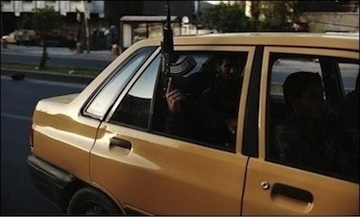
1559Shia militiamen are becoming a fixture of daily life in the Iraqi capital.

The Hashed al-Shaabi was founded on June 15, 2014, following a fatwa by venerated Iraqi Shia cleric Ali al-Sistani a day earlier. Sistani called for a limited jihad at a time when the forces of ISIS were juggernauting toward Baghdad. The militias came together, under the auspices of Quds Force kingpin Qassem Suleimani and his Iraqi right-hand man Abu Mahdi al-Muhandis.

Because of the parlous performance of the Iraqi Army, the Shia militias have become in effect the sole force standing between ISIS and the Iraqi capital.

Therein lies the source of their strength. Political power grows, as another master strategist of irregular warfare taught, from the barrel of a gun. In the case of Iraq, no instrument exists in the hands of the elected government to oppose the will of the militias. The militias, meanwhile, in their political iteration, are also part of the government.

In the course of my visit, I travelled deep into Anbar Province with fighters of the Kataeb Hizballah, reaching just eight miles from Ramadi City. I also went to Baiji, the key front to the capital’s north, accompanying fighters from the Badr Corps.

1469Asaib Ahl al-Haq fighters operating in Baiji in June

In all areas, I observed close cooperation between the militias, the army, and the federal police. The latter are essentially under the control of the militias. Mohammed Ghabban, of Badr, is the interior minister. The Interior Ministry controls the police. Badr’s leader, Hadi al-Ameri, serves as the transport minister.

In theory, the Hashd al-Shaabi committee answers to Iraqi Prime Minister Haider al Abadi. In practice, no one views the committee as playing anything other than a liaison role. The real decision-making structure for the militias’ alliance goes through Abu Mahdi al Muhandis and Hadi al-Ameri, to Qassem Suleimani, and directly on to Supreme Leader Ali Khamenei.

No one in Iraq imagines that any of these men are taking orders from Abadi, who has no armed force of his own, whose political party (Dawa) remains dominated by former Prime Minister Nouri al-Maliki and his associates, and whose government is dependent on the military protection of the Shia militias and their political support. When I interviewed al-Muhandis in Baiji, he was quite open regarding the source of the militias’ strength: “We rely on capacity and capabilities provided by the Islamic Republic of Iran.”

1482Iraqi militia leader Abu Mahdi al-Muhandis (right) with Iranian Quds Force commander Qassem Suleimani

The genius of the Iranian method is that it is not possible to locate a precise point where the Iranian influence ends and the “government” begins. Everything is entwined. This pro-Iranian military and political activity depends at ground level on the successful employment and manipulation of religious fervor. This is what makes the Hashed fighters able to stand against the rival jihadis of ISIS. Says Major General Juma’a Enad, operational commander in Salah al-Din Province: “The Hashed strong point is the spiritual side, the jihad fatwa. Like ISIS.”

So this is Tehran’s formula. The possession of a powerful state body (the IRGC’s Quds Force) whose sole raison d’etre is the creation and sponsorship of local political-military organizations to serve the Iranian interest. The existence of a population in a given country available for indoctrination and mobilization. The creation of proxy bodies and the subsequent shepherding of them to both political and military influence, with each element complementing the other. And finally, the reaping of the benefit of all this in terms of power and influence.

This formula has at the present time brought Iran domination of Lebanon and large parts of Syria, Iraq, and Yemen. Current events in Iraq form a perfect study of the application of this method, and the results it can bring. Is Iran likely to change this winning formula as a result of the sudden provision of increased monies resulting from the nuclear deal? This is certainly the hope of the authors of the agreement. It is hard to see on what it is based.

The deal itself proves that Iran can continue to push down this road while paying only a minor price, so why change? Expect further manifestations of the Tehran formula in the Middle East in the period ahead.

“This caliphate will take over the entire world and behead every last person that rebels against Allah”

August 1, 2015

“This caliphate will take over the entire world and behead every last person that rebels against Allah,”  Front Page Magazine, Daniel Greenfield, August 1, 2015

(But of course, as all good little Obamabots know, the Islamic State it not Islamic. Please see also, Despite Bombing Campaign, Islamic State No Weaker Than a Year Ago. — DM)

isis_map


The Un-Islamic JayVee team that Obama is trying to fight has a big plan. Behead all non-Muslims. Rule the world.

The undated document, titled “A Brief History of the Islamic State Caliphate (ISC), The Caliphate According to the Prophet,” seeks to unite dozens of factions of the Pakistani and Afghan Taliban into a single army of terror.  It includes a never-before-seen history of the Islamic State, details chilling future battle plans, urges al-Qaeda to join the group and says the Islamic State’s leader should be recognized as the sole ruler of the world’s 1 billion Muslims under a religious empire called a “caliphate.”

“Accept the fact that this caliphate will survive and prosper until it takes over the entire world and beheads every last person that rebels against Allah,” it proclaims. “This is the bitter truth, swallow it.”

Unlike al-Qaeda, which has targeted terror attacks on the United States and other western nations, the document said Islamic State leaders believe that’s the wrong strategic goal. “Instead of wasting energy in a direct confrontation with the U.S., we should focus on an armed uprising in the Arab world for the establishment of the caliphate,” the document said.

First the Muslim world. Then the world. It’s a straightforward strategy, one that Osama bin Laden flirted with but never truly committed to. Though he celebrated the Arab Spring, ISIS would reap its rewards.

Retired Defense Intelligence Agency Director Lt. Gen. Michael Flynn, who also reviewed the document, said it “represents the Islamic State’s campaign plan and is something, as an intelligence officer, I would not only want to capture, but fully exploit. It lays out their intent, their goals and objectives, a red flag to which we must pay attention.”

The failure to target the radical Islamic ideas behind the group has given its fighters the opportunity to spread, Flynn said. “If I were in their shoes, I would say,’We are winning, we are achieving our objectives,’” Flynn said. “They have demonstrated an incredible level of resiliency and they will not be defeated by military means alone.”

We have yet to try defeating them by military means.

Column One: Obama strikes again

July 31, 2015

Column One: Obama strikes again, Jerusalem Post, Caroline Glick, July 30, 2015

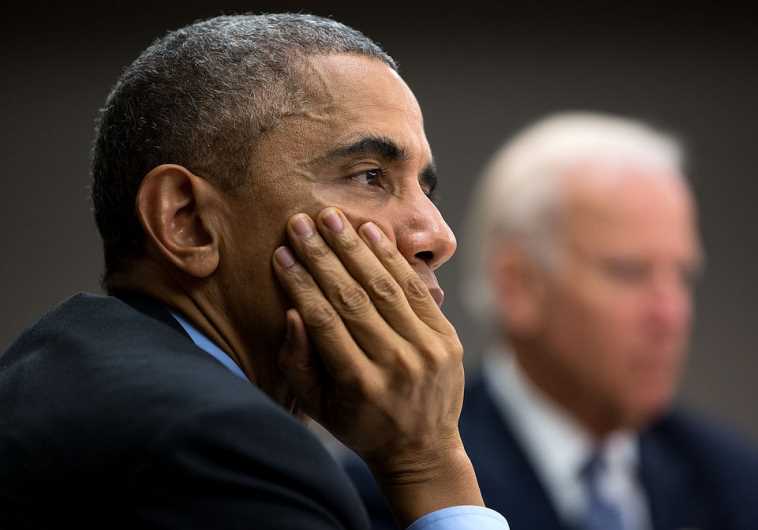
ShowImage (5)US President Barack Obama (L) and Vice President Joe Biden. (photo credit:OFFICIAL WHITE HOUSE PHOTO BY PETE SOUZA)

Most of the antiquities that ISIS plunders in Iraq and Syria make their way to the world market through Turkey. So, too, most of the oil that ISIS produces in Syria and Iraq is smuggled out through Turkey. According to the US Treasury, ISIS has made $1 million-$4m. a day from oil revenue.

Instead of maintaining its current practice of balancing its support for Turkey with its support for the Kurds, under the agreement, the West ditches its support for the Kurds and transfers its support to Turkey exclusively.

************************

While Israel and much of oficial Washington remain focused on the deal President Barack Obama just cut with the ayatollahs that gives them $150 billion and a guaranteed nuclear arsenal within a decade, Obama has already moved on – to Syria.

Obama’s first hope was to reach a deal with his Iranian friends that would leave the Assad regime in place. But the Iranians blew him off.

They know they don’t need a deal with Obama to secure their interests. Obama will continue to help them to maintain their power base in Syria though Hezbollah and the remains of the Assad regime without a deal.

Iran’s cold shoulder didn’t stop Obama. He moved on to his Sunni friend Turkish President Recep Erdogan.

Like the Iranians, since the war broke out, Erdogan has played a central role in transforming what started out as a local uprising into a regional conflict between Sunni and Shiite jihadists.

With Obama’s full support, by late 2012 Erdogan had built an opposition dominated by his totalitarian allies in the Muslim Brotherhood.

By mid-2013, Erdogan’s Muslim Brotherhood- led coalition was eclipsed by al-Qaida spinoffs. They also enjoyed Turkish support.

And when last summer ISIS supplanted al-Qaida as the dominant Sunni jihadist force in Syria, it did so with Erdogan’s full backing. For the past 18 months, Turkey has been ISIS’s logistical, political and economic base.

According to Brett McGurk, the State Department’s point man on ISIS, about 25,000 foreign fighters have joined ISIS in Syria and Iraq. All of them transited through Turkey.

Most of the antiquities that ISIS plunders in Iraq and Syria make their way to the world market through Turkey. So, too, most of the oil that ISIS produces in Syria and Iraq is smuggled out through Turkey. According to the US Treasury, ISIS has made $1 million-$4m. a day from oil revenue.

In May, US commandos in Syria assassinated Abu Sayyaf, ISIS’s chief money manager, and arrested his wife and seized numerous computers and flash drives from his home. According to a report in The Guardian published last week, the drives provided hard evidence of official Turkish economic collusion with ISIS.

Due to Turkish support, ISIS has become a self-financing terrorist group. With its revenue stream it is able to maintain a welfare state regime, attracting recruits from abroad and securing the loyalty of local Sunni militias and former Ba’athist forces.

Some Western officials believed that after finding hard evidence of Turkish regime support for ISIS, NATO would finally change its relationship with Turkey. To a degree they were correct.

Last week, Obama cut a deal with Erdogan that changes the West’s relationship with Erdogan.

Instead of maintaining its current practice of balancing its support for Turkey with its support for the Kurds, under the agreement, the West ditches its support for the Kurds and transfers its support to Turkey exclusively.

The Kurdish peshmerga militias operating today in Iraq and Syria are the only military outfits making sustained progress in the war against ISIS. Since last October, the Kurds in Syria have liberated ISIS-controlled and -threatened areas along the Turkish border.

The YPG, the peshmerga militia in Syria, won its first major victory in January, when after a protracted, bloody battle, with US air support, it freed the Kurdish border town of Kobani from ISIS’s assault.

In June, the YPG scored a strategic victory against ISIS by taking control of Tal Abyad. Tal Abyad controls the road connecting ISIS’s capital of Raqqa with Turkey. By capturing Tal Abyad, the Kurds cut Raqqa’s supply lines.

Last month, Time magazine reported that the Turks reacted with hysteria to Tal Abyad’s capture.

Not only did the operation endanger Raqqa, it gave the Kurds territorial contiguity in Syria.

The YPG’s victories enhanced the Kurds’ standing among Western nations. Indeed, some British and American officials were quoted openly discussing the possibility of removing the PKK, the YPG’s Iraqi counterpart, from their official lists of terrorist organizations.

The YPG’s victories similarly enhanced the Kurds’ standing inside Turkey itself. In the June elections to the Turkish parliament, the Kurdish HDP party won 12 percent of the vote nationally, and so blocked Erdogan’s AKP party from winning a parliamentary majority.

Without that majority Erdogan’s plan of reforming the constitution to transform Turkey into a presidential republic and secure his dictatorship for the long run has been jeopardized.

As far as Erdogan was concerned, by the middle of July the Kurdish threat to his power had reached unacceptable levels.

Then two weeks ago the deck was miraculously reshuffled.

On July 20, young Kurdish activists convened in Suduc, a Kurdish town on the Turkish side of the border, 6 kilometers from Kobani. A suicide bomber walked up to them, and detonated, massacring 32 people.

Turkish officials claim that the bomber was a Turkish Kurd, and a member of ISIS. But the Kurds didn’t buy that line. Last week, HDP lawmakers accused the regime of complicity with the bomber. And two days after the attack, militants from the PKK killed two Turkish policemen in a neighboring village, claiming that they collaborated with ISIS.

At that point, Erdogan sprang into action.

After refusing for months to work with NATO forces in their anti-ISIS operations, Erdogan announced he was entering the fray. He would begin targeting “terrorists” and allow the US air force to use two Turkish air bases for its anti-ISIS operations. In exchange, the US agreed to set up a “safe zone” in Syria along the Turkish border.

Turkish officials were quick to explain that in targeting “terrorists,” the Turks would not distinguish between Kurdish terrorists and ISIS terrorists just because the former are fighting ISIS. Both, they insisted, are legitimate targets.

Erdogan closed his deal in a telephone call with Obama. And he immediately went into action.

Turkish forces began bombing terrorist targets and rounding up terrorist suspects. Although a few of the Turkish bombing runs have been directly against ISIS, the vast majority have targeted Kurdish forces in Iraq and Syria.

Moreover, for every suspected ISIS terrorist arrested by Turkish security forces, at least eight Kurds have been taken into custody.

Then, too, Erdogan has called on AKP lawmakers to begin criminalizing their counterparts from the HDP. Kurdish lawmakers, he urged them, must be stripped of their parliamentary immunity to enable their arrests.

As Erdogan apparently sees things, by going to war against the Kurds, he will be able to reestablish the AKP’s parliamentary majority. Within a few weeks, if the AKP fails to form a governing coalition – and it will – then new elections will be held. The nationalists, who abandoned the AKP in June, will return to the party to reward Erdogan for fighting the Kurds.

As for that “safe area” in northern Syria, as the Kurds see it, Erdogan will use it to destroy Kurdish autonomy. He will flood the zone with Syrian Arab refugees who fled to Turkey, to dilute the Kurdish majority. And he will secure coalition support for the Sunni Arab militias – including those still affiliated with al-Qaida – which will be permitted by NATO to operate openly in the safe area.

Already the Kurds are reporting that the US has stopped providing air support for their forces fighting ISIS in the border town of Jarablus. Those forces were bombed this week by Turkish F-16s.

For their part, despite Erdogan’s pledge to fight ISIS, his forces seem remarkable uninterested in rolling back ISIS achievements. The Turks have no plan for removing ISIS from its strongholds in Raqqa or Haskiyah.

The Obama administration is presenting the deal with Turkey as yet another great achievement.

In an interview with Charlie Rose on Tuesday, McGurk explained that the deal was a long time in the making. It began with a phone conversation between Obama and Erdogan last October and it ended with their phone call last week.

In October, Obama convinced Erdogan not to oppose US air support for the Kurds in Kobani and to enable the US to resupply YPG fighters in Kobani through Turkey. In the second, Obama agreed not to oppose Erdogan’s offensive against the Kurds.

Two years ago, in August 2013, the world held its breath awaiting US action in Syria. That month, after prolonged equivocation amidst mountains of evidence, the Obama administration was forced to acknowledge that Iran’s Syrian puppet Bashar Assad had crossed Obama’s self-declared redline and used chemical weapons against regime opponents, including civilians.

US forces assembled for battle. Everything looked ready to go, until just hours before US jets were scheduled to begin bombing regime targets, Obama canceled the operation. In so doing, he lost all deterrent power against Iran. He also lost all strategic credibility among America’s regional allies.

To save face, Obama agreed to a Russian proposal to have international monitors remove Syria’s chemical weapons from the country.

Last summer, the administration proudly announced that the mission had been completed.

UN chemical weapons monitors had removed Syria’s chemical weapons arsenal from the country, they proclaimed. It didn’t matter to either Obama or Secretary of State John Kerry that by that point Assad had resumed chemical assaults with chlorine-based bombs. Chlorine bombs weren’t chemical weapons, the Americans idiotically proclaimed.

Then last week, the lie fell apart. The Wall Street Journal reported that according to US intelligence agencies, Assad not surrendered his chemical arsenal.

Rather, he hid much of his chemical weaponry from the UN inspectors. He had even managed to retain the capacity to make chemical weapons – like chlorine-based bombs – after agreeing to part with his chemical arsenal.

Assad was able to cheat, because just as the administration’s nuclear deal with the Iranians gives Iran control over which nuclear sites will be open to UN inspectors, and which will be off limits, so the chemical deal gave Assad control over what the inspectors would and would not be allowed to see. So, they saw only what he showed them.

Obama has gone full circle in concluding his deal with Erdogan. Since entering office, Obama has sought to cut deals with both the Sunni jihadists of the Muslim Brotherhood ilk and the Shi’ite jihadists of the Iranian ilk.

His chemical deal with Assad and his nuclear deal with the ayatollahs accomplished the latter goal, and did so at the expense of America’s Sunni Arab allies and Israel.

His deal last week with Erdogan accomplishes the former goal, to the benefit of ISIS, and on the backs of America’s Kurdish allies.

So that takes care of the Middle East. With 17 months left to go till Obama leave office, the time has apparently come for the British to begin to worry.

ISIS wipes out the Syrian army’s main strategic arsenal, flattens heart of Al Safira complex

July 29, 2015

ISIS wipes out the Syrian army’s main strategic arsenal, flattens heart of Al Safira complex, DEBKAfile, July 29, 2015

barrel_bombsSyrian “barrel bombs” dropped on targets

As the US and Turkey got started on a new air campaign against the Islamic State in Syria, the jhadis pulled off their most devastating attack yet on the Syrian army’s biggest arsenal. They subjected the giant Al-Safira military complex north of Aleppo to a steady blitz of an estimated 50 Grad missiles from Monday night to Tuesday, July 28.

DEBKAfile’s military sources report that Facility No.790, a large depot of the Syrian army’s strategic weapons, including chemicals, was set on fire and flattened.

Al Safira was important and big enough to be guarded by 1,800 members of the Syrian Air Force’s elite intelligence unit (not part of the air force) which comes under the direct command of President Bashar Assad.

Wednesday morning, flames continued to burn over the facility and explosions still shook buildings far away.

Some sources attributed the attack to Turkish Air Force bombers. In fact, it was the Islamic State which kept the complex under steady Grad missile fire, that was precise enough to raise suspicions of an inside leak betraying the exact locations of key targets, including subterranean structures, workshops for manufacture and repairs and large stockpiles of weapons.

Our sources list the items and sections of the Al-Safira military complex which ISIS demolished:

  • The Syrian army’s strategic stock of Scud D surface missiles.
  • Parts of the Syrian army’s chemical weapons production plant and stocks.
  • The production line for “barrel bombs” newly set up by Iranian engineers, which had become the most frequently used Syrian air force’s weapon against rebel forces.
  • A big helicopter pad where the Syrian choppers would load up on barrel bombs and distribute them among air bases across the country.
  • The storage facilities in a part of the base known as the “Suleiman area” which housed chemical artillery shells.
  • Many Iranian engineers and technicians were known to be present at Al Safira at the time of the attack. No information is available on casualties.

Our military sources say that never in the course of the four years plus of the Syrian conflict has the Assad regime’s army suffered a loss on this scale of its essential stock of hardware. It will undoubtedly affect its combat effectiveness and especially its fire power.

To gratify Tehran and Moscow, new US-Turkish anti-ISIS war campaign in Syria skirts Assad’s forces

July 26, 2015

To gratify Tehran and Moscow, new US-Turkish anti-ISIS war campaign in Syria skirts Assad’s forces, DEBKAfile, July 25, 2015

Tanks_face_IS_at_Syria_25.7.15

Not exactly by chance, the security zone bisects Kurdish territory and holds back Kurdish forces in their assaults on ISIS.

DEBKAfile’s military sources report that a glance at the map betrays an all-out US-Turkish effort not put up backs in Tehran by interfering with Syrian, Hizballah and pro-Iranian militia operations in critical northern Syrian war zones such as Aleppo or give the Syrian rebels a helping hand in the Idlib province.

*********************

After the second successive night of Turkish cross-border bombing attacks on the Islamic State in northern Syria, Ankara and Washington agreed Saturday, July 25, to name the “security zone” covered by a “partial no fly zone” they had declared in northern Syria the “Islamic State free zone.” Click HERE for full-size map!

This name represents a significant US-Turkish concession to Iran of immunity for its allies, Syrian President Bashar Assad and Hizballah, in order to gain Tehran’s cooperation in the campaign Turkey launched against ISIS Friday. Integral to the deal is also a promise to abstain from using the campaign to grant anti-Assad rebel groups any advantages.

This immunity did not extend to the Kurdish Workers Movement (PKK), which were targeted in the course of Turkish air and ground action in and over the new “security zone.” Those warplanes also flew missions Friday night over the PKK bases and logistical facilities in the Qandil Mountains of northern Iraq. The PKK responded Saturday with an announcement that their armistice with Ankara was over. Turkey may consequently expect a recurrence of Kurdish terrorist violence in its cities,DEBKAfile notes.

High-placed sources in Ankara disclosed details of the US-Turkish deal with Iran. US warplanes will have the use of Turkish air bases, and not just the big Incirlik facility, for staging air strikes against ISIS, so long as Syrian targets are avoided. Washington agreed to Ankara using its air and ground operations against ISIS in Syria to drive into the new “security zone” and push toward the east to continue those attacks – eve if they run up against Kurdish forces which are also fighting ISIS.

The security zone’s area covered by a no-fly zone is 90 km wide and 40km deep, running between Mere, a small town 25  km north o Aleppo in the west, to the northwestern town of Jarabulus, which is situated on the west bank of the Euphrates.

Not exactly by chance, the security zone bisects Kurdish territory and holds back Kurdish forces in their assaults on ISIS.

DEBKAfile’s military sources report that a glance at the map betrays an all-out US-Turkish effort not put up backs in Tehran by interfering with Syrian, Hizballah and pro-Iranian militia operations in critical northern Syrian war zones such as Aleppo or give the Syrian rebels a helping hand in the Idlib province.

The combined US-Turkish action moreover greatly supports the Assad-Hizballah war against ISIS gains in Syria and enhances Iranian and Russian influence in Damascus.

US Secretary of Defense Ashton Carter, in Irbil Friday, July 24, assured leaders of the semiautonomous Kurdish Republic of Iraq. “We are trying to build a force through the territory of Iraq, and someday in Syria, that can do what the peshmerga have achieved.”

At the same time, in Syria, the Kurds and their national aspirations look like losing out dramatically in the fallout from the complex US-Turkish partnership for beating ISIS back.

Turkey Uses ISIS as Excuse to Attack Kurds

July 26, 2015

Turkey Uses ISIS as Excuse to Attack Kurds, Gatestone Institute, Uzay Bulut, July 26, 2015

(Please see also, Will Anyone Help the Kurds? — DM)

  • It appears as if the Turkish government is using ISIS as a pretext to attack the PKK (Kurdistan Workers’ Party).
  • Turkey just announced that its air base at Incirlik will soon be open to coalition forces, presumably to fight ISIS. But the moment Turkey started bombing, it targeted Kurdish positions in Iraq, in addition to targeting ISIS positions in Syria.
  • In Turkey, millions of indigenous Kurds are continually terrorized and murdered, but ISIS terrorists can freely travel and use official border crossings to go to Syria and return to Turkey; they are even treated at Turkish hospitals.
  • If this is how the states that rule over Kurds treat them, why is there even any question as to whether the Kurds should have their own self-government?

Turkey’s government seems to be waging a new war against the Kurds, now struggling to get an internationally recognized political status in Syrian Kurdistan.

On July 24, Turkish media sources reported that Turkish jet fighters bombed Kurdish PKK (Kurdistan Workers’ Party) bases in Qandil, in Iraqi Kurdistan, as well as the Islamic State (ISIS) in Syria.

Turkey is evidently unsettled by the rapprochement the PKK seems to be establishing with the U.S. and Europe. Possibly alarmed by the PKK’s victories against ISIS, as well as its strengthening international standing, Ankara, in addition to targeting ISIS positions in Syria, has been bombing the PKK positions in the Qandil mountains of Iraqi Kurdistan, where the PKK headquarters are located.

There is no ISIS in Qandil.

As expected, many Turkish media outlets were more enthusiastic about the Turkish air force’s bombing the Kurdish militia than about bombing ISIS. “The camps of the PKK,” they excitedly reported, “have been covered with fire.”

It appears as if Turkey’s ruling Justice and Development Party (AKP) is using ISIS as a pretext to attack the PKK. Ankara just announced that its air base at Incirlik will soon be open to coalition forces, presumably to fight ISIS, but the moment Turkey started bombing, it targeted Kurdish positions. Those attacks not only open a new era of death and destruction, but also bring an end to all possibilities of resolving Turkey’s Kurdish issue non-violently.

Prime Minister Ahmet Davutoglu announced that

“a second wave operation against Daesh [ISIS] in Syria was started. Just after that, a very comprehensive operation was carried out against the camps of the terrorist organization PKK in northern Iraq. I am glad that the targets were hit with great success. We have given instructions to start a third wave operation in Syria and a second wave operation in Iraq.”

The “great success” of the Turkish military has brought much damage and injury to even Kurdish civilians — including children. The Kurdish newspaper Rudaw reported that two Kurdish villagers in Duhok’s Berwari region were carried to hospital in the aftermath of a Turkish artillery bombardment in the Amediye region. One of the victims was 12 years old. The second victim lost a leg in an airstrike. Four members of the PKK were killed and several others were injured.

Shortly after military operations against the PKK started, access to the websites of pro-Kurdish newspapers and news agencies was denied “by decree of court.” These websites — including Fırat News Agency (ANF), Dicle News Agency (DIHA), Hawar News Agency (ANHA), Ozgur Gundem newspaper, Yuksekova News, Rudaw and BasNews — are still blocked in Turkey.

ISIS, meanwhile, has not so far made any statement regarding Turkey’s so-called bombings of ISIS in any of its media outlets.

Had Turkish military attacked the PKK alone, and not in addition to attacking ISIS, it would probably have received widespread international condemnation. So to add “legitimacy” to its attacks against the Kurdish PKK — whose affiliate Democratic Union Party (PYD) in Syria and its armed wing, the Kurdish People’s Defense Units (YPG) have been resisting ISIS and other Islamist terrorist groups since 2013 — Turkey declared that it will also attack ISIS. This would give it cover for its attacks against Kurdish fighters.

In 2014, Turkey’s President Recep Tayyip Erdogan described the plan he wanted to carry out in Syria and Iraq: “The problem in Syria should be taken into account. Iraq too should be considered similarly. Moreover, there needs to be a solution that will also deal with the Syrian wing [PYD] of the separatist terrorist organization [PKK].”

The AKP government, dissatisfied with the results of last month’s parliamentary elections, also seems to want to hold new elections, to push the mainly Kurdish HDP Party below the required 10% threshold, and thus force them out of parliament. Perhaps the government thinks that bombing the PKK will generate Turkish nationalist enthusiasm that will work in the AKP’s favor to help it regain a majority in early elections.

Apparently, Turkey does not need Kurdish deputies in its parliament. Apparently, the state prefers to slaughter or arrest the Kurds — as it has done for decades. Why hold talks and reach a democratic resolution when you have the power to murder people wholesale?[1]

Sadly, Turkey has preferred not to form a “Turkish-Kurdish alliance” to destroy ISIS. First, Turkey has opened its borders to ISIS, enabling the growth of the terrorist group. And now, at the first opportunity, it is bombing the Kurds again. According to this strategy, “peace” will be possible only when Kurds submit to Turkish supremacism and abandon their goal of being an equal nation.

In the meantime, Mevlut Cavusoglu, Turkish minister of foreign affairs, said that the Incirlik air base in Turkey has not yet been opened for use by the U.S. and other coalition forces, but that it will be opened in the upcoming period.

Kurdish forces, therefore, are the only forces that are truly resisting the Islamic State.

They have been repressed by Baghdad and murdered by Turkey and Iran.

If this is how the states that rule over Kurds treat them, why is there even any question as to whether the Kurds should have their own self-government?

As a result of the ISIS attacks in the region, the Kurdish PKK — as well as its Syrian Kurdish affiliate, Democratic Union Party (PYD) and its armed wing, Kurdish People’s Defense Units (YPG) — have emerged as the America’s most effective battlefield partners against ISIS. Ever since ISIS became a major force in Syria, the U.S. has apparently relied heavily on YPG to stop ISIS from advancing. According to Henri Barkey, a former State Department specialist on Turkey, “The U.S. has become the YPG’s air force and the YPG has become the U.S.’s ground force in Syria.”

* * *

Attacks on the Kurds were already under way last week. On July 20, a bomb attack in the Kurdish town of Suruc (Pirsus) in Turkey killed 32 people during a meeting of young humanitarian activists, who were discussing the reconstruction of the neighboring Kurdish town of Kobane.

1171The scene of the suicide bombing in Suruc, Turkey. An ISIS suicide bomber murdered 32 people and wounded more than 100 others in a July 20 attack on Kurdish humanitarian activists. (Image source: VOA video screenshot)

The blast took place while the activists were making a statement to the press in the garden of a cultural center. At least 100 others, mostly university students, were wounded. (Graphic video of the explosion)

The suicide bomber was identified through DNA testing, according to reports in the Turkish news media. Seyh Abdurrahman Alagoz was reportedly a 20-year-old Turkish university student, recently returned from Syria, and believed to have had ties to ISIS.

Alagoz targeted a meeting 300 secular activists, members of the Federation of Socialist Youth Associations (SGDF), who gathered at a cultural center in the province of Urfa, opposite the Kurdish town of Kobane in Syrian Kurdistan. As part of an effort to rebuild Kobane, they were preparing to provide aid, give toys to the children there and build a hospital, school, nursery, children’s park, library and a memorial forest for those who had lost their lives in Kobane.

“Work on the building of hospitals and schools needs to be done,” Oguz Yuzgec, the co-president of the federation, said before the explosion. “One of the things we will do is to build a children’s park in Kobane. We will name it after Emre Aslan, who died fighting in Kobane. We are collecting toys. We will participate in the construction of the nursery that the canton of Kobane is planning to build. We have the responsibility of helping the nursery function. We need everybody who knows how to draw and can teach children.”

Mazlum Demirtas, a survivor of the attack, said: “The main one responsible for this incident is the state of Turkey, the AKP fascism, the AKP dictatorship. … It attacked us with its gunmen and gangs. Since yesterday, parents have been collecting the dismembered body parts of their children. They are trying to identify the dismembered bodies. This is called fascism, inhumanity and barbarity.”

Pinar Gayip, another survivor of the attack, said in a telephone interview on the pro-government Haberturk TV that, “Instead of helping the wounded, the murderer-police of the murderer-AKP threw tear gas at the vehicles with which we carried the wounded.” She was taken off the air.

All across Turkish Kurdistan, there were protests condemning the massacre and the government’s alleged involvement in it. Police in Istanbul used plastic bullets and water cannonsagainst people who gathered to remember those murdered in Suruc.

The Turkish authorities briefly blocked access to Twitter last Wednesday to prevent the people from viewing photos of the bombing in Suruc. Officials admitted that Turkey had asked Twitter to remove 107 URLs (web addresses) with images related to the bombing; before the ban, Twitter had already removed 50.

Selahattin Demirtas, the co-chair of the pro-Kurdish Peoples’ Party (HDP), said that state surveillance activities were intensive in Suruc, and that the intelligence service was recording the identity of everyone traveling to and from Suruc.

As Demirtas’s own convoy had recently not been permitted to enter Suruc, he emphasized the extent of state surveillance in the town, and said that nobody could argue that someone could have managed to infiltrate the crowd and carry out the suicide attack without state support.

“Today, we have witnessed in Suruc yet again what an army of barbarity and rape, an army that has lost human dignity, can do,” Demirtas said. “Those who have been silent in the face of ISIS, who have not dared even raise their voice to it, as well as the officials in Ankara who threaten even the HDP every day but caress the head of ISIS, are the accomplices of this barbarity.”

In the meantime, Mehmet Gormez, the head of the Turkish Presidency of Religious Affairs (Diyanet), announced on its Twitter account that the perpetrators of the Suruc attack do not have religion.

However, three days before the massacre in Suruc, about 100 Islamists — alleged to be ISIS sympathizers — had performed mass Islamic Eid prayers in Istanbul. They demanded Islamic sharia law instead of democracy. ISIS sympathizers had performed the same Eid prayers at the same place the year before, as well.

Over the border in Syrian Kurdistan, shortly after the blast in Suruc, a suicide bomber detonated a car bomb at a checkpoint in Kobane. Two Kurdish fighters were killed in the explosion, according to Rami Abdel Rahman, director of the Syrian Observatory for Human Rights.

Last month, a deadly blast hit the Kurdish province of Diyarbakir in Turkey, during an election rally of the pro-Kurdish HDP that was attended by tens of thousands of people. Just before the HDP co-chair Selahattin Demirtas was going to speak, two bombs exploded at different places. Four people were killed, and more than 100 people are estimated to have been wounded. One of the wounded, Lisa Calan, 28, a Kurdish art director from Diyarbakir, lost both legs in the explosion.

As the wounded were being carried to hospitals, police used tear gas against people trying to run from the area in panic

The bomber was reported to be a member of ISIS.

* * *

In Turkey, millions of indigenous Kurds are continually terrorized and murdered, while ISIS terrorists can freely travel and use official border crossings to go to Syria and return to Turkey; they are even treated at Turkish hospitals. Emrah Cakan, for instance, a Turkish-born ISIS commander wounded in Syria, got medical treatment at the university hospital in Turkey’s Denizli province in March.

The Denizli governor’s office issued a written statement on 5 March:

“The treatment of Emrah C. at the Denizli hospital was started upon his own application. The procedural acts concerning his injury were conducted by our border city during his entry to our country and they still continue. And his treatment procedures continue as a part of his right to benefit from health services just like all our other citizens have.”

The “compassion” and hospitality that many Turkish institutions have for ISIS members is not even hidden. The silence of the West is mystifying and disappointing.

The U.S. government cooperates with oppressive regimes — including the terrorist regime of Iran, under which Kurds are forced to live — to the detriment of the Kurds, to the detriment other persecuted peoples, and to the detriment of the future of the West.

Many Middle Eastern regimes are ruled by Islamist, often genocidal governments — so there is not much to expect from them in terms of human rights and liberties.

The Kurds need real support, real arms and real recognition. Otherwise, there does not seem to be much difference between the dictatorial, genocidal Middle Eastern regimes and the West, which used to represent democracy and freedom.
_____________________________

[1] The so-called “peace process” was reportedly started in 2012 and through it, Kurds and the Turkish government were to resolve the Kurdish issue through negotiations.)

Jordan launches war on ISIS in Iraq, Turkish warplanes hit ISIS in Syria. US, Israel involved in both ops

July 24, 2015

Jordan launches war on ISIS in Iraq, Turkish warplanes hit ISIS in Syria. US, Israel involved in both ops, DEBKAfile, July 24, 2015

ISIS_24.7.15F-16 warplane in action against ISIS

The Middle East woke up Friday, July 24, to two new full-fledged wars launched by Jordan and Turkey for cutting down the Islamic State of Iraq and the Levant as is forces advanced on their borders. The United States and Israel are involved in both campaigns. Jordanian armored, commando and air forces are already operating deep inside Iraq, while Friday morning, Turkey conducted its first cross-border air strike against ISIS targets in Syria. Clashes between Turkish troops and Islamic fighters erupted at several points along the border. Both governments also conducted mass arrests of suspected Islamists. The Jordanian police picked up ISIS adherents, while 5,000 Turkish police detained 250 Islamist and outlawed Kurdish PKK suspects in Istanbul, Ankara, Izmir and Saniurta. Jordan Friday shut down its only border crossing with Iraq.

Earlier this week, Turkey permitted US warplanes to us the Incirlik air base in the south for bombing missions against ISIS, and Israel handed over to Jordan 16 Cobra combat helicopters and assured Jordan of air force cover for its anti-ISIS operation.

Read more about this new chapter in the war on ISIS in the DEBKAfile report of Thursday, July 23.

In the first publicized Israeli military hardware transaction with an Arab nation, Israel has handed over “around 16 Cobra” combat helicopters in support of Jordan’s war on the Islamic State. This was confirmed Thursday, July 23, by a US official close to the transfer. It was also the first time US-Jordanian-Israeli military cooperation in the struggle against ISIS was publicly disclosed.

“These choppers are for border security,” said the unnamed US official.DEBKAfile’s military and counter-terror sources disclose that the Cobras are needed for a large-scale Jordanian aerial-commando operation launched in the western Iraqi province of Anbar, which borders on the Hashemite Kingdom. This operation is designed to carve out a security belt tens of kilometers deep inside Iraq as a barrier against Islamic State’s encroachment.

Amman approached Washington for combat helicopters to back the operation and was told that the US is short of these items and would turn Israel to pitch in. The US first provided mechanical overhauls for the aircraft before they were incorporated free of charge in Jordan’s existing Cobra fleet.

The transfer was announced while US Defense Secretary Ashton Carter was touring the Middle East. He arrived in Amman Tuesday, July 21,after talks in Israel, and visited Baghdad unannounced Thursday, July 23 for an update on the war on ISIS

The mounting Islamist threat to Jordan is coming now from two directions – the Iraqi province of Anbar and  Syria. ISIS forces have grabbed positions in southern Syria near the intersection of the Jordanian, Iraqi and Syrian borders. They have also moved up to the eastern Syrian town of Abu Kamal on the Iraqi border and, since mid-May, have gradually detached small groups from the captured central Syrian town of Palmyra and quietly built up positions in the south near Jabal Druze.

This buildup has been tracked by US, Jordanian and Israeli surveillance.

The Islamist domestic threat to the Hashemite Kingdom is no less acute. Jihadist sleeper cells have been planted in Jordan ready to strike strategic targets for a reign of terror to coincide with the onset of external Islamic State attacks staged from Iraq and Syria.

Our military sources report that US-Israeli-Jordanian cooperation is channeled through the US Central Command Forward-Jordan from its headquarters north of Amman. It is staffed by US, British, Jordanian, Saudi and Israeli officers working together to defeat ISIS.

US Defense Secy to visit Iraqi Kurdistan after Baghdad

July 24, 2015

US Defense Secy to visit Iraqi Kurdistan after Baghdad, DEBKAfile, July 24, 2015

US Defense Secretary Ashton Carter plans to visit Irbil, capital of the semi-autonomous Kurdish Republic of Iraq, before he leaves Iraq. He will hold talks with the KRG president Massoud Barazani and other Kurish leaders. DEBKAfile: The main purpose of his talks in Irbil is to determine whether the US will provide the peshmerga with heavy weapons, including warplanes and combat helicopters, for grappling with Islamic State’s assaults on their doors. Obama has until now turned down Kurdish requests for this hardware, mainly because of Iranian and Iraqi objections. The Kurds maintain that their army is the only effective force fighting in the field capable of routing ISIS.