Archive for the ‘Islam’ category

Columnist On Jordanian Daily: ISIS ‘Did Not Invent A New Islam’

February 11, 2015

Columnist On Jordanian Daily: ISIS ‘Did Not Invent A New Islam,’ MEMRI, February 11, 2015

(It would be encouraging if such statements were more often made in the “legitimate news” media of the U.S. and the “free” world. — DM)

In a February 10, 2015 article in the English-language Jordanian daily Jordan Times, titled “We Have a Problem”, attorney and columnist Zaid Nabulsi wrote that Muslims must not suffice with protesting that “Islam is innocent” of the terrorists’ actions. They must also acknowledge that the extremism of terrorist organizations like ISIS emanates directly from the teachings of Wahhabi Islam that now permeate the Sunni world, and from messages spread by the Muslim Brotherhood and by prominent clerics like Yousuf Al-Qaradawi. He added that Muslims must be brave enough not merely to condemn the ideology of the terrorists, but also to renounce Islamic texts that are incompatible with basic human values, including certain hadiths that are erroneously attributed to the Prophet Muhammad, as well as the writings of certain prominent medieval scholars, such as Ibn Taymiyyah.

The following are excerpts from his article:

“Some Wahabist Teachings, Which Have Permeated The Air We Breathe In The Muslim World, Are Simply Irreconcilable With Decent Human Values”

“Enough is enough. It is time to speak out. ‘Islam is innocent’ is an incomplete sentence. Introspection is needed, for, if we shy away from reality, the alternative will be more images like those we witnessed last Tuesday night, when brave Lt. Muath Al-Kasasbeh was burnt to death in a cage…

“Some Wahabist teachings, which have permeated the air we breathe in the Muslim world, are simply irreconcilable with decent human values, especially the ones that declare that every non-Wahabist is a disposable body whose bloodletting is unproblematic. So enough of this burial of our heads in the sand. It has become tiresome to keep hearing the unproductive cliché that Islam is innocent after each atrocity committed by devout fanatics who did nothing except execute the exact letter of their textbooks, which order them to slaughter the infidels.

“The escapism that mainstream Islam has nothing to do with those atrocities does not hold water anymore because Wahabism and Islam have become indistinguishable. To understand the crisis of Muslims today, one has to remember that Wahabism exists in several textbooks containing the alleged sayings of the Prophet Mohammad, or books of ‘Hadith,’ revered by so many. What we must confront is the undeniable fact that it is from many stories found in these books that the unprecedented cruelty of groups such as the so-called Islamic State and Jabhat Al-Nusra emanates.

“The problem today has nothing to do with the original spirit of Prophet Mohammad’s message. Nor has it anything to do with the tumultuous history of Muslims over 14 centuries, parts of which were no doubt glorious and enlightened. The catastrophe today is with the visible manifestation of Islam in the modern world, as demonstrated by the prevalent beliefs and practices of many people who call themselves Muslims.”

“[The] Negative Image Of Muslims Is Not All Just Smoke And No Fire”

“[But] this negative image of Muslims is not all just smoke and no fire. This is what those 120 Islamic scholars who sent a letter to Abu Bakr Al-Baghdadi last year could not fathom. [ISIS] did not invent a new Islam. On the contrary, its followers are strict adherents of the same textbooks quoted in that long letter (bizarrely addressed to ‘Dr Ibrahim Awwad Al-Badri,’ Baghdadi’s real name, bestowing intellectual respectability upon this mass murderer, as if one were writing a letter to the mayor of Copenhagen). In fact, the scholars’ letter was a misguided attempt to disinfect Wahabism, to cleanse it from itself, by claiming that IS simply misinterpreted texts that are otherwise compatible with human decency. In that sense, the letter squabbled over the semantics of the alleged instructions by the Prophet to spread Islam by the sword, but it did not dare renounce the authenticity of those same sayings…

“If we truly want to defend Islam, we need to perform a much more invasive surgery. Take the Muslim Brotherhood as an example of the prevalence of the Wahabist teachings among Muslims today. The Brotherhood is the virtual womb that incubated all the current jihadist groups, including Al-Qaeda itself (Al- Zawahiri hailed from the Egyptian MB offshoot that murdered president Anwar Sadat). Yet, when Abu Musab Al-Zarqawi was killed in 2006, the three most senior leaders of the MB in Jordan brazenly visited the condolence house in Zarqa and announced to the media that Zarqawi was a martyr in the eyes of God, despite Zarqawi having blown up three hotels in Amman the previous year, killing scores of Jordanians going about their lives or celebrating a peaceful wedding…

“The orgy of decapitations in Syria over the last four years was promoted by very rich Sunni clerics such as Yusuf Al-Qaradawi and Mohammad Al-Uraifi, aided by the countless satellite stations openly calling for the murder of Alawites and Shiites, and financed by billions from extremely wealthy but hateful Muslims. So, enough with the denials. It is time to raise the alarm. We have a problem!”

“If We Really Want To Defend Islam As A Religion Of Mercy… We Have To Muster The Courage To Identify The Specific Texts That Actually Defame Islam, Denounce Them And Permanently Cleanse Islamic Tradition Of Them”

“There is obviously a propensity towards eliminating ‘the other’ imbedded deep within Wahabist ideology. It is not only foolish to deny this fact, it is also dangerous, for we would be covering the cancerous tumour with a bandage. What we cannot deny is that many of the Wahabist textbooks are the same operating manuals that Islamist butchers use to justify their savagery. For example, very few people know that while [the Jordanian pilot] Muath was being set on fire in that macabre video, the voiceover was a recitation of an Ibn Taymiyah fatwa deeming the incineration of unbelievers a legitimate act of jihad. Ibn Taymiyah is not some obscure scholar on the fringe of Sunni Islam. In the Sunni world, he is universally venerated with the title ‘Sheikh of Islam,’ elevating him to an almost infallible clerical status.

“If we really want to defend Islam as a religion of mercy, if we really want to be believed when we proclaim the innocence of this religion, we need to do more than just repeat this meaningless mantra about us having nothing to do with [ISIS]. We have to muster the courage to identify the specific texts that actually defame Islam, denounce them and permanently cleanse Islamic tradition of them.”

Iran’s Moves in the Middle East and Why You Should Care.

February 10, 2015

Iran’s Moves in the Middle East and Why You Should Care, The Watchman via You Tube, February 10, 2015


Egypt Under Al-Sisi: An Interview with Raymond Stock

February 9, 2015

Egypt Under Al-Sisi: An Interview with Raymond Stock, Middle East Forum, February 8, 2015

by Jerry Gordon
The New English Review
February 2015

The introduction to this interview has been abridged.

To discuss Egypt’s prospects under the Abdel Fattah al-Sisi government, we invited back Dr. Raymond Stock whom we had interviewed in November 2012. (See: No Blinders About Egypt Under Muslim Brotherhood ). Stock is a Shillman/Ginsburg Writing Fellow at the Middle East Forum and a former Assistant Professor of Arabic and Middle East Studies at Drew University. He spent twenty years in Egypt and was deported by the Mubarak regime in 2010. He is writing a biography of 1988 Egyptian Nobel laureate in literature Naguib Mahfouz (1911-2006) for Farrar, Straus and Giroux and is a prolific translator of his works.

……………………..

“[The Muslim Brotherhood] has deeply bonded with the highest levels of the Obama administration, which uncritically backed its creation of an elected, one-party dictatorship under Morsi.

“Unlike Morsi and the MB, who worked covertly with the terrorists in Sinai, al-Sisi wholeheartedly supports the peace with Israel.”

Egypt is now in an informal alliance with Israel, the United Arab Emirates and Bahrain to confront Iran. That alliance is compromised, however, by recent moves from Egypt’s Gulf partners to mend fences with Iran as a result of their feeling exposed by Washington’s alarming pivot toward Tehran at the expense of its traditional Sunni clients.

“Obama’s leftist, rather Edward-Saidian worldview … sees indigenous anti-Western forces such as the Islamists to be the benignly natural and legitimate consequence of American and European policies during the colonial era and the Cold War.”


********************

Jerry Gordon: Ray Stock thank you for consenting to this interview.

Raymond Stock: Thank you for inviting me back.

Jerry Gordon: Egyptian President al-Sisi started 2015 with two dramatic moves- his New Year’s speech at al-Azhar University and Christmas greetings at a Coptic church with Pope Tawadros II present. What were the messages he conveyed to Muslim clerics, Coptic Christians and the world?

Raymond Stock: At al-Azhar, President al-Sisi was saying it is not merely an extremist interpretation of Islam that is threatening the world with global jihad, but ideas that are at the core of the mainstream, orthodox understanding of the religion–and that this would require a “religious revolution” to change.

At the Coptic Cathedral, he urged Egyptians not to define themselves by their religion, be it Christian or Muslim, but by the fact that they are Egyptians–a rejection of Islamism, which defines national identity in purely religious terms.

To the world, he was saying that Islam as it is being taught and practiced by its leading religious scholars has given birth to a globally destructive ideology which is now threatening us all.

Moreover, he wants to launch a movement within Islam to save the religion from itself, that is, before it tears itself apart completely and the rest of the world destroys it in self-defense.

And he challenged the clerics to take the lead in that effort by openly re-examining their own teachings and source materials for interpreting Islam.

Gordon: Al-Sisi has cracked down on press freedoms in Egypt and brought to trial three Al Jazeera correspondents. What in your view prompted that?

Stock: Though no libertarian, it is hard to say if al-Sisi himself has had anything to do directly with the suppression of press freedom, though it is happening on his watch. Going back to Pharaonic times, Egypt’s state institutions, the oldest in the world, and its political culture, have little tradition of respecting civil liberties. Some periods have been worse than others–the worst was actually under Gamal Abdel-Nasser in the 1950s and ’60s, when many thousands of political prisoners were sent “behind the sun” to camps in the Western Desert.

Al-Sisi is still so popular, the public so widely disgusted with the unending social and political chaos since the 2011 revolution, and so alarmed by the terrorist insurgency waged by the Islamists, that probably a majority of news editors and perhaps also of reporters have decided to support him completely and to oppose his critics automatically. At this point it is hard to find any clear connection with al-Sisi himself to this consensus, enshrined in a declaration by several hundred key media figures a few months ago. However, certainly if he didn’t like it he could well speak up against it–yet he hasn’t so far.
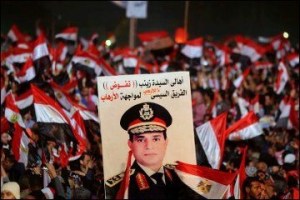
948Pro-Sisi demonstrators celebrate the third anniversary of Mubarak’s overthrow, January 2014.

Last summer he publicly regretted the imprisonment of the three Al Jazeera journalists, saying he wished they had been deported instead. Citing his belief in an independent judiciary, he refused to intervene in the legal process. Now that they are being retried after winning on appeal, we’ll see if he pardons and deports them should they be convicted again.

Gordon: Following, al-Sisi’s ouster of President Morsi and crackdown on Muslim Brotherhood leaders, what has happened to the movement in Egypt?

Stock: Though deservedly banned as a terrorist group, its top leaders in jail and the rest driven underground or abroad, it is far from dead and remains a threat to the Egyptian state and society. Its refusal to accept the June 30 popular revolution (far larger than the one that overthrew Mubarak), parental bonds to Hamas, financial support from Qatar and wealthy Gulf donors (and possibly Iran), partnership with the Salafis and ideological affinity and outreach to groups like al-Qa’ida and Islamic Jihad have served it well in retaining its base while gaining sympathy–especially internationally.

Though all these factors–plus its horrendous behavior in power–have greatly alienated the majority of Egyptians, they are for the most part also its greatest assets for the future, if they can only survive the current storm. As they have shown in several major periods of repression in the past–the most severe being under Abdel-Nasser–they only need to endure until there is successor to al-Sisi, who may decide to restore the MB to political legitimacy as a means of fighting al-Sisi’s remaining political allies. (Anwar al-Sadat, for example, freed the MB activists from prison to combat the surviving members of Abdel-Nasser’s coterie.) Such a situation could put them in striking distance of taking power again.

Meanwhile, the MB has global headquarters in Istanbul and London, is very influential in Europe, and has enormously increased its penetration at the federal, state and local levels all over the US. As part of this, it has deeply bonded with the highest levels of the Obama administration, which uncritically backed its creation of an elected, one-party dictatorship under Morsi. Obama evidently seeks to help the MB to return to power in Egypt—as shown, for example, by the State Department’s recent hosting of a conference of MB allies at Foggy Bottom, though it may take a while. Al-Sisi probably only has a year or two to turn the economy around before he risks another uprising.

The goal of the terrorist insurgency is to discourage foreign investment and stifle the stimulus provided by major government projects such as the new second channel to the Suez Canal to aid the recovery from the last four years of chaos. This, they hope, will pave the way for new popular upheaval which they hope to manipulate if not lead.

Gordon: Has the Islamic State supplanted the Salafist and Muslim Brotherhood movements?

Stock: In a sense, yes, but the situation is actually quite complex. Ideologically, IS—like al-Qa’ida–is an extension of the Salafist movement and the MB (itself established as a Salafi organization in the Salafi library in Ismailiya, Egypt in 1928). IS, because of its uncompromising Islamist purity, harshness, brutality and its dramatic seizure of so much territory in Iraq and Syria, coupled with its incredibly savvy use of social media, has largely eclipsed all of its predecessors in recruitment of fighters to the Middle East. It also outpaced all of them in its creation of lone wolves and sleeper cells in Europe, America and elsewhere.
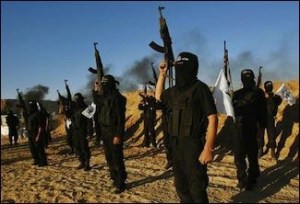
949Ansar Bayt al-Maqdis pledged allegiance to the Islamic State (IS) group last year.

That includes Egypt, where the MB-and-AQ aligned Ansar Bayt al-Maqdis (ABM) organization is responsible for most of the attacks in the country over the past two years. ABM, along with its allies controls much of North Sinai and has declared its allegiance to IS. The MB, as noted, still retains a very strong base, as does the Salafi al-Nour Party which has pragmatically allied itself with Al-Sisi. The appeal of IS may frustrate their ability to draw younger members–yet it is far from clear that IS will do any better in the long run. So have many of the Islamists in Libya, the eastern half of which IS now controls, and may soon run Tripoli as well. The stunning success of IS provides further inspiration to groups like Boko Haram, which has overrun much of northeastern Nigeria and has recently spread into Cameroon, as well as al-Shabaab in Somalia. IS also now has a presence in southern Afghanistan and beyond. Unless it is destroyed militarily in the very near future–which is virtually impossible so long as Obama is President–IS threatens every state with a significant Muslim population, as well as the West, which is its ultimate target.

Gordon: Al-Sisi has propounded a doctrine of stability for Egypt. What is it and has he succeeded since his election?

Stock: I would say that if al-Sisi truly has established such a doctrine for stability, it would consist of the following:

    1. Anti-Islamism—i.e. a more limited role for Shariah (which is nonetheless still enshrined in the new constitution, yet no longer to be interpreted by the clerics at al-Azhar, but by the government, whose authority and much of its outlook is secular, not religious;
    2. Electoral democracy though with somewhat limited civil liberties, to satisfy both the demand for popular sovereignty and for an end to the endless chaos–strikes and demonstrations (and skyrocketing crime) since the fall of Mubarak in 2011, and to limit the public role of the Islamists, who are at war with Egypt; and
    3. An independent foreign policy—one that still seeks to maintain the traditional alliance with the U.S. and the West, but is not afraid to go elsewhere as needed.

Obama’s backing of the Islamists and his cutting of aid for the past two years have driven al-Sisi to radically diversity Egypt’s sources of funding and investment from abroad, including for the first time military aid. For more than three decades, Egypt’s military assistance came almost exclusively from Washington, though that is now being surpassed by multi-billion dollar arms deals from Moscow and even to an extent from Beijing, funded by al-Sisi’s backers in the Gulf. That puts the Egyptian-American alliance and its principal benefits—the more than thirty-five year peace with Israel, our priority access to the Suez Canal (now being expanded with a second channel but without US investment), and vital cooperation on security issues—seriously at risk.

Gordon: Some analysts have said that in the wake of the Arab Spring the old order of regional autocracies has re-emerged in an alliance against the Muslim Brotherhood. What is your view and especially in the case of Egypt’s North African neighborhood?

Stock: That depends on the country: in North Africa, King Mohammed VI is still in power, but the Muslim Brotherhood has won more seats than the other parties in parliament, a situation echoing that in Jordan, though it is less precarious at present. Algeria, still recovering from the savage Islamist bloodbath after the Army’s annulment of elections in January 1992, was least affected of all the states in the region by the Arab Spring. (Perhaps the only major result there was the lifting of the State of Emergency that had prevailed for nearly two decades, in February 2011.) Tunisia, where the Arab Spring began in December 2010, threw out its MB-affiliate controlled government in a popular movement backed by the army—in a situation that rather echoed the one in Egypt, and late last year elected a new secularist plurality in parliament and a new secularist president, Béji Caїd Essebsi.

In Libya, the feeble central government that we helped install by foolishly removing the vicious, eccentric but cooperative Col. Mu’ammar al-Qaddafi has predictably collapsed. Yet a new secularist-dominated government was elected last June 25 and a pro-secularist remnant of the Qaddafi era, General Khalifa Haftar, for the past year has been at war with the Islamist militias that have been the real powers since 2011. Haftar also wants to destroy the Libyan iteration of the Muslim Brotherhood, root and branch, especially after it launched an armed uprising in eastern Libya following Morsi’s ouster in Egypt in 2013. As a result of this chaos, generated by our own needless—or at least, badly botched–intervention in the Arab Spring, the U.S. now has no effective presence in Libya. The security vacuum prompted Egypt and the United Arab Emirates to cooperate in launching air strikes near Tripoli last summer in support of Haftar’s forces. IS and other Islamist organizations are now infiltrating weapons and fighters into Egypt from Libya, threatening the country’s—and the region’s—stability.

In the Eastern Arab world, Egypt’s principal allies now are Saudi Arabia and the UAE, who together immediately pledged 12 billion dollars in aid after Morsi’s removal, and have given billions more since. All of it and more is desperately needed to compensate for the depletion of Egypt’s hard currency reserves, loss of foreign investment and near-destruction of the once lucrative tourist industry that have all continued since the January 25th Revolution against Hosni Mubarak. Both the Saudis and the Emiratis oppose the MB and Hamas, who—along with Egypt under Morsi—are clients of their Gulf rival, Qatar. America’s annual, mainly military package of $1.5 billion seems trifling in comparison (unless viewed cumulatively since it began in 1979). Still, it will be difficult to switch to mainly Russian or Chinese systems–much as the latter may be based on hacked American designs–after so many years of absorbing Yankee equipment and training.

Gordon: What is the emerging change in Egypt’s relations with Israel, both geo-political and economic?

Stock: Unlike Morsi and the MB, who worked covertly with the terrorists in Sinai, al-Sisi wholeheartedly supports the peace with Israel. He has greatly increased security cooperation with the Jewish state—which had been endangered in the 2011-12 transition and during the Morsi era—to levels exceeding those under Mubarak. Again, even more than Mubarak, who loathed them too, al-Sisi sees the MB, Hamas and their Islamist allies as threats to Egypt as well as Israel. Likewise, he sees Iran—with whom Morsi sought a rapprochement—as Egypt’s greatest strategic adversary in the region.

As a result, Egypt is now in an informal alliance with Israel, the United Arab Emirates and Bahrain to confront Iran. That alliance is compromised, however, by recent moves from Egypt’s Gulf partners to mend fences with Iran as a result of their feeling exposed by Washington’s alarming pivot toward Tehran at the expense of its traditional Sunni clients.

Meanwhile, though overall Israel-Egypt trade remains minimal (as it had through the decades of cold peace under Mubarak and afterward), energy-strapped Egypt may soon be importing natural gas from Israel’s newly-developed Tamar Reservoir in the Mediterranean. Given that Israel used to import natural gas from Egypt via a pipeline shared with Jordan (repeatedly sabotaged physically as well as assailed legally in Egypt since the fall of Mubarak), that is a remarkable turnaround indeed.

Gordon: What triggered Qatar’s re-opening of relations with Egypt despite the former’s support of Hamas and the Brotherhood?

Stock: The main factor was probably al-Sisi’s logical desire to stay in step with the policy of Egypt’s current primary foreign donors and investors, the Arab states in the Persian Gulf. After freezing relations with Qatar due to its support for Hamas and the MB, and perhaps also AQ and IS (the latter only early on?), and the universal irritant of Doha-based Al Jazeera, the members of the Gulf Cooperation Council (GCC), especially Saudi Arabia and the United Arab Emirates, decided last summer to repair the rift, apparently in face of the increasing U.S. tilt toward Iran. The U.S. tried to bypass al-Sisi by turning to Qatar and Turkey—both of whom Cairo had shunned for their support of Islamists and their criticism of Morsi’s ouster—as intermediaries with Hamas in the Gaza conflict last summer.

Ironically, that move may have done more to damage relations with Washington than with either Doha or Ankara, who probably could not be totally excluded in any case, given their closeness to Hamas. Yet those two regional rival countries’ desire to cut out Cairo, the historic mediator between the Palestinians, Israel and the West, did aggravate the Egyptians enormously, to be sure.

Qatar has taken some token steps to distance itself from the MB, like deporting several MB leaders who had taken refuge there. But Qatar apparently continues to finance them in their new home in London, and few believe the change is more than cosmetic. Thus the warming with Egypt and even within the GCC may not long endure.

Gordon: Why has the US Administration maintained an arm’s length relationship with al-Sisi subsequent to the ouster of Morsi?

Stock: It is no doubt due to Obama’s leftist, rather Edward-Saidian worldview, which sees indigenous anti-Western forces such as the Islamists to be the benignly natural and legitimate consequence of American and European policies during the colonial era and the Cold War—for which he has apologized repeatedly. He also has a positive, nostalgic view of Islam, given that he was born of a Muslim father and having apparently been raised as one by his step-father during his early childhood in Indonesia, and seems to project this image onto radical groups like the MB who cleverly pose as moderates. He is thus surrounded by numerous pro-Islamist advisers, as well as those who simply take a naïve view of groups like the MB, Hamas and Hizbollah–and even the Taliban (not a new position, but one now getting attention in the news).

It also means that he denies the common Islamist ideology of all those groups as well as AQ and IS, or even any connection of their beliefs to Islam. This, despite their being made up entirely of Muslims, that they base their ideology and tactics on the Qur’an, Hadith and other key Islamic texts, and that they have a very wide appeal in the global Islamic community. This is even more bizarre if you compare his statements and those of his aides about this question to those of al-Sisi—a Muslim leader of a majority Muslim country—at the seat of Sunni Islam’s highest authority, al-Azhar, on New Year’s Day. One of them, Obama, is willfully blind; the other, al-Sisi, with devastating clarity, identifies the problem as coming from within the very heart of Islam.

On a personal level, Obama does not take kindly to those who cross him. Just look at his relationship with Congress, and with Benjamin Netanyahu, while ignoring his own transgressions against those he thinks are transgressing against him. He regarded al-Sisi’s patriotic overthrow of Morsi–whom he had bolstered with more and more aid even as the MB leader became more and dictatorial–at the demand of more than twice as many Egyptians as those who voted for Morsi, as a personal affront as well as ideological heresy. He has since punished al-Sisi and the Egyptian people who rejected his chosen savior of their destiny accordingly. That may have softened a bit recently, due to the need to find Arab allies to fight IS, but that is not a serious effort: the default position is against al-Sisi and for the MB.

Gordon: Given your Egyptian sojourn does al-Sisi have both the domestic and international support to implement his agenda?

Stock: Domestic, yes—all but a quarter to a third of the country wants him to succeed. But internationally is another story. Al-Sisi’s greatest enemy is not the MB, or even IS, but the president of the United States. When the State Department invited key figures from the pro-MB alliance of groups to a major conference in Washington this week, he was signaling his desire (and only Obama sets our foreign policy) to overthrow al-Sisi—just as his invitation to the leaders from the banned MB to sit in the front row of his Cairo speech in 2009 signaled that he wanted to remove Mubarak. So U.S.-dependent international institutions and allies may not be too supportive of al-Sisi.

The only possible silver lining for Egypt is, ironically (given our historic alliance), really a great problem for our country, if one values its role of global leadership since World War II. That is, Obama has done so much to destroy America’s standing with the rest of the world that even our closest allies no longer fear to stray, and may yet not follow his wishes regarding al-Sisi. Tragically, on many issues, that may be better for us all until Obama leaves office. For the heading he has set leads directly to hell, a destination that many countries, thanks to in large part to his policies, have already seen (and Syria and Libya have already become)–good intentions (by his lights) notwithstanding.

Gordon: Dr. Stock many thanks for this highly informative interview.

Stock: You’re most welcome.

Qatar, Egypt on a collision course

February 9, 2015

Qatar, Egypt on a collision course, Israel Hayom, Dr. Reuven Berko, February 9, 2015

This anti-Egypt agenda, which seems to be shared by Turkey, is fueled by the desire to realize the dream of installing a Sunni Islamic empire, all while undermining moderate Arab regimes and giving a nod to Iran, as a way of covering all bases — just in case.

******************

Qatar and Egypt are at odds, and the attempts by the late King Abdullah of Saudi Arabia to facilitate a reconciliation between them have failed.

Qatar’s relentless efforts to overthrow Egyptian President Abdel-Fattah el-Sissi’s regime and reinstate the Muslim Brotherhood to power are evident from the programs airing on the Doha-controlled Al-Jazeera television network, and from the publication of doctored wiretaps featuring the Egyptian president and his advisers, who allegedly “stole” Egypt away from the Muslim Brotherhood and the “holy” Mohammed Morsi.

This anti-Egypt agenda, which seems to be shared by Turkey, is fueled by the desire to realize the dream of installing a Sunni Islamic empire, all while undermining moderate Arab regimes and giving a nod to Iran, as a way of covering all bases — just in case.

Egypt’s decision to outlaw the Muslim Brotherhood has resulted in increased incitement by Qatar as well as in an escalation in terrorist attacks in Egypt and Sinai. Egyptian intelligence has linked the latest series of attacks to Ansar Beit al-Maqdis, an offshoot of the Islamic State group, as well as to Hamas’ Izzedine al-Qassam Brigades. Hamas and the Izzedine al-Qassam Brigades are very much Qatar’s “babies,” and their involvement in these terrorist attacks has prompted Egypt to outlaw both.

In response, Al-Jazeera has begun portraying Izzedine al-Qassam Brigades’ operatives, who have denounced Sissi as a traitor to Islam and Arabs everywhere, as heroes fighting for the liberation of “Palestine.” The Qatari television station has also been obsessively covering the riots and unrest instigated by the Muslim Brotherhood to undermine the regime, intimidate foreign investors, and reverse the image of stability Sissi’s government is trying to convey to the world.

The airing of secret wiretaps, on which Sissi is heard mocking the wealthy Persian Gulf states, at this time seeks to pit Cairo against the Gulf states, ahead of the World Economic Forum on the Middle East, which is scheduled to convene in Sharm el-Sheikh, in Egypt, in late February, and where Egypt will lobby for aid.

Sissi’s assertion about the current situation in the Middle East is correct: Sunni Arab states are being offered as sacrifice to Iran, which is pursuing its nuclear endeavors uninterrupted. These states understand that Egypt’s stability is a prerequisite for their own national security, and therefore aiding Cairo is a favor that could only work to their advantage.

At the end of the day, in a reality where Iran poses an existential threat to other Arab countries, pointing to the emir of Qatar as a leader drowning in gold while millions of Egyptians go hungry — as heard on the wiretaps — may prove to be a double-edged sword, which may end up striking Qatar itself.

Obama’s conciliatory approach

February 8, 2015

Obama’s conciliatory approach, Israel Hayom, Omer Dostri, February 8, 2015

Instead of taking a determined, aggressive stance against Islamic extremism and openly condemning the religion that gives it moral, spiritual, and material support, Obama is opting for more concessions and far-reaching conciliation. And absurd as it might seem, this is seen by Islam as weakness and provides an incentive for its operatives to attempt to undermine the principles of the West: liberalism and democracy.

******************

On Thursday, in an almost unprecedented declaration, U.S. President Barack Obama, speaking at the National Prayer Breakfast, attacked claims that the vicious terrorist acts we are witnessing today are “unique to some other place” (meaning, to the Middle East and Islamic regimes), while comparing the acts of Christians during the Crusades to the acts of the Islamic State group today.

When you first hear these remarks, the sheer amazement makes it seem like you need to listen to them again. But the more one delves into Obama’s foreign policy and the more his conduct since being elected president is analyzed, the sense of shock subsides, and the picture becomes clearer and more comprehensible. From the start, Obama has stood for progressive policy, seen in some circles as “enlightened.” In practice, this means that Obama has steadfastly refused to discuss the problem of “extremist Islam” and “world terrorism.” Likewise, in September 2014, Obama declared that “the Islamic State does not reflect Islam.” These remarks join the famous Cairo speech in which Obama tried to make a new start with the Muslim world and brand the U.S., a superpower, as on the same level while presenting an accepting, conciliatory policy without any misgivings about or criticism of the sickness in the Islamic religion.

This policy is indicative of Obama’s ideology, which includes universalism, postcolonialism, and hints of Marxism and highlights the supposedly weakened “victims of imperialism.” This ideology drops the U.S. from its position as the greatest superpower in the world to that of an equal to non-Western nations that are the result of “oppressive” cultures, all in the name of optimistic equality. This is also one of the main reasons for the absence of American leadership in the world and why anti-democracies like China and Russia and countries that provide a haven for terrorism — such as Iran and Qatar — are trying to take control of the void.

But it’s clear that Obama’s behavior reached an apex with his recent declaration, when U.S. citizens found themselves witnessing the leader of the free world, who stands at the head of a liberal-democratic superpower, standing there trying to find justifications for the barbaric, murderous terrorist acts from the House of Islam. The fact that Obama needed events that took place nearly 1,000 years ago to compare with things that are happening in our time, in the cultured, democratic world, didn’t faze him for an instant. Nor did the facts that the Crusades were launched in opposition to aggression by the same murderous Islam operating today; or that they focused on Jerusalem and not conquering the world, like Islam.

For centuries, some Christians toiled brutally and murdered a not inconsequential number of people — including many Jews, of course. But while Christianity progressed and expressed remorse and the Catholic Church (that same violent, corrupt entity that was responsible for so many wars) weakened as Protestantism grew stronger, Islam has remained in the same darkness, loyal to its utopian and intolerant approach that sees every non-Muslim as a heretic. It’s us or them — the original version.

The very fact that Obama is digging around in history and looking for moral justifications for the Islamic State’s deeds highlights the danger of his policy, which is reflected in his pursuit of a bad deal with Iran, in his ignoring that same Iran’s terrorist activity throughout the world, in his attempts to join forces with the Muslim Brotherhood throughout the Middle East and in his soft policy toward extremist Islam, which he sees as part of a general cultural problem and not as a specific one.

Instead of taking a determined, aggressive stance against Islamic extremism and openly condemning the religion that gives it moral, spiritual, and material support, Obama is opting for more concessions and far-reaching conciliation. And absurd as it might seem, this is seen by Islam as weakness and provides an incentive for its operatives to attempt to undermine the principles of the West: liberalism and democracy.

What Is the Islamic State Trying to Accomplish?

February 7, 2015

What Is the Islamic State Trying to Accomplish? National Review on line, Andrew C. McCarthy, February 7, 2015

(As soon as Obama defeats climate change, he may begin to focus on other less important problems.  — DM)

pic_giant_020715_SM_ISIS-Fighter(Image: ISIS video)

The Islamic State and al-Qaeda are our problem.

*********************

The Islamic State’s barbaric murder of Lieutenant Mouath al-Kasaebeh, the Jordanian air-force pilot the jihadists captured late last year, has naturally given rise to questions about the group’s objectives. Charles Krauthammer argues (here and here) that the Islamic State is trying to draw Jordan into a land war in Syria. It is no doubt correct that the terrorist group would like to destabilize Jordan — indeed, it is destabilizing Jordan. Its immediate aim, however, is more modest and attainable. The Islamic State wants to break up President Obama’s much trumpeted Islamic-American coalition.

As the administration proudly announced back in September, Jordan joined the U.S. coalition, along with the United Arab Emirates, Saudi Arabia, Bahrain, and Qatar. The only potential value of the coalition is symbolic: It has enabled the president to claim that Muslim countries were lining up with us against the Islamic State. Militarily, the coalition is of little use. These countries cannot defeat the Islamic State.

Moreover, even the symbolism is insignificant. Symbolism, after all, cuts both ways. As I pointed out when the administration breathlessly announced the coalition, our five Islamic partners have only been willing to conduct (extremely limited) aerial operations against the Islamic State. They would not attack al-Qaeda targets — i.e., the strongholds of al-Nusra (the local al-Qaeda franchise) and “Khorasan” (an al-Qaeda advisory council that operates within al-Nusra in Syria).

Obviously, if the relevance of the five Islamic countries’ willingness to fight the Islamic State is the implication that the Islamic State is not really Islamic, then their unwillingness to fight al-Qaeda equally implies their assessment that al-Qaeda is representative of Islam. The latter implication no doubt explains why the Saudis, Qatar, and the UAE have given so much funding over the years to al-Qaeda . . . the terror network from which the Islamic State originates and with which the Islamic State shares its sharia-supremacist ideology.

I’ll give the Saudis this: They don’t burn their prisoners alive in a cage. As previously recounted here, though, they routinely behead their prisoners. In fact, here’s another report from the British press just three weeks ago:

Authorities in Saudi Arabia have publicly beheaded a woman in Islam’s holy city of Mecca. . . . Laila Bint Abdul Muttalib Basim, a Burmese woman who resided in Saudi Arabia, was executed by sword on Monday after being dragged through the street and held down by four police officers.

She was convicted of the sexual abuse and murder of her seven-year-old step-daughter.

A video showed how it took three blows to complete the execution, while the woman screamed “I did not kill. I did not kill.” It has now been removed by YouTube as part of its policy on “shocking and disgusting content”.

There are two ways to behead people according to Mohammed al-Saeedi, a human rights activist: “One way is to inject the prisoner with painkillers to numb the pain and the other is without the painkiller. . . . This woman was beheaded without painkillers — they wanted to make the pain more powerful for her.”

The Saudi Ministry of the Interior said in a statement that it believed the sentence was warranted due to the severity of the crime.

The beheading is part of an alarming trend, which has seen the kingdom execute seven people in the first two weeks of this year. In 2014 the number of executions rose to 87, from 78 in 2013.

Would that the president of the United States were more worried about the security of the United States than about how people in such repulsive countries perceive the United States.

In any event, the Islamic State is simply trying to blow up the coalition, which would be a useful propaganda victory. And the strategy is working. It appears at this point that only Jordan is participating in the airstrikes. While all eyes were on Jordan this week for a reaction to Lieutenant al-Kasaebeh’s immolation, the administration has quietly conceded that the UAEsuspended its participation in bombing missions when the pilot was captured in December.

The explanation for this is obvious: The Islamic countries in the coalition know they can’t stop the Islamic State unless the United States joins the fight in earnest, and they know this president is not serious. The White House says the coalition has carried out a total of about 1,000 airstrikes in the last five months. In Desert Storm, we did 1,100 a day.

Seven strikes a day is not going to accomplish anything, especially with no troops on the ground, and thus no search-and-rescue capability in the event planes go down, as Lieutenant al-Kasaebeh’s did. With no prospect of winning, and with a high potential of losing pilots and agitating the rambunctious Islamists in their own populations, why would these countries continue to participate?

The Islamic State knows there is intense opposition to King Abdullah’s decision to join in the coalition. While the Islamic State’s sadistic method of killing the pilot has the king and his supporters talking tough about retaliation, millions of Jordanians are Islamist in orientation and thousands have crossed into Syria and Iraq to fight for the Islamic State and al-Qaeda. There will continue to be pressure on Jordan to withdraw. Without a real American commitment to the fight, this pressure will get harder for Abdullah to resist.

Jordan has no intention of getting into a land war the king knows he cannot win without U.S. forces leading the way. But the Islamic State does not need to lure Jordan into a land war in order to destabilize the country — it is already doing plenty of that by intensifying the Syrian refugee crisis, sending Jordanians back home from Syria as trained jihadists, and trying to assassinate Abdullah.

I will close by repeating the larger point I’ve argued several times before. We know from experience that when jihadists have safe havens, they attack the United States. They now have more safe havens than they’ve ever had before — not just because of what the Islamic State has accomplished in what used to be Syria and Iraq (the map of the Middle East needs updating) but because of what al-Qaeda has done there and in North Africa, what the Taliban and al-Qaeda are doing in Afghanistan, and so on.

If we understand, as we by now should, what these safe havens portend, then we must grasp that the Islamic State, al-Qaeda, and the global jihad constitute a threat to American national security. That they also (and more immediately) threaten Arab Islamic countries is true, but it is not close to being our top concern. Ensuring our security is a concern that could not be responsibly delegated to other countries even if they had formidable armed forces — which the “coalition” countries do not.

The Islamic State and al-Qaeda are our problem.

Obama: Christianity No Different From the Islamic State

February 7, 2015

Obama: Christianity No Different From the Islamic State, Front Page Magazine, February 6, 2015

(Some Christians did awful things during the crusades and inquisition, particularly during the Spanish inquisition. Assume arguendo that they did evil things comparable to those of the Islamic State, its cohorts and other Islamists, as commanded by the Koran. In recent centuries, Christians in general managed to get over it. Islam, however, remains stuck in a former millennium of barbarism and seems to be regressing. So what’s Obama’s point, assuming that he has one? — DM)

Obama-at-2015-National-Prayer-Breakfast-450x315

As the world reacts with shock and horror at the increasingly savage deeds of the Islamic State (IS)—in this case, the recent immolation of a captive—U.S. President Obama’s response has been one of nonjudgmental relativism.

Speaking at the National Prayer Breakfast on February 5, Obama counseled Americans to get off their “high horse” and remember that Christians have been equally guilty of such atrocities:

Unless we get on our high horse and think this [beheadings, sex-slavery, crucifixion, roasting humans] is unique to some other place, remember that during the Crusades and the Inquisition, people committed terrible deeds in the name of Christ.

There is so much to be said here.  First, the obvious: the wide gulf between violence and hate “justified in the name of Christ” and violence and hate “justified in the name of Muhammad” is that Christ never justified it, while Muhammad continuously did.

This is not just a theoretic point; it is the very reason that Muslims are still committing savage atrocities.  Every evil act IS commits—whether beheading, crucifying, raping, enslaving, or immolating humans—has precedents in the deeds of Muhammad, that most “perfect” and “moral” man, per Koran 33:21 and 68:4 (see “The Islamic State and Islam” for parallels).

Does Obama know something about Christ—who eschewed violence and told people to love and forgive their enemies—that we don’t?  Perhaps he’s clinging to that solitary verse that academics like Philip Jenkins habitually highlight, that Christ—who “spoke to the multitudes in parables and without a parable spoke not” once said, “I come not to bring peace but a sword.” (Matt. 10:34, 13:34).

Jesus was not commanding violence against non-Christians but rather predicting that Christians will be persecuted, including by family members (as, for example, when a Muslim family slaughters their child for “apostatizing” to Christianity as happens frequently).

Conversely, in its fatwa justifying the burning of the Jordanian captive, the Islamic State cites Muhammad putting out the eyes of some with “heated irons” (he also cut their hands and feet off).  The fatwa also cites Khalid bin al-Walid—the heroic “Sword of Allah”—who burned apostates to death, including one man whose head he set on fire to cook his dinner on.

Nor is the Islamic State alone in burning people.  Recently a “mob accused of burning alive a Christian couple in an industrial kiln in Pakistan allegedly wrapped a pregnant mother in cotton so she would catch fire more easily.”

As for the Islamic “authorities,” Al Azhar—the Islamic world’s oldest and most prestigious university which cohosted Obama’s 2009 “New Beginning” speech—still assigns books that justify every barbarity IS commits, includingburning people alive.  Moreover, Al Azhar—a religious institution concerned with what is and is not Islamic—has called for the cutting off of the hands and feet of IS members, thereby legitimizing such acts according to Islamic law.

On the other hand, does Obama know of some secret document in the halls of the Vatican that calls for amputating, beheading or immolating enemies of Christ to support his religious relativism?

As for the much maligned Crusades, Obama naturally follows the mainstream academic narrative that anachronistically portrays the crusaders as greedy, white, Christian imperialists who decided to conquer peace-loving Muslims in the Middle East.

Again, familiarity with the true sources and causes behind the Crusades shows that they were a response to the very same atrocities being committed by the Islamic State today.  Consider the words of Pope Urban II, spoken almost a millennium ago, and note how well they perfectly mirror IS behavior:

From the confines of Jerusalem and the city of Constantinople a horrible tale has gone forth and very frequently has been brought to our ears, namely, that a race from the kingdom of the Persians [i.e., Muslim Turks] … has invaded the lands of those Christians and has depopulated them by the sword, pillage and fire; it has led away a part of the captives into its own country [as slaves], and a part it has destroyed by cruel tortures; it has either entirely destroyed the churches of God or appropriated them for the rites of its own religion ….  What shall I say of the abominable rape of the women? To speak of it is worse than to be silent….  On whom therefore is the labor of avenging these wrongs and of recovering this territory incumbent, if not upon you? You, upon whom above other nations God has conferred remarkable glory in arms, great courage, bodily activity, and strength…

If the crusaders left their own lands and families to come to the aid of persecuted Christians and to liberate Jerusalem, here is Obama portraying them as no better than the Islamic State—which isn’t surprising considering that, far from helping persecuted Christians, Obama’s policies have significantly worsened their plight.

According to primary historical texts—not the modern day fantasies peddled by the likes of Karen Armstrong, an ex-nun with an axe to grind—Muslim persecution of Christians was indeed a primary impetus for the Crusades.

As for the Inquisition, this too took place in the context of Christendom’s struggle with Islam. (Isn’t it curious that the European nation most associated with the Inquisition, Spain, was also the only nation to be conquered and occupied by Islam for centuries?)  After the Christian reconquest of Spain, Muslims, seen as untrustworthy, were ordered either to convert to Christianity or go back to Africa whence they came.  Countless Muslims feigned conversion by practicing taqiyya and living as moles, always trying to subvert Spain back to Islam.  Hence the extreme measures of the Inquisition—which, either way, find no support in the teachings of Christ.

Conversely, after one of his jihads, Muhammad had a man tortured to death in order to reveal his tribe’s hidden treasure and “married” the same man’s wife hours later.  Unsurprisingly, the woman, Safiya, later confessed that “Of all men, I hated the prophet the most—for he killed my husband, my brother, and my father,” before “marrying” her.

In short, Obama’s claim that there will always be people willing to “hijack religion for their own murderous ends” is patently false when applied to the Islamic State and like organizations and individuals.

Muhammad himself called for the murder of his enemies; he permitted Muslims to feign friendship to his enemies in order to assassinate them; he incited his followers to conquer and plunder non-believers, promising them a sexual paradise if they were martyred; he kept sex slaves and practiced pedophilia with his “child-bride,” Aisha.

He, the prophet of Islam, did everything the Islamic State is doing.

If Muslims are supposed to follow the sunna, or example, of Muhammad, and if Muhammad engaged in and justified every barbarity being committed by the Islamic State and other Muslims—how, exactly, are they “hijacking” Islam?

Such is the simple logic Obama fails to grasp.  Or else he does grasp it—but hopes most Americans don’t.

The Glamor of Evil

February 6, 2015

The Glamor of Evil, Mark Stein on line, February 5, 2015

1157

President Obama’s response was to go to the National Prayer Breakfast and condescendingly advise us – as if it’s some dazzlingly original observation rather than the lamest faculty-lounge relativist bromide – to “remember that during the Crusades and the Inquisition, people committed terrible deeds in the name of Christ“.

[C]ivilization is a fragile and unnatural state of affairs. Droning on about the Crusades and Jim Crow, Obama offers the foreign policy of Oscar Wilde’s cynic: He knows the price of everything and the value of nothing. And so, as the world burns, he, uh, redoubles his, uh, vigilance, uh uh uh… Whatever. That and $16.4 million will buy you coffee and some trauma counseling in Kiev.

****************

On Tuesday the Islamic State released a 22-minute video showing Flight Lieutenant Muath al-Kasasbeh of the Royal Jordanian Air Force being doused in petrol and burned to death. It is an horrific way to die, and Flt Lt al-Kasasbeh showed uncommon bravery, standing stiff and dignified as the flames consumed him. And then he toppled, and the ISIS cameras rolled on, until what was left was charred and shapeless and unrecognizable as human.

King Abdullah’s response to this barbaric act was to execute two ISIS prisoners the following morning, including the evil woman who was part of the cell that blew up the lobby of my favorite hotel in Amman, the Grand Hyatt.

President Obama’s response was to go to the National Prayer Breakfast and condescendingly advise us – as if it’s some dazzlingly original observation rather than the lamest faculty-lounge relativist bromide – to “remember that during the Crusades and the Inquisition, people committed terrible deeds in the name of Christ“.

Gee, thanks. If you’re watching on ISIS premium cable, I’m sure that’s a great consolation when they’re reaching for the scimitar and readying you for your close-up. Oh, and, even by the standards of his usual rote cookie-cutter shoulder-to-shoulder shtick that follows every ISIS beheading of western captives, the President could barely conceal his boredom at having to discuss the immolation of Flt Lt al-Kasasbeh:

Aaand it, I think, will redouble [pause] the vigilance aaand determination on the part of our global coalition to, uh, make sure that they are degraded and ultimately defeated. Ummmm. [Adopting a whimsical look] It also just indicates the degree to which whatever ideology they’re operating off of, it’s bankrupt. [Suppressing a smirk, pivoting to a much more important subject.] We’re here to talk about how to make people healthier and make their lives better.

The lack of passion – the bloodlessness – of Obama’s reaction to atrocity is always striking. He can’t even be bothered pretending that he means it.

I am not a great fan of the Hashemites, and there is great peril for Jordan in getting sucked deeper into a spiral that could quickly consume one of the weakest polities in the region and turn the least-worst Sunni monarchy into merely the latest Obama-era failed-state – after Iraq, Syria, Libya, Yemen, etc. The UAE took advantage of Flt Lt al-Kasasbeh’s capture to cease participation in sorties entirely, and, given the general halfheartedness of Obama’s “coalition”, King Abdullah could have been forgiven for also deciding to head for the exit.

Yet he understood the necessity of action. Obama, by contrast, declares action, and then does nothing. His war against ISIS was supposed to be one in which the US would not put “boots on the ground”, but instead leave that to our allies. The allies have the boots, but they could use some weapons, too. Obama has failed to supply the Kurds or anybody else with what they need to defeat our enemies. It’s becoming what they call a pattern of behavior. Elliott Abrams draws attention to this passage in a New York Times story about Ukraine:

The Russians have sent modern T-80 tanks, whose armor cannot be penetrated by Ukraine’s aging and largely inoperative antitank weapons, along with Grad rockets and other heavy weapons. Russian forces have also used electronic jamming equipment to interfere with the Ukrainians’ communications….

Ukraine has requested arms and equipment, including ammunition, sniper rifles, mortars, grenade launchers, antitank missiles, armored personnel carriers, mobile field hospitals, counterbattery radars and reconnaissance drones.

Hmm. So how much of that shopping list have we responded to? Obama won’t write Ukraine a blank check, but he will write them a blanket check:

The $16.4 million in aid that Mr. Kerry will announce in Kiev is intended to help people trapped by the fighting in Donetsk and Luhansk. The aid will be used to buy basic items like blankets and clothing, along with counseling for traumatized civilians.

Could be worse. He might have thrown in another James Taylor singalong. Then they really would need trauma counselors.

With at least another two years of civilizational retreat to go, we’re gonna need a lot more security blankets, which is good news for whichever Chinese factory makes them.

~As Kyle Smith points out, the video of Flt Lt al-Kasasbeh’s death is an extremely sophisticated and professional production. US news media have declined to run it, because it’s too disturbing, as opposed to, say, Brian Williams’ ripping yarns of derring-do about being shot out of the sky by an RPG. There are really two parallel media structures now: Consumers of Brian Williams-delivered “news” aren’t even aware of the metastasizing of evil. Meanwhile, out there on Twitter and Facebook it’s the hottest recruiting tool on the planet. You’ll recall Hannah Arendt’s tired and misleading coinage “the banality of evil”, derived from her observation of Adolf Eichmann at his trial in Jerusalem. As I wrote last August:

Hitler felt obliged to be somewhat coy about just how final the final solution was. As Eichmann testified at his trial, when typing up the minutes of the Wannsee conference, “How shall I put it? Certain over-plain talk and jargon expressions had to be rendered into office language by me.” Even the Nazis were reluctant to spell it out.

The Germans didn’t have social media, but they had newsreels, and Hitler knew enough not to make genocide available to Pathé or “The March of Time”. He had considerations both domestic and foreign. Pre-Wannsee, in Poland and elsewhere, German troops had been ordered to shoot Jewish prisoners in cold blood, and their commanders reported back to Berlin that too many soldiers had found it sickening and demoralizing. So the purpose of “the final solution” was to make mass murder painless, at least for the perpetrators – more bureaucratic, removed, bloodless.

As for foreign considerations, Germany expected to be treated as a civilized power by its enemies, and that would not have been possible had they been boasting about genocide.

Seventy years on, the Islamic State has slipped free of even these minimal constraints. They advertize their barbarism to the world, because what’s the downside? Let’s say the guys who burned Flt Lt al-Kasasbeh are one day captured by Americans. They can look forward to a decade or two of a soft, pampering sojourn in the US justice system, represented by an A-list dream-team that’ll string things along until the administration figures it’ll cut its losses and ship them to Qatar in exchange for some worthless deserter.

As for the upside, “the banality of evil” may have its appeal for lower-middle-class Teuton bureaucrats, but the glamor of evil is a far more potent and universal brand. The Islamic State has come up with the ultimate social-media campaign: evil goes viral! At some level German conscripts needed to believe they were honorable soldiers in an honorable cause, no different from the British or Americans. But ISIS volunteers are signing up explicitly for the war crimes. The Islamic State burned Flt Lt al-Kasasbeh alive not only to kill him but to inspire the thousands of ISIS fanbois around the globe, like Moussa Coulibaly, the guy who stabbed three French policemen outside a Jewish school in Nice this week.

For many of its beneficiaries, modern western life is bland, undemanding and vaguely unsatisfying. Some seek a greater cause, and turn to climate change or LGBTQWERTY rights. But others want something with a little more red meat to it. Jihad is primal in a way that the stodgy multiculti relativist mush peddled by Obama isn’t. And what the Islamic State is offering is Jihad 2.0, cranking up the blood-lust and rape and sex slavery and head-chopping and depravity in ways that make Osama-era al-Qaeda look like a bunch of pantywaists.

Success breeds success. The success of evil breeds darker evil. And the glamorization of evil breeds ever more of those “recent Muslim converts” and “lone wolves” and “self-radicalized extremists” in the news. That’s a Big Idea – a bigger idea, indeed, than Communism or Nazism. Islam, as we know, means “submission”. But Xtreme-Sports Hyper-Islam, blood-soaked and baying, is also wonderfully liberating, offering the chance for dull-witted, repressed young men to slip free of even the most basic societal restraints. And, when the charms of the open road in Headchoppistan wear thin, your British and Canadian and Australian and European welfare checks will still be waiting for you on the doormat back home.

By contrast, civilization is a fragile and unnatural state of affairs. Droning on about the Crusades and Jim Crow, Obama offers the foreign policy of Oscar Wilde’s cynic: He knows the price of everything and the value of nothing. And so, as the world burns, he, uh, redoubles his, uh, vigilance, uh uh uh… Whatever. That and $16.4 million will buy you coffee and some trauma counseling in Kiev.

Megyn Kelly & Ingraham Discuss Hamas on Campus

February 4, 2015

Megyn Kelly & Ingraham Discuss Hamas on Campus, Truth Revolt via You Tube, February 4, 2015


U.S. Seen in Middle East as Ally of Terrorists

February 4, 2015

U.S. Seen in Middle East as Ally of Terrorists, The Gatestone InstituteKhaled Abu Toameh, February 5, 2015

Many Egyptians and moderate Arabs and Muslims were shocked to hear that the U.S. State Department recently hosted a Muslim Brotherhood delegation. They were equally shocked when an EU court decided to remove Hamas from the bloc’s list of terror groups.

“Just two days after the controversial visit, the Brotherhood called for a war against their fellow Egyptians.” — Linda S. Heard, Middle East Expert, Gulf News.

“The Muslim Brotherhood is seeking to return to the political arena through the American door and terrorist attacks. The U.S. policy appears to be devious and unreliable.” — Ezzat Ibrahim, columnist, Al Ahram.

“[Ousted Egyptian President] Mohamed Morsi, before his election, described these Jews as descendants of apes and pigs. In English, the Muslim Brotherhood says one thing and in Arabic something completely different.” — Mohamed Salmawi, Egyptian columnist

While the Egyptian government has been waging war on the Muslim Brotherhood and other Islamic radical groups, the U.S. Administration and some Europeans are continuing to hamper efforts to combat terrorism.

Many Egyptians and moderate Arabs and Muslims were shocked to hear that the U.S. State Department recently hosted a Muslim Brotherhood delegation. They were equally shocked when an EU court decided to remove Hamas from the bloc’s list of terror groups.

The State Department’s hosting of the Muslim Brotherhood leaders has outraged Egypt’s President Abdel Fattah Sisi, who has been waging a relentless war against the organization over the past year.

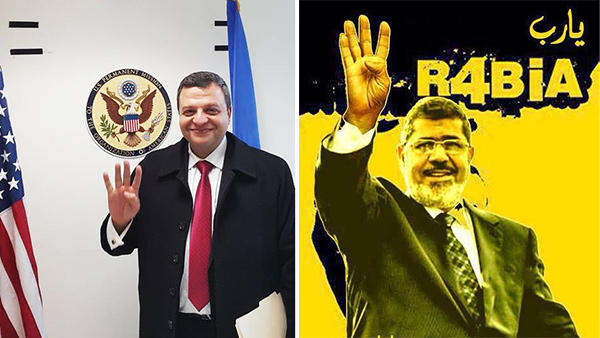
One member of the delegation, Muslim Brotherhood judge Waleed Sharaby, posed for a picture while at Foggy Bottom, as he held up the organization’s four-finger “Rabia” sign. (The gesture is named for Cairo’s Rabia Square, where counter-demonstrations backing ousted Egyptian President Mohamed Morsi — who is from the Muslim Brotherhood — took place in August 2013.)

919While being hosted by the State Department on a visit to Washington, Muslim Brotherhood judge Waleed Sharaby (left) flashed the organization’s four-finger “Rabia” sign. At right, ousted Egyptian President Mohamed Morsi (from the Muslim Brotherhood) displays the Rabia sign.

“If the White House is out to offend some of its closest Arab allies and is intent on heightening their suspicions, it’s succeeded,” wrote Middle East expert Linda S. Heard. “If there’s a plot, then it’s unfolding,” she added. “Just two days after the controversial visit, the Brotherhood called for a war against their fellow Egyptians.”

A statement issued by the Muslim Brotherhood said, “It is incumbent upon everyone to be aware that we are in a process of a new phase, where we summon what is latent our strength, where we recall the meanings of jihad and prepare ourselves, our wives, our sons, our daughters, and whoever marched on our path to a long, uncompromising fight, and during this stage we ask for martyrdom.”

The Egyptian government condemned the hosting of the Muslim Brotherhood officials by the State Department. Egyptian Foreign Minister Same Shoukry denounced the State Department’s move, saying, “The Muslim Brotherhood is not a political party, but according to the Egyptian law, which must be respected, it is designated as a terrorist organization.”

The timing of the meeting between State Department officials and Muslim Brotherhood leaders could not have been worse for many Egyptians — it took place shortly after Islamist terrorists killed 31 soldiers and wounded 45 others in a series of attacks on Egypt’s Sinai Peninsula.

Although the Islamic State terror group took credit for the attacks, Sisi held the Muslim Brotherhood responsible. “Egypt is waging a war against the strongest clandestine group over the past two decades,” he said. “This organization has secretive arms, secretive thoughts and secretive forums.”

Egyptian columnists and newspaper editors have also attacked the U.S. Administration for its ties with the Muslim Brotherhood.

“The U.S. Administration is continuing to jeopardize its relations with Egypt by appeasing Muslim Brotherhood,” remarked columnist Ezzat Ibrahim. “The Muslim Brotherhood is seeking to return to the political arena through the American door and terrorist attacks. The U.S. policy appears to be devious and unreliable.”

Another Egyptian columnist, Mohamed Salmawi, launched a scathing attack on the U.S. Administration; he accused it of deception and double standards. He said that the meeting between U.S. officials and Muslim Brotherhood leaders exposes the U.S. Administration’s deceptive policy toward Islamic terror groups.

“The U.S. Administration says it is combating these groups at home while it is supporting them abroad,” Salmawi wrote. “This meeting has grave indications because it shows that Washington has not abandoned its policy of double standards toward Islamic terrorism.

Salmawi also took issue with the U.S. Administration for turning a blind eye to the hypocrisy and double talk of the Muslim Brotherhood. “One of the leaders of Muslim Brotherhood, for example, told the world that he welcomes the Jews of Israel,” he added. “But this same leader announced in front of the Egyptian people that they should march in the millions to liberate Jerusalem from the occupation of the Jews. [Ousted President] Mohamed Morsi, before his election, described these Jews as descendants of apes and pigs. In English, the Muslim Brotherhood says one thing and in Arabic something completely different.”

Said Lindawi, a prominent Egyptian international affairs expert, said that the meeting of the Muslim Brotherhood leaders with State Department officials means that the Obama Administration has given the organization a green light to carry out terrorist attacks against Egypt.

“The U.S. Administration has refused to recognize the Muslim Brotherhood as a terror group,” hesaid. “The Americans continue to insist that the Muslim Brotherhood is not responsible for the terrorist attacks in Egypt.”

By embracing the Muslim Brotherhood, the U.S. Administration has sent the wrong message to moderate Arabs and Muslims. This is a message that says that Washington believes that there are good terrorists and bad terrorists.

Judging from the angry reactions of Egyptians, it has become obvious that most moderate Arabs and Muslims no longer see the U.S. as an ally in the war against Islamic terror groups. What is even more disturbing is that they view the U.S. as an ally and friend of the terrorists.