Archive for the ‘Iraq’ category

Global Assembly of Islamic Awakening aims at rooting out Takfiri thought

October 22, 2016

Global Assembly of Islamic Awakening aims at rooting out Takfiri thought, AhlulBayt News, October 21, 2016

(The split between Shiite – Sunni Muslims began centuries ago due to disputes about who was Mohamud’s legitimate successor . A Takfiri 

is a Muslim who accuses another Muslim (or an adherent of another Abrahamic faith) of apostasy.[1] The accusation itself is called takfir, derived from the word kafir (unbeliever), and is described as when “one who is, or claims to be, a Muslim is declared impure.”[2]Accusing other Muslims of being takfiris has become a sectarian slur, particularly since the outbreak of the Syrian Civil War in 2011

Significant healing of the rift between Shiites and Sunnis seems unlikely anytime soon, but were it to happen it probably would not be advantageous for non-Muslims. — DM)

Velayati, also a top advisor to Supreme Leader Ayatollah Seyyed Ali Khamenei on international affairs, made the remarks during a joint press conference held in Baghdad on Thursday after he met with Head of the Supreme Islamic Council of Iraq Ammar Hakim.

Velayati travelled to Iraq on Wednesday to participate in the 9th meeting of the supreme council of the Global Assembly of Islamic Awakening.

He told reporters at the conference that the fact that most of the participants in the meeting are from some 22 Sunni Muslim countries and a few of them are from Shia countries has indicated the unity and solidarity among all Muslim nations.

He also stressed that Iran would continue its support for Iraq as the latter is an ‘oppressed country which was occupied by the US and liberated later with the help of God and is now being ruled completely based on democracy.’

Meanwhile, Hakim told reporters that the Assembly meeting is being held in Baghdad while Mosul liberation operation is underway in north of the country.

He noted that the Daesh (ISIS) terrorists are not only considered a threat for Iraq but for the entire world.

Hakim noted that the Assembly meeting aims at briefing the Shiite and Sunni Muslims and scholars on the latest developments in the Islamic world.

A ‘lasting defeat’ of the Islamic State will be elusive

October 18, 2016

A ‘lasting defeat’ of the Islamic State will be elusive, Long War Journal, October 18, 2016

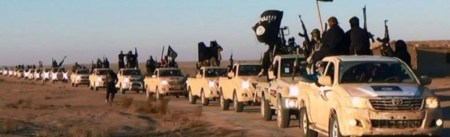
islamic-state-convoy-anbar-e1440694626820-1023x312

As the Iraqi government and Coalition forces launched the offensive to retake Mosul, the US military has optimistically said that the campaign will deal a “lasting defeat” to the Islamic State. But, if the recent history of the fight against jihadist groups in the Middle East, Africa, and South Asia is any indicator, a lasting defeat of the Islamic State will remain elusive.

On Oct. 16, the US military made the claim that the Mosul operation will “deliver ISIL [Islamic State] a lasting defeat” [emphasis mine]:

Tonight Iraqi Prime Minister Haider al-Abadi announced the start of Iraqi operations to liberate Mosul from ISIL. This is a decisive moment in the campaign to deliver ISIL a lasting defeat. The United States and the rest of the international coalition stand ready to support Iraqi Security Forces, Peshmerga fighters and the people of Iraq in the difficult fight ahead. We are confident our Iraqi partners will prevail against our common enemy and free Mosul and the rest of Iraq from ISIL’s hatred and brutality.

Keep in mind that many analysts were quick to pronounce the Islamic State’s predecessor, al Qaeda’s Islamic State of Iraq, as defeated after the US surge that began in 2007 rooted out the jihadists from its sanctuaries across Iraq. By 2010, Iraqi and US forces killed the Islamic State of Iraq’s emir, Abu Omar al Baghdadi, and War Minister Abu Ayyub al Masri a.k.a. Abu Hamza al Muhajir, and the group was driven underground. But these setbacks did not deter the Islamic State of Iraq. Its new leader, Abu Bakr al Baghdadi rallied the Islamic State of Iraq’s remaining forces and reconstituted the organization. In Syria, the Islamic State of Iraq took advantage of the Syrian civil war to rebuild its strength. By 2012, it created the Al Nusrah Front, its branch in Syria, and was launching large scale raids inside Iraq, such as the one in Haditha in March 2012, that presaged the events of 2014, which saw Iraqi forces defeated in Anbar, Salahaddin, Ninewa, and Diyala.

The Islamic State is not alone in its phoenix-like rebirth after losing ground to local forces backed by the US. Al Qaeda branches in Somalia, Yemen, and Mali, have experienced major setbacks and lost ground it held, only to regroup and retake territory. The same is true with Boko Haram in Nigeria and Taliban branches in Afghanistan and Pakistan. Each of these countries have been in a state of perpetual war for well over a decade due to jihadist insurgencies.

In Iraq, the political and security situation is ripe for an eventual Islamic State (or whatever jihadist entity may follow it) comeback. There are large rural areas in Iraq still under Islamic State control today, and it is highly unlikely that Iraqi forces will root out the Islamic State from all of these areas. Syria remains a security nightmare, and even with recent Islamic State losses, it still controls large areas. Iraq remains a fractured state divided between the Shia-led government, which is under pressure from Iran, the marginalized Sunnis that make up the recruiting base for the Islamic State, and the Kurds, who seek independence. The Islamic State has deftly taken advantage of Iraq’s political and sectarian fault lines to stoke the fires of conflict. Iran’s machinations in Iraq and its Shia militias provide the Islamic State all of the recruiting fodder it needs to convince Sunnis to join the fight.

The fight in Iraq, as in other jihadist theaters, ebbs and flows. For the Islamic State, it is currently retreating from many of the cities and towns in Iraq and Syria that it once held. But do not expect a lasting defeat of the Islamic State. The Islamic State has survived the full might of the US surge, and was able to regroup, wage a terrorist insurgency, and build an army that overran large areas of Iraq and Syria, all over the course of four years.

Turkey’s New Territorial Claims Threaten NATO

October 13, 2016

Turkey’s New Territorial Claims Threaten NATO, Counter Jihad, October 13, 2016

turkey-islamic

Should Russia be able to get a process of negotiation going between Turkey, Iraq and Iran on the issue of Turkish territorial expansion, Russia would assume the leadership role in the region.  Should it actually resolve the negotiations successfully, it could expect Turkey to become part of the Russian sphere of influence.  That would potentially derail NATO, as NATO’s decisions must be taken by a unanimous vote.  If Turkey becomes as strong a Russian ally as China, NATO could become as useless an organ for opposing Russian ambition as the United Nations Security Council (on which Russia has a veto).

American diplomatic weakness is partially a function of American military weakness in the region.  Russian diplomatic success is partially likewise a function of its deployment of air and naval-gunnery forces, as well as its so-far successful alliance with Iran.  Better American leadership might help, but for now, the situation is rapidly sliding away from America and towards the Russians.

****************************

A significant claim is being pushed by the Turkish government, one that could redraw the lines of the old Ottoman Empire:

Тhe spat erupted after Turkish President Recep Tayyip Erdogan took the country and the region by surprise last month by calling into question the 1923 Treaty of Lausanne, which defined modern Turkey’s borders.  He declared Turkey had been blackmailed by foreign powers into giving up vast swaths of territory that were once part of the Ottoman Empire….

[A]ccording to visiting Carnegie Europe scholar Sinan Ulgen[:]  “The message should be seen more of a signal in relation to Turkish polices towards the south, Syria and Iraq. I read it as a backdrop to a policy that tries to build domestic support for a more long-term presence, particularly in Syria, by pointing out, at allegedly past historical mistakes,” Ulgen said.

Turkish forces are currently in Syria and Iraq. But the Turkish presence at the Bashiqa base, close to the Iraqi city of Mosul, has become the center of a deepening dispute with Baghdad. The base is ostensibly tor training Sunni militia to fight Islamic State.

On Tuesday, Erdogan dismissed Iraqi Prime Minister Haider al-Abadi’s calls to withdraw Turkish troops, telling him “he should know his place.”

Ulgen went on to point out that Turkey has historical claims not only to Mosul, currently contested in the fight against the Islamic State (ISIS).   Both Mosul and oil-rich Kirkuk were part of the original design of the modern-day Turkey.  The Turks’ traditionalists and nationalists view the treaty that gave them away as having been forced on them at the end of World War I.

If Russian diplomacy can broker a deal that allows Turkey to expand into Iraq and Syria, it could cement Turkey’s move into Russia’s sphere.  Until recently, that looked unlikely at best.  Last year, Turkmen fighters shot down a Russian jet over repeated incursions by the Russian air force.  At that time, relations between the two nations became quite tense.  Russia is backing Iran’s play in the region, apparently in the hope that a powerful Shi’a Iran will create a buffer zone between Russia and the Sunni jihadist forces that have acted to inflame Muslim minorities in Central Asia.  Likewise, the war in the Middle East draws attention away from Russia’s strategic moves in Eastern Europe, such as last week’s deployment of nuclear missiles on the very borders of Poland and the Baltic States.

Turkey’s latest move appears likely to inflame Iraq’s government, and Russia’s ally Iran intends to control Iraq at the end of this conflict.  Surrendering territory, especially oil-rich territory, may be a difficult negotiation.  On the other hand, Kirkuk is also disputed with the Kurds, and whichever government formally holds it after the war is going to have to fight to keep it.  Iran may be willing to be persuaded to concede the fight to Turkey in return for a more firmly-controlled corridor between Tehran and the Levant.

That will require some subtle diplomacy to negotiate, but right now Russia is having significant success in its diplomatic moves.  In the wake of a new energy deal between Turkey and Russia, the Russian diplomatic corps seems to have a lot of momentum on its side.  Turkey was already looking away from NATO and Europe in the wake of its Islamist purge following an alleged attempted coup.  Should Russia be able to get a process of negotiation going between Turkey, Iraq and Iran on the issue of Turkish territorial expansion, Russia would assume the leadership role in the region.  Should it actually resolve the negotiations successfully, it could expect Turkey to become part of the Russian sphere of influence.  That would potentially derail NATO, as NATO’s decisions must be taken by a unanimous vote.  If Turkey becomes as strong a Russian ally as China, NATO could become as useless an organ for opposing Russian ambition as the United Nations Security Council (on which Russia has a veto).

American diplomacy is meanwhile spinning its wheels.  The United States broke off talks with Russia, and then called for war crimes investigations into Russia and Assad for their campaign in Syria.  American Secretary of State John F. Kerry also accused Russia of interfering with America’s elections.  However, it appears that Kerry now wants a new push for a cease-fire in Aleppo, which would require Syria and Russia to sign on.

American diplomatic weakness is partially a function of American military weakness in the region.  Russian diplomatic success is partially likewise a function of its deployment of air and naval-gunnery forces, as well as its so-far successful alliance with Iran.  Better American leadership might help, but for now, the situation is rapidly sliding away from America and towards the Russians.

In Debate, Hillary Dodges Blame for Libya, What Obama Called His “Greatest Mistake”

September 27, 2016

In Debate, Hillary Dodges Blame for Libya, What Obama Called His “Greatest Mistake”, Counter Jihad, September 27, 2016

16live1

The first Presidential debate revealed a Democratic candidate who believes she has all the answers even though her failed performance as Secretary of State led directly to the formation of the Islamic State (ISIS), aided the rise of Iran, and furthered much of the chaos in the Middle East.  She cannot learn anything while she believes she already knows everything.  Electing her promises more of the same, and ‘the same’ has been a disaster.

The Republican challenger, meanwhile, has much still to learn about the security structure he would command as President.  Clinton’s strongest moment against him on foreign policy came as she chided him for appearing to suggest that America would not honor its mutual defense treaties with Japan or South Korea.  Nothing is more important to the world than the reliability of America’s word.  Clinton should know that:  it was her former boss, President Obama, who personally kicked off the refugee crisis bedeviling Europe by failing to enforce his red line against Syria’s use of chemical weapons against its own people. His failure to keep his word on a security agreement gave the Syrian regime free rein to wage war on its own population, putting millions on the road to Europe.

Trump’s strongest moment against Clinton came when he accused her of bad judgment in the formation of ISIS.  She attempted to respond by saying that George W. Bush had negotiated the withdrawal from Iraq, and that “the only way that American troops could have stayed in Iraq is to get an agreement from the then-Iraqi government that would have protected our troops, and the Iraqi government would not give that.”

That’s all true, but whose job was it to obtain such an agreement?  That was her job.  She was the one who was supposed to obtain that agreement, and she failed utterly.  As our earlier coverage states:

It was her job to negotiate an arrangement with the Iraqi government that would do two things:  allow a stabilizing US military presence to remain in Iraq, and allow the US Department of State the freedom of movement it would need to step up as guarantors of the peace.  The peace, you see, had been purchased not only by the US military’s victory on the battlefields, but also by its patient negotiation with militants formerly aligned with al Qaeda in Iraq.  These tribes, mostly but not exclusively Sunni, had rejected the terrorism of al Qaeda in Iraq in return for promises of fair treatment from the Iraqi central government.  This included jobs, assistance for communities recovering from the war, and many other things that the government promised to provide in return for the support of these former enemies.  The United States helped to negotiate all these agreements, and promised to see that they would be kept faithfully.

Instead, the Secretary of State failed to produce either a new Status of Forces agreement that would permit US troops to remain in Iraq, or an agreement that would allow State Department personnel to move about the country safely to observe whether agreements were being kept.  In the wake of the precipitous withdrawal of US forces, Prime Minister Maliki moved to arrest Sunni leaders in government, and broke all his promises to the tribes.

The result was that the western part of Iraq once again became fertile ground for an Islamist insurgency.

Clinton was similarly unreflective when she argued that Trump had supported “the actions we took in Libya,” without pausing for a moment to acknowledge what a destabilizing mistake it was.  Effecting regime change with no capacity to control the outcome is what allowed radical groups, including ISIS, to expand into the vacuum.  That one is also her fault personally, as she pushed President Obama to take this action.  Her own President says that he considers ataking her advice on Libya to be his “worst mistake.”  Yet again, she has learned nothing, and does not seem to be aware that there is even anything to learn.

A similar failure to understand the lessons of the recent past occurred in their exchange on NATO.  Trump is right to be critical of the institution’s continuing relevance, but he is criticizing it on the wrong grounds.  That the other nations do not pay their way is true, but it is not the problem with NATO.  That it does not focus on terrorism is partly true, but it does not render the organization obsolete because a resurgent Russia remains a security challenge for western Europe.

Nevertheless, Clinton’s smug response is un-reflective and wrong.

You know, NATO as a military alliance has something called Article 5, and basically it says this: An attack on one is an attack on all. And you know the only time it’s ever been invoked? After 9/11, when the 28 nations of NATO said that they would go to Afghanistan with us to fight terrorism, something that they still are doing by our side.

What Clinton fails to mention here is that, like all of NATO’s decisions, invoking Article 5 must be done unanimously.  The reason to question NATO’s continued relevance is that the Turkish drift into Islamist politics makes it unlikely that a unanimous vote could still be reached.  Turkey has also shown signs recently of falling into Russia’s orbit.  If Turkey becomes a Russian ally in the way that China is, NATO may be rendered obsolete simply because it can never take a decision.  If Turkey becomes a Russian satellite, NATO will indeed have been rendered obsolete.  In either case, NATO’s continued relevance turns on figuring out how to swing Turkey away from Islamist thought and Russian influence, eliminating the unanimity requirement on NATO actions, or else developing a mechanism to expel the Turks from the alliance.   None of that exists, and since Turkey would have to agree to any of those changes, none of it is likely to come to exist.

Finally, on Iran, Clinton is wedded to a policy that Trump rightly describes as a disaster.

You look at the Middle East, it’s a total mess. Under your direction, to a large extent.

But you look at the Middle East, you started the Iran deal, that’s another beauty where you have a country that was ready to fall, I mean, they were doing so badly. They were choking on the sanctions. And now they’re going to be actually probably a major power at some point pretty soon, the way they’re going.

The horror show in Syria is linked to the Iran deal, as Obama decided to let Syria fester in order to pursue Iran’s approval of his deal.  Clinton’s role in this deal is something she herself has celebrated, so she cannot walk away from it.  Since then, Iran has developed new ballistic missiles that make sense only as a delivery mechanism for nuclear payloads.  It has bought advanced anti-aircraft missiles, and installed them around one of the nuclear sites allegedly to be made harmless by this wonderful “deal.”  Why is it hardening this site against air strikes if it intends to live by the deal?  Why develop a delivery mechanism for weapons you don’t intend to build?

Clinton cannot even ask these questions, because she is wedded to her failures.

Dangerous Weakness in Iraq and Syria

September 23, 2016

Dangerous Weakness in Iraq and Syria, Counter Jihad, September 22, 2016

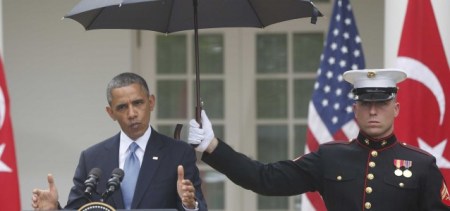
umbrellaman

US Secretary of State John F. Kerry “urges” Russia and Syria to ground their military aircraft after the destruction of a humanitarian aid convoy. Meanwhile, in the eastern part of that same theater, American and Iraq forces came under a sulfur mustard (commonly known as “mustard gas”) attack from the Islamic State (ISIS).

This is not the first use of sulfur mustard by ISIS and their predecessors.  They used them in IEDs against American forces during the Iraq War, and against Kurdish forces as late as last year.  Nevertheless, they clearly do not fear to use them against Americans at this time.  Whatever message we are conveying to ISIS, it does not include a proper respect for violating the laws of war when dealing with our soldiers.

Likewise, the Russians are not going to ground their aircraft just because we ask them to do.  In fact, the Russians are sending their only active aircraft carrier to join the war in Syria.  Defying an empty “urging” by our Secretary of State is just another way for Russia to show that they, and not we, are in control of the conflict.

Syrian jets, meanwhile, came close to bringing American forces under aerial attack for the first time since World War II.  Only good fortune kept American soldiers from being killed by Syrian bombs.  Fighters had to be scrambled to prevent additional sorties by the Syrian bombers.

In addition to Russia, Syria, and ISIS, Iran’s challenges against US Navy forces are up 50% from last year.  The Iranians are violating international law on a regular and consistent basis in challenging American fleet ships over access to international waters.

According to U.S. officials, the incidents all involved the IRGC, which operates a navy in parallel to Iran’s regular naval force, and whose leaders answer directly to Iranian Supreme Leader Ayatollah Ali Khamenei, Defense News reported.

Ten American sailors and their two boats were seized by IRGC naval forces in January of this year in violation of international law.

Subsequent to the sailors’ release, Iran portrayed their capture as a victory against the U.S., releasing the sailors after claiming that Washington apologized for the incident. Khamenei proclaimed that the naval forces who captured the sailors did “God’s deed” and issued medals to the commanders involved, while the IRGC announced plans to build a statue to commemorate the seizure.

In May, the deputy commander of the IRGC threatened to close the strategic Straits of Hormuz to the U.S. and its allies if they “threaten us,” adding: “Americans cannot make safe any part of the world.”

The U.S. Navy reported last month that in 2015, there were close to 300 encounters or “interactions” between American and Iranian naval vessels in the Persian Gulf. While most of the encounters were not considered to be harassment, the behavior of the Iranian navy was found to be less disciplined than that of other navies.

Weakness is provocative in a military conflict.  Refusing to embrace strong measures that would control these aggressive moves is exactly how American servicemen get killed.  Across the Middle East, our President’s predilection for weakness is putting American lives in grave [danger.]

The Case for Kurdish Statehood

July 11, 2016

The Case for Kurdish Statehood, Investigative Project on Terrorism, Noah Beck, July 11, 2016

1691

Why has the West been so supportive of Palestinian nationalism, yet so reluctant to support the Kurds, the largest nation in the world without a state?

The Kurds have been instrumental in fighting the Islamic State (ISIS); have generously accepted millions of refugees fleeing ISIS to the Kurdistan Regional Government (KRG); and embrace Western values such as gender equality, religious freedom, and human rights. They are also an ancient people with an ethnic and linguistic identity stretching back millennia and have faced decades of brutal oppression as a minority. Yet they cannot seem to get sufficient support from the West for their political aspirations.

The Palestinians, by contrast, claimed a distinct national identity relatively recently, are less than one-third fewer in number (in 2013, the global Palestinian population was estimated by the Palestinian Authority to reach 11.6 million), control land that is less than 1/15th the size of the KRG territory, and have not developed their civil society or economy with nearly as much success as the Kurds. Yet the United Nations, the European Union, the Arab League, and other international bodies have all but ignored Kurdish statehood dreams while regularly prioritizing Palestinian ambitions over countless other global crises.

Indeed, in 2014 the UK and Sweden joined much of the rest of the world in recognizing a Palestinian state. There has been no similar global support for a Kurdish homeland. Moreover, Kurdish statehood has been hobbled by U.S. reluctance to see the Iraqi state dismantled and by regional powers like Turkey, which worries that a Kurdish state will stir up separatist feelings among Turkish Kurds.

With an estimated worldwide population of about 35 million (including about 28 million in the KRG or adjacent areas), the Kurds are the fourth-largest ethnic group in the Middle East (after the Arabs, Persians, and Turks), and have faced decades of persecution as a minority in Turkey, Iran, and Iraq.

The 1988 “Anfal” attacks, which included the use of chemical weapons, destroyed about 2,000 villages and killed at least 50,000 Kurds, according to human rights groups (Kurds put the number at nearly 200,000). Several international bodies have recognized those atrocities as a genocide.

The Kurds in Turkey have also suffered oppression dating back to Ottoman times, when the Turkish army killed tens of thousands of Kurds in the Dersim and Zilan massacres. By the mid-1990s, more than 3,000 villages had been destroyed and 378,335 Kurdish villagers had been displaced and left homeless, according to Human Rights Watch.

The drive for Kurdish rights and separatism in Iran extends back to 1918, and – during its most violent chapter – cost the lives of over 30,000 Kurds, starting with the 1979 rebellion and the consequent KDPI insurgency.

A 2007 study notes that 300,000 Kurdish lives were lost just in the 1980s and 1990s. The same study states that 51,000 Jews and Arabs were killed in the Arab-Israeli conflict from 1950 until 2007 (and, because that total includes wars with Israel’s Arab neighbors, Palestinians are a small fraction of the Arab death toll).

Perhaps because of the Kurds’ own painful history, the KRG is exceptionally tolerant towards religious minorities and refugees. The KRG has embraced its tiny community of Jews, and in 2014, the Kurds rescued about 5,000 Yazidis trapped on Mount Sinjar after fleeing attempted genocide by ISIS. Last November, the Kurds recaptured the Sinjar area from ISIS, liberating hundreds more Yazidis from vicious oppression.

The KRG absorbed 1.8 million refugees as of December, representing a population increase of about 30 percent. The KRG reportedly needs $1.4 to 2.4 billion to stabilize the internally displaced people in its territory.

“Most of the refugees [in the KRG] are Arab Sunnis and Shia, Iranians, Christians, and others,” Nahro Zagros, Soran University vice president and adviser to the KRG’s Ministry of Higher Education, told the  IPT. “Yet there is no public backlash from the Kurds. And of course, we have been helping the Yazidi, who are fellow Kurds.”

The Kurdish commitment to gender equality is yet another reason that Kurdish statehood merits Western support. There is no gender discrimination in the Kurdish army: their women fight (and get beheaded) alongside the men. Last December, Kurdistan hosted the International Conference on Women and Human Rights.

The Kurds are also the only credible ground force fighting ISIS, as has been clear since the ISIS threat first emerged in 2014. ISIS “would have totally controlled the Baji oil field and all of Kirkuk had the [Kurdish] Peshmerga not defended it,” said Jay Garner, a retired Army three-star general and former Army assistant vice chief of staff who served during “Operation Provide Comfort” in northern Iraq. “Losing Kirkuk would have changed the entire war [against ISIS], because there are billions of dollars [per] week in oil flowing through there. The Iraqi army abandoned their equipment [while the Kurds defended Kirkuk, which has historically been theirs].”

Masrour Barzani, who heads the KRG’s intelligence services, says that Kurdish independence would empower the Kurds to purchase the type of weapons they need without the delays that currently hobble their military effort against ISIS. Under the present arrangement, Kurdish weapons procurement must go through Iraq’s Shia-led central government, which is also under heavy Iranian influence.

Besides bolstering the fight against ISIS, there are other geopolitical reasons for the West to support Kurdish statehood: promoting a stable partition of Syria, containing Iran, balancing extremist forces in the Middle East, and giving the West another reliable ally in a volatile region.

Now that Syria is no longer a viable state, it could partition into more sustainable governing blocs along traditional ethnic/sectarian lines with Sunni Arabs in the heartland, Alawites in the northwest, Druze in the south, and Kurds in the northeast. KRG leader Masrour Barzani recently argued that political divisions within Iraq have become so deep that the country must transform into “either confederation or full separation.”

Southeast Turkey and northwest Iran also have sizeable Kurdish areas that are contiguous with the KRG, but those states are far from disintegrating, and would aggressively resist any attempts to connect their Kurdish areas to the future Kurdish state. However, the Kurdish areas of former Syria should be joined to Iraqi Kurdistan as a way to strengthen the fledgling Kurdish state and thereby weaken ISIS.

In a recent article, Ernie Audino, the only U.S. Army general to have previously served a year as a combat adviser embedded inside a Kurdish Peshmerga brigade in Iraq, notes that Iran currently controls the Iraqi government and Iran-backed fighters will eventually try to control Kurdistan. He also makes the point that Western support for the Kurdish opposition groups active in Iran would force the Iranian regime to concentrate more on domestic concerns, effectively weakening Iran’s ability to pursue terrorism, expansionism, and other destabilizing activities abroad.

Because the Kurds are religiously diverse moderates who prioritize their ethno-linguistic identity over religion, a Kurdish state would help to balance out the radical Mideast forces in both the Shiite and Sunni camps. The Kurds are already very pro-American, thanks to their Western-leaning values, the U.S.-backed-no-fly zone, and the 2003 toppling of Saddam Husssein that made the KRG possible.

A Kurdish state would also have excellent relations with Israel, another moderate, non-Arab, pro-Western democracy in the region. Israeli Prime Minister Benjamin Netanyahu endorsed Kurdish independence in 2014, and Syrian Kurds – after recently declaring their autonomy – expressed an interest in developing relations with Israel.

By contrast, the Palestinian Authority slanders Israel at every opportunity: Abbas recently claimed in front of the EU parliament that Israel’s rabbis are trying to poison Palestinian drinking water. The Authority raises Palestinian children to hate and kill Jews with endless anti-Israel incitement coming from schools, media, and mosques. Palestinians have also shown little economic progress in the territories that they do control, particularly in Gaza, where Palestinians destroyed the greenhouses that donors bought for them in 2006 and instead, have focused their resources on attacking Israel with tunnels and rockets.

By almost any measure, a Kurdish state deserves far more support from the West. After absorbing millions of Syrian refugees while fighting ISIS on shrinking oil revenue, the KRG is battling a deepening financial crisis. Aggravating the situation, Iraq’s central government has refused – since April 2015 – to send the KRG its share of Iraqi oil revenue. The economic crisis has cost the KRG an estimated $10 billion since 2014.

U.S. Rep. Ed Royce, R-Calif., chairman of the House Foreign Affairs Committee, introduced House Resolution 1654 “to authorize the direct provision of defense articles, defense services, and related training to” the KRG. Fifteen months later, the bill is still stuck in Congress.

Helping the Kurds should be an even bigger priority for the European Union, which absorbs countless new refugees every day that ISIS is not defeated. If the EU were to fund the KRG’s refugee relief efforts and support their military operations against ISIS, far fewer refugees would end up on their shores.
 

Trump gets it right on Saddam

July 8, 2016

Trump gets it right on Saddam, CNNPeter Bergen, July 7, 2016

Occasionally Donald Trump says something that is politically incorrect but which also happens to be true.

On Tuesday at a campaign rally in North Carolina, Trump defended the former Iraqi dictator Saddam Hussein’s record on terrorism, saying, “He was a bad guy — really bad guy. But you know what? He did well? He killed terrorists. He did that so well. They didn’t read them the rights. They didn’t talk. They were terrorists. Over. Today, Iraq is Harvard for terrorism.”

Defending the brutal Iraqi dictator who killed hundreds of thousands of his own people isn’t exactly fashionable. But if you consider the 13 years of war that have wracked the country — in which a quarter of a million have died — and add that Saddam brutally repressed all dissent, including groups such as al Qaeda, and also add to this that ISIS is itself a fruit of the Iraq War, it’s a far more defensible position.

Trump didn’t offer any evidence for his assertions about Saddam’s brutal repression of terrorist groups or of Saddam “killing terrorists,” but his observations about the dictator are an implicit critique of the George W. Bush administration’s erroneous claims before the Iraq War that Saddam was allied to al Qaeda. Those claims were an essential element of the case that the administration made to go to war, since Saddam’s supposed connections to al Qaeda were the only purported evidence that he might give his putative weapons of destruction to terrorists.

The centerpiece of the Bush administration’s case for going to war in Iraq was Secretary of State Colin Powell’s presentation to the U.N. Security Council on February 5, 2003, six weeks before the invasion. Powell’s presentation was a bravura performance that seemed to establish beyond a doubt that Saddam was actively concealing an ongoing weapons of mass destruction program and was in league with al-Qaeda.

At one point the secretary of state dramatically brandished a small vial of a white powder of supposed anthrax, saying “about this amount…shut down the U.S. Senate in the fall of 2001.” As Powell gave his speech, sitting directly behind him was CIA director George Tenet, giving a visual imprimatur to what Powell was saying.

One section of Powell’s UN speech tried to make the case for an emerging alliance between Saddam and al-Qaeda:

“Iraq today harbors a deadly terrorist network headed by Abu Musab al-Zarqawi, an associate and collaborator of Osama bin Laden and his al-Qaeda lieutenants…When our coalition ousted the Taliban, the Zarqawi network helped establish another poison and explosive training center camp, and this camp is located in northeastern Iraq… He traveled to Baghdad in May of 2002 for medical treatment, staying in the capital of Iraq for two months while he recuperated to fight another day.”

Five weeks before the invasion of Iraq, CIA director Tenet testified before the Senate Armed Services Committee that Iraq had “provided training in poisons and gases to two al-Qaeda associates,” a point that Powell had also made in his U.N. presentation.

What the American public did not know about Tenet’s and Powell’s crucial claim about Iraq training al-Qaeda associates on poison gases was that it didn’t show a nexus between bin Laden, Saddam and some of the world’s nastiest weapons. Instead, it was the tainted fruit of an “extraordinary rendition” in which militants were transported by American officials to countries that routinely used torture, where they would supposedly finally divulge whatever secrets they had been keeping from their American interrogators.

In December 2001 Ibn al Shaykh al Libi, a Libyan militant who had run an al-Qaeda-affiliated training camp, was captured in Pakistan. Libi told his FBI interrogators that there were no ties between Saddam and al-Qaeda. Several days into his interrogation the CIA then rendered Libi to Egypt, where jailors were known for subjecting their prisoners to beatings, electric shocks and sexual assaults.

To improve his chances of better treatment once in Egypt, Libi told his interrogators that bin Laden had sent two operatives to Iraq to learn about biological and chemical weapons.

Because Libi’s story encapsulated the key arguments for the Iraq war, his tale was picked up by President Bush in a keynote speech in Cincinnati on October 7, 2002 in which he laid out his rationale for the coming conflict with Iraq, saying, “We’ve learned that Iraq has trained al-Qaeda members in bomb-making and poisons and deadly gases.”

But once he was back in American custody, on February 14, 2004, Libi recanted what he had falsely told his Egyptian interrogators. Libi told his U.S. interrogators that he had “fabricated” his tale of the Saddam-al-Qaeda-poison connection to the Egyptians following “physical abuse and threats of torture.”

Two and a half years into the Iraq war, in October 2005, the CIA released a report that finally disposed of the myth that Saddam and the leader of Al-Qaeda in Iraq, Zarqawi, had ever been in league, assessing that prior to the war, “the regime did not a have a relationship, harbor, or turn a blind eye towards Zarqawi.”

Since the fall of Baghdad no documents have been unearthed in Iraq proving the Saddam-al-Qaeda axis despite the fact that, like other totalitarian regimes, Saddam’s government kept meticulous records. The Defense Intelligence Agency had by 2006 translated 34 million pages of documents from Saddam’s Iraq and found there was nothing to substantiate a “partnership” between Saddam and al-Qaeda.

Two years later the Pentagon’s own internal think tank, the Institute for Defense Analyses (IDA), concluded after examining 600,000 Saddam-era documents and several thousand hours of his regime’s audio and video tapes that there was no “smoking gun (i.e. direct connection between Saddam’s Iraq and al-Qaeda.)”

Iraq’s Al-Sadr reportedly summoned to Tehran

May 5, 2016

Iraq’s Al-Sadr reportedly summoned to Tehran, Middle East Monitor, May 5, 2016

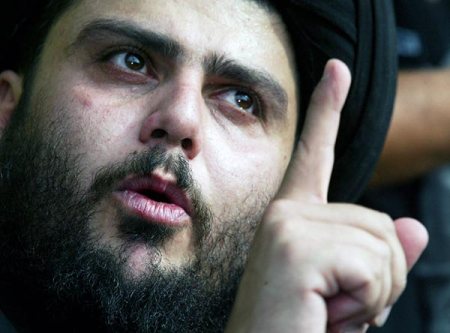
muqtada-al-sadrMuqtada al-Sadr

Iraq’s Shia cleric Muqtada Al-Sadr was summoned to Tehran “for bashing and rebuke”, a Lebanon-based Shia cleric said.

Secretary General of the Arab Islamic Council in Lebanon Mohammad Ali Husseini said that the Iranian embassy in Baghdad informed Al-Sadr that he was summoned to Tehran because “his followers crossed red lines by criticizing and insulting clerical rule at a time when the Iranian regime is facing noticeable political and military decline among the countries of the region”.

Husseini told Okaz newspaper that Al-Sadr “will be subjected to much blame, censure and pressure” and he will be “redirected to serve Iran’s interest”.

Al-Sadr has mobilized followers to take to the streets to demand reforms and the replacement of ministers belonging to the parties dominating power in Baghdad.

Supporters of Al-Sadr stormed Baghdad’s Green Zone on Saturday before forcing their way into the parliament building where they broke windows and smashed furniture.

A Shiite Extremist Plunges Iraq into Crisis

May 2, 2016

A Shiite Extremist Plunges Iraq into Crisis, Clarion ProjectRyan Mauro, May 2, 2016

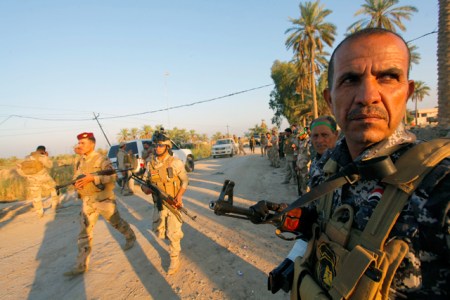
Iraq-Shiite-Militia-Iraqi-Army-IP_1Member of a Shiite militia group in Iraq (Photo: © Reuters)

A virulently anti-American Shiite Islamist cleric has thrown Iraq into a political crisis after his followers stormed the parliament, triggering a state of emergency. The cleric has hijacked popular resentment against corruption and sectarianism to attempt what the Institute for the Study of War deems “a de facto coup.”

Moqtada-al-Sadr-InsideMoqtada al-Sadr (Photo: Husain H. Rukun/WikiMedia Commons)

The leader of the protests is a radical Shiite cleric named Moqtada al-Sadr, best known for his militia’s targeting of U.S. troops and Iraqi security forces after the fall of Saddam Hussein. His forces’ sectarian violence brought the county to the brink of a civil war, which was only prevented by the U.S. “surge” in 2007. Sadr responded by moving to Iran and burnishing his religious credentials by studying at a seminary in Qom until 2011. It also helped him deny responsibility for the crimes committed by his militia and its splinter groups.

The institute warns that the instability damages the Iraqi government’s ability to operate as well as fight against the Islamic State (ISIS/ISIL). It could even lead to the collapse of the government. There is a high chance of violence between the “Sadrists” and Iraqi security forces and Iranian-linked militias allied with the Iraqi government.

For the U.S., it is dangerous that a ferociously anti-American cleric can shape events as Sadr has done. Sadr preaches that ISIS is a CIA front, seeking to equate the U.S. with the worst of Iraq’s enemies. When the U.S. campaign against ISIS began, Sadr said his forces would attack any U.S. military deployment.

“Like we gave you a taste of the heat of our fire and our might in the past, we will give a taste of the scourge of this decision, which will be the cause of your regrets and regression,” he said.

Last May, he threatened to “unfreeze the military wing … so that it may start targeting American interests in Iraq and outside of Iraq when possible.” He was infuriated over the U.S. budget allocating money for assisting Sunni tribes and Kurdish forces fighting ISIS.

Considering these comments, it may not be a coincidence that the Sadrists’ storming of parliament came right after Vice President Biden came to Iraq for the first time since 201l and praised the Iraqi-American cooperation in the fight against ISIS. Sadr may have wanted to remind the Iraqi political class, particularly the allies of Prime Minister Haider al-Abadi, that he’s the one who really determines their fate.

The irony is that many of those responding to Sadr’s calls are complaining about the sectarianism of which he was a shining example. There is video of demonstrators chanting, “Iran, get out, get out.”

Yet, it was but Sadr who brought Iran in. “Many of the protesters are chanting anti-Iranian slogans because we suspect that Iran is covertly promoting sectarianism in Iraq by supporting corrupt politicians,” said one demonstrator.

The situation in Iraq is a classic example of Islamists hijacking a popular grievance to gain power — or perhaps it is even a master act of manipulation at the hands of both Sadr and Iran. When he was in Iran addressing his lack of religious credibility, he underwent a political makeover.  He remained as anti-American as ever, but he adapted to the times by becoming a “born-again nationalist.” He began playing the role of political king-maker as parties competed for his constituency’s support and even began criticizing Shiite militias for being too cozy with Iran.

Perhaps Sadr’s relationship with the Iranian regime has genuinely weakened because of his political ambitions and because others have won Iran’s favor. Or perhaps it’s part of a skillful Iranian strategy to have proxies both allied to the Iraqi government and opposed to it.

For the U.S., it shouldn’t matter much. Sadr is a Shiite extremist whose hands are covered in American and Iraqi blood. He may be talking about corruption and sectarianism now, but the departure of the U.S. military is among his top demands. And he is far less hostile to Iran than he is to the West.

Iraq Parliament Collapses, Lawmakers Flee Baghdad

May 1, 2016

Iraq Parliament Collapses, Lawmakers Flee Baghdad, Voice of AmericaSharon Behn, May 1, 2016

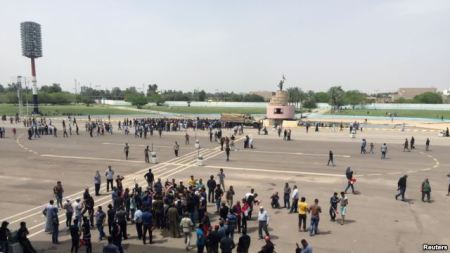
Baghdad parliament flees

Baghdad teeters on the edge of political chaos Sunday.

The city is in a state of emergency, protesters are occupying parts of the once-secure International Zone (IZ), lawmakers have run away and the military is on high alert.

By Sunday morning, protesters led by Shi’ite cleric Muqtada al-Sadr continued to crowd the streets in front of the country’s now-empty parliament and gather in what is known as the zone’s “Celebration Square.”

Lawmakers fled Saturday after protestors stormed into the parliament.

About 60 lawmakers, mostly from the minority Kurdish and Sunni parties, flew out of the capital for Irbil and Suleymania, in the northern autonomous Kurdish region.

“It was dangerous for all of us,” one parliament official told VOA, speaking on condition of anonymity out of fear of retaliation. Some lawmakers were beaten, he said.

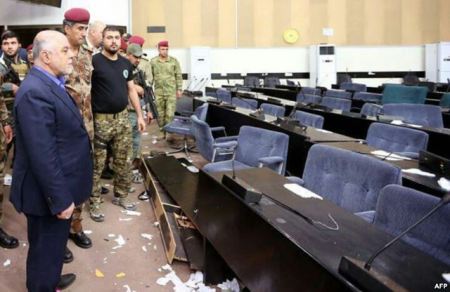
Baghdad 1A handout image released by the press office of Iraqi Prime Minister Haider al-Abadi on May 1, 2016, shows him (L) looking at the damage after protesters stormed the Iraqi parliament building in Baghdad’s fortified Green Zone area.

The official said thousands of protesters were still in the so-called International Zone Sunday, parked outside the major government buildings.

WATCH: Related video of protesters in the International Zone (Video at the link — DM)

Normally only those with special badges are allowed into the secured area, which is also home to many foreign embassies and the United Nations.

“It is dangerous,” the parliament official said. “At any time, the protesters could attack any embassy, any institution they want, or abuse anybody passing by.

“It seems al-Sadr wants to keep them inside the IZ so he can force the government to do what he wants,” the official said.

Political unrest

The parliament takeover was the culmination of weeks of political wrangling and increasing instability, and came just days after U.S. Vice President Joe Biden visited Baghdad.

White House Press Secretary Josh Earnest said the visit was a good indication of U.S. continued support for Iraqi Prime Minister Haider al-Abadi’s efforts to unify Iraq and confront the Islamic State (IS) group.

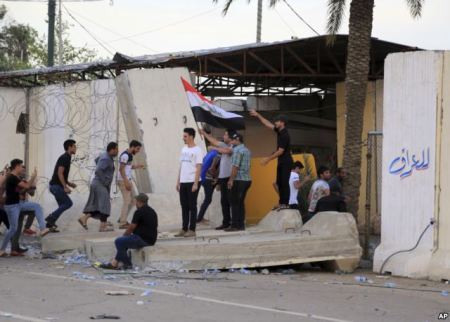
Baghdad 2Supporters of Shi’ite cleric Muqtada al-Sadr walk over the blast walls surrounding Baghdad’s highly fortified Green Zone, April 30, 2016. Dozens of protesters climbed over the blast walls and could be seen storming the parliament building.

But the visit was not enough to stave off the deepening political crisis.

Sadr has been demanding a new government of technocrats.

Abadi, who had also promised reform, had been unable to deliver any real change as political parties, unwilling to let go of their political power, blocked the majority of his list of candidates.

The prime minister on Sunday walked through the ransacked parliament building, and called on Interior Minister Mohammed Salem al-Ghabban to bring the attackers “to justice.”

Unrest growing

But even as political blocs have fought to maintain their positions and all the trappings of power, the anger in the Iraqi street has been growing for the past year over the lack of basic services, security, and the vast government corruption and political patronage.

Sadr, a firebrand cleric sometimes described as a Shi’ite nationalist, has managed to capitalize on that anger and frustration.

“Al-Sadr has the power of the people. One speech and he can deliver thousands of people to do what he wants. It is the power of the populace,” the parliament official said. “Al-Sadr is capable of running and leading the anger within each Iraqi person.”

Baghdad 3Supporters of Shiite cleric Muqtada al-Sadr raise the Iraqi flag outside parliament in Baghdad’s Green Zone, April 30, 2016.

One high-ranking Iraqi military official, also speaking to VOA on condition of anonymity, said that Sadr had many young Iraqis, including Sunnis and Christians, on his side.

The Institute for the Study of War describes Sadr’s power grab as a de facto political coup.

But the military official said Prime Minister Abadi was still in control of the Iraqi military and running the country.

Rival Shi’ite powers

Yet, the military official warned that powerful rival Shi’ite powers in Baghdad were not comfortable with Sadr’s attempted power grab. He said members of the notorious Badr Brigade militia, which is strongly allied with Iran, were beginning to converge on the capital’s center.

The possibility for intra-Shi’ite violence in Baghdad is high, and Baghdad residents said they are unsure of what will happen next.

There is also concern that IS could take advantage of the turmoil to ramp up its attacks. Iraqi security forces closed off all entrances to the city Saturday.

Resident Mahdi Makhmour, who lives outside the IZ, said the city streets were empty Sunday morning and many roads were still blocked, partly because of the start of a three-day Shi’ite religious celebration in the capital.