Archive for the ‘Iraq’ category

Syria tribal revolt against Islamic State ignored, fueling resentment

October 21, 2014

Syria tribal revolt against Islamic State ignored, fueling resentment, Washington PostLiz Sly, October 20, 2014

(Aside from responding to anticipated domestic political pressure after the (non-Islamic) Islamic State beheaded an American, what are we doing in Iraq and Syria and why? Are we trying to win hearts and minds, to maintain the semblance of a coalition of the unwilling or merely to do “something?” — DM)

“When you see your relatives being slaughtered, you will be forced to accept compromises you would otherwise never have been prepared to accept,” he said. “And when you see the world has abandoned you, you will do nothing about it.”

******************

The cost of turning against the Islamic State was made brutally apparent in the streets of a dusty backwater town in eastern Syria in early August. Over a three-day period, vengeful fighters shelled, beheaded, crucified and shot hundreds of members of the Shaitat tribe after they dared to rise up against the extremists.

By the time the killing stopped, 700 people were dead, activists and survivors say, making this the bloodiest single atrocity committed by the Islamic State in Syria since it declared its existence 18 months ago.

The little-publicized story of this failed tribal revolt in Abu Hamam, in Syria’s eastern Deir al-Zour province, illuminates the challenges that will confront efforts to persuade those living under Islamic State rule — in Iraq as well as Syria — to join the fight against the jihadist group, something U.S. officials say is essential if the campaign against the militants is to succeed.

The Abu Hamam area has now been abandoned, and many of the bodies remain uncollected, offering a chilling reminder to residents elsewhere of the fate that awaits those who dare rebel.

Just as powerful a message for those living under the militants’ iron fist was the almost complete international silence on the bloodbath.

(Please go to the link for a video — DM)

The fiercest fighting in days shook the Syrian border town of Kobane, forcing more refugees to pour into Turkey for shelter from the violence. (Reuters)

News of the massacre coincided with President Obama’s decision to order airstrikes to turn back an Islamic State advance unfolding farther east in Iraq, toward the Kurdish regional capital of Irbil, as well as humanitarian airdrops to help desperate Iraqi Yazidis trapped on a mountain by the onslaught.

Many Syrians in the opposition are starting to complain about unequal treatment.

U.S. warplanes have carried out more airstrikes on Islamic State forces besieging the Kurdish town of Kobane on Syria’s border with Turkey than on any other single location in Iraq or Syria. And Washington announced Sunday that U.S. planes had airdropped weapons and medical supplies to the beleaguered Kurdish fighters there.

Yet even now, Washington has directed little effort toward helping Sunni Arabs who want to fight the militants but lack the resources to do so, said Abu Salem, who was among the Shaitat tribesman and rebel commanders who gathered recently in an apartment in the Turkish border town of Reyhanli to recount the killings of their clansmen.

“We saw what the Americans did to help the Yazidis and the Kurds. But they have done nothing to help the Sunnis against the Islamic State,” he said.

Abu Salem and the other men said they did not so much begrudge the efforts to help Kurds as wonder why no one had helped them when their community was under attack. The carnage inflicted on the Shaitat tribe has instilled in the Abu Hamam survivors a loathing for the Islamic State and the warped brand of Islamist politics for which it stands, said Abu Siraj, another of the tribesmen. A former lawyer, he, like most of the men, asked to be identified only by his nom de guerre because he fears being tracked even to Turkey by the jihadists.

“Now we hate everyone who prays,” he said. “Now we hate even beards.”

But finding support for efforts to organize against the militants is proving hard, he said, pulling out his mobile phone to show a photograph released that day of the trussed, decapitated body of a friend who had purportedly been caught attempting to throw a hand grenade against them.

“When you see your relatives being slaughtered, you will be forced to accept compromises you would otherwise never have been prepared to accept,” he said. “And when you see the world has abandoned you, you will do nothing about it.”

U.S. officials say the Kobane attacks were not intended to show preference for one community over another, but rather served as an opportunity to take aim at the large number of militant fighters who converged on the town to capture it. The Pentagon claims to have killed hundreds of Islamic State militants around Kobane, in keeping with the wider U.S. goal of targeting the Islamists’ infrastructure and resources in Syria to downgrade their ability to reinforce and finance their operations in Iraq.

The primary focus of the American strategy, Gen. Lloyd Austin, the U.S. Central Command leader, stressed last week, remains on Iraq, and on preventing the Islamic State from projecting power there.

“Iraq is our main effort, and it has to be,” he said at a news conference in Washington. “And the things we are doing right now in Syria are being done primarily to shape the conditions in Iraq.”

Such comments have reinforced perceptions among Syrians that the U.S.-led air war does not have their interests at heart. Differences over the purposes and direction of the war risk alienating the many rebel groups that were engaged in battling the Islamic State before the U.S. government intervened, said Steven Heydemann of the U.S. Institute of Peace.

“It’s already become an impediment,” he said. “I don’t think the administration has fully taken on board how much damage the way they’ve conducted this campaign has done to the relationships they’ve developed with some of these actors.”

‘We were finished’

The Sunni areas of Syria occupied by the Islamic State would seem to be a more likely venue for a revolt than Iraq, where the extremists’ extensive territorial gains this year were aided by local Sunni insurgents and tribes alienated by the discriminatory behavior of the Shiite-led Iraqi government.

In Syria, however, the Islamic State’s conquests came at the expense of local rebels who already had fought to eject their government and then found themselves outgunned and outmaneuvered by the newly emerging Islamist extremists.

The Shaitat tribe, along with many others in the oil-rich province of Deir al-Zour bordering Iraq, spent much of this year battling to retain control of their area against encroachments by the Islamic State, and they might have prevailed had the Islamic State not swept into the Iraqi city of Mosul in June, rebels say. The vast amounts of U.S. weaponry the Islamic State captured were trundled across the rapidly dissolving border with Syria, said Abu Salem, who commanded a rebel battalion in the area before he escaped to Turkey.

“After they took Mosul, we were finished,” he said.

Abu Hamam and a cluster of villages nearby were targeted. After the new armaments from Iraq arrived, “we realized we had no hope. We were surrounded. We wanted to save our people,” said Abu Abdullah, another of the Shaitat fighters, describing how they agreed to a truce with the militants in mid-July.

The Islamic State was permitted to enter the town and establish a garrison, but local leaders were left in charge, he said.

Relations quickly frayed. The crunch came, the tribesmen in Reyhanli said, when Islamic State fighters whipped a local man who was caught smoking a cigarette in the street, a crime under the Islamic State’s harsh interpretation of Islam. The man’s brother, incensed, shot at a passing Islamic State patrol, killing one of its fighters.

The brother was arrested and publicly beheaded, triggering an outpouring of rage. Residents marched on the Islamic State’s headquarters, forcing its fighters to flee. The militants then brought in reinforcements and began shelling the town, using artillery they had captured the previous month in Iraq.

After a three-day barrage, the Islamic State militants moved in. They rounded up all the surviving men and boys older than 15 they could find and set about systematically killing them, the fighters in Reyhanli said.

A photo essay on an Islamic State blog boasted of the different ways tribesmen were killed, including beheadings, mass shootings and a crucifixion. A video shows how the militants lined up scores of captives on a road, their hands bound, then set about clumsily decapitating them, one by one. The executioners, speaking in Tunisian, Egyptian and Saudi accents, taunted those not yet dead by swinging severed heads in front of their faces and telling them, “It’s your turn next.”

The tribesmen in Reyhanli, like many other rebel fighters in Deir al-Zour now living in Turkey or elsewhere in Syria, said they managed to slip away using fake identity cards or escape routes honed during their battle against the government.

They said they are plotting their return, to take revenge and fight — without counting on international support.

“We are tribal people. We will never forget to avenge,” said Abu Salem, the commander of the group. “But we will do it by ourselves, in our own way. We won’t take any help from anyone.”
U.S. Humanitarian Aid Going to ISIS

October 20, 2014

U.S. Humanitarian Aid Going to ISIS, Daily BeastJamie Dettmer, October 19, 2014

Not only are foodstuffs, medical supplies—even clinics—going to ISIS, the distribution networks are paying ISIS ‘taxes’ and putting ISIS people on their payrolls.

While aid is still going into ISIS-controlled areas, only a little is going into Kurdish areas in northeast Syria.

***************

GAZIANTEP, Turkey — While U.S. warplanes strike at the militants of the so-called Islamic State in both Syria and Iraq, truckloads of U.S. and Western aid has been flowing into territory controlled by the jihadists, assisting them to build their terror-inspiring “Caliphate.”

The aid—mainly food and medical equipment—is meant for Syrians displaced from their hometowns, and for hungry civilians. It is funded by the U.S. Agency for International Development, European donors, and the United Nations. Whether it continues is now the subject of anguished debate among officials in Washington and European. The fear is that stopping aid would hurt innocent civilians and would be used for propaganda purposes by the militants, who would likely blame the West for added hardship.

The Bible says if your enemy is hungry, feed him, and if he is thirsty, give him something to drink—doing so will “heap burning coals” of shame on his head. But there is no evidence that the militants of the Islamic State, widely known as ISIS or ISIL, feel any sense of disgrace or indignity (and certainly not gratitude) receiving charity from their foes.

Quite the reverse, the aid convoys have to pay off ISIS emirs (leaders) for the convoys to enter the eastern Syrian extremist strongholds of Raqqa and Deir ez-Zor, providing yet another income stream for ISIS militants, who are funding themselves from oil smuggling, extortion and the sale of whatever they can loot, including rare antiquities from museums and archaeological sites.

“The convoys have to be approved by ISIS and you have to pay them: the bribes are disguised and itemized as transportation costs,” says an aid coordinator who spoke to The Daily Beast on the condition he not be identified in this article. The kickbacks are either paid by foreign or local non-governmental organizations tasked with distributing the aid, or by the Turkish or Syrian transportation companies contracted to deliver it.

And there are fears the aid itself isn’t carefully monitored enough, with some sold off on the black market or used by ISIS to win hearts and minds by feeding its fighters and its subjects. At a minimum the aid means ISIS doesn’t have to divert cash from its war budget to help feed the local population or the displaced persons, allowing it to focus its resources exclusively on fighters and war making, say critics of the aid.

One of the striking differences between ISIS and terror groups of the past is its desire to portray the territory it has conquered as a well organized and smoothly functioning state. “The soldiers of Allah do not liberate a village, town or city, only to abandon its residents and ignore their needs,” declares the latest issue of the group’s slick online magazine, “Dabiq.” Elsewhere in the publication are pictures of slaughtered Kurdish soldiers and a gruesome photograph of American journalist Steven Sotloff’s severed head resting on top of his body. But this article shows ISIS restoring electricity in Raqqah, running a home for the elderly and a cancer treatment facility in Ninawa, and cleaning streets in other towns.

Last year, a polio outbreak in Deir ez-Zor raised concerns throughout the region about the spread of an epidemic. The World Health Organization worked with the Syrian government and with opposition groups to try to carry out an immunization campaign. This has continued. In response to a query by The Daily Beast, a WHO spokesperson said, “Our information indicates that vaccination campaigns have been successfully carried out by local health workers in IS-controlled territory.”

“I am alarmed that we are providing support for ISIS governance,” says Jonathan Schanzer, a Mideast expert with the Washington D.C.-based think tank Foundation for Defense of Democracies. “By doing so we are indemnifying the militants by satisfying the core demands of local people, who could turn on ISIS if they got frustrated.”

U.S. and Western relief agencies have been caught before in an aid dilemma when it comes to the war on terror. Last December, the Overseas Development Institute, an independent British think tank focusing on international development and humanitarian issues, reported that aid agencies in Somalia had been paying militants from the al Qaeda offshoot al-Shabab for access to areas under their control during the 2011 famine.

Al-Shabab demanded from the agencies what it described as “registration fees” of up to $10,000. And in many cases al-Shabab insisted on distributing the aid, keeping much of it for itself, according to ODI. The think tank cited al-Shabab’s diversion of food aid in the town of Baidoa, where it kept between half and two-thirds of the food for its own fighters. The researchers noted the al Qaeda affiliate developed a highly sophisticated system of monitoring and co-opting the aid agencies, even setting up a “Humanitarian Co-ordination Office.”

Something similar appears to be underway now in the Syrian provinces of Raqqa and Deir ez-Zor.

Aid coordinators with NGOs partnering USAID and other Western government agencies, including Britain’s Department for International Development, say ISIS insist that the NGOs, foreign and local, employ people ISIS approves on their staffs inside Syria. “There is always at least one ISIS person on the payroll; they force people on us,” says an aid coordinator. “And when a convoy is being prepared, the negotiations go through them about whether the convoy can proceed. They contact their emirs and a price is worked out. We don’t have to wrangle with individual ISIS field commanders once approval is given to get the convoy in, as the militants are highly hierarchical.” He adds: “None of the fighters will dare touch it, if an emir has given permission.”

That isn’t the case with other Syrian rebel groups, where arguments over convoys can erupt at checkpoints at main entry points into Syria, where aid is unloaded from Turkish tractor-trailers and re-loaded into Syrian ones.

Many aid workers are uncomfortable with what’s happening. “A few months ago we delivered a mobile clinic for a USAID-funded NGO,” says one, who declined to be named. “A few of us debated the rights and wrongs of this. The clinic was earmarked for the treatment of civilians, but we all know that wounded ISIS fighters could easily be treated as well. So what are we doing here helping their fighters, who we are bombing, to be treated so they can fight again?”

What becomes even more bizarre is that while aid is still going into ISIS-controlled areas, only a little is going into Kurdish areas in northeast Syria. About every three or four months there is a convoy into the key city of Qamishli. Syrian Kurds, who are now defending Kobani with the support of U.S. warplanes, have long complained about the lack of international aid. Last November, tellingly, Syrian Kurds complained that Syria’s Kurdistan was not included in a U.N. polio vaccination campaign. U.N. agencies took the position that polio vaccines should go through the Syrian Red Crescent via Damascus when it came to the Kurds.

The origins of the aid programs pre-date President Barack Obama’s decision to “degrade and defeat” ISIS, but they have carried on without major review. The aid push was to reach anyone in need. A senior State Department official with detailed knowledge of current aid programs confirmed to The Daily Beast that U.S. government funded relief is still going into Raqqa and Deir Ez-Zor. He declined to estimate the quantity. But an aid coordinator, when asked, responded: “A lot .”

The State Department official said he, too, was conflicted about the programs. “Is this helping the militants by allowing them to divert money they would have to spend on food? If aid wasn’t going in, would they let people starve? And is it right for us to withhold assistance and punish civilians? Would the militants turn around,. as al-Shabab did when many agencies withdrew from Somalia, and blame the West for starvation and hunger? Are we helping indirectly the militants to build their Caliphate? I wrestle with this.”

Western NGO partners of USAID and other Western agencies declined to respond to Daily Beast inquiries about international relief going to ISIS areas, citing the complexity of the issue and noting its delicacy.

Mideast analyst Schanzer dismisses the notion that ISIS can use an aid shutdown as leverage in its PR campaign: “I think this is false. In areas they control everyone understands they are a brutal organization. This is their basic weakness and by pushing in aid we are curtailing the chances of an internal revolt, which is the best chance you have of bringing down ISIS.”


Fiercest fighting in days hits Syrian border town

October 19, 2014

Fiercest fighting in days hits Syrian border town, ReutersHumeyra Pamuk, October 19, 2014

(Islam is the religion of peace. The (non-Islamic) Islamic State recruits Islamists who then engage in violence because of Israeli intransigence when ordered to commit suicide; thus spake Ubermench Zarathustra Secretary Kerry. — DM)

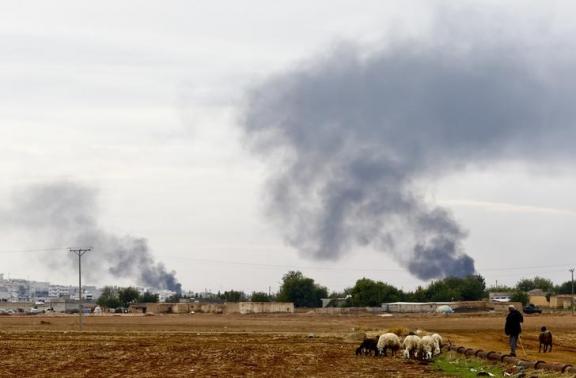
Smoke rises over the Syrian town of KobaniSmoke rises over the Syrian town of Kobani after an airstrike, as seen from the Turkish-Syrian border in the southeastern town of Suruc, October 19, 2014.

The fiercest fighting in days shook the Syrian border town of Kobani overnight as Islamic State fighters attacked Kurdish defenders with mortars and car bombs, sources in the town and a monitoring group said on Sunday.

Islamic State, which controls much of Syria and Iraq, fired 44 mortars at Kurdish parts of the town on Saturday and some of the shells fell inside nearby Turkey, according to the British-based Syrian Observatory for Human Rights. It said four more mortars were fired on Sunday.

The month-long battle for Kobani has ebbed and flowed. A week ago, Kurds said the town would soon fall. The United States and its coalition partners then stepped up air strikes on Islamic State, which wants to take Kobani in order to strengthen its position in northern Syria.

The coalition has been bombing Islamic State targets in Iraq since August and extended the campaign to Syria in September after Islamic State, a group that espouses a rigid interpretation of Islam and initially fought Syrian President Bashar al-Assad’s forces, made huge territorial gains.

Raids on Islamic State around Kobani have been stepped up, with the fate of the town seen as an important test for U.S. President Barack Obama’s campaign against the Islamists.

NATO member Turkey, whose forces are ranged along the border overlooking Kobani, is reluctant to intervene. It insists the allies should also confront Assad to end Syria’s civil war, which has killed close to 200,000 people since March 2011.

“We had the most intense clashes in days, perhaps a week, last night. (Islamic State) attacked from three different sides including the municipality building and the market place,” said Abdulrahman Gok, a journalist in Kobani.

“Clashes did not stop until the morning. We have had an early morning walk inside the city and have seen lots of damaged cars on the streets and unexploded mortar shells,” he said.

CAR BOMBS

The Observatory reported two Islamic State car bombs hit Kurdish positions on Saturday evening, leading to casualties. A cloud of black smoke towered over Kobani on Sunday.

A fighter from one of the female units of the main Syrian Kurdish militia in Kobani, YPG, said Kurdish fighters were able to detonate the car bombs before they reached their targets.

“Last night there were clashes all across Kobani … this morning the clashes are still ongoing,” she said, speaking on condition of anonymity.

The Observatory said 70 Islamic State fighters had been killed in the past two days, according to sources at the hospital in the nearby town of Tel Abyab, where Islamic State bodies are taken. Reuters cannot independently confirm the reports due to security restrictions.

The Observatory said some Syrian Arab fighters from the Revolutionaries of Raqqa Brigade, who are fighting alongside Kurdish fighters, had executed two Islamic State captives.

“One was a child of around 15 years old. They shot them in the head,” he said.

Islamic State have also used executions throughout their campaigns in Syria and Iraq, killing hundreds of enemy combatants and civilians who oppose their cause, according to Islamic State videos and statements.

Welat Omer, a doctor caring for the few remaining civilians in Kobani, told Reuters by telephone that he was looking after 15 patients, including children and the elderly.

“We need medicine, including antibiotics and milk for the children, and medicine for the elderly, who have heart conditions, diabetes and high blood pressure,” Omer said.

Hundreds of thousands have fled Islamic State’s advance. Turkey hosts about 1.5 million Syrian refugees, including almost 200,000 Syrian Kurds from Kobani.

Ankara has refused to rearm beleaguered Kurdish fighters, who complain they are at huge disadvantage in the face of Islamic State’s weaponry, much of it seized from the Iraqi military when the militants took the city of Mosul in June.

Turkey views the YPG with suspicion for its long-standing links with the Kurdistan Workers Party (PKK), which has waged a 30-year armed campaign for self-rule in Turkey.

President Tayyip Erdogan was quoted in the Turkish media on Sunday as saying Ankara will never arm the YPG through its political wing, the PYD.

“There has been talk of arming the PYD to establish a front here against Islamic State. For us, the PYD is the same as the PKK, it’s a terrorist organization,” he was quoted as saying.

This stance has sparked outrage among Turkey’s own Kurds, who make up about 20 percent of the population. Riots in several cities earlier this month killed left than 35 people dead.

In a call with Erdogan on Saturday night, Obama expressed appreciation for Turkey hosting over a million refugees, including thousands from Kobani.

“The two leaders pledged to continue to work closely together to strengthen cooperation against ISIL (Islamic State),” the White House said.

Obama’s approach to Islamic State has drawn fire from his political opponents at home.

“We have dropped a bomb here and a missile there, but it has been a photo-op foreign policy,” U.S. Senator Ted Cruz of Texas, a Republican and a potential presidential candidate in 2016, said on CNN’s “State of the Union” show.

He criticized Obama for delays in aiding Kurdish fighters in desperate need of weapons and assistance.

Peshmerga head speaks of struggle against IS

October 18, 2014

Peshmerga head speaks of struggle against IS, Al-Monitor, Faraj Obaji, October 17, 2014

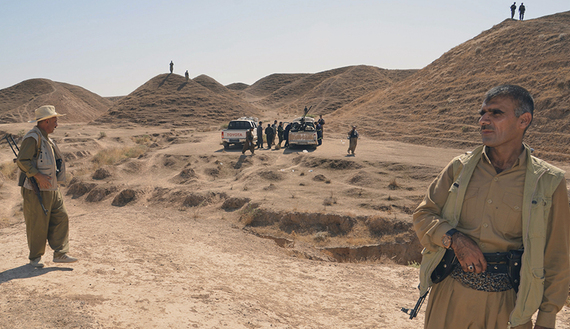
Kurdish peshmerga fighters stand guard around vehicles left behind by fleeing Islamic State militants during clashes in the al-Zerga area near Tikrit cityKurdish peshmerga fighters stand guard around vehicles with weapons and ammunition left behind by fleeing Islamic State militants during clashes in the al-Zerga area near Tikrit city in Salahuddin province, Oct. 8, 2014. (photo by REUTERS)

Commenting on the criticism of certain Kurdish parties inside Kobani, regarding the lack of support provided by KRG to the besieged city, he said, “Despite the differences with certain Kurdish political parties in the city, the KRG expressed its readiness to support our brothers in the city and we asked Washington and its allies to help the resisting Kurdish fighters.

“We helped them as much as possible, and the KRG’s president affirmed this. But, we cannot offer more. We are still waiting for international aid. The region initially includes 5 million people, add to that one and a half million displaced from Syria and the Iraqi provinces. We are helping them and taking care of them, and this is a huge burden.”

******************

Eliminating the Islamic State (IS) in Iraq does not seem to be an easy mission that will happen anytime soon; it seems rather impossible. The terrorist attacks against Iraq exposed how weak the Iraqi army is, how fragile its military structure and intelligence services are, and how it is unable to protect its country against any attack.

Some believe that the responsibility of the army’s failure to fight IS should be borne by the political authority ruling the country since 2004, which was unable to build an army based on a unified doctrine. Others consider the policies adopted by former Prime Minister Nouri al-Maliki faulty and the maliciousness allowed the terrorist group to enter the country, while the political conflicts between the central government and the Sunni leaderships provided an embracing environment for the group in Sunni provinces.

Secretary-General of the Ministry of Peshmerga Lt. Gen. Jabbar Yawar spoke to An-Nahar regarding the situation in Iraq in general, and in the Kurdistan Regional Government (KRG) in particular, in light of the IS threat, which occupied a number of Iraqi provinces, reaching the besieged Kobani.

The peshmerga harasses IS

The Kurdish military leader welcomed the international aid provided to the KRG, which is fighting a crucial battle against IS. He said, “The military aid which reached KRG saved it from falling into the hands of the terrorist group and allowed peshmerga forces to move from the negative defense position to the striker position, inflicting heavy losses on IS.”

Yawar does not hesitate to say, “The peshmerga forces’ position in the fight against IS is much better than the Iraqi army’s position. We are in a continuous fight along the 1,050-kilometer [650-mile] border of five Iraqi provinces, starting from Mosul to Erbil and passing through Kirkuk, Saladin and Diyala.”

He said, “The peshmerga forces have liberated the Mosul Dam and continues to liberate the rest of the regions that have fallen into the hands of IS, while creating plans to completely achieve this.”

The fall of Mosul and Anbar

Yawar attributed the fall of Mosul and Anbar to several reasons, most importantly, the fragility of the army in both provinces. He said, “The army in Mosul was fragile, and its six military units failed to withstand IS. There were also the political conflicts between the Sunni blocs and the government in Baghdad, which prevented these forces from fighting IS in Mosul, Saladin and parts of Kirkuk. These forces either handed over their advanced and heavy weapons to the group and fled, or joined and began to fight alongside IS.”

“The lack of a unified fighting doctrine among the army, and the shortage of air support, were all elements that contributed in the army’s quick collapse and IS’ occupation of a number of Iraqi provinces, especially the Sunni ones,” he said.

The difficulty in liberating Sunni regions

On the subject of the army’s situation in provinces in general, Yawar said that he found “a certain difficulty in liberating the Sunni-dominated regions from IS, such as Anbar, Saladin and Mosul, especially after it fell into the hands of the terrorists who took over its weapons on June 10.” He said that although they used all available means, the Iraqi forces were unable to liberate the city of Heet in Anbar and Tikrit, the center of Saladin province. “The situation on the field unfortunately proves that IS only controls the Sunni-dominated regions. We hope that our Sunni brothers, who are suffering the group’s injustice, will cooperate with the federal government and the KRG in order to eliminate this terrorist group,” he explained.

How did IS reach Erbil’s borders?

When asked how IS was able to reach KRG even though its intentions to occupy the region were obvious, Yawar answered with regret: “We knew before the group attacked Mosul on June 10 that it was up to no good in Iraq and Mosul. We were alerted by the joint committees and meetings that we used to hold in Baghdad, that there were some suspicious and dangerous movements on the borders with Syria. We were advised to strike them at an early stage, but we did not listen. The federal government and its former prime minister, Nouri al-Maliki, believed our proposals were political outbidding. Even when IS attacked Mosul, we asked them to allow us to support the federal forces there, but they told us that they were able to fight back themselves. Then Mosul fell, its residents fled and, due to Maliki’s faulty policy, IS was able to reach Baghdad’s borders.”

When asked why the terrorist group was able to reach Erbil, Yawar said, “When IS’ attack began, the peshmerga fought with all its strength, but it does not own advanced weapons such as the ones the group took from Mosul, because Maliki’s government never reinforced, trained or funded the peshmerga forces, although they are official governmental forces, according to the federal constitution.

“Despite all this, the peshmerga withstood IS from June 10 until the beginning of August. However, when we ran out of munitions and had no source of getting any, the group was able to penetrate our defense and move toward Erbil. Yet, thanks to Washington’s assistance and some of the countries participating in the international alliance, we were able to change the negative defense equation in Erbil and attack IS to liberate our lands,” he said.

Baghdad will not fall

The Kurdish leader ruled out the possibility of Baghdad falling for the time being, according to the available security data. “Until now, the Iraqi army can protect Baghdad and prevent the penetration of IS, which has spread in neighboring regions, such as Amiriya, Fallujah, Saqlawiyah and Ramadi,” he said.

We helped Kobani as much as we could

Commenting on the criticism of certain Kurdish parties inside Kobani, regarding the lack of support provided by KRG to the besieged city, he said, “Despite the differences with certain Kurdish political parties in the city, the KRG expressed its readiness to support our brothers in the city and we asked Washington and its allies to help the resisting Kurdish fighters.

“We helped them as much as possible, and the KRG’s president affirmed this. But, we cannot offer more. We are still waiting for international aid. The region initially includes 5 million people, add to that one and a half million displaced from Syria and the Iraqi provinces. We are helping them and taking care of them, and this is a huge burden.”

Yawar said, “The region has not been able to help Kobani like it should, due to its tough and complex geographic location, as it is 300 kilometers [185 miles] from the Syrian border, and it’s hard for aid to reach it. Kobani’s situation is geographically similar to Gaza or Sinjar.”

Raids

Yawar is not afraid that IS, which he believes is an extension of al-Qaeda in Afghanistan, will persist. He said, “The situation in Iraq and Syria today is similar to that of Tora Bora and Afghanistan. The airstrikes are beneficial for the peshmerga, Kobani and even for the Iraqi government, as they halt the advance of IS militants and drain them. These strikes also destroy IS warehouses and heavy weapons. But, to free these areas completely from IS, a comprehensive international operation should be put in place, like the one in Afghanistan, and there should be an actual training campaign for the Iraqi forces to defend themselves. However, I rule out the possibility of a foreign land intervention in Iraq, with the existing conflict between the ruling political parties.”

No Kurdish expansion

Political circles have been talking about a Kurdish expansion in an attempt to build the awaited state. In this regard, Yawar says, “We are part of the federal state, and neither of us expands into the other’s territories. Until now, there aren’t any official international borders between us and the federal state. We have some problems in many regions administratively. But the KRG and Baghdad are both facing IS threat. We should destroy it first, then resort to the constitution to solve the pending problems with the Baghdad government regarding the land, oil, the budget and Peshmerga.”


Defense Department fights global warming with courage and determination

October 16, 2014

Defense Department fights global warming with courage and determination, Dan Miller’s Blog, October 16, 2014

It’s the greatest threat of all time. Aside from Ebola, the DUH DOD has little else to do. According to the Daily Pest Beast, nurses fight Ebola more bravely than members of our military, so only 4,000 of our bravest and best boots on the ground are being ordered to Africa to fight it. Although the (non-Islamic) Islamic State is a bit of a nuisance now that Al-Qaeda is on the run, whatever we say or do about it might defame Islam. Since that would be “as bad as rape,” we must not do it.

Fantasy Island Obama

We have much to learn from Secretary Kerry, even beyond the horrors of man-caused climate change, which has not manifested itself during the past eighteen years or so but might someday. Or might not. For example, Kerry recently called on his vast wisdom to tell us that defaming Islam is as bad as rape. It’s a bit confusing, but there are probably two possibilities: (1) he was defending the Religion of Beheading, Rape, Pillage, Genocide, Sharia Law and Slaughter in General Peace yet again, or (2) he was trying to diminish “rape” and “microaggression” so that feminists would focus more on highlighting all of the horrors of the Republican War on Women with equal vigor and harshness.

In the recent past, our fair, honest and objective news media constantly researched and reported stuff with extraordinary competence, if not honesty. Surely, by now they have taken Andrew Klavan’s advice and become less stupid and corrupt.

Since they still consistently tell us that most Muslims are “moderate” and merely engage is a bit of normal workplace violence now and then, we don’t have to worry about them despite this hatefully Islamophobic and therefore racist nonsense:

Please see also, In Search of the ‘Moderate Islamists’.

Modeate Muslim

As all right left thinking people know, here is no valid reason why the truly moderate Islamic Republic of Iran should not have nuclear weapons. It tells us, repeatedly, that it neither has nor wants them and, in any event, won’t use them unless it wants to. Accordingly, we and the rest of P5+1 under Obama’s corrageous leadership will say, “OK that’s cool.”

Probably, most Islamists are harmless fruitcakes and we should try to get along better. We just need to try harder, that’s all.

It’s official: U.S. will build new Syrian rebel force to battle Islamic State

October 16, 2014

It’s official: U.S. will build new Syrian rebel force to battle Islamic State, McClatchy DC, Hannah Allam, October 15, 2014

(Phase Two of “Operation We Got It Wrong Again.” Will Kurds or newbies be supplied, equipped and trained? By whom will the “moderates” be vetted and trained? By now focusing on the Syrian political opposition, will we be distancing ourselves from Assad’s supporter Iran?– DM)

Airstrike KobaniSmoke rises following an airstrike by US-led coalition aircraft in Kobani, Syria, during fighting between Syrian Kurds and the militants of Islamic State group, Oct. 9, 2014. (AP Photo/Lefteris Pitarakis)

This time, Allen said, the United States and its allies will work to strengthen the political opposition and make sure it’s tied to “a credible field force” that will have undergone an intense vetting process.

******************

— John Allen, the retired Marine general in charge of coordinating the U.S.-led coalition’s response to the Islamic State, confirmed Wednesday what Syrian rebel commanders have complained about for months – that the United States is ditching the old Free Syrian Army and building its own local ground force to use primarily in the fight against the Islamist extremists.

“At this point, there is not formal coordination with the FSA,” Allen told reporters at the State Department.

That was perhaps the bluntest answer yet to the question of how existing Syrian rebel forces might fit into the U.S. strategy to fight the Islamic State. Allen said the United States’ intent is to start from scratch in creating a home-grown, moderate counterweight to the Islamic State.

For most of the three years of the Syrian conflict, the U.S. ground game hinged on rebel militias that are loosely affiliated under the banner of the Free Syrian Army, or FSA. Their problems were no secret: a lack of cohesion, uneven fighting skills and frequent battlefield coordination with the al Qaida loyalists of the Nusra Front.

This time, Allen said, the United States and its allies will work to strengthen the political opposition and make sure it’s tied to “a credible field force” that will have undergone an intense vetting process.

“It’s not going to happen immediately,” Allen said. “We’re working to establish the training sites now, and we’ll ultimately go through a vetting process and beginning to bring the trainers and the fighters in to begin to build that force out.”

The Syrian arena is important, Allen said, but to the U.S., “the emergency in Iraq right now is foremost in our thinking.” There will be a simultaneous training-and-equipping campaign for Iraq, where the U.S.-trained military collapsed during the Islamic State’s summer offensive.

Allen said the new training program is “for those elements of the Iraqi national security forces that will have to be refurbished and then put back into the field,” with the ultimate goal of reclaiming Iraqi territories seized by the Islamic State.

Allen sounded confident that the United States and its allies could juggle two massive training efforts even as the Islamic State has shown itself to be resilient under weeks of coalition airstrikes.

“We have the capacity to do both, and there is significant coalition interest in participating in both,” Allen said of the twin force-building efforts in Iraq and Syria.

But, as he stressed repeatedly in his remarks, “it’s going to take a while.”

Ahmad Tomeh, who was just re-elected prime minister of the Syrian opposition’s interim government, told McClatchy that Allen met six leaders of the political opposition during his trip to Istanbul last week, but had no talks with any of the ground commanders, including the vetted, trained commanders the U.S. has been supporting. They asked for increased help, Tomeh said, but got no commitment.

The UN’s terrorism apologists

October 15, 2014

The UN’s terrorism apologists, New York Daily News, October 15, 2014

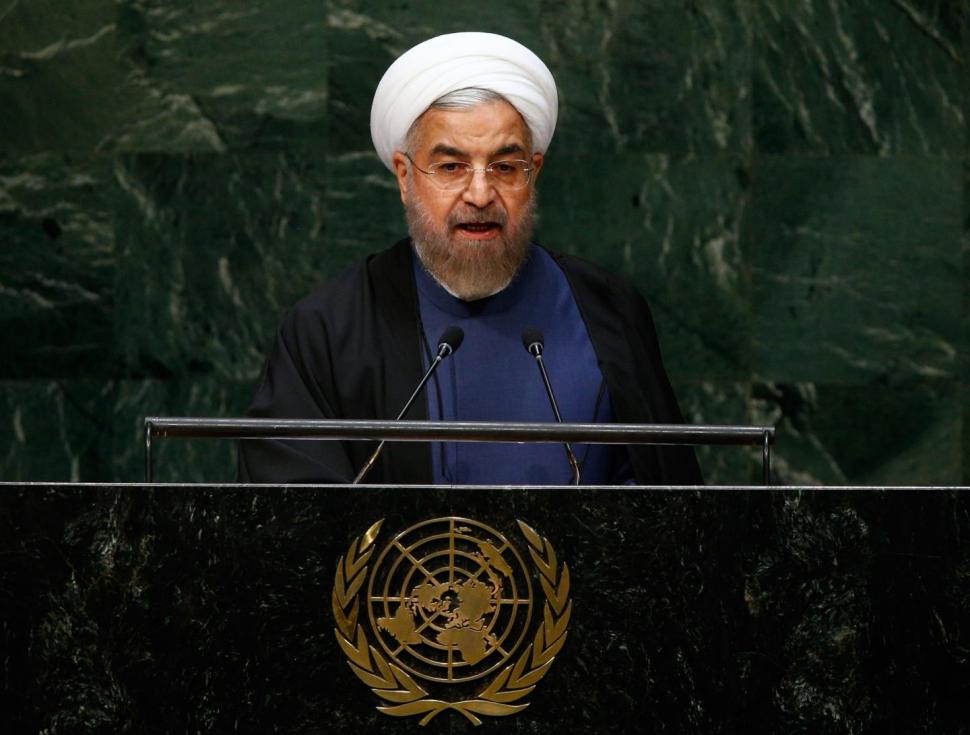
bayefsky16e-1-webHassan Rouhani of Iran.

It’s a two-step charade. First, since the UN has no definition of terrorism, state sponsors of terrorism happily denounce “terrorism” at the very same time as they promote it. Second, the terrorist funders and weapons suppliers redirect the world’s attention to the supposed “root causes” of terrorism.

On Oct. 7, at the legal committee meeting at UN headquarters, Hezbollah-controlled Lebanon listed “root causes that may lead to radicalism such as . . . poverty, social exclusion and marginalization” along with “Islamophobia.”

Iranian President Hassan Rouhani played the same card in an address to the General Assembly in September when he whined about “Iranophobia.

******************

While we are looking for terrorists sneaking across borders, lurking in mosques and holed up in caves, pro-terrorist ideology is spreading across America and around the globe — disseminated in plain sight from the United Nations, in the heart of New York City.

Over the past week, the UN’s top legal committee — a General Assembly body where all 193 states are represented — met to discuss terrorism. The webcasts are broadcast globally in multiple languages. The documents are translated and disseminated on a mammoth website free of charge.

It’s a two-step charade. First, since the UN has no definition of terrorism, state sponsors of terrorism happily denounce “terrorism” at the very same time as they promote it. Second, the terrorist funders and weapons suppliers redirect the world’s attention to the supposed “root causes” of terrorism.

Conveniently, the catalog of root causes of terrorism dreamed up in these circles never includes religiously driven bigotry doled out by anti-Semites and misogynist, homophobic sociopaths — whose need to torture, rape and kill requires no deep explanation.

A quick moral inversion, and the terrorist becomes the victim.

The UN was full of such dangerous canards last week.

On Oct. 7, at the legal committee meeting at UN headquarters, Hezbollah-controlled Lebanon listed “root causes that may lead to radicalism such as . . . poverty, social exclusion and marginalization” along with “Islamophobia.”

Iranian President Hassan Rouhani played the same card in an address to the General Assembly in September when he whined about “Iranophobia.”

Iran is the leading state sponsor of terrorism. And to the organization’s great shame, Iran is also the president of the so-called “Non-Aligned Movement” — a group of nations routinely aligned against the West. As such, Iran speaks for 120 UN member states — a majority of the 193 UN countries.

Here’s the Iranian speech to the UN legal beagles that was webcast Oct. 7: “Terrorism should not be equated with the legitimate struggle of peoples under colonial or alien domination and foreign occupation for self-determination and national liberation.”

Here’s state sponsor of terrorism North Korea on the same day: “Domination and interference, poverty and social inequality, and racial or religious discrimination constitute the root cause of terrorism. International efforts to put an end to terrorism should be preceded by removing the root cause of terrorism.”

All 56 member states of the Organization of Islamic Cooperation have signed on to the Islamic Convention on Combating International Terrorism, which gives a green light to killing Israelis, Americans and anybody else deemed fair game. The treaty says: “Peoples’ struggle, including armed struggle against foreign occupation, aggression, colonialism and hegemony, aimed at liberation and self-determination . . . shall not be considered a terrorist crime.”

Speaking on behalf of the Organization of Islamic Cooperation on Oct. 7, Egypt reiterated this pro-terror exemption clause. Over the course of Oct. 7 and 8, the UN trumpeted support for the Iranian and Organization of Islamic Cooperation call to arms from half of all the speakers.

Compounding the efficacy of this outrage, unfortunately, is the Obama administration. With great fanfare, on Sept. 24,, President Obama chaired a Security Council meeting that unanimously adopted a resolution on foreign terrorist fighters.

But the only reason everybody could agree that “terrorism constitutes one of the most serious threats to international peace and security” was because terrorism was left undefined.

Moreover, the Security Council didn’t just denounce terrorism. It demanded we “address the conditions conducive to the spread of terrorism.” Next it insisted we “counter the violent, extremist narrative that can incite terrorist acts.” And then it ordered us to “address the conditions conducive to the spread of violent extremism.”

In other words, Obama sold us an infinite regression. Because at the UN, the buck never stops with radical Islamists or the governments that support them.

‘Inherent Resolve’: Military campaign against ISIS gets a name

October 15, 2014

‘Inherent Resolve’: Military campaign against ISIS gets a name, Fox News, October 15, 2014

(How about naming the enemy, Islamism? That would not be suitably multicultural. Here are some of the names for the U.S. military operation suggested by Foreign Policy Situation Report readers (via e-mail):

The response to my request for names of the US mission against IS was overwhelming. It’s hard to draw any conclusions from the names offered, but I will say this: SitRep has an engaged, intelligent and global audience (I got responses from all over the world), and the names offered up show a huge disparity in opinion. Some show resolve, while others reflect a growing criticism – one might say cynicism – of Obama’s strategy. Some of the best are below; email me if you’d like to receive the full list.

Operation Empty Chair; Operation Oops, Sorry About That; Operation Good Intentions; Operation Seriously?  Again?; Operation Passive-Aggressive; Operation Coalition of the Dragged Kicking and Screaming; Operation Did I Leave My Keys Here?; Operation Slam Dunk; Operation IS you IS, or IS you Ain’t? Operation Syri-ous about Iraqi Freedom; and Operation Iraqi Freedom 2: Electric Boogaloo.

Make sense. How about “Inherent Dithering?” — DM)

ff_isis_101514US strategy failing as ISIS militants march on

More than two months after the U.S. first launched airstrikes against the Islamic State, the military mission has a name: “Inherent Resolve.”

A senior military source confirmed to Fox News that “Inherent Resolve” officially has been chosen as the title of the operation.

The name comes after questions were raised about why the administration had not named a mission that has escalated to involve several coalition partners and hundreds of airstrikes in both Iraq and Syria.

As of Sunday, the U.S. had conducted nearly 400 strikes in both countries. The number has risen since then – on Wednesday, the U.S. military said it launched another 18 airstrikes overnight near the contested Syrian city of Kobani, intensifying an air campaign against Islamic State militants’ efforts to capture the city near the Turkish border.

Why the mission was not named until now is unclear.

Every U.S. military intervention since the invasion of Panama in 1989, code-named Operation Just Cause, has had a name.

Even the operation to combat Ebola in West Africa was given an operational name the same day it was announced: Operation United Assistance.

An unnamed Defense official was quoted in a recent Wall Street Journal report suggesting the administration was reluctant to name the anti-ISIS mission because: “If you name it, you own it. … And they don’t want to own it.”

But Pentagon spokesman Rear Adm. John Kirby rejected that claim.

He said earlier this month that officials were considering a potential title. Kirby explained that one reason for waiting to name the operation has to do with the complex evolution of the mission.

The demise of ‘responsibility to protect’ at the U.N.

October 15, 2014

The demise of ‘responsibility to protect’ at the U.N., Washington Times, Clifford D. May, October 14, 2014

(The UN’s “responsibility to protect” doctrine now applies principally to groups favored by the multicultural international community, such as the “Palestinians” from wicked Israel, disfavored by the international community. Those needing protection from Islamic terror must look elsewhere. But where? The U.S. of Obama?– DM)

UN logoIllustration on the illusion of “Responsibility to Protect” by Linas Garsys

[I]’s ludicrous to propose that the U.N. Security Council — whose permanent members include neo-Soviet Russia and anti-democratic China — should be vested with the authority to pass judgment on the legitimacy of such missions.

While the Islamic State is currently attracting the most attention, it is the Islamic Republic of Iran — which has been using proxies to kill Americans on and off for the past 35 years — that could soon have nuclear weapons as well as missiles to deliver them to targets anywhere in the world. Hezbollah and other terrorist groups offer an alternative means of delivery. Iran’s radical Shia rulers are more sophisticated than the Sunni jihadis displaying disembodied heads on pikes. However, their goals differ little from those of their rivals.

[T]he notion of an international community that can prevent or halt mass atrocities is a chimera.

***************

Remember R2P? Not to be confused with R2-D2 (a robotic character in the “Star Wars” movies), “Responsibility to Protect” was an international “norm” proposed by United Nations Secretary-General Kofi Annan following the genocide in Rwanda in 1994 and the mass murders in the Bosnian town of Srebrenica a year later. The idea was for the “international community” to assume an obligation to intervene, militarily if necessary, to prevent or halt mass atrocities.

Why has R2P not been invoked to stop the slaughters being carried out in Syria and Iraq? Why isn’t it mentioned in regard to the Syrian-Kurdish city of Kobani, which, as I write this, may soon be overrun by barbarians fighting for what they call the Islamic State?

Here’s the story: In 2009, Mr. Annan’s successor, U.N. Secretary-General Ban Ki-moon, issued a report on “implementing” R2P. The foreign-policy establishment cheered. For example, Louise Arbour, a former U.N. high commissioner for human tights, called R2P “the most important and imaginative doctrine to emerge on the international scene for decades.” Anne-Marie Slaughter, an academic who served under Hillary Clinton at the State Department, went further, hailing R2P as “the most important shift in our conception of sovereignty since the Treaty of Westphalia in 1648.”

In 2011, President Obama cited R2P as his primary justification for using military force to prevent Libyan dictator Moammar Gadhafi from attacking the opposition stronghold of Benghazi.

If that was the apogee of R2P, the nadir was not far off. The intervention in Libya has led to chaos and bloodshed with no end in sight. Meanwhile, in Syria, four years ago this spring, Bashar Assad brutally cracked down on peaceful protesters.

Mr. Obama made Mr. Assad’s removal American policy but overruled the recommendation of his national security advisers to assist Syrian nationalist opposition groups. Civil war erupted. Self-proclaimed jihadis from around the world flocked to Syria to fight on behalf of the Sunnis. The opposition was soon dominated by the al Nusra Front, an al Qaeda affiliate, and the Islamic State (also known as ISIS or ISIL), whose leader, Abu Bakr al-Baghdadi, broke with al Qaeda and, audaciously, declared himself caliph, or supreme leader.

As for Mr. Assad, he is supported by the Islamic Republic of Iran, deploying both its elite Quds Force (designated in 2007 by the U.S. government as a terrorist organization) and Hezbollah, a Lebanon-based militia loyal to Iran’s supreme leader, Ayatollah Ali Khamenei. Russia also backs Mr. Assad, even supplying on-the-ground military intelligence specialists.

With no U.N.-approved R2P effort to rescue the innocent civilians of the region from these brutal forces, the death toll in Syria and Iraq has topped 200,000, and the number of refugees is in the millions.

Failed experiments, like crises, should not go to waste. Among the lessons to be learned from the R2P debacle: First, the notion of an international community that can prevent or halt mass atrocities is a chimera. If such work is going to get done, the United States has to do it, perhaps supported by a coalition of the willing and, with few exceptions, not particularly able. Second, it’s ludicrous to propose that the U.N. Security Council — whose permanent members include neo-Soviet Russia and anti-democratic China — should be vested with the authority to pass judgment on the legitimacy of such missions. Third, American power should be used primarily in pursuit of American interests. Sometimes that will include humanitarian interventions, but that’s a decision for Americans to make.

This, too, should be clear: While the Islamic State is currently attracting the most attention, it is the Islamic Republic of Iran — which has been using proxies to kill Americans on and off for the past 35 years — that could soon have nuclear weapons as well as missiles to deliver them to targets anywhere in the world. Hezbollah and other terrorist groups offer an alternative means of delivery. Iran’s radical Shia rulers are more sophisticated than the Sunni jihadis displaying disembodied heads on pikes. However, their goals differ little from those of their rivals.

In response to this dire and deteriorating situation, Mr. Obama should be instructing his advisers to present him with a range of strategic options. I’d recommend conceptualizing the global conflict not as disconnected “overseas contingency operations,” and not as akin to World War II, but more like the Cold War. That is to say, the United States should plan for a long, low-intensity struggle. In particular, we should support those willing to fight the jihadis who threaten them.

Economic weapons can be powerful if used correctly, which has not been the case in the past. For example, though sanctions brought Iran’s rulers to the negotiating table, premature relief from sanctions pressure has encouraged Iranian intransigence as the talks proceeded.

Also long overdue is a serious war of ideas — it’s insufficient to leave that to Bill Maher and Ben Affleck on HBO. Bottom line: We are not really engaged in a conflict against “violent extremism” or even “terrorism.” What we’re confronting are ideologies derived from fundamentalist readings of Islamic scripture. Proponents of those ideologies stress the supremacy of one religion — much as communists stressed the supremacy of one class, and Nazis of one race. There is no reason to suppose that saying this clearly, rather than obfuscating, will radicalize Muslims not already favorably inclined toward killing infidels.

Our aim should be, to borrow a phrase from Mr. Obama, to “degrade and eventually defeat” jihadism. Nothing is more imperative than preventing Iran’s rulers from taking the next, short steps toward a nuclear-weapons capability that they clearly intend to use to threaten not just their neighbors, but also Americans for decades to come. For an American president, this is where the R2P needs to begin.


How to defeat Islamic State’s war machine

October 15, 2014

How to defeat Islamic State’s war machine, Al-MonitorMetin Turcan, October 14, 2014

(Which team is the “junior varsity?”

The article suggests the obvious need for close air support using trained ground forces to guide aircraft to strike useful targets. The U.S. has trained “boots” capable of doing that, but Obama continues to assert that the U.S. will have no ground combat presence in Iraq or Syria. U.S. spotters would need be in combat areas, would be targeted by Islamic State forces and would therefore need to engage in combat. Non-U.S. target spotters, in addition to needing substantial technical training, would also need to be capable of communicating with aircraft pilots. In many if not most case, spotters capable of communicating in English would be needed. –DM)

Although much has been written to explain the tactical military successes of the Islamic State (IS), there has not yet been a comprehensive assessment of how, since June 2014, IS has managed to rule over terrain larger than Lebanon to include 8 million Iraqis and Syrians.

How has it been possible that in a short three months IS has been able to control extensive terrain, with 3,000 IS fighters capturing Mosul, which was guarded by 30,000 Iraqi soldiers, and after seizing Mosul on June 10 engage in battles two days later with Iraqi forces in towns north of Baghdad, 230 miles from Mosul?

Although one can allude to the delayed reaction of the international community, the lack of strong military opposition to IS, the international support IS has acquired and the support from Sunni tribes and political bodies in areas it captures, none of it defies the reality that — at the tactical level — IS is an extremely lethal and effective war machine. To understand this key determinant of IS gains, one has to understand that reality. This article will attempt to analyze the factors contributing to IS’ military efficiency, particularly at the tactical level.

Factors that boost tactical effectiveness of IS can be summarized as fluid and decentralized command and control structure; novel hybrid military tactics blending conventional warfare with terrorist tactics; effective use of armored platforms in offensive operations; dispersion; preservation of momentum at all costs; effective exploitation of topographic and human terrains; simplicity and flexibility in planning; and conducting operations and high levels of initiative and morale.

Fluid and decentralized command control structure

IS does not have permanent and centralized command and control structure in the traditional sense of warfare. Unlike contemporary armies of the world, IS doesn’t make sharp distinctions between strategic, operative and tactical levels. In their traditional warfare, tactical achievements is the way to achieve strategic objectives. For IS, the basic goal is to score tactical successes and expand on them step by step. Deviating from the traditional approach, what IS fields is a bottom-up command structure focused on a fast pace for small military achievements. At the moment, US-led airstrikes have been mostly against IS communication and training facilities. It is extraordinary that there is not a single control facility that has been hit by allied airstrikes.

IS warfare combines and hybridizes terrorist tactics, urban guerrilla warfare and conventional warfare.

IS is adept enough to conduct armor attacks at night and is skilled in accurate firing of their main tank guns with thermal cameras, and is capable of planting improvised explosive devices in critical areas and routes. It wages hybridized guerrilla warfare and conventional armored warfare by deploying eight to 10 men teams carrying out building-by-building, block-by-block clear and hold operations in urban terrain.

After the recent air attacks, IS has dispersed its forces to the extreme. Its teams have been minimized to two or three vehicles and eight to 10 men. Their concealment has been highly professional. IS’ executive orders are brief, setting out what the mission is in simple terms, leaving how it is to be carried out to field units.

It is imperative to acknowledge that a typical IS militant is endowed with a win-win mindset that assures him that to kill in jihad is a blessing, but if he is martyred he will end up in paradise also. No wonder IS combatants are high-adrenalin fighters who can kill and get killed without hesitation.

A typical IS operation goes like this: An IS armored unit of tanks or a mobile unit of eight to 12 fighters with two to three vehicles are informed by WhatsApp, a message on Facebook or Twitter or phone text message, and if this mode is not available through their own radio net, to assemble at a certain place at a certain time. This is the first time we are seeing combat units making use of social media in combat operations. Before its operations, IS disseminates propaganda messages via social media to enemy fighters and civilians living in the targeted urban settlements to demoralize and dishearten them. IS operations and logistics units that are thus alerted assemble at a meeting point within two to three hours, and after another 1 ½ hours of coordination discussions and logistics preparations the operation is underway.

One must remember that a regular IS tank driver is trained to drive his tank at night with a thermal camera, and that the commander of the team has enough tactical military knowledge to best deploy his tanks. Then it is a matter of attacking the enemy’s weakest point, preferably after the morning prayers. Vehicles stage the first phase of the attacks, followed by infantry attacks that depend on the nature of the enemy’s opposition. In these attacks, IS has been remarkably successful in creating a balance between the phased campaign design and maintaining the tempo of warfare. The high tempo of combat is routine for an IS fighter, but usually too high for opposing soldiers.

How to defeat IS?

How to first stop IS and then defeat it? The secret is in a concept that has so far been lacking the forces fighting IS in Syria and Iraq: Close air support that can only be provided by intense cooperation between ground troops and air units. Coalition air attacks so far are at least limiting IS advances; close cooperation between ground forces and armed helicopters such as AH-64 or fixed-wing platforms such as A-10 Thunderbolts can enable full integration of each air mission with fire and movement of ground forces, and bring the end to IS.

The question then becomes how the US-led coalition can provide that level of air support, and who has the substantial technical know-how and military expertise needed on the ground.

We know special forces elements of countries contributing to the coalition are participating in operations to provide precision target guiding with laser pointers. But this has been limited. Then what can be the solution?

Either the local forces fighting against IS will have to learn this technique that requires high military expertise, or special detachments formed by countries contributing to the coalition will be assigned to each combat zone or to major units as a close air support coordinator. It is no surprise then that the hottest topic in ongoing military discussions is who will provide this close air support and how. When tailoring strategies of close air support, one should keep in mind that IS has MANPADs (man-portable air defense systems) that make air units providing close air support highly vulnerable in their low-speed and low-altitude missions.