Archive for the ‘Iraq’ category

Kurdish Land-Grab Stuns Baghdad

January 27, 2015

Kurdish Land-Grab Stuns Baghdad, Newsweek and , January 27, 2015

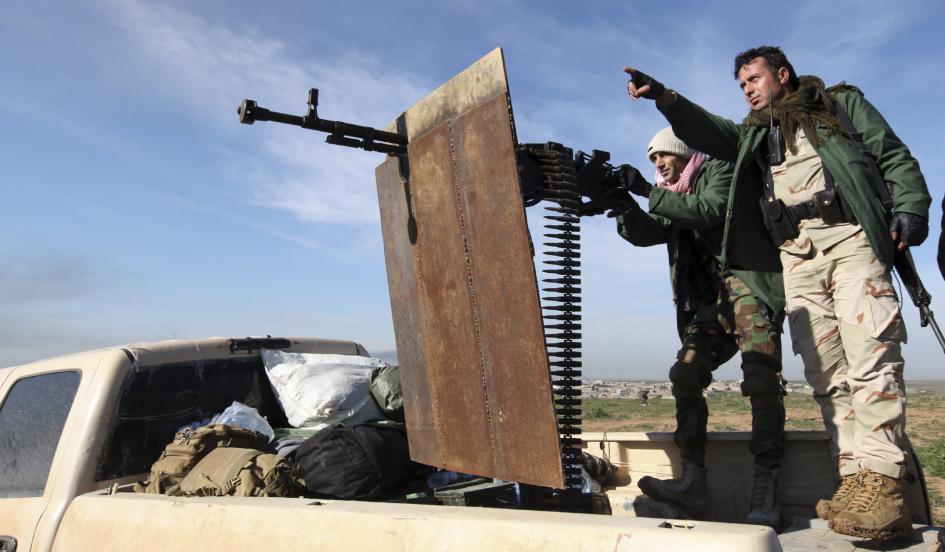
peshmergaKurdish Peshmerga fighters keep watch during the battle with Islamic State militants on the outskirts of Mosul January 21, 2015. AZAD LASHKARI/REUTERS

A senior Kurdish federal official, who declined to be named, said that Peshmerga forces would never hand back areas captured after Isis’s march across northern Iraq, which brought the group to within miles of the semi-autonomous Kurdish region.

While the threat of Isis remains significant, Kurds may have to put their independence dreams on hold and the Iraqi government will worry about Kurdish territorial claims later. As the terror group continues to grow, both parties need each other and the radical Islamist threat will bind them together, at least for now.
******************

Kurdish forces launched a barrage of Grad missiles against Islamic State (Isis) positions inside Mosul last week, for the first time since Isis overran Iraq’s second-largest city in June last year, marking a dramatic shift in the Kurds’ battle against the terrorist group.

The bombardment was preceded by a large-scale Kurdish operation against Isis in northern Iraq, which saw 5,000 Kurdish fighters, supported by US-led coalition airstrikes, sweep around Mosul to recapture an area larger than the size of Andorra, Liechtenstein and San Marino combined.

In the offensive, Kurdish Peshmerga fighters killed over 200 Isis militants, ousting the group from almost 300 square miles of territory, capturing a number of areas contested with Baghdad. As they advanced, encircling Mosul on three sides and cutting vital Isis supply lines to the nearby towns of Tal Afar and Sinjar, the Kurdish forces began a counter-offensive that analysts worry may be the start of a territory war between the Kurdish capital, Erbil, and Baghdad.

The Kurdish forces captured Makhmour, to the east of the city; the towns of Zimar and Wannah, and several Arab villages located in the Sinjar Mountains, west of Mosul; and the area around Mosul Dam, in what amounts to a Kurdish land-grab backed by Western airstrikes.

Iraqi Kurds believe that the recaptured territory around the city is rightfully theirs while the Iraqi government “fears that the Kurds will use territory as leverage during political negotiations”, according to Ranj Alaaldin, a visiting scholar at Columbia University.

A senior Kurdish federal official, who declined to be named, said that Peshmerga forces would never hand back areas captured after Isis’s march across northern Iraq, which brought the group to within miles of the semi-autonomous Kurdish region. “All the current military operations that involve the Peshmerga are implemented in coordination with the international military coalition and the central government is aware of it, but, in the Kurdish areas, we will never ever let Arabs control them again,” the official warned. “We are not ready to fight, terrify our fighters’ souls to liberate these areas and hand them to a traitor who would sell it to the killers. We will not allow this scenario to take place again in these areas.”

While the Kurds argue that they have taken control of this territory to defend against Isis, many Iraqis believe that the Kurds will never give up what they have captured because of their ambitions for an independent state.

“In the chaos that followed the Isis assault on Iraq in June, the Iraqi army melted away from its positions throughout northeastern and northwestern Iraq and the Peshmerga swiftly moved in to take their place – taking control of the whole of Kirkuk,” she said.

Despite these aspirations, Iraqi officials seem content to let Kurdish forces claim the territory from Daesh (as Isis is also known), for now. “As long as we are not ready to move as far as to fight in Mosul, it would be better to let them (Kurds) re-control these areas rather than leave it at the hands of Daesh,” a senior Iraqi military officer said. “Now, we will not raise any political disputes. Let [the Kurds] drive the militants away from these areas and we will think about the consequences later,” he added.

Hamed al-Khudari, a senior Shia lawmaker, agreed that Iraqis should “clear our lands” and “talk about this [territorial dispute] later”. Nevertheless, analysts do not believe that the Iraqi government in Baghdad is capable of ousting Kurdish forces from the territory they have seized in the recent advance. “Baghdad cannot do much to kick out the Kurds from any territory they have captured,” says Wladimir van Wilgenburg, analyst on Kurdish politics for the Jamestown Foundation.

The Kurds’ success on the battlefield, coupled with rumours of a potential Iraqi operation in Mosul, has put Isis on the back-foot but also caused disagreement between Erbil and Baghdad. Differences remain over involvement in any potential operation to recapture Mosul. Masrour Barzani, the head of Kurdistan’s regional security council, has said that Mosul will soon be “liberated” from the terror group’s self-proclaimed caliphate. “I don’t think anyone would envy the situation the people of Mosul are in,” he said. “The terror of Isis is too much for anyone to handle.”

But Kurdish officials believe that the responsibility for the recapture of the predominantly Sunni-Arab city lies solely with Baghdad. “Peshmerga are now 8km away from Mosul but they will not fight inside the city,” the official, who declined to be named, said. “When it comes to liberating Mosul, its people have to fight, not anyone else. We will just support them because we do not want anyone to say that Kurds are fighting Arabs. The [Iraqi] government understands that Mosul is not our battle or Shiites’ battle. Arab Sunnis in Mosul have to take the initiative to liberate their areas.”

Whereas Kurdish officials believe that Baghdad should take leadership over the battle for the city, where citizens now live under the group’s radical version of Islamic law, Iraqi officials claim that the battle against “Daesh is everyone’s to fight. The main goal now for all Iraqis is to fight Daesh and drive them away from all the Iraqi lands, so we will not allow anyone to talk about these [territorial] issues”, says al-Khudari. “This [fighting against IS] is the responsibility of everyone including the central government, the Kurdish forces, the public crowd (Shia militias and volunteers) and the anti-IS Sunni tribes.”

The lack of Kurdish motivation to enter into a battle for Mosul alongside Iraqi forces is due to the knowledge that any fight would be a drawn-out and lethal affair, according to van Wilgenburg. “They know the battle is going to be very heavy if it has to involve street to street fighting,” he says.

“The Kurds are already assisting the fight in Mosul. They recently fired into the city.” Erbil and Baghdad both have “to be pragmatic”, says Gonul Tol, executive director at the Center for Turkish Studies at the Middle East Institute. Baghdad is focused on recapturing Isis-held territory as opposed to Kurdish territory while Kurds “do not want to get involved” in Mosul to avoid “igniting a Kurdish-Arab war”.

While the threat of Isis remains significant, Kurds may have to put their independence dreams on hold and the Iraqi government will worry about Kurdish territorial claims later. As the terror group continues to grow, both parties need each other and the radical Islamist threat will bind them together, at least for now.

President Obama’s ‘successful’ counterterrorism strategy in Yemen in limbo

January 25, 2015

President Obama’s ‘successful’ counterterrorism strategy in Yemen in limbo, Long War Journal, Thomas Joscelyn & Bill Roggio, January 24, 2015

If this is what a successful counterterrorism strategy looks like, we’d hate to see failure.

**********************

When announcing the US strategy to “degrade and ultimately destroy” the Islamic State in both Iraq and Syria, President Barack Obama said he would model it after America’s counterterrorism strategy in Somalia and Yemen, “one that we have successfully pursued…for years.”

Immediately after Obama’s speech, we at The Long War Journal questioned the wisdom of describing Somalia and Yemen as “successfully pursued” counterterrorism operations. Al Qaeda’s official branches, Shabaab in Somalia and al Qaeda in the Arabian Peninsula (AQAP) in Yemen, remain entrenched in their respective countries, despite some setbacks here and there. AQAP’s core leadership cadre is intact. And both al Qaeda branches continue to control territory while working to conduct attacks outside of their countries. [For details, see LWJ report, US strategy against Islamic State to mirror counterterrorism efforts in Yemen, Somalia.]

In the four plus months since Obama described Yemen as a successful engagement, things have gone from bad to worse. The Iranian-backed Shiite Houthis have broken out from the northern provinces and overran the capital. Just this week, President Hadi, who was perhaps America’s greatest ally on the Arabian Peninsula as he actively endorsed and facilitated US counterterrorism operations, including controversial drone strikes against AQAP, was forced to step down. The prime minister has also resigned and the government has dissolved.

During this timeframe, the US drone program against AQAP has stalled. The last US drone strike in Yemen that has been confirmed by The Long War Journal took place on Nov. 12, 2014. This is especially remarkable given that AQAP has claimed credit for the assault on Charlie Hebdo’s offices in Paris, and the terrorists themselves said that AQAP sent them.

Unsurprisingly, US officials are now telling Reuters that counterterrorism operations in Yemen are “paralyzed” with the collapse of the Hadi government (the long gap in strikes in the face of the Charlie Hebdo attack is a clear indication that US CT operations are in limbo). Yemen’s military is also said to be in disarray.

If US officials expect the Houthis to be willing participants against AQAP, they are mistaken. The Houthis, while enemies of AQAP, are no friends of the US. While their movement was not created by Iran, they have adopted the Iranians’ motto: “Death to America.” Additionally, any action against AQAP only serves to strengthen the Houthis, and by extension, Iran.

Meanwhile, without a central government and effective military, Sunnis may be tempted to back AQAP against the Shiite Houthis, thereby increasing AQAP’s recruiting pool. There is already evidence that this is happening.

If this is what a successful counterterrorism strategy looks like, we’d hate to see failure.


John Bolton on WMAL 1-22-15

January 23, 2015

John Bolton on WMAL 1-22-15, via You Tube, January 22, 2015

(Audio only. Amb. Bolton speaks of PM Netanyahu’s address to Congress, no-go zones and Obama’s fantasies about Islamic terrorism, the Islamic State and Iran. — DM)


800,000-strong Shiite militia calls for formal recognition by Baghdad

January 18, 2015

800,000-strong Shiite militia calls for formal recognition by Baghdad, RUDAW, January 18, 2015

(RUDAW is a Kurdish media network. Hezbollah was conceived by Muslim clerics and funded by Iran following the Israeli invasion of Lebanon in 1982. From the inception of Hezbollah to the present, the elimination of the State of Israel has been one of Hezbollah’s primary goals. [Footnotes omitted.] — DM)

97644Image1Thousands of Shiite men responded to a call for jihad after ISIS stormed across Iraq in June and captured a third of the country. AFP photo.

BAGHDAD, Iraq – The leader of Iraq’s Hezbollah met with Shiite clerical authorities in Najaf Sunday to discuss formal recognition of hundreds of thousands of militiamen by the government and putting them on official payroll, a Hezbollah statement said.

Sheikh Abbas al-Mahmadawi, leader of the Shiite militia group Hezbollah, said that he met with Shiite clerics in Najaf, including Ayatollah Muhammad Saeed al-Hakim, to seek recognition “for the success of the militia groups in the fight against the Islamic State (ISIS).”

Al-Mahmadawi added that the Shiite volunteer militia should be recognized by the authorities and compensated financially “because many of them do not have any salaries and many have been wounded and handicapped.”

According to al-Mahmadawi, there are 800,000 volunteer Shiite fighters in Iraq who joined the fight against ISIS last June.

But he added that “the numbers have been inflated by some political parties” by more than double.

“We do not have any such numbers on the ground which is put down as 2 million volunteers,” he said in a statement following his visit to Najaf.

Al-Mahmadawi hoped that Baghdad would put the Shiite militia on its payroll now that the country is about to pass this year’s budget.

Thousands of Shiite men responded to a call for jihad against ISIS by Iraq’s Grand Ayatollah Ali Sistani last year, when the extremist Sunni group captured Mosul and made a lightening advance towards Baghdad and important Shiite shrines.

A great number of Shiite militiamen are based in the towns of Jalawla and Saadiya, north of Diyala, which they jointly liberated from ISIS in November.

Local residents, mainly the Kurdish population, have remained apprehensive about returning to their homes for fear of the armed militia groups, which operate outside government control and have been accused by Sunnis of acting as vigilantes.

On Saturday, Iraq’s parliament speaker Salim al-Jibouri met with Kurdish leaders in Sulaimani on forming a joint committee to facilitate the return of displaced peoples to Jalawla and Saadiya.

Meanwhile, around 200 tribal and political figures in Diyala met on Saturday to discuss normalizing the situation in the province after some of the fiercest battles between ISIS and a joint force of Peshmerga and Shiite militia groups.

Exclusive: ISIS Gaining Ground in Syria, Despite U.S. Strikes

January 15, 2015

Exclusive: ISIS Gaining Ground in Syria, Despite U.S. Strikes, The Daily Beast, January 15, 2015

1421322880562.cachedHosam Katan/Reuters

American jets are pounding Syria. But ISIS is taking key terrain—and putting more and more people under its black banners.

ISIS continues to gain substantial ground in Syria, despite nearly 800 airstrikes in the American-led campaign to break its grip there.At least one-third of the country’s territory is now under ISIS influence, with recent gains in rural areas that can serve as a conduit to major cities that the so-called Islamic State hopes to eventually claim as part of its caliphate. Meanwhile, the Islamic extremist group does not appear to have suffered any major ground losses since the strikes began. The result is a net ground gain for ISIS, according to information compiled by two groups with on-the-ground sources.In Syria, ISIS “has not any lost any key terrain,” Jennifer Cafarella, a fellow at the Washington, D.C.-based Institute for the Study of War who studies the Syrian conflict, explained to The Daily Beast.Even U.S. military officials privately conceded to The Daily Beast that ISIS has gained ground in some areas, even as the Pentagon claims its seized territory elsewhere, largely around the northern city of Kobani. That’s been the focus of the U.S.-led campaign, and ISIS has not been able to take the town, despite its best efforts.Other than that, they are short on specifics.

1421269431538.cachedClick to Enlarge (Coalition For a Democratic Syria)

“Yes, they have gained some ground. But we have stopped their momentum,” one Pentagon official told The Daily Beast.

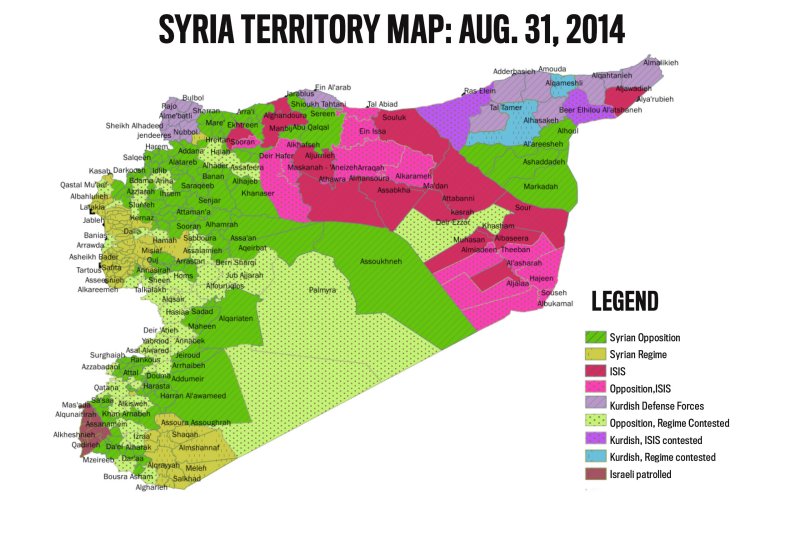
A map developed by the Coalition for a Democratic Syria (CDS), a Syrian-American opposition umbrella group, shows that ISIS has nearly doubled the amount of territory it controls since airstrikes began last year.

“Assessing the map, ISIS has almost doubled its territorial control in Syria. But more importantly, the number of people who now live under ISIS control has also increased substantially,” CDS political adviser Mouaz Moustafa said.

With the fall of that much territory into ISIS hands, Syrians who once lived in ungoverned or rebel held areas are now under ISIS’s grip. Of course, in an irregular war like this one, control of people is far more important than control of territory. In that regard, too, things appear to be going in the wrong direction.

In the first two months following American airstrikes, about a million Syrians who had previously lived in areas controlled by moderates now lived in areas controlled by extremist groups al Nusra or ISIS, according to CDS, citing conversations with European diplomats who support the Syrian opposition.

The area of ISIS’s expansion includes large segments of the Homs Desert, which begins far south of the contested northern city of Aleppo. It stretches below the presumed capital of ISIS in Syria, Raqqa, and all the way to the Iraqi border. It is largely rural and not an area that ISIS has had to fight for. Rather the group took control of uncontested parts of the countryside while skirting key regime strongholds in the area, Cafarella said.

But that does not mean that land is not valuable to ISIS. That newly acquired terrain allows ISIS troops to target and threaten more valuable areas, Cafarella said.

Since the U.S. campaign began in August, “there are little buds of ISIS control in eastern Homs, al Qalamoun [which borders northern Lebanon], and southern Damascus that do appear to be growing because of that freedom of operation that can connect those western cells to key ISIS terrains in Raqqa and Deir ez Zour” in northern and eastern Syria.

Moustafa, the CDS political adviser, blamed ISIS territorial gains on a lack of “strategic coordination between coalition strikes and moderate forces inside Syria, meaning that the Free Syrian Army and aligned groups cannot use the strikes to retake territory.” Further, Moustafa told The Daily Beast, coalition strikes have given other extremist groups sympathy for ISIS.

One frustration of the Syrian opposition groups is that the bombing campaign has been focused at the heart of ISIS controlled territory, rather than at the front lines, where ISIS territorial gains could be pushed back.

“The coalition strikes seem similar to drone campaigns in Yemen or Pakistan, targeting only leadership. The front-line strength of ISIS has undoubtedly increased even as some of these targeted strikes take out mid-level individual leaders,” Moustafa said.

As of Sunday, the U.S. and its coalition partners had conducted 790 airstrikes in Syria, according to Pentagon statistics. In all, the U.S. has spent $1.2 billion on its campaign against ISIS in Iraq and Syria.

In its public comments, the U.S. military has said repeatedly the effort against ISIS is on the right track. However it often does this by conflating its war in Iraq and Syria. Ask a question about what is happening in Syria, and U.S. officials will stress that ISIS has not gained ground in Iraq. Ask if the U.S. effort is working in Syria, and the military often points to the fact that ISIS has failed to take control of Kobani.

During a Jan. 6 press briefing, for example, when a reporter asked “where ISIS’s relative strength is right now,” Navy Rear Adm. John Kirby replied by talking exclusively about the U.S. effort in Iraq, naming cities were the military believed ISIS’s momentum has been “halted.”

When the reporter pressed for an answer on what was happening in Syria, Kirby struggled, saying, “I couldn’t give you a—a specific point at which, you know, we believe, well geez, we’ve halted their momentum. It—it’s come slowly, in various stages. But I think it’s safe to say that over the last three to four weeks, we—we’ve been confident that that momentum has largely been blunted.”

On Friday, Kirby proclaimed that ISIS had lost 700 square kilometers since the campaign began—over half the size of New York City or about four times the size of the District of Columbia. But the Pentagon spokesman could not say what percentage that area marked of total ISIS-controlled land. Nor could he say if that loss was in Iraq, Syria, or combined in both nations. As Kirby asserted: “I’m frankly not sure how relevant that is. I mean, it’s—they have less ground now than they did before. They’re trying to defend what ground that they have. They’re not going on the offense much, and they’re really trying to preserve their own oxygen.”

1421269455425.cachedClick to Enlarge (Coalition For a Democratic Syria)

The American military has not been able to take full advantage of the difficulties ISIS is facing. A worldwide drop in oil prices threatens the recently declared state’s ability to raise revenue, while declining standards in public services, distribution of aid, and provision of electricity threaten to undercut the group’s support across the territories it controls. ISIS has also not been able to follow through on its military quest to challenge the Iraqi government all the way to Baghdad.

The U.S. military stressed it is waging an “Iraq first” war, that is focused on eliminating ISIS from that country first. There, the U.S. can turn to Iraqi troops on the ground to assess its efforts. But there is no equivalent resource on the ground in Syria. Perhaps because of that, the U.S. military has offered a far more detailed assessment of the air campaign in Iraq than the one in Syria.

The Combined Joint Task Force in charge of the American air campaign refused to answer a Daily Beast query about ISIS gains in Syria, even as it striking targets there. U.S. Central Command replied, “As a matter of policy we do not discuss intelligence issues.”

Information on the maps:

The maps provided by the Coalition for a Democratic Syria show the areas controlled by moderate Syrian rebels, the Syrian regime, ISIS, Syrian al Qaeda affiliate al Nusra, as well as territories contested by these groups. The maps were developed by a field team from the Coalition for a Democratic Syria (CDS), an umbrella group of Syrian American organizations. The maps were sourced through on-the-ground networks including civilian councils, humanitarian organizations, armed actors, and media monitoring of independent Syrian channels.

Obama’s 2015 gift for Israel and Mid East: Funding for a new Iraqi army – dominated by Iran’s Rev Guards

January 1, 2015

Obama’s 2015 gift for Israel and Mid East: Funding for a new Iraqi army – dominated by Iran’s Rev Guards, DEBKAfile, January 1, 2015

Iraqi_52nd_Infantry_Battalion_12.14New Iraqi 52nd Infantry Battalion set up by Iran

All those militias are under the direct command of the Guards. Therefore, the Obama administration has committed the United States to forging a strong military bond with Tehran and providing military and financial assistance for the creation of a strong regional Shiite armed force that will elevate Iran to the standing of leading military power in the Middle East.

******************

President Barack Obama’s New Year gift to Israel and the Middle East is a multibillion fund for establishing an Iraqi army as a division of the Iranian Revolutionary Guards (IRGC). Wednesday, the last day of 2014, two defense ministers, Iran’s Brig. Gen. Hossein Dehqani and Iraq’s Khallid al-Obeidi, signed a pact whereby Iran i.e. the Revolutionary Guards, will “continue to train new Iraqi military units” for replacing the army that crumbled under the onslaught launched by the Islamic State of Iraq and Levant since last June.

“We do not see any other option than cooperation and being on the same side as Iran to uproot the terrorists,” said the Iraqi general.

But he carefully avoided mentioning the 1,850 US soldiers posted to Baghdad, Kurdistan’s Irbil and the Al Asad air base in the western province of Anbar, or the 1,300 addition American combat troops, including paratroops of the elite 82nd Airborne Division’s 3rd Brigade Combat Team.

The 3,150 US troops currently serving in Iraq are therefore sharing the task of rebuilding Iraqi military units with Iran’s Revolutionary Guards!

Two other key points glossed over by the two defense ministers are revealed here by DEBKAfile’s exclusive military and intelligence sources: The sources of financing and recruits.

On the quiet, President Obama has promised Tehran and Baghdad to put up the funding for the new Iraqi army. It is to come out of the US budgetary allocation for the war on terror – a truly ironic gesture considering the missions of the Revolutionary Guards Corps’s pro-active arm, its Al Qods Brigades, which are primarily to orchestrate external terrorism.

The source of the new manpower was disclosed by Deputy Commander of the IRGC Brig. Gen. Hossein Salami, when he announced this week that Iran was assembling a mighty army from the various Shiite militias fighting in Syria and Iraq. “This force will be larger even than the Lebanese Hizballah,” he boasted.

All those militias are under the direct command of the Guards. Therefore, the Obama administration has committed the United States to forging a strong military bond with Tehran and providing military and financial assistance for the creation of a strong regional Shiite armed force that will elevate Iran to the standing of leading military power in the Middle East.

US-Iranian cooperation in the war on ISIS is already in full swing in Iraq between the US officers and troops posted there and the headquarters of Iranian Al Qods Brigades Commander, Gen. Qassem Soleimani. Iraq’s Shiite Prime Minister Haider al-Abadi provides liaison. So closely are the two forces aligned, that no Iraqi Shiite operation goes forward without first being cleared with the US command.

Over 7,000 Iranian Revolutionary Guards in Iraq to compensate for Maliki’s ouster not to fight ISIS

December 28, 2014

(Interesting if accurate. A few sometimes reliable sources are cited, but without links. — DM)

Original posted by Dan Miller

Over 7,000 Iranian Revolutionary Guards in Iraq to compensate for Maliki’s ouster not to fight ISIS, National Council of Resistance of Iran, December 26, 2014

suleimani-ameriQassem Suleimani and Hadi al-Ameri head of Badr Organization
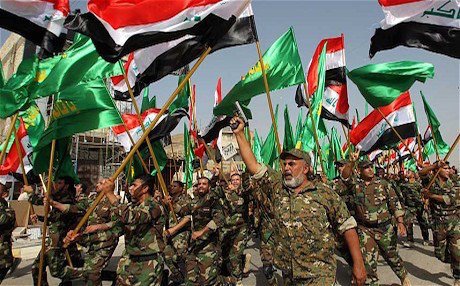
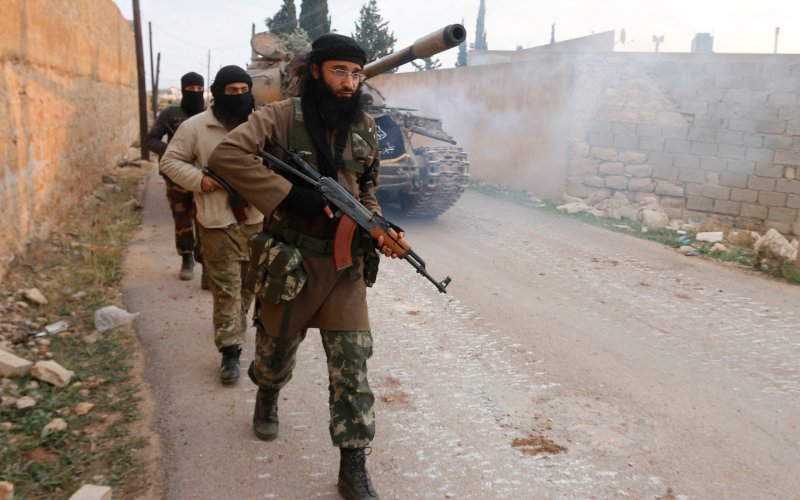
The objective of mullahs in dispatching revolutionary guards and strengthening militias is not to fight ISIS but to compensate for the decisive blow of Nouri al-Maliki’s ouster and to consolidate dominion of velayat-e faqih caliphate over Iraq

NCRI – The Iranian Resistance warns of the escalating presence of the criminal revolutionary guards of the terrorist Qods Force (QF) in Iraq that is a blatant breach of UN Security Council resolutions and underscores that their objective is not to fight ISIS, but to compensate for the heavy blow caused by Maliki’s ouster and to consolidate the velayat-e faqih caliphate in Iraq.

The slaughter and forced migration, along with aggression against the Iraqi people, in particular the Sunnis, and ridding them of their property by the revolutionary guards and their affiliated militias under the pretext of fighting ISIS has endangered peace and security throughout the region and fuels the machine of extremism and terrorism in the whole region.

1. According to Resistance’s information from inside the regime, the number of revolutionary guards of the QF now reaches 7000 in Iraq. A large number of them have been stationed in Baghdad, Diyala and Salah ad-Din provinces and the cities of Samarra, Karbala, Najaf, Khaneqain, Sa’adiyah and Jaloula. A great number of commanders and experts from the revolutionary guards accompany the terrorist militias in various areas of Iraq. Regime’ fighter jets have been flying in Iraq since early November and are currently carrying out military missions in Diyala and Salah ad-Din provinces.

2. The extent of this meddling is such that mullahs’ Defense Minister Dehqan stated on December 20: “In the realm of weapons and equipment, usually their governments (Iraq and Syria) purchase from us and in the realms of training and advising we are serving the armies and resistance forces of Syria, Lebanon and Iraq.” He added: The presence of Qasem Soleimani in Iraq “is to offer advice, guidance and training… the people who have gone there are to advise and offer training to help out with organizing and training and to offer advice on operational plans”.

3. The clerical regime and the QF that had brought Iraq under their hidden occupation in a step by step manner since 12 years ago, had taken over all aspects of that country through their proxy prime minister. Subsequent to the initiation of the popular uprising against Maliki in January 2013, they broadened their interference to suppress the uprising and to strengthen their hand in Iraq.

4. Since January 2014 that Maliki initiated the Anbar conflict and suffered a severe defeat in the hands of the people and tribes of that region, the Iranian regime felt imperiled and thus the presence of the QF in Iraq took on new dimensions. Mohammad Hejazi, Deputy for Logistics in regime’s General Command Headquarters of the Armed Forces, announced that the clerical regime is prepared to offer Iraq equipment and consultation (IRNA News Agency – January 5, 2014).

5. In February 2014, a number of QF commanders who had participated in the slaughter of the Syrian people went to Iraq to pass on their experiences in trainings to the Iraqi forces. Intimately and directly they transferred their experience in Iran and Syria to Ali Qaidan, the at the time Commander of the Army, and Fadhil Barwari, the Commander of the Golden (Dirty) Division. They primarily order to Maliki to establish a Basij-like force. They noted that they had initiated the civil defense in Syria which is capable of saving Assad’s regime; the classical army is designed to fight an external war and is useless in guerrilla warfare.

6. During this period, the QF beefed up the terrorist militia groups under its command such as Asa’ib Ahl al-Haq, Kata’ib Hezbollah and Badr Corps and dispatched them to Anbar Province, especially to Ramadi and Garmeh regions. Their first task was to pump morale into Maliki’s military. Since March 2014, 15-day training courses were arranged for these militias in Iran; the same thing that the regime had initiated two years ago for the mercenaries who were dispatched to Syria.

7. In March 2014, the QF sent some trainers from the Lebanese Hezbollah to Iraq to organize and train the militias and concurrently sent all types of weapons and equipment in an attempt to organize a powerful force capable of preserving the power in the hands of Maliki and Iranian regime’s elements.

8. Since late March 2014, the militias who had been equipped and organized in orderly units and were accompanied by QF commanders were deployed in battlefields and specific defensive lines were trusted to them. The Garmeh region until Zaidan and Baghdad Beltway from Taramiyah to Abu Ghoraib was given to Asa’ib militias; Fallujah and Baghdad Beltway from south of the airport to Yousefiyah was given to the Kata’ib terrorist group; and the Badr forces were deployed to the west of Fallujah and Ramadi. A division composed of the militias was organized to be deployed in Baghdad’s Beltway from Taramiyah to Madaen, west of Baghdad. Maliki and the QF jointly provided their equipment. Special equipment, bombs and missiles were transferred to Najaf and Baghdad through air transport with coordination by Hadi Ameri, Iraq’s at the time Minister of Transportation, to be transferred subsequently to these forces.

9. During this period, the commanders of the QF were placed in active liaison and direct coordination with Maliki’s army and police commanders and a joint Tactical Operating Center (TOC) was set up in Anbar. IRGC Brigadier General Iraj Masjedi, Qasem Soleimani’s “supreme advisor”, and a number of other commanders of the QF were deployed in Iraq. In addition, “Esmail Qa’ani Akbarnejad”, Deputy to Qasem Soleimani, regularly travelled to Iraq to supervise the situation.

10. Following the disintegration of Maliki’s army on June 10 and as Ninawa and Salah ad-Din slipped from his hands, the QF dispatched its command system to Iraq in a matter of hours. In the early days of this development, over 2000 seasoned revolutionary guards entered Iraq who were primarily tasked to Baghdad’s Beltway. Others were deployed in Diyala. Concurrently, people from IRGC Air Force were deployed in Diyala, Salah ad-Din and Kurdistan to collect information and direct drones. The number of revolutionary guards continues to rise and has now reached 7000.

11. At this stage, Soleimani used Abu Mehdi Mohandess, the known terrorist, as his Deputy of Operations in Iraq and commander of the militias and formed a special TOC for coordinating the militias in Baghdad. The military and security responsibility for Diyala was given to Hadi Ameri, Maliki’s Minister of Transportation. These two are both in the list of 32000 employees of IRGC in Iraq. This is the list that the Iranian Resistance exposed back in 2006.

12. To compensate for the sidelining of Maliki and regain former status, the clerical regime ramped up the presence of the QF in August and the presence of Qasem Soleimani increased, especially in battlefields such as Amerli, Jarf al-Sakhar, Sa’adiyah and Jaloula. In order to build up the morale of its defeated mercenaries, regime’s Farsi and Arabic speaking media staged a noisy propaganda campaign about the presence of Soleimani and the IRGC in Iraq.

13. During this period, organizing the “popular Basij” forces was left to the militias and the QF. In an interview with al-Iraqiya state TV on December 22, Maliki’s National Security Advisor Faleh Fayad stipulated that there are a number of “Iranian advisors” within the “popular Basij” forces.

14. The objective of IRGC and the militias is not to fight ISIS, but to exploit on the present situation and consolidate their grip on Iraq. That is why the massacres, aggressions, forced migration of populations, and ridding the Sunnis of their property that have been ongoing by these forces since 2003 took on unprecedented dimensions in the recent months. In an interview on December 1st with the official website of Kurdish Democratic Party (KDP), Sheik Jafar, KDP’s official in Khaneqain, said: “The actions of Shia militias is like ISIS or even worse. They are experts in killing, burning and looting. They have disrupted 90% of Sa’adiyah and looted and burned all its places… Their objective is to expand their rule and influence… They rarely use the Iraqi flag and mostly hoist a flag that carries the emblem of the Islamic Republic of Iran… They have initiated purging of all Sunnis and kill people anywhere they can… These forces blew up people’s homes under the pretext of neutralizing mines and explosives.”

15. In a shocking report on December 15, the Al-Jazeera TV unveiled the bombing of Sunni areas and forcible displacement of the Sunnis in Iraq including in Diyala and Salah ad-Din and especially in Samarra, various districts of Baghdad and its suburbs such as Mahmoudiyah, Arab Jabour, Jarf-al-Sakhar, Yousefiyah, Latifiyah, Abu Ghraib, Taji and Moshahedeh by the militias affiliated with the QF. The number of forcibly displaced people in Baghdad reaches one million. A resident of Jarf-al-Sakhar testified, “Militias burn homes, arrest the youth, and kill them in undisclosed locations… No Sunni family is left in Jarf-al-Sakhar. They arrest young and old men, forcibly displace the families, and kill them… We are witnessing the beginning of an Iranian caliphate just as ISIS has announced its caliphate.”

16. On 14 October 2014, in a detailed report titled “Absolute impunity, Militia rule in Iraq”, Amnesty International underscored the affiliation of the militias to the Iranian regime and wrote:
• The growing power of Shi’a militias has contributed to an overall deterioration in security and an atmosphere of lawlessness.
• Shi’a militias are ruthlessly targeting Sunni civilians on a sectarian basis under the guise of fighting terrorism, in an apparent bid to punish Sunnis for the rise of the IS and for its heinous crimes.
• Scores of unidentified bodies have been discovered across the country handcuffed and with gunshot wounds to the head, indicating a pattern of deliberate execution-style killings.
• Militia members, numbering tens of thousands, wear military uniforms, but they operate outside any legal framework and without any official oversight.
• By granting its blessing to militias who routinely commit such abhorrent abuses, the Iraqi government is sanctioning war crimes and fuelling a dangerous cycle of sectarian violence that is tearing the country apart.
• Successive Iraqi governments have displayed a callous disregard for fundamental human rights principles. The new government must now change course and put in place effective mechanisms to investigate abuses by Shi’a militias and Iraqi forces and hold accountable those responsible.

17. On 18 September 2014, the Foreign Policy website in an article titled “Iraq’s Shiite militias are becoming as great a danger as the Islamic State” wrote: “These groups, many of which have deep ideological and organizational links to Iran… are actively recruiting — drawing potential soldiers away from the Iraqi army and police and bringing fighters into highly ideological, anti-American, and rabidly sectarian organizations. Many of these trainees are not simply being used to push back Sunni jihadists, but in many cases form a rear guard used to control districts that are supposedly under Baghdad’s control…In early June, Shiite militias, along with Iraqi security forces, reportedly executed around 255 prisoners, including children…The growth of these pro-Iranian Shiite militias, and many more like them, helps demonstrate Iran’s goals for the domination of Shiite Iraq. These groups not only benefit from Iran’s patronage and organizational capabilities — they also all march to Tehran’s ideological tune. They are loyal to Iran’s Supreme Leader Ayatollah Khamenei and Iran’s ideology of absolute wilayat-e faqih.”

18. On September 16, New York Times wrote: “‘We break into an area and kill the ones who are threatening people,’ said one 18-year-old fighter with Asaib Ahl al-Haq… insisting that their militia commanders had been given authority by Iraqi security officials… This militia was once a leading killer of American troops … Alla Maki, a Sunni lawmaker said that under former Prime Minister Nuri Kamal al-Maliki, Asaib Ahl al-Haq was ‘encouraged to do dirty jobs like killing Sunnis, and they were allowed to operate freely. Now the international community are all being inspired by the removal of Maliki personally, but the policy is still going on’… So far, though, there is no sign of any official attempts to investigate even the most publicized allegations of extrajudicial killings of Sunnis by Asaib Ahl al-Haq.”

Kurdistan: More Like Israel, Less Like Iraq

December 25, 2014

Kurdistan: More Like Israel, Less Like Iraq, Gatestone Institute, Lawrence A. Franklin, December 25, 2014

It is a society that rejects religious zealotry. Most Kurds are Sunni Muslim and one can hear the five-times-a-day Muslim call to prayer, but it is muted and ignored by most.

Like Israel, Kurdistan is more democratic than any of its neighbors. Like Israel, Kurdistan is surrounded by enemies that wish it did not exist. Like Israel, Kurdistan looks West. And like Israel, Kurdistan has maintained an internal equilibrium though all the world betrays it.

Iraqi Kurdistan is full of surprises. Probably, the most unexpected discovery is how normal life is in its capital city, Erbil. Despite a late summer scare by Islamic State [IS] military gains north of Mosul and the threat of suicide bomber attacks, the social discipline of Kurdistan’s citizens is admirable. There is a relaxed state of tension. It is “business as usual.”

There is also a sense of optimism, pervasive and infectious. Entrepreneurial spirit is alive and well. While there was an exodus of foreign businessmen after the initial territorial gains by the IS, foreign investors are filtering back. The Kurdistan Regional Government [KRG] has already drawn up plans for large-scale projects to improve the infrastructure. Heavy-duty construction vehicles are everywhere. The most visible project is the beltway being built around the city.

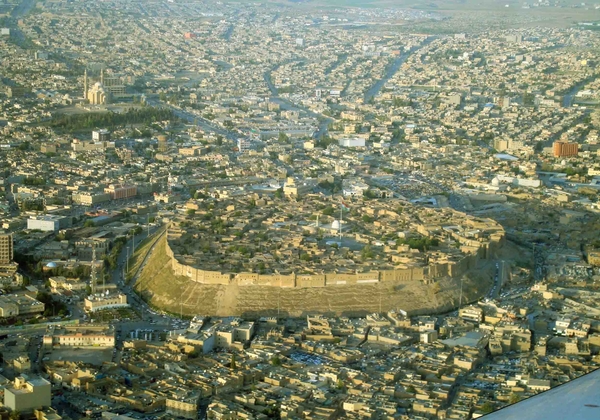
853An aerial view of Erbil, in Iraqi Kurdistan, featuring the ancient Erbil Citadel in the center. (Image source: Wikimedia Commons/Jan Kurdistani)

Political pluralism has come to the Kurdish north as well. While the Kurdistan Democratic Party [KDP] and the Patriotic Union of Kurdistan [PUK] respectively remain the one-two political powerhouses, they now have plenty of company. No one party dominates the parliament. There is plenty of horse-trading on issues, fleeting coalitions, and new political personalities are being heard. Nevertheless, the most influential and respected leaders still come from the Barzani extended family, which run the KDP. The late Mustafa Barzani (1903-1979) is revered as the warrior-godfather of modern Kurdistan.

Kurds, for the most part, are a welcoming lot. The methodical and rapid settlement of tens of thousands of refugees from IS-controlled Iraq required bold leadership by the Barzani-led government and especially from the Catholic hierarchy of Kurdistan. This success also reflects the compassion of a self-confident people. The population of the Dohok region, for example has doubled due to the influx of refugees. There is no observable tension between the newcomers and the population of the host country. Despite the inveterate resentment of the excesses of past Arab regimes, Kurdistan is a multi-ethnic and multi-religious society. It has become even more so with the emigration from other parts of Iraq of Turkmen, Yezidis, and Christian Assyrians and Arabs. It is also a society that rejects religious zealotry. Most Kurds are Sunni Muslim and one can hear the five-times-a-day Muslim call to prayer, but it is muted and ignored by most.

Men, mostly, walk on the streets of Erbil, Dohok, and Zako, especially at night. Kurdistan is not, however, a society that represses women. There are many in parliament, and they are outspoken on the issue of violence to females in Kurdish society. At one conference in mid-November, at least half of the speakers were women prominent in Kurdistan. Women military volunteers are widely admired. The Kurdish media celebrates the Kurdish Peshmerga‘s female fighters. One woman — a veteran of the fierce battle to save the Syrian Kurdish town of Kobane (near Turkey’s border) from an IS takeover — who recently visited Erbil, was received as a national hero. Female Yezidis who have escaped after torture by IS operatives are deeply admired too.

Zako, once the center of Kurdistan’s Jewish population, still invites back descendants of those who long ago left for Zion. Zako’s isolated villages are the wild west of Kurdistan. Its stark beauty against a ring of mountain chains may become a tourist magnet both for its ancient historical attractions and recreational possibilities.

For all of the above reasons, Kurdistan reminds one of Israel. Like Israel, Kurdistan is not dominated by the Arab, nor by Islam. Like Israel, Kurdistan is more democratic than any of its neighbors. Like Israel, Kurdistan is surrounded by enemies that wish it did not exist. Like Israel, Kurdistan looks West. And like Israel, Kurdistan has maintained an internal equilibrium though all the world betrays it.

ISIS sneaks behind US-backed Kurdish victories in Iraq to retake Baiji refinery city

December 22, 2014

ISIS sneaks behind US-backed Kurdish victories in Iraq to retake Baiji refinery city, DEBKAfile, December 22, 2014

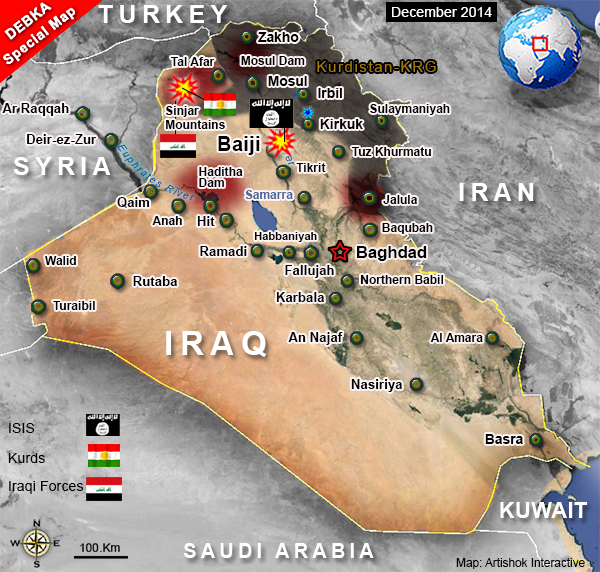
IraqBaiji

American, Kurdish and Iraqi officials have hailed as a “major victory” the release of thousands of distressed members of the Yazdi community, trapped for four months on on Mt. Sinjar in northern Iraq, since Islamic State thugs overran their town. Many more fled to Syria while Yazdi women were kidnapped.

This was a necessary rescue operation, but hardly a major victory, say DEBKAfile’s military experts. ISIS continues to maintain its grip on vast stretches of Iraq and Syria, defying the efforts of sparse US and coalition air strikes to dislodge them – beyond minor tactical withdrawals.

The town of Sinjar is not mentioned in the US and Kurdish releases, because large sections are still in jihadi hands.

Even less is heard about the situation on the northern Iraqi-Syrian border, where Abu Bakr Al-Baghdadi has achieved almost total supremacy.

But the most telling omission by the US-led allies is the fact that, while they focused on Mt. Sinjar, ISIS forces restored their siege of Baiji, Iraq’s main oil refinery center, after pushing Iraqi troops out.

This happened after a majority of the local Sunni tribes who fought alongside the Iraqi army up until November, switched sides.

The tribal chiefs complained that the Iraqi Prime Minister Haider al-Abadi, who was installed in Baghdad with Washington’s support last year, as a figure able to unite the country’s Sunni and Shiite communities for the war on ISIS, reneged on his promise of pay checks and weapons for the tribesmen who threw in their lot with the national army.

Instead, he is accused of aggravating disunity in the armed forces by firing Sunni officers and replacing them with officers loyal to Iraq’s pro-Iranian Shiite militias, who take their orders from Iranian Revolutionary Guards Corps commanders.

DEBKAfile’s military and counter-terrorism sources describe the current military state of play in Iraq as bizarre, fought on three more or less disconnected levels:

1.  In the north, a mixed Iraqi-Kurdish force, accompanied by US military advisers, is poised to attack the key town of Tal Afar, which lies 50 km west of Mosul.

Friday, Dec. 21, they took the town’s Iraqi military base that fell to ISIS in June. But, like in Sinjar, the assault force has not yet occupiedy the town.

This Tel Afar operation was a compromise in the disagreement the Iraqis and Kurds had with Washington. They asserted they were fully capable of recapturing Mosul from the Islamists, while the US military advisers disagreed and warned that this offensive was doomed to failure.

2.   While Iraqi and Kurdish peshmerga forces are concentrating their assaults on areas where ISIS forces are thin on the ground (like Mt. Sinjar), the jihadis are throwing strength into capturing and controlling the Iraqi and Syrian oil industries (like Baiji). They are by now accruing revenues running into $2 to 2.5 billion, despite falling crude prices. In fact they are dumping the looted oil for $25-30 per barrel, well below the world market prices.

3.  Washington is sparing too little attention for the ISIS outgrowths mushrooming outside Iraq and Israel – especially in Libya, Egypt and Egyptian Sinai.

Iran Is Basically Running The Iraqi Government’s Air War Against ISIS

December 17, 2014

Iran Is Basically Running The Iraqi Government’s Air War Against ISIS, Business Insider, Joel Wing, December 16, 2014

Iranian air forceIran Air Force F 4 Phantom II

Tehran is now considered one of the main defenders of the country and Iraqi politicians regularly praise its help and give it cover for its operations. It has also garnered popular support as well amongst some Iraqis.

This will all go a long way to make sure that Iran maintains its power within the country after the war is over.

***********

In November 2014 an Iranian jet was filmed carrying out a bombing mission in Iraq’s Diyala province. Iran was already known to have mobilized its militia allies, sent in advisers and military equipment, and brought in Lebanon’s Hezbollah to help Baghdad.

General Qasim Suleimani, the head of the Iranian Revolutionary Guards’ Quds Force, is all over social media with pictures showing him providing leadership to Iraqi forces.

Sending in air support seemed like the next natural step for Iran’s strategy in Iraq.

Iranian planes supported an Iraqi military operation to retake two villages from the Islamic State (ISF) in Diyala. In the middle of November Iraqi Security Forces, militias, and the peshmerga started a campaign to retake Jalawla and Sadiya in northeast Diyala, which was completed on November 23.

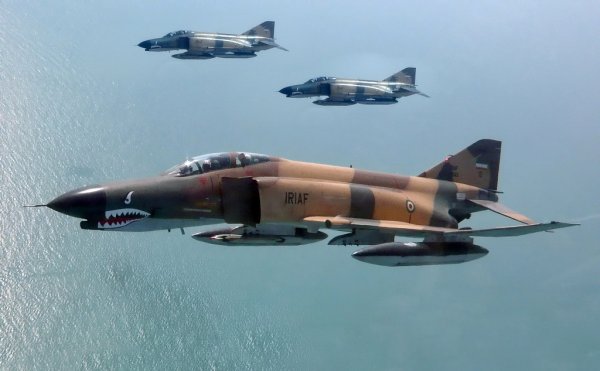
During that period Al Jazeera filmed an Iranian F-4 Phantom jet flying over the area. According to an Iranian military expert, Tehran was carrying out air missions there from November 18-23 using F-5 and F-4 jets as well as UAVs.

The planes were said to be flying out of Kermanshah air base in Iran. An Iranian politician was quoted in the Los Angeles Times saying that Tehran considered the Sadiya and Jalawla area a buffer zone because it is close to the border, thus explaining Iranian intervention there.

This was the first hard evidence that Iran had committed air assets to the fight in Iraq. But they had been there for some time and still continue to operate.

Iranian air power was supposedly part of a security agreement between Iraq and Iran. After the fall of Mosul Prime Minister Nouri al-Maliki allegedly signed a deal with Tehran to provide military assistance to the Iraqi forces, including through air assets.

By the end of June there were the first reports of Iranian drones based out of Baghdad flying over Iraq to collect intelligence. In July several Su-25 fighter-bombers were delivered to Iraq from Russia. But that included planes from Iran as well.

That same month an Iranian Revolutionary Guards pilot named Shojat Almdari was killed in the Samarra area of Salahaddin. He was probably acting as a forward air controller for air strikes there.

Iranians were carrying out many of these missions and flying the Su-25s as well. In November an Iraqi pilot told the Guardian that Iranians were regularly manning Iraqi air force planes and helicopters in combat and supply missions.

He said they were operating out of Rasheed air base in Baghdad. There were more reports of bombing and close air support missions on November 29 and 30 and December 1 and 2 in Iraq. Iranians are supposedly in the air in Salahaddin and flying in support of ongoing ISF and militia operations there.

Finally, Iran is providing training to Iraqi pilots on Su-25s, and MiG-23s and 29s at the Kermanshah air base. The Iraqi Air Force is undermanned and lacks fighter jets and trained pilots. Given that situation and all the other military support Iran has already given it was no surprise that it would send in some of its air power as well to help Baghdad.

Only now is the extent of this support becoming public. But Iran should have been expected this to happen.

Iran has a two-fold strategy in Iraq. First, it wants to provide military assistance to make sure that the Islamic State is turned back and eventually defeated. It also wants to expand its influence within the Iraqi state through the military and bureaucracy.

It is currently achieving both of these goals. Tehran is now considered one of the main defenders of the country and Iraqi politicians regularly praise its help and give it cover for its operations. It has also garnered popular support as well amongst some Iraqis.

This will all go a long way to make sure that Iran maintains its power within the country after the war is over.