Archive for the ‘Iraq war’ category

U.S. Accused of Training Iranian-Tied Forces in Iraq

December 16, 2016

U.S. Accused of Training Iranian-Tied Forces in Iraq, Washington Free Beacon, December 26, 2016

(It all depends on what “Iranian-tied” means. — DM)
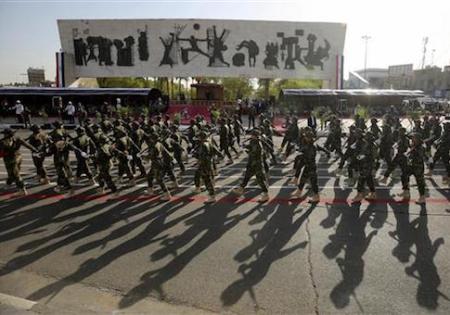
pmfIraqi government-backed Popular Mobilization forces take part in a joint military parade with Iraqi security forces in Baghdad / AP

“There are militiamen, Sunni, Shias, and Christians who are not part of the Iranian-backed network in Iraq and are not necessarily amenable to Tehran’s influence,” he said. “However, these are dwarfed, out-financed, and out-gunned by the IRGC-backed militias, who promote the brand of Islamic identity as espoused by the IRGC, and openly display ideological loyalty to the velayat-e faghih (the Islamic Republic’s founding ideology) and Iran’s supreme leader.”

*****************************

The United States military is facing accusations that it has been training Iraqi militia fighters who are tied to Iran, a charge that military officials who spoke to the Washington Free Beacon denied this week while insisting that the United States and Iran share common goals in the war-torn country, as both sides fight to eradicate the threat of Islamic State terrorists.

The latest charge that the United States may be directly involved in the training of Iranian-backed militia fighters has reignited concerns that America is becoming too cozy with Iranian interests operating in Iraq, an issue that highlights the difficultly facing U.S forces as they seek to counter the influence of ISIS.

Video recently emerged of U.S. military advisers training Iraqi militia fighters in Makhmur. Some foreign policy observers assessed that these militia fighters may have ties to Iran, which controls an increasing number of Iraqi militia fighters taking on ISIS.

The charge was picked up this week in a lengthy Los Angeles Times exposé claiming, “The U.S. is helping train Iraqi militias historically tied to Iran.”

Senior military sources who spoke to the Free Beacon denied the United States is directly working with Iranian forces, but acknowledged the United States and Iran do share similar goals in Iraq when it comes to combatting the threat of ISIS.

“In Iraq, with regards to ISIL, our interests and Iranian interests have some convergence,” said one senior military official who spoke to the Free Beacon on background, using another acronym for the Islamic State.

Iranian influence over militias in Iraq continues to be a challenge for the United States, which is barred by law from working with any such group. Foreign policy insiders who spoke to the Free Beacon about the issue warned that U.S. intervention against ISIS in Iraq is serving to bolster and legitimize Iran’s regional influence.

During last spring’s campaign in Fallujah, the U.S. provided air cover to Iraqi fighters, some of whom came from militias tied to Iran. Iranian media reported that some of the fighters belonged to Iran’s state-controlled militia.

“The forces that the LA Times observed in that story are not affiliated with Iran,” Col. John Dorrian, a spokesman for the U.S. Joint Task Force operating in Iraq, told the Free Beacon. “They are approved as hold forces ‎for terrain that has been liberated by the Iraqi Security Forces. They are being trained by coalition forces. They are local forces, and they represent diverse ethnic and sectarian backgrounds. The local tie is a key element in their acceptance by the population they are going to keep secure.”

Dorrian added that the headline on the LA Times article discussing the training of these militias “is very misleading.”

“There’s a lot of good information ‎in the article but the Iranian tie is nonexistent,” Dorrian said. “The Government of Iraq has enrolled these forces as Popular mobilization forces. I think LAT conflated that fact with Iran. Despite my telling them there’s no tie, they went with that headline.”

Multiple other military officials, Obama administration sources, and outside experts familiar with the matter told the Free Beacon that the militia fighters depicted in recent videos have no ties to Iran.

However, they said the United States and Iran share common goals in Iraq, where the threat of ISIS has sparked sectarian battles and endangered the Western-backed government.

A State Department official authorized only to speak on background told the Free Beacon that the United States does not train any Iranian-tied fighters, even if they are officially backed by the Iraqi government.

“The U.S. provides support to the Iraqi Security Forces, and those aligned with the Iraqi government,” the official said. “The U.S. does not, and will not, provide direct support to any group proscribed by American law, or which does not operate under the aegis of the Iraqi government.”

Much of Iraq’s Popular Mobilization Forces, or PMFs, are comprised of Shia Muslim fighters, many of whom are ideologically aligned with Iran’s hardline regime.

Maj. Adrian J.T. Rankine-Galloway, a Defense Department official, confirmed to the Free Beacon that some Iraqi units have been barred from receiving U.S. training due to their inability to pass background checks.

“Some Iraqi units have been restricted from receiving assistance because their commander didn’t pass vetting,” Rankine-Galloway said. “Because that quarterly report is classified, we cannot release which units were disqualified from receiving ITEF assistance.”

Rankine-Galloway further maintained that the United States has not changed its policy with regards to training in Iraq.

“U.S. government support to the counter-ISIL campaign remains by, with, and through the central Government of Iraq—and only to forces under the command and control of the Iraqi Security Forces,” Rankine-Galloway said. “Department of Defense policies on the provision of military assistance to foreign military forces have not changed. Iraqi Security Forces units who receive Iraq Train and Equip Fund assistance are strictly vetted” for ties to terror groups and the government of Iran.

Critics of the Obama administration’s policy in Iraq charge that even if the forces are not directly under the Iranian government’s orders, they are influenced by its senior military leaders.

“For proof the Obama administration treats our enemies like friends, look no further than their efforts to train armed militias loyal to Qassem Soleimani, commander of the IRGC-Qods Forces, in Makhmur,” said one senior congressional aide who works on the matter. “Incoming national security adviser Michael Flynn knows intimately what Iran is capable of, so it’s hoped that he and the Trump administration will reverse this disgrace.”

Amir Toumaj, an Iran analyst at the Foundation for Defense of Democracies, said that militia fighters tied to Iran far outnumber other fighters in Iraq.

“There are militiamen, Sunni, Shias, and Christians who are not part of the Iranian-backed network in Iraq and are not necessarily amenable to Tehran’s influence,” he said. “However, these are dwarfed, out-financed, and out-gunned by the IRGC-backed militias, who promote the brand of Islamic identity as espoused by the IRGC, and openly display ideological loyalty to the velayat-e faghih (the Islamic Republic’s founding ideology) and Iran’s supreme leader.”

“Key leaders” in the PMF “are beholden to Qassem Soleimani,” a top Iranian military leader, Toumaj said. “For example, the PMF operations commander is Abu Mahdi al Muhandis, Iran’s number one man in Iraq who has been designated as a terrorist by the U.S. Treasury and has overseen lethal attacks against U.S. soldiers during the occupation of Iraq. Iraqi militia and party leaders openly travel to Iran, and have received royal treatment, such as Akram al Kabi, head of Harakat al Nujaba, or the Movement of the Noble. The group under his command has committed war crimes and summary executions of women and children in east Aleppo this past week, according to the U.N.”

“The law legalizing the PMF has been welcomed in Iran. When Supreme Leader Ali Khamenei this past week received Ammar Hakim, head of the National Alliance Shia party that helped passed that bill, he called the PMF a ‘great wealth’ for Iraq that should be ‘supported and consolidated.’”

“The current U.S. policy of defeating the Islamic State above all else is empowering the IRGC-backed network, which has worked to infiltrate the Iraqi government and cement itself into a part of the state and establish an Iraqi version of the IRGC, crystallized in the PMF,” Toumaj said.

Mosul offensive folds, waiting now for Trump

December 5, 2016

Mosul offensive folds, waiting now for Trump, DEBKAfile, December 5, 2016

qayyarah_iraqi_forces_12-16

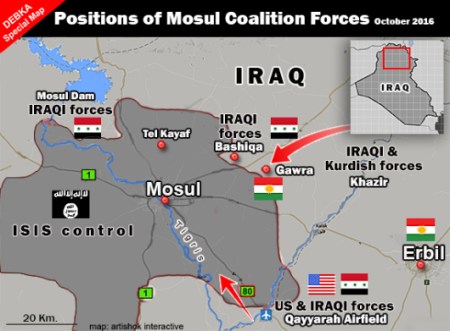
Altogether 54,000 Iraqi troops and 5,000 US servicemen – supported by 90 warplanes and 150 heavy artillery pieces – were invested in the Mosul campaign when it was launched in October. They proved unable to beat 9,000 jihadists.

Aware of the crisis on the Mosul front, the Pentagon has drawn up plans for sending out US reinforcements in the hope of turning the tide of the stalled battle. Those plans repose in their pending trays to await the decisions of the incoming US President Donald Trump and the new Defense Secretary Gen. James Mattis.

********************

The failure of the US-backed Iraqi army offensive to liberate Mosul – nine weeks after it began – could no longer be denied when a delegation of ISIS chiefs arrived there Sunday, Dec. 4, traveling unhindered from Raqqa, Syria.

DEBKAfile’s military and intelligence sources report that they arrived to discuss how to synchronize the operations of the two jihadist strongholds, after the Islamist leaders occupying Mosul changed course about leaving the city and decided to stay put.

This decision followed their assessment that the Iraqi army and its American backers were incapable of bringing their offensive to a successful conclusion. It was also evident in Washington that the US commanders in the field would not be able to meet Barack Obama’s presidential directive to capture Mosul by the end of December, so that he could exit the White House next month with a successful Mosul campaign behind hm.

Altogether 54,000 Iraqi troops and 5,000 US servicemen – supported by 90 warplanes and 150 heavy artillery pieces – were invested in the Mosul campaign when it was launched in October. They proved unable to beat 9,000 jihadists.

Iraqi forces have gained no more than one-tenth of the territory assigned them. This lack of progress has damped their initial impetus and sapped their morale. While Baghdad keeps on pumping out reports of good progress and new fronts opening up, the Iraqi army has come to a virtual standstill and does nothing more than exchange fire with ISIS fighters.

The first sign that ISIS had reversed its tactics and decided to hold out against the Iraqi assault came in the form of a slickly-produced video released by the jihadists on Dec. 27 to display their defenses inside Mosul. It showed commando units in battle formation, sniper positions in place, bomb cars parked at key points and well-barricaded streets. In the terrain from which they pulled back, they had strewn shells and rockets loaded with poisonous chemicals as a warning message to Iraqi troops that they would storm the city at their peril.

Our sources report meanwhile that some of the ISIS fighters who quit Mosul in the early stage of the Iraqi offensive are turning back, along with some of the administration officials.

The Kurdish Peshmerga, which three weeks ago turned their backs on the campaign, now realize they will have to live with ISIS as a dangerous next-door neighbor, after all. They are bending their energies to establishing a strong line of defense against Mosul, to secure their capital Irbil and other towns of the semiautonomous Kurdish Republic of Iraq.

Aware of the crisis on the Mosul front, the Pentagon has drawn up plans for sending out US reinforcements in the hope of turning the tide of the stalled battle. Those plans repose in their pending trays to await the decisions of the incoming US President Donald Trump and the new Defense Secretary Gen. James Mattis.

US on alert for terror strikes around elections

November 4, 2016

US on alert for terror strikes around elections, DEBKAfile, November 4, 2016

baghdadi_call480-1

Following threats from Al Qaeda and ISIS, US security authorities have warned officials in New York, Texas and Virginia about possible attacks by al Qaeda or ISIS in the run-up to Election Day on Nov. 8. No specific locations were mentioned. However, the Port Authority of New York and New Jersey, which operates airports, tunnels and bridges around New York City said they will continue with “high level of patrols” in the four days leading up to and after Tuesday’s vote. “The FBI, working with our federal, state and local counterparts, shares and assesses intelligence on a daily basis and will continue to work closely with law enforcement and intelligence community partners to identify and disrupt any potential threat to public safety” the Bureau said Friday.

The terror alert came a day after DEBKAfile’s intelligence and counterterrorism sources reported that Islamists may be planning terrorist attacks to occur around the time of the presidential election. After checking out the information, the FBI and Homeland Security Department decided to alert the public to a possible Al Qaeda/ISIS terrorist threat.

DEBKAfile reported Thursday, Nov. 3:

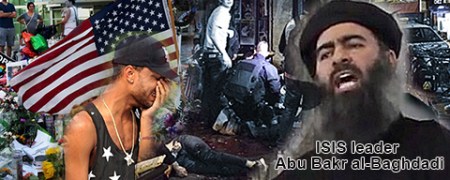
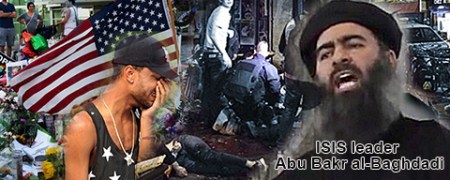
As Iraqi troops entered Mosul, Wednesday night, Nov. 2, Islamic State’s leader Abu Bakr al-Baghdadi called on his suicide bombers all over the world “to destroy the cities of the unbelievers.”

In a rare, audio-taped speech from an unknown location, he rallied jihadists from across the world to rise up against “God’s enemies from the Jews, Christians, atheists, Shiites, apostates and all of the world’s infidels.”

This was interpreted as a coded signal to the Islamist State’s dormant cells in key Western and Middle Eastern cities to go into action for a new, multiple outburst of suicide terror.

In an apparent response to military pressure, Al Baghdadi followed his rallying to ISIS-affiliated fighters across the globe by urging ISIS members to defend Mosul since “holding our ground in honor is a thousand times better than retreating…”

International intelligence and counterterrorism agencies in the US, Western Europe and the Middle East had widely expected Al-Baghdadi’s call for widespread terror to come at the outset of the US-led coalition offensive on Oct. 15 to retake Mosul. When it was not forthcoming, they speculated that the “caliph” was either unwilling or unable to issue the call for action in the early stages of the battle.

According to one conjecture, the advance of the Iraqi army and allies into Mosul Wednesday may have been  the trigger for the ISIS leaders first taped speech since December 2015.

So too might the proximity of the US presidential election next Tuesday with the intention of causing maximum disruption on America’s voting day.

The possible response to the ISIS leaders rallying call is seen as cause for alarm, according to DEBKAfile’s counterterrorism sources. It is feared that the Mosul operation against ISIS will spawn new and more devastating forms of terror, such as, for instance, mass-hostage taking in order to extort the coalition forces’ withdrawal from Mosul.

So far, ISIS has not managed to unleash terrorist attacks in response to the Mosul operation in America or against US targets in the Middle East and Europe. The Islamist terror attacks on Sept. 18 and 19 in New Jersey and Manhattan that were perpetrated by Ahmad Khan Rahami were instigated by Al Qaeda, not ISIS. Our sources foresee that al-Baghdadi, under pressure to show his jihadists are still active terror players, may pull off a dramatic strike at a prominent American location – possibly even on election-day.

His explicit call for terrorist attacks in Saudi Arabia and Turkey show his sights have not been removed from the Middle East either.

ISIS chief looses suicide bombers at W. cities

November 3, 2016

ISIS chief looses suicide bombers at W. cities, DEBKAfile, November 3, 2016

baghdadi_call480

Our sources foresee that al-Baghdadi, under pressure to show his jihadists are still active terror players, may pull off a dramatic strike at a prominent American location – possibly even on election-day.

***********************

As Iraqi troops entered Mosul, Wednesday night, Nov. 2, Islamic State’s leader Abu Bakr al-Baghdadi called on his suicide bombers all over the world “to destroy the cities of the unbelievers.”

In a rare, audio-taped speech from an unknown location, he rallied jihadists from across the world to rise up against “God’s enemies from the Jews, Christians, atheists, Shiites, apostates and all of the world’s infidels.”

This was interpreted as a coded signal to the Islamist State’s dormant cells in key Western and Middle Eastern cities to go into action for a new, multiple outburst of suicide terror.

In an apparent response to military pressure, Al Baghdadi followed his rallying to ISIS-affiliated fighters across the globe by urging ISIS members to defend Mosul since “holding our ground in honor is a thousand times better than retreating…”

International intelligence and counterterrorism agencies in the US, Western Europe and the Middle East had widely expected Al-Baghdadi’s call for widespread terror to come at the outset of the US-led coalition offensive on Oct. 15 to retake Mosul. When it was not forthcoming, they speculated that the “caliph” was either unwilling or unable to issue the call for action in the early stages of the battle.

According to one conjecture, the advance of the Iraqi army and allies into Mosul Wednesday may have been  the trigger for the ISIS leaders first taped speech since December 2015.

So too might the proximity of the US presidential election next Tuesday with the intention of causing maximum disruption on America’s voting day.

The possible response to the ISIS leaders rallying call is seen as cause for alarm, according to DEBKAfile’s counterterrorism sources. It is feared that the Mosul operation against ISIS will spawn new and more devastating forms of terror, such as, for instance, mass-hostage taking in order to extort the coalition forces’ withdrawal from Mosul.

So far, ISIS has not managed to unleash terrorist attacks in response to the Mosul operation in America or against US targets in the Middle East and Europe. The Islamist terror attacks on Sept. 18 and 19 in New Jersey and Manhattan that were perpetrated by Ahmad Khan Rahami were instigated by Al Qaeda, not ISIS. Our sources foresee that al-Baghdadi, under pressure to show his jihadists are still active terror players, may pull off a dramatic strike at a prominent American location – possibly even on election-day.

His explicit call for terrorist attacks in Saudi Arabia and Turkey show his sights have not been removed from the Middle East either.

ISIS will survive Mosul and Raqqa

November 2, 2016

ISIS will survive Mosul and Raqqa, Israel Hayom, Dr. Ori Goldberg, November 2, 2016

The American administration recently announced that it is planning an offensive to take the city of Raqqa, the Syrian “capital” of Islamic State. The American announcement illustrates the overarching logic behind the current campaign against Islamic State. According to this logic, Islamic State is, in fact, a state. And one state defeats another if it conquers its capital. Such a conquest forces the enemy’s administrative institutions to crumble, along with its remaining forces and defenses, while the conquering country can effectively “take control” of the vanquished country.

Reality, however, does not necessarily abide logic, as we will see when Raqqa is taken, because Islamic State is not a state. Even its expected defeat in Mosul, along with the future downfall of Raqqa, cannot dissolve the “Islamic State,” because it is just one expression, or one phase, of an ongoing struggle. The purpose of this struggle is to prepare the world for the day of judgment, and a ready world is a world that realizes the weakness and fallacy inherent to the human political order.

The state of Islamic State is a mirror intended to demonstrate to the entire world the tenuous nature of the “Arab” states in the Middle East. The role of this state is to rise, and after it has risen to make a laughing stock of the countries around it. It melts away borders and nullifies national identity; it rejects the laws of the state and the international community, and scorns such ideas as “human rights.”

ISIS, however, does not portend to be a complete or sufficient alternative to the Western model or to any other model. The Islamic State is part of a path whose ending is already known — judgment day will come, the final battle will be decided and the Muslims will win. Therefore, when Raqqa falls Islamic State will not simply vanish into thin air. If the tangible Islamic State can no longer fulfil its grand purpose, another means of fulfilling it will be found. When the physical state finally collapses, after much blood is spilled, the citizens who lived under its boot will surely breathe a sigh of relief. The soldiers of the Islamic State will disperse; some will join any of the numerous terrorist groups out there, others will go back home to their worried parents, from Tunisia to Kosovo. The idea of Islamic State, however, will not dissipate in the slightest. Quite the opposite, it can be expected to grow stronger.

The creation of the Islamic State marked a significant escalation for global jihad. Many talked about a caliphate while waging jihad over the years, from the mid-1980s in Afghanistan until today, but no one felt secure enough to implement the idea. Islamic State took the step and was successful, specifically because it never believed that having a state was the end all and be all.

The memory of the Islamic State will encourage new believers, in groups or on their own, to continue undermining the stability and unity in their host countries. Violence will continue to be, to an even higher degree, the most readily accessible and effective way to expand Islamic State’s jihadi doctrine and religious struggle. There is no reason to necessarily expect grandiose terrorist attacks in the style of al-Qaida.

The purpose of Islamic State does not lie in the spectacle, the widespread destruction or in the unfathomable number of casualties. We can, however, expect a dogged response unrestrained by time or distance. The current and soon-to-be martyrdom in Mosul and Raqqa is not the result of loyalty to the state, rather a devotion to the unceasing advance forward, toward the assured end.

Turkey’s Descent into Islamist Tyranny Deepens

October 31, 2016

Turkey’s Descent into Islamist Tyranny Deepens, Counter Jihad, October 31, 2016

turkey-islamic-1

Turkey’s military forces have just seized the Hagia Sophia, appointing a full-time imam to lead Islamic prayers there after 80 years of it being held as a neutral place for both Christians and Muslims.  The move is symbolic, but shows clearly the designs of Turkey’s Islamist president.

The Turkish government under Recep Tayyip Erdoğan used the abortive coup of this summer to deepen its control over every aspect of Turkish life, but especially the media and education.  Over ten thousand public servants have been purged from the government in recent days, raising the total figure to over a hundred thousand — some 37,000 of whom have been arrested. Erdoğan has pressed the Turkish parliament to reinstate the death penalty so that he can begin disposing of those he has identified as his enemies.

“Our government will take this proposal [on capital punishment] to parliament. I am sure parliament will approve it, and when it comes back to me, I will ratify it…Soon, soon, don’t worry. It’s happening soon, God willing. The West says this, the West says that. Excuse me, but what counts is not what the West says. What counts is what my people say.”

According to CounterJihad’s sources, the detained who are subjected to trial must submit to having all of their conversations with their lawyers recorded whenever the prosecution requests it.  Such recordings are of course admissible as evidence against the client — or the lawyer, if he comes to be considered an enemy of the state from working too hard to defend people already classified as ‘enemies of the state.’

The detained include especially members of opposition media.  The leadership of the Cumhuriyet daily newspaper, which is nearly a century old, were arrested and their laptops seized by the police.  Their paper is not only critical of Erdoğan , but occasionally supportive of the Kurdish minority.  That appears to be grounds for arrest in Turkey now:  even two mayors were seized by order of a Turkish court on suspicion of being sympathetic to Kurdish militants.  In addition to the attacks on the Cumhuriyet daily, 15 Kurdish news outlets have been shuttered by order of the state.  A pro-Kurdish television station was raided by police and forced off the air.

In addition to the media, the state has moved to consolidate control over its system of higher education.  Some 1267 academics who signed a “Peace Petition” last January have been removed from their jobs according to CounterJihad’s sources, and several have been arrested and charged with “terroristic acts” for signing or forwarding that petition.  Our sources tell us that under the new laws, President Erdoğan must personally approve all new university presidents.

At the same time, the Turkish government is pressing NATO to end its naval mission aimed at containing migration flows across the Mediterranean sea.  Turkey claims that the mission is no longer needed, but the siege of Mosul is expected to produce at least a million new refugees in the coming months.  The Russian operations against Aleppo are likewise expected to produce new waves of migrants.

Turkey appears to be using its position within NATO to advance Russia’s interest here, which is to flood Europe with migrants in order to overburden European governments.  That will produce a Europe less able to resist Russian expansion into Eastern Europe.  Turkey and Russia recently signed a major energy deal, clearing the way for at least an economic alliance.  Erd also moved to abandon daylight savings time, a shift that places Turkey in the same time zone as Moscow.  Russia for its part appears to be negotiating a peace between Turkey and Iran on a partition of Iraq, one that would give Turkey greater control over its Kurdish problems.  If Russia succeeds in peeling Turkey off from NATO, it would invalidate the alliance as NATO requires unanimous decisions for all military decisions.

Bernard-Henri Lévy: With the Peshmerga, on the Front Line in the Battle for Mosul

October 30, 2016

Bernard-Henri Lévy: With the Peshmerga, on the Front Line in the Battle for Mosul, Algemeiner, Bernard-Henri Lévy,October 30,2016

Editor’s note: Bernard-Henri Lévy’s documentary, “Peshmerga,” was an Official Selection at the 2016 Cannes Film Festival. He and his team are back in Iraqi Kurdistan, embedded with the Peshmerga, filming a follow-up. The following is his report.

Return to Kurdistan. My first move is to go into the hills around Mount Zartak to gather my thoughts in the spot where Maghdid Harki, the young, white-haired general who was one of the heroes of Peshmerga, spent his last moments. Nothing has changed. Not the sandbags that were too flimsy to protect him. Not his bunker which, as he liked to say, was no better fortified than those of his men. Those men have kept his water bottle hanging in its place on the wall near the door, still containing the last gulp of water that he had been about to drink. The only difference is that American special forces are now using the bunker.

Through binoculars, a US soldier scans the valley in which the human bombs of ISIS may appear at any moment. Another stands behind a telescope trained 20 kilometers farther away on the outskirts of Mosul. A third, with long, blond hair and an Errol Flynn mustache, recovers a drone that has just landed at our feet in a cloud of dust. A fourth who looks like an intellectual (reminding me of Norman Mailer’s cartographer from the 112th cavalry of San Antonio) sits under a canopy deciphering the data coming in on his PC. And a fifth, the highest in rank, from Tennessee, passes on the intelligence. Who are these young Americans, oppressed by the heat and squinting at the light like blind men blinking at the dark? With Mosul a stone’s throw away, they are the leading edge of the coalition that has finally decided, in support of the Kurdish Peshmerga and the Iraqi army, to take the capital of the Islamic State.

I am in Sheikh Amir in the al-Khazir zone. Sheikh Amir is the last liberated village before the beleaguered Christian city of Qaraqosh. Three brand new Toyotas come to a screeching halt, disgorging a squad of men in mismatched black uniforms — definitely not the Peshmerga.

“What are you doing here?” demands General Hajar, with whom I’ve traveled from Erbil. “You shouldn’t be here!”

“This is our land!” answers an ill-shaven man with a nasty, menacing look who seems to be the leader of the group.

“No,” says Hajar, gesturing toward a distant stand of prefabricated shelters that, from the road, we had taken for a refugee camp. “That’s where you should be. The accords are clear: You’re not supposed to leave your camp unless you’re attacking.”

“To hell with you!” chimes in another of the men in black. “We’re home wherever we are.”

As Hajar ups the ante and the confrontation threatens to turn ugly, the leader mumbles a half-hearted apology and, after ordering his bunch back into their pickups, heads off in the direction of the camp, where we can make out three helicopters landing. It all took place very quickly. But the men in black, we now know, were among the thousands of Shi’ite militiamen that Baghdad has hastily incorporated into the Iraqi regular army. And the incident, however minor, speaks long about the tensions among the participants (the Peshmerga on the one hand; Baghdad’s majority Shi’ite army on the other) called upon to liberate the Islamic State’s Berlin.

Another sign. A few kilometers farther on, we are in the Christian village of Manguba. Here, ISIS put up little resistance. But, in retreat, it left behind explosives hidden in soda bottles, fuel cans and sometimes even Korans. And Anwar, a Christian officer in the Peshmerga, is one of very few who take the risk of going out to see what remains of his house. He arranges to rejoin us at a nearby spot, the highest in the village, which, to judge from the punctured soccer ball and the marbles mingled with spent cartridges, must have been a playground before becoming, today, the unit’s lookout post.

“It’s terrible,” he tells us on his return. “There’s nothing left of my house, and they torched the church.” Then, choking back a sob: “But there’s another problem, Mr. Lévy. These bastards have left and, God willing, they won’t come back. But then what? Who will be responsible for protecting our community? We have a Christian brigade training with the Peshmerga, but what will become of it after the victory? Under whose command will it be then?”

Egged on by questions from my friend, Gilles Hertzog, Anwar speaks his mind plainly. Neither he nor any of the Christians in the Qaraqosh region has any confidence in Iraq. He won’t bring his wife and children back, he says, unless the Kurds, and the Kurds alone, are protecting the Plain of Nineveh. In what form, we ask? As a province? An autonomous zone under Kurdish mandate? And does he think that the Iraqis or the Americans on Mount Zartak will agree to such a thing? He shrugs. For soldiers of God, life and salvation are non-negotiable.

Hassan al-Sham. Near the Christian town of Bartallah. The same landscape of charred earth, wreckage of suicide trucks, and lingering fires from torched fuel depots. And suddenly, right in front of me, a big hole. A well, I think at first. Wrong. There is a ladder in the hole, which my cameraman and I climb down behind a member of the bomb squad. Three meters down, I discover a tunnel a meter wide with an arched ceiling and cement walls interspersed with crude masonry in which a man my height can stand upright.

After walking tentatively for 100 meters by the light of the bomb technician’s flashlight, we come upon a passage perpendicular to the one we are in and similarly walled but that we do not enter because we can make out bundles of plastic explosive and contact wires. Then, on each side of the tunnel, rooms filled with a jumble of dirty mattresses. Then, again symmetrically arranged, a twin command center in which someone has left behind a pile of newspapers in Arabic. It’s a black-and-white publication of eight pages, a sort of bulletin for ISIS fighters, entitled “The News.” On the front page, under a photo of a man being beheaded, the headline: “How we identify traitors.” Inside, an article on a terrorist operation in the Sinai; an “analysis” of the “unlimited rights” of a shahid (martyr) who has rid the world of a kafir (heretic); and a report on the presence of sleeper cells in Kirkuk. On page 2, a strange roundup of the past year: “1,031 news reports, 110 infographics, 50 maps, and 112 executions of traitors.” If the enemy took the trouble to dig this tunnel in a forlorn village, what are we likely to find in Mosul? What lacework of traps and pitfalls? What secret, subterranean city for what sort of dirty war?

We are on the road again heading due north to the outskirts of Dohuk, 13 kilometers from the Mosul dam. The man whom we have come to see is Rawan Barzani, the younger brother of the prime minister of Iraqi Kurdistan and the commander of the first battalion of the Kurdish special forces. The base where he receives us is no more than 300 meters from the front line. In his bunker, furnished with a simple table and spartan bed, I observe this amazing officer who is the age of Napoleon’s generals. I listen to him explain, in perfect English and against a background of arriving and departing mortar shells, his theory of an enemy made up of (1) “loonies” (the drivers of suicide trucks); (2) “rats” (the denizens of the tunnels); and (3) “attack dogs” (whom he believes will offer fierce resistance).

How is it possible that a soldier of his rank should be so exposed, so close to the combat zone that he can grant me only a few seconds for a photo outside in the open? There is the legendary courage of the Kurdish commanders who place themselves not behind but in front of their men … There is his name, which could expose him to suspicions of nepotism if he didn’t force himself to be all the braver … But, above all, there is the following. Here, ISIS holds one of its most strategic positions. We are only a few kilometers from an immense dam that, if sabotaged, would flood the entire region extending to Mosul and on to Baghdad. Therefore, the coalition has no choice. It has no use for men in black or Sunni tribesmen hastily recruited for walk-on parts. It needs serious, solid soldiers. It needs seasoned commandos to pass behind enemy lines and carry out the boldest attacks. And, at their head, it needs a grandson of the founder of the Kurdish nation, the father of the Peshmerga, Mustafa Barzani…

An envoy from the general staff comes looking for us during the night. We are to head east toward Nawaran, where the taking of Bashiqa, the last linchpin before Mosul, is to start. The usual crush of tanks, armored vehicles, and Toyotas. Then, at the first glimmers of dawn, two drones, similar to the one that dropped a bomb two weeks ago on the French camp in Erbil: but this time the Peshmerga, in a hail of fire from Kalashnikovs and 12.7 mm caliber machine guns, destroy them before they can touch down. We slip into the last of the five armored personnel carriers that are headed for the front. We leave behind us the mounds of excavated earth where the rest of the troops will await the order to advance. We wend through a landscape of hamlets, warehouses, and ghostly houses from which we expect at any moment to see a suicide bomber emerge. A sniper! Our gunner at his turret takes him out. And another, whose shot grazes our lead cameraman who is filming from the turret next to the gunner. This one escapes, disappearing into the gloom. A spasm of anxiety at the sound of something striking our vehicle’s armor. Another when we learn through walkie-talkie exchanges with the excavators ahead of us that the road is mined and we will have to find a new route across the empty terrain to our left. We spend two hours driving nearly blind, with no other guidance but that of the local villager riding on the lead bulldozer, two hours of jolts and swerves in the dust, of bogging down, all to travel the eight kilometers that separate us from the fringes of the village of Fazlia, which the column has been ordered to retake.

Of the sequence that follows, I have the images recorded by our second cameraman, Ala Tayyeb, after operational command orders the vehicle I’m in to turn back. The personnel carriers and T55 tanks encircle the village. The men get out, are joined by an elite Zeravani unit, and advance in the open. Suddenly, shots burst forth from houses and from an olive grove that had seemed abandoned. Over his walkie-talkie, the colonel in command requests air support. The voice at the other end of the line promises it within minutes, as is the norm. But the shooting becomes more intense. The jihadists surge out of the olive grove and surround the Peshmerga on three sides. Seven Kurdish soldiers are hit. Those that their comrades haul behind the armored carriers are targeted by snipers. When two of the assailants raise a white flag and Ardalan Khasrawi, who also appeared in Peshmerga, approaches to accept their surrender, he finds another trap. The two men open fire and seriously wound Khasrawi. Orders and counterorders. Total confusion. Should the vehicles form a circle? Should they spread out? And the fact is that for the two and a half hours the ambush lasts, for the interminable minutes of hell on earth during which the Kurdish commander never stops pleading for air support and never stops hearing that it is coming, nothing comes. The unit is left to fend for itself, abandoned by the gods and by its allies. Only by their own valiance do the Kurds overcome the jihadists and liberate the village — but at what a price!

Two hours later, we are with President Barzani at his camp of Mount Zartak, which lies at the end of a winding road protected by US special forces. I had asked to see him. And, it soon becomes clear, he has messages to pass on. Yes, in the Arab villages that it is taking, his army is conducting itself in an exemplary manner. No, that army does not intend, at least for the time being, to enter Mosul proper, a job that the allied accords have reserved for the Iraqi army. Yes, again, he had a plan for the “day after,” and he deplores the fact that his partners, in their haste to be done with this before the US election, did not heed him more closely. But his face betrays nothing. The same dark eyes but devoid of their usual mischief. The commanders and dignitaries seated around the makeshift shed that serves as his HQ do not look any more overjoyed than he. He says hardly a thing when I praise the courage of his soldiers. He ducks when I ask him if he believes that the prospect that seemed to haunt him when we last talked in September, the specter of a Shi’ite corridor running through Mosul from Baghdad to Syria, has been dispelled. And, when Gilles Hertzog tells him the story of the Christians who have confidence only in the KRG, he is terse: “It will be up to them to decide and up to the international community to assume its responsibilities — or not.” The truth, which I learned a few hours later from his chief adviser, is that the president spent the hours of the battle for Fazlia in communication with the American ambassador in Iraq, demanding air support for his troops. And the reason for his mood during our interview, not to say his wrath, is that he felt abandoned by his allies — and not far from believing that he has fulfilled his part of the bargain and that, for him, the war is over.

Because why didn’t the promised air support arrive? Why, in defiance of the rules of engagement, did no aircraft take off from the bases in Erbil or Qayyarah? Why, when an Apache helicopter had, at that same moment and not far away, come to the rescue of a mortally wounded American soldier, was another not found to come to the assistance of the trapped Peshmerga fighters? Some in Washington, London and Paris will pin the tragic failure on the chain of command. Others will point to the change in itinerary, when the column realized that the road was mined and had to find another route. But here in Erbil the most widely accepted explanation is less forgiving. We are the best, the Kurds say. We were flying from one victory to another while the Iraqi regulars were managing to lose again two of the villages they had just taken. But our western allies were listening selectively. They wanted success to be equally apportioned among all parties: Kurds, the majority Shi’ite Iraqi army, and the Sunni militiamen designed to reassure the Arabs of Mosul. And, in this studied balance that they sought; in the distribution of roles testily negotiated with, in particular, Baghdad and its Iranian backers; within the framework, then, of the commitment the Americans made not to let the Peshmerga move too fast and gain an advantage that would cost too much later on — the price being the independence of Kurdistan and the supposed “destabilization” of Iraq and the region — it was not necessarily a bad thing to see our column rubbed out in Fazliya.

authorThe author with Peshmerga fighters.

That explanation is probably too simple. But I do remember one of Barack Obama’s predecessors sending the late Richard Holbrooke to warn President Izetbegovic of Bosnia that he would cease to benefit from American air cover if he persisted in his intemperate goal of entering Banja Luka. And we all remember the trouble that a certain General de Gaulle had in obtaining from another American president the right to have a Free French division enter insurgent Paris. And thus that explanation may not be too absurd to ascribe to allied capitals locked into their old sovereign schemes and ready to do nearly anything to try to please one newly rehabilitated power (Iran) or to preserve another pseudo-nation (Iraq) while not becoming overly indebted to a people who would certainly not shrink, when the time came to settle up, from claiming their fair share of the fruits of victory (the Kurdish people, who for a century have played the fall guy in our schemes). If that were the case, if that were the nature of the powers’ great game here, if one persisted in asking the Peshmerga to open the doors to Mosul but not to enter it, and if the return of the Christians to the Plain of Nineveh were to hang on such a cynical accommodation, then the battle would have gotten off to a very bad start and the moral defeat of ISIS would be much less certain than it appears.

Iran’s Tel Afar op is in sync with Russia in Syria

October 30, 2016

Iran’s Tel Afar op is in sync with Russia in Syria, DEBKAfile, October 30, 2016

hezbollah_brigades_convoy_mosul_b_30-10-16-png

The irony of this arrangement is that, the US armed the Iraqi army, and indirectly the Shiite militias, for this offensive with top-notch Abrams M1 tanks, M1-198 Howitzers and M88 Recovery vehicles for tanks. All this s valuable hardware looks like ending up away another battlefield away from Mosul in Syria, and under a different command, Russia.

****************************

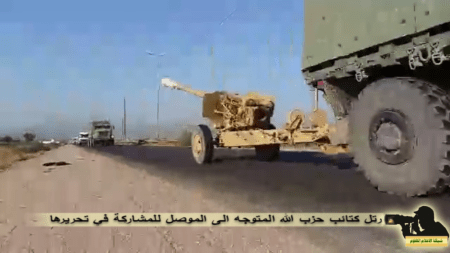
The pro-Iranian Iraqi Shiite drive to capture Tel Afar, 55 km from Mosul in western Iraq, was designed less to complete the encirclement of the Islamists in Mosul – in support of the US-led coalition – and more to forge a link in the land bridge Tehran aspires to build to give its Revolutionary Guards free passage to Hizballah and the Shiite groups fighting for Bashar Assad in Syria. This is reported by DEBKAfile’s military and intelligence sources.

The Iraqi Shiite battle for Afar is led by Iran’s Al Qods chief, Gen. Qassem Soliemani from the front lines.

US and Iraqi commanders of Operation Inherent for expelling ISIS from Mosul welcomed the Iran-led Iraqi Shiites’ initiative to take Tal Afar in order to sever ISIS’ supply lines from Syria to Mosul.

But Iran’s overriding motive in initiating this operation was laid bare by Ahmad al-Asadi, spokesman of the pro-Iranian Iraqi Hashid Shaabi Shiite groups, when he spoke to reporters Saturday, Oct. 29 in Baghdad.

After “clearing” these “terrorist gangs,” from 14,000 sq. km of Iraq including Tal Afar and the regions bordering on Syria, he said, “We are fully ready to cross the border into Syria and fight alongside President Bashar al-Assad.

According to our sources, this plan was not coordinated directly with the US-Iraqi command of the Mosul operation, but with the Russian military command center in the Syrian province of Latakia.

It is important enough for the Russian command to have just established a new center for military and intelligence interchanges. It is staffed by Russian, Turkish, Syrian, Iraqi Shiite and Iranian officers. This mechanism has been put in charge of coordinating Shiite military operations both in Syria and Iraq.

It was decided that when US military assistance or air support is deemed necessary, requests will be piped through the bureau of Iraq’s Shiite Prime Minister Haider al-Abadi and passed on to the US-Iraqi command of Operation Inherent.

Russian, Iranian and Turkish officers have thus effectively hitched on to the decision-making process for the Mosul offensive alongside American officers.

The irony of this arrangement is that, the US armed the Iraqi army, and indirectly the Shiite militias, for this offensive with top-notch Abrams M1 tanks, M1-198 Howitzers and M88 Recovery vehicles for tanks. All this s valuable hardware looks like ending up away another battlefield away from Mosul in Syria, and under a different command, Russia..

Al-Hariri’s Choice Of Hizbullah Ally Aoun For Lebanese Presidency Is Another March 14 Forces Concession To Pro-Iran Axis

October 28, 2016

Al-Hariri’s Choice Of Hizbullah Ally Aoun For Lebanese Presidency Is Another March 14 Forces Concession To Pro-Iran Axis, MEMRI, E.B. Picali and Y. Yehoshua, October 28, 2016

Introduction

On October 31, 2016, the Lebanese parliament will convene and is expected to vote in Free Patriotic Movement leader and Hizbullah ally Michel Aoun as president of Lebanon; he is Hizbullah’s sole candidate. The move follows a deal struck between Aoun and former Lebanese prime minister Sa’d Al-Hariri, leader of the Sunni Al-Mustaqbal stream, under which Aoun, if elected, will assign Al-Hariri the task of forming the next government.

This move by Al-Hariri has significant implications for the intra-Lebanese political arena and for the regional power balance. Therefore it has encountered criticism both within and outside Lebanon. This move represents a surrender by the March 14 Forces, headed by Al-Mustaqbal, to Hizbullah’s will, and reinforces the position of Hizbullah’s patron Iran at the expense of Saudi Arabia.

The following report reviews Al-Hariri’s decision, the reactions it has encountered, and what it means for Lebanon and the region.

Hizbullah Ally Aoun Expected To Be Chosen President

On October 31, 2016, the Lebanese parliament will hold its 46th presidential selection session since Michel Suleiman’s term ended two-and-a-half years ago.  That session is expected to choose Free Patriotic Movement leader Michel Aoun, who is an ally of Hizbullah, as president. Aoun’s selection will end a two-and-a-half-year presidential vacuum that resulted from disagreement over Suleiman’s successor from among the country’s opposing streams – primarily Al-Mustaqbal, led by Sa’d Al-Hariri, and Hizbullah, which together with Aoun stymied the formation of the quorum that is necessary to elect a president. The breakthrough in the talks over the selection of a president came when Al-Hariri and Aoun reached an agreement under which Al-Hariri would support Aoun’s presidential candidacy and in return Aoun would task Al-Hariri with forming the new government, which would be a national unity government as stipulated in the agreement.[1] This constitutes an Al-Hariri surrender to Hizbullah, which sought an Aoun presidency. It should be mentioned that Al-Hariri’s support for an overt Hizbullah ally is not unprecedented; a year ago, Al-Hariri announced his support for another ally of Hizbullah, and of Syrian president Bashar Al-Assad, Suleiman Frangieh, for the post of Lebanese president.[2]

Al-Hariri announced his support for Aoun in an October 20, 2016 speech, saying that by supporting him he was aiming to save Lebanon from dangerous leadership and economic crises which could, in turn, lead to a new civil war.[3]

Two days later, on October 22, Hizbullah secretary-general Hassan Nasrallah announced that his party’s MPs, who had been boycotting presidential selection sessions, as had MPs from other parties including Aoun’s own Change and Reform bloc, would be attending the October 31 session and would be choosing Aoun.  Nasrallah added that Hizbullah had no objections to Al-Hariri’s serving as prime minister in the new government.

These statements by Al-Hariri and Nasrallah pave Aoun’s path to the presidential palace, even though obstacles and uncertainty remain, both in Lebanon and in the region, in this matter.

Various Lebanese Elements Oppose Aoun’s Appointment As President

The opposition to Aoun’s appointment comes mainly from Lebanese parliamentary speaker Nabih Berri, and from Suleiman Frangieh, who is running against Aoun in the presidential race. Both Berri and Frangieh are March 8 Forces members and open Hizbullah allies. Berri even announced that he would not be part of the government that would be established under the Al-Hariri-Aoun deal, and questioned the deal’s future, saying that it had been arrived at by two sides only, without taking into account the country’s main political elements, himself among them. Druze leader and centrist bloc member Walid Jumblatt, who is another major Lebanese political figure, has not yet expressed a position on this matter, but it is thought that he will back Aoun.

On the other side as well, some in Al-Hariri’s Al-Mustaqbal party and in the March 14 Forces in general   oppose this deal. Immediately after Al-Hariri’s October 20 announcement of support for Aoun, another former prime minister, Fouad Al-Siniora, the head of the Al-Mustaqbal party, (a component of Al-Hariri’s broader Al-Mustaqbal stream) announced that he would not join Al-Hariri in backing Aoun for president. Al-Siniora was joined by other party members, including parliamentary vice president Farid Makari, MPs Ahmad Fatfat and Ammar Houri, Telecommunications Minister Boutros Harb of the March 14 Forces, and March 14 Forces secretary-general Fares Souaid.

Along with the opposition to an Aoun presidency within the Al-Mustaqbal party, other Sunni public figures also objected to the deal, among them Justice Minister Ashraf Rifi, former director-general of the Lebanese Internal Security Forces and a former Al-Hariri supporter. Last year, Rifi harshly attacked Al-Hariri for his support for Hizbullah and Syrian regime ally Suleiman Frangieh. On October 22, 2016, two days after Al-Hariri’s announcement of his support for Aoun as president, Rifi organized an anti-Aoun protest in Tripoli called “Proud Tripoli Rejects the Candidate of Iranian Patronage.” The next day, October 23, a convoy of vehicles from Akkar in the north of the country made its way to Rifi’s home in Tripoli bearing posters of him and expressing support for his position on this matter. It should be mentioned that in the past year, Rifi has gradually chipped away at overall Lebanese Sunni support for Al-Hariri, as evidenced by his party’s landslide victory over Al-Hariri’s party in the mayoral elections in Tripoli, the city with the largest Sunni concentration in the country.

Many in the Al-Mustaqbal party, the March 14 Forces, and the Sunni public who oppose the Al-Hariri-Aoun deal see Al-Hariri’s support for Aoun as yet another concession to Hizbullah and the pro-Iran axis that backs it, and to Hizbullah as an armed state within a state.[4] They accuse Al-Hariri, inter alia, of seeking to become prime minister by selling out Sunni interests and the political legacy of his father Rafiq Al-Hariri, whose 2005 assassination, when Syria was the real power in Lebanon, is thought to have been carried out by five senior Hizbullah officials.

Addressing critics of his deal, Al-Hariri explained his support for Aoun as well as his previous support for Frangieh: “I am willing to take the risks a thousand times over, just as I am willing to risk myself, my people, and my political future, to defend Lebanon and its people.”[5]

Al-Hariri’s Choice Of Aoun Is A Political Victory For Hizbullah

Al-Hariri’s move to support the Hizbullah candidate and ally Aoun has major implication for the internal Lebanese political arena. It constitutes another successful attempt by Hizbullah to impose its wishes there and a further weakening of the country’s main Sunni force, the Al-Mustaqbal party. This triumph for Hizbullah comes at a time when it is mostly preoccupied outside of Lebanon’s borders, primarily with fighting alongside the Assad regime in Syria, as well as elsewhere in the Arab world as a proxy of Iran. The organization has fortified its position within Lebanon by virtue of its network of political alliances in the country, as well as by virtue of the quantity of weapons in its possession.

Ibrahim Al-Amin, head of the board of directors of the Lebanese daily Al-Akhbar and a known Hizbullah supporter, argued that the March 14 Forces, including the Al-Mustaqbal stream, show “the symptoms of card-game addicts,” who delude themselves that they can win and are “unwilling to give up” even when it is clear that it is Hizbullah who is actually directing events on the ground.[6]

At the same time, Hizbullah’s success in pushing its own candidate through is also a result of the political weakness of its rivals, particularly the Hariri-led Al-Mustaqbal stream, who wants the premiership at nearly any cost in order to strengthen his own political status in the country and perhaps his economic status as well.

An Aoun presidency does not mean that the issues contributing to the vast schism between the sides in Lebanon will be resolved, among them the disarming of Hizbullah as demanded by the March 14 Forces – Aoun opposes the organization’s disarmament.[7] As president, Hizbullah ally Aoun would be in charge of a number of security and military portfolios, aggravating the tension between the sides and jeopardizing the army’s independence .

Additionally, the Al-Hariri-Aoun deal does not guarantee that Al-Hariri will actually succeed in forming a government, because of the opposition he faces both inside and outside Lebanon. The deal with Aoun could also harm Al-Hariri’s status among his traditional Sunni support base, thus weakening him in the upcoming spring 2017 parliamentary elections.

An Aoun Presidency: Ramifications For The Regional Power Balance – Down With Saudi Arabia, Up With Iran

Since Lebanon’s future depends on the regional political balance, with Iran, Syria, and Saudi Arabia the patrons of various local Lebanese political players, Al-Hariri’s move has regional ramifications. His surrender to Hizbullah’s wishes reflects the strengthening of Iran, which has exploited the Syrian civil war to deepen its penetration of the region and of Lebanon in particular. Electing the Hizbullah presidential candidate Aoun will definitely serve future pro-Iran interests in Lebanon at the expense of Sunni interests in Lebanon, and also at the expense of Saudi Arabia, which views itself as the protector of these interests.

Saudi Arabia has previously backed Al-Hariri’s past substantial political moves even if these moves haven’t always served Saudi political interests in Lebanon or elsewhere. It is still unclear whether his deal with Aoun has Saudi support, and the Lebanese press has published conflicting reports on the matter. As yet, there has been no official Saudi comment on this, but recent articles in the Saudi press indicate a lack of support for Al-Hariri’s deal with Aoun. However, following a lengthy Saudi silence, Saudi Gulf Affairs Minister Thamer Sabhan, who visited Beirut on October 27 said that his country would not intervene in the selection of Lebanon’s president and would support the president chosen by the Lebanese.[8]

There were also reports in the Lebanese press noting that Al-Hariri’s political status in Lebanon is declining, and that the Saudis no longer consider him the sole representative of the Sunnis in Lebanon, but only one such representative.

It should be noted that in previous years, Saudi Arabia, as the leader of the Sunni world, played a key role in the selection of Lebanese presidents, as did Syria, which together with Hizbullah’s patron Iran represented the resistance axis. Al-Hariri’s choosing Aoun for president without full Saudi backing reflects a decline in Saudi influence in Lebanon, and in Saudi Arabia’s regional status in general. In this context, a report in the Lebanese daily Al-Safir, a known supporter of the resistance axis, claims that Egypt was involved in promoting Aoun’s prospects for the presidency.[9] A possible inference from this report is that Egypt is attempting to step into Saudi Arabia’s shoes in Lebanon in an attempt to restore its status in the Arab world, and particularly in the Sunni world.

Articles in the daily Al-Akhbar, known for its pro-Hizbullah line, addressed the regional implications of Al-Hariri’s gambit and gloated that the move reflected Saudi Arabian weakness. Al-Akhbar columnist Ghassan Saoud wrote that an Aoun presidency would be a manifestation of “Hizbullah’s ability to break the international will, and the Saudi will.”[10]

However, Ibrahim Al-Amin wrote in an Al-Akbar editorial that wars in the Arab region created a reality that was forcing the March 14 Forces to see the choice of Lebanese president differently, and that they needed to realize that the Saudis can no longer help them. As he usually does, he concluded his piece with implied threats, stating: “Anyone who does not want anarchy in Lebanon has no alternative but to choose Aoun for president.”[11]


*E. B. Picali is a research fellow at MEMRI; Y. Yehoshua is Vice President for Research And Director of MEMRI Israel


Endntoes:

[1] One of the main political players pushing for an Aoun presidency is Samir Geagea, chairman of the Lebanese Forces. In January 2016, after a long period of talks, Geagea and Aoun, formerly bitter Christian political rivals, agreed that Geagea would support Aoun’s presidential bid. One of the main reasons behind Geagea’s decision to do so was Al-Hariri’s previous support for the presidential candidacy of Suleiman Frangieh – a fierce rival of Geagea who had been accused of killing several members of the Frangieh family during the country’s civil war.

[2] Similarly, in 2008, during another presidential interregnum, the March 14 Forces and Al-Hariri were forced to make concessions to Hizbullah, which was included in the newly formed Fouad Siniora government; this took place at the Doha conference. The most important concession won by the Hizbullah-led March 8 Forces, as stipulated in the government guidelines, was the legitimation of the Resistance (which allowed Hizbullah to operate as an independent armed force within Lebanon). Hizbullah also received enough cabinet seats to veto any government decision, and Hizbullah subsequently used this veto power against Al-Hariri’s government in 2011. Hizbullah obtained these concessions following the leadership vacuum, the lengthy Hizbullah siege on central Beirut, and the violent events of May 7, 2008.

[3] Al-Mustaqbal (Lebanon), October 21, 2016.

[4] See MEMRI Inquiry & Analysis Series Report No. 1092, Al-Mustaqbal Losing Ground As Representative Of Lebanese Sunnis, May 19, 2014.

[5] Al-Mustaqbal (Lebanon), October 21, 2016.

[6] Al-Akhbar (Lebanon), October 24, 2016.

[7] In an interview with Al-Akhbar, Lebanese Foreign Minister Gebran Bassil, who is Aoun’s son-in-law and heads the Change and Reform bloc founded by Aoun, said that Free Patriotic Movement, to which the Change and Reform bloc belongs, supports Hizbullah’s retention of its weapons. Al-Akhbar(Lebanon), October 22, 2016.

[8] Al-Watan (Saudi Arabia), October 28, 2016.

[9] Al-Safir (Lebanon), October 25, 2016.

[10] Al-Akhbar (Lebanon), October 27, 2016.

[11] Al-Akhbar (Lebanon), October 24, 2016.

Pro-Iranian Shiites ready to lead Mosul operation

October 28, 2016

Pro-Iranian Shiites ready to lead Mosul operation, DEBKAfile, October 28, 2016

1-5

The US-led coalition offensive for liberating Mosul from ISIS suffered two ominous downturns on its 10th day

Friday, Oct. 28, DEBKAfile’s military sources report. One: Pro-Iranian Iraqi Shiites stand ready to assume a lead role, sparking the threat of sectarian violence in the mainly Sunni city; and, two, the Islamic State is poised to launch surface missiles with a range of 500km against Baghdad, as well as Jordan and Israel.

Friday, a spokesman for the Iraqi Shiite paramilitary groups the Bader Brigades and the Population Mobilization Force announced that their advance toward the Islamic State-held town of Tal Afar, about 55 km west of Mosul, was imminent.

These militias are fighting under the command of the Iranian Al Qods chief, Gen. Qasem Soleimani, who takes his orders from Tehran.

The capture of Tal Afar – a mix of Sunni and Shiite ethnic Turkmen until the Islamic State’s takeover two years ago – would cut off ISIS-held Mosul from Syria.

Turkey, Iraq’s northern neighbor, and the Kurds are seriously alarmed by the Shiite groups’ initiative.

The Shiites, who are not part of the main coalition fighting body preparing to storm Mosul, are about to strike ISIS from the north.

DEBKAfile’s military sources note that coalition commanders erred by not taking Tal Afar in the early stage of the Mosul offensive and so blocking ISIS supply lines.

The offensive was hobbled two days day earlier by the Kurdish decision to withdraw Peshmerga fighters from the operation to retake Mosul. President Masoud Barzani of the autonomous Kurdish Regional Government stated Wednesday, Oct. 26, that his army had ended its role in the warfare, after cleansing dozens of mostly uninhabited villages on the road to Mosul, and did not intend to enter the city at this time.

This decision by the KRG in Irbil was not published.

Since the Kurds and the Shiite militias are out of it, who is left to finish the job and go into Mosul?

The mission which started out as a grand coalition enterprise has been left now to US forces and the Iraqi army.

However, Iraq’s elite 9th Golden Division and its federal anti-terror police unit have not made much headway in their advance against ISIS forces east of Mosul. Their commanders now warn the government in Baghdad that they can’t go any further without reinforcements.

But there are no Iraqi military reserves to draw on, without stripping any more main Iraqi towns of their defenses and laying them open to Islamists assaults, like those ISIS staged successfully last week on the oil city of Kirkuk, the Kurdish town of Sinjar and Rutba near the Jordanian border.

The long and short of it is that the Mosul offensive has virtually ground to a halt.

ISIS meanwhile is compounding its atrocities and gearing up for escalation.

1. The UN Human Rights agency reported Friday that, since the Mosul offensive began on Oct. 17, Islamic State forces in Iraq have abducted tens of thousands of men, women and children from areas around Mosul and are using them as “human shields” in the city as Iraqi government troops advance.

They shot dead at least 232 people on Wednesday, including 190 former Iraqi troops and 42 civilians when they refused to obey their orders.

2.  ISIS has plans to use chemical weapons against the coalition forces advancing any further towards Mosul.

3.  Following their raids on key Iraqi cities, the Islamist State is preparing to launch surface missiles against Baghdad.

4. ISIS may not confine its missile attacks to targets in Iraq. Our military sources report that the jihadists have laid hands on Syrian and Iraqi ground-to-ground missiles with a range of 500km and are holding them ready for attacks on Iraq’s neighbors, which could be Jordan. Israel too is in their sights.