Archive for the ‘Iranian Revolutionary Guard’ category

Tehran Relies on Propaganda to Make up For Misallocation of Funds to Foreign Conflicts

March 10, 2017

Tehran Relies on Propaganda to Make up For Misallocation of Funds to Foreign Conflicts, Iran News Update, March 10, 2017

(Please see also, Time to Call Iran’s Revolutionary Guards What They Are: Terrorists. — DM)
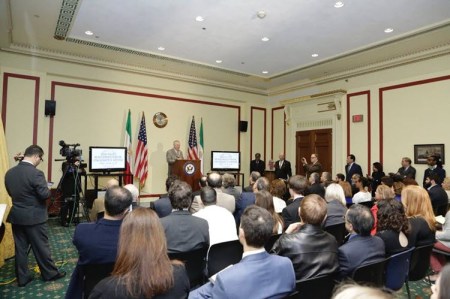
[R]ecently released intelligence strongly suggests that the supreme leader and hardline authorities like the Islamic Revolutionary Guard Corps bear a great deal of responsibility for the economic struggles of Iranian citizens, as a result of the systematic misappropriation both of budgetary funds and financial resources earned through Iran’s private sector. On Wednesday, the National Council of Resistance of Iran held a panel discussion coinciding with the release of an e-book titled, The Rise of the Revolutionary Guards’ Financial Empire.

In both the discussion and the document, the leading Iranian opposition group explained that a recent push toward widespread privatization of the Iranian economy has actually resulted in the private acquisition of more than half of the country’s gross domestic product by front companies and other affiliates of the IRGC and the supreme leader himself.

********************

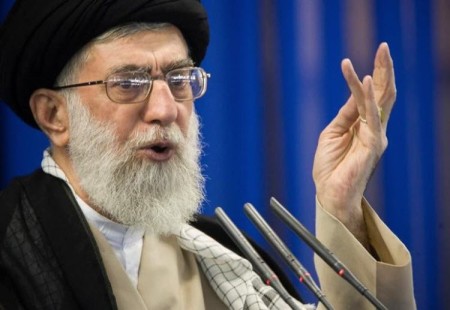
On Friday, Reuters picked up on reporting in Iranian state media which noted that Supreme Leader Ali Khamenei had once again voiced criticism of President Hassan Rouhani’s handling of the nation’s economy following the nuclear agreement that went into effect at the beginning of last year. The supreme leader’s remarks appeared to specifically highlight the ongoing struggles of the Iranian people, who are experiencing poverty at a rate of at least nine percent and likely much higher.

“Of course the government has taken remarkable steps but if the resistance economy had been implemented fully and widely, we could witness a tangible difference in people’s lives,” Khamenei was quoted as saying. In previous months, he had already called for the renewal of his own “resistance economy” plan, which involves domestic development aimed at making the nation more capable of weather the storm of international economic sanctions, as distinguished from Rouhani’s plan of reaching out to Western powers in order to alleviate those sanctions.

Khamenei’s recommendations thus serve a dual purpose. In the first place, they further undermine the prospects for further rapprochement between the Islamic Republic and the West. And secondly, they defray blame for economic woes away from the supreme leader’s office and its hardline affiliates, putting it instead onto the Rouhani administration, which faces a contentious reelection bid in May.

But recently released intelligence strongly suggests that the supreme leader and hardline authorities like the Islamic Revolutionary Guard Corps bear a great deal of responsibility for the economic struggles of Iranian citizens, as a result of the systematic misappropriation both of budgetary funds and financial resources earned through Iran’s private sector. On Wednesday, the National Council of Resistance of Iran held a panel discussion coinciding with the release of an e-book titled, The Rise of the Revolutionary Guards’ Financial Empire.

In both the discussion and the document, the leading Iranian opposition group explained that a recent push toward widespread privatization of the Iranian economy has actually resulted in the private acquisition of more than half of the country’s gross domestic product by front companies and other affiliates of the IRGC and the supreme leader himself.

The Washington Times reported upon some of the findings presented in that document, emphasizing the fact that the regime is using these privately acquired assets to channel billions of dollars into regional terrorism, paramilitary activities, and weapons development. The article notes that the intelligence gathered by the People’s Mojahedin Organization of Iran found that approximately 100 billion dollars was being spent annually just on salaries for militant fighters in the Syrian Civil War.

The Washington Times credits the NCRI with presenting a clear warning to Western businesses and policymakers. And the document itself says, “Foreign investors cannot in practical terms avoid entanglement by affiliation in the Iranian regime’s behavior, including its support for terrorism, continued aggressive policies towards regional countries, manufacture and testing of ballistic missiles, and systematic egregious human rights violations inside Iran.”

To critics of Iran’s clerical regime, this entanglement is worrying in its own right because of Tehran’s traditional behavior. And it is made more worrying by the fact that the above-mentioned ballistic missile program is being used alongside other types of weapons as a tool of explicit anti-Western propaganda.

This fact was highlighted once again on Friday when the Associated Press reported that General Amir Ali Hajizadeh, the head of the IRGC’s aerospace division, had boasted of the successful testing of another ballistic missile. The launch was aimed at naval targets and took place amidst three days of large-scale training exercises by the Iranian Navy, which is separate from the naval forces of the IRGC.

The IRGC conducted its own naval operations the previous week, and both demonstrations were accompanied by boastful rhetoric about readiness for war with proclaimed enemies including the United States. In a separate example of the same propaganda trends, Iran also premiered an animated film depicting a military officer modeled after IRGC Quds Force commander Qassem Suleimani leading a small number of Iranian vessels in destroying a much larger American fleet.

In January, the IRGC conducted the test launch of a nuclear-capable ballistic missile barely a week after the inauguration of US President Donald Trump. Such tests take place in defiance of a UN Security Council resolution calling on Iran to refrain from work on weapons that could carry a nuclear warhead, but a half dozen other such launches had been carried out before Trump was inaugurated but after the conclusion of nuclear negotiations between Iran and the five permanent members of the Security Council plus Germany.

The January incident was apparently the immediate impetus for a statement by the Trump administration putting Iran on notice over its provocative behavior. But various observers including US Navy officers have declared that that behavior remains unchanged, and that the IRGC continues to act unprofessionally and confrontationally in the region. Last weekend, for instance, several fast-attack vessels belonging to the IRGC positioned themselves about 600 yards away from a US Navy surveillance ship and three British vessels, compelling them to change course.

The AP reported on Friday that Iranian officials had since made exactly the opposite claim about the incident: that the American and British vessels had changed course specifically to approach the Iranian boats. But considering that this is at odds with the accounts of various other Iranian-initiated close-encounters, it seems to suggest an effort on Tehran’s part to justify its missile tests and defiant rhetoric, by suggesting that the US is the more aggressive party.

Assuming that this particular Iranian claim is indeed a deceptive one, it is certainly not the only one of its kind. The ongoing propaganda campaign also appears to involve an effort to present Iran as being much better positioned than it is for global conflict. This is suggested by the aforementioned film and the statements accompanying military demonstrations and missile tests. But the tendency is perhaps much more clearly on display in allegedly false Iranian claims of advanced weapons development.

The National Interest recently pointed to this phenomenon as it concerns the Qaher F-313 fighter jet, which is supposedly equivalent to an American F-35 stealth fighter, and which Iranian Defense Minister Hossein Dehqan claimed was ready for operational testing. In fact, independent analyses of photographs of the craft are broadly in agreement that it is merely a non-functional mockup, and a poorly structured one, at that.

Similar claims have been made about other Iranian weapons and equipment, including drones supposedly cloned from captured American technology. Other military hardware unveiled by the Iranian Army and the Revolutionary Guards has been shown to be little more than outmoded technology affixed with purely cosmetic upgrades. But to the extent that the regime is able to use its tightly controlled state media to present these so-called developments to a domestic audience, it may evoke a more war-ready image of Iran than is defensible in reality.

What’s more, this messaging dovetails with Supreme Leader Khamenei’s statements on the Iranian economy, insofar as it suggests Iran is capable of greater-than-expected domestic military development, while also concealing the fact that much of the country’s military allotment is being spent in foreign territory like Syria and Yemen instead of on advanced domestic development, whether military or civilian.

 

Time to Call Iran’s Revolutionary Guards What They Are: Terrorists

March 10, 2017

Time to Call Iran’s Revolutionary Guards What They Are: Terrorists, American ThinkerReza Shafiee, March 10, 2017

What is missing in all the talks and arguments made in Washington as to what is an effective remedy to counter the mullahs in Iran is the role of Iranian people. Iran is boiling with popular discontent, now. According to Brigadier General Hossein Ashtari, the Iranian regime’s chief of police: “On average 20 to 30 protest gatherings take place around the country by citizens who have lost their life savings to the banks,” These citizens are mainly retired with very limited savings and were scammed out of their lifetime savings by various government-owned financial institutions.  Such protests are but a drop in the ocean when we add the teachers, nurses, factory workers, and an army of college graduates with no prospects of finding decent jobs to the discontent. This amounts to tens of thousands of people, in large numbers of gatherings each year. According to a BBC report, more than 11 million or Iran’s 83 million people are unemployed in the country.

*********************************

Ever since signs emerged that Trump administration is considering a long-overdue classification of Iran’s Islamic Revolutionary Guard Corps (IRGC) as a terrorist organization, the ruling mullahs have gone to work. They put into place a well-known strategy of intimidation and deception aboard, coupled with an absolute iron fist at home. They do this because they know the value of controlling a terrorist organization. The problem is in the harm it means for everyone else.

In the past, the Supreme Leader, Ayatollah Ali Khomeini, would brandish the former by reminding Western governments that if they chose to cross Tehran then they must be prepared to pay dearly. But that was decades ago. One fact is undisputable now: The Iranian regime has long passed its prime revolutionary and glory days when Khomeini rode in on the tides of millions who were sadly unaware of what was to come. In those days, people tasted a short-lived period of high expectations, at the time wildly called “spring of freedom.”

At the same time, hostage-taking by IRGC’s protégés, such as nascent Lebanese Hezbollah, of foreign nationals, preferably Americans, was routine. The ayatollahs were behind it even though it often took place in Lebanon. After each kidnapping, IRGC’s proteges then engaged hostages’ governments in a lengthy and humiliating process of hostage negotiations and sometimes hostage swaps in the 1980s.

Today the IRGC has made it much more convenient to reach the same ends by taking the hostages among dual citizens who take the risk of traveling to Iran. Case in point was hostages released just after Iranian regime struck the nuclear deal with the U.S. and five other world powers. IRGC’s deputy chief, Brigadier General Hossein Nejat, in a speech in Bushehr (south of Iran), said: “The Iranian-American journalist of the Washington Post, Jason Rezaian, who had formed an espionage network was identified and arrested by the IRGC.”

Hossein Nejat stated: “The former Secretary of State, John Kerry with his intelligence forces urged the Iranian Foreign Minister, Mohammad Javad Zarif to release Jason Rezaian. Consequently, the U.S. government in return paid 1 billion and 400 million dollars ransom to Iran for the release of Jason Rezaian.”

Other IRGC officials, on different occasions after the hostages were released, have bragged that the Obama administration released Iranian prisoners in the United States and on top of that paid a hefty sum as ransom money.

In past few weeks, despite attempts by regime officials, such as Zarif, to keep a low profile while anxiously monitoring Donald Trump’s every move, IRGC is actively scheming. It raised the prize on Salman Rushdie’s head, showcased and glorified old terrorists such as Anis-Alnaghash on state-run television and openly threatened the U.S.

CNC News revealed on Feb. 28 that an IRGC strategist, Hassan Abbasi renewed threats that the force has planned to unleash terror cells on U.S. soil. He has elaborated plans to sabotage nuclear plants in the United States among other things. Ironically, at the same time, IRGC has claimed that it is fighting terrorism in neighboring countries.

Javad Zarif has recently said: “the world at large agrees that the IRGC has extended the utmost support for neighboring countries in their fight against terrorism.”

Zarif seemingly refers to IRGC’s destructive and brutal role in Syria and is trying to sell it as constrictive. According to IRGC’s own figures, more than 1,000 members of its rank and file have been killed in cities around the war-torn country.  Many were veteran IRGC officers. The Iranian regime claims that it has only an advisory role in Syria, however it has recruited and dispatched thousands of Afghani and Pakistani nationals to Syrian fronts. Not one has fought ISIS.

On March 2, Brigadier General Ismail Ghaani, who is deputy Quds Force commander, speaking in the northeastern city of Mashhad, told a group from the Fatemiyoun Division, an offshoot of the force fighting in Syria: “Fatemiyoun proved that it is a capable force ready to operate not only in Syria but anywhere else on the planet when Islam requires it.” Fatemiyoun was formed of Afghani recruits, along with its sibling organization Zenabiyoun Division of Pakistanis.

The Iranian regime today makes it no secret that it is heavily involved in Syria and Iraq. It sugarcoats its involvement with the illusion that IRGC and its armed wing, the Quds Force, are fighting ISIS. But it’s not true. After almost six years of involvement in the bloody civil war in Syria, it is out in the open that the regime has no quarrel with ISIS. Former Secretary of State John Kerry said in an interview with Fox News: “Assad facilitated the release of 1,500 prisoners, parallel to 1,000 by Maliki in Iraq, leading to the foundation of ISIS.”  Former U.S. ambassador to Iraq, James Jeffrey, said that Americans knew what Prime Minister Maliki was up to, but chose not to take any action.

It is also a hard fact that Maliki was in every way a puppet of the Iranian regime. He was trained by the IRGC and fought alongside its forces during the 1980-1988 Iran-Iraq war.

What is missing in all the talks and arguments made in Washington as to what is an effective remedy to counter the mullahs in Iran is the role of Iranian people. Iran is boiling with popular discontent, now. According to Brigadier General Hossein Ashtari, the Iranian regime’s chief of police: “On average 20 to 30 protest gatherings take place around the country by citizens who have lost their life savings to the banks,” These citizens are mainly retired with very limited savings and were scammed out of their lifetime savings by various government-owned financial institutions.  Such protests are but a drop in the ocean when we add the teachers, nurses, factory workers, and an army of college graduates with no prospects of finding decent jobs to the discontent. This amounts to tens of thousands of people, in large numbers of gatherings each year. According to a BBC report, more than 11 million or Iran’s 83 million people are unemployed in the country.

When it comes to Iran, the decision-makers in Washington have two options: One is to follow the status quo and tolerate a regime which is the number one state sponsor of terrorism in the world, a stirrer of sectarian violence in the region, and engaged in two wars in Iraq and Syria. It’s a nation that secretly supplies weapons to Yemen’s Houthis which has also cost American servicemen’s lives. If the Trump administration chooses this option, it will make the same mistakes the Obama administration made.

The other, and better, option is to stand with Iranian people and their resistance, to let them shape their own future. All they asked of U.S. in 2009 was for the U.S. to stand with them. At the time, they chanted: “Obama are you with us or with them.” They clearly hoped the U.S. would not placate mullahs with concessions, nor turn a blind eye to regime’s terrorism.

One such good signal in the right direction would be to designate IRGC as a terrorist organization.  In light of all it has done and its growing strength, in designating the IRGC as a terrorist group, we are doing ourselves a favor.

Reza Shafiee is a member of Foreign Affairs Committee of the National Council of Resistance of Iran (NCRI) 

Iran’s latest terrorist plots

March 9, 2017

Iran’s latest terrorist plots, American ThinkerHeshmat Alavi, March 9, 2017

Iran is continuing its blatant belligerence against the international community, especially the Middle East, despite President Donald Trump and his administration threatening to take major action. During the past month alone Iran has test launched a number of ballistic missiles enjoying the capability of delivering a nuclear payload. This includes last weekend’s pair of ballistic missile launches.

Knowing its military capabilities are outdated and limited, Iran is resorting to a range of different terrorist measures in an attempt to maintain the leverage gained through the preposterous concessions they enjoyed during the Obama years.

The most recent scenario involves fast-attack vessels approaching a U.S. Navy surveillance ship in the Strait of Hormuz in a threatening manner described as “unsafe and unprofessional” in a recent statement.

Iran’s Revolutionary Guards, under major discussion in Washington to be designated as a foreign terrorist organization, has suffered a major blow after the discovery of a terrorist network in Bahrain. This unveils, yet again, further aspects of Iran’s unbridled meddling in the region.

The IRGC Bahrain network consists of 54 members focusing on planning and executing terrorist plots. To date, 25 such individuals have been arrested. These individuals were coordinating with Tehran to assassinate, terrorize, and target Bahrain security forces.

Following their raids, Bahrain authorities announced a significant cache of arms, explosives, and ammunition were also confiscated.

All individuals are reportedly Bahrain natives, further indicating the sophistication of Iran’s blueprints in using locals for such plots. Following their arrest, it was revealed the cells received support from both Iran and Lebanon, procuring arms or coordinates where such logistics were hidden. In the past weeks Bahrain witnessed two bomb blasts killing and injuring civilians, and most specifically, Shiite Muslims. This can be assumed as an attempt to instigate Shiite dissent in the small Gulf island.

It is crystal clear how the IRGC commanded this proxy group, as the individual calling the shots is currently in Iran. Other members of this group are even stationed in Iraq and directly involved in the attacks carried out in Bahrain.

Iran also has intentions to increase its use of suicidal drone boats in Yemen through the Houthi militias. The U.S. Navy command issued a recent warning over this threat against ships in the Red Sea. This warning follows a recent revelation of the Houthis obtaining drone boats in their attack against a Saudi Navy frigate.

Vice Adm. Kevin Donegan, commander of the Bahrain-based U.S. Fifth Fleet and head of U.S. Naval Forces Central Command, accused Iran of supporting the Houthis in preparing such boats.

This new development can pose a major threat to shipping lines in strategic naval routes, Donegan said in an interview with Defense News, adding that terrorist groups can now obtain such lethal boats.

It is worth noting that the attack on the Saudi frigate Al-Madinah on January 30th was carried out with a remote-controlled drone suicide boat packed with explosives. This was the first such attack resembling actual suicide attacks in the past.

The U.S. has recently issued a warning that the Iran-backed Houthis and forces loyal to former Yemeni president Ali Abdullah Salah are placing underwater mines in the Bab-el-Mandeb Strait passage near the entrance of Port Mokha.

The Bab-el-Mandeb Strait, narrowing to 25 kilometers in width at some points, is of grave importance for global shipping lines, providing access to the Red Sea, the Suez Canal, and the Mediterranean Sea. Much of the world’s oil and other goods are transferred through these very strategic waterways.

More than 60 ships containing commercial goods pass through the Bab-el-Mandeb Strait each day, carrying around 3.3 million barrels of crude oil. The U.S. Navy’s warning indicates the closing of such a crucial water passage can lead to major financial costs and a significant rise in global oil prices.

Further reports also indicate that Iran is having a tough time digesting a series of defeats suffered by the Houthis in Yemen. In response, Iran is weighing the possibility of dispatching Shiite militias from Iraq to Yemen, according to Khalij Online. As the fighting has decreased in Iraq, Tehran may dispatch units of the 140,000-strong Popular Mobilization Front, consisting of 54 different sectarian militia groups, to Yemen.

In an international scene undergoing drastic changes, all of them threatening Iran’s short and long-term interests, the mullahs in Tehran are desperately searching for a method to both keep a straight face and maintain their previous leverage across the Middle East.

Such developments gain even more importance as we inch closer to Iran’s presidential elections in May, when the regime in its entirety will face a major test.

Iran in Crisis

March 5, 2017

Iran in Crisis, American ThinkerHeshmat Alavi, March 5, 2017

(Please see also, Mullahs’ Nightmare: Huge Demonstration Breaks Out In Tehran. — DM)

Forecasting what lies ahead is truly impossible, making Khamenei and his entire regime extremely concerned, trekking this path very carefully and with a low profile. As we witnessed with the inauguration of Ronald Reagan, Iran immediately released the 52 hostages held for 444 days.

This regime understands the language of force very carefully. And yet, there is no need to use military force to inflict a significant blow and make Tehran understand the international community means business. Blacklisting Iran’s IRGC as a terrorist organization by the U.S. at this timing would be the nail in the coffin for the mullahs.

********************************

The recent dust storms that wreaked havoc in southwest Iran signaled only one of the many crises the mullahs are facing less than three months before critical elections. Tehran has been hit with severe blows during the Munich Security Conference, contrasting interests with Russia, the recent escalating row with Turkey, and most importantly, a new U.S. administration in Washington.

These crises have crippling effects on the mullahs’ apparatus, especially at a time when Iranian Supreme Leader Ali Khamenei sees his regime facing a changing balance of power in the international community, and is faced with a major decision of selecting the regime’s so-called president.

Iran and Ahvaz

The dust storms crisis in Ahwaz, resulting from the mullahs’ own destructive desertification policies, caused severe disruptions in water and power services and people pouring into the streets in major protests.

The regime, and especially the Revolutionary Guards (IRGC), has for decades pursued a desertification policy of constructing dams, drying lagoons, digging deep oil wells beneath underground water sources with resulting catastrophic environmental disasters. Various estimates indicate the continuation of such a trend will literally transform two-thirds of Iran into desert lands in the next decade. This will place 14 to 15 million people at the mercy not only dust storms but also salt storms.

Iran and the Munich Security Conference

Iranian Foreign Minister Mohammad Javad Zarif attended this conference with a series of objectives in mind, only to face a completely unexpected scene. U.S. Vice President Mike Pence described Iran as the world’s leading state sponsor of terrorism. Saudi Arabia Foreign Minister Adel al-Jubeir said the mullahs are the source of threats and instability throughout the Middle East. Turkey went one step further and said Tehran is the heart of sectarianism and spreads such plots across the region, and all traces in Syria lead to Iran’s terrorism and sectarian measures.

This resembles a vast international coalition against Tehran, inflicting yet another blow to the mullahs following a new administration taking control of the White House. These developments are very costly for Khamenei and the entire regime.

In comparison to the early 2000s when the U.S. launched wars against Afghanistan and Iraq, Iran was the main benefactor. The current balance of power now is quite different, as seen in Munich. While there is talk of an Arab NATO, any coalition formed now in the Middle East will be completely against Iran’s interests.

Iran and Russia

Following a disastrous joint campaign in Syria, for the first time Russia is reportedly supporting a safe zone in Syria. Russian Deputy Foreign Minister Mikhail Bogdanov said contacts have been made with the Syrian regime to establish safe zones in Syria. These are the first remarks made by any Russian official on the issue of safe zones in Syria.

Moscow’s increasing contrast in interest with Iran over Syria has the potential of playing a major role in regional relations. Russia certainly doesn’t consider Bashar Assad remaining in power as a red line, a viewpoint far different from that of Iran. Moscow is also ready to sacrifice its interests in Syria in a larger and more suitable bargain with the Trump administration over far more important global interests.

Iran and Turkey

Yes, Ankara and Tehran enjoy a vast economic partnership. However, recent shifts in geopolitical realities have led to significant tensions. Turkish President Recep Tayyip Erdogan accused the mullahs of resorting to “Persian nationalism” in an effort to split Iraq and Syria.

Turkish Foreign Minister Mevlut Cavusoglu accused Iran of seeking to undermine Bahrain and Saudi Arabia as part of Tehran’s “sectarian policy.” Cavusoglu used his speech in Munich to say, “Iran is trying to create two Shia states in Syria and Iraq. This is very dangerous. It must be stopped.”

Tehran considers Ankara’s soldiers in Iraq and Syria as a major obstacle in its effort to expand its regional influence.

U.S. president Donald Trump’s strong approach vis-à-vis Iran and the possibility of him supporting the establishment of a Turkish-administered northern Syria safe zone may have also played a major part in fuming bilateral tensions between these two Middle East powers.

Erdogan has obviously realized completely the new White House in Washington intends to adopt a much more aggressive stance against Tehran. This is another sign of changing tides brewing troubles for Iran’s mullahs.

Iran and Presidential Elections

With new reports about his ailing health, Khamenei is extremely concerned about his predecessor. One such signal is the candidacy of Ibrahim Reisi, current head of the colossal Astan Quds Razavi political empire and a staunch loyalist to Khamenei’s faction, for the presidency. With former Iranian president Ali Akbar Hashemi Rafsanjani out of the picture, Khamenei may seek to seal his legacy by placing Reisi against Iranian president Hassan Rouhani in the upcoming May elections.

This is literally Khamenei playing with fire, as Reisi is considered a hardline figure and such an appointment may spark 2009-like protests across the country, as the country has become a scene of massive social challenges. Rouhani himself doesn’t enjoy any social base support, especially after four years of lies and nearly 3,000 executions.

Final Thoughts

This places the entire regime in a very fragile situation. From the internal crises of Ahwaz, the upcoming elections and the formation of a significant international front threatening the Iranian regime’s strategic interests.

Forecasting what lies ahead is truly impossible, making Khamenei and his entire regime extremely concerned, trekking this path very carefully and with a low profile. As we witnessed with the inauguration of Ronald Reagan, Iran immediately released the 52 hostages held for 444 days.

This regime understands the language of force very carefully. And yet, there is no need to use military force to inflict a significant blow and make Tehran understand the international community means business. Blacklisting Iran’s IRGC as a terrorist organization by the U.S. at this timing would be the nail in the coffin for the mullahs.


Why the US Should Target Iran’s Revolutionary Guards

February 14, 2017

Why the US Should Target Iran’s Revolutionary Guards, AlgemeinerHeshmat Alavi, February 13, 2017

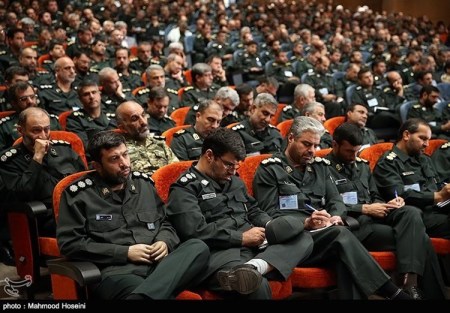
iranian-revolutionary-guard-in-2012-military-parade-in-tehran-wikipediaMembers of the Iranian Revolutionary Guard Corps. Photo: Wikipedia.

The Trump administration is now facing a very important opportunity to deliver the message that the mullahs deserve to hear. In so doing, it will be on the right side of history where supporting the Iranian people’s struggle for freedom and democracy through peaceful regime change is concerned.

****************************

The possibility of the Trump White House blacklisting Iran’s Islamic Revolutionary Guard Corps (IRGC) as a foreign terrorist organization (FTO) is causing enormous tension in Tehran, as the regime understands the political, economic — and, perhaps most importantly — geopolitical consequences of such a move.

An Iranian opposition group has scheduled a Tuesday press conference to provide new information about the IRGC Quds Force “command headquarters for terrorist training of foreign mercenaries and a number of overt and covert training centers” across Iran, according to the online statement.

The IRGC was established supposedly to safeguard the “Islamic Revolution.” The FTO designation of this enormously important Tehran entity would further toughen US President Donald Trump’s push on Iran.

The IRGC is in full control of the mullahs’ cherished ballistic missile program, used especially to lift morale within the regime’s dwindling and highly fragile social base.

Washington has considered Tehran a state sponsor of terrorism since 1984, as the regime has continuously armed, trained and financed a conglomerate of terrorist groups in the Middle East — mainly Hezbollah in Lebanon, Shiite militias in Syria and Iraq and the Houthis in Yemen.

Designating the IRGC, an official armed force, rather than another militia group, would be unprecedented. It would send a signal to Iran that the new US administration is targeting the very core of its apparatus — one that also enjoys significant leverage over its economy.

The IRGC is the leading force behind Iran’s nuclear programballistic missile driveinvolvement in Syria and other states and atrocious domestic human rights violations. The FTO designation would ban any economic transactions and relations with IRGC-affiliated companies, thereby significantly curbing its access to the revenue needed to pursue all the above-mentioned ambitions.

There are already signs of increasing concerns in this regard having a considerable effect.

The France-based international oil and gas French company Total has hinged its plans for a $2 billion project in Iran in the summer on US sanctions waivers, which now seem unlikely, to say the least, with the Trump administration imposing a major policy overhaul.

Companies across the world are already described as wary about doing business with Iran. The FTO designation would bring an end to all the leeway provided for foreign businesses to enjoy working with entities that may be connected with the IRGC.

And while some argue that an FTO designation for the IRGC would result in Iran’s abandoning ship on the nuclear deal reached with the P5+1 in July 2015, they are absolutely wrong. Tehran needs the accord more than any other party, as crippling international sanctions were taking their toll on its economy. And rest assured that Iranian Supreme Leader Ali Khamenei would never have blessed such a pact were better options available.

The Iranian opposition has a history of shedding important light on the IRGC’s destructive roles, and calling for necessary action in this regard.

Iran’s “nuclear and missile program is against the Iranian people’s interest and must be stopped,” Maryam Rajavi, president of the National Council of Resistance of Iran (NCRIsaid recently.

The NCRI has welcomed the Trump administration’s recent round of sanctions against Tehran and earlier proposed measures aimed at “banning all deals and trade with IRGC-affiliated companies.”

The Trump administration is now facing a very important opportunity to deliver the message that the mullahs deserve to hear. In so doing, it will be on the right side of history where supporting the Iranian people’s struggle for freedom and democracy through peaceful regime change is concerned.

Israel’s inaction in Syria may open Golan to Iran

February 7, 2017

Israel’s inaction in Syria may open Golan to Iran, DEBKAfile, February 6, 2017

jordanisraelsyria480en

Prime Minister Binyamin Netanyahu has given “diplomatic priority” to stressing the perils posed by Iranian-sponsored terrorism and its nuclear-capable ballistic weapons, and placed them at the top of his talks with British premier Theresa May in London Monday, Feb. 6, and with President Donald Trump in Washington on Feb. 15.

But it stands to reason that their national security and intelligence experts have advised the US president and the British premier that Netanyahu has been firmly advised up to the present day to stay clear of military involvement in the Syrian conflict by the IDF high command and his past and present defense ministers, Avigdor Lieberman and Moshe Ya’alon.

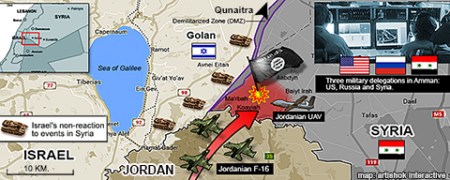
Israel therefore stands to be excluded from the practical deliberations ongoing for Syria’s future. Jordan in contrast has stepped forward as the key Middle East player in the pacts and military understandings shaping up between the US, Russia and Turkey for throwing Iran out of Syria.

Jordan’s King Abdullah swallowed his pride and took the initiative of flying to Washington last Thursday, Feb. 2, to buttonhole President Trump. From their brief conversation, he became the first Middle East ruler to win a green light from the US for an air strike against the ISIS ally, the Khalid Ibn al-Walid Army, which occupies the triangle formed by the Syrian, Jordanian and Israeli borders. Israel has never attacked this force in the five years since it moved into that part of southern Syria.

DEBKAfile”s military and intelligence sources disclose that Abdullah informed Trump that the air strike would take place under the supervision of the US, Russian and Syrian commands, making it the first instance of US-Russian support for a Middle East army’s action against ISIS in Syria.

And so, on Saturday, Feb. 4, six Royal Jordanian Air Force F-15 fighters and five drones bombed seven Khalid Ibn al-Walid positions. This air strike most probably heralded more bombardments to come. Jordanian commando units are also likely to mount raids, in concert with the Syrian rebel militias they have trained, to seize the ground occupied by ISIS’ offshoot.

And on the diplomatic front, the US President authorized Jordan’s attendance at the Syrian peace talks that are ongoing under Russian sponsorship at the Kazakh capital of Astana. The Jordanian delegation was deputized to act on America’s behalf to monitor the process for determining the future of Syria.

This move came a week after the British prime minister was urged by Trump to fly straight to Ankara after their talks in Washington in search of a military collaboration deal for Syria between the UK and Turkey.

The onset of Jordan’s military action in Syria has pumped up to seven the number of foreign armies involved in that country’s conflict: Russia, Iranian Revolutionary Guards, pro-Iranian Shiite militias from Iraq, Afghanistan and Pakistan, the Lebanese Hizballah, US forces, the Turkish Army and now Jordan.

Synchronously with the Jordanian air strike in southern Syria, President Bashar Assad announced that its launch makes it possible for Syrian civilians who fled from the Islamists to start returning to their homes, starting with the Quneitra region of the Syrian Golan. He was talking about 30,000 refugees.

It is obvious to anyone familiar with the Syrian scene that this population shift is an open invitation for thousands of Iranian Revolutionary Guards Corps members and Hizballah terrorists to take the opportunity of stealing into the Golan, in the guise of returning refugees.

Israel, aside from providing an intelligence service on Syria to coalition forces, finds itself left out of any say in the currently evolving peace process. While ISIS may be rooted out of this border area at some point, the Netanyahu government’s military inaction risks exposing the Golan to another attempted incursion by Iranian and Hizballah forces by covert means.

The diplomatic prioritization of the Iranian threat, coupled with talks with US president Trump and deals with Russian President Putin, amount to a policy that has gone bankrupt for Netanyahu and his security chiefs. The powers who will determine what happens next in Syria are bound by military cooperation and action. Because Netanyahu’s rhetoric about the perils posed by Iran is not backed by military action, Israel has no influence on coming events, and faces the very real risk of being faced with an Iranian presence on its northern doorstep.

Guest Column: Washington Finally Designates Iran’s Revolutionary Guard Corps

February 4, 2017

Guest Column: Washington Finally Designates Iran’s Revolutionary Guard Corps, Investigative Project on Terrorism, Raymond Tanter and Edward Stafford, February 3, 2017

1962

The U.S. Treasury Department announced sanctions Friday on a host of Iranian companies and individuals as terrorists. It is a welcome development, which hopefully sends a signal to Tehran to rein in its global terror support, ballistic missile testing, and oppression of its people.

The action targets people and entities involved in procuring technology and/or materials to support Iran’s ballistic missile program, as well acting for or on behalf of, or providing support to, Iran’s Islamic Revolutionary Guard Corps (IRGC)-Qods Force.

The Iranian entities operate like a network out of Lebanon. It is the base of Hizballah (Party of God), an IRGC proxy, which was designated in 1997, but the IRGC was not designated.

Friday’s sanctions could help liberal democracy grow in Iran by showing Iranians that their leadership would face consequences for violating civil liberties at home and international relations norms abroad.

Per the Iranian Constitution (See Articles 107, 110), Iran is a theocratic dictatorship. Its parliament is under the sway of the Supreme Leader and other ayatollahs who select themselves. There is no such thing as a separation of powers by an independent authority.

Iran’s military is subordinated to the IRGC, which also controls most of the economy. Electoral results that do not satisfy the leadership are ignored and protests of anti-democratic governmental action are ruthlessly and systematically suppressed.

In the aftermath of the 2009 presidential elections, the Greens and the National Council of Resistance of Iran (NCRI) led protests. There is evidence the NCRI continues to exist despite facing heavy persecution. But the Greens have faded away, with their leaders Mir Hossein Mousavi and Mehdi Karroubi under house arrest in Tehran, subject to the whims of Supreme Leader Ayatollah Khamenei.

It appears as if Iran’s leaders face few domestic consequences for their illiberal and anti-democratic rule; so, to paraphrase Burke, the fewer consequences from within, the more needed from without.

Candidates for Designation

A 2015 study by Israel’s Meir Amit of the Intelligence and Terrorism Information Center, Portrait of Qasem Soleimani, commander of the Iranian Islamic Revolutionary Guards Corps’ Qods Force, provides ample evidence of the IRGC’s role in fomenting global terrorism.

Starting in 2012, the IRGC recruited several thousand Shi’ite volunteer fighters from among Afghan refugees living in Iran. The IRGC also cultivated terrorist networks in the Golan Heights. These activities morphed into terrorism on Aug. 20, 2015, when local forces, including Hizballah operatives supported and supplied by the IRGC, fired four rockets at Israel from the Syrian-controlled Golan Heights. Two hit Israeli territory in the Upper Galilee and two fell in the Golan.

Last April, Hizballah with the backing of the IRGC, began building new military installations in Syria, according to a report from the Foundation for Defense of Democracies. These appear to be geared toward a future, conventional war with Israel, but they offered Hizballah a venue from which it can launch strikes against northern Israeli cities.

Deliberately targeting civilians is a textbook example of terrorism. During this same time, the IRGC helped Hizballah operate complex weapons rockets that increased Hizballah’s ability to target Israeli cities.

A study published last fall by Iranian specialist Alireza Jafarzadeh and his colleagues shows how Iran fuels the Syrian civil war by placing the IRGC on the ground and transporting some Afghan refugees living in Iran to fight in Syria. The IRGC combined its troops and those of surrogates on the ground in terrorist assaults on civilians in places like Aleppo, Syria. This combination of forces on land with Syrian airstrikes proved to be a toxic mix of terrorism: “Syria is our 35th province, and is a strategic province for us,” Mehdi Taeb, a former commander of IRGC intelligence said in 2013. Because Taeb retains influence in the IRGC, his statements were and are indicative of the depth of the IRGC commitment to Syrian regime capabilities to conduct terrorism against civilians:

“If the enemy attacks us and seeks to take Syria or Khuzestan [an Iranian province], our priority would be to keep Syria, because if we keep Syria, we can retake Khuzestan. But if we lose Syria, we cannot keep Tehran.”

These three studies show the IRGC meets the legal criteria for an FTO designation. They are: 1) It must be a foreign organization; 2) engage in terrorist activity or terrorism, or retain the capability and intent to engage in terrorist activity or terrorism; and 3) the organization’s terrorist activity or terrorism must threaten the security of U.S. nationals or the national security (national defense, foreign relations, or the economic interests) of the United States).

To designate an organization or individual, there must be evidence they threaten the United States’ national security, foreign policy, or economy. The studies cited show that the IRGC is a threat to U.S. national security interests.

As evidence of congressional interest in designation, on Friday, MSNBC reported a bipartisan letter to President Trump in favor of sanctions against the IRGC. In addition,The Iranian Revolutionary Guard Corps (IRGC) Terrorist Designation Act” was introduced in the House and Senate in January. These identical bills emphasize that the IRGC meets the criteria for designation as a foreign terrorist organization under U.S. law.

“If a foreign organization looks like a terror group, operates like a terror group, and supports terrorism, then it should be called for what it is–a foreign terrorist organization,” said House co-sponsor Michael McCaul, R-Texas. “As obvious as that seems, for years the IRGC has been allowed to operate clandestinely using front companies and illicit networks to evade formal designation.”

Fellow Texas Republican and Senate co-sponsor Ted Cruz added that, by designating IRGC as a foreign terror organization, the U.S. would be “signaling to financial institutions and companies who facilitate or conduct business with the IRGC that they may be held liable.”

The Way Forward

Regarding the executive branch, President Trump made excellent choices for his national security team—Secretary of State Rex Tillerson; Defense Secretary James Mattis; National Security Adviser, Mike Flynn; Homeland Security Secretary, John Kelly; Director of National Intelligence, Dan Coats; and Director of Central Intelligence, Mike Pompeo.

These talented officials need not sing from the same songbook, that is, they need not agree. But it is important that their views be taken into account in the interagency process. That said, consider two major benefits of designation their consultation might produce.

First, tagging the IRGC would give succor to democratic forces within Iran by imposing costs on anti-democratic ones, including those who lead the IRGC. The IRGC leader Qasem Soleimani, who goes virtually unchallenged, would be weakened. A weaker Soleimani could give rise to splits within the regime and place Iran on its back foot. Now, Tehran can spend money abroad on Afghan fighters, Hizballah in Lebanon and Syria, Hamas in Gaza, and ignore unmet economic needs of the population.

Second, designating the IRGC sends a strong signal to the Arab Gulf States, led by Saudi Arabia: Washington is serious about regime change in Tehran. Prince Turki al Faisal, former Saudi intelligence chief, spoke to a group of Iranian dissidents in Paris in July 2016. Although he was not then in the government, Prince Turki remains an influential player in Riyadh.

A crowd of over 100,000 Iranian oppositionists chanted in Farsi that they wanted regime change in Iran. Prince Turki spoke to the dissidents in Arabic, saying he also wanted to see regime change in Tehran. This remark brought the house down.

In a subsequent brief conversation with Tanter, Turki said that designating the IRGC would be a good start toward unraveling of the Iranian regime.

The bottom line is that designation could help bring liberal democracy to Iran by weakening the grip of its key repressive institution—the Islamic Revolutionary Guard Corps and its proxies like Hizballah.

US Lawmakers Promise Iranian Opposition that there will be Tougher Laws on Iran

January 28, 2017

US Lawmakers Promise Iranian Opposition that there will be Tougher Laws on Iran, Iran News Update, January 28, 2017

unnamed-2

A bipartisan group of US lawmakers have promised the Iranian Opposition that they will press for tougher sanctions on the Iranian Regime. The House members made this pledge to the Organization of Iranian-American Communities (OIAC) on Tuesday. 

The OIAC is allied with the Iranian dissident group Mujahedin-e-Khalq (MEK)  and advocates for a “democratic, secular and non-nuclear government”, and overthrowing the  “religious dictatorship” in Iran.

Republican Congresswoman Ileana Ros-Lehtinen called for an expansion of the sanctions against Iran’s Islamic Revolutionary Guard Corps (IRGC), which were not removed during the nuclear deal.

She said: “It is time that we put the tools that we have created to use, broadening our sanctions so that they include IRGC-controlled businesses and subsidiaries. We must target the (Iranian) regime at every turn, not only enforcing the sanctions that have been too long neglected, but expanding their scope whenever and wherever possible.”

The lawmakers also want to stop IRGC-affiliated companies from buying US-made passenger planes, which would likely be used to ship weapons, troops and even money to terrorist cells.

Democratic Congressman Brad Sherman co-sponsored a bill to require the Trump administration to report any signs of Iran using US-made aircraft for “illicit military or other activities” which would violate the terms of the 2015 nuclear deal.

He said: “We need an ironclad system that makes sure (any newly-acquired planes with American technology) are not used for military or terrorist purposes (by Iran).”

During his campaign, Trump promised to renegotiate the Iranian Nuclear Deal- unlike his Republican opponents, Ted Cruz and Marco Rubio, who promised to “rip up” the deal, on their first day in office- but has not made steps towards it yet.

Sherman also wanted to prevent US banks from loaning Iran any money to pay for new planes.

Republican Congressman Dana Rohrabacher called for increased political pressure against the Iranian despots, especially to protect the human rights of the people living there.

He said: “One strategy is to help pro-democracy movements who would replace the mullahs. I’m willing to help the Azeris, Baluch and Kurds, who are not part of the Persian majority, to create a situation where you have autonomous regions similar to the states of the United States so that those people’s rights will feel secure as well.”

Democratic Congressman Eliot Engel explained that he wanted to help the Iranian dissidents who were previously exiled to Camp Liberty in Iraq, but have since been safely relocated to Albania.

He noted that they still have not received the money from the sale of their property in Iraq; an estimated $50 million left at Camp Liberty and $500 million at Camp Ashraf. This money is needed to help them make a new life, without handouts.

He said: “As all of their expenses in Albania are paid by MEK, they need their money to be returned as soon as possible. So, I urge Iraq, which the United States has helped for so many years, to honour its commitment to return the money to MEK.”

Get to Know Iran’s Terrorist ‘Ambassador’ to Iraq

January 25, 2017

Get to Know Iran’s Terrorist ‘Ambassador’ to Iraq, Clarion Project, Shahriar Kia, January 25, 2017

(Please see also The Islamic Revolutionary Guard Corps (IRGC) Has Become More Influential and Powerful. — DM)

iran-revolutionary-guards-atta-kenare-afp-getty-with-ira-masjed-640-320iIranian Revolutionary Guards. (Photo: © ATTA KENARE/AFP/Getty Images). Inset: Brigadier General Iraj Masjedi (Photo: Twitter)

In contrast to international political norms, Iran’s embassy in Iraq is not under foreign ministry authority. The IRGC enjoys complete hegemony over this diplomatic post.

Iran’s new ambassador appointment in Iraq provides a clear insight into the terrorist nature of the mullahs’ intentions, and Tehran’s specific objectives of continuing a policy of lethal meddling in Iraq — while using the country as a springboard for further intervention in Syria and beyond.

This is a challenge the new U.S. administration and Congress should meet with a firm policy calling to end Iran’s destructive role in the Middle East.

************************************

Iran’s new ambassador to Iraq is part of a terrorist network, an advisor of the notorious Revolutionary Guards (IRGC) Quds Force. Brigadier General Iraj Masjedi replaces Hassan Danaii Far, himself a senior IRGC member.

“The Iranian embassy in Baghdad is considered a strategic post outside the country and the ambassador is a highly important figure,” notes the state-run Asre Iran daily.

Masjedi is often quoted by Iran’s media as a senior advisor to the terrorist Quds Force commander Qassem Suleimani, also sanctioned by the West and under a travel ban.

According to the Saudi news site Al Arabiya, “The Revolutionary Guards considers the Iranian embassy in Baghdad of strategic importance within the states that are subject to Iranian influence.

“Since the fall of the former Iraqi regime in 2003, all the ambassadors of Iran to Iraq were members of the Revolutionary Guards.”

In contrast to international political norms, Iran’s embassy in Iraq is not under foreign ministry authority. The IRGC enjoys complete hegemony over this diplomatic post.

Far’s specific mission in Iraq was literally to purge all members of the Iranian opposition, the People’s Mojahedin Organization of Iran (PMOI/MEK), through attacks launched by the Quds Force and affiliated Iraqi proxy groups. The MEK was able to resettle all its members to Europe (which is a different discussion).

Masjedi has a dark record of playing a major role in suppressing the Iraqi people and specifically leading genocidal attacks targeting locals of Diyala Province, a melting pot bordering Iran where Sunnis, Shiites, Kurds and others used to live in peace prior to Iran’s covert occupation of Iraq from 2003 onward.

The highly-respected, Saudi-founded pan-Arab news outlet Asharq Al-Awsat writes, “…commanders of the Quds Force who supervise the Shi’ite militia leadership in Iraq are Brigadier Generals Mohammed Shahlaei, Mojtaba Abtahi, Iraj Masjedi and Ahmad Forouzandeh, who are all directly supervised by the Quds Forces Commander Qasem Soleimani.”

Masjedi is a loathed figure in Iraq for his efforts to completely restructure the province’s social fabric. He is known for his remarks justifying Iran’s military presence in Iraq.

“The enemy charged towards Iraqi cities and reached Samara and Karbala, and near Iran’s borders in Diyala. And you expect us to remain silent?” he said.

“We must strategically deepen our struggle,” Masjedi explained on January 31t, 2015, shedding light into the dangerous mentality of an individual now appointed as Iran’s top diplomat in Iraq.

This statement is significant when taken together with the fact that Iran remains designated as the leading state sponsor of terrorism and has taken advantage of the Obama administration’s failed policy of delivering Mesopotamia on a silver platter to Tehran’s mullahs.

The IRGC has stationed around 7,000 armed Quds Force-affiliated elements in various cities across Iraq.

Masjedi strongly agrees with senior Iranian officials who underscore the necessity for Iran to support Syrian dictator Bashar Assad and send troops and Shiite militias to the Levant.

“War in that region [i.e., Syria] is in ways providing security for [Iran],” he said.

The people of Aleppo and Diyala have no doubts about the active role that Iran, the IRGC and the Quds Force are playing in the region.

Masjedi is also known for his comments regarding the battle for the city of Fallujah, a former Islamic State stronghold west of Baghdad, emphasizing, “The involvement of the Iranian Revolutionary Guards in the battle of Fallujah was in order to preserve Iran’s status as a Shiite center in the world. We are defending Iran and its borders.”

“The next step of the Islamic Revolutionary Guard Corps was been the formation of the massive Basij [mobilization] force that is faithful and a friend of Islamic Iran, such as the Iraqi Hashd al Shabi [PMF], which has been established as a powerful army with our organizing and our experience in the Sacred Defense [Iran-Iraq War],” Masjedi said according to a Long War Journal report.

“Many of the militias that are part of the PMF remain hostile to the United States, and some have threatened to attack U.S. interests in the region. One of the more influential militias within the PMF, Hezbollah Brigades, is listed as a Foreign Terrorist Organization. Several influential PMF leaders, including the operational leader of the PMF, are listed by the U.S. as global terrorists,” the LWJ report adds.

Iran’s new ambassador appointment in Iraq provides a clear insight into the terrorist nature of the mullahs’ intentions, and Tehran’s specific objectives of continuing a policy of lethal meddling in Iraq — while using the country as a springboard for further intervention in Syria and beyond.

This is a challenge the new U.S. administration and Congress should meet with a firm policy calling to end Iran’s destructive role in the Middle East.

“The regime in Tehran is the source of the crisis in the region and killings in Syria; it has played the greatest role in the expansion and continuation of ISIS. Peace and tranquility in the region can only be achieved by evicting this regime from the region,”said Iranian opposition leader Maryam Rajavi, President of the National Council of Resistance of Iran (NCRI).

The Islamic Revolutionary Guard Corps (IRGC) Has Become More Influential and Powerful

January 25, 2017

The Islamic Revolutionary Guard Corps (IRGC) Has Become More Influential and Powerful, Iran News Update, January 24, 2017

(Please see also, What Is Iran’s Policy-Making Mechanism? — DM)

10611

The IRGC has successfully suppressed domestic opposition. Examples  include supporters and leaders of the Green Movement, and religious and ethnic minorities such as Kurds, Sunnis and Arabs. As well, other political factions, such as the moderates, have come to the conclusion that they need the blessing of the IRGC in order to survive politically.

The reintegration of Tehran into the global financial system is deepening, and more countries are committing themselves to trade with Iran and investment in its markets.The IRGC and the office of the supreme leader are the main beneficiaries of the increased revenues, which have been diverted into upgrading the IRGC’s military capabilities.  Iran’s lawmakers voted to increase the military budget despite the high unemployment rate.

Regional stability was an obstacle for the IRGC’s objective of expanding its influence beyond Iran’s borders. Rafizadeh writes, “In fact, it was through domestic conflicts that the IRGC expanded its stranglehold by penetrating other countries such as Lebanon and Iraq, and gave birth to several critical Shia proxies. In the long term, these proxies increase Iran’s political and ideological influence.”  He adds, “The more tensions and conflicts there are, the more the militaristic role of the IRGC increases in the region in order to achieve its regional ambitions. This has led to a vicious series of heightened conflicts.”

Once the child that Iran’s Islamic revolution gave birth to, the IRGC is now becoming the father of the Islamic republic. This can only be reversed if global powers or a coalition of regional nations stand against the IRGC’s increasing influence in the region.

*************************************

Majid Rafizadeh, Iran¬ian-American political scientist, Harvard University scholar and president of the International American Council, writes in an article for The National on January 23, 2017 about the Islamic Revolutionary Guard Corps, who were given birth to during Iran’s 1979 revolution.

Ayatollah Ali Khamenei, after becoming the country’s second supreme leader in 1989, gave considerable power to the IRGC, while sidelining other powerful clerics.

Although the IRGC still had obstacles preventing it from expanding its influence, recent developments suggest that those barriers are being lifted, allowing Iran’s military to be the key decision-maker in Iran’s policy-making.

Many people, who once had considerable amount of political weight and influence, which counterbalanced the IRGC’s increasing power, do not play a crucial role any more. The late Ali Akbar Rafsanjani, who was one of the founding fathers of the Islamic republic was sidelined by Khamenei towards the end of his life, still enjoyed a considerable amount of political legitimacy in creating challenges for the IRGC and others. However, Rafsanjani died this month.

Rafsanjani had significant power as a member of the Assembly of Experts, which is given the power to supervise, elect or remove the supreme leader. After his death, the IRGC is now much stronger, suggesting that the next supreme leader will be under the IRGC’s influence. If the IRGC controls the next supreme leader, it rules Iran’s political establishment unequivocally.

While the nuclear agreement remains in place, the Iranian government’s global legitimacy expands, leading to less scrutiny from the international community on how the IRGC treats domestic opposition.

The IRGC has successfully suppressed domestic opposition. Examples  include supporters and leaders of the Green Movement, and religious and ethnic minorities such as Kurds, Sunnis and Arabs. As well, other political factions, such as the moderates, have come to the conclusion that they need the blessing of the IRGC in order to survive politically.

The reintegration of Tehran into the global financial system is deepening, and more countries are committing themselves to trade with Iran and investment in its markets.The IRGC and the office of the supreme leader are the main beneficiaries of the increased revenues, which have been diverted into upgrading the IRGC’s military capabilities.  Iran’s lawmakers voted to increase the military budget despite the high unemployment rate.

Reuters reported, “Iranian lawmakers approved plans to expand military spending to 5 per cent of the budget, including developing the country’s long-range missile programme which US president-elect Donald Trump has pledged to halt. The vote is a boost to Iran’s military establishment – the regular army, the elite IRGC and the defence ministry.”

Regional stability was an obstacle for the IRGC’s objective of expanding its influence beyond Iran’s borders. Rafizadeh writes, “In fact, it was through domestic conflicts that the IRGC expanded its stranglehold by penetrating other countries such as Lebanon and Iraq, and gave birth to several critical Shia proxies. In the long term, these proxies increase Iran’s political and ideological influence.”  He adds, “The more tensions and conflicts there are, the more the militaristic role of the IRGC increases in the region in order to achieve its regional ambitions. This has led to a vicious series of heightened conflicts.”

The IRGC, more than ever before, is capable of exploiting the rise of Sunni extremist groups such as the ISIL, not only to justify its military presence in the region, but also to increase its global legitimacy by arguing that it is fighting extremism. Without a specific agenda for fighting ISIL, western powers have allowed a certain amount of leeway to the IRGC.  Additionally, some global and regional powers have been reluctant to address counterbalancing the increasing role of the IRGC across the region for economic or geopolitical reasons.

Although founded as a theocracy, Iran is becoming more of a military state as the IRGC pursues its regional ambitions. According to Rafizadeh, “We are more likely to witness the increasing influence and domination of the IRGC domestically and regionally as several major obstacles against Iran’s military have been lifted.”

Once the child that Iran’s Islamic revolution gave birth to, the IRGC is now becoming the father of the Islamic republic. This can only be reversed if global powers or a coalition of regional nations stand against the IRGC’s increasing influence in the region.