Archive for the ‘Iranian proxies’ category

IRGC-controlled Iraqi militia forms ‘Golan Liberation Brigade’

March 13, 2017

IRGC-controlled Iraqi militia forms ‘Golan Liberation Brigade’, Long War Journal, , March 12, 2017

(Please see also, Iran’s Islamic Revolutionary Guards now opposite Israeli troops on 1967 ceasefire line in Golan Heights — DM)

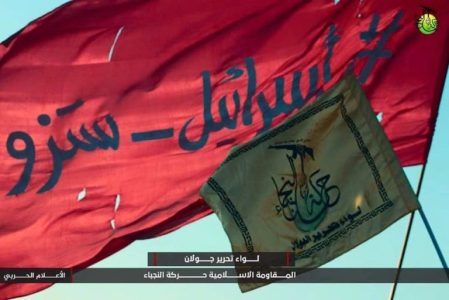
Photo 1: Harakat al Nujaba Golan Liberation Brigade, as portrayed in propaganda video.

The IRGC’s goals in southern Syria are to crush Syrian opposition forces, and build the capability to open another front against Israel. The IRGC hopes a viable Golan foothold would serve as deterrence against Israel and US, and that it could activate in a future conflict, such as another Israel-Hezbollah war. For now, the IDF’s fortified posture in the Golan remains a difficult, if not futile, target for the Guard and its allies. The IRGC nevertheless intends to project steadfast commitment to ideological principles and defiance of adversaries.

*****************************

The Iranian-controlled Iraqi militia Harakat al Nujaba this week announced the formation of its “Golan Liberation Brigade.” While it is not uncommon for entities to name themselves after areas they aim to “liberate,” the militia’s spokesman has said that the unit could assist the Syrian regime in taking the Golan Heights, a region in the Levant that has been controlled by Israel since the 1967 Six-Day War.

If true, the unit would likely participate in a future offensive to capture territory from Syrian opposition in the part of the Golan Heights still controlled by Syria, before moving on to the much taller order of dislodging the Israelis across the border. This week’s announcement reflects Tehran’s priorities in southern Syria since finally taking the fiercely contested city of Aleppo late last year: crush Syrian opposition, and pose military threat to Israel from the Golan Heights. While the Islamic Republic is incapable of credibly challenging the Jewish state’s fortress in the Golan, reaffirming ideological commitment to fighting Israel signals defiance to a global audience amid a reportedly converging American-Arab-Israeli military alliance against Tehran.

Harakat al Nujaba, or Movement of the Noble, has sustained operations in the Syrian and Iraqi combat zones. An offshoot of the Iranian-backed militias Asaib Ahl al Haq and the Hezbollah Brigades, Harakat al Nujaba was formed in 2013 to fight in the Syrian Civil War as part of Iranian-led Iraqi expeditionary forces. The militia joined the Popular Mobilization Forces, the umbrella organization of Iraqi militia, the following year, after the Islamic State incursion into Iraq. Operating as one of the largest Iraqi-Shiite militia contingents in Syria, the militia has claimed to field 10,000 forces. Harakat al Nujaba played an important role in assisting Iran’s Islamic Revolutionary Guard Corps (IRGC) and pro-Syrian regime forces conquer Aleppo late last year.

The Iraqi militia functions as an extension of the Islamic Republic. Having sworn full allegiance to Iran’s Supreme Leader, Ayatollah Ali Khamenei, the militia promotes velayat-e faqih (guardianship of jurisprudence), the Islamic Republic’s founding ideology. Harakat al Nujaba takes direct orders from Major General Qassem Soleimani, the chief of the IRGC extraterritorial branch the Qods Force. Last year, the Iraqi militia, which is also known as Harakat Hezbollah al Nujaba, proclaimed that it and Lebanese Hezbollah, Iran’s most powerful foreign militia, were “the twins of resistance.”

The militia leader Akram al Kabi is close to the top Iranian leadership, including the supreme leader. A co-founder of the Asaib Ahl al Haq – itself an offshoot of the Mahdi Army – Kabi was designated in September 2008 by the US Treasury as a terrorist for aiding Iraqi insurgents. In 2015, he openly said he would depose the Iraqi government if Khamenei issued the order. Last year, top Iranian officials close to Khamenei gave Kabi a highly publicized reception in Tehran, unprecedented in scope and scale for a militia leader. This past December, Harakat al Nujaba publicized Kabi’s meeting with Khamenei on the sidelines of a conference in Tehran.

Harakat al Nujaba has divulged some details about the Golan Liberation Brigade. The commander of the militia’s forces in Syria released a statement declaring the unit to be a synthesis of combat experiences gained in Lebanon, Syria and Iraq. The militia’s official spokesman confirmed the event as a press conference March 8 in Tehran at the IRGC-affiliated Tasnim News Agency, saying the unit was formed following “recent victories” (an implicit reference to Aleppo). He claimed the Golan unit is comprised of “special” forces.

“Should the Syrian government make the request, we are ready to participate in the liberation of occupied Golan with our allies,” the spokesman said. “We will not permit the soil of Arab countries to remain in the grasps of occupiers.”

Harakat al Nujaba also released a video promoting the Golan unit that showed fighters marching in columns and carrying a banner reading, “Israel will be destroyed.”

(The video is at the link. — DM)

Tehran’s goal of establishing a foothold in the Golan Heights is not a secret. Last year, the head of the Israeli foreign and defense legislative committee revealed without divulging details that Israel had repelled several Iran-directed attempts to move forces into Syrian Golan Heights.

Senior Iranian military commanders are known to operate in Syrian Golan. Last July, the then-commander of the IRGC Basij paramilitary publicized an inspection of Quneitra by the Israel border. In January 2015, an Israeli strike in the area killed several high-value targets including IRGC Brigadier General Mohammad Ali Allah-Dadi and multiple Hezbollah operatives.

A chasm remains between the capabilities and ambitions of Harakat al Nujaba and the IRGC to retake the Golan from Israel. The combined forces of the Syrian regime and IRGC-led militias are no match for the Israel Defense Forces (IDF), and this disparity is expected to hold for the foreseeable future. Israel could also adopt a more proactive approach in Syria to foil IRGC encroachment by the Golan, for example coordinating with Syrian rebels positioned in the area. Syrian Golan’s flat geography furthermore denies the IRGC suitable terrain to replicate the southern Lebanon model of concealing rocket launch sites dispersed across a widespread area, making it easier for the IDF to search and destroy weapons systems. For years, the IDF has been fortifying positions in the rocky plateau of Golan to face greater capabilities than the IRGC and its allies can muster.

Yet the claim to retake Israeli Golan underscores Harakat al Nujaba’s ideological commitment to the IRGC’s and Khamenei’s declared goal of destroying Israel. Khamenei and his top Guard generals have frequently spoken that that the divine hand would aid the faithful who take steps towards “divine-inspired” ideological principles.

Brandishing the formation of the Golan unit also challenges Arab countries on the Palestinian issue, as the Tehran has accused them of abandoning the cause in service of Israel. The Islamic Republic has slammed reported Arab-Israeli rapprochement and talks to form a US-brokered military coalition with the goal of countering Tehran, as covered in The Wall Street Journal. Last month, top Iranian government officials hosted another round of the Support of Palestinian Intifada Conference in a show of unity and defiance. This past week, Tehran’s interim Friday prayer leader this week excoriated “some leaders in Islamic countries who are with Zionists,” calling them “not human.” Suffering from loss of legitimacy over support of Syrian President Bashar al Assad against a Sunni-Arab uprising and nervous over a converging Israeli-Arab alliance, the Islamic Republic is projecting to the globe and “sell-out”Arab leaders a defiant commitment to fighting Israel.

The Iraqi militia’s Golan unit and IRGC-led expeditionary forces could help pro-Syrian regime forces take opposition-held areas in the south. In February 2015, IRGC-led forces launched a failed campaign in the Daraa and Quneitra in the south. Since conquering Aleppo last year, the IRGC-led expeditionary forces and other pro-Syrian regime forces have been able to redirect their dwindling assets to several fronts in north, central, and south Syria. Pro-regime forces backed by Russian air power have been pounding Daraa in the south for more than a month to slow an opposition offensive, and have recently launched a new bid to capture it. An IRGC colonel was also killed last month in the area. A pro-Syrian regime propaganda outlet late last month reaffirmed the government’s intention to retake all of Daraa and open a major border crossing with Jordan. Meanwhile, pro-regime forces have made progress in the northern pocket of Quneitra Governorate, located in the Syrian-controlled part of the Golan.
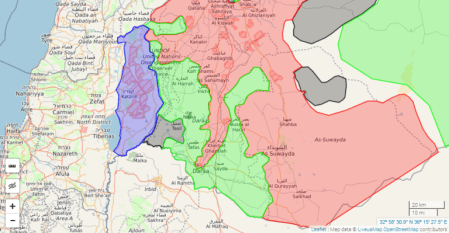
Map 1: southern Syria front, March 2017. Red: pro-Syrian regime forces. Green: rebel forces including Free Syrian Army and al Qaeda-affiliate Jabhat Fath al Sham. Black: Islamic State affiliates. Credit: Liveuamap.

The IRGC’s goals in southern Syria are to crush Syrian opposition forces, and build the capability to open another front against Israel. The IRGC hopes a viable Golan foothold would serve as deterrence against Israel and US, and that it could activate in a future conflict, such as another Israel-Hezbollah war. For now, the IDF’s fortified posture in the Golan remains a difficult, if not futile, target for the Guard and its allies. The IRGC nevertheless intends to  project steadfast commitment to ideological principles and defiance of adversaries.
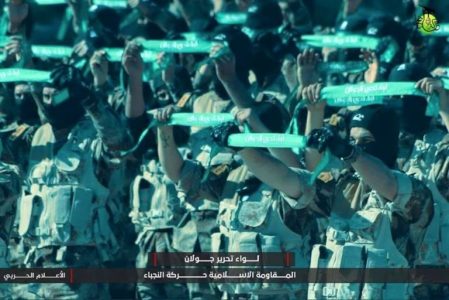
Photo 2.
Photo 3: Harakat al Nujaba Golan Liberation Brigade flag at front, and “Israel will burn” banner in the back.

Amir Toumaj is a Research Analyst at Foundation for Defense of Democracies.

Iran’s Islamic Revolutionary Guards now opposite Israeli troops on 1967 ceasefire line in Golan Heights

March 12, 2017

Iran’s Islamic Revolutionary Guards now opposite Israeli troops on 1967 ceasefire line in Golan Heights, Jihad Watch

(Please see also, Iranians at the gate. — DM)

Israeli Prime Minister Benjamin Netanyahu has stated:

The threat of Shia Islamic terror is directed not only against us, but against the region and the entire world.

Perhaps Israel, more than any other nation, fully understands what “radical Islamic terrorism” is, and its primary goal of obliterating Israel.

“We do not want to see Shia Islamic terrorism led by Iran step in to replace Sunni Islamic terrorism,” Mr Netanyahu told the Russian President.

Iran continues attempts to destroy the Jewish state. They speak of this openly and write this in black and white in their newspapers.

Iran is now in a strategic position to try to destroy Israel directly (instead of through its proxies) as it expands its Shia base into Iraq and Syria.

Netanyahu could also not be clearer in his message that replacing Sunni terrorism with Shia terrorism is counterintuitive. Netanyahu is right about the global danger of mainstream Shia and Sunni terrorism, which is normalized in all too many Islamic states, not just in the Islamic State.

Netanyahu also once stated:

Islamic terrorism is inundating the world and inciting millions in many countries, from Jakarta to Africa to California.

“Iranian Revolutionary Guards opposite Israeli troops on 1967 ceasefire line in Golan Heights as tensions mount,” by Lizzie Dearden, Independent, March 10, 2017:

Benjamin Netanyahu has accused Iran of using the Syrian civil war to “gain a foothold to fight Israel” amid fears over Iranian troops stationed along the border with the occupied Golan Heights.

Tehran is supporting Bashar al-Assad with deployments of the Revolutionary Guards (IRGC), Basij militia and funding to allied militias including Hezbollah.

The IRGC are now reported to be present in Syrian-government controlled territory along the 1967 ceasefire line in the Golan Heights, which has seen months of Israeli air strikes met with rockets fired towards the Israel Defence Forces (IDF).

Brigadier General Mohammad-Reza Naghdi, a commander in Iran’s Basij force, was pictured surveying the border, while a Shia paramilitary group has formed a “Golan Liberation Brigade”.

Harakat Hezbollah al-Nujaba, an Iraqi force backed by Iran, is “ready to take action to liberate Golan” from Israeli occupation, according to spokesman quoted by Iranian state media this week.

The deployments have made the Iranian government a major power broker in the Syrian civil war, meeting with Russian and Turkish representatives at ceasefire talks in Astana, Kazakhstan.

In a meeting with Vladimir Putin on Thursday, the Israeli Prime Minister said that any truce must not allow the continued presence of Iranian forces in Syria.

“We do not want to see Shia Islamic terrorism led by Iran step in to replace Sunni Islamic terrorism,” Mr Netanyahu told the Russian President.

“Iran continues attempts to destroy the Jewish state. They speak of this openly and write this in black and white in their newspapers.

“Today, we have our own country and our army, and we can defend ourselves. But I want to say that the threat of Shia Islamic terror is directed not only against us, but against the region and the entire world.”

He told reporters Iran was “arming itself and its forces against Israel including from Syria territory and is, in fact, gaining a foothold to continue the fight against Israel”.

After the meeting, the Israeli Prime Minister said the removal of Iranian forces from Syria were vital to “prevent misunderstandings”.

“I made it clear that regarding Syria, while Israel is not opposed that there should be an agreement there, we strongly oppose the possibility that Iran and its proxies will be left with a military presence in Syria under such an agreement,” Mr Netanyahu added.

A statement released by the Kremlin said he and Mr Putin discussed “joint efforts to combat international terrorism” and examined areas of bilateral cooperation.

Two years ago, Israel and Russia agreed to coordinate military actions over Syria in order to avoid accidentally trading fire but the risk of skirmishes is increasing as pro-Assad forces fight for more territory in the Golan Heights….

Hizballah Continues Recruiting Palestinians to Kill Israelis

March 9, 2017

Hizballah Continues Recruiting Palestinians to Kill Israelis, Investigative Project on Terrorism, March 9, 2017

Over the years, Hizballah has tried to establish a West Bank foothold to carry out terrorist and kidnapping attacks against Israelis. Members of Hizballah’s Unit 133 external operations branch used social media, particularly Facebook, to recruit West Bank Palestinians.

*****************************

Israeli security authorities arrested a suspected Palestinian member of Hizballah for planning terrorist attacks against Israelis, Israel’s domestic security agency announced on Thursday.

A subsequent Shin Bet interrogation revealed that Hizballah recruited Yusef Yasser Suylam, 23, via Facebook page. Suylam hails from the West Bank town Qalqiliya.

Investigators say the Palestinian operative was responsible for establishing a cell devoted to kidnapping Israeli civilians. Hizballah also directed Suylam to conduct surveillance on Israeli military bases and other security sites, in addition to various places in Jerusalem.

After an Israeli military court filed an indictment, several felony charges are expected against the Palestinian terrorist.

Over the years, Hizballah has tried to establish a West Bank foothold to carry out terrorist and kidnapping attacks against Israelis. Members of Hizballah’s Unit 133 external operations branch used social media, particularly Facebook, to recruit West Bank Palestinians.

Last August, a Shin Bet investigation found disrupted a terror cell that was recruited though the “Palestine the Free” Facebook page featuring anti-Israel Hizballah posts. Cell leader Mustafa Kamal Hindi recruited other operatives in hopes of waging a shooting attack against the Israeli military. Each operative was between the ages of 18-22 and lived in Qalqiliya.

One of the cell members purchased the material required to build a suicide bomb, while another was tasked with building the explosive device. Another terrorist focused on garnering intelligence about IDF patrols in the area. The group also began training with rifles for shooting attacks.

The characteristics, modus operandi, and recruitment methods match the description and reports surrounding recently arrested Yussef Suylam.

In January 2016, a Shin Bet investigation found that Hizballah leader Hassan Nasrallah’s son, Jawan, used social media to recruit terrorists in the West Bank. Through encrypted email exchanges with a Hizballah handler, cell leader Muhammad Zaghloul received instructions for carrying out suicide-bombing attacks and provided a plan to kill an IDF officer. Zaghloul admitted that the cell conducted surveillance of the officer and requested $30,000 to purchase arms to kill him. The plot to kill Israeli troops was likely in the execution phase, considering the two operatives were arrested in possession of a firearm.

Click here to read more details about other Hizballah attempts at recruiting Palestinians to conduct terrorist attacks against Israelis.

Hizballah’s Ongoing Threat to U.S. National Security

March 8, 2017

Hizballah’s Ongoing Threat to U.S. National Security, Investigative Project on Terrorism, March 7, 2017

Most analyses of Hizballah focus on the terrorist group’s intervention in Syria or its threat to Israel. But the Iranian-backed organization maintains a significant presence in and near the United States, threatening national security. Current American proposals to strengthen borders and immigration measures may be limited to address this important, yet poorly understood, threat.

A recent Al-Arabiya article examines Hizballah’s North American threat.

It has the expertise to build advanced tunnels on the southern U.S. border, enabling Hizballah terrorists and Mexican cartel operatives to infiltrate the United States. Relations between Iranian-backed proxies, including Hizballah, and Latin American drug cartels are well established. Mexican gang members learn from Hizballah’s combat experience and use of advanced weaponry. Hizballah, in turn, derives a significant portion of its finances from the drug trade and other illicit activities.

In recent years, security officials in southwestern states noticed a rise in tattoos featuring Hizballah’s insignia among imprisoned drug cartel operatives. This surprising trend indicates a strengthened relationship between the terrorist group and Mexican gang members. In line with its foreign policy, Iranian operatives infiltrating Latin America seek to convert individuals to adopt its extremist Shi’ite ideology. Over the years, pro Iranian websites have proliferated across Latin America, in an attempt to cultivate support for the Islamic Republic.

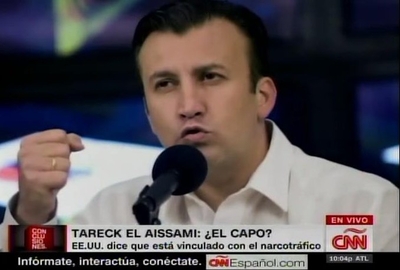
Powerful Latin American politicians also help Iran and Hizballah penetrate the region and threaten the United States. In February, CNN received a 2013 secret intelligence document from several Latin American countries demonstrating ties between Venezuelan Vice President Tarreck El Aissami and 173 Venezuelan identification cards and passports issued to people from the Middle East, including Hizballah operatives. El Aissami “took charge of issuing, granting visas and nationalizing citizens from different countries, especially Syrians, Lebanese, Jordanians, Iranians, and Iraqis,” the report shows.

Iranian and Hizballah operatives have cultivated and consolidated operating bases in South America, especially in the tri-border area (TBA) of Argentina, Brazil and Paraguay. With a large Muslim population featuring significant numbers of Hizballah sympathizers, the region is ripe for recruitment, arms smuggling and drug trafficking. Hizballah continues to exploit other Lebanese Shi’ite diaspora communities, including in the United States, to strengthen its presence worldwide.

In 2011, the United States disrupted a plot led by the Iranian Revolutionary Guard Corps (IRGC) in cooperation with a Mexican drug cartel to assassinate Saudi Arabia’s ambassador to Washington.

The problematic nexus between Iranian-backed operatives, including Hizballah, and Mexican drug cartels allows terrorists to earn big money to fuel their violent operations. These connections also enable Hizballah to make inroads into the United States through its porous border with Mexico.

American intelligence reports show that Hizballah maintains a significant network of sleeper cells in the United States. Though Hizballah has not conducted a major attack on U.S. soil, the group could decide to strike key American sites should U.S.-Iran relations deteriorate substantially. Preparations to combat Islamist terrorism broadly should strongly consider the nuanced and growing Hizballah threat to U.S. national security.


Forging a new approach to Iran

March 6, 2017

Forging a new approach to Iran, Washington Times, Shahram Ahmadi Nasab Emran, March 5, 2017

iranianoctopusIllustration on the continuing threat of Iran by Alexander Hunter/The Washington Times

By identifying the gross overreach by the Iranian regime and promising a swift, punitive response, the White House’s stance marked the end of a longstanding American policy of naive appeasement. In so doing, the Trump administration has rightly recognized the true source of instability and existential threat the region faces. Now, instead of issuing broad statements, it must act on a smart strategy for dismantling the key pillars of Iran’s international terror network and stunting the regime’s emboldened overreach.

***********************

Even as the Trump administration seeks to designate the Revolutionary Guard as a Foreign Terrorist Organization, Iran continues its blatant defiance of international norms. Promising “roaring missiles” if threatened, Tehran has test fired several ballistic weapons capable of delivering nuclear material in just the past month. A fundamentally weak regime with dated military capabilities, Iran is attempting to call the United States’ bluff, perhaps to gain leverage in any subsequent re-evaluations of the nuclear deal Tehran struck with the Obama administration. Several blistering statements from the White House backed by a round of sanctions presage the administration’s muscular new approach. But if it hopes to secure the region, it must systematically target the core destabilizing activities of the regime.

In a steady stream of denunciations, the White House pledged tougher U.S. action if the mullahs continue to violate international norms through illicit missile tests, making clear that the Obama era of appeasement is over. “Instead of being thankful to the United States for these agreements, Iran is now feeling emboldened,” an official White House statement read. “We are officially putting Iran on notice.” While many Iranian officials dismissed President Trump’s tough talk on the nuclear deal as empty campaign rhetoric, the president’s appointment of fellow anti-regime hardliner Gen. James Mattis demonstrates his intention to deliver.

Perhaps more importantly, the White House has also challenged the regime’s extended proxy offensives against U.S. allies and friends in the neighborhood. Such actions “underscore what should have been clear to the international community all along about Iran’s destabilizing behavior across the Middle East,” the White House statement continued. Contrary to President Obama’s Middle East policy of abandoning friends and allies and trying to make friends with the adversaries, the Trump administration will fully support its friends. Specifically, this stance challenges Iran’s practice of hiding behind Hezbollah and Houthis militants as it funds and trains them.

Holding a vastly dated arsenal of weapons, Iran is no match for U.S. firepower, leaving only backchannel mercenaries to promote regional dominance. The White House acknowledged this dynamic, specifically characterizing the affront against Saudi forces as being “conducted by Iran-supported Houthi militants.” This link was never recognized by the Obama administration. Such oversight left Iran free to grow and strengthen its hand in these groups, which terrorize the region and undermine our partners. If the Trump administration will craft a strategy for stunting Iran’s proxy network, particularly by cutting funding and armament flows, the region would be far safer and more stable.

Noting Mr. Trump’s concerns about the nuclear deal being “weak and ineffective”, the Trump administration addressed a third key issue in the U.S.-Iranian relationship. Rapidly losing money and influence, the nuclear deal allowed the regime to avoid military confrontation over its development program for which it was grossly unprepared. And despite the intention of weakening the regime and strengthening the Iranian people, rushed U.S. concessions granted the regime an eleventh-hour trickle of lifeblood, both financially and symbolically. By rolling sanctions back, destabilizing behavior was ostensibly met with an influx of funds. As such, the deal signaled that military action against Iran was highly improbable, thus essentially greenlighting the illicit activity that effected warnings and sanctions from the White House over the past month. And despite official remarks by Iranian officials denouncing these statements as naive and weak, the regime would be in dire straits if America turns off the faucet opened by the nuclear deal.

Finally, the administration’s condemnation for Iran’s broader support for terrorism demonstrated clear perspective on the direct threat it poses to international security. In addition to supporting Hezbollah, Iran is currently involved in a life-and-death battle in Syria that includes continuous weapon and militant transfer from Iran to Syria. President Bashar Assad’s downfall in Syria would destroy the linchpin of Iran’s terror apparatus.

Further, any sustainable resolution calls for the withdrawal of all foreign forces from Syria, culling both activity in the country and a pipeline to Hezbollah via the porous borders between Syria and Libya. As Iran finds itself backed into a corner by its regional export of terror, Mr. Trump and his team have many cards to play.

By identifying the gross overreach by the Iranian regime and promising a swift, punitive response, the White House’s stance marked the end of a longstanding American policy of naive appeasement. In so doing, the Trump administration has rightly recognized the true source of instability and existential threat the region faces. Now, instead of issuing broad statements, it must act on a smart strategy for dismantling the key pillars of Iran’s international terror network and stunting the regime’s emboldened overreach.

‘Abd Al-Rahman Al-Rashed: We Must Form ‘Arab NATO’ To Confront Iran

February 22, 2017

‘Abd Al-Rahman Al-Rashed: We Must Form ‘Arab NATO’ To Confront Iran, MEMRI, February 22, 2017

In February 2017, prominent Saudi journalist ‘Abd Al-Rahman Al-Rashed, the former editor of Al-Sharq Al-Awsat and former director of Alarabiya TV, published two articles calling to take a firm position vis-à-vis Iran and even form an “Arab NATO” to confront the alliance Iran has formed with Iraq and Syria.

The following are excerpts from the articles, as published in English by Al-Sharq Al-Awsat and Alarabiya, respectively:

alrashed‘Abd Al-Rahman Al-Rashed (image: alarabiya.net)

In one article,[1] Al-Rashed criticized the claim that U.S. President Donald Trump’s declarations against the Iran agreement strengthen the radicals there. He argued that Iran’s belligerence since the signing of the agreement proves that openness and flexibility towards it, like the policy pursued by Obama, only encourage it to escalate its aggression. He added that the radical camp in Iran has controlled the country since the Islamic Revolution, while the moderate camp is merely a front used to encourage the West to be lenient with Iran. Hence, policy towards Iran should be firm:

“Nothing happened during three decades to prove that there’s real competition between radicals and moderates inside the [Iranian] ruling command. Major events rather confirmed that the authority was in fact under the control of the radicals, while moderates were just front men. President Hassan Rouhani and his FM Zarif both represented the moderates and they succeeded [in] winning over the administration of former president Barack Obama. They also managed to convince the administration that lifting sanctions and encouraging Iran’s openness were [in] the interest of moderate figures, the region and the whole world.

“Once again, evidence suggested this assumption was wrong. [The] Iranian leadership became more aggressive than ever and for the first time since the establishment of the Islamic Republic, the regime dared to expand its military activity outside its borders. It is currently participating in and funding four wars outside of Iran. All of this was possible due to the nuclear deal that paved the way for better relations, trade and activity and kept silent over Iran’s threats to the region.

“Trump’s extremist rhetoric is a natural outcome of the disappointment [that] prevailed [in] Washington due to Iran’s behavior after signing the deal. Things will keep on getting worse unless a strict international position against Iran’s adventures is taken and unless Iran is forced to end the chaos it is funding in the region and the world.

“Those familiar with the Iranian regime’s [actions] cannot believe the excuses being made by Iran’s allies which stipulate that being lenient with Iran [may cause it to have a] positive [attitude to] the rest of the world. The nature of the regime in Tehran is religious with a revolutionary ideology. It has a political agenda that has not changed much since it attacked the American embassy in Tehran and held diplomats hostage [in 1979]. The same logic leads us to conclude that Iran will dominate [by] using power via its proxies and militias across the region and [by] encouraging and supporting the rebellious behavior of certain local parties in neighboring countries.

“Iran has not changed much since it announced it plans to export revolutions to the world. The only change that happened is that its financial and military situations improved a lot thanks to the nuclear deal it signed with the West.”

In another article,[2] Al-Rashed wrote that Iran has exploited the political vacuum that formed in the region in recent years, as well as the Obama administration’s policy, including the nuclear agreement with it, to expand its influence in Iraq, Syria and Yemen. In light of this, he advised: “Military cooperation, under any umbrella, is a good idea and a necessary step, especially if expanded beyond [military cooperation]. Establishing an alliance to confront Iran is an essential balance to respond to its military alliance that includes Iraq and Syria.

“Iran also cooperates with Russia and the latter has a military base in Iran. The Russians strongly participate in the war in Syria alongside this Iranian alliance. Tehran has strengthened its alliance by bringing armed militias from Pakistan, Iraq, Lebanon and other countries into Syria and they are fighting there under its banner. Iranian forces, in the guise of ‘experts,’ are fighting in Iraq and to some extent manage the conflict there. Therefore, establishing an Arab NATO… remains a natural reaction to Iran’s ‘Warsaw Pact.'”


[1] For the Arabic version of this article see: Al-Sharq Al-Awsat (London), February 12, 2017; for the English version see: english.aawsat.com, February 13, 2017. The English text has been lightly edited for clarity.

[2] For the Arabic version of the article see: -Sharq Al-Awsat (London), February 20, 2017; for the English version see: alarabiya.net, February 21, 2017. The English text has been lightly edited for clarity.

Iran’s Leader Urges Palestinians to Launch Violent Uprising

February 21, 2017

Iran’s Leader Urges Palestinians to Launch Violent Uprising, Investigative Project on Terrorism, February 21, 2017

Highly Classified National Security Information Must Not be Leaked

February 20, 2017

Highly Classified National Security Information Must Not be Leaked, Dan Miller’s Blog, February 20, 2017

(The views expressed in this article are mine and do not necessarily reflect those of Warsclerotic or its other editors. — DM)

Evidence of political corruption should be.

It has been obvious since the early Republican primaries that most media coverage of a Trump presidency would be adverse and presented out of context. Perhaps a recent editorial at The Week Magazine explains why, albeit inadvertently. Or maybe this cartoon better explains the media view:

Trump and Putin as seen by the lamebrain media

Trump and Putin as seen by the lamebrain media

According to The Week Magazineall leaks are equal. However, we approve of those which fit our politics and disapprove of those which don’t.

Live by the leak, die by the leak. When WikiLeaks was releasing a steady stream of embarrassing emails hacked from Democratic officials during the presidential campaign, Hillary Clinton and her supporters cried foul, and urged the press not to report their contents. Donald Trump applauded every new revelation, saying the leaks provided voters with important information, and gleefully invited the Russians to find and publish emails she had deleted. “Boy, that WikiLeaks has done a job on her, hasn’t it?” Trump exulted. Now that it’s Trump who is being tortured by leaks, he’s complaining they’re illegal and “un-American.” Democrats, meanwhile, are welcoming the torrent like a rainstorm after a long drought. (See Main Stories.) When it comes to leaks, everyone is a hypocrite. “Good” leaks are ones that damage our opponents. “Bad” leaks are those that hurt Our Side. [Emphasis added.]

But let’s set partisanship aside for a moment. Is it always in the public interest for government officials to leak, and for the media to publish leaked material? Crusading journalist Glenn Greenwald—who angered the Obama administration by publishing Edward Snowden’s trove of stolen NSA documents—argues in TheIntercept.com this week that all leaks exposing “wrong-doing” are good ones, regardless of the leaker’s motives. “Leaks are illegal and hated by those in power (and their followers),” Greenwald says, “precisely because political officials want to be able to lie to the public with impunity and without detection.” The implication of this argument, of course, is that governments, politicians, and organizations should not keep any secrets—that when people in power conceal documents, emails, or information that could embarrass them, they are by definition deceiving the public. Radical transparency certainly sounds noble—but I suspect it’s a standard no public official, or indeed most of us, could survive. It’s so much more convenient to have a double standard: Transparency for thee, but not for me.

I disagree. Leaks of unclassified materials demonstrating corruption of the political process by either party are necessary for an effectively functioning democracy. Leaks of highly classified national security information — particularly in the area of foreign policy — endanger our democracy, are crimes and the perpetrators should be dealt with accordingly. When the media sensationalize leaks of the latter type, they are complicit and must be criticized vigorously.

The press has long served as an objective fail-safe to protect the public from the powers-that-be. That objectivity is now absent and the media’s role in our democratic society is in jeopardy. Rather than self-reflect as to how they got off course, the press have opted to label the man who exposed this derailment as un-American.

What’s un-American is the belief that the press should be unaccountable for its actions. What’s un-American is the belief that any attempt to criticize the press should be viewed as heresy. What’s un-American is the belief that the press is akin to a golden calf that compels Americans, presidents included, to worship the press.

Two very different types of leaks

a. DNC and Podesta e-mails:

The DNC and Podesta e-mails were released as written and posted by DNC officials and Podesta for transmission on unsecured servers easily hacked by modestly competent teenage hackers. I have seen no suggestion that the e-mails were classified. The intelligence community opined that Russian agents had done the hacking, but offered no significant proof beyond that the methods used by the hacker(s) were comparable to those used by Russian hackers in the past.

They found no discrepancies between the original e-mails and those posted by WikiLeaks (which denied that Russia had been the source). The e-mail leaks damaged the Clinton campaign because they portrayed, accurately — and in their own words —  dishonest efforts of high-level DNC and Clinton campaign personnel to skew the Democrat primary process in Ms. Clinton’s favor. They did not involve American foreign policy until Obama — who had previously done nothing of significance to halt Russia’s hacking of highly classified information from our intelligence establishment beyond asking, “pretty please, stop” — decided that Russia must be punished for Hillary’s loss of the general election through sanctions and by the expulsion of thirty-five of its diplomats.

Russian president Vladimir Putin had been expected to respond in kind, with the expulsion of US diplomats from its territory.

However, he later said he would not “stoop” to “irresponsible diplomacy”, but rather attempt to repair relations once Donald Trump takes office.

Mr Trump praised the decision as “very smart.”

b. Flynn telephone conversations:

Neither transcripts nor audio recordings of the Flynn telephone conversations were released. Instead, conclusions of the leakers were released. According to House Intelligence Chair Devin Nunes,

“I think there is a lot of innuendo out there that the intelligence agencies have a problem with Donald Trump. The rank and file people that are out doing jobs across the world — very difficult places — they don’t pay attention to what is going on in Washington,” the California representative told CBS “Face the Nation” host John Dickerson.

“What we have is we do have people in the last administration, people who are burrowed in, perhaps all throughout the government, who clearly are leaking to the press,” Nunes added. “And it is against the law. Major laws have been broken. If you believe the Washington Post story that said there were nine people who said this, these are nine people who broke the law.” [Emphasis added.]

Nunes said the FBI and other intelligence agencies ought to investigate who has leaked information to the press because so few people in the administration knew these secrets, that it would have had to have been someone at the “highest levels of the Obama administration” who is an acting official until Trump replaces him or her.

Did the leaker(s) try to present the conversations honestly, or to damage President Trump’s efforts to deal with Russia in matters of foreign policy where American and Russian interests coincide? To disrupt America’s badly needed “reset” with Russia which seemed likely to succeed under President Trump after Clinton’s and Obama’s efforts had failed?

resetbutton

Remember the Obama – Romney debate when Romney characterized Russia as America’s greatest geopolitical threat and Obama responded that the cold war was over and that “the 1980’s are calling and want their foreign policy back”?

The position now asserted by the Democrats and the media seems rather like the position that Obama rejected. If the position(s) of the Democrats and the media are now correct and Russia is again our enemy, might it be due to actions which Obama took or failed to take over the past eight years?

It is unfortunate that there has been a resurgence of Democrat (and some Republican) Russophobia when Russia is reassessing her relationship with Iran and America.

On January 22, 2017, the Russian media outlet Pravda.ru published an analysis on Russia-Iran relations. According to the article’s author, Dmitri Nersesov, Iran is becoming a problem for Russian interests. Nersesov also added that Iran wants Russia to choose between Iran and Washington. “Iran wants Russia to recognize that Teheran holds the key to the regulation of the Syrian crisis. Should Russia decide that the real strategy is built on the cooperation between Moscow and Washington, rather than Moscow and Teheran; the Islamic Republic will be extremely disappointed,” Nersesov wrote. [Emphasis added.]

An American – Russian realignment in areas of mutual concern — which as suggested below had seemed to be progressing well until General Flynn ceased to be involved — would be good, not bad. We have many areas of mutual concern, and Iran is one of them. The war in Syria is another. When were Russians last directed to yell Death to America? Or to refer to America as the “Great Satan?”

c. General Flynn, Russia and Iran

General Flynn had, at President Trump’s request, been dealing with Russia concerning the future roles of Iran, Russia and America in the Syria debacle:

Overlaying US President Donald Trump’s extraordinary, hour-long skirmish with reporters Thursday, Feb. 16, was bitter frustration over the domestic obstacles locking him out from his top security and foreign policy goals. [Emphasis added.]

Even before his inauguration four weeks ago, he had arranged to reach those goals by means of an understanding with President Vladimir Putin for military and intelligence cooperation in Syria, both for the war on the Islamic State and for the removal of Iran and its Lebanese surrogate Hizballah from that country. [Emphasis added.]

But his antagonists, including elements of the US intelligence community, were turning his strategy into a blunderbuss for hitting him on the head, with the help of hostile media.

Thursday, in a highly unconventional meeting with the world media, he tried to hit back, and possibly save his strategy.

That won’t be easy. The exit of National Security Adviser Mike Flynn, the prime mover in the US-Russian détente, sent the Kremlin a negative signal. The Russians began unsheathing their claws when they began to suspect that the US president was being forced back from their understanding. The SSV 175 Viktor Leonov spy ship was ordered to move into position opposite Delaware on the East Coast of America; Su-24 warplanes buzzed the USS Porter destroyer in the Black Sea.

Before these events, Washington and Moscow wre moving briskly towards an understandingdebkafile’s intelligence sources disclose that the Kremlin had sent positive messages to the White House on their joint strategy in Syria, clarifying that Moscow was not locked in on Bashar Assad staying on as president. [Emphasis added.]

They also promised to table at the Geneva conference on Syria taking place later this month a demand for the all “foreign forces” to leave Syria. This would apply first and foremost to the pro-Iranian Iraqi, Pakistani and Afghan militias brought in by Tehran to fight for Assad under the command of Revolutionary Guards officers, as well as Hizballah. [Emphasis added.]

Deeply troubled by this prospect, Tehran sent Iran’s supreme commander in the Middle East, the Al Qods chief Gen. Qassem Soleimani, to Moscow this week to find out what was going on.

Flynn’s departure put the lid on this progress. Then came the damaging leak to the Wall Street Journal, that quoted an “intelligence official” as saying that his agencies hesitated to reveal to the president the “sources and methods” they use to collect information, due to “possible links between Trump associates and Russia.. Those links, he said “could potentially compromise the security of such classified information.”

A first-year student knows that this claim is nonsense, since no agency ever share its sources and methods with any outsider, however high-placed.

What the leak did reveal was that some Washington insiders were determined at all costs to torpedo the evolving understanding between the American and Russian presidents. The first scapegoat was the strategy the two were developing for working together in Syria. [Emphasis added.]

Defending his policy of warming relations with Moscow, Trump protested that “getting along with Russia is not a bad thing.” He even warned there would be a “nuclear holocaust like no other” if relations between the two superpowers were allowed to deteriorate further.

It is too soon to say whether his Russian policy is finally in shreds or can still be repaired. Trump indicated more than once in his press briefing that he would try and get the relations back on track.

Asked how he would react to Russia’s latest provocative moves, he said: “I’m not going to tell you anything about what responses I do. I don’t talk about military responses. I don’t have to tell you what I’m going to do in North Korea,” he stressed.

At all events, his administration seems to be at a crossroads between whether to try and salvage the partnership with Russia for Syria, or treat it as a write-off. If the latter, then Trump must decide whether to send American troops to the war-torn country to achieve his goals, or revert to Barack Obama’s policy of military non-intervention in the conflict. [Emphasis added.]

Substantially more is generally involved in matters of foreign policy than is facially apparent or than government officials should discuss publicly, particularly while negotiations with foreign powers are underway. Leaks by held-over members of the intelligence community did much to reveal the opinions of the leakers but little to reveal what General Flynn had been doing, while upsetting the chances of better American – Russian relations in areas of mutual concern.

Conclusions — The Administrative State

The Federal Government has grown far too big for its britches, giving the unelected “administrative state” substantially more authority, and hence power, than is consistent with a properly functioning democracy. As they have been demonstrating in recent months, holdovers from one administration can succeed, at least partially, in paralyzing a new and democratically elected president. Holdovers with political appointee status can generally be fired. Few others who should be can be.

Getting rid of the obstructionist “civil servants” who have become our masters should rank very high on President Trump’s “to do” list and should be accomplished before it’s too late. The task may be difficult but is not impossible. Perhaps some particularly obnoxious Federal agencies (or departments within those agencies) can be relocated to places less congenial than Washington. Inner City Chicago comes to mind. So do otherwise pleasant cities in California, where housing prices are much higher than in the Washington, D.C. area. How many Federal employees faced with the choice of relocating or resigning would choose the latter option?

There are likely other and probably better ways to get rid of the fatheads. President Trump’s administration should devise them.

EXCLUSIVE – Arab Intel Official Warns Israel, Jordan, Syria Borders at Risk of Becoming an Iranian Stronghold

February 18, 2017

EXCLUSIVE – Arab Intel Official Warns Israel, Jordan, Syria Borders at Risk of Becoming an Iranian Stronghold, BreitbartAaron Klein and Ali Waked, February 18, 2017

(Please see also, Can Trump rescue his Syria deal with Putin?. — DM)

jordan-border-640x480AP Raad Adayleh

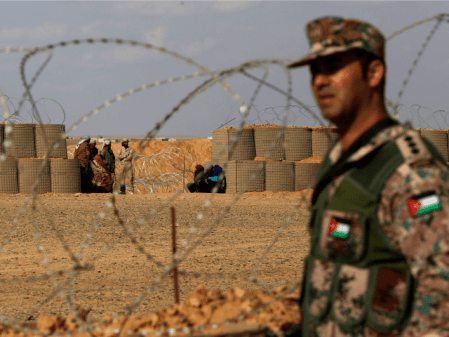
TEL AVIV — There is fear that further advances by the Syrian army, assisted by the Iran-backed Hezbollah and elite Iranian troops, may turn the Israel-Jordan-Syria border area into an Iranian proxy base, an Arab intelligence officer said.

“It’s not so much the possibility that it happens, but the prospects of an Israeli retaliation if Iranian forces come near its border,” he said. “Israel made it clear, publicly and behind the scenes, that it would not tolerate Hezbollah and Revolutionary Guards’ presence along its border.”

“Iran has exploited the campaign against Nusra Front and the Islamic State to take root in the border area,” he said. “Jordan and Israel too would like to see these organizations out, but not to the point that Hezbollah and Iran fill the void.”

Lately, Israel and Jordan have cooperated closely on the matter, he stated. “Israel knows that Jordan needs to act against extremist elements but both want to prevent Iran from taking advantage of it.”

“It is also in [Syrian President Bashar] Assad’s best interest to keep the Iranians out,” the official contended. “True, he has stated that the Golan Heights would be liberated by force, and he relies heavily on Hezbollah and Iran. But at some point he’d wish to rule over his own border areas, which is something Jordan can live with. But not Iran.”

He added that the Iranian Revolutionary Guards tried several times in the past to gain a foothold in Jordan. “But these cells were unveiled and dismantled before they became operational.”

He added that the joint operation room of the Syrian opposition groups has become almost completely inactive.

“Its activity has been dramatically reduced,” he said of the operation room. “There are no more operational and tactical plans and directives. The world wants first and foremost to remove the jihadist threat, but the elements in the region believe that the jihadi threat will be replaced by an Iranian one.”

He said that Jordan has rebuffed Iranian proposals to increase economic cooperation despite the financial dire straits in which the Kingdom finds itself. “They want to prevent Iran from having any kind of foothold in the kingdom.”

Venezuela: State Sponsor of Terrorism?

February 18, 2017

Venezuela: State Sponsor of Terrorism? Investigative Project on Terrorism, February 17, 2017

1977

U.S. intelligence has long considered Tareck El Aissami as a key figure in the global narcotics trade with ties to Iran. He oversaw massive shipments of drugs from Venezuela to other countries, including the United States, and issued identification documents to Hizballah operatives. But El Aissami isn’t an affiliate of Hizballah or the Iranian Revolutionary Guard Corp (IRGC). El Aissami is the vice president of Venezuela.

After an extensive Treasury Department investigation spanning several years, the Trump administration levied sanctions against El Aissami on Monday, freezing his assets in the United States and prohibiting business relationships with him. American officials have previously identified and sanctioned other senior Venezuelan officials involved in drug trafficking operations with Colombian FARC and close cooperation with Iran’s terrorist activities.

U.S. officials previously have criticized Venezuela’s failure to cooperate on global counterterrorism issues. Yet these latest allegations – surrounding the upper echelons of Venezuela’s government – suggest that the South American country has devolved into a full-blown state sponsor of terrorism.

Earlier this month, CNN received a 2013 secret intelligence document from several Latin American countries highlighting ties between El Aissami and 173 Venezuelan identification cards and passports issued to people from the Middle East, including Hizballah affiliated personnel. El Aissami “took charge of issuing, granting visas and nationalizing citizens from different countries, especially Syrians, Lebanese, Jordanians, Iranians, and Iraqis,” the report shows.

Previous U.S. reports detailed blatant corruption and vulnerabilities on Venezuela’s borders, failing to even conduct basic biographic screening at various ports of entry. However, the allegations surrounding El Aissami’s operations take these security concerns to a whole new level. One of the most powerful leaders of a large Western country stands accused of facilitating terrorist infiltration into other states, including the United States.

The Simon Wiesenthal Center also suggests that El Aissami served as an interlocutor between Iran and Argentina in an effort to hide the Islamic Republic’s role in coordinating the 1994 Jewish Center bombing in Buenos Aires. Hizballah operatives are widely believed to be responsible for that attack, which killed 85 people and wounded 300. Moreover, a Wiesenthal Center representative in South America fears that El Aissami may encourage the Venezuelan government to adopt formal state policies based on anti-Semitism.

Under the reign of former President Hugo Chavez, Iran exploited friendly ties with Venezuela to establish terrorist networks throughout region. Iranian and Hizballah operatives have cultivated and consolidated operating bases in South America, especially in the tri-border area (TBA) of Argentina, Brazil and Paraguay. With a large Muslim population featuring significant numbers of Hizballah sympathizers, the terrorist organization uses this area for recruitment, arms smuggling and drug trafficking, and logistics planning for terrorist operations.

Hizballah also relies on legitimate businesses and front organizations in the region, diversifying its terrorist financing profile to generate a significant portion of its revenues from its Latin American operations. With Venezuelan help, the terrorist group continues to expand its presence and consolidate support in other Latin American countries. Hizballah has even registered as a political party in a Peruvian region characterized as having that nation’s largest Muslim population.

Yet Venezuelan ties to drug trafficking and terrorists are not limited to South America. The Treasury Department also revealed that El Aissami helped coordinate narcotics shipments to drug cartels operating on the U.S. border, including Mexico’s infamous Los Zetas. In 2011, Virginia prosecutors said that a Lebanese man helped the Mexican Los Zetas drug cartel smuggle of more than 100 tons of Colombian cocaine. The U.S. Treasury Department claimed that Hizballah benefitted financially from the criminal network.

Later that year, the United States disrupted an IRGC-led plot in cooperation with a Mexican drug cartel to assassinate Saudi Arabia’s Ambassador to Washington.

The problematic nexus between Iranian-backed operatives – including Hizballah – and Mexican drug cartels allows terrorists to earn big money to fuel their violent operations. These connections also enable Hizballah to make inroads into the United States through its porous border with Mexico.

In a 2011 testimony before a House Homeland Security subcommittee, Roger F. Noriega, former U.S. ambassador to the Organization of American States, highlighted the danger posed to U.S. homeland security from the growing Hizballah presence in Latin America:

“The more broad implication for U.S. homeland security is that Hizballah—via Iran and Venezuela—has engaged the United States in an offensive strategy of asymmetric warfare on our doorstep. It is aiming to win the mental battle of attrition and the moral battle of legitimacy—particularly with the youth in Latin America. Unless our government recognizes and responds to their efforts, our ability to protect our interests and our homeland will be gradually and dangerously diminished.”

That testimony is as relevant today as it was years ago, foreshadowing continued cooperation between Iran, its terrorist proxies, and the government of Venezuela. Now with a vice president who maintains intimate ties to a variety of violent organizations, Venezuela has transitioned from a safe haven for nefarious activities to a global state sponsor of terrorism.