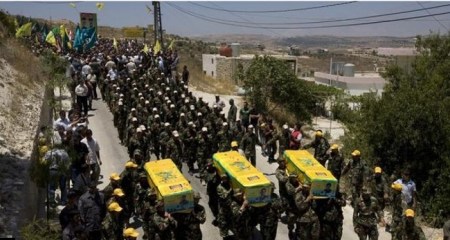
Archive for the ‘Iranian proxies’ category

Al Qaeda in Iran

July 25, 2016

Al Qaeda in Iran, Weekly Standard August 1, 2016 issue, Stephen F. Hayes and Thomas Joscelyn

Last week, President Barack Obama’s administration dismissed reports of Iranian support for al Qaeda as the product of fevered minds. Claims of collaboration between the Islamic regime and the terrorist organization are little more than “baseless conspiracy theories,” an Obama administration official told The Weekly Standard. “Anyone who thinks Iran was or is in bed with al Qaeda doesn’t know much about either.”

That group of ignoramuses apparently includes the Obama administration’s top official on terror financing. Adam J. Szubin, the Treasury Department’s acting undersecretary for terrorism and financial intelligence, this week designated three senior al Qaeda officials operating in Iran. A statement explaining the designations says Treasury “took action to disrupt the operations, fundraising, and support networks that help al-Qaida move money and operatives from South Asia and across the Middle East by imposing sanctions on three al-Qaida senior members located in Iran.”

One of the three operatives is part of a “new generation” of al Qaeda leaders, replenishing the ranks of those who have been killed by the United States and its allies. Treasury identifies that man, Faisal Jassim Mohammed al-Amri al-Khalidi, as the chief of al Qaeda’s Military Commission and a key operative in al Qaeda’s global network, responsible for weapons acquisition and a liaison between al Qaeda leaders and associated groups.

There is considerably more evidence of Iran’s support for al Qaeda in the collection of documents captured during the raid of Osama bin Laden’s compound on Abbottabad, Pakistan, in 2011. Senior U.S. intelligence officials have told The Weekly Standard that the document collection includes letters describing the nature of the relationship between Iran and al Qaeda and specific ways in which Iran has aided al Qaeda’s network and operations. The Obama administration has refused to release the documents to the public and fought to keep them hidden during the negotiations over the Iran nuclear deal.

The Weekly Standard contacted the Obama administration official who last week dismissed Iran-al Qaeda cooperation to see if the new designations changed his view that claims of Iranian support for al Qaeda are “baseless conspiracy theories.” He replied: “Al Qaeda has long used Iran as a transit and facilitation point between South Asia and the Middle East, sometimes with the knowledge of some Iranian authorities. At the same time, the Iranian government has imprisoned some al Qaeda operatives, and we believe today’s action provides another opportunity for Iran to take action against al Qaeda.”

Think about that for a moment. The Obama administration accuses Iran of harboring senior al Qaeda operatives and sanctions those operatives in an effort to prevent them from hurting America and its interests. But rather than scold Iran for continuing to provide safe haven to terrorists devoted to killing Americans, the administration spins the move as an “opportunity” for Iran.

An opportunity? Why would the Iranian regime need the U.S. government to provide an “opportunity” to take action against the very terrorists it has been supporting for more than a decade? This is illogical, insulting, and dangerous. But it is consistent with the kind of irresponsible whitewashing of the radical regime that has become a trademark of the Obama administration’s approach to Iran.

And now the Obama administration pretends that another public accusation of Iran’s complicity in al Qaeda’s terror is just an “opportunity” for the terror-sponsoring regime to stop doing what it is committed to doing?

Iran’s support for al Qaeda is not a “baseless conspiracy theory.” It’s a dangerous reality.

Hezbollah’s Massive Arms Build-up in Lebanese Civilian Areas

July 19, 2016

Hezbollah’s Massive Arms Build-up in Lebanese Civilian Areas, Front Page MagazineJoseph Klein, July 19, 2016

hn

Every calendar quarter the United Nations Security Council holds an extensive debate on the Israeli-Palestinian “situation.” The Israeli and Palestinian UN representatives make speeches following the Secretary General’s report on the current status, which are normally predictable restatements of their respective positions. This time, however, Israel’s ambassador Danny Danon, addressing the Security Council at its July 12th meeting, presented new graphic evidence of Hezbollah’s alarming arsenal of rockets and missiles located in civilian areas of southern Lebanon.

Ten years ago, when Security Council Resolution 1701 was adopted, ending the war that had broken out between Israel and Hezbollah, the terrorist group was estimated to have had about 7000 rockets. The resolution called for Hezbollah and other armed groups not officially a part of the Lebanese government’s armed forces to relinquish their weapons. Instead, precisely the opposite has happened. Hezbollah never stopped its arms build-up, which has been funded and supplied principally from the world’s leading state sponsor of terror, Iran.

Hezbollah now has approximately 120,000 rockets and missiles aimed at Israeli civilian population centers.  By way of comparison, Ambassador Danon said that “more missiles are hidden underground in 10,000 square kilometers [of Lebanon] than the above-ground 4 million square kilometers” of the European North Atlantic Treaty Organization countries.

Referring to aerial satellite imagery, based on the latest Israeli intelligence, Ambassador Danon demonstrated to the members of the Security Council the location of rocket launchers and arms depots that Hezbollah had placed in civilian areas. “The village of Shaqra has been turned into a Hezbollah stronghold with one out of three buildings used for terror activities, including rocket launchers and arms depots,” Ambassador Danon said.  “Hezbollah has placed these positions next to schools and other public institutions putting innocent civilians in great danger.”

Hezbollah, aided and abetted by Iran, was “committing double war crimes,” the Israeli ambassador charged. “They are attacking civilians, and using Lebanese civilians as human shields,” he said. “We demand the removal of Hezbollah terrorists from southern Lebanon.”

Not surprisingly, Ambassador Danon’s presentation of irrefutable evidence of Hezbollah’s clear and present danger to Israeli and Lebanese civilians, and his demand for Security Council action, fell on deaf ears. In her own statement that followed Ambassador Danon’s remarks, U.S. Ambassador to the UN Samantha Power said not a word about what was just presented regarding Hezbollah. Instead, she stuck to her canned talking points that continue to draw a moral equivalence between acts of Palestinian terrorism and Israeli self-defense. “In recent months, there’s been a steady stream of violence on both sides of the conflict,” she said. Then Ambassador Power proceeded to criticize the building of Israeli settlements, as if again to draw a moral equivalence between housing construction and terrorism. She assailed what she called Israel’s “systematic process of land seizures, settlement expansions, and legalizations of outposts that is fundamentally undermining the prospects for a two-state solution.” All that Ambassador Power said about Lebanon was to decry the political stalemate in electing a new president and to state that “the United States is helping the Lebanese armed forces build the capabilities necessary to counter violent extremism and protect the Lebanese people.”  If the Obama administration were truly interested in countering “violent extremism” in Lebanon and protecting the Lebanese people, it would start by doing everything possible to eliminate the violent extremist threat posed by Hezbollah’s massive rearmament. That, in turn, would require the Obama administration to reverse its appeasement course towards Iran and tighten, not loosen, the financial screws on the regime.

There is no doubt where the bulk of Hezbollah’s funding and arms is coming from. Even Secretary of State John Kerry acknowledged last January Iran’s leading role in arming Hezbollah.

The terrorist organization’s chief Hasan Nasrallah boasted last month about Iran’s bankrolling its operations:

“We are open about the fact that Hezbollah’s budget, its income, its expenses, everything it eats and drinks, its weapons and rockets, are from the Islamic Republic of Iran,” Nasrallah was quoted by Hezbollah’s official Al Ahed newspaper as saying.  “As long as Iran has money we will have money. Hezbollah gets its money and arms from Iran, as long as Iran has money, so does Hezbollah. We extend gratitude to the Leader Imam, [His Eminence] Sayyed Khamenei, and to the leadership of the Islamic Republic and its government, president, scholars and people for their generous support which has never stopped.”

To add insult to injury, Nasrallah made his remarks while honoring the “martyrdom” of a top Hezbollah terrorist killed in Syria whom has been linked to the 1983 attack on the U.S. Marines barracks in Lebanon. That attack took the lives of 241 Americans. Now, Hezbollah is stronger than ever, with Iran’s “generous support.”

Iran continues to fund global terrorism, with its treasury being replenished thanks to the Obama administration’s largesse.

How Hilary’s foreign policy ‘succeeded’ for Iran

June 4, 2016

How Hilary’s foreign policy ‘succeeded’ for Iran, DEBKAfile, June 4, 2016

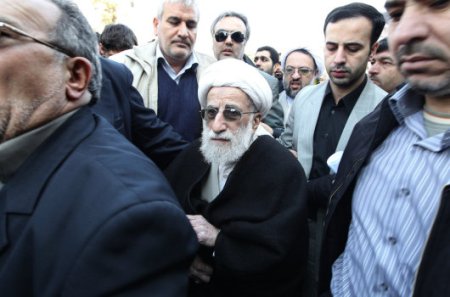
6Hardline Ayatolla Ahmad Janati

Hillary Clinton, the Democratic presidential frontrunner, declared Thursday June 2 in a major foreign policy address: ‘We are now safer than we were before this agreement (the International-Iran nuclear deal).”

A short while before her speech, the State Department, published its yearly report on world terror, and determined, as in past years, that Iran remains “the leading state sponsor of terrorism, on account of its support for designated terrorist groups and proxy militias in Lebanon, Syria, and Iraq.”

Three days earlier, on May 31, scientists at the Institute for Science and International Security, published an extensive analysis of the second report of the IAEA in Vienna, whose job it is to monitor the Iranian nuclear program and establish whether Tehran’s is complying with its commitments.

Their report is titled: IAEA’s Second JCPOA Report: Key Information Still Missing.

The American scientists found oversights in the international watchdog’s report, suggesting collaboration between the Obama administration and the IAEA to conceal Iranian violations.

The scientists offered some examples of these omissions:

Data is lacking on the number of centrifuges, including advanced models, operating in Natanz enrichment facilities as well as the Fordo underground plant. There is no information on what happened to the 20 percent-enriched uranium still remaining in Iran.

Another example is the lack of information on the Iran’s heavy water which is provisionally stored in Oman. Who does it belong to and who oversees it?

These are just a few examples of the blanks in the promised oversight over Iran’s nuclear program, not to mention Iran’s banned ballistic missile program which is geared to design missiles able to reach the US.

The Obama administration had based his detente with Tehran, capped by the nuclear deal, on producing a breakthrough in US-Iran relations. It was intended to strengthen the moderate, reformist and liberal political elements in Iran. ButDEBKAfile sources and Iranian experts report that the exact opposite happened, as is evident in two important elections held in Iran in the past two weeks.

In the elections to the Assembly of Experts, the body which chooses Iran’s top leader, the 91-year-old Ayatollah Ahmad Janati was elected. He is one of the most extreme hardliners in Iran.

A few days later, Ali Larijani was re-elected as Speaker of the Iranian Parliament. Larijani is close to Ayatollah Ali Khamenei. He won by a land slide over the reformist candidate put forward by President Hassan Rouhani.

Five months ago, when the first results of the Iranian elections to the Majlis and to the Assembly of Experts came in, there were cries of joys in the Obama administration. US Secretary of State John Kerry and Iranian Foreign Minister Muhammad Jawad Zarif proclaimed it at the time a victory for the moderates.

Where did these ‘moderates’ disappear in the interim and how did they become supporters of the extremists?

On Friday, June 3, less than 24 hours after Clinton’s foreign policy speech, Iran’s leader Ayatollah Khamenei celebrated his victory over American policy saying: Iran has many small and big enemies, but foremost among them are America and Britain. “Any cooperation with the US,” he stressed, “is an act against Iran’s independence.”

Iran’s Chess Board

June 3, 2016

Iran’s Chess Board, Front Page MagazineCaroline Glick, June 3, 2016

official_photo_of_hassan_rouhani_7th_president_of_iran_august_2013

Even if Obama’s successor disavows his actions, by the time Obama leaves office, America’s options will be more limited than ever before. Without war, his successor will likely be unable to stem Iran’s rise on the ruins of the Arab state system.

********************

Reprinted from jpost.com.

Strategic thinking has always been Israel’s Achilles’ heel. As a small state bereft of regional ambitions, so long as regional realities remained more or less static, Israel had little reason to be concerned about the great game of the Middle East.

But the ground is shifting in the lands around us. The Arab state system, which ensured the strategic status quo for decades, has collapsed.

So for the first time in four generations, strategy is again the dominant force shaping events that will impact Israel for generations to come.

To understand why, consider two events of the past week.

Early this week it was reported that after a two-year hiatus, Iran is restoring its financial support for Islamic Jihad. Iran will give the group, which is largely a creation of the Iranian Revolutionary Guard Corps, $70 million.

On Wednesday Iranian media were the first to report on the arrest of a “reporter” for Iran’s Al-Alam news service. Bassam Safadi was arrested by Israel police in his home in Majdal Shams, the Druse village closest to the border with Syria on the Golan Heights. Safadi is suspected of inciting terrorism.

That is, he is suspected of being an Iranian agent.

There is nothing new about Iranian efforts to raise and run fronts against Israel within its territory and along its borders. Iran poses a strategic threat to Israel through its Hezbollah surrogate in Lebanon, which now reportedly controls the Lebanese Armed Forces.

In Gaza, Iran controls a vast assortment of terrorist groups, including Hamas.

In Judea and Samaria, seemingly on a weekly basis we hear about another Iranian cell whose members were arrested by the Shin Bet or the IDF.

But while we are well aware of the efforts Iran is making along our borders and even within them to threaten Israel, we have not connected these efforts to Iran’s actions in Iraq and Syria. Only when we connect Iran’s actions here with its actions in those theaters do we understand what is now happening, and how it will influence Israel’s long-term strategic environment.

The big question today is what will replace the Arab state system.

Syria, Iraq, Lebanon, Yemen and Libya no longer exist. On their detritus we see the fight whose results will likely determine the fates of the surviving Arab states, as well as of much of Europe and the rest of the world.

Israel’s strategic environment will be determined in great part by the results of Iran’s actions in Iraq and Syria. While Israel can do little to affect the shape of events in these areas, it must understand what they mean for us. Only by doing so, will we be able to develop the tools to secure our future in this new strategic arena.

Until 2003, Saddam Hussein was the chief obstacle to Iran’s rise as the regional hegemon.

US forces in Iraq replaced Hussein until they left the country in 2011. In the meantime, by installing a Shi’ite government in Baghdad, the US set the conditions for the rise of Islamic State in the Sunni heartland of Anbar province on the one hand, and for Iran’s control over Iraq’s Shi’ite-controlled government and armed forces on the other.

Today, ISIS is the only thing checking Iran’s westward advance. Ironically, the monstrous group also facilitates it. ISIS is so demonic that for Americans and other Westerners, empowering Iranian-controlled forces that fight ISIS seems a small price to pay to rid the world of the fanatical scourge.

As former US naval intelligence analyst J.E. Dyer explained this week in an alarming analysis of Iran’s recent moves in Iraq published on the Liberty Unyielding website, once Iranian- controlled forces defeat ISIS in Anbar province, they will be well placed to threaten Jordan and Israel from the east. This is particularly the case given that ISIS is serving inadvertently as an advance guard for Iran.

In Syria, Iran already controls wide swaths of the country directly and through its surrogates, the Syrian army, Hezbollah and Shi’ite militias it has fielded in the country.

Since the start of the war in Syria, Israel has repeatedly taken action to block those forces from gaining and holding control over the border zone on the Golan Heights.

Prime Minister Benjamin Netanyahu’s surprising recent announcement that Israel will never relinquish control over the Golan came in response to his concern that in exchange for a cease-fire in Syria, the US would place that control on the international diplomatic chopping block.

A week and a half ago, Iran began its move on Anbar province.

On May 22, Iraqi forces trained by the US military led Iraq’s offensive to wrest control over Fallujah and Mosul from ISIS, which has controlled the Sunni cities since 2014. Despite the fact that the lead forces are US-trained, the main forces involved in the offensive are trained, equipped and directed by Iran.

As Iraqi forces surrounded Fallujah in the weeks before the offensive began, Qassem Soleimani, the commander of the Revolutionary Guards’ Quds forces, paid a public visit to the troops to demonstrate Iran’s dominant role.

The battle for Fallujah is a clear indication that Iran, rather than the US, is calling the shots in Iraq. According to media reports, the Pentagon wanted and expected for the forces to be concentrated in Mosul. But at the last minute, due to Soleimani’s intervention, the Iraqi government decided to make Fallujah the offensive’s center of gravity.

The Americans had no choice but to go along with the Iranian plan because, as Dyer noted, Iran is increasingly outflanking the US in Iraq. If things follow their current course, in the near future, Iran is liable to be in a position to force the US to choose between going to war or ceasing all air operations in Iraq.

On May 7, Asharq al-Awsat reported that the Revolutionary Guards is building a missile base in Suleimaniyah province, in Iraqi Kurdistan.

A senior IRGC general has made repeated visits to the area in recent weeks, signaling that the regime views this as an important project. The report further stated that Iran is renewing tunnel networks in the region, built during the 1980-88 Iran-Iraq War.

Dyer warned that depending on the type of missiles Iran deploys – or has deployed – to the base, it may threaten all US air operations in Iraq. And the US has no easy means to block Iran’s actions.

To date, commentators have more or less agreed that US operations in Iraq and Syria make no sense. They are significant enough to endanger US forces, but they aren’t significant enough to determine the outcome of the war in either territory.

But there may be logic to this seemingly irrational deployment that is concealed from view. A close reading of David Samuels’s profile of President Barack Obama’s Deputy National Security Adviser Ben Rhodes published last month in The New York Times, points to such a conclusion.

Samuels described Rhodes as second only to Obama in his influence over US foreign and defense policy. Rhodes boasted to Samuels that Obama’s moves toward Iran were determined by a strategic course he embraced before he entered office.

A fiction writer by training, Rhodes’s first “national security” job was as the chief note taker for the Iraq Study Group.

Then-president George W. Bush appointed the group, jointly chaired by former secretary of state James Baker and former congressman Lee Hamilton, in 2006, to advise him on how to extricate the US from the war in Iraq.

In late 2006, the ISG published its recommendations.

Among other things, the ISG recommended withdrawing US forces from Iraq as quickly as possible. The retreat was to be enacted in cooperation with Iran and Syria – the principle sponsors of the insurgency.

The ISG argued that if given the proper incentives, Syria and Iran would fight al-Qaida in Iraq in place of the US. For such action, the ISG recommended that the US end its attempts to curb Iran’s nuclear program.

Responsibility for handling the threat, the ISG recommended, should be transferred to the US Security Council.

So, too, the ISG recommended that Bush pressure Israel to withdraw from the Golan Heights, Jerusalem and Judea and Samaria in the framework of a “peace process.”

Such action too would serve to convince Iran and Syria that they could trust the US and agree to serve as its heirs in Iraq.

Bush of course, rejected the ISG’s recommendations.

He decided instead to sue for victory in Iraq. Bush announced the surge in US forces shortly after the ISG published its report.

But now we see, that through Rhodes the Iraq Study Group’s recommendation became the blueprint for a new US strategy of retreat and Iranian ascendance in Iraq and throughout the Middle East.

The chief components of that strategy have already been implemented. The US withdrawal from Iraq in 2011 left Iran as the new power broker in the country. The nuclear pact with Iran facilitated Iran’s transformation into the regional hegemon.

Against this strategic shift, the US’s minimalist campaigns in Iraq and Syria against ISIS make sense.

The US forces aren’t there to defeat ISIS, but to conceal Iran’s rise.

When ISIS is defeated in Anbar and in Raqqa in Syria, its forces are liable to turn west, to Jordan.

The US is currently helping Jordan to complete a border fence along its border with Iraq. But then ISIS is already active in Jordan.

And if events in Iraq and Syria are any guide, where ISIS leads, Iran will follow.

Iran’s strategic game, as well as America’s, requires Israel to become a strategic player.

We must recognize that what is happening in Iraq is connected to what is happening here.

We need to understand the implications of the working alliance Obama has built with Iran.

Even if Obama’s successor disavows his actions, by the time Obama leaves office, America’s options will be more limited than ever before. Without war, his successor will likely be unable to stem Iran’s rise on the ruins of the Arab state system.

In this new strategic environment, Israel must stop viewing Gaza, Judea and Samaria, the Golan Heights and Lebanon as standalone battlefields. We must not be taken in by “regional peace plans” that would curtail our maneuver room. And we must bear in mind these new conditions as we negotiate a new US military assistance package.

The name of the game today is chess. The entire Middle East is one great board. When a pawn moves in Gaza, it affects the queen in Tehran.

And when a knight moves in Fallujah, it threatens the queen in Jerusalem.

John Kerry, The Islamic Republic’s New Lobbyist

June 2, 2016

John Kerry, The Islamic Republic’s New Lobbyist, Front Page MagazineAri Lieberman, June 2, 2016

(Please see also, Is Obama’s Iran Deal a ‘Dhimmi’ Contract? — DM)

john_kerry_senator_from_ma-2 (2)

Iran, the nation that has built a well-deserved reputation as the world’s premier state-sponsor of terrorism has a new lobbyist and he is none other than U.S. Secretary of State John Kerry. Since the Obama administration inked the Joint Comprehensive Plan of Action in January, Kerry has been busying himself with ensuring that European banks start doing business with the Iranians. Yes, you read that correctly. Not only has the United States and its European allies agreed to lift sanctions against the Islamic Republic, the administration is now encouraging the private banking sector to do the same. It appears however, that their intense lobbying efforts are being received with a healthy dose of skepticism.

HSBC’s chief legal officer, Stuart Levey confirmed that Kerry had requested that HSBC start opening its banking doors to the Iranians and transact business with them. Levey criticized Kerry’s misguided initiative noting that the U.S. still maintains other non-nuclear related sanctions against the Islamic Republic and that doing business with Iran runs the risk of running afoul of those sanctions. HSBC has had prior negative experience with the U.S. Treasury and Justice departments. In 2012, the bank was forced to fork over $1.9 billion to U.S. authorities to settle allegations involving money laundering for Mexican drug barons.

Levey also noted that the Iranian Revolutionary Guard Corps, which controls large swaths of the Iranian economy, has been slapped with sanctions by both the U.S. and Europe because of the central role it plays in illicit regional and international activities. Doing business with Iran will almost certainly result in facilitating IRGC operations. Adding to the uncertainty, Iran has over the years developed a penchant for hiding money, engaging in shady deals and money laundering thus making it difficult, if not impossible for banking institutions to engage the Iranians in legitimate business transactions without being complicit in their illegal dealings.

Kerry has assured the banks that they have nothing to fear if they perform their due diligence but banking representatives have expressed other legitimate concerns. Iran is one of the most corrupt nations on the planet and ranks poorly in the categories of transparency and ease of doing business. Banking institutions and large businesses are naturally reluctant to deal with such an opaque entity.

Practical matters and banking concerns aside, it is disturbing to witness the zeal in which Kerry is conducting his lobbying campaign on behalf of an enemy country whose national pastime involves chants of “Death to America” and “Down, Down U.S.A.” Even more disturbing is the fact that despite signing the JCPOA, Iran continues to act in defiance of United Nations Security Council resolution 2231 which calls on Iran to cease all research and testing activities relating to its ballistic missile program.

Since the conclusion of the Iran deal, the Islamic Republic has test-fired eight ballistic missiles. The Iranians boasted that some of their missiles were capable of reaching targets 1,200 miles away. Israel is only 1,000 miles away from Iran placing it well within the target radius. Emblazoned on the side of at least one test-fired missile was an ominous threat; “Israel must be wiped out from the face of the earth.”

The Iranians are continuously attempting to increase the range and accuracy of their ballistic missiles. Iran’s illicit ballistic missile program has only one aim, to deliver weapons of mass destruction (WMDs). That apocalyptic prospect does not seem to worry Kerry who seems more interested in propping up the Islamic Republic rather than ensuring that it lives up to its international obligations and stops behaving like a pariah state. Indeed, in an effort to prevent derailment of the JCPOA, the administration asked the Iranians not to publicize their launches. Iran’s illicit ballistic missile program doesn’t seem to bother the Obama administration so long as the Iranians keep their activities below the radar.

Iran’s nefarious undertakings extend far beyond its illicit ballistic missile program. The IRGC, the group that runs Iran in partnership with the ayatollahs, represents the life-blood of Hezbollah. Both Hezbollah and the IRGC are engaged in a full-fledged operation to destabilize the region. From Syria to Yemen, Iranian and Hezbollah operatives are fomenting chaos and bloodshed with the aim of establishing a Shiite arc extending from Iran through Syria and Lebanon as well as securing control of two of the region’s most important chokepoints, the Strait of Hormuz and the Bab-el-Mandeb Strait.

Hezbollah’s main source of funding comes from Iran, which trains, arms and pays the salaries of its operatives. Its other sources, though minor in comparison to Iranian assistance, include drug trafficking and extortion. Last week, Adam Szubin, the acting Treasury undersecretary for terrorism and financial intelligence, noted that Hezbollah was “in its worst financial shape in decades.” It’s hard to take that near-comical boast seriously in light of the $150 billion cash infusion the Obama administration injected into the anemic Iranian economy. It’s hard to imagine that Iran will spend any of that money on improving the quality of life of its citizens and promoting human rights. Iran will almost certainly channel a large portion of those funds to its proxy stooges in Syria, Lebanon, Iraq, Yemen and elsewhere.

Kerry’s lobbying efforts on behalf of Iran in connection with the banking industry will make Iran’s ability to transfer funds to these terrorist groups less difficult. The lengths to which the Obama administration will go to indulge the Iranians is beyond shocking, it’s frightening. But we should expect no more from an administration that expressed gratitude to the Islamic Republic after its naval pirates kidnapped and humiliated 10 American sailors when their craft encountered mechanical difficulties in the Arabian Gulf. Sadly, the Obama administration continues to lose the trust of its allies, while emboldening its enemies and has given new meaning to the term appeasement.

What Washington Doesn’t Get about Iran

June 1, 2016

What Washington Doesn’t Get about Iran, The National Interest, Lincoln P. Bloomfield Jr.Ramesh Sepehrrad, May 31, 2016

(It’s a very long article. That’s necessary when trying to analyze the mess Washington has made through its dealings with Iran. — DM)
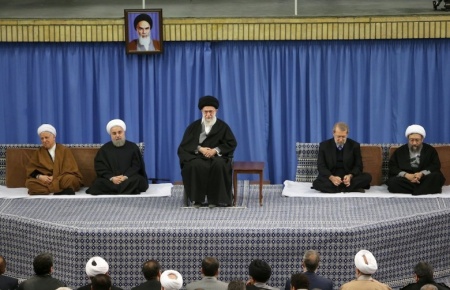
ayatollah (1)

Obscured by the drama of America’s presidential campaign, one major foreign policy issue—the future direction of the U.S. approach to Iran—is at a crossroads. President Obama stood before world leaders at the UN General Assembly in September 2013 and stated, “If we can resolve the issue of Iran’s nuclear program, that can serve as a major step down a long road towards a different relationship, one based on mutual interests and mutual respect.” Yet in the aftermath of the July 2015 nuclear accord, statements by Iran’s Supreme Leader Ali Khamenei and Iranian actions have provided little indication that U.S.-Iran relations are moving in a direction more respectful of American interests.

“It is now clear,” writes UAE Ambassador to the United States Yousef al-Otaiba, “that one year since the framework for the deal was agreed upon, Iran sees it as an opportunity to increase hostilities in the region.” Internally, executions of prisoners is at a twenty-year high. Still, the occasion of national elections in February for Iran’s parliament and Assembly of Experts—like the June 2013 election of President Hassan Rouhani—generated widespread commentary by policy experts in the United States that a process of meaningful change was at hand, as “reform” candidates outpolled their hard-line opponents in Tehran.

Testifying before the Senate on April 5, Under Secretary of State for Political Affairs Thomas Shannon asserted that “the extent to which reformers. . . swept the board” in polling for parliamentary seats in Tehran “highlights the fact that President Rouhani, and his intent on opening Iran to the world and addressing the fundamental stumbling blocks, has resonated in a positive way.” Under Secretary Shannon cited the difficulty in determining the impact of these electoral results on “how Iran behaves strategically” because, as he explained, Iran is “a mix of conflictive entities and groups, with hard-liners aligning themselves both with religious. . . and security leadership to prevent reformists from moving too fast, too far.” Part of the supreme leader’s work, said Mr. Shannon, “is to balance forces inside of Iran.”

Factionalism and jockeying for influence and position occur quite naturally in leadership ranks of democracies and dictatorships alike, including Iran. The key question Under Secretary Shannon could not answer definitively is whether regime politics would ever allow for real change in Iran’s “strategic” behavior. His remarks, however, reflected a long-standing belief by policymakers and advisors that the clerical circle in power since the 1979 revolution is capable of empowering political stewards who are inclined to reform Iran and fulfill President Obama’s hopeful vision, reciprocating his administration’s solicitude and forbearance toward Tehran.

Decades of Chasing the Elusive Promise of Reform

U.S. policymakers have experienced cycles of hope and disappointment with Tehran. After being singed by scandal in the mid-1980s, when President Reagan’s arms-for-hostages dealings were exposed, U.S. officials anticipated positive change in Iran when Akbar Hashemi Rafsanjani gained the presidency in 1990 with the promise of rebuilding an economy weakened after eight years of war with Iraq. However, terror attacks in Germany and Argentina ensued, along with assassinations of exiled regime opponents, tied directly to Rafsanjani and Khamenei. The June 25, 1996, bombing of Khobar Towers in Saudi Arabia killed nineteen U.S. airmen, as the Clinton administration maintained a “dual containment” approach toward both Iran and Iraq, backed by mounting sanctions.

When Mohammad Khatami took office as president in 1997 and proposed a “Dialogue of Civilizations,” again Washington judged that he was a reasonable interlocutor signaling a departure from Iran’s pattern of repression at home and terrorism abroad. The wave of domestic oppression that followed, including what came to be known as the “chain murders” of dissidents by Iran’s intelligence ministry, appeared to many as a hard-line reaction to Khatami’s agenda; nevertheless, for the Iranian people, hopes for reform under Khatami gave way to “fears of darker times ahead.”

Not even the fact that Iran’s nuclear program advanced dramatically in secret under President Khatami would shake Washington’s durable conviction that progressive elements within the Tehran ruling elite might one day ascend to power, as keen to see Iran adhere to international norms and uphold universal rights as are Western governments and citizens.

Listening to most Iran analysts at policy gatherings in Washington, two themes will be apparent. First, any mention of Iran’s status as the leading state sponsor of terrorism, its domestic human rights abuses or the destructive activities of the Islamic Revolutionary Guard Corps (IRGC), including its elite Quds Force, will be at once acknowledged and dismissed with a figurative hand-wave. This is old news; Iran has for years been sanctioned over it. Since there is no new story here, only unenlightened warmongers would harp on these aspects of Iranian affairs which, while condemnable, only stifle consideration of the possibilities for U.S. policy with Iran looking forward.

Second, the topic that animates the policy cognoscenti, and comports with the aspirations of the Obama White House, is the dynamic ebb-and-flow of political factions competing within Iranian leadership circles: “principlists” versus “reformers,” “conservatives” versus “moderates,” the hard-line Khamenei group versus the Rafsanjani group that seeks to integrate Iran more with the outside world. At a time when America’s own presidential election process has featured candidates channeling popular discontent toward the country’s political and economic elites, media coverage of Iran’s most recent elections—encouraged by the administration’s own rhetoric—has amplified the theme of grassroots rebellion at the polls. Given the lack of details reported about Iran’s managed electoral process, the average American would be forgiven for assuming that 79 million Iranian citizens were freely exercising popular sovereignty.

Iran’s wrongful behavior, other than actions seen as possible violations of the Joint Comprehensive Plan of Action (JCPOA), is reported, but not debated, as the policy community seems devoid of confidence that it could constructively influence the regime organs overseeing terrorism, paramilitary operations, judicial abuse, monopoly control of economic and financial assets, restraints on journalism, communications monitoring and censorship, arms trafficking to violent nonstate actors, propaganda and intelligence deception operations. This drumbeat of undesirable Iranian actions, now well into its fourth decade, has continued unabated despite the nuclear deal. Yet much more attention is paid to President Rouhani and Foreign Minister Mohammad Javad Zarif, the lead figures in Tehran’s diplomatic overture to the West, because they are perceived as agents of hoped-for change that might, at long last, end the negative drumbeat.

Is the administration’s hope justified or misplaced? Granted that factions rise and fall inside Iran’s clerical elite, the implications of these dynamics, like so much of Iran’s post-1979 history, offer reasonable grounds for debate. Debate is needed, as President Obama presented his diplomatic project with Iran last year as a fait accompli, accusing any detractors of courting war. Is it impolitic to suggest that neither Supreme Leader Ali Khamenei nor former president Rafsanjani would press their rival tendencies within the governing structure to the point of empowering other political forces and destabilizing the regime’s collective hold on power in Iran? Where has the case been made that clerical “reformers” will effect strategically significant change?

The central policy issue—how meaningful change in Iran can occur—has not been seriously explored. The administration’s and its supporters’ energies have largely been directed toward defending the JCPOA against political critics whose knowledge of Iranian affairs they regard as inferior. A top advisor to President Obama has recently admitted that the administration’s narrative “of a new political reality in Iran, which came about because of elections that brought moderates to power in that country. . .  was largely manufactured for the purpose for [sic] selling the deal.”

Nevertheless, by underscoring reformist challenges to the conservative order and touting electoral “upsets,” policy experts are acknowledging differences within the regime, and tensions between government and governed in Iran. What direction and scenario should the United States wish to see unfold from here? With the U.S. presidency transitioning in 2017, a proper understanding of the Tehran regime’s challenges, priorities and choices is needed now as the predicate to a realistic, principled and forward-looking “post-JCPOA” Iran policy.

Overlooked Clues from the Regime’s History

Americans of a certain age are familiar with scenes reported from Iran since 1979, where crowds gathered to chant “Death to America”; news in recent years has signaled the existence of dissent against the status quo, manifested in the rise and suppression of the Green uprising during the June 2009 elections, and the popular demonstrations against election fraud that followed, during which twenty-six-year-old philosophy student Neda Agha-Soltan was shot to death in the streets of Tehran by regime enforcers. But the reality behind these and other political events merits closer examination.

In a system where political authority is permanent and nonnegotiable, the narrative of both current and past events is vigilantly managed by the rulers, as an essential tool of regime survival. What with Foreign Minister Zarif’s artful appeals to Western opinion in which he proclaims Iran’s peaceful intent and devotion to international law, and laments its unfair victimization by “threats, sanctions and demonization” by the United States in particular, one can only imagine what effect thirty-seven years of managed media have had on the population, the penetration of internet and satellite television notwithstanding.

In Iran today, where the loyalty of aspirants to political office is closely monitored and overt dissent is severely punished, there is no credible measurement of the population’s true level of attachment to, or desire to be rid of, the constitutional caliphate fashioned in 1979 by Ayatollah Khomeini. Khomeini’s fusing of politics and religion via a new constitution codifying a “guardianship of the Islamic jurist” (velayat-e faqih) drew upon the religious devotion of Iran’s Muslims as the basis for his exercise of temporal power. For many Iranians at the time, Muslims included, religious dictatorship was a far cry from the participatory democracy they had anticipated after enduring the excesses of the shah.

Confronted with growing resistance in the spring of 1981 to the restrictive new order that culminated in massive pro-democracy demonstrations across the country invoked by MEK leader Massoud Rajavi on June 20—twenty-eight years to the day before Neda famously met her death under similar circumstances—Khomeini’s reign was secured at gunpoint with brute force, driving Iran’s first and only freely elected president, Abolhassan Bani-Sadr, underground and into permanent exile. This fateful episode was described by historian Ervand Abrahamian as a “reign of terror”; Professor Marvin Zonis called it “a campaign of mass slaughter.”

President Obama, reflecting a view common among analysts and journalists in America, has made imprecise reference to “the theocrats who overthrew the Shah.” The reality is that in the late 1970s the shah lost his mandate with many segments of the Iranian population, and his departure sparked a dramatic outburst of electoral competition, even while Khomeini was requiring office seekers to accept his constitutional formula, elevating religious authority over all politics. As the incompatibility of democratic principles with velayat-e faqih became increasingly evident, the regime was, as Professor Abrahamian described it, “clearly. . . losing control in the streets.” What Iranians today know all too well, and Americans would profit by better understanding, is that the “theocrats” secured control of Iran not by bringing down the shah, but by bringing down the revolution.

It is not the only historical misperception that has stood uncorrected. Speculation has surrounded the Obama administration’s Iran diplomacy that some kind of gesture by the United States—if not an outright apology, then an acknowledgement of past mistakes—would be extended as atonement for the CIA coup that deposed nationalist Prime Minister Mohammad Mossadegh in 1953. Indeed, Tehran has repeatedly demanded it. Yet, for historical justice to be served, a representative of the supreme leader would need to affix his signature to any such mea culpa alongside that of the president’s representative, reflecting the fact that the leading clerics at the time, including Khomeini’s mentor Ayatollah Abol-Ghasem Kashani, openly colluded with the Pahlavi dynasty and backed the ouster of Mossadegh.

Kashani later pronounced Mossadegh guilty of betraying the jihad, and said he deserved the death penalty. Khomeini himself expressed satisfaction with Mossadegh’s downfall. Here again, the clerics have airbrushed their place in Iran’s turbulent political evolution for the West’s edification.

June 1981—a cataclysmic event in Iran’s modern political history, second only perhaps to the shah’s demise—is relevant to understanding why the clerics responded with deadly force to the challenge of the Green uprising and the return of citizens to the streets en masse in 2009, demanding democratic accountability. Nor was the closed (and rigged) electoral process the only longstanding source of disaffection: Khomeini’s fundamentalist forces early on had targeted Iran’s universities with their “cultural revolution” to suppress mainly leftist critics, whose appeal among students and intellectuals further highlighted their lack of political legitimacy.

Despite their comprehensive efforts to silence intellectual dissent, the torch of antiauthoritarian resistance carried through the 1980s to the next generation, resurfacing in public protests during July of 1999. People took to the streets after regime forces closed a student paper and violently attacked a dormitory at Tehran University, reportedly throwing students from windows.

Fear of the “street,” consequently, was almost certainly a central consideration behind Iran’s costly (and continuing) intervention in Syria after pro-democracy Arab Spring demonstrations first arose there in 2011. More than any other partisan in the Syria conflict, Iran is credited with keeping a minority secular dictatorship in power, in defiance of President Obama’s vow that Bashar al-Assad must go, a determined if ill-equipped Syrian resistance, and UN-backed efforts to foster a national reconciliation process entailing a transition to new leadership.

Similarly in Iraq, the Quds Force’s active direction of client Shia parties and militias, reported to be “carrying out kidnappings and murders and restricting the movement of Sunni Arab civilians,” has impeded that country’s efforts toward a functioning multiethnic constitutional system, and further imperiled Iraq’s fragile national unity.

Islamic State may be a concern to Iran, but successful, multiethnic constitutional republics replacing the Baathist dictatorships in Syria and Iraq would be a much greater concern. For Tehran, the potential that an eastward-spreading Arab Spring could ignite a new Persian Spring was, and remains, a constant danger to the Islamic Republic’s grip on the reins of power, to be prevented at all costs.

The deficit of legitimacy underlying the mullahs’ claim to power remains a blind spot in Washington’s collective understanding of the Iranian revolution, overlooked in the wake of the hostage crisis. It may account for the absence of critical thinking to challenge, for example, the regime’s narrative of its eight-year war with Saddam Hussein’s Iraq, never questioning why Khomeini, after regaining by mid-1982 all the Iranian territory seized by Iraq in 1980, prosecuted the war for six more years, during which Iran suffered 90 percent of its casualties and depleted its economy.

Just as the seizure of the U.S. embassy in 1979 had empowered the clerics against contending political forces, the war with Iraq provided the supreme leader with an emergency mandate to crush growing internal dissent, impose religious and cultural requirements, and appropriate all necessary resources to assure the regime’s primacy and control. While every Iranian schoolchild and adult throughout the 1980s was fed the jingoistic line justifying these extreme sacrifices, Khomeini’s role in perpetuating the war is by no means universally recalled by Iranians in a favorable light.

A similar lack of skepticism has left U.S. policymakers with no insight as to why a hojatoleslam—a cleric with religious status well below others at the time—belatedly became Khomeini’s chosen successor as supreme leader rather than the broadly respected Grand Ayatollah Hossein Ali Montazeri; no benign explanation as to why Iran would choose to pursue major nuclear infrastructure investments instead of far more accessible and cost-effective energy options, given its meager national uranium supplies; and no reflection on whether considerations other than sanctions-induced financial duress may have led Iran to the P5+1 negotiating table.

Similarly, one saw no speculation in Washington that factors other than personal legal transgressions could have lain behind the arrest and imprisonment of the Washington Post’s correspondent Jason Rezaian—or curiosity about what the regime hoped to hide by deterring Western correspondents from seeking visas to report from Iran at that time. A clue may be found in the emerging story of another U.S. hostage, former CIA contractor Robert Levinson (still held by Iran), whom the Iranians reportedly offered via the French government in 2011 to release in exchange for conclusions, in a pending IAEA report, that Iran’s nuclear program was “peaceful” in nature.

This credulous U.S. approach to Iranian affairs has not been helped by what might delicately be termed self-censorship on the part of Western correspondents and media companies, who know they would be shut out of Iran if their reporting sufficiently displeased the regime. For too long, U.S. policy has reacted to Iranian government actions and words without a credible functional understanding of the nature of this important international actor.

The Regime’s “Job One”: Maintain Control

During the regime’s formative years, the man who would in 1989 succeed Khomeini as supreme leader, Ali Khamenei, worked in partnership with Rafsanjani to implement Khomeini’s doctrine of bast (expansion) and hefz (preservation), the two facets assuring continuity of the Islamic revolution. Their work was at the center of Khomeini’s velayat-e faqih project. While both figures are today identified with conflicting political tendencies and loyalists, the larger reality is that bast and hefz remain core tenets of the Islamic Republic of Iran.

What Washington describes in straight factual terms—destabilization of neighboring countries, propping up a dictator in Damascus guilty of grave crimes against his country, arming extremist nonstate actors, fomenting sectarian warfare that undermines Iraq’s fragile hopes for rights-based governance—the clerics in Tehran call bast. The revolution, said Khomeini, requires energetic efforts to advance Tehran’s agenda well beyond the country’s borders.

Similarly, the surreptitious and aggressive buildup at home of Iran’s uranium enrichment capacity, and associated “possible military dimensions” of its nuclear program, combined with widely condemned and worsening human rights abuses, restrictions on journalists, monitoring and propaganda imposed within the information space, and seizure of control over much of the functioning economy—all these and other domestic measures fulfill the doctrine of hefz. To stay in power, the regime must monopolize the levers of power within the country.

As two of the original officers of the velayat-e faqih operation from the outset of Ayatollah Khomeini’s tenure, Ali Khamenei and Hashemi Rafsanjani understood, as few others did, the dynamic nature of the revolutionary enterprise. Both recognized that the Islamic Republic would not long survive without continually demanding respect and pursuing influence externally while requiring sacrifice and enforcing subservience internally. In 1989, after Ali Khamenei succeeded Khomeini, Rafsanjani worked in partnership with the new supreme leader to enhance the authority of the office as compensation for his lack of religious and political stature and charisma.

The velayat-e faqih has always operated on two fronts. Domestically, it maintains a focus on image-building propaganda for the leader of the revolution, ever promoting the stature of its “heroic” godfather, Ayatollah Khomeini. Propaganda is used to rally and unify the Revolutionary Guards, mobilize paramilitary forces such as the Basij for public crackdowns, and organize the religious sector across the nation for Friday prayers in accordance with prescribed policy themes.

Internationally, the office sustains the narrative of leadership over Shia Muslims around the region, and the Islamic world generally. Khomeini’s mantra that the new Islamic republic would conquer “Quds via Karbala” makes clear that he set out to create a dominion of influence unbounded by Iran’s borders. As the embodiment of the Twelfth Imam succeeding the Prophet Muhammad, Iran’s Supreme Leader poses a challenge to the Sunni world, asserting its own claim to Islam’s most holy sites in defiance of the Saudi king (“Guardian of the Two Holy Mosques” at Mecca and Medina) and the Hashemites of Jordan, who trace their lineage to the Prophet and are considered the overseers of the Al Aqsa mosque in Quds (Jerusalem), Islam’s third holiest site.

In both its internal and external dimensions, the revolutionary project spawned by Khomeini has confounded Western efforts to understand it, and thus to engage diplomatically with confidence in a predictable outcome. Why did the clerical regime from its earliest years, consumed with extinguishing democratic impulses at home and repelling Iraq’s incursions on their shared border, repeatedly target U.S. and European forces, embassies, hostages and airline passengers, starting in Lebanon? What was the purpose of arming and supporting proxy nonstate militias abroad and staging spectacular acts of terror as far afield as Argentina?

While Iran’s abuse of sovereign privilege—running terror operations under the cover of diplomatic secrecy and immunity in such capitals as Ankara, Damascus, Bonn and Buenos Aires—has long branded it a serial violator of international law and norms, these hostile acts abroad are better understood for their intended effect on regime cohesion and the loyalty of its footsoldiers, as manifestations of Khomeini’s bast doctrine, his unique theory of empowerment through religious extremism, pursued at the direct expense of the Westphalian system.

The one goal the international community has sought in all its dealings with Tehran—a readiness to adhere to accepted norms of state conduct, including respect for universally recognized rights at home—is the very condition that the Islamic Republic of Iran could least tolerate. The acceleration of both bast and hefz since 2013 under President Rouhani, at the same time that Iran was garnering international goodwill, relief from economic sanctions and legal recognition of its nuclear rights at the negotiating table, may have been a response to popular discontent inside Iran. It was not, however, a move toward any version of reform that would comport with American principles or ideals.

Signs of Failure and Desperation

A compelling case can be made, and should be the subject of policy debate today, that Iran’s exertions around the Middle East are falling well short of Khomeini’s doctrinal requirements calling for export of its revolution and leadership of the Muslim world against the West, particularly the United States. In 2016, much of the Muslim world rejects Iran’s brand of revolution. Even the fifty-seven-member Organization of Islamic Cooperation has formally “deplored Iran’s interference in the internal affairs of the States of the region and other member states. . . and its continued support for terrorism.”

With the exceptions of Syria’s secular dictatorship and some Shia factions in Iraq, states surrounding Iran continue to defy and resist Tehran’s pretensions of religious hegemony. Tehran’s overt attempts to influence Shia populations within Arab Gulf states have only served to poison relations with those governments, which to date have refrained from reciprocal meddling on behalf of 18 million Sunni Iranians, to whom the mullahs have denied a single mosque. Influential Shia figures, including Ayatollah Sistani in Iraq, refuse to accept the system of velayat-e faqih or endorse Khamenei’s leadership among Muslims. Iran’s funding, training and sponsoring of warring factions in Iraq, Syria, Yemen and Afghanistan could as rightfully be assessed a losing as a winning effort by the regime’s own metrics.

The costs of these campaigns, particularly casualties suffered by the IRGC and the Quds Force, which have struggled to replenish their ranks and their leadership cadres from today’s young generation, would likely prove unsustainable over time. Recent losses reportedly suffered by the IRGC along the Iran-Iraq border, and claims by the Democratic Party of Iranian Kurdistan and the Kurdistan Freedom Party that they have recently resumed “armed resistance” against the revolutionary republic, reinforce perceptions that the momentum of the ambitious crusade launched thirty-seven years ago by Khomeini is now in retreat.

The supreme leader’s office has therefore viewed the nuclear weapons program as a game-changing substitute for Tehran’s unproductive paramilitary efforts—hence Khamenei’s denial (without further explanation) that the JCPOA leaves Iran stripped of nuclear deterrence. In recent years his office has lauded the “jihad spirit” of Iran’s nuclear scientists in their drive to stand up to foreign powers “like a lion.” He earlier declared the program an essential aspect of Iran’s “national identity” and “dignity,” all part of a narrative intended to compensate for, and obscure, Khamenei’s diminishing power at home and in the region.

Recall that the nuclear program began during Rafsanjani’s presidency; it was institutionalized during Khatami’s time, and expanded to a multitrack program during Ahmadinejad’s presidency. Whatever Washington analysts may believe about the June 2013 elections, the clerics made clear months beforehand that they would “engineer” the electoral process to succeed Ahmadinejad. Khamenei’s expectation of his one-time nuclear negotiator, Hassan Rouhani, was that he would deliver the program despite all the external and internal pressures.

Rouhani’s pursuit of a nuclear deal entailing sanctions relief, far from representing a policy split from Khamenei’s embrace of the nuclear program, was done with the supreme leader’s full support. While the P5+1 secured arrangements to inhibit and detect any near-term nuclear weapons breakout efforts by Iran, the many statements by Khamenei are consistent with the conclusion that Rouhani’s diplomatic approach was deemed more likely to enable the Islamic Republic to maintain the posture of nuclear deterrence than a policy of escalating confrontation and defiance of the West.

Two years of high diplomacy—extended repeatedly without complaint from any side, despite the absence of agreement—by the regime, sharing the global spotlight with the world’s leading powers, rehabilitated Iran’s image after a period of growing isolation, threats of military confrontation and, yes, economic pain from targeted sanctions, falling oil prices and a weakening currency in 2012. Such considerations lay behind Iran’s success in shaping the JCPOA as a nonbinding agreement in which the language and process to enable the “snap-back” of sanctions is convoluted—the term never appears—and thus hard to portray within Iran as a concession.

At the same time he was calling publicly for “heroic flexibility” in Iran’s foreign policy, Khamenei clearly intended that Rouhani and Iran’s negotiators secure the maximum flexibility to continue the militarization of the nuclear program, including ballistic missile development, as was seen with the March 2016 missile tests. While the United States responded by sanctioning the IRGC Aerospace and Missile Force, and Secretary Kerry suggested a new arrangement with Iran to address concerns about the missile tests, Foreign Minister Zarif called his complaints “baseless”; Defense Minister Hossein Dehghan called them “nonsense.” The commander of the missile force claimed that the U.S. government had quietly urged Iran not to publicize its missile tests, presumably to avoid complicating the larger relationship.

Regime Preservation or Change from Within?

If Iran’s strategic behavior, in Under Secretary Shannon’s parlance, is not fundamentally different under either hard-line or “reformist” management, what to make of the factional differences within the regime? Khamenei’s focus has been on hefz and the sustainment of Iran’s nuclear and conventional military modernization programs. For self-proclaimed reformers, including Rouhani and Rafsanjani, the priority order is the reverse. Their view is that by easing international sanctions they can better defuse the public’s push for meaningful political reform and thereby preserve the system of velayat-e faqih.

Rouhani, like Khatami before him, has pledged domestic reform yet presided over repression. Even his explicit 2013 pledge, to release from house arrest the leaders of the Green uprising and all who were imprisoned following the 2009 protests within one year, has gone unfulfilled years later. While the regime’s internal fissures may inspire hope in the West for positive change, the evidence for that is lacking.

The perennial perception in the U.S. policy community that “reformist” equates to true moderation is belied by, for example, “reformist” Mohammad Khatami’s role as minister of Islamic Culture and Guidance early in the Iran-Iraq War, when he generated propaganda to recruit children to sacrifice themselves by crossing minefields ahead of military forces. An estimated forty thousand died. Despite worldwide condemnation of this practice, Khatami as recently as 2007 lauded the wartime role of youth in “the proud years of the Sacred Defense.” The use of child soldiers by Tehran has now apparently been revived by his “reformist” successor Hassan Rouhani.

For all the talk about reform and betterment of the people’s lot, in Iran today one finds no equivalent to glasnost or perestroika, no clerical Deng Xiaoping ready to strike a grand bargain freeing the people economically and socially in return for continued political subservience to the supreme leader.

The relevant fault line within Iran’s leadership, for many years now, has been a difference over how best to carry forward Khomeini’s Islamic republic, not how to end it. Differences in regime priorities manifested themselves in the recent parliamentary elections, and more factionalism and clashing rhetoric is predictable in the political arena. Still, as competition over priorities and tactics to preserve velayat-e faqih has become personal—and public—for both sides over the years, and some individuals have shifted alliances and rebranded themselves, the roster of leading players has remained strikingly consistent.

While many have moved seamlessly between so-called reformist and conservative patronage, the driving motive seems less to be ideology than competition for resources and leverage. Even such proven supporters of velayat-e faqih as the five Larijani brothers, who rose to positions of influence within the parliament, Guardian Council, judiciary, broadcasting (IRIB) and foreign ministry, are viewed with suspicion by Khamenei for this very reason.

Khamenei has survived by surrounding himself with a small and shrinking circle of trusted advisors, including his own son Mojtaba, who leads the Basij and oversees all his financial affairs operating beyond the reach of sanctions. Some have speculated that Mojtaba is being groomed to become his father’s successor, suggesting Khamenei’s misgivings about Khomeini’s own mechanism for leadership transition.

Ali Akbar Velayati, serving as his foreign-affairs advisor, once served under Prime Minister Mir Hossein Mousavi (the now-detained leader of the Green uprising) and Hashemi Rafsanjani. Yahya Safavi, head of the IRGC, serves as his special advisor in regional affairs and has recently touted the “alliance” of Iran, Russia, Iraq, Syria and Hezbollah. Mojtaba Zolnour also serves as his representative in the IRGC, and has recently claimed that even if Iran were to give up its nuclear program, it would not weaken “this country’s determination to destroy Israel.” Mohammad Salimi, formerly defense minister in the cabinet of Mir Hossein Mousavi, now serves as his commander of the Iranian Army.

As much as regime figures may jostle for primacy and influence over Iranian policy, all are charter members of an enterprise whose overriding mission is their collective survival in power. What recent trends reveal is that the supreme leader’s diminishing power is accompanied by, and likely further eroded by, the more open rivalries at play in Tehran.

How to Reform the Islamic Republic?

It may seem exhausting for the U.S. foreign-policy establishment, having devoted so much effort to closing off Iran’s “pathways to the bomb,” to be expected now to address an array of additional concerns about Iran, from political disenfranchisement to human-rights abuses, suppression of women and minorities, destabilization of neighboring countries, and support for terrorism. The list is long, and Washington’s record of tempering Tehran’s malignant behavior offers little grounds for optimism.

What makes these concerns more pertinent today is not the closing off of Iran’s illicit pathways to the bomb under the JCPOA, but the opening up of a new pathway to the bomb courtesy of the JCPOA itself: the right granted to Iran to become an internationally recognized nuclear power when the agreement’s restraints expire. Secretary Kerry emphasizes how far into the future that time will be. Can the United States be certain that the regime in Tehran will have “reformed” by then? And—crucially—what changes from today’s Iran would constitute “reform”?

If one were to poll experts on how the United States should measure reform in Iran, a consensus would likely be elusive. Ending the loyalty screening and disqualification by the Guardian Council of candidates for office would be an obvious metric; yet it has been more than two decades since the percentage of registered candidates ultimately permitted to run for president has exceeded 2 percent. Even with Rafsanjani’s two electoral victories, in 1989 and 1993, more than 96 percent of registered candidates were disqualified in advance.

Certainly a sharp reduction, and preferably the end, of executions in Iran would herald reform; yet here again, one has to question the likelihood of meaningful change. The State Department’s 2015 annual human rights report, released in April 2016, cites a long list of human rights abuses in Iran, noting that “Impunity remained pervasive throughout all levels of the government and security forces.” President Rouhani, upon being elected in 2013, nominated as his justice minister Mostafa Pour Mohammadi, a man personally implicated in the 1988 extrajudicial executions of as many as thirty thousand jailed dissidents. This was a crime “of greater infamy,” according to British-Australian human rights lawyer Geoffrey Robertson, whose 2009 inquiry brought the full story to light, than the World War II Japanese death marches or the 1995 Srebrenica genocide.

While a serious debate is needed on U.S. policy toward this troublesome, and troubled, regime, there is one act that more than any other would signal to the West, Iran’s neighbors and above all its 79 million citizens that reform is at hand. Iran’s rulers need to face the inescapable truth that in their quest to be at once a religious caliphate and a sovereign country, they have failed in both roles.

By removing from the constitution the writ of divine power—velayat-e faqih—that has corrupted both politics and religion in Iran with immeasurable human costs, the clerics can focus on repairing their religious reputation and return the revolution to its rightful owners, the Iranian people. The world will reward Iran for a national effort to pursue reconciliation without recrimination, a social contract enabling freely elected leaders to reflect the goodness of a great people. In time, an Iran so reformed will recover, and assume a position of honor and responsibility among nations.

Ambassador Lincoln Bloomfield Jr., a former U.S. defense and foreign policy official now serving as Chairman of the Stimson Center in Washington, has written and testified about the inaccuracies of narratives emanating from the regime in Iran. Dr. Ramesh Sepehrrad is a ranking executive for a major American technology company and a Scholar Practitioner at the George Mason University School of Conflict Analysis and Resolution. Her parents and sister were arrested by the fundamentalist regime in Iran during the 1980s for helping to publish pro-democracy literature; detained at the age of fourteen, her sister was kept in prison for two years.

Can US, Turkey keep up appearances in Syria?

May 30, 2016

Can US, Turkey keep up appearances in Syria? Al-Monitor, May 29, 2016

A terrorist group linked to the Islamic State (IS) claimed responsibility for suicide bombings in Tartus and Jableh in Syria on May 23 that killed more than 150 civilians and wounded more than 200 others. Maxim Suchkov points out that the attack in Tartus occurred deep inside government-controlled territory. Russia maintains a naval base in Tartus and an air base and reconnaissance center in Khmeimim in the Latakia region. The suicide attacks, Suchkov suggests, could be a catalyst for a Russian “first strike” strategy against terrorist and aligned Salafi groups.

Moscow had already signaled the prospect of escalation against Jabhat al-Nusra and allied groups prior to the May 23 attacks. The Russian Ministry of Defense has announced a pause in its air campaign to allow armed groups allied with Jabhat-al Nusra to distance themselves from the al-Qaeda affiliate. On May 26, Jabhat al-Nusra, Ahrar al-Sham and allied groups seized the town of Dirkhabiyah near Damascus. Ahrar al-Sham has coordinated more closely with Jabhat al-Nusra in response to increased US and Russian targeting of the al-Qaeda affiliate over the past few months.

This column last week suggested that the United States take up a Russian offer to coordinate attacks on Jabhat al-Nusra, which is not a party to the cessation of hostilities. For the record, we have no tolerance or empathy for groups or individuals who stand with al-Qaeda. We hope that this is at least part of the message the United States is conveying to its regional partners who have backed these groups.

With the Geneva talks suspended for several weeks, the prospect of a Russian campaign to deliver heavy and potentially fatal blows to Jabhat al-Nusra and its allies, especially in and around Aleppo and Idlib, could signal yet another turning point in the Syria conflict.

Turkey’s failed proxy war

The United States and Turkey are struggling to keep up appearances in Syria, despite even further signs of division and discord.

Gen. Joseph Votel, US CENTCOM commander, met last week with Syrian Kurdish forces during a “secret” visit to northern Syria as part of a regional diplomatic tour that also included a stop in Ankara. Votel told Washington Post columnist David Ignatius that he is seeking to “balance” Turkey’s role as a “fabulous” partner in the battle against IS with that of the People’s Protection Units (YPG), the backbone of the Syrian Defense Forces (SDF), which is a “very good partner on the ground.”

In contrast to the YPG, Turkey’s proxy forces, including a worrying mix of Salafists who are willing to run operations with Jabhat al-Nusra, have been a flop. Last week, IS seized at least seven villages in the northern Aleppo region.

Fehim Tastekin reports that SDF-led military operations to liberate Jarablus, which is an essential gateway along with al-Rai to the outside world via Turkey, were postponed “because of Turkey’s red line against the Kurds.” The offensive against Raqqa has also been slowed, writes Tastekin, because “the SDF’s operational capacity still leaves much to be desired. It is not an option for the Kurdish YPG-YPJ to control Raqqa, because they will encounter local resistance. They also worry that scattering their forces in Arab regions could weaken the defensive lines of Rojava (Syrian Kurdistan). Therefore, Arab forces would have to get in shape to control the situation in the post-IS period.” Laura Rozen reports from Washington that the United States is seeking to boost the numbers of Arab Sunni forces among the SDF in anticipation of an advance on Raqqa.

Meanwhile, the Pentagon found itself in a public relations fiasco after Turkey complained that US special forces in Syria were wearing badges with the logo of the YPG, which Turkey considers the Syrian partner of the Kurdistan Workers Party (PKK) and therefore also a terrorist organization. This might be compared with what in the sports world is known as an unforced error, and made Votel’s already daunting diplomacy that much more complicated.

Air Force Col. Sean McCarthy also told Ignatius that US air operations against IS out of Incirlik Air Base were mostly “autonomous” of Turkish missions, saying that “we don’t discuss with them where we’re going.”

Adding it all up, the US-Turkish “partnership” against IS may be more fable than fabulous. The open secret is that Turkey is preoccupied first with thwarting advances by Syria’s Kurds, and second with shutting down the remaining lifelines for IS in northern Syria. These priorities are of a piece. No doubt Turkey is taking up the fight against IS, but first things first. Tastekin, who previously broke the back story on Turkey’s disastrous proxy efforts to retake al-Rai from IS in April, now concludes that “there is no room for optimism that Ankara will erase its red lines vis-a-vis the Kurds. Instead, Turkey is now trying to put together an even more formidable force with Jabhat al-Nusra, which it is trying to steer away from al-Qaeda.”

The catch might just be that many of the Syrian armed groups backed by Washington’s regional partners are proxies for a sectarian agenda that is mostly about toppling Syrian President Bashar al-Assad, however unlikely that now appears, and, by extension, keeping the heat on Iran. The when and where of taking the fight to IS or Jabhat al-Nusra is more or less negotiable, depending on trade-offs and pressure. We do not feel we are out on a limb in suggesting that efforts by Ankara or others to wean Jabhat al-Nusra from al-Qaeda will come to no good. This column has repeatedly documented the fluidity of foreign-backed Salafi groups such as Ahrar al-Sham and Jaish al-Islam shifting in and out of tactical alliances with Jabhat al-Nusra, all the while preaching an ideology almost indistinguishable from al-Qaeda and IS.

The losers, of course, are the people of Syria, including those who suffer under IS’ tyranny that much longer because of Turkey’s concerns about the Kurds, and as Washington’s policymakers and pundits begin another maddening deep dive into how to rejigger ethnic and sectarian fault lines. Syrians fleeing IS terror in Aleppo, meanwhile, told Mohammed al-Khatieb that living under IS is “like hell … unbearable.” While we acknowledge the complexities and challenges of the raw ethnic and sectarian politics of Syria, as well as the potential for vendettas and mass killings, there is, in our score, an urgency and priority to focus on the destruction of IS and al-Qaeda above all else.

Sur’s aftermath

Diyarbakir’s historic district of Sur has witnessed some of the most brutal fighting between Turkish military and PKK forces over the past year. Mahmut Bozarslan reports from Diyarbakir that “historical landmarks in Sur, which was last year added to UNESCO’s World Heritage List, also suffered their share of destruction. The walls of the Armenian Catholic church are partially destroyed, while the nearby Haci Hamit Mosque is missing its minaret, with a dome riddled with bullets. Another Armenian church, Surp Giragos, had its windows shattered and interior damaged.”

“Still, those ancient monuments were lucky compared with more ordinary structures in the area,” writes Bozarslan. “A building with an intact door was almost impossible to find. The warring parties had used some buildings as fighting bases, others as places to rest. Stairways were littered with empty tins; one was also stained with blood. At the bloodied spot, a piece of paper reading “body #1” was left behind, suggesting that the security forces had been there for a crime scene report. A couple seemed relieved that they had escaped with relatively little damage, but grumbled that their apartment had been broken into, with the bedroom and closets rummaged. They claimed it was the security forces who had entered, while their neighbor showed Al-Monitor binoculars that had been left behind.”

Analysis: Iran has supported the Taliban’s insurgency since late 2001

May 29, 2016

Analysis: Iran has supported the Taliban’s insurgency since late 2001, Long War Journal, , May 29, 2016

Joint Task Force – Guantanamo (JTF-GTMO), which oversees the detention facility, deemed Khairkhwa a “high” risk to the U.S. and its allies, in part, because of his dealings with the Iranians. Despite JTF-GTMO’s assessment, and the DC court’s rejection of his habeas petition, Khairkhwa was transferred to Qatar in 2014. He was one of the five Taliban commanders exchanged for Sgt. Bowe Bergdahl.

**********************

On May 21, an American drone strike ended Mullah Akhtar Mohammad Mansour’s reign as the Taliban’s leader. As The Wall Street Journal first reported, US intelligence officials tracked Mansour to Iran, where he was visiting his family, and then targeted his car as he crossed back over the border into Pakistan. Iran’s foreign ministry spokesman, Hossein Jaber Ansari, quickly denied this version of events, claiming that his country “welcomes any measure in line with bringing peace and stability to Afghanistan.”

However, Zabihullah Mujahid (the Taliban’s chief spokesman) has conceded that Mansour was indeed inside Iran. Dawn quotes Mujahid as saying the Taliban chief crossed the border because of “ongoing battle obligations,” adding that Mansour made multiple “unofficial trips” to Iran.

While many of the details concerning Mansour’s travels remain murky, his presence inside Iranian territory shortly before his death isn’t surprising. Iran has a long history of backing the Taliban’s insurgency against US and allied forces in Afghanistan. Indeed, the relationship between the two former foes is one of the most misunderstood and oft-overlooked aspects of the 9/11 wars.

Iran and the Taliban nearly went to war in 1998 after senior Taliban commanders slaughtered Iranian diplomats and other Shiites in Mazar-i-Sharif. But by late 2001, as the Americans prepared to topple the Taliban’s government, the situation changed dramatically. Outwardly, the Iranians acted as if they just wanted to help rebuild Afghanistan. Western diplomats have praised Iran for its role in the Dec. 2001 meetings in Bonn, Germany, where a post-Taliban government was established. But there is much more to this story. Just before the American-led invasion of Afghanistan two months earlier, the Iranians cut a secret deal with Mullah Omar’s representatives.

One of Omar’s most trusted lieutenants, Khairullah Khairkhwa, helped broker an agreement with the Iranians in Oct. 2001. We know this because Khairkhwa was captured in Pakistan in early 2002, transferred to Guantanamo and then told American officials all about it.

A district court in Washington, DC denied Khairkhwa’s petition for a writ of habeas corpus in 2011. The court found that Khairkhwa “repeatedly admitted” that after the 9/11 attacks “he served as a member of a Taliban envoy that met clandestinely with senior Iranian officials to discuss Iran’s offer to provide the Taliban with weapons and other military support in anticipation of imminent hostilities with U.S. coalition forces.” [SeeLWJ report, DC district court denies former Taliban governor’s habeas petition.]

According to the court, the Iranians told Khairkhwa and his Taliban delegation that they could provide shoulder-fired missiles (SAM-7’s) and “track all movements by the United States.” In addition, the Iranians “offered to open their border to Arabs entering Afghanistan.” Iran did just that, allowing some al Qaeda members and others to escape the American onslaught.

Joint Task Force – Guantanamo (JTF-GTMO), which oversees the detention facility, deemed Khairkhwa a “high” risk to the U.S. and its allies, in part, because of his dealings with the Iranians. Despite JTF-GTMO’s assessment, and the DC court’s rejection of his habeas petition, Khairkhwa was transferred to Qatar in 2014. He was one of the five Taliban commanders exchanged for Sgt. Bowe Bergdahl.

During the twelve years Khairkhwa was detained in Cuba, Iran continued to collude with the Taliban. The Defense, State and Treasury Departments have all documented the relationship.

In its “Annual Report on [the] Military Power of Iran,” which was delivered to Congress in 2012, the Department of Defense explained that Iran’s support for the Taliban was part of its “grand strategy” to challenge “US influence.” Although there was “historic enmity” between the two sides, the Pentagon said, support for the Taliban “complements Iran’s strategy of backing many groups to maximize its influence while also undermining US and North Atlantic Treaty Organization (NATO) objectives by fomenting violence.”

“Since 2006,” the State Department noted in its Country Reports on Terrorism for 2012, “Iran has arranged arms shipments to select Taliban members, including small arms and associated ammunition, rocket propelled grenades, mortar rounds, 107mm rockets, and plastic explosives.” In 2012, the Iranians “shipped a large number of weapons to Kandahar, Afghanistan, aiming to increase its influence in this key province.”

Foggy Bottom added that the Islamic Revolutionary Guard Corps’ Quds Force (IRGC-QF) “trained Taliban elements on small unit tactics, small arms, explosives, and indirect fire weapons, such as mortars, artillery, and rockets.”

A series of Treasury Department terror designations illuminate the relationship between the IRGC-QF and the Taliban.

In August 2010, Treasury designated two IRGC-QF commanders as terrorists for providing “financial and material support to the Taliban.” A special unit in the IRGC-QF known as the Ansar Corps is responsible for orchestrating attacks in Afghanistan. Nearly two years later, in Mar. 2012, Treasury identified IRGC-QF General Gholamreza Baghbani as a narcotics trafficker. At the time, Baghbani was based in Zahedan, Iran, which is near the border with Afghanistan and Pakistan. From this strategically situated crossroads, Baghbani allegedly oversaw an operation that “moved weapons to the Taliban,” while smuggling “heroin precursor chemicals through the Iranian border” and facilitating “shipments of opium into Iran.” This guns-for-drugs scheme directly fueled the Taliban’s insurgency, according to Treasury.

Treasury wasn’t finished. In February 2014, three other IRGC-QF officials and one of their associates were designated for plotting terrorist acts in Afghanistan and also using “intelligence operations as tools of influence against” the Afghan government. Iran’s duplicitous scheme meant that the IRGC-QF was “currying favor” with some Afghan politicians while targeting other officials for assassination.

In the weeks immediately following 9/11, the Iranian regime and the Taliban met in the shadows. In the 14-plus years since, their relationship has become overt. The Wall Street Journal reported in 2012 that the Taliban has set up an office in Zahedan, which is also a well-known al Qaeda hub. Taliban officials have repeatedly and openly attended meetings in Tehran. And other sources confirm that Iran has often provided the Taliban with arms and training.

Contrary to what Ansari claims, the Iranians don’t want “peace and stability” in Afghanistan – at least not at the expense of achieving their other objectives. They want to force the US out and expand their influence. Given Iran’s enduring partnership with the Taliban, forged in the aftermath of the 9/11 attacks, Mansour’s trips to Iran may have been “unofficial,” but they are definitely unsurprising.

Lebanese ‘Al-Safir’ Daily Marks 16th Anniversary Of Israel’s Withdrawal From South Lebanon: Hizbullah Is Digging Tunnels On Israel Border

May 26, 2016

Lebanese ‘Al-Safir’ Daily Marks 16th Anniversary Of Israel’s Withdrawal From South Lebanon: Hizbullah Is Digging Tunnels On Israel Border, MEMRI, May 25, 2915

On May 25, 2016, the Lebanese daily Al-Safir, which is known for its support for Hizbullah, published a front- page article celebrating “Liberation Day,” i.e. the 16th anniversary of Israel’s withdrawal from South Lebanon. The article, which appears without a byline, analyzes the current situation of Hizbullah (which it calls “the resistance”) as well as its combative actions on the Syrian and Israeli fronts. It claims that this year’s Liberation Day celebrations are mixed with heartbreak for Hizbullah supporters, due to the large number of Hizbullah casualties in the Syria war. It adds that in its fight in Syria, Hizbullah currently faces the toughest challenge since its establishment, greater even than its conflict against Israel, because the price thus far paid by Hizbullah in this war – both in capabilities and casualties – is unprecedented, and no solution in Syria is on the horizon.

The article assesses that Hizbullah may expand its theater of operations even further in the future, in response to new challenges, and that this will turn it into a “regional power” that “formulates new equations in the region.”

Adding that alongside its fighting in Syria, Hizbullah is continuing its activity against Israel, the article also reports that resistance fighters work day and night along the Israeli border, “conducting observations, preparing, and digging tunnels that cause the settlers and enemy soldiers to lose sleep.” It also states that in fighting “tafkiri organizations,” Hizbullah has encountered an enemy that excavates tunnels, after becoming accustomed to being the only one digging them; in fact, it was Hizbullah that taught other resistance fighters, particularly Palestinians in the Gaza Strip, the tunnel doctrine.[1]

The following are excerpts from the article:[2]

28169Funeral of Hizbullah fighters killed in Syria (image: Safa.ps)

“[Since its founding], the resistance [i.e. Hizbullah] never found itself deployed on several fronts and facing more than one challenge and more than one danger at once [as is happening today]. These four years since it became involved in the war in Syria represent the greatest trial it has [ever] faced… The movement has never paid in flesh, blood and abilities as it has paid [during the Syria war] and as it may continue to pay in the future, in the open confrontation with the takfiri [groups, i.e. the groups fighting against the Assad regime in Syria].[3] [So far] over 1,000 [fighters] have died and thousands have been wounded and disabled, and many others may meet [the same fate] in the ever-expanding confrontation that is becoming more difficult and more aggressive every day. This, especially since the horizon of a political solution seems to have been eliminated for the foreseeable future.

“Amid all this comes the 16th [anniversary] of the liberation [of South Lebanon], which underscores an element that Israel cannot ignore, namely the strengthening of the security and stability equation on both sides of the Palestine-Lebanon border. [This is] thanks to the deterrence system, or more accurately the balance of terror, which is an equation that has turned South Lebanon into the most secure region in the entire Middle East. Though we must not ignore other factors, no less important, [that contribute to this security], including [UN] Resolution 1701, UNIFIL and the Lebanese army.

“The celebrations of liberty are held amid heartbreak mixed with joy. Heartbreak [at the sight of] the processions of martyrs crossing the boundary south of the Litani every day [i.e. bodies of Hizbullah fighters killed in Syria being returned to Lebanon for burial], and joy [at the sight of] the processions [of people] rejoicing over [Hizbullah’s victory in some of] the local elections [that have been held in Lebanon in recent weeks]…

“The heartbreak over the martyrs is a necessary tax [that must be paid] in the struggle, [a struggle] which the Lebanese, of all sectors, regard as existential, even though they are divided on whether the preemptive war against the terrorists outside the borders of the homeland is justified. This heartbreak is present in every home in South [Lebanon]… When Hizbullah secretary-general Hassan Nasrallah speaks at Liberation Day ceremonies [today] in the town of Al-Nabi Shayth in the Bekaa [Valley], he will be speaking to a public that has contributed to the resistance [by supporting Hizbullah’s activity in Syria] just as residents of the South have contributed [in fighting against Israel], and perhaps even more, since [Bekaa Valley residents] face a danger today on their eastern border that is just as bad as the Israeli danger.

“It is right to say that the men of resistance on the eastern border complement the mission of the first men of resistance [who operate against Israel], who work day and night [along the border, from] the last border point in Al-Naquora to [the one in] Kfar Shouba, conducting observations, preparing, and digging tunnels that cause the settlers and enemy soldiers to lose sleep. [All this they do] without abandoning the [other] tasks of the resistance, which stands ready, openly and secretly, throughout Lebanon, and especially in the Southern Dahiya, in order to prevent any terrorist attack by the takfiris, in full coordination with the Lebanese army and Lebanon’s other security apparatuses. There might be further expansion of Hizbullah’s battle front, in accordance with future challenges, and this expansion turns this Lebanese group [Hizbullah], which was established 34 years ago in Sheikh ‘Abdallah’s base in Baalbek, into a regional force that formulates new equations in the region…

“In all of its rounds of fighting with the Israeli enemy, the resistance never faced what it has been facing for years in confronting the dark [elements] armed with the Prophet Muhammad’s Koran and Sunnah, who receive funding from tyrannical regimes and innumerable intelligence apparatuses, and are armed with military [equipment] that only armies possess.”

“The resistance also never experienced a four-year war in an area several times larger than Lebanon [itself]. It never experienced [war] against groups that imitate its methods and ways of warfare, but [who] instead of blowing themselves up against an Israeli convoy terrorize innocent people in the cities and villages, without batting an eyelash, as happened in the southern Dahiya or yesterday in Tartus and Jableh.

“The resistance never experienced war against groups fighting in caves and in the hills, mountains, wadis and even deserts, as happened at Tadmor and in the rural areas of Homs and Aleppo… Before [the war with Syria], the resistance did not storm cities and did not fight armies deep in the mountains.  Before this, no one lay in wait for it in tunnels like the ones that only it used to excavate, and [the doctrine of which] it spread to the rest of the men of the resistance, particularly to the Palestinians in the Gaza Strip.

“All these have been the unique characteristics of the resistance throughout the 16 years since May 25, 2000. All these [characteristics] and others will cause Hassan Nasrallah to declare that defending the achievement of liberation will end only with the defeat of the terrorists…”

Endnotes:

[1] Regarding the issue of the tunnels, it should be noted that Ibrahim Al-Amin, chairman of the board of the Lebanese dailyAl-Akhbar, wrote in a January 13, 2014 article that Hamas members fighting in Syria, in the Al-Quseir area and other regions, had dug tunnels there, similar to the ones excavated by Hamas in Gaza. He explained that Hizbullah had taught Hamas to dig these tunnels in the days when the two organizations were cooperating in smuggling arms into Gaza and preparing military plans against Israel.

[2] Al-Safir (Lebanon), May 25, 2016.

[3] Hizbullah, like the Syrian regime, does not draw a distinction between the rebels and the Salafi-jihadi groups.

Obama’s Animus toward Israel May Lead to War

May 15, 2016

Obama’s Animus toward Israel May Lead to War, American ThinkerVictor Sharpe and Robert Vincent, May 15, 2016

Will the looming conclusion of the Obama presidency lead him to engineer an all-out war by Iran’s terror surrogates, Hamas and Hezbollah, against the embattled Jewish state?  Will that war conveniently occur in December 2016, as Obama serves out the final days of his presidency?

Is it conceivable that the pro-Muslim president of the United States will use such a conflict to predictably and mendaciously blame Israel as a means to permanently fracture the U.S.-Israeli alliance in a manner that would be difficult for any successor to repair?  As extreme as this may sound, it is entirely possible in view of Obama’s past acts of blatant hatred toward America’s one and only true democracy and ally in the Middle East.

As should be obvious by now, Obama believes that Islam has suffered from British and European Christian colonization and oppression.  After being thoroughly prepared to be receptive to this message by his stridently anti-Western mother and maternal grandparents, such was the indoctrination Obama received from Khaled al-Mansour – a Muslim high-level adviser to Saudi Prince Al-Waleed bin Talal and anti-Jewish hate-monger – during his formative years.

It was al-Mansour who helped Obama gain admittance to the Harvard Law School.  Edward Said, an outspoken anti-Israel professor of Obama’s at Columbia University, and Rashid Khalidi, a former press agent for Yasser Arafat’s PLO, served as Obama’s mentor in the former case and friend in the latter.

These figures, whose entire professional adult lives had been essentially dedicated to eliminating Israel, focused on influencing Obama to support the Arabs who call themselves Palestinians – along with their thugocracy known as the Palestinian Authority.  These overwhelmingly Muslim terrorists amount to little more than cannon fodder in the ongoing Islamist quest to effectively perpetrate yet another Holocaust.

Thus, while Obama weakens America and disparages Western values and the tenets of Judeo-Christian civilization, he always chooses to suppress the reality of Islamic triumphalism and its appalling and inhumane history of slavery, hatred of non-Muslims, brutal Muslim conquests, and slaughter dating back to its 7th-century origins in Arabia.

This is why no one should be surprised that he would bow to a Saudi king and venerate the Islamic call of the muezzin.

Given his background, it is no wonder that Obama fell for the monumental lie that the Jewish state is also a modern colonizer, just as the European powers were.  After all, Obama’s other confidants included, as the principled and worthy Victor David Hanson recently pointed out, “the obscene Reverend Wright and reprobates like Bill Ayers and Father Michael Pfleger.”

But unlike the European colonizers who had no ancestral roots in the Middle Eastern territories they occupied, Israel is the biblical and post-biblical homeland of the Jewish people, and as the native people of its ancestral homeland, the Jews predate the Muslim invasion of Israel by millennia, as is clearly evident in the Bible, which could not have been written when and where it was otherwise.

Even though sovereignty was lost to them after the Roman destruction of the Jewish state, Jews have always lived in their native land in whatever numbers they could sustain under a succession of alien occupiers.

Despite these clearly established historical facts, modern reborn Israel and her democratically elected leader, Prime Minister Netanyahu, have been treated with unprecedented contempt by Obama and his sycophants.

This was evident early on with Obama’s support of and friendship to the Islamist Erdoğan in Turkey, who has reduced once secular Turkey to a growing totalitarian Islamic state that has openly supported terrorism against Israel, as demonstrated by the Gaza flotilla incident of 2010.

Erdoğan’s perfidy – which has included all but open support for ISIS – has in no way dampened Obama’s preferential treatment of this dictator, in contrast to his appalling treatment of Israel’s Prime Minister Netanyahu.

Routinely, the State Department promotes the hypocrisy of the Obama administration by ignoring the aggression and terror of the Palestinian Authority, led by the Holocaust-denying Mahmoud Abbas and the Hamas and Islamic Jihad thugs who rule over the Gaza Strip.

In deplorable contrast, the State Department routinely attacks Israel for building homes in Jerusalem for young couples, or chiding Israel to exercise “restraint” when Israel is forced to defend itself from relentless Palestinian brutality and murder of Israeli civilians.  Was France or Belgium similarly asked to exercise “restraint” in the face of recent Muslim terrorist attacks in those countries?

This spitefulness was exhibited when the U.S., at the behest of a high-level individual in the Obama administration (wonder who!), denied visas to Israelis during Israel’s defensive Gaza war in 2014 against Hamas aggression.

Even as the barrage of thousands of rockets aimed at Israeli villages and towns from Gaza continued, this outrage was compounded when President Obama banned the much needed resupply of armaments to Israel at the height of the Hamas terror blitz and temporarily banned U.S. airlines from flying to Israel on the flimsiest of pretexts (23 international carriers – including British Airways – continued flights to Israel in spite of this ban).

Obama has also treated America’s other traditional allies with insolent disdain and cozied up to the worst enemy of freedom and liberty – namely, the Islamo-Nazi regime of Iran.

Iran’s ongoing implicit threats of nuclear warfare – against the U.S. as well as Israel – including its aggressive development of potentially nuclear-armed ICBMs, which can eventually reach the U.S., does not faze this incumbent in the White House.

The fact that this supposed nuclear “agreement” with Iran was reached, even as his very own State Department admits that Iran has yet to actually sign the agreement and even as Iranian mobs continue to chant “Death to America” to the approving nods of the Iranian mullahs, also fits into Barack Hussein Obama’s distorted world view – a deliberate policy of lies, deception, and dissimilitude.

This was admitted to by one of his closest advisers, Ben Rhodes, who recently disclosed that the Obama administration had deliberately deceived Congress and the American public about the Iran deal – as if this was something to be proud of.

Perhaps one of the most blatant examples of Obama’s anti-Western, anti-American, and anti-Israeli ideology was his support for the Muslim Brotherhood in Egypt and his reluctance to sell arms to President El-Sisi, who overthrew the Brotherhood’s Mohammed Morsi and his vicious anti-Christian regime after it had been in power for only two years and had wrought havoc on that country.

Obama’s support for Morsi should have come as no surprise, given the endless flow of Muslim Brotherhood activists visiting Obama’s White House and the filling of senior positions within the administration, as documented by former CIA analyst Clare Lopez.

Even today, El-Sisi fights al-Qaeda terrorism in the Sinai and the Hamas terrorists in Gaza without any apparent support or approval from Obama.

These examples of the president’s bias, his pro-Islamic sympathies, and his agenda point to a seminal hatred of not only America itself, but most pointedly of the Jewish state – this hatred may override all other practical considerations in the remaining few months of his term in office.

His parting shot at Israel may well be to force her expulsion from the United Nations and turn the Jewish state into another Taiwan.

As suggested at the beginning of this article, he might well encourage both Iranian terror proxies, Hamas in Gaza and Hezb’allah in Lebanon, to attack Israel with a massive missile bombardment sometime this coming December.

Hamas, for its own part, has thousands of lethal rockets and mortars and is feverishly building tunnels into Israeli territory in the hope of sending its terrorist hordes into Israeli villages and towns and slaughtering as many civilians as possible.  Hezb’allah, on the other hand, is estimated to have more than 150 thousand missiles and rockets aimed at all of Israel, hidden in Lebanese schools, hospitals, and apartments.

Even as the deliberate use of civilians as human shields is explicitly spelled out by the Geneva Conventions as a crime against humanity, and though Israel would have no choice but to inflict substantial civilian casualties in her own defense, this circumstance would naturally be used as a pretext by the U.N. to punish Israel in an unprecedented manner.

They would do so knowing that for the first time, an American president would likely stand by and approve whatever the U.N. anti-Israel “lynch mob” might concoct in order to further isolate and delegitimize the Jewish state.  This might include severe economic sanctions or embargoes or might even involve expulsion of Israel from the U.N. entirely.

It should be emphasized here that once the American national election is over, there will be nothing to stop Obama from doing this.  Obama’s entire foreign policy has revolved around undermining Israel.  Such an action on his part in the closing weeks of his administration can be seen as not only possible, but likely, given the pattern of his behavior toward Israel for the whole of his presidency.

This latter punishment would suit Israel’s enemies very well, even though it would change nothing on the ground.  An Israel reduced to a Taiwan-like status – i.e., a de facto sovereign state not officially recognized as such by the U.N. – would obviate the need for Gulf Arabs (who are covertly making common cause with Israel against Iran) to establish any formal diplomatic relations with her.

The “Zionist entity,” as their official propaganda impudently puts it, would remain just that.  This might even, in rhetorical terms, satisfy the requirement of Iran’s mullahs to “wipe Israel from the map.”  What is more, once Israel is expelled from the U.N., it would be very difficult for any future U.S. president, no matter how pro-Israel, to successfully support Israel’s re-admittance into the U.N.

As is the case with Taiwan, the U.S. may maintain a commitment to supplying Israel with arms and supporting her efforts at self-defense, but in practical terms, that may be the extent of the relationship, even in the best-case scenario surrounding Israel’s expulsion from the U.N. under Obama during his final days in office.

While such a turn of events may sound far-fetched to even some of those most critical of Obama, it is entirely possible in view of Obama’s past acts of blatant hatred toward America’s one and only true ally and democracy in the Middle East.