Archive for the ‘Iranian proxies’ category

Giuliani’s Ties to Iranian Resistance Group MEK Should be Viewed as a Valuable Contribution

November 29, 2016

Giuliani’s Ties to Iranian Resistance Group MEK Should be Viewed as a Valuable Contribution, Iran Focus, November 29, 2016

(The objected-to Politico article was written by Daniel Benjamin, often referred to below but not identified as author of that article. — DM)

trumpandgu

London, 29 Nov – On November 28, in an article for Politico Magazine, Robert G. Torricelli, former U. S. Senator from New Jersey, and a former member of the U.S. House of Representatives, wrote about the Iranian Resistance Group, Mujahidin e-Khalq (MEK).  His article was written  in response to an article published in Politico last week, criticizing the MEK and the U.S. politicians who support them, particularly former New York Mayor Rudy Giuliani.

Torricelli, a former Democratic member of the Senate Foreign Relations Committee, who is familiar with the MEK and with Giuliani’s work on behalf of the organization says, “I can say unequivocally that Benjamin’s assertions are outrageous—so outrageous that I must respond.” 

A large bipartisan coalition supports the MEK in its campaign for regime change in Iran, including two former chairmen of the joint chiefs, two former CIA directors, a former attorney general and the former chairs of both political parties. People with such varied political ideals, such as Howard Dean and Patrick Kennedy to Newt Gingrich and John Bolton support the MEK. Torricelli says, “From this perspective, the outlier isn’t Rudy Giuliani; it’s Daniel Benjamin.” 

The history of the MEK began when it was part of the coalition opposing the shah of Iran in the late 1970s. The shah’s secret police executed and imprisoned most of their leadership. That vacuum was briefly filled by a Marxist group who were rejected by the incarcerated MEK leaders. Most of the Marxist leaders were killed by the shah or by the mullahs after their ascent to power in 1979. The MEK eventually regained its original leadership, and the MEK became an opposition group to the theocratic regime, and fled into exile in Paris and Iraq.

Torricelli writes, “Throughout this time, the MEK did take part in legitimate political and military action against the Iranian regime, but I have seen no evidence to support the assertion Benjamin makes that it took part in terrorist activities against Iranians or Americans.”

In Iraq in the 1980s, the refugee camps of the MEK were under the protection of the government of Iraq. MEK fighters were aligned with Iraqi Army during Iran/Iraq War. “But Benjamin’s claims that they assisted in Saddam Hussein’s repression of the Kurds have been denied by both MEK and U.S. Army leaders in Iraq. Upon the arrival of U.S. forces in 2003, the MEK willingly handed over its weapons, accepted U.S. protection and actively exposed the Iranian regime and its proxies’ terrorist activities. This included saving American lives by identifying IED locations. This, more than anything, explains the group’s support by former U.S. military personnel, including the former army anti-terror officer and the U.S. military police general assigned to the camp,” writes Torricelli.

The MEK provided invaluable intelligence regarding the Iranian nuclear program that helped counter Tehran’s efforts to develop atomic weapons. Maryam Rajavi, leader of the movement, committed herself publicly to a democratic, non-nuclear, secular Iran at peace with its neighbors with gender equality and a ban on capital punishment. The MEK organized thousands in the Iranian diaspora and built political support in Congress and parliaments across Europe. It is now the most organized and disciplined of the Iranian opposition groups.

“Some current and former State Department employees, including Mr. Benjamin, have a different concept. They remain committed to the idea that the MEK was a terrorist organization—a notion, I believe, which stems from an illusion of American reconciliation with the mullahs. In 1997, a group at State succeeded in convincing President Bill Clinton to place the MEK on the State Department list of terrorist organizations. Some claimed at the time that this decision was mainly intended as a goodwill gesture to Iran. The State Department gave as its reasons the MEK’s long record of violence, but I can tell you that as a member of the Foreign Relation Committee, I reviewed the State Department file on the MEK and found no evidence, no testimony and no reason for the designation except placating Tehran,” Torricelli writes, adding, “Thousands of Iranian-Americans and literally hundreds of members of Congress protested. In 2011, as a private attorney, I led a team of lawyers in a State Department inquiry to resolve the issue. After four hours of testimony, we yielded to the State Department to present their contradictory evidence. They had nothing.”

Without evidence, an order by the U.S. District Court was issued.  The MEK was removed from the State Department list of terrorist organizations by Secretary Hillary Clinton in 2012.

Torricelli continues, “Defeat came hard for the Iran apologists within the department. Mr. Benjamin isn’t the first to argue that the broad coalition of former U.S. intelligence, military, diplomatic and congressional leaders can’t be believed because some accepted speaking fees to attend MEK meetings around the world. The fact that these people faced combat for or dedicated their entire careers to our country, and are among our most respected leaders seems to be of no consequence. It’s an argument that requires no rebuttal except to note that by this standard the views of Thomas Paine, Elie Wiesel and Winston Churchill—all of whom accepted speaking fees from various international organizations—would have been silenced as well.”

Rudy Giuliani was one of the most outspoken supporters. The 3,000 MEK refugees settled along the Iran/Iraq border were under imminent threat in 2012. Iraqi relations with the United States were tense. Torricelli writes,  “Secretary Clinton requested that I assemble a persuasive group of distinguished Americans to travel to Europe and persuade Mrs. Rajavi to relocate the refugees to a former U.S. military base near Baghdad. I appealed to Louis Freeh, Ed Rendell, Michael Mukasey and Rudy Giuliani. Each accepted, canceled commitments, paid his own transportation to Paris and argued persuasively that the MEK assist the United States by relocating.”

Such a broad coalition of diverse Americans has varied perspectives. Torricelli says that, “Some believe that in the political vacuum following an economic or political collapse in Tehran, a determined and well-funded political opposition like the MEK could seize power. Others believe that the MEK might simply be part of a broader coalition, a simple pressure point or just a source of continuing intelligence.” Although rationales for support might differ, this group of Americans is united by the beliefs that the MEK is a genuine democratic force, and that regime change in Tehran is the best option to keep the peace, avoid a nuclear Iran, and benefit American interests.

Going back to Mr. Benjamin’s argument that Rudy Giuliani’s participation in this coalition should disqualify him for consideration as secretary of state, Torricelli has this to say, “Experience and participation in public policy issues was once a condition for high government service. It’s now a complication, because a record of advocacy creates controversy. But the selection of secretary of state needs to be different. Among the most likely crises facing the new president is an escalation in the struggle with the fundamentalist Islamic Republic of Iran. Rudy Giuliani has lived that struggle for a decade. Mr. Benjamin may quarrel with his efforts but it’s important to note that voices in the American foreign policy establishment as diverse as Senator McCain, Secretary Clinton, Deputy Secretary Blinken and John Kerry’s own personal representative on the MEK, Jonathan Weiner disagree. Each has thanked Rudy Giuliani and the other Americans involved in these efforts.”

Whether or not the president-elect chooses Mr. Giuliani as secretary of state, countering Tehran and assisting our country should not be seen as anything other than a valuable contribution to his consideration.

Iran and the Houthis of Yemen

November 29, 2016

Iran and the Houthis of Yemen, Front Page MagazineJoseph Puder, November 29, 2016

shia

Lt. Gen. Sir Graeme Lamb, former head of U.K. Special Forces, wrote in The Telegraph (September 2, 2016), “Iran’s involvement in Yemen must be seen in the broader context of its strategy of challenging the existing Middle East order by generating unrest, which then allows it to maneuver an advantage through the resulting uncertainty.  Iranian military forces and their proxies predominate in Iraq and Syria, while other proxies have a long history of involvement in Lebanon and Gaza.  Nor are these forces likely to leave the region when the immediate threats such as ISIL (Islamic State in Iraq and the Levant) are pushed underground or displaced, as we, the West, will.” 

*******************

Arab News has reported on November 23, 2016 that Yemen’s Houthi rebels and supporters of the former Yemeni President Ali Abdullah Saleh are responsible for the killing of 9,646 civilians.  8,146 of them men, 597 women, and 903 children, from January 1, 2015 to September 30, 2016 in 16 Yemeni provinces.  According to Shami Al-Daheri, a military analyst and strategic expert, the Houthis are being led by Iran and follow Tehran’s orders.  “They are moving in Yemen, Iraq, and Syria following Tehran’s orders.  If the country sees there is pressure on its supporters in Iraq, it issues orders to the Houthis in Yemen to carry out more criminal acts in order to divert attention and ease pressure on its proxies in these countries.”

The brutality of the Iran led campaign in Syria, and U.S. voices calling for some form of intervention, might have prompted Tehran to give the Houthis a green light to attack American naval ships. The Houthis fired three missiles at the U.S. Navy ship USS Mason last month, in all probability following Tehran’s orders. In retaliation, U.S. Navy destroyer USS Nitze launched Tomahawk cruise missiles, destroying three coastal radar sites in areas of Yemen controlled by the Houthis.  These radar installations were active during previous attacks, and attempted attacks on ships navigating the Red Sea. The USS Mason did not sustain any damage.  U.S. Army Gen. Joseph Votel, the top American commander in the Middle East, said that he suspected Iran’s Shiite Islamic Republic to be behind the twice launched missiles by the Houthi rebels against U.S. ships in the Red Sea.

Al-Arabiya TV (August 16, 2016) claimed that Iran’s Islamic Republic News Agency (IRNA) said that missiles made in Tehran were also recently used in Yemen by Houthi militias in cross border attacks against Saudi Arabia.  The Saudis it seems, were able to intercept the Iranian manufactured Zelzal-3 rockets, also delivered to Hezbollah in Lebanon, and Assad regime forces in Syria.  The rockets were fired into the Saudi border city of Najran, according to the official Saudi Press Agency.  The Saudi-led coalition has been targeting the Houthis in an effort to restore the internationally-recognized Yemeni president, Abd Rabbuh Mansour Hadi.

The conflict in Yemen has its recent roots in the failure of the political transition that was supposed to bring a measure of stability to Yemen following an uprising in November, 2011 (The Year of the Arab Spring) that forced its longtime authoritarian president, Ali Abdullah Saleh, to hand over power to his deputy, Abd Rabbuh Mansour Hadi.  President Hadi had to deal with a variety of problems, including attacks by al-Qaeda, a separatist movement in the South, the loyalty of many of the army officers to the former President Saleh, as well as, unemployment, corruption, and food insecurity.

The Zaidi-Shiite Houthi minority captured Yemen’s capital Sanaa on September 21, 2014. They were helped by the Islamic Republic of Iran, who have provided the rebel Houthis with arms, training, and money.  As fellow Shiite-Muslims, the Houthis became another Iranian proxy harnessed to destabilize the Sunni-led Arab Gulf states, and Saudi Arabia.  Since 2004, the Houthis have fought the central government of Yemen from their stronghold of Saadah in northern Yemen.  The Houthis are named after Hussein Badreddin al-Houthi, who headed the insurgency in 2004 and was subsequently killed by Yemeni army forces.  The Houthis, who are allied with Ali Abdullah Saleh, against Abd Rabbuh Mansour Hadi, the legitimate President of Yemen, have the support of many army units and control most of the north, including the capital, Sanaa.

The Houthis launched a series of military rebellions against Ali Abdullah Saleh in the previous decade. Recently, sensing the new president’s (Hadi) weakness, they took control of their Northern heartland of Saadah province and neighboring areas.  Disillusioned by the transition of power and Hadi’s weakness, many Yemenis, including Sunnis, supported the Houthi onslaught.  In January, 2015, the Houthis surrounded the Presidential palace in Sanaa, placing President Hadi and his cabinet under virtual house arrest. The following month, President Hadi managed to escape to the Southern port city of Aden.

Yemen is another flashpoint in the conflict between Shiite-Muslim Iran and Sunni-Muslim Saudi Arabia, over regional power and influence.  Sanaa, along with Baghdad, Damascus, and Beirut are Arab capitals now forming the so called Shiite “arc of influence.”   In Baghdad, the site of the Abbasid Sunni Caliphate, the Shiites dominate the government of Haider al-Abadi.  In Damascus, the capital of the Umayyad Sunni Caliphate, Bashar Assad, an Alawi (offshoot of Shiite Islam) dictator, is ruling over a Sunni majority in a state of civil war.  Iran, its Revolutionary Guards, Iraqi Shiite militias, and the Lebanese Shiite proxy Hezbollah, are fighting Sunni Islamists, and genuine Syrian Sunnis, who are frustrated with being ruled by a minority dictator.  Beirut is dominated by Hezbollah, the only group allowed to carry arms, whose power exceeds that of the Lebanese army, and whose masters in Tehran set its priorities.

Lt. Gen. Sir Graeme Lamb, former head of U.K. Special Forces, wrote in The Telegraph (September 2, 2016), “Iran’s involvement in Yemen must be seen in the broader context of its strategy of challenging the existing Middle East order by generating unrest, which then allows it to maneuver an advantage through the resulting uncertainty.  Iranian military forces and their proxies predominate in Iraq and Syria, while other proxies have a long history of involvement in Lebanon and Gaza.  Nor are these forces likely to leave the region when the immediate threats such as ISIL (Islamic State in Iraq and the Levant) are pushed underground or displaced, as we, the West, will.”

Gen. Lamb asserted that “the tragedy of Yemen is that it has become, over the decades, a sphere of contested influence between the grand masters of Empire and superpowers: East against West, Communism versus Capitalism.  Today, it is Iranian backed Shiite revivalism against Sunni status quo, an emerging order versus an existing order.”  According to Gen. Lamb, Tehran has dissuaded the Houthis from accepting a U.N. peace plan in favor of creating its own “supreme political council” to challenge the legitimate Yemeni government of Abdrabbuh Mansour Hadi.

It is tempting for Tehran to enter the exposed underbelly of Saudi Arabia though the Houthis control of Northern Yemen, bordering Saudi Arabia. It is however, too expensive a proposition for the Islamic Republic to have to fund another proxy – a failing state like Yemen.  While Hezbollah requires millions of dollars in support, Yemen would require billions.  Iran is spending a great deal in support of the Assad regime in Syria, Hamas in Gaza, and loyalist Iraqi Shiite militias.  Iran would nevertheless like to control the sea lanes into the Red Sea and have access to the Bab Al Mandeb strait, which connects the Red Sea to the Gulf of Aden.  This would provide it with a strategic vantage point in threatening the U.S. and the West.

Iran’s meddling in Yemen is another example of its Shiite revivalism, and its challenge of the existing Middle East order, regardless of the cost in human lives that its proxies (Houthis, Hezbollah, Hamas, and Iraqi Shiite militias) are inflicting.

Iran’s Forces Outnumber Assad’s in Syria

November 24, 2016

Iran’s Forces Outnumber Assad’s in Syria, Gatestone Institute, Majid Rafizadeh, November 24, 2016

Pursuing a sectarian agenda, Iranian leaders have also fueled the conflict by sending religious leaders to Syria to depict the conflict as a religious war.

Iran’s military forces and operations in Syria are significantly more than what has been generally reported so far.

The Syrian war has led to the rise and export of terrorism abroad as well as to one of the worst humanitarian tragedies, in which more than 470,000 people have been killed.

Iran has played a crucial role in maintaining in power President Assad, who has repeatedly used chemical weapons on civilians. Iran has promoted continuing the conflict.

2070

While, according to reports by Iran’s Islamic Revolutionary Guard Corps (IRGC), the Syrian military has fewer than 50,000 men, Iran has deployed more than 70,000 Iranian and non-Iranian forces in Syria, and pays monthly salaries to over 250,000 militiamen and agents. According to a report entitled, “How Iran Fuels Syria War,” published by the National Council of Resistance of Iran (NCRI), non-Iranian mercenaries number around 55,000 men; Iraqi militias are around 20,000 men (from 10 groups), Afghan militias are approximately 15,000 to 20,000 men, Lebanese Hezbollah are around 7,000 to 10,000 men, and Pakistani, Palestinian and other militiamen number approximately 5,000 to 7,000.

In addition, the composition of Iranian IRGC forces are around 8,000 to 10,000 men, and 5,000 to 6,000 from the regular Iranian Army.

The major Iranian decision-makers in the Syrian conflict are Supreme Leader Ayatollah Ali Khamenei and the senior cadre of the Revolutionary Guards. Iran’s so-called moderate leaders — including President Hassan Rouhani and Foreign Minister Javad Zarif — are also in favor of Iran’s military, advisory, financial, and intelligence involvement in Syria. Rouhani repeatedly announced his support for Assad and pledged to “stand by [Syria].”

Khamenei insists on using more military power in Syria:

“[I]n December 2015, Khamenei ordered the IRGC to stand fast in the Aleppo region. He reiterated that if they retreated, their fate would be similar to the Iran-Iraq war and the regime would ultimately be defeated in Syria. Thus, in January 2016, the IRGC doubled the number of its forces in Syria to about 60,000 and launched extensive attacks in the region. However, despite tactical advances in some areas, these forces have been unable to even take control of southern Aleppo. IRGC faced a deadlock. In March 2016, Khamenei ordered the regular Army’s 65th Division (special operations) to be deployed around Aleppo, and increased the number of other forces as well. Plans for a major offensive to capture Aleppo were set in motion. During attacks by the IRGC and the Iranian army in April 2016, dozens of the regime’s forces, including IRGC commanders and staff, Iranian army personnel and foreign mercenaries from Iraq, Lebanon and Afghanistan, were killed. Although the IRGC and the Iranian regime’s regular army forces have failed to change the balance of military power in Syria, Khamenei insists on sending more IRGC and army forces into the Syrian quagmire. Seeing no way forward, and no way back.”

Iran has also played critical role in pushing Russia to intensify its military involvement in Syria by providing air support, so that the IRGC and its allies could help Iran’s military make quick territorial gains.

Iran has spent approximately USD $100 billion on the Syrian war. The sanctions relief given to Iran as a result of the “nuclear agreement” has significantly assisted the Iranian leaders’ ability to continue the war.

Iran also pays salaries to non-Iranian militias to participate in the war: “The Tehran regime spends one billion dollars annually in Syria solely on the salaries of the forces affiliated with the IRGC, including military forces, militias, and Shiite networks.”

Iran, for example, pays nearly USD $1,550 a month to the IRGC’s Iraqi mercenaries who are dispatched to Syria for a month-and-a-half, and approximately USD $100-200 a month to the Syrian militia fighters from the Syrian National Defense.

Pursuing a sectarian agenda, Iranian leaders have also fueled the conflict by sending religious leaders to Syria to depict the conflict as a religious war.

“Iran’s ruling regime has deployed a vast network of its mullahs to Syria, where their warmongering stirs up the fighters. And much like during the Iran/Iraq War, religious zealots are also sent to Syria to fuel the flames of religious fervor among the IRGC’s Basiij fighters and Afghan and Iraqi mercenaries.”

Iran has divided Syria into five divisions and haד over 13 military bases including the “Glass Building” (Maghar Shishe’i), which is the IRGC’s main command center in Syria, located close to the Damascus Airport. The IRGC placed its command center near the airport because,

“the airport would be the last location to fall. IRGC forces airlifted to Syria are dispatched to other areas from this location. One of the commanders stationed at the Glass Building is IRGC Brig. Gen. Seyyed Razi Mousavi, commander of IRGC Quds Force logistics in Syria. Between 500 and 1,000 Revolutionary Guards are stationed there.”

Other Iranian bases are scattered across Syria including in Allepo, Hama, and Latakia.

Since Brig. General Hossein Hamedani was killed in Syria, the current command of Iran’s forces in Syria lies with the Command Council, whose members include: IRGC Brig. Gen. Esmail Qaani (deputy of Qassem Soleimani who is the commander of the Quds Force) and IRGC Brig. Gen. Mohammad Jafaar Assadi (aka Seyyed Ahmad Madani).

The Syrian conflict has become the “root cause” of terrorism, which does not recognize borders and has spread to Europe and America. Since the Syrian war is the epicenter of terrorism, fighting terrorist groups such as ISIS without resolving the Syrian conflict is fruitless.

Terrorist groups such as ISIS are the symptoms, and the Syrian war is the disease. We need to address the disease and the symptoms simultaneously.

The best strategic and tactical approach is to cut off the role of a major player in the conflict: i.e. Iran. Without Iran, Assad would most likely not have survived the beginning phase of the uprising.

Iran kept Assad in power and gave birth to terrorist groups such as ISIS. In other words, Iran and Assad are the fathers of ISIS. Iran and Assad also played the West by claiming that they are fighting terrorism.

Considering the military forces and money invested in Syria, Iran is the single most important player in the Syrian war, and has tremendously increased radicalization of individuals, militarization and terrorism. Iran benefits from the rise of terrorism because it expands its military stranglehold across the region. Iran is top sponsor of terrorism, according to the latest report from U.S. State Department.

Iran will not agree to abandon Assad diplomatically.

In order to resolve this ripe environment of conflict for terrorism in Syria, Iran’s financial and military support to Assad should be strongly countered and cut off.

Iran, Hamas and the Dance of Death

November 23, 2016

Iran, Hamas and the Dance of Death, Gatestone InstituteKhaled Abu Toameh, November 23, 2016

It now appears that the Obama Administration’s failed policies in the Middle East have increased the Iranians’ appetite, such that they are convinced that they can expand their influence to the Palestinians as well.

Iran has one goal only: to eliminate the “Zionist entity” and undermine moderate and progressive Arabs and Muslims.

“Relations between Iran and Hamas are currently undergoing revitalization, and are moving in the right direction,” announced Osama Hamdan, a senior Hamas official. He went on to explain that “moving in the right direction” means that Iran would “continue to support the resistance” against Israel.

Hamas and Iran have no meaningful ideological or strategic differences. Both share a common desire to destroy Israel and replace it with an Islamic empire. Iran expects results: Hamas is to use the financial and military support to resume attacks on Israel and “liberate all of Palestine, from the Jordan River to the Mediterranean Sea.”

As far as Iran is concerned, there is nothing better than having two proxy terror organizations on Israel’s borders — Hezbollah in the north and Hamas in the south.

The biggest losers, once again, will be President Mahmoud Abbas and his Palestinian Authority in the West Bank.

Israel’s presence in the West Bank has thus far thwarted Iran’s repeated attempts to establish bases of power there.

The Iranians and Hamas are exploiting the final days of the Obama Administration to restore their relations and pave the way for Tehran to step up its meddling in the internal affairs of the Palestinians in particular and the Israeli-Palestinian conflict in general.

Emboldened by the nuclear deal framework with the world powers, Iran has already taken the liberty of interfering in the internal affairs of other Arabs, particularly the Iraqis, Lebanese, Syrians, Yemenites and some Gulf countries.

It now appears that the Obama Administration’s failed policies in the Middle East have increased the Iranians’ appetite, such that they are convinced that they can expand their influence to the Palestinians as well.

Thanks to the civil war in Syria, relations between Hamas and Iran have been strained over the past few years. Hamas’s refusal to support the regime of Bashar Assad — Iran’s chief ally in the region — has led the Iranians to suspend financial and military aid to the Islamist movement in the Gaza Strip. However, recent signs indicate that Iran and Hamas are en route to a kind of Danse Macabre — a move that will undoubtedly allow Tehran to become a major player in the Israeli-Palestinian conflict.

1162-2Iran used to funnel money to Hamas because the terrorist group shares Iran’s desire to destroy Israel and replace it with an Islamic empire. Relations between Iran and Hamas foundered a few years back, when Hamas leaders refused to support the Iranian-backed Syrian dictator, Bashar Assad. Pictured above: Hamas leader Khaled Mashaal (left) confers with Iranian “Supreme Leader” Ali Khamenei, in 2010. (Image source: Office of the Supreme Leader)

This, of course, bodes badly for any future peace process between Israel and the Palestinians. Iran has one goal only: to eliminate the “Zionist entity” and undermine moderate and progressive Arabs and Muslims.

The new US administration would do well to take very seriously Iran’s comeback to the Israeli-Palestinian conflict, because of its implications not only concerning prospects for peace, but also because it means that this will lead to an upsurge in violence and terror attacks against Israel.

Proof of Iran’s renewed effort to infiltrate the Palestinian arena was provided this week by statements made by a senior Hamas official, Osama Hamdan, who is in charge of the Islamist movement’s “external affairs.” Asked about Hamas’s relations with Iran, Hamdan was quoted as saying that he had good reason to be optimistic.

“Relations between Iran and Hamas are currently undergoing revitalization, and are moving in the right direction,” Hamdan announced. He went on to explain that “moving in the right direction” means that Iran would “continue to support the resistance” against Israel:

“Relations between Iran and Hamas extend over a period of 25 years. Undoubtedly, any flaw in this relationship has a negative impact. But this relationship is capable of renewing itself. This is a relationship that is based on supporting the resistance and the Palestinian cause.”

In reality, Hamas and Iran have no meaningful ideological or strategic differences. Both share a common desire to destroy Israel and replace it with an Islamic empire. The two entities are also committed to an “armed struggle” against Israel, and are vehemently opposed to any compromise with it.

The crisis between the two sides over the civil war in Syria is no more than a minor, tactical dispute. When it comes to the real agenda, such as destroying Israel and launching terror attacks, Iran and Hamas continue to be in total alignment.

Another sign of the apparent rapprochement between Iran and Hamas came in the form of reports that the Islamist movement has appointed a new leader in the Gaza Strip with close ties to Tehran. According to the reports, Emad El Alami, who previously served as Hamas’s first emissary to Tehran, has been entrusted with temporarily replacing Ismail Haniyeh as the ruler of the Gaza Strip. Haniyeh has in recent months relocated from the Gaza Strip to Qatar. At this stage, it remains unclear when and if Haniyeh will return to the Gaza Strip. Some Palestinians have surmised that Haniyeh may replace the Doha-based Khaled Mashaal as head of the Hamas “Political Bureau.” If this happens, then El Alami, who is regarded by many Palestinians as Iran’s agent, will become the permanent de facto ruler of the Gaza Strip.

El Alami’s rise to power will undoubtedly further facilitate Iran’s ambition to become a significant player in the Israeli-Palestinian conflict through the gates of the Gaza Strip. This means that Hamas can expect more cash and weapons to enter Gaza in the coming weeks and months. Such an influx would significantly increase the likelihood of another war between Hamas and Israel. Iran’s millions will not be used by Hamas for building schools and hospitals, or providing desperately needed jobs for Palestinians in the Gaza Strip. Nor will the Iranian-supplied weapons be stored in Hamas warehouses and tunnels, or used in military parades.

Iran expects results: Hamas is to use the financial and military support to resume attacks on Israel and “liberate all of Palestine, from the Jordan River to the Mediterranean Sea.”

When Hamas leaders talk about Iranian support for the Palestinian “resistance,” they mean suicide bombings, rocket attacks and other forms of terrorism. They are saying with unmistakable clarity that they seek a resumption of Iranian support for the “resistance” — not for the tens of thousands of unemployed and impoverished Palestinians living under the Hamas regime in the Gaza Strip. The well-being of the Palestinians living under its rule is the last thing on Hamas’s mind.

The Iranians, for their part, appear to be extremely eager to resume their role as enablers and funders of any group that vows to eliminate Israel. As far as Iran is concerned, there is nothing better than having two proxy terror organizations on Israel’s borders — Hezbollah in the north and Hamas in the south.

Iran is already backing other terror groups in the Gaza Strip, such as the Palestinian Islamic Jihad and Al-Sabireen. But these are tiny groups compared to Hamas, which has tens of thousands of gunmen and a strong military group, Ezaddin Al Kassam. And there is nothing to prevent Iran from extending its control to the Gaza Strip through Hamas, especially in the wake of the Obama Administration’s policy of appeasing not only the Iranians, but also the Muslim Brotherhood.

In the coming months, Hamas is scheduled to hold secret elections to elect a replacement for Khaled Mashaal. Mashaal’s departure from the scene is also set to facilitate Iran’s effort to infiltrate the Gaza Strip. The three candidates who are seen as potential successors to Mashaal — Ismail Haniyeh, Musa Abu Marzouk and Yehya Al Sinwar — have all pledged to improve their movement’s ties with Iran.

The biggest losers, once again, will be President Mahmoud Abbas and his Palestinian Authority (PA) in the West Bank.

PA officials continue to express deep concern over Iran’s meddling in Palestinian affairs, especially its financial and military support for terror groups in the Gaza Strip and even some parts of the West Bank. Yet Israel’s presence in the West Bank has thus far thwarted Iran’s repeated attempts to establish bases of power there. Abbas has no choice but to work with Israel if he wishes to prevent Iran and its supporters from overthrowing his regime, and perhaps dragging him to the center of Ramallah and hanging him as a traitor.

Abbas and his senior aides are nonetheless plenty worried about Iran’s increased efforts to infiltrate the Palestinian arena. At a lecture in Bahrain last week, PLO Secretary-General Saeb Erekat sounded an alarm bell when he said:

“Iran has no right to interfere in the internal affairs of the Palestinians. Iran must respect the particularity of our country. We hope that Iran will focus on placing Palestine back on the map and not intervene through this or that group.”

But this warning is likely to fall on deaf ears in the waning Obama Administration, which obviously no longer shares the widespread concern among Arabs and Palestinians that Iran remains a major threat to stability and security in the region, including Israel. Perhaps the new US administration will see Iran and its machinations a bit more clearly. The alternative is allowing Iran and its proxy terror groups further to drench the region in blood.

Two Hizballah brigades deployed to Aleppo

November 20, 2016

Two Hizballah brigades deployed to Aleppo, DEBKAfile, November 20, 2016

hezbollaonparade

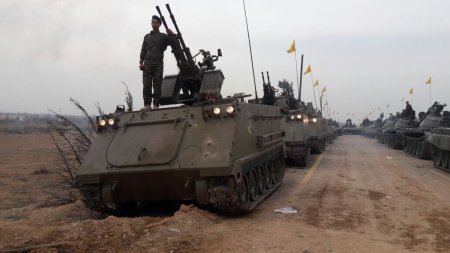
The two Hizballah brigades carry both American and Russian weaponry. DEBKAfile’s military sources report: The motorized rifle brigade is armed with American armored personnel carriers and tanks, whereas the Light Brigade carries Russian arms. Some of the units use both American and Russian hardware, like the Russian ZPU-2 anti tank guns which are mounted on US M113 APCs.

****************************

Hizballah this week transferred two brigades of some 5,000 fighters to the Aleppo front to bolster the Assad regime’s concentrated push to finally rout the rebels who have been holding out year after year in the eastern half of the ravaged city. Indiscriminate Syrian air strikes continue.

The new spearhead is made up of Hizballah’s heavy motorized rifle brigade of tanks and heavy weapons and its light commando brigade, which is trained to operate behind enemy lines. Their arrival brings the total number of Hizballah fighters in Syria to 15,000.

Russian military sources say that, after Aleppo is won for Bashar Assad, the two Lebanese Shiite brigades will turn to Idlib province in the north, to tackle the largest concentration in the country of Al Qaeda’s Syrian arm, the Nusra Front.

The two Hizballah brigades carry both American and Russian weaponry. DEBKAfile’s military sources report: The motorized rifle brigade is armed with American armored personnel carriers and tanks, whereas the Light Brigade carries Russian arms. Some of the units use both American and Russian hardware, like the Russian ZPU-2 anti tank guns which are mounted on US M113 APCs.

Sunday, Nov. 14, on the day that Hizballah started moving the two brigades to the Aleppo front, its propaganda machine released to the Arab media images of a military parade in Qusayr, in the Qalamoun mountain range of western Syria, showing Hizballah troops marching with American hardware. The parade, according to our sources, was faked, the point being to show the world that the Iranian proxy was amply supplied with American equipment.

Assad rewarded Hizballah for capturing Qusayr three years ago by allowing the Iranian proxy to turn the ghost town into a military center. Several workshops for recycling captured weapons for reuse in battle were set up there. (In the same way, the IDF recycled the masses of Russian weapons taken booty from Arab armies in the 60s and 70s.)

Another project was the creation and arming of the Light Brigade modeled on the Iranian Revolutionary Guards special operations units. They are equipped with highly adaptable “jihad-mobiles” which are designed to move in all-terrain and all-weather conditions to take the enemy by surprise from the rear. The the battle of Aleppo sees their first operation in the Syrian war.

Like Syrian special forces units, the Hizballah Light Brigade drives Russian UAZ Patriot-SUV pickup trucks on which are mounted Kord heavy machine guns and AGS-17 grenade launchers. These vehicles are equipped with automatic filters adapted for combat in arid desert conditions to overcome difficulties in vision and breathing.

Together With Its Allies, The Syrian Regime Is Forcing Demographic Change In Areas Of The Country – For Self-Protection And Self-Preservation

November 15, 2016

Together With Its Allies, The Syrian Regime Is Forcing Demographic Change In Areas Of The Country – For Self-Protection And Self-Preservation, MEMRI, E. B. Picali* November 15, 2016

Introduction

Throughout the five and a half years of the war in Syria, and along with military action against the rebels, the regime of Syrian President Bashar Al-Assad, together with Iran, Hizbullah, and the pro-Assad militias, have implemented various measures to change the demographics of regions populated primarily by pro-rebel Sunnis, replacing them with pro-regime groups, primarily Alawites and Shi’ites.

These moves appear to be aimed at creating a homogenously pro-regime area with a Shi’ite and Alawite majority in a geographic region many refer to by the post-World War I term La Syrie Utile (“Useful Syria”). This is aimed at helping ensure the survival of the Syrian regime and of its strategic depth with Hizbullah in Lebanon and with Iran, in the event that Syria ends up being divided in any way as a solution to the crisis.

President Assad outlined this policy in a July 26, 2015 speech, saying: “The homeland does not belong to those who live there, nor to those who hold a passport or are citizens. The homeland belongs to those who protect and guard it.” Assad explained that circumstances on the ground require the Syrian army to withdraw from various areas “so that it can protect other, more important regions” and that the regime army “cannot fight on all fronts out of fear of losing control in certain areas, [and therefore] we relinquish [certain] regions in favor of important areas under our control.” These statements have been interpreted by Syrian opposition elements as proof that such a La Syrie Utile project is indeed underway.[1]

The Assad regime seems to be using a number of methods to carry out this project, including expelling its non-Shi’ite population that is not loyal to Assad and replacing it with an Assad-loyalist Shi’ite or Alawite population; agreements regarding the removal and replacement of local residents; killing and intimidating residents; demolishing homes and burning farmland; besieging towns and starving residents; offering besieged residents food if they sell their land to the regime; burning down land registration offices to destroy records; the buying up of land and homes by Iranian agents. In addition to these methods are the continued Shi’ization of the area, which has been underway for some time.[2]

Some of these measures, particularly the agreements for the removal and replacement of local residents, have been carried out under the auspices of the UN. Both the regime and the UN have been harshly criticized for them, by elements in the Syrian opposition as well as by anti-Syrian regime elements in Lebanon.

This report will review the purpose of this removal of local populations from areas of Syria, the means used to do so, and criticism of it and of the UN. The main sources cited in this report are anti-Syrian regime, anti-Iran, and anti-Hizbullah.

Creating A Homogenously Pro-Regime Geographic Region Stretching From Western Syria To Lebanon – To Ensure The Survival Of The Regime And Of Its Strategic Depth With Hizbullah And Iran

As stated, the army of the Syrian regime, along with Iran, Hizbullah, and the pro-regime militias, have been working to change the demographics of regions of Syria, using various means to remove their mostly Sunni pro-rebel residents, who include Palestinians, and replacing them with a pro-regime population. These measures are being carried out primarily in Damascus and its surroundings, in the west of the country along Lebanon’s northern and central Beqaa Valley, and along the Damascus-Beirut highway, with the aim of creating a contiguous region from Tartus to Latakia on the Mediterranean coast eastward to Homs and southward to Damascus – and perhaps even farther south to Quneitra – that will ultimately be populated solely by pro-Assad Shi’ites, Alawites, and others. Many refer to this region as La Syrie Utile, because it  will serve the Syrian regime and Iran if Syria ends up divided as part of a solution to the crisis.
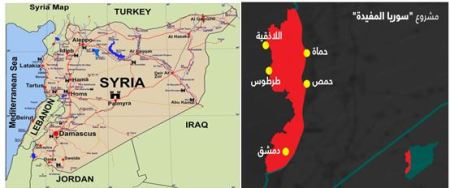
30686La Syrie Utile region (Alkhaleejonline.net, Istanbul-city-guide.com/map/Latakia-map)

Originally, the term La Syrie Utile, coined following World War I by the French Mandate for Syria and the Lebanon, referred to the borders of Greater Syria minus Jordan and Palestine. It defined the area of the Levant that at that time was considered economically and demographically more important and more central than other areas. The area the term refers to today covers nearly all of Syria’s most important economic, administrative, and demographic areas. Many Syrian oppositionists saw proof that the Assad regime had a plan to make this region demographically homogenous and pro-regime in Assad’s July 26, 2016 speech to union officials at the presidential palace in Damascus. In it, Assad explained that circumstances on the ground require the Syrian army to withdraw from various areas “so that it can protect other, more important regions” and that the regime army “cannot fight on all fronts out of fear of losing control in certain areas, [and therefore] we relinquish [certain] regions in favor of important areas under our control.”[3]

Today’s La Syrie Utile region borders on the regime’s strategic depth in Lebanon, that is, the areas controlled by Hizbullah and its allies. These include the northern Beqaa Valley, which has a decisive Shi’ite majority; parts of the central Beqaa Valley, whose border with Syria is controlled by the Popular Front for the Liberation of Palestine – General Command (PFLP-GC); and the Damascus-Beirut highway. Following extensive removal of the original residents by various means, the Syrian regime and its allies now control a large swath of Syria’s western regions and parts of eastern Lebanon in which the population is loyal to tem, rendering actual international borders nearly meaningless.

Syria’s creation of pro-regime demographic homogeneity within this region serves Iranian plans to control Syria and Lebanon, and serves the Iran-Hizbullah relationship. In January 2016, the anti-Iran Lebanese lawyer Nabil Al-Halabi, who heads the Lebanese Institute for Democracy and Human Rights (LIFE), told the Syrian oppositionist website Orient News: “Iran’s agenda in Syria is aimed at creating a large expanse… that will incorporate the entire [Syrian] border into Lebanon’s northern and eastern Beqaa and will connect them to the Baalbek-Hermel area [that is, Lebanon’s northern Beqaa], so as to transform it into an Iranian statelet subordinate to [Iran’s] Rule of the Jurisprudent.”[4] Similar statements were made by ‘Abdelilah Fahd, of the National Coalition for Syrian Revolutionary and Opposition Forces.[5]

In this context it should be mentioned that as early as three years ago, Lebanese newspapers that are known to support Hizbullah, Syria, and the resistance axis published articles about the importance of this geographic region in Syria and the need to connect it to the Lebanese depth so as to create a single area that will ensure the survival of the Syrian regime, Hizbullah’s strategic depth in Syria, and the geographic connection between them.[6]

Syrian oppositionists and anti-Assad Lebanese have warned about this plan. In August 2016, Syrian oppositionist Ahmad Abazid told the London-based Saudi daily Al-Sharq Al-Awsat: “The implementation of the plan [to bring about] a demographic shift in Syria began in the last quarter of 2012, with the regime using Shi’ite militias to change the composition of the population around Damascus and near the Lebanese border.”[7] Earlier, in February 2016, Lebanese Druze leader Walid Jumblatt, who was aware of the ramifications of this move for Lebanon, warned: “Lebanon could become a new province of La Syrie Utile, which the Syria-Iran axis is attempting to establish from Daraa to Tartus to Latakia.”[8]

Methods And Means Used By Regime And Its Allies To Create Pro-Regime Homogeneity In La Syrie Utile Region

For the past few years, Arab media, and particularly Syrian and Lebanese media hostile to the resistance axis, have been reporting on what is happening to the mostly Sunni anti-regime population in Damascus and its environs; in Homs, on the Damascus-Tartus road; in the towns of Al-Qusayr and Baniyas, between Homs and the northern Lebanese Beqaa Valley; in Al-Zabadani, north of the Damascus-Beirut highway; and recently also in the town of Madaya (on the Damascus-Beirut highway) and in Darayya (south of Damascus). The latter two locales have been in the news because of the regime’s systematic starvation and expulsion of their residents.[9] These reports reveal a wide range of violent methods used by the Syrian regime, Iran, and Hizbullah to shift the mostly Sunni population that they do not want there, including besieging towns and starving their residents;[10] transferring residents as part of ceasefire agreements; demolishing homes and burning farmland; setting up roadblocks to monitor and intimidate the population; forcing residents to sell their property; burning land registration offices in order to destroy records; and killing residents and intimidating the survivors. In addition to these methods are Shi’ization (on which see below) and, following the removal of Sunni and anti-regime residents, settling Shi’ite, ‘Alawite, and other pro-regime families in these areas.
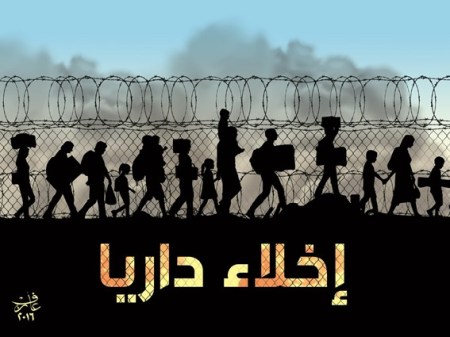
30687“The evacuation of Darayya” ( Al-Arab, Qatar, August 28, 2016)

 Following are examples of these methods, which Syrian regime opponents claim constitute “sectarian cleansing”:

Expelling Non-Shi’ite Residents From La Syrie Utile Region

One violent method used by the regime and its allies to create demographic homogeneity has been expelling non-Shi’ite anti-Assad residents and making it impossible for them to return. Sometimes this is done by intimidating residents and threatening them with death so that they will leave of their own accord.

Thus, for example, in August 2015, the Lebanese daily Al-Mustaqbal, which is known to oppose Hizbullah and the Syrian regime, cited General Authority of the Syrian Revolution (GASR) spokesman Ahmad Al-Qusayr as saying that since it occupied the town of Al-Qusayr in June 2013, Hizbullah has expelled most non-Shi’ite residents of the surrounding villages and is preventing them from returning to their homes.[11]

A November 2015 report in another Lebanese daily, Al-Safir, which supports the resistance axis, provided proof for the claim that Hizbullah and the Syrian regime are preventing residents of Al-Qusayr from returning to their homes. Reporting from the town, Al-Safir reporter Ali Duraij said that only former residents whose names are on a Syrian Army list may enter. The daily also quoted a Syrian soldier as saying that pro-rebel residents would only be returning to the town “over the soldiers’ dead bodies.”[12]

In March 2015, the Egyptian news portal Masr Al-Arabia quoted a young man residing in the old city of Damascus as saying that Shi’ite militias are threatening local young Sunnis with forced labor in order to drive them out of the city, and that as a result many families have abandoned their homes. It also reported that Damascenes are saying that Hizbullah is preventing families who have left from returning to their homes in neighborhoods that Hizbullah has taken over and made into strongholds.[13]

In January 2015, the Syrian oppositionist website Orient News reported that when Hizbullah and other Shi’ite militias occupied the town of Sayyidah Zaynab and others surrounding it, south of Damascus, they executed residents and left their bodies lying in the street to terrorize others and spur them to leave on their own. The remaining residents were forcefully expelled, and the area was transformed into a center for Shi’ite militiamen and their families. Abu Nasser Al-Shami, an opposition activist in southern Damascus, said that the expelled residents had repeatedly tried to return to their homes but that the Shi’ite militias had prevented them from doing so.[14]

The regime has also razed entire neighborhoods in Damascus and Homs as part of new infrastructure plans. Alsouria.net cited Syrian legal expert ‘Abd Al-‘Aziz as stating, in August 2015, that Assad’s Presidential Decree No. 66, of 2012, ordering  the demolition of thousands of homes and other buildings in the neighborhoods of Al-Mezzeh, Kafr Soussa, and others in southern Damascus, and the construction of new homes in their place, was aimed at expelling their original residents, since Al-Mezzeh and Kafr Sousa are strategic strongholds housing important security facilities of the Syrian regime.[15] Two months previously, in June 2015, the London-based Qatari daily Al-Quds Al-Arabi had cited an Al-Mezzeh resident as saying that the regime had ordered hundreds of families living east of the neighborhood and near the Iranian Embassy to leave their homes because they were going to be demolished to make way for “Iranian towers.”[16]

Following the regime’s approval of two new plans for infrastructure for Homs’ Baba Amr neighborhood,  local residents claimed that the plans as they were approved by the city council are aimed at expelling them from their homes as retribution for their support for the rebels.[17]

On March 20, 2016, Al-Quds Al-Arabi reported, citing Syrian activists and eyewitnesses, on the construction of a nonconventional military facility and on the excavation of tunnels, with help from Iranian experts, on the Syria-Lebanon border and near the Damascus-Beirut highway, and that local residents were being expelled, their homes were being razed, and trees were being uprooted.[18] The following day, the daily again reported that it was feared that the facilities were for the storage of chemical or other nonconventional weapons.[19]

On June 11, 2016, Al-Quds Al-Arabi correspondent ‘Omar Muhammad in the town of Madaya reported that Hizbullah fighters who control the southern approach to the town had forced 16 local families to immediately evacuate their homes. According to Muhammad, the fighters then looted the buildings, torched them, and took over the land, as part of the plan to change the demographics of the Damascus environs.[20]  

Pro-Rebel Residents Out, Shi’ite And Alawite Families In

Another method being used by the regime and its allies to change the demographics of the region is to settle Shi’ite and ‘Alawite families in areas from which non-Shi’ite residents have been removed. In many cases, ownership of the properties is transferred to the new residents without the original owners’ knowledge, and land registration offices have been burned down in order to remove all evidence of original ownership. Fields have also been burned, and homes razed.

In August 2015, the Lebanese daily Al-Mustaqbal reported that privately owned farmland surrounding the town of Al-Qusayr that belonged to Syrians who had been forced to leave their homes was being sold at attractive prices and on installment plans to “a specific sector” (likely pro-Hizbullah) of Lebanese citizens. Additionally, according to the report, Hizbullah had demolished the homes of residents “one after another.”[21] Previously, the newspaper reported that Hizbullah was settling its own fighters and their families in homes abandoned by the locals.[22]

Further evidence that Shi’ites were being moved into Al-Qusayr appeared in an August 2015 article discussing the population transfer methods being used by the regime and its allies, that was posted on the Syrian oppositionist website Alsouria.net. The article cited Samer Al-Homsi, a Syrian oppositionist in Homs, as stating that Hizbullah was settling the families of its fighters in Al-Qusayr.[23] Al-Homsi added that the Homs provincial council, which he said supported the regime, had posted notices on the doors of shops in the city’s old marketplace warning that if they did not open for business the property would be expropriated and turned over to new owners – while the regime was preventing the shop owners from returning to the city. He said that the regime is transfering these properties to newly arrived Alawite and Shi’ite families with security clearance.

The article also stated that the Syrian regime and Hizbullah had burned down the land registration office and other buildings in the city where real estate records were stored, so as to eliminate evidence of the ownership of thousands of properties.[24] The anti-Hizbullah Shi’ite-Lebanese website Janoubia.com also cited a source that said that the regime had transferred these properties to Iraqi and Lebanese Shi’ites, as well as to Alawites.[25]

The same thing happened in the old city of Damascus. A Masr Al-Arabia report quoted a young resident who said that homes abandoned by their original residents now house Lebanese, Iraqi, and Afghan militiamen whose families recently received Syrian citizenship, as well as displaced non-Sunni Syrians – all in accordance with a regime order giving itself the right to rent out these homes and to hold the rent received in escrow for the owners.[26] The report also quoted residents as saying that the regime had decreed that homes in Damascus may only be rented to people approved by the security authorities – and that only Iraqi, Iranian, Afghan, and Lebanese fighters are approved.[27]

The Syrian oppositionist website All4syria.info reported that in the town of Sayyidah Zaynab in the Rif Dimashq Governorate, Shi’ite militias were settling Shi’ite refugees from Basra, Iraq in homes whose owners had been removed. The report also quoted young resident Abu Radwan Al-Shami as saying said that a militia member had taken over his family home  and refused to leave despite his demands that he do so. Upon appealing to the police, Al-Shami was told that these militiamen are “guests who must be welcomed, and who cannot be removed.” The policemen cited Assad’s speech about  the land belonging to those who fight and defend it.[28]

An Al-Zabadani city councilmember told the London-based Al-Arabi Al-Jadid daily that the regime had demolished some 95% of the homes and commercial areas in the city, set fire to much of the farmland south and southwest of the city, near Madaya, and capped irrigation wells used by the farmers, all in an effort to force residents to leave. Media personality Faris Al-Arabi attested to the torching of orchards and buildings in these areas. According to Al-Zabadani residents, the town’s commerce and agriculturehad provided a livelihood for thousands, and the city is no longer worth living in because its economy and infrastructure have been completely destroyed.[29]

Hizbullah and the Syrian military have used the tactic of burning farmlands in the Madaya region as well, as reported on September 11,  2016  by the Syrian oppositionist website Enabbaladi.net.[30]

On September 6, 2016, Al-Sharq Al-Awsat cited a source close to the Iraqi militias in Syria as stating that the Iran-backed Al-Nujaba militia had begun settling some 300 Shi’ite families from southern Iraq in the towns of Darayya and Muadamiyat Al-Sham, southwest of Damascus. According to the report, the towns’ original residents had left as part of population transfer agreements (see following section).[31]

Siege, Starvation, And UN-Sponsored Population Transfer

The Syrian regime, along with Hizbullah and its other allies, are also besieging areas and starving the residents,[32] with the aim of wearing down the local population, causing it to turn against the rebels, and leveraging it to push rebel forces into signing local ceasefire agreements. The Assad regime calls these ceasefire agreements “national reconciliations” or “local reconciliations,” spinning them as a rebel surrender – while in actuality they involve the uprooting of pro-rebel residents and their transfer outside the La Syrie Utile region. This has been implemented in many places, particularly in Homs, the Al-Yarmouk refugee camp, Al-Zabadani, and Madaya and Darayya.

Some of the siege-lifting agreements have been sponsored by UN representatives, even though they were achieved by harsh sieges and by starving local residents, and involved removing residents from their homes and  the departure of the rebels and their families under population transfer agreements. From 2014 to 2016, the regime and the rebels arrived at a number of agreements under which the regime lifted the siege, stopped bombardment, and allowed humanitarian aid into the area, in return for the rebels’ and their families’ departure. Such UN-sponsored agreements have been signed for Homs’ old city[33] and parts of its Al-Waer neighborhood.[34] They were also signed for the majority-Turkmen towns of Kezhal and Umm Al-Qasab in western Rif Homs; rebel families from these towns were transferred to the northern Rif Homs.[35]
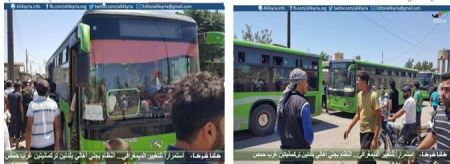
30688Residents of Turkmen towns west of Homs exiled north of Homs (All4syria.info, July 17, 2016)

Nabil Al-Halabi, the Lebanese lawyer and LIFE director, said that in Homs’ old city the regime had offered food to besieged residents who wanted to leave the city but only on the condition that they sold the regime their land and property.[36] On January 13, 2016, Al-Mustaqbal reported that Hizbullah fighters in Bloudan had threatened residents of the besieged Al-Zabadani and Madayya nearby who had managed to escape that they would be forced back into Madayya unless they sold their land and houses to them for pennies on the dollar. According to the daily, some of these residents agreed to this extortion in return for food or a handful of coins, while others were brought back into Madayya.[37] It was around this time that the ongoing siege on Madayya – which violated a previous agreement between the regime and rebels in the city – made headlines, after residents and rebels raised an outcry because the residents were reduced to eating weeds, eggshells, and cats, with some dying of starvation, and medical supplies had run out.[38] Earlier in January, Orient News quoted Madayya activists as saying that Hizbullah was allowing residents to leave if they sold them their homes, land, and property.[39]

In September 2015, Iranian representatives, with UN sponsorship and assistance, arrived at a ceasefire with the rebel group Ahrar Al-Sham, which controlled Al-Zabadani. The agreement covered the city and several surrounding towns, among them Madayya, besieged by Assad and Hizbullah, and the Shi’ite towns of Al-Fua and Kefraya in northern Syria, besieged by the rebels, and included a population transfer agreement. Under the latter, armed rebels and interested residents from Al-Zabadani would be transferred to the northern city of Idlib, which is under rebel control and outside of La Syrie Utile, while 10,000 women, children, and over-50 men from Al-Fua and Kefraya would be transferred to Al-Zabadani – thus effecting a demographic shift.[40]

One of the most prominent examples of the regime’s removal of anti-regime residents following extended siege, starvation, and bombardment occurred recently as part of a rebel-regime agreement in Darayya, south of Damascus. After four years of siege, Darayya has become a symbol of this regime policy. In November 2012, the Syrian army and its allies besieged Darayya, and only allowed in humanitarian aid three and half years later, in early 2016. Almost four years of siege, starvation, and carpet bombing of the city, and, according to the rebels, regime threats to burn down the city with all its residents, brought the rebels to surrender. On August 25, 2016, the sides reached an agreement under which the armed rebels and residents would leave the city and hand over their medium and heavy weapons to the regime army as it entered.[41] Thus, on August 27, 1,650 rebel fighters and anti-regime residents abandoned Darayya for the rebel-controlled Idlib in northern Syria.[42] The Assad regime said that Darayya had been rendered uninhabitable, and promised that after it was rebuilt, its residents would be allowed to return.[43] However, on August 27, 2016, the Kurdish website Ara News reported that mere hours after the expulsion of its residents, dozens of Iraqi families had already moved in.[44]

According to the opposition, in Darayya the regime had escalated its attempts to subdue the rebels and the residents, threatening to exterminate the population. Syrian oppositionist Bassma Kodmani, a member of the Syrian opposition’s High Negotiations Committee (HNC), said that regime forces changed tactics after failing to starve the residents in the besieged areas, and that “the threats of ‘surrender or starve’ that we have heard for four years have now become ‘surrender or we will destroy you.'”[45]

The UN was criticized for its role in the Darayya agreement. UN Special Envoy for Syria Staffan de Mistura denied that he had had any connection to it, and said he had not even known about it,[46] but city councilman Fahdi Muhammad said, “The council updates de Mistura on events and developments in the city immediately after they happen, and his denial is nothing but an attempt to shirk his responsibility to protect the residents who were expelled by the Assad regime.” He added: “UN officials and a Red Cross delegation knew about the negotiations, and even oversaw the expulsion operation.”[47]

Among the opponents of the Darayya agreement were Arab League secretary-general Ahmed Abu Al-Gheit, who in a statement called it “a worrisome development that could pave the way for similar arrangements that bring about demographic changes in Syrian cities, especially since they are with UN sponsorship.” He added: “Expelling residents under duress is a violation of international law.”[48]

Reports in recent months indicate that there will be a repeat of this ceasefire-agreement scenario in the town of Muadamiyat Al-Sham, also southwest of Damascus. On September 1, 2016, the Syrian daily Al-Watan, which is close to the Assad regime, reported that an agreement is set to be signed between the regime and representatives of the town residents, under which all rebels  and anti-regime residents will leave the town in order to “settle their status vis-a-vis the regime.”[49] The previous day, on August 31, Orient News had reported that the regime is aiming for an agreement like Darayya’s in Muadamiyat Al-Sham, and that in talks between the sides, the regime had warned the townspeople that it would burn the whole town along with its residents if the rebels did not hand over their medium and heavy weapons and depart with the anti-regime residents.[50]

Apparently, the Russians, in addition to the UN, are also involved in these so-called “reconciliation agreements” under which population transfers are conducted following siege and starvation. Thus, for example, Russian officials praised the Darayya agreement. On September 1, 2016, Russian Foreign Ministry spokeswoman Maria Zakharova, said that “the successful experience” of removing the rebels from Darayya “will help reduce the level of violence.” She assessed that further agreements were forthcoming, stating that the regime had “reached an agreement similar to” the Darayya agreement in Muadamiyat Al-Sham, and called for the international community to support these agreements and for the signing of similar ones on all Syrian battlefronts.[51] Orient News reported that Russian officers had participated in the talks between Muadamiyat Al-Sham representatives and the regime.[52]

In this context, it should be mentioned that the regime and its allies have also taken measures to get rid of Palestinians residing in Palestinian refugee camps who have expressed support for the rebels. Ayman Abu Hisham, director of the general Palestinian refugee authority in the temporary Syrian government of the National Coalition of Syrian Revolutionary and Opposition Forces, said that the regime is assassinating or expelling Palestinians who do not support it, without distinguishing opponents from neutral parties. He accused it of starving residents of the Al-Yarmouk refugee camp in southern Damascus, and of completely destroying other camps, such as Jaramana on the Damascus airport road and Handarat in northeastern Aleppo, to keep the residents, who had fled, from returning.[53]

On November 8, 2016, the website of the National Coalition of Syrian Revolutionary and Opposition Forces reported that the regime had bombarded Khan Al-Sheikh, a Palestinian refugee camp in the western Ghouta, in order to drive out its residents, after they did not heed the regime’s demand to evacuate the camp.[54]

Shi’ization And Iran’s Takeover Of Property In And Around Damascus

There have also been many reports on significant Iranian activity in Damascus and its environs,including direct and indirect purchase of land and homes, as well as extensive Shi’ite religious outreach and proselytizing, aimed particularly at young people, and the establishment of Shi’ite religious, cultural, and educational centers.
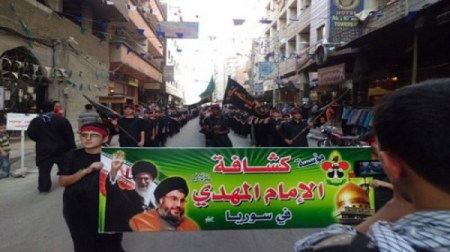
30693A march of the Al-Imam Al-Mahdi scouts movement in Syria (orientnews.net, January 19, 2015)

The Lebanese daily Al-Mustaqbal cited knowledgeable sources as stating that the Syrian regime was transferring ownership of state buildings and land in Damascus to Iran, as part of a repayment of regime debts.[55] Some three months previously, the Lebanese daily Al-Akhbar, which supports Hizbullah and the resistance axis, had reported that the Syrian regime had mortgaged state real estate to Iran in exchange for Iranian military and economic aid.[56]

A Damascus engineer identified as Suheil told Alsouria.net that he had sold his home to a Gulf businessman who later turned out to be an agent for Iranian firms, and that many other Syrians had done likewise. The website also reported that the number of Shi’ite residents in many Damascus neighborhoods was on the rise.[57]

The London daily Al-Sharq Al-Awsat also reported, citing numerous Syrian sources, that Iranian merchants and brokers had purchased property and land in various cities, with Iranian encouragement and support and with the cooperation of the Syrian regime. The daily quoted a report by the Electronic Group of the Syrian Rebellion as stating that Iran had established a network of real estate brokers and speculators for purchasing homes, hotels, and land from Syrian citizens who wish to leave Syria. According to the report, Iran had fraudulently transferred to itself ownership of various assets.[58]

Orient News reported that the Supreme Syrian-Iranian Council, headed by the Syrian Samer Al-As’ad, a representative of Iranian businessman and former IRGC general Rostam Qasemi, had appointed agents on the council’s behalf to pressure Damascus residents to sell their assets as part of an Iranian plan to create a demographically homogenous area stretching “from Darayya to the new building of the Iranian embassy in Damascus.”[59]

On June 22, 2015, Al-Quds Al-Arabi cited a resident of the Al-Mezzeh quarter in Damascus who said that Iranian Shi’ites fighting in Syria had been pressuring anti-regime owners of homes and land to sell them their assets by various means, including public humiliation, beatings, and even murder. According to the resident, the Kafr Soussa neighborhood is seeing much of this activity as well.[60]

On April 11, 2016, the Iranian news agency Fars reported that Iranian Majlis member Amir Khojasteh had presented a report to the Majlis after visiting Lebanon and Syria with a Majlis delegation. According to this report, Assad had agreed to grant residency visas to the 10,000 Iranian citizens already living in Syria, at no cost.[61]

In recent years, there has been increased Shi’ite and Iranian religious activity in both Damascus and in the town of Sayyidah Zaynab, south of Damascus. Sayyidah Zaynab is the site of the tomb of Zaynab, a descendent of the Prophet Muhammad, and it attracts many thousands of Shi’ite pilgrims annually. Entire areas of Damascus and other cities have turned Shi’ite, after families of foreign Shi’ite fighters immigrated to Syria and occupied homes abandoned because of the war. Further evidence of the rise of Shi’a in Syria was the unprecedented scale of the 2014 ‘Ashura ceremonies in Damascus, which were held even in areas of the capital that were not recognized as Shi’ite.[62]
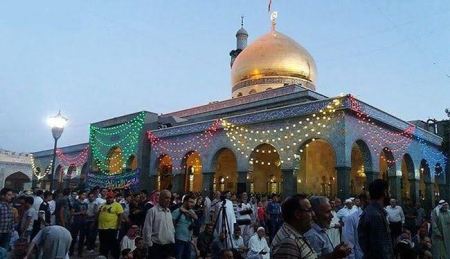
30690The tomb of Sayyidah Zaynab south of Damascus (All4syria.info, January 29, 2016)

Orient News reported that days after the residents of Darayya left it, as part of the agreement with the Assad regime, Shi’ite militiamen entered it to pray and conduct Shi’ite ceremonies at a tomb that has in recent years become a Shi’ite pilgrimage site. It is claimed to be the burial site of Sayyidah Sakinah, the daughter of Hussein and granddaughter of the Prophet Muhammad.[63]
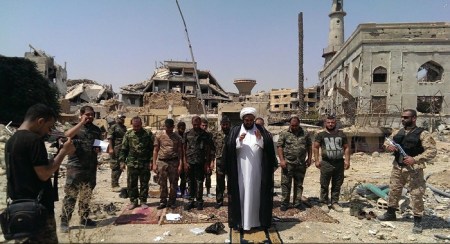
30692Amjad Al-Bahadli, leader of the Iraqi Al-Imam Al-Hussein Brigade militia praying at the ruins of the tomb of Sayyidah Sakinah in Darayya (Facebook.com/500674723445460, August 31, 2016)

The Syrian oppositionist website Enabbaladi.net reported that the Iraqi Abu Al-Fadl Al-Abbas militia has launched an advertising campaign, aimed at Iraqi Shi’ites, for an eight-day trip to the Shi’ite holy sites in Syria at a cost of $400 per person. The trip includes the tomb of Sayyidah Sakinah.[64]

Opponents Of Syrian Regime: These Forced Demographic Changes Are War Crimes, Carried Out With UN Complicity – That Serve Iran

The Syrian opposition and its supporters in Lebanon have been extremely critical of the La Syrie Utile project and the measures undertaken, by the regime and by its allies, to implement it.[65] Some said that the regime’s methods were worse than Israeli actions against the Palestinians, while others compared them to the Nazi racial policy that eventually become the Final Solution.

The head of the interim government of the National Coalition of Syrian Revolutionary and Opposition Forces, Ahmad Tu’mah, said that the regime was changing the demographics in Homs Governorate by forcing Sunnis out and bringing in Iranians to replace them.[66] George Sabra, head of the Syrian National Council and a member of the National Coalition, claimed that the La Syrie Utile project was aimed at dividing the country into sectarian statelets that served Iran; he added that the Syrian regime no longer cares about the Syrian homeland or people, but only about self-protection and self-preservation.[67]

HNC member Muhammad ‘Aloush called the removal of residents of Darayya and Muadamiyat Al-Sham “a war crime carried out by the Syrian regime, and forced expulsion.”[68] Orient News wrote about the siege and starvation of Madaya that Hizbullah and its secretary-general Hassan Nasrallah were using methods “that even Israel does not use.”[69]

Syrian opposition officials also harshly criticized the UN, saying that it was participating in these arrangements that are changing the country’s demographics. On August 29, 2016, HNC general coordinator Riyad Hijab sent a letter to the UN secretary-general warning the UN not to sponsor measures by the regime and its allies aimed at shifting demographics. Hijab argued that Aleppo, Homs, Rif Dimashq, and other areas are subject to such forced demographic changes, and that the Assad regime and its allies are carrying out these changes with UN sponsorship in the guise of local ceasefires. He asked rhetorically: “Do you believe that this will eliminate terrorism? Will it eliminate extremism? Will it end the spilling of Syrian blood and the killing of women and children? Will it make the world a safer place? Will it preserve the unity and territorial integrity of Syrian soil?” He added that since the start of the political process vis-à-vis Syria, “the regime, Iran, and the militias [supporting them] have killed over half a million Syrians and expelled millions,” and that therefore this political process is “backing the regime and its allies in implementing this demographic change.”[70]

In an article in the Kuwaiti daily Al-Qabas, National Coalition member Abdelilah Fahd alleged: “Officials in UN offices in Damascus have pressured the residents [of the Al-Waer neighborhood in Homs] in an attempt to reach a ceasefire that leads to a surrender [of the rebels]. The [UN] office in Damascus held talks with local residents to persuade them to accept a false ceasefire, which indicates it is a party to the expulsion plan… and that it has failed miserably to defend citizens according to international law.” Fahd also stated that the regime is implementing a policy of expulsion, killing, and destruction “in order to preserve the regime at all costs, in the belief that additional crimes will help it eliminate the rebelling Syrian people’s desire for freedom.” He called the methods being used by the regime “a scarlet letter in the history of the UN and international law.”[71]

The Lebanese daily Al-Mustaqbal  has published articles criticizing the demographic policies of the Syrian regime and its allies. In his July 7, 2015 column, ‘Ali Rabah wrote: “Hizbullah is attempting to change Syria’s demographics by expelling original residents to settle others in their place… This is the modus operandi of Hizbullah – which has for decades warned about a Zionist plan to divide the region – in an attempt to cancel the Sykes-Picot Accords.”[72] In another column, published August 12, 2015, Rabah wondered how Hizbullah leader Nasrallah could warn Shi’ites in Bahrain about demographic change that the Bahraini regime might implement against them while he was doing the same thing to Sunnis in Syria – and using the methods that Israel used against the Palestinians in 1948. He wrote: “The [Syrian] villages that Hizbullah wants to empty of their local residents could total a larger area than all of Palestine, or at least larger than all the [Israel-]occupied lands from 1948. Many haven’t noticed that the number of Syrian refugees in camps in Turkey and Jordan alone is three times greater than the number of Palestinians expelled by Israel.” Rabah added that Hizbullah was occupying Syria and establishing settlements and camps there.[73]

Lebanese poet and literary critic Paul Shaoul, who writes for Al-Mustaqbal, compared Hizbullah to Dracula, saying that it is sucking the blood of Syrians, and added that its policy in Syria was racist and sectarian and aimed at changing Syria’s demographics by eliminating Sunnis and expelling them from the country.[74] Mustafa ‘Aloush, a member of the Al-Mustaqbal faction’s Political Bureau and a columnist for the Al-Mustaqbal daily, compared the plan of Syria, Hizbullah, and Iran to the Nazi racial theory that developed into the Final Solution: “Their despair over the [failure of the] plan for the Rule of the Jurisprudent to control all Syria as its backyard has made the followers [of the Rule of the Jurisprudent] settle for the so-called La Syrie Utile. Today, it appears that Hizbullah’s entry into Syria is part of a ‘Final Solution’ supported by an Iranian fatwa aimed at ethnically cleansing areas bordering the central and northern Beqaa Valley [in Lebanon], possibly in preparation for the next stage, which will bring extensive changes to the political and demographic maps.”[75]

* E.B. Picali is a research fellow at MEMRI


Endnotes:


[1] Al-Watan (Syria), July 26, 2015.

[2] See MEMRI Inquiry & Analysis No. 1131, Shi’ization Of Syria: In Damascus, Unprecedentedly Extensive Observance Of The ‘Ashura, November 13, 2014.

[3] Al-Watan (Syria), July 26, 2016.

[4] Orient-news.net, January 6, 2016.

[5] Etilaf.org, September 21, 2016.

[6] Al-Akhbar (Lebanon), May 27-29, 2013. See MEMRI Inquiry & Analysis Series Report No. 980, Lebanon Openly Enters Fighting In Syria, June 13, 2013.

[7] Al-Sharq Al-Awsat (London), August 28, 2016.

[8] Al-Mustaqbal (Lebanon), February 4, 2016.

[9] See MEMRI Inquiry & Analysis Series Report No. 1226, Hizbullah Faces Criticism In Lebanon For Besieging Madaya: Its Starvation Of Syrians Recalls Past Crimes Of Mass Extermination In History, February 9, 2016.

[10] See MEMRI Inquiry & Analysis Series Report No. 1221, Local Ceasefire Agreements In Syria: Capitulation To Regime’s Siege-And-Starvation Strategy Under UN Sponsorship, January 26, 2016.

[11] Al-Mustaqbal (Lebanon), August 12, 2015.

[12] Al-Safir (Lebanon), November 4, 2015.

[13] Masralarabia.com, March 15, 2015.

[14] Orient-news.net, January 19, 2015.

[15] Alsouria.net, August 21, 2015.

[16] Al-Quds Al-Arabi (London), June 22, 2015.

[17] Alarabiya.net, August 27, 2015.

[18] Al-Quds Al-Arabi (London), March 20, 2016.

[19] Al-Quds Al-Arabi (London), March 21, 2016.

[20] Al-Quds Al-Arabi (London) June 11, 2016.

[21] Al-Mustaqbal (Lebanon), August 12, 2015.

[22] Al-Mustaqbal (Lebanon), July 30, 2015. Yasser Haidar, a member of the coordinating body in Al-Qusayr, told the Saudi daily ‘Okaz that he and other residents were expelled from the town, and that under the auspices of Hizbullah, it has become a center for bandits and gangs of smugglers and kidnappers. ‘Okaz (Saudi Arabia), February 7, 2015. According to the Lebanese daily Al-Mustaqbal, Hizbullah sent Shi’ite Lebanese criminals wanted in Lebanon to Syria, and particularly to the Al-Qusayr and Al-Qalamoun areas, chief among them the Shi’ite Lebanese fugitive Noah Zaiter, who posted images on his Facebook page of himself along with Hizbullah officers fighting in those areas in Syria. Al-Mustaqbal (Lebanon), September 15, 2015.

[23] Alsouria.net, August 21, 2015.

[24] Alsouria.net, August 21, 2015.

[25] Janoubia.com, December 11, 2015.

[26] Al-Ba’th (Syria), May 21, 2014.

[27] Masralarabia.com, March 15, 2015.

[28] All4syria.info, January 29, 2016.

[29] Al-Arabi Al-Jadid (London), October 20, 2015.

[30] Enabbaladi.net, September 11, 2016.

[31] Al-Sharq Al-Awsat (London), September 6, 2016.

[32] See MEMRI Inquiry & Analysis Series Report No. 1221, Local Ceasefire Agreements In Syria: Capitulation To Regime’s Siege-And-Starvation Strategy Under UN Sponsorship, January 26, 2016; and Inquiry & Analysis Series Report No. 1069, Syria Regime’s Tactic Against Opponents: ‘Surrender Or Starve’, February 13, 2014.

[33] Al-Quds Al-Arabi (London), May 3, 2015.

[34] Alarabiya.net, December 5, 2015.

[35] All4syria.info, July 17, 2016.

[36] Orient-news.net, January 6, 2016.

[37] Al-Mustaqbal (Lebanon), January 13, 2016.

[38] See MEMRI Inquiry & Analysis Series Report No. 1221, Local Ceasefire Agreements In Syria: Capitulation To Regime’s Siege-And-Starvation Strategy Under UN Sponsorship, January 26, 2016.

[39] Orient-news.net, January 6, 2016.

[40] Orient-news.net, September 19, 2015.

[41] Sana.sy, August 25, 2016.

[42] Al-Quds Al-Arabi (London), August 27, 2016; Sana.sy, August 27, 2016.

[43] Dp-news.com, August 29, 2016.

[44] Aranews.net, August 27, 2016.

[45] Aksalser.com, September 1, 2016.

[46] Orient-news.net, August 27, 2016.

[47] Etilaf.org, August 27, 2016.

[48] Alarabiya.net, August 28, 2016.

[49] Al-Watan (Syria), September 1, 2016.

[50] Orient-News.net, August 31, 2016.

[51] Aksalser.com, September 1, 2016.

[52] Orient-news.net, August 31, 2016.

[53] Al-Quds Al-Arabi (London), May 2, 2014.

[54] Etilaf.org, November 8, 2016.

[55] Al-Mustaqbal (Lebanon), August 12, 2015.

[56] Al-Akhbar (Lebanon), April 29, 2015.

[57] Alsouria.net, August 21, 2015.

[58] Al-Sharq Al-Awsat (London), March 26, 2016.

[59] Orient-news.net, November 6, 2016.

[60] Al-Quds Al-Arabi (London), June 22, 2015.

[61] Fars (Iran), April 11, 2016.

[62] See MEMRI Inquiry & Analysis No. 1131, Shi’ization Of Syria: In Damascus, Unprecedentedly Extensive Observance Of The ‘Ashura, November 13, 2014.

[63] Orient-news.net, September 1, 2016.

[64] Enabbaladi.net, September 17, 2016.

[65] See MEMRI Inquiry & Analysis Series Report No. 1226, Hizbullah Faces Criticism In Lebanon For Besieging Madaya: Its Starvation Of Syrians Recalls Past Crimes Of Mass Extermination In History, February 9, 2016.

[66] Dp-news.com, January 23, 2016.

[67] Aljazeera.net, September 29, 2015.

[68] Alarabiya.net, September 1, 2016.

[69] Orient-news.net, January 6, 2016.

[70] Aksalser.com, August 29, 2016.

[71] Al-Qabas (Kuwait), August 31, 2016.

[72] Al-Mustaqbal (Lebanon), July 7, 2015.

[73] Al-Mustaqbal (Lebanon), August 12, 2015.

[74] Al-Mustaqbal (Lebanon), August 12, 2016.

[75] Al-Mustaqbal (Lebanon), January 13, 2016.
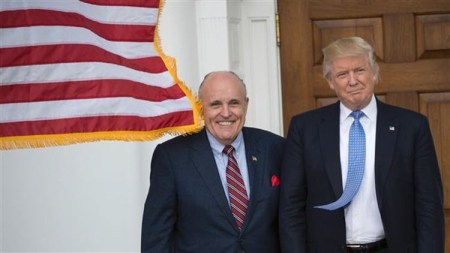
Hamas Funding Sources Drying Up

November 15, 2016

Hamas Funding Sources Drying Up, Investigative Project on Terrorism, Yaakov Lappin, November 14, 2016

1161-1

Hamas in Gaza is facing an acute financial crisis as its overseas cash sources dry up. This is forcing the Islamist regime and its armed terrorist wing, the Izzadin Al-Qassam Brigades, to resort to increasingly desperate measures, such as using international aid organizations to funnel cash away from Gazan civilians.

Hamas’s dire financial situation has multiple causes. Egypt has effectively blocked off many smuggling tunnels linking Gaza to Sinai, which previously were used to transfer money into Gaza from Hamas donors.

Additionally, Hamas finds itself without a clear international backer these days. Not only is Egypt under the rule of President Sisi decidedly hostile, but relations between Hamas and Iran are unstable, rising and falling periodically due to disagreement over conflict raging in Syria.

Iran provides Syrian dictator Bashar al-Assad with military support through its own generals, and thousands of assistance fighters from its Lebanese terror proxy Hizballah. Palestinians generally oppose the Assad regime.

Nevertheless, Iran sometimes does try to smuggle money to Hamas, but this source of funding is unreliable.

Qatar’s financial aid to Gaza has, since the 2014 Israel-Hamas war, been limited to civilian reconstruction programs. Here, too, Hamas has gotten involved, seized apartment buildings to use as financial assets.

Israel’s Defense Minister Avigdor Liberman told the Israeli Knesset’s Foreign Affairs and Defense Committee late last month that sources of outside funding for Hamas are drying up.

Recent revelations by Israel’s domestic intelligence agency, the Shin Bet, confirm this situation.

In August, the Shin Bet revealed that Hamas had been targeting international aid organization operating in Gaza, rerouting money intended for humanitarian assistance towards preparations for war with Israel.

For example, Hamas stole 60 percent of the annual budget of the World Vision international air organization, stealing 7.2 million dollars a year from it, according to the Shin Bet. Money intended to feed and help Gazan children instead went towards purchasing weapons, building bases, and digging attack tunnels.

The theft went as far as taking thousands of food packages intended for Gazan civilians and sending them to armed members of Hamas territorial battalions, according to the Shin Bet investigation.

World Vision responded by firing 120 Gaza employees.

Also in August, Israel charged an engineer from Gaza with exploiting his position in the United Nations Development Program, which rebuilds damaged residential buildings, for rerouting 300 tons of construction material to help build a Hamas naval terrorist base.

On Nov. 1, the Israel Defense Forces (IDF) exposed a Hamas plan to smuggle money to its operatives in Israeli prisons, and to its West Bank terror cells, by forcing Palestinians who have travel papers allowing them into Israel to act as cash smugglers.

Two Hamas operatives targeted Gazan civilians at a border crossing on their way to Israel for business or medical treatment, said the IDF’s Coordinator of Government Activities in the Territories (COGAT), Maj.-Gen. Yoav Mordechai.

In July, the Shin Bet arrested two Gazans with tens of thousands of dollars hidden in their shoes. They were under Hamas orders to transfer the cash to operatives in the West Bank to fund terrorist attacks. Hamas intelligence agents had been approaching Gazan civilians systematically for money smuggling purposes, Shin Bet said.

Hamas’s financial situation is part of a larger ticking bomb that is the Gazan economy. “The whole of the Gaza Strip is in economic-civilian distress,” Liberman told Knesset.

Noting that 95 percent of Gaza’s civilian economic funding come from the international community, Liberman said Israel faced a structural tension between its wish to improve the living conditions of ordinary Gazans and the attempts by Hamas to exploit Israel’s humanitarian steps. Hamas has stolen construction material, injected into Gaza by Israel for civilian reconstruction, to build itself up militarily, Liberman said.

According to Liberman, as part of its bid to keep money from the international community pouring into Gaza’s economy, Hamas also refuses to resolve crises. For example, it did not take link up Gaza’s purification plant, paid for by the World Bank (and costing $100 million), to the electric grid, despite the fact that Israel approved a unique electrical supply to it, Liberman added.

Meanwhile, more than 90 percent of Gaza’s water is unfit for consumption, and it will take at least two years for the international community to set up desalination plants on Gaza’s coastline. A water crisis will likely strike Gaza long before that, Liberman said. Israel is formulating a water crisis response policy.

The warning signs from Gaza’s economic situation continue to mount, driven by Hamas’s insistence of using the enclave as a fortress of jihadist hostility towards Israel and ignoring its peoples’ basic needs.

Hamas’s 26,000 armed members, and 40,000 government employees receive their salaries, and the regime is building up its armed forces despite the cash shortages. Ordinary Gazans, on the other hand, are on their own.

Iran’s Tel Afar op is in sync with Russia in Syria

October 30, 2016

Iran’s Tel Afar op is in sync with Russia in Syria, DEBKAfile, October 30, 2016

hezbollah_brigades_convoy_mosul_b_30-10-16-png

The irony of this arrangement is that, the US armed the Iraqi army, and indirectly the Shiite militias, for this offensive with top-notch Abrams M1 tanks, M1-198 Howitzers and M88 Recovery vehicles for tanks. All this s valuable hardware looks like ending up away another battlefield away from Mosul in Syria, and under a different command, Russia.

****************************

The pro-Iranian Iraqi Shiite drive to capture Tel Afar, 55 km from Mosul in western Iraq, was designed less to complete the encirclement of the Islamists in Mosul – in support of the US-led coalition – and more to forge a link in the land bridge Tehran aspires to build to give its Revolutionary Guards free passage to Hizballah and the Shiite groups fighting for Bashar Assad in Syria. This is reported by DEBKAfile’s military and intelligence sources.

The Iraqi Shiite battle for Afar is led by Iran’s Al Qods chief, Gen. Qassem Soliemani from the front lines.

US and Iraqi commanders of Operation Inherent for expelling ISIS from Mosul welcomed the Iran-led Iraqi Shiites’ initiative to take Tal Afar in order to sever ISIS’ supply lines from Syria to Mosul.

But Iran’s overriding motive in initiating this operation was laid bare by Ahmad al-Asadi, spokesman of the pro-Iranian Iraqi Hashid Shaabi Shiite groups, when he spoke to reporters Saturday, Oct. 29 in Baghdad.

After “clearing” these “terrorist gangs,” from 14,000 sq. km of Iraq including Tal Afar and the regions bordering on Syria, he said, “We are fully ready to cross the border into Syria and fight alongside President Bashar al-Assad.

According to our sources, this plan was not coordinated directly with the US-Iraqi command of the Mosul operation, but with the Russian military command center in the Syrian province of Latakia.

It is important enough for the Russian command to have just established a new center for military and intelligence interchanges. It is staffed by Russian, Turkish, Syrian, Iraqi Shiite and Iranian officers. This mechanism has been put in charge of coordinating Shiite military operations both in Syria and Iraq.

It was decided that when US military assistance or air support is deemed necessary, requests will be piped through the bureau of Iraq’s Shiite Prime Minister Haider al-Abadi and passed on to the US-Iraqi command of Operation Inherent.

Russian, Iranian and Turkish officers have thus effectively hitched on to the decision-making process for the Mosul offensive alongside American officers.

The irony of this arrangement is that, the US armed the Iraqi army, and indirectly the Shiite militias, for this offensive with top-notch Abrams M1 tanks, M1-198 Howitzers and M88 Recovery vehicles for tanks. All this s valuable hardware looks like ending up away another battlefield away from Mosul in Syria, and under a different command, Russia..

IRGC commander killed on eve of Aleppo battle

October 28, 2016

IRGC commander killed on eve of Aleppo battle, Long War Journal, , October 28, 2016

While employing foreign fighters minimizes domestic political backlash in Iran, it also serves a long-term strategic objective to develop capable Shiite proxies. A retired IRGC commander who has deployed to Syria recently claimed the formation of a “Shiite liberation army,” and IRGC commanders have openly discussed a global Basij paramilitary taking shape in the laboratory of Syria, with talks of laying the groundwork for the apocalypse and the Mahdi’s arrival in more intimate quarters. The IRGC, however, has not hesitated to inject regular Iranian soldiers and mid-ranked officers during major offensives and whenever the situation has demanded it, such as the offensive in southern Aleppo in October 2015 and the assault north of Aleppo in February 2016.

********************

The Jaysh al Fath and Fath Halab coalitions and their allies launched an anticipated major offensive today west of Aleppo in another bid to break the siege of rebel-held eastern Aleppo, according to Reuters. In early September forces allied with the Syrian government backed by Russian air power repelled the opposition’s first attempt to break the siege following a month-long battle. Pro-regime forces attempted to build upon their momentum and launched major offensives in late September to tighten their grip on Aleppo. They have made slow but steady gains on the city blocks of eastern Aleppo, and have attempted to push their gains in western and southwestern Aleppo to prevent the opposition from breaking the siege again.

The pro-government coalition includes the Syrian Arab Army (SAA), the Shiite expeditionary forces led by Iran’s Islamic Revolutionary Guard Corps (IRGC), as well as Lebanese Hezbollah, Iraqi Harakat al Nujaba, Afghan Fatemiyoun Division and the Pakistani Zeynabiyoun. Furthermore, the Palestinian Quds Brigade, which has effectively become Russia’s proxy, has made gains in the northern Aleppo sector alongside the SAA.

The Russian defense minister has reportedly asked President Vladimir Putin to resume airstrikes today in Aleppo following a 10-day hiatus, citing an upsurge in opposition activities, but Putin has said that airstrikes are unnecessary for now, according to Reuters citing Interfax News Agency. The IRGC provides intelligence to Russia for airstrikes in Syria.

A high-ranking former IRGC commander was killed in Syria on Oct. 26 during an “advisory mission” in Aleppo. according to Iranian media. He was buried in Mashhad, Iran, today along with two Afghan Fatemiyoun Division combatants killed in Syria this past week. The IRGC Qods Force deputy commander Brigadier General Esmail Gha’ani, who delivered remarks at the deceased commander’s funeral, said “the blood of martyrs strengthen the foundation of the Islamic Republic system.”

Qolam-Reza Samai was a retired commander with the rank of Brigadier General or Brigadier General Second Class who had volunteered to fight Syria, and will be buried in his home province of Khorasan. A veteran of the Iran-Iraq War (1980–1988), Samai held several command posts in artillery, intelligence, and operations capacities in several provincial Ground Forces units.

The IRGC has tapped into its retired and active duty Ground Forces, and special forces officer corps to augment the efforts led by the Qods Force in Syria and Iraq. The deployment pattern of Ground Forces commanders depends on the mission need and crisis at hand. For example, there was a surge of commanders in Iraq following the incursion of the Islamic State in mid-2014, and most were called back when the IRGC-backed Shiite militias were able to better manage the situation.

The IRGC Ground Forces have been present in Syria since as early as 2011. Their numbers have increased as the war deteriorated, peaking in Oct. 2015 as Iran deployed significant numbers of its regular forces in coordination with Russia’s military intervention, before spiking again in Feb. 2016 during a major offensive north of Aleppo. More than a dozen senior Guard commanders were killed in Syriaduring the past year, with the overwhelming majority in Aleppo. Fatalities and causalities of high-ranking officers have continued as the Guard has reduced regular Iranian forces since May and has relied more on Shiite proxies. Contrary to the insistence of the IRGC, commanders are engaged in more than just advising: they design and lead operations for the Iranian-led Shiite expeditionary forces.

The high fatality rate of Iranian commanders is explained by the tactically risk-tolerant and egalitarian culture of the Guard, which values martyrdom in battle as the highest honor and takes pride in fighting on the frontline. Whereas the IRGC is tactically risk-tolerant, it is strategically risk-averse and prefers to limit Iranian exposure, as discussed in depth by Ali Alfoneh and Michael Eisenstadt in The Washington Institute. 

While employing foreign fighters minimizes domestic political backlash in Iran, it also serves a long-term strategic objective to develop capable Shiite proxies. A retired IRGC commander who has deployed to Syria recently claimed the formation of a “Shiite liberation army,” and IRGC commanders have openly discussed a global Basij paramilitary taking shape in the laboratory of Syria, with talks of laying the groundwork for the apocalypse and the Mahdi’s arrival in more intimate quarters. The IRGC, however, has not hesitated to inject regular Iranian soldiers and mid-ranked officers during major offensives and whenever the situation has demanded it, such as the offensive in southern Aleppo in October 2015 and the assault north of Aleppo in February 2016.

Al-Hariri’s Choice Of Hizbullah Ally Aoun For Lebanese Presidency Is Another March 14 Forces Concession To Pro-Iran Axis

October 28, 2016

Al-Hariri’s Choice Of Hizbullah Ally Aoun For Lebanese Presidency Is Another March 14 Forces Concession To Pro-Iran Axis, MEMRI, E.B. Picali and Y. Yehoshua, October 28, 2016

Introduction

On October 31, 2016, the Lebanese parliament will convene and is expected to vote in Free Patriotic Movement leader and Hizbullah ally Michel Aoun as president of Lebanon; he is Hizbullah’s sole candidate. The move follows a deal struck between Aoun and former Lebanese prime minister Sa’d Al-Hariri, leader of the Sunni Al-Mustaqbal stream, under which Aoun, if elected, will assign Al-Hariri the task of forming the next government.

This move by Al-Hariri has significant implications for the intra-Lebanese political arena and for the regional power balance. Therefore it has encountered criticism both within and outside Lebanon. This move represents a surrender by the March 14 Forces, headed by Al-Mustaqbal, to Hizbullah’s will, and reinforces the position of Hizbullah’s patron Iran at the expense of Saudi Arabia.

The following report reviews Al-Hariri’s decision, the reactions it has encountered, and what it means for Lebanon and the region.

Hizbullah Ally Aoun Expected To Be Chosen President

On October 31, 2016, the Lebanese parliament will hold its 46th presidential selection session since Michel Suleiman’s term ended two-and-a-half years ago.  That session is expected to choose Free Patriotic Movement leader Michel Aoun, who is an ally of Hizbullah, as president. Aoun’s selection will end a two-and-a-half-year presidential vacuum that resulted from disagreement over Suleiman’s successor from among the country’s opposing streams – primarily Al-Mustaqbal, led by Sa’d Al-Hariri, and Hizbullah, which together with Aoun stymied the formation of the quorum that is necessary to elect a president. The breakthrough in the talks over the selection of a president came when Al-Hariri and Aoun reached an agreement under which Al-Hariri would support Aoun’s presidential candidacy and in return Aoun would task Al-Hariri with forming the new government, which would be a national unity government as stipulated in the agreement.[1] This constitutes an Al-Hariri surrender to Hizbullah, which sought an Aoun presidency. It should be mentioned that Al-Hariri’s support for an overt Hizbullah ally is not unprecedented; a year ago, Al-Hariri announced his support for another ally of Hizbullah, and of Syrian president Bashar Al-Assad, Suleiman Frangieh, for the post of Lebanese president.[2]

Al-Hariri announced his support for Aoun in an October 20, 2016 speech, saying that by supporting him he was aiming to save Lebanon from dangerous leadership and economic crises which could, in turn, lead to a new civil war.[3]

Two days later, on October 22, Hizbullah secretary-general Hassan Nasrallah announced that his party’s MPs, who had been boycotting presidential selection sessions, as had MPs from other parties including Aoun’s own Change and Reform bloc, would be attending the October 31 session and would be choosing Aoun.  Nasrallah added that Hizbullah had no objections to Al-Hariri’s serving as prime minister in the new government.

These statements by Al-Hariri and Nasrallah pave Aoun’s path to the presidential palace, even though obstacles and uncertainty remain, both in Lebanon and in the region, in this matter.

Various Lebanese Elements Oppose Aoun’s Appointment As President

The opposition to Aoun’s appointment comes mainly from Lebanese parliamentary speaker Nabih Berri, and from Suleiman Frangieh, who is running against Aoun in the presidential race. Both Berri and Frangieh are March 8 Forces members and open Hizbullah allies. Berri even announced that he would not be part of the government that would be established under the Al-Hariri-Aoun deal, and questioned the deal’s future, saying that it had been arrived at by two sides only, without taking into account the country’s main political elements, himself among them. Druze leader and centrist bloc member Walid Jumblatt, who is another major Lebanese political figure, has not yet expressed a position on this matter, but it is thought that he will back Aoun.

On the other side as well, some in Al-Hariri’s Al-Mustaqbal party and in the March 14 Forces in general   oppose this deal. Immediately after Al-Hariri’s October 20 announcement of support for Aoun, another former prime minister, Fouad Al-Siniora, the head of the Al-Mustaqbal party, (a component of Al-Hariri’s broader Al-Mustaqbal stream) announced that he would not join Al-Hariri in backing Aoun for president. Al-Siniora was joined by other party members, including parliamentary vice president Farid Makari, MPs Ahmad Fatfat and Ammar Houri, Telecommunications Minister Boutros Harb of the March 14 Forces, and March 14 Forces secretary-general Fares Souaid.

Along with the opposition to an Aoun presidency within the Al-Mustaqbal party, other Sunni public figures also objected to the deal, among them Justice Minister Ashraf Rifi, former director-general of the Lebanese Internal Security Forces and a former Al-Hariri supporter. Last year, Rifi harshly attacked Al-Hariri for his support for Hizbullah and Syrian regime ally Suleiman Frangieh. On October 22, 2016, two days after Al-Hariri’s announcement of his support for Aoun as president, Rifi organized an anti-Aoun protest in Tripoli called “Proud Tripoli Rejects the Candidate of Iranian Patronage.” The next day, October 23, a convoy of vehicles from Akkar in the north of the country made its way to Rifi’s home in Tripoli bearing posters of him and expressing support for his position on this matter. It should be mentioned that in the past year, Rifi has gradually chipped away at overall Lebanese Sunni support for Al-Hariri, as evidenced by his party’s landslide victory over Al-Hariri’s party in the mayoral elections in Tripoli, the city with the largest Sunni concentration in the country.

Many in the Al-Mustaqbal party, the March 14 Forces, and the Sunni public who oppose the Al-Hariri-Aoun deal see Al-Hariri’s support for Aoun as yet another concession to Hizbullah and the pro-Iran axis that backs it, and to Hizbullah as an armed state within a state.[4] They accuse Al-Hariri, inter alia, of seeking to become prime minister by selling out Sunni interests and the political legacy of his father Rafiq Al-Hariri, whose 2005 assassination, when Syria was the real power in Lebanon, is thought to have been carried out by five senior Hizbullah officials.

Addressing critics of his deal, Al-Hariri explained his support for Aoun as well as his previous support for Frangieh: “I am willing to take the risks a thousand times over, just as I am willing to risk myself, my people, and my political future, to defend Lebanon and its people.”[5]

Al-Hariri’s Choice Of Aoun Is A Political Victory For Hizbullah

Al-Hariri’s move to support the Hizbullah candidate and ally Aoun has major implication for the internal Lebanese political arena. It constitutes another successful attempt by Hizbullah to impose its wishes there and a further weakening of the country’s main Sunni force, the Al-Mustaqbal party. This triumph for Hizbullah comes at a time when it is mostly preoccupied outside of Lebanon’s borders, primarily with fighting alongside the Assad regime in Syria, as well as elsewhere in the Arab world as a proxy of Iran. The organization has fortified its position within Lebanon by virtue of its network of political alliances in the country, as well as by virtue of the quantity of weapons in its possession.

Ibrahim Al-Amin, head of the board of directors of the Lebanese daily Al-Akhbar and a known Hizbullah supporter, argued that the March 14 Forces, including the Al-Mustaqbal stream, show “the symptoms of card-game addicts,” who delude themselves that they can win and are “unwilling to give up” even when it is clear that it is Hizbullah who is actually directing events on the ground.[6]

At the same time, Hizbullah’s success in pushing its own candidate through is also a result of the political weakness of its rivals, particularly the Hariri-led Al-Mustaqbal stream, who wants the premiership at nearly any cost in order to strengthen his own political status in the country and perhaps his economic status as well.

An Aoun presidency does not mean that the issues contributing to the vast schism between the sides in Lebanon will be resolved, among them the disarming of Hizbullah as demanded by the March 14 Forces – Aoun opposes the organization’s disarmament.[7] As president, Hizbullah ally Aoun would be in charge of a number of security and military portfolios, aggravating the tension between the sides and jeopardizing the army’s independence .

Additionally, the Al-Hariri-Aoun deal does not guarantee that Al-Hariri will actually succeed in forming a government, because of the opposition he faces both inside and outside Lebanon. The deal with Aoun could also harm Al-Hariri’s status among his traditional Sunni support base, thus weakening him in the upcoming spring 2017 parliamentary elections.

An Aoun Presidency: Ramifications For The Regional Power Balance – Down With Saudi Arabia, Up With Iran

Since Lebanon’s future depends on the regional political balance, with Iran, Syria, and Saudi Arabia the patrons of various local Lebanese political players, Al-Hariri’s move has regional ramifications. His surrender to Hizbullah’s wishes reflects the strengthening of Iran, which has exploited the Syrian civil war to deepen its penetration of the region and of Lebanon in particular. Electing the Hizbullah presidential candidate Aoun will definitely serve future pro-Iran interests in Lebanon at the expense of Sunni interests in Lebanon, and also at the expense of Saudi Arabia, which views itself as the protector of these interests.

Saudi Arabia has previously backed Al-Hariri’s past substantial political moves even if these moves haven’t always served Saudi political interests in Lebanon or elsewhere. It is still unclear whether his deal with Aoun has Saudi support, and the Lebanese press has published conflicting reports on the matter. As yet, there has been no official Saudi comment on this, but recent articles in the Saudi press indicate a lack of support for Al-Hariri’s deal with Aoun. However, following a lengthy Saudi silence, Saudi Gulf Affairs Minister Thamer Sabhan, who visited Beirut on October 27 said that his country would not intervene in the selection of Lebanon’s president and would support the president chosen by the Lebanese.[8]

There were also reports in the Lebanese press noting that Al-Hariri’s political status in Lebanon is declining, and that the Saudis no longer consider him the sole representative of the Sunnis in Lebanon, but only one such representative.

It should be noted that in previous years, Saudi Arabia, as the leader of the Sunni world, played a key role in the selection of Lebanese presidents, as did Syria, which together with Hizbullah’s patron Iran represented the resistance axis. Al-Hariri’s choosing Aoun for president without full Saudi backing reflects a decline in Saudi influence in Lebanon, and in Saudi Arabia’s regional status in general. In this context, a report in the Lebanese daily Al-Safir, a known supporter of the resistance axis, claims that Egypt was involved in promoting Aoun’s prospects for the presidency.[9] A possible inference from this report is that Egypt is attempting to step into Saudi Arabia’s shoes in Lebanon in an attempt to restore its status in the Arab world, and particularly in the Sunni world.

Articles in the daily Al-Akhbar, known for its pro-Hizbullah line, addressed the regional implications of Al-Hariri’s gambit and gloated that the move reflected Saudi Arabian weakness. Al-Akhbar columnist Ghassan Saoud wrote that an Aoun presidency would be a manifestation of “Hizbullah’s ability to break the international will, and the Saudi will.”[10]

However, Ibrahim Al-Amin wrote in an Al-Akbar editorial that wars in the Arab region created a reality that was forcing the March 14 Forces to see the choice of Lebanese president differently, and that they needed to realize that the Saudis can no longer help them. As he usually does, he concluded his piece with implied threats, stating: “Anyone who does not want anarchy in Lebanon has no alternative but to choose Aoun for president.”[11]


*E. B. Picali is a research fellow at MEMRI; Y. Yehoshua is Vice President for Research And Director of MEMRI Israel


Endntoes:

[1] One of the main political players pushing for an Aoun presidency is Samir Geagea, chairman of the Lebanese Forces. In January 2016, after a long period of talks, Geagea and Aoun, formerly bitter Christian political rivals, agreed that Geagea would support Aoun’s presidential bid. One of the main reasons behind Geagea’s decision to do so was Al-Hariri’s previous support for the presidential candidacy of Suleiman Frangieh – a fierce rival of Geagea who had been accused of killing several members of the Frangieh family during the country’s civil war.

[2] Similarly, in 2008, during another presidential interregnum, the March 14 Forces and Al-Hariri were forced to make concessions to Hizbullah, which was included in the newly formed Fouad Siniora government; this took place at the Doha conference. The most important concession won by the Hizbullah-led March 8 Forces, as stipulated in the government guidelines, was the legitimation of the Resistance (which allowed Hizbullah to operate as an independent armed force within Lebanon). Hizbullah also received enough cabinet seats to veto any government decision, and Hizbullah subsequently used this veto power against Al-Hariri’s government in 2011. Hizbullah obtained these concessions following the leadership vacuum, the lengthy Hizbullah siege on central Beirut, and the violent events of May 7, 2008.

[3] Al-Mustaqbal (Lebanon), October 21, 2016.

[4] See MEMRI Inquiry & Analysis Series Report No. 1092, Al-Mustaqbal Losing Ground As Representative Of Lebanese Sunnis, May 19, 2014.

[5] Al-Mustaqbal (Lebanon), October 21, 2016.

[6] Al-Akhbar (Lebanon), October 24, 2016.

[7] In an interview with Al-Akhbar, Lebanese Foreign Minister Gebran Bassil, who is Aoun’s son-in-law and heads the Change and Reform bloc founded by Aoun, said that Free Patriotic Movement, to which the Change and Reform bloc belongs, supports Hizbullah’s retention of its weapons. Al-Akhbar(Lebanon), October 22, 2016.

[8] Al-Watan (Saudi Arabia), October 28, 2016.

[9] Al-Safir (Lebanon), October 25, 2016.

[10] Al-Akhbar (Lebanon), October 27, 2016.

[11] Al-Akhbar (Lebanon), October 24, 2016.