Archive for the ‘Iranian parliament’ category

Dangerous illusions about Iran

March 10, 2016

Dangerous illusions about Iran, Israel Hayom, Elliott Abrams, March 10, 2016

Last year’s Iran nuclear agreement was sold with several powerful arguments, and among the most important were these: that the agreement would strengthen Iranian “moderates” and thus Iran’s external conduct, and that it would allow us unparalleled insight into Iran’s nuclear program.

Both are now proving to be untrue, but the handling of the two differs. The “moderation” argument is being proved wrong but the evidence is simply being denied. The “knowledge” argument is being proved wrong but the fact is being met with silence. Let’s review the bidding.

The idea that the nuclear agreement was a reward for Iran’s “moderates” and would strengthen them is a key tenet of the defense of the agreement. If Iran remains the bellicose and repressive theocracy of today when the agreement ends and Iran is free to build nukes without limits, we have entered a dangerous bargain. It is critical that Iran change, so defenders of the agreement adduce evidence that it has. And the new evidence is Iran’s recent elections. Those elections were a great victory for “moderates” and hard-liners, it is said, and they help to prove that the nuclear deal was wise.

The problem here is that those elections were anything but a victory for Iran’s reformers. As Mehdi Khalaji wrote about the Assembly of Experts election, “If one understands ‘reformist’ as a political figure who emerged during the reform movement of the late 1990s and is associated with the parties and groups created at that time, then neither the candidates on the ‘reformist’ list nor the winners of Tehran’s sixteen assembly seats can credibly be called by that name.” To take one of the examples Khalaji cites, Mahmoud Alavi ran on what has been called a reformist ticket but he “is the current intelligence minister, and Supreme Leader Ali Khamenei appointed him as head of the military’s Ideological-Political Organization from 2000 to 2009.” Khalaji concludes that “no new prominent reformists won seats, and the proportion of hardliners remained the same.”

Ray Takeyh and Reuel Gerecht draw a stark conclusion: This year’s elections “spelled the end of Iran’s once-vivacious reform movement” which has simply been crushed by the regime. “The electoral cycle began with the usual mass disqualification of reformers and independent-minded politicians,” they remind us. I’d cite another fact: that reformers of past election years, presidential candidates Mir-Hossein Mousavi and Mehdi Karoubi, have remained under house arrest for five years now, during the entire Rouhani presidency, demonstrating the true fate of reformers of even a mild variety.

What’s the point of the “reformist” charade? As Takeyh and Gerecht note, “Foreigners don’t have to confess that they are investing in an increasingly conservative and increasingly strong theocracy; rather, they are aiding ‘moderates’ at the expense of hardliners.” But this charade has in fact worked well, producing headline after headline in the Western media about “reformist” victories. You can fool most of the people some of the time, or at least most of the people who have a strong desire to be fooled — because they wish to protect the nuclear deal and its authors.

Iran’s conduct certainly suggests radicalization rather than moderation, and the past weeks have seen repeated ballistic missile tests. Ballistic missiles are not built and perfected in order to carry 500 pound “dumb” bombs; they are used to carry nuclear weapons. So Iran’s continued work on them suggests that it has never given up its nuclear ambitions, not even briefly for the sake of appearances.

The American response has been anemic, even pathetic; we threaten to raise the issue at the United Nations. Two missiles were test-fired today, with the phrase “Israel must be wiped out” written on them. These tests violate U.N. Security Council resolutions, but the American reaction is cautious: a speech, a debate in New York, perhaps some sanctions, but nothing that could possibly lead Iran to undo the nuclear deal. Because Iran knows that this will be the Obama administration’s reaction, expect more and more ballistic missile tests. Expect more conduct like the interception, capture, and humiliation of American sailors in the Gulf. Expect more Iranian military action throughout the region.

Some moderation.

The head of CENTCOM, Gen. Lloyd Austin, put it this way: “We see malign activity, not only throughout the region, but around the globe as well. … We’ve not yet seen any indication that they intend to pursue a different path. The fact remains that Iran today is a significant destabilizing force in the region. … Some of the behavior that we’ve seen from Iran of late is certainly not the behavior that you would expect to see from a nation that wants to be taken seriously as a respected member of the international community.”

Are we now, to turn to the second matter, gaining unparalleled insight into the Iranian nuclear program? Is this one of the achievements of the agreement? On the contrary, it seems. As the Associated Press put it, “The four Western countries that negotiated with Iran — the U.S., Britain, France and Germany — prefer more details than were evident in last month’s first post-deal [International Atomic Energy Agency] report. In contrast, the other two countries — Russia and China — consider the new report balanced, while Iran complains the report is too in-depth. IAEA chief Yukiya Amano feels he has struck the right balance, considering Iran is no longer in violation of U.N. and agency demands to curb its nuclear program. His report was much less detailed than pre-nuclear deal summaries.”

Much less detailed? Sure, because the U.N. Security Council resolutions under which the IAEA provided the detail, are gone, wiped out by the nuclear deal. The IAEA’s February 26 report was its first since the nuclear deal went into effect, and lacked details on matters such as uranium stockpiles, production of certain centrifuge parts, and progress by Iran toward meeting safeguard obligations. The Obama administration has wavered, sometimes saying there was enough detail, but then demanding more. The deal was sold, in part, as a way of providing transparency, but that does not appear to be accurate: it may in fact legitimize opacity. Earlier this week came a remarkable exchange between a reporter and State Department spokesman John Kirby, who defended the degree of knowledge we have.

Kirby said, “So we now know more than we’ve ever known, thanks to this deal, about Iran’s program.” The reporter, Matt Lee of AP, asked “How much near-20% highly enriched uranium does Iran now have?” Kirby replied, “I don’t know.” To which Lee noted, “You don’t know because it’s not in the IAEA report.”

So, the bases on which the nuclear agreement with Iran was sold appear to be crumbling. Moderates are not gaining power, Iran is not moderating its behavior, and we know less rather than more about what it is actually doing in its nuclear program. Some of those conclusions are denied by the administration and by credulous portions of the press, and others are ignored. But all those verbal games will not make us any safer.

From “Pressure Points” by Elliott Abrams. Reprinted with permission from the Council on Foreign Relations.

Iran: The Deep State Endures

March 9, 2016

Iran: The Deep State Endures, Gatestone InstituteLawrence A. Franklin, March 9, 2016

♦ Western governments need to accept the harsh reality that the Islamic Republic of Iran remains a revolutionary regime. The IRGC has responsibility over all ballistic missile programs and research and development. The West also needs to internalize that all decisions over ballistic missiles and associated delivery systems, the pursuit of a nuclear weapons capability, export of the revolution, aggressive support of the Shi’a ascendancy in the Gulf and militant acts of inhumanity towards their own people are made by the deep state.

♦ In short, the Iranian regime is much more Islamic than a Republic. The regime’s most reviled and inveterate enemies remain Israel and the United States.

♦ Those Iranians opposed to the existing order have been broken physically and psychologically by a combination of regime cruelty and lack of support from the world’s democracies.

Despite the voluminous and biased reporting about the conclusions that should be drawn from Iran’s recent Majles (Consultative Assembly) elections, the results signify next to nothing.[1] Hundreds of candidates are disqualified from running by the Council of Guardians (COG) if they are judged to be opposed to the current Islamic regime, or on grounds of “moral turpitude” and other reasons that would be irrelevant in a true democracy. When given the limited choice from a thoroughly vetted set of pro-regime candidates, all of whom favor Islamic rule, the people will always vote for the more “liberal” of the alternatives. This is hardly surprising in a country where the existing martial, theocratic order remains highly unpopular.

Whatever the balance in the Majles between hardliners and those members who may be a bit more flexible on some economic and social issues, it matters little. There will always be a significant number of deputies who are former IRGC (Islamic Revolutionary Guard Corps) men, and who will hector a President’s cabinet members and political allies about decisions which run afoul of “deep state” institutions.[2]

20101112fireIran’s Majles (Consultative Assembly). Image source: Mahdi Sigari/Wikimedia Commons

The political superstructure of Iran’s government is much like that of the former Soviet Union. The office of the President, the Majles, and the Civil/Criminal Court System have little real decision-making power in the Islamic Republic. They are more for show, for the people to let off steam, and for foreign observers who might imagine that from there, the seeds of democracy might take root.

Similar to all of the illusions and wishful thinking of the past, the Rouhani era will not usher in an Iran which will conduct itself like a conventional member of the nation-state system. The aforementioned superstructure institutions will remain superficial. Indeed, they serve as screen for the deep state institutions, which will not evolve. The unelected leaders of Iran’s deep state institutions are even more powerful today. No election has resulted in diminution of their power. These substructure institutions — the Council of Guardians, the Assembly of Experts, the Ministry of Information and Security (MOIS), the IRGC’s Intelligence Bureau, the Special Courts, and the Office of the Supreme Leader — remain largely insulated from external pressure and domestic transitory moods.

Western governments need to accept the harsh reality that the Islamic Republic of Iran remains a revolutionary regime. The IRGC has responsibility over all ballistic missile programs and research and development. The West also needs to internalize that all decisions over ballistic missiles[3] and associated delivery systems, the pursuit of a nuclear weapons capability, export of the revolution,[4] aggressive support of the Shi’a ascendancy in the Gulf [5] and militant acts of inhumanity towards their own people are made by the deep state.

In short, the regime remains much more Islamic than a Republic. The regime’s most reviled and inveterate enemies remain Israel and the United States.

Moreover, those Iranians opposed to the existing order have been broken physically and psychologically by a combination of regime cruelty and lack of support from the world’s democracies.[6] The people, though sullen, appear resigned to their fate. The dispirited state of the populace has proven advantageous for the ruling clique of the regime’s Praetorian Guard, the IRGC, the politically reactionary mullahs, and the economy’s kleptocrat-bureaucrats to rule with virtual impunity.

________________________

[1] A Majles in Islamic governments is more of a consultative assembly rather than a legislative body. It is more of a sounding board for various political constituencies. In fact, the original meaning of the term referred to a Council of Tribes. “The Oxford Dictionary of Islam” by John Esposito, 2003, p. 187. In Iran, it is the Council of Guardians which (Shuraya-e-Negahban) decides whether any bill passed by the Majles is theologically compatible with the Koran and Islam. See “Who Rules Iran” by Wilfried Buchta, Konrad Adenauer Stiftung, 2000, p. 59.A slightly different version of this institution is the Loya Jirga in Afghanistan.

[2] “Who Rules Iran: The structure of Power in the Islamic Republic” by Wilfried Buchta. See Chapter III: “The Internal Political Struggle (1997-2000). All of Iran’s previous six Presidents before Hassan Rouhani were victims of tense vocal challenges to Presidential and/or Cabinet level decisions. This was particularly true during President Khatami’s two terms (1997-2005).

[3] See Michael Eisenstadt’s Chapter on “Iran’s Military Dimension” in “Iran Under Khatami,” The Washington Institute for Near East Policy, 1998.

[4] “Islam and Revolution” by Imam Khomeini. Mizan Press: Berkeley, California, 1981. Imam Khomeini outlined in detail in his speeches and writings the Islamic Republic’s worldwide mission to establish Allah’s Kingdom on earth.

[5] Iran has dispatched thousands of troops, military advisers, militia warriors and spies to assist Shi’a causes in Syria, Yemen, Iraq, and Bahrain.

[6] See the HBO Film “For Neda” which focuses on the millions of protesters challenging the presidential election of Mahmoud Ahmadinejad to a second term in 2009. The film quotes the regime as claiming that the President had received 63% of the vote. During the student led protests in 1999 and the widespread national demonstrations after the fraudulent re-election of Ahmadinejad in 2009, the world’s democracies amounted to muted vocal support.

No new dawn in Iran

March 1, 2016

No new dawn in Iran, Israel Hayom, Ruthie Blum, March 1, 2016

For the past three years, the West has been tricking itself into seeing the Islamic Republic of Iran as a country undergoing a gradual process of reform. The outcome of Friday’s two elections — one for the Majlis (parliament) and the other for the Assembly of Experts — is serving as the latest mirage in the delusion.

In 2013, when Hassan Rouhani replaced Mahmoud Ahmadinejad as president of Iran, the United States and Europe took it as a sign of a new dawn. Even Supreme Leader Ali Khamenei, the chief mullah controlling Iran’s “elected” leader, came to understand that Rouhani was preferable to the volatile and fanatic Ahmadinejad, whose repeated pronouncements about wiping Israel off the map before attending to America were not serving Tehran in good stead.

Rouhani’s appearance on the international stage provided particular fantasy-fodder for supporters of a diplomatic solution to the problem of Iran’s race to obtain nuclear weapons and to guarantee its regional, and eventually global, hegemony.

Those people today feel vindicated for two reasons. The first is that world powers finally did reach a nuclear deal with Iran. The second is that Rouhani’s “pro-deal” camp emerged victorious in the latest parliamentary election, and two of the most hard-line ayatollahs were voted out of the Assembly of Experts, the body charged with appointing the supreme leader. And considering Khamenei’s advancing age and questionable health, this clerical assembly, which sits for eight years, is likely to end up selecting his successor.

To understand why the above is no cause for celebration, two crucial things need to be kept in mind: the only thing the nuclear deal accomplished was to enable Iran to step up its nuclear program, but with lots more money at its disposal; and Rouhani is no moderate.

Indeed, Iran continues to assert its right to nuclear power, while flexing its military muscles nearly daily by testing missiles and threatening the West not to intervene. In addition, celebrations less than three weeks ago marking the anniversary of the 1979 revolution that turned Iran into an Islamic state included chants of “death to America,” “death to Israel” and a reenactment of the Iranian Revolutionary Guard Corps Navy’s humiliation of U.S. sailors who had strayed into Tehran’s territorial waters.

A review of Rouhani’s record also leaves little room for optimism. Though the Shiite cleric was not Khamenei’s preferred choice, he would never have been approved as a candidate in the first place if his revolutionary credentials had not been impeccable. And they certainly were.

Rouhani was a long-time Ayatollah Ruhollah Khomeini loyalist, who has always backed and spearheaded the quelling of any popular protests, employing any bloody means to nip them in the bud. The only real difference between him and his predecessor is in his strategic understanding of how to accomplish Iran’s goals by presenting himself as more palatable to the West.

In 1992, his eldest son committed suicide, leaving a note to this very effect, saying, “I hate your government, your lies, your corruption, your religion, your double-dealing and your hypocrisy. I am ashamed to live in an environment in which I am forced to lie to my friends every day and tell them that my father is not part of all this — to tell them that my father loves the nation and to know that the reality is far from this. I get nauseated when I see you, father, kissing Khamenei’s hand.”

But it was his resume that made Rouhani such an appropriate nuclear negotiator, a role he fulfilled for years. Addressing Iran’s Supreme Cultural Revolution Council in September 2005, he explained the purpose of being a wolf in sheep’s clothing: “While we were talking with the Europeans in Tehran, we were installing equipment in parts of the Isfahan facility,” he said. “By creating a calm environment, we were able to complete the work.”

It is this tactic that puts Rouhani in the “pragmatist” camp.

In July, after the completion of the nuclear deal was first announced — and then disputed as to its contents, perceived differently in Washington and Tehran — Rouhani made a speech to the Iranian public.

“Peace and blessings upon the pure souls of the prophets and the holy men, the great Prophet of Islam [Muhammad], the imams, the imam of the martyrs [Khomeini], and the exalted martyrs, especially the nuclear [scientists], and peace and blessings upon the Hidden Imam,” he began.

“We aspired to achieve four goals: The first was to continue the nuclear capabilities, the nuclear technology, and even the nuclear activity. The second was to remove the mistaken, oppressive, and inhuman sanctions. The third was to remove the Security Council resolutions that we see as illegitimate. The fourth was to remove the nuclear dossier from Chapter VII of the U.N. Charter and the Security Council in general. All four goals have been achieved today.”

He later referred to Israel’s warnings about the deal. “The people in Gaza, the West Bank, Jerusalem and Lebanon are happy, too, because the hollow efforts of the oppressive Zionist regime to thwart the negotiations during the past 23 months have failed,” he said, ending with a message to the Arab countries of the region.

“Do not be misled by the propaganda of the Zionist regime and the evil-mongers of this [Iranian] nation,” he cautioned. “Iran and its might are always your might. We see the security of the region as our security, and the stability of the region as our stability.”

Let us not kid ourselves. Rouhani’s showing in the elections does not signify a new era of freedom for the Iranian people. Nor does it indicate a shift away from the regime’s sponsorship of global terrorism. On the contrary, if anything, it could provide American voters with a false sense of national — and international — security that is utterly unwarranted.

On October 19 President Obama Will Announce Lifting Of American Sanctions

October 15, 2015

Senior Iranian Negotiators Salehi, Kamalvandi: On October 19 President Obama Will Announce Lifting Of American Sanctions, Middle East Media Research Institute, October 15, 2015

(Please see also, The Iranian Majlis Has Not Approved The JCPOA But Iran’s Amended Version Of It. If the statements by Iranian negotiators are accurate, it appears that Obama plans to implement the Iranian Parliament’s version of the JCPOA rather than the one submitted to the U.S. Congress. The Iranian version calls for the lifting of sanctions, the version submitted to the Congress calls for their suspension. — DM)


According to senior Iranian negotiators, Ali Akbar Salehi, the head of the Atomic Energy Organization of Iran and an architect of the nuclear agreement (JCPOA), and Beherouz Kamalvandi, the spokesman for the Atomic Energy Organization of Iran, on October 19, 2015 President Obama will announce that sanctions will be lifted and not merely suspended, contrary to the July 14, 2015 text of the agreement to which Iran is obligated.[1]

If this report proves accurate, it means that President Obama surrendered to the threats and demands of Iran’s Supreme Leader Ali Khamenei to amend the nuclear agreement (JCPOA) on this critical point, because lifting sanctions instead of suspending them will not allow their automatic reimposition (“snapback”). In this way, President Obama’s promise that the agreement incorporates the security mechanism of restoring the sanctions in the event of an Iranian violation, has been broken.

It should be emphasized that Salehi’s statement has not been verified at this stage by any Western or American source.

Khamenei issued his demands and threat on September 3, 2015 in a public address before Iran’s Assembly of Experts[2] and the Iranian Majlis incorporated them in the text that it approved on October 13, 2015.[3]

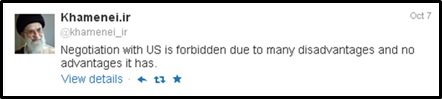
Following Khamenei’s address in early September 2015, contacts between Iran and the US and the P5 +1 powers took place September 28, 2015, on the sidelines of the UN General Assembly but their results were not published[4] and subsequently Khamenei issued a guideline on October 7, 2015 banning contacts with the US.[5]

25258

Endnotes:

[1] Fars (Iran), October 15, 2015; ILNA (Iran), October 15, 2015.

[3] See MEMRI Inquiry and Analysis No. 1192, The Iranian Majlis Has Not Approved The JCPOA But Iran’s Amended Version Of It, October 13, 2015.

[5] Twitter.com/khamenei_ir, October 7, 2015.

The Iranian Majlis Has Not Approved The JCPOA But Iran’s Amended Version Of It

October 13, 2015

The Iranian Majlis Has Not Approved The JCPOA But Iran’s Amended Version Of It, Middle East Media Research Institute, A. Savyon* and Y. Carmon, October 13, 2015

(Even Obama’s foggy notions of “common sense” should include the premise that, if there are multiple parties to an agreement, they should all follow the same agreement. — DM)

[T]he inclusion of these new Iranian demands in a Majlis decision constitutes the first written demand by an Iranian authority to amend the agreement, a demand that was mentioned verbally on September 3, 2015 by Iran’s Supreme Leader Ali Khamenei.

****************

On October 13, 2015 the Iranian Majlis approved, by a majority of 161-59 with 13 abstentions, not the JCPOA but rather an Iranian amended version it.

Paragraph 3 of the Majlis decision states that “the government will monitor any non-performance by the other party [to the agreement] in the matter of failing to lift the sanctions, or restoring the canceled sanctions, or imposing sanctions for any another reason, and will take steps to actualize the rights of the Iranian nation and to terminate the voluntary cooperation [this apparently refers to the Additional Protocol, which, according to the JCPOA, Iran will implement voluntarily] and to handle the rapid expansion of the Iranian nuclear program for peaceful purposes, so that within two years the enrichment potential in Iran will reach 190,000 SWU. The Supreme National Security Council will handle this matter, and the government will to submit to the Council a plan in the matter within four months.”[1]

Implications:

Considering that the non-cancellation of the sanctions is part of the JCPOA (according to the JCPOA, U.S. sanctions will be merely “suspended,” rather than canceled, so as to allow their “snapback” in the case of an Iranian violation); and considering that the re-imposition of sanctions, and the imposition of new sanctions, in case of an Iranian violation are likewise part of the JCPOA – the Majlis decision constitutes ratification of a nonexistent document. It was not a ratification of the JCPOA as it stands, but rather of additional demands made by Iran after the JCPOA was agreed upon on July 14, 2015 in Vienna.

Furthermore, the inclusion of these new Iranian demands in a Majlis decision constitutes the first written demand by an Iranian authority to amend the agreement, a demand that was mentioned verbally on September 3, 2015 by Iran’s Supreme Leader Ali Khamenei.[2]

The Majlis decision defines clauses in the JCPOA as “non-performance of the agreement by the other party” and therefore the Majlis’ approval is meaningless.

* A. Savyon is director of the MEMRI Iran Media Project; Y. Carmon is President of MEMRI.

Endnotes:

[1] ISNA (Iran), October 13, 2015.

[2] Khamenei announced explicitly on September 3, 2015 that he does not accept the terms of the agreement and demanded that the sanctions should be immediately removed, rather than suspended, as a condition for accepting the agreement. See the following MEMRI reports:

Special Dispatch No. 6151, “Khamenei Declares That He Will Not Honor The Agreement If Sanctions Are Merely Suspended And Not Lifted,” September 4, 2015; Special Dispatch No. 6162, “Expected September 28 NY Meeting Between P5+1 Foreign Ministers And Iran Could Signify Reopening Of Nuclear Negotiations To Address Khamenei’s September 3 Threat That If Sanctions Are Not Lifted, But Merely Suspended, There Will Be No Agreement,” September 21, 2015.

Obama Will Be the Only Person Sticking to Iran Deal

October 12, 2015

Obama Will Be the Only Person Sticking to Iran Deal, Gatestone InstituteAmir Taheri, October 12, 2015

(Happy implementation day. — DM)

Sometime this week, President Obama is scheduled to sign an executive order to meet the Oct. 15 “adoption day” he has set for the nuclear deal he says he has made with Iran. According to the president’s timetable the next step would be “the start day of implementation,” fixed for Dec. 15.

But as things now stand, Obama may end up being the only person in the world to sign his much-wanted deal, in effect making a treaty with himself.

The Iranians have signed nothing and have no plans for doing so. The so-called Joint Comprehensive Plan of Action (JCPOA) has not even been discussed at the Islamic Republic’s Council of Ministers. Nor has the Tehran government bothered to even provide an official Persian translation of the 159-page text.

The Islamic Majlis, the ersatz parliament, is examining an unofficial text and is due to express its views at an unspecified date in a document “running into more than 1,000 pages,” according to Mohsen Zakani, who heads the “examining committee.”

“The changes we seek would require substantial rewriting of the text,” he adds enigmatically.

Nor have Britain, China, Germany, France and Russia, who were involved in the so-called P5+1 talks that produced the JCPOA, deemed it necessary to provide the Obama “deal” with any legal basis of their own. Obama’s partners have simply decided that the deal he is promoting is really about lifting sanctions against Iran and nothing else.

So they have started doing just that without bothering about JCPOA’s other provisions. Britain has lifted the ban on 22 Iranian banks and companies blacklisted because of alleged involvement in deals linked to the nuclear issue.

German trade with Iran has risen by 33 percent, making it the Islamic Republic’s third-largest partner after China.

China has signed preliminary accords to help Iran build five more nuclear reactors. Russia has started delivering S300 anti-aircraft missile systems and is engaged in talks to sell Sukhoi planes to the Islamic Republic.

France has sent its foreign minister and a 100-man delegation to negotiate big business deals, including projects to double Iran’s crude oil exports.

Other nations have also interpreted JCPOA as a green light for dropping sanctions. Indian trade with Iran has risen by 17 percent, and New Delhi is negotiating massive investment in a rail-and-sea hub in the Iranian port of Chah-Bahar on the Gulf of Oman. With help from Austrian, Turkish and United Arab Emirates banks, the many banking restrictions imposed on Iran because of its nuclear program have been pushed aside.

“The structures of sanctions built over decades is crumbling,” boasts Iranian President Hassan Rouhani.

Meanwhile, the nuclear project is and shall remain “fully intact,” says the head of Iran’s Atomic Energy Agency, Ali Akbar Salehi.

“We have started working on a process of nuclear fusion that will be cutting-edge technology for the next 50 years,” he adds.

Even before Obama’s “implementation day,” the mullahs are receiving an average of $400 million a month, no big sum, but enough to ease the regime’s cash-flow problems and increase pay for its repressive forces by around 21 percent.

Last month, Iran and the P5+1 created a joint commission to establish the modalities of implementation of an accord, a process they wish to complete by December 2017 when the first two-year review of JCPOA is scheduled to take place and when Obama will no longer be in the White House. (If things go awry Obama could always blame his successor or even George W Bush.)

Both Obama and his Secretary of State John Kerry have often claimed that, its obvious shortcomings notwithstanding, their nuke deal with the “moderate faction” in Tehran might encourage positive changes in Iran’s behavior.

That hasn’t happened.

The mullahs see the “deal” as a means with which Obama would oppose any suggestion of trying to curb Iran.

1173 (1)

“Obama won’t do anything that might jeopardize the deal,” says Ziba Kalam, a Rouhani adviser. “This is his biggest, if not the only, foreign policy success.”

If there have been changes in Tehran’s behavior they have been for the worst. Iran has teamed up with Russia to keep Bashar al-Assad in power in Syria, mocking Obama’s “Assad must go” rhetoric. More importantly, Iran has built its direct military presence in Syria to 7,000 men. (One of Iran’s most senior generals was killed in Aleppo on Wednesday.)

Tehran has also pressured Iraqi Premier Haidar al-Abadi’s weak government to distance itself from Washington and join a dubious coalition with Iran, Russia and Syria.

Certain that Obama is paralyzed by his fear of undermining the non-existent “deal” the mullahs have intensified their backing for Houthi rebels in Yemen. Last week a delegation was in Tehran with a long shopping list for arms.

In Lebanon, the mullahs have toughened their stance on choosing the country’s next president. And in Bahrain, Tehran is working on a plan to “ensure an early victory” of the Shiite revolution in the archipelago.

Confident that Obama is determined to abandon traditional allies of the United States, Tehran has also heightened propaganda war against Saudi Arabia, now openly calling for the overthrow of the monarchy there.

The mullahs are also heightening contacts with Palestinian groups in the hope of unleashing a new “Intifada.”

“Palestine is thirsty for a third Intifada,” Supreme Guide Khamenei’s mouthpiece Kayhan said in an editorial last Thursday. “It is the duty of every Muslim to help start it as soon as possible.”

Obama’s hopes of engaging Iran on other issues were dashed last week when Khamenei declared “any dialogue with the American Great Satan” to be” forbidden.”

“We have no need of America” his adviser Ali-Akbar Velayati added later. “Iran is the region’s big power in its own right.”

Obama had hoped that by sucking up to the mullahs he would at least persuade them to moderate their “hate-America campaign.” Not a bit of that.

“Death to America” slogans, adoring official buildings in Tehran have been painted afresh along with US flags, painted at the entrance of offices so that they could be trampled underfoot. None of the US citizens still held hostages in Iran has been released, and one, Washington Post stringer Jason Rezai, is branded as “head of a spy ring “in Tehran. Paralyzed by his fear of undermining the non-existent deal, Obama doesn’t even call for their release.

Government-sponsored anti-American nationwide events are announced for November, anniversary of the seizure of the US Embassy in Tehran. The annual “End of America” week-long conference is planned for February and is to focus on “African-American victims of US police” and the possibility of “self-determination for blacks.”

According to official sources “families of Black American victims” and a number of “black American revolutionaries” have been invited.

Inside Iran, Obama’s “moderate partners” have doubled the number of executions and political prisoners. Last week they crushed marches by teachers calling for release of their leaders. Hundreds of trade unionists have been arrested and a new “anti-insurrection” brigade paraded in Tehran to terrorize possible protestors.

The Obama deal may end up as the biggest diplomatic scam in recent history.

The nuclear chess game begins: Iran plays for sanctions relief before compliance with deal

September 4, 2015

The nuclear chess game begins: Iran plays for sanctions relief before compliance with deal, DEBKAfile, September 4, 2015

Leadership_9.15A long way to go for Iranian approval of nuclear accord

The crowing this week over Barack Obama’s success in gaining congressional support for his Iranian nuclear deal against Binyamin Netanyahu’s defeat was premature. The July 14 Vienna deal between Iran and six world powers was just the first round of the game. Decisive rounds are still to come, before either of the two can be said to have won or lost.

The biggest outstanding hurdle in the path of the accord is Iran’s supreme leader Ayatollah Ali Khamenei and his silence on where he stands on the deal whether by a yea or a nay.

Without his nod, nothing goes forward in the revolutionary republic. So the nuclear accord is not yet home and dry either in Tehran or even in Washington.

While Obama gathered congressional support in Washington for the accord to pass, Khamenei made three quiet yet deadly remarks:

1. “Sanctions against Tehran must be lifted completely rather than suspended. If the framework of sanctions is to be maintained, then why did we negotiate?”

White House spokesman Josh Earnest answered him: “Iran will only see sanctions relief if it complies with the nuclear deal.”

There lies the rub. For the Obama administration, it is clear that Iran must first comply with the accord before sanctions are eased, whereas Tehran deems the accord moot until sanctions are lifted – regardless of its approval by the US Congress.

Here is the first stalemate, and not the last. DEBKAfile’s Iranian sources foresee long, exhausting rounds ahead that could drag on longer even than the protracted negotiations, which Secretary of State John Kerry and Foreign Minister Mohammed Javad Zarif brought to a close in Vienna.

2. Khamenei next took the step of referring the accord to the Majlis (parliament) for approval, pretending that to be legally in force, the accord requires a majority vote by the parliament in Tehran. He put it this way, “I believe… that it is not in the interest of the majlis to be sidelined.”

This step was in fact designed to sideline President Hassan Rouhani, on whom Obama and Kerry counted to get the nuclear deal through, and snatch from him the authority for signing it – or even determining which body had this competence.

It had been the intention of Rouhani and Zarif to put the accord before the 12-member Council of Guardians for their formal endorsement. But Khamenei pulled this rug out from under their feet and kept the decision out of the hands of the accord’s proponents.

3. His next step was to declare with a straight face: “I have no recommendation for the majlis on how to examine it. It is up to the representatives of the nation to decide whether to reject or ratify it.”

This step in the nuclear chess game was meant to show American democracy up in a poor light compared to that of the Revolutionary Republic (sic). While Obama worked hard to bring his influence to bear on Congress he, Khamenei, refrained from leaning on the lawmakers, who were freed to vote fair and square on the deal’s merits.

This of course is a charade. Our Iranian sources point out that the ayatollah exercises dictatorial control over the majlis through his minion, Speaker Ali Larijani. He has absolute trust in the lawmakers never reaching any decision on the nuclear deal, or anything else, without his say-so.

Congressional approval in Washington of the nuclear accord may give President Obama a fine boost but will be an empty gesture for winning endorsement in Tehran. It might even be counter-productive if American lawmakers carry out their intention of hedging the nuclear deal round with stipulations binding Iran to full compliance with the commitments it undertook in Vienna, or also continue to live with existing sanctions or even face new ones.

Netanyahu and the Israeli lobby AIPAC, far from experiencing defeat in their campaign to prevent a nuclear-armed Iran, are well fired up for the next round: the fight for sanctions.

Iran’s supreme leader: No nuclear deal unless sanctions fully lifted

September 4, 2015

Iran’s supreme leader: No nuclear deal unless sanctions fully lifted, Israel Hayom, Erez Linn, Shlomo Cesana, Yoni Hersch, Associated Press and Israel Hayom Staff, September 4, 2015

144135927674638061a_bSupreme Leader Ayatollah Ali Khamenei speaks in a meeting with members of Iran’s Experts Assembly in Tehran | Photo credit: AP

If Khamenei decides to make good on his word and demand the lifting of sanctions entirely, it will not be possible to implement the snapback mechanism and reimpose sanctions should Iran violate its obligations under the deal.

******************

Iran’s supreme leader said Thursday that “there will be no deal” if world powers insist on suspending rather than lifting sanctions as part of a landmark nuclear agreement and said it is up to Iran’s parliament, and not him, to approve or reject it.

His remarks, read aloud by a state TV anchorman, mark the first official comment on the deal since U.S. President Barack Obama secured enough support to prevent the Republican-led Congress from blocking it.

Ayatollah Ali Khamenei has yet to express a clear opinion on the deal, clinched in July, which would curb Iran’s nuclear activities in exchange for relief from crippling sanctions.

Khamenei said some U.S. officials have spoken of the “suspension” of sanctions, which he said was unacceptable. “If the sanctions are going to be suspended, then we will also fulfil our obligations on the ground at the level of suspension and not in a fundamental way,” he said.

In response, White House press secretary Josh Earnest reiterated the Obama administration’s stance that it would focus on Tehran’s actions and not its words.

Washington has been “crystal clear about the fact that Iran will have to take a variety of serious steps to significantly roll back their nuclear program before any sanction relief is offered,” he said.

However, the snapback plan (reimposing economic sanctions on Iran if it violates the deal), which Iran agreed to as part of the deal, could lose its validation as it is based on the suspension of the sanctions rather than a full removal.

If Khamenei decides to make good on his word and demand the lifting of sanctions entirely, it will not be possible to implement the snapback mechanism and reimpose sanctions should Iran violate its obligations under the deal.

Iran’s supreme leader has traditionally had the final say on all important matters in the country, but on Thursday Khamenei said that Iran’s parliament, the Majlis, known to oppose the agreement, should decide on the deal.

“It is the representatives of the people who should decide. I have no advice regarding the method of review, approval or rejection,” he said.

Either way, according to a Revolutionary Guard senior official, the deal does not detract one bit from the Iranian regime’s rancor toward Israel. “The Islamic revolution will continue to enhance its abilities until it will destroy Israel and liberate Palestine,” he said.

Meanwhile on Thursday, Prime Minister Benjamin Netanyahu told Foreign Ministry officials that most Americans agreed with Israel over dangers posed by Iran. In remarks at a Rosh Hashanah reception at the Foreign Ministry, Netanyahu made no direct mention of President Barack Obama’s victory on Wednesday in securing enough Senate votes to protect the agreement in Congress.

Speaking of a need to preserve Israel’s traditionally close ties with Washington despite what he called “differences of opinion,” Netanyahu told diplomatic staffers: “I must say, however, that the overwhelming majority of the American public sees eye to eye with us on the danger emanating from Iran.”

Israel’s message to ordinary Americans, Netanyahu said, would continue to be that “Iran is the enemy of the United States — it declares that openly — and Israel is a U.S. ally.”

Netanyahu explained that the “ratio of people who oppose the deal to people who support the deal in the U.S. is two to one.”

Ensuring the U.S. public understands that point will have “important ramifications for our security down the line,” Netanyahu said, according to an official statement.

Foreign Ministry Director General Dore Gold, meanwhile, revealed that Iran was transferring advanced weapons from arms depots in Syria to Hezbollah.

Speaking to Israel Hayom, Gold explained that the Iranians want to provide the Shiite terrorist organization with cruise missiles, Yakhont missiles and S2 land-based strategic missile.

Hezbollah’s activity, backed by Iran, has reached Kuwait and is evident in the Golan Heights, as seen in their attempts to launch another battle front with Israel.”

Gold also touched on Iran’s Parchin nuclear facility, saying that the Iranians had paved the floor of the facility with asphalt. He explained that the purpose of the move was to prevent International Atomic Energy Agency inspectors from testing the soil for dangerous substances.

Meanwhile, tensions are running high surrounding the approaching vote in the U.S. Congress. The Wall Street Journal published on Thursday a caustic article, warning the Democratic Party that if the nuclear deal fails, it will be their fault. “Politically, Obama’s victory in Congress makes Democrats hostage to Iran’s behavior. This means that if a nuclear arms race breaks out in the Middle East, democrats are accountable,” the article said.

Iranian President Says Nuclear Deal a ‘Non-Committal Agreement’

August 29, 2015

Iranian President Says Nuclear Deal a ‘Non-Committal Agreement,’ The Jewish PressTzvi Ben-Gedalyahu, August 29, 2015

(If Rouhani, backed by Khamenei, says the “deal” has no legally binding effect, that is Iran’s position. Why should the U.S. be “legally bound” by such an agreement? — DM)

rouhani-obamaPresidents Rouhani and Obama.

Iranian President Rouhani said Saturday the parliament should not vote on the nuclear deal so that it will not become a legal obligation.

************************

Iran has given U.S. Congressmen the perfect reason to oppose the nuclear deal by saying that the Iranian parliament should not make it a legal obligation for the Islamic Republic.

Iranian President Hassan Rouhani told a news conference Saturday that the deal is only a political understanding, and he urged parliament not to vote on it so that it does not become a legal obligation.

Iran’s official Islamic Republic News Agency (IRNA) reported Saturday:

President Hassan Rouhani underlined that Joint Comprehensive of Action (JCPOA) does not need the Majlis (Iranian parliament) approval for its implementation.

‘Under the Iranian Constitution, a treaty has to be submitted for approval or disapproval to the Parliament if it has been signed by the president or a representative of his,’ President Rouhani said, addressing a press conference in Tehran on Saturday.

‘That is not the case about the Iran-Group 5+1 nuclear agreement or the JCPOA,’ the Iranian president added.

Rouhani emphasized that parliamentary approval of the JCPOA would mean that he has to sign it, “an extra legal commitment that the administration has already avoided,” according to IRNA.

The Associated Press added that Rouhani said:

Why should we place an unnecessary legal restriction on the Iranian people?

President Barack Obama needs only four more Democratic senators to back the bill in order to prevent a veto-proof majority if Congress rejects the agreement.

If the agreement is approved, the United States will be obligated to honor it unless it can catch Iran cheating, a process that could involved months or even a year.

On the other side of the ocean, Rouhani has made it clear that the deal has no legal standing in Iran.

The Supreme Leader Caught in His Own Web?

August 20, 2015

The Supreme Leader Caught in His Own Web? Iran Truth, Clare Lopez, August 19, 2015

Khamenei depends on the U.S. Congress to save his regime. Congressional members may want to think about that long and hard before voting on this disastrous deal next month.

**********************

For those who have only experienced either democracy or dictatorship, it is difficult to grasp the complexities of Iran’s political system, which is an autocracy that has adopted some democratic features. A careful reading of the Iranian constitution, however, clarifies for the reader that the Supreme Leader is the one and only person who wields ultimate power in that system, including appointment power for a vast number of positions.

Hossein Shariatmadari, editor-in-chief of Kayhan, the most important Iranian daily widely viewed as the regime outlet for the Supreme Leader’s ideas and policies, is one of those appointed to his job directly by Ayatollah Ali Khamenei. Thus, it was no surprise that Shariatmadari’s 15 August 2015 editorial, claiming that Khamenei opposes the nuclear deal, drew immediate attention. Obviously, Shariatmadari would not have written that without Khamenei’s consent. The confusing part, however, is that Hamid Reza Moghadam Far, top advisor to MG Mohammed Ali Jafari, Islamic Revolutionary Guards Corps (IRGC) commander, then harshly criticized Shariatmadari and warned him not to ascribe to the Supreme Leader his own ideas and understandings.

Given that Jafari is directly appointed by the Supreme Leader (just like Shariatmadari), and that there’s little history of this Iranian regime sending out such mixed messages from its own top ranks, the only conclusion possible is that sowing confusion is a calculated move at this time, intended to serve a regime objective.

For over three decades, the Islamic regime of Iran has made implacable enmity toward the U.S. and Israel the foundation of its official foreign policy, reflecting its leaders’ ideological dedication and fervor. Generations of young people have been indoctrinated to Islamic beliefs and recruited to the IRGC, Qods Force, and Basij on the basis of commitment to these beliefs. A blood-soaked litany of terror attacks instigated by this mullahs’ regime stretches from the ruins of the Marine Corps barracks in Beirut through Khobar Towers, the East Africa Embassy bombings, the USS Cole attack, 9/11 and hundreds of American troops killed and maimed by Iranian and Hizballah explosives in Iraq and Afghanistan. Tehran’s support for Islamic terror groups has left a global trail of murder and mayhem. “Resistance” is what the Ayatollahs call it. “Death to America” and “Death to Israel” are the slogans, chanted in endless repetition. America is the “Great Satan” and Israel the “Little Satan.” Never did the Supreme Leader imagine negotiating, much less reaching an actual agreement, with such hated enemies.

But the sanctions took their toll and financial collapse had to be avoided, even if it meant coming to the table to negotiate with the world’s superpowers, however noxious that was for Khamenei personally. Getting the West to believe Iran was desperate enough to obtain relief from sanctions that it would agree to limit its nuclear weapons program was only a clever ruse, of course, but it worked. The first step was allowing Hassan Rouhani, an old regime hand who’d served as negotiator in earlier talks, to become president. Khamenei needed Rouhani’s smiling demeanor to smooth international impressions of the Islamic Republic. The years-long cultivation of Secretary John Kerry by Foreign Minister Javad Zarif also would pay off big time. The clincher was bringing in Energy Secretary Ernest Moniz, an old friend of Iran’s Atomic Energy Organization (AEO) chief, Ali Akbar Salehi, to push through to the final agreement. Intelligence services like Iran’s are willing to invest lots of time and effort with targets at this level.

The American collapse on every single key issue—from enrichment (a stipulation demanded—and obtained—even before the first secret talks began in Oman in 2011) to centrifuges, the Arak plutonium-producing reactor, off-limits facilities, Iran’s Intercontinental Ballistic Missiles (ICBMs), sanctions relief, and P5+1 technical assistance with nuclear development and site protection—surprised and delighted the Iranians. Contrary to Shariatmadari’s claims, the Supreme Leader is in fact quite satisfied with the nuclear deal; but, he cannot show that publicly, for two key reasons. If the U.S. Congress should vote against the deal, potentially leaving in place even some sanctions that President Obama could neither waive nor lift, Khamenei would find himself the public supporter of a failed deal. The powerful IRGC and Basij militia might hold him responsible for compromising the blood of martyrs and values of the Islamic Revolution for which the Iranian people sacrificed their economy and lives. And that would spell the end of the regime.

What to do? Khamenei wants the benefits of this deal without any of the possible liabilities. So, even as his trusted Iran Lobby pulls out the stops to make sure the deal goes through, he tries to find a way to support it without disappointing the guns that keep him in power. Solution: in public, Khamenei has spoken in general, nebulous phrases that convey no certain position. But in private, to certain audiences among the IRGC, Qods Force, and Basij, he pretends to oppose the deal. To others, he expresses support. Each group is allowed to go out and express its understanding of the Supreme Leader’s position with the media. Meanwhile, Khamenei plays the game safely and waits to see which way the deal will go.

If something goes wrong with the deal, Khamenei will be the one who warned Rouhani’s negotiating team not to trust the Americans. Publicly, then, he can discredit Shariatmadari and claim the media misstated his position (even though everyone knows that without Khamenei’s prior permission, neither Jafari nor Kayhan’s editor-in-chief would even discuss the subject). The regime is trapped in a web of its own making. It has radiated hatred toward Israel and the West for so long and so insistently that it cannot now just stop chanting “Death to America” or calling for Israel to be wiped off the face of the map. Nor can it abandon its terror proxies across the region. Disappointing the IRGC and Basij that are the backbone of this regime would shake the very foundation of the Islamic Republic of Iran: unthinkable.

Khamenei depends on the U.S. Congress to save his regime. Congressional members may want to think about that long and hard before voting on this disastrous deal next month.

This piece was co-written by Daniel Akbari, a lawyer certified to practice before the Supreme Court of Iran, holds a master’s degree from Texas State University and a graduate certificate in homeland security from the Bush School of Government and Public service.