Archive for the ‘Iranian nukes’ category

Netanyahu finds himself increasingly alone on Iran

October 2, 2014

Netanyahu finds himself increasingly alone on Iran, Reuters, Dimi Reider, October 2, 2014

(Churchill stood nearly “alone” during the mid to late 1930’s in his arguments concerning the dangers of Germany under Hitler. Churchill was right, Chamberlain was wrong. Churchill’s arguments were eventually vindicated — but only after the substantial damage left by his predecessor had diminished Britain’s abilities to fight Nazi Germany and had to be fixed. Like many directed against Churchill, the post provided below is in large measure a selective hit piece against Netanyahu. Still, it’s worth reading because it apparently reflects the views of many. Churchill was right and so is Netanyahu. Will he be vindicated as well? — DM)

bibib1-1024x604

The client retains its value only so long as it aligns itself with the interests of its patron — or at the very least tries not to undermine them. On Iran, however, Netanyahu has repeatedly attempted to dictate to America what its interests should be in trying to hamstring his patron’s push toward a nuclear deal with Iran.

*******************

For Israeli Prime Minister Benjamin Netanyahu, Iran and the Islamic State, also known as ISIS, are essentially the same thing.

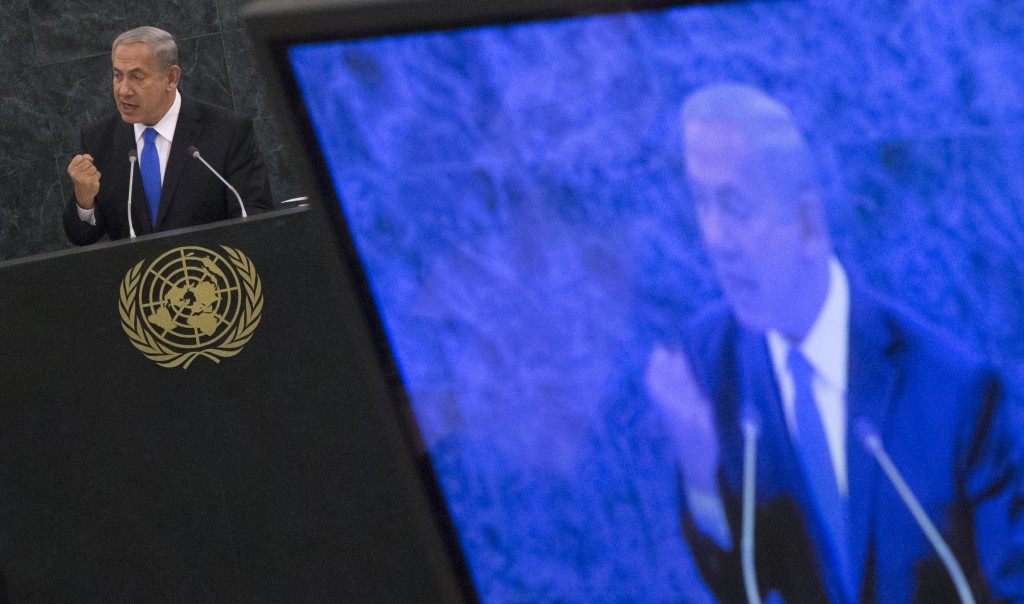
During a diatribe against Iran in his United Nations speech on Monday, Netanyahu asked: “Would you let ISIS enrich uranium? Would you let ISIS build a heavy water reactor? Would you let ISIS develop intercontinental ballistic missiles? Of course you wouldn’t.”

It was almost as if Netanyahu views Iran and ISIS as interchangeable. But the rest of the world doesn’t see it that way — least of all the United States, which is making a crucial last push for a comprehensive agreement with Iran on its nuclear program, even as it musters an international coalition to fight the Islamic State.

In insisting that Iran and ISIS are essentially the same enemy, Netanyahu broadcast his isolation among world leaders and underscored the jadedness of the idea that he has championed for most of his political career: the imminence of an Iranian nuclear bomb and the apocalyptic threat it would pose to the free world.

After all these years, Netanyahu still calls for every nook and cranny of Iran’s nuclear program to be demolished by military force, though preferably not Israel’s alone.

The isolation of his views was evidenced not only by the near-empty General Assembly hall when he gave his speech, but also in the Israeli media.

Although the Islamic Republic of Iran (which Netanyahu persistently, if not naggingly, referred to as “The Islamic State of Iran”) was referenced in Netanyahu’s speech many more times than ISIS, the Israeli media did not follow suit.

They instead focused on Netanyahu’s appeal to “moderate” Arab states to unite against common threats, including militant Islam. A few outlets looked at Netanyahu’s riposte to Palestinian leader Mahmoud Abbas’ charges of genocide. And even the most pro-Netanyahu daily, Yisrael Hayom, led with a headline proclaiming the Israeli Defense Forces to be “the most moral army in the world”– a quote from the speech, but not about the Islamic Republic’s nuclear project.

The Israeli media’s disinterest in Netanyahu’s Iran obsession is matched at home. In poll after poll, Israelis consistently put Iran behind such concerns as street crime and the rising cost of living.

Netanyahu’s fixation on Iran has also deepened divisions between Israel’s political leadership and top military brass. The nadir was reached in 2010, when Netanyahu and then-Defense Minister Ehud Barak ordered the army to stand by for an imminent attack on Iran and the chief of staff refused to comply.

Former Mossad chief Meir Dagan, who related the incident two years later, added that he’d never before seen the entire political leadership adamantly insisting on one course of action and the entire professional military leadership absolutely opposing it.

Four years on, the issue still festers. At the peak of the war in Gaza this summer, analyst Shlomi Eldar accused Netanyahu of all but turning a blind eye to Hamas’ tunnels that formed a pretext for the ground incursion. The reason for this, Eldar charged, was that the prime minister was completely “obsessed” with Iran.

Netanyahu’s absolutist approach to Iran is also straining Israel’s bond with the United States. For all the grandeur, courtesy and genuine complexity that feed into the staple American reference to Israel as an ally, the relationship between the two is, on the strategic level, fundamentally that of a patron power and a client state.

The client retains its value only so long as it aligns itself with the interests of its patron — or at the very least tries not to undermine them. On Iran, however, Netanyahu has repeatedly attempted to dictate to America what its interests should be in trying to hamstring his patron’s push toward a nuclear deal with Iran.

Such an agreement could radically shift the power paradigm in the Middle East toward a more open, less violent and more consensus-based arrangement. Would Israel see itself as a player in this new arrangement or outside it?

Depends on who you ask.

The relative silence of most Israeli institutions on the talks on Iran’s nuclear program suggests they are reluctant to make themselves entirely external to the potential new paradigm. But Netanyahu’s speech — intransigent as it was – indicates that at least one Israeli leader will go down fighting rather than bring Israel on board.

Obama’s Peace Process for Iraq, Syria and the Islamic State begins [Caution: includes satire]

October 2, 2014

Obama’s Peace Process for Iraq, Syria and the Islamic State begins [Caution: includes satire], Dan Miller’s Blog, October 2, 2015

Obama was heard to remark during a recent presidential golf game,

“Israel is a terrorist war criminal. It won’t even yield to my reasonable demands for a two state solution with my beloved Palestinians, whose children and other innocent civilians it relishes murdering. However, Iraq, Syria, ISIL, etc. are humanitarians and will recognize that I am like them, as I lead them to peace through the Light of My true wisdom and greatness.”

FINALLY, He has a plan!

His best plan yet!

Obama functions at His very best with no intelligence. Intelligence would imperil His domestic and foreign priorities and perhaps even His brilliant world view.

I don’t think the problem is Obama’s inattentiveness. It’s not the demands of his golf game. It’s not his incessant fundraising. It’s his worldview. [Not satire.]

(The video is not satire)

The first Peace Process phase

In Iraq and now in Syria, Obama is trying to appear less humanitarian. It’s the initial focus of His Peace Process (PP), through which He plans to arrange a three state solution among the Non-Islamic Islamic State, its cohorts, friends and associates, Iraq and Syria. During His initial PP phase, He intends to gain credibility with and empathy from the Islamic State, et al. Accordingly, He has lifted His rules of engagement, previously intended to minimize civilian casualties, when striking forces of the Islamic State, et al.

The White House revealed on Tuesday that its usually strict rules of engagement, intended to prevent civilian casualties of US airstrikes, have been relaxed in the current offensive against the Islamic State and other radical Islamist groups. [Emphasis added.]

National Security Council spokeswoman Caitlin Hayden told Yahoo News in an email that a much-publicized statement last year by President Barack Obama that US drone strikes would only be carried out if there is a “near certainty” of no civilian injuries would not apply to the US campaign against jihadi forces in Syria and Iraq.

Hayden wrote that the “near certainty” rule was intended “only when we take direct action ‘outside areas of active hostilities,’ as we noted at the time.

“That description — outside areas of active hostilities — simply does not fit what we are seeing on the ground in Iraq and Syria right now,” she continued, but added that the strikes, “like all US military operations, are being conducted consistently with the laws of armed conflict, proportionality and distinction.”

The statement came after reports that a dozen civilians, including women and children, were killed on September 23 after an errant Tomahawk cruise missile hit a house in the village of Kafr Daryan, in Syria’s Idlib province, believed to be a stronghold of al-Qaeda-linked militants. [Emphasis added.]

In a briefing to the House Foreign Affairs Committee last week, Syrian rebel commanders described scenes of devastation as the bodies of women and children were pulled from the beneath the rubble of the destroyed building, which was apparently being used as a shelter for displaced civilians. [Emphasis added.] [Not satire.]

It’s His most clever strategy yet, and only Obama could devise it: by showing the Islamic State, et al, that He agrees with their strategy of maximizing casualties, both combatant and civilian, Obama will easily convince them of the benefits of the true peace and security His PP will provide.

When asked whether, during the next Gazan conflagration, Israel should adopt His modified rules of engagement, Obama was heard to mumble at the 15th hole, “That’s entirely different. Hamas does not threaten My popularity in My country.” State Department spokesperson Jen Psaki hinted at much the same in August:

US State Department Spokesperson Jen Psaki delivered an unusually strong condemnation of an Israeli strike near a Gaza school being used as a shelter in Rafah, saying that the US was “appalled” by the “disgraceful shelling outside an UNRWA school. [Emphasis added.]

The shelling, which left 10 people dead according to Palestinian reports, drew harsh condemnations worldwide, including from the United Nations, London and elsewhere, amid growing international criticism of the 27-day-long operation. [Emphasis added.]

The IDF issued a statement saying that forces had targeted three Palestinian Islamic Jihad terrorists on board a motorcycle in vicinity of an UNRWA school in Rafah, and added that “the IDF is reviewing the consequences of this strike.”

However, the US said that the presence of combatants did not justify targeting areas near the school. [Emphasis added.]

. . . .

Before the reports of the latest strike came in, senior White House adviser and Obama confidant Valerie Jarrett addressed the ongoing violence on CBS’s Face the Nation Sunday morning.

Describing the conflict as “a devastating situation,” Jarrett asserted that “Israel absolutely has the right to defend itself, and we are Israel’s staunchest ally.”

At the same time, she added that “you also can’t condone the killing of all of these innocent children,” referring to the hundreds of civilian casualties reported in Gaza over the course of the past three weeks. [Emphasis added.] [Not satire.]

Neither Psaki nor Jarrett mentioned Obama’s popularity at home expressly. However, increasing civilian (mainly Muslim) casualties in Iraq and Syria, and demanding that Israel do even more to engage in strictly proportionate kinetic actions against Hamas Islamists, are both calculated to increase Obama’s popularity at home. This twofer is consistent with an address prepared for Him by my confidential White House informant, The Really Honorable I.M. Totus:

Israel’s actions have been disgracefully disproportionate and must stop. If they do not cease before I leave for my much needed family vacation at Martha’s Vineyard on August 9th, my red line will have been crossed and upon my return I may issue an Angry Executive Decree chastising Israel. Here is what Israel has done and what it must stop doing:

Israel has used WMDs (Weapons Minimizing Death and Destruction) including “Iron Dome,” warning sirens and shelters to thwart missile attacks. The Palestinians in Gaza have no even remotely comparable WMDs: They have no Iron Domes, their tunnels — clearly dug as air-raid shelters — have been destroyed maliciously and their air-raid sirens often can not be used due to Israel’s inhumane refusal to furnish electricity. They are therefore forced to use civilians, including small children, to guard their missile sites. They do so in the forlorn hope that Israel will take pity on them and refrain from attacking. Merciless Israel continues to attack, wantonly and intentionally wasting the precious lives of many innocent Palestinians. [Emphasis added.] [Satire.]

Second PP phase

Unlike the Obama Nation and its splendid coalition of the unwilling, the Islamic State, et al, have no aircraft. Nor have they any WMDs comparable to the Iron Dome used by wickedly ferocious Israel. Despite that, airstrikes have done little to diminish their effectiveness.

As of Tuesday, the U.S. and its coalition partners had conducted nearly 310 air attacks on Islamic terrorist targets, more than 230 in Iraq and 76 in Syria, a Pentagon spokesman said.

And while the air campaign has forced the terrorists to change their tactics, “We still believe ISIL remains a very potent force,” Admiral John Kirby told reporters on Tuesday. [Emphasis added.]

“Yes, they’ve changed some of their tactics, there’s absolutely no question about that, in response to the pressure that we put them under, but that doesn’t make them less dangerous or less potent over time,” Kirby said. [Emphasis added.] [Not satire.]

Accordingly, during the second phase of His PP strategy, Obama will cease all air strikes. He will also require Iraqi, coalition and any U.S. boots on the ground to use only stolen or abandoned weapons, ammunition and vehicles. As the photo provided below clearly shows, Islamic State, et al, forces have little more than rocks for weapons and that is not fair. Neither is forcing them to steal the few they do have, vigorously punished under Sharia law.

islamic-state-stoning-from-dabiq-magazine-ip_0 (1)

Additionally, all lethal weapons heretofore provided to those fighting disproportionately will now be provided only to the Islamic State, et al. Obama will make it perfectly clear that, in return, non-Islamic freedom fighters must read their rights under Sharia law (to be drafted by Attorney General Holder) to all whom they intend to execute. If convenient, the notification must be read in languages they are believed able to understand.

These steps will level the playing field and help the non-Islamic Islamic State, et al, to understand that Obama is the Messiah of true Peace, Virtue and Understanding based on true Islamic values under Sharia law, as recently articulated in a letter signed by one hundred and twenty-six moderate Islamists (not satire). They may even accept Him as the Mahdi, an honor greater even than His highly regarded and equally well deserved Nobel Peace Prize.

Third PP phase

With the realistic understanding of His life, His universe and everything which Obama will thus give to them, they will follow Him anywhere He may lead, particularly from well behind. They will jump, shout with joy and fire our their rifles into the air when He receives His second Nobel PP prize.

Conclusions

According to Reuters, Obama met with Israeli Prime Minister Netanyahu at the White House on October 1st — the same day that His new rules of engagement increasing civilian casualties in Iraq and Syria were announced.

Even as Netanyahu pressed Obama over Iran in White House talks, the president urged the Israeli leader to help find ways to prevent Palestinian civilian casualties like those inflicted in the recent Gaza war between Israel and Hamas militants.

. . . .

While Netanyahu put the emphasis on Iran, Obama was quick to focus on the bloody 55-day Gaza conflict, which ended in August with no clear victor. This followed the collapse of U.S.-sponsored peace talks between Israel and Palestinians in April. [Not satire]

“Iran? Nukes? What’s wrong with that,” Obama didn’t ask. He probably knows that a nuke deal allowing the Islamic Republic of Iran to get (or to keep) nukes will enhance His popularity ratings if Iran doesn’t actually use them until He leaves office in January of 2017, in accordance with His informal understanding with the Islamic Republic. And to Him, that’s what matters. When He leaves office, anything bad that happens will be somebody else’s fault, as He will be quick to point out.

Anne in PT, my favorite Israeli blogger, wrote a serious article about Obama’s hypocrisy titled Hypocrisy as demonstrated by the White House. She began,

In this post I want to highlight the brazen double standards and utter screaming hypocrisy demonstrated by that ill-mannered hostile man who stands at the head of Israel’s ostensible best friend, America. [Not satire.]

She then does so, clearly and well. I had considered writing a similar article but didn’t have the stomach for it. Therefore, I tried to write this bit of satire instead.

Obama’s post-American world is taking shape with the rise of Iran

October 1, 2014

Obama’s post-American world is taking shape with the rise of Iran, Washington Examiner Opinion, Arthur Herman, October 1, 2014

(Iran is a post-mature bastion of human rights and tolerance, cf. “Goodbye, Dear Mum”: Iran Executes Rayhaneh Jabbari — UPDATED. A post-moderate, post-benign country such as Iran would never attack another country and desires only post-peaceful nukes. Right? — DM)

Remarkable is one word for it; obscene might be another. Whatever word you choose, the long-term implications of embracing Iran are nearly all bad for the region and for the United States.

[W]in or lose against the Islamic State, the West’s outreach to Iran only sets the stage for more chaos in the Middle East — and more opportunities for Tehran to extend its power. The irony is that the West has a potential democratic ally in the region, one that really does have a stake in a peaceful, stable Middle East and in defeating terrorism — Israel.

*********************

Anyone wanting to take the moral temperature of the post-American world President Obama wants to create only had to drop by the United Nations last Thursday afternoon.

There he would have seen British prime minister David Cameron sitting down with Iranian President Hassan Rouhani to ask — no, beg him to join the misbegotten coalition Obama has assembled against the Islamic State. Obama and Secretary of State John Kerry had already extended the invitation to Iran to join, and Iran had already refused. Now it was Cameron’s turn.

He may think this will burnish his image as a master diplomat after convincing the Scots not to demand independence. Instead, he’s only opened one more sordid chapter in the most remarkable story of how Iran, a vicious rogue nation and state sponsor of terrorism — not to mention beacon of anti-Semitism — has become the rising dominant power in the region, and is now being blatantly courted as an ally by the West.

Remarkable is one word for it; obscene might be another. Whatever word you choose, the long-term implications of embracing Iran are nearly all bad for the region and for the United States.

Even more strikingly, this change in Iran’s international status comes only two years after the regime in Tehran was reeling from sanctions that had largely cut off its access to Western banks and capital, and above all, Western customers of its oil. Iran’s oil output plummeted by nearly half; gasoline prices in the country soared into the stratosphere while the economy teetered on bankruptcy. The country’s natural gas industry (Iran’s gas reserves are among the biggest in the world) was in an extended state of collapse as Western companies and technicians packed up and left. Even China had agreed to abide by some modified sanctions against Iran, all in order to force the mullahs to halt their illegal nuclear weapons program.

Now today China is importing record amounts of oil from Iran while Western companies are rushing back to its oil and gas fields. Iran is the chief protector and patron of Syria, and also Iraq. Moreover, Iran’s bomb is more on track than ever. Indeed, its uranium enrichment program is close to 70 percent of what’s required — and no one now seriously believes they can be stopped from making a bomb, or putting it on the long-range ballistic missiles they continue to develop.

So what happened? John Kerry’s disastrous deal struck in Geneva last year lifting key sanctions against Iran in exchange for promises to cut back on the enrichment process — a promise premier Hassan Rouhani never intended to keep—is only symptomatic of a much larger delusion. This is that Iran can be persuaded to become a constructive actor in the Middle East if only the United States will offer enough carrots including lifting sanctions, and forswear the sticks, including military strikes against the regime’s nuclear sites.

Many Russian experts had a similar delusion about the Soviet Union during the Cold War; it’s also the one that convinced Neville Chamberlain to sit down with Hitler at Munich. It holds that self-interest will trump ideology; that bad regimes are bad because they’ve been badly treated (Hitler had Versailles to complain about, after all; Tehran has the CIA plot against Prime Minister Mossadegh some sixty years ago) — and that evil ultimately isn’t evil.

Now we know better about Hitler, and about the former Soviet Union. Whether we learn the same about Iran before it’s too late, is going to be the major issue in the Middle East in the next decade — far more than the Islamic State.

In fact, even as the world’s attention has been distracted by the Islamic State, Iranian-backed Shia rebels scored a major victory in Yemen, and now control 17 of the country’s 21 provinces. Soon Tehran’s proxies will be poised on the border of Saudi Arabia, its arch rival for regional dominance. If anything gives Saudi Arabia a signal that it’s time to get its own atomic bomb, it won’t just be whether Iran finishes its enrichment process; it will also be a Yemen firmly in Tehran’s camp, and ready to foment revolt in the kingdom’s Shia provinces.

In short, win or lose against the Islamic State, the West’s outreach to Iran only sets the stage for more chaos in the Middle East — and more opportunities for Tehran to extend its power. The irony is that the West has a potential democratic ally in the region, one that really does have a stake in a peaceful, stable Middle East and in defeating terrorism — Israel.

Nevertheless, this administration and its NATO allies still insist on treating the Jewish state as the pariah, even as they know it will be Iran’s principal target once it gets its nuclear bomb.

The sight of Western leaders kissing the hem of Rouhani’s robe may be sickening, but it’s also understandable. When you lose your moral compass, your self-respect follows. Sadly, it’ll be a long time before the United States will get either one back.

Netanyahu tells UN: Israel’s fight is the world’s fight

September 30, 2014


Iran’s “Hanging Machine” to Execute Reyhaneh Jabbari

September 29, 2014

Iran’s “Hanging Machine” to Execute Reyhaneh Jabbari, Gatestone Institute, Mina Ahadi, Nazanin Afshin Jam, Shabnam Assadollahi and Shadi Paveh, September 29, 2014

(The Islamic Republic of Iran, like the Islamic State, has nothing to do with Islam. Right? — DM)

Reyhaneh Jabbari has been transferred to Rajai-Shahr Prison to be hanged — while the world parties at the UN and gets ready to permit Iran nuclear capability.

Reyhaneh Jabbari has been transferred to Rajai-Shahr Prison to be hanged — while the world parties at the UN and gets ready to permit Iran nuclear capability.

While the West is focused on an Iran nuclear deal and defeating ISIS terrorists, the executioner-regime of the Islamic Republic of Iran continues violating human rights.

The regime has just transferred Reyhaneh Jabbari to Rajai-Shahr Prison in Tehran and, as she is transferred to be executed, told her to say goodbye to her mother and family.

The Petition to Save Reyhaneh Jabbari from being hanged has been signed by over 188,000 people, but as usual has been ignored by the Iranian regime.

Reyhaneh Jabbari’s execution may carried out by tomorrow.

718Reyhaneh Jabbari in court during her trial.

(Here is an excerpt from an earlier article about Reyhaneh Jabbari from the Gatestone Institute.– DM

Jabbari has written from prison about the day of the attack, her interrogations, torture and the fate of other female prisoners:

As soon as I arrived at the Police Headquarters three large men were waiting for me in a small room. As soon as I entered, they handcuffed me to a chair and made me sit on the floor… They took turns screaming, “You think you are smart? People more important than you have been broken here. You insect, who do you think you are? Answer every question loudly…

I could feel something on my back and my skin swelling getting ripped. I felt a burning sensation and screamed until my ears hurt from the sound of my own screams. I did not hear the lash of the whip. I do not know if they were beating me with a whip, a rope or a piece of wood. I never learned what those three monsters were burning me with. I could only hear myself screaming. With my hands tied higher than my body to the chair, the pain and burning made my arms numb…

Winter was cold this year; it coincided with the prison’s heating system breaking down. In our ward, all you could hear was chattering teeth, coughing, sneezing…. The chattering teeth reminded me of 2007, when I was 19, in solitary confinement, with wounds all over my body, and shaking from anxiety and fear … I was questioned mostly by two men whose names I never found out. They would dictate [my confession] and I would write. Once they took me somewhere for interrogation where I saw a 14 or 15 year old girl hanging from the ceiling from her wrists. The girl was pale, her lips were cracked. She was whimpering.

[In another room,] the interrogator sat across from me and said that today or tomorrow they would go get my little sister… He referred to her by name: Badook. “It is her turn,” he said. “She is frail, thin … How long do you think she will last hanging like that one?” He began telling me in detail what he was going to do in front of me to my little sister … I started crying and begged him not to do such a thing. He said he had no alternative. I asked him what I could do to stop him from hurting my sister. He said: “It is very simple. Just confess that you bought the knife before the murder”. … So I wrote that I had bought the knife beforehand, signed the paper and breathed a sigh of relief.

Jabbari has said that Sarbandi had lured her to an apartment in July 2007, when she was 19, with the promise of an interior design job. When they arrived, according to her, Sarbandi locked the door and attempted to rape her. After a struggle, she saw a knife in the kitchen and stabbed him once in the shoulder. He later died in the hospital.

As Islamic courts do not recognize self-defense, especially from a woman, Reyhaneh was charged with first degree murder. The files from the court case are said to have gone missing.

On April 14, 2014, Ahmad Shaheed, a UN Special Rapporteur, asked for a stay of her execution — one day before her scheduled hanging. Shaheed also asked Iranian authorities for a review of the case, including a retrial and a request that the courts adhere to International standards for a fair trial.

Perhaps fearing further exposure of a corrupt and illegal judicial system — which includes sham trials and the systematic use of torture, the Islamic Republic postponed Reyhaneh’s execution and announced a review of her case.

Rouhani ties Iran cooperation on Mideast violence to nuke deal

September 25, 2014

Rouhani ties Iran cooperation on Mideast violence to nuke deal, Fox News, September 25, 2014

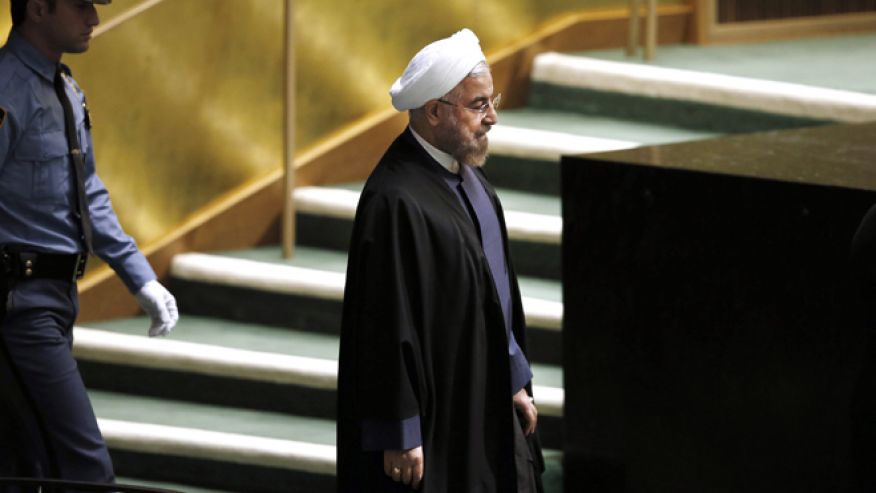
UN General Assembly_Rouhani_AP_660In this Thursday, Sept. 25, 2014 photo, President Hassan Rouhani of Iran walks in before addressing the 69th session of the United Nations General Assembly at U.N. headquarters. (AP)

Iranian President Hassan Rouhani on Thursday sought to leverage the crisis in the Middle East to ease sanctions on his country as part of nuclear talks, suggesting during a United Nations address that security cooperation between Iran and other nations could only occur if they struck a favorable nuclear deal.

The Iranian president, meanwhile, sought to lay the blame for raging violence in the Middle East at the feet of western nations. He strongly condemned terrorism and described it as a serious threat, but also said the West’s “blunders” in the region have created a “haven for terrorists and extremists.” He alleged that attempts to “export” democracy have created “weak and vulnerable governments.”

While focusing in large part on violent extremists in the region, Rouhani made clear Iran’s cooperation in addressing these threats hinges on the outcome of ongoing nuclear talks – as he once again urged other nations to drop what he described as “excessive demands.”

Rouhani said a deal could mark the “beginning of multilateral cooperation” and allow for “greater focus on some very important regional issues such as combating violence and extremism.”

But, he said: “The people of Iran who have been subjected to pressures … as a result of continued sanctions cannot place trust in any security cooperation between their governments with those who have imposed sanctions.”

Whether Iran’s cooperation in addressing Middle East unrest will serve as an effective bargaining chip remains to be seen.

The U.S. publicly has said it will not cooperate militarily or share intelligence with Iran to address the Islamic State threat.

Yet Secretary of State John Kerry said this week he was “open to have a conversation at some point in time if there’s a way to find something constructive.” And the U.S. reportedly notified Iran in advance of plans to strike inside Syria.

In his address to world leaders late Wednesday, British Prime Minister David Cameron also said Iran could help in defeating the terror group’s threat. Cameron spoke hours after meeting in person with Rouhani, the first meeting between the British and Iranian leaders since the Iranian revolution in 1979.

The world leaders spoke as the U.S., Iran and other nations resume nuclear talks after a two-month hiatus.

They are running up against a Nov. 24 deadline to reach a comprehensive agreement to curb Iran’s nuclear activities in exchange for easing sanctions.

Tehran, though, is resisting U.S. calls that it gut a nuclear program that enriches uranium, a process that can make both reactor fuel and the fissile core of a nuclear warhead. GOP lawmakers have also warned that the Obama administration may be willing to give too much ground to Iran in pursuit of an agreement.

Failure to seal a deal could see a return to confrontation, including U.S. and Israeli threats of military means as a last resort to slow Iran’s nuclear program.

“My message to Iran’s leaders and people is simple: Do not let this opportunity pass,” President Obama said Wednesday in his own address to world leaders.

The disagreement has complicated efforts to regarding the Islamic State menace.

In comments on the eve of his own General Assembly speech, Rouhani suggested his country was ready to join Washington and others in opposing the Islamic State. But he said the U.S. needed to move beyond “insignificant” fears that his country seeks nuclear arms.

At the same time, he was critical of the U.S. bombing campaign of Islamic State group strongholds and the growing coalition of countries seeking to stop the extremists by military means. “Bombing and airstrikes are not the appropriate way,” Rouhani said, warning that “extraterritorial interference … in fact only feeds and strengthens terrorism.”

There are other issues. American officials are furious with Iran for detaining Jason Rezarian, a Washington Post journalist who has both American and Iranian citizenship, as well as his wife.

Iranian officials have not specifically said why the couple is being held, and Rouhani has dodged questions about their fate. Asked again Wednesday about Rezarian, he said he would be freed if he is innocent of any crime.

Manufacturing Excuses So Iran Can Get Nukes

September 24, 2014

Manufacturing Excuses So Iran Can Get Nukes, Gatestone InstitutePeter Huessy, September 24, 2014

(Islam is the religion of peace death and a nuclear armed Iran will act accordingly. — DM)

We assume Iran’s leaders will abide by the very international rules they are dedicated to destroying.

When we refer to Iranian missiles as a legitimate form of “deterrence,” we just fool ourselves into imagining that Iranian missiles, which support aggression, are no different from American and allied missiles, which prevent and deter aggression.

The U.S. has said it would not address Iran’s 30-plus years of sponsorship of terror nor is extensive ballistic missile program, even though the U.S. officially designates Iran as the leading state-sponsor of terror in the world.

While security threats have been increasingly serious, the United States and its allies have not been willing honestly to face the challenges of our time — especially from the coalition of oil-rich, rogue state sponsors of terror and their jihadist affiliates.

Instead they have been content to push for declining defense budgets and jettisoning their security obligations. This has — and is — making it increasingly difficult to find the leadership necessary to lead a coalition of nations to defeat the threats we face.

The United States is making three critical mistakes.

First, much of the deterrent effect of U.S. military power is being squandered. Not only have the U.S. and its NATO allies neglected their defense needs and cut defense budgets by a collective $2 trillion from the base budgets of 2009[1], but many leaders have adopted the view that military power is the problem, not part of the solution.

In the United States, critics of wars in both Afghanistan and Iraq have claimed that U.S. military power was the cause of much of the terrorism and aggression we see around the world. They see less military presence — even a complete withdrawal from parts of the world — as the key to a more peaceful world.[2]

This “blame America first” view was wrong in 1984 — as Ambassador Jeanne Kirkpatrick explained then — and it is wrong now. “They [San Francisco Democrats] said that saving Grenada from terror and totalitarianism was the wrong thing to do,” Kirkpatrick said then. “They didn’t blame Cuba or the communists for threatening American students and murdering Grenadians — they blamed the United States instead. But then, somehow, they always blame America first.”[3]

The second mistake the U.S. is making is not taking the threats we face seriously. Oddly, this seems true even when we admit that the threats are real and warrant action.

In June 2000, for instance, the top administration counter-terrorism expert, Richard Clarke, told a private Congressional briefing that, “we [the U.S.] could not prioritize the terrorist threats we faced because there were too many.” He concluded that therefore the administration could not “prioritize how to spend counter-terrorism funds.”[4]

The third mistake, also one of long standing, is that we have relied on false assumptions. One is that our adversaries adhere to international law, support “stability,” hold similar humanitarian concerns and are afraid of “being isolated.”

The other is we can persuade our adversaries to change by threatening them with paying an economic price for aggressive behavior. We hope that our adversaries will fear that “tough” economic sanctions levied on them will be painful enough to compel them to stop acting aggressively.

Then we hope that our adversaries will conclude that there is no long-term benefit even to starting aggression in the first place, and that therefore a series of peaceful deals are possible — theoretically as the only “reasonable alternative” our adversaries have.

From this rosy, wishful view we often see our adversaries’ intransigence only as a reaction to our “unfair” negotiating position, or to our supposedly threatening behavior — and not due to our determination to prevent them from carrying out their aggressive designs.

The late Senator Arlen Specter, for instance, traveled to Iraq in June 1990 and concluded that Saddam Hussein was “sincere” and had no territorial designs on his neighbors. On his return to Washington, he led a successful effort to block the imposition of sanctions against Iraq by the Bush Sr. administration, arguing Saddam Hussein had no territorial ambitions against Kuwait. Two months later Saddam invaded Kuwait.[5]

Taken together, dismantling a credible military capability, minimizing dangers to our security and failing to understand the intentions of our enemies markedly increases the danger to our Republic and our allies especially at a time when strong U.S. leadership is increasingly uncertain.

Probably the most serious of these mistakes is undermining the respect once given America’s combined military and diplomatic power. The United Arab Emirates and Egypt bombed Libya this past month without consulting the U.S. — this a time when Washington believes there is an effective central government in Tripoli, a conclusion clearly not shared by the UAE or Egypt.

Adam Garfinkle of the Foreign Policy Research Institute explains with understated disbelief: “According to [US] Administration fantasists, a competent and democratically elected Libyan central government exists and is in basic control of the country—excepting maybe a little militia kerfuffle, you know—so outsiders should not be dropping ordnance on warring groups so that the United Nations can work its diplomatic magic.”

In addition, Mahmoud Abbas of the Palestinian Authority is going to unveil a new initiative to resolve (he claims) the Palestinian-Israeli conflict but has announced the plan will not be shared beforehand with the United States.

When the red line on Syria’s use of chemical weapons disappeared during the first political sandstorm, it was clear the U.S. was contributing to this enfeebled state of affairs.

Meanwhile, even as U.S. intelligence sources for the past year have warned both Congress and administration officials of the expansion and growing danger to both Syria and Iraq from the armed Islamic State of Iraq and Syria ISIS], it was dismissed by the administration as a “JV” [junior varsity] affiliate of the more “serious” threat of Al Qaeda.

A Congressional Reference Service had reported to Congress in June 2014: “Senior U.S. officials have [over the past year] stated that ISIL poses a serious threat to the United States and maintains training camps in Iraq and Syria”.

After three videotaped beheadings of American journalists and British aid worker, even the American people, who have no stomach for more war, are said by at least one recent poll — by an overwhelming margin approaching 90% — to want a strong U.S. response to the threat from ISIS.[6]

Withdrawing precipitously from the international arena — avoiding “war” — does not buy peace. Avoiding war buys only more bad actors who march in wherever a vacuum has been created — creating, ironically, even greater threats.

American leaders have failed to lead the country toward what needs to be done simply because what needs to be done looked unpopular.

As former Secretary of State Henry Kissinger warned: “A free standing diplomacy is an ancient American illusion. History offers few examples of it. The attempt to separate diplomacy and power results in power lacking direction and diplomacy being deprived of incentives.”

When confronted with similar isolationist public perceptions, Prime Minister Margaret Thatcher and President Ronald Reagan, because of their extraordinary “complete cultural self-belief” succeeded. “[T]he world shifted toward them” as they led the U.S. and Great Britain with a policy of “peace through strength,” not “peace through retreat.”

The lawyer and constitutional scholar, John W. Howard, summed matters up:

“America has squandered 60 years of assiduous diplomacy and expanding American influence in the Middle East… Successive presidents, Republican and Democrat alike, carefully navigated the esoteric alleyways of shifting Middle Eastern politics to American advantage. American primacy was solidified by the decline and collapse of the Soviet Union, leaving a uni-polar sphere of influence. If there is one principle underlying Middle Eastern political culture, it is an acute sense of the importance and consequences of power and alliances.”

In confronting even those threats we admit must be faced, consider the deployment of missile defenses in Europe. They are a good thing, especially if you happen to be a state near Russia.

Many in the media, Hollywood, politics and academia, however, have charged that U.S. missile defense deployments in Europe “might upset the Russians” or “fuel an arms race.”

Their criticism started with the first proposed defense deployments early in the George W. Bush administration and continued long after the Polish and Czech governments had agreed to install the missiles and their associated radars.

The Bush-era pledge of a missile defense shield was scrapped, however, in 2009 by the current U.S. administration. Today, as Russia violates the Budapest memorandum of 1994 by invading Ukraine, we are still — again! — told that the new deployments of missile defense elements will “inflame tensions.”[7]

The missile defense components in Europe, specifically those now in Spain and England, but also those planned for Poland and Romania, were initiated primarily in response to missiles deployed by Iran, not the other way around.

Today, it is both Russian and Iranian missiles that are creating tensions. Both countries are carrying out terrorist acts or acts of aggression, safe in the belief that they are secure from being challenged because there is no threat from the West or its missiles.

This lack of seriousness extends to our allies as well. We are about to deploy a limited number of new THAAD [Terminal High Altitude Air Defenses] batteries in South Korea. These missile defenses are also a good thing, especially if you happen to be a state near North Korea, Russia or China.

But a spokesman for the South Korean government felt compelled to reassure Russia and China that the missile defenses are “only to protect American troops” and not part of any emerging South Korean “missile defense cooperative effort” with the United States.[8]

Conversely, Russia threatens to deploy Iskander nuclear-tipped missiles in the Crimea along with other nuclear-armed cruise missiles with the range to threaten all of Western Europe. Missiles of between 500-5500 kilometers are currently forbidden by the 1987 U.S.-Russia INF treaty — an agreement the US has formerly charged Russia with violating. If such missiles were deployed in the Crimea, their range could cover all of Europe.

Opponents of U.S. and NATO missile defense deployments admit Russia has already deployed such threatening missiles even absent any US missile defense. However, they are already charging that should the U.S. accelerate its plans for missile defenses in Europe to defend against these Russian missiles, “it would do nothing to reduce the Russian threat and would likely give Moscow reason to move Iskander short-range missiles closer to NATO.”[9]

In the face of recent Russian aggression against Ukraine, the U.S. initially put into place only relatively weak and limited sanctions against certain Moscow entities.

One part of those sanctions would prohibit prominent Russians from banking in New York City, but Russians have long since moved their money out of Russia, and would certainly not give up their pretensions to reconstituting their empire; they will continue to try to “shoot” Ukraine back into being the subsidiary of a new Russian state.

Since then, U.S. sanctions have been measurably strengthened, but the first action was what was noticed, and it was lacking in seriousness. Even today, as it is still not clear what further sanctions the U.S. is prepared to put into place, the sheer lack of resolve is associated with a lack of seriousness.

Another example of the U.S. lack of seriousness regarding national security threats is what former Army War College Russian expert Steve Blank calls the “cottage industry” of manufacturing excuses for Russian aggression.

One essay published by The Nation proclaimed that Putin’s invasion of Ukraine was really not an invasion because, after all, Ukraine was not a real country. The essay went on to excuse Russian aggression even further with the explanation that the “non-invasion” had simply taken place out of concern for “corruption” in the Kiev government — corruption being long known as a key concern of the Russian government![10]

Then, in addition to making excuses for our enemies, we go out of our way to announce to our adversaries that the U.S. military power will be used only in a very limited way. Airstrikes are to be only “pin pricks.” Military campaigns are advertised as “unbelievably small.” There will be “no boots on the ground,” or only “for limited objectives” or “only to protect American personnel.”

Years ago, President Eisenhower is reported to have warned his successor: “Never tell your enemies what you willnot do.”[11] Minimalist tactics, while perhaps popular, denote a lack of seriousness, which our adversaries see as incentives for continuing their aggression, while our friends further doubt our resolve and strength.

We appear to pick only those tools of war designed not to upset our political supporters rather than the tools needed to get the job done.

Then we assume that our enemies actually share some of our common objectives — such as “stability”, not being “isolated” and wanting “approval” from the “international community.”

The U.S. also deliberately handicaps itself by apparently believing that some kind of UN-sponsored “deal” — which no one will implement, that is if they even try — purporting to uphold international law, is the only workable solution to the threats we face.

After 9/11, Admiral James Loy, the Commander of the Coast Guard, explained to the author how helpful the United Nations International Maritime Organization [IMO] was in working to guard against attacks on our ports. The IMO effort was successful, he explained, because members of most host countries, and associated private commercial interests, all had an extremely strong economic interest in maintaining free trade and international commerce.[12]

Other U.N. institutions, however, are far less serious in the extreme. Not only has the UN’s Human Rights Council, for example, been chaired by Iran, but its current members include such “champions” of human rights such as Venezuela, Cuba, China, Pakistan, Russia, and Saudi Arabia. Further, over 70% of all the council’s past decade of inquiries have been about the supposed crimes or human rights violations of the only open, transparent, democratic human-rights adherent in the region: Israel.

The newest U.N.-approved inquiry about Gaza is being directed by London professor William Schabas, a Canadian citizen who reportedly refuses to describe Hamas as a terrorist outfit. That the U.S. continues to fund nearly a quarter of the budget of such a fraud once again shows the degree of contempt in which the U.S. holds its taxpayers.

Nowhere is this disingenuousness more evident than in the more than three decades of U.S. relations with the Islamic Republic of Iran. During this period, the U.S. has engaged in a variety of charades with Tehran, always with the Americans assuming that they would end with a deal in which the U.S. would no longer be the “Great Satan” and the mullahs would no longer seek nuclear weapons.[13]

In the current discussions with Iran over its nuclear program, however, the U.S. has said it would not address Iran’s 30-plus years of sponsorship of terror nor its major ballistic missile production programs — even though the U.S. officially designates Tehran as the leading state-sponsor of terror in the world and has repeatedly assessed its missile programs as dangerous.

The U.S. also seems not to understand that Iran calls America the “great arrogance” for a reason — because America was the major country putting together the “rules of the road” internationally after World War II.

Naturally, it is precisely these rules or “norms” — such as those governing international trade, the right to have nuclear weapons, which currencies are convertible, and, most critically, the rules against the use of force, assassinations and terrorism in conducting international relations — that Tehran seems to want to drop into the next ash-heap of what it considers historically bad ideas.

There is a message there, but we are not listening. We assume Iran’s leaders will abide by the very international rules they are dedicated to destroying.[14]

The U.S. administration also seems to be trying to downplay the extent to which Tehran’s extraordinarily robust missile production program, costing tens of billions of dollars, is now a threat now to the U.S., or will be into the future.

When asked whether a third East Coast missile-defense site would be beneficial to protect America from Iranian missiles, the administration reassures the American people that the mullah’s missiles cannot reach New York. (Yet.)

Spencer Ackerman of the Washington Post, in a February 24, 2012 essay, quotes intelligence officials: “Calm down, Iran’s missiles can’t (and won’t) hit the East Coast.” Former CIA Mideast analyst Paul Pillar assures us that, “the intelligence community does not believe the Iranians are anywhere close to having an ICBM”.

Even when the U.S. acknowledges that Iranian missiles can hit targets throughout the Middle East and much of Europe, especially U.S. allies and key security facilities, some intelligence analysts find a way to make such missiles seem less threatening.
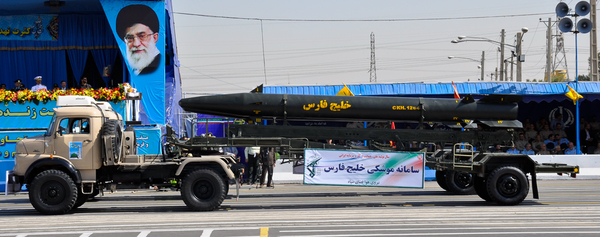
709An Iranian “Khalij Fars” mobile ballistic missile on parade in Iran. (Image source: Wikimedia Commons)

U.S. intelligence reports to Congress, for example, proclaim in all seriousness that Iran’s missiles, and even its nuclear programs, exist merely to ensure regime survival.

The Arms Control Association, for instance, approvingly quotes an administration report that, “Since the revolution, Iran’s first priority has consistently remained the survival of the regime” and that is why they are building and deploying ballistic missiles.

Iran’s missiles, we are told, are a “deterrent.” The deterrent, it is implied — is to protect Iran from the US and its allies.

Well, who can argue with that? Without their missiles and their nuclear weapons program (which, we are repeatedly assured they do not have — yet), they would be wide open to a U.S. invasion, don’t you see? And if the United States or Israel has nuclear weapons, why cannot Iran? So, the thinking seems to go, if we just leave Iran alone, then Iran’s missiles and bombs might very well go away.

This viewpoint is more widespread than many might believe. The former Director General of the United Nations International Atomic Energy Administration [IAEA], Mohamed Mustafa ElBaradei, admonished the United States and the Bush administration: “You can’t bomb your way through countries” to stop nuclear proliferation. He was implying that the U.S wanted to end nuclear proliferation in Iran, Iraq and Libya to give the U.S. a free hand to commit serial aggression against them.

During his entire time as head of the IAEA, ElBaradei also repeatedly downplayed or ignored the nuclear weapons threats from North Korea, Iran and Iraq. He said it was unfair for some countries such as the U.S. to have nuclear weapons while denying them to others, such as Iran.

He was also opposed to the liberation of Iraq, and claimed that the use of military force made terrorist problems worse. He ridiculed the U.S. and British elimination of the Libyan nuclear program largely because his agency, the IAEA, had “mysteriously” missed its very existence although it was their responsibility to monitor exactly such activities.[15]

One Times of India story put it this way: “Disarmament is for wimps. Go get your nukes if you can”.

The Washington Post ran an essay on December 2, 2013, in which nuclear-abolitionist Joe Cirincione of the Ploughshares Fund was quoted complaining, “Why is the U.S. okay with Israel having nuclear weapons but not Iran?” — again implying that U.S. concern over Iran’s potential nuclear proliferation was “unfair.”

A Christian Science Monitor essay concluded about the troubling lesson of Libya’s President Muammar Qaddafi giving up his nuclear weapons: that if he hadn’t, the U.S. and NATO would not have bombed him out of power.[16]

This sounds logical, but it is wrong. The U.S. government worked with the Libyan government to get rid of its nuclear program — which had not produced nuclear weapons fuel, let alone nuclear warheads. The two governments discussed normalizing relations after the elimination of Qaddafi’s nuclear program.

The bombing of Libya in 2011-12 took place in reaction to the terrorist threat emerging in Benghazi and the potential for mass killings in Libya. The bombing may have been misguided, but it was not triggered by Libya giving up its nuclear program in 2007.

Thus, by alleging that the US concern with Iranian or Libyan nuclear weapons programs is less than genuine, arms controllers and others in the U.S. then claim that Iran’s reluctance to abide by the rules of the Nuclear Non-Proliferation Treaty — which prohibits all but the permanent five members of the UN Security Council from having nuclear weapons — is understandable.

This view then leads to calls for even greater U.S. concessions to Iran — in order to “get a deal.” After all, it is claimed, Iran obviously has a legitimate reluctance to give ups its nuclear program with the knowledge that once Libya gave up its nuclear centrifuges in 2007, the U.S. then bombed Libya and helped overthrow the Qaddafi government four years later in 2011.

That supposed lesson is also being applied to Ukraine. In the 1994 Budapest Memorandum, Ukraine transferred its nuclear arsenal back to Russia with the assurance that Russia would guarantee Ukraine’s borders.

Today, some lawmakers in Kiev and critics of the 1994 deal have concluded that if Ukraine still possessed nuclear weapons, Russia would not have invaded either Crimea or Donetsk.

Yet at the time, Ukraine’s new leaders had no desire to become a new nuclear power and so they happily worked with the U.S. government to remove the Soviet-era nuclear weapons from their soil.

Glenn Greenwald, writing in the Guardian, echoes the idea that U.S. adversaries such as Iran have to keep whatever nuclear program they have because such weapons — once acquired — would allow Iran to “deter U.S. attacks.”[17]

The implication is that, as the U.S is such an out-of-control threat, Iran has every good reason to seek and build nuclear weapons.

The entire premise, however, that rogue states should resist having their nuclear programs dismantled because they are then more likely “to be invaded,” is wrong.

There are roughly 190 countries in the world with no nuclear weapons. Although they all lack nuclear weapons, the U.S., and its NATO and East Asian allies, have not invaded any of them and have no intention of invading them.

Afghanistan and the Taliban were removed from power because, with Osama bin Laden, they were partners in the 9-11 attacks.

Iraq was liberated from the murderous regime of Saddam Hussein because, since 1991, the Baghdad government had done everything not to comply with 17 UN resolutions; it had undermined and violated sanctions; it had armed and gave sanctuary to terrorists, and it remained committed to securing WMDs.[18]

When we refer to Iranian missiles as a legitimate form of “deterrence,” we just fool ourselves into imaging that Iranian missiles, which support aggression, are no different from American and allied missile defenses, whichprevent and deter aggression.

We have come to see Iran as a mirror image of ourselves. We assume Iran’s nuclear weapons and ballistic missiles are solely for deterrence and regime survival because, after all, that is why we in the US have both nuclear weapons and ballistic missiles — to protect our security.

But Iran’s ballistic missiles and potential nuclear weapons are to protect Tehran’s projection of power and terrorist activities, which are critical to its goals of dominating the Middle East, uniting all Muslims under its version of Islamic Shariah law, and gain the prize of having control over nearly 70% of the world’s conventional oil and gas resources — a hardly benign objective.

Judging from recent failures to counter Syria, Libya, Russia and ISIS, the U.S.’s squandering of its military might, taking a casual view of threats, and misunderstanding its enemies has led it to becoming an object of ridicule, instead of an object of fear, trust or respect.

Those can only be gained through the serious waging of war — economic, political, diplomatic and militarily — until our adversaries and enemies are defeated. Only then will they cease to fight.


[1] America in Retreat: The New Isolationism and the Coming Global Disorder by Bret Stephens (forthcoming Nov 18, 2014)

[2] See Sandy Davis, Progressive Democrats of America, “We Need To End the Disastrous Failure Of The War On Terror by Sandy Davis, February 4, 2014; or ABC News Blog: “Ron Paul Recruits Anonymous to Attack Rudy’s Foreign Policy,” May 22, 2007; and Jack A. Smith, “Terrorism–Cause and Effect”, May 29, 2010, anti-War.com; and Glen Greenwald on Salon: “A Rumsfeld-era reminder about what causes Terrorism”, October 20, 2009.

[3] Jeanne Kirkpatrick “They Always Blame America” from Jim Geraghty, The Campaign Spot, National Review, April 24th, 2013.

[4] This was explained in a detailed June 2000 letter from Congressman Chris Shays to Richard Clarke following the latter’s appearance before Shays Subcommittee on National Security, Emerging Threats and International Relations of the Committee on Government Reform.

[5] This is but one example of many cited by Michael Rubin of the American Enterprise Institute in his new book “Dancing with the Devil: The Perils of Engaging Rogue Regimes“, 2014, p. 209. Rubin notes that Senator Specter later acknowledged he had been “played by Saddam”.

[6] CNN poll as reported in FDD, 8 Sept 2014, “Majority of Americans Alarmed by ISIS”

[7] MDA Digest, September 4, 2014

[8] MDA Digest, September 4, 2014

[9] MDA Digest, August 29, 2014; and Tom Collina, “Nukes are Not the Answer to Containing Russia,” in Breaking Defense, April 11, 2014

[10] Stephen Cohen cited in the Daily Kos, February 20, 2014, “Stephen Cohen accuses Obama Administration of Coup Attempt in Ukraine” by Mark Lippman

[11] This quote was referenced by General Jack Keane, (US Army-Ret) on Fox News, Monday September 8, 2014.

[12] Admiral John Loy told me this about the IMU in a 2006 conversation we had at one of my NDUF Congressional breakfast seminars where he was the featured speaker. For an excellent review of the distortions of the UN see “UN Perversion of Human Rights“, J. Puder, Frontpage, September 8, 2014.

[13] Michael Ledeen in his “Accomplice to Evil: Iran and the War Against the West”, 2009; and Michael Ledeen, “How to Protect Against a Bad Deal With Iran“, The Hill, July 9, 2014.

[14] In a January 2014 Carnegie Europe report titled “Tehran Calling: Understanding a New Iranian Leadership”, Cornelius Adebahr says the norms Iran has had difficulty adhering to are “prohibitions against using assassinations and terrorism as legitimate tools of diplomacy” although he says the use of such tools by Iran is only “alleged” although he does admit “Iran does not accept all norms governing today’s international system”.

[15] Match Blog, October 26, 2004 and Ben Smith in Politico, January 31, 2011, quoting Malcolm Hoenlein, of the Conference of Presidents of Major American Jewish Organizations.

[16] See Reza Sanati, in the Christian Science Monitor, August 30, 2011, “A troubling lesson from Libya: Don’t give up nukes”. And NewsMax, “Ukraine Pays Price for US Advice to Give Up Nuclear Weapons” March 20, 2014; Ukrainian legislator Pavlo Rizanenko sums up the Crimea crisis: “If you have nuclear weapons, people don’t invade you.” See also “Ukraine’s Broken Nuclear Promises”, by Owen Matthews, March 19, 2014, Newsweek.

[17] Critics of US policy toward North Korea and Iran often assert both rogue states have or seek nuclear weapons to deter the United States from attacking — a variation on the “Always Blame America First Theme”. Here are two such essays: “DPRK Briefing Book: Confronting Ambiguity: How to Handle North Korea’s Nuclear Program”, by Phillip Saunders, Arms Control Association, March 3, 2003; and Glenn Greenwald, “The true reason US fears Iranian nukes: they can deter US attacks” in theguardian.com, Tuesday 2 October 2012. Greenwald also asserts “GOP Senator Lindsey Graham echoes a long line of US policymakers: Iran must not be allowed to deter US aggression”.

[18] On March 17, 2014, former Congressman Ron Paul wrote an essay in USA Today in which he said we have no interest in a fight “many thousands of miles from the US” about a country and people of “which we know almost nothing.” In the 2008 book “Munich: The 1938 Appeasement Crisis” by David Faber, British Prime Minister Neville Chamberlain is quoted saying this on September 27, 1938, just before traveling to Munich to sign a peace agreement with Chancellor Adolph Hitler:

“How horrible, fantastic, incredible it is that we should be digging trenches and trying on gas-masks here because of a quarrel in a far-away country between people of whom we know nothing. It seems still more impossible that a quarrel that has already been settled in principle should be the subject of war.

In light of the lack of seriousness with which we are treating the threats we face, it is instructive to refer to an exchange that reportedly took place between then Prime Minister Chamberlain and Winston Churchill. In this story Churchill told Prime Minister Chamberlain when the latter complained that preparing to defend England against Nazi aggression “might upset trade with Germany”: “Well, yes, Mr. Prime Minister”, said the representative from Epping/Woodford, “That would be the idea.”