(Obama needs high profile stuff and photo ops to keep his polls from falling even more dramatically than they have. He needs help from Iran and little if anything else matters. It will be rewarded. — DM)
From the Oval Office, U.S. President Barack Obama speaks on the phone with Iranian President Hassan Rouhani on Sept. 27, 2013.
Instead of preemptively stopping ISIS from spreading into Iraq, Obama effectively waited until some high-profile beheadings forced him to focus on the danger. While such gruesome murders can reliably rally public opinion in favor of military action, the duty of the Commander-in-Chief is to lead and take military action when and how national security requires it, and not just when terrorists provoke some tardy and token airstrikes into empty buildings.
Kobani also has geostrategic importance to the Iranian nuclear threat. The more ISIS succeeds at capturing territory and recruiting fighters, a trend bolstered by Kobani’s fall, the more desperate the U.S. becomes for help from Iran, which, as leader of the Shiite world, is the natural enemy of the Sunni ISIS fighters.
[A]s Iran watches how feebly the U.S. responds to the loss of Iraq and how Obama cowers from a relatively minor fight in Kobani, the Ayatollahs can rest assured that there really is no U.S. military option to stop their nuclear program. This conclusion becomes all the more inevitable, when they look at Obama’s waning influence at home, as he enters the lame-duck period of his presidency.
Whatever the U.S. accomplished after about a decade of war in Iraq has, in a matter of months, deteriorated to a situation that may become unprecedented in its instability and threat to Western interests. Obama’s clumsy departure from Iraq, his military mismanagement of the mess that ensued, and his refusal to intervene in Syria – again, overruling his top security advisers – are what produced the current quagmire.
The loss of Christianity in Mosul didn’t have to happen. Obama’s tardy airstrikes managed to prevent the Mosul Dam from falling, but the city may never be the same. Similarly, why did the Yazidis have to find themselves besieged on Mount Sinjar before the U.S. took action?
Instead of preemptively stopping ISIS from spreading into Iraq, Obama effectively waited until some high-profile beheadings forced him to focus on the danger. While such gruesome murders can reliably rally public opinion in favor of military action, the duty of the Commander-in-Chief is to lead and take military action when and how national security requires it, and not just when terrorists provoke some tardy and token airstrikes into empty buildings.
As the next disaster is about to unfold on Obama’s watch, he should recognize that there is much more at stake with the fight for Kobani than just the loss to ISIS of a small town on the Syria-Turkey border.
Above all, letting Kobani fall means betraying our only ally fighting ISIS on the ground, and allowing them to be massacred while the world watches. What message does the U.S. send to Mideast partners and the world at large, if the Kurds are the only force providing the ground troops that Obama so desperately needs now, and yet Obama is unwilling to support them enough to avoid the horrific slaughter that will follow an ISIS victory in Kobani?
Kobani also has geostrategic importance to the Iranian nuclear threat. The more ISIS succeeds at capturing territory and recruiting fighters, a trend bolstered by Kobani’s fall, the more desperate the U.S. becomes for help from Iran, which, as leader of the Shiite world, is the natural enemy of the Sunni ISIS fighters. Because Iran also has one of the most powerful militaries in the region, and has – even before the ISIS crises – outmaneuvered the West in talks to curb Iranian nuclear ambitions, Iran could easily leverage the situation to secure tacit Western acceptance of its nukes. Indeed, Iran has already signaled its fight-ISIS-for-nukes strategy.
Even more important, as Iran watches how feebly the U.S. responds to the loss of Iraq and how Obama cowers from a relatively minor fight in Kobani, the Ayatollahs can rest assured that there really is no U.S. military option to stop their nuclear program. This conclusion becomes all the more inevitable, when they look at Obama’s waning influence at home, as he enters the lame-duck period of his presidency.
There is also a moral dimension to Kobani. Obama – in his 2009 and 2012 speeches on Holocaust Remembrance Day – proudly recalled how his great uncle helped to liberate a Nazi death camp. Yet Obama’s inaction in Syria has left about 200,000 dead, including many who were simply massacred, and Kobani may be where the next atrocities happen. Does the U.S. not hold itself to a higher standard than that of Turkey, which has thus far chosen just to watch the fighting a mere mile from its border?
Turkish history already includes genocides against the Armenian Christians and the Kurds (in the Dersim Massacre), so it’s no surprise that the Islamist regime of Recep Tayyip Erdoğan would let his army stand idly by, watching and waiting for ISIS to slaughter thousands of Kobani Kurds. But does the U.S. really want to be in the same camp as the Turks on this one? How much more shame will fall upon the United States, and the Obama legacy, when the Internet overflows with images of mass graves containing Kobani’s brave and abandoned fighters, along with Kurdish civilians who were too weak, infirm, or elderly to flee the approaching ISIS barbarism?
As if the above concerns weren’t enough to goad Obama into action, there is also the strategic impact of letting Kobani fall. As good as ISIS recruiting on social media already is, the popularity of this terrorist army among Islamists worldwide will surge when ISIS can boast about one more example of how even the mighty U.S. military can’t stop them.
Having foolishly telegraphed that he won’t send ground troops to confront ISIS, Obama can still try to convert his error into a feint by doing the opposite and sending troops to Kobani. At least that would restore some element of unpredictability to how ISIS regards U.S. military moves in the region.
Obama is effectively weeks away from the lame-duck portion of his presidency. If Republicans take Congress in next month’s midterm elections, then Obama will become that much more ineffectual. But the president can still try to demonstrate some leadership by changing his strategic approach to Mideast threats – if only to prevent his legacy from going into freefall. If the Middle East has only one lesson for Obama, it is that much can go terribly wrong in very little time. With Iranian nukes around the corner and ISIS on the march, two years of Mideast deterioration is a frighteningly long time to be on Obama’s watch.
Obama likely to extend Iran nuclear talks and flex on demands says senior Israeli source, even as Egypt wages diplomatic war on Israel.
**************
According to a senior diplomatic source in Jerusalem, the chances of a deal being reached on Iran’s nuclear program between it and world powers before the November 24 deadline are slim – but US President Barack Obama is liable to flex on several points, including the deadline.
“When there’s a will on the part of both leaders everything is possible, but Israel needs to stand guard so that a bad deal won’t be made,” the source told Walla!, warning against a deal that will leave the Islamic regime with thousands of centrifuges and breakout capability to quickly create a nuclear bomb.
The source further warned that the current American-led coalition against Islamic State (ISIS) terrorists in Iraq and Syria may impact the deal with Iran, as Obama’s administration has already backtracked about possible military cooperation with Iran.
There is a real danger that the US will hold secret talks with Iran and make agreements against Israeli interests, warns the source.
Indeed, Obama was revealed last November to have been holding secret talks with Iran for over half a year which led to a temporary agreement, and likewise reportedly had been easing sanctions on Iran for five months ahead of the deal.
“Iranian boastfulness has taken over their minds and they aren’t hurrying to reach an agreement that will contradict their red lines and add to their sanctions. That’s their real concern,” the source said of Iran.
On the other side, he added “the Americans want to reach a deal, and the true danger is that they will flex their position for the Iranians.”
“A nuclear Iran will undermine all of the balance in the region,” warned the source against a bad deal. “The Arabs won’t agree – not Saudi Arabia and not Egypt. The Egyptians already said officially that they will arms themselves with nuclear weapons (in the case of a deal). These are the dangers that senior officials are repressing.”
Egypt has also been increasingly hostile towards Israel according to the source, who says the Nile state backed by other Arab countries is pushing an initiative to have Israel recognized as a nuclear capable state – a process that is part of the diplomatic war on Israel.
“It doesn’t even interest anyone in Israel and that is serious,” warned the source. “Their goal is to weaken Israel.”
Cairo has been holding host to the truce talks between Israel and the Hamas terror organization, and just on Sunday hosted an international donor conference that saw world states pledge $5.4 billion for Gaza.
(The Korean mess was similar, particularly after China entered the conflict in mid – late 1950. Political attempts to end the conflict (1951 – 1953) by putting things back where they had been before the Russian sponsored June 25, 1950 invasion of South Korea resemble current negotiations with Iran over its nukes.
In Korea and Vietnam, we were not fighting for our homes and mothers; they were not at risk. In Korea, after China joined the conflict against us, we were fighting to maintain our status quo as a world power against alien cultures (mainly China) and to bring as many of our “boots on the ground” back home alive as possible. After initial successes and attempts to win, we no longer sought victory. Victory was not politically useful and had ceased to be an objective.
Have we learned much since then? It does not appear that we, or our “leaders,” have. Here we go again, this time with (as Obama has often pledged) no boots on the ground against the “not Islamic” Islamic State although it may in time threaten our homes and mothers, and with little interest in keeping Iran from getting (or keeping) nukes. — DM)
The “grand strategy” of Obama in the Middle East is an indecent flux of poll numbers and sound bites. It is to react to crises that affect American public opinion until the media and the voters are lulled into thinking that he has done something. The purpose of American national security policy is to make Barry look good.
The price for such selfishness is that innocent blood is spilt for ignoble vanities. Today it is Kurdish blood, but because ISIS is the sort of existential threat to Western values that in time will demand either its defeat or our surrender, inevitably it will be the blood of our best and bravest that will wash away the venality of Obama and his Vietnam.
***************
Vietnam has long been recognized as a failure caused by political meddling in military operations, coupled with lying by Democrat presidents anxious to protect their image and popularity. Although many Americans – count me in that group – believed that the cause of freedom demanded that communist aggression in Southeast Asia be stopped, implementing this policy demanded presidential leadership. The man in the White House had to tell us why spending treasure and blood to win a war was in our nation’s interest, and he had to explain, at least in broad terms, how we were going to win.
Vietnam was a winnable war. The idea that American military power could not stop a communist attack from the north and a guerrilla war from within South Vietnam was absurd. As Goldwater accurately explained during his 1964 presidential campaign, our command of the air meant that if we let military leaders decide the targeting in North Vietnam, we could “bomb them back to the Stone Age.” (This phrase was twisted by leftists to imply that he wanted to use nuclear weapons.)
Our four Iowa-class battleships – each with nine sixteen-inch guns, which could hit targets in 90% of North Vietnam with perfect precision – if all four were brought out of mothballs, had a combined rate of fire of one sixteen-inch shell every two seconds. Every factory, every bridge, every railway, every anti-aircraft battery, every North Vietnamese Army post, every power generation plant – everything of any military, political, or economic value – could have been utterly destroyed in a few months.
Our minelayers, our bombers, and our submarines had the capacity to completely blockade Haiphong Harbor, where nearly all the munitions, weapons, and supplies the North Vietnamese came through, with an airtight quarantine. The Ho Chi Minh Trail, if hit at irregular intervals by different types of attacks, could have been stopped cold. The very preventable Holocaust that Cambodia and Vietnam endured happened because of gutless American presidents and in spite of the courage and honor of our fighting men.
Whatever the faults of George H. Bush, he fully grasped the reasons we failed in Vietnam, and he scrupulously avoided those in Desert Storm, a war against a much more powerful Iraq (we tend to forget that the battle-tested Iraqi army had outfought, in a decade-long war, an Iranian army three times as big.) We had a specific goal, and we used every weapon we had to achieve that goal. Leftists at the time predicted that this would be “another Vietnam,” but they were utterly and pathetically wrong.
Obama, now, is demonstrating that it is possible to repeat all the mistakes of Vietnam. He is following what fifty years ago was called “escalation,” or the incremental response with American military power to communist aggression with the vague intention of raising the costs high enough so that the rational actors who were leading enemy forces would decide that peace was in their best interest. ISIS leaders, like communists and like similar radical Islamists, are madmen obsessed with the destruction of those they cannot conquer. These are the folks who successfully recruit suicide bombers.
Obama also fails to tell us what victory will look like. Will we establish and support a free Kurdistan? Is our goal to both defeat ISIS and the Assad regime and create a functioning democracy in Syria? Are we trying to prevent a general conflagration in West Asia? Obama doesn’t say, and, scary as this sounds, his dull-witted advisers – truly embarrassingly dumb folks – don’t know any more than he does what we are trying to do.
The “grand strategy” of Obama in the Middle East is an indecent flux of poll numbers and sound bites. It is to react to crises that affect American public opinion until the media and the voters are lulled into thinking that he has done something. The purpose of American national security policy is to make Barry look good.
The price for such selfishness is that innocent blood is spilt for ignoble vanities. Today it is Kurdish blood, but because ISIS is the sort of existential threat to Western values that in time will demand either its defeat or our surrender, inevitably it will be the blood of our best and bravest that will wash away the venality of Obama and his Vietnam.
Parallels between the current negotiations with Iran over nukes and those with North Korea and China over the end of the U.S. – U.N. “police action” in Korea should be considered in evaluating the former. That is the purpose of this article.
Among the conclusions to be drawn is that Obama’s America and the rest of the “international community” are heading down a foolishly misguided path in nuke negotiations with Iran. The path is likely to lead to results more inconclusive and substantially worse than did negotiations to end the Korean Conflict.
Korea negotiations
Negotiations looking to the end of the Korean conflict began on July 10, 1951 at Kaesong, a town occupied by North Korea. On November 25th, negotiations moved to neutral territory in Panmunjom, where they continued until July 19, 1953, just over two years after they had begun.
During the Korea negotiations — which South Korea opposed and at which North Korea and China, but not South Korea were represented — fighting continued with many casualties on all sides. The push for “peace” and political strategies to achieve it — mainly on the part of the United Nations, America and her allies — overwhelmed military considerations. Those factors pushed the casualty rate higher than it would likely have been during more normal combat operations had there been no “peace process.” (Note: much of the information provided here on the Kaesong – Panmunjom peace process and the continuing combat which accompanied it is from T. R. Fehrenbach’s excellent book titled This Kind of War, first published in 1963. During the conflict, Mr. Fehrenbach served in Korea as a U.S. Army officer.)
The resulting agreement put the geographical situation back where it had been when North Korean troops – supplied, trained and led by Stalin’s Russia — invaded the South on June 25, 1950.
Still a horridly repressive country, North Korea still remains aggressive against South Korea and now has nuclear weaponry. In contrast Japan — which we nuked to end the war in the Pacific with fewer casualties than would otherwise likely have occurred had the war continued — has become one of few reasonably free, democratic and prosperous nations in Asia. Another is South Korea, far past the days of the Japanese occupation followed by the increasingly dictatorial reign of U.S. supported Syngman Rhee.
is the key trading partner of Iran.[4]Iran’s nuclear program depends mainly upon German products and services. For example, the thousands of centrifuges used to enrich the uranium are controlled by Siemens “Simatic WinCC Step7” software.[5][6] Around 50 German firms have their own branch offices in Iran and more than 12,000 firms have their own trade representatives in Iran. Several well-known German companies are involved in major Iranian infrastructure projects, especially in the petrochemical sector, like Linde, BASF, Lurgi, Krupp, Siemens, ZF Friedrichshafen, Mercedes, Volkswagen and MAN (2008). (Emphasis added.]
Iran’s relationships with Russia and China are similar. Negotiations have continued at various venues since February of 2013 with little if any progress and have been extended through November 24, 2014. They seem likely to be extended further. By November 24th, they will have lasted one year and nine months. An extension could well prolong them beyond the two years consumed by negotiations over the Korean conflict.
Iran has benefited substantially from the amelioration of sanctions which pressed it into negotiations and which seem highly unlikely to be restored in any effective manner no matter what happens during the negotiations. Iran has very likely continued its efforts to obtain (or keep) and militarize nukes. P5 + 1 negotiators, with “guidance” from Obama, have yielded to many if not most Iranian demands pointing to that result.
Iran continues to refuse the U.N. “watchdog,” the International Atomic Energy Agency (IAEI), access to sites such as Parchin, where it is thought that Iran continues its nuclear weapons research but which the IAEI has not been permitted to inspect since 2005. According to the IAEI, it has
collected about 1,000 pages of information that point to attempts to develop such weapons.
Several meetings have resulted in little progress since Iran and the IAEA agreed late last year on a new effort to try and clear up the allegations.
The agency said Thursday that Iran presented no new proposals at the latest talks with IAEA experts. An IAEA statement gave no date for a new meeting.
The explosions at Parchin may have been workplace violence a workplace accident, sabotage or, perhaps more likely, an effort by Iran to hide its nuke developments because pressure to allow inspection by IAEI has increased significantly.
The timing of the blast is notable. On Monday night, a delegation from the IAEA landed in Tehran for a new round of talks scheduled for that Tuesday. The UN’s demand to inspect Parchin was set to be one of the top agenda items at the talks. [Emphasis added.]
Given the timing, it is certainly possible that the Iranians carried out the explosion themselves as a means of preventing the IAEA from demanding access.
The explosions at Parchin strongly suggest that Iran continues its nuclear weapons development while Obama and many others continue to live in a world of fantasy, hoping that Iran does not have, may not get and in any event will not use nukes. Obama has not declared the Islamic Republic of Iran “non-Islamic,” so evidently He fantasizes that it (unlike the “non-Islamic” Islamic State) is benign and trustworthy.
Here is an Iranian video simulation of a nuclear attack on Israel:
According to the summary posted at You Tube,
A short animated film being aired across Iran, shows the nuclear destruction of Israel and opens with the word ‘Holocaust’ appearing on the screen, underneath which a Star of David is shown, Israel’s Channel 2 reported on Tuesday.
Israel may well be the first to suffer an Iranian nuclear attack if when Iran decides to use its nukes. Why would Iran — which continues to proclaim to the West its innocence of any past, present or future desire for nuclear weapons — try to convince its denizens otherwise? Just as South Korea had the most to lose, opposed and was not represented at the Korean peace process negotiations, Israel is not represented in the P5+1 peace process. She can do little more than sit on the sidelines and urge an international community that rejects her contentions to deny Iran nukes.
As was the case during the Panmunjom peace process, the human rights abuses by Iran appear to be deemed irrelevant. Despite Iranian President Rouhani’s pre-election promises to improve Iranian human rights, its human rights record remains little if any better than that of North Korea. Indeed, far from improving, the situation under “moderate” Iranian President Rouhani has worsened.
The Iranian regime executed more people per capita than any other country, executing as many as 687 people in 2013—an increase of 165 over the prior year. In March 2014, Reuters quoted Dr. Ahmed Shaheed, the U.N. special rapporteur for human rights in Iran, as saying: “I am still at a loss to understand how a reformist president should be in office and see such a sharp rise in executions. The government hasn’t given an explanation, which I would like to hear.”
The United Nations cited an increase in the rate of executions in Iran under Rouhani’s presidency in the second half of 2013. As the Office of the United Nations High Commissioner for Human Rights (OHCHR) noted in an April 2014 report: “An escalation in executions, including of political prisoners and individuals belonging to ethnic minority groups such as Baloch, Ahwazi Arabs and Kurds, was notable in the second half of 2013. At least 500 persons are known to have been executed in 2013, including 57 in public. According to some sources, the figure may be as high as 625.”
Under Rouhani, Iranian authorities have executed more than two people per day in 2014. As Iran Human Rights reported in June 2014: “at least 320 prisoners have been executed in 2014 in Iran. Iranian official sources have announced at least 147 executions in the period between 1. January and 1. June 2014. In addition, more than 180 executions have been reported by human rights groups and not announced by the official sources. Based on these numbers, the Iranian authorities have executed in average, more than 2 people every day in the first five months of 2014. This is despite the fact that there has been a 3 week’s halt in the executions around the Iranian New Year in March.” [All emphasis is in the original.]
It also appears to be deemed inconsequential that Iran is among the world’s foremost state sponsors of Islamic terrorism, perhaps because Obama and His minions refuse to recognize the nature of Islamic terrorism. Indeed, the State Department recently
issued a tweet endorsing a manual that promotes sharia and admonishes investigators not to use terms like “jihad,” which it describes as “a noble concept” in Islam.
. . . .
Upon reading the book, Toronto Star columnist Anthony Furey observes that it frowns on “liberal values,” forbidding such things as the intermingling of the sexes in civil society and the marriage of a Muslim woman to a non-Muslim, while promoting the treatment of adultery and premarital sex as crimes for which “punishments are harsh.” [Emphasis added.]
Even if Iran does not itself use nukes against its enemies (e.g., Israel) how likely is it that it will provide nukes to its Islamic terrorist clients? It has been supplying them with conventional weapons for years.
Iranian negotiators, like the negotiators for North Korea and China, are skillful, well led and devious. They know what they want and will not accept less. “Our” negotiators? Not so much. Indefinite continuation of the Iran Scam negotiations helps rather than hurts Iran. Please see The Iran Scam continues for a summary of the problems as of January of this year. The situation has not got better and instead continues to worsen.
Summany
The Korean “police action” was a deadly mess and its results were inconclusive. Ditto the 1951 – 1953 peace process and the attenuation of military strategy and tactics for the political purpose of achieving “success” at Panmunjom. In view of Obama’s likely willingness to continue negotiations with Iran for however long it may take to get a deal – any deal that He can claim will bring peace in His time – the results are likely to be far worse than merely inconclusive.
Iran even without nukes — assuming that it does not already have them — has been and continues to be a major problem. With nukes, it will become an even greater threat to world security, including that of the United States.
While North Korea has nukes, it has not yet used them. Since North Korea (unlike the Islamic Republic of Iran) is “not Islamic,” perhaps it may eventually do so. However, North Korea has more than enough problems for now. It continues to deteriorate economically and it is not now even known for sure whether Kim Jong-un remains in power, if he ever was. As I noted here in January of 2013,
I disagree that Young Kim leads the direction in which North Korea travels and contended even prior to the death of Kim Jong-il, his father, that a regency would be needed to “guide” his steps. Kim Jong-un is only twenty-eight or so. He is simply too young, too unworldly, too untrained, and by himself too weak, to govern a nation — particularly one such as North Korea, where age is revered and poverty worse than we can imagine based on our own experiences is endemic. For those reasons, and because continuation of the Kim Dynasty was and remains necessary to prevent unfortunate events — among them the death or worse of those in Kim Jong-il’s inner circle — a regency was and remains necessary. There have been changes in the Kim Jong-un regency as central leaders have gained power and those at the periphery have lost it or been ousted. But there is still a regency and Kim Jong-un still seems to dance in step with the music it plays and directs.
Iran — with which North Korea has collaborated in nuke development — is very different. Supreme Leader Khamenei is its most powerful leader; “moderate” President Rouhani has comparatively little power. With the amelioration of sanctions, and despite Iran’s abysmal record of human rights abuses and continuing sponsorship of terrorism, Iran has grown economically as it continues to pursue nuclear weapons; its government seems more than merely stable because it has and uses forceful means to keep it so.
Conclusions
P5 +1 negotiations with the Persian rug merchants of Iran should terminate on November 24th and Iran should be told, clearly and emphatically, that any further attempt to augment its nuclear arsenal will be met with such force as may be needed to eliminate it. That of course assumes something quite unlikely, that such attempts will come to our attention. It also assumes with little basis that the “international community” will care enough to do anything substantial.
However, any Iranian attempt to use its nuclear weapons is more likely to be obvious, and the U.S., what’s left of Israel and others should respond forcefully. It can probably be done effectively even without boots on the ground.
It would be criminally insane to leave the matter up to the “international community” and the U.N. The U.N. in June of 1950, immediately following the North Korean invasion of South Korea, took several of its rare useful steps to respond to aggression. Then, however, Russia was boycotting the U.N. in its efforts to have Communist China admitted as a member. At the request of the U.N. as then very temporarily configured, members of what was then an international community of sorts sent troops and supplies to fight along with the American and South Korean troops. Had Russia been present in the Security Council, the U.N. could not and would not have taken those steps. The Russian boycott stopped soon after the initial U.N. actions and, by 1951, the U.N. and the “international community” were clamoring for an end of military conflict regardless of the outcome and its consequences. America now has far fewer friends there and the U.N. is now far worse than in June of 1950.
Hopefully, Obama will be out of office by the time that Iran uses its nuclear weapons and there may be someone in the Oval Office with sufficient courage, testicular fortitude, belief in freedom and democracy to collaborate with Israel in eliminating those weapons. That remains to be seen, but the prospects do not seem very encouraging.
(Obama continues to tell us that Islam helped to make America what she is today and is not his our enemy. Since we seem to have some, who might they be? Surely not the soon-to-be Islamic Nuclear Republic of Iran. — DM)
It is the height of folly to believe we can degrade and ultimately destroy anti-American jihadist organizations while continuing to turn a blind eye to Iran’s essential support for those organizations, while accommodating the mullahs on nuclear weapons, and while idling as Tehran’s agents seize control of key strategic territory (see Mr. Gerstman’s excerpt from Michael Segall’s analysis of Iran’s goals in Yemen and beyond). Again, we cannot defeat our enemies without recognizing who they are.
******************
Iran, the enemy of the United States that the Obama administration nonetheless regards as a potential ally and stabilizing influence in the Middle East, has seized substantial control of Yemen.
Under the apt headline, “While you were watching ISIS, Iran took Yemen,” Legal Insurrection’ David Gerstman sifts through reports from the Washington Post and Reuters, relating that the Houthi, Shiite jihadists backed by Tehran’s mullahs, have wrested “control of almost all state buildings, from the airport and the cental bank to the Defense Ministry.” They have likewise festooned Sanaa with signs proclaiming their mullah-echoing slogan, “Death to America, death to Israel, a curse on the Jews and victory to Islam.”
As Mr. Gertzman observes, the same chant is routinely heard from Iran’s forward jihadist militia, Hezbollah. Hezbollah means the “Party of Allah” and the Houthisimilarly call themselves “Ansal Allah,” the “Supporters of Allah.” And, taking another page out of the Hezbo playbook, the Houthi are blocking the appointment of a new prime minister – just as Hezbollah has done in Lebanon in the terror group’s role as, to quote the Post report, “top down brokers dominating the government and running a virtual state-within-a-state.
As in Syria, the Shiites are opposed by the combination of the “moderate” Muslim Brotherhood – i.e., the Islah party, whose power-sharing arrangement with the rump of the ousted Sunni government the Houthi reject – and the local al Qaeda franchise (al Qaeda in the Arabian Peninsula), which continues to attack Houthitargets.
Not to beat a dead horse, but we are in a global conflict in which the Islamic State is only one component of the enemy – and not the most significant one. I argued it this way a few weeks back:
The main challenge in the Middle East is not the Islamic State; it is the fact that the Islamic State and its al-Qaeda forebears have been fueled by Iran, which supports both Sunni and Shiite terrorism as long as it is directed at the United States. There cannot be a coherent strategy against Islamic supremacismunless the state sponsors of terrorism are accounted for, but Obama insists on seeing Iran as a potential ally rather than an incorrigible enemy.
It is the height of folly to believe we can degrade and ultimately destroy anti-American jihadist organizations while continuing to turn a blind eye to Iran’s essential support for those organizations, while accommodating the mullahs on nuclear weapons, and while idling as Tehran’s agents seize control of key strategic territory (see Mr. Gerstman’s excerpt from Michael Segall’s analysis of Iran’s goals in Yemen and beyond). Again, we cannot defeat our enemies without recognizing who they are.
The FSA found photos and lists of senior Russian intelligence and military officials who visited the facility, pictures of Russian personnel running the base, and maps showing the location of Israeli military units. Israeli news reports earlier this year said the Russian government had upgraded an advanced surveillance and intelligence gathering station in that area which could snoop on Israel, large parts of Jordan, and western Iraq, potentially to warn Iran in advance of an Israeli strike. Initial reports said documents from the facility suggested the Russian equipment was used to spy on Israel, Saudi Arabia and Jordan.
***************
When the Free Syrian Army pushed Assad’s soldiers out of a town south of Damascus, the last thing they expected to find was a Russian spy post, a few miles from the Golan Heights.
Syrian rebels have overtaken a joint Russian-Syrian secret facility that they claim was a covert intelligence collection base. Opposition fighters say the post was used to snoop in on the communications of opposition groups — and perhaps even the nearby Israelis.Free Syrian Army officials, U.S. officials, and independent experts told The Daily Beast that the evidence of Russian involvement in the facility, just a few miles from Syria’s border with Israel, if verified, would show a level of Russian involvement in the Syrian civil war that was not previously known.
Free Syrian Army officials posted several videos on YouTube showing both the outside and the inside of the facility, which the FSA captured over the weekend during a battle near Al Harah, south of Damascus, next to the Golan Heights.
The videos and accompanying photos show insignias representing a branch of Syrian intelligence and the Russian Osnaz GRU radio electronic intelligence agency. The FSA found photos and lists of senior Russian intelligence and military officials who visited the facility, pictures of Russian personnel running the base, and maps showing the location of Israeli military units. Israeli news reports earlier this year said the Russian government had upgraded an advanced surveillance and intelligence gathering station in that area which could snoop on Israel, large parts of Jordan, and western Iraq, potentially to warn Iran in advance of an Israeli strike. Initial reports said documents from the facility suggested the Russian equipment was used to spy on Israel, Saudi Arabia and Jordan.
U.S. defense officials told The Daily Beast the photos of the Russian insignia first shared on blogs were legitimate. But that evidence, at the same time, may not necessarily mean the facility captured by the opposition was controlled by Russia’s military; it could just mean that Russians were working there, as advisors or partners to Syrian troops.
Mark Galeotti, an expert on Russia’s military and intelligence services at New York University said the term “Osnaz” on the insignia just meant a special unit of any kind. “It’s the kind of unit that the Russians would have had there because Syria is not the easiest area to operate in, they are an element of the radio-technical intelligence boys who do this.”
Firas Al Hawrani, the official spokesman for the FSA in southern Syria, told The Daily Beast Monday that FSA forces had seen about 15 Russian personnel operating in the Al Harah area before the FSA took the facility, but they left before the area fell out of regime control.
“The Russians who were at the Al Harah mountain, the regime took them to Damascus by plane two weeks ago,” he said.
Galeotti said these Russian advisers would specifically be working on intercepting radio communications of opposition figures. “They would be running an operation for detailed radio technical intelligence, we are not talking about intercepting telemetry and aircraft,” he said. “This is for eavesdropping on rebel radio communications. Cell communications are easier identified through other means. And this is also for identifying the presence of these units, which leads directly into targeting.”
Russia has been one of Syria’s most important allies for years. The port of Tartus is Russia’s only naval base on the Mediterranean, for example. And since the civil war in the country broke out in 2011, Russia has provided the country with advisers and billions of dollars’ worth of heavy military equipment. Galeotti said Syria’s security services are good as “traditional secret police skills,” such as interrogation and bugging telephones. The facility taken over by the Syrian opposition, however, suggests the Russians gave the regime “a whole new capability,” Galeotti said. “A lot of the Syrians are very clumsy. Some of the more precise attacks in the last year have suggested a new sophistication.”
Sen. John McCain told The Daily Beast Monday that the apparent Russian involvement in the base, which was also reportedly tasked with collecting signals intelligence and communications of rebel groups, showed of the depth of Moscow’s collusion with Damascus in the Syrian civil war.
“If what they’ve recovered is true and I have no reason to believe it’s not, it really is very indicative of the significant involvement of Russia in this conflict,” he said. “It shows significant coordination, establishment of a facility they could use for coordination and intelligence capabilities including intercepts. It’s a pretty sophisticated operation there that they’ve uncovered.”
Meanwhile, in Northern Syria, ISIS continued a major assault on the city of Kobani near the Turkish border as Kurdish and tribal forces tried to repel them. Dr. Najmaldin Karim, the governor of Kirkuk, was in Washington last week asking U.S. officials to expand the airstrikes in both Iraq and Syria and to increase aid to the Kurdish forces in both countries.
Not only is ISIS advancing in Northern Syria, they are digging in their positions in several Iraqi cities, including Mosul and Ramadi, Karim told The Daily Beast in an interview. Gen. John Allen, whom President Obama appointed to coordinate the international coalition against ISIS, said in Baghdad that the drive to free key cities like Mosul may take as long as a year.
“A lot of the front lines are basically frozen,” said Karim. “The worst thing would be for the United States, the region, and for Iraq, would be if the situation stays like this and festers. These guys have been there since June. If it goes further, it becomes a way of life. It will become like Somalia.”
U.S. intelligence officials tell The Daily Beast that the apparent Iranian decision not to target American troops inside Iraq reflects Iran’s desire to strike a nuclear bargain with the United States and the rest of the international community before the current negotiations expire at the end of November.
“They are not going after Americans,” one senior U.S. intelligence official told The Daily Beast familiar with the recent assessments. “They want the nuclear talks to succeed and an incident between our guys and their guys would not be good for those talks.”
******************
The last time Iranian and American forces were in Iraq, the two sides quietly fought each other. Now Iran’s Quds Force officers in Iraq are purposely leaving the Americans alone.
Pay no attention to the Shi’ite militias threatening to kill U.S. troops in Iraq. The elite Iranian forces backing those militias have been ordered not to attack the Americans.
That’s the conclusion of the latest U.S. intelligence assessment for Iraq. And it represents a stunning turnaround for Iran’s Quds Force, once considered America’s most dangerous foe in the region.
U.S. intelligence officials tell The Daily Beast that the apparent Iranian decision not to target American troops inside Iraq reflects Iran’s desire to strike a nuclear bargain with the United States and the rest of the international community before the current negotiations expire at the end of November.
“They are not going after Americans,” one senior U.S. intelligence official told The Daily Beast familiar with the recent assessments. “They want the nuclear talks to succeed and an incident between our guys and their guys would not be good for those talks.”
The Quds Force, named for the Arabic word for Jerusalem, are believed to have hundreds of troops in Iraq. As the primary arm of the Iranian state that supports allied terrorist organizations, their operatives worried Obama’s predecessor so much that the Treasury Department began sanctioning its members in 2007 for sabotaging the government of Iraq. The U.S. military accused the Quds Force of orchestrating cells of terrorists in Iraq. In 2012, Wired magazine dubbed Quds Force leader Qassem Suleimani the most dangerous person on the planet. In 2013, the New Yorker arrived at a similar conclusion, and claimed he has “directed Assad’s war in Syria.”
More recently, the Treasury Department has accused the Quds Force of international heroin trafficking and conducting terrorism and intelligence operations against the Afghanistan government. That’s why it’s so extraordinary that the Quds Force would be perceived to be laying off U.S. forces in Iraq.
But in some ways, the assessment is not surprising. Both Iran and the United States share a common enemy in the Islamic State of Iraq and al-Sham (ISIS). In late August, U.S. airpower and Iranian-backed militias broke the ISIS siege on the town of Amerli. Suleimani, the commander of the Quds Force, was photographed in Amerli, after the town was liberated from ISIS.
The latest assessments from the U.S. intelligence community also interpret Iran’s behavior in part as linked to the ongoing negotiations between Iran, the United States, the United Kingdom, France, Germany, Russia and China.
A U.S. intelligence official said the Quds Force behavior was the equivalent of a confidence building measure, a diplomatic term that refers to a concession offered to improve the atmosphere of negotiations. (Iran had already offered to play a more “active role” in the regional fight against ISIS, in exchange for nuclear concessions.)
The latest U.S. nuclear proposal to Iran would be favorable to the Islamic Republic and allow Iran to keep many of its declared centrifuges so long as they were disconnected from one another. Iran’s declared facilities in Qom and Natanz use a centrifuge process to enrich uranium into nuclear fuel.
The latest U.S. assessment also undercuts the public warnings from Iranian backed militias in Iraq that are doing much of the fighting now against ISIS.
Last month, the three largest Shiite militias told President Obama not to send ground troops into Iraq. But because the Quds Force is so instrumental in funding, training and in some cases providing strategic direction to these militias, it would suggest these public warnings were merely idle boasts.
To date, the Pentagon acknowledges that there are more than 1,600 U.S. forces inside Iraq, but these forces do not engage in combat missions, according to the Defense Department. Instead, the U.S. presence in Iraq is to advise Iraqi and Kurdish forces, assess the state of those forces and protect U.S. facilities inside Iraq.
Earlier this month in New York, Iran’s foreign minister Javad Zarif said the presence of foreign forces inside Iraq “creates domestic opposition and domestic resentment.” But in response to a question about the Shi’ite militias’ warnings against the United States, he also stressed that Iran did not support “anything that would complicate the situation” in Iraq..
The recent public warnings from groups like the Mahdi Army and the Asa’ib al-Haq were reminiscent of Iraq between 2006 and 2009. That’s when Shiite militias, working closely with Iran’s Quds Force, placed the sophisticated improvised bombs on routes traveled by U.S. forces. In the later years of the conflict, American forces captured what they said were dozens of Quds Force operatives working inside Iraq.
Exactly how long this informal Quds Force truce lasts is anyone’s guess. But Kimberly Kagan, the president of the Washington-based Institute for the Study of War and a one-time adviser to Gen. David Petraeus, cautioned that this alliance of convenience could break down quickly. “Without a doubt, Iranian backed elements have declared their intention many times in the past to attack the U.S. inside Iraq,” she said. “Whether or not those elements have immediate intentions to attack the United is irrelevant. They are declared enemies of the United States.”
That said, Kagan added that she believed “The Iranians do have a short term interest in being on their best behavior during these nuclear negotiations.” Those negotiations are set to expire at the end of November.
(Disregarding the obligatory kind words for the Obama Administration and the multicultural nation it has spawned, PM Netanyahu’s words ring true. — DM)
With the Iran nuclear talks now in their endgame and the prospect of a very different political environment in Washington next year if Republicans capture the Senate, Obama officials are in overdrive to achieve their dream of a legacy agreement with Tehran so that President Obama can claim he halted the threat from the Iranian nuclear program. Their goal is to get a final agreement before the nuclear talks are scheduled to end November 24.
While the Obama administration has long been desperate to get such an agreement, two recent ill-advised American concessions and a string of misleading statements and proposals demonstrate how far the White House is willing to go and why it is vital that Congress denounce on a bipartisan basis the nuclear talks and a possible final agreement .
Two weeks ago, the United States floated a proposal to let Iran keep all of its 19,000 centrifuge machines, which Tehran is using to enrich uranium to reactor grade as long as all but 1,500 are “disconnected” and cease enriching uranium. This proposal alarmed many experts because Iran could quickly begin enriching uranium to weapons grade by reconnecting all of its centrifuges.
As generous as this offer was, it apparently did not go far enough for Tehran. The Associated Press reported on September 25 that U.S. diplomats have proposed letting Iran operate up to 4,500 centrifuges if its stockpile of enriched uranium gas is converted to uranium “powder.” This proposal rests on the assumption that such an arrangement would give the international community plenty of time to react to an Iranian “dash” toward constructing a nuclear weapon because it would take over a year for Iran to re-convert low-enriched powder into uranium gas for further enrichment to weapons-grade uranium.
The assumption behind this proposal is false. Both Amos Yadlin, former head of the Israeli Military Intelligence Directorate, and Mark Hibbs, a senior associate with the Carnegie Endowment and nuclear proliferation expert, agree that it would take Iran only about two weeks. [Emphasis added. — DM]
A final agreement also appears unlikely to do anything to reduce the nuclear-proliferation threat posed by Iran’s large stockpile of low-enriched uranium. I noted in NRO last November how a 2013 American Enterprise Institute study found that Iran has produced enough reactor-grade uranium since 2009 “to fuel a small arsenal of nuclear weapons after conversion to weapons grade.” The Langley Intelligence Group Network agreed with this assessment and estimated that, from its 20 percent-enriched-uranium stockpile, Iran could make enough nuclear fuel for one bomb and could make another seven from its reactor-grade uranium if further enriched to weapons grade.
This latest proposed concession continues a pattern of misleading statements and proposals by Obama-administration officials on the Iran talks that began with last November’s interim agreement with Iran, which set up this year’s negotiations on a final agreement.
For example, last November, President Obama claimed the interim deal “halted the progress of the Iranian nuclear program.” At best, the agreement froze only part of this program.
Also last November, National Security Council aide Anthony Blinken said the interim deal halted progress on Iran’s Arak nuclear reactor — which will be a source of plutonium when completed — even though it allowed work on this reactor to continue. This marked a retreat from the West’s prior insistence that the dangerous Arak reactor be abandoned.
Negotiators are now discussing ways to allow the completion of the Arak reactor with design or operational alterations so it produces little plutonium. Iran has been resisting any limitations on this reactor and will likely agree only to one easily reversible change — fueling it with low-enriched uranium.
Although the interim agreement permitted Iran to continue uranium enrichment, Secretary of State John Kerry has insisted this did not mean the United States has conceded to Iran the “right” to enrich. Not true. The preamble of the interim agreement says “a final agreement will involve a mutually defined enrichment program.”
There also are issues concerning the interim deal and this year’s nuclear talks that Obama officials prefer not to discuss publicly. Talks on a final agreement were supposed to begin in late December 2013 but were delayed for several weeks because Iran cheated on the interim agreement shortly after it was signed by installing centrifuges with more advanced designs.
The Obama administration is playing down how the interim deal committed all parties to a “sunset” clause in a final agreement that will limit its duration and treat Iran as a “normal” state entitled to pursue whatever nuclear technologies it wishes under the Nuclear Nonproliferation Treaty after the agreement expires. This means after a final agreement, there will be no limits on how many uranium centrifuges and plutonium-producing reactors Iran can build as long as it informs the IAEA.
Iran wants a final agreement to last less than ten years. The Obama administration wants it to last “in double digits.”
Although there are three legs to a nuclear-weapons program — fuel production, designing and building a warhead, and delivery systems — the nuclear talks have ignored Tehran’s growing ballistic-missile arsenal, which experts believe is being developed to deliver nuclear warheads. Iran’s ballistic missiles have been excluded from the talks despite three Iranian satellite launches since 2009, which many experts believe were actually tests of long-range missiles capable of striking Europe and the United States.
Moreover, there is compelling evidence in a Iranian document obtained by the IAEA in 2005 of an effort by Iran to develop nuclear warheads for ballistic missiles. The IAEA believes this document is a layout for a Shahab-3 missile re-entry vehicle that appears “quite likely to accommodate a nuclear device.” Iran refuses to explain this document and has denounced it as a forgery.
Add to these concerns a recent IAEA report that says Iran is refusing to comply with an important element of the interim agreement: to fully cooperate with the IAEA, grant its inspectors full access to nuclear facilities, and answer all outstanding questions about past nuclear activities that appear to be related to weapons development.
Iran’s refusal to cooperate with the IAEA during the nuclear talks is certain to continue after the signing of a final nuclear agreement, which will make it difficult to verify its compliance with the agreement and the peaceful nature of any nuclear activities that Tehran launches after the pact expires.
And then there are recent reports that U.S. diplomats have discussed with Iranian officials during the nuclear talks how Iran might help defeat the Islamic State. Mixing the Iran nuclear talks with discussions of the situation in Iraq and Syria was a bad idea for two reasons.
First, Iran bears significant responsibility for the sectarian violence in Iraq because of its ties to the Maliki government and its training of Shiite militias that have killed Iraqi Sunnis. The U.S. should be trying to get Iran out of Iraq’s affairs, not draw it in further.
Second, Iran is using the U.S. request for help against the Islamic State to bargain for even better terms in a nuclear agreement. Senior Iranian officials told Reuters last week that Iran is ready to work with the United States and its allies to stop Islamic State militants but would like to see them show more flexibility on Iran’s uranium-enrichment program.
The Obama administration is telling the press that Western states and Iran are still far apart on key issues in the nuclear talks and that reported U.S concessions on enrichment have not been formally presented to Iranian diplomats. I doubt this is the case. I believe it is more likely that the Obama administration is staging an eleventh-hour show of toughness while simultaneously leaking controversial elements of the draft agreement before it announces a final nuclear deal that the White House knows will be very unpopular with Congress.
This all adds up to a dramatic and reckless shift in the U.S. approach to the Iranian nuclear program.
Before the spring of 2012, the Obama administration’s public approach to Iran’s nuclear program was the same as the Bush administration’s and can be summed up by the question “How do we stop Iran from getting a nuclear bomb?”
However, in their desperation to get a legacy nuclear agreement with Iran for President Obama, his diplomats have given away so much that the U.S. approach has essentially shifted to “How long can we delay an Iranian nuclear bomb?” and “How many nuclear bombs should Iran be allowed to make?”
This approach is unacceptable and poses grave risks to the Middle East and the world. We are headed for a weak, short-duration nuclear agreement with Iran that will do nothing to stop its pursuit of nuclear weapons and could spark a nuclear-arms race in the Middle East. The Iran talks have drifted so far from reality that they are unsalvageable. Congress therefore should reestablish a responsible U.S. policy on the Iranian nuclear program by renouncing these negotiations on a bipartisan basis and place new sanctions on Tehran if it does not halt its current nuclear activities, which violate six U.N. Security Council resolutions.
I believe a meaningful agreement with Tehran on its nuclear program involving significant compromises by both sides will someday be possible. Such an agreement must halt or significantly set back Iran’s pursuit of nuclear weapons and last 20 years or longer. Because of the one-sided concessions made by the United States in the current nuclear talks, it is clear this administration is incapable of negotiating a nuclear agreement with Iran that meets these standards.
If we are really determined to eradicate Islamism, we should stop making deals with them and start supporting the people against the Islamist regimes.
It is believed that the reason for President Obama’s silence is the fear that it may cause the supreme leader Khamenei unhappy. He needs the top Islamist’s consent to give him a deal on their nuclear bomb no matter what the cost.
*******************
The war against Islamist terrorism has been going in the wrong direction, and the cancer has metastasized under the present administration. As we get rid of one Islamist tumor, more pop up.
But the most dangerous of all Islamists are ruling Iran and are determined to make themselves untouchable by possessing their own nuclear bomb.
We have wrongly chosen to ignore the majority moderate and secular Moslems in the Middle East and here at home. Those advising the White House and the State Department are lobbyists for the Islamist dictators, not secular Moderate Moslem Americans.
For reasons unknown, the Obama Administration had no qualms in removing and even bombing the secular Arab dictators, citing the human rights of their citizens, but when it comes to the human rights of the citizens living under the bloodiest Islamist dictators in Iran, this administration has gone out of its way to ignore the victims and empower the aggressors.
President Obama did not support the secular uprising in Iran but chose to stand by the Islamist clerics and their international terrorist Revolutionary Guards who are creating havoc across the Middle East, Africa, South America, and even here in the United States. Hizb’allah is the brainchild of Khomeini. Hamas is another gang of Islamists that Khamenei supports, leaving the people of Iran hungry. The Revolutionary Guards are operating in Africa, in every city in Europe, and in South America making deals with the drug cartels.
If we are really determined to eradicate Islamism, we should stop making deals with them and start supporting the people against the Islamist regimes.
America was the savior of the colonial world after the WWII. American foreign policy was based on human rights, but it is now based on policies that the old imperialists might well approve of.
94% of Iranian people are against the ruling Islamist regime that is anti-Iranian, anti-American, anti-civilization, and rules under barbaric Sharia laws.
Many Iranian clerics are against the rule of religion in government. The majority of the clerics do not dare to speak up — the ones who have spoken up have either disappeared or been arrested, imprisoned, tortured, and executed by the clerics in charge of Iran’s so- called Justice system, called Revolutionary Court.
The numbers of opposing clerics are high enough for the regime to create Cleric’s Wards in the prisons of Iran.
The most prominent cleric prisoner is Ayatollah Seyyed Hossein Kazemeini Boroujerdi, who has been held in the dreaded Evin prison since the supreme leader Khamenei ordered his arrest in 2006.
Not only he was arrested, his wife and children were harassed and their home and belongings were confiscated. By order of the supreme leader Khamenei, he was then defrocked and imprisoned. Since being in prison he has suffered two heart attacks as the result of mistreatment and torture.
Mr. Broudjerdy’s crimes have included urging the separation of the government of Iran from Islamic rule. He first went public with his support of the Universal Declaration of Human Rights and protestations against the abuses of theocratic rule. He condemned Islamic fundamentalism, radicalism, and terror. He rejected anti-Semitism and advocating religious freedom. He has spoken for the equal rights of women and has called for abolishment of capital punishment, and cruel, inhuman, degrading treatment or punishments such as torture, stoning and flogging.
On the day President Rohani was speaking in the United Nations, clergyman Mohammad Movahedi, was in the clerical ward of the Evin prison Threatening Mr. Boroujerdi, and all those who had proceeded to publish and disseminate his books will be sentenced for apostasy and executed.
Although there has been calls from the human rights organizations and Iranians in and outside Iran who have provided a Petition with more than 600,000 signatures asking the president of the United States to help his release, there has been no response from the most powerful man on earth.
It is believed that the reason for President Obama’s silence is the fear that it may cause the supreme leader Khamenei unhappy. He needs the top Islamist’s consent to give him a deal on their nuclear bomb no matter what the cost.
Instead of supporting the secular Moslems to rid the world of a gang of Islamist clerics and their revolutionary guards, United States is ignoring the security of Israel, the world at large, and the human rights issue and instead supports the Islamists.
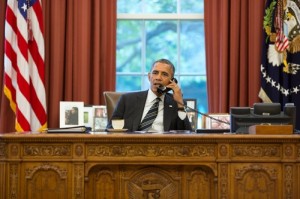 From the Oval Office, U.S. President Barack Obama speaks on the phone with Iranian President Hassan Rouhani on Sept. 27, 2013.







 anneinpt
 artaxes
 danmillerinpanama
 davidking1530
 Peter Hofman
 Joseph Wouk
 Peter
Peter Louisiana Steve

Recent Comments