King Abdullah II: We’re War With “Outlaws Of Islam” – Special Report via You Tube, April 13, 2015
(He seems quite diplomatic, but what does he actually think? — DM)
King Abdullah II: We’re War With “Outlaws Of Islam” – Special Report via You Tube, April 13, 2015
(He seems quite diplomatic, but what does he actually think? — DM)
Dr Andrew Bostom on Lisa Benson show 12.5.2015, You Tube, April 13, 2015
(Dr. Bostom relates Islamic doctrine to Iran’s negotiating tactics. Please see also, Lt. Col Ralph Peters: “The Iranians Negotiate, We BEG!” — DM)
https://www.youtube.com/embed/sRDctfQDPD0“>Lt. Col Ralph Peters: “The Iranians Negotiate, We BEG!” You Tube, April 11, 2015
The hallucinatory deal with Iran resembles Alice Through the Looking Glass more than any kind of diplomatic or political achievement.– anneinpt)

The magic Iranian Easter Bunny (via Twitter)
Shortly before Purim I wrote a post about “Venahafoch hu” – how “everything was turned about” in matters to do with Israel and the Palestinians. Well, Pesach is now over and yet it seems that the Purim spirit is still with us in everything to do with the nuclear deal between Iran and Barack Obama. (Note: I use Obama’s name deliberately rather than “Iran and the P5+1” because this deal has Obama’s name (literally) written all over it with seemingly very little input from the other 5 partners.)
How else other than utter surrealism, if not willful blindness, could explain the following headlines? (All the links in the Twitter embeds are clickable and will take you to the original articles).
Yes, the Saudis and Israel are the world’s new “best friends”, or at least politically-convenient allies. Who would have thought we would live to see the day? And keep in mind that it was the Americans, or rather Barack Obama himself, who drove the two into each others’ arms. Maybe that was his devious plan all along?
Note to politicians: When Haaretz contradicts you, you know you are on the wrong side:
https://twitter.com/HenryRops1/status/584871507714768896
They should take advice from Prof. Alon Ben Meir, a world expert in the Middle East.
It’s surely past time to take the Iranians at their word (click on the picture below to enlarge and see the quotes in their entirety):
And this is confirmed by former Presidential candidate, Senator John McCain:
The Israeli government is not relenting on its persistent questioning of the “deal” with Iran:
This is summarized in these convenient tabs:
Possibly the most surreal moment of this whole surreal farce (apologies for the overuse of this word. I just cannot think of a better description) was Obama actually confirming Binyamin Netanyahu’s assertion that the Iranian’s will have zero time to nuclear breakout, and then the State Department frantically trying to walk back Obama’s words:
From the linked article:
As reported yesterday, President Obama admitted that Netanyahu was correct when he said that the sunset clause in the P5+1 nuclear deal with Iran “paves the way” for Iran to get nuclear weapons.
Obama admitted that in years 13 and 14 under his deal, the breakout time, which has since dropped to its current 2-3 months, and which the deal hopes to expand to 1 year, then drops to zero.
“What is a more relevant fear would be that in Year 13, 14, 15, they have advanced centrifuges that enrich uranium fairly rapidly, and at that point, the breakout times would have shrunk almost down to zero.”
The State Department faced a crisis when Obama accidentally told the truth, and to correct it, Spokeswoman Marie Harf said the President’s words got “a little mixed up”, and he was referring to a “hypothetical” case of what would happen without a deal.
Kemberly Kaye at Legal Insurrection blasted the “dippy” Marie Harf (although she was probably acting under orders) and quoted two former Secretaries of State, Henry Kissinger and George Shultz in the Wall Street Journal:
Brutally critical of the administration’s much touted Iran deal, the op-ed focused on the White House’s dismissive attitude towards the danger Iran poses. Kissinger and Shultz were less than impressed by the administration’s insistence on the necessity of a deal with a country whose priorities aren’t remotely in the same galaxy as those of the United States, noting:
Cooperation is not an exercise in good feeling; it presupposes congruent definitions of stability. There exists no current evidence that Iran and the U.S. are remotely near such an understanding. Even while combating common enemies, such as ISIS, Iran has declined to embrace common objectives. Iran’s representatives (including its Supreme Leader) continue to profess a revolutionary anti-Western concept of international order; domestically, some senior Iranians describe nuclear negotiations as a form of jihad by other means.
In sum, the op-ed eloquently observes the Iran deal is a complete and total cluster.
As pointed out above several times, the White House is suffering from a severe case of cognitive dissonance on Iran. Amy Miller at Legal Insurrection lists the ways:
Yesterday, Senator John McCain talked with radio host Hugh Hewitt about the non-deal—and the White House is not happy about it.
During the interview, McCain laid it all bare when he said that, with regards to the framework, “John Kerry is delusional.”
…
The White House comms shop, of course, can always be counted upon to barrel headfirst through a brick wall when faced with criticism. No exception here:
https://twitter.com/rorycooper/status/586608713433292801
https://twitter.com/BrettLoGiurato/status/586608095507296257
This Alice in Wonderland view is cleverly illustrated thus:
https://twitter.com/coinabs/status/585641373510041603
We can add to this whole mish-mash the rather important but somehow unnoticed little fact that the Iran deal is not in fact a deal at all, as the Diplomad explains:
In all these mushrooming detonations of praise and self-congratulation one simple, little, itsy-bitsy fact has been overlooked. I hate to be the party pooper, but, well, there is no deal.
…
So comparing the Geneva “deal” with Iran to the Munich Agreement is unfair to the Munich Agreement. Chamberlain wasn’t lying when he announced he had a deal; Obama and Kerry are lying when they announce that they have a deal.
I repeat, there is no deal.
I have been in lots of negotiations, and can spot fake talking points real fast. The giveaway, of course, is that the detailed “parameters” were announced by the US; where are the signatures on the deal? I want to see where the Iranians signed.
The Iranian take on the “parameters” is quite different from the line peddled by Obama and Kerry. While Obama seeks to give the impression that these “parameters” have been agreed, the Iranian position is that, basically, these “parameters” establish the topics that will be discussed over the following weeks and months, except, of course, for one. The Iranians claim that sanctions must be lifted immediately or there is no further “progress.” In addition, of course, the Iranians get to keep their nuclear program. A minor detail.
David Gerstman also concurs with the Diplomad that the deal, such as it is, is going to kill the Non-Proliferation Treaty:
The idea that the protocols (remember there’s no deal yet) agreed to last week somehow would strengthen the NPT is utterly false.
The point of the ongoing nuclear negotiations from Iran’s standpoint is to remove its violations from the books and end the sanctions it incurred for those violations. Iran’s goal in the negotiations is to enshrine its “right to enrich” uranium. (No such right exists. Nuclear research for peaceful purposes is a right, an important qualification that cannot be attached to Iran’s nuclear research, according to the NPT.)
…
Now let’s assume the most optimistic outcome: that Iran addresses all key concerns. (Iran was supposed to explain possible military dimensions – PMD – of its nuclear work according to the Joint Plant of Action (JPOA) of November 2013, and still has not done so.) Iran would still have over 5000 centrifuges enriching uranium at Natanz. Iran would have centrifuges operating (though not enriching uranium) in an underground reinforced facility at Fordow and would have a heavy water reactor operating at Arak. (In December 2013, Obama himself acknowledged that Iran did not need the latter two facilities “to have a peaceful nuclear program.”)
So by defying the IAEA and the Security Council Iran will be awarded 5000 centrifuges enriching uranium that it didn’t have before. The sanctions triggered by those violations will be wiped away. (By the way, 5000 centrifuges is enough for a bomb, but not for civilian nuclear program.)
…
Ironically, the president overseeing the destruction of the NPT was once a proponent of nuclear disarmament.
One more hallucinatory piece of cognitive dissonance for today (though I could go on for ages. This Iran deal is a giver):
https://twitter.com/soccerdhg/status/587139164296126466
Seriously, if this weren’t so deadly serious we would be laughing hysterically.
And just to complete today’s upside-down news, we are now officially into “Jewish summer time” since we wish each other “a good summer” at the end of Pesach. But someone forgot to inform the weather. We have been suffering from a wintry storm with huge amounts of rain, hail, thunder and lightning. My little side road has been flooded and my car can barely get out without the water going above the wheels. My daughter in Gush Etzion has reported a temperature of 1°C!! Any lower and it will snow. This is Spring. In Israel. Where its’ supposed to be in the mid-20s at the very least. To cap it all, last Wednesday it was almost 40°C.
Welcome to the crazy Middle East.
Khamenei Smashes Terms of Nuclear Agreement, Clarion Project, Ryan Mauro, April 12, 2015
(Obama demands, don’t mention Iran’s mumblings about his once in a lifetime deal. Partisan wrangling must stop!– DM)
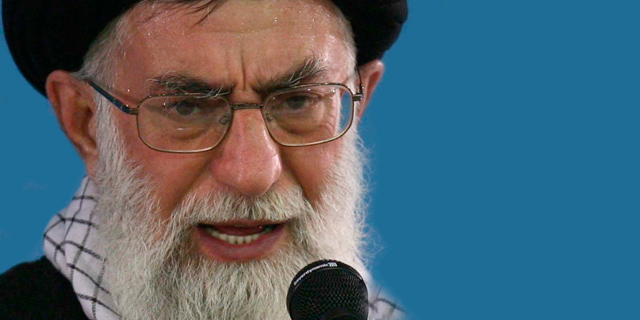 Iranian Supreme Leader Ayatollah Kamenei (Photo: © Reuters)
Khamenei’s accusations make Saudi Arabia a legitimate target under any understanding of jihad. He even went so far as to say the Saudis’ actions are equivalent to Israel’s so-called “genocide” in Gaza. This implies that a violent jihad against Saudi Arabia is as justifiable as one against Israel.
Iran believes that these end times prophesies correlate to the death of Saudi King Abdullah, the Houthis’ overthrow of the Yemeni government, the civil war in Syria, Saudi military action and the fierce fighting in Iraq. The regime sees the confluence of all these crises as beyond the realm of coincidence and signaling the imminent arrival of the “Hidden Imam” which will herald military victory for Iran.
Before the “Hidden Imam” can arrive, two other condition must be fulfilled: instability in Saudi Arabia and the march of a prophetic figure titled “Yamani” who will lead Shiite forces from Yemen into Mecca. The Houthis recently pledged to invade Saudi territory, capture Mecca and overthrow the royal family in Riyadh. They were likely referring to this prophecy.
“We’re not going to respond to every public statement made by Iranian officials or negotiate in public,” said State Department spokesman Jeff Rathke during a daily press briefing.
********************
Iranian Supreme Leader Ayatollah Khamenei ended his eerie silence since the nuclear framework agreement was announced with a fiery speech accompanied with “Death to America” chants. Khamenei essentially smashed the viability of the nuclear framework to pieces, signalled a major escalations in the war in Yemen and essentially endorsed a violent jihad against the Saudi royal family.
Wishful thinkers can’t dismiss the speech as theater for a domestic audience. Khamenei tweeted highlights in English to make sure the world, especially Americans, saw them. The threats and demands are so unequivocal that failing to follow through would sacrifice his entire credibility and prestige.
The Iranian Supreme Leader is unsatisfied with the nuclear framework agreement even though it generously permits Iran to retain the ability to produce nuclear weapons while getting major sanctions relief.
First, he said that the fact sheet published by the U.S. contains lies and does not reflect what Iran agreed to. The statement obliges the regime to seek significant revisions shortly after it gave President Obama the go ahead to make a high-profile victory lap.
Khamenei’s demands are inescapably incompatible with America’s requirements for a deal.
First, Iran is demanding that all sanctions be lifted on the first day that a final deal is signed. The framework only agrees to lift sanctions in phases and only those related to nuclear activity, not terrorism or human rights. Doing so would unfreeze the assets of individuals and entities involved in terrorism around the world, sparking a massive growth in Iran’s terrorist apparatus and proxy warfare.
The inherently flawed hope by the West that “moderate” President Rouhani and other Iranian figures can reign in Khamenei can be immediately ruled out, since Rouhani said the same exact thing.

Second, Iran is insisting that there will be no “unconventional,” “special” or “foreign” inspections or monitoring. In other words, Iran will not be subject to exceptionally intrusive inspections. Khamenei’s tweets do not specify Iran’s standards, but it is clear that Iran does not intend to give the IAEA unlimited access.
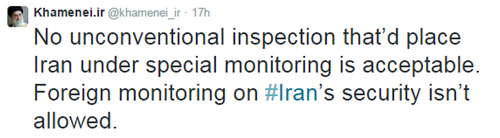
This is almost definitely a reference to military sites, to which Iran consistently says it has the option of denying access. Iran wants the ability to deny access to any location by declaring it a military institution.
This is how Iran denies access to the critical Parchin site, where damning evidence may exist to prove that Iran conducted major nuclear weapons research until at least 2003. An Iranian opposition group identified an alleged nuclear site in February that is within a military compound. It is claimed that the facility is used for uranium enrichment and the production of advanced centrifuges.
Notice the language of the tweets, which was reported to be equally non-compromising in Farsi. There is no wiggle room. Khamenei would have left some ambiguity if he was willing to budge. If you believe this is just talk, then you must believe that Khamenei made the calculated decision to cause an easily avoidable self-inflicted wound for no reason.
Another flurry of tweets related to the war in Yemen, where Iran is backing the Shiite Houthi rebels who have overthrown the government.
A U.S.-supported coalition of Sunni countries intervened militarily to support President Hadi and stop Iran from threatening the strategic Bab al-Mandeb Strait. This alliance includes Saudi Arabia, Egypt, Bahrain, Qatar, Kuwait, the United Arab Emirates, Jordan, Morocco, Turkey, Pakistan and Sudan. The last two are especially significant because of their close ties to Iran. Separately, Al-Qaeda is gaining ground in Yemen and the Islamic State (ISIS) is rising up as a competitor.
Interestingly, the tweets only threatened Saudi Arabia and did not mention any of these other participants by name. Khamenei stopped just short of a formal declaration of jihad, instead laying out the justification for it.
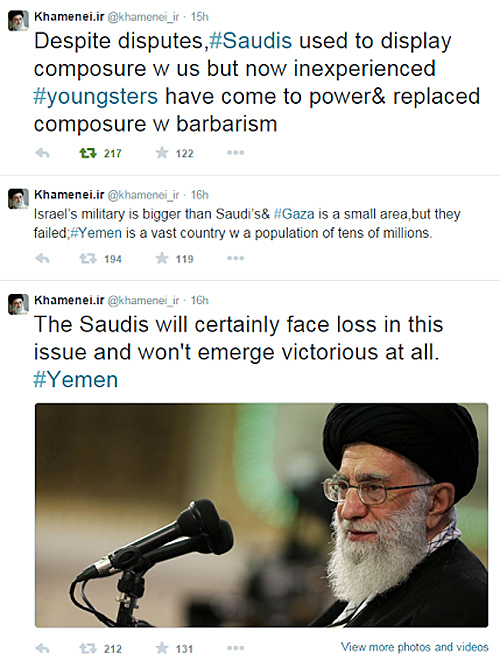

Khamenei’s accusations make Saudi Arabia a legitimate target under any understanding of jihad. He even went so far as to say the Saudis’ actions are equivalent to Israel’s so-called “genocide” in Gaza. This implies that a violent jihad against Saudi Arabia is as justifiable as one against Israel.
Don’t be comforted by Khamenei’s mentioning of prosecuting Saudi leaders in international courts. This is not meant to substitute jihad. Khamenei is making a point about how blatant the Saudi crimes are. He’s not even saying that this is Iran’s chosen course of action.
This comes as Iran dispatches two ships to the front in Yemen, including a destroyer to “safeguard naval routes” — meaning it will challenge the challenge the Saudi-Egyptian naval blockade.
Iran sent a flotilla to Bahrain in 2011 after Saudi and Emirati forces intervened to stomp out a revolution against the Sunni monarchy. The regime blinked at the last moment when the Arabs made it clear they would use force to stop it. However, the Yemen conflict has significant differences that Khamenei’s tweets help explain.
Khamenei is signaling that unprecedented hostilities with Saudi Arabia will now commence. The previous Saudi leaders, he says, could be dealt with. The new Saudi King and his circle must be handled more toughly.
However, Iran orchestrated massive terrorist attacks on Saudi interests even under the previous “composed” leaders, a campaign that put the U.S. economy and homeland at risk.
For example, in 2011, the U.S. prevented an Iranian Revolutionary Guards’ plot to assassinate the Saudi ambassador in Washington, D.C. by blowing up a restaurant, which inevitably would have taken the lives of American citizens as well. The scheme involved hiring a Mexican drug cartel to perpetrate the attack, along with bombings of the Israeli embassy in D.C. and the Israeli and Saudi embassies in Argentina.
In 2012, Iran launched a cyber attack on the Saudi Aramco oil company in response to the country’s policies in Bahrain and Syria. Aramco said the hackers tried to take down the country’s oil and gas production (which failed), but they did erase the data on 30,000 computers, three-fourths of the corporate computers.
Khamenei says that the new Saudi leadership is committing far worse crimes, so we should expect a far worse response.
We must also remember the prophecies cited by the Iranian regime. Iran believes that these end times prophesies correlate to the death of Saudi King Abdullah, the Houthis’ overthrow of the Yemeni government, the civil war in Syria, Saudi military action and the fierce fighting in Iraq. The regime sees the confluence of all these crises as beyond the realm of coincidence and signaling the imminent arrival of the “Hidden Imam” which will herald military victory for Iran.
Before the “Hidden Imam” can arrive, two other condition must be fulfilled: instability in Saudi Arabia and the march of a prophetic figure titled “Yamani” who will lead Shiite forces from Yemen into Mecca. The Houthis recently pledged to invade Saudi territory, capture Mecca and overthrow the royal family in Riyadh. They were likely referring to this prophecy.
Khamenei’s speech wasn’t the typical bluster we are used to hearing from Islamist radicals and dictators. The timing, language and high-profile nature makes it very significant.
Even though the U.S. State Dept. responded by saying that sanctions against Iran would be removed gradually based on verification that Iran had kept its commitments, its response lacked conviction:
“We’re not going to respond to every public statement made by Iranian officials or negotiate in public,” said State Department spokesman Jeff Rathke during a daily press briefing.
Could Saudi Arabia Need Israel More than Vice Versa? Israel National News, Gedalyah Reback, April 12, 2015
Israel’s status as a regional superpower is unusual for its lacking a reliable set of local allies. Even where security ties with Egypt, Jordan and Saudi Arabia might be strong, the country is forced to keep those ties in the background. Regardless, it exerts a degree of influence just by its own strategic value. While ties are not public, they are also not available for public scrutiny, perhaps enhancing the relationship opportunities with the above mentioned countries as well as other Arab states.
“Rather than a charm offensive,” asserts Robert Kappel of the German Institute of Global and Area Studies, “Israel needs an assertive regional foreign policy” in order to gain more allies.
But is that really true?
“I don’t think that it’s either-or,” says Professor Eytan Gilboa of Bar Ilan University. “I think Israel has a regional policy. We don’t see it but it collaborates with Arab countries and the Persian Gulf, especially on Iran and much more on counter-terrorism. It has a regional policy but it’s undercover.”
Solving the Israeli-Palestinian Conflict is not a Condition for an Alliance
Turning back specifically to Kappel, Gilboa states “I think he means to use it to deal with the Palestinian issue; then comes the Arab Peace Initiative. The assumption is the PA is unable, unable, to reach an agreement with Israel.”
Gilboa sees an Arab desire to expand relations with Israel in spite of the conflict with the Palestinians. Thus, the Arab Peace Initiative might be evidence the Arab countries are eager to reach out with a public offer that would allow them to open the door for Jerusalem without necessarily having to seal a deal on the conflict.
“I reject one claim: that resolution of the Israeli-Palestinian issue is a condition for a regional alliance. The reason for this is simple – all these countries couldn’t care less about the Palestinians. They have an interest in blocking Iran and extremist Islamic organizations. They made all kinds of statements to the contrary but that is not the issue. I don’t think there’s a linkage here.”
Pressing his point, Gilboa says “There’s much less opportunity for regional pressure on the Palestinians than most people think. ‘Collaboration’ is a euphemism for security cooperation on ‘negative interests.’”
Those negative interests are opposition to common regional security challenges like the above mentioned Iran and Islamist terrorist organizations. But to create an alliance, you need much more than common enemies, says Gilboa – you need common interests.
“Turkey ambivalent to ISIS – they share an ideology but still see it as a competitor. Erdogan would like to revive the Ottoman Empire where a non-Arab country leads the Arab world. Where you see this kind of geopolitics, there are a lot of opportunities for collaboration with these countries.”
And actually, “there’s criticism of Israel for not exploiting the situation,” says Gilboa.
New Countries?
When Arutz Sheva asked if Israel’s chances for regional alliances might actually increase if Syria were to collapse into several smaller states or the Iraqi Kurdish Regional Government (KRG) were to become a full-fledged independent state, Gilboa sees the idea as having validity.
“I think this is a valid point. I am only hearing that Israel is collaborating with the Kurds there and you can do a little bit more, but it is a lot more than it used to be. The alliance with Turkey had prohibited close collaboration with the Kurds. But now that the relationship is bad, this condition is nonexistent. I think indeed they could do more.”
Focusing on the much more developed autonomy, infrastructure and ambitions of the Iraqi Kurds than other groups that could emerge in Syria, Gilboa says Kurdistan could definitely become a game-changer in the region’s mixture of waxing and waning alliances. Most significantly, it could be something that does not necessarily replace Arab states as a reliable ally, but actually enhances the chances of a strong alliance between those Arab countries and Israel.
“I also think there is room for a strategic alliance between Israel and pro-US Arab states. Not just potential between Israel and the non-Arab groups, but collaboration with Israel, non-Arab states and those emerging new political entities in the Middle East. It could be done on a bilateral basis first – perhaps between Israel and Kurdistan – or multilateral. Once you gain influence with a group like the Kurds, you could translate that into the other (multilateral) type of alliance.”
Israel and Kurdistan have a long history of both covert and overt relations, especially on security. Kurdistan might then be an example of an emerging country where Israel could carry more influence than the Saudis (assuming Kurdistan is able to gain more autonomy or full sovereignty). Saudi Arabia’s diplomatic and military clout is still behind that of Israel, according to Gilboa.
“Saudi Arabia’s power is limited to its ability to manipulate oil markets, but their strength is precarious as major importers like the United States become self-sufficient in that realm. Even their military strength might turn out to be limited as its operation in Yemen is one of the largest it has ever undertaken. The assumption the Saudis might have strong influence over Pakistan and could persuade Islamabad to sell Riyadh a nuclear bomb to pull ahead of the Iranians has been thrown into doubt by Pakistan’s decision not to join the military operation against the Houthis.”
Ultimately, it might be Israel’s power that the Saudis need more.
Anything but a Saudi win (in Yemen) would not be good for Saudi Arabia,” emphasizes Gilboa. On the other hand, “Israel is much stronger diplomatically, militarily and its society is much more vibrant.”
Obama still believes in a nuclear deal, although Iran is skittish – even against a military option, DEBKAfile, April 12, 2015
 US Defense Secretary Ashton Carter:The nuclear option is on the table
In the last two days, the Obama administration has swung between conflicting signals on the Iranian nuclear deal. Unable to wave away the tough conditions laid down by Tehran, the US president was nonetheless optimistic about a final deal to curb Iran’s nuclear program in comments he made at the Americas summit in Panama Sunday, April 12. Obama said he was not surprised at the way supreme leader Ali Khamenei had characterized the framework agreement, because “Iran has it own politics and hardliners who need to be satisfied, but there may be ways to structure the final nuclear deal that achieve core objectives while satisfying Iran’s pride.”
Just Saturday, US Defense Secretary Ashton Carter said: “We have the capability to shut down, set back and destroy the Iranian nuclear program.” He referred to the Massive Ordinance Penetrator-MOP, aka the “bunker buster” which is capable of penetrating fortified facilities up to 200 feet underground. “My job is among other things to make sure that the so-called military option is on the table,” he said.
Iranian media headlines screamed: “US Secretary of Defense Ashton Carter has threatened Tehran with war.”
This is exactly what Khamenei was aiming for when on April 9, he laid down two implacable terms for a deal: the removal of sanctions on the day a final deal is signed and a firm refusal to allow international inspections of Iran’s military sites.
Both of these provisions contradicted Washington’s presentation of its core conditions for a comprehensive accord as being gradual sanctions relief and intrusive inspections.
One of Khamenei’s objects was indeed to remove all suspicion on his home front that Iran’s negotiators had given ground to the world powers either in the overt agreement or in any secret annexes.
The Iranian media headlines achieved this purpose.
But underlying the vocal exchanges between the two capitals is Iran’s confidence that President Obama has discarded the option of military force against its nuclear sites. This confidence gave Tehran the edge in round after round of diplomacy with the US and the world powers.
Senior negotiator Foreign Minister Javad Zarif boasted on April 7, that Iran was “capable of producing an atomic bomb at any given moment,” and was contained solely by “religious Islamic injunctions.”
His boast was amply illustrated by the 20,000 centrifuges Iran had built up during the years of negotiations, plus thousands of advanced machines standing by to further accelerate uranium enrichment – even though its stockpile of 3.6 percent had soared to 10 tons – enough to build 4-6 nuclear bombs.
This edge further enabled the Iranians to bring the Arak heavy water plant capable of producing plutonium to its final stages of construction, without encountering a prohibition in Lausanne, any more than the Fordo enrichment site, stealthily installed some years ago, or its ballistic missile program were sentenced to be dismantled.
That Iran would continue to get away with its tactic of talking while enriching was borne out by Obama assurance Sunday that ways would be found “to structure the final nuclear deal that achieve core objectives while satisfying Iran’s pride.”
The negotiating tactics pursued by Secretary of State John Kerry in Lausanne and in the previous round in Geneva not only diluted America’s military option but virtually took it off the table – not only for America but for everyone else, including Israel. To put it back, much more is needed than Ashton Carter’s reference to the bunker-buster. To make it credible, the United States must rebuild its military presence in the Gulf and the Middle East – bringing back two aircraft carriers to reinforce the lone USS Carl Vinson, for starters.
This, however, would contradict the doctrine Obama expounded on April 2 when he said: “When you hear the inevitable critics of the deal sound off, ask them a simple question: Do you really think that this verifiable deal, if fully implemented and backed by the world’s powers, is a worse option than the risk of another war in the Middle East?”
But he failed to explain the multiple versions of the Lausanne deal published in Washington, Tehran and latterly Paris, whose discrepancies can no longer be glossed over.
Speaking after his historic meeting with Cuba’s Raul Castro Sunday, Obama rebuked Republican senators for pointing this out, accusing them of “partisanship which has crossed all boundaries.”
Sen. John McCain shot back that discrepancies between US and Iranian versions of the deal extended to inspections, sanctions relief, and other key issues. ‘‘It is undeniable that the version of the nuclear agreement outlined by the Obama administration is far different from the one described by Iran’s supreme leader,’’ he said.
This exchange took place two days before members of the Senate Foreign Relations Committee plan to vote on Senator Bob Corker’s bipartisan Iran nuclear agreement review act. This would give members of Congress 60 days after a nuclear deal is reached to decide if they want to waive sanctions against Iran.
But most of all it calls into question the Obama administration’s presentation of a tentative set of disputed concepts reached in Lausanne as a finalized framework, which left just a few loose ends for resolving by the next deadline of June 30. The very real gaps have been highlighted and exploited by Tehran.
US tactics don’t work well in the Persian bazaar, where the carpet seller pretends to be unwilling to sell his merchandise to an interested customer, while putting the price up in round after round of haggling.
Khamenei falls naturally into the role of the reluctant carpet seller when he is confronted with an especially keen American customer.
US Admits N. Korea, Maybe Iran, Can Now Target it with EMP-Nukes, Israel National News,Mark Langfan April 12, 2015
(Please see also, Why IS the US military moving back into ‘Stargate’ base deep under the Rocky Mountains a decade after it was abandoned? — DM)
Adm. Gortney revealed that America’s anti-missile missile shield is not only configured to repulse a North Korean missile, but an Iranian ICBM as well. The Admiral explained that the current assessment is that the threat of an ICBM EMP strike comes from North Korea and not from Iran, but that the system could handle both scenarios. “Our system is designed for North Korea, and if we get our assessment wrong, for Iran. Its [the US homeland missile shield] is designed to defend the nation [the homeland] against both those particular threats today,” he said.
US President Barack Obama is currently negotiating a deal with Iran that he himself has admitted would enable it to manufacture its own nuclear weapons, 12-13 years after it is signed.
*********************
In a blockbuster admission, Admiral Bill Gortney, Commander of North American Aerospace Defense Command (NORAD) and US Northern Command (USNORTHCOM) disclosed that the Pentagon now believes North Korea has mastered the ability to miniaturize its nuclear bombs so they can be fitted onto their latest mobile KN-08 intercontinental ballistic missiles (ICBMs), which are capable of reaching the continental United States.
At the news conference, Adm. Gortney flatly stated, Pyongyang has “the ability to put a nuclear weapon on a KN-08 and shoot it at the homeland [the continental United States].” He expressed confidence that the US could knock down such a missile if launched by North Korea or its ally, Iran.
He also admitted, however, that it is “very difficult” for the US to counter the threat, because its intelligence is unable to follow the mobile ICBMs and give an efficient warning before they are launched.
The admission was accompanied by the announcement that NORAD is reopening its nuclear-EMP-proof Cheyenne Mountain bunker,
The KN-08 is a road-capable, highly mobile ICBM, which can be hidden anywhere throughout the North Korea and could be fired on a short-countdown virtually undetectable by American intelligence. As Adm. Gortney further explained about the North’s KN-08 ICBM, “It’s the relocatable [highly-mobile, can go anywhere – ML] target set that really impedes our ability to find, fix, and finish the [KN-08] threat. And as the [KN-08] targets move around and if we don’t have a persistent stare [i.e., the ability to monitor its location at all times – ML] and persistent [intelligence, surveillance, and reconnaissance] that we do not have over North Korea at this time, that relocatable nature makes it very difficult for us to be able to counter it.”
Despite Adm. Gortney’s concerns, he still believes that if a KN-08 was fired at the US homeland, in the Admiral’s words – “Should one get airborne and come at us [the US homeland], I’m confident we would be able to knock it down.”
Even if this is true, it is not clear if the US ballistic defense could knock down an incoming North Korean ICBM in time, if the nuke is intended as an EMP weapon, which explodes soon after re-entering the atmosphere.
System can defend against Iran strike, too
In another dramatic revelation, Adm. Gortney revealed that America’s anti-missile missile shield is not only configured to repulse a North Korean missile, but an Iranian ICBM as well. The Admiral explained that the current assessment is that the threat of an ICBM EMP strike comes from North Korea and not from Iran, but that the system could handle both scenarios. “Our system is designed for North Korea, and if we get our assessment wrong, for Iran. Its [the US homeland missile shield] is designed to defend the nation [the homeland] against both those particular threats today,” he said.
Experts have estimated that the KN-08 has a range of 5,600 miles and would be capable of hitting the US’s west coast if launched from North Korea. Experts also believe the missile is not accurate.
However, Adm. Gortney’s statement about North Korea’s nuke-capable KN-08 ICBM must be taken in the context of his simultaneous announcement of the Pentagon’s concern about an EMP-missile strikeon the United States homeland.
South Korean intelligence has long believed that North Korea has been developing an EMP-nuclear device. As early as June 2009, Kim Myong Chol, who was an “unofficial” spokesperson of the then-Supreme Leader Kim Jong-il, openly threatened use of a “high-altitude detonation of hydrogen bombs that would create a powerful electromagnetic pulse” bomb.” And, in November of 2013, South Korea’s intelligence service (NIS) issued a report to the South Korean parliament that North Korea had “purchased Russian electromagnetic pulse (EMP) weaponry to develop its own version” of a nuclear EMP device.
EMP strike on South Korea?
In 2005, then-USAF Major Colin Miller posited, in a public-domain US Air Force University thesis, that the North Koreans could tactically use a nuclear-EMP weapon on the Korean Peninsula to “level-the playing field” against the electronic dependent forces of the United States and South Korea.
The tactical North Korean EMP “decapitation” attack would likely bag as POWs the 40,000 living US marines now guarding South Koreabecause an EMP doesn’t kill human beings, only electronics.
A tactical nuclear-EMP aimed at South Korea would not need an ICBM to reach the 30-50 km level above the earth to explode. Rather, it would only need a much smaller short-range missile to achieve its suitable EMP-location above the Korean peninsula for an effective EMP detonation.
Given the degree of cooperation between the Islamic Republic of Iran and North Korea, it is highly likely that any nuclear-EMP-technology mastered by North Korea has already been shared with Iran. Therefore, the EMP-proliferation danger from North Korea to Iran is a catastrophic danger.
North Korea has been threatening a pre-emptive nuclear strike on the US for two years, as explained in this ABC News report from 2013. At the time of the report, North Korea was said to be “years away” from a developing a missile that could hit the US: These “years” have apparently passed.
And yet, inexplicably, US President Barack Obama is currently negotiating a deal with Iran that he himself has admitted would enable it to manufacture its own nuclear weapons, 12-13 years after it is signed.
US Sec. Defense on Iran nuclear facilities: Bunker buster bombs ‘ready to go’ Jerusalem Post, April 11, 2015
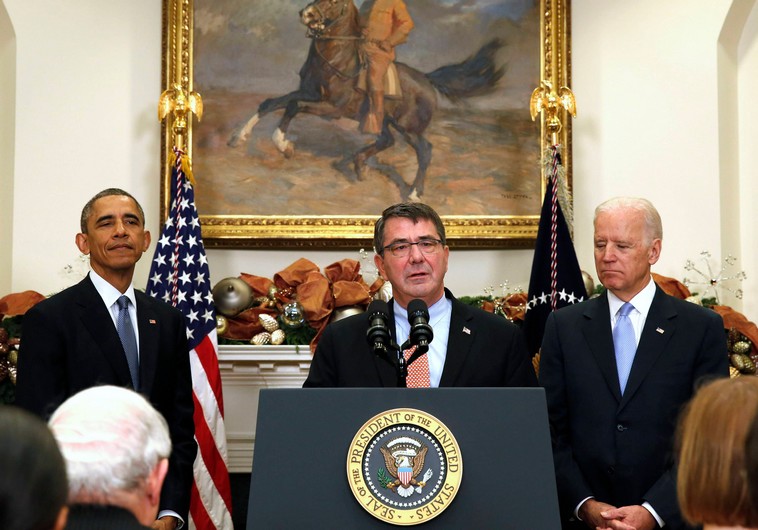 Ashton Carter (C), US President Barack Obama (L) and US Vice President Joseph Biden (R).. (photo credit:REUTERS)
US Secretary of Defense Ashton Carter addressed the possibility of a military option against Iran, saying that bunker busting bombs, meant to penetrate Iran’s underground facilities, are “ready to go.”
Speaking to CNN in an interview aired Saturday morning, Carter said that the deal between Iran and the P5+1, the basics of which were recently laid out in during negotiations in Switzerland, will hinge not on “trust but rather on “verification.”
“We have the capability to shut down, set back and destroy the Iranian nuclear program and I believe the Iranians know that and understand that,” Carter said, indicating the US’s willingness to utilize high-powered bombs if Tehran does not abide by the deal reached in the Swiss resort town where the various delegations were hosted during the eight day marathon negotiations.
The reference to the Massive Ordinance Penetrator, or MOPS, whose reach extends 200 feet below ground, is the first that any American figure has made concerning substantive military planning against the Islamic Republic’s fortified subterranean facilities.
One such facility is Fordow, near the city of Qom, where Iran maintains a facility dedicated to producing 20% enriched medium-grade uranium. Tehran insists that this would only be used for civilian purposes, a claim that has failed to assuage fears that it could then be further enriched to 90%, the necessary amount needed to produce weaponized material.
While he voiced a more hawkish tone than the White House, Carter echoed Washington’s preference for a diplomatic solution, explaining that negotiations would actually be a more long-lasting method of ensuring a nuclear-bomb free Iran since “military action is reversible overtime.”
Asked about another key factor affecting US interests int the Middle East, namely the White Houses’ willingness to deploy ground troops against the Islamic State group in Iraq and Syria, Carter suggested that the administration has not yet reached that conclusion, but that he “would not hesitate to give that advice.”
Iran Sitting on Nuclear Weapons and ICBMs Makes Our World Safer According to the Administration
by Sara Noble April 10, 2015 Via the Independent Sentinel

(An ICBM breakout this year? I imagine the payload is not far behind. – LS)
The so-called nuclear agreement told Tehran they could: keep their underground Fordow fuel enrichment plant; they didn’t have to dismantle their Arak plutonium facility; they had the right to enrich uranium; and the centrifuges spinning are fine as well. Iran is now insisting that sanctions must be immediately canceled and the inspections are to be limited with no oversight of military dimensions.
The nuclear agreement is not an agreement at all.
One should always be suspicious of miraculous last-minute deals. It was more likely a tactic employed to keep the talks going without congressional interference.
More important than what is in the agreement, is what is not.
Since 2014, we have known that Iran is close to developing ICBMs, yet President Obama has sought to dismantle or disrupt U.S. ICBM systems and has not included ICBMs in the current nuclear talks with Iran. In fact, the deal is leaving in place enough nuclear capability for Iran to put nuclear warheads of some ICBMs even before the sunset clause is reached.
Why is Iran building them? You don’t build ICBMs in order to deliver insignificant explosives. Their only purpose is to carry nuclear warheads. Iran does not need an ICBM to hit Tel Aviv. Intercontinental missiles are for reaching other continents like North America.
The nuclear agreement is the end of nonproliferation. Iran is a rogue state that is illegally enriching with our blessing. The arms race has already begun in fragile countries with paper governments and transitory values.
President Obama’s alleged goal was nonproliferation to give us a safer world, but among the many mistakes he is making with the nuclear agreement is ignoring Iran’s missile development.
The 2014 Annual Report on Military Power of Iran stated that “Iran could have an ICBM capability by 2015,” said Rep. Mike Rogers (R., Ala.), chairman of the House Armed Services strategic forces subcommittee last July when the report became public.
“We have known this [Iran’s interest in developing ICBMs] since well before the Obama administration,” Rogers said. “This unchanging fact is one of the reasons I have been and continue to be concerned about the administration’s efforts to dismantle our missile defenses.”
Rogers said that suggestions that somehow the danger of Iran’s developing long-range missile capabilities has diminished, or that the Pentagon report has altered U.S. intelligence assessments “is untrue.”
Lt. Gen. Michael Flynn, former head of the Defense Intelligence Agency confirmed that Iran is close to having ICBM capability.
James Clapper, the director of national intelligence, told the Senate Select Committee on Intelligence, Jan. 29, 2014, that “Iran would choose a ballistic missile as its preferred method of delivering nuclear weapons.”
There is some dispute over the year, but whether or not Iranian ICBMs will be ready this year or five years from now, there is no question that Iran is developing a robust missile program.
The concern that they will have ICBMs by 2015 appears to be jumping the gun but it’s not far off.
Iran is developing ballistic missiles with a range of up to 6,000 kilometers, capable of holding parts of the American homeland at risk but it might not come for five years or more.
According to the Center for Nonproliferation Studies, such capability is still only aspirational because as scientist David Wright points out, building ICBMs is tricky. In fact, it is unlikely that Iran would be capable of fielding an ICBM until 2020 at the earliest and even then its missiles would be “too large and cumbersome to be placed on a mobile platform.”
Iran currently has the largest and most diverse ballistic missile arsenal in the Middle East. Israel has more capable ballistic missiles, but fewer in number and type.
Iran is currently reliant on foreign suppliers for key ingredients and components which have not been readily forthcoming from Russia and China up until now, but Iran will come into large sums of money when the sanctions are removed. They are quickly becoming a powerful and dominant force in the region. Iran has also just forged a partnership with Russia.
Iran’s space program, which includes the successful launch of a small, crude satellite into low earth orbit using the Safir carrier rocket, proves the country’s growing ambitions and technical prowess.
Iran has an expanding nuclear and missile program representing Iran’s ultimate goals of attacking what it calls “the little Satan” (Israel) and “the great Satan” (the United States).
In a video obtained by Israel in January of this year, a new and previously hidden missile and launch site in Iran was at first thought to be capable of sending a rocket into space or launching an ICBM.
While this idea has been debunked as a misreading of satellite imagery by outfits such as Janes 360, the same publication said the facility is not yet complete. They also advised that while Iran claims they do not need missiles with a longer range than what they currently have, there are indications that they continue to work on long-range rockets.
Jane’s has seen a surge of activity at the Bid Ganeh missile development facility and Iran has invested significant resources into building a new launch facility near Shahrud that “could test longer-range, solid-fuel missiles”.
Sen. Bob Menendez, D-N.J., recently made a stunning comment at a Senate Foreign Relations Committee hearing on Iran.
“The more I hear from the administration and its quotes, the more it sounds like talking points that come straight out of Tehran,” the Democratic lawmaker said.
He has been an outspoken critic of Obama’s approach with Iran and Cuba. He is now under indictment on corruption charges. While the investigation into his dealings has been ongoing for two years, the timing of the indictment is curious.
Republican Sen. Bob Corker, R-Tenn., told Jerusalem news agencies he can’t understand why the president promises to veto upcoming congressional legislation about Iran even before it’s been written.
“For Congress not to have the ability to weigh in on this, which has such geo-political importance and where Congress has played such an important role, is ridiculous and candidly irresponsible for Congress not to play a role,” Corker said.
Wouldn’t we all like to know the answer to that and as to why ICBMs are being ignored. It appears that Obama only intends to kick the can down the road to the next president while setting up a more dangerous chessboard on which to play. We should keep in mind that Iranians invented the game of chess and they lie.
The people behind the Obama platform, fully support a policy of appeasement and say things like this.
This is why our Constitution has safeguards to prevent one man from ruling alone. Hypothetically and using an extreme but not impossible example, one man alone could be a fool, a subversive, or a madman. Unfortunately, Congress has been rendered near-useless and there is a wide opening for fatal mistakes.
President Obama thinks ignoring Iran’s ICBM aspirations and their sitting on nuclear weapons makes for a safer world.
We have already appeased evil leaders, ignoring reality, sacrificing allies, and it hasn’t worked. It can’t work, it will never work.




 anneinpt
 artaxes
 danmillerinpanama
 davidking1530
 Peter Hofman
 Joseph Wouk
 Peter
Peter Louisiana Steve

Recent Comments