Archive for the ‘Iranian missiles’ category

In its Last Days, Obama Administration Clings to Hope of a Positive Role for Iran

January 8, 2017

In its Last Days, Obama Administration Clings to Hope of a Positive Role for Iran, Iran News Update, January 7, 2017

(Iran News Update 

Iran News Update (INU) features news, analysis, and commentary on events inside Iran and the Iranian Diaspora around the world.  News and information is provided in cooperation with the National Council of Resistance of Iran (NCRI), the parliament in exile of the Iranian Resistance, and the People’s Mojahedin Organization of Iran (PMOI/MEK).

— DM)

hstaee-750

Kerry’s remarks seem to imply that the Obama administration’s early claims about Iranian moderation will continue to be repeated until it departs the office. But the incoming administration cannot be expected to pick up that thread. And articles like the above-mentioned Fox News editorial indicate that on such issues as Iran’s coordination with America’s enemies, Donald Trump and his advisors will recognize the continuance of Tehran’s worst behaviors.

**********************

On Friday, Fox News published an editorial on the topic of recent nuclear threats from North Korea. As well as being a longstanding thorn in the side of the United States, the Korean dictatorship’s obsession with nuclear weapons development has also variously exposed the cooperation between Iran and other enemies of Western democracies.

This cooperation was highlighted in the Fox News article, with specific reference to a number of instances of Iran helping North Korea with its nuclear program. In the view of the author and other critics of recent US foreign policy, this assistance has effectively been further enabled by a conciliatory approach to dealing with the Iranian nuclear program. As well as failing to address this alleged cooperation while negotiating the 2015 Iran nuclear agreement, the Obama administration has also taken very little punitive action against Iran following its post-agreement ballistic missile tests, which were conducted in defiance of UN Security Council resolutions on the matter.

This has arguably given North Korea the impression that the United States is presently either unwilling or unable to react to such tests, of which the Fox News article says the east Asian dictatorship conducted 20 in the past year alone. But to whatever extent Obama-era permissiveness encouraged these activities, that permissiveness is all but certain to end when Donald Trump assumes the presidency on January 20. And the Fox News article concludes with recommendations as to what Trump can do to prevent North Korea’s nuclear development and missile testing.

Those recommendations include bolstering US defensive capabilities along the West Coast, and also constraining “enablers” of North Korean development, chiefly the Islamic Republic of Iran. However, the appropriate means for such constraint remain a serious topic of dispute. On the campaign trail, Trump frequently accused the Obama administration of handing the Iranians a nuclear agreement that brought little benefit to the West. He also threatened to tear it up – a measure that theoretically would have taken the world community back to the drawing board and allowed it to pursue a more comprehensive suite of Iranian concessions.

But subsequent to his election, Trump has taken a different tack, promoting renegotiation of the existing deal instead of its cancellation. Even some Republicans who opposed the deal or viewed it as seriously flawed have taken a similar view. As an example, The Guardian featured an article on Friday that detailed the input offered to Trump by Bob Corker, the Republican head of the Senate Foreign Relations Committee. He has been insistent that tearing up the nuclear deal would create more problems than it would solve, and that the best way forward is to enforce its existing provisions much more strictly than the Obama administration has done.

Iran has at various times been caught in the midst of small violations of the Joint Comprehensive Plan of Action, including two instances of exceeding the deal’s defined limits on Iranian stockpiles of heavy water, a nuclear byproduct. The absence of consequences for these violations has gone a long way toward promoting the perception of the outgoing administration’s permissiveness. And there has been a great deal of associated speculation and analysis of the reasons for this. The most natural explanations deal with the administration’s fear of endangering Iranian participation in the agreement. But the situation may also be more complex than this and include worries about antagonizing Iran at a time when its participation in regional conflicts is occasionally viewed as a positive thing.

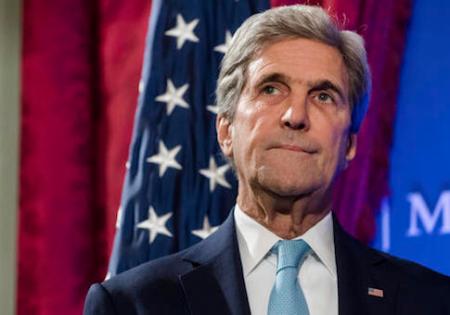
Real Clear Politics points out that this perspective was explicitly expressed by Obama’s Secretary of State John Kerry in an interview with MSNBC’s Andrea Mitchell. “Together, Iran and Russia had to prop [Assad] up, and save him from the possibility that the extremists might take over the country,” Kerry said, apparently deviating from previous US positions calling for Assad’s ouster and promoting the possibility of a victory by moderate rebel groups led by the Free Syrian Army.

Iran and Russia have widely been credited with not only preventing Assad’s fall to these groups, but also with damaging them so severely as to push the Syrian Civil War toward a situation in which the only choices for the country’s future are the established Assad dictatorship and the militant rebels affiliated with ISIL and the Al Nusra Front. Meanwhile, Iran has done its best to advance the notion that its own interests in the region are adverse to Islamic extremism. But Tehran’s pro-democratic opposition the National Council of Resistance of Iran has often referred to the Islamic Republic as the “prototype” for Islamic extremism throughout the world.

On Friday, The Iran Project pointed to recent statements by Alaeddin Boroujerdi, the chairman of Iran’s National Security and Foreign Policy Commission, claiming that Iran has always been committed to a political solution in Syria. If taken at face value, those comments can be expected to encourage Kerry’s notion that under current circumstances, a victory for Iran in Syria is a defeat for Islamic terrorism. But the trouble with this claim is that it can only be reasonably defended if one takes “Islamic terrorism” to refer only to “Sunni terrorism.”

As a major part of Iran’s strategy not only in Syria but also in Iraq and Yemen, it has directed recruitment and deployment of multitudes of Shiite militant groups to those battlefields. Previous reports have confirmed that many of these groups swear allegiance to the Islamic Republic over and above the governments of the countries in which they are operating. In this way, Iran is evidently extending its Hezbollah model of foreign influence into other part of the region. And in Syria, it is a well-known fact that Iran is actually utilizing the Lebanese paramilitary group to strengthen its operations and build a large-scale network that spans several nearby countries.

On Thursday, Xinhua News Agency pointed out that the Iranian leadership had fervently disputed rumors that Hezbollah would be withdrawing from the Syrian Civil War. It is not clear what the ultimate source of those rumors was. But they are possibly rooted in Turkey’s demands for such a withdrawal as part of a political solution to the crisis, or else in the outgoing US administration’s optimism about Iranian “moderation” and willingness to cooperate over important foreign affairs. But although Boroujerdi’s comments about a desire for a political solution promote this perception, they are belied by the Iranian leadership’s clear unwillingness to withdraw its militant proxies, even as they continue to violate ceasefire agreements negotiated by Turkey, Russia, and others.

Nevertheless, Kerry’s remarks seem to imply that the Obama administration’s early claims about Iranian moderation will continue to be repeated until it departs the office. But the incoming administration cannot be expected to pick up that thread. And articles like the above-mentioned Fox News editorial indicate that on such issues as Iran’s coordination with America’s enemies, Donald Trump and his advisors will recognize the continuance of Tehran’s worst behaviors.

Iran’s New Indigenous Air Defence System

January 3, 2017

Iran’s New Indigenous Air Defence System, Gatestone InstituteDebalina Ghoshal, January 3, 2016

Clearly, if Iran continues to develop long range launch capabilities, it could choose destabilize the entire Middle East region, and directly threaten Israel and Europe.

The rapid development of an advanced system such as the Bavar-3 demonstrates that the Iranians are capable of developing not only defensive but also offensive weapons systems, even as Iran remains prohibited under the present UNSC Resolution 2231 (2015) from developing surface-to-surface nuclear-capable ballistic missiles.

If Iran continues to develop offensive nuclear and long-range ballistic missile capabilities, the international community may be in for an unpleasant surprise — awakening to find a nuclear-armed Iran protected by sophisticated, hardened air defences. By then, the balance of power in the Middle East will be altered irreversibly.

While Western governments and NATO continue to congratulate themselves on the Iranian nuclear deal, in Tehran it is business as usual as the regime continues to plan for war.

In August 2016, on Iran’s National Defense Industry Day, the mullahs unveiled a sophisticated, domestically-built air-defence system — a surface-to-air long range missile system called the Bavar-373 [“Belief”]. Iran’s system was commissioned in 2010, when UN sanctions suspended a deal for Iran to purchase additional S-300 air defence systems from Russia.

As Iranian President Hassan Rouhani bragged with complete accuracy, “The Islamic Republic is one of the eight countries in the world who have mastered the technology to build these engines.” Brigadier General Hossein Dehqan claimed that Iran would begin mass production by the end of 2016. As the Bavar-373 is made entirely from domestic components, it can be manufactured and deployed even in the face of future sanctions.

2179Iranian President Hassan Rouhani (right) poses with the Bavar-373 air-defense system, August 21, 2016. (Image source: Fars News/Wikimedia Commons)

Bavar-373 is a marked upgrade from previous Iranian air defence capabilities. It is reportedly mounted on a Zafar 8×8 special wheeled chassis, designed to operate both on and off roads, with an operational range of 800km. The system uses Sayyed-3 category canister-launched missiles along with target acquisition radar, target engagement radar, and phased-array radar. The Sayyed-3 missiles hit mid-altitude targets with greater destructive power and increased range and speed than previous generations of Iranian missiles.

The Iranians claim, probably accurately, that the Bavar will be capable of downing bombers and other combat aircraft including helicopters and drones. Many reports confirm that the Bavar is superior to the Russian S-300, as it has greater mobility, better targeting capability, and faster launch preparation.

The Bavar is just one of Iran’s moves to develop military self-sufficiency in order to circumvent future sanctions. While still purchasing some components from Russia, Iran is clearly planning to go it alone in the future — especially with ballistic and cruise missile technology. The rapid development of an advanced system such as the Bavar-3 demonstrates that the Iranians are capable of developing not only defensive but also offensive weapons systems, even as Iran remains prohibited under the present UNSC Resolution 2231 (2015) from developing surface-to-surface nuclear-capable ballistic missiles. Clearly, if Iran continues to develop long range launch capabilities it could choose to destabilize the entire Middle East region and directly threaten Israel and Europe.

Iran’s intentions appear ominous. Tehran continues to deploy defensive systems at nuclear and military sites throughout the country, apparently concerned about a potential Israeli strike. Even more worrisome, the Bavar system could make any attack by Israel or NATO extremely difficult and costly.

If Iran continues to develop offensive nuclear and long-range ballistic missile capabilities, the international community may be in for an unpleasant surprise — awakening to find a nuclear-armed Iran protected by sophisticated, hardened air defences. By then, the balance of power in the Middle East will be altered irreversibly.

Facing North Korea and Iran, Trump Must Strengthen Nuclear Deterrence

January 3, 2017

Facing North Korea and Iran, Trump Must Strengthen Nuclear Deterrence, National Review, Tom Rogan, January 3, 2017

Ultimately, the nuclear issue is just one challenge the incoming Trump administration faces in foreign policy. The U.S. needs a new strategy of realist resolution. After years of Obama’s fraying credibility with allies and foes alike, the United States must resume leading. Kim Jong-un and Iranian supreme leader Khamenei are arrogant. If given an inch, they will walk the nuclear mile. And history tells us that great power and totalitarian zealots rarely blend positively.

***********************************

How President Trump should strengthen America’s ICBM-deterrence posture. Like Big Brother in George Orwell’s Nineteen Eighty-Four, North Korean dictator Kim Jong-un holds absolute power. And Kim, the same as his father and grandfather, wants to forcibly unify the Korean peninsula under a xenophobic ideology of self-sufficiency.

Since the end of the Korean War, the Kims’ wacky “Juche” ideology has sparked Western laughter as much as fear. We have rightly assumed the Kims are deterred by their understanding that a conventional-arms conflict with America would destroy them. While the U.S. has had to occasionally reinforce this conventional deterrence, it has been sustained for 60 years.

Over the weekend, Kim Jong-un announced that the North’s development of an intercontinental ballistic missile (ICBM) is advancing rapidly. Unless America appeases him, Kim warned, he will build a “preemptive striking capacity with a main emphasis on nuclear force.” Recently successful rocket tests suggest we should take Kim at his word.

Still, it’s not just North Korea the West should be concerned about here.

Today, alongside other malevolent activities, the Islamic Revolutionary Republic’s ballistic-missile research is advancing unabated. In his wisdom, President Obama decided to exclude a ban on such research from his legacy Iran deal. He lacked the threat-of-force credibility to compel the Iranians to cease their missile development. Unfortunately, when Iran perfects ballistic-missile technology, it will break the nuclear deal. By then, sanctions relief will have made Iran tens of billions of dollars richer.

Collectively, these developments threaten not just the stability of international peace, but the civilian population of the United States. They demand a robust response in U.S. nuclear-deterrent posture. President Trump should deliver it.

First, Trump should reform the Iran nuclear deal to include prohibitions on Iranian ballistic-missile development. This is the realist compromise between scrapping the nuclear deal entirely and attempting to make it work better.

Second, Trump should enforce a new, proactive strategy to deal with North Korea’s increasingly advanced ICBM program. Whereas, in the past, the U.S. has simply monitored North Korean missile tests, stronger action is now required. North Korean ICBMs demand it. After all, the base-minimum range of an ICBM is 3,400 miles. But seeing as 1960s-era Soviet and U.S. ICBMs easily exceeded 6,200-mile ranges, we must assume North Korean ICBMs will exceed the minimum range. And with just 125 miles more than the minimum, North Korea could strike Darwin, Australia. An extra 270 miles would put Anchorage, Alaska, in range. Hawaii, a little over 4,300 miles from North Korea, would also be vulnerable.

Countering this threat, Trump should supplement the U.S military’s multi-phase missile-defense programs. He should publicly announce that if the North tests an ICBM, he will establish three North Korea focused missile-test defense sectors. Trump should be clear that any North Korean ICBM that enters or passes these sectors will be shot down. U.S. military planners would, of course, fine-tune such proposals, but here’s one example of what the defense zones might look like.

Trump could establish a northern sector — focused on protecting Alaska — off the Japanese coast in the Sea of Okhotsk. Second, a western sector — focused on protecting Hawaii and the U.S. west coast — could be set up approximately 1,000 miles west of Midway Island, at the southern tip of the Emperor seamounts. Third, a southern sector — to protect Australia — could be established south of Palau Island between Papua and Papua New Guinea. These sectors should be maintained by U.S. Navy destroyers and cruisers (and hopefully allied assets), equipped with the Aegis missile-defense system.

Next, Trump should clarify his willingness, where facing imminent nuclear attack, to use nuclear weapons in a “first strike” role. That demand is urgent because President Obama has equivocated on this fundamental precept of U.S. nuclear-deterrent posture. Namely, the understanding that U.S. nuclear weapons serve both deterrence (preventing an attack) and capability (destroying an enemy). A retained first-strike capability is necessary to prevent the loss of millions — or tens of millions . . . or hundreds of millions — of American lives in a nuclear showdown. Yes, ideally, the U.S. would be able to use conventional non-nuclear capabilities to achieve that objective. But idealism is a dangerous master. For one, U.S. military pilots might not be able to penetrate enemy air defenses in time to prevent a ballistic-missile attack. Similarly, conventional bunker-busting bombs might not destroy enemy nuclear platforms.

Fourth, Trump should aggressively confront illicit ICBM research-and-development networks. Specifically, Trump should push Pakistan, Russia, and the former Soviet states to take action against smugglers in their nations. In the case of Pakistan and the former Soviet states, such action should be tied to U.S. aid payments. A philosophical evolution of U.S. tactics is equally important here. Put simply, instead of treating nuclear smuggling as a law-enforcement matter, the U.S. must be prepared to coerce or kill those who support the illicit nuclear industry. Fear is always the best guarantor against a nuclear holocaust.

Ultimately, the nuclear issue is just one challenge the incoming Trump administration faces in foreign policy. The U.S. needs a new strategy of realist resolution. After years of Obama’s fraying credibility with allies and foes alike, the United States must resume leading. Kim Jong-un and Iranian supreme leader Khamenei are arrogant. If given an inch, they will walk the nuclear mile. And history tells us that great power and totalitarian zealots rarely blend positively.

Iran Breaks Nuclear Deal and UN Resolutions

December 15, 2016

Iran Breaks Nuclear Deal and UN Resolutions, Gatestone Institute, Majid Rafizadeh, December 15, 2016

“We will have a new ballistic missile test in the near future that will be a thorn in the eyes of our enemies.” – Iranian President Hassan Rouhani.

The range of existing Iranian ballistic missiles has grown from 500 miles to over 1,250 miles (roughly 2,000 kilometers), which can easily reach Eastern Europe, as well as countries such as Israel.

In addition, Iranian Defense Minister Brig. Gen. Hossein Dehqan said that there would be no limit for the range and amount of missiles that Iran will develop.

The nuclear agreement, known as the Joint Comprehensive Plan of Action Agreement (JCPOA) — effective, as of October 18, 2015, according to the State Department – clearly and distinctly stipulates that Iran should not undertake any ballistic missile activity “until the date eight years after the JCPOA Adoption Day or until the date on which the IAEA submits a report confirming the Broader Conclusion, whichever is earlier.”

Not only is Iran avoiding honoring this stipulation, but also Iran’s ballistic missile operations have significantly ratcheted up. More importantly, there has been no criticism at all from the Obama administration or other involved parties regarding this critical violation.

As cited by Iran’s state-owned Fars News Agency, Brig. Gen. Amir Ali Hajizadeh, Iran’s commander of the Islamic Revolutionary Guards Corps (IRGC) Aerospace Force, said in Tehran on Dec 6, 2016:

“In addition to enhancing the precision-striking power and quality of ballistic missiles, the Iranian authorities and experts have used innovative and shortcut methods to produce inexpensive missiles, and today we are witnessing an increase in production [of ballistic missiles].”

Iran is bragging about it.

1173-2

In addition, Iranian Defense Minister Brig. Gen. Hossein Dehqan said that there would be no limit for the range and amount of missiles that Iran will develop. He boasted:

“90 percent of the country’s defense systems have reached an acceptable standard and enjoy competitive quality compared with the weapons of advanced countries; production of the national individual weapons and efforts to improve the quality and precision-striking power of ballistic missiles are among the defense ministry’s achievements in the defense field.”

Fars News reported on a December 6, 2016 statement from Iran’s Defense Minister:

“His remarks came as the Islamic Revolution Guards Corps (IRGC) fired 2 home-made ‘Qadr H’ ballistic missiles from the Eastern Alborz Mountains at a target in Iran’s Southeastern Makran seashore some 1400km away… The missiles were fired on the sidelines of the main stage of the IRGC drills in Central Iran and various parts of the country.”

One missile, which was launched on March 2016, had a clear message written on it that said in the Hebrew language: “Israel should be wiped off the Earth”. Fars Agency adds:

“Qadr is a 2000km-range, liquid-fuel and ballistic missile which can reach territories as far as Israel… The missile can carry different types of ‘Blast’ and ‘MRV’ [Multiple Reentry Vehicle] payloads to destroy a range of targets. The new version of Qadr H can be launched from mobile platforms or silos in different positions and can escape missile defense shields due to their radar-evading capability.”

Iran has repeatedly test-fired, long-range ballistic missiles and laser-guided surface-to-surface missiles. For example, on March 2016, Iran tested a new ballistic missile, capable of carrying multiple warheads. More recently, Iran fired a test missile with an accuracy within 25 feet, which is characterized as “zero error,” according to Brig. Gen. Ali Abdollahi, the Iranian military’s deputy chief of staff, and Iran’s semi-official Tasnim news agency.

The range of existing Iranian ballistic missiles has grown from 500 miles to over 1,250 miles (roughly 2,000 kilometers), which can easily reach Eastern Europe, as well as countries such as Israel.

According to a previous report obtained by the Associated Press, the launches are “destabilizing and provocative” and the Shahab-3 medium-range ballistic missile and Qiam-1 short-range ballistic missile fired by Iran are “inherently capable of delivering nuclear weapons.”

In addition to violating the nuclear agreement, provoking and threatening other nations, and destabilizing the region, Iran is breaching two UN Security Council Resolutions. Security Council resolution 2231 (section 3 of Annex B) “calls upon Iran not to undertake any activity related to ballistic missiles designed to be capable of delivering nuclear weapons, including launches using such ballistic missile technology.”

The second United Nations Security Council resolution, 1929, states:

“Iran shall not undertake any activity related to ballistic missiles capable of delivering nuclear weapons, including launches using ballistic missile technology, and that States shall take all necessary measures to prevent the transfer of technology or technical assistance to Iran related to such activities.”

Iran has the largest ballistic missile arsenal in the Middle East. It is also the most diversified one. No country, other than Iran, has acquired long-range ballistic missiles before obtaining nuclear weapons. Ballistic missiles can be used for offensive or defensive purposes, but sophisticated missiles are more likely developed as delivery vehicles for nuclear weapons.

These missiles have the capability of carrying multiple nuclear warheads. Iran Tasnim news agency reported:

“Defense Minister Brigadier General Hossein Dehqan praised the country’s military might…saying the Islamic Republic can mass produce ballistic missiles with any range and destructive power… In the missile sphere, Iran has been able to maximize the accuracy of projectiles, as emphasized by Leader of the Islamic Revolution Ayatollah Seyed Ali Khamenei, with reliance on the local forces, Brigadier General Amir Ali Hajizadeh said at an academic ceremony in Tehran on Tuesday.”

Iran is also is increasingly provoking other countries in the region, and has made it clear that the ballistic missiles are aimed at targeting other nations. Brig. Gen. Amir Ali Hajizadeh, said previously to FARS news agency that “Iran has built missiles that can hit targets at 2,000 Km. They are designed to hit Israel at such a distance.” He added that Islamic countries have surrounded Israel and “its [Israel’s] life is short. So it will collapse in any given war — long before a missile is even fired.”

Iran also exports these missiles to its proxies across the region. Tasnim news agency quoted General Hossein Salami as saying:

“Hezbollah has 100,000 missiles that are ready to hit Israel to liberate the occupied Palestinian territories if the Zionist regime repeats its past mistakes… today, the grounds for the annihilation and collapse of the Zionist regime are (present) more than ever.”

In addition, Gen. Salami warned Israeli leaders that if they make the “wrong move,” Israel would come under attack.

It is crucial to point out that both Iran’s so-called “moderates” and hardliners are on the same page when it comes developing ballistic missiles. When his country was unveiling a new missile, Fateh 313, President Hassan Rouhani pointed out that “we will have a new ballistic missile test in the near future that will be a thorn in the eyes of our enemies.”

The Obama administration, the international community, a major global power, or a coalition of nations need robustly to confront these provocations, threats, and violations of the nuclear deal and UN Security Council Resolutions by Iran.

US Tomahawks destroy Iran’s radar bases in Yemen

October 13, 2016

US Tomahawks destroy Iran’s radar bases in Yemen, DEBKAfile, October 13, 2016

uss_mason_fires__9-10-16_an_sm-2-1

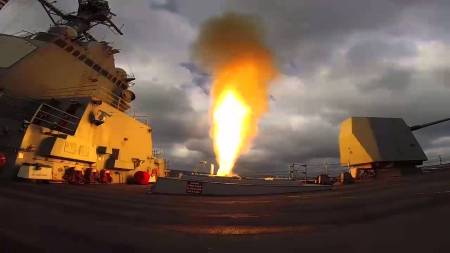
Tomahawk cruise missiles launched by US Navy destroyer USS Nitze early Thursday, Oct. 13, destroyed three Iranian-Yemeni coastal radar stations, after C-802 anti-ship missiles supplied by Iran to Yemeni Houthi rebels were fired at US naval vessels off the Yemeni coast. The stations were built and  operated  by Iran’s Revolutionary Guards (IRGC) for their Yemeni proxies to back up a threat to blockade the Red Sea.

From Oct. 9, the new missiles four times targeted the US flotilla shortly after it arrived to patrol the Red Sea and the Bab al-Mandeb Strait. Neither the US nor Iran has acknowledged their mounting confrontation over control of these strategic waters, which Tehran is waging through its Yemeni proxy.

DEBKAfile was first to disclose this confrontation in a special report Wednesday. (see below)

Iran’s Guards are repeating the mode of operation they employed a decade ago at another Middle East flashpoint. On July 14, 2006, Hizballah used an earlier version of the C-802 to attack and cripple the Israeli Hanit missile ship on the day this Iranian Lebanese proxy launched the Second Lebanese War against Israel. Rev Guards seized control of Lebanese shore radar station to guide their aim.

A highly advanced radar installation is required for the use of the C-802. Two radar stations set up outside Yemen’s two principal Red Sea ports, Mokha and Hudaydah earlier this month were operated by Rev. Guards missile and radar teams until they were destroyed Thursday, DEBKAfile’s military sources report. The third station was added for triangulation. The destruction of all three by a US Tomahawk has knocked out the Houthis’ ability to use C-802 missiles and Iran’s threat to blockade the Red Sea.

To drive this lesson home, the US Pentagon issued the following statement:

“Destroying these radar sites will degrade their ability to track and target ships in the future. These radars were active during previous attacks and attempted attacks on ships in the Red Sea, including last week’s attack on the USA-flagged vessel “Swift-2”, and during attempted attacks on USS Mason and other ships as recently as yesterday.

The official was referring to the United Arab Emirates US-flagged transport ship that was badly damaged last week in the Bab al-Mandeb strait by a Houthi missile..

DEBKAfile reported earlier:

Contrary to Tehran’s assurance to Washington in August that Iranian arms supplies to Yemeni Houthi rebels had been suspended, the rebels took delivery last week of the largest consignment of Iranian weapons to date.

According to DEBKAfile’s military sources, the shipment included highly sophisticated Scud D surface-to-surface missiles with a range of 800km; and C-802 anti-ship missiles (an upgraded version of the Chinese YJ-8 NATO-named CSS-N-8 and renamed by Iran Saccade).

They came with Iranian Revolutionary Guards officers and radar systems to fine-tune the targeting of these missiles by Iran’s Yemeni proxies.

The Scuds were given to the Houthi forces fighting in northern Yemen on the Saudi border, while the C-802s were delivered to the Houthis’ Ansar Allah faction, which is under direct Iranian Rev Guards command.

The missiles were posted at special launch bases constructed by Iran outside Yemen’s two principal Red Sea ports of Mokha and Hudaydah.

Since no more than 62km of Red Sea water divides the Saudi and African coasts, the Iranian missiles are well able to block shipping and tanker traffic plying to and from the Gulf of Suez and the Persian Gulf. Therefore, the threat of blockade hangs imminently over one-third of Saudi and Gulf Emirate oil exports.

The same threat hangs over Israeli civilian and naval shipping from its southern port of Eilat through the Gulf of Aden and out to the Indian Ocean.

One of the most troubling aspects of this pivotal new menace to an international waterway was that US, Saudi, Egyptian and Israeli intelligence agencies missed the huge consignment of Iranian missiles as it headed towards Yemen. Neither did they pick up on the construction by Iranian military engineers of three ballistic missile bases – one facing Saudi Arabia and two Red Sea traffic.

Tehran’s Yemeni proxies moreover landed large-scale military strength on Perim island in the mouth of the Bab al-Mandeb strait, the chokepoint for ingress and egress from the Red Sea.

Since the strait is just 20km wide, control of this island empowers this force to regulate shipping movements through this strategic strait.
Tehran wasted no time after all its assets were in place to begin using them:

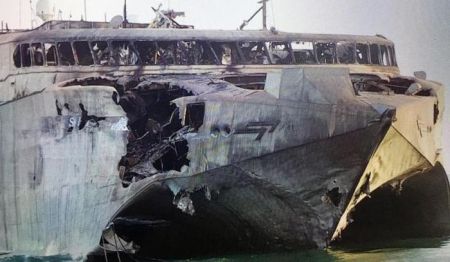
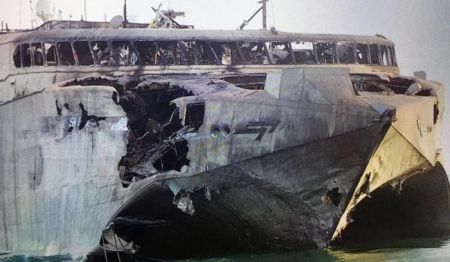
1. On Oct. 1, Iran’s Houthi surrogates launched C-8-1 missiles against a United Arab Emirates transport HSV-2 Swift logistics catamaran as it was about to pass through the strait. The ship, on lease from the US Navy, was badly damaged. No information was released about casualties.

uae_hsv-2_1-1-16-1

DEBKAfile’s military and intelligence sources discerned that the aim of this attack was to choke off the movements of UAE warships from the southern Yemeni port of Aden, where large Emirate and Saudi forces are concentrated, to the Eritrean port of Assab, where the UAE has established a large naval base.

This attack did finally evoke a US response. The guided missile destroyers, USS Mason and USS Nitze, were dispatched to the Red Sea, along with the USS Ponceafloat forward staging base, to patrol the strait opposite the Yemeni coast

2. This did not deter Tehran or its Yemeni pawns: On Oct. 9, they fired an additional barrage of C-802 at the American flotilla, which according to a US spokesman, missed aim.

The Mason hit back with two Standard Missile-2s and a single Enhanced Sea Sparrow Missile.

There has been no official word about whether these weapons destroyed a Yemeni launching site. But the event itself was a landmark as the first direct Iranian-Houthi attack of its kind on an American naval vessel.

3. That same day, the Houthis fired Scud-D missiles at the Saudi town of Ta’if, 700 km from the Yemeni border and only 70km from the Muslim shrine city Mecca. This was meant as a direct assault on the Saudi royal house and its claim to legitimacy, by virtue of its role as Guardian of the Holy Places of Islam.

In America’s heated presidential campaign, the Democratic contender Hillary Clinton boasts repeatedly that as Secretary of State she helped “put the lid on Iran’s nuclear program without firing a single shot.”

That is factually true. America did not fire a single shot. Iran did the shooting and still does, constantly upgrading its arsenal with sophisticated ballistic missiles.

First Iranian-Yemeni missile attack on US flotilla

October 12, 2016

First Iranian-Yemeni missile attack on US flotilla, DEBKAfile, October 12, 2016

uss_mason_fires__9-10-16_an_sm-2

Contrary to Tehran’s assurance to Washington in August that Iranian arms supplies to Yemeni Houthi rebels had been suspended, the rebels took delivery last week of the largest consignment of Iranian weapons to date.

According to DEBKAfile’s military sources, the shipment included highly sophisticated Scud D surface-to-surface missiles with a range of 800km; and C-802 anti-ship missiles (an upgraded version of the Chinese YJ-8 NATO-named CSS-N-8 and renamed by Iran Saccade).

They came with Iranian Revolutionary Guards officers and radar systems to fine-tune the targeting of these missiles by Iran’s Yemeni proxies.

The Scuds were given to the Houthi forces fighting in northern Yemen on the Saudi border, while the C-802s were delivered to the Houthis’ Ansar Allah faction, which is under direct Iranian Rev Guards command.

The missiles were posted at special launch bases constructed by Iran outside Yemen’s two principal Red Sea ports of Mokha and Hudaydah.

Since no more than 62km of Red Sea water divides the Saudi and African coasts, the Iranian missiles are well able to block shipping and tanker traffic plying to and from the Gulf of Suez and the Persian Gulf. Therefore, the threat of blockade hangs imminently over one-third of Saudi and Gulf Emirate oil exports.

The same threat hangs over Israeli civilian and naval shipping from its southern port of Eilat through the Gulf of Aden and out to the Indian Ocean.

One of the most troubling aspects of this pivotal new menace to an international waterway was that US, Saudi, Egyptian and Israeli intelligence agencies missed the huge consignment of Iranian missiles as it headed towards Yemen. Neither did they pick up on the construction by Iranian military engineers of three ballistic missile bases – one facing Saudi Arabia and two Red Sea traffic.

Tehran’s Yemeni proxies moreover landed large-scale military strength on Perim island in the mouth of the Bab al-Mandeb strait, the chokepoint for ingress and egress from the Red Sea.

Since the strait is just 20km wide, control of this island empowers this force to regulate shipping movements through this strategic strait.

Tehran wasted no time after all its assets were in place to begin using them:

1. On Oct. 1, Iran’s Houthi surrogates launched C-8-1 missiles against a United Arab Emirates transport HSV-2 Swift logistics catamaran as it was about to pass through the strait. The ship, on lease from the US Navy, was badly damaged. No information was released about casualties.

uae_hsv-2_1-1-16

DEBKAfile’s military and intelligence sources discerned that the aim of this attack was to choke off the movements of UAE warships from the southern Yemeni port of Aden, where large Emirate and Saudi forces are concentrated, to the Eritrean port of Assab, where the UAE has established a large naval base.

This attack did finally evoke a US response. The guided missile destroyers, USS Mason and USS Nitze, were dispatched to the Red Sea, along with the USS Ponce afloat forward staging base, to patrol the strait opposite the Yemeni coast

2. This did not deter Tehran or its Yemeni pawns: On Oct. 9, they fired an additional barrage of C-802 at the American flotilla, which according to a US spokesman, missed aim.

The Mason hit back with two Standard Missile-2s and a single Enhanced Sea Sparrow Missile.

There has been no official word about whether these weapons destroyed a Yemeni launching site. But the event itself was a landmark as the first direct Iranian-Houthi attack of its kind on an American naval vessel.

3. That same day, the Houthis fired Scud-D missiles at the Saudi town of Ta’if, 700 km from the Yemeni border and only 70km from the Muslim shrine city Mecca. This was meant as a direct assault on the Saudi royal house and its claim to legitimacy, by virtue of its role as Guardian of the Holy Places of Islam.

In America’s heated presidential campaign, the Democratic contender Hillary Clinton boasts repeatedly that as Secretary of State she helped “put the lid on Iran’s nuclear program without firing a single shot.”

That is factually true. America did not fire a single shot. Iran did the shooting and still does, constantly upgrading its arsenal with sophisticated ballistic missiles.

New Report Shows Iran’s Revolutionary Guards Profiting from Iran Deal

October 5, 2016

New Report Shows Iran’s Revolutionary Guards Profiting from Iran Deal, Counter Jihad, October 5, 2016

iranian-nuclear-weapon

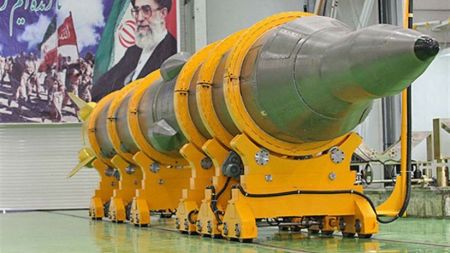
A new report from the Foundation for the Defense of Democracies showcases the ways in which Iran’s Revolutionary Guards Corps (IRGC) has benefited from the so-called nuclear deal.  This deal, which Congress never voted to approve nor reject, and which the Iranian government fundamentally altered rather than accepting, has nevertheless led to a vast transfer of wealth to Iran.  Much of that wealth has fallen right in the hands of the IRGC, which oversees Iran’s terrorist and military nuclear programs.

Here at CounterJihad, we have covered the problems withIran’s nuclear deal somewhat extensively.  The Foundation for Defense of Democracies report’s conclusions will thus be of little surprise to our regular readers.  However, it does include additional detail on the degree to which Iran’s corporate and business ventures are secretly dominated by IRGC elites.  As the report says:

[IRGC abuses] did not stop France’s mobile phone giant, Orange, from beginning talks with Iran’s largest mobile phone operator, Mobile Telecommunication Company of Iran (MCI), over acquiring a stake in the Iranian company. The IRGC controls MCI through a 50-percent-plus-one stake in its parent company, the Telecommunication Company of Iran (TCI).  In short, whether its internal security, foreign adventures, or large corporate ventures, the IRGC plays an outsized role in Iran’s internal power structure. Established in 1979 to consolidate the Islamic revolution and fight its enemies, the IRGC has evolved over the years into a full-fledged conventional army, conducting and directing terrorist activity abroad. The Guard has also become a political power broker, an economic conglomerate, and an agency in charge of nuclear and ballistic-missile proliferation….  IRGC revenues from economic activities yield the necessary resources and political leverage to place its members in positions of power. Conversely, the Guard’s political power serves the economic enterprises it owns, and both its political and economic weight in turn advance its military projects.

The IRGC’s corporate activity offers revenue to the organization in the same way that its control of narcotics within Iran does.  However, whereas the narcotics are often passed on to Hezbollah to be turned into heroin, corporate profits can be rolled over into apparently legitimate enterprises that have useful military applications.  That allows Iran a backdoor to internationally-developed advanced weaponry and so-called “dual use” technologies.  These are technologies that have both a legitimate purpose, but also an application to Iran’s nuclear program.

Their space program is an excellent example of the way in which a legitimate purpose can mask development of nuclear weapons:  the same technologies involved in building space rockets that can deploy satellites in particular orbits can also be used to develop ballistic missiles that will deliver nuclear warheads to particular cities.  The New York Times reported in September that the biggest engine in North Korea’s nuclear missile program seems to have been developed in partnership with Iran.  Iran’s version is “nuclear-capable,” but the North Korean version makes no pretense about its intentions.

The potential links to Iran complicate the issue. Iran has ignored a United Nations Security Council resolution, passed in conjunction with last year’s agreement freezing its nuclear program, to refrain from tests of nuclear-capable missiles for eight years.  The Obama administration has not sought sanctions, knowing they would be vetoed by Russia and China, nor has it said much in public about the details of the cooperation on the new rocket engine.

Nor are they likely to do so, given how much of the administration’s prestige is tied up with the so-called nuclear deal.  It is worth noting, however, that the effect of the deal has been to embolden Iran — and North Korea, and Russia, and America’s enemies in general.

Obama Admin Secretly Facilitated Iranian Ballistic Missile Program

October 4, 2016

Obama Admin Secretly Facilitated Iranian Ballistic Missile Program, Washington Free Beacon, , October 4, 2016

U.S. Secretary of State John Kerry smiles during a speech on the future of "Transatlantic Relations" during an event hosted by The German Marshall Fund (GMF) and the U.S. Mission to the EU at Concert Noble in Brussels, Tuesday, Oct. 4, 2016. Kerry is in Brussels for a two-day conference, hosted by the EU, with the participation of over 70 countries to discuss the current situation in Afghanistan. (AP Photo/Geert Vanden Wijngaert)

U.S. Secretary of State John Kerry smiles during a speech on the future of “Transatlantic Relations” during an event hosted by The German Marshall Fund (GMF) and the U.S. Mission to the EU at Concert Noble in Brussels, Tuesday, Oct. 4, 2016. AP Photo/Geert Vanden Wijngaert

The Obama administration misled journalists and lawmakers for more than nine months about a secret agreement to lift international sanctions on a critical funding node of Iran’s ballistic missile program, as part of a broader “ransom” package earlier this year that involved Iran freeing several U.S. hostages, according to U.S. officials and congressional sources apprised of the situation.

The administration agreed to immediately lift global restrictions on Iran’s Bank Sepah—a bank the Treasury Department described in 2007 as the “linchpin of Iran’s missile procurement”–eight years before they were to be lifted under last summer’s comprehensive nuclear agreement. U.S. officials initially described the move as a “goodwill gesture” to Iran.

The United States also agreed to provide Iran $1.7 billion in cash to release or drop charges against 21 Iranians indicted for illegally assisting Tehran. Full details of this secret agreement were kept hidden from Congress and journalists for more than nine months, multiple sources told theWashington Free Beacon.

State Department officials who spoke to the Free Beacon now say the United States “already made” the decision to drop U.S. sanctions, but declined to address multiple questions aimed at clarifying the discrepancy between past and current explanations for dropping international sanctions.

The Free Beacon first reported on these terms in January, including the dropping of international sanctions on Bank Sepah.

State Department officials told the Free Beacon at the time that the settlement with Iran, including the $1.7 billion cash award, was “not related” to “the release of the U.S. citizens from Iran.”

U.S. officials last week confirmed to the Wall Street Journal that in fact the dropping of sanctions on Bank Sepah “was part of a package of tightly scripted agreements” surrounding the release of the U.S. citizens from Iran.

When asked about the discrepancies between these statements, a State Department official would not elaborate, instead telling the Free Beacon, “The U.S. government had already made the determination that it would remove Bank Sepah from our domestic Specially Designated Nationals and Blocked Persons List on Implementation Day, which was outlined clearly in the JCPOA [nuclear deal] itself in July 2015.”

“We made this determination after a careful review of the activity of all individuals and entities—including Bank Sepah—that would be removed from the SDN list,” the official explained. “Although we removed Bank Sepah from the U.S. SDN list, Bank Sepah will continue to be cut off from the U.S. financial system and its funds under U.S. jurisdiction will remain blocked. Furthermore, we have the ability to quickly reimpose additional U.S. sanctions if Bank Sepah or any other entity engages in activities that remain sanctionable.”

The Free Beacon was not the only publication that was provided with misleading information by the Obama administration.

U.S. officials told Al Monitor in late January that the move to cancel international sanctions on Bank Sepah at the United Nations was undertaken by Venezuela without U.S. action.

“We already made the decision to delist this bank as part of U.S. secondary sanctions as part of the nuclear deal,” the official added, claiming the United States only agreed “not to oppose the delisting at the U.N., which Iran very much wanted.”

Senior Iranian officials said in January that the $1.7 billion payment and delisting of Bank Sepah were part of the agreement to free U.S. hostages, a charge the Obama administration denied at the time.

“The annulment of sanctions against Iran’s Bank Sepah and reclaiming of $1.7mln of Iran’s frozen assets after 36 years showed that the U.S. doesn’t understand anything but the language of force,” Mohammad Reza Naqdi, commander of Iran’s Basij Volunteer Force, told Iran’s state-controlled press in early February.

Senior congressional sources apprised of the matter told the Free Beacon that these latest revelations provide further proof of the administration’s intentional bid to deceive the public about its dealings with Iran.

“Facts are facts, no matter how much the administration tries to hide them,” said one senior congressional aide involved in investigating the matter. “Journalists and Members of Congress are on the trail and have already uncovered so much, including the cash payment of almost $2 billion to the world’s largest state sponsor of terrorism as a ransom for four American hostages. The truth, no matter how disturbing it is, will continue to come out.”

“This should eliminate any remaining doubt that the administration paid a ransom to Iran,” said another source familiar with the issue. “Why else would they keep Congress and the American people in the dark about this unprecedented concession? President Obama’s continued capitulation to the Iranian regime is a hazard to our national security.”

Another source who serves as a senior adviser to Congress and is familiar with the administration’s thinking told the Free Beacon that the Obama administration misled the public to avoid sparking outrage over its decision to drop sanctions on the top funder of Iran’s ballistic missile program.

“The Obama administration couldn’t tell the American public that it had just unleashed Iran’s ballistic missile program as one part of an enormous ransom extracted by Iran,” the source said. “So instead they ran to friendly reporters to misleadingly boast about how successful their diplomacy was, while they were bribing Iran with billions of dollars and military concessions to stay at the table.”

The Foundation for Defense of Democracies, a Washington, D.C.-based think tank, described the administration’s move as putting Iran’s ballistic missile program “back in business.”

“It represents a unilateral dismantling of the international ballistic missile embargo against the Islamic Republic,” FDD wrote in a recent policy analysis. “Iran’s preferred missile-financing bank is back in business.”

Iran has test fired multiple ballistic missiles since the nuclear deal was implemented, despite international restrictions on this type of activity.

Iranian Official: ‘If America Wants To Try Its Luck Against Us, [It Should Know That] We Are Completely Capable Of Mobilizing 9 Million Fighters… In Under 10 Days’; ‘We Have Warehouses Full [Of Missiles]… That Can Hit Tel Aviv’

October 3, 2016

Iranian Official: ‘If America Wants To Try Its Luck Against Us, [It Should Know That] We Are Completely Capable Of Mobilizing 9 Million Fighters… In Under 10 Days’; ‘We Have Warehouses Full [Of Missiles]… That Can Hit Tel Aviv’ MEMRI, October 2, 2016

In a September 25, 2016 speech to a Tehran political circle, Mohsen Rafighdoost, who was minister of the Iran’s Islamic Revolutionary Guard Corps (IRGC) during the 1980-88 Iran-Iraq War and who heads the Noor Foundation,[1] said that the secret of the victory of Iran’s Islamic Revolution was Iranians’ total obedience to the leader. He said that today the IRGC ground forces are “five times better” than the U.S. Army, and that the Iranian regime is capable of deploying nine million troops against it in less than 10 days.

Rafighdoost added that Iran’s missiles in Tehran and the northwest of the country can reach Tel Aviv, and expressed his yearning for Israel to launch a missile at Iran so that Iran could “flatten Tel Aviv.” He also said that Islamic Revolution founder Ayatollah Khomeini established Hizbullah in Lebanon to promote the Islamization of other countries,[2] and that today, in the era of Supreme Leader Ali Khamenei, the organization has become “a supreme force in the region.”

30165Mohsen Rafighdoost. Source: Wilayah.info, January 27, 2014.

Following are his September 25 statements:

“The IRGC’s Ground Forces Are Perhaps Five Times Better Than The American Army”

“The factor that led to our victory in the [Iran-Iraq] War is [the same] factor that led to our victory in the [Islamic] Revolution. The Imam [Khomeini], in France, would order a parade [to be held in Iran], and the people would hold a parade, even in remote villages.

“During the eight years of the imposed war, not only was not one inch of Iranian land surrendered to the enemy, but we also acquired deterrent capability. I believe that as long as the Islamic Revolution stands against the Western and Eastern camps, we will be under military sanctions. We must never think that the world will provide us with military aid. Thanks to the war and its martyrs, Iran currently has deterrent capability. After a while, the Imam [Khomeini] replaced the call of ‘war, war to victory’ with ‘war, war until the fitna is removed.’ At the time, we understood this call as meaning that ‘we must be so strong that the enemy will not even think of a military strike against Iran.’

“Today, Iran has deterrent capability. In recent years, the enemies have spoken of the option [of a military strike against Iran] as being on the table, but that was a lie. [Our] air force and navy are good, but it is [our] ground forces that finish the war. The IRGC’s ground forces are perhaps five times better than the American army.

“Despite all the enemy media and cultural propaganda against us, if America wants to try its luck against us, [it should know that] we are completely capable of mobilizing nine million fighters [against it]… on the [battle]front in under 10 days.”

“If Only A Single [Israeli] Shell Would Strike Anywhere In This Country – So That We Can Flatten Tel Aviv”

“We have warehouses full [of missiles] in Tehran, Zanjan [in northwest Iran] and Oshnavieh [in Western Azerbaijan Province in northwest Iran] that can strike Tel Aviv. If only a single [Israeli] shell would strike anywhere in this country, so that we can flatten Tel Aviv.”

In Khamenei’s Era, Hizbullah “Has Become A Supreme Force In The Region”

“In accordance with his secondary plan, the Imam [Khomeini] created Hizbullah in Lebanon. This plan was [aimed at] Islamizing other countries. Today, in the era of the Leader [Khamenei, Hizbullah] has become a supreme force in the region.

“Despite all the criminal [plots], Iranian security forces grow stronger every day. Some of the statements being put out there are made out of lack of awareness, and anyone who makes them is ignorant.[3]

“The secret to victory lies in wise and complete obedience to the leader [Khamenei]. During the time of the Imam [Khomeini], we obeyed him, and today we obey the leader [Khamenei].”[4]


Endnotes:


[1] Since 1999, Mohsen Rafighdoost has been director of the Noor Foundation, which reportedly owns significant real estate and has revenues of over $200 million from importing pharmaceuticals, sugar and construction materials.

[2] During the 1980s, Rafighdhoost was involved in the creation of Hizbullah in Lebanon and likely had knowledge of its terror activities in Beirut.

[3] A reference to Hashemi Rafsanjani’s August 20, 2016 call for investing in Iran’s economy instead of in its the military, as Japan and Germany did post-World War II. MEMRI is soon publishing a report on Rafsanjani’s statements and reactions to them.

[4] Khabaronline.ir, September 25, 2016.

In NBC Interview, Hassan Rouhani Can’t Stop Lying

October 2, 2016

In NBC Interview, Hassan Rouhani Can’t Stop Lying, The TowerDavid Gerstman, October 2, 2016

(Rouhani and Hillary would make a good team for Iran. DM)

rouhanilies

The portrait that emerges from Rouhani’s interview is of a man who lies and distorts to defend Iran’s illicit behavior— with its domestic nuclear program and in Syria. Simply put, Rouhani is not a “moderate,” as he is so often described, but an apologist for Iran’s revolutionary regime that operates in defiance of international law and norms.

****************************

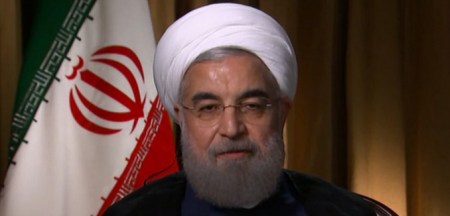
In an interview two weeks ago, Iranian President Hassan Rouhani consistently lied and evaded questions put to him by NBC News’s Chuck Todd.

Todd first asked why Iran was claiming that the United States was not living up to the nuclear deal, known as the Joint Comprehensive Plan of Action (JCPOA). Rouhani responded that the deal states “that all nations involved in this agreement must free the path, pave the way for resumption of normal activities with the Islamic Republic of Iran, such as banking transactions, insurance transactions, and the likes.” Not only is that not correct, it fits a pattern described earlier this week by analysts from the Foundation for Defense of Democracies, in which Iran hopes to gain additional concessions by threatening to walk away from the deal unless the West provides every economic concession that it believes it is owed.

The United States was only required to suspend its nuclear-related sanctions, not sanctions placed on Iran due to its history of terror financing and money laundering. (The United States has seen to it that the global watchdog against money laundering, the Financial Action Task Force, relaxed some restriction on Iran despite Iran’s continued presence at the top of the list of money launderers.)

When asked by Todd whether that was a misinterpretation of the deal’s sanctions-related clauses, Rouhani evaded the question, instead accusing the United States of blocking access to large financial institutions. Then he added that “the other breach of the agreement on the side of the United States, it has been brought into the JCPOA that airplanes intended for civil aviation only must be freely sold to Iran.”

But the airplanes that Iran wants are likely not “intended for civil aviation only.” As Emanuele Ottolenghi of the Foundation for Defense of Democracies has shown, Iran Air, Iran’s national airline, which is seeking to purchase planes from Boeing and Airbus, is using planes to transport arms and troops to Syria to support the regime of Syrian dictator Bashar al-Assad. Transporting soldiers and materiel is not “civil aviation.”

Todd later asked Rouhani if the world should be concerned about Iran’s intentions once most nuclear restrictions on Iran are lifted. Rouhani responded that Iran has adopted additional anti-weaponization safeguards as per the JCPOA, and even if these measures weren’t in place, “within the doctrine or within the laws of the Islamic Republic of Iran to include the fatwa issued by the Supreme Leader of the Islamic Republic of Iran…the building or pursuing or obtaining and using any type of weapons of mass destruction are strictly and unequivocally forbidden by Islamic law.”

The Middle East Media Research Institute has searched for a record of Khamenei’s nuclear fatwa and found no such fatwa. Mehdi Khalaji, an Iran expert at the Washington Institute for Near East Policy (WINEP), wrote in a 2011 study (.pdf) “no written texts exist for the Supreme Leader’s fatwas.” But as WINEP research director Patrick Clawson observed in the preface to Khalaji’s analysis, even if Khamanei had issued such a fatwa, “past proclamations about the matter, like all fatwas issued by Shiite clerics, can be revised under new circumstances.”

Furthermore, Rouhani himself said in a 2005 speech (.pdf) that “having [nuclear] fuel cycle capability almost means that the country that possesses this capability is able to produce nuclear weapons, should that country have the political will to do so,” suggesting that he believes the decision to develop nuclear weapons to be a political, not religious, decision.

Todd followed up by asking Rouhani why Iran has deployed a missile defense system at the Fordow nuclear site if its purpose is strictly civilian. Rouhani cited the need for Iranians to “defend ourselves,” but didn’t fully address the question. When Todd persisted, Rouhani stated that “Iran has always maintained her commitment to any agreement it has become a signatory of. You will not find any instances during the past 38 years of the history of the Islamic Republic of Iran in which a bilateral agreement or an international agreement has been signed and Iran has broken its commitment.”

This is blatantly false. Iran, a signatory to the Nuclear Nonproliferation Treaty refused to end its uranium enrichment program despite the threat of being sanctioned by the United Nations Security Council. The JCPOA allowed Iran to maintain a portion of its enrichment capacity, which it had maintained despite being repeatedly sanctioned. Being forgiven for the breach of an agreement is not the same thing as having abided by it.

Then Rouhani added, “What we were accused of for years, called ‘possible military dimensions,’ the International Atomic Energy Agency eventually reached the conclusion that that file must be closed for good and announced that the activities of Iran were solely for peaceful purposes.”

This is also false. The IAEA report (.pdf) last December did not find that Iran’s nuclear activities “were solely for peaceful purposes.” Rather, it found that Iran had a military nuclear program until at least 2009, though it found “no credible indications” that its military nuclear program continued after this point. It’s true that the IAEA closed down its investigation of Iran’s past nuclear work, but as the Institute for Science and International Security assessed, “the IAEA’s report can be viewed, at best, as a document that closes the process set forth by terms of the Roadmap” to the nuclear deal, but not as a clean bill of health.

Rouhani’s protestations of abiding by the deal also must be viewed with a certain amount of skepticism based on his own record as Iran’s lead nuclear negotiator more than a decade ago. In 2006, after he left the position, Rouhani boasted in a meeting with Islamic clergy and scholars that he had duped the West. Rouhani claimed that Iran had continued installing equipment for converting yellowcake, one of the ingredients necessary for creating nuclear fuel, even as he told his European counterparts that there was no nuclear work being performed at that time.

“When we were negotiating with the Europeans in Tehran we were still installing some of the equipment at the Isfahan site,” Rouhani told his audience. “There was plenty of work to be done to complete the site and finish the work there. In reality, by creating a tame situation, we could finish Isfahan.”

Similarly, when he was running for president in 2013, Rouhani said in an interview that he used the earlier negotiations to advance Iran’s clandestine, illicit nuclear work, boasting, “We halted the nuclear program? We were the ones to complete it! We completed the technology.”

Todd then asked Rouhani about Iran’s involvement in the Syrian Civil War, starting with a question about the recent Russian bombing of a humanitarian convoy, which killed 20 aid workers and which one United Nations official called a war crime. Instead of condemning the attack, Rouhani pointed to a mistaken American airstrike on a Syrian army position—as if an accidental bombing somehow excuses a deliberate one. Rouhani also claimed that since the Syrian soldiers were fighting ISIS (also known as Daesh), the United States was involved in “a direct defense of the Daesh terrorist group.” The charge is outrageous. Even though Syrian troops have been targeting civilians, the United States said that it was an accident and apologized.

Rouhani went on to state that Israel had also attacked some Syrian positions, though he neglected to mention that it was in response to shells being fired into Israel. He allowed that a ceasefire would be beneficial because “food stuff and medicines can get to those who are in need and have been waiting for those supplies for months.” But he didn’t mention that the party engaging in the sieges is Assad, with Iran’s backing.

In response to Secretary of State John Kerry’s recent call for a halt to all flying above Syria, Rouhani stated that “any proposal can be coordinated in order to avoid the targeting of humanitarian convoys.” But a general from his own country’s Islamic Revolutionary Guard Corps (IRGC) boasted last month that Iran provides intelligence on the ground to guide Russia’s bombing campaigns. Given this, and the ensuing possibility that Iranian troops were complicit in the bombing in question, Rouhani’s assurances that convoys can be protected are glib and meaningless.

The portrait that emerges from Rouhani’s interview is of a man who lies and distorts to defend Iran’s illicit behavior— with its domestic nuclear program and in Syria. Simply put, Rouhani is not a “moderate,” as he is so often described, but an apologist for Iran’s revolutionary regime that operates in defiance of international law and norms.