Archive for the ‘Iranian missiles’ category

Trump under NKorean and Iranian missile siege

July 29, 2017

Trump under NKorean and Iranian missile siege, DEBKAfile, July 29, 2017
But the fact is that Iran was not trying this time to put a satellite in orbit. Its objective, for which a big step was taken forward, was to perfect the technology for building missiles able to carry small nuclear warheads, as well as carriers for boosting military and spy satellites into space.

President Barack Obama, hell bent on a deal, gave in to Tehran’s demand to leave its missile program out of the accord. Iran was left free to pursue its ballistic missile program unchecked by international law up until now.

Therefore, when on Thursday, the US Senate slapped sanctions on Iran as punishment for its missile tests, the Foreign Ministry in Tehran was formally within its rights Saturday in affirming “Iran’s inalienable right” to develop missiles “in compliance with its international obligations.”

******************************

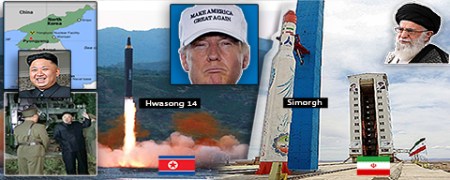
In the same 48-hour time frame, North Korea and Iran both managed to rattle the West by successfully testing advanced missiles. Thursday, July 27, Tehran launched a “Simorgh” rocket, which is capable of carrying a 250-kg satellite into space. The next day, Pyongyang test-fired its second intercontinental ballistic missile, an improved version of the Hwasong 14, first tested three weeks earlier.

President Donald Trump was discovering that sanctions are no deterrent.

The depth of the dismay in the West may explain why none of the experts dared mention the even more troubling fact which has been known for some time: Iran and North Korea are longstanding partners in their long-range missile programs. Each maintains experts at the other’s development facilities.

On July 28, the Hwasong 14 flew 47 minutes over a distance of 3,724km before dropping into the Sea of Japan. Kim Jong-un boasted: “The test confirmed that all the US mainland is within striking range,” confirming the new estimate that North Korea’s latest ICBMs can now reach major American cities like Chicago and Los Angeles.

That was his delighted response to the latest round of US sanctions.

Iran was less forthcoming about its latest test, without however neglecting to underline its success. DEBKAfile’s military and intelligence sources confirm that Iran’s success was no less impressive than North Korea’s – and just as dangerous. The Simorgh, aka Safir-3, is the fruit of years of Iranian development and many failed tests on the way to achieving a satellite-carrying rocket as the basis for nuclear-armed ballistic missiles.

US military sources tried to present the Iranian test as another flop, only admitting at length that “the only thing we know for sure is that no satellite was put into orbit.” Like the Americans with regard to Iran, Russian military sources tried play down the North Korean success by tossing it off as an ordinary, medium-range ballistic missile.

But the fact is that Iran was not trying this time to put a satellite in orbit. Its objective, for which a big step was taken forward, was to perfect the technology for building missiles able to carry small nuclear warheads, as well as carriers for boosting military and spy satellites into space.

Tehran was extremely cagey with details about its success. The Safir-2, built around components of the North Korean BM-25 ballistic missile, which too derived from the Soviet R-27 fired from submarines, was able to attain an estimated range of 3,000-4,000km. The Simorgh or Safir-3 tested this week was an advanced version of its predecessor. The two-stage version, powered by solid fuel, is believed to have an improved range of 7,500km.

Two years ago, when Iran placed an imaging rocket into orbit during February 2015, Israeli rocket experts established that these rockets were also capable of striking any point that Iran may chose. Tehran was therefore well ahead of Pyongyang in its ability to stage a missile attack on the United States mainland – except that this discovery was eclipsed at the time by the Iranian nuclear negotiations nearing conclusion with six world powers, led by the United States.

President Barack Obama, hell bent on a deal, gave in to Tehran’s demand to leave its missile program out of the accord. Iran was left free to pursue its ballistic missile program unchecked by international law up until now.

Therefore, when on Thursday, the US Senate slapped sanctions on Iran as punishment for its missile tests, the Foreign Ministry in Tehran was formally within its rights Saturday in affirming “Iran’s inalienable right” to develop missiles “in compliance with its international obligations.”

In another event tied to Iran’s missiles, Saudi Arabia Thursday, July 26, announced the interception of “a ballistic missile launched by Yemen’s Iran-backed Houthi insurgents against the holy city of Mecca.” The defense ministry in Riyadh said the missile had been shot down some 69km away from Mecca, causing no damage or casualties.

The Saudis have for some months accused Iran of supplying the Yemeni insurgents with Fatteh-110 missiles for targeting Saudi cities, including the capital, Riyadh. They had expected President Donald Trump to hit back at Iran. However, other than reprimanding Tehran for hostile action against the “US partner Saudi Arabia,” no tangible US action was forthcoming – only fresh sanctions, which don’t cut much ice in Tehran or Pyongyang.

Donald Trump’s six-month presidency is clearly under siege. On top of the bucketfuls of trouble landing on his head at home, he is being pushed against a wall by America’s enemies in two world regions – the Far East and the Middle East.
Iran poised to launch rocket into space, as North Korea readies another missile test, US officials say

July 26, 2017

Iran poised to launch rocket into space, as North Korea readies another missile test, US officials say, Fox NewsLucas Tomlinson, July 26, 2017

While Iran insists its space program is for peaceful purposes, officials have long said any components used to put a satellite into orbit can also be used for building an intercontinental ballistic missile capable of hitting the United States.

*********************************

Two American foes are poised for upcoming rocket launches, two senior U.S. officials told Fox News, with another North Korean intercontinental ballistic missile launch expected as soon as Wednesday night and Iran on the verge of sending its own vehicle into space.

Iran’s Simorgh space-launch vehicle is believed to be carrying a satellite, marking the second time in over a year that Tehran has attempted to put an operational satellite into orbit — something the Islamic Republic has never done successfully, according to one of the officials who has not authorized to discuss a confidential assessment.

Iran’s last space launch in April 2016 failed to place a satellite into orbit, the official said.

The intelligence community is currently monitoring Iran’s Semnan launch center, located about 140 miles east of Tehran, where officials say the “first and second stage airframes” have been assembled on a launch pad and a space launch is expected “at any time,” according to the official.

Just days after President Trump took office, Iran conducted its first ballistic missile test under the new administration, prompting the White House to put Tehran “on notice.” Since then there have been other ballistic missile and cruise missile tests, including one from a midget submarine in early May — a type of submarine used by both Iran and North Korea.

North Korea and Iran have long been accused of sharing missile technology.

“The very first missiles we saw in Iran were simply copies of North Korean missiles,” said Jeffrey Lewis, a missile proliferation expert at the Middlebury Institute of International Studies at Monterey. “Over the years, we’ve seen photographs of North Korean and Iranian officials in each other’s countries, and we’ve seen all kinds of common hardware.”

U.S. officials are skeptical, however, that North Korea and Iran are coordinating their rocket and missile launches.

While Iran insists its space program is for peaceful purposes, officials have long said any components used to put a satellite into orbit can also be used for building an intercontinental ballistic missile capable of hitting the United States.

U.N. resolution 2231 says Iran is “called upon not to undertake any activity related to ballistic missiles designed to be capable of delivering nuclear weapons, including launches using such ballistic missile technology,” according to the text of the agreement which went into effect days after the landmark Iran nuclear agreement that was engineered by the Obama administration.

Critics have said that language was purposefully watered down to “called upon” instead of a more restrictive phrase because Russia intervened.

In a sign Congress is losing patience with both Iran and North Korea, the House of Representatives on Tuesday overwhelmingly passed (419-3) new sanctions targeting Iran, North Korea and Russia, due in part to Iran and North Korea’s missile programs.

News of Iran’s pending rocket launch coincides with more evidence North Korea is also preparing to test another ICBM, perhaps as early as Wednesday night — a date that would coincide with the 1953 Korean Armistice Agreement, which ended the fighting in the Korean War, but technically not the war itself.

U.S. officials say North Korea has recently moved fueling equipment and trucks to a launch pad near the town of Kusong, near North Korea’s border with China and about 100 miles north of the capital city of Pyongyang.

North Korea has a history of conducting missile tests on historic dates.

North Korea’s first successful launch of a long-range missile capable of reaching Alaska — a rocket the Pentagon now calls the KN-20 — occurred on July 4th, while the U.S. celebrated Independence Day.

That North Korean ICBM traveled some 1,700 miles into space, seven times higher than the orbit of NASA’s International Space Station. It is not clear, however, if the rocket’s “reentry” vehicle successfully returned to earth in one piece after it splashed down in the Sea of Japan hundreds of miles off the Korean peninsula.

Officials believe a new test of North Korea’s KN-20 is for the purpose of testing the reentry vehicle.

Iran may withdraw from N-deal for “US violations

July 18, 2017

Iran may withdraw from N-deal for “US violations, DEBKAfile, July 18, 2017

(Why not? Iran has already received all of the substantial U.S. financial benefits of the Iran Scam. Withdrawal would allow Iran to pursue its nuclear objectives without the minor conveniences of trying to hide them. Please see also, Iran’s Nuclear Weapons Program: On Course, Underground, Uninspected. — DM)

Iran’s Foreign Minister Mohammed Javad Zarif told a National Interest interview Tuesday: “If it comes to a major [US] violation, or what in the terms of the nuclear deal is called significant nonperformance, then Iran has other options available, including withdrawing from the deal.” This was his rejoinder to the Trump administration’s statement in certifying that Iran was in compliance of the nuclear deal while “in default of its spirit.”


Trump Admin to Hit Iran With New Sanctions as Tehran Threatens Attacks on U.S. Bases

July 17, 2017

Trump Admin to Hit Iran With New Sanctions as Tehran Threatens Attacks on U.S. Bases, Washington Free Beacon, July 17, 2017

(Please see also, Iran’s Nuclear Weapons Program: On Course, Underground, Uninspected. — DM)

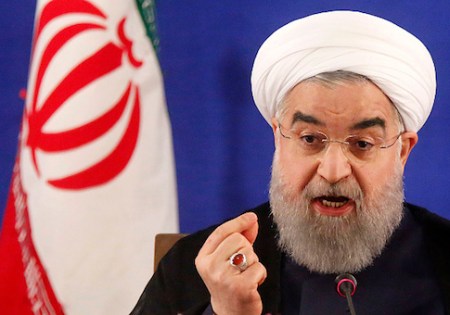
Iranian President Hassan Rouhani / Getty Images

The Trump administration is expected to ratchet up pressure on Iran with a slew of new sanctions targeting the Islamic Republic’s illicit ballistic missile program and regional support for terrorism as the landmark Iranian nuclear deal hits its two-year anniversary, according to senior U.S. officials who deemed Iran in violation of the agreement’s “spirit.”

News of the new sanctions comes on the same day that Iranian military leaders threatened attacks on U.S. forces and bases in the Middle East should America move forward with new sanctions, particularly ones targeting the Iranian Revolutionary Guards Corps, or IRGC.

The new sanctions are part of a larger White House effort to counter Iran’s massive military buildup and rogue militant activities across the Middle East, specifically in Syria, where Iranian-backed forces have launched a series of direct attacks on American forces in recent weeks.

U.S. official dubbed Iran “the most dangerous threat to U.S. interests” and promised a series of new efforts both militarily and policy oriented to combat the Islamic Republic’s illicit activities.

The new sanctions are being leveled outside the purview of the nuclear deal, meaning that they are all non-nuclear related and do not violate conditions of the deal barring the United States from engaging in such activity.

The Trump administration is continuing to perform a full-scale review of its Iran policy, including the nuclear deal. The review is set to be completed in about a month’s time, according to the administration.

The White House must make a decision by Tuesday on whether it will recertify that Iran is in compliance with the deal. The administration is likely to again certify Iran as in compliance of the agreement, despite mounting evidence this not the case. Deliberations in the White House had not concluded as of late Monday morning, but officials signaled they were leaning towards certifying Iran as not in technical violation.

U.S. officials were hesitant to deem Iran in direct violation of the deal, but said Tehran “is in default on the spirit of that agreements,” according to senior administration officials who spoke on background.

“Years of concessions … have resulted in the unintended effect of empowering Iran across the region,” one senior administration official said about the package of new sanctions on multiple Iranian individuals and entities tied to the country’s ballistic missile program and proliferation efforts.

“What we’re saying is Iran is in default of the spirit of the JCPOA,” or Joint Comprehensive Plan of Action, the Iran deal’s official title. “We need to ensure more aggressively they are in compliance with the letter of the JCPOA.”

U.S. officials said that Iran has obfuscated key details of its nuclear program, and continues to engage in activities that could be in violation of the agreement.

“Iran has been less than forthcoming, walking up to the edge of violating the JCPOA,” one senior U.S. official said. “That behavior has to stop.”

Officials also criticized key flaws in the deal that allow Iran to engage in critical nuclear work within the next decade.

The United States plans to “ramp up our efforts to verify reports” of Iran’s alleged violations, officials said.

As part of the effort to combat Iran’s activities, the Trump administration is expected to announce an additional package of sanctions that includes 16 Iranian entities and individuals found to be supporting Tehran’s illicit and criminal activities in the region. This includes seven entities and five individuals found to be supporting the Iranian military and criminal organizations.

Sanctions also have been leveled on three networks designated as supporting Iran’s military procurement and another two organizations supporting Iran’s ballistic missile program.

As news of the expected new package of sanctions came, Iranian military leaders issued new threats warning of attacks on U.S. regional bases should the Trump administration move forward with plans to sanction the IRGC and designate it as a terror group.

“Putting the IRGC in one single class with the terrorist groups and imposing similar sanctions against the IRGC poses a major risk to the U.S., its bases and forces deployed in the region,” Mohammad Hossein Baqeri, chief of staff of Iran’s armed forces, warned on Monday during remarks before IRGC commanders.

Baqeri also lashed out at sanctions on Iran’s ballistic missile program, stating, “the Islamic Republic of Iran’s missile power is defensive and is never negotiable at any level.”

Intelligence Report Warns of Growing Missile Threats

July 13, 2017

Intelligence Report Warns of Growing Missile Threats, Washington Free Beacon, July 13, 2017

China’s CSS-5 Mod 5 MRBMsdf

The United States faces a growing threat of ballistic and cruise missiles from China, Russia, Iran, and North Korea, according to a military intelligence report.

“Ballistic and cruise missiles present a significant threat to U.S. and allied forces overseas, and to the United States and its territories,” states the latest report by the National Air and Space Intelligence Center in Ohio.

The report warns that both China and Russia are expanding their force of strategic nuclear missiles with new multi-warhead weapons.

North Korea now has three intercontinental-range missiles and is moving ahead with a submarine-launched ballistic missile.

The report was published days before North Korea on July 4 conducted the first flight test of the new Hwasong-14 missile, described in the report as a new road-mobile ICBM first unveiled in October 2015.

In addition to that missile, North Korea also has another road-mobile ICBM called Hwasong-13, also known as the KN-08, and the Taepo Dong-2.

“Any of these systems could be exported to other countries in the future,” the report said.

Iran appears to be on a path to developing long-range missiles as part of what the report said was “Tehran’s desire to have a strategic counter to the United States.”

Multiple test firings of Iran’s Simorgh space launch vehicle are viewed as a test bed for developing long-range missiles.

“In 2015, Iran publicized the launch of the Emad-1, which officials claim is Iran’s first long-range missile that is guided throughout flight and capable of hitting its targets with high-precision,” the report said.

“Iranian officials have also announced plans for an Emad-2 with greater precision as well as a new Sejjil which can also be guided all the way to the target.”

The proliferation of missile systems and technology has resulted in over 20 nations having ballistic missiles that the report said “likely will be a threat in future conflicts involving U.S. forces.”

In the past 30 years, missiles were used in several wars, including the Iran-Iraq war, the Afghan civil war, the war in Yemen, the 1991 and 2003 Persian Gulf conflicts, Russian military actions in Chechnya and Georgia, and most recently in the conflicts in Syria and Ukraine.

The NASIC missile threat report is published periodically and is the first report since 2013.

For the first time, the center reveals new details about China’s force of “close-range” missiles that could be used in an attack on Taiwan.

The report also warns that new “hypersonic” missiles are being developed that have characteristics of both ballistic and cruise missiles. Ballistic missiles travel in space on a trajectory to their targets while cruise missiles often fly close to land or sea.

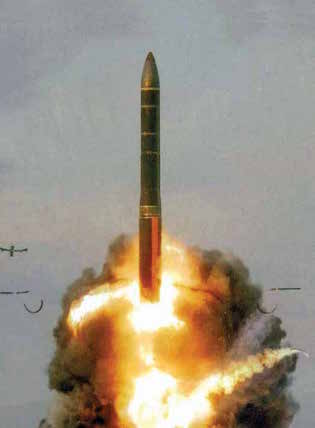
Russia’s SS-27 ICBM

Hypersonic missiles are maneuvering weapons launched atop ballistic missiles that glide to their targets. They are being developed by China and Russia as both strategic nuclear and conventional weapons capable of passing through U.S. missile defenses, often at speeds of up to 7,500 miles per hour.

“Overall, the threats posed by ballistic missile delivery systems are likely to continue to increase and grow more complex,” the report said.

“Adversary ballistic missile systems are becoming more mobile, survivable, reliable, and accurate while also achieving longer ranges. Hypersonic glide vehicles delivered by ballistic missile boosters are an emerging threat that will pose new challenges to missile defense systems.”

China’s missile forces are expanding in both numbers and types.

“China continues to have the most active and diverse ballistic missile development program in the world,” the report said. “It is developing and testing offensive missiles, forming additional missile units, qualitatively upgrading missile systems, and developing methods to counter ballistic missile defenses.”

Beijing’s nuclear missile forces are expanding with multiple-warhead systems that will expand China’s warhead stockpile in the coming years.

On China’s close-range missiles, which can be used in artillery salvos during a conflict with Taiwan or against ships in the South China Sea from newly militarized islands, the report identified 19 different missiles with ranges of between 24 miles to 173 miles.

Russia, North Korea, Iran, Pakistan, and India also have close-range missiles some of which are precision guided.

To defeat increasingly effective missile defenses, short-range missile manufacturers are working on countermeasures, such as maneuverable reentry vehicles called MaRVs.

New missiles with ranges of between 620 miles and 3,400 miles are in development by China, North Korea, Iran, India, and Pakistan, and many will be armed with nuclear or other unconventional warheads.

“All of these countries except Iran have tested nuclear weapons,” the report said.

Iran has promised to give up developing nuclear weapons for the next 10 years under the deal reached in 2016. Critics note that the continued development of Iran’s long-range missiles is an indication Tehran plans to break out of the treaty in the future.

The report for the first time mentions Russia’s new hypersonic missile called the “object 4202” that will be used to penetrate missile defenses. Several other new long-range missiles, including a heavy ICBM called the Sarmat, are being deployed or are in development.

China also is building a new DF-41 road-mobile ICBM that will carry multiple warheads.

“The number of warheads on Chinese ICBMs capable of threatening the United States is expected to grow to well over 100 in the next five years,” the report said.

For submarine-launched missiles, the report identified Russia’s submarine forces as “substantial” and undergoing modernization. New long-range submarine nuclear missiles include the SS-N-32 Bulava, along with upgraded SS-N-23s.

The intelligence report for the first time confirms that China’s new CSS-N-14 submarine-launched missile is deployed on four missile submarines.

“This missile will, for the first time, allow Chinese SSBNs to target portions of the United States from operating areas located near the Chinese coast,” the report said.

Cruise missile threats, those that are guided by satellite navigation, also are increasing.

“The cruise missile threat to U.S. forces is increasing in the number of countries possessing [land attack cruise missiles], the number of LACMs, and the number of LACMs possessing advanced capabilities,” the report said.

China has a new DH-10 long-range cruise missile and Iran has developed a Soumar cruise missile, based on Russia’s AS-15 air launched cruise missile.

Russia’s Club-K cruise missile is dubbed the “container launcher” weapon that is fired from what appears as a standard shipping container, making it easy to hide and fire from cargo ships, trains, or commercial trucks.

“The majority of LACMs will still be subsonic, but supersonic and hypersonic missile will be deployed in the future,” the report said.

Missile weapons are sought by many nations because they can be used effectively against adversaries with formidable air defenses that make using aircraft impractical or too costly, the report concludes.

“In addition, missiles can be used as a deterrent or an instrument of coercion…. Even limited use of these weapons could have devastating consequences if armed with chemical, biological, or nuclear warheads.”

Rick Fisher, a military affairs analyst with the International Assessment and Strategy Center, said the report for the first time details China’s growing arsenal of very accurate close-range missiles.

Fisher said China is a world leader in developing new, longer range and precision guided artillery rockets like the 124-mile-range CSS-X-16, and the new 174-mile range CSS-14 Mod-X-2. A third is the 161-miles range CSS-9 Mod-X-2.

“NASIC, however, does not mention that these new systems have the potential to carry five to eight missiles per launcher, so they could rapidly increase the number of missile targeting Taiwan into the multiple thousands, when considering potential reloads,” he said.

As a result of the close-range missile threat from China, the United States should speed up development of energy weapon defenses, like rail-guns and lasers that can defeat large numbers of the close-range missiles, he said.

Fisher also notes that the report understates China’s potential warhead expansion.

“If China modifies all of its DF-5 to the 10 warhead DF-5C standard, as it has started to modify the older single-warhead DF-5A with the three-to-five warhead DF-5B warhead bus, this type of ICBM alone could account for over 200 warheads,” he said.

“Then to this you add the road and rail mobile 10 warhead DF-41, with at least two units of six missiles accounting for 120 warheads. Many times 100 Chinese warheads is much more than ‘well over.'”

U.S. warhead cuts under the Obama administration should be reconsidered, he said.

“China’s potential to approach at least 1,000 warheads over the next decade, plus Russia’s missiles, means the United States must prepare to exceed existing limitations on deployed weapons or face the possibility of coordinated nuclear blackmail from China and Russia,” Fisher said.

Mark Schneider, a former Pentagon nuclear missile expert with the National Institute for Public Policy, said the report reveals that Russia’s 3M-14 Kalibr cruise missile, capable of being fired from the ground, ships, or submarines, has a range of 1,553 miles.

“This is obviously the INF Treaty violation,” he said of the 1987 U.S.-Russian accord banning all ground launched cruise missiles with range of between 620 and 3,420 miles.

The U.S. government has accused Russia of violating the INF treaty but has not provided details of the cruise missile Moscow has deployed in violation of the accord.

Iran Regime President: The Government Builds the Missiles

July 13, 2017

Iran Regime President: The Government Builds the Missiles, Iran News Update, July 13, 2017

Rouhani’s statements defending JCPOA once again exposed more than ever the depth of divisions among the regime’s various bands.

***********************************

INU – At a ceremony entitled Healthy Life Festival on 11 July 2017, the Iranian regime’s president Hassan Rouhani said: “…The strategic weapons built by the 11th (i.e. Rouhani’s) government, make up 80% of the total weapons built in the previous governments.”

In his preliminary speech, in an attempted to take missile claims and the claims about military presence in the countries of the region out of the hands of the Khamenei Revolutionary Guards (IRGC) and in order to advance his own demands, he made significant confession saying that despite the sanctions, his government has given the Iraqi government and the Syrian regime all the money and weapons they needed.

He also noted the IRGC’s missile attack on Syria and said: “We hear that a missile fired from our land and targeted a center, a terrorist center. It is true that those who fired the missile tried hard and sacrificed but who built the missile? The defense Ministry builds these missiles.”

Rouhani’s statements defending JCPOA once again exposed more than ever the depth of divisions among the regime’s various bands.

While attacking Khamenei’s band in this regard, Rouhani said: “If the foreign minister were supposed to go out of the field with a few cursing and (insulting) slogans, the JCPOA would not be realized. Well, some people insulted the foreign minister, on their site, in their newspaper, on the anniversary of the revolution on February 11, on the streets of Tehran; well, one should not be excluded from the service field for the slogans of a few individuals.”

Rouhani also referred to the rival band as “a minority that monopolized everything” and added: “We should not be afraid of those who unfortunately have the big loudspeakers unjustly at their disposal…”

Report: Iran Building Long-Range Ballistic Missiles in Syria

July 12, 2017

Report: Iran Building Long-Range Ballistic Missiles in Syria, Washinton Free Beacon , July 12, 2017

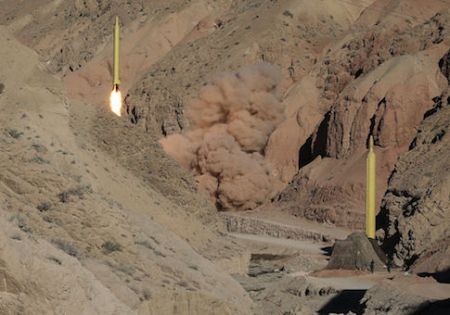
A long-range Qadr ballistic missile is launched in the Alborz mountain range in northern Iran on March 9, 2016. AFP / TASNIM NEWS / Mahmood Hosseini (Photo credit should read MAHMOOD HOSSEINI/AFP/Getty Images)

Iran is said to be building new long-range ballistic missiles at a Syrian weapons factory identified by the United States as developing non-conventional weaponry, according to regional reports alleging that Russia and North Korea are aiding in the endeavor.

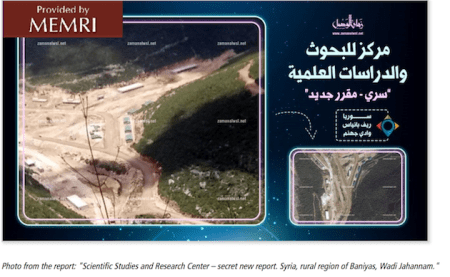
The Syrian opposition news website Zamanalwsl.net recently published multiple reports and pictures of a weapons factory in Syria that it claims is under direct control of Iran.

The reports appear to confirm other recent news articles indicating that Iran has begun manufacturing advanced missile technology in Syria with permission from embattled President Bashar al-Assad.

The reports claim that Iran is constructing long-range ballistic missiles in a factory operating under the Syrian Scientific Studies and Research Center, which the United States had identified as the key government agency behind the country’s contested non-conventional weapons work, including chemical weapons.

Assad is reported to have visited the Iranian factory recently, where he met with Iranian and Syrian weapons experts, according to a translation of the articles conducted by the Middle East Media Research Institute, or MEMRI.

“The facility is producing long-range missiles as well as M600 ballistic missiles, which are a Syrian version of the Iranian Fateh 110 missile,” according to MEMRI’s readout of the report. “This facility has a branch in western Hama province for producing chemicals, and that that there is a Russian military base in the region, where North Korean officers once served.”

The facility is said to be shrouded in secrecy, despite evidence that agents from Russia, North Korea, and Iran are freely moving around the site.

Iran gets North Korean expertise in building up, testing and hiding its ballistic missiles

June 21, 2017

Iran gets North Korean expertise in building up, testing and hiding its ballistic missiles, Washington Times

(The North Korea – Iran nuclear/missile axis has been active for years. Why not? Iran has lots of money courtesy of Obama’s Iran Scam and North Korea has technology that Iran wants. Iran is also likely pleased that the threat of North Korean nuke-laden missiles may be diverting attention from the dangers posed by Iran. — DM)

Iranian dissidents have documented work at 42 missile centers operated by the Islamic Revolutionary Guard Corps, the regime’s dominant security force. A dozen of those sites had never been disclosed before. (Associated Press/File)

Iran has increased production and testing of ballistic missiles since the 2015 nuclear deal with the U.S. while playing permanent host to scientists from North Korea, which has the know-how to build and launch atomic weapons, a leading Iranian opposition group said Tuesday.

The National Council of Resistance of Iran issued a white paper that the dissidents say identifies and documents work at 42 missile centers operated by the Islamic Revolutionary Guard Corps, the regime’s dominant security force.

A dozen sites had never been disclosed before, said the council, which operates a spy network that has exposed Iran’s hidden nuclear program.

Tehran views expertise from North Korea as being so critical that it has established residences in Tehran for Pyongyang’s scientists and technicians, according to the white paper. North Koreans have shown Iran how to dig tunnels and build “missile cities” deep inside mountains to prevent destruction by airstrikes, among other projects.

“On the basis of specific intelligence, the IRGC’s missile sites have been created based on North Korean models and blueprints,” the white paper said. “North Korean experts have helped the Iranian regime to build them. Underground facilities and tunnels to produce, store, and maintain missiles have also been modeled after North Korean sites and were created with the collaboration of the North Korean experts.”

Iranians also are traveling to North Korea, which uses occasional missile test-firings to rattle its neighbors South Korea and Japan, two strong U.S. allies.

“In the context of these trainings and relations, delegations of the IRGC’s aerospace constantly travel to North Korea and exchange knowledge, information and achievements with North Korean specialists,” the report said. “North Korea’s experts constantly travel to Iran while the IRGC’s missile experts visit North Korea.”

President Trump has been harshly critical of the 2015 deal struck by the Obama administration and five international allies to lift economic sanctions and other financial penalties in exchange for curbs on Iran’s nuclear weapons programs, but has said he will stick with the accord for now while closely monitoring Tehran’s adherence to the deal.

Iran’s leaders say they have yet to see all the benefits promised with the lifting of sanctions.

But even supporters of the Obama deal say there has been little sign that Iran’s Islamic Republic has moderated its behavior on other fronts, including the series of ballistic missile tests in recent months that some argue violate U.N. sanctions. U.S. officials also say Iran continues to back terror groups and foment instability in regional hot spots such as Syria and Yemen.

At a press conference Tuesday, Alireza Jafarzadeh, the council’s deputy director in Washington, displayed satellite photos that he said clearly show trademark North Korean mountain entrances to “cities” that hold hundreds of missiles.

He said the regime reorganized the IRGC Aerospace Force to focus almost exclusively on missile production and testing rather than aircraft.

“It’s not by accident,” Mr. Jafarzadeh said. “It’s part of their overall strategy.”

He said a huge missile arsenal allows the ruling Shiite mullahs to intimidate Sunni Muslim neighbors such as rival Saudi Arabia. In addition, missiles provide a delivery system for the nuclear weapons that the regime plans to build once the 2015 nuclear deal, known as the Joint Comprehensive Plan of Action, expires in less than 10 years.

“We’re racing against the clock,” he said.

The National Council of Resistance of Iran held a press conference in Washington in April to present evidence that Tehran’s harsh Islamic regime is cheating on the nuclear deal by continuing secret work on atomic bomb components. The Trump administration recently certified that the Islamic republic is living up to its obligations in the deal, which restricts Tehran’s production of only nuclear material, not missiles.

The council’s report pays close attention to the Semnan missile center, a complex of storage facilities and launching pads for medium-range ballistic missiles in north-central Iran. It is here, the white paper says, that Iran melds missile work with nuclear research conducted by the Organization of Defensive Innovation and Research, known by the Persian acronym SPND.

The council first disclosed SPND’s existence in 2011. In 2014, the Obama administration imposed sanctions on SPND for conducting illicit work not allowed at by the pending nuclear deal.

“The Semnan center for missile projects has been much more active after the JCPOA,” a council official said. “The speed and scope of activities and research in Semnan has increased significantly in this period and the exchanges and traffic between SPND.”

Iran has flouted U.N. resolutions repeatedly by test-firing ballistic missiles. In February, the nonprofit Foundation for Defense of Democracies put the number at 14 since the nuclear deal was signed in July 2015. Since then, Iran has conducted at least two more tests.

On Sunday, Iran for the first time since 2001 fired an operational missile outside its boundaries, targeting an Islamic State-controlled town in eastern Syria. Tehran said the ground-to-ground missile strike was retaliation for the Islamic State’s June 7 terrorist attack on the Iranian parliament. In 2001, the regime fired missiles on resistance targets in Iraq.

Iran owns one of the world’s largest inventories of ballistic missiles. GlobalSecurity.org lists more than a dozen different short- and medium-range Iranian missiles, some of which closely resemble North Korea’s Nodong arsenal.

Tehran this year announced the launch of the Emad, which has a range of 1,000 miles. It said the test marked a first for an Iranian precision-guided ballistic missile.

More than ever, the resistance council said, Iran’s religious leaders see missiles as instrumental to their survival strategy.

“The Iranian regime has remained in power in Iran by relying on two pillars: internal repression and external export of Islamic fundamentalism and terrorism,” the council said. “Its illicit nuclear weapons program and its continued expansion of ballistic missiles serve its policy of export of Islamic fundamentalism and terrorism.”

Iranian President: ‘We Need Missiles’ to Confront Trump Admin, Enemies

May 25, 2017

Iranian President: ‘We Need Missiles’ to Confront Trump Admin, Enemies, Washington Free Beacon, May 25, 2017

(Iran’s missiles for peace program. Secretary Tillerson spoke of his hopes for the future conduct of Iran. While laughing, he declined to comment on his expectations.– DM)

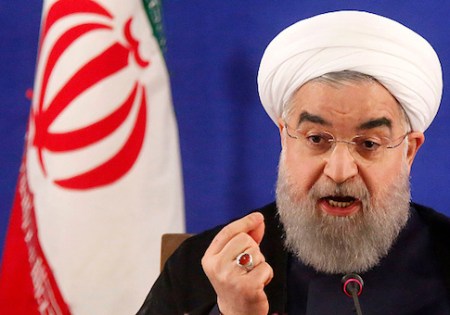
Iranian President Hassan Rouhani speaks during a press conference in Tehran on May 22, 2017. AFP PHOTO / ATTA KENARE (Photo credit should read ATTA KENARE/AFP/Getty Images)

A bipartisan delegation of nearly 50 senators announced on Thursday that it is moving forward with new legislation to increase economic sanctions on Iran as a result of its missile program, as well as the Islamic Republic’s support for terrorism and illegal weapons trade.

“The U.S. secretary of state’s expectations of the Iranian president indicate the U.S. officials’ non-understanding of the Islamic Republic of Iran,” Jazzayeri was quoted as saying in the country’s state-controlled press.

***********************

Recently re-elected Iranian President Hassan Rouhani lashed out at the Trump administration this week, describing it as ignorant and saying that Iran “needs missiles” to confront the United States and its allies, according to recent remarks certain to rile leaders in Washington, D.C.

Just days after President Donald Trump blasted the Islamic Republic for its illicit ballistic missile program and support of terrorism in the Middle East, Rouhani confirmed that Iran would not cease its missile activity, despite repeated calls by U.S. officials.

“We need missiles and the enemy should know that we make everything we need and we don’t pay an iota of attention to your words,” Rouhani was quoted as saying on Wednesday during a meeting with Iranian cabinet members. “The remarks by the enemies of the Iranian nation against Iran’s missile power are out of ignorance.”

The Iranian leaders remarks support recent comments by senior military leaders in the country, who have repeatedly declared that Iran will “never stop” developing ballistic missiles, a program that has raised concerns with the U.S. intelligence community, which assesses that Iran’s missile program could be used to carry a nuclear weapon.

The remarks came as Iran announced the construction of a third underground ballistic missile production factory, helmed by Iran’s Revolutionary Guard Corps, or IRGC.

Iranian General Amir Ali Hajizadeh, and IRGC leader, said the factory is meant to boosts Tehran’s “missile power” and intimidate the United States and “Zionist regime,” or Israel.

“We will increase our missile power. Our enemies, the United States, and the Zionist regime (Israel) are naturally upset and get angry at our missile production, tests and underground missile facilities because they want Iran to be in a weak position,” Hajizadeh announced on Thursday.

The facility was built in the last few years, according to the IRGC. Iranian military leaders also are working on building Iran’s first “ground-to-ground” ballistic missile.

Iran’s repeated test firing of ballistic missiles, as well as its multiple space launches—which are believed to be cover for an intercontinental ballistic missile program—have riled the Trump administration and leaders of both parties on Capitol Hill.

A bipartisan delegation of nearly 50 senators announced on Thursday that it is moving forward with new legislation to increase economic sanctions on Iran as a result of its missile program, as well as the Islamic Republic’s support for terrorism and illegal weapons trade.

Sen. Robert Menendez (D., N.J.), a chief sponsor of the legislation, said that it is part of a larger effort to ensure that “Iran’s leaders understand they do not enjoy blanket impunity as the United States continues to live up to its commitments under the” nuclear agreement.

“Independent of the nuclear portfolio, and as President Rouhani starts his second presidential term, our broader policy towards Iran must be one that holds Tehran accountable for their destabilizing efforts in the region, illegal and dangerous missile technology development, and nefarious activities as the world’s leading sponsor of terrorism,” Menendez said. “As the administration continues to review its Iran policy, Congress must set out clear markers that impose real consequences to Iran’s illicit behavior that runs counter to our national security and that of our allies in the region.”

The legislation would impose mandatory sanctions on all individuals associated with Iran’s ballistic missile program, as well as those who perform transactions with them.

Sanctions also would be applied to those who support Iran’s terror operations, including the IRGC, which is not currently designated as a terror organization by the United States.

The legislation also requires President Trump to block the property of all individuals and entities involved in supplying, selling, and transferring prohibited arms and other weaponry to Iran.

A State Department official, speaking on background, told the Washington Free Beacon that the Trump administration is moving closer to finishing its comprehensive review of the Iran deal and dealing with Iran’s provocative actions in the region.

“As Secretary [Rex] Tillerson said, the Trump administration is currently conducting a comprehensive review of our Iran policy,” the official said. “Once we have finalized our conclusions, we will meet the challenges Iran poses with clarity and conviction.”

One veteran foreign policy adviser who is close to the White House told the Free Beacon that the Trump administration would not stand by as Iranian leaders mock and threaten the United States.

“The Obama administration treated the Iranians with kid gloves because that was to get the nuclear deal,” the source said. “That ended last January but the Iranians are still acting as if they have a friend in the White House. They threaten and mock the United States, our leaders, and our allies, and they expect us to roll with it. This president is not going to roll with it, and neither is Congress.”

Meanwhile, senior Iranian military leaders continue to criticize the Trump administration for its efforts to stop Iran’s missile program.

Iranian Armed Forces Brigadier General Massoud Jazzayeri offered harsh words for Secretary of State Tillerson following his call for Iran to cease its ballistic missile work.

“The U.S. secretary of state’s expectations of the Iranian president indicate the U.S. officials’ non-understanding of the Islamic Republic of Iran,” Jazzayeri was quoted as saying in the country’s state-controlled press.

Tillerson and Saudi Foreign Minister hold briefing

May 20, 2017

Tillerson and Saudi Foreign Minister hold briefing, PBS via YouTube, May 20, 2017