Archive for the ‘Iranian missiles’ category

Obama’s Surrender to Iran

March 12, 2015

Obama’s Surrender to Iran, Front Page Magazine, March 12, 2015

obama-iran

Iran, therefore, needs nuclear weapons to protect itself should it fail to derail Obama’s ambitious plans. Should the Pan Arabic (Sunni) Islamic Union become a reality, the Iranian rulers believe that having the capability of ushering in Armageddon will keep the Sunni’s at bay.

At the very least, the Mullahs in Iran rest better knowing, should they fall, that they can take everyone else down with them. Think “mutually-assured destruction.” A sort of “MAD” amongst madmen.

***************************

It is becoming increasingly clear that Obama’s agenda in the Middle East is to help the Islamists regain the land they once controlled but lost in 1924 with the fall of the Ottoman Empire.

The Arab Spring was not a movement to replace ruthless dictators with democratic governments. It was an Islamic movement to replace secular governments with Islamic ones.

Step by step, this administration is helping to establish the Islamists’ dream of a revived caliphate, or “Pan Arabic Islamic Union” as it has been called by Islamist leaders recently.

There is a mistaken school of thought that believes such an Islamic Union would function like an Arabic European Union, growing their economies and enabling them to take their place among the other nations of the world as equals.

This school neglects to answer the most salient question: How do you contain a movement that recognizes no borders but its own and is compelled by dint of faith to dominate the rest of the world or die in the effort?

Unfortunately, the primary opposition to this plan isn’t coming from the American people. Sadly, much of America is suffering from confusion, ignorance, self-loathing and a dedication to bending over backwards in an attempt to avoid the confrontation that looms ahead.

Rather than marshaling a strong core of support for the hard choices that must be made, our administration is creating a huge chasm between citizens over trivialities and over-amplified slights. We are far weaker for it.

One might ask then, who is opposing the mighty President of the United States? Who dares stand in the way of the Nobel Peace prize winner “Barack Obama?”

The answer will be something of a shock to many.

In no particular order, listed below are those who are arrayed against the designs of our “Dear Leader.”

Putin

Standing most prominently, is Vladimir Putin, the Russian bear. Putin has designs on the former Soviet satellite nations and he needs a strong economy and the leverage that an oil monopoly over the European market provides to fuel his aspirations.

His Ukraine adventure is proving more troublesome than originally thought, and Obama’s push to topple Assad in Syria threatens Putin’s access to a warm water port for Russia’s oil exports to Europe.

The Russian oligarchs are growing restive under the thumb of Putin, seeing his dreams of Sovietus revivivus as bad for business and potentially catastrophic. Putin’s leash is shortening, and his tenure is by no means a sure thing.

While Putin remains in power, he will oppose Obama’s Ottoman revival. He has no choice.

Old Guard and Monarchies of the Middle East

Next are the old guard and monarchies of the Middle East. We like to call them “dictators” even though in reality, while they are all Sunni Muslims, they are more concerned with maintaining their own wealth and power than in recreating an Islamic caliphate.

Among these were Gaddafi, Mubarak and the others deposed in the Arab Spring, but also numbered in this groups is the Hashemite kingdom of Jordan and both Saudi Arabia and the Emirates.

All are in danger of being ejected from this game. But just like Putin, they will not go bloodlessly.

Islamic Republic

The final player is also the strongest: Iran.

Iran, a Shiite nation, is a natural enemy to any Sunni Islamic caliphate system. The Iranian rulers know from Islamic history (the same history we completely ignore here in the West) that any Sunni caliphate will soon swallow and erase the Shi’a, destroying all opponents to their well-established ideals of Islamic religious and political structure.

Iran, therefore, needs nuclear weapons to protect itself should it fail to derail Obama’s ambitious plans. Should the Pan Arabic (Sunni) Islamic Union become a reality, the Iranian rulers believe that having the capability of ushering in Armageddon will keep the Sunni’s at bay.

At the very least, the Mullahs in Iran rest better knowing, should they fall, that they can take everyone else down with them. Think “mutually-assured destruction.” A sort of “MAD” amongst madmen.

Don’t let this apocalyptic scenario, however, lead you to think that Iran is going quietly into oblivion. On the contrary, it has tirelessly worked to thwart Obama’s plans.

Iran’s use of terror and terror proxies is on the upswing. It will distract and misdirect, strike and cajole, but it will not permit a Sunni caliphate to appear on its border without a nuclear capability of its own to deter Sunni adventurism.

Obama’s setbacks in Syria and Benghazi have forced him to negotiate with the Iranians. He wants to assure them that they have nothing to fear from a caliphate, while simultaneously keeping the American people from recognizing the monumentally stupid policy objective he is pursuing.

To this end, he tells us he has gotten Iran to agree to postpone its nuclear work for ten years, under the ridiculously naive idea that the dynamics of the Middle East will have changed. Many believe Obama is in fact a Muslim. In reality, that really doesn’t matter.

His administration believes that all conflict can be framed in Marxist terms. Empower those who have little and they will join the community with smiles and slaps on the back. The administration fundamentally misunderstands the problem and is applying a solution akin to gasoline on a grease fire.

Economics are unimportant to the Islamists. Power is their currency and they spend all they have to purchase the world for Allah. The establishment of an Islamic caliphate will not calm the Arab street, it will invigorate it to greater conquests, as Islam demands.

Of course, in the eyes of the neo-progressives in the White House, to speak truthfully about this “Islamophobia.”

To Obama, a nuclear Iran is an acceptable trade-off for a revived caliphate, To Israel, however, both Iran and a caliphate are threats to their very existence.

Iran with a nuclear weapon has no reason not to make good on its long-standing promise to “wipe Israel from the face of the earth.” A reconstituted caliphate modeled after the former Ottoman Empire has no room for Israel, indeed, on Iran’s maps, Israel doesn’t exist at all.

America is negotiating nuclear policy with a terrorist state, and geopolitical hegemony with an ideology/religion that knows no borders but its own.

In 2013, President Obama told us we can all take a deep breath, he was able to wring an invaluable concession out of the Iranians. He breathlessly announced that Iran had issued a fatwa against nuclear weapons.

It appeared that we had been brought back from the brink by the president’s keen ability to negotiate.   Notwithstanding the obvious (and wholly inappropriate) grandstanding by the POTUS, there are a few other issues that need to be addressed in relation to this irrelevant fatwa.

Most Americans aren’t aware that the foundation of Iran’s nuclear program was laid on March 5th, 1957 by the United States, under an Eisenhower program called “Atoms for Peace.”  Iran established the Tehran Nuclear Research Center (TNRC) in 1967, which was a 5 megawatt nuclear research reactor, fueled by enriched uranium.

In 1968, Iran signed the Nuclear Non-Proliferation Treaty (NPT) ratifying it in 1970, making Iran’s nuclear program subject to International Atomic Energy Agency (IAEA) verification and accountability.

Following the 1979 Revolution, nearly all international nuclear cooperation with Iran was cut off.  With little hope of regaining international cooperation, Iran elected to continue the program on their own, although they thought it best to save face and attempt to “shame” America (and by extension its advanced nuclear technology) by condemning all things nuclear.

It was for this reason and this reason alone, that the fatwa was issued. It had nothing to do with any humanitarian interests held deeply in the hearts of Iranian leaders; they are certainly more than amenable to any method that allows them to more efficiently eliminate their enemies, most especially Israel.

The anti-nuclear fatwa, is fully revealed to be a sham five years later, when we see the destruction of a reputedly “non-existent” Iranian nuclear program by Iraqi forces.

All of this is still occurring under the reign of the same Ayatollah that issued the nuclear fatwa a brief five years previous. Clearly, the Iranians had continued their nuclear program, despite the fatwa.

The next time we saw any reference to the 1979 “nuclear fatwa” was in 2003.  The IAEA issued a report, condemning the Iranian nuclear program, accusing it of once again, trying to weaponize the technology.

Still, Iran didn’t budge.  It wasn’t until the U.S. threatened to get involved militarily (the full might and power of the U.S. military was on display right next door in Iraq under the leadership of President Bush) that the Iranians finally caved.

What did this concession look like?  Well, as you might have guessed, Iran simply reaffirmed the old stand-by fatwa from 1979, condemning nuclear weapons and promising to play nice.

So, for the record, we have clear evidence that the Iranians consider their anti-nuclear fatwa to be toilet paper, so Obama’s “concession” is more enabling than disarming. Iran had cast the ‘79 fatwa out again in 2013, hoping we’ll bite on it one more time. Obama readily obliged.

President Obama appears willing to do whatever it takes to build his legacy on reestablishing the Islamic state after an 80 year absence. He also appears willing to endanger both the United States and Israel to get it done.

European colonization didn’t create terrorists; Islam and Mohammed birthed terrorism in order to spread a brutal and unforgiving ideology.

Absent European intervention, Muslims might yet be centuries further behind than they already are. Islam is a crippling force. Science has never been particularly important to the Islamists.

European contact brought Muslim countries out of the Stone Age; the same stone age to which the Islamic jihad intends to return us all.
Iranian President: Diplomacy With U.S. is an Active ‘Jihad’

March 12, 2015

Iranian President: Diplomacy With U.S. is an Active ‘Jihad’, Washington Free Beacon, March 12, 2015

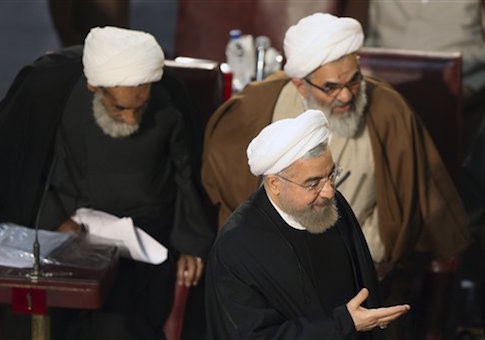
Hassan RouhaniHassan Rouhani / AP

Iranian President Hassan Rouhani described his country’s diplomacy with the United States as an active “jihad” that is just as significant to Tehran’s advancement as the slew of new weapons and missiles showcased by the Islamic Republic’s military.

Rouhani praised the country’s military leaders for standing “against the enemy on the battlefield” and said as president, he would carry out this “jihad” on the diplomatic front.

Rouhani’s comments echo those of foreign minister and lead nuclear negotiator Javad Zarif, who said Tuesday that Iran has emerged as “the winner” in talks with Western powers. Like Zarif, Rouhani boasted that Iran’s years-long diplomacy with Western nations over its nuclear program established the Islamic Republic as a global power.

Iran has made headway in convincing the U.S. to allow it to maintain much of its core infrastructure through diplomatic talks that Rouhani said are viewed as a “jihad.”

“Our negotiations with the world powers are a source of national pride,” Rouhani said earlier this week. “Yesterday [during the Iran-Iraq War], your brave generals stood against the enemy on the battlefield and defended their country. Today, your diplomatic generals are defending [our nation] in the field of diplomacy–this, too, is jihad.”

“Our power is growing each day, but we don’t intend to be aggressive toward anyone. However, we will certainly defend our country, nation, independence, and honor wholeheartedly.”

Iran stands “10 times more powerful” than it was during the time of the Iran-Iraq War, Rouhani said, which “reflects a serious deterrence to the enemies’ threats.”

Iranian leaders view the ongoing talks with the United States and other nations as a source of global legitimacy.

Rouhani’s remarks have “significant domestic implications,” according to an analysis published by the American Enterprise Institute.

“Iran’s negotiations team to the status of Iran-Iraq War commanders, who are traditionally revered by the regime as upholders of Islamic Revolutionary values, could potentially lead to rhetorical backlash from regime hardliners opposed to the nuclear negotiations,” AEI wrote.

Matan Shamir, director of research at United Against Nuclear Iran, said Rouhani’s latest comments show he is not a moderate leader.

“While Rouhani talks about a ‘win-win’ nuclear deal to global audiences, his comments make clear that he continues to view the U.S. an antagonistic global oppressor that must be triumphed over, in this case by a diplomatic ‘jihad,’” Shamir said. “This is clearly not the language of a moderate or of a regime with which rapprochement is at all realistic.”

Zarif said Tuesday that a final nuclear deal with the United States is meaningless at this point.

“We are the winner whether the [nuclear] negotiations yield results or not,” Zarif was quoted as saying by the Tasnim News Agency. “The capital we have obtained over the years is dignity and self-esteem, a capital that could not be retaken.”

As Rouhani and Zarif grandstand on the nuclear front, Iranian military leaders have begun to unveil a host of new missiles and sea-based weapons.

General Amir Ali Hajizadeh, a leader in the Iranian Revolutionary Guard Corps, said Iran’s defensive capabilities “are non-negotiable in the nuclear talks,” AEI reported.

The comments came the same day Iran paraded its new cruise missiles.

Hajizadeh also dismissed economic sanctions on Iran, saying that “his is a message which should be understood by the bullying powers which raise excessive demands.”

On Wednesday, the State Department said any final deal with Iran was “nonbinding,” meaning that neither party would be legally obliged to uphold the agreement.

Iran Declares Pre-emptive Victory in Nuke Talks

March 11, 2015

Iran Declares Pre-emptive Victory in Nuke Talks, Washington Free Beacon, March 11, 2015

(Unfortunately, he appears to be correct. Iran seems to have improved her arsenal substantially since November of 2013 and the sanctions relief, used to get Iran to “negotiate,” doubtless helped it to do so. Please see also Iran is an empire, Iraq is our capital.

What will Obama do if Iran declines even his “extremely reasonable” deal because Iran doesn’t want one? Blame it on the recent letter sent by Republican members of the Congress? — DM)

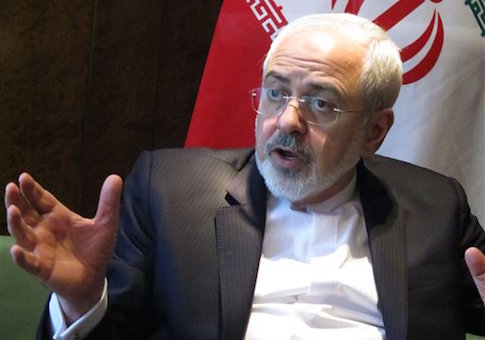
Iran minister says sanctions must be lifted before nuclear agreementIranian Foreign Minister Mohammad Javad Zarif / AP

Iran’s foreign minister and chief negotiator in nuclear talks with the West declared victory for his country, stating that no matter how the negotiations end, Tehran has come out “the winner,” according to remarks made on Tuesday and presented in the country’s state-run press.

Javad Zarif, the Islamic Republic’s foreign minister, stated in remarks before the country’s powerful Assembly of Experts, which recently installed a hardline new cleric as its leader, that the nuclear negotiations have established Tehran as a global power broker.

“We are the winner whether the [nuclear] negotiations yield results or not,” Zarif was quoted as saying before the assembly by the Tasnim News Agency. “The capital we have obtained over the years is dignity and self-esteem, a capital that could not be retaken.”

Zarif’s comments were accompanied by a host of bold military displays by Tehran in recent weeks, including the announcement of one new weapon that Iranian military leaders have described as a “very special” missile.

As the United States and Iran rush to hash out a final nuclear agreement ahead of a self-imposed July deadline, Zarif also lashed out at congressional Republicans who have expressed skepticism over the Obama administration’s diplomacy and have fought to exert control over the implementation of any deal.

Zarif dismissed as a “propaganda ploy” a recent letter signed by 47 Senate Republicans that warned Tehran against placing too much stock in a weak deal agreed to by the Obama administration.

Meanwhile, Iran’s military continues to unveil a range of new strategic missiles and advanced weapons meant to project strength throughout the region.

Iran disclosed during military drills late in February that it is developing a missile capable of being fired from a submerged submarine. Top Iranian military leaders have described the missile as a “very special weapon,” according to IHS Jane’s, a defense industry news source.

“I believe that this weapon is a strategic weapon,”Admiral Ali Fadavi, the naval commander of the Iranian Revolutionary Guard Corps (IRGC), said on state television, according to Jane’s. “It has special characteristics.”

Fadavi declined to provide additional details about the missile. “I would like to keep this information for the future. It is a very special weapon and the Americans cannot even surmise how strong and effective this weapon is.”

On Tuesday morning, the commander of Iran’s navy previewed the unveiling of “advanced surface and subsurface vessels” that will soon be incorporated into the country’s fleet, according to the state-run Fars News Agency.

Iran has put great stock in its navy, investing significant resources to bolster the force and make it a principal player in key global shipping lanes, including around the Strait of Hormuz, the Gulf of Oman, and the Caspian Sea.

Sea-based weapons were a major focus of recent high-level meetings between Iranian and Russian officials, who agreed to a new arms pact.

Earlier this week, Iran initiated into its fleet a new destroyer ship that is “armed with advanced anti-surface and anti-subsurface weapons and air defense systems,” according to military leaders quoted by Fars.

The ship was immediately deployed to the Caspian Sea, an area Iran views as critical to its interests.

Admiral Kordad Hakimi, a top Iranian navy official, told the country’s press that Iran is prepared to use force in the region.

“We have no security problem in the Caspian Sea today, [but] … the Navy is fully prepared to confront any threat,” he was quoted as saying.

Iranian officials have also bragged about being in full control of five out of nine major international waterways.

What Iran Won’t Say About the Bomb

March 8, 2015

What Iran Won’t Say About the Bomb, New York Times

(Please refer to the link for an excellent diagram I was unable to reproduce here. It shows the few IAEA successes and the many Iranian refusals to permit access. — DM)

Last month, the inspectors reported that “Iran has not provided any explanations” for two of the three design questions now on the table. The other nine remain in limbo.

********************

OVER the course of a dozen years, ever since atomic sleuths from the United Nations began scrutinizing Iran’s nuclear program, hundreds of inspections have uncovered a hidden world of labs and sprawling factories, some ringed by barbed wire and antiaircraft guns, others camouflaged or buried deep underground. Yet despite that progress, Iran has so far managed to evade a central question — whether it knows how to build an atom bomb.

With negotiators from six world powers facing a deadline later this month to cut a basic agreement with Iran on the fate of its nuclear program, much of the public discussion has focused on curtailing Iran’s uranium plants and plutonium complex, its pathways to atomic fuel. In short, the buzz centers on brawn, not brains. But quietly, the United States and its allies are also discussing whether a final deal should compel Tehran to reveal the depth of its atomic knowledge.

That inner debate, as one European official in the midst of the negotiations put it, turns on “whether to force Iran to explain its past” — especially before 2003, when American intelligence officials believe Iran operated a full-scale equivalent of the Manhattan Project — “or whether to focus on the future.”

American officials are vague when pressed on how fully Iran will have to answer questions it has avoided for years from United Nations inspectors with the International Atomic Energy Agency, based in Vienna. To date, Iran has dodged all but one of the agency’s dozen sharp questions on bomb design.

“Iran’s most serious verification shortcoming,” Olli Heinonen, the former chief inspector, now at Harvard, said recently, “remains its unwillingness to address concerns about the past and possibly ongoing military dimensions of its nuclear program.”

Investigators at the I.A.E.A., drawing on intelligence from member states as well as their own investigations, have assembled a secret trove of reports, correspondence, viewgraphs, videos and blueprints that purport to show Iran’s skill in warhead design.

Iran ridicules the material as fake, maintaining that the trove is full of forged documents created by the Central Intelligence Agency or Israel’s Mossad. (The atomic agency’s chief, Yukiya Amano, dismissed that allegation in an interview last summer, saying the inspectors had confirmed the documents by consulting other sources.)

The problem is that the documents, if real, would undercut Iran’s argument that its nuclear ambitions are entirely peaceful, centering on the production of radioisotopes for medicine and electrical power for economic growth.

Expertise in warhead design, as opposed to atomic fuel production, is far more ephemeral and hard to track. It can also be less ambiguous. Some nuclear parts have application only to making weapons, such as neutron spark plugs at the core of some atom bombs. In contrast, uranium can fuel both nuclear arms and reactors that make electricity — it can light cities or annihilate them.

In early 2003, when the inspectors began their investigation, the focus was mainly on whether Iran was building factories that could make fuel for nuclear arms. That agenda made sense because acquiring fuel is the hardest part of the bomb equation. It’s the chokepoint. Moreover, it was relatively easy for the inspectors to monitor the giant factories that Iran was building, such as the plutonium reactor at Arak and the uranium plant at Natanz, its halls roughly half the size of the Pentagon.

Today, the six powers negotiating with Iran — Britain, China, France, Germany, Russia and the United States — still focus overwhelmingly on fuel production. They want Tehran to downsize or disconnect the centrifuges that spin at supersonic speeds to purify uranium. They want the reactor at Arak, still under construction, reconfigured to produce less plutonium, the other bomb fuel. The negotiators want the cutbacks to be large enough and long enough in duration — a decade or more — to ensure that Iran for the near future cannot mount a headlong rush for a bomb, known in the field as breakout.

Even Prime Minister Benjamin Netanyahu of Israel, in his dramatic speech to a joint session of Congress on Tuesday, elevated brawn over brains, saying “nuclear know-how without nuclear infrastructure doesn’t get you very much.” He added, “A pilot without a plane can’t fly.”

True enough. But there are other ways to get fuel, including buying it from the likes of North Korea or on the black market. So the design riddle still lurks in the background, both for breakout and what experts call sneak out.

Iran already knows how to make a rudimentary bomb. So do terrorists and college students. The real question is whether Iran can miniaturize a weapon to fit atop a missile, can make bombs more destructive than the one that turned Hiroshima into a radioactive cinder, and can use precious fuel sparingly enough to build a nuclear arsenal.

The I.A.E.A. inspectors saw hope of getting answers in mid-2007 when they agreed on a “work plan” with Iran meant to shed light on what happened inside the secretive laboratories run by Mohsen Fakhrizadeh, said to be Iran’s atomic mastermind. More than two years later, in late 2009, the plan lay in ruins. Mohamed ElBaradei, then the agency’s director general, said the inquiry had “effectively reached a dead end” because of Iran’s intransigence.

In November 2011, the inspectors stepped up the pressure by publishing a detailed listing of a dozen major fields critical for warhead building, saying their cache indicated that Iran had deeply researched the topics. Iran repeated its disavowal. In August 2013, as tensions mounted, Iran’s new president, Hassan Rouhani, elected on a platform of getting international sanctions lifted, agreed to open negotiations about the overall fate of Iran’s atomic program.

While those talks have dragged on for 18 months, Iran has let inspectors deep inside its production facilities and observed every commitment on cutting back its production of nuclear fuel. But it has continued to stiff-arm the inspectors on the question of suspected “military dimensions,” despite agreeing to another work plan. The Obama administration has said little about that silence.

Last month, the inspectors reported that “Iran has not provided any explanations” for two of the three design questions now on the table. The other nine remain in limbo.

So will Iran have to come clean before the economic sanctions are lifted? American officials won’t say. “It’s the most sensitive topic for the Iranians,” said one former American negotiator. “Is it worth blowing up a potential agreement in the name of forcing a confession?”

One solution, analysts suggest, would be the gradual lifting of sanctions in step with the investigators certifying that Tehran was finally answering their longstanding queries. That is under discussion. But it remains unclear whether the atomic riddle will be resolved. If past is prologue, the West might once again find itself stonewalled.

Ron Dermer and Dore Gold on Fox

March 8, 2015

Ron Dermer and Dore Gold on Fox, via You Tube, March 8, 2015

(Giving Iran years to pursue its ambition of obliterating the U.S. and Israel, with few or no remaining sanctions as Iran continues its efforts to control the Middle East, and no significant progress in allowing the IAEA to pursue its investigations of Iran’s past and future progress in nuclear weaponry strikes me as worse than merely absurd.– DM)

Nuclear Truth; Clare Lopez, Hide the Nukes

March 8, 2015

Nuclear Truth; Clare Lopez, Hide the Nukes, via You Tube, March 7, 2015


The Pointlessness of the Two-Phased Nuclear Deal

March 5, 2015

The Pointlessness of the Two-Phased Nuclear Deal, Front Page Magazine, March 5, 2015

(The pointless point is: Never mind the pesky details which you wouldn’t understand anyway; Obama achieved peace in our time! — DM)

366376_Ayatollah-Khamenei-428x350

According to Kerry and Iranian leaders, the first phase is aimed at reaching a general outline by the end of March, while the second phase will chart a way to agree on the nuances and technical issues by June. But didn’t both sides previously reach an interim deal and discuss the major talking points for the final nuclear talks?

The major objective of this strategy by the Obama administration is to avoid criticism by projecting a pointless picture that “progress” is being made, that Iran is complying with the International Atomic Energy Agency (IAEA) and sanction rules, and that the Obama administration’s policy on Iran is effective. The administration appears to ignore that Iran is already skirting the sanction, as at least $1 billion has been smuggled into Tehran by the Iranian government in bank notes.

****************

The deadline for the “first phase” of nuclear talks between the Islamic Republic and the six world powers (known as the P5+1; the United States, the United Kingdom, Germany, France, Russia, and China) is approaching.

The prolonged negotiations appear to be making progress, according to Secretary of State John Kerry. In addition, Iranian Foreign Minister Mohammad Javad Zarif stated that both sides came to “a better understanding” at the negotiation.

After the interim nuclear deal was reached in November 2013, the nuclear negotiations between the two sides were again divided into two stages in order to reach a final and comprehensive nuclear deal. Kerry previously proposed the two-phased nuclear negotiations.

The question that is being ignored by the mainstream media is: What are the real objectives of dividing the final negotiations into two stages?

According to Kerry and Iranian leaders, the first phase is aimed at reaching a general outline by the end of March, while the second phase will chart a way to agree on the nuances and technical issues by June. But didn’t both sides previously reach an interim deal and discuss the major talking points for the final nuclear talks?

The major objective of this strategy by the Obama administration is to avoid criticism by projecting a pointless picture that “progress” is being made, that Iran is complying with the International Atomic Energy Agency (IAEA) and sanction rules, and that the Obama administration’s policy on Iran is effective. The administration appears to ignore that Iran is already skirting the sanction, as at least $1 billion has been smuggled into Tehran by the Iranian government in bank notes.

For President Obama, striking a ceremonial, pointless, and redundant deal by the proposed March deadline — rather than waiting until June to reach a final accord — would buttress his argument that “progress” is being continuously made with respect to his administration’s efforts to curb Iran’s nuclear program.

Domestically speaking, the administration has been heavily criticized by Congress (by both the Republicans and Democrats) for allowing the Islamic Republic to buy time, making unnecessary and unprecedented concessions, prolonging the talks, and not showing signs of real progress towards a credible final and comprehensive nuclear deal.

In addition, by striking a pointless deal in the “first phase” and projecting that “progress” has been made, President Obama would desire to ratchet up his leverage in vetoing any sanctions bill that might be proposed by Congress against the Islamic Republic’s nuclear and sanctions defiance.

In other words, President Obama will need this unnecessary first-phase deal in order to avoid further domestic pressure, show the effectiveness of spending so much political capital on the nuclear talks with Iran, ease sanctions on Iran, and justify making compromises.

It is in the interest of both President Obama and Hassan Rouhani to reach a deal in the first phase.

In addition to the aforementioned political reasons and interests of the Obama and Rouhani administrations to strike a deal in the first phase, other factors contribute to the increasing likelihood of reaching a general accord by the end of March.

The first phase agreement will not include the technical details regarding Iran’s nuclear program. The accord will likely include the major talking points that both sides repeatedly discussed previously. Some of the crucial points are:

·      US possible flexibility on the breakout timeline (The amount of time that Tehran will need to build a nuclear bomb from highly enriched uranium or Plutonium);

·      Iran’s flexibility for the immediate sanction reliefs;

·      Iran’s acceptance of providing more data regarding the military dimensions of Tehran’s nuclear program;

·      The heavy water Arak Reactor, and the production of plutonium at this site;

·      Flexibility on both sides to reduce and further discuss the scope and capacity of Tehran’s uranium enrichment; and

·      The possibility of allowing Iran to maintain an additional number of centrifuges.

The nuances and the technical details are not part of the first phase accord.  The following crucial questions are less likely to be included in the first phase of the agreement: What exactly will the minimum “breakout” time be? What will the duration of the deal be? 10 years? 15 years? 20 years? How many years will it take to remove all economic sanctions against Iran? Will Tehran keep 1,500, 4,500, or 6,500 centrifuges? What is the exact scope of nuclear research and development that Tehran can maintain?

Since the aforementioned crucial and nuanced questions are not part of the first phase accord, striking this dispensable accord of the first phase is very likely and not a strenuous task.

As a result, reaching this general outline by end of March will not be historic as some mainstream media suggest. It is in fact pointless, unnecessary, redundant, and it is more likely to occur.

The World Bows to Iranian Regional Hegemony

March 4, 2015

The World Bows to Iranian Regional Hegemony, Asia Times Online via Middle East Forum, David P. Goldman, March 4, 2015. Originally published under the title, “World Bows to Iran’s Hegemony.”

1025The looming nuclear agreement is a dark cloud for countries within range of Iranian ballistic missiles.

The powers of the world hope to delay, but not deter, Iran’s eventual acquisition of nuclear weapons.

The US has tacitly accepted the guiding role of Iranian commanders in Iraq’s military operations against ISIS.

Washington destroyed the balance of power that defined the region’s politics when it pushed through majority rule in Iraq.

****************

The problem with Israeli Prime Minister Benyamin Netanyahu’s address to Congress March 3 was not the risk of offending Washington, but rather Washington’s receding relevance. President Barack Obama is not the only leader who wants to acknowledge what is already a fact in the ground, namely that “Iran has become the preeminent strategic player in West Asia to the increasing disadvantage of the US and its regional allies,” as a former Indian ambassador to Oman wrote this week.

For differing reasons, the powers of the world have elected to legitimize Iran’s dominant position, hoping to delay but not deter its eventual acquisition of nuclear weapons. Except for Israel and the Sunni Arab states, the world has no desire to confront Iran. Short of an American military strike, which is unthinkable for this administration, there may be little that Washington can do to influence the course of events. Its influence has fallen catastrophically in consequence of a chain of policy.

The best that Prime Minister Netanyahu can hope for is that the US Congress will in some way disrupt the Administration’s efforts to strike a deal with Iran by provoking the Iranians. That is what the White House fears, and that explains its rage over Netanyahu’s appearance.

Tehran may overplay its hand, but I do not think it will. The Persians are not the Palestinians, who discovered that they were a people only a generation ago and never miss an opportunity to miss and opportunity; they are ancient and crafty, and know an opportunity when it presents itself.

Most of the world wants a deal, because the alternative would be war. For 10 years I have argued that war is inevitable whatever the diplomats do, and that the question is not if, but how and when. President Obama is not British prime minister Neville Chamberlain selling out to Hitler at Munich in 1938: rather, he is Lord Halifax, that is, Halifax if he had been prime minister in 1938. Unlike the unfortunate Chamberlain, who hoped to buy time for Britain to build warplanes, Halifax liked Hitler, as Obama and his camarilla admire Iran.

China is Chamberlain, hoping to placate Iran in order to buy time. China’s dependence on Middle East oil will increase during the next decade no matter what else China might do, and a war in the Persian Gulf would ruin it.

Until early 2014, China believed that the United States would guarantee the security of the Persian Gulf. After the rise of Islamic State (ISIS), it concluded that the United States no longer cared, or perhaps intended to destabilize the region for nefarious reasons. But China does not have means to replace America’s presence in the Persian Gulf. Like Chamberlain at Munich, it seeks delay.

Obama, to be sure, portrays his policy in the language of balance of power. He told the New Yorker’s David Remnick in 2014,

It would be profoundly in the interest of citizens throughout the region if Sunnis and Shias weren’t intent on killing each other. And although it would not solve the entire problem, if we were able to get Iran to operate in a responsible fashion – not funding terrorist organizations, not trying to stir up sectarian discontent in other countries, and not developing a nuclear weapon – you could see an equilibrium developing between Sunni, or predominantly Sunni, Gulf states and Iran in which there’s competition, perhaps suspicion, but not an active or proxy warfare.

That, as the old joke goes, is the demo version.

On the ground, the US has tacitly accepted the guiding role of Iranian commanders in Iraq’s military operations against ISIS. It is courting the Iran-backed Houthi rebels who just overthrow a Saudi-backed regime in Yemen. It looks the other way while its heavy arms shipments to the Lebanese army are diverted to Hezbollah.

At almost every point at which Iran has tried to assert hegemony over its neighbors, Washington has acquiesced. “In the end, peace can be achieved only by hegemony or by balance of power,” wrote Henry Kissinger. The major powers hope for peace through Iranian hegemony, although they differ in their estimate of how long this will last.

Apart from its nuclear ambitions, the broader deal envisioned by Washington would leave Iran as a de facto suzerain in Iraq. It would also make Iran the dominant power in Lebanon (via Hezbollah), Syria (via its client regime) and Yemen (through its Houthi proxies). Although Sunni Muslims outnumber Shi’ites by 6:1, Sunni populations are concentrated in North Africa, Turkey and South Asia. Iran hopes to dominate the Levant and Mesopotamia, encircling Saudi Arabia and threatening Azerbaijan.

It is grotesque for America to talk of balance of power in the Persian Gulf, because America destroyed the balance of power that defined the region’s politics from the end of the First World War until 2006, when Washington pushed through majority rule in Iraq.

The imperialist powers in their wisdom established a power balance on two levels. First, they created a Sunni-dominated state in Iraq opposite Shi’ite Iran. The two powers fought each other to a standstill during the 1980s with the covert encouragement of the Reagan administration. Nearly a million soldiers died without troubling the world around them.

Second, the Sykes-Picot agreement of 1916 created two states, Syria and Iraq, in which minorities ruled majorities – the Alawite minority in Syria, and the Sunni minority in Iraq. Tyranny of a minority may be brutal, but a minority cannot exterminate a majority.

America’s first great blunder was to force majority rule upon Iraq. As Lt General (ret.) Daniel Bolger explained in a 2014 book,

The stark facts on the ground still sat there, oozing pus and bile. With Saddam gone, any voting would install a Shiite majority. The Sunni wouldn’t run Iraq again. That, at the bottom, caused the insurgency. Absent the genocide of Sunni Arabs, it would keep it going.

Under majority Shi’ite rule, Iraq inevitably became Iran’s ally. Iranian Revolutionary Guards are now leading its campaign against the Sunni resistance, presently dominated by ISIS, and Iranian officers are leading Iraqi army regulars.

This was the work of the George W Bush administration, not Obama. In its ideological fervor for Arab democracy, the Republicans opened the door for Iran to dominate the region. Condoleezza Rice, then Bush’s National Security Advisor, proposed offering an olive branch to Iran as early as 2003. After the Republicans got trounced in the 2006 Congressional elections, defense secretary Donald Rumsfeld got a pink slip, vice president Dick Cheney got benched, and “realist” Robert Gates – the co-chairman of the 2004 Council on Foreign Relations task force that advocated a deal with Iran – took over at Defense.

China and Russia

In the past, China has sought to strike a balance between Saudi Arabia and Iran with weapons sales, among other means. One Chinese analyst observes that although China’s weapons deliveries to Iran are larger in absolute terms than its sales to Saudi Arabia, it has given the Saudis its best medium-range missiles, which constitute a “formidable deterrent” against Iran.

1026A Chinese warship arrives in Bandar Abbas, Iran in September 2014.

As China sees the matter, its overall dependency on imported oil is rising, and the proportion of that oil coming from Iran and its perceived allies is rising. Saudi Arabia may be China’s biggest provider, but Iraq and Oman account for lion’s share of the recent increase in oil imports. China doesn’t want to rock the boat with either prospective adversary.

Among the world’s powers, China is the supreme rationalist: it views the world in terms of cold self-interest and tends to assume that others also view the world this way. One of China’s most respected military strategists told me bluntly that the notion of a nuclear exchange between Israel and Iran (and by implication any regional nuclear power and Iran) was absurd: the Iranians, he argued, know that a nuclear-armed Israel could destroy them in retaliation.

Other Chinese analysts are less convinced and view Iran’s prospective acquisition of nuclear weapons with trepidation. It is not only war with Israel but with Saudi Arabia that concerns the oil-importing Chinese. For the time being, Beijing has decided to accommodate Iran. In a March 2 commentary, Xinhua explicitly rejected Israeli objections:

The US Congress will soon have a guest, Israeli Prime Minster Benjamin Netanyahu, who is expected to try to convince lawmakers that a deal with Iran on its nuclear program could threaten the very existence of the Jewish state.

Despite the upcoming pressure, policymakers in Washington should have a clear mind of the potential dangers of back-pedaling on the current promising efforts for a comprehensive deal on the Iranian nuclear issue before a March 31 deadline …

With a new round of talks in Switzerland pending, it is widely expected that the P5+1 [the five permanent members of the UN Security Council plus Germany] could succeed in reaching a deal with Iran to prevent the latter from developing a nuclear bomb, in exchange for easing sanctions on Tehran.

The momentum does not come easy and could hardly withstand any disturbances such as a surprise announcement by Washington to slap further sanctions on Tehran.

The Obama administration needs no outside reminder to know that any measures at this stage to “overwhelm” Iran will definitely cause havoc to the positive atmosphere that came after years of frustration over the issue.

While it is impossible for Washington to insulate itself from the powerful pro-Israel lobbyist this time, the US policymakers should heed that by deviating from the ongoing endeavor on Iran they may squander a hard-earned opportunity by the international community to move closer to a solution to the Iran nuclear issue, for several years to come if not forever.

Russia has taken Iran’s side explicitly, for several reasons.

First, Russia has stated bluntly that it would help Iran in retaliation for Western policy in Ukraine, as I wrote in this space January 28. Second, Russia’s own Muslim problem is Sunni rather than Shi’ite. It has reason to fear the influence of ISIS among its own Muslims. If Iran fights ISIS, it serves Russian interests. Russia, to be sure, does not like the idea of a nuclear power on its southern border, but its priorities place it squarely in Iran’s camp.

Demographic Time Bomb

The Israeli prime minister asserted that the alternative to a bad deal is not war, but a better deal. I do not think he believes that, but Americans cannot wrap their minds around the notion that West Asia will remain at war indefinitely, especially because the war arises from their own stupidity.

Balance of power in the Middle East is inherently impossible today for the same reason it failed in Europe in 1914, namely a grand demographic disequilibrium: Iran is on a course to demographic disaster, and must assert its hegemony while it still has time.

Game theorists might argue that Iran has a rational self-interest to trade its nuclear ambitions for the removal of sanctions. The solution to a multi-period game – one that takes into account Iran’s worsening demographic weakness – would have a solution in which Iran takes great risks to acquire nuclear weapons.

Between 30% and 40% of Iranians will be older than 60 by mid-century (using the UN Population Prospect’s Constant Fertility and “Low” Variants). Meanwhile, its military-age population will fall by a third to a half.

Belated efforts to promote fertility are unlikely to make a difference. The causes of Iranian infertility are baked into the cake – higher levels of female literacy, an officially-sanctioned culture of sexual license administered by the Shi’ite clergy as “temporary marriage,” epidemic levels of sexually-transmitted disease and inbreeding. Iran, in short, has an apocalyptic regime with a lot to be apocalyptic about.

Henry Kissinger is right: peace can be founded on either hegemony or balance of power. Iran cannot be a hegemon for long because it will implode economically and demographically within a generation. In the absence of either, the result is war. For the past 10 years I have argued in this space that when war is inevitable, preemption is the least damaging course of action. I had hoped that George W Bush would have the gumption to de-fang Iran, and was disappointed when he came under the influence of Condoleezza Rice and Robert Gates. Now we are back in 1938, but with Lord Halifax rather than Neville Chamberlain in charge.

IRGC Navy Commander Ali Fadavi Presents New “Strategic” Weapon, Says: We Have Deterred America

March 4, 2015

IRGC Navy Commander Ali Fadavi Presents New “Strategic” Weapon, Says: We Have Deterred America, MEMRI Videos via You Tube, March 4, 2015


Netanyahu: ‘Even if Israel has to stand alone, Israel will stand.’

March 4, 2015

Netanyahu: ‘Even if Israel has to stand alone, Israel will stand.’ Front Page Magazine, Daniel Greenfield, March 4, 2015

Screen-Shot-2015-03-03-at-10.57.51-PM-420x350

“America’s founding document promises life, liberty and the pursuit of happiness. Iran’s founding document pledges death, tyranny, and the pursuit of jihad,” he said. It was the type of clarity that he had brought to the difficult questions of life as a teenager. It is a clarity that still evades Obama today.

A measure of how thoroughly Netanyahu exposed Obama’s unseriousness can be found in Obama’s reply that before taking a position on a nuclear deal “it is very important not to be distracted by the nature of the Iranian regimes’ ambitions when it comes to territory or terrorism.”

For Netanyahu and for many in Congress, Iran’s terrorism is not a distraction; it is the main issue.

********************

In 1967, Benjamin Netanyahu skipped his high school graduation in Pennsylvania to head off to Israel to help in the Six Day War. That same year Obama moved with his mother to Indonesia.

When Obama suggested that Israel return to the pre-1967 borders, described by Ambassador Eban, no right-winger, as “Auschwitz borders,” it was personal for Netanyahu. Like many Israeli teens, he had put his life on hold and risked it protecting those borders.

In the seventies, Obama was part of the Choom Gang and Netanyahu was sneaking up on Sabena Flight 571 dressed as an airline technician. Inside were four terrorists who had already separated Jewish passengers and taken them hostage. Two hijackers were killed. Netanyahu took a bullet in the arm.

The Prime Minister of Israel defended the operation in plain language. “When blackmail like this succeeds, it only leads to more blackmail,” she said.

Netanyahu’s speech in Congress was part of that same clash of worldviews. His high school teacher remembered him saying that his fellow students were living superficially and that there was “more to life than adolescent issues.” He came to Congress to cut through the issues of an administration that has never learned to get beyond its adolescence.

Obama’s people had taunted him with by calling him “chickens__t.” They had encouraged a boycott of his speech and accused him of insulting Obama. They had thrown out every possible distraction to the argument he came to make. Unable to argue with his facts, they played Mean Girls politics instead.

Benjamin Netanyahu had left high school behind to go to war. Now he was up against overgrown boys and girls who had never grown beyond high school. But even back then he had been, as a fellow student had described him, “The lone voice in the wilderness in support of the conservative line.”

“We were all against the war in Vietnam because we were kids,” she said. The kids are still against the war. Against all the wars; unless it’s their own wars. Netanyahu grew up fast. They never did.

Netanyahu could have played their game, but instead he began by thanking Obama. His message was not about personal attacks, but about the real threat that Iran poses to his country, to the region and to the world. He made that case decisively and effectively as few other leaders could.

He did it using plain language and obvious facts.

Netanyahu reminded Congress that the attempt to stop North Korea from going nuclear using inspectors failed. The deal would not mean a denuclearized Iran. “Not a single nuclear facility would be demolished,” he warned. And secret facilities would continue working outside the inspections regime.

He quoted the former head of IAEA’s inspections as saying, “If there’s no undeclared installation today in Iran, it will be the first time in 20 years that it doesn’t have one.”

And Netanyahu reminded everyone that Iran’s “peaceful” nuclear program would be backed by ongoing development of its intercontinental ballistic missile program that would not be touched under the deal.

He warned that the deal would leave Iran with a clear path to a nuclear endgame that would allow it to “make the fuel for an entire nuclear arsenal” in “a matter of weeks”.

Iran’s mission is to export Jihad around the world, he cautioned. It’s a terrorist state that has murdered Americans. While Obama claims to have Iran under control, it has seized control of an American ally in Yemen and is expanding its influence from Iraq to Syria.

Its newly moderate government “hangs gays, persecutes Christians, jails journalists.” It’s just as bad as ISIS, except that ISIS isn’t close to getting a nuclear bomb.

“America’s founding document promises life, liberty and the pursuit of happiness. Iran’s founding document pledges death, tyranny, and the pursuit of jihad,” he said. It was the type of clarity that he had brought to the difficult questions of life as a teenager. It is a clarity that still evades Obama today.

A measure of how thoroughly Netanyahu exposed Obama’s unseriousness can be found in Obama’s reply that before taking a position on a nuclear deal “it is very important not to be distracted by the nature of the Iranian regimes’ ambitions when it comes to territory or terrorism.”

For Netanyahu and for many in Congress, Iran’s terrorism is not a distraction; it is the main issue.

Obama insists in that same interview that “sanctions are not sufficient to prevent Iran from pursuing its nuclear ambitions.” And yet the entire premise of the deal he’s pushing is that the sanctions forced Iran to come to the negotiating table and agree to give up its race for the bomb. Sanctions can’t stop Iran from going nuclear, but negotiations using the sanctions as leverage can.

And to believe all this, we have to avoid being distracted by Iran’s invasions of other countries and support for terrorists.

It’s self-contradictory nonsense that wouldn’t pass muster in a high school paper in 1967. And yet it’s the unchallenged argument dominating the political class, foreign policy experts and the media today.

Netanyahu came to challenge the argument that Iran could be appeased out of getting the bomb. He had to do it because Obama and his media allies had ignored or shut up everyone who had made it before him. By making Netanyahu’s very appearance into the issue, they hoped to shut him down the way they had senators from their own party. They succeeded in making his appearance controversial, but that just meant that more people were listening when he finally broke through and spoke.

“Would Iran be less aggressive when sanctions are removed and its economy is stronger? If Iran is gobbling up four countries right now while it’s under sanctions, how many more countries will Iran devour when sanctions are lifted? Would Iran fund less terrorism when it has mountains of cash with which to fund more terrorism?” he asked.

It’s a question that the administration and its defenders do not want to answer because it strikes at the heart of their logic of appeasement.

The appeasers claim that the negotiations will stabilize the region. Instead Netanyahu demonstrated that they will lead to a region in which every major Muslim country has nukes and is ready to use them.

The appeasers insist that we need to ally with Iran to stop ISIS. Netanyahu brought clarity to that as well.

“Iran and ISIS are competing for the crown of militant Islam. One calls itself the Islamic Republic. The other calls itself the Islamic State. Both want to impose a militant Islamic empire first on the region and then on the entire world,” he warned. “They just disagree among themselves who will be the ruler of that empire,”

Netanyahu offered an alternative to another worthless nuclear agreement by focusing not only on Iran’s nuclear capability, but on its intentions. He asked the world to turn its attention to stopping Iran from attacking its neighbors and engaging in terrorism.

The things that Obama calls a distraction are for Benjamin Netanyahu the main point.

The former high school student who had been described as a “lone voice in the wilderness” closed his speech by saying, “Even if Israel has to stand alone, Israel will stand.”

Netanyahu knows something about standing alone. No Israeli politician has faced the continuing level of hate by the left that he has. The mockery and sneers directed at him by Obama’s media allies in these past weeks have been nothing. The teenager who had learned to stand by his values in a high school in the sixties and as Israel’s ambassador to the United Nations in the eighties has let it all roll off him.

In war, Netanyahu had nearly drowned in the Suez Canal. In politics, he has kept his head above water. In Congress, he concluded by quoting Moses. “Be strong and resolute, neither fear nor dread them.”

It can refer to Iran or to the political mobs of the left who thought that smearing him would silence him.

Netanyahu understood what was at stake when Israel was fighting for its life in 1967. He did not let the comforts of suburbia blind him to the personal sacrifices that he had to make by going to Israel.

That is why he came to America now.