Archive for the ‘Iranian military sites’ category

Iran violating U.S. deal with secret nukes research, opposition group says

April 21, 2017

Iran violating U.S. deal with secret nukes research, opposition group says, Washington TimesRowan Scarborough, April 21, 2017

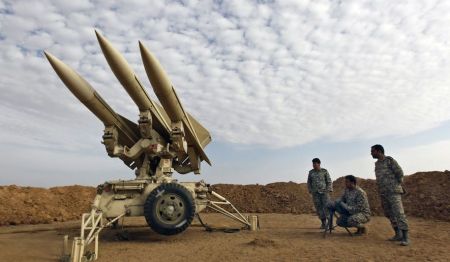
In this photo obtained from the Iranian Mehr News Agency, Iranian army members prepare missiles to be launched during a maneuver at an undisclosed location in Iran on Nov. 13, 2012. (AP Photo/Mehr News Agency, Majid Asgaripour) **FILE**
The council and MEK have a good track record over the years of disclosing Iranian nuke programs that operated under the radars of Western intelligence agencies. It boasts an extensive spying network inside the Defense Ministry, Islamic Revolutionary Guard Corps and other organs of the hard-line Islamic state ruled by religious mullahs.

The MEK said METFAZ is operating in a secret location unbeknownst to the International Atomic Energy Agency (IAEA), the world’s nuclear watchdog. In official communications, the regime refers to it as the code name “Research Academy.”

********************************

Iran is cheating on its historical deal with the U.S. by secretly conducting research into nuclear weapons components such as bomb triggers and enriched uranium, the main Iranian opposition group said Friday.

The regime is doing engineering and weaponization testing at a walled military complex south of Tehran, a location which Iran has declared off-limits to inspectors, said the National Council of Resistance of Iran (NCRI) and its main operational arm, the People’s Mujaheddin of Iran (MEK).

“This is the site that has been kept secret,” said Alireza Jafrazadeh, NCRI’s Washington office deputy director. “There is secret research to manufacture the bomb and basically cover up the real activities of the Iranian regime.”

The 2015 Joint Comprehensive Plan of Action (JCPOA), negotiated by the Obama administration, has become a major foreign policy issue for the Trump White House as it evaluates whether to reimpose economic sanctions on Tehran. Iran has benefited with billions of dollars in freed-up funds while it pursues interventions in Iraq, Syria and Yemen against U.S. interests.

The NCRI-MEK report came the day after Secretary of State Rex Tillerson lambasted Iran for its expansionist terrorist activities in the region which he said violated the spirit of the JCPOA. He called the deal a “failed approach” since Iran can break out and build bombs after 10 years.

The JCPOA outlaws the type of weaponization work described by the NCRI-MEK report.

The State Department reported this week that Iran was abiding by the deal hammered out by former Secretary of State John Kerry and approved by Russia and other powers.

The NCRI rebutted that conclusion during a press conference in Washington by saying it is providing new information on Iranian misdeeds.

The council and MEK have a good track record over the years of disclosing Iranian nuke programs that operated under the radars of Western intelligence agencies. It boasts an extensive spying network inside the Defense Ministry, Islamic Revolutionary Guard Corps and other organs of the hard-line Islamic state ruled by religious mullahs.

The NCRI asserts that Iran’s so-called “declared” sites were not disclosed by Iran, but by the intelligence work of MEK.

The heart of the NCRI-MEK intelligence report is a research operation known as the Organization of Defensive Innovation and Research (SPND) and its seven subdivision, which MEK said it first exposed in 2011.

“They are carrying out their research in various fields related to the manufacturing of a nuclear weapon,” the council’s report said. “In some of these fields, new initiatives have also been undertaken in order to keep the real objectives of the research a secret and to cover up the real activities.”

One those subdivisions, the Center of Research and Expansion of Technologies on Explosions and Impact (METFAZ) works on triggers and explosive yields, the statement said. The MEK disclosed METFAZ’s existence in 2009.

The MEK said METFAZ is operating in a secret location unbeknownst to the International Atomic Energy Agency (IAEA), the world’s nuclear watchdog. In official communications, the regime refers to it as the code name “Research Academy.”

The council investigation said that for the mullahs to continue METFAZ’s work undetected, they downsized a center in Sanjariana and transferred the research and testing to a new site in the military district of Parchin 20 miles south of Tehran.

“We are disclosing this for the first time today,” Mr. Jafrazadeh said. “They felt this was optimum location for shielding the actives of METFAZ.”

Reporters asked Mr. Jafrazadeh why the U.S.’s latest 90-day report to Congress say Iran was complying if it is now cheating.

He answered that the assessment is based on the IAEA monitoring known sites and measuring technical metrics, such as the amounts of enriched uranium.

He said that what the council is disclosing is secret weaponization work that now needs to be investigated. He said the council provided its report in the last few days to the Trump administration and the IAEA.

“We’re talking about an extensive covert operation by the Iranian regime,” he said.

Mr. Jafrazadeh said that when the IAEA visited a limited number of sites at Parchin in 2015, Iran had cleansed them of weaponization evidence.

“It needs to be inspected immediately,” Mr. Jafrazadeh said. He predicted this new intelligence report will prompt Iran to “clean out” its illicit work.

Iranian Supreme Leader Ali Khamenei has said that “inspection of our military sites is out of the question and is one of our red lines.” A number of Iranian leaders have repeated that warning in recent months.

The MEK provided satellite photos and descriptions of the exact locations of nuclear research inside the Parchin complex, such as “Plan 6” which is located at “the end of Babaj highway, Khojir-Parchin military road, after the tunnel on the southern side of Mamlo Dam.”

The site is protected by the Islamic Revolutionary Guard Corps, the dominant security force inside Iran.

The report described the musical chairs this way: “The move resulted in the subsiding of activities at the Sanjarian site. The Iranian regime has done its utmost to keep the Research Academy, which is an important site, a secret from the eyes of international organizations. The reason for the move was based on the conclusion reached by regime officials that the probability for the IAEA to get access to Parchin in the future is extremely low, which means that the site is an optimal location for shielding the regime’s activities in this regard.”

To bolster its findings, the MEK released what it said are the nuts and bolts of Iran’s cheating, such as the identities of 15 METFAZ personnel and their jobs descriptions, and addresses of various secret sites.

The SPND network is headquartered in Tehran in the “Nour Building,” near the Defense Minister which supervises operations.

“In order to understand the regime’s secret and illicit activities, it is critical that the IAEA inspect and monitor not only the Research Academy, but also all other sites related to SPND,” the NCRIR-MEK said. “This will help shed light on the scope of the regime’s secret military and nuclear activities.”

It added, “The weaponization program must be totally dismantled. There is no reason to maintain SPND, and all its subordinate organizations, including METFAZ. They have no peaceful, energy use whatsoever and, their only function is to facilitate the development of the nuclear bomb.”

Mr. Jafrazadeh termed as “ridiculous” Iran’s restrictions on military site inspections since it is the military that oversees nuclear bomb research.

The NCRI received a boost this week when Senate Armed Services Chairman John McCain, Arizona Republican, attended a council event in Tirana, Albania, its new home after spending years in Iraq.

He met privately with NCRI leader Maryam Rajavi.

The Washington Times asked the State Department to respond to the NCRI-MEK investigation.

A spokesman referred to Mr. Tillerson’s April 18 letter to Congress certifying that Iran is in compliance. Mr. Tillerson added that the Trump administration will conduct a review of whether the suspension of economic sanctions under JCPOA is in the U.S’s interest.

“Notwithstanding, Iran remains a leading state sponsor of terror through many platforms and methods,” Mr. Tillerson wrote.

Iran: A “Paper Tiger”

April 1, 2017

Iran: A “Paper Tiger,” Iran Focus, March 31, 2017

(What would Russia do? Please see also, Iran’s Elections: A Breaking Crisis? — DM)

London, 31 Mar – While Iran calls for the destruction of Israel, according to some experts, an American or Israeli attack against the Islamic Republic’s nuclear and military sites would be fairly easy to execute. This is because, although Iran points to technological advancement in their military, it is actually has overextended itself in Syria.

A report published in March by the Middle East Media Research Institute (MEMRI), noted Iran has backed off their provocations against U.S. Navy vessels, and has even ceased their threats to sink these ships in the Persian Gulf. The report continued, “The slogan ‘death to America’ has disappeared almost entirely from the official discourse of regime spokesmen, including Iranian Supreme Leader Ali Khamenei himself, as have public burnings of the American flag.”

Fars News Agency reported on March 26, that deputy chief of staff of Iran’s armed forces, Brigadier General Masoud Jazayeri, warned the U.S. to be more careful about its warship movements in the Persian Gulf, which is a softer warning than we’ve heard in the past from Iranian leaders.

President and founder of MEMRI, Yigal Carmon, has stated that Iran’s claims of domestic development of military technologies are “complete nonsense,” but said that the country’s acquisition of North Korean missiles is concerning. Carmon said further, that Iran imports North Korean missiles and renames them to give the impression that they were domestically developed.

He explained that Iranian media publishes stories every few weeks about success of their military programs. One such story in January 2013, announced that Iran’s Space Agency had sent a monkey into space, yet pictures of the monkey before and after the “mission” failed to match up. “Iran does not create any quality military equipment, they only are able to buy from abroad. What do they invent to counter U.S. ships? All they are able to come up with is suicide speed boats,” he said.

Iran has also “displayed what they claimed to be domestically built submarines, but when we saw the picture that they put out, we saw that the size would be good for the Baltimore aquarium,” said Carmon.

The ballistics test Iran conducted in January failed. Carmon believes that Iran poses no real challenge to the U.S. “If the U.S. or Israel attack Iran’s nuclear sites and military targets, it will be a done deal,” he said.

A comparison of American and Iranian financial resources may bolster this argument. Fox News columnist Jonathan Adelman, an international studies professor at the University of Denver, wrote in February, “Look at the figures. The American GDP of over $18 trillion is more than 40 times the GDP of Iran ($450 billion)…. Given all this, the fear of Iran getting nuclear weapons still remains real. But, even more real is the notion that the biggest power in the world, plus three significant regional powers (Israel, Egypt and Saudi Arabia), could handle Iran if they would put their minds to it.”

Iran sank $6 billion annually of its resources into the Syrian Civil War, according to Bloomberg News.

Dr. Harold Rhode, a distinguished senior fellow at the Gatestone Institute, and a former U.S. Defense Department official, has stated that while America is strong both militarily and internally, Iran and North Korea “appear strong, but are weak and rotten inside.” Rhode said that while Iran is trying to develop nuclear weapons, it is destroying its country by inaction on domestic problems such as its water crisis. London-based NGO Small Media published a study in March 2016, saying that Iran “faces an unprecedented crisis of water resources that threatens to render vast swathes of the country near-uninhabitable within the coming decades.”

A dangerous opium drug problem is also facing Iran. Rhode speculated that Iranian authorities could crack down on drugs, but ignore it instead, in order “to keep the people preoccupied so they don’t concern themselves with overthrowing the government.”

Rhode believes the American or Israeli approach should be one of strength, but said, “Do we need to have a massive invasion [of Iran]? No. We must show that this regime cannot do what is necessary to keep themselves in power.”

There are alternatives to “actual physical attacks,” such as electronic warfare, when it comes to confronting Iran, according to MEMRI’s Carmon.

Rhode said other options should be considered before putting troops on the ground, including bringing about regime change. “We live in very stable societies, we expect changes to come slowly, but that is not how it works in totalitarian societies like Iran. The moment the people see the regime has lost its ability and willingness to keep itself in power, the regime will topple very quickly, as happened to the shah in 1979. The shah was not willing to do what was necessary to put down the rioting,” he said, and called Iran a “potentially a paper tiger” adding that it is “our job to encourage regime change—and we can.”

Obama, the Iran Scam, Ben Rhodes and Public Credulity

May 8, 2016

(The views expressed in this article are mine and do not necessarily reflect those of Warsclerotic or any of its other editors. — DM)

A recent article by David Samuels at the New York Times Magazine, based on an interview with Obama’s foreign policy guru Ben Rhodes, purported to explain how, and about what, the Obama administration lied to get public support for the Iran Scam. According to the article, the principal Obama lie involved who was the Iranian president when the negotiations with Iran began. It’s much deeper and worse than that. As Paul Harvey would say, “Here’s “the rest of the story.” 

Iranian President Rouhani was elected on June 15, 2013 and assumed office on August 3d. According to Rhodes,

negotiations started when the ostensibly moderate Hassan Rouhani was elected president, providing an opening for the administration to reach out in friendship. In reality, as Samuels gets administration officials to admit, negotiations began when “hardliner” Mahmoud Ahmadinejad was still president. [Emphasis added.]

There is no necessary inconsistency — about a month and a half elapsed between Rouhani’s election and becoming the Iranian president. However, that is of little if any consequences.

Mr. Rosen, interviewed in the above video, touches, very briefly, on other problems with the Iran scam. Back in the world of reality, “we” had been negotiating with Iran during Ahmadinejad’s presidency for a couple of years, during which “we” gave Iran everything it requested. This article is intended to provide substantially more information and analysis of what happened and why during “our” secret bilateral negotiations with Iran.

The Negotiations

According to interviews with Iranian vice president and Atomic Energy Organization head Ali Akbar Salehi, translated and published by the Middle East Media Research Institute (MEMRI) on August 17, 2015, secret bilateral negotiations between the Obama and Iranian regimes had begun much earlier and included Obama’s Assistant Secretary of State, William Burns. During those negotiations, the U.S. conceded that Iran’s right to Uranium enrichment would be respected, that Iran’s missile programs would be left out of any deal and that its efforts to develop nuclear warheads and other devices would be ignored. Obama had essentially caved in to Iran’s demands even before the existence of negotiations was acknowledged.

In an interview published in the daily Iran on August 4, 2015 under the title “The Black Box of the Secret Negotiations between Iran and America,” Iranian vice president and Atomic Energy Organization head Ali Akbar Salehi, who is a senior member of Iran’s negotiation team and was foreign minister under president Ahmadinejad, revealed new details on the secret bilateral talks between Iran and the U.S. that started during Ahmadinejad’s second presidential term. According to Salehi, U.S. Secretary of Energy Dr. Ernest Moniz, whom Salehi knew from his period as a doctoral student at MIT, was appointed to the American negotiation team at Salehi’s request, a request which the Americans met within hours. [Emphasis added.]

Salehi added that Khamenei agreed to open a direct channel of negotiations between Iran and the U.S. on the condition that the talks would yield results from the start and would not deal with any other issue, especially not with U.S.-Iran relations. Following this, Salehi demanded, via the Omani mediator Sultan Qaboos, that the U.S. recognize Iran’s right to enrich uranium, and received a letter from Qaboos expressing such American recognition, which he relayed to Ahmadinejad.  [Emphasis added.]

The secret bilateral Iran-US negotiations had begun with a letter for Iran delivered to an Omani official. Salehi told an Omani intermediary.

‘I am not sure how serious the Americans are, but I will give you a note. Tell them that these are our demands. Deliver it on your next visit to Oman.’ I wrote down four clear issues, one of which was official recognition of rights to [uranium] enrichment. I figured that if the Americans were sincere in their offer, then they must agree to these four demands. Mr. Suri gave this short letter to the mediator, and stressed that these were Iran’s demands. [He added that]if the Americans wished to solve this issue, they were welcome to, otherwise dealing with White House proposals would be useless and unwarranted…

“All the demands in the letter were related to the nuclear challenge. These were issues we have always come against, such as closing the nuclear dossier [in the Security Council], official recognition of [Iran’s] right to enrich [uranium], and resolving the issue of Iran’s actions under the PMD [Possible Military Dimensions]. After receiving the letter, the Americans said: ‘We are certainly willing and able to easily solve the issues Iran has brought up.’ [Emphasis added.]

The first meeting between the Iranian and American negotiating teams began following eight months of coordination. Iran

sent a team to Oman that included the deputy foreign minister for European and American affairs, Mr. [Ali Asghar] Khaji, as well as several CEOs. The Americans were surprised in the first meeting and said, ‘We cannot believe this is happening. We thought Oman was joking. We aren’t even prepared for these talks with you.’

Q: What was the level of the team that the Americans dispatched?

A: It included Assistant Secretary of State William Burns. They said: ‘We only came to see if Iran was truly willing to negotiate.’ Our representative gave them the required response and eventually there were talks on this issue. The initial result was achieved and the ground was prepared for further coordination. [Emphasis added.]

Q: How were the Americans convinced that the Iranian diplomats who were dispatched had the necessary authority?

A: [Until] that phase, Iran and America had not been allowed to sit opposite each other at the negotiating table. The fact that Iran had sent a deputy foreign minister to the talks indicated its seriousness. The Americans also noticed how seriously [Iran was taking] the issue. At that meeting, Khaji pressed the Americans to set up a roadmap for the negotiations, and eventually the talks of a roadmap were postponed to the second meeting. At the second meeting, Khaji warned the Americans: ‘We did not come here for lengthy negotiations. If you are serious, you must officially recognize enrichment, otherwise we cannot enter into bilateral talks. But if you officially recognize enrichment, then we too are serious and willing to meet your concerns on the nuclear matter as part of international regulations.

International regulations were later agreed upon by the P5+1 negotiators, in the form of the Iran – IAEA secret deals concerning nuke inspections and a UN resolution dealing with Iranian missiles. Neither was included in the Joint Cooperative Plan of Action.

“Of course, at that time we were [still] exchanging various information with the Americans via the [Omani] mediation, and this is documented at the Foreign Ministry. We did not do it in the form of official letters, but rather unofficially and not on paper. The Omani mediator later came to Iran, held talks with us, and then later spoke to the Americans and told them our positions, so that the ties were not severed. But there was no possibility for direct talks.

Thus, a real opportunity was squandered because, at the time, the Americans were genuinely prepared to make real concessions to Iran. Perhaps it was God’s will that the process progressed like that and the results were [eventually] in our favor. In any case, several months passed and Obama was reelected in America [in November 2012]. I thought that, unlike the first time, we must not waste time in coordinating [within regime bodies], so with the leader’s backing and according to my personal decision, I dispatched our representatives to negotiate with the Americans in Oman. [Emphasis added.]

Q: Didn’t you have another meeting with the leader about the process and content of the talks?

A: No. Obviously during the process I wrote a letter to the leader detailing the problems. He said ‘try to solve them.’ He was always supportive but told me to ‘act in a manner that includes necessary coordination [within the regime]. In this situation, I dispatched Khaji to the second meeting in Oman (around March 2013) and it was a positive meeting. Both sides stayed in Oman for two or three days and the result was that the Omani ruler sent a letter to Ahmadinejad saying that the American representative had announced official recognition of Iran’s enrichment rights. Sultan Qaboos sent the same letter to the American president. When Ahmadinejad received the letter, several friends said that this move would be fruitless and that the Americans do not keep [their]  commitments. [But] we had advanced to this stage. [Emphasis added.]

. . . . We [then ] prepared ourselves for the third meeting with the Americans in order to set up the roadmap and detail the mutual commitments. All this happened while Iran was nearing the presidential elections [in June 2013]. At that time, the leader’s office told me that I had to cease negotiations and let the next government handle the talks after the results of the elections were known.

. . . .

Q: What was the Americans’ position in the first meetings between Iran and the P5+1 held during the Rohani government [era]?

A:After the Rohani government began to operate – along with the second term of President Obama – the new negotiations between Iran and the P5+1 were started. By then, Kerry was no longer an American senator but had been appointed secretary of state. As a senator, Kerry had been appointed by Obama to be in charge of handling the nuclear dossier, and then [in December 2012] he was appointed secretary of state. [Emphasis added.]

“Before that, the Omani mediator, who had close relations with Kerry, told us that Kerry would soon be appointed [U.S.] secretary of state. During the period when the secret negotiations with the Americans were underway in Oman, there was a situation in which it was easier to obtain concessions from the Americans. After the Rohani government and the American administration [of Obama’s second term] took power, and Kerry become secretary of state, the Americans spoke from a more assertive position. They no longer showed the same degree of eagerness to advance the negotiations. Their position became harder, and the threshold of their demands rose. At the same time, on the Iranian side, the situation [also] changed, and a most professional negotiating team took responsibility for negotiating with the P5+1. [Emphasis added.]

As to the reluctance of the American side to make concessions after Kerry had replaced Clinton as the Secretary of State, it must be remembered that “we” had already made all or most of the concessions Iran sought.

Another positive point was that [President] Rohani oversaw the dossier, knew its limits, and as a result succeeded in producing a good strategy to advance the nuclear dossier. At the same time, Rohani took responsibility for everything. Many may have reservations and ask why we were putting ourselves in danger, but Rohani’s willingness to take responsibility was very high. There are those who say, from a political standpoint, that he was willing to take a very great risk, because, had the negotiations not achieved certain results, and had the best results not been achieved, he would have faced waves of criticism. But he took upon himself the risk of [such] criticism. In any event, he agreed to take this responsibility, and, God be praised, even God helped him, and he emerged [from the negotiations] with his head held high.” [Emphasis added.]

At some point, the negotiations broke down over “technical issues.” Salehi, a technical expert as well as a diplomat, found a way to resolve those issues.

A . . .  condition was that American experts would come to Iran and talk to me. I said that as vice president I would not enter into a discussion with their experts, because as far as the protocol was concerned, this would create a bad situation and they would say that Iran would capitulate in any situation. This was not good for Iran, but I was willing to quit and to come to the talks not as vice president but as the foreign minister’s scientific advisor. Larijani said ‘he’s right.’ The next day, Fereydoun asked me to come to his office and asked me who my [American] counterpart was. I said, the [U.S.] Department of Energy. Fereydoun called Araghchi and said, ‘Tell [U.S. Under Secretary of State for Political Affairs] Ms. [Wendy] Sherman that Salehi is joining the negotiations provided that the American secretary of energy also joins the negotiators.‘ Araghchi and Sherman were the liaison between Iran and America. Araghchi said in this conversation with Fereydoun that on such short notice it was unlikely that they [i.e. the Americans] would send their secretary of energy. I heard [Fereydoun’s conversation with Araghchi]. In short, Fereydoun asked and Araghchi contacted Sherman and a few hours later a report that they welcomed Iran’s proposal arrived. [Emphasis added.]

Q: How many hours did it take before they [the Americans] said yes?

A: It didn’t take long. I went to see Fereydoun in the evening and the next day they responded. This was because of the time difference [between Tehran and Washington].

Q: The general perception was that because Moniz was brought into the negotiating team, you were brought into the Iranian team?

A: [On the contrary,] Moniz came because of me. In any case, in February [2015] I joined [the negotiations], and praise God, matters moved forward with Moniz.

Q: Did you and Moniz study together?

A: Moniz knew me more than I knew him. I saw him at the annual IAEA meeting. When I was a doctoral student at MIT, he had just been accepted as a staff member. He is five years older than me.

Q: Did you take one of his classes?

A: No. He knew me because my doctoral studies advisor was his close friend and right hand man in scientific fields. Even now he is an advisor on many of Moniz’s scientific programs. Many of my fellow students are now experts for Moniz. One of them was Mujid Kazimi, who is of Palestinian origin. He recently died. He was two years older than me but we were friends in college. After graduating, he became the head of the MIT Department of Nuclear Science and was a prominent figure who carried out many programs with Moniz.

Q: How did Moniz treat you initially?

A: In light of our prior acquaintance, he was excited. We’ve known each other for years and he treated [me] very well. Our first meeting was in public.

Q: How did you feel when you heard Moniz was coming [to the talks]?

A: I was very happy. I was assured. I said that the prestige of the Islamic Republic remained intact [because] an Iranian official would not speak to an American expert but rather would negotiate with a high-ranking American official. This was very important. Second, as I said before, he could make a decision [while] an expert could not. We had a very interesting group meeting. The American experts were same ones who had dealt with disarmament vis-à-vis the Soviet Union.

“I said [to Moniz]: ‘I cannot accept your offer for various reasons.’ One American expert said, ‘We do not accept the basic assumption of your calculations.’ I said, ‘Tell us what is the basic assumption of [your] calculations so we can work from there.’ He said ‘we can’t do that.’ I said to them, ‘If you don’t accept our estimation, then tell us [yours]. You say that you cannot because this [exposes] your process. If we show [our] calculation, you will know our working secrets.’ So then I said ‘ok, what do we do now?’ The meeting stagnated.

“Later I thought about it… and said ‘Mr. Moniz, I am here with full authority from my country. Anything I sign will be acceptable to my country. Do you have full authority as well, or does any result achieved here need to be asked and clarified with officials from other countries?’ He said ‘no, I have full authority.’

Q: Did you have full authority?

A: Yes. In the scientific discussions, I knew the level of [Iran’s] demands. I said, ‘Mr. Moniz, you made an offer to Iran, and Iran rejects it. I want to ask you a question. If you can answer it [then] I will have no problem with your offer.’ I continued and said: ‘Show me one place on earth where enrichment is taking place using the method you are demanding of us. If you can give me even a single example then I will sign on the spot and we will become the second country to enrich in this method.’ He looked [at me] and then announced that the meeting was over, and we spoke. We had the first private meeting that lasted two or three hours. He said: ‘Mr. Salehi, when I was called [out of the negotiating room, it was because] Obama wanted to speak to me. Now I am free [to continue]. What you said is acceptable [but] there are practical problems with your offer.’ I said, ‘Do you agree? Then I relinquish that proposal.’ Eventually. we reached mutual understandings on this issue. I said ‘let’s start from the top.’ This diplomatic challenge should be published in a memoir so that everyone can understand how we reached 6,000 centrifuges. It is a very nice story… [Emphasis added.]

The Aftermath

Ultimately, Iran’s right to enrich Uranium was fully recognized in the Joint Plan of Action (JPOA) and in the subsequent Joint Cooperative Plan of Action (JCPOA). As to the missile aspects of the  “possible military dimensions” of Iran’s nuclear program, neither document dealt with Iranian missiles. That was left up to the United Nations Security Council to deal with in its resolution approving the nuke “deal.” In light of Russia’s warm relations with Iran, Russia would most likely veto any proposed Security Council resolution finding Iran in violation of its missile provisions.

The “verification” mechanism was included only in separate and secret “side deal(s)” solely between Iran and the IAEA which members of the U.S. Congress were not permitted to see during the pseudo-approval process. According to Kerry, he was not permitted to see them either, but the details were “fully explained” to him.

Here’s a video of Secretary Kerry under questioning about the side deals:

Questions might have been better directed to this Kerry clone; more candid answers might have been provided.

As I wrote earlier, the Iranian nuke inspections are a sick joke.

Any pretense that the IAEA will have “any time, anywhere” access to Iran’s military sites was mere rhetoric, as acknowledged by US Under Secretary of State Wendy Sherman on July 16th

“I think this is one of those circumstances where we have all been rhetorical from time to time,” Sherman said in a conference call with Israeli diplomatic reporters. “That phrase, anytime, anywhere, is something that became popular rhetoric, but I think people understood that if the IAEA felt it had to have access, and had a justification for that access, that it would be guaranteed, and that is what happened.” [Emphasis added.]

Ms. Sherman was right about the rhetorical nature of administration assertions, but wrong about IAEA access, of which there will apparently be little or none pursuant to the secret deals between Iran and the IAEA.

As I observed on August 4, 2015,

In an interview on Al Jazeera TV last week Ali Akbar Velayati, Security Adviser to Iran’s Supreme Leader, stated that

United Nations nuclear inspectors from the International Atomic Energy Agency would not be given access to Tehran’s sensitive military nuclear sites.

. . . .

“First, allow me to emphasize that the issue of the missiles and of Iran’s defensive capabilities were not part of the negotiations to begin with,” Velayati said. [Emphasis added.]

“No matter what pressure is exerted, Iran never has negotiated and never will negotiate with others – America, Europe, or any other country – about the nature and quality of missiles it should manufacture or possess, or about the defensive military equipment that it needs. This is out of the question.” [Emphasis added.]

. . . .

Reza Najafi, Iran’s ambassador and permanent envoy to the IAEA, stated over the weekend that “no country is permitted to know the details of future inspections conducted by the IAEA.” [Emphasis added.]

Najafi’s statement could mean (a) that no details about inspection methodology will be disclosed, (b) that no details about inspection results will be disclosed or (c) both. If inspection methodologies — who did the inspections as well as when, where and how, are not disclosed, what useful purpose will they serve, other than for Iran? If details of the results of inspections are not disclosed, that will also be the case. How, in either or both cases, will the members of the P5+1 negotiating teams have sufficient information to decide whether to “snap back” sanctions — if doing so is now even possible — or anything else? [Emphasis added.]

Conclusions

One can only hope that our next president will dispose of the Iranian “deal” as a treaty which Obama refused to submit to the Congress as the Constitution requires or at least ostentatiously ignore it and grant no more concessions.

Otherwise, be not afraid; Obama the Great One — the smartest person in any room and the best President ever — has made us safe. How can one possibly be safer alive than dead?

Will The West Ease The Sanctions Even Though Iran Is Not Meeting Its JCPOA Obligations?

December 18, 2015

Will The West Ease The Sanctions Even Though Iran Is Not Meeting Its JCPOA Obligations? MEMRI, A. Savyon and Y. Carmon* December 17, 2015

26096

According to various reports, Iran is holding contacts with the U.S. vis-à-vis implementation of the JCPOA. On November 29, 2015, Iranian Foreign Minister Javad Zarif announced that the U.S. must do its part, that is, lift the sanctions, even before Iran meets its obligations – expressly contradicting the JCPOA.

*********************

Introduction

With the International Atomic Energy Agency (IAEA) Board of Governors’ closure, on December 15, 2015, of Iran’s PMD (Possible Military Dimensions) dossier, the JCPOA is now back on track for the implementation that began on Adoption Day, October 18, 2015.

It is now Iran’s turn to meet its JCPOA obligations, which include removing nine tons of low-level enriched uranium from the country, dismantling centrifuges so that only 6,000 active ones remain, pouring concrete into the core of the nuclear reactor at Arak in a way that will prevent it from being used for producing plutonium, adopting the Additional Protocol of the Nuclear Non-Proliferation Treaty, and more.

Once the IAEA confirms that Iran has done this, Implementation Day will be declared; under it, the lifting of some of the sanctions on Iran and the suspension of others will take place, as promised by the U.S. and European countries on October 19, 2015.

However, at this point, Iran is providing only a show of making progress in its implementation of its obligations. Inactive centrifuges are being transferred from site to site, and not a single active centrifuge has yet been dismantled. Iran has reached agreements with Russia to store its enriched uranium, and documents have been signed with the superpowers for changing the designation of the Arak reactor. But so far Iran has actually met none of its obligations.[1]

Holding back Iran’s implementation is the October 21, 2015 letter from Iranian Supreme Leader Ali Khamenei to Iranian President Hassan Rohani setting nine new conditions that must be met first.

According to various reports, Iran is holding contacts with the U.S. vis-à-vis implementation of the JCPOA. On November 29, 2015, Iranian Foreign Minister Javad Zarif announced that the U.S. must do its part, that is, lift the sanctions, even before Iran meets its obligations – expressly contradicting the JCPOA.[2] Zarif also announced, upon his arrival in New York on December 17, 2015, that there is a possibility that he will meet with U.S. Secretary of State John Kerry “for discussions on the implementation of the JCPOA.”[3]

Could The U.S. And Europe Ease Or Lift Sanctions Even If Iran Does Not Meet Its JCPOA Obligations?

U.S. representatives have given no indication that the sanctions will be eased or lifted if Iran does not meet its obligations under the JCPOA. However, in his December 15, 2015 statements, when he presented his PMD report to the IAEA Board of Governors, IAEA secretary-general Yukiya Amano hinted at such a possibility. He said: “First, Iran needs to complete the necessary preparatory steps to start implementing its nuclear-related commitments under the Joint Comprehensive Plan of Action agreed with the E3/EU+3 countries. JCPOA Implementation Day will occur when the Agency has verified that Iran has implemented measures specified in that agreement. I will inform the Board promptly when the Agency has verified that the preparatory steps have been completed [emphasis MEMRI’s].”[4]

The term “preparatory steps” does not appear in the JCPOA. It is not reasonable to suppose that the West would be satisfied with mere “preparatory steps” on Iran’s part instead of full implementation of its obligations before sanctions are eased.

It should also be noted that Amano said on the same occasion: “All parties must fully implement their commitments under the JCPOA.”[5]

At this stage, it is unclear whether Amano’s use of the words “preparatory steps” instead of the words “fully implement… commitments under the JCPOA” represents intentions on the part of the U.S. administration; it could be nothing more than a general statement. This will become clear in the near future.

In the meantime, in his December 16, 2015 address to the nation, Iranian President Rohani effusively praised the JCPOA and Iran’s gains under it, and stated that in “January” the sanctions on Iran would be lifted.[6]

However, “January” is not a reasonable time frame. Iran would not succeed in completing all its tasks in such a short time, and IAEA would certainly not be able to submit a report verifying it had done so by then.


*A. Savyon is Director of the MEMRI Iran Media Project; Y. Carmon is President of MEMRI.


Endnotes:

[1] MEMRI Inquiry & Analysis No. 1209, Power Struggle Between Iranian Supreme Leader Khamenei’s Ideological Camp And Rafsanjani’s Pragmatic Camp Intensifies – Part I: Khamenei Blocks Iran’s Implementation Of The JCPOA, December 11, 2015.

[2] See Zarif’s statements in MEMRI Inquiry & Analysis No. 1209, Power Struggle Between Iranian Supreme Leader Khamenei’s Ideological Camp And Rafsanjani’s Pragmatic Camp Intensifies – Part I: Khamenei Blocks Iran’s Implementation Of The JCPOA, December 11, 2015.

[3] ISNA (Iran), December 17, 2015. It was also reported that secret talks were held in Oman in November 2014 between U.S. Energy Secretary Ernest Moniz and Atomic Energy Agency of Iran (AEAO) director Ali Akbar Salehi, on the possibility that Kazakhstan would be the country to which Iran would sent its enriched uranium, instead of Russia. The Wall Street Journal, December 8, 2015.

[4] Iaea.org/newscenter/statements/introductory-statement-board-governors-67, December 15, 2015.

[5] Iaea.org/newscenter/statements/introductory-statement-board-governors-67, December 15, 2015.

[6] President Rohani said: “I announce to the Iranian people that in January the sanctions will be lifted; thus, one of the 11th government’s election promises to the people will be kept, the sanctions will be lifted from the feet of the Iranian economy, and the way will be opened for more cooperation with the world.” President.ir (Iran), December 16, 2015.

US bows to Russian demand to keep Assad in office. Israel follows suit

December 16, 2015

US bows to Russian demand to keep Assad in office. Israel follows suit, DEBKAfile, December 16, 2015

kerry-meets-putin-moscow_15.12.15

After two tries, US Secretary of State John Kerry finally turned President Barack Obama away from his four-year insistence that Bashar Assad must go, as a precondition for a settlement of the Syrian conflict. Tuesday, night, Dec. 15, the Secretary announced in Moscow: “The United States and our partners are not seeking so-called regime change.”

After Kerry’s first try, Obama still stuck to his guns. He said in Manilla on Nov.19 that he didn’t believe the civil war in Syria “will end while the dictator remains in power.”

Almost a month went by and then, Tuesday night, after a day of dickering with Foreign Minister Sergei Lavrov culminating in a joint conference with Putin at the Kremlin, Kerry confirmed this evolution in US policy. The focus now, he said, is “not on our differences about what can or cannot be done immediately about Assad.” Rather, it is on facilitating a peace process in which “Syrians will be making decisions for the future of Syria.”

Rather, it is on facilitating a peace process in which “Syrians will be making decisions for the future of Syria.”

This statement brought Washington in line with Moscow’s demand for the Syrian president’s future to be determined by his own people.

This statement brought Washington in line with Moscow’s demand for the Syrian president’s future to be determined by his own people.

On this demand, Iran’s Ayatollah Ali Khamenei is even more obdurate than Putin.

DEBKAfile’s Middle East sources wonder about the measure of freedom the Syrian people can expect while it is clamped firmly in a military vice by Russia, Iran and Hizballah. However, this was of no immediate concern to the big power players. Washington’s surrender to the Russian and Iranian line on Assad’s future was offered in the short-term hope of progress at the major international conference on the Syrian question taking place in New York Friday.

Another major US concession – this one to Tehran – was scarcely noticed.

Earlier Tuesday, the UN nuclear watchdog’s 35-nation board in Vienna closed its investigation into whether Iran sought atomic weapons, opting to back the international deal with Tehran rather than dwell on Iran’s past activities.

This motif of going forward toward the future rather than dwelling on the past was a repeat of the argument for keeping Assad in power. It provided an alibi for letting Tehran get away with the suspicion of testing a nuclear detonation at its Parchin military complex, without forfeiting sanctions relief, by the simple device of denying access to UN nuclear agency monitors to confirm those suspicions.

In a single day, the Obama administration handed out certificates of legitimacy to the Syrian dictator, who is responsible for more than a quarter of a million deaths, and to Iran’s advances toward a nuclear weapon.

These epic US policy reversals carried three major messages:

1. The Obama administration has lined up behind Putin’s Middle East objectives which hinge on keeping Bashar Assad in power.

2. Washington endorses Russia’s massive military intervention in Syria, although as recently as last month Obama condemned it as doomed to failure.

3. The US now stands behind Iran – not just on the Syrian question – but also on the existence of an Iranian-Syrian-Hizballah alliance, based on a solid land bridge from Iran and the Gulf up to the Mediterranean coast under Russian military and political protection and influence.

Even more surprising were the sentiments heard this week in Jerusalem.

Our military and intelligence sources cite officials urging the government to accept the American policy turnaround. In some military circles, senior voices were heard commenting favorably on Assad’s new prospects of survival in power, or advising Israel to jump aboard the evolving setup rather than obstructing it.

Those same “experts” long claimed that Assad’s days were numbered. They were wrong then and they are wrong now.

Israel was forced to yield on the Iranian nuclear program, but its acceptance of the permanence of Assad and the indefinite presence in Syria of his sponsors, Iran and Hizballah, will come at a high price for Israel in the next conflict.

The inspection joke

December 16, 2015

The inspection joke, Israel Hayom, Dan Margalit, December 16, 2015

Amano knew very well what was expected of him as early as 2014, and he acted accordingly. Obama and other Western leaders wanted an agreement at any cost, and as a result they gave without taking. Rather than letting Amano visit the site on his terms, Iran handed over soil samples collected by Iran itself, with no supervision, making a mockery of the inspection process.

*************************

U.S. President Barack Obama addressed the American nation from the Oval Office following the San Bernardino terrorist attack earlier this month. In his address, he beat around the bush, doing all he could to avoid describing the attack as the work of Islamic terrorists. He opted instead for euphemism and bland language. This turned him into the butt of a viral joke online about how he would have responded to the Pearl Harbor attack almost exactly 74 years ago. “A few bad men arrived on planes and shot people on ships,” Obama would have told the nation, making no mention of “Japanese” “war” or “attack on America.” This approach neatly dovetails with what happened on Tuesday, when the International Atomic Energy Agency adopted a resolution ending its probe into Iran’s efforts to manufacture nuclear bombs.

The Iran nuclear deal stipulates that the IAEA director general “will provide by 15 December 2015 the final assessment on the resolution of all past and present outstanding issues” regarding “possible military dimensions” of Iran’s nuclear program. Although current IAEA chief Yukiya Amano is highly regarded, it was clear early in the negotiations that the Iran deal was skewed in favor of Tehran.

Almost two years ago, Defense Minister Moshe Ya’alon attended a panel in Munich. On stage were Iran’s Foreign Minister Mohammad Javad Zarif and Amano, among others. When Zarif was asked why his government would not let Amano visit Parchin [where some of the clandestine research was carried out], Zarif lied, telling the audience that such a visit was prohibited. When Ya’alon asked Amano why he didn’t interject and expose Zarif’s lie, Amano said the timing, and the venue, weren’t right. From that moment onward, it was clear that Amano would probably shirk his duty as chief inspector when it came to the Iranian nuclear deal, culminating with the Tuesday’s decision at the IAEA Board of Governors meeting (Iran, for its part, was not convinced that the IAEA would be on its side, and staged a conflict in the upper echelons of the regime, but it calmed down once it became clear that the IAEA would pass a very nonthreatening resolution.)

Amano knew very well what was expected of him as early as 2014, and he acted accordingly. Obama and other Western leaders wanted an agreement at any cost, and as a result they gave without taking. Rather than letting Amano visit the site on his terms, Iran handed over soil samples collected by Iran itself, with no supervision, making a mockery of the inspection process.

Why has Amano let Iran off the hook? Why has he forgone, at the very least, an effort to get to the bottom of Iran’s deception over the years? Why does Amano think that it is not worth exposing the truth, even if the West wants to look the other way and ignore Iran’s bomb making efforts? Only he knows.

Even the proponents of the deal should view Amano’s approach as a mistake. During the 2014 conference in Germany, Ya’alon warned that the West was fooling itself if it thinks the deal would work. Tuesday’s decision has two ramifications: First, Iran will consider it a concession and assume that this will define the West’s conduct down the road, and second, it will embolden the ayatollahs in Iran. From now on their approach to the West will be “anything goes, because we are always successful.” One day, a leader may rise in the West and try to end Iran’s lucky streak, but it may be too late.

History has proven that mistakes are bound to be repeated.

Kerry Welcomes End of Investigation into Iran’s Past Nuclear Efforts (Including Lies)

December 16, 2015

Kerry Welcomes End of Investigation into Iran’s Past Nuclear Efforts (Including Lies), The Jewish PressLori Lowenthal Marcus, December 15, 2015

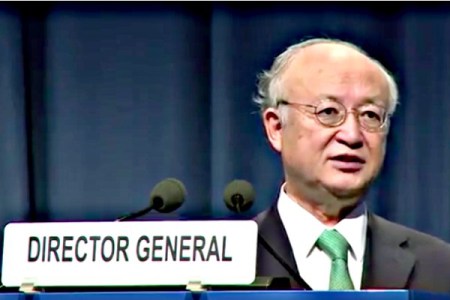
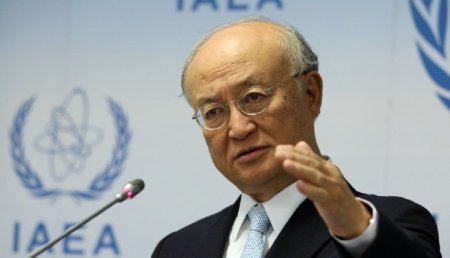
IAEA-AmanoIAEA’S Dir. Gen. Yukiya Amano in Vienna. Sept. 14, 2015. Photo Credit: YouTube screen capture

U.S. Secretary of State John Kerry is thrilled that the world’s nuclear watchdog agency has decided, despite the continued lying by Iran about its nuclear weapons program and its violations of UN ballistic missile bans, to close its investigation into whether there had been any possible military dimensions to Iran’s nuclear weapons program.

Kerry’s statement, released on Tuesday, Dec. 15, noted that a Dec. 2 assessment by Yukiya Amano, Director General of the IAEA, revealed Iran had engaged in activities consistent with a nuclear weapons program as recently as a mere six years ago.

For some reason, Kerry seemed to find that reassuring.

The Secretary of State said that with the consensus adoption by the IAEA Board of Governors, it will now be able to “turn its focus now to the full implementation and verification of the Joint Comprehensive Plan of Action (JCPOA).”

In other words, everyone can now move towards lifting sanctions against Iran which not only continued to lie about its past nuclear activity, but which has already twice violated United Nations missile bans on it since the time the JCPOA was agreed to in July.

U.S. Ambassador to the U.N. Samantha Power acknowledged Iran’s October violation of the missile ban.

Iran’s latest violation of the missile ban was made public by a United Nations Panel in a report dated Dec. 11, Reuters reported on Tuesday. That report was forwarded to the UNSC’s sanctions committee.

Iran has consistently said it will defy any limitations on its ballistic missile program, whether enshrined in UN resolutions or otherwise.

Congressman Mike Pompeo (R-KS) was outraged by the IAEA’s decision, and the green light it gives to the administration’s willingness to move towards implementation of its nearly toothless Nuclear Iran Deal.

“The vote today is a total capitulation to the Iranian regime’s aggressively dishonest behavior with respect to its commitment under the Joint Comprehensive Plan of Action (JCPOA). Sadly, though not surprisingly, the IAEA Board of Governors closed the investigation into Iran’s nuclear program, despite proof of Iran’s dishonesty and in the absence of thorough, truthful answers to many outstanding issues. The president will now use this decision to lift sanctions on Iran without having the complete truth regarding its nuclear weapons related activity. This is a grave and historic error that sends the wrong message,” wrote Pompeo.

The Kansas member of Congress pointed out that the Iran deal, which lasts for more than a decade, means many more years of the U.S. and its partner nations look the other way while the world’s leading sponsor of terrorism continues “cheating, lying, and breaking the rules.”

“This is wholly unacceptable and will most assuredly lead to more of the same from Ayatollah Khamenei. Other rogue nations now know too that America will accept deceit and fraud in dealings with respect to nuclear proliferation.”

Kerry said on Tuesday that the watchdog agency can still investigate Iran if “there is reason to believe” that country is “pursuing any covert nuclear activities in the future, as it had in the past. In fact, the JCPOA – by providing for implementation of the Additional Protocol as well as other enhanced transparency measures – puts the IAEA in a far better position to pursue any future concerns that may arise.”

The IAEA may be able to continue to investigate, but given that past violations have been met with no consequences, it’s a cold assurance that such investigations can continue.

Incredibly, Kerry’s statement concludes:

Today’s resolution makes clear that the IAEA’s Board of Governors will be watching closely to verify that Iran fully implements its commitments under the JCPOA. We will remain intensely focused going forward on the full implementation of the JCPOA in order to ensure the exclusively peaceful nature of Iran’s nuclear program.

Isn’t that comforting?

Nuke watchdog approves Iran for sanctions relief

December 15, 2015

Nuke watchdog approves Iran for sanctions relief, Washington ExaminerDavid Brown, December 15, 2015

(The watchdog’s teeth were extracted and its glasses taken away by the “side deals.” — DM)

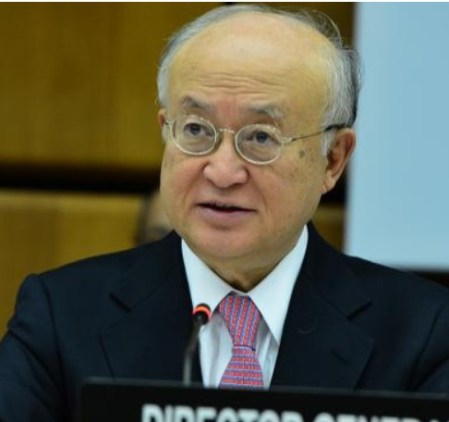
730x420-79ad08c54362ad0f598ff795dd9dc307Director General of the IAEA Yukiya Amano said, “the agency has no credible indications of activities in Iran relevant to the development of a nuclear explosive device after 2009.” (AP Photo/Ronald Zak, File)

The board of the nuclear watchdog group agreed to close the file on Iran’s past nuclear work on Tuesday, clearing the way for Tehran to receive billions in relief from international sanctions, according to news reports.

The board’s decision, according to diplomats quoted by Agence France-Presse, followed the recommendation of International Atomic Energy Agency Director General Yukiya Amano, who earlier on Tuesday said “the agency has no credible indications of activities in Iran relevant to the development of a nuclear explosive device after 2009.”

“Nor has the agency found any credible indications of the diversion of nuclear material in connection with the possible military dimensions to Iran’s nuclear program,” he said.

“Significant progress has been made on the Iran nuclear issue, but now is not the time to relax. This issue has a long and complex history, and the legacy of mistrust between Iran and the international community must be overcome,” he said. “Much work lies ahead of us. All parties must fully implement their commitments under the JCPOA. Considerable effort was required in order to reach this agreement. A similar and sustained effort will be required to implement it.”

What About Iran’s “JCPOA”?

December 15, 2015

What About Iran’s “JCPOA”? Gatestone InstituteLawrence A. Franklin, December 15, 2015

(The article mentions, but otherwise provides little of substance concerning, Iran’s interpretation of the Joint Cooperative Plan of Action (JCPOA).  This analysis by the Middle East Media Institute is about Supreme Leader Khamenei’s “guidelines” for its interpretation and implementation. They suggest something quite different from the document presented to the U.S. Congress.– DM)

  • The self-appointed P5+1, elected by no one but themselves, should be embarrassed to find that they have made a deal with no one but themselves.
  • The media’s emphasis on the JCPOA has sadly neglected any in-depth coverage of Iran’s own comprehensive plan of action, which seems to consist of developing nuclear weapons, ballistic missiles and related systems to deliver them.
  • The IAEA cannot even confirm with certainty that Iran does not already possess a nuclear bomb, and yet is not expected to challenge Tehran’s assertion that it ceased nuclear weapons development more than a decade ago.
  • Although the U.S. also cannot be certain of Iran’s intentions, it would be advisable to assume that Iran means what it says: “Death to America” and “Death to Israel.”

Iran is cheating already — or is it? Iran has not signed anything, so presumably it cannot be cheating on something it never agreed to – as predicted on these pages half a year ago. The self-appointed P5+1 (the five permanent members of the UN Security Council plus Germany), elected by no one but themselves, should be embarrassed to find that they have made a deal with no one but themselves.

The lavishly touted and lavishly dangerous “Iran Deal” not only paves the way for Iran to have nuclear weapons, as it was planning, anyway; it also rewards Iran’s repeated violations of the Non-Proliferation Treaty — which it did sign — with up to $150 billion. With a punishment like that, we should all start violating commitments.

Iran’s recent missile tests have, been undermining the rationale of the Joint Comprehensive Plan of Action (JCPOA), which the P5+1 signed with itself. If Iran is concerned that its missile tests might have violated multiple UN Resolutions, a paltry detail such as that clearly has not bothered anyone before, so why should it bother anyone now?

The media’s emphasis on the JCPOA has sadly neglected any in-depth coverage of Iran’s own comprehensive plan of action, which seems to consist of developing nuclear weapons, ballistic missiles and related systems to deliver them.

While Western diplomats were congratulating themselves on their JCPOA arrangement, Iran sent a “slap-in-the-face” signal to the Free World by launching an Emad [“Pillar”] ballistic missile on October 10. On December 8, State Department spokesperson John Kirby indirectly acknowledged the launch of a second ballistic missile, fired on November 21. Kirby was quick to point out that test was not a violation of the JCPOA.

The launches are violations, however, of UN Security Council Resolution #2231, which bans ballistic missile tests by Iran. Although these tests do not defy the letter of the JCPOA, they do defy the spirit of it. Even though the initial missile test was denounced by the U.S. and allied UN representatives, no action has so far been taken against Iran. The U.S. Ambassador to the United Nations, Samantha Power, did condemn the October test and probably will also condemn the second test. But if this is outrage, that may be the extent of it.

What seems clear is that Iran’s Islamic Revolution Guard Corps (IRGC), which controls the ballistic missile program, is attempting to goad the West into additional punitive action against the Islamic Republic. Such response would serve to strengthen the hardline opposition to the JCPOA in Iran. Further, if the United States does nothing but issue condemnatory rhetoric, it will be interpreted by the regime as additional confirmation that the U.S. desires a nuclear agreement at virtually any cost.

1388

The International Atomic Energy Association (IAEA), after its investigation into the Possible Military Dimensions (PMD) of Iran’s past nuclear weapons development activities, was forced, thanks to Tehran’s lack of cooperation and transparency to deliver an inconclusive initial report on December 2[1].

The Iranian regime’s officials, such as Deputy Foreign Minister Sayed Abbas Araghchi, have demanded the immediate lifting of the 12 UN Resolutions against Iran when the IAEA Board of Governors votes on the final PMD report on December 15.

The IAEA cannot therefore confirm with certainty that Iran does not already possess a nuclear bomb, or whether or not Tehran is presumably still pursuing one. The IAEA Board of Governors is, nevertheless, not expected to challenge Tehran’s assertion that it ceased any such activities more than a decade ago.

Iran currently has several types of ballistic missiles in varying stages of development. The range of these missiles extends from the regional to the intercontinental — with a version of one missile capable of reaching the continental United States. The most touted operational system is the Shahab (“Meteor”) program, with several follow-on versions. The Shahab system has benefited by seemingly close cooperation with North Korea’s ballistic missile program, Russian nuclear weapons engineers who were unemployed after the Soviet Union imploded, and China’s direct and indirect technical assistance.

The principal threat to regional states, particularly to Israel, is that one does not know what one does not know — in this instance, the stage of Iran’s nuclear weapons programs.

Action by the U.S. Congress to inquire why the public disclosure of Iranian ballistic missile tests is being disseminated in dribs and drabs is long overdue, especially as America’s technical intelligence collection methods provide immediate and certain knowledge of such tests.

Although the U.S. also cannot be certain of Iran’s intentions, it would be advisable to assume that Iran means what it says: “Death to America” and “Death to Israel.” If one assumes that these statements, made by a regime that stones women to death, are not mere propaganda, but ideological commitments, the time to demonstrate the Free World’s resolve by way of strategic military exercises on Iran’s borders is long overdue.

______________________________
[1] Initial PMD Report summary observations are that Iran had a coordinated program to develop a nuclear explosive device up through 2003 but the program appears not to have advanced beyond scientific testing which did permit Iran to acquire certain competencies and capabilities. However, some aspects of the program continued until 2009.

The Prospects For JCPOA Implementation Following The Release Of IAEA Sec-Gen Amano’s Report On The PMD Of Iran’s Nuclear Program

December 8, 2015

The Prospects For JCPOA Implementation Following The Release Of IAEA Sec-Gen Amano’s Report On The PMD Of Iran’s Nuclear Program, MEMRI, A. Savyon, Y. Carmon, and U. Kafash, December 8, 2015

Introduction

On December 2, 2015, International Atomic Energy Agency (IAEA) secretary-general Yukiya Amano released his report on the Possible Military Dimensions (PMD) of Iran’s nuclear program.[1]

The report’s findings, whatever they turned out to be, were not supposed to impact the continued implementation of the Joint Comprehensive Plan of Action (JCPOA) in any way – even if they were completely negative regarding Iran. From the outset, it was agreed that all that Iran was obligated to do was to cooperate with the IAEA investigation of its PMD, and nothing more.

The next milestone date for the continued implementation of the JCPOA is December 15, 2015, when Amano’s PMD report will be presented to the IAEA Board of Governors and the latter will resolve whether to close Iran’s PMD dossier in the IAEA. This resolution is meant to be adopted by the UN Security Council.

The implementation process is meant to be continued by Iran – that is, Iran must meet its obligations under the JCPOA. These consist primarily of the removal of nine tons of low-grade enriched uranium from the country, the dismantling of centrifuges so that only 6,000 active ones remain, the pouring of concrete into the core of the Arak nuclear reactor such that it will not be able to be used to manufacture plutonium, the adoption of the Additional Protocol, and more.

After that, the IAEA will check to verify that Iran has carried these out; when it announces that it has, the next milestone date, Implementation Day, will come into force. At that time, Europe and the U.S. will carry out their promise, made October 19, 2015, to lift and suspend their sanctions on Iran.

It was Iran itself that made Amano’s PMD report a problematic issue, and, essentially, a condition for its continued implementation of the JCPOA. Iran demanded that the IAEA Board of Governors close its PMD dossier, and, according to some Iranian spokesmen, it should do so in a way that completely exonerates Iran of accusations against it regarding development of a military nuclear program. That is, Iran will not be satisfied with a closure of the dossier that is merely formal if Amano’s report does not completely exonerate it.

To this end, in the days leading up to the release of the report, Iran pressured the IAEA and the P5+1, with the aim of ensuring that the report would completely clear Iran of suspicions regarding PMD.[2]

In addition to its direct pressure on Amano, Iran also implemented political pressure on the P5+1, warning that if the dossier remained open, Iran would not implement its obligations under the JCPOA, and that the West had to choose between the PMD, that is, accusing Iran of developing a military nuclear program, and implementing the JCPOA.[3]

The Findings Of Amano’s PMD Report

Iran’s pressure netted only partial success. Prior to the report’s release, Amano stated: “What I can now say is that this is an issue that cannot be answered by ‘yes’ and ‘no.'”[4] The report included aspects that were both positive and negative for Iran.

On the one hand, it stated: “The Agency has not found indications of an undeclared nuclear fuel cycle in Iran, beyond those activities declared retrospectively by Iran. The Agency has found no indications of Iran having conducted activities which can be directly traced to the ‘uranium metal document’ or to design information for a nuclear explosive device from the clandestine nuclear supply network.”

However, it also said: “The Agency assesses that explosive bridgewire (EBW) detonators developed by Iran have characteristics relevant to a nuclear explosive device.”

With regard to the Parchin facility, Amano’s PMD report stated that “[t]he information available to the Agency… does not support Iran’s statements on the purpose of the building.” Furthermore, the report stated that “the Agency assesses that the extensive activities undertaken by Iran since February 2012 at the particular location of interest to the Agency seriously undermined the Agency’s ability to conduct effective verification.” It continued:

“The Agency assesses that Iran conducted computer modelling of a nuclear explosive device prior to 2004 and between 2005 and 2009. The Agency notes, however, the incomplete and fragmented nature of those calculations… The Agency assesses that, before the end of 2003, an organizational structure was in place in Iran suitable for the coordination of a range of activities relevant to the development of a nuclear explosive device. Although some activities took place after 2003, they were not part of a coordinated effort. The Agency’s overall assessment is that a range of activities relevant to the development of a nuclear explosive device were conducted in Iran prior to the end of 2003 as a coordinated effort, and some activities took place after 2003. The Agency also assesses that these activities did not advance beyond feasibility and scientific studies, and the acquisition of certain relevant technical competences and capabilities. The Agency has no credible indications of activities in Iran relevant to the development of a nuclear explosive device after 2009.”[5]

Iran’s Future Moves Vis-à-vis The PMD Dossier In The IAEA Board Of Governors

Assuming that the IAEA Board of Governors follows the Iran-U.S. dictates and closes Iran’s PMD dossier[6] in spite of the findings mentioned above, it is not clear that a formal closure of the dossier by the Board of Governors would satisfy Iranian Supreme Leader Ali Khamenei, or whether he would block Iran’s implementation of the JCPOA because the Amano report’s findings do not exonerate Iran.

The Iranian reactions to the report have been mixed, in accordance with the speakers’ affiliation with either the pragmatic camp of President Rohani and Foreign Minister Zarif, or the ideological camp. While the former is willing to settle for a formal closure of the PMD dossier without Iran’s complete exoneration,[7] the latter stresses that the reports’ findings determine that Iran conducted military nuclear development prior to 2009, and see this as a reason to stop the entire JCPOA process. 

The Appendix below presents statements by Deputy Foreign Minister and negotiator Abbas Aragchi, representing the pragmatic camp, and by Hossein Shariatmadari, editor of the Iranian daily Kayhan, which is affiliated with Supreme Leader Khamenei, representing the ideological camp.

It cannot be known whether Khamenei and ideological camp spokesmen will accept the Board of Governors’ resolution as sufficient. Furthermore, even if Khamenei decides to accept a closure of the PMD dossier by the Board of Governors as sufficient, his nine new conditions for Iran’s implementation of the JCPOA, as set out on October 21, 2015, remain an obstacle to Iran’s implementation of the JCPOA.[8]

Appendix

Statements By Deputy Foreign Minister Araghchi Immediately After The Release Of Amano’s PMD Report

On December 2, 2015, Iranian Deputy Foreign Minister Abbas Araghchi told Iranian Channel 1: “In the matter of the [Final Assessment] on Past and Present Outstanding Issues [Regarding Iran’s Nuclear Program], the Amano report states explicitly that all the claims about PMD [refer] strictly to scientific studies [and not to military development]. This is the most salient point in the Amano report. The general view of the IAEA vis-à-vis Past and Present Outstanding Issues in Iran’s nuclear program counters the claims made against Iran in the past decade.

“The IAEA assessment is that prior to 2003, research activity was carried out in Iran, not by it. Likewise, there is no sign that nuclear material was diverted to any initiatives that are not for peaceful purposes.

“The claims in the IAEA report about science and research activity are unacceptable to us, and we will inform the IAEA of our opinion on this matter within the allotted time, even though previously Amano said that his report was not black or white, but in my opinion it leans more towards the white side, particularly when the conclusion of the report explicitly rejects [the claim] that there is in Iran a military program, and it is preparing the ground for the Board of Governors to close the issue of the PMD dossier.

“The report states that there is no sign of nuclear material in matters that are not for peaceful purposes, and also that there is no sign of an undeclared nuclear fuel cycle in Iran. In the matter of equipment [for] dual use, the IAEA says that in the past Iran worked on detonators, but the report declares that these detonators had uses for both peaceful and non-peaceful purposes, and that the IAEA could not make a determination in this matter…

“Likewise, Iran’s procurements [activities] are not against [the law] and there is no organization in Iran that was established to produce an atomic bomb and nuclear weapons. The IAEA pointed out that in the past there was an organizational structure for this purpose [i.e. to create a nuclear weapon] and that in Iran’s view this, this organization could have been used for conventional weapons.

“Nowhere in the IAEA report does it say that Iran conducted dual use activity, except it is written that dual use activity was carried out in Iran; nowhere in the report does it accuse the Iranian government of operating in this direction.

“An additional positive point is that nowhere in the IAEA report is the term PMD used, since we have never officially recognized this matter and have not allowed the use of it in official documents or discussions. The JCPOA and the [IAEA] Road-map likewise do not use this term. In this report, there is use of [the term] ‘[Final Assessment] on Past and Present Outstanding Issues [Regarding Iran’s Nuclear Program] and there is no use at all of the term Possible Military Dimensions.

“The IAEA’s claim that in the past there was research concerning military nuclear activity could be a negative issue. I believe that if the IAEA had sought the truth, it would not have said such a thing. Additionally, the IAEA claimed that an explosives firing chamber was constructed at Parchin, that now does not exist. According to photos from 2000 that we have shown the IAEA, and on which the IAEA is basing its claims, there was never any such chamber at such a location. Further, the IAEA visited Parchin twice, in 2004 and 2005, and saw no such thing. We do not confirm this claim, and we did not want such a summary to appear in the IAEA report.

“All in all, when all the IAEA’s previous claims are placed next to the [Amano report’s] findings, it appears that the report’s fairness leans in Iran’s favor. The Board of Governors has no excuse to leave this dossier open…

“Although the IAEA took samples from the Parchin site, it is not declaring that it found nothing to justify its claims. We expected the IAEA to act fairly and realistically and not to present these things in the report…

“Amano is not in a position to close the PMD dossier. Amano is a [strictly] technical element that must report on his assessment according to reality, facts on the ground, and research that was carried out. The Board of Governors must resolve whether to close the PMD dossier. In my opinion, with regard to the report that Amano published, this procedure should be ended, because there is no proof that Iran’s nuclear program is military, or [was so] even in the past…

“According to the JCPOA, the P5+1 must submit to the Board of Governors a draft resolution with the aim of closing the PMD dossier. It does not appear that the board will decide otherwise in the matter, because the [political] will is to close [the dossier], and the Amano report provides a reason to do so.

“Another positive point in the Amano report is its pointing out that the Road-map was carried out perfectly by Iran. According to it, Iran met all its obligations.

“Still, the absolute Iranian position is that if this dossier is not closed, and if even the smallest window remains open [that will allow] a return to this issue, the JCPOA will not be implemented. We have conveyed this message, in a serious manner, to the other side, that if the PMD dossier is not closed [as noted above], we will not carry out our main steps in the JCPOA. The P5+1 and the Board of Governors must choose one or the other: the PMD or the JCPOA.

“The IAEA report mentions a prohibition on the use of dual equipment in illegal matters, particularly nuclear weapons, but there is no prohibition on the use of dual equipment in ways that are for peaceful purposes or for conventional weapons. The IAEA has said that EBW [Exploding-Bridgewire Detonator] and MPI [Multipoint Initiation] are equipment that has a use in nuclear weapons, Iran has manufactured them and used them. The IAEA says explicitly that it cannot determine [which] use Iran has made of them. We have presented the IAEA with documents that show the use of this equipment in the oil industry and Amano mentioned that Iran has used dual equipment in matters of peaceful purposes…”[9]

Hossein Shariatmadari In Kayhan Editorial, December 5, 2015

In Kayhan’s December 5, 2015 editorial, Shariatmadari wrote: “On Wednesday, December 2, the IAEA released its final report on the PMD. In this report, without presenting any evidence or proof, the IAEA rejects the opinion of Iran, which Iran has stated many times, and writes that up until 2009 Iran engaged in a series of activities connected to the production of nuclear weapons. This is despite the fact that in the past 12 years Iran has absolutely rejected any deviation [in a military direction] in its civilian nuclear activity.

“In spite of the extensive and comprehensive visits by IAEA inspectors, there is no finding to this claim. Several minutes after it was released, the report was welcomed by the media in the U.S. and in the Zionist regime. It was said that this report confirms their previous statements against Iran’s nuclear program, and Iran was accused of lying and cheating for several years.

“It may be that the IAEA report will have dangerous ramifications, that should be stated:

“1.   It was told [to us] that in the nuclear talks it was agreed that the IAEA report would be grey, but that the Board of Governors will close [the matter of the] claim [regarding] the PMD by means of its final resolution. About this, it must be said that:

“a.    If this is a matter of an official agreement, where is this mentioned in the JCPOA? The answer is: Nowhere.

“b.   And if this was an oral agreement, how can the oral agreements of the rival be trusted when it has violated and continues to violate its formal obligations?!

“c.    It was told [to us] that the IAEA report would be grey – that is, with black and white points, positive and negative. Contrary to the opinion of our dear brother Dr. Araghchi, not only does this report not lean more towards white, but most of its sections are black. Additionally, the white points that the members [of the negotiating team] mention have only a white exterior, and their essence is completely black; we will address this later on.

“2.   The report states that up to 2009, Iran engaged in research and development connected to [nuclear] weapons – that is, the part of the report that addresses Iran’s nuclear challenge, which has continued for 12 years, is decided in favor of the rival. This is because in the past 12 years, the U.S. and its allies, and after that the P5+1, accused Iran of deviating in its nuclear program in the direction of nuclear weapons… Ultimately, the IAEA carried out more extensive oversight activity than [that required] in the Additional Protocol, and found no document attesting that Iran’s nuclear activity was not civilian. [Our] technical and judicial expectation was that the report would reject the claims that Iran had deviated in its nuclear program or at the very least that it would be stated [in it] that it had found no sign of such a deviation. But the report confirms the groundless and evidence-free claim of the U.S. and its allies.

“3.   Our friends [on the negotiating team] say that the general view of the report shows that its conclusion contradicts all the claims and talk against Iran’s nuclear program in the past 12 years… For 12 years [the U.S. and its allies] have claimed that Iran’s nuclear program is not civilian and is advancing in the direction of nuclear weapons. The IAEA report justifies this claim. How, then, can it be said that ‘the report contradicts the claims [against Iran] in the past 12 years!?’

“4.   The U.S. and its allies accused Iran, without presenting any proof, that up until 2009 it made efforts to obtain nuclear weapons. Now, the report justifies the claims and accuses Iran of lying, cheating, concealing, breaking the law, and more. Those responsible for the nuclear negotiations must be asked: Was this the intention of the ‘acquisition of international confidence for Iran’ that you talked so much about? Take a quick look at the statements by American, European, and Zionist elements, and at the commentary and analysis by the foreign media, that were published immediately after the report was released: U.S. Secretary of State John Kerry says proudly that everything we [the U.S.] said about Iran’s nuclear program was true.[10] He stresses that we [the U.S.] had never had any doubts that Iran had striven to attain nuclear weapons.[11] Reuters rejected Iran’s statements that we had never wanted nuclear weapons, and wrote, with a large headline: ‘Iran had ‘coordinated effort’ relevant to atom bombs – IAEA.’ USA Today accuses Iran of lying about its non-civilian nuclear activity up to 2009. The Times of Israel spoke respectfully of the opinion of Israeli experts that from the outset, they had said that Iran was making efforts to create nuclear weapons, and more.

“5.   The first article of the [IAEA] report states that it is ‘based on information available to the IAEA… [The points in the original report] include information obtained by the IAEA from Iran in the Framework for Cooperation, including the Road-map and the JCPOA.’ This article says, or at least can be interpreted as saying, that even the elements in Iran (as the IAEA supposes) agreed that up to 2009 Iran engaged in non-civilian [nuclear] activity. Now, tell me: What is white in this report [as Araghchi said], and what in it arouses pride?!

“6.   The IAEA report on the PMD is a final report, and the IAEA saw no need to continue to investigate. Perhaps there will be those who will see this as a white point, and as a point in [Iran’s] favor. But in effect, the IAEA is stating absolutely that Iran made efforts to attain nuclear weapons, and that there is no need to reexamine this. That is, the ground has been prepared for future exploitation [of this claim against Iran].

“7.   The report justifies the suspicion of the U.S. and its allies regarding Iran’s nuclear activity and their perception of it non-civilian. Therefore, this justifies grave restrictions on Iran’s nuclear activity, as well as unprecedented oversight on it. If we accept this report, we will destroy [with our own hands] all our achievements gained through great effort and sacrifices in blood.

“8.    The IAEA report could be more dangerous than the JCPOA, because it is an international document that proves that the opinions and proof that Iran submitted concerning its non-civilian nuclear program are unrealistic and unreliable. Therefore, the U.S. can extend the implementation of the JCPOA from 15 years to 25 years, or even for eternity, on the pretext that the IAEA report shows that you [i.e. Iran] have lied  for 12 years about your nuclear program and there is guarantee that you will not want to produce nuclear weapons under your civilian program.  

“9.    If Iran accepts the IAEA report, as unfortunately is becoming clear from statements by certain elements, the document will gain international [validity], and even if the Board of Governors closes the PMD dossier, this document [i.e. the report] is sufficient in order to permanently restrict our nuclear program and to leave Iran’s nuclear activity in the laboratory and as pilot [project]. That is, on the level of ‘nothing.’ Not for nothing have the rival’s media published the report enthusiastically and applauded the IAEA and its secretary-general.

“10. With regard to the U.S.’s long list of broken promises and deception in the past 12 years of [Iran’s] nuclear challenge, it can be said fervently that even if we assume that the Board of Governors closes the PMD dossier, as the friends [in the negotiating team] say it has promised, the IAEA’s final report can serve as a good basis for future extortion and excessive demands on the part of the U.S…

“11. In conclusion, the defense of [Iran’s] national and scientific interests requires that the elements connected to the nuclear [issue] in Iran show strength and might and explicitly oppose the report and [demand that it be considered] an illegal report and not a technical report [that is, that it be considered a political report] lacking all findings and proof.”[12]


Endnotes:

[1] Final Assessment on Past and Present Outstanding Issues regarding Iran’s Nuclear Programme, Isis-online.org/uploads/isis-reports/documents/IAEA_PMD_Assessment_2Dec2015.pdf.

[2] Iranian Deputy Foreign Minister Abbas Araghchi said: “In the coming days, our experts will be in touch with IAEA experts, and if necessary, they will raise further points. It is even possible that I will meet with Amano again… According to what we were told, there are some weak points in the IAEA report, on which I have commented. I am optimistic that they will be amended. I have provided necessary comments to the Americans and Europeans.” ISNA (Iran), November 25, 2015. On November 29, 2015, he said: “We expect [IAEA secretary-general] Amano to present the Board of Governors with a realistic and moderate report. It is true that it is not possible to determine absolutely what happened 10-15 years ago, and there are various possibilities. We do not expect that Amano will present an absolute report… In any event,  the resolution [about closing the PMD dossier]  lies with the Board of Governors [and not with Amano]. Our criterion is the closure of the PMD dossier in the Board of Governors. We are waiting for its resolution.” Mehr. Iran, November 29, 2015. Also see MEMRI Special Dispatch No. 6229, Statements By Iranian Deputy Foreign Minister Abbas Araghchi Indicate: IAEA’s PMD Report Is Being Written In Negotiation With Iran, Not Independently, November 27, 2015.

[3] Aragchi said on November 29, 2015: “We are now in consultation on the content of the draft resolution that the P5+1 is meant to present to the Board of Governors. In the content [of the draft resolution], they must use terms that mean closure and conclusion of the PMD dossier in the Board of Governors. If this dossier is not closed, our position is absolutely clear – this dossier must be closed, so that we implement the JCPOA. If not, we will not implement our obligations, that according to the JCPOA Iran must implement after the closure of the PMD dossier. That is, the JCPOA will not be implemented fully. Mehr (Iran), November 29, 2015. Araghchi added, “If Yukiya Amano or the Board of Governors present their report in such a way that it does not meet the obligations that were given, Iran too will stop [implementing] the JCPOA.” Press TV, Iran, November 26, 2015. Also, at a November 26, 2015 press conference, Foreign Minister Zarif said: “The Amano report, in the coming days, will help close the dossier permanently. If the report is realistic enough, Iran will move in the direction envisioned for it in the past [that is, it will implement the JCPOA].”The PMD is encapsulated, though we believe undeservedly, as ‘concerns past and present’ in the text of the JCPOA; we hope Amano’s report within upcoming days will help close the case forever. If the report is realistic enough, Iran will move in the direction predicted for it before.” Mehr (Iran), November 26, 2015. Also see similar statements by Supreme National Security Council secretary Ali Shamkhani, ISNA, Iran, November 29, 2015. Additionally, on December 1, 2015, the daily Etemaad, which is affiliated with pragmatic camp leader Hashemi Rafsanjani, stated that the negotiating team had said clearly that the West must choose between the PMD and the JCPOA.

[4] Reuters, November 26, 2015.

[5] Final Assessment on Past and Present Outstanding Issues regarding Iran’s Nuclear Programme. Isis-online.org/uploads/isis-reports/documents/IAEA_PMD_Assessment_2Dec2015.pdf.

[6] A hint at this could be found in the December 5, 2015 editorial of the Iranian daily Kayhan, in which the paper’s editor, Hossein Shariatmadari, wrote: “It was told [to us] that in the nuclear talks it was agreed that the IAEA report would be grey, but that the Board of Governors will close [the matter of the] claim [regarding] the PMD by means of its final resolution” (see Appendix for the full editorial). Also, Araghchi’s November 26, 2015 statements to Iran’s Press TV hinted at commitments to Iran in this vein: “If Yukiya Amano or the Board of Governors present their report in such a way that it does not meet the obligations that were given, Iran too will stop [implementing] the JCPOA.”

[7] Although the members of the negotiating team also claimed that the Amano report contains statements that are unacceptable. Following the report’s release, Araghchi said in a December 2, 2015 television interview: “The claims in the IAEA report about science and research activity are unacceptable to us, and we will inform the IAEA of our opinion on this matter within the allotted time… The IAEA’s claim that in the past there was research concerning military nuclear activity could be a negative issue. I believe that if the IAEA had sought the truth, it would not have said such a thing. Additionally, the IAEA claimed that an explosives firing chamber was constructed at Parchin, that now does not exist. According to photos from 2000 that we have shown the IAEA, and on which the IAEA is basing its claims, there was never any such chamber at such a location. Further, the IAEA visited Parchin twice, in 2004 and 2005, and saw no such thing. We do not confirm this claim, and we did not want such a summary to appear in the IAEA report” (for the full statements, see Appendix). ISNA, Iran, December 2, 2015. See also statements by Atomic Energy Organization of Iran director Ali Akbar Salehi: “Based on the Amano report, there remains no way to leave the PMD dossier open… Based on this [report], and on my extensive experience in the IAEA, the PMD dossier will be closed for certain, because they have not succeeded in presenting any document. Therefore, this false dossier that has entangled us for many years will be closed permanently.” Nasimonline, Iran, December 3, 2015.

[8] See MEMRI Inquiry & Analysis Series Report No. 1196, Iranian Supreme Leader Khamenei’s Letter Of Guidelines To President Rohani On JCPOA Sets Nine Conditions Nullifying Original Agreement Announced July 14, 2015, October 22, 2015.

[9] ISNA (Iran), December 2, 2015.

[10] MEMRI did not find Kerry’s exact words in this regard.

[11] Kerry said at a December 4, 2015 press conference that “nobody has had any doubts whatsoever about Iran’s past military endeavors.” State.gov/secretary/remarks/2015/12/250362.htm.

[12] Kayhan (Iran), December 5, 2015.