Archive for the ‘Iranian dissidents’ category

Iran: Possible US and Iranian Opposition Cooperation to Counter the Threat of Mullahs’ Rule

April 21, 2017

Iran: Possible US and Iranian Opposition Cooperation to Counter the Threat of Mullahs’ Rule, Iran Focus, April 20, 2017

(Please see also, Iran’s Top Judge Warns of Enemy Schemes for Election. Might the “enemy schemes” of the Iranian dissidents who met with Sen. McCain be among those referenced there? — DM)

Senator McCain’s visit to Albania to visit dissidents and Maryam Rajavi could perhaps be a step in the direction of cooperation between the US government and the main Iranian opposition. It is true that the NCRI is receiving more and more support from lawmakers in the West, and from all over the world, and it is making the Iranian regime nervous. Cooperation between the US and the Iranian opposition, which has large networks of people all over Iran, will be a positive move for the people of Iran. No one knows more about the Iranian regime and its activities than the main opposition group and it will help the US get foreign policy to counter the regime’s threat right.

*****************************

London, 20 Apr – Last week, Senator John McCain went to Albania where he met a number of the former residents of the Camp Liberty base. The dissidents were finally released from the former US military base last year and many of them have now made Albania their permanent residence. The dissidents at Camp Liberty had been victim to numerous attacks planned by the Iranian regime.

However, they have now all finally been released from Camp Liberty and have the freedom to continue their activism, must to the dismay of the Iranian regime.

Senator McCain also met with the leader of the People’s Mojahedin Organization of Iran (PMOI/MEK) and the National Council of Resistance of Iran (NCRI), Maryam Rajavi.

It was no surprise that the mullahs were unhappy about this encounter and claimed it was part of a conspiracy against the Islamic Republic. There were also threats that the US would be made to “pay” for the “mistakes” it has made. This predictable anger is nothing but proof that the Iranian regime is extremely weak and terrified of opposition.

For years, the Iranian regime has attempted to destroy the opposition via various methods including force, violence, false allegations and slander. It is clear that the opposition groups, especially the National Council of Resistance of Iran (NCRI), pose a very real threat to the mullahs’ rule.

The threat has got even more real now that the Trump administration is in place. While President Obama was in office, the Iranian regime enjoyed free reign over the Middle East. Obama did not dare call the regime out on its malign activities, let alone sanction it.

In his presidency so far, Trump has put Iran “on notice” after it conducted testing of ballistic missiles and has issued numerous sanctions on Iranian individuals and entities. The Trump administration is also weighing up whether or not to designate the IRGC (Islamic Revolutionary Guard Corps) as a FTO (Foreign Terrorist Organisation). However, the biggest message was sent to Iran when it launched a strike on its ally in Syria. As well as saying that the United States will not put up with such evil acts (the chemical weapons attack that killed dozens of civilians), it was a challenge to Iran’s position as the main backer of the Syrian regime.

Senator McCain’s visit to Albania to visit dissidents and Maryam Rajavi could perhaps be a step in the direction of cooperation between the US government and the main Iranian opposition. It is true that the NCRI is receiving more and more support from lawmakers in the West, and from all over the world, and it is making the Iranian regime nervous. Cooperation between the US and the Iranian opposition, which has large networks of people all over Iran, will be a positive move for the people of Iran. No one knows more about the Iranian regime and its activities than the main opposition group and it will help the US get foreign policy to counter the regime’s threat right.

Iran’s Top Judge Warns of Enemy Schemes for Election

April 20, 2017

Iran’s Top Judge Warns of Enemy Schemes for Election, Tasnim News Agency, April 20, 2017

(Apparently, the external Resistance Movement and the internal dissidents are causing the Mad Mullahs concern. Please see also, Iran’s Stage-Managed Elections. — DM)

In an address to a meeting of judicial officials on Thursday, Ayatollah Amoli Larijani highlighted the enemies’ outright hostility to Iran, pointing to the huge investment they have made for undermining the Islamic Republic and to the rising number of anti-Iranian media outlets.

“They (enemies) may also want to deal a blow to the (Iranian) Establishment during the elections,” the top judge added.

He then called on the judicial authorities and prosecutors to work in cooperation with the police and security forces to foil attempts at creating tensions and chaos.

Iran’s presidential election is planned to be held on May 19.

Iranians will also cast their ballots in the City and Village Councils elections on the same day.

On Wednesday, Leader of the Islamic Revolution Ayatollah Seyed Ali Khamenei warned of the enemies’ attempts to damage the process of election by publishing tempting stories in their media outlets, stressing that the Iranian nation will foil such plots with the same vigilance it has shown in the past.

The election should be held with high turnout and in healthy and secure conditions, Ayatollah Khamenei emphasized, saying that way polls would provide the country with immunity.

Iran’s Stage-Managed Elections

April 15, 2017

Iran’s Stage-Managed Elections, American ThinkerReza Shafiee, April 15, 2017

(What can President Trump do to promote regime change in Iran? What can he do to support the resistance, in and outside Iran? What, if anything will he do?– DM)

Iran’s history has shown that people are willing to risk and speak openly when they have outside support and sympathy. The United States’ policies with regard to human rights have an instant effect in hearts and minds of ordinary citizens in Iran. What happened in Iran in 2009 is not a distant memory. The Obama administration’s flawed policy set off a chain reactions in the region which still reverberates in Syria, Yemen and Iraq. By focusing just on getting the nuclear deal done with the mullahs in Tehran, it actually left out other pressing issues such supporting the Iranian people and indirectly preventing the carnage in the neighboring countries. 

***************************

Every four years, Iranian citizen witness a show called ‘elections.’ These have nothing in common with genuine democratic elections; they’re facades. The upcoming May 19 elections are no exception.

A closer look at the candidates proves that they are no different from one another and all have a clear track record of participation in suppression of Iranian people over the past four decades. They have won the approval to enter the race by the mullahs for just this reason.

The two more serious ones are: Hassan Rouhani, the incumbent president; and Ebrahim Raisi, custodian of Iran’s wealthiest charity, Astan Quds Razavi in Iran’s holiest shrine of Imam Reza in Mashhad, northeastern Iran. Having charge of such vast amount of wealth, it’s a given that Raisi enjoys Supreme Leader Khamenei’s full trust. Both candidates are cut from the same cloth and are committed to principle to Supreme Guardianship (Velayat-e faqih), meaning, the rule of the ayatollahs

So who are they? Let’s start with the second one.

Ebrahim Raiai a member of “Death Commission” and close confident of Ali Khamenei

He was a low-level cleric who climbed the ladder in the mullahs’ hierarchy just for his undeniable services to the late Khomeini in slaughtering of 30,000 political prisoners in summer of 1988. (In Iran, we don’t refer to Khomeini as “Ayatollah,” just Khomeini is enough.  The title has been stolen and abused by the ruling mullahs in Iran.) The prisoners were mainly members and sympathizers of the Iranian opposition People’s Mojahedin Organizations of Iran (PMOI/MEK).

The “Death Commission” was a four-member body with the sole task of carrying out Khomeini’s fatwa against dissidents. In his hand-written decree, Khomeini openly ordered the commission to kill the political prisoners, the majority of whom had been already imprisoned.

Ayatollah Hossein-Ali Montazeri, Khomeini’s handpicked successor was later sacked over his quarrel with Khomeini for the indiscriminate killings. In a shocking 28-year-old audio file of one the meetings of Death Commission leaked in August by his son Ahmad, Montazeri called the killings a “crime that future generations will certainly not forget” and declared: “It is committed in the name of the Islamic Republic and carried out by you.”

Ahmad Montazeri has regarded Ebrahim Raisi’s standing for presidential elections a ‘joke’ and ‘an insult to Iranian people’. Raisi’s record does not stop at just his role in the massacre of political prisoners in 1988, but what he did overrides any other tasks he has undertaken in Islamic Republic’s killing machine.

Canada’s Parliament adopted the following motion on June 5th, 2013 on the events of 1988 in Iran: “That the House condemn the mass murder of political prisoners in Iran in the summer of 1988 as a crime against humanity, honors the memory of the victims buried in mass graves at Khavaran cemetery and other locations in Iran, and establishes Sept. 1 as a day of solidarity with political prisoners in Iran.”

Now let’s look at the other candidate:

Hassan Rouhani is no saint

Make no mistake about Rouhani being a saint by comparison. He is not far behind Raisi when it comes to cruelty. For starters, Mostafa Pour-Mohammadi, his justice minister, is none other than another member of the same notorious Death Commission. Last summer when Pour-Mohammadi was pressed to answer for the massacre of 1988, he proudly said: “I carried out God’s will and I have not lost sleep over what I did.”

The rate of executions during Rouhani’s presidency has been unprecedented in past 25 years in Iran, according to Ahmed Shaheed, who was Iran’s last UN Special Rapporteur for human rights. During Rouhani’s tenure, around 3000 executions were carried out.

When asked about hangings during his presidency, Rouhani simply said: “They were carried out according to God’s laws.”

Amnesty International’s report for 2016 indicates that with the exception of China, Iran carried out 55 percent of all executions worldwide.

Rouhani has always said that he has been in a decision making-position throughout the life of the Islamic Republic. He personally was in a commanding position when the 1999 student uprisings were crushed in Iran.

The European Union extended its sanctions on Iranian regime’s offices for participating in suppression of Iranian citizens.

EU documents state that they target persons complicit in “torture, cruel, inhuman and degrading treatment, or the indiscriminate, excessive and increasing application of the death penalty, including public executions, stoning, hangings or executions of juvenile offenders.”

As U.S. Ambassador to the UN Nikki Haley mentioned recently: “Peace and security cannot be achieved in isolation from human rights.” The long-suffering people of Iran, Syria, and Iraq bear witness that “human rights abuses are not the byproduct of conflict; they are the cause of conflict, or they are the fuel that feeds the conflict.”

There’s also a third candidate worth looking at:

Mahmoud Ahmadinejad is back in the race

The trio of Rouhani, Raisi and Ahmadinejad in Iran’s upcoming elections is more than a mere joke: It has a plain and clear message – that of Khamenei’s extreme weakness in controlling his goons. The humorous Iranian people have already made jokes about the three and this bagatelle called elections. Social media is full of them.

Khamenei ordered Ahmadinejad to stay away from elections. By disobeying his master’s direct order he is demonstrating the Supreme Leader’s unprecedented lack of control over his establishment. Khamenei offered an explicit warning in September that his candidacy would be a “polarizing situation” that would be “harmful to the country.”

That is a reference to the disputed election in 2009 which ignited massive street demonstrations and subsequent arrests of thousands of protesters and the killing of hundreds of others by the Revolutionary Guard Corps (IRGC).

Final thoughts     

Iran’s history has shown that people are willing to risk and speak openly when they have outside support and sympathy. The United States’ policies with regard to human rights have an instant effect in hearts and minds of ordinary citizens in Iran. What happened in Iran in 2009 is not a distant memory. The Obama administration’s flawed policy set off a chain reactions in the region which still reverberates in Syria, Yemen and Iraq. By focusing just on getting the nuclear deal done with the mullahs in Tehran, it actually left out other pressing issues such supporting the Iranian people and indirectly preventing the carnage in the neighboring countries.

The elections in Iran – for parliament or president – have been designed or “engineered,” as the word has been widely used, by the regime’s inner circles, for both internal and external consumption. However after the nuclear deal with the West, it has become a high priority for the regime to show popular support at home and project it as an image to the rest of the world as a regime fully in control and ready to do business. It is no secret that the regime has no popular support in Iran.

Ebrahim Rasis, Hassan Rounhani, Mahmoud Ahmadinejad and their likes should not be allowed to escape the consequences of their crimes against humanity. Known human rights criminals such as entire ruling mullah class in Iran should not go unpunished. They should soon see the inside of International Criminal Court.

Reza Shafiee is a member of Foreign Affairs Committee of the National Council of Resistance of Iran (NCRI) 


Trump Administration Sanctions Iran Prison Torture Industry

April 13, 2017

Trump Administration Sanctions Iran Prison Torture Industry, Washington Free Beacon, April 13, 2017

An Iranian inmate peers from behind a wall as a guard walks by at the female section of the infamous Evin jail, north of Tehran, 13 June 2006. (AFP PHOTO/ATTA KENARE KENARE/AFP/Getty Images)

The Trump administration is leveling new economic sanctions against senior Iranian officials and its prison system for widespread human rights abuses, including the systematic torture of those being held in these facilities, according to White House officials familiar with the matter.

The latest sanctions target the Tehran Prisons Organization and Sohrab Suleimani, a senior official in the prison system and the brother of Qassem Soleimani, a senior Iranian military figure responsible for operating Iran’s rogue activities in Syria and elsewhere.

Sohrab Soleimani is responsible for overseeing Iran’s notorious Evin Prison, which is known for torturous interrogations, forced interrogations, and widespread mistreatment of inmates.

The latest sanctions are certain to rankle Tehran, already the subject of a range of new sanctions under the Trump administration, which is currently conducting a widespread review of all matters related to the landmark nuclear agreement.

A senior official on the White House National Security Council told the Washington Free Beacon that the Soleimani family has a history of fomenting violence and unrest both inside and outside Iran.

“It’s no coincidence that Sohrab Suleimani is the brother of the notorious Qassem Soleimani, the head of the IRGC’s Quds Forces, who has been responsible for so much of the violent disruption Iran has been spreading through the region,” said the official, who was not authorized to speak on record.

Iranian human rights abuses have only grown under the leadership of so-called reformist President Hassan Rouhani, the official said. This includes the detention of U.S. citizens

“There has been a disturbing and significant increase in the number of detentions and executions of Iranian citizens under President Rouhani, and the infamous Evin Prison under Sohrab Suleimani’s control has been a key facility in this program of domestic repression,” the official said.

The Trump administration is holding meetings with the family members of American citizens still being detained in Iran and believed to be subjected to torture.

“In addition, we have been deeply concerned by the treatment of American citizens in this prison, and in others throughout Iran,” the official said. “Just today, senior officials in the Trump administration met with members of the Namazi family representing Siamak Namazi and Baquer Namazi who have been unjustly detained in Iran since October, 2015 and February, 2016, respectively.”

“Today’s designations highlight our continued support for the Iranian people and demonstrate our commitment to hold the Government of Iran responsible for its continued repression of its own citizens,” John E. Smith, director of the Treasury Department’s Official of Foreign Assets Control, said in a statement. “We will continue to identify, call out, and sanction those who are responsible for serious human rights abuses in Iran.”

The sanctions do not conflict with U.S. obligations under the nuclear agreement and are not being leveled as part of that agreement, according to U.S. officials.

The sanctions were formulated following a series of investigations by the U.S. government into Iran’s systematic breach of human rights.

“These designations are in response to what we see as pattern of human rights abuses by the Government of Iran and reflect the United States’ deep concern regarding the human rights situation in Iran,” the State Department explained in a background document provided to reporters.

“We continue to see Government of Iran officials engage in repressive behavior against its own citizens, including through their mistreatment and abuse of prisoners,” the document states. “This is especially evident at Evin Prison, which is where numerous prisoners of conscience are held. We have documented these and many other human rights abuses perpetrated by the government of Iran in our annual State Department authored Human Rights, Religious Freedom, and Trafficking in persons reports.”

Soleimani’s role in Iran’s prison system makes him one of the foremost human rights abusers worldwide.

Soleimani oversaw an April 2014 incident at the Evin Prison in which dozens of security guards and prison officials beat a number of political prisoners. The attack is believed to have lasted several hours and impacted more than 30 prisoners. Many of these prisoners were later denied medical treatment.

Evin Prison is home to large number of Iranian political dissidents and other government opponents, who are routinely shut down and arrested by the Iranian regime for political activities targeting those in power.

U.S. Options in Syria Don’t Include Ground Troops

April 10, 2017

U.S. Options in Syria Don’t Include Ground Troops, PJ Media, David P. Goldman, April 10, 2017

FILE – In this file image provided on Friday, April 7, 2017 by the U.S. Navy, the guided-missile destroyer USS Porter (DDG 78) launches a tomahawk land attack missile in the Mediterranean Sea. The U.S. missile attack has caused heavy damage to one of Syria’s biggest and most strategic air bases, used to launch warplanes to strike opposition-held areas in central, northern and southern Syria. (Mass Communication Specialist 3rd Class Ford Williams/U.S. Navy via AP, File)

The war has already displaced half of Syria’s 22 million people, and Iran plans to replace Sunnis with Shi’ite immigrants in order to change the demographic balance. The Sunni side of the conflict has become globalized with fighters from the Russian Caucasus, China’s Xinjiang Province, as well as Southeast Asia.

The U.S. State Department last year estimated that 40,000 foreign fighters from 100 countries were in Syria; Russia cited a figure of 30,000. Whatever the number is today, it would not be difficult to add a zero to it.

Russia and China must be frightened of America’s prowess, especially in military technology. A Reagan-style effort to established unquestioned U.S. supremacy in military technology is the Big Stick we require. Tomahawk missiles are not a Big Stick. They speak loudly. Trump was magnificently right to send the signal to Moscow and Beijing, especially (as Secretary Tillerson said) in the light of Russia’s duplicity or incompetence in the matter of Syrian poison gas. Now we need to get to work.

***************************

Writing in the Washington Post, neo-conservatives Reuel Gerecht and Ray Takeyh propose to send U.S. ground troops to fight Iran and its proxies in Iran and Syria:

It is way past time for Washington to stoke the volcano under Tehran and to challenge the regime on the limes of its Shiite empire. This will be costly and will entail the use of more American troops in both Syria and Iraq. But if we don’t do this, we will not see an end to the sectarian warfare that nurtures jihadists. We will be counting down the clock on the nuclear accord, waiting for advanced centrifuges to come on line. As with the Soviet Union vs. Ronald Reagan, to confront American resolution, the mullahs will have to pour money into their foreign ventures or suffer humiliating retreat.

They’re nuts.

It isn’t Iran that we would be fighting: It’s an international mercenary army that already includes thousands of fighters recruited from the three million Hazara Afghans now seeking refuge in Iran, from the persecuted Pakistani Shi’ites who comprise a fifth of that country’s huge population, and elsewhere. As I reported recently in Asia Times:

The IRGC’s foreign legions include volunteers from Afghanistan and Pakistan, where Shi’ites are an oppressed minority often subject to violent repression by the Sunni majority. IRGC-controlled forces include the Fatemiyoun Militia recruited mainly from Shi’ite Hazara refugees from Afghanistan, with reported manpower of perhaps 12,000 to 14,000 fighters, of whom 3,000 to 4,000 are now in Syria. Iranians also command the Zeinabiyoun militia composed of Pakistani Shi’ites, with perhaps 1,500 fighters in Syria.

The manpower pool from which these fighters are drawn is virtually bottomless. The war has already displaced half of Syria’s 22 million people, and Iran plans to replace Sunnis with Shi’ite immigrants in order to change the demographic balance. The Sunni side of the conflict has become globalized with fighters from the Russian Caucasus, China’s Xinjiang Province, as well as Southeast Asia.

The U.S. State Department last year estimated that 40,000 foreign fighters from 100 countries were in Syria; Russia cited a figure of 30,000. Whatever the number is today, it would not be difficult to add a zero to it.

Russia and China, as I explained in the cited Asia Times essay, blame the U.S. for opening the Pandora’s Box of Sunni radicalism by destroying the Iraqi State and supporting majority (that is, Shi’ite) rule in Iraq. Sadly, they are broadly correct to believe so. Thanks to the advice of Gerecht and his co-thinkers at the Weekly Standard and Commentary, the Bush administration pushed Iraq’s and Syria’s Sunnis into the hands of non-state actors like al-Qaeda and ISIS.

A seventh of Russia’s population is Muslim, and 90% of them are Sunnis. China has a restive Muslim population among the Uyghurs in its far West, and all of them are Sunnis. Moscow and Beijing therefore support Shi’ite terrorists as a counterweight to Sunni jihadists. A Eurasian Muslim civil war is unfolding as a result. Daniel Pipes of the Middle East Forum thinks America should let Sunnis and Shi’ites exhaust each other. If it were just Syria, that would make sense, but the Syrian conflict is the nodal point for a much larger and more dangerous conflagration. If the 300 million Muslims of Southeast Asia were to become involved, the consequences would be horrific.

Gerecht and Tayekh want the U.S. to back the anti-regime forces whom Obama left twisting in the wind during the 2009 demonstrations against Iran’s rigged elections. That is the right thing to do. The Trump administration should create a special task force for regime change in Iran and recruit PJ Media’s Michael Ledeen to run it. Iran is vulnerable to subversion. With 40% youth unemployment and extreme levels of social pathology (the rate of venereal disease infection is twenty times that of the U.S.), Iranians are miserable under the theocratic regime.

But I don’t know if that will work: Iran gets all its money from oil, and the mullahs have the oil, the money, and all the guns. If we can’t overthrow the Iranian regime, we will have two choices.

The first is to bomb Iran — destroy nuclear facilities and Iran Revolutionary Guard Corps bases. That risks war with Russia and China. It is an option, but a dangerous one, and not anyone’s first choice. We could have done this before Iran became a Russian-Chinese ally.

The second is to cut a deal with Russia and China: We muzzle the Sunni jihadists whom we (or our allies like Saudi Arabia) supported, and Russia and China cut Iran off at the knees. I sketched out such a deal in August 2016. It won’t happen easily, or any time soon, because Russia and China are not sufficiently afraid of us to want to come to the table. Russia would demand other concessions (e.g., recognition of its acquisition of territory by force in Ukraine). As the use of poison gas despite past Russian assurances makes clear, one can’t trust the Russians unless, of course, they really are scared of us.

So it all comes down to Grand Strategy: Russia and China must be frightened of America’s prowess, especially in military technology. A Reagan-style effort to established unquestioned U.S. supremacy in military technology is the Big Stick we require. Tomahawk missiles are not a Big Stick. They speak loudly. Trump was magnificently right to send the signal to Moscow and Beijing, especially (as Secretary Tillerson said) in the light of Russia’s duplicity or incompetence in the matter of Syrian poison gas. Now we need to get to work.

—————

Update: Christina Lin, a former senior U.S. Defense Department analyst and fellow at SAIS (and frequent Asia Times contributor), told The Diplomat in an interview today:

As a recent Israeli intelligence report documented, there are thousands of Chinese Uyghurs fighting in the ranks of al-Qaeda affiliates and ISIS in Syria, namely in the Turkistan Islamic Party (TIP) based in Idlib — an al-Qaeda stronghold. The August 30, 2016 bombing of the Chinese embassy in  Krgyzstan, planned by TIP in Syria and financed by Al Nusra, signals increasing threats to Chinese citizens and interests overseas if Syria becomes a terrorist safe haven.

Because of “inter-mingling” with Ahrar al Sham and other so called “moderate” jihadists, TIP and Nusra enjoy U.S. and its allies’ protection even though they are designated as terrorist organizations. The have procured advanced Western weapons such as U.S.-supplied anti-tank TOW missiles, Grad missiles, and likely anti-aircraft MANPADS, and drones that they used to record their recent suicide campaigns against the Syrian army. These Western weapons enhance their war fighting capabilities to launch future attacks on China and Chinese interests, so Beijing will likely step up its military support to the Syrian army. Chinese military advisers are already on the ground in Syria, according to media reports.

After Syrian Gassing, Trump Must Expose the Iran Deal

April 10, 2017

After Syrian Gassing, Trump Must Expose the Iran Deal, PJ Media, Roger L Simon, April 9, 2017

Among the more disturbing questions emerging from the renewed use of gas by Bashar Assad is whether Barack Obama and his loyal minions (Kerry, Rhodes, Rice, etc.) actually knew the Syrian leader still had chemical weapons, even though they trumpeted the opposite to the American public on numerous occasions. Either they lied or were so extraordinarily credulous they believed — apparently without verification — the Syrians had truly rid themselves of those WMDs, in which case Obama — not Trump — was Vladimir Putin’s personal “useful idiot.”

(It may even be time to take a second look at the contention of some that Saddam transferred his chemical weapons to Syria way back when, which would be a surprise vindication of Bush 43.)

Whatever the case, it’s “heavy water” under the bridge at this point, but should alert us even more to the absolute necessity of revealing everything known about the also Obama-instigated Iran Deal, all its myriad hidden codicils and clauses that remain mysterious to the citizens of this country in whose name they were allegedly signed. That agreement too could be the product of useful idiocy, a sucker punch from the mullahs.  The devil, in this case, is very much in the details, few of which we know, except that the Iranians refused to give a baseline development level for their nuclear weapons program in this first place. In a sense, that made everything else moot.

Nevertheless, Iran has been the beneficiary of this deal to the tune of billions of dollars, some evidently in cash, much of which has been and is being spent in Syria, if not directly on chemical weapons, on a war that no less than the former chief rabbi of Israel, himself a Holocaust survivor, has called another Holocaust.  Iran is also using the money to finance Hezbollah in that war, simultaneously arming those terrorist thugs with tons of modern weapons, including long range missiles, even while the mullahs use Hezbollah’s guerrillas as cannon fodder to spare Iran’s own quasi-terrorist Revolutionary Guard. The Islamic Republic’s obvious goal is to control both Syria and Iraq by proxies.  A victorious Assad would be Iran’s boy as much as Russia’s, possibly more.

The Trump administration should expose this deal in its entirety to public view now.  If that means Iran pulls out of the agreement — as they have warned — so be it.  The transparency is worth whatever minimal insurance against a nuclear-armed Iran might be inherent in these evanescent documents.  After seeing just how much insurance against chemical weapons was inherent in Obama’s deal with Putin over the crossing of our then-president’s “red line,” one could be skeptical that there is any at all.  Indeed, what little we know of the Iran Deal leads one to believe that it would be simple for the mullahs to be as busy as ever on their nuclear program.  That they are allied with North Korea makes this all the more likely.

Further to be investigated is Obama’s peculiar desire to make a deal with these same mullahs from the very beginning of his administration or even before. Indeed, Obama representatives have been accused of meeting with both Hamas and Iran during his first presidential campaign. These meetings are better documented than Trump’s supposed collusion with Putin, which seems so unlikely now.

In a continuation of that behavior, Obama later famously ignored the pleas for support by the Iranian pro-democracy demonstrators during the Green Revolution of 2009.  “Obama, you are either with us or are you with them!”  they chanted.  Obama was evidently with them. He didn’t want to disrupt his rapport with Ahmadinejad in order to make his dreamed-of deal. (You can see it all on YouTube here.  As we used to say in the sixties, “Which side are you on?”)

Obama and Kerry then welcomed the election of Hassan Rouhani, whom their cheering section in the willfully ignorant mainstream media ludicrously called a “moderate” when he was, if anything, worse than Ahmadinejad and has since been responsible for many more murders of political prisoners than his predecessor.  They made their deal with Rouhani, who is obviously now cooperating in the maintenance of peace…. Well, not exactly.

What’s behind all this? As I said at the outset, this is disturbing — liberalism and progressivism turned upside down, at least according to their own self-described principles. Everything is situational. That Democrats like Schumer and Pelosi were so positive about Trump’s actions in Syria is a sure sign that not so deep down they were more than a little uncomfortable when Obama did nothing after a similar gassing.  Like a lot of people I would imagine, they had to bury their feelings and opinions in the name of party loyalty, what the French called mauvaise foi.  They should have felt the same way yet more intensely after Obama’s execrable non-reaction to the Green Revolution.  Maybe they did, but we’ll never know until someone leaks it out in a memoir. We didn’t need to send in the Marines.  All Obama would have had to have done was to say a few words of encouragement echoed by the international community and the revolution might have happened.  It was close enough.

Thank God there’s a new sheriff in town. Maybe there will be some hope for the citizens of Iran, eventually, some support for regime change after eight years of kowtowing to the mullahs.  But for now lets at least clear up the terms of the mysterious deal, its provenance and its usefulness, if any.  No time like the present.

The Real War in ‘Syria’ and the Strategy for Long-Term Victory

April 7, 2017

The Real War in ‘Syria’ and the Strategy for Long-Term Victory, PJ MediaMichael Ledeen, April 6, 2017

(Iran is ripe for regime change and the sooner the better. Please see also, Iran’s Elections: A Breaking Crisis? and All 15 Arab Summit resolutions blast Iran.– DM)

Syria’s President Bashar al-Assad (Reuters, RTX34BQA)

Punishing Assad would be satisfying, but we’ve got a big war to win. It’s smarter and more effective to go after the regime in Tehran. Not militarily, but rather supporting the tens of millions of Iranians who detest the Khamenei regime. Call it political warfare, or subversion, or democratic revolution. It worked against the Soviet Empire, and there are good reasons to believe it would work in Iran as well. Most Iranians, suffering under the failed regime, want a freely chosen government that will address their problems instead of dispatching their husbands and sons sent to the battlefield.

Regime change in Iran would be devastating to Assad and Putin, and its positive effects would be felt in North Africa and our own hemisphere, striking at the Revolutionary Guards and Hezbollah in Latin America. And it would remind the tyrants that America’s greatest weapon is political. We are the most revolutionary country in the world, and we should act like it.

****************************

Of course I loathe Assad. And of course I despise the Obamans for that phony red line and the subsequent retreat-and-bogus-Russian-deal. But just carrying out vengeance against Assad isn’t good enough. It fails to address the central problem of our time: the global anti-American alliance.

There is no Syria any more, and the enemy forces on the Middle Eastern battlefield come from various jihadi groups, and three regimes: Moscow, Tehran, and Damascus. We have to defeat them all, and other members of the enemy alliance, including Cuba and North Korea. Nikki Haley has it right: “The truth is that Assad, Russia and Iran have no interest in peace.”

Indeed, they are waging war, and the principal force driving that war is not Assad, but Iranian Supreme Leader Ali Khamenei. Khamenei’s killers have been alongside Assad’s from the very beginning, as the survival of the Syrian dictator is crucial to Iranian ambitions and quite likely also the survival of the Islamic Republic itself. Listen to Defense Secretary James Mattis a few days ago (from Reuters):

Asked about comments Mattis made in 2012 that the three primary threats the United States faced were “Iran, Iran, Iran,” Mattis told reporters that Iran’s behavior had not changed in the years since.

“At the time when I spoke about Iran I was a commander of US central command and that (Iran) was the primary exporter of terrorism, frankly, it was the primary state sponsor of terrorism and it continues that kind of behavior today,” Mattis said.

True, and Mattis’ characteristically strong language points the way to the best American action in the region, namely bringing down the Tehran regime. Lashing out at Assad isn’t nearly good enough. After all, what strategic objective would we accomplish by smashing, even removing, Assad? The Iranian and Russian fighters would still be there, as would the Islamist forces. The demands on our military would dramatically expand. We do not want to occupy a significant land mass in what used to be called Syria, nor do we seem to have sorted out what we want to do with the Turks and the Kurds.

Punishing Assad would be satisfying, but we’ve got a big war to win. It’s smarter and more effective to go after the regime in Tehran. Not militarily, but rather supporting the tens of millions of Iranians who detest the Khamenei regime. Call it political warfare, or subversion, or democratic revolution. It worked against the Soviet Empire, and there are good reasons to believe it would work in Iran as well. Most Iranians, suffering under the failed regime, want a freely chosen government that will address their problems instead of dispatching their husbands and sons sent to the battlefield.

Regime change in Iran would be devastating to Assad and Putin, and its positive effects would be felt in North Africa and our own hemisphere, striking at the Revolutionary Guards and Hezbollah in Latin America. And it would remind the tyrants that America’s greatest weapon is political. We are the most revolutionary country in the world, and we should act like it.

Iran: A “Paper Tiger”

April 1, 2017

Iran: A “Paper Tiger,” Iran Focus, March 31, 2017

(What would Russia do? Please see also, Iran’s Elections: A Breaking Crisis? — DM)

London, 31 Mar – While Iran calls for the destruction of Israel, according to some experts, an American or Israeli attack against the Islamic Republic’s nuclear and military sites would be fairly easy to execute. This is because, although Iran points to technological advancement in their military, it is actually has overextended itself in Syria.

A report published in March by the Middle East Media Research Institute (MEMRI), noted Iran has backed off their provocations against U.S. Navy vessels, and has even ceased their threats to sink these ships in the Persian Gulf. The report continued, “The slogan ‘death to America’ has disappeared almost entirely from the official discourse of regime spokesmen, including Iranian Supreme Leader Ali Khamenei himself, as have public burnings of the American flag.”

Fars News Agency reported on March 26, that deputy chief of staff of Iran’s armed forces, Brigadier General Masoud Jazayeri, warned the U.S. to be more careful about its warship movements in the Persian Gulf, which is a softer warning than we’ve heard in the past from Iranian leaders.

President and founder of MEMRI, Yigal Carmon, has stated that Iran’s claims of domestic development of military technologies are “complete nonsense,” but said that the country’s acquisition of North Korean missiles is concerning. Carmon said further, that Iran imports North Korean missiles and renames them to give the impression that they were domestically developed.

He explained that Iranian media publishes stories every few weeks about success of their military programs. One such story in January 2013, announced that Iran’s Space Agency had sent a monkey into space, yet pictures of the monkey before and after the “mission” failed to match up. “Iran does not create any quality military equipment, they only are able to buy from abroad. What do they invent to counter U.S. ships? All they are able to come up with is suicide speed boats,” he said.

Iran has also “displayed what they claimed to be domestically built submarines, but when we saw the picture that they put out, we saw that the size would be good for the Baltimore aquarium,” said Carmon.

The ballistics test Iran conducted in January failed. Carmon believes that Iran poses no real challenge to the U.S. “If the U.S. or Israel attack Iran’s nuclear sites and military targets, it will be a done deal,” he said.

A comparison of American and Iranian financial resources may bolster this argument. Fox News columnist Jonathan Adelman, an international studies professor at the University of Denver, wrote in February, “Look at the figures. The American GDP of over $18 trillion is more than 40 times the GDP of Iran ($450 billion)…. Given all this, the fear of Iran getting nuclear weapons still remains real. But, even more real is the notion that the biggest power in the world, plus three significant regional powers (Israel, Egypt and Saudi Arabia), could handle Iran if they would put their minds to it.”

Iran sank $6 billion annually of its resources into the Syrian Civil War, according to Bloomberg News.

Dr. Harold Rhode, a distinguished senior fellow at the Gatestone Institute, and a former U.S. Defense Department official, has stated that while America is strong both militarily and internally, Iran and North Korea “appear strong, but are weak and rotten inside.” Rhode said that while Iran is trying to develop nuclear weapons, it is destroying its country by inaction on domestic problems such as its water crisis. London-based NGO Small Media published a study in March 2016, saying that Iran “faces an unprecedented crisis of water resources that threatens to render vast swathes of the country near-uninhabitable within the coming decades.”

A dangerous opium drug problem is also facing Iran. Rhode speculated that Iranian authorities could crack down on drugs, but ignore it instead, in order “to keep the people preoccupied so they don’t concern themselves with overthrowing the government.”

Rhode believes the American or Israeli approach should be one of strength, but said, “Do we need to have a massive invasion [of Iran]? No. We must show that this regime cannot do what is necessary to keep themselves in power.”

There are alternatives to “actual physical attacks,” such as electronic warfare, when it comes to confronting Iran, according to MEMRI’s Carmon.

Rhode said other options should be considered before putting troops on the ground, including bringing about regime change. “We live in very stable societies, we expect changes to come slowly, but that is not how it works in totalitarian societies like Iran. The moment the people see the regime has lost its ability and willingness to keep itself in power, the regime will topple very quickly, as happened to the shah in 1979. The shah was not willing to do what was necessary to put down the rioting,” he said, and called Iran a “potentially a paper tiger” adding that it is “our job to encourage regime change—and we can.”

Iran’s Elections: A Breaking Crisis?

April 1, 2017

Iran’s Elections: A Breaking Crisis? American ThinkerShahriar Kia, April 1, 2017

(If and to the extent that this analysis is correct, we should provide clandestine assistance to the Iranian resistance, both in and outside Iran. In view of the hostility between the current Iranian regime and the Arab League, it might well be willing to do its part. — DM)

The 12th presidential election in Iran will be held on May 19th. These polls are taking place at a time when the regime in Tehran, and especially Supreme Leader Ali Khamenei, are facing three distinct crises.

a)  Khamenei, suffering from prostate cancer, sees his days as numbered and must designate a successor. From March 2015 he has held various sessions with senior regime and Revolutionary Guards (IRGC) officials for this very purpose. Khamenei insists that his successor be clarified prior to his death.

b)  A major policy overhaul in Washington following the end of Obama’s tenure. This has terrified Iran and placed this regime in intense isolation on the international stage and across the region in the face of Arab and Islamic countries.

c)  The presidential election crisis in May.

Khamenei, witnessing his establishment coming to its knees during the 2009 uprisings, is extremely concerned about a repeat scenario. In such circumstances, the possibility of his entire regime crumbling at the hands of a revolting population is very serious and even likely. Khamenei is weighing how to properly engineer the elections while not providing any pretext for popular upheaval.

In contrast to the viewpoints of various parties in the West, the rifts inside Khamenei’s faction and those supporting Iranian President Hassan Rouhani does not arise from a difference between two so-called “moderate” and/or “hardline” mentalities. The fact is that the sham election is a dispute over two solutions aimed at safeguarding and maintaining a religious dictatorship in power, furthering their expansionism and ambitions.

Both factions, including Khamenei and the current formerly represented by the influential Ali Akbar Hashemi Rafsanjani, believe in resorting to a domestic crackdown, obtaining nuclear weapons, meddling in the internal affairs of other countries such as Iraq and Syria, and using instability and terrorism leverage as a tool to pursue their foreign policy. The only difference is how to advance in their goal to realize these objectives. Therefore, when we are talking about two factions, we must not mistakenly compare the Iranian regime with today’s advanced democracies.

Khamenei is considered very weak due to the current crises his regime is facing. In contrast to last year, when he constantly lashed out at Rouhani for the deal sealed to curb Iran’s nuclear program and similar initiatives sought for other purposes, Khamenei refused to mention Iran’s current political crises. Furthermore, following the major U.S,-Iran policy change, Khamenei has set aside his stereotype threats against the U.S. and maintained a state of hesitancy in his remarks.

Khamenei and Election Engineering

Candidates for Iran’s presidential elections will register from April 11th to the 16th. The ultraconservative Guardian Council, a 12-man body directly and indirectly appointed by Khamenei himself, will weigh the candidates’ qualifications from April 17th to the 27th. The elections are scheduled for May 19th.

Iran’s presidential elections always feature a large number of candidates. However, the main candidates from the two main factions must receive Khamenei’s explicit or implicit approval.

“Rouhani’s candidacy was confirmed after gaining the approval of the establishment’s senior officials,” according to the Ebtekar daily.

By establishing the “Popular Party of Revolutionary Forces” and the membership of the same individuals who elevated firebrand Mahmoud Ahmadinejad as president from the ballot boxes back in 2005, Khamenei has revealed signs of how he has engineered the upcoming elections.

In his “Nowruz” message marking the Iranian calendar New Year, Khamenei came to admit his role in the results of the 2009 presidential election.

“I entered the 2009 [presidential election] and stood firm,” he said. In his remarks, Khamenei warned about the May election by stipulating, “I will stand firm and intervene.”

It is worth noting the IRGC command, and especially Quds Force chief Qassem Suleimani, are seeking the candidacy of Ibrahim Reisi, who is also considered one of Khamenei’s options as his successor. Khamenei has yet to reach a final decision over Reisi’s candidacy in the May elections. If he registers as a candidate and fails to become president, his chances of succeeding Khamenei will be severely undermined. And if Khamenei seeks to select Reisi as the next president at all costs, he faces the severe possibility of instigating nationwide uprisings.

What is the Forecast?

Naturally, due to the numerous different elements facing Khamenei and his regime’s factions, forecasting even the near future is quite a challenging task. However, there are three different scenarios facing Khamenei:

1) Eliminating Rouhani and selecting a candidate meeting his standards, and that of the IRGC.

2) Rouhani is severely weakened after losing Rafsanjani, considered a major pillar in the regime’s apparatus. He will be reappointed as president on the condition of succumbing to the hegemony of Khamenei and the IRGC.

3) Rouhani views Khamenei weak in the balance of power and stands as a major opponent against his faction.

Of course, Khamenei prefers to realize the first scenario. If concerns of nationwide uprisings cancel this possibility, he will give in to the second scenario.

Although Rouhani is in favor of the third scenario, considering the society’s powder keg conditions and losing the support of Rafsanjani, such a turn of events would be considered dangerous for both the regime’s factions. This outcome can bring an end to the public’s fear of the regime’s domestic crackdown machine and ignite a new nationwide uprising. This is a red line for both of Iran’s factions.

Those supporting Khamenei, and especially the IRGC, seek to eliminate Rouhani from these elections. However, Khamenei cannot take very bold measures and officially oppose Rouhani’s candidacy. When confirming Rouhani’s candidacy, Khamenei asked him to hold coordinating meetings with Sulemani and IRGC chief Mohammad Ali Jafari. This request brings us closer to the second scenario.

However, the Iranian people and their organized opposition, symbolized in the National Council of Resistance of Iran (NCRI), consider such elections under the mullahs’ regime as baseless and demand free and fair elections held under the United Nations auspices. Such polls are only possible through regime change in Iran and establishing a democratic system.

Iraqi Kurds Unite Ahead of March 21 Confrontation with Iran

March 14, 2017

Iraqi Kurds Unite Ahead of March 21 Confrontation with Iran, Clarion ProjectRyan Mauro, March 14, 2017

(What, if anything, can/will the Trump administration do to help overthrow the Mad Mullahs? Iran seems ripe for regime change, please see, e.g., From Execution to Medieval Torture: “Iran’s Mandela” Ayatollah Boroujerdi, and In Iran, A Nationwide Teachers’ Demonstration.— DM)

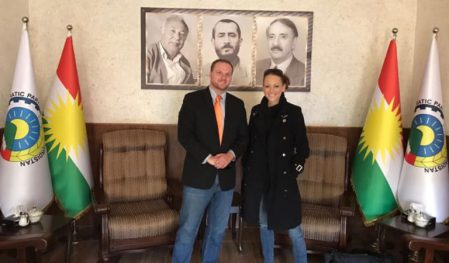
Clarion Project’s National Security Analyst Prof. Ryan Mauro & Legal Analyst Jennifer Breedon in Iraq with Hossein Yazdanpanah, the leader of the Kurdistan Freedom Party (PAK)

Its leader, Mustafa Hijri, said in a speech in Europe in October 2016 that his group was not fighting just for Iranian Kurds, but for the replacement of the current theocratic Iranian regime with a secular democracy for all. He asked the “progressive and democratic forces of the world” to support the PDKI and other Iranians seeking to topple the government.

Kurds are an oppressed minority in Iran, representing about 10 percent of the population (between 8 and 10 million people). According to the U.N., almost half of the political prisoners in Iran are Kurdish and about one-fifth of the executed prisoners last year were Kurdish.

******************************

Mark March 21 on your calendar. Six armed Kurdish parties in Iraq have united ahead of expected protests in Iran on that date. Both the Iranian regime’s Revolutionary Guards Corps and an Iranian Kurdish militia have held military exercises in preparation for expected conflict.

The six groups are preparing for protests in the Kurdish areas of Iran to celebrate the Kurdish New Year, Newroz, on March 21. Holiday events become the scene of political protests, Iranian regime repression and even clashes.

But the Kurdish alliance says this time will be different because they are unified, preparing in advance and agreed to jointly collect and share intelligence in January for a common defense against the Iranian regime.

“There always have been activities in Kurdistan for celebrating Newroz and these activities always are opportunities for people to express their resistance against the fact that they have been denied of their basic rights.

“Using symbols, songs and gatherings, youth in Newroz have always shown their anger and resentment toward the lasting oppression of Kurds in Iran,” explained the U.S. representative of the Democratic Party of Iranian Kurdistan (PDKI).

The PDKI recently held a military exercise near the border with Iran in preparation for a “full guerilla fight,” in the words of one of its officials. The Iranian Revolutionary Guards Corps likewise held a military exercise in the Kurdish-majority province of Kermanshah, where protests and clashes are expected.

PDKI has about 2,000 fighters in the border area between the autonomous Iraqi Kurdistan region and Iran. It declared the end of a 20-year ceasefire with Iran last year and openly said it was sending its Peshmerga fighters into Iranian Kurdistan, but would not fire the first shot.

The Kurdish Rudaw newspaper describes PDKI as “historically considered the most formidable Kurdish military organization opposing the Islamic Republic in Tehran.”

Clarion Project’s National Security Analyst Prof. Ryan Mauro & Legal Analyst Jennifer Breedon inside the headquarters of the Democratic Party of Iranian Kurdistan (PDKI) on a recent trip to Iraq.

Its leader, Mustafa Hijri, said in a speech in Europe in October 2016 that his group was not fighting just for Iranian Kurds, but for the replacement of the current theocratic Iranian regime with a secular democracy for all. He asked the “progressive and democratic forces of the world” to support the PDKI and other Iranians seeking to topple the government.

A Shiite political bloc within the Iraqi parliament called on the Iraqi government to kick out the Kurdish forces that fight the Iranian regime in January. The Kurdish parties attributed the move to Iranian influence, pointing out that it came after two bombings targeted the office of the PDKI in Koye, Iraq in December. Seven people died. The party blamed Iran for the attack.

Prior to the attack on the PDKI, Iranian Supreme Leader Ayatollah Khamenei accused Saudi Arabia of arming Kurdish opposition forces through its consulate in Iraqi Kurdistan. Khamenei demanded that the Kurdish Regional Government stop all opposition activity and close the Saudi consulate, neither of which happened.

The other Iraqi Kurdish parties in the alliance are the Kurdistan Democratic Party of Iran (KDPI), Khabat and three groups all bearing the name of Komala.

Another group that is likely to be active in the confrontation with Iran but is not part of the six-party alliance is the Kurdistan Freedom Party (PAK). I met their leader Hossein Yazdanpanah in January in Iraq at one of his camps near the battlefield with ISIS.

Kurds are an oppressed minority in Iran, representing about 10 percent of the population (between 8 and 10 million people). According to the U.N., almost half of the political prisoners in Iran are Kurdish and about one-fifth of the executed prisoners last year were Kurdish.

There was significant repression last year resulting in bloody clashes between the PDKI and other Kurdish militants on one side and the Iranian regime on the other. It received almost no attention from the West, a rather unsurprising development considering the U.S. turned away from Iran’s 2009 Green Revolution that could have positively changed the world.

If the Iranian Kurdish opposition in Iraq has its way, then the U.S. will have another opportunity to support the Iranian people. In my meetings with Iranian Kurds in Iraq, I was struck by how much hope they invested in the hope that, despite the U.S.’ mistakes and overlooking of their cause, the U.S. would eventually come around and support them—not only because it is in the U.S.” interest, but because America is a good country with good people.

America and the West more broadly should not repeat the mistakes of the past.

Let’s hope that when the Kurds rise up against the Iranian regime on March 21, they will be joined by a chorus of freedom-loving voices eager to see them triumph over Islamist tyranny.