Archive for the ‘Iran’ category

Relying on the U.S. for security is a mistake

May 21, 2015

Relying on the U.S. for security is a mistake, Al Arabiya News, Khalaf Ahmad Al Habtoor, May 21, 2015

(Al Arabiya is based in the United Arab Emirates and is majority-owned by Saudi broadcaster Middle East Broadcasting Center.– DM)

Obama says Iran’s newfound wealth will be used to improve lives rather than end up in the treasure chests of Hezbollah, the Shiite Yemeni Houthis, or other troublemakers under the Iranian wing. Sorry, but to me that smacks of naivety at best, snake oil at worst.

According to a Daily Telegraph investigation, Iran’s Supreme Leader controls “a financial empire” estimated to be worth $95 billion, more than even the grandiose Shah had managed to accumulate. That alone should tell Mr Obama that Iran has no intention of prioritising the needs of its people over its regional mischief makers.

****************

At a passing glance, President Barack Obama’s meetings with the leaders of the Arab Gulf States have borne fruit in terms of furthering mutual respect and as a building block to closer cooperation. But when one digs beneath the flimflam and the verbal pledges – with the exception of a joint missile defense system and a promise that deliveries of U.S. weapons would be fast-tracked – the recent Camp David Summit delivered few tangible benefits.

Indeed, more than a few commentators have described the meeting as a U.S.-hosted arms bazaar, one that will fill the coffers of American weapons manufacturers with billions of dollars. Plus the P5+1 – Iranian nuclear deal is set to enrich and empower Tehran once economic sanctions are lifted.

Obama says Iran’s newfound wealth will be used to improve lives rather than end up in the treasure chests of Hezbollah, the Shiite Yemeni Houthis, or other troublemakers under the Iranian wing. Sorry, but to me that smacks of naivety at best, snake oil at worst.

According to a Daily Telegraph investigation, Iran’s Supreme Leader controls “a financial empire” estimated to be worth $95 billion, more than even the grandiose Shah had managed to accumulate. That alone should tell Mr Obama that Iran has no intention of prioritising the needs of its people over its regional mischief makers.

Eradicating terrorism

The question is whether the leaders of the GCC countries should rightly feel secure from Iranian aggression now that the U.S. President has promised to come to their defense, militarily if deemed necessary. Naturally, that assessment would be made by the White House, not by the threatened states.

Without a signed and sealed security pact and in light of Obama’s track record of hesitancy in ending regional conflicts or eradicating terrorism, I don’t think so. Are we seriously to believe that the U.S. would declare war on Iran were we to be menaced?

Obama’s rhetoric speaks otherwise when he told the New York Times that internal threats to Gulf States are “bigger than Iran” and, at Camp David, he warned his guests not to “marginalise” Tehran. And even if Obama’s undertaking was rock solid, his term expires in just over 18 months. What happens then?

In any case, while there is nothing wrong with cementing better relations with the U.S., we must not on any account rely on its protection or that of any other world power. Yemen proves that we are able and willing to protect ourselves and our allies and when the proposed Joint Arab Force comes into play, our capabilities will be strengthened. We have no need of guardians or bosses in foreign capitals. We have strong, well equipped armies and air forces. We are not helpless, underage youths pleading to be defended, as characterised by sectors of the media.

Merely a public relations exercise

I would urge GCC heads of state to put Camp David under a microscope to ascertain whether it was a genuine attempt on Obama’s behalf to induce closer ties or merely a public relations exercise to bring Gulf States on board a bad deal rewarding Iran for its hostility, regional interference and its backing of terrorists.

In my opinion, trusting the Obama administration to rein in Iran would be a huge mistake. U.S. engagement with Iran was exactly the legacy Obama was after even before he moved into the Oval Office. And to that end he surrounded himself with pro-Iranian officials, such as Vice President Joe Biden, Secretary of State John Kerry and Deputy Secretary-of-State Bill Burns, who have all been championing détente with Iran for many years.

Obama’s personal adviser and family friend, Valerie Jarrett grew up in Iran, speaks Farsi, and was a main player along with Bill Burns in U.S.-Iranian secret talks to pave the way for official negotiations. The President’s National Security Council Director for Iran, Sahar Nowrouzzadeh is a former employee of the National-Iranian American Council, a pro-Iranian lobbying organisation.

The President’s own behaviour with regards to America’s long-time sworn enemy was suspect since the beginning. He has been sending the Iranians video Nawrus (New Year) messages and letters to Iran’s Supreme Leader. This year, Obama actually celebrated the Persian New Year at home with his wife and daughters.

Just as strange was Obama’s silence concerning Iran’s crackdown on street protests following elections. And if he condemns Tehran for its human rights abuses and lack of civil liberties, he must be whispering. Because all we hear from him is condemnation of predominately Sunni Arab states on those issues.

“The greatest supporter and plotter of terrorism”

Stranger still, while Obama comes across as the ayatollahs’ new best friend, just days ago, the Ayatollah Khamenei attacked the U.S. as “the greatest supporter and plotter of terrorism” and accuses Washington of pursuing its own interests making the region insecure, while branding America as the enemy of both Shiite and Sunni Muslims. Far from committing to stay out of Arab affairs, Khamenei stressed that his country would continue supporting “the oppressed people of Yemen, Bahrain and Palestine in every way possible.”

Are we really going to place our trust in America’s Commander-in-Chief when he claims backing the Free Syrian Army against the Syrian regime partnered with Iran and Hezbollah, even as his Air Force provides air cover to Iran’s Quds Force and pro-Iranian Shiite militias in Iraq’s Anbar province? This rabble with blood-stained hands – officially known as Popular Mobilisation Forces (Al-Shaabi) – has been deployed by Prime Minister Haider Al-Abadi and is directed by the commander of Iran’s Quds Force Qassem Soleimani. What is worse is that Iran is poised to send in ground troops as soon as it receives the go ahead from the government.

And what does Mr Obama say about the shocking news revealed by the Times and other papers to the effect that the government in Baghdad is turning away tens of thousands of desperate Sunni refugees fleeing the city of Ramadi, recaptured by ISIS? Nothing much as far as I can tell! Iraq families with nowhere to go are being treated worse than foreign foes, barred entrance into their own capital city unless they happen to have a local “guarantor.” This is a plan to reduce the Sunni population by sending them into the fray to die; there is no other explanation.

In reality, Saudi Arabia’s towns bordering northern Yemen are under direct threat from Houthis, while Iran, close to being literally under the Iranian boot, constitutes a grave threat to Gulf States. Does the Obama administration plan to wait until the horse has bolted before acting? The Iranian plot to dominate the region is taking shape before our eyes. We are being surrounded. Yet the U.S. president asks us to play nice with the plotters.

Qualitative military edge

The bottom line is we did not get what we asked for. Obama’s commitment to intervene in Syria to stop the regime’s killing spree was off the table along with a joint defense pact on the lines of those the U.S. has with Israel, Japan and South Korea. Moreover, he has turned down the Saudi request to purchase state-of-the-art F-35 Joint Strike Fighters to maintain Israel’s qualitative military edge over its neighbors.

And we certainly did not get what we need. Most importantly, any final agreement with Iran should be negotiated with the participation of Gulf states and co-signed by our leaders. Such agreement should not be limited to nuclear issues, but should be conditional upon Tehran’s commitment to quit meddling in the affairs of Arab countries, notably Syria, Lebanon, Iraq, Yemen and Bahrain whether directly (in the case of Iraq and Syria) or via its armed proxies (Lebanon and Yemen).

We should not trust any other countries but our own. We must not await instructions from the White House on how to pursue our own interests, as it is well-known that U.S. friendship is not proffered without strings. We must proceed with our mission to free Yemen of Houthi rabble, continue with our efforts to destroy ISIS and lend every support to that sector of the Syrian opposition fighting for a democratic, inclusive state – as opposed to terrorist groups that seek to drag Syria back to the Middle Ages.

Lastly, we should insist upon the stringent terms outlined above. And if those terms are not put in writing, the GCC should work to weaken the Iranian regime once and for all, beginning with material support for the oppressed Ahwazi Arab citizens of Iranian-occupied Arabistan – a region Iran now calls Khuzestan, which supplies the country with most of its oil and gas.

I fear that Camp David was a well-timed bluff and its weapons bounty no more than candies to sweeten the pill. I trust and believe that our leaders understand the score and will maintain independent strategies to counteract threats to our very existence. We cannot gamble with tomorrow on the words of one man, even if that man is the U.S. president.

Our region has been burned many times before. If the past is a good predictor of the future, we should recognise that ultimately we must become the masters of our own destiny, which is far too precious to be handed to the safekeeping of fair-weather friends.

Strategic Failures, the US and the Fall of Ramadi

May 21, 2015

Strategic Failures, the US and the Fall of Ramadi, Clarion ProjectRyan Mauro, May 21, 2015

Islamic-State-Victory-Parade-HPIslamic State fighters celebrate their take over of Ramadi with a victory ‘parade.’ (Photo: Islamic State social media)

The U.S. must correct its strategy by sidelining Iranian-backed militias and terrorists, leveraging influence with the Iraqi government and significantly increasing assistance to the Anbar tribes, Kurds, Iraqi government and to the persecuted Christian minority that is forming its own self-defense force.

Recent history has shown that the Iraqi government will choose the U.S. over Iran if compelled.

********************

The Islamic State (ISIS) has captured Ramadi, the capital of Iraq’s Anbar Province, reportedly “terrifying” Iraqi officials who now foresee a “tsunami of international terror.” It is an important achievement for the terrorist group aimed at pre-empting a potential Sunni tribal uprising.

The Sunni tribes in Anbar Province were critical to the success of the 2007 “surge” that ousted the Islamic State’s predecessor, Al-Qaeda in Iraq. The deterioration in the relationship between these tribes and the central Iraqi government was likewise critical to the terrorists’ comeback in Iraq.

The Islamic State remembered these lessons and acted quickly as the Iraqi government began training tribal fighters and the U.S. defense budget allotted $179 million to Kurdish and Sunni tribal forces. The U.S. forgot these lessons and has long rejected Sunni and Kurdish pleas for direct aid to fight the Islamic State.

The Obama Administration is now planning to change course and directly arm and train the Iraqi Sunni tribes after the fall of Ramadi. The White House previously chose to work only through the central Iraqi government that has given the Kurds and Sunnis inadequate support.

A delegation of 11 Sunni tribal leaders, including Sheikh Ahmed Abu Risha, the President of the Anbar Awakening Council, flew to the U.S. on January 18 to plead for direct assistance. Former President George W. Bush called Abu Risha and listened to his complaints for 20 minutes and offered to help. Administration officials were less willing. One tribal official said, “I wouldn’t call it the ‘cold shoulder,’ but it certainly was a cool one.”

The Obama Administration told them that it would only work through the elected central government. Its viewpoint was that working with forces outside the government’s authority undermines the Iraqi leadership and threatens the country’s unity.

That standpoint ignores what was learned after the fall of Saddam Hussein. Nothing threatens Iraq’s unity and the government’s authority more than instability. Direct U.S. aid to the Sunni tribes helped save Iraq from disintegration into sectarian enclaves ruled by terrorists and militias.

The Islamic State struck Ramadi during a sandstorm that delayed American air support. Former U.S. Central Command advisor Ali Khedery says that a Kurdish member of parliament informed him that 6,000 Iraqi Security Forces fled when faced with a mere 150 Islamic State fighters. About 500 Iraqi security personnel and civilians died in two days. The Iraqi officials spoke straight forwardly and  admitted that the current strategy is failing.

The Pentagon says it has finished training about 7,000 Iraqi Security Forces and another 3-4,000 are in the process of training, but training won’t solve the problem of collapsing Iraqi forces. The U.S. trained the Iraqis from 2003 until the withdrawal in 2011. The strategy of waiting for the Iraqi security forces to become strong enough to stabilize the country is the same strategy that failed before the surge.

Iraqi personnel flee because they don’t want to die for a lost cause or to fight for a replacement worse than the Islamic State.

The Iraqi Security Forces face a fundamental disadvantage when battling the Islamic State: They want to live and their enemies want to die. This disadvantage is further compounded by a lack of confidence. If given the choice to die fighting in a losing battle or to flee and perhaps regroup later with better chances of victory, they will choose the latter.

An Anbar official placed the blame on the Iraqi government, telling CNN, “If 10% of the government’s promises had been implemented, Ramadi would still in our hands and the Islamic State wouldn’t dare to be anywhere near the city.”

Iraqi Sunnis are faced with a terrible choice. The Iranian-backed Shiite militias are often nicknamed “Shiite ISIS” because their crimes are comparable to ISIS but are less known by the West because they aren’t broadcasted. However, the Anbar Provincial Council is officially welcoming them now out of desperation and perhaps an awareness that their opposition will be ignored anyway.

The Shiite militias should be expected to mistreat the local Sunnis the second after the Islamic State is expelled or even during the fighting. Tribal support is far from unanimous. The son of the largest tribe’s leader is in the U.S. asking for support right now and bluntly warned that sending the Shiite militias into Anbar Province “will cause a civil war.”

The New York Times has noticed the change in American attitude towards the Shiite militias. Pentagon spokesperson Col. Steve Warren said, “As long as they’re controlled by the central Iraqi government, there’s a place for them.” Yet, only two months ago, Central Command Commander General Austin said, “I will not—and I hope we will never—coordinate or cooperate with Shiite militias.”

The U.S. must correct its strategy by sidelining Iranian-backed militias and terrorists, leveraging influence with the Iraqi government and significantly increasing assistance to the Anbar tribes, Kurds, Iraqi government and to the persecuted Christian minority that is forming its own self-defense force.

Recent history has shown that the Iraqi government will choose the U.S. over Iran if compelled.

In March, the U.S. withheld support to Iraqi forces fighting the Islamic State in Tikrit because of the involvement of Iranian-backed militias and the Revolutionary Guards Corps. The Iranian proxies stalled and could move no further, displaying the value of U.S. air support. The Iraqis chose America and the Iranians were removed from the battle. U.S. aid delivered the victory that the Iranians could not.

The Iraqis had been asking for U.S. for more help including possibly advisors on the ground since October 2013. By March 2014, the Iraqis were asking for airstrikes on the Islamic State. The Islamic State blitz into Iraq began in June.

The Iraqi ambassador complained that the U.S. had denied requests for help including Apache helicopter sales, thereby putting Iraq “in an uncomfortable position in seeking support from whoever is available on the ground.” He emphasized that the “U.S. is our strategic partner of choice.”

Iran opposed the return of U.S. soldiers on the ground in Iraq as advisors. The Iranian-backed cleric Moqtada al-Sadr threatened to attack the advisors and two other Iranian-backed militias alsoforcefully opposed U.S. involvement. The Iraqi government went ahead anyway.

Even now, Iraqi Prime Minister Haider al-Abadi is in Russia and talking to China and Iran about delivering arms that the U.S. refuses to provide.

The U.S. needs to give the Iraqi government a clear choice: Iran or us.

The Iraqi government should be put on notice. If it is willing to restrain the Shiite militias and work with us to disband them, then we will provide all necessary aid. We will help negotiate with the Sunni tribes so their local forces operate within a national framework.

If the Iraqi government chooses Iran, then we will cut our aid and redirect it towards our Sunni, Kurdish and Christian partners while maintaining contact with friendly Shiites. We will not act as the air force for Iranian proxies. If necessary, we will talk about a role for the forthcoming Arab force led by Egypt to replace yours.

It is positive news that the Obama Administration is reversing its stance and will directly help the Sunni tribes, but the anti- Islamic State strategy requires an anti-Iran strategy.

Next challenge for US after Ramadi defeat: Iranian ship nears Yemeni shore

May 19, 2015

Next challenge for US after Ramadi defeat: Iranian ship nears Yemeni shore, DEBKAfile, May 19, 2015

Iran_Shahed_21.5.15Iranian aid vessel with “medical relief” personnel

DEBKAfile’s analysts strongly doubt that the USS Theodore Roosevelt carrier and strike force, which have been monitoring the Iranian flotilla’s movements, will be ordered to intervene against the Iranian ships reaching the Yemeni port.

Tehran, for its part has threatened to treat any such inspections as an act of war.

********************

Tuesday, May 19, two days after Ramadi’s fall to the Islamic State landed a major blow to Baghdad and US strategy in the region, 10,000 troops – more than half American – ended a large US-led military exercise in Jordan that was designed to practice tactics for countering ISIS. Taking part surprisingly in the two-week exercise was a heavy US nuclear-capable B-52H bomber, which flew in from the United States, crossing through Israeli air space and returning to home base when it was over.

This was the first time in the 12 years since the US invasion of Iraq that a B-52H, which can deliver nuclear weapons and bunker buster bombers, has appeared in Middle East skies for any military mission.

East of Jordan, as some 25,000 refugees from Ramadi slept in the open, the Islamist conquerors began moving on their next target, the Habbaniyah air base some 70 km west of Baghdad. Its fall would cut Baghdad off from northern and eastern Iraq and place it under siege from three directions – north, east and west.

Most Arab members have dropped out of the US-led coalition committed to fighting the Islamist terrorists in Iraq and Syria. This has left the US Air Force to bear the brunt of the aerial campaign. Its average of 19 air strikes a day is far too few to have any real effect on ISIS’s battle momentum. It certainly did not stop the long columns of black-clad Islamist fighters swarming on Ramadi from all directions in hundreds of tanks, APCs and minivans armed with heavy machine guns, and taking control of the capital of Iraq’s largest province, Anbar.

Western intelligence from the Ramadi region offered disturbing accounts of thousands of fully-armed ISIS fighters springing up apparently from nowhere to descend on the city, with no one able to see where they came from and no air action to scatter them before they entered the city.

After the Ramadi defeat, the Obama administration’s next major test in the region comes from an Iranian cargo vessel heading, accompanied by two warships, for the Yemeni Red Sea port of Hodeida and scheduled to dock Thursday, May 21. According to Tehran, the ship will unload 2,500 tons of humanitarian aid for Yemen, and the hundreds of passengers who disembark are Red Crescent medical relief workers.

The Saudi, US and Egyptian fleets have imposed a sea and air blockade on Yemen to prevent Iran provding the Yemeni Houthi rebels with fresh arms. Saudi and other regional intelligence agencies are convinced that the “paramedics” are in fact Revolutionary Guards officers and instructors in disguise, sent to strengthen the Houthi revolt.

Washington, Riyadh and Cairo have all vowed to stop the Iranian flotilla from putting into port in Yemen and said that its vessels will be forced to submit to inspections to make sure no illicit weapons are aboard and to confirm the passengers’ identities.

Tehran, for its part has threatened to treat any such inspections as an act of war.

Deputy Revolutionary Guards Commander Gen. Masoud Jazayeri put it plainly when he said: “I am distinctly stating that the patience of Iran has limits. If the Iranian aid ship is prevented from reaching Yemen then they, Saudi Arabians and United States, should expect action from us.”

DEBKAfile’s analysts strongly doubt that the USS Theodore Roosevelt carrier and strike force, which have been monitoring the Iranian flotilla’s movements, will be ordered to intervene against the Iranian ships reaching the Yemeni port. It is not a good moment for President Barack Obama to upset Tehran when he is in dire need of the Iraqi Shiite militias controlled by Iran to stand up to ISIS before its columns reach Baghdad.

Without the US, it is hard to see Saudi and Egyptian warships directly engaging an Iranian naval force and risking a major military conflagration.

Therefore, just as the B-52H came and went without action to impede ISIS’s creep closer to Baghdad, the Roosevelt is not likely to halt Iranian warships before they reach Yemen.

How the Islamic Republic Is Manipulating the U.S.

May 19, 2015

How the Islamic Republic Is Manipulating the U.S., Front Page Magazine, May 19, 2015

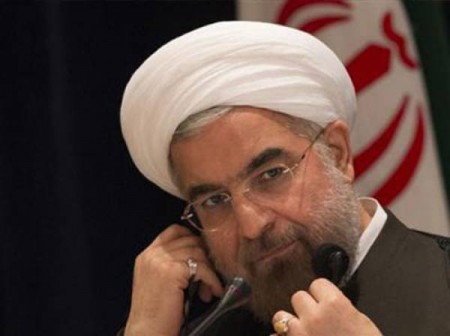
iran-s-rouhani-phones-pm-nawaz-after-soldier-s-killing-1395854702-4802-450x336

Rouhani and the moderate camp have persuaded Ayatollah Ali Khamenei that superficial diplomatic ties with the Obama administration will, in fact, empower the Islamic Republic, further its hegemonic ambitions, and raise Tehran’s economic status without the need for the Iranian leaders to give up on their revolutionary principles, anti-Americanism and anti-Semitism.

****************

There is a crucial Machiavellian (but not a strategic) tactical shift in the Islamic Republic’s foreign policy and its pursuit of regional preeminence.

First of all, Iranian leaders have realized that by superficially showing the Obama administration that the Islamic Republic is willing to restore diplomatic ties with his administration, they can in fact further advance their ideological and national interests.

Second, knowing that President Obama is desperate for a “historic” nuclear deal and the establishment of diplomatic ties with the Islamic Republic, Iranian leaders have played the role very well by attempting to satisfy President Obama’s empty goals.

Third, the ruling clerics of the Islamic Republic became cognizant of the fact that dealing with the Obama administration does not necessarily mean that they have to give up anything with respect to its domestic suppression, revolutionary Islamist principles, human rights abuses, regional hegemonic ambitions, anti-Americanism, hatred towards Israel, and foreign policy objectives.

The tactical shift, currently, is to satisfy President Obama’s personal and shallow objectives by allowing him to project that he is making historic moves (such speaking on the phone with the Iranian leaders), while simultaneously pursuing their own ideological objectives.

For example, most recently, Rouhani and the Obama administration agreed on opening new diplomatic offices in Tehran and Washington. For President Obama, opening diplomatic offices can be viewed as another “historic move” cited in his records or on his Wikipedia page. From the perspective of Iranian leaders, it is a crucial pillar for the advancement of Iran’s foreign policy and ideological objectives in the region without pressure from the US.

To pursue their objectives more efficiently, Iranian leaders have agreed to meet frequently with the diplomats at the highest level of the Obama administration, “negotiating,” and having some of their interactions publicly televised on American and Western media. In addition, the American and the Iranian flags are repeatedly shown next to each other in the high level meetings.

These moves, in fact, give legitimacy to the theocratic regime to further its ambitions.

The president was also delighted to make another “historic move” by speaking on the phone with his Iranian counterpart, President Hassan Rouhani. (One would wonder what a great accomplishment it is to pick up a phone and call another president.)

Washington and Tehran broke diplomatic ties in 1979. After the hostage crisis, high American officials and diplomats have not set foot on the Iranian soil due to Iran’s continuous violation of international norms and anti-Americanism.

Nevertheless, President Obama and Secretary of State John Kerry have decided to turn a blind eye on Iran’s egregious human rights abuses, aggressiveness and violations of international laws.

In another shallow move, Kerry claimed to be proud to set foot on Iranian “territory.” He met with Iran’s Foreign Minister, Mohammad Javad Zarif, at the residence of the Iranian ambassador to the United Nations, Gholamali Khoshroo, in New York.

Instead of attempting to change the behavior of the Ayatollahs and their revolutionary principles, President Obama and Kerry are satisfied with these superficial “historic moves.”

Since Iran’s political establishments and policies are driven, not solely by national and geopolitical interests, but also by ideological Islamist (Shiite) principles, hardliners and the office of the Supreme Leader will always view a real rapprochement with the US as taboo.

Restoring full diplomatic ties can also be analyzed as betraying the revolutionary principles of the Islamic Republic, which were based on anti-Americanism, as well as their opposition to Western models of socio-political and socio-economic landscapes.

From the perspective of Iran’s Supreme Leader, Ayatollah Ali Khamenei — who has the final say in foreign policy decisions — genuine diplomatic ties with the US will lead to the empowerment of Iranian civil society and secular factions. From the prism of the senior cadre of the IRGC, relationships with the American government might lead to the opening of the Iranian market, endangering the economic monopoly of IRGC institutions.

On the other hand, Rouhani and his technocrat team, who share the same objectives with the hardliners and want to preserve the interests of the Islamic Republic, came to the realizations that satisfying President Obama’s superficial and shallow objectives of “historic moves,” can indeed assist them in advancing their ambitions.

In conclusion, similar to the ongoing nuclear negotiations, Rouhani and the moderate camp have persuaded Ayatollah Ali Khamenei that superficial diplomatic ties with the Obama administration will, in fact, empower the Islamic Republic, further its hegemonic ambitions, and raise Tehran’s economic status without the need for the Iranian leaders to give up on their revolutionary principles, anti-Americanism and anti-Semitism.

Kerry – North Korea can have a great nuke deal like Iran if it becomes as moderate

May 17, 2015

Kerry – North Korea can have a great nuke deal like Iran if it becomes as moderate, Dan Miller’s Blog, May 17, 2015

(The views expressed in this article are mine and do not necessarily reflect those of Warsclerotic or its other editors. — DM)

North Korea played those negotiating its denuclearization for fools, much as Iran has been doing more recently with Obama. It must not have been difficult to do. To continue the process with Iran, and to repeat it with North Korea, makes no sense.

Speaking in the People’s Republic of China on May 16th, Secretary Kerry offered North Korea a nuke deal

Kerry explained that an Iran deal could help in showing North Korea how “your economy can do better, your country can do better, and you can enter into good standing with the rest of the global community by recognizing — just like Iran — that there is a verifiable, irreversible, denuclearization for weaponization, even as you can have a peaceful nuclear power program.”

Iran has not agreed to “a verifiable, irreversible, denuclearization for weaponization” and likely never will. On April 15th, Iran disputed the accuracy of the Obama Administration’s April 2nd “fact sheet,” which had made such claims about the deal. In the highly unlikely event that Iran were it to claim to do accept such terms, it would “cheat” as it has done in the past. In this video, John Bolton speaks about the “deal” with Iran as well as the North Korean connection.

Nevertheless, Iran has already received many of the rewards of essentially irreversible sanctions relief, including augmented power, both military and financial, in the Middle East.

A deal like the one Iran is about to get by virtue of the Iran scam should be welcomed by North Korea. The countries have long cooperated on nukes and missile development, a matter apparently ignored during Obama’s P5+1 “negotiations” with Iran.

Kerry also said,

the United States will continue to work with its partners “to make it absolutely clear to the DPRK that their actions, their destabilizing behavior — unlike Iran’s — is unacceptable against any international standard.” [Emphasis added.]

Iran’s destabilization efforts and successes are, in Kerry’s view, apparently not “against any international standard.” Yet Iran does far more regional destabilizing than does North Korea — North Korea mainly relies upon bellicose bluster (with infrequent military actions against South Korea). Iran — a major if not the most active sponsor of terrorism —  sends its proxies throughout the Middle East while accusing America and others of destabilization. A likely “signing bonus” of up to fifty billion dollars for Iran if and when the “deal” is finalized will substantially further Iran’s hegemonic ambitions and power as well as its missile and nuclear weapons development.

Here’s a video of Iran having some fun:

According to Hossein Salami, Deputy Commander of the Iranian Revolutionary Guard, Iran welcomes war with the United States:

This North Korean propaganda video purports to displays North Korean military prowess:

Conclusions

The rogue nations of Iran and North Korea are both intent upon maximizing their nuclear weapon capabilities. Both are totalitarian and have obscene human rights records. To trust either would be a gross mistake; yet that appears to be what Obama intends to do.

The only thing notably missing from Kerry’s offer is a requirement that North Korea abandon the Religion of Kim and adopt the glorious “Religion of Peace” instead. That would help North Korea to fit even better than at present into Obama’s policy of supporting America’s enemies and rejecting her friends. If Kim Jong-un would merely recognize Allah as the superior power, perhaps he could become the first Korean Ayatollah. Obama would probably be thrilled were North Korea to become the Democratic Islamic Republic of Korea (DIRK).

Kerry: Iran Nuclear Deal Could Be Lesson for North Korea

May 16, 2015

Kerry: Iran Nuclear Deal Could Be Lesson for North Korea, ABC News, Matthew Lee, May 16, 2015

(Please say that you will stop destabilizing the region, have a good human rights record and become moderate like The Islamic Republic of Iran and we will grant all concessions you seek. Pretty please? — DM)

U.S. Secretary of State John Kerry said Saturday he is hopeful that the successful conclusion of a nuclear deal with Iran will send a positive message to North Korea to restart negotiations on its own atomic program.

Speaking at a joint news conference with Chinese Foreign Minister Wang Yi in Beijing, Kerry said he believed an Iran agreement could have “a positive influence” on North Korea, because it would show that giving up nuclear weapons improves domestic economies and ends isolation. He stressed, though, that there was no way to tell if North Korea’s reclusive leadership would be able to “internalize” such a message.

“I am sure Foreign Minister Wang would join me in expressing the hope that if we can get an agreement with Iran, … that agreement would indeed have some impact or have a positive influence” on North Korea, Kerry said.

Although Wang did not appear to respond, Kerry explained that an Iran deal could help in showing North Korea how “your economy can do better, your country can do better, and you can enter into good standing with the rest of the global community by recognizing that there is a verifiable, irreversible, denuclearization for weaponization, even as you can have a peaceful nuclear power program.”

“Hopefully that can be a message, but whether or not DPRK is capable of internalizing that kind of message or not, that’s still to be proved,” he said, referring to North Korea by the acronym of its official name, the Democratic People’s Republic of Korea.

International negotiators are rushing to finalize a nuclear deal with Iran by the end of June under which Iran’s program would be curbed to prevent it from developing atomic weapons in exchange for the lifting of international sanctions that have crippled its economy.

Nuclear talks with North Korea, which has already developed atomic weapons despite previous attempts to forestall it, broke down three years ago as it has continued atomic tests and other belligerent behavior, including ballistic missile launches.

North Korea conducted its first nuclear test in 2006 and is now believed to have at least 10 such weapons despite some of the toughest international sanctions in existence. It conducted its third nuclear test in February 2013, and U.S.-based experts forecast that it could increase its nuclear arsenal to between 20 and 100 weapons by 2020.

Kerry travels on Sunday to South Korea, where North Korea will be a major topic of discussion.

He said the United States will continue to work with its partners “to make it absolutely clear to the DPRK that their actions, their destabilizing behavior is unacceptable against any international standard.”

Obama’s Not-So-Ironclad Guarantee

May 15, 2015

Obama’s Not-So-Ironclad Guarantee, Commentary Magazine, May 15, 2015

Now that the nuclear deal makes an Iranian bomb only a matter of when rather than if, the Gulf nations were hoping for more than just a carefully worded expression of American indifference.

***********

This was supposed to be the week when President Obama put on a show of his desire to reaffirm America’s support for its Arab allies. Saudi Arabia and the other Gulf states have spent the last year in the unusual position of agreeing more with Israel than the United States, as Obama pushes for détente with Iran. Like the Israelis, the Arabs are pondering their future in a region dominated by an Iranian nuclear threshold state that appears to be the lynchpin of the president’s foreign policy legacy. So to demonstrate his good will, Obama invited these nations to a summit at which he would convince them they had nothing to fear. But with the U.S. putting nothing on the table of substance that would allay those concerns about the weak nuclear deal being negotiated with Iran, the Saudi king and other leaders snubbed the event, turning it into a fiasco even before it began. But it turned out King Salman didn’t miss much. Though Obama offered what he called an “ironclad guarantee’ of America’s support for the Arabs, it was phrased in the kind of ambiguous language that rendered it meaningless. The meeting and especially the statement epitomized an Obama administration foreign policy that puts a premium on appeasing foes and alienating friends.

The wording of the president’s “guarantee” is a marvel of lawyerly ambiguity that any connoisseur of diplomatic doubletalk must appreciate:

In the event of such aggression or the threat of such aggression, the United States stands ready to work with our GCC partners to determine urgently what action may be appropriate, using the means at our collective disposal, including the potential use of military force, for the defense of our GCC partners.

Let’s unpack this carefully so we’re clear about what the United States isn’t promising its Arab allies. As even Obama’s cheerleaders at the New York Times noted, this “carefully worded pledge that was far less robust than the mutual defense treaty the Gulf nations had sought.” In the event of aggression, the U.S. isn’t going to spring into action to defend them. Instead it will “work” with them to “determine” what they might do. That falls quite a bit short of a hard promise of collective action, let alone the drawing of a line in the sand across which the Iranians may not cross. In other words, if something bad happens, Obama will talk with the threatened parties but he won’t say what he will do in advance or if he will do anything at all. If that is an “ironclad guarantee,” I’d hate to see what a less binding promise might sound like.

To understate the matter, this is not the sort of pledge that will deter an Iran that is emboldened by its diplomatic victory in the negotiations that let them their nuclear infrastructure and continuing working toward a bomb. Iran’s push for regional hegemony has also been boosted by the triumph of their Syrian ally Bashar Assad with the help of Tehran’s Hezbollah terrorist auxiliaries. With the Iran-backed Houthi rebels threatening to take over Yemen and Iran also resuming its alliance with Hamas in Gaza, the axis of Iranian allies has Arab states understandably worried about their future. Now that the nuclear deal makes an Iranian bomb only a matter of when rather than if, the Gulf nations were hoping for more than just a carefully worded expression of American indifference.

That’s why the statement at the end of the summit made no mention of America’s chief worry about the Gulf states: the possibility that the Saudis will, either acting alone or in concert with their neighbors, seek to match Iran’s nuclear potential. As critics of the Iran deal foretold, far from saving the Middle East from an Iranian bomb, it has set off an arms race that has will make the world a fare more dangerous place.

This omission will likely make the Iranians even more reluctant to give in to U.S. demands about sanctions, Tehran’s military research and the disposition of its stockpile of enriched uranium in the final stages of the nuclear talks. A better guarantee for the Arabs might have convinced the Islamist state that the president really meant business about strengthening the deal. In its absence, they have no reason to think Obama won’t fold as he has at every other stage of the negotiations.

Under the circumstances, it’s little wonder that Bahrain’s King Hamad preferred to go to a horse show London rather than confer with Obama. Just as Israel has learned that the United States is more interested in a new Iran-centric policy than it backing its traditional allies, so, too, must the Arabs come to grips with a new reality in which their Iranian foe is no longer restrained by the United States.

FIG LEAVES FALLING

May 15, 2015

Fig leaves falling, Power LineScott Johnson, May 14, 2015

Certain impediments complicate Barack Obama’s selling of the arrangement with the Islamic Republic of Iran. Obama seeks to camouflage the arrangement as one that deters Iran from the acquisition of nuclear weapons. In reality, the arrangement will finance and expedite the mullahs’ acquisition of nuclear weapons.

John Kerry has issued ludicrous “guarantees” in connection with the arrangement. One such guarantee is categorical, but it’s not a money-back sort of a guarantee: “I say to every Israeli that today we have the ability to stop [the Iranians] if they decided to move quickly to a bomb and I absolutely guarantee that in the future we will have the ability to know what they are doing so that we can still stop them if they decided to move to a bomb.”

We may doubt the omniscience that is the predicate of Kerry’s guarantee. But this is strictly a limited warranty. Kerry doesn’t even “guarantee” that his boss would do anything about it if Iran were to break out. Kerry only guarantees that “we” could. Good to know. Kerry’s “guarantee” amounts to nothing more than meaningless verbiage two or three time over.

The arrangement will also provoke an equal and opposite reaction from the Sunni rivals of Iran such as Saudi Arabia. The Sunni rivals understand the nature of the arrangement in process. Their understanding accounts for Obama’s “lonely Arab summit.”

President Obama’s dubious fact-sheet setting forth Parameters for a Joint Comprehensive Plan of Action reflects the fig leaves with which the president seeks to cover the nuts of the deal. Senator Rubio couldn’t get to first base in his proposal requiring any final deal to include the fig leaves. (Eli Lake dubbed it “Rubio’s new and improved poison pill.”)

The fig leaves are falling. The official Farsnews outlet reports that inspection of military sites is not included in the arrangement in process — this according to Iranian envoy to the IAEA Reza Najafi and despite the alleged parameter requiring Iran “to grant access to the IAEA to investigate suspicious sites or allegations of a covert enrichment facility, conversion facility, centrifuge production facility, or yellowcake production facility anywhere in the country.”

The alleged parameters regarding sanctions provide that Iran “will receive sanctions relief, if it verifiably abides by its commitments” and that “•U.S. and E.U. nuclear-related sanctions will be suspended after the IAEA has verified that Iran has taken all of its key nuclear-related steps. If at any time Iran fails to fulfill its commitments, these sanctions will snap back into place.”

We have already learned that President Obama intends to reward Iran with a huge “signing bonus” at the outset of the arrangement. He will agree to the removal of all United Nations sanction on Iran at the same time. He will also waive our own statutory sanctions on Iran. Just about the last fig leaf remaining on this element of the deal is the (utterly meaningless) assertion: “If at any time Iran fails to fulfill its commitments, these sanctions will snap back into place.”

Now Bloomberg News reports that this fig leaf is falling too: “Russia rejects automatic sanctions return if Iran cheats on deal.” Bloomberg quotes Russia’s UN Ambassador Vitaly Churkin bluntly asserting yesterday, “There can be no automaticity, none whatsoever” in reimposing UN sanctions if Iran violates the terms of an agreement to curb its nuclear program.

Omri Ceren writes to comment this morning (footnotes omitted):

The statement really shouldn’t count as breaking news, even though it is. Reuters reported toward the very end of Lausanne that the Russians and Chinese were still rejecting the multilateral snapback. But then the Lausanne announcement happened, and President Obama declared from the Rose Garden that in fact “if Iran violates the deal, sanctions can be snapped back into place.” But then a week later the Associated Press reported that, no, “Russia and China are unlikely to accept any process that sees them sacrifice their veto power.”

At the end of April the American Enterprise Institute quoted Russian Deputy Foreign Minister Sergey Ryabkov saying the exact same thing that Churkin just told Bloomberg News: “in the hypothetical situation that Iran should fail to honour its commitments, then this process should not in any way be automatic.”

And yet the policy conversation has been proceeding as if multilateral snapback is actually a real thing that could happen in our reality.

Part of the reason is that snapback is all the Obama administration has left on the sanctions debate. White House officials had assured lawmakers for literally years that sanctions relief would be phased out only as Iran met a series of nuclear obligations. But after Lausanne, Supreme Leader Ayatollah Ali Khamenei set a new red line, in which he demanded that the relief must be immediate. The administration began trying to find ways to concede to his demand without violating its previous “phase out” promises, which is how the WSJ’s scoop about a $50 billion signing bonus came to be.

That apparently didn’t work, and so instead the administration went all-in on snapback. At his press conference with Renzi in the middle of April the President signaled the that he was prepared to cave on upfront sanctions relief because – he told journalists – what was actually important was snapback: “with respect to the issue of sanctions coming down, I don’t want to get out ahead of John Kerry and my negotiators… [o]ur main concern here is making sure that if Iran doesn’t abide by its agreement that we don’t have to jump through a whole bunch of hoops in order to reinstate sanctions. That’s our main concern.”

The arrangement’s alleged Iranian concession are, you might say, phony baloney all the way down.

Czechs stopped potential nuclear tech purchase by Iran

May 14, 2015

Czechs stopped potential nuclear tech purchase by Iran, Reuters via Ynet News, May 14, 2015

(But they won’t cheat after Obama gets his legacy deal. Right. — DM)

Czechs stopped potential nuclear tech purchase by Iran.UN report says Tehran attempted to buy centrifugal compressors from company in Czech Republic, using false documentation to hide destination of order.

UNITED NATIONS/PRAGUE – The Czech Republic blocked an attempted purchase by Iran this year of a large shipment of sensitive technology useable for nuclear enrichment after false documentation raised suspicions, UN experts and Western sources said.

The incident could add to Western concerns about whether Tehran can be trusted to adhere to a nuclear deal being negotiated with world powers under which it would curb sensitive nuclear work in exchange for sanctions relief.

The negotiators are trying to reach a deal by the end of June after hammering out a preliminary agreement on April 2, with Iran committing to reduce the number of centrifuges it operates and agreeing to other long-term nuclear limitations.

562262409915100640360noNuclear plant in Iran’s Bushehr (Photo: Reuters)

Some details of the attempted purchase were described in the latest annual report of an expert panel for the United Nations Security Council’s Iran sanctions committee, which has been seen by Reuters.

The panel said that in January Iran attempted to buy compressors – which have nuclear and non-nuclear applications – made by the US-owned company Howden CKD Compressors.

A Czech state official and a Western diplomat familiar with the case confirmed to Reuters that Iran had attempted to buy the shipment from Howden CKD in the Czech Republic, and that Czech authorities had acted to block the deal.

It was not clear if any intermediaries were involved in the attempt to acquire the machinery.

There was no suggestion that Howden CKD itself was involved in any wrongdoing. Officials at Prague-based Howden declined to comment on the attempted purchase.

The UN panel, which monitors compliance with the UN sanctions regime, said there had been a “false end user” stated for the order.

“The procurer and transport company involved in the deal had provided false documentation in order to hide the origins, movement and destination of the consignment with the intention of bypassing export controls and sanctions,” it added.

The report offered no further details about the attempted transaction. Iran’s UN mission did not respond to a query about the report.

Contract worth $61 million

The Czech state official said the party seeking the compressors had claimed the machinery was needed for a compressor station, such as the kind used to transport natural gas from one relay station to another.

The official declined to say exactly how the transaction was stopped, provide specifications of the compressors or confirm the intended purchaser. However, he made clear it was the Czech authorities who halted the deal

The official, who spoke on condition of anonymity, said the total value of the contract would have been about 1.5 billion Czech koruna ($61 million).

This was a huge amount for the company concerned, the previously named CKD Kompresory, a leading supplier of multi-stage centrifugal compressors to the oil and gas, petrochemical and other industries.

The firm was acquired by Colfax Corp. of the United States in 2013 for $69.4 million. A spokesman for Colfax declined to comment.

The United States and its Western allies say Iran continues to try to skirt international sanctions on its atomic and missile programs even while negotiating the nuclear deal.

The UN panel of experts also noted in its report that Britain informed it of an active Iranian nuclear procurement network linked to blacklisted firms.

While compressors have non-nuclear applications in the oil and gas industry, they also have nuclear uses, including in centrifuge cascades. Centrifuges purify uranium gas fed into them for use as fuel in nuclear reactors or weapons, if purified to levels of around 90 percent of the fissile isotope uranium-235.

“Such compressors can be used to extract enriched uranium directly from the cascades,” Olli Heinonen, former deputy director-general of the International Atomic Energy Agency and a nuclear expert currently at Harvard University, told Reuters.

“In particular, they are useful when working with higher enrichment such as 20 percent enriched uranium,” he said, adding that precise specifications of the compressors in question would be necessary to make a definitive assessment.

Iran has frozen production of 20 percent enriched uranium, a move that Western officials cite as one of the most important curbs on Iranian nuclear activities under an interim agreement in 2013.

Tehran rejects allegations by Western powers and their allies that it is seeking the capability to produce atomic weapons and says its nuclear program is for peaceful purposes.

The IAEA and the United States have said repeatedly that Tehran has adhered to the terms of the 2013 interim deal.


IRGC Deputy Commander Salami: “We Welcome War with the Americans”

May 14, 2015

IRGC Deputy Commander Salami: “We Welcome War with the Americans”, MEMRI via You Tube, May 14, 2015

(Does Iran really believe Obama’s “all option are on the table” nonsense, which hardly anyone credits? — DM)

In an Iranian TV interview, IRGC Deputy Commander Hossein Salami threatened the Americans, saying: “We welcome war with the Americans.” The U.S. aircraft carriers would be destroyed, its air bases in the region burned, and the skies set ablaze, he said. “We have built our strength for the purpose of long, extended wars… more than for the purpose of peace, compromise, and dialogue with them,” said Salami. The interview aired on the Iran TV’s Channel 1 on May 6, 2015.