Netanyahu will ask Washington to exercise its veto against the Palestinian motion. But the Obama administration would rather not, since it supports the Palestinians in principle.
Israel may therefore find itself this time ranged against a united US-Russian front on the Palestinian issue, Moscow’s reward for Washington lining up behind its plan for Syria.
Netanyahu told a cabinet meeting in Jerusalem Sunday, Dec. 14, that Israel would “rebuff any UN moves to set a timetable for withdrawal from territory.” He said Israel now faced a possible diplomatic offensive “to force upon us” such a withdrawal within two years.
*****************
High expectations based on unconfirmed reports swirled around Arab capitals Sunday, Dec. 14, that US President Barack Obama, in league with Moscow and Tehran, had turned his longstanding anti-Assad policy on its head. He was said to be willing to accept Bashar Assad’s rule and deem the Syrian army the backbone of the coalition force battling the Islamic State in Iraq and the Levant.
If these expectations are borne out by the Obama administration, the Middle East would face another strategic upheaval: The US and Russia would be on the same side, a step toward mending the fences between them after the profound rupture over Ukraine, and the Washington-Tehran rapprochement would be expanded.
The Lebanese Hizballah and its leader, Hassan Nasrallah would be vindicated in the key role they played in buttressing President Assad in power.
But for Saudi Arabia and Israel, an Obama turnaround on Assad would be a smack in the face.
The Saudis along with most of the Gulf emirates staked massive monetary and intelligence resources in the revolution to topple the Syrian ruler.
Israel never went all-out in its support for the Syrian uprising, but focused on creating a military buffer zone under rebel rule in southern Syria, in order to keep the hostile Syrian army, Hizballah and elements of the Iranian Revolutionary Guard Corps fighting for Assad at a distance from its northern borders with Syria and Lebanon.
If Obama goes through with accepting the Assad regime, Israel will have to write off most of its military investment in Syria. In any case, Israel’s intelligence agencies misjudged the Syrian situation from the first; until a year ago, they kept on insisting that Assad’s days were numbered.
DEBKAfile’s Arab sources single out major pointers to the approach of a reversal of Syrian policy in Washington:
1. The resignation of Chuck Hagel as defense secretary last month. Hagel was adamant in advocating Assad’s ouster.
2. No more than one sentence was devoted to the Syrian conflict in the Gulf Cooperation Council’s (GCC) summit’s resolutions in Doha last week, despite its centrality to inter-Arab affairs: the summit called for “a political solution” of the Syrian issue that would “ensure Syria’s security, stability and territorial integrity.”
Not a word on Assad’s removal from power.
3. DEBKAfile’s Washington and Moscow sources report that the Syrian issue was destined to figure large in the Rome talks between US Secretary of State John Kerry and Russian Foreign Minister Sergey Lavrov Sunday, Dec. 14.
The Kremlin is making US acceptance of its plan for ending the Syrian conflict the condition for joining the US-European line on the Palestinian demand that next week’s UN Security Council session set a two-year deadline for Palestinian statehood within 1967 border. The text calls for Israeli “occupation of Palestinian territory captured in the 1967 war” to end by November 2016.
France, Britain and Germany are in efforts to draft a resolution of their own.
So any deal Kerry and Lavrov are able to finalize for a tradeoff between the Palestinian and Syria issues will be put before Israeli Prime Minister Binyamin Netanyahu when he meets the US secretary in Rome Monday, Dec. 15.
Netanyahu will ask Washington to exercise its veto against the Palestinian motion. But the Obama administration would rather not, since it supports the Palestinians in principle.
Israel may therefore find itself this time ranged against a united US-Russian front on the Palestinian issue, Moscow’s reward for Washington lining up behind its plan for Syria.
Moscow proposes that the Syrian opposition throw in the towel and both sides accept a truce – especially in the long battle for Aleppo – for the re-convening of the Geneva 2 peace conference in Moscow, with America’s support and participation. Provincial elections would then take place in Syria to bring the Assad government and opposition elements into collaborating in the various ruling institutions.
Russian Deputy Foreign Minister Mikhail Bogdanov spent two days in Damascus last week to work on the details of this blueprint with Bashar Assad, after which he commented tellingly that he was “in contact with our American partners.”
Russian officials then elaborated on their plan before Hizballah and opposition representatives in Turkey.
Even the US Senate bill calling for fresh sanctions against Moscow and the supply of $350 million worth of military aid to Ukraine under the Ukraine Freedom Support Act is unlikely to rock the Kerry-Lavrov Middle East boat.
President Obama is unlikely to affix his signature to the bill and President Vladimir Putin will take it in his stride if he sees progress in reaching an agreement with the United States on Syria.
Even the American threat to station medium-range nuclear missiles in Europe following Moscow’s refusal to endorse the Intermediate-Range Nuclear Forces Treaty failed to cast a cloud over the Kerry-Lavrov encounter.
The two top diplomats have a solid history of progress in forging diplomatic accords on thorny international issues (e.g. Iran’s nuclear program and Syria’s chemical weapons).
If they fail this time, Netanyahu’s talks with Kerry will be lighter and smoother. But if a Syria-Palestinian tradeoff is forged between the two powers, Israel may for the first time find itself on a collision course with a joint US-Russian front on the Palestinian issue.
Netanyahu told a cabinet meeting in Jerusalem Sunday, Dec. 14, that Israel would “rebuff any UN moves to set a timetable for withdrawal from territory.” He said Israel now faced a possible diplomatic offensive “to force upon us” such a withdrawal within two years.
Therefore, the Israeli air strikes against a shipment of Russian missiles for Syria for Hizballah last Monday, Dec. 8, may be seen as an act of defiance against this nascent big-power partnership. Our sources reveal that Moscow was not alone in demanding “explanations” for Israel’s “aggressive” – so too did Washington.
America, according to Friedman and the Israel Lobby professors should also ignore Israeli concerns and push forward with a nuclear deal with Iran. A successful negotiation, even one which leaves Iran with nuclear breakout capability in a few months, is certain to change Iran’s pattern of international behavior, as it becomes a regular member of the “community of nations” and gets back to enjoying more robust economic relations with many other nations. Iranian aid to Hezbollah, Hamas, Assad in Syria, Yemeni Shiite rebel groups, Iraqi Shiites, all of these aggressive efforts will soften or go away once Iran becomes America’s latest and greatest strategic partner.
Friedman has been one of the great lap dogs for the Obama administration, and his loyalty cost the president very little.
A touch of realism would be welcome in the White House at this point. But it won’t happen because the self-styled realists are wearing the blinkers, and think they know all there is to know.
*********************
Professor Stephen Walt of Harvard University’s John F. Kennedy School of Government and Professor John Mearsheimer of the University of Chicago like to call themselves foreign policy realists. Realists are, in their minds, people who can assess international situations without any ideological blinders or bias. Walt and Mearsheimer co-authored “The Israel Lobby,” originally as a lengthy article in the London Review of Books in 2006, and then as a much longer book version in 2007. In both the article and book, the professors argued that America’s very tight relationship with Israel was strategically unsound for the United States. The authors claimed that the closeness between the two countries was a product of the behavior of the Congress of the United States, which they believe had been unduly influenced by the political power of the American Israel Public Affairs Committee and other supporters of the Jewish state, such as evangelical Christians.
In less academic, and blunter terms, New York Times columnist Tom Friedman welcomed Israel’s Prime Minister Benjamin Netanyahu to his address to a joint session of Congress in 2011, writing that the applause for Netanyahu reflected the fact that the Congress was “bought and paid for by the Israel lobby.”
Of course, Friedman had been out ahead of Walt and Mearsheimer, with a similar themed comment in a column in The New York Times in February 5, 2004:
”Israel’s prime minister has had George Bush under house arrest in the Oval Office. Mr. Sharon has Mr. Arafat surrounded by tanks, and Mr. Bush surrounded by Jewish and Christian pro-Israel lobbyists, by a vice president, Dick Cheney, who’s ready to do whatever Mr. Sharon dictates, and by political handlers telling the president not to put any pressure on Israel in an election year all conspiring to make sure the president does nothing.”
Friedman styles himself as an “eminence grise,” sitting high up in New York Times land, a platform from where he can speak as an equal with the likes of academic intellectuals such as Mearsheimer and Walt, but also foreign leaders too numerous to name, and American presidents, all of whom understand the significance of receiving a favorable column from Tom Friedman. As a presumably great strategic thinker and realist like Walt and Mearsheimer, Friedman has come to the same conclusions as the professors on where America’s strategic interests lie in the Middle East. America must challenge Israel and force a two-state solution with the Palestinians. This is in Israel’s interests as well, of course, since the absence of peace creates so much ill will for both Israel and its ally America among other nations in the region and around the world. Friedman always claims he has Israel’s real interests at heart, while their elected government digs deeper holes. Clearly, if Israel were only to be more forthcoming, the deal with the Palestinians could finally get done this time (next time, some time, whenever…).
America, according to Friedman and the Israel Lobby professors should also ignore Israeli concerns and push forward with a nuclear deal with Iran. A successful negotiation, even one which leaves Iran with nuclear breakout capability in a few months, is certain to change Iran’s pattern of international behavior, as it becomes a regular member of the “community of nations” and gets back to enjoying more robust economic relations with many other nations. Iranian aid to Hezbollah, Hamas, Assad in Syria, Yemeni Shiite rebel groups, Iraqi Shiites, all of these aggressive efforts will soften or go away once Iran becomes America’s latest and greatest strategic partner.
Friedman has been one of the great lap dogs for the Obama administration, and his loyalty cost the president very little. In his case, the president revealed that he reads Friedman’s columns, and then followed it up by inviting Friedman into the Oval Office to offer up his invaluable insights. With all that respect and notoriety, nothing could possibly stop the love coming from the Times columnist for everything Obama. Friedman’s latest service to President Barack Obama was to trash the critics of the president’s Iran policy:
”Never have I seen Israel and America’s core Arab allies working more in concert to stymie a major foreign policy initiative of a sitting U.S. president, and never have I seen more lawmakers — Democrats and Republicans — more willing to take Israel’s side against their own president’s. I’m certain this comes less from any careful consideration of the facts and more from a growing tendency by many American lawmakers to do whatever the Israel lobby asks them to do in order to garner Jewish votes and campaign donations. “
Friedman and Walt and Mearsheimer are locked into an old and predictable thesis that America’s real strategic interest in the region is securing its oil supplies, and cozying up with the oil-rich nations of the Gulf and Saudi Arabia. Improving relations with Iran fosters a new climate where American is not so isolated as a result of its support for Israel. And if Israel and the Palestinians make peace, there will be a warm glow everywhere, improving the atmospherics to address other regional issues.
There is however a new realism which has overtaken some of those countries who have been patronized by the American realists for decades. For years, many oil rich nations subsidized the efforts of Islamists in schools, universities, mosques, and in politics. They believed they had bought them off to a large extent in their own countries, but could tip the scales against Israel by aiding Hamas and could satisfy the aggressive demands for Islamist expansion in other places.
The new realism, demonstrated most prominently by Egypt, but also by Saudi Arabia and the United Arab Emirates, all Sunni Arab states, is that Iran, in particular a nuclear Iran, will become more assertive, not less, and represents the biggest threat to their own regimes. Sunni Islamists are also a threat to stability — witness Iraq, Libya, Syria, the Sinai in Egypt. Increasingly, Turkey and Qatar are now grouped with Iran as advancing an agenda that is unhelpful to the Saudis, Egypt, and the UAE. Saudi Arabia and Egypt will not vote with Israel at the United Nations, and they will continue to sign onto the usual collection of resolutions condemning Israeli human rights violations against the Palestinians. But it is Egypt that has gone to war with jihadists in Sinai, and effectively shut its border with Gaza. Egyptian soldiers and civilians are being murdered by Hamas and other allies of the Muslim Brotherhood. Defeating this threat is as important to Egypt, as defeating Hamas is for Israel.
”But the alliance that emerged this summer between Israel and Egypt, with the participation of Saudi Arabia and the UAE, is also a highly significant strategic development. For the first time, a major regional power is basing its strategic posture on its understanding that the threats against itself and against Israel stem from the same sources and as a consequence, that the war against Israel is a war against it.
“Israelis have argued this case for years to their Arab neighbors as well as to the Americans and other Western states. But for multiple reasons, no one has ever been willing to accept this basic, obvious reality.
“As a consequence, everyone from the Americans to the Europeans to the Saudis long supported policies that empower jihadist forces against Israel.
“[Egyptian President Abdel-Fattah] Sissi is the first major leader to break with this consensus, as a result of actions Hamas took before and since his rise to power. He has brought Saudi Arabia and the UAE along on his intellectual journey.
“Sissi’s reassessment of the relationship between the war against Israel and the war against Egypt has had a profound impact on regional realities generally and on Israel’s strategic posture specifically.
”From Israel’s perspective, this is a watershed event.
“The government must take every possible action, in economic and military spheres, to ensure that Sissi benefits from his actions.”
Of course, the Obama administration seemed enthralled with the Muslim Brotherhood government in Egypt, and both threatened and for a time carried out an aid suspension when Sissi and his supporters engineered the overthrow. There have been rumors, denied of course, that the White House has entertained similar notions for Israel due to its ”unconstructive” policy on settlement construction. More likely, the administration may be trying to intervene in a none too subtle fashion with the upcoming Israeli elections, to signal how much better relations would be between Israel and America if only Netanyahu were gone. If that is the White House strategy, it is not, to use a word, realistic. Most Israelis expect nothing but the back of the hand from Obama at this point, and Obama’s blessing will not enhance the candidates of the Left in the election.
A touch of realism would be welcome in the White House at this point. But it won’t happen because the self-styled realists are wearing the blinkers, and think they know all there is to know.
(Mainstream media reports in the United States, and reports elsewhere reliant upon them, seem to affect perceptions in Israel and elsewhere of Israel, Islam, Iran and the Iran Scam. Here’s a question. To what extent do Israeli media mimic the U.S. mainstream media? — DM)
All the news that fits the desired narrative, and none other, shall be reported by the legitimate “news” media.
On February 11, 2013 Vice President Biden said that he and Obama are “counting on…legitimate news media” to help in their gun control efforts.
He said he knew people would continue to “misrepresent” the positions taken by himself and Obama, but that “legitimate news media” would cover them in a way that’s helpful to the administration.
In this post, I use the term “legitimate ‘news’ media” in the same sense that Biden apparently did.
I have been reading Sharyl Attkisson’s November 2014 book Stonewalled. Its thesis is that favored businesses, Government agencies and politicians set the agenda of the legitimate “news” media, which defer to them in what they report and how they report it.
Since Obama’s 2008 nomination and subsequent election, the legitimate “news” media have embraced Him by reporting (or creating) good news for Him and His administration while ignoring or disparaging any reports that they consider inconsistent with their pro- Obama ideological talking points. In doing so, they have relied excessively on administration spokespersons without verifying, independently, what they have been told.
On December 11th, The Washington Times published an article by Monica Crowley titled How do we protect Barack Obama today? It relates to the ideological perspective of the media as related by a broadcast journalist shortly before the 2012 presidential elections.
When I asked her for an example, she replied, “Every morning, we hold a meeting about how to build that evening’s broadcast. We’ve been doing this for decades. Everybody talks about which stories we’re going to air, what the line-up looks like, and which reporters we’ll have live in the field and which ones will be filing taped pieces. In the past, the left-wing bias was always left unspoken. People just ‘got it,’ because they all thought the same. [Emphasis added.]
“Once Obama pulled ahead of Hillary and certainly once he became president,” she said, “the bias came out of the closet. Now, every morning when we meet to discuss that night’s show, they literally say — out loud — ‘How do we protect Barack Obama today?’” [Emphasis added.]
Shocking? No more shocking than any other common but unpleasant reality. And it is congruent with Ms. Attkisson’s multiple accounts in Stonewalled. Less than half way through her book, I have learned more than I had previously understood about what, how and why the media reported — and did not report — on the green scam, the Benghazi scam, the Fast and Furious scam, the IRS scam and others. It’s disgusting but neither shocking nor surprising.
We have a “free press” in the legitimate “news” media. They are free to lie, to accept officially authorized “news” and to reject as not newsworthy or wrong anything which disputes, or is even merely inconsistent with, the prevailing narrative based on the official line.
Here are two interviews with Ms. Attkisson:
Many viewers and readers of the legitimate “news” media seem to be catching on. Perhaps that explains the decline in their numbers of viewers and readers. Do the legitimate “news” media care? They must, because it impacts their bottom lines. Will they continue their march into oblivion by running ever more bland pap while hoping for change they can believe in? Or will they, eventually, begin to report hard news, regardless of whom it might distress?
Please read Stonewalled. Depending on where you live, it may (or may not) be available at your local public library.
A satellite image of Iran’s Parchin military complex, where IAEA inspectors have been refused access. Photo: Twitter
Amano will have received scant comfort from the comments yesterday of State Department spokeswoman Jen Psaki that the public was “just going to have to trust” that Iran wasn’t in violation of the November 2013 Joint Plan of Action (JPOA) agreement, despite a UN report claiming that the regime had violated international sanctions by acquiring materials for its Arak nuclear facility.
****************
The International Atomic Energy Agency (IAEA) has for the first time publicly refused an Iranian offer to inspect a suspected nuclear site at Marivan, an area near the border with Iraq.
In 2012, the IAEA believed that Marivan was the location of high-explosive experiments linked to setting off a nuclear charge. However, those concerns were not borne out and the Agency shifted its attention to Parchin, a military complex south-east of Tehran.
Diplomats have said that Iran first suggested a visit to Marivan instead of Parchin two years ago and the agency has repeatedly refused any tradeoff, AP reported. But Thursday appeared to be the first time it did so publicly, possibly reflecting exasperation with the lack of progress in its probe since its first attempts more than a decade ago.
The probe is separate from newly extended talks between Iran and six world powers meant to reduce Iran’s technical capacity to make nuclear weapons, AP said. However, its failure would throw hopes of a deal at the talks into doubt because the U.S. says an agreement can be reached only if the IAEA is satisfied with the probe and its final results.
The latest dispute with the Iranian regime comes just as IAEA chief Yukiya Amano asked key members of the organization to provide $5.7 million in extra funding. Amano said the extra cash is needed if the IAEA is to continue monitoring a preliminary deal that temporarily restrains Iran’s nuclear programs as negotiators work on a longer-term agreement. Both the UK and the US have agreed to assist, Reuters reported, quoting Laura Kennedy, the U.S. Ambassador to the IAEA, saying “We would like to announce our intent to make an additional extra-budgetary contribution.”
In an interview with CNN last month, Amano stated that “Iran is not fully cooperating with the Agency to clarify the information that may have military aspects.”
The IAEA chief added, “Another problem is that Iran is not allowing us to implement a more powerful verification tool which is called an ‘Additional Protocol.’ Agreement was not reached.”
Amano will have received scant comfort from the comments yesterday of State Department spokeswoman Jen Psaki that the public was “just going to have to trust” that Iran wasn’t in violation of the November 2013 Joint Plan of Action (JPOA) agreement, despite a UN report claiming that the regime had violated international sanctions by acquiring materials for its Arak nuclear facility.
After the failure of negotiators to reach an agreement on the nuclear program by last November 24, new talks have been scheduled in Geneva next week. Those discussions on December 17 will be preceded by two days of bilateral talks between the US and Iran, the official Iranian Mehr News Agency reported.
Obama does not want Americans to be free — to think for ourselves, to have our First and Second Amendment and other constitutional rights or to reject any aspect of His radical transformation of our country and others into nations of which He, in His twisted way, can be proud. Part II of this multipart series deals with Obama’s foreign policy.
When el Presidente Chávez took office in 1999, he began only slowly to implement his “reforms.” To a casual observer, few changes were apparent in Venezuela between 1997 when my wife and I first arrived and late 2001 when we left, probably never to return. We had a few concerns about the future of the country under Chávez but they were low on our list of reasons not to buy land and build our home in the state of Merida, up in the Andes. Mainly, we wanted to continue sailing and Merida is inconveniently far from an ocean.
Chávez’ initiatives increased dramatically in number and in magnitude only when he was well into his seemingly endless terms in office. Maybe he had heard the story of the frog put into a pleasantly warm but slowly heating pot of water. The frog failed to realize until too late that he was being boiled for dinner. By then the frog had become unable to jump out of the pot.
President Obama, flush with victory and perhaps not having heard the frog story, turned up the heat quickly at first. As a result, starting in January of last year, President Obama’s dinner was delayed by an uncooperative House of Representatives. The frog survived for a while longer. If reelected and given a compliant Congress, he seems likely to turn up the heat. We are the frog.
The situation has worsened since I wrote that article in January of 2012, not the least in Obama’s foreign policies. His then already rapid pace has accelerated and the consequences of His actions have become more “transformational.” In no particular order, He has done His utmost to enhance racial divisions, to conduct His own “war on women,” to engorge the welfare state, to import many illegal aliens, to punish His enemies and reward His friends and to conceal His intentions and actions and otherwise to deceive the public. He has also continued to militarize Federal, State and local law enforcement entities and others well beyond their legitimate needs to the detriment of those who obey the law. His transformational depredations have also infested His foreign policies and actions. In particular, He has tried to punish His, rather than America’s, enemies and to reward His, rather than America’s, friends. Despite all of this He remains — although decreasingly — popular with His admirers.
The United States has slashed its defense budget to historic lows. It sends the message abroad that friendship with America brings few rewards while hostility toward the U.S. has even fewer consequences. The bedrock American relationships with staunch allies such as Australia, Britain, Canada, Japan and Israel are fading. Instead, we court new belligerents that don’t like the United States, such as Turkey and Iran. ]Emphasis added.]
Radical Islam is spreading in the same sort of way that postwar communism once swamped postcolonial Asia, Africa and Latin America. But this time there are only weak responses from the democratic, free-market West. Westerners despair over which is worse — theocratic Iran, the Islamic State or Bashar Assad’s Syria — and seem paralyzed over where exactly the violence will spread next and when it will reach them. [Emphasis added.]
. . . .
In the late 1930s, it was pathetic that countries with strong militaries such as France and Britain appeased fascist leader Benito Mussolini and allowed his far weaker Italian forces to do as they pleased by invading Ethiopia. Similarly, Iranian negotiators are attempting to dictate terms of a weak Iran to a strong United States in talks about Iran’s supposedly inherent right to produce weapons-grade uranium — a process that Iran had earlier bragged would lead to the production of a bomb. [Emphasis added.]
The ancient ingredients of war are all on the horizon. An old postwar order crumbles amid American indifference. Hopes for true democracy in post-Soviet Russia, newly capitalist China or ascendant Turkey long ago were dashed. Tribalism, fundamentalism and terrorism are the norms in the Middle East as the nation-state disappears. [Emphasis added.]
. . . .
What is scary in these unstable times is that a powerful United States either thinks that it is weak or believes that its past oversight of the postwar order was either wrong or too costly — or that after Afghanistan, Iraq and Libya, America is no longer a force for positive change. [Emphasis added.]
A large war is looming, one that will be far more costly than the preventative vigilance that might have stopped it.
Islam
Islam is on the march for greater power and against other religions, including Christianity and Judaism. In the Islamic view, Allah is the only true God and Mohamed is His messenger. According to Wikipedia,
Islam teaches that everyone is Muslim at birth[30][31] because every child that is born has a natural inclination to goodness and to worship the one true God alone. . . . [Emphasis added.]
Muhammad commanded: “Whoever changed his Islamic religion, then kill him” (Bukhari 9.84.57). This is still the position of all the schools of Islamic jurisprudence, both Sunni and Shi’ite. Sheikh Yusuf al-Qaradawi, the most renowned and prominent Muslim cleric in the world, has stated: “The Muslim jurists are unanimous that apostates must be punished, yet they differ as to determining the kind of punishment to be inflicted upon them. The majority of them, including the four main schools of jurisprudence (Hanafi, Maliki, Shafi`i, and Hanbali) as well as the other four schools of jurisprudence (the four Shiite schools of Az-Zaidiyyah, Al-Ithna-`ashriyyah, Al-Ja`fariyyah, and Az-Zaheriyyah) agree that apostates must be executed.” There is only disagreement over whether the law applies only to men, or to women also – some authorities hold that apostate women should not be killed, but only imprisoned in their houses until death.
In some but not all cases, it may be possible to escape death by paying, in perpetuity, substantial fines which many simply cannot afford.
Here is a video of Ayan Hirsi Ali‘s September 15, 2014 remarks at a Yale Buckley Foundation symposium. They deal with the clash of civilizations. If you want to skip the introductory formalities, go directly to 03:45. Her remarks begin at 10:33.
Obama, like Ayan Hirsi Ali, was raised as a Muslim child. As she matured and began to think for herself, she found the realities of Islam increasingly hateful. Obama continues to find Islam good and to consider it the “religion of peace. Why?
At a dinner in Washington, Biden attempted to correct her perspective on relationship between the Islamic State and Islam, saying, “ISIS had nothing to do with Islam.” When she pushed back, Biden said, “Let me tell you one or two things about Islam…” [Emphasis added.]
“I politely left the conversation at that,” Hirsi Ali said. “I wasn’t used to arguing with vice presidents.”
Consistently, Obama’s “solution” and that of many other multiculturalists: declare the Islamic State, et al, (but not Islam itself, of course) non-Islamic.
Why Uruguay? It’s one of several South American countries run by Marxist terrorists.
Uruguayan President Jose Mujica, a former Marxist terrorist, already offered to take in Syrian refugees and a number of the freed Gitmo Jihadists are Syrians who trained under the future leader of what would become ISIS. If they stay on in Uruguay, they can try to finish the job of killing the Syrian refugees resettled there. If they don’t, they can just join ISIS and kill Christian and Yazidi refugees back in Syria.
It’s a win-win situation for ISIS and Marxist terrorists; less so for their victims.
Most of the Guantanamo detainees freed by Obama were rated as presenting a high risk to America and our allies. They include a bomb maker, a trained suicide bomber, a document forger and a terrorist who had received training in everything up to RPGs and mortars.
Outgoing Uruguayan President José Mujica has made clear that Uruguay would not hold or restrict the six Guantanamo detainees who were recently resettled in his country.
“The first day that they want to leave, they can leave,” said Mujica in a Spanish-language interview with state television TNU. [Emphasis added.]
Please see also this article at The Long War Journal for additional information on the released terrorists. It also observes that
In its final recommendations, issued in January 2010, President Obama’s Guantanamo Review Task Force recommended that all six be transferred “to a country outside the United States that will implement appropriate security measures.” [Emphasis added.]
Right. Was it an humanitarian gesture from Obama? An early Christmas present for the Islamic state and related peace loving Islamic terrorists?
Iran and Nukes
The Israel versus Iran context provides glaring examples of Obama’s predilection for punishing His, rather than America’s, enemies while rewarding His, rather than America’s, friends. As I observed here, Iran is well known as a major sponsor of Islamic terrorism. It is also remarkable for its failure to provide even the most basic human rights.
It has been reported that Iran executed more than four hundred people during the first half of 2014. That’s more than two per day.
Despite Iran’s state anti-Semitism, the recent arrest of U.S. journalists, and the continued oppression of women, the Obama administration has been attempting a rapprochement with the Iranian regime. Fending off Iran hawks in Congress and the D.C. punditocracy, the administration has argued for a policy of constructive engagement, pursuing diplomacy over military action to halt Iran’s nuclear program. The execution of two gay men, while it may not be surprising, certainly doesn’t make that “engagement” any easier.
Iran’s abysmal human rights record and support for Islamic terrorism appear to be of little if any relevance to Obama and the P5+1 negotiators as they pursue a deal with Iran. As noted here, Iran is already at least a nascent nuclear power and, due to Obama’s twisted world view and His desire for a legacy consistent with it, the P5+1 nuclear negotiations gave, and will likely continue to give, Iran substantial advantages. Iran continues to use those advantages, as P5+1 continues to give Iran all that it demands while receiving little if anything in return. The recent seven month extension highlights this strategy.
[W]hat is clear is that the Islamic Republic, particularly the Supreme Leader Ayatollah Ali Khamenei and senior cadre of Iran’s Revolutionary Guard Corps (IRGC), have gained considerable amount of geopolitical, geostrategic and economic advantages from this offer by the Obama administration. The Supreme Leader’s strategies to buy time, regain full recovery in the economy, pursue his regional hegemonic and ideological ambitions, and reinitiate his government’s nuclear program have been fulfilled. [Emphasis added.]
. . . .
[T]he extension of nuclear talks offered to the Islamic Republic is not going to alter Iran’s stand on its nuclear program. Iran will continue holding the position that their demands for the following issues to be met: maintaining a specific number (tens of thousands of) fast-spinning centrifuge machines, Tehran should have the capacity to produce nuclear fuel in the future, and maintain specific level of enriching uranium. In the next few months, the Islamic Republic is not going to give up its capacity to produce plutonium which can be utilized for weapons at its heavy water reactor in the city of Arak. Iran is less likely to provide more evidence proving that it did not carry out secret tests on the development of atomic weapons in Parchin or other military complexes. The head of the International Atomic Energy Agency recently pointed out that the Islamic Republic continues to deny the IAEA access to sensitive military site which are suspected to be used for nuclear activities. [Emphasis added.]
. . . .
After the extension of the nuclear talks, President Rouhani pointed out on state television that “I promise the Iranian nation that those centrifuges will never stop working.” The extension not only will not alter the Islamic Republic’s position on its nuclear program, but will give the ruling clerics the opportunity to be further empowered, making them more determined to pursue their regional hegemonic ambitions. [Emphasis added.]
Alireza Forghani, a former provincial governor (and pro-nuclear radical) who now serves as strategist at a think tank aligned with Ayatollah Ali Khamenei, said in his blog that Iran is pursuing a tactic of “elongation” in the talks, which “never are supposed to be brought to a successful conclusion.” He backs a policy of nuclear weapons being the Islamic Republic’s “definite right” and looks forward to a time when the United States faces “a nuclear Iran who not only has nuclear power, but also is equipped with nuclear weapons.” [Emphasis added.]
In a previous post headlined “Iran Needs a War,” Forghani cautioned that “American politicians should know that their next war with the Islamic Revolution of Iran, the war which guarantees Iranian Muslims survival, will be an utter destruction.” He also denounced “the childish behavior of Obama” regarding the negotiations and said that “nuclear weapons capabilities are essential in order to prevent U.S. freedom of action” and that Iran needed the capability to mount a “rapid response at the level of the atom bomb.” [ Emphasis added.]
The Obama administration is trying to portray the failure to reach a nuclear agreement with Iran as just part of the ebb and flow of the diplomatic process. But the signals coming from Tehran indicate that arms control negotiations are just another tool in Iran’s drive to achieve nuclear capability. [Emphasis added.]
Iran contends that the Obama Administration continues to lie about Iranian concessions, which Iran denies having made. Due to the overall credibility deficit of the Obama administration, I consider Iran more credible on the matter.
Iran over the weekend pushed back against key claims made by the administration to lawmakers and the press about further concessions agreed to by Iran following the last round of talk in Vienna regarding the country’s contested nuclear program.
In talking points disseminated to congressional offices since the extension in talks was announced, the administration has claimed that the terms of the agreement—which will prolong talks through July 2015—included “significant concessions” by Tehran, according to the Associated Press. [Emphasis added.]
However, Iran says that this is a lie and that no new concessions have been agreed upon.
Islam and Israel
Islam, the Religion of Peace Death and Subjugation, is not the root of all evil, but it engages in and promotes far more than its fair share of the worst types. Obama assists it in its depredations. Here’s a video of a Muslim preacher at the Al-Aqsa Mosque in Jerusalem speaking with great warmth heat about Jews.
The words of that “preacher-teacher,” as Ayan Hirsi Ali would probably characterize him, and those of like-minded Islamists, have gained many devout followers among Palestinians. According to this article,
An overwhelming majority of Palestinian Arabs support the recent spate of terrorist attacks against Israelis, an opinion poll released Tuesday finds, according to The Associated Press (AP).
. . . .
The poll found 86 percent of respondents believe the Al-Aqsa mosque is in “grave danger” from Israel. It said 80 percent supported individual attacks by Arabs who have stabbed Israelis or rammed cars into crowded train stations. [Emphasis added.]
Islamists have been regularly clashing with Israeli police on the Temple Mount and escalated a campaign of harassment against Jewish visitors, who are already under severe restrictions due to Muslim pressure. The violence reached a peak with the recent attempted murder of prominent Jewish Temple Mount activist Yehuda Glick.
Palestinian Authority (PA) Chairman Mahmoud Abbas has blamed Israel for the ongoing tensions in Jerusalem.
The Iranian regime has launched a nationwide social media campaign called, “We Love Fighting Israel,” which encourages Iranian children, teens, and Internet users to photograph themselves alongside messages of hate for the Jewish state.
. . . .
Thousands of Iranians are reported to have already joined the electronic movement following comments by Khamenei’s outlining Iran’s goal of destroying the Jewish state.
“Our people love fighting against the Zionists and the Islamic Republic has proved this as well,” [Supreme Leader] Khamenei was quoted as saying in a recent speech by the country’s state-run media. “By Allah’s Favor and Grace, we have passed through the barrier of denominational discord.” [Emphasis and bracketed insert added.]
. . . .
The anti-Israel campaign now “has gone viral on the web,” according to Iran’s state-controlled Mehr News Agency, “getting more and more boost from individuals who post photos reading similar sentences, [and] sharing the #Fightingthezionists hash tag.”
In 1975, after repeated attempts to kick Israel out of the U.N., the General Assembly succumbed to the pressure exerted by the Arab countries and determined that Zionism is racism. The decision was the cornerstone of the institutionalized factory of discrimination against Israel at the United Nations. The U.N. waited 16 long years before retracting its “Zionism is racism” decision. The protocols have been updated, but even with no official reminder, the stain remains on the walls of the general assembly hall and the stench is still in the U.N.’s corridors today. [Emphasis added.]
Of the 193 states that belong to the U.N., only 87 are democracies — less than half. The countries that are taking advantage of the democratic process at the United Nations are the same ones that suppress any spark of democracy within their borders. Although the U.N. uses a parliamentary mechanism, many of the hands raised to vote are the hands of brutal dictators. [Emphasis added.]
The U.N. has gone from being a stage for courageous statecraft to a theater of the absurd: The General Assembly allows wild Palestinian incitement, the Security Council has Venezuela and Malaysia managing peacekeeping forces, and then there is the Human Rights Council, in which the guardians of humanity are regimes without a shred of humanity, regimes that invent blood libels against Israel while in Syria, a tyrant slaughters hundreds of thousands of his own people. [Emphasis added.]
The UN created a unique organization, UNRWA, to handle refugees from Palestine/Israel while every other global refugee is managed in an under-funded, undermanned separate agency. The UN compounds the abuse by only allowing descendants of UNRWA to receive aid, while denying descendants of the rest of the world’s refugees any support.
. . . .
The UN only condemned the nationalist movement of Israelis as “racism” while ignoring nationalism of other countries
The UN censured Israel when the Israeli Prime Minister visited the holiest spot for Jews during regular visiting hours, but didn’t say a word while some countries were slaughtering thousands of people.
Unlike the UN believer in the cartoon, Obama remains unwilling to learn about the bases of, let alone to consider, other perceptions.
A senior official of the United Nation Relief and Works Agency for Palestine Refugees in the Near East (UNRWA), also known to some as the United Nations Rocket Warehousing Agency), recently called for a boycott of the Jerusalem Post for publishing an editorial
by Palestinian human rights activist Bassam Eid that called for an audit of all allocated funds to UNRWA and the dismissal of its Hamas-affiliated employees. (“Proud Palestinians must lead the fight to reform UNRWA,” Dec. 1, 2014.)
And Obama often relies on the U.N. to tell Him how and where to “lead.”
For Obama and European leaders, Israel is reducible to the peace process. And the Israeli left depends on the support of foreign governments for its network of foreign funded non-profit organizations. The Israeli left can’t let go of its exploding version of ObamaCare [the peace process] because the left is becoming a foreign organization with limited domestic support. Its electorate isn’t in Israel; it’s in Brussels. [Emphasis and bracketed insert added.]
The Israeli left is short on ideas, both foreign and domestic, and its last remaining card is Obama.
Escalating a crisis in relations has been the traditional way for US administrations to force Israeli governments out of office. Bill Clinton did it to Netanyahu and as Israeli elections appear on the horizon Obama would love to do it all over again.
There’s only one problem.
The United States is popular in Israel, but Obama isn’t. Obama’s spats with Netanyahu ended up making the Israeli leader more popular. The plan was for Obama to gaslight Israelis by maintaining a positive image in Israel while lashing out at the Jewish State so that the blame would fall on Netanyahu. [Emphasis added.]
Obama considers Prime Minister Netanyahu the principal impediment to realization of His fantasy of Palestinian peace through creation of a Palestinian state. “Peace” with the Palestinians will not bring peace to Israel — aside from Islamic peace through death. Yet it seems that Obama is meddling in Israeli politics to get Prime Minister Netanyahu removed from office. Obama recently met with Netanyahu’s Israeli opponents:
The White House is still working on a detailed plan of action, but has lost no time in setting up appointments for the president to receive heads of the parties sworn to overthrow Netanyahu – among others, ex-minister Lapid, opposition leader Yitzhak Herzog of Labor and Tzipi Livni (The Movement), who was fired this week as Justice Minister along with Lapid. [Emphasis added.]
They will be accorded attractive photo-ops with Obama and joint communiqués designed to signify to the Israeli voter that the US president would favor their election to the future government and the country as a whole would gain tangibly from a different government to the incumbent one. [Emphasis added.]
This White House campaign would be accompanied by leaks from Washington for putting Netanyahu and his policies in a derogatory light. Messages to this effect were transmitted to a number of serving political figures as an incentive to jump the Likud-led ship to opposition ranks. The US administration has begun hinting that it may emulate the Europeans by turning the screws on Israel as punishment for the prime minister’s signature policy of developing West Bank and Jerusalem development construction. [Emphasis added.]
Conclusions
Should we, who claim to be civilized and therefore to support democracy with freedom — including freedom of religion but not freedom to engage in genocidal religious wars — respect and emphasize with the Islamic views of the “preacher-teacher” in the video embedded above and of Iran’s Supreme Leader that the Jews who infest the Earth must be hated and killed? Does Hillary Clinton’s sympathy and empathy meme apply only to our enemies? Does she consider the preacher-teacher, the Supreme Leader and their ilk to be our friends or enemies?
Rather than be troubled by the nature of Islam, Obama heartily approves of it. As far as the Middle East is concerned, He is troubled principally by Israel’s refusal to commit national suicide by bowing to His every demand which, in His apparent view, should bring peace to the entire region. If Israel fails to do as He demands, it must suffer the fate of a rabid dog so that its infection cannot spread.
Obama has been a disaster as a world leader and, when He has actually tried to lead He has done so, often in conjunction with the U.N., to deprive many of their freedoms while enhancing the abilities of others, particularly devotees of Islam, to trash even more of those freedoms. If, as seems increasingly likely, the P5+1 negotiations as eventually concluded permit Iran to get (or keep) nukes and the means to use them, the world will be a much less safe place for all.
If Obama succeeds, Iran will see to it that Israel is not the only nation to suffer the consequences of His actions.
(If Mr. Carter fails to change his views on Iran, or at least stop talking about them, how long will he last as Obama’s Secretary of Defense? — DM)
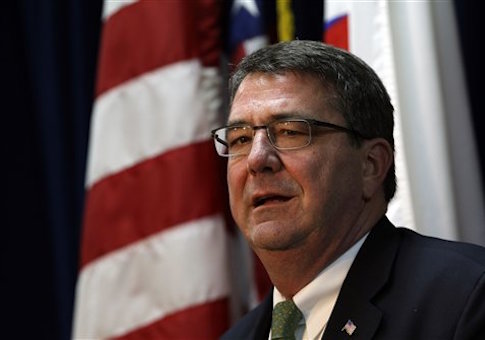
Ashton Carter / AP
President Barack Obama’s nominee for secretary of defense Ashton Carter has a very strong position on nuclear non-proliferation issues, the Tower reports.
Some of those positions stand in contrast with those of the Obama administration.
Politico on Tuesday described him as a “leading member of a clique of defense intellectuals long concerned with the possibility of a nuclear terrorist attack” and suggested he “could be more consequential when it comes to Obama’s plans for dealing with Iran’s nuclear program.”
Two months before President Obama’s 2008 election, Carter argued, in a paper coauthored with diplomatic heavyweights including former Special Middle East Coordinator Dennis Ross and Nonproliferation Policy Education Center Executive Director Henry Sokolski, that “Iran’s nuclear development may pose the most significant strategic threat to the United States during the next Administration.” The Times of Israel covered Carter’s nomination, noting that he was a “vocal proponent of stronger action to stymie nuclear proliferation.” Carter had visited the Jewish state in 2013, and was quoted as telling a group of Israeli soldiers that “protecting America means protecting Israel, and that’s why we’re here in the first place.”
The Jerusalem Post reported on Friday that as part of the Pentagon’s Defense Advisory Acquisition Group, Carter played an “instrumental” role in the transfer of F-35 fighter jets from the U.S. to Israel. Israel recently placed a preliminary order to purchase 25 more of the state of the art fighters. Speaking Friday to reporters at the State Department press briefing about U.S.-Israel ties, Deputy Spokesperson Marie Harf reaffirmed the closeness of the relationship, calling ties between the countries “incredibly close, essential” and “unshakable” and noting that it is “arguably the closest military-to-military relationship” the countries have ever had.
[T]he State Department never conducts lessons-learned exercises to determine why previous episodes of diplomacy have failed.
Kerry is like a gambler who has lost everything, but figures if only he is given one more round at the craps table, he can win big. American national security, however, is nothing with which to gamble. Especially when a gambler is desperate, the house will always win. In this case, however, the house is not Washington, but rather Tehran.
**********
As Jonathan Tobin notes, Colum Lynch’s Foreign Policy bombshell report about Iran’s covert efforts to buy equipment for its Arak plant, a facility which could produce plutonium for a nuclear bomb, raises questions about the logic of the Obama administration, and the recent comments by both Vice President Joe Biden and Secretary of State John Kerry with regard to the wisdom of extending nuclear talks with Iran.
If Lynch’s report is true—and it appears very much to be so—then there are two possibilities as to what happened vis-à-vis American diplomacy. The first is that Iranian diplomats were always insincere in pursuit of a nuclear resolution, and lied outright to Kerry, Undersecretary Wendy Sherman, Clinton, Biden-aide Jake Sullivan, and other officials who have championed the drive for nuclear talks with the current Iranian administration. That possibility is troubling enough, but the second scenario is as troubling, and that is that Iranian diplomats were perfectly sincere, but that the regime simply couldn’t care less what its diplomats said and pursued its own goals irrespective of any commitments they made.
A key theme of my recent book exploring the history of U.S. diplomacy with rogue regimes (of which Iran is the marquee example) is that the State Department never conducts lessons-learned exercises to determine why previous episodes of diplomacy have failed. One example they might consider is the pre-Iraq War negotiations with Iran: Immediately prior to the U.S.-led invasion of Iraq, National Security Council official Zalmay Khalilzad along with Ambassador Ryan Crocker met with Mohammad Javad Zarif, Iran’s UN ambassador (and its current foreign minister) in secret talks in Geneva. Almost simultaneously, British Foreign Secretary Jack Straw met with Iranian Foreign Minister Kamal Kharrazi. Both talks solicited the same Iranian pledge: Iranian officials would not interfere with coalition forces in Iraq, and Iran would not insert its own personnel or militias into Iraq.
In hindsight, the Iranians there, too, lied. Soon after Saddam’s fall, the Islamic Revolutionary Guard Corps (IRGC) infiltrated 2,000 fighters, militiamen, and Qods Force personnel into Iraq replete with radio transmitters, money, pamphlets, and supplies. The source for that statement? Iranian journalists. Those most enthusiastic for rapprochement, however, are now placing their hopes in the same Mr. Zarif, the man who a decade ago either lied shamelessly or bluffed about the power he did have to control the behavior of the IRGC and influence the supreme leader. Then again, there is a reason why, before he became vice president, Joe Biden was Tehran’s favorite senator.
Kerry is like a gambler who has lost everything, but figures if only he is given one more round at the craps table, he can win big. American national security, however, is nothing with which to gamble. Especially when a gambler is desperate, the house will always win. In this case, however, the house is not Washington, but rather Tehran.
(But the humanitarian, peace-loving Islamic Republic of Iran, where sanity, good will toward all and freedom flourish, needs nukes to take its rightful place in our multicultural International Community. Right? — DM)
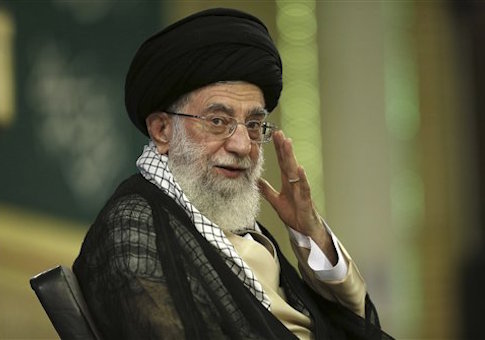
Ali Khamenei / AP
The Iranian regime has launched a nationwide social media campaign called, “We Love Fighting Israel,” which encourages Iranian children, teens, and Internet users to photograph themselves alongside messages of hate for the Jewish state.
The movement has sprouted online in the last few days across social media sites such as Twitter, Instagram, and other platforms as a result of a recent call by Iranian Supreme Leader Ayatollah Ali Khamenei rallying the nation to take on Israel.
The campaign drew outrage from opponents of Iran’s hardline regime and calls for sites such as Instagram to shut it down for violating policies against hate speech.
Thousands of Iranians are reported to have already joined the electronic movement following comments by Khamenei’s outlining Iran’s goal of destroying the Jewish state.
“Our people love fighting against the Zionists and the Islamic Republic has proved this as well,” Khamenei was quoted as saying in a recent speech by the country’s state-run media. “By Allah’s Favor and Grace, we have passed through the barrier of denominational discord.”
These remarks inspired Iranian social media users to take to the Internet and launch the “We Love Fighting Israel” movement. The campaign even has spawned its own hashtag on Twitter, “#FightingtheZionists.”
The anti-Israel campaign now “has gone viral on the web,” according to Iran’s state-controlled Mehr News Agency, “getting more and more boost from individuals who post photos reading similar sentences, [and] sharing the #Fightingthezionists hash tag.”
More than 300 pictures have already been posted to an Instagram account titled, “FightingTheZionists.” The account, which had some 3,000 followers as of Tuesday evening, links to Khamenei’s personal Instagram account.
Users post pictures with messages declaring, “We love fighting against Israel,” “I love to fight Israel,” “We are lovers of fighting Israel,” and “I love fighting against Zionists,” among other similar messages.
One picture in particular has caught the eye of Iran critics on the web and prompted a harsh response to the anti-Israel campaign.
The photo shows a young child decked out in military gear and holding a sign that translates from Farsi as, “I love fighting against Zionists.”
Captioned alongside the photo is an English language message that reads: “Our people love fighting against the Zionists and the Islamic Republic has proved this as well, Ayatollah Khamenei.”
It is not the only photo to depict young children as participating in the campaign to fight Israel.
The photos posted on the Instagram page depict “several groups of people including war veterans, students, journalists, and people from all walks of life joining the campaign,” according to Mehr News.
The American nonprofit group United Against Nuclear Iran (UANI), which works to prevent Tehran from obtaining a nuclear weapon, expressed disgust at the campaign on its Twitter account.
UANI lashed out at the Iranian regime for promoting “vile hate” and the “indoctrination of hate children.”
Additionally, Matan Shamir, UANI’s director of research, called on social media sites to immediately take steps to remove the Iranian campaign.
“The Iranian regime’s brazen exploitation and indoctrination of innocent children to hate and commit violence is utterly deplorable,” Shamir said. “Instagram and its parent company Facebook must enforce their own guidelines prohibiting hate speech and incitement to violence, and remove such propaganda immediately.”
Shamir went on to criticize Iran for its own domestic human rights abuses, such as preventing average citizens from accessing the Internet.
“It is intolerable that while the regime blocks its own citizens from accessing many popular social media platforms, it uses them to advance its own crude and hateful ideology,” he said.
(Is either the Obama Administration or Iran to be believed? Or are both just continuing to “Gruberize” their “stupid” audiences?– DM)
Iran’s heavy water nuclear facility is backdropped by mountains near the central city of Arak, Iran / AP
The Obama administration is misleading lawmakers and the public about purported concessions made by Iran in the latest round of nuclear talks, top Iranian officials insisted over the weekend, renewing a year-old debate about the administration’s transparency regarding the fragile negotiations.
Iran over the weekend pushed back against key claims made by the administration to lawmakers and the press about further concessions agreed to by Iran following the last round of talk in Vienna regarding the country’s contested nuclear program.
In talking points disseminated to congressional offices since the extension in talks was announced, the administration has claimed that the terms of the agreement—which will prolong talks through July 2015—included “significant concessions” by Tehran, according to the Associated Press.
However, Iran says that this is a lie and that no new concessions have been agreed upon.
The confusion over what was exactly agreed upon between the sides is likely to impact an ongoing political dispute between Congress and the White House over whether continued diplomacy is enabling the Islamic Republic to advance its nuclear program.
The conflict also harkens back to similar disagreements regarding the November 2013 interim nuclear agreement struck in Geneva.
Iran, at that time, also accused the White House of lying about the deal after several statements by the administration were later rebuffed by Iran’s negotiating team. The administration was ultimately forced to walk back these statements.
In the latest round of talks, Iran is said to have promised to permit surprise inspections of its nuclear sites and to eradicate portions of its uranium stockpiles, according to terms of the deal being presented by the White House to lawmakers.
The State Department claimed to the Washington Free Beacon that “additional steps” had been agreed upon in the talks.
“There are additional steps Iran has agreed to take in order to provide further proof of the peaceful nature of its nuclear program,” a State Department official told the Free Beacon when asked about the terms of the extension. “These include increased access on centrifuge production, more conversion of oxide into fuel, curbs on work on certain enrichment technologies, and curbs on certain forms of [research and development].”
However, Iranian officials maintain that none of this is true.
The conflicting accounts raise new questions about what exactly was agreed upon under the extension, the details of which are being closely guarded by the White House and are only accessible to those with classified security clearance.
In response to the AP’s initial report about the White House’s claims, a top Iranian official said that no further concessions have been agreed to by Iran.
“The conditions for extending the nuclear negotiations to July 1, 2015, were like the conditions reining the extension of the previous deadlines and no new undertaking has been added to it,” Behrouz Kamalvandi, the spokesman for Iran’s Atomic Energy Organization (AEOI,), told the country’s state-run media over the weekend.
Other Iranian officials also rejected the terms of the deal as presented to Congress by the White House.
“A source close to the Tehran-powers negotiations said that ‘this is not true at all and the trend of R&D on enrichment is moving along its natural track at the AEOI,’” Iran’s Fars News Agency reported.
Sen. Mark Kirk (R., Ill.), a leading advocate of imposing greater sanctions on Tehran, called the conflicting statements from the United States and Iran “deeply troubling.”
“It’s deeply troubling that the United States and Iran cannot even publicly agree on what it is that they privately agreed to in the November 24th extension of the nuclear talks,” Kirk told the Free Beacon.
“None of this bodes well for the administration’s chances of getting a good Iran deal that can survive in the 114th Congress, let alone after Obama’s term ends,” Kirk said.
Sources working closely on the Iran issue speculated that the administration might be exaggerating the terms in order to appease hawkish members of Congress who are seeking to impose greater sanctions on Tehran, a policy the White House objects to.
“The administration desperately needs to convince Congress that Iran’s uranium and plutonium programs are actually frozen, which isn’t true, and so they could very well be lying about these new concessions,” said a foreign policy analyst involved in the public debate over the extension.
“The problem is that there’s no way to tell. White House officials have no credibility left, because they’ve been caught outright lying to lawmakers and journalists about imaginary Iranian concessions before,” the source said. “No one would be surprised if they did it again.”
A State Department official did not respond to further questions about Iran’s most recent claims that the administration is misleading lawmakers about the extension.
A similar fight between Iran and the White House erupted in 2013, when Tehran accused the White House of lying about the terms of the deal as presented to reporters in a fact sheet.
The White House originally announced that Iran “has committed to no further advances of its activities” on the Arak heavy water reactor, which potentially provides Iran with a plutonium path to the bomb.
That claim was walked back just days later by the State Department after a top Iranian official declared that Iran would continue bolstering its plutonium producing facility at Arak.
In addition to discrepancies over Iran’s work at Arak, the administration also was forced at the time to admit that the nuclear deal did not put an end to Iran’s controversial ballistic missiles program.
Iranian officials were quick to publicly lash out at the White House for lying about the interim deal, which is still in effect as talks continue through next year.
“What has been released by the website of the White House as a fact sheet is a one-sided interpretation of the agreed text in Geneva and some of the explanations and words in the sheet contradict the text of the Joint Plan of Action, and this fact sheet has unfortunately been translated and released in the name of the Geneva agreement by certain media, which is not true,” the Iranian Foreign Ministry said in the days following the 2013 interim agreement.
(The Iran Scam continues to plod along and along as Iran gets what it demands. — DM)
The nuclear extension definitely lacks any clear key terms upon which prospective nuclear talks would be anchored or that give any idea how a final nuclear deal could be reached.
But what is clear is that the Islamic Republic, particularly the Supreme Leader Ayatollah Ali Khamenei and senior cadre of Iran’s Revolutionary Guard Corps (IRGC), have gained considerable amount of geopolitical, geostrategic and economic advantages from this offer by the Obama administration. The Supreme Leader’s strategies to buy time, regain full recovery in the economy, pursue his regional hegemonic and ideological ambitions, and reinitiate his government’s nuclear program have been fulfilled.
[T]he extension of nuclear talks offered to the Islamic Republic is not going to alter Iran’s stand on its nuclear program.
The extension not only will not alter the Islamic Republic’s position on its nuclear program, but will give the ruling clerics the opportunity to be further empowered, making them more determined to pursue their regional hegemonic ambitions.
******************
While the Obama administration formerly stated that extending the nuclear talks is out of equation, nevertheless, President Obama and Secretary of State John Kerry raised the option of an extension a day before the November 24th deadline. Iran’s foreign minister, Javad Zarif, definitely welcomed the idea.
After over a year of negotiations, which have traveled across the globe from Vienna, to Oman, and to New York, the negotiators (the Islamic Republic and the P5+1: China, France, Germany, Russia, the United Kingdom, and the United States) planned to extend the nuclear talks for another seven months in order to finalize the preliminary deal reached last year in Geneva. Accordingly, the nuclear negotiations will continue through the end of June.
The obscure objectives are to achieve a “headline” agreement by March 1st and seal the complete technical details of the headline agreement by July 1st. Details and nuances of the nuclear talks, with regards to agreements and gaps, have yet to be released, but some diplomats stated the repeatedly-heard phrase that “progress has been made.”
The nuclear extension definitely lacks any clear key terms upon which prospective nuclear talks would be anchored or that give any idea how a final nuclear deal could be reached.
But what is clear is that the Islamic Republic, particularly the Supreme Leader Ayatollah Ali Khamenei and senior cadre of Iran’s Revolutionary Guard Corps (IRGC), have gained considerable amount of geopolitical, geostrategic and economic advantages from this offer by the Obama administration. The Supreme Leader’s strategies to buy time, regain full recovery in the economy, pursue his regional hegemonic and ideological ambitions, and reinitiate his government’s nuclear program have been fulfilled.
Based on the extension offered by the Obama administration, the Islamic Republic will continue receiving $700million per month in frozen assets during the extended seven month period. Secondly, Iran will further consolidate its economy through increased sales in oil, particularly to Asian countries, heighten business deals with some Western companies, regain the value of its currency, and enjoy the removed sanctions on some of its industries. As a result, Iran will attempt to address the economic challenges which were threatening the hold on power of the ruling politicians.
From the economic perspective, the $700 million in sanctions relief will boost Iran’s economy as it is an equivalence of approximately 350,000 more oil barrels a day, based on the current market price.
The Islamic Republic exports roughly one million barrels of crude oil in a day. The sanctions relief would be equivalent to a 30 percent increase in oil sale. In the next few months, Tehran will attempt to push for additional sanctions relief as well as ratchet up its economic deals, such export of gas and other goods, to some European and Eastern countries including France, Germany, Russia, Japan, and China.
Some European countries’ exports to Iran have already ratcheted up due to the prospects of the nuclear negotiations. Tehran Times, the Islamic Republic’s state newspaper, stated that Germany was Iran’s leading trade partner “The European country (Germany) exported €207 million of goods to Iran in June 2014, an 88 percent rise compared to June 2013.” Nevertheless, Tehran needs the complete lifting of economic sanctions in order to gain the optimal potentials of its economy and gain full recovery.
Third, the extension of the nuclear negotiations will ensure to the Iranian leaders that the international community, specifically the West, will not make efforts in further isolating Iran and pressuring it economically or politically.
In addition, the extension of nuclear talks offered to the Islamic Republic is not going to alter Iran’s stand on its nuclear program. Iran will continue holding the position that their demands for the following issues to be met: maintaining a specific number (tens of thousands of) fast-spinning centrifuge machines, Tehran should have the capacity to produce nuclear fuel in the future, and maintain specific level of enriching uranium. In the next few months, the Islamic Republic is not going to give up its capacity to produce plutonium which can be utilized for weapons at its heavy water reactor in the city of Arak. Iran is less likely to provide more evidence proving that it did not carry out secret tests on the development of atomic weapons in Parchin or other military complexes. The head of the International Atomic Energy Agency recently pointed out that the Islamic Republic continues to deny the IAEA access to sensitive military site which are suspected to be used for nuclear activities.
Finally, the Islamic Republic’s antagonistic stance towards the United States and the West will remain the same as well. This week, while Khamenei officially granted his blessing to Rouhani to continue with the game of nuclear negotiations, he also called the West “arrogant.” Earlier, he published a “9-step plan” to eliminate Israel. After the extension of the nuclear talks, President Rouhani pointed out on state television that “I promise the Iranian nation that those centrifuges will never stop working.” The extension not only will not alter the Islamic Republic’s position on its nuclear program, but will give the ruling clerics the opportunity to be further empowered, making them more determined to pursue their regional hegemonic ambitions.
 Bashar Assad gets a new lease of life







 anneinpt
 artaxes
 danmillerinpanama
 davidking1530
 Peter Hofman
 Joseph Wouk
 Peter
Peter Louisiana Steve
 WarSclerotic
Recent Comments