Archive for the ‘Iran scam’ category

Obama and cognitive dissonance

January 26, 2015

Obama and cognitive dissonance, Dan Miller’s Blog, January 26, 2015

(The views expressed in this article are mine and do not necessarily reflect those of Warsclerotic or its other editors. — DM)

It has been argued that Obama’s cognitive dissonance is demonstrated by His dealings with Iran and His other disruptive efforts in the Middle East.  Perhaps the contrary is more accurate.

Basis of His foreign policies?

Basis of His foreign policies?

An article at Front Page Magazine by Bruce Thorton is titled The Dangers of Obama’s cognitive dissonance (also at Warsclerotic). It argues that Obama mistakenly believes that Iran and “we” want many of the same things and that He acts on that belief.

The heart of this mistake is the belief that whatever their professed beliefs, all peoples everywhere are just like us and want the same things we want. Since our highest goods are peace and prosperity, we think other nations’ privilege the same things. If peoples behave differently, it’s because they are warped by poverty or bad governments or religious superstitions, and just need to be shown that they can achieve those boons in rational, peaceful ways, especially by adopting liberal democracy and free-market economies. Once they achieve freedom and start to enjoy the higher living standards economic development brings, they will see the error of their traditional ways and abandon aggression and violence, and resolve conflicts with the diplomacy and negotiation we prefer. [Emphasis added.]

The Islamic Republic of Iran most likely does want peace and prosperity, but on its own terms.

Iran hangings by crane

Iran wants Islamic “peace” — the peace of universal submission to (a Shiite?) Allah — and at least sufficient prosperity to force its will on others who do not want “peace” of that sort. If Iran gets (or gets to keep) nuclear weapons, along with increasingly longer range missiles, it will be in an increasingly improved position to do that.

Obama may well have very similar goals for Iran. His demands that the P5+1 process continue despite Iran’s persistent refusals to make significant concessions, even as it continues to enhance its nuclear war machine, and His disposition to give Iran whatever concessions it wants, suggest that His and Iran’s objectives are similar. There is support for an alternative, that Obama is simply delusional. However, unless His closest, most trusted and therefore most important advisors are at least equally delusional, that alternative makes little sense. Although she appears to be a despicable person, Valerie Jarrett seems quite competent at what she does on His behalf. Others fall on their swords, fall into line and salute or leave.

Obama’s “extraordinary disconnect” in foreign policy was recently highlighted on CBS’ Face the Nation.

John Bolton said much the same.

Is it more likely that Obama merely fails to understand what’s happening, or that He understands and likes it? His State of Union address was full of foreign policy nonsense, much of it about Iran. However, it seems to have worked quite well with the large segment of the American public which neither understands nor cares about foreign affairs (except amusing affairs of a salacious nature) and believes that He strives mightily to give them the “free stiff” they believe they want, without understanding the economic hardships it has brought and will bring to them. If members of the public who already worship Him (and that includes most of the “legitimate news” media) continue to do so, it may well make little if any difference to Him or to His closest advisors whether those who disagree with Him still like, or continue to like, Him.

Leftist beliefs

After all, as we learned at the Democrat National Convention that nominated Obama for a second term, “we all belong to the Government,” it’s “one big happy family” and Obama is the head of “our family.”

In the final analysis, it may make little difference whether Obama is incompetent and delusional or is competent, understands His plans for Iran and the rest of the world far better than the rest of us and has perverse conceptions of evil and good.

Both theories are worth considering because both can help us to understand what He does, why He does it and what He intends to accomplish. However, delusional actions and intentions are difficult for those who are not delusional to understand and therefore to challenge. Actions and intentions that are, instead, based on a rational thought process — but one that views evil as good and good as evil — are easier to understand and therefore to challenge.

As I have watched Obama and His accomplishments over the years, I have come to lean toward the notion that He is competent, evil, understands what He is trying to achieve and likes it.

The Dangers of Obama’s Cognitive Dissonance

January 26, 2015

The Dangers of Obama’s Cognitive Dissonance, Front Page Magazine, January 26, 2015

ol-450x253

The worst crisis we face is the relentless progress Iran is making toward creating nuclear weapons, a development that would set off an arms race in the Middle East and destabilize an already chaotic region. The Islamic Republic has already extended its malign influence into Syria, Lebanon, and Yemen, creating a Shi’a crescent that threatens our allies in the region, especially Israel, Jordon, Egypt, and Saudi Arabia. If a failed gangster-state like North Korea can demand so much international attention just because it possesses nuclear weapons, think what Iran––with 3 times the population and the world’s 3rd largest oil reserves––could do. Oil won’t stay cheap forever.

Obama, in short, can say that “all options are on the table” all he wants, but the mullahs know he will not take military action against them, nor help Israel to. They know that Obama has withdrawn from the region, and at best will make only token gestures of engagement, like the current bombing campaign against ISIL. They know his ultimatums and “red line” threats are empty. They know he wants a deal more than they do, so he can burnish his legacy. Thus the Iranians are spinning out the negotiations, cadging extensions, pocketing concessions without reciprocating, and giving Obama just enough hope to think he can achieve what he thinks will be a Nixon-goes-to-China foreign policy coup, but will in fact will go down in history as a humiliating and dangerous blunder like Chamberlain’s Munich debacle.

*********************

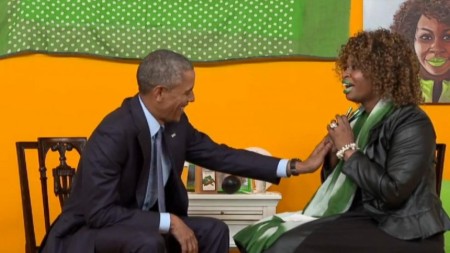
There are many moments from the past 6 years that demonstrate the criminal incompetence of this president and his administration. But for me, Obama’s interview with GloZell––whose claim to YouTube fame comes from eating Cheerios in a bathtub filled with milk––represents best the essential emptiness, triviality, and sheer dumbness of this president. Imagine Franklin D. Roosevelt in 1938 being interviewed by a carnival geek, and you can gauge just how low the most consequential political office in the world has sunk.

This interview, remember, took place the same time as problems requiring urgent presidential attention were escalating. Libya imploding, Iran inching toward a nuclear bomb, ISIS expanding in Syria and holding ground in northern Iraq, Iranian military assets active in Iraq, Yemen falling to an Iranian proxy terrorist group, another Iranian client, Bashar al Assad, strengthening his hold over Syria––and that’s just the Middle East. And don’t forget, the GloZell farce followed hard on Obama’s State of the Union address, a congeries of wishful thinking, narcissistic braggadocio, and outright-lies, a preposterous catalogue in which generous sprinklings of first-person-pronoun fairy dust transmuted every failure into an achievement.

It is the contradiction between fact and fiction, evident in every line of the president’s speech, that typifies progressives in general. This cognitive dissonance may simply be nothing more than the grubby machinations of those who will say and do anything for political power and the wealth and influence it brings. In other words, they know they are hypocrites. But it also could be something more dangerous than a venal character and moral corruption. One gets the feeling that many progressives actually believe what they say, that they are reciting the mantras of their ideological cult, no matter how contrary to reality or their own actions. What’s more important is that whatever the source, this failure to acknowledge reality, to think critically, and to respect intellectual coherence is dangerous to all of us, especially in the many foreign policy crises that have mushroomed on Obama’s watch.

And the worst crisis we face is the relentless progress Iran is making toward creating nuclear weapons, a development that would set off an arms race in the Middle East and destabilize an already chaotic region. The Islamic Republic has already extended its malign influence into Syria, Lebanon, and Yemen, creating a Shi’a crescent that threatens our allies in the region, especially Israel, Jordon, Egypt, and Saudi Arabia. If a failed gangster-state like North Korea can demand so much international attention just because it possesses nuclear weapons, think what Iran––with 3 times the population and the world’s 3rd largest oil reserves––could do. Oil won’t stay cheap forever.

But in the face of this threat, Obama has appeased the mullahs under the guise of diplomatic “engagement” and negotiations, the time-proven way to avoid action while pretending to do something. Indeed, so besotted is he by his faith in diplomacy that he has threatened to veto a Congressional bill that would strengthen his negotiating position by toughening economic sanctions, the best non-lethal shot we have for changing the Iranians’ behavior, given the current decline in their oil revenues. But what we see here is a problem that transcends any one president or Secretary of State, for it reflects the intellectual error and failure of imagination peculiar to modernity.

The heart of this mistake is the belief that whatever their professed beliefs, all peoples everywhere are just like us and want the same things we want. Since our highest goods are peace and prosperity, we think other nations’ privilege the same things. If peoples behave differently, it’s because they are warped by poverty or bad governments or religious superstitions, and just need to be shown that they can achieve those boons in rational, peaceful ways, especially by adopting liberal democracy and free-market economies. Once they achieve freedom and start to enjoy the higher living standards economic development brings, they will see the error of their traditional ways and abandon aggression and violence, and resolve conflicts with the diplomacy and negotiation we prefer.

The problem with this scenario is not that other peoples don’t want freedom and prosperity, or are incapable of achieving them. Rather, it is that they often have other goals more important than the ones we prize. Like religion, for example, or national honor, or revenge. We may think such motives are irrational avatars from an uncivilized past, but they are still drivers of action in individuals and nations alike. They may be, to quote Orwell on the Nazis, “ghosts” out of the premodern world, but they’re still “ghosts which need a strong magic to lay them.”

Of course, if weaker than an enemy or rival, such a people may conceal these motives, and pretend to play by the rules of the more powerful, until they are strong enough to use force to achieve their aims. In such situations, diplomatic engagement becomes a tactic for achieving through words what cannot be gained through deeds. As Robert Conquest said of our Cold War negotiations with the Soviets, “The Soviets did what their interests required when the alternative seemed less acceptable, and negotiation was merely a technical adjunct.”

History shows the truth of this insight, from the Munich Conference in 1938, to the many arms reduction treaties with the Soviet Union, which we know the Soviets and now the Russians have serially violated. More pertinent for Iran is the sorry history of the diplomatic attempts to prevent North Korea from developing nuclear weapons. For decades we indulged in cycles of concessions, agreements, conferences, and violations that all ended up with the North announcing it had gone nuclear. The failure to learn from that recent history is evident in Obama’s current reprise of that sordid dance in his engagement with Iran.

This is not to say that diplomacy can’t ever work. But to be effective, negotiation has to start with a clear understanding of the other side’s motives. One must avoid the “trap,” as Conquest called it, “of thinking that others think, within reason, like ourselves. But this trap is precisely the error that must be avoided in foreign affairs.” The rulers of Iran may lust after wealth and secular power, the default materialist motives recognized by the West. But that greed can coexist with their messianic, apocalyptic strain of Shi’a Islam, and the acceptability of violence in service to their faith that characterizes traditional Islam.

Thus when Muslim warriors tell us, as they have for 14 centuries, that they love death as we love life; when they proclaim, as Mohammed, Iran’s Ayatollah Khomeini, Osama bin Laden, and the Fort Hood jihadist did, “I was instructed to fight all men until they say there is no god but Allah,” we’d better listen and take them seriously, rather than brush aside such profound religious beliefs as mere camouflage for materialist motives. Yet so blind is Obama to this truth, that he and his officials stubbornly refuse even to utter a phrase like “Islamic extremist,” since he has decided that all the Muslim violence roiling the world every day has “nothing to do with Islam.”

Second, diplomacy can work only when backed by a credible threat of force. The other side must believe that mind-concentrating violence will punish them for negotiating in bad faith and violating agreements. In the case of Iran, the mullahs must believe that we will put to the test their love of death and longing for paradise. But our long history with the Islamic Republic has proved the opposite. Iran has never been punished for taking our embassy staff hostage in 1979, for instigating the murder of 241 of our soldiers in Beirut in 1983, or for training and funding the terrorists who have killed our troops in Iraq and Afghanistan, or for being the world’s leading promoter of terrorist violence.

Obama, in short, can say that “all options are on the table” all he wants, but the mullahs know he will not take military action against them, nor help Israel to. They know that Obama has withdrawn from the region, and at best will make only token gestures of engagement, like the current bombing campaign against ISIL. They know his ultimatums and “red line” threats are empty. They know he wants a deal more than they do, so he can burnish his legacy. Thus the Iranians are spinning out the negotiations, cadging extensions, pocketing concessions without reciprocating, and giving Obama just enough hope to think he can achieve what he thinks will be a Nixon-goes-to-China foreign policy coup, but will in fact will go down in history as a humiliating and dangerous blunder like Chamberlain’s Munich debacle.

So much is obvious. Yet in his State of the Union speech Obama astonished even his loyal media retainers when he asserted that his negotiations have “halted the progress of its [Iran’s] nuclear program and reduced its stockpile of nuclear material.” In reality, Iran continues to enrich uranium and is building new nuclear reactors, not to mention constructing missile sites and nuclear facilities in Syria. International inspectors are still barred from numerous sites in Iran, and so the West has no real idea of how many facilities exist there. This means that even if an agreement is signed, it will be worthless if it leaves Iran with the knowledge and technology needed to make nuclear bombs at a time of its choosing. And it means that someday we all will pay the price for our president’s cognitive dissonance.

US-Saudi summit in Riyadh to deal with pivotal issues of oil prices, Iran and Yemen

January 24, 2015

US-Saudi summit in Riyadh to deal with pivotal issues of oil prices, Iran and Yemen, DEBKAfile, January 24, 2015

He will want to clear the air most urgently on three controversial items of burning interest to both leaders: Riyadh’s flat opposition to the multilateral nuclear deal with Iran and skepticism in the face of Obama’s conviction that a comprehensive accord will curtail the Islamic Republic’s drive for a nuclear weapon.

(Only if King Salman is truly demented would he agree with Obama on Iran and oil prices. Increases in Saudi oil production have hurt Iran while Obama’s Iran scam and relief from sanctions continue to help it. — DM)

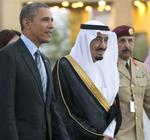
Obama_King_Salman_bin_Abdulaziz__27.1.15Past meeting between President Barack Obama and King Salman, then Crown Prince

President Barack Obama, having decided to cut short the third day of his India visit, will arrive in Riyadh Tuesday, Jan. 27 with the First Lady, to offer US condolences on the death of King Abdullah and hold critical talks with his successor, King Salman Bin Abdulaziz.

He will want to clear the air most urgently on three controversial items of burning interest to both leaders: Riyadh’s flat opposition to the multilateral nuclear deal with Iran and skepticism in the face of Obama’s conviction that a comprehensive accord will curtail the Islamic Republic’s drive for a nuclear weapon.

Next, the US leader will try and persuade the new Saudi ruler to slow down oil production in order to put the brakes on plunging prices, an example which other OPEC members are sure to follow.

Finally, Obama and Salman must decide how to handle the fall of Yemen into the hands of Shiite Houthi rebels, who have seized the capital Sanaa with Iranian support and brought down the US-Saudi-sponsored president Abed Rabbo Mansour Hadi.

Two secondary issues will be the struggle against the Islamic State of Iraq and the Levant in the oil kingdom’s back yard, in which the US and Saudi Arabia are coalition partners; and the situation in the Syrian conflict.

Since this is an outsize agenda for one meeting, DEBKAfile’s sources in Washington and the Gulf expect Obama to focus in his initial encounter with Salman on the broad lines of the nuclear Iran dispute and oil prices. Detailed discussions on these and other issues will be set aside for US and Saudi officials of lower rank to hammer out in the coming weeks, as the new king begins to take hold of the reins of government.

A number of Middle East leaders will be following the outcome of this Riyadh summit with bated breath. Many are worried that Obama may persuade the new monarch to play ball with his Middle East policies, so effecting a radical reversal of the late Abdullah’s stance of flat opposition to Obama’s tactics in the region, aside from isolated cases.

A decision by Salman to accept America’s lead on the Iranian nuclear question and oil prices would be a serious blow for the anti-US Arab front, spearheaded hitherto by Saudi Arabia, Egypt and some of the Gulf emirates. It would also be a setback for Israeli Prime Minister Binyamin Netanyahu’s fight against Obama’s nuclear diplomacy for Iran. This policy was underpinned by the Saudi-Egyptian political and military partnership that aimed at stalling the deal crafted by Washington, which purported to lay to rest the nuclear controversy with Iran.

John Bolton on WMAL 1-22-15

January 23, 2015

John Bolton on WMAL 1-22-15, via You Tube, January 22, 2015

(Audio only. Amb. Bolton speaks of PM Netanyahu’s address to Congress, no-go zones and Obama’s fantasies about Islamic terrorism, the Islamic State and Iran. — DM)


Argentine Prosecutor Death in Iran Terror Case Gets Curiouser

January 23, 2015

Argentine Prosecutor Death in Iran Terror Case Gets Curiouser, Legal Insurrection, January 23, 2015

He documented enough of his charges that Interpol issued “red notices” for seven high-ranking Iranian officials, including Ali Akbar Rafsanjani and Ali Velayati, who were Iran’s president and foreign minister respectively at the time of the AMIA bombing. (Interpol does not have the power to arrest, so a “red notice” is as close as it comes to issuing an arrest warrant) Rafsanjani, despite being implicated in an act of terrorism in another nation is often referred to as a “moderate” nowadays. He is also considered to be a mentor to Iran’s current president, also often referred to as a “moderate,” Hassan Rouhani.

Alberto Nisman’s work exposed the danger that Iran poses to world security. Iran continues to violate international law with impunity and unfortunately there are too few Nisman’s daring to challenge Iran’s brazen misbehavior. His death will make the task of reining in Iran’s ambitions that much more difficult.

****************

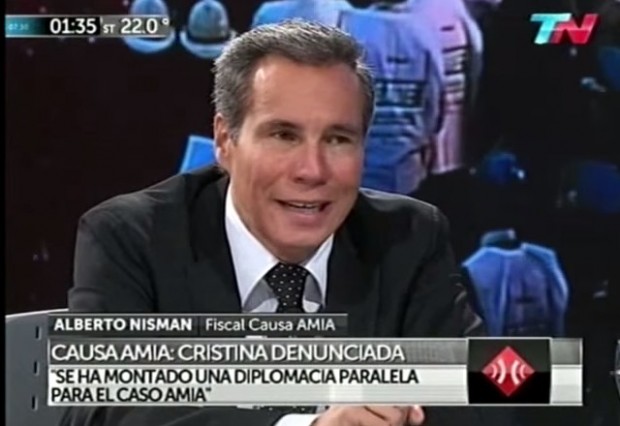
2015-01-23_074410_Nisman-620x426

Sunday night Argentinian prosecutor Alberto Nisman was found shot to death in his apartment. Nisman had been scheduled the following day to present his criminal complaint against Argentinian President  Cristina Fernández de Kirchner before a closed session of Argentina’s congress.

The initial claim (one made by Kirchner herself on her Facebook page) that Nisman committed suicide hardly seemed credible at the time. How many people would kill themselves before the high point of their careers? Nisman had spent ten years investigating the 1994 AMIA Jewish center bombing in Buenos Aires and now he was about to charge the president and other officials of his country with conspiring to cover up the Iranian involvement in that attack. (Now Kirchner says he was killed but “suggests that Nisman was murdered on the instructions of his foreign masters in order to create a scandal damaging to her and to her government.”)

Subsequent revelations during the week have made the claim of suicide even less credible now. At Business Insider, Armin Rosen recounted some of those revelations.

The lack of an exit wound suggested the fatal shot was fired at a further distance than Nisman could have managed had the wound been self-inflicted. His last WhatsApp was a photo of stacks of documentation related to the next day’s testimony and Nisman had apparently given his maid a grocery list for the following week. A 10-person government security detail was reportedly pulled off of his apartment the night of his assassination. Most damningly, there was no gunpowder residue found on Nisman’s hands, physical evidence that he didn’t discharge a firearm prior to his death.

Fausta has more, including some gleaned from the Spanish press. Notably despite earlier claims that Nisman’s apartment was locked from the inside, there are reports that there were two other ways into his apartment that were not locked. Fausta is also right that Nisman’s murder is all about Iran. (Rosen also wrote, “no matter who’s responsible for Nisman’s death, the Iranian regime benefits.”)

Nisman’s work on the AMIA case was invaluable in documenting Iran’s efforts to build a terror infrastructure in South America. Matt Levitt, an expert on Hezbollah, who recently published a book about the Iran-backed terror organization, wrote this week, “As I was writing my book, trying to navigate the convoluted details of the AMIA bombing and other Hezbollah plots, Nisman was an invaluable resource.”

Nisman’s work wasn’t just academic though. He documented enough of his charges that Interpol issued “red notices” for seven high-ranking Iranian officials, including Ali Akbar Rafsanjani and Ali Velayati, who were Iran’s president and foreign minister respectively at the time of the AMIA bombing. (Interpol does not have the power to arrest, so a “red notice” is as close as it comes to issuing an arrest warrant) Rafsanjani, despite being implicated in an act of terrorism in another nation is often referred to as a “moderate” nowadays. He is also considered to be a mentor to Iran’s current president, also often referred to as a “moderate,” Hassan Rouhani.

The AMIA bombing was not the only time Iran’s leadership was implicated in an attack on foreign soil. In addition to Rafsanjani and Velayati, a red notice was issued for Ali Fallahian for the AMIA bombing. Rafsanjani, Velayati and Fallahian were all implicated in another terror attack on foreign soil.

A German prosecutor “without naming them … implicated Supreme Leader Ayatollah Khamenei, President Akbar Hashemi Rafsanjani, Foreign Minister Ali Akbar Velayati and Intelligence Minister Ali Fallahian” in the 1992 massacre at the Mykonos restaurant in Berlin.

Iran’s revolutionary government is lawless. The Iranian actors in these foreign terror attackes weren’t rogue operators but members of the country’s political elite. It’s something to keep in mind when the Obama administration insists that it will make a nuclear agreement with Iran that will make everyone safer and more secure.

Even assuming the P5+1 nations can come to an agreement with Iran (an agreement is hardly a foregone conclusion, Iran would probably be very happy with a series of temporary agreements that free up billions and don’t force it to dismantle any element of their nuclear program), what grounds are there to trust Iran to keep its commitments?

Remember that the crisis with Iran over its nuclear program stems from Iran’s violations of the Nuclear Non-Proliferation Treaty that it signed. Six UN Security Council resolutions – three of them unanimous – were passed imposing sanctions on Iran for its violations. Iran isn’t looking to come into compliance but to be granted absolution for its violations.

Alberto Nisman’s work exposed the danger that Iran poses to world security. Iran continues to violate international law with impunity and unfortunately there are too few Nisman’s daring to challenge Iran’s brazen misbehavior. His death will make the task of reining in Iran’s ambitions that much more difficult.

The death of an Iranian general on the Golan gave US Senators’ Iran sanctions bills military muscle

January 22, 2015

The death of an Iranian general on the Golan gave US Senators’ Iran sanctions bills military muscle, DEBKAfile, January 22, 2015

This was a dual threat: Israel would not stand by if Iranian and Hizballah forces moved into the Syrian Golan right up against its frontier. But in the wider context, Binyamin Netanyahu was signaling Obama in Washington and Khamenei in Tehran, that he no longer had any qualms about striking Iranian military targets if the two rulers failed to forge a workable, credible accord for keeping nuclear weapons out of Iranian hands.

The Israeli action added military muscle to the US Senate legislation on Iran –  in the face of Obama’s reluctance to embrace tactics he believes would be disincentives for Khamenei to play ball on the ongoing multilateral nuclear diplomatic track in Geneva.

*****************

netanyahu_us_congress_11.2.15Binyamin Netanyahu in former address to US Congress

It is hard to believe that the White House was caught by surprise over House leader John Boehner’s unusual invitation for Israeli Prime Minister Binyamin Netanyahu to address Congress on Feb. 11. After all, prior arrangements must have kept the Israeli embassy in Washington busy for weeks in a city, whose life blood is kept flowing by the mining and trading of information and secrets about friends and rivals alike.

All the same, it suited the four parties involved in this extraordinary event – Republican and Democratic lawmakers, the White House and Netanyahu – to pretend they were taken aback on Wednesday, Jan. 21 by the Speaker’s announcement of the prime minister’s coming address on “the grave threats radical Islam and Iran pose to our security and way of life.”

He accused President Barack Obama of “papering over” these threats over in his State of the Union speech a few hours earlier.

The White House said the invitation breached “typical protocol” but the administration would reserve judgment until they heard from Netanyahu about his plans.

The assumed air of astonishment greeting the invitation added an element of drama to the event. It also had the effect of further polarizing the camps for and against the Obama administration’s insistence on banking solely on diplomacy for containing Iran’s nuclear program.

Inevitable showdown

Obama and Netanyahu, who could never stand each other, have been at loggerheads for most of the six years of the former’s presidency over what is widely seen as the dead-end US Middle East policies he pursued in most major arenas such as Iraq, Yemen and Libya, the futile US air strikes against marching Islamist State soldiers, the unending Syrian conflict and the Palestinian issue.

The showdown building up for years between them may now be at hand. It will catch Obama and Secretary of State John Kerry fully engaged in a desperate pursuit of a comprehensive nuclear deal between Iran and the Six-World-Powers group. This deal could then be presented as an unquestioned success of Obama’s Middle East policies – indeed the only one.

Together with Iran’s President Hassan Rouhani and Foreign Minister Mohamed Zarif, US officials have roughed out a draft accord. But most American nuclear experts and Israel’s top political and military leaders view this paper as a bad agreement, because it would leave Tehran with the freedom and resources to jump back from low-grade enrichment to full-dress production of a nuclear bomb and missiles when international and economic circumstances were more convenient.

But Obama and Kerry are counting on the ayatollahs holding their horses until the end of 2016, when the US administration changes hands. The Iranian nuclear deal’s inevitable breakdown would then land squarely on the shoulders of the next president and secretary of state taking over in Washington, while Obama would have formally honored his commitment to prevent Iran from acquiring a nuclear bomb.

Khamenei between two compulsions

But this plan faces an outsize impediment: Rouhani and Zarif are holding back from putting pen to paper because of the strong objections posed by supreme leader Ayatollah Ali Khamenei and the Revolutionary Guards military chiefs.

Earlier this month, the issue reached boiling point in Tehran, DEBKAfile’s Iranian sources report: The Guards threatened to unseat Khamenei by a military coup if he let Rouhani and Zarif sign the draft into a comprehensive, binding nuclear accord.

Khamenei, never lost for a devious maneuver, began weaving between the two compulsions – American demands for more concessions to finalize the deal and demands by hardliners at home not to give way. The move he made was to throw a bone in the form of an offer to cut down on the number of centrifuges used in uranium enrichment.

Obama and Kerry hailed this as a breakthrough toward a deal, although the experts dismissed it as meaningless.

Obama propositions Netanyahu

On this basis, Obama phoned Netanyahu Monday night, Jan. 13, to ask him for Israel’s support for the evolving comprehensive nuclear accord with Iran.

In return, he offered closer US cooperation in various areas of interest to Israel, such as the Palestinian issue, if the prime minister would withhold or cool his support for US Senate sanctions legislation:

The Republican Mark Kirk and Democrat Robert Menendez seek to enact new sanctions on Iran if nuclear negotiations fail to meet their June 30 deadline for an accord.

Bob Corker, chairman of the Senate Foreign Relations Committee — supported by Republican Senators Lindsay Graham and John McCain — is pushing for legislation which does not contain sanctions but would require a Senate vote on any pact that is agreed upon in Geneva.

Netanyahu rejected Obama’s proposition.

The US President was therefore adamant in his State of the Union references to the Iranian nuclear issue: “New sanctions on Iran would all but guarantee that diplomacy fails, heightening the prospects of war.” He said.: “Between now and this spring, we have a chance to negotiate a comprehensive agreement that prevents a nuclear-armed Iran, secures America and our allies – including Israel – while avoiding yet another Middle East conflict.”

Obama did not elaborate on the parties who would take part in this hypothetical conflict, or explain why he limited himself to only two extreme scenarios – either a deal with Iran or tighter sanctions that would precipitate war.

Israel takes direct aim at Iran

It was no accident that two days before this speech, Obama had his answer from Israel. Sunday, Jan. 19, Israeli Air Force drones struck an Iranian-Hizballah military convoy near the Syrian Golan town of Quneitra. Six Iranian officers were killed, led by Gen. Mohamad Ali Allah Dadi, as well as the same number of high-ranking Hizballah operatives.

This was a dual threat: Israel would not stand by if Iranian and Hizballah forces moved into the Syrian Golan right up against its frontier. But in the wider context, Binyamin Netanyahu was signaling Obama in Washington and Khamenei in Tehran, that he no longer had any qualms about striking Iranian military targets if the two rulers failed to forge a workable, credible accord for keeping nuclear weapons out of Iranian hands.

The Israeli action added military muscle to the US Senate legislation on Iran –  in the face of Obama’s reluctance to embrace tactics he believes would be disincentives for Khamenei to play ball on the ongoing multilateral nuclear diplomatic track in Geneva.

It also explains why John Boehner invited Netanyahu to address Congress on Feb. 11.

However, until then, Iran, Hizballah, Syria and even Israel may not stand idle. And the Obama administration may also decide to round up its assets in a bid to spoil the prime minister’s run for re-election on March 17.

Mossad denies opposing harsher sanctions on Iran

January 22, 2015

Mossad denies opposing harsher sanctions on Iran, Ynet News, Itamar Eichner, January 22, 2015

Head of Israeli spy agency releases statement denying it was working with the Obama administration against Netanyahu on Iran issue.

In an unusual step, the Israeli spy agency Mossad released an official statement on Thursday afternoon in which it denied that it opposes imposing additional sanctions on Iran, as reported in a Bloomberg report earlier in the day.

The Mossad statement said, “Mossad chief Tamir Pardo met with a delegation of American senators on January 19, 2015. The meeting was held at the request of the senators and with the approval of the prime minister. Contrary to the report, the head of the Mossad did not say that he opposed additional sanctions on Iran. The Mossad chief emphasized in the meeting the remarkable efficacy of the sanctions imposed on Iran over the last few years in bringing Iran to the negotiating table.

“The Mossad chief stated that when negotiating with Iran, the ‘carrots and sticks’ approach needs to be taken and at present, there aren’t enough ‘sticks.’ The Mossad chief noted that without strong pressure, it would not be possible to bring to meaningful compromises from the Iranian side.

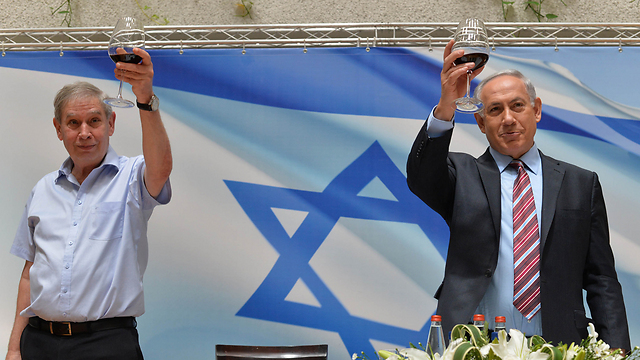
56024560100388640360noPardo and Netanyahu: On the same page (Photo: GPO)

“As for the use of the term ‘grenade’, the Mossad chief did not use that with regards to imposing sanctions, which, as mentioned, he considers to be the ‘sticks’ that would aid in achieving a good agreement. He used this term to describe the possibility of creating a temporary crisis in the talks, at the end of which the negotiations will be renewed under better terms. The Mossad chief specifically stated that the agreement currently being formulated with Iran is bad and might lead to a regional arms race.”

The Bloomberg report was published after US House Speaker John Boehner invited Prime Minister Benjamin Netanyahu to speak in front of Congress about the Iranian nuclear threat. Netanyahu has been urging the American administration to harden its sanctions policy. The Obama administration, Bloomberg reported, has been using the internal divide between the Mossad and Netanyahu to torpedo the bi-partisan proposal, penned by Senators Mark Kirk and Robert Menendez.

Meanwhile, Republican Senator Bob Corker, chairman of the Senate Foreign Relations Committee, has teamed up with Lindsay Graham and John McCain to propose a bill requiring the White House bring any deal with Iran to a vote in Congress.

The Obama administration opposes both measures and has warned the Senate to stay away from the delicate negotiations between Iran and world powers.

According to the report, Mossad officials have briefed the White House, as well as Republican legislators, on their opposition to the Kirk-Menendez bill, which would implement new sanctions on Iran if the negotiations fail to yield results by June 30 or the Islamic Republic fails to live up to its commitments.

Netanyahu, on the other hand, has expressed his support for the legislation, in particular, and sanctions on Iran, in general.

Evidence to Israeli interference in the Iran-US talks comes from comments made by Secretary of State John Kerry, who said an unnamed Israeli intelligence official had said the new sanctions bill would be “like throwing a grenade into the process.” When Menendez heard about the Mossad briefing, he demanded clarifications from Israel’s Ambassador to the US Ron Dermer.

Obama’s White Flag On Assad a Gift for Iran

January 21, 2015

Obama’s White Flag On Assad a Gift for Iran, Commentary Magazine, January 21, 2015

[T]he American white flag acknowledging his continued reign of terror is more than merely an admission that he can’t be pushed out of Damascus. It must now be understood as part of a comprehensive policy that is aimed at appeasing Iran. That presents a danger not only to the oppressed people of Syria but to every other nation in the region, including both moderate Arabs and Israel, who are targets of Iran’s predatory ambition.

************************

As anyone who has heard President Obama discuss his opposition to more sanctions being placed on Iran knows, the White House is deeply disturbed at the notion of the United States doing anything to disturb those who run the Islamist regime. Thus, the news that the United States is signaling what may be the formal end of its opposition to Bashar Assad’s rule over Syria must be seen in the context of a general American push for détente with that dictator’s allies in Tehran. This is bad news for the people of Syria who are seeking an alternative to Assad’s murderous rule–other, that is, than the ISIS terrorists. But it is very good news for the Iranians who are pleased about the way the rise of ISIS has led to a de facto alliance on the ground between the U.S. and Iran’s allies Assad and Hezbollah in the effort to fight ISIS. This has led not only to a tacit green light for Assad to go on killing Syrians but also for negotiations that seemed fated to grant a Western seal of approval for Iran’s aspiration to become a threshold nuclear power.

It must be acknowledged that at this point the United States has no good options open to it on Syria. If the U.S. had acted swiftly to aid moderate opponents to the Assad regime after the Arab Spring protests began, it might have been possible to topple Assad, something that would have been a telling blow to Iran’s ambitions for regional hegemony. But President Obama was characteristically unable to make a decision about what to do about it for years despite continually running his mouth about how Assad had to go. By the time he was ready to strike—after Assad crossed a “red line” enunciated by the president about his use of chemical weapons against his own people—the moderate option looked less attractive. The president quickly backed down and punted the task of cleaning up the chemical weapons to Assad’s Russian ally.

Even worse, after Obama’s precipitate withdrawal of U.S. forces from Iraq and inaction on Syria led to the rise of ISIS terrorists, Washington seemed more interested in using this crisis as an excuse to make common cause with Iran than in actually fighting the Islamist group. Thus, while U.S. air attacks on ISIS have barely made a dent in the terrorists’ grip on control of much of Syria and Iraq, the administration is signaling enthusiasm for Russian and United Nations-sponsored diplomatic events that will effectively doom a framework agreed to by the West last year in Geneva by which Assad would be forced to yield power.

The administration will defend this switch as something that will aid the effort to end a war that has killed hundreds of thousands. They also justify the tacit alliance with Iran, Assad, and Hezbollah on the Syrian battlefield as the only possible option available to those who wish to combat ISIS. At this point with non-Islamist Syrian rebels effectively marginalized and the battlefield dominated by the Iran/Hezbollah/Assad alliance and their ISIS foes, forcing Assad out may no longer be an option.

But the chain of events that led to this American move to allow Assad to survive despite his crimes must now be viewed from a different perspective than merely one of Obama’s Hamlet routine on difficult issues.

The decision to gradually back away from the president’s campaign pledge to dismantle the Iranian nuclear program and to engage in negotiations aimed at granting Tehran absolution for its ambitions will, if it results in an agreement, at best make Iran a threshold nuclear power. A weak nuclear deal will further buttress Iran’s hopes for regional hegemony by which it will further threaten moderate regimes and strengthen its Hezbollah and Hamas terrorist allies.

It’s not clear yet whether the Iranians will ever sign a nuclear agreement with the U.S. or if, instead, it will continue to run out the clock on the talks. That’s something that the president’s zeal for a deal may permit because he refuses to admit failure or pressure the Iranians as Congress would like him to do by toughening sanctions in the event the talks collapse.

But what we do know now is that this administration’s Syria policy must now be viewed through the prism of its infatuation with the idea of, as the president put it last month, letting “Iran get right with the world.”

Options for getting rid of the butcher Assad may be few these days. But the American white flag acknowledging his continued reign of terror is more than merely an admission that he can’t be pushed out of Damascus. It must now be understood as part of a comprehensive policy that is aimed at appeasing Iran. That presents a danger not only to the oppressed people of Syria but to every other nation in the region, including both moderate Arabs and Israel, who are targets of Iran’s predatory ambition.

Boehner invites Israeli PM Netanyahu to address Congress

January 21, 2015

Boehner invites Israeli PM Netanyahu to address Congress, The Washington TimesStephen Dinan, January 21, 2015

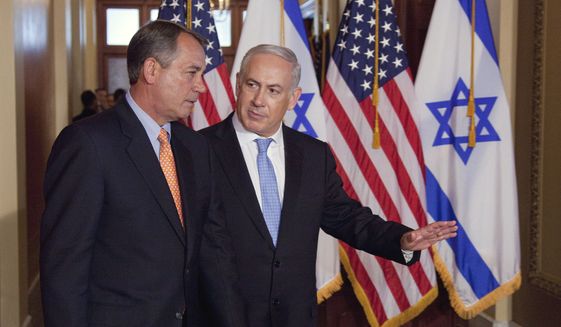
us-israel-iranjpeg-088fd_c0-0-3500-2040_s561x327FILE – In this May 24, 2011 file photo, Israeli Prime Minister Benjamin Netanyahu walks with House Speaker John Boehner of Ohio to make a statement on Capitol Hill in Washington. Boehner has invited Netanyahu to address Congress about Iran.

House Speaker John A. Boehner said Wednesday he’s invited Israeli Prime Minister Benjamin Netanyahu to speak to a joint session of Congress in February.

“In this time of challenge, I am asking the prime minister to address Congress on the grave threats radical Islam and Iran pose to our security and way of life,” Mr. Boehner said. “Americans and Israelis have always stood together in shared cause and common ideals, and now we must rise to the moment again.”

The invitation comes a day after President Obama told Congress he would veto any legislation imposing stiffer sanctions on Iran — a move that has bipartisan support on Capitol Hill, but which the president said would squelch chances for a deal to control Iran’s nuclear program, and could move closer to war.

The speech is slated for Feb. 11. Mr. Netanyahu has addressed Congress twice before, in 1996 and again in 2011.


Making sense of Obama’s counter-intuitive approach to negotiations with Iran

January 19, 2015

Making sense of Obama’s counter-intuitive approach to negotiations with Iran, Power LinePaul Mirengoff, January 18, 2014

Obama doesn’t want just any nuclear deal. Obama wants a deal Iran will feel good about so that he can make more deals with the ruling clerics. He sees Iran as the key to a grand bargain in the Middle East, one that will thwart ISIS and bring stability — on Iran’s terms — to the region. Israel, of course, excepted.

********************

Last week, President Obama and British Prime Minister Cameron pleaded with Congress not to pass new sanctions legislation against Iran. Such legislation, which has strong bipartisan support, could undermine ongoing negotiations, they argued. “Just hold your fire” until we complete negotiations, Obama urged.

But Obama’s position seems nonsensical on its face. The sanctions legislation Congress contemplates passing does exactly what Obama instructs Congress to do. As the Washington Post’s editors remind us, the Menendez-Kirk legislation would impose sanctions only if Iran reaches no agreement before the June 30 deadline it previously agreed to. “Fire” is “held” until then.

If anything, as the Post argues, the legislation would make a deal with Iran more likely. For unless Obama is going to cave entirely (a definite possibility, sadly), Iran will have to make concessions. And Iran is more likely to make concessions if the consequence of no deal is a stepped-up sanction regime.

In other words, the legislation to which Obama objects would give him a bargaining chip. The fact that Obama doesn’t want one (he says he’d veto the Menendez-Kirk bill) should tell Congress that he’s not interested in playing hardball in negotiations with Iran.

Iran is playing hardball, though. It has manufactured two bargaining chips. First, it recently announced that is has begun the construction of two new nuclear reactors.

Second, Iran has referred the case of Jason Rezaian, a Washington Post reporter held prisoner in Tehran, for processing by the “Revolutionary Court.” Rezaian has been denied basic humanitarian treatment by his captors — for example, his weight is down by 40 pounds, according to his mother — and has neither been informed of the charges against him nor allowed to consult with his lawyer, according to the Post.

Put simply, Rezaian is a hostage to the nuclear negotiations. And why not? The Castro brothers got what they wanted from Obama using the same approach.

As with Cuba, Iran is actually using a belt and suspenders approach. Obama has always wanted to lift sanctions on Cuba and he clearly wants a nuclear deal, any deal, with Iran. With Cuba, he was able to obtain the photo ops accompanying a prisoner release to make his concessions easier for Americans to swallow. The Rezaian captivity means that Obama may be able to do the same with a nuclear deal with Iran.

But Obama doesn’t want just any nuclear deal. Obama wants a deal Iran will feel good about so that he can make more deals with the ruling clerics. He sees Iran as the key to a grand bargain in the Middle East, one that will thwart ISIS and bring stability — on Iran’s terms — to the region. Israel, of course, excepted.

This, I believe, is why Obama opposes congressional action that would strengthen his bargaining position. Obama is fine with bargaining from weakness with Iran, and wants to earn credit with the mullahs for standing up on their behalf to Congress, including members of his own party.

A final note. The Post’s editors should be commended for the strong position they advance in today’s editorial. A few days age, I suggested that the Post was experiencing something resembling Stockholm syndrome in its reporting on Iran. If so, the syndrome has not spilled over to its editorial page.