Archive for the ‘Iran scam’ category

A Reckless Act in the Senate on Iran

April 15, 2015

A Reckless Act in the Senate on Iran, New York Times, The Editorial Board, April 14, 2015

(Consider the source. — DM)

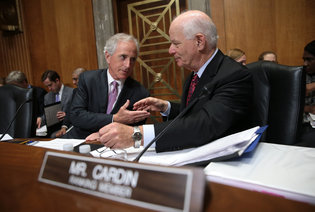
15wed1Web-master315Senators Bob Corker, left, and Ben Cardin, the leaders of the Senate Foreign Relations Committee. Credit Win McNamee/Getty Images

Congress has formally muscled its way into President Obama’s negotiations with Iran, creating new and potentially dangerous uncertainties for an agreement that offers the best chance of restraining that country’s nuclear program.

With a unanimous vote on Tuesday, the Senate Foreign Relations Committee approved a bill that would require Congress to review, and then vote on, the final text of a nuclear deal. It would also prohibit Mr. Obama from waiving economic sanctions on Iran — the crucial element of any agreement under which Iran rolls back its nuclear program — for at least 30 days, and up to 52 days, after signing an agreement so Congress has time to weigh in.

The full Senate and the House will have to approve the bill. But the committee’s action gives momentum to those who have bitterly criticized Mr. Obama for negotiating with Iran, though they offer no credible alternative to the preliminary deal on the table. Republicans who control Congress have largely been the driving force behind the legislation, but this bill was passed overwhelmingly by the Senate committee thanks to Democratic support.

Mr. Obama initially threatened to veto the legislation, but he backed off rather than face a bipartisan override of his veto. The administration did get some compromises. The review period was shortened, and language making the lifting of sanctions dependent on Iran ending support for terrorism was softened.

Mr. Obama’s acquiescence might be a tactical move. He could veto the congressional vote on the final agreement, which is supposed to be concluded by the June 30 deadline, rather than expending political capital in vetoing this measure if it were to pass both chambers of Congress. But the Senate committee’s action puts him in an weakened position as the only leader involved in the negotiations who may not be permitted to fully honor commitments that were made.

The nuclear deal is the product of a multinational negotiation with Iran conducted by the United States, France, Britain, China, Germany and Russia. In no other country has a legislative body demanded the right to block the agreement. Even if Congress barred Mr. Obama from waiving American sanctions, the European Union and the United Nations Security Council could lift the sanctions they imposed, thus undercutting the American decision.

Obama Hid North Korea Rocket Component Transfer to Iran

April 15, 2015

Obama Hid North Korea Rocket Component Transfer to Iran, Israel National News, Ari Yashar, April 15, 2015

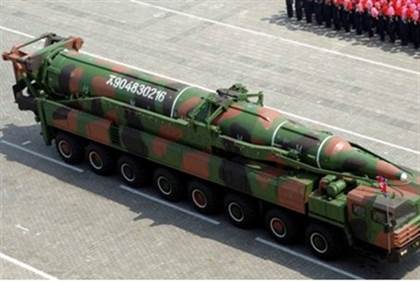
NK missileA North Korean rocket in a military parade (file)Reuters

The information is particularly damaging given that Admiral Bill Gortney, Commander of North American Aerospace Defense Command (NORAD) and US Northern Command (USNORTHCOM), admitted this month that the Pentagon fears that North Korea and possibly Iran can target the US with a nuclear EMP strike.

********************

US intelligence officials revealed that during the ongoing Iran nuclear negotiations, North Korea has provided several shipments of advanced missile components to the Islamic regime in violation of UN sanctions – and the US hid the violations from the UN.

The officials, who spoke to the Washington Free Beacon on Wednesday on condition of anonymity, said more than two shipments of missile parts since last September have been monitored by the US going from North Korea to Iran.

One official detailed that the components included large diameter engines, which could be used to build a long-range missile system, potentially capable of bearing a nuclear warhead.

The information is particularly damaging given that Admiral Bill Gortney, Commander of North American Aerospace Defense Command (NORAD) and US Northern Command (USNORTHCOM), admitted this month that the Pentagon fears that North Korea and possibly Iran can target the US with a nuclear EMP strike.

Critics have pointed out that the nuclear framework deal reached with Iran earlier this month completely avoids this question of Iran’s intercontinental ballistic missile (ICBM) program, which would allow it to conduct nuclear strikes.

US President Barack Obama was given details of the shipments in his daily intelligence briefings, but the officials say the information was hiddenfrom the UN by the White House so that it would not take action on the sanctions violations.

Back in 2010, the UN Security Council put sanctions on Iran’s illegal uranium enrichment program. Those sanctions prohibit Iran from buying ballistic missile parts, and any “technology related to ballistic missiles capable of delivering nuclear weapons.”

The US officials said the recent transfers fall within the scope of the sanctions.

In confirmation, a spokesperson for Spain’s mission to the UN, now in charge of the UN’s sanctions committee, said the committee has not been told about the incidents by the US since Spain took over in January.

White House and State Department spokespersons contacted by the paper refused to comment on the report.

Hiding transfers from the UN – “typical” Obama

A wave of experts came out with criticism against Obama’s administration for hiding the missile part transfer from the UN.

Former UN Ambassador John Bolton said the shipments violate UN sanctions on Iran, as well as those imposed on North Korea back in 2009.

“If the violation was suppressed within the U.S. government, it would be only too typical of decades of practice,” Bolton said. “Sadly, it would also foreshadow how hard it would be to get honest reports made public once Iran starts violating any deal.”

Former CIA analyst Fred Fleitz shared his assessment, saying “while it may seem outrageous that the Obama administration would look the other way on missile shipments from North Korea to Iran during the Iran nuclear talks, it doesn’t surprise me at all.”

“Iran’s ballistic missile program has been deliberately left out of the talks even though these missiles are being developed as nuclear weapon delivery systems,” noted Fleitz. “Since the administration has overlooked this long list of belligerent and illegal Iranian behavior during the Iran talks, it’s no surprise it ignored missile shipments to Iran from North Korea.”

The mounting criticism was added to by Thomas Moore, a former Senate Foreign Relations Committee arms control specialist, who told Washington Free Beacon that the transfer “certainly points out the glaring omission present in the Iran deal: the total lack of anything on its missile threat.”

“If true, allowing proliferation with no response other than to lead from behind or reward it, let alone bury information about it, is to defeat the object and purpose of the global nonproliferation regime – the only regime Obama may end up changing in favor of those in Tehran, Havana and Pyongyang,” Moore said.

And Henry Sokolski, head of the Nonproliferation Policy Education Center, said the missile transfer “more than suggests why the administration had to back away from securing any ballistic missile limits in its negotiations” with Iran.

Exposing the Iran-North Korea missile partnership

The Washington Free Beacon went into detail about the relationship between North Korea and Iran in building the latter’s advanced missile program, which is poised to construct ICBMs capable of delivering a strike with a nuclear warhead at astounding distances.

A classified State Department cable from October 2009 that was exposed by Wikileaks details that Iran is the leading missile customer of North Korean.

It stated how since the 1980s North Korea has been handing Scud missiles and technology for developing Nodong missiles with a 620-mile range to Iran.

“Pyongyang’s assistance to Iran’s [space launch vehicle] program suggests that North Korea and Iran may also be cooperating on the development of long-range ballistic missiles,” read the cable.

Another cable from September 2009 posited that the steering engines in Iran’s Safir rocket likely come from North Korea, and are based on Soviet-era SS-N-6 submarine launched ballistic missiles.

Importantly, that transfer of technology let Iran develop a self-igniting missile propellant that “could significantly enhance Tehran’s ability to develop a new generation of more-advanced ballistic missiles.”

“All of these technologies, demonstrated in the Safir [space launch vehicle] are critical to the development of long-range ballistic missiles and highlight the possibility of Iran using the Safir as a platform to further its ballistic missile development,” read the cable.

The assessments of the classified cables were confirmed by Joseph DeTrani, former director of the US intelligence agency National Counterproliferation Center, who said North Korea has kept “close and long term” relations with Iran in transferring missiles and related technology.

“U.N. Security Council resolutions prohibit this type of activity, and continued missile-related transfers from North Korea to Iran would be in violation of these Security Council resolutions,” added DeTrani, a former CIA officer and special envoy to North Korea nuclear talks.

Obama caves on Corker-Menendez

April 15, 2015

Obama caves on Corker-Menendez, Power Line, Scott Johnson, April 14, 2015

(It’s not a great bill but may be enough to scuttle the “deal.” Might Obama have decided that his and Iran’s talking points about the “deal” are too far apart, that there will be no agreement and that he would prefer to put the blame on the Congress rather than on his negotiating team or Iran? — DM)


[T]he Obama administration flipped this afternoon, just before the markup started, and withdrew its veto threat. Josh Earnest disclosed the move to reporters at today’s White House briefing. In retrospect this was probably just simple math. After the Corker-Cardin compromise, a Senate Democratic staffer told the New York Times that a veto-proof majority was now assured. McCarthy had already told reporters that he had the votes he needed in the House to sustain a veto. Someone in the White House seems to have counted to 67 and 290, and made the call.

*****************

We’ve been following the political action following the arrangement in process with Iran mostly via the email reports of Omri Ceren. Today he mailed two reports on the Corker-Menendez bill, which passed unanimously out of the Senate Foreign Relations Committee this afternoon. In the second of the two messages below, Omri reports that the White House has backed off its veto threat in light of its impending loss on this matter. Some readers may want to skip to the second of these two messages.

These messages are not brief, but I think they summarize the information necessary to understand developments in this most consequential matter. Here is Omri’s first message, sent this morning.

Happy Markup Day.

The Senate Foreign Relations Committee takes up Corker-Menendez at 2:15pm today, and it looks like the session will go quickly. The NYT, Reuters, CNN, etc. are reporting that Corker and Cardin came to an agreement on language earlier today, and the NYT quoted a senior Democratic aide saying that the changes mean the bill will “now have overwhelming, veto-proof support.”Reuters has more details on what the final provisions – which call for Congressional approval of any Iran deal – will probably look like.

I’ll send around whatever gets finalized this afternoon, but it looks like this is locked and everyone has their lines. Opponents from the left will say the vote damaged hopes for a deal. Supporters will respond that any deal that can’t stand up to Congressional scrutiny isn’t worth having. Opponents from the right will say the bill actually undermines Congressional prerogatives because it requires a supermajority to block a deal. Supporters will respond that any bipartisan compromise legislation capable of mustering a veto-proof majority is going to be imperfect.

All of which will get lost in what’s sure to be the broader takeaway: Congress looked at what came out of Lausanne and they didn’t like it. Then they got briefed by the administration – and they liked it even less. This is their way of sending a message to the President about the need to make any deal stronger, and this is their way of mobilizing pressure to make sure their message gets through.

The question is what exactly they didn’t like. On that point, I wanted to make sure you had the report on the Lausanne announcement published this weekend by David Albright’s Institute for Science and International Security (ISIS), which has been making the rounds on the Hill. ISIS is widely considered one of the most credible shops on Iran proliferation, if not flat out the most credible. But because their paper is so brutal – it’s tersely titled “P5+1/Iran Framework: Needs Strengthening” – Albright and his team had to open by reminding people of that: “no outside group has worked as much as ours on generating recommended provisions for this deal, identifying missing pieces, and assessing the strengths and weaknesses of proposed provisions… consistently we have been met with gratitude and positive feedback from negotiators in several countries about our contributions.”

Then there’s a brief bright spot for the administration – ISIS assesses that Iran’s concessions on the Arak heavy water reactor are adequate – before things get very bad on every other issue. The whole paper is 13 pages, it gets wonkish at times, and there’s no way a summary could be adequate. There are sections like the one on breakout times, where the authors are in disbelief that the administration refuses to include Iran’s 20% enriched uranium in breakout calculations, which just have to be slogged through.

But one useful way to wrap your mind around the paper – and this gets back to the conversation on the Hill – is that it’s a catalog of how the concessions made to Iran at Lausanne detonated the possibility of a good deal. In order to get even the contested announcement that came out, the Americans had to cave diplomatically on a variety of issues. The ISIS paper, in part, now describes the consequences of those concessions. It’s not written that way – it’s just a policy paper that goes issue by issue – but it can be usefully read like that to see how the political and policy debates are interacting. Remember how the news unfolded during Lausanne:

Wednesday 25th — the Wall Street Journal revealed that Iran will be allowed to put off making a full disclosure of its nuclear activities until after sanctions relief — now the ISIS assessment on disclosure: “Negotiators must not agree to lift UNSC sanctions before the IAEA has reached its broader conclusion about the peaceful nature of Iran’s program, including determining the extent of past progress on Iran’s military nuclear program and dismantling any remaining efforts… Unless this facet of Iran’s nuclear program is dealt with, no agreement should be made. It is a deal component that negotiators would ignore at the peril of regional security and peace.”

Thursday 26h — the Associated Press revealed that Iran will be allowed to continue spinning centrifuges in its underground military bunker at Fordow — now the ISIS assessment on Fordow: “A surprise in the Framework is the proposed continuation of the Fordow enrichment plant… If bans on producing near 20 percent LEU also sunset at year 15 (see above), this heavily fortified plant would be capable of producing enough weapon-grade uranium for a nuclear weapon within a few weeks, or enough WGU for two weapons in less than a month.”

Monday 29th — the New York Times revealed that Iran will not be forced to ship its enriched uranium beyond its borders — now the ISIS assessment on stockpiles: “How will this material be disposed of so that the limit is not exceeded?… accumulations of more than 500 kilograms of 3.5 percent LEU above the 300 kilogram limit would lower breakout times significantly below 12 months… If Iran accumulates stocks of 3.5 percent LEU hexafluoride above 1,000 kilograms and can access quickly only 50 kilograms of near 20 percent LEU hexafluoride, it could reduce breakout times to less than six months.”

Again, these are just part of the paper. But they’re enough to understand why Congress is demanding oversight: combined, the concessions made in just the last few weeks to the Iranians give Tehran a breakout time significantly shorter than 12 months, an enrichment facility where breakout can happen that’s impervious to most air attacks, and a verification regime so weak it threatens to undermine “regional security and peace.”

Here is Omri’s second message, commenting on the passage of the Corker-Menendez bill out of the Senate Foreign Relations Committee on a unanimous vote:

That was quick. Apparently everything had indeed been worked out this morning. One token failed amendment, one vote on everything else in a single manager’s package, and then a quick vote. 19-0.

The big news from this afternoon isn’t actually the vote. It was already clear by late this morning that the legislation would get out of committee with strong bipartisan support, although I don’t think anyone was willing to predict unanimous support. As I wrote in the morning’s email with the Albright report, today’s compromise between Corker and Cardin guaranteed that the markup would be a snoozefest (let me know if you didn’t get that email, by the way, because the report at the bottom is now one of the most important policy document circulating around).

Instead the breaking news is that the Obama administration flipped this afternoon, just before the markup started, and withdrew its veto threat. Josh Earnest disclosed the move to reporters at today’s White House briefing. In retrospect this was probably just simple math. After the Corker-Cardin compromise, a Senate Democratic staffer told the New York Times that a veto-proof majority was now assured. McCarthy had already told reporters that he had the votes he needed in the House to sustain a veto. Someone in the White House seems to have counted to 67 and 290, and made the call.

The White House spin is that the Corker-Cardin compromise substantively altered the legislation, so that now just ‘a vote to vote later’ on sanctions. The spin is going to be tough to sustain, and it’s not yet clear what part of the legislation the White House is even claiming was substantively altered. One change reduced the time Congress gets to review a deal from 60 days to 52 days. Another change removed language linking sanctions to Iranian terrorism (Barrasso offered an amendment to put the restriction back in, which failed 13-6 and had Corker quipping that if Iranian terrorism kills Americans they’re going to get missiles not sanctions). Neither of those seem particularly dramatic.

The substantive problem for the White House spin is that this bill locks in what Corker-Menendez was always supposed to lock in: it gives Congress the ability to intervene after an Iran deal is signed by the parties but before it is implemented by Washington. The legislation prohibits the President from implementing the provisions of a deal immediately, and instead provides lawmakers with 30 days to review its details. If Congress acts to block the deal, the President will presumably veto that action, at which point lawmakers will have the remainder of the 52 days to try to override the veto.

Corker more or less rolled his eyes at the spin during today’s markup: “I think the reason the administration in the last 2 hours has chosen the path that they’re now taking, is the number of Senators that they realized were going to support this legislation.” He had already brushed aside the idea that there were any substantive changes: “This legislation is exactly the congressional review we’ve been working on since day 1.”

The political problem for the White House spin is that it looks like they lost big. They fought against oversight for months, up to and including accusing supporters of being warmongers (also something that came up during today’s session). The National Iranian American Council – one of the groups that has been at the front of the White House campaign to block Congressional action – issued a press release blasting the vote and declaring “the compromise amendment that was struck by Senators Corker and Cardin does not change the fundamental problems with this bill.” Beyond the substance, it’s just very difficult in DC to spin a loss like this. Votes spin themselves. The White House talk about substantive changes is probably aimed as much at preventing that narrative from taking hold, as it is anything else.

Let me add this: the bill is far from perfect. At best it just locks in how a post-deal vote would go down. Congress always would have needed 67 votes to do anything (imagine the first day after a deal; Congress passes new sanctions; Obama vetoes; Congress needs 2/3 to override). At worst it may help the President by letting him get a headline like “Congress approves Iran deal” if only 34 Senators approve.

But politically, it’s important to show that Congress disapproves of the President’s diplomacy to such an extent that the Senate Foreign Relations Committee just advanced legislation 19-0 prohibiting him from touching Congressional sanctions until they review a deal. It builds pressure on the administration to explain what they’re doing. It will serve as a formal way for the Senate to have a debate on the floor. It forces the issue.

Nuclear Iran’s “Spillover Effects”

April 14, 2015

Nuclear Iran’s “Spillover Effects” Gatestone InstituteVijeta Uniyal, April 13, 2015

As President Obama tries to sell the world his mysterious nuclear “framework agreement,” India’s defense establishment is just not buying it. The U.S. and Western commentators might be expecting “peace dividends” from Iran, but India cannot afford to harbor such illusions.

The Iranians have already announced that they plan to sell “enriched uranium” in the international marketplace, and will be “hopefully making some money” from it. To whom will they sell?

A nuclear Iran would be able to hold the world hostage by blocking one-third of the world’s oil supply at the Strait of Hormuz. Iranian proxies have also been trying to seize control of the Bab-el-Mandeb Strait, the maritime choke point of the Suez Canal.

The only question is whether the West would rather have an adversary such as Iran before it has nuclear weapons or after.

When the West and Iran agreed — or not, depending on whether one believes the U.S. version or Iran’s — on the parameters of a supposed nuclear “framework,” India’s foreign office hailed the agreement as a “significant step.”

India’s foreign office might have joined the international chorus welcoming the deal, but as U.S. President Barack Obama aggressively tries to sell the world his mysterious nuclear “framework,” India’s defense establishment is just not buying it.

India’s defense establishment seems to be having acute qualms about this “framework.”

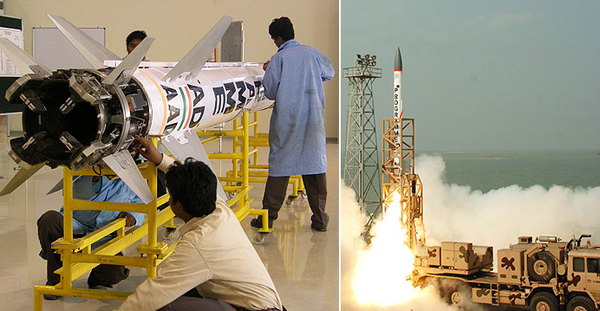
One day after the P5+1’s mysterious “agreement” with Iran, India began gearing up for a more effective nuclear defense, and unveiled plans to equip the country’s capital, New Delhi, with a comprehensive missile defense shield to avert a nuclear attack.

Once in place, the shield could intercept missiles fired from a range of 5,000 km, roughly double the aerial distance between New Delhi and Tehran.

The first step would be to install the long-range “Swordfish” radars, developed with the help of Israel. They can track missiles from a range of 800 km.

India’s missile interceptor capability is expected to be functional by 2016. India also plans to set up a missile shield for its commercial capital, Mumbai.

1020At left, Indian defense contractors work on an Advanced Air Defence (AAD) interceptor missile. At right, an Indian AAD missile is test-launched.

On April 4, India’s Defence Research and Development Organisation (DRDO) also reiterated the country’s ability to hit targets well beyond its adjoining region.

India has always been seriously concerned about prospect of nuclear proliferation in the Middle East. If Arab and Muslim countries decide to counter the Iranian nuclear threat with nuclear arsenal of their own, India’s hostile neighbor, Pakistan, is likely to want to play a crucial role.

India is not only vulnerable to nuclear threats from Pakistan. Both the Islamic State (ISIS) and Al-Qaeda have also openly declared hostility toward it. India has long been concerned about nuclear capabilities or materiel falling into the hands of Islamists in Pakistan. By now, it is no secret that if Iran acquires nuclear weapons capability, nuclear proliferation in the Middle East will increase exponentially. The Iranians have already announced that they plan to sell “enriched uranium” in the international marketplace and will be “hopefully making some money” from it. To whom will they sell?

President Obama and Western commentators might be expecting “peace dividends” from this “historic reconciliation” and be awaiting all sorts of positive “spillover effects” as a result of lifting sanctions — from changing Iran’s attitude towards Israel to democratizing the Iranian regime — but India cannot afford to harbor such illusions. Islamist terror has claimed more than 30,000 Indian lives in just the last two decades.

Indians are now bracing for the real spillover effects of a nuclear Iran.

Thanks to Washington’s indifference, Iran now controls four Arab capitals — Damascus, Baghdad, Beirut, and now Sana’a, while the U.S. has retreated from three: in Libya, Yemen and Iraq. If Iran can hold the Obama administration hostage without any leverage, a nuclear Iran would be able to hold the whole world hostage by blocking one-third of the world’s oil supply at the Strait of Hormuz — with impunity. Iranian proxies have also been trying to seize control of the Bab-el-Mandeb Strait, the maritime choke point of the Suez Canal.

European leaders who failed to show any resoluteness in face of Russian aggression against Ukraine, and even failed to vote against a “framework” that threatens global security, can hardly be expected to stand up to Tehran. The only question is whether the West would rather have an adversary such as Iran before it has nuclear weapons or after.

Once major European powers such as Russia, France and Germany start investing in Iranian infrastructure and entangling themselves with Iran economically, one can forget about rolling back sanctions.

Western leaders can spin the “framework” agreement all they want to cover up their abysmal diplomatic failure, but as Tehran’s centrifuges keep spinning as a result of the deal, the region turns more and more volatile.

Regardless of the diplomatic chorus and the media circus, the defense planers in New Delhi are just not buying this agreement. Other countries that care about the free world would be wise not to buy it, too.

King Abdullah II: We’re War With “Outlaws Of Islam” – Special Report

April 14, 2015

King Abdullah II: We’re War With “Outlaws Of Islam” – Special Report via You Tube, April 13, 2015

(He seems quite diplomatic, but what does he actually think? — DM)


Dr Andrew Bostom on Lisa Benson show 12.5.2015

April 13, 2015

Dr Andrew Bostom on Lisa Benson show 12.5.2015, You Tube, April 13, 2015

(Dr. Bostom relates Islamic doctrine to Iran’s negotiating tactics. Please see also, Lt. Col Ralph Peters: “The Iranians Negotiate, We BEG!” — DM)

Lt. Col Ralph Peters: “The Iranians Negotiate, We BEG!”

April 13, 2015

https://www.youtube.com/embed/sRDctfQDPD0“>Lt. Col Ralph Peters: “The Iranians Negotiate, We BEG!” You Tube, April 11, 2015


Through the looking glass with Barack Obama into the Iran nuclear deal

April 13, 2015

Through the looking glass with Barack Obama into the Iran nuclear deal | Anne’s Opinions, 12th April 2015

The hallucinatory deal with Iran resembles Alice Through the Looking Glass more than any kind of diplomatic or political achievement.– anneinpt)

Iran bunny

The magic Iranian Easter Bunny (via Twitter)


Shortly before Purim I wrote a post about “Venahafoch hu” – how “everything was turned about” in matters to do with Israel and the Palestinians. Well, Pesach is now over and yet it seems that the Purim spirit is still with us in everything to do with the nuclear deal between Iran and Barack Obama. (Note: I use Obama’s name deliberately rather than “Iran and the P5+1” because this deal has Obama’s name (literally) written all over it with seemingly very little input from the other 5 partners.)

How else other than utter surrealism, if not willful blindness, could explain the following headlines? (All the links in the Twitter embeds are clickable and will take you to the original articles).

Yes, the Saudis and Israel are the world’s new “best friends”, or at least politically-convenient allies. Who would have thought we would live to see the day? And keep in mind that it was the Americans, or rather Barack Obama himself, who drove the two into each others’ arms. Maybe that was his devious plan all along?

Note to politicians: When Haaretz contradicts you, you know you are on the wrong side:

https://twitter.com/HenryRops1/status/584871507714768896

They should take advice from Prof. Alon Ben Meir, a world expert in the Middle East.

It’s surely past time to take the Iranians at their word (click on the picture below to enlarge and see the quotes in their entirety):

And this is confirmed by former Presidential candidate, Senator John McCain:

The Israeli government is not relenting on its persistent questioning of the “deal” with Iran:

This is summarized in these convenient tabs:

Possibly the most surreal moment of this whole surreal farce (apologies for the overuse of this word. I just cannot think of a better description) was Obama actually confirming Binyamin Netanyahu’s assertion that the Iranian’s will have zero time to nuclear breakout, and then the State Department frantically trying to walk back Obama’s words:

From the linked article:

As reported yesterday, President Obama admitted that Netanyahu was correct when he said that the sunset clause in the P5+1 nuclear deal with Iran “paves the way” for Iran to get nuclear weapons.

Obama admitted that in years 13 and 14 under his deal, the breakout time, which has since dropped to its current 2-3 months, and which the deal hopes to expand to 1 year, then drops to zero.

“What is a more relevant fear would be that in Year 13, 14, 15, they have advanced centrifuges that enrich uranium fairly rapidly, and at that point, the breakout times would have shrunk almost down to zero.”

The State Department faced a crisis when Obama accidentally told the truth, and to correct it, Spokeswoman Marie Harf said the President’s words got “a little mixed up”, and he was referring to a “hypothetical” case of what would happen without a deal.

Kemberly Kaye at Legal Insurrection blasted the “dippy” Marie Harf (although she was probably acting under orders) and quoted two former Secretaries of State, Henry Kissinger and George Shultz in the Wall Street Journal:

Brutally critical of the administration’s much touted Iran deal, the op-ed focused on the White House’s dismissive attitude towards the danger Iran poses. Kissinger and Shultz were less than impressed by the administration’s insistence on the necessity of a deal with a country whose priorities aren’t remotely in the same galaxy as those of the United States, noting:

Cooperation is not an exercise in good feeling; it presupposes congruent definitions of stability. There exists no current evidence that Iran and the U.S. are remotely near such an understanding. Even while combating common enemies, such as ISIS, Iran has declined to embrace common objectives. Iran’s representatives (including its Supreme Leader) continue to profess a revolutionary anti-Western concept of international order; domestically, some senior Iranians describe nuclear negotiations as a form of jihad by other means.

In sum, the op-ed eloquently observes the Iran deal is a complete and total cluster.

As pointed out above several times, the White House is suffering from a severe case of cognitive dissonance on Iran. Amy Miller at Legal Insurrection lists the ways:

Yesterday, Senator John McCain talked with radio host Hugh Hewitt about the non-deal—and the White House is not happy about it.

During the interview, McCain laid it all bare when he said that, with regards to the framework, “John Kerry is delusional.”

The White House comms shop, of course, can always be counted upon to barrel headfirst through a brick wall when faced with criticism. No exception here:

https://twitter.com/rorycooper/status/586608713433292801

https://twitter.com/BrettLoGiurato/status/586608095507296257

This Alice in Wonderland view is cleverly illustrated thus:

https://twitter.com/coinabs/status/585641373510041603

We can add to this whole mish-mash the rather important but somehow unnoticed little fact that the Iran deal is not in fact a deal at all, as the Diplomad explains:

In all these mushrooming detonations of praise and self-congratulation one simple, little, itsy-bitsy fact has been overlooked. I hate to be the party pooper, but, well, there is no deal.

So comparing the Geneva “deal” with Iran to the Munich Agreement is unfair to the Munich Agreement. Chamberlain wasn’t lying when he announced he had a deal; Obama and Kerry are lying when they announce that they have a deal.

I repeat, there is no deal.

I have been in lots of negotiations, and can spot fake talking points real fast. The giveaway, of course, is that the detailed “parameters” were announced by the US; where are the signatures on the deal? I want to see where the Iranians signed.

The Iranian take on the “parameters” is quite different from the line peddled by Obama and Kerry. While Obama seeks to give the impression that these “parameters” have been agreed, the Iranian position is that, basically, these “parameters” establish the topics that will be discussed over the following weeks and months, except, of course, for one. The Iranians claim that sanctions must be lifted immediately or there is no further “progress.” In addition, of course, the Iranians get to keep their nuclear program. A minor detail.

David Gerstman also concurs with the Diplomad that the deal, such as it is, is going to kill the Non-Proliferation Treaty:

The idea that the protocols (remember there’s no deal yet) agreed to last week somehow would strengthen the NPT is utterly false.

The point of the ongoing nuclear negotiations from Iran’s standpoint is to remove its violations from the books and end the sanctions it incurred for those violations. Iran’s goal in the negotiations is to enshrine its “right to enrich” uranium. (No such right exists. Nuclear research for peaceful purposes is a right, an important qualification that cannot be attached to Iran’s nuclear research, according to the NPT.)

Now let’s assume the most optimistic outcome: that Iran addresses all key concerns. (Iran was supposed to explain possible military dimensions – PMD – of its nuclear work according to the Joint Plant of Action (JPOA) of November 2013, and still has not done so.) Iran would still have over 5000 centrifuges enriching uranium at Natanz. Iran would have centrifuges operating (though not enriching uranium) in an underground reinforced facility at Fordow and would have a heavy water reactor operating at Arak. (In December 2013, Obama himself acknowledged that Iran did not need the latter two facilities “to have a peaceful nuclear program.”)

So by defying the IAEA and the Security Council Iran will be awarded 5000 centrifuges enriching uranium that it didn’t have before. The sanctions triggered by those violations will be wiped away. (By the way, 5000 centrifuges is enough for a bomb, but not for civilian nuclear program.)

Ironically, the president overseeing the destruction of the NPT was once a proponent of nuclear disarmament.

One more hallucinatory piece of cognitive dissonance for today (though I could go on for ages. This Iran deal is a giver):

https://twitter.com/soccerdhg/status/587139164296126466

Seriously, if this weren’t so deadly serious we would be laughing hysterically.

And just to complete today’s upside-down news, we are now officially into “Jewish summer time” since we wish each other “a good summer” at the end of Pesach. But someone forgot to inform the weather. We have been suffering from a wintry storm with huge amounts of rain, hail, thunder and lightning. My little side road has been flooded and my car can barely get out without the water going above the wheels. My daughter in Gush Etzion has reported a temperature of 1°C!! Any lower and it will snow. This is Spring. In Israel. Where its’ supposed to be in the mid-20s at the very least. To cap it all, last Wednesday it was almost 40°C.

Welcome to the crazy Middle East.

Khamenei Smashes Terms of Nuclear Agreement

April 12, 2015

Khamenei Smashes Terms of Nuclear Agreement, Clarion ProjectRyan Mauro, April 12, 2015

(Obama demands, don’t mention Iran’s mumblings about his once in a lifetime deal. Partisan wrangling must stop!– DM)
Iran-Ayatollah-Khamenei-HP_3Iranian Supreme Leader Ayatollah Kamenei (Photo: © Reuters)

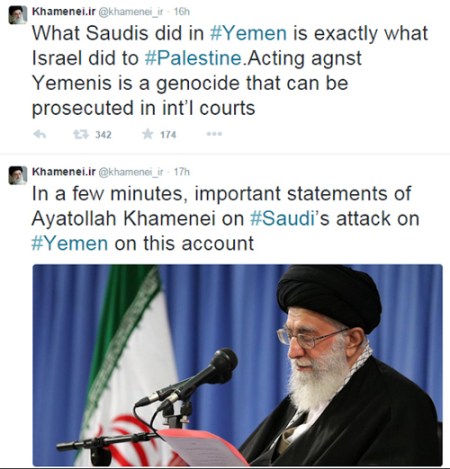
Khamenei’s accusations make Saudi Arabia a legitimate target under any understanding of jihad. He even went so far as to say the Saudis’ actions are equivalent to Israel’s so-called “genocide” in Gaza. This implies that a violent jihad against Saudi Arabia is as justifiable as one against Israel.

Iran believes that these end times prophesies correlate to the death of Saudi King Abdullah, the Houthis’ overthrow of the Yemeni government, the civil war in Syria, Saudi military action and the fierce fighting in Iraq. The regime sees the confluence of all these crises as beyond the realm of coincidence and signaling the imminent arrival of the “Hidden Imam” which will herald military victory for Iran.

Before the “Hidden Imam” can arrive, two other condition must be fulfilled: instability in Saudi Arabia and the march of a prophetic figure titled “Yamani” who will lead Shiite forces from Yemen into Mecca. The Houthis recently pledged to invade Saudi territory, capture Mecca and overthrow the royal family in Riyadh. They were likely referring to this prophecy.

“We’re not going to respond to every public statement made by Iranian officials or negotiate in public,” said State Department spokesman Jeff Rathke during a daily press briefing.

********************

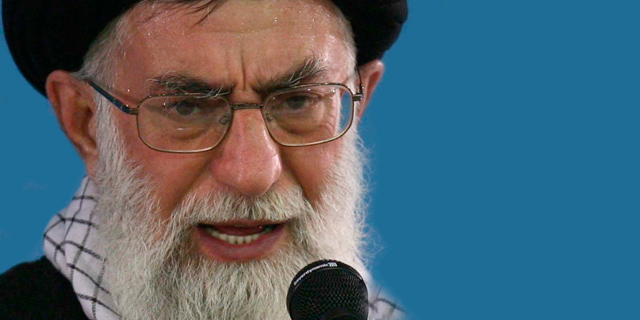
Iranian Supreme Leader Ayatollah Khamenei ended his eerie silence since the nuclear framework agreement was announced with a fiery speech accompanied with “Death to America” chants. Khamenei essentially smashed the viability of the nuclear framework to pieces, signalled a major escalations in the war in Yemen and essentially endorsed a violent jihad against the Saudi royal family.

Wishful thinkers can’t dismiss the speech as theater for a domestic audience. Khamenei tweeted highlights in English to make sure the world, especially Americans, saw them. The threats and demands are so unequivocal that failing to follow through would sacrifice his entire credibility and prestige.

The Iranian Supreme Leader is unsatisfied with the nuclear framework agreement even though it generously permits Iran to retain the ability to produce nuclear weapons while getting major sanctions relief.

First, he said that the fact sheet published by the U.S. contains lies and does not reflect what Iran agreed to. The statement obliges the regime to seek significant revisions shortly after it gave President Obama the go ahead to make a high-profile victory lap.

Khamenei’s demands are inescapably incompatible with America’s requirements for a deal.

First, Iran is demanding that all sanctions be lifted on the first day that a final deal is signed. The framework only agrees to lift sanctions in phases and only those related to nuclear activity, not terrorism or human rights. Doing so would unfreeze the assets of individuals and entities involved in terrorism around the world, sparking a massive growth in Iran’s terrorist apparatus and proxy warfare.

The inherently flawed hope by the West that “moderate” President Rouhani and other Iranian figures can reign in Khamenei can be immediately ruled out, since Rouhani said the same exact thing.

Iran-Khamenei-Nuke-Tweets

Second, Iran is insisting that there will be no “unconventional,” “special” or “foreign” inspections or monitoring. In other words, Iran will not be subject to exceptionally intrusive inspections. Khamenei’s tweets do not specify Iran’s standards, but it is clear that Iran does not intend to give the IAEA unlimited access.
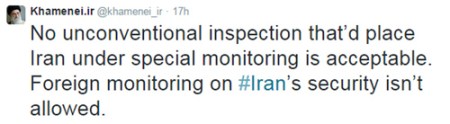
Iran-Khamenei-Rejects-Inspections-Tweets

This is almost definitely a reference to military sites, to which Iran consistently says it has the option of denying access. Iran wants the ability to deny access to any location by declaring it a military institution.

This is how Iran denies access to the critical Parchin site, where damning evidence may exist to prove that Iran conducted major nuclear weapons research until at least 2003. An Iranian opposition group identified an alleged nuclear site in February that is within a military compound. It is claimed that the facility is used for uranium enrichment and the production of advanced centrifuges.

Notice the language of the tweets, which was reported to be equally non-compromising in Farsi. There is no wiggle room. Khamenei would have left some ambiguity if he was willing to budge. If you believe this is just talk, then you must believe that Khamenei made the calculated decision to cause an easily avoidable self-inflicted wound for no reason.

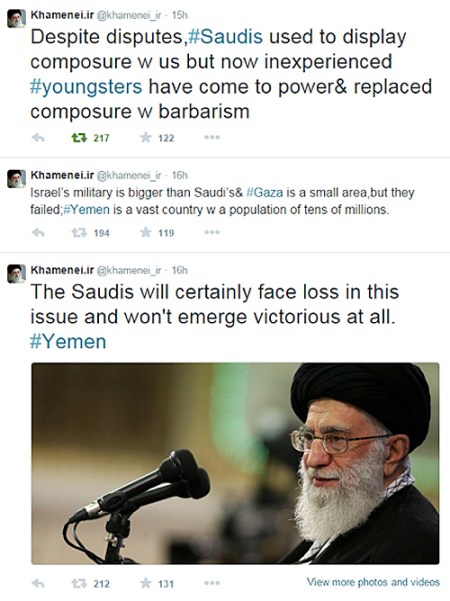
Another flurry of tweets related to the war in Yemen, where Iran is backing the Shiite Houthi rebels who have overthrown the government.

A U.S.-supported coalition of Sunni countries intervened militarily to support President Hadi and stop Iran from threatening the strategic Bab al-Mandeb Strait. This alliance includes Saudi Arabia, Egypt, Bahrain, Qatar, Kuwait, the United Arab Emirates, Jordan, Morocco, Turkey, Pakistan and Sudan. The last two are especially significant because of their close ties to Iran. Separately, Al-Qaeda is gaining ground in Yemen and the Islamic State (ISIS) is rising up as a competitor.

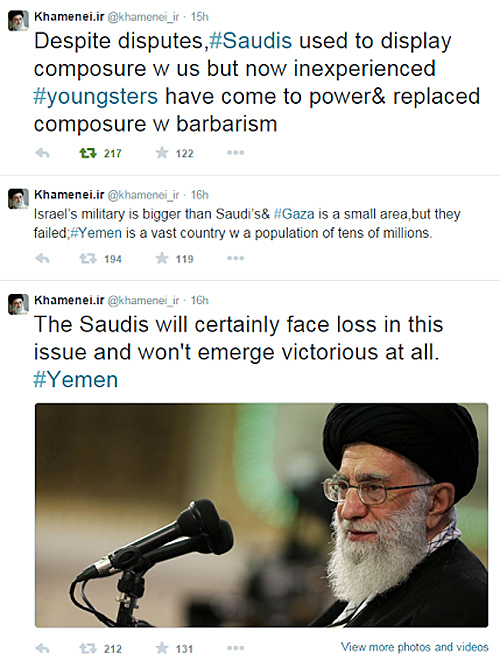
Interestingly, the tweets only threatened Saudi Arabia and did not mention any of these other participants by name. Khamenei stopped just short of a formal declaration of jihad, instead laying out the justification for it.
Iran-Khamenei-Yemen-1-Tweets
Iran-Khamenei-Yemen-2-Tweets

Khamenei’s accusations make Saudi Arabia a legitimate target under any understanding of jihad. He even went so far as to say the Saudis’ actions are equivalent to Israel’s so-called “genocide” in Gaza. This implies that a violent jihad against Saudi Arabia is as justifiable as one against Israel.

Don’t be comforted by Khamenei’s mentioning of prosecuting Saudi leaders in international courts. This is not meant to substitute jihad. Khamenei is making a point about how blatant the Saudi crimes are. He’s not even saying that this is Iran’s chosen course of action.

This comes as Iran dispatches two ships to the front in Yemen, including a destroyer to “safeguard naval routes” — meaning it will challenge the challenge the Saudi-Egyptian naval blockade.

Iran sent a flotilla to Bahrain in 2011 after Saudi and Emirati forces intervened to stomp out a revolution against the Sunni monarchy. The regime blinked at the last moment when the Arabs made it clear they would use force to stop it. However, the Yemen conflict has significant differences that Khamenei’s tweets help explain.

Khamenei is signaling that unprecedented hostilities with Saudi Arabia will now commence. The previous Saudi leaders, he says, could be dealt with. The new Saudi King and his circle must be handled more toughly.

However, Iran orchestrated massive terrorist attacks on Saudi interests even under the previous “composed” leaders, a campaign that put the U.S. economy and homeland at risk.

For example, in 2011, the U.S. prevented an Iranian Revolutionary Guards’ plot to assassinate the Saudi ambassador in Washington, D.C. by blowing up a restaurant, which inevitably would have taken the lives of American citizens as well. The scheme involved hiring a Mexican drug cartel to perpetrate the attack, along with bombings of the Israeli embassy in D.C. and the Israeli and Saudi embassies in Argentina.

In 2012, Iran launched a cyber attack on the Saudi Aramco oil company in response to the country’s policies in Bahrain and Syria. Aramco said the hackers tried to take down the country’s oil and gas production (which failed), but they did erase the data on 30,000 computers, three-fourths of the corporate computers.

Khamenei says that the new Saudi leadership is committing far worse crimes, so we should expect a far worse response.

We must also remember the prophecies cited by the Iranian regime.  Iran believes that these end times prophesies correlate to the death of Saudi King Abdullah, the Houthis’ overthrow of the Yemeni government, the civil war in Syria, Saudi military action and the fierce fighting in Iraq. The regime sees the confluence of all these crises as beyond the realm of coincidence and signaling the imminent arrival of the “Hidden Imam” which will herald military victory for Iran.

Before the “Hidden Imam” can arrive, two other condition must be fulfilled: instability in Saudi Arabia and the march of a prophetic figure titled “Yamani” who will lead Shiite forces from Yemen into Mecca. The Houthis recently pledged to invade Saudi territory, capture Mecca and overthrow the royal family in Riyadh. They were likely referring to this prophecy.

Khamenei’s speech wasn’t the typical bluster we are used to hearing from Islamist radicals and dictators. The timing, language and high-profile nature makes it very significant.

Even though the U.S. State Dept. responded by saying that sanctions against Iran would be removed gradually based on verification that Iran had kept its commitments, its response lacked conviction:

“We’re not going to respond to every public statement made by Iranian officials or negotiate in public,” said State Department spokesman Jeff Rathke during a daily press briefing.
Statement by PM Netanyahu

April 12, 2015

Statement by PM Netanyahu, April 12, 2014