Archive for the ‘Iran scam’ category

How Iran Saved Obama’s “Blame America” Foreign Policy

April 29, 2015

How Iran Saved Obama’s “Blame America” Foreign Policy, Front Page Magazine, April 28, 2015

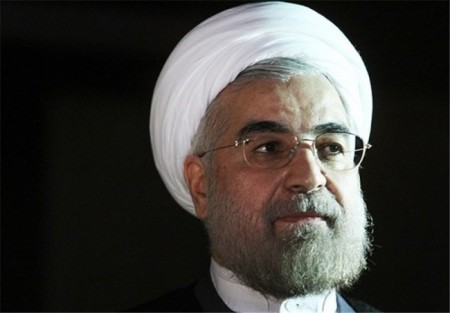
rouh-450x313

Obama’s public rejection of every ally, from Israel to Egypt to Saudi Arabia, has finally created the Post-American Middle East that his “Blame America” doctrine sought. The Post-American Middle East is a hive of terrorist groups and a region of nuclear arms races where murderous despots with vast armies dream of resurrecting the Ottoman Empire, the Persian Empire and the Abbasid Caliphate.

*********************

Obama’s Middle East policy was doomed to fail because it was based on the myth that everything wrong with the region was America’s fault.

Senator Obama had argued that Iraq would fix itself once we pulled out. Without America, the Iraqis would create a “political solution”. Instead the Shiites used the withdrawal to take over the government and Al Qaeda rebounded to dominate the Sunnis. After years of denying what was going on, he was forced back into Iraq after genocide and beheadings filled every television screen.

From the White House, he deployed the “Iraq Solution” across the Middle East by withdrawing support from American allies and backing terrorist groups like the Muslim Brotherhood. The chaos tore apart the region and turned over entire cities and countries to terrorists.

Egypt went through multiple coups. Street violence in Tunisia wrecked the country and supplied thousands of fighters to ISIS. His regime change war in Libya led to terrorist takeovers of its capital. Al Qaeda nearly took over Mali. Houthi Jihadists backed by Iran took over Yemen’s capital. The Saudis are bombing Yemen. The Egyptians are bombing Libya. The French are still fighting in Mali.

Iran and Al Qaeda have divided up Iraq, Syria and Yemen between themselves.

Withdrawing American power and influence didn’t work because we were never the problem. American soldiers weren’t causing the Sunnis and Shiites to fight each other. They were the only thing preventing it. American power and influence across the Middle East wasn’t holding back freedom and human rights, it was the only thing keeping a modicum of freedom alive in places like Egypt and Tunisia that quickly fell to Islamist rule in the Arab Spring, resulting in street violence, torture, terrorism and military coups.

The left had been fundamentally wrong about the cause of the problems in the Middle East. Obama trashed the region by following its wrongheaded doctrines.

Once the “Blame America” foreign policy has been implemented and the region went to hell, he had no idea what to do next. Intervening in Libya made sense according to the “Blame America” doctrine because Gaddafi had recently cut a deal with the United States and was obstructing the Jihadists who were implementing the local version of the Arab Spring in coordination with the Muslim Brotherhood.

But intervening in Syria didn’t. Assad wasn’t an American ally. Therefore the “Blame America” doctrine said that he should be left alone. But he was obstructing the Arab Spring. Overthrowing him would let the Muslim Brotherhood claim another country, but would alienate Iran and spoil any reconciliation.

Unable to make a final decision, Obama veered back and forth between Iran and the Muslim Brotherhood. Some days he seemed on the verge of bombing Syria and other days he was against even providing the promised weapons to the Sunni rebels. Even his supporters accused him of having no plan.

Syria’s real red line was the one that it had drawn through his foreign policy. Instead of making the Middle East better, his withdrawals had made it worse. And the beneficiaries of his foreign policy, especially the Muslim Brotherhood, were clamoring for more American military intervention.

Even Iraq’s Shiite government, backed by Iran, wanted American intervention.

Obama’s foreign policy had created a new set of untrustworthy client states which had to be kept alive by American intervention. The great joke of his foreign policy was that his new terrorist states acted just like the old dictators they were supposed to replace. They wanted American weapons and soldiers. Their own people hated them and hated America by extension. The climax of the Arab Spring came with crowds in Tahrir Square denouncing Obama and the Muslim Brotherhood for acting as his client state.

The “Blame America” foreign policy had led to even more blame of America. The new “democratic” Islamist governments that he helped bring to power to appease the Arab Street and atone for the sins of supporting the old secular-ish dictators backfired by making the Arab Street hate us more than ever.

Iran saved Obama’s foreign policy. Just as he was stumbling around Syria and weeping at being stuck back in Iraq, the agents of the Iran Lobby suggested that the whole mess could be put back together again. Iran and the US would fight on the same side against ISIS in Syria and Iraq. And this cooperation could be used to hammer out a nuclear accord that would retroactively justify Obama’s Nobel Prize.

The only problem was that everyone else in the region was completely against the idea.

The Iran Lobby threw Obama’s failed foreign policy a lifeline and he grabbed it. The bombing of Syria was off. Assad turned over some WMDs, but went on using others. The US began acting as the air force for Iran’s Shiite militias in Iraq while the Kurds and the Sunni Sheikhs of the Awakening were shut out.

When the Houthis took over Yemen, Obama shrugged. When the Saudis began bombing Yemen, they didn’t tell him because they were afraid the news would leak to Iran. And the administration covertly began pressuring them to stop, confirming that it now took its marching orders from Tehran, not Riyadh.

Obama ignored the vocal opposition, particularly from Israel’s Netanyahu, because the Iran deal was the only thing holding his foreign policy together. It made it seem as if he knew what he was doing. Take away the Iran deal and there was no longer a strategy, just a series of incoherent panicked responses.

That is why he continues to cling to the Iran deal. Without it, the Emperor’s foreign policy is naked.

The Iran deal salvaged the “Blame America” foreign policy by reorienting it away from the Muslim Brotherhood to deal with our great enemy in the region. By acceding to Iran’s nuclear program, Obama could finally fix everything by atoning for America’s biggest foreign policy sin in the region.

Despite his Muslim family background, Obama never understood the Middle East. Instead he looked at the region through a left-wing lens and saw only America’s crimes.

The Sunnis and Shiites, the Arabs, Kurds, Persians and Turkmen, weren’t fighting because of America. They were fighting over differences in religion, ethnicity and clan. The left has always thought that the way to fix the Middle East was to withdraw American influence. Instead doing that destabilized the region and created a power vacuum that Russia and Iran have been more than happy to fill.

Obama’s final foreign policy act was to fall directly into Iran and Al Qaeda’s trap.

Iran and the various Al Qaeda groups had effectively split parts of the region among themselves. By embracing Iran, Obama alienated the Sunni Middle East and shoved entire populations into Al Qaeda’s waiting embrace. He completed the polarizing process that he began with the Arab Spring by selling out the moderates to the extremists and waiting for everyone in the region to love America again.

But the Muslim Brotherhood lost out to its edgier Al Qaeda children. Egypt and the Saudis are scrambling to hold together some sort of Sunni center without the United States and against its wishes. Obama’s alignment with Iran, his rejection of Egypt’s new government and his failure to back the Saudis in Yemen has sent the message that the only legitimate alternative to Al Qaeda is Iran.

That’s not an alternative that most Sunnis can accept. Many would rather stand with Al Qaeda than Iran.

Obama’s public rejection of every ally, from Israel to Egypt to Saudi Arabia, has finally created the Post-American Middle East that his “Blame America” doctrine sought. The Post-American Middle East is a hive of terrorist groups and a region of nuclear arms races where murderous despots with vast armies dream of resurrecting the Ottoman Empire, the Persian Empire and the Abbasid Caliphate.

While genocide goes on, sex slaves are raped under the rule of a Caliph and black flags are unfurled and nuclear weapons are developed to fulfill apocalyptic Islamic prophecies, Obama smiles for the camera and waits for his second Nobel Prize.

It had been America’s fault all along. Now that Iran and Al Qaeda are in charge, everything will be okay.

Report: Kerry Told Iran He Wishes ‘U.S. Had a Leader like Iran’s Supreme Leader’

April 29, 2015

Report: Kerry Told Iran He Wishes ‘U.S. Had a Leader like Iran’s Supreme Leader’ Washington Free Beacon, April 29, 2015

(Who is fibbing?– DM)

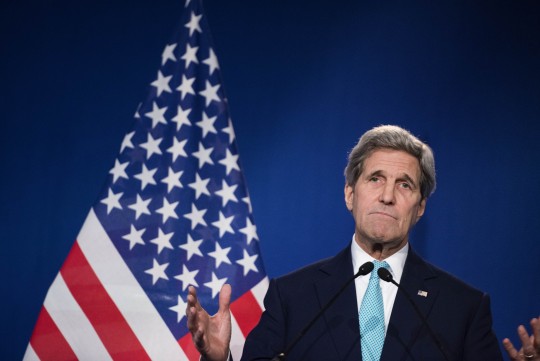
Kerry againAP

Secretary of State John Kerry told his Iranian counterpart that he wished the United States had a leader more like Supreme Leader Ayatollah Khamenei, according to comments made by a senior Iranian cleric and repeated in the country’s state-run media.

Ayatollah Alam al-Hoda claimed during Friday prayer services in Iran that in negotiations over Tehran’s contested nuclear program, Kerry told the country’s foreign minister that he “wished the U.S. had a leader like Iran’s supreme leader,” according to a Persian-language report on the remarkspublished by the Asriran news site.

“In the negotiations Kerry told [Iranian Foreign Minister Javad] Zarif that he [Kerry] wished U.S. had a leader like Iran’s supreme leader,” according to Alam al-Hoda, who is a senior member of the Iran’s powerful Assembly of Experts.

A senior administration official told the Washington Free Beacon that such a contention is patently absurd.

The remarks are the latest in a string of comments made by Iranian leaders purporting to reveal private details of the talks.

Iranian newspapers have carried multiple reports in recent months suggesting that Iranian Foreign Minister and chief negotiator Javad Zarif was ordered to stop screaming at Kerry behind closed doors.

In his Friday remarks, al-Hoda went on to say that Obama is set on striking a deal with Iran by June.

“Both Republicans and Democrats want these negotiations with Iran, but they fight each other for partisan interests,” he was quoted as saying. “Obama wants the negotiation to succeed so his party can win the next election and Republicans want to stop him.”

Alam al-Hoda also celebrated Iran’s expansion in the region and controversial activities in war-torn countries such as Syria and Yemen.

“Today, the resistance crescent has gone beyond Syria and Lebanon and reached to Yemen,” he said. “Today the resistance front is in control of Strait of Hormuz and Bab-el-Mandeb.”

The “U.S. and Israel have not been so weak anytime before,” he continues. “All these events are being managed by the hidden Imam,” a revered religious figure in Shia Islam.

Saeed Ghasseminejad, an Iranian dissident and fellow at the Foundation for Defense of Democracies (FDD), said U.S. overtures to Iran at the negotiating table have failed to win it any respect from the Islamic Republic’s leaders.

“President Obama thinks that by making more concessions he can gain the trust and respect of Iranian leaders,” Ghasseminejad said. “However, Iranian leaders neither trust him nor respect him.

“Seeing unprecedented weakness in the U.S. president, Iranian leaders do not fear the United States anymore. Partnership, trust, and alliance between the radical Islamist regime of Tehran and United States cannot and should not exist.”

Meanwhile, Zarif said over the weekend that fighting between the Obama administration and Congress over a potential final deal could not stop America from implementing any agreement the White House signs.

“As we have stated since the beginning, we consider the U.S. administration responsible for implementing the agreement and internal problems and conflicts in the U.S. are not related to us and to the implementation of the agreement, and based on the international laws, the countries’ internal problems don’t exempt them from implementing their undertakings and this is the main framework that we attach importance to,” Zarif said, according to the Fars News Agency.

On Monday, Zarif urged the United States to woo Iran.

“Maintaining an uncertain and unstable situation is not acceptable to Iran and the Americans should take practical and confidence-building measures to reach a comprehensive nuclear agreement,” Zarif was quoted as telling reporters.

A timely message from Iran

April 29, 2015

A timely message from Iran, Power Line, Scott Johnson, April 28, 2015

What the hell are the Iranians doing playing chicken with the U.S. Navy on the same day that the full Senate takes up debate on Corker-Menendez?

*****************

Omri Ceren provides this email update on today’s developments in the Persian Gulf, reported in this brief Reuters story:

It’s been a busy two hours, but some clarity is starting to emerge about the Iranian seizure of a cargo vessel in the Strait of Hormuz. The vessel is the M/V Maersk Tigris and sails under a Marshall Islands flag. It was intercepted by Iranian navy patrol crafts earlier today and sent a distress call, and which point it was contacted by US naval assets who streamed to the area to monitor the confrontation. The vessel was ordered to sail into Iranian waters and refused, at which point the Iranians fired shots across her bow, and the master complied. It’s now in the Iranian port of Bandar Abbas.

There is a dispute over whether the M/V Maersk Tigris was in international waters when it was initially intercepted. The Pentagon seems to have told journalists this morning that it was transiting through Iranian territorial waters. Defense analysts are posting maps showing otherwise (https://twitter.com/PatMegahan/status/593073911786377216).

A few things you’re likely to be hearing as the afternoon kicks off:

(1) The U.S. is treaty-bound to defend the security of the Marshall Islands. To what extent will the US be obligated to act in response to functionally unspinnable Iranian aggression? Keep in mind that in two weeks the President will be personally in a room floating security assurances to the Gulf, promising that the U.S. will protect them from future Iranian aggression.

The Republic of the Marshall Islands (RMI) is a sovereign nation. While the government is free to conduct its own foreign relations, it does so under the terms of the Compact. The United States has full authority and responsibility for security and defense of the Marshall Islands, and the Government of the Marshall Islands is obligated to refrain from taking actions that would be incompatible with these security and defense responsibilities. (http://www.state.gov/r/pa/ei/bgn/26551.htm)

(2) The administration just wrapped up a week of insisting that under no circumstances would it allow Iran to interfere with shipping in the area. It’s unclear how that can be reconciled with what the Iranians just did.

White House Press Secretary Josh Earnest, April 21: “principal goal of this operation is to maintain freedom of navigation and free flow of commerce in the Gulf of Aden and the Red Sea… would send a clear signal about our continued insistence about the free flow of commerce and the freedom of movement in the region… this is a clear statement about our commitment to ensuring the free flow of commerce in this important region of the world” (https://www.whitehouse.gov/the-press-office/2015/04/21/press-briefing-press-secretary-josh-earnest-4212015)

State Department Spokesperson Marie Harf, April 21: “I think the Defense Department may have already addressed this in their briefing today, but there were reports about these U.S. ships that have been moved. And I want to be very clear, just so no one has the wrong impression, that they are not there to intercept Iranian ships, to do issues like that; that the purpose of moving them is only to ensure the shipping lanes remain open and safe. I think there was some misreporting and confusion on this, and I just wanted to be very clear.” (http://www.state.gov/r/pa/prs/dpb/2015/04/240950.htm)

Pentagon spokesman Col. Steve Warren, April 21: “[U.S. warships] are operating [in the Arabian Sea] with a very clear mission to ensure that shipping lanes remain open, to ensure there’s freedom of navigation through those critical waterways, and to help ensure maritime security…By having U.S. ships in the region, we…preserve options should the security situation deteriorate to the point where there is a problem or a threat to freedom of navigation or to the shipping lanes or to overall maritime security.” (http://www.defense.gov/news/newsarticle.aspx?id=128634)

(3) What the hell are the Iranians doing playing chicken with the U.S. Navy on the same day that the full Senate takes up debate on Corker-Menendez? Business Insider’s national security and military editor Armin Rosen had one of the early lines on this:

Whatever else is going on, IRGCN just baited a Burke-class US destroyer into a confrontation in the world’s busiest oil choke point. (https://twitter.com/ArminRosen/status/593076865922891779)

Can Iran Do Whatever It Wants?

April 29, 2015

Can Iran Do Whatever It Wants? Commentary Magazine, April 28, 2015

[I]f the Obama administration were, in fact, to “tolerate” this disruption of the free flow of shipping it would send a dangerous signal, or to be more accurate, to reinforce a signal already sent: The U.S. lacks the will to stand up to predators in the international system, and in particular to Iran.

*****************

Every day, everywhere around the world, a silent referendum is going on about the state of American power. President Obama has consistently failed that test. By demanding that Bashar Assad leave power and then letting him stay; by letting Assad cross a “red line” on chemical weapons with impunity; by talking big about ISIS (“degrade and destroy”) and doing little; by standing by as Iran expanded its power into Iraq, Syria, and Yemen, as Russia seized chunks of Ukrainian territory, and as China intimidated its neighbors to claim sovereignty over disputed island, the president has dissipated the most precious commodity in the world—American credibility.

Today comes yet another test of American resolve. Details remain in dispute, but it appears that Iranian Revolutionary Guard gunboats seized the Maersk Tigris, a container ship traversing the Persian Gulf either through international waters or through a small section of Iranian waters that it would be allowed to traverse under the international legal doctrine of “innocent passage.” Instead of allowing the ship to go on its way, the IRGC fired a shot across its bow and detained the ship along with its crew. This is a vessel flagged in the Marshall Islands, a U.S. protectorate, owned by the Maersk line (a company with substantial American operations that is headquartered in Denmark, a NATO ally), and chartered by Rickers Ship Management, the Singapore-based subsidiary of a German company (two more U.S. allies).

The Iranian action may well be an indirect response to the U.S. decision to deploy an aircraft carrier strike group in order to intimidate Iran into turning back a cargo of supply ships reportedly bringing weapons to Iranian-backed Houthi fighters in Yemen. But whatever caused the Iranian action, it is a direct threat to freedom of navigation, which the U.S. Navy has defended around the world for centuries.

In the Persian Gulf, the U.S. commitment to that doctrine led President Reagan to order U.S. Navy ships to escort tankers and protect them from Iranian attacks, precipitating a short and sharp conflict (the Tanker War of 1987-88) between the U.S. and Iran. This was the last time, incidentally, that the U.S. used force to respond to Iranian attacks and it was an unqualified success—the Iranians lost some oil platforms and boats that they had been using to harass shipping. Finally the accidental shootdown of an Iranian airliner in 1988 by the USS Vincennes (an unintended and unfortunate consequence of these operations) helped convince the Iranian leadership to end their war with Iraq.

Today the U.S. still remains committed, at least on paper, to protecting freedom of navigation in the Persian Gulf. In 2011, a 5th Fleet spokesman put it well: “The free flow of goods and services through the Strait of Hormuz is vital to regional and global prosperity. Anyone who threatens to disrupt freedom of navigation in an international strait is clearly outside the community of nations; any disruption will not be tolerated.”

Thus if the Obama administration were, in fact, to “tolerate” this disruption of the free flow of shipping it would send a dangerous signal, or to be more accurate, to reinforce a signal already sent: The U.S. lacks the will to stand up to predators in the international system, and in particular to Iran. Put another way, it would signal to the entire region that the president is so invested in reaching a deal with Iran that no Iranian misconduct—not the dropping of barrel bombs on Syrian civilians, not the takeover of Yemen, not the ethnic cleansing of Sunni communities in Iraq, and now not the seizure of a Western cargo ship—will be allowed to interfere with his objective.

The fate of the Maersk Tigris does not matter much in and of itself, but it will say much about this administration’s commitment to maintaining America’s traditional security responsibilities.

Raid on Iran

April 28, 2015

Raid on Iran, Jerusalem PostHarry Moskoff, April 28, 2015

The only question now is:  when could an attack on Iran be carried out? At this point, Israel can’t afford NOT to make a strike, as the policy of the current nuclear negotiations with Iran has changed from prevention, to containment.  Indeed, all have come to agree that if the military option isn’t utilized by either the US or Israel, a nuclear Iran is simply a fait accompli.

If a preventative strike on Iran’s nuclear facilities is going to happen, it must be both before the P5+1 negotiating deadline of June 30th, and before the Russian S-300 anti-aircraft missiles are delivered and setup on Iranian soil. Indeed, if and when that eventuality comes into play, Israel may be forced to destroy that weapons convoy on route to Iran. I’m pretty sure this threat has already been issued.

**********************

As a rule, I don’t usually get involved in war scenarios, but after seeing the Israeli Air Force (IAF) jets put on their brilliant display this week for Israel Independence Day, I was inspired.  I was thinking: what if they just continued flying southwest? There’s an important point that I want to make here.

Sooner rather than later, Israel will be forced to make that raid. You know the one. It’s the BIG one. It will make the 1981 precision strike on Iraqi’s Osirak reactor, otherwise known as Operation Raid on the Sun, look like a walk in the park. Back then (just like now), when some argued that the attack would alienate both the United States and Europe, Ariel Sharon allegedly quipped “If I have a choice of being popular and dead or unpopular and alive, I choose being alive and unpopular.” Prime Minister Begin ultimately agreed and the rest of the cabinet fell in behind him. The only question now is:  when could an attack on Iran be carried out? At this point, Israel can’t afford NOT to make a strike, as the policy of the current nuclear negotiations with Iran has changed from prevention, to containment.  Indeed, all have come to agree that if the military option isn’t utilized by either the US or Israel, a nuclear Iran is simply a fait accompli.

If a preventative strike on Iran’s nuclear facilities is going to happen, it must be both before the P5+1 negotiating deadline of June 30th, and before the Russian S-300 anti-aircraft missiles are delivered and setup on Iranian soil. Indeed, if and when that eventuality comes into play, Israel may be forced to destroy that weapons convoy on route to Iran. I’m pretty sure this threat has already been issued. Effectively, we’re looking at a window of opportunity of a little over 2 months to initiate an attack that could take many hours, if not days to carry out, with hundreds or even thousands of missile strikes per day.  Simply put, if there is no attack now, Israel must prepare for the day after – a new, grim reality in the Middle East.

However, here’s an interesting point. If the arms shipment isn’t destroyed, there may be another answer to the S-300. Israel’s Defense Ministry sent a Letter of Request to Congress in 2003 asking for authorization to purchase “up to” 75 brand new, top of the line jet fighters that have significant new counter-missile capabilities. In 2010, it signed a deal with the US-based Lockheed-Martin aeronautical company for 19 F-35As, with the first few aircraft set to arrive in late 2016. The total cost of that deal was $2.75 billion, a spokesman for Lockheed-Martin said, out of which $475 million was for non-recurrent costs for the incorporation of upgraded Israeli technology. It’s interesting to note that the approximate cost of the aircrafts was (a staggering) $120 million. Each! These are stealth fighters with highly advanced radar, which will see its targets before it is seen.  Armed with the intelligence of where the surface to air missile systems are located, the IAF will then take the necessary measures to first avoid the S-300 systems, then destroy them.  What other choice is there – finding the Ark of the Covenant and using that, as in biblical times? True, the planes are insanely expensive, but obviously quite necessary!

On April 15 at Yad Vashem, and echoing his recent, now-famous address to Congress, PM Netanyahu said: “Even if we are forced to stand alone against Iran, we will not fear…”  Well folks, I dare say that we have reached that point.  Everyone knows by now that where the negotiations are concerned, the US no longer considers use of force in the cards, and quite the contrary, President Obama has indicated that even sanctions have become negotiable. People here in Israel feel that the State Dept. may even act AGAINST Israel if it unilaterally attempts a pre-emptive attack.  Besides the obvious existential threat to Israel, one of the other problems is that Iran seeks to “dominate the region” (Netanyahu’s words), and impose a Khomeini-style revolution in the Middle East.  We now see clearly that they are doing just that in places like Yemen, Syria, Lebanon, and even here in Gaza. Whether Israel sees a right-wing government emerge in the coming weeks, or even a broad-based coalition with the Left, all agree at the end of the day that it’s just a matter of time before Iran breaches their side of an already bad deal, and action will need to be taken, whether backed by the US or not.

What most Israeli’s don’t realize is that once a breach in the agreement is discovered (publicly), there is simply no way the US will neutralize Iranian capabilities with a military strike.  Obama won’t do it, and the reason why he won’t do it is because he is not prepared to cast and label Iran as an Enemy of the State. To him, those days are over and it doesn’t lie in synch with his doctrine. In fact, the US President apparently vetoed a potential Israeli attack on Iran’s nuclear facilities back in 2012. Is it so hard to see why? Back door negotiations were going on even then between the US and Iran, as Hillary Clinton recently admitted herself.  It is crystal clear that the White House CAN forcibly bring the Iranian nuclear program to a halt, it simply chooses not to do so. Will this change after, let’s say – an Iranian nuclear test?  Perhaps, but unlikely.

As such, practically speaking, can Israel attack Iran with any real success? Is it worth it? The following are some salient points to consider.

We know that Saudi Arabia has already given tacit permission for Israel to use its airspace to reach the Iranian military targets because as a Sunni Muslim state, they are considered as ‘infidels’ to Iran, who are Shiite Muslims. In fact, they have more to worry about than Israel does, and as a result of the framework agreement that was signed in Vienna, they are demanding the same rights to nuclear capabilities that Iran is apparently going to get. Credible sources state that Pakistan is now prepared to ship a nuclear package to the Saudis. As for Iran, it already has the ballistic missile capability that could hit Saudi Arabia with a warhead at the push of a button. And they know it. So does Jordan.

The truth is that Israel has sufficient nuclear and conventional power to destroy the Islamic Republic in one day in the event of any war. In this case though, we’re talking about a surprise attack (more or less). As mentioned above, Israel is believed to have a fully prepared plan to launch a strike, which by necessity, would likely involve some 80 planes, and perhaps up to several hundred aircraft according to some military experts. In reality, this has been in the planning for over 10 years. Israel possesses the advanced midair refueling capabilities required for carrying out sorties over multiple Iranian targets situated between 1,500 and 2,000 km away from home. Possible targets could include uranium-enrichment sites at Natanz and Qom, the uranium-conversion plant at Isfahan, and a heavy water reactor in Arak suspected of being used to pursue a plutonium-based nuclear arms program, as well as additional facilities. The mission would require the use of powerful, penetrating warheads, otherwise known as bunker-buster bombs, as well as possible repeated strikes to ensure success. According to a Newsweek article from September of last year, the US Congress signed and transferred 55 such bombs to Israel. Further, the attack would likely be coordinated with the assistance of Israeli intelligence satellites that could provide real time detailed images from the battle arena, as well as Airborne Warning and Control (AWAC) aircraft. It could also involve the use of a fleet of giant Heron 2 drones, which are the size of 737 commercial airliners. The UAVs form the first line of defense against an expected Iranian counterstrike, involving the launch of long-range Shihab 3 missiles, or worse.   These drones can reportedly reach Iran and hover over missile launch sites. Israel’s Arrow missile defense shield would undoubtedly also come into play to intercept missiles heading into Israeli airspace.

In terms of other forms of weaponeering capabilities, Israel maintains (at least) two elite special forces units dedicated to assisting with air strikes, one dedicated to laser target designation (Sayeret Shaldag/Unit 5101) and one to real time bomb damage assessment (Unit 5707).  These units are extremely well-trained and could potentially be infiltrated to the target zone prior to attack.  While it would be both difficult and risky to deploy these units inside Iran, they would be very useful in aiding the strike package, particularly in bad weather.

Obviously, such a strike would touch off conflict with Iran’s proxy in southern Lebanon, Hezbollah, which is armed with thousands of rockets, as well as Hamas in Gaza, and possibly with Syria. The resulting chain of events could easily lead to a major regional war and long-term instability, so much so that some senior Israeli defense figures have reportedly been rejecting the idea of attacking Iran for years.  Assuming that a military strike is issued in the near future, Israel cannot hope to destroy Iran’s entire nuclear infrastructure, as facilities are distributed across the country and there are simply too many sites to plan to attack them all.  To have a reasonable chance of success, both in the mission and in the ultimate goal of rendering Iran’s nuclear program impotent, the target set must be narrowed to concentrate on the critical nodes in Iran’s nuclear infrastructure, which seems to be growing by the day!

The main focus of an imminent strike must be to target the Natanz facility first.  Natanz is by far both the most difficult and most important target to destroy.  The main enrichment facility apparently has two large (25,000-32,000 m2) halls located 8 to 23m underground and protected by multiple layers of concrete.  The combination of large size and target hardening mean that only a very robust strike could hope to destroy or at least render unusable the centrifuges within.  In order to ensure penetration of a target with these high levels of hardening, one technique is to use the bunker busters targeted on the same aimpoint but separated slightly in release time to ‘burrow’ into the target. What happens essentially, is that one bomb hits the crater made by the previous weapon, a technique contemplated by the U.S. Air Force in the first Gulf War.  This takes advantage of the extremely high accuracy of bombs in combination with a penetrating warhead.  The IAF appears to have purchased these with this technique in mind. In fact, Gen. Eitan Ben-Eliyahu, former commander of the IAF (and a participant in the Osirak strike), commented on this method of attacking hardened facilities in Jane’s Defense Weekly: “Even if one bomb would not suffice to penetrate, we could guide other bombs directly to the hole created by the previous ones and eventually destroy any target.”

Has the point been made yet? This is just the tip of the proverbial iceberg on Israel’s military capability, and there is no doubt that the IAF can pull off an attack and get the job done. And let’s not forget about our Dolphins (nuclear subs) in the Gulf.  The factor that complicates matters so much is that, unlike in 1981 where the mission was so secret that the pilots themselves only learned of their target the day before, the US government must be notified before an attack of this magnitude.

On that note, the Obama administration has been exerting great pressure in the back halls for some time now in order to convince (even by means of veiled threats to withhold their veto power in the UN), their Israeli counterparts to refrain from issuing an attack order on Iran.  The only problem is that if Israel chooses again to wait it out and not attack, the world is bound to lie in dread of a new, powerful Iranian nuclear regime – to shake under their threat, similar to the way the world was just 70 years ago regarding the appeasement of Germany. Saudi Arabia will then look to the US for advice, and to provide an umbrella defense mechanism. Needless to say, a third world war might just emerge (heaven forbid).  This scenario is actually already depicted in the Zohar, the Midrash and other traditional Jewish texts in reference to the future world war of ‘Gog and Magog.’  Let’s pray it doesn’t come to that! In our lifetimes, or our offspring.

What bothers me the most right now though, is that even as the West is negotiating with a fanatical, expansionist Islamic regime in those posh Viennese boardrooms, the people on Tehran’s streets are chanting: “Death to the US; death to Israel” (in that order). The recent military parade echoed the same rhetoric.  HELLO…… isn’t someone paying attention over there? This is the reason why Israel shouldn’t just flex its military muscles for display to the Mullahs. It must attack. And it must attack now. This is precisely what the IDF was created for! Ben Gurion knew it. Menachem Begin knew it, and now Netanyahu knows it too. At this juncture in time, Iran cannot be trusted, and we know this to be an undeniable and unfortunately, well proven fact. Especially since, as of last week, the world discovered that Iran’s intent to destroy Israel is “non-negotiable.”  I believe that the citizens living in Israel (like myself) should, and will, accept the inevitable consequences that come with protecting our beautiful country.

A raid on Iran? My point here is:  The best defense is a good offense.

Hizballah terror attack on Golan stokes face-off between Israel and the Syrian-Hizballah alliance

April 27, 2015

Hizballah terror attack on Golan stokes face-off between Israel and the Syrian-Hizballah alliance, DEBKAfile, April 27, 2015

Israel over SyriaAlleged Israeli air strikes over Syria

Last week, the Obama administration managed to hold back the clash threatening to blow up opposite Yemen by the US, Saudi and Egyptian navies against an Iran convoy. Washington is likely to lean hard on Israel and Tehran to make sure that the current sparring does not run out of control and explode into a military showdown.

If this happened, Tehran would likely refuse to sign the nuclear deal which is nearing conclusion with the world powers led by the US.

*********************

According to Arab media, Israeli executed its third strike against Syrian and Hizballah targets in the Qalamoun area on the Syrian Lebanese border Sunday night, April 26 – shortly after Hizballah attempted to plant an explosive device near an Israeli Golan military post.

But then, Monday morning, anonymous Israeli sources improbably attributed this air strike to possible Syrian opposition action by the Al Qaeda’s Nusra Front.

Hizballah was meanwhile identified as responsible for the thwarted bomb attack on the Israeli Sheita military post guarding the northern Golan border with Syria. “Four terrorists placed an explosive on a fence near Majdel Shams. The air force thwarted the attack, killing all four,” a military spokesman said.
On the face of it, Israel’s purported third air strike over Syrian territory in five days, this time targeting the Wadi a-Sheikh and Al Abasiya regions of the Qalamoun mountains, was in retaliation for the thwarted Hizballah attack on the Golan.

However, DEBKAfile’s military sources give the exchange of blows a different slant: It is more likely to be the onset of a systematic Israeli campaign to wipe out Syrian-Hizballah military bases repositioned on the mountain range as depots and launching-pads for firing long-range missiles into Israel from Syrian territory.

A clue to this objective was offered Sunday night by Defense Minister Moshe Ya’alon in a firm statement that Israel would not permit Iran to arm Hizballah with advanced weapons. He did not explicitly admit to the air strikes of last Wednesday and Saturday,which were reported by Arab TV stations to have hit surface-to-surface missile depots on Qalamoun. But he nearly gave the game away. He accused Iran of trying to arm Hizballah with advanced weapons by every possible route. “We will not allow the delivery of sophisticated weapons to terrorist groups, Hizballah in particular… or allow Hizballah to establish a terror infrastructure on our borders with Israel,” the minister said, adding: “We know how to lay hands on anyone who threatens Israeli citizens, along our borders or even far from them.”

In a previous report, DEBKAfile disclosed that Syrian and Hizballah forces were on the point of conducting an offensive, under Iranian Revolutionary Guards officers, to flush Syrian rebels out of their last remaining pockets on the mountain slopes in order to clear the Syrian-Lebanese highway link for troop and arms convoys between the two countries.

We also reported that Hizballah had already relocated substantial military manpower and missile stocks from northern Lebanon to an enclave it now controlled on the Syrian Qalamoun mountains.

The anonymous sources’ attribution of Sunday night’s air strike to the Nusra Front sounded more like a lame cover story than a serious supposition. The Syrian opposition has never managed to use air power against the armies of Assad and Hizballah. Nusra did capture a few fighter-bombers from the enemy, but never acquired the technical infrastructure, ordnance or trained pilots to fly them.

This improbable theory would in any case contradict the warning message Israel was clearly addressing to Damascus and Hizballah that any violations of Israel’s red lines on their part would be met with action to knock over their military set-up on their shared border, section by section – even at the risk of a showdown with Iran in the Syrian arena.

Israel’s destruction of the Qalamoun war machine would have four far-reaching ramifications:

1. It would impair the Syrian army’s capabilities and strike at the heart of the Assad regime.

2. It would give a strong leg up to the Syrian opposition, especially Al Qaeda’s Nusra Front, which is emerging as the strongest and most effective paramilitary force in the Syrian opposition camp.

3. It would curtail the transformation of the Qalamoun Mts. into Hizballah’s most important forward base of attack against Israel.

It is hard to see Tehran standing by if the sparring escalates further and Israel continues to punch away at the Islamic Republic’s two most valuable strategic assets. Direct action by Iran would not be its style. Tehran would rather put the Syrian army and Hizballah up to stepping up its campaign of terror against Israel, possibly by expanding the arena across two borders into Lebanon and Israel itself.

Last week, the Obama administration managed to hold back the clash threatening to blow up opposite Yemen by the US, Saudi and Egyptian navies against an Iran convoy. Washington is likely to lean hard on Israel and Tehran to make sure that the current sparring does not run out of control and explode into a military showdown.

If this happened, Tehran would likely refuse to sign the nuclear deal which is nearing conclusion with the world powers led by the US.

Cartoon of the day

April 26, 2015

(Tip of the hat to Joopkiepzeiker — DM)

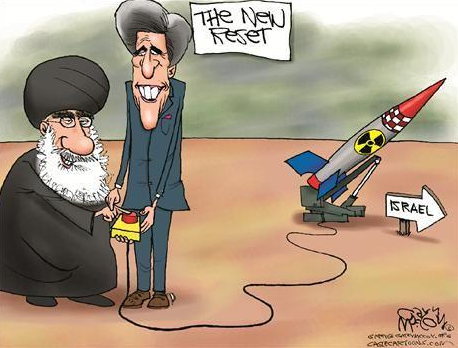
Kerry reset with Iran

How does sanctions-ridden Iran find a multibillion war chest to fund 6 armies fighting in 4 Mid East wars?

April 24, 2015

How does sanctions-ridden Iran find a multibillion war chest to fund 6 armies fighting in 4 Mid East wars? DEBKAfile, April 24, 2015

(The sanctions on Iran have been of decreasing significance since the initial “framework” of 2013 went into effect. — DM)

According to figures reaching DEBKAfile in March, Iran is spending a vast fortune – up to an estimated $6-8 billion per year – to keep six armed forces fighting in four Middle East war campaigns for expanding its sphere of influence.  Month after month, Tehran forks out close to half a billion dollars – and sometimes more – to keep those conflicts on the boil. How Iran manages to keep this war chest flowing so abundantly from an economy crippled by international sanctions has never been explained.

Syria
As the Syrian war enters its fifth year, Iranian Revolutionary Guards are found to be running it from four command and control centers, our military and intelligence sources report:

1. In Damascus, the IRGC operates as a part of the Syrian General Staff, with two imported pro-Iranian militias at its independent disposal. This command center has three tasks: To oversee the Syrian general staff and monitor its operational planning; to guard President Bashar Assad’s regime and his family; defend key locations such as the military airport and Shiite shrines, and keep the highways to Lebanon open.

2.  In the Aleppo region of the north, IRGC officers were engaged in drawing up plans for a general offensive to rout rebel forces from positions they have captured in the city. Tehran attaches prime importance to a peak effort for the recapture of Aleppo, Syria’s largest city. The IRGC command has transferred large-scale Hizballah forces from Lebanon to this arena, along with Afghan and Pakistani Shiite militias. Thousands of these combatants underwent training at specialist IRGC bases. Our military sources disclose that those militias recently took so many casualties that Iranian officers decided to hold off the Aleppo offensive.

3.  In the Qalamoun Mts., which are situated athwart the Syrian-Lebanese frontier, Tehran has given high priority to flushing rebel forces, including the Nusra Front and the Islamic State, out of the pockets they have seized on the mountain slopes, so as to clear the mountain roads for the passage of Hizballah units. This offensive has also been delayed.

4.  In South Syria, Iranian officers led a large-scale month-long drive to drive rebel forces out of the area they hold between Deraa and Damascus, in order to position Iranian-led Hizballah and pro-Iranian militia forces face to face with the Israeli army on the Golan. This drive has so far been stalled.

Tehran establishes – and pays for – new Syrian army

Iranian officers have established, trained and equipped a new 70,000-strong fighting force called the Syrian National Defense Force. Its operations, including the soldiers’ wages, are financed from Tehran’s pocket.

Iran runs airlifts day by day to re-supply the Syrian army with weapons systems and ammunition, and the Syrian Air Force with bombs and ordnance for attacks against rebel forces – of late, mostly barrel bombs. Intelligence sources estimate that Iran’s expenditure in the Syrian conflict now hits $200 million per month – around $2.5 billion a year.

Iran bankrolls Hizballah from top to bottom

The 25,000-strong Lebanese Shiite Hizballah operates under the direct command of IRGC officers. All its military equipment comes from Tehran, which also draws up its annual budget. Each month, Iran transfers to Beirut $150-200 million, as well as paying for all the Lebanese militias’ expenses for maintaining an expeditionary force in Syria. Hizballah costs Tehran an approximate $2 billion per annum.

An all-Shiite “people’s national army” for Iraq, re-supplies for Yemen

Iran’s deep military intervention in Iraq includes the creation of an all-Shiite “people’s national army.” It follows the same template as the Syrian National Defense Force and consists of the same number of fighters – 70,000 troops.

Tehran has also invested in barricades to fortify Baghdad against invasion from the north and the west.

The offensive to retake the Sunni town of Tikrit from the Islamic State was led by Iranian officers, and fed constantly with high-quality weapons systems, including missiles and tanks.

All the war materiel required by the Iraqi army and Shiite militias fighting the Islamic State is airlifted to Baghdad, some directly from Iran.

There is no reliable estimate of the Islamic Republic’s current contribution to Iraq’s war budget (estimated at a quarter of a billion dollars per month) because part of the cost is carried by the Iraqi government from oil revenues.

In Yemen, until Saudi Arabia and Egypt imposed an air and sea blockade a month ago, Iran ran supplies by air and sea to the Shiite Zaydi Houthis and their Yemeni army allies whom Tehran championed, sponsored and funded directly. The deployment of US warships in the Gulf of Aden this week put a stop to this traffic. But by then, Iran had sunk an estimated half a billion dollars in a Houthi victory.

Sanctions are no bar to Iran’s ambitions

This arithmetic is testimony to Iran’s mysteriously deep pockets. The sanctions the US, Europe and the United Nations clamped down on Tehran clearly had no effect on its willingness and ability to lay out fabulous sums to promote its ambitions as Middle East top dog.

China Warns Of Rising Nuclear Threat From North Korea – Lou Dobbs

April 24, 2015

China Warns Of Rising Nuclear Threat From North Korea – Lou Dobbs, Fox News via You Tube, April 23, 2015

(The first four minutes is about the mess in Yemen and the last four minutes is about the North Korean nuclear threat. — DM)


Empowering Iran

April 24, 2015

Empowering Iran, Weekly Standard, Lee Smith, May 4, 2015 (print date)

Obama’s foreign policy legacy will be to have tied America’s fortunes to an imperial and nuclear Iran governed by an ambitious and ruthless anti-American regime.

*****************

Last week, the Obama administration urged Saudi Arabia to halt its air campaign against the Iranian-backed Houthi rebels who have wrested control of the Yemeni capital Sanaa. The White House’s professed concern was that Riyadh’s Operation Decisive Storm was killing too many civilians. Unfortunately, that’s hardly surprising since Iranian proxies, like Hezbollah and Hamas, typically stash their missiles and rockets in civilian areas. Presumably, the Houthis have read from the same playbook. The effect of the administration’s diplomatic efforts, then, was to protect Iranian arms in Yemen. And this, in turn, the administration no doubt believes, protects Obama’s nuclear agreement with Iran.

Houthi rallyHouthis rally against Saudi Arabia, April 1. Newscom

In public, Obama is eager to show that the United States still stands by its traditional allies, like Riyadh. But behind the scenes, it’s clear that the White House’s real priority is partnering with Iran. Sure, the White House dispatched an aircraft carrier to the Arabian Sea, but this was not to stop Iran from shipping arms to the Houthis. As Obama himself explained, America’s blue-water Navy was present to ensure freedom of navigation in the Persian Gulf. The notion that the White House really intended to interdict Iranian arms shipments beggars belief. For more than four years Obama has done nothing to stop Bashar al-Assad from killing nearly a quarter of a million people in Syria, lest he endanger his nuclear agreement with Iran. With a deal so close, Obama is certainly not going to risk what he sees as the capstone of his foreign policy legacy by disarming Iranian allies in Yemen.

The problem is that by protecting his nuclear agreement with Iran, the president has protected and empowered the Islamic Republic. Tehran may boast of controlling four Arab capitals, but the reality is that its regional position is a house of cards. Pull out one of those Arab capitals, or the nuclear program, and Iran’s burgeoning empire quickly collapses. It’s Obama who is propping it up.

It’s interesting to imagine how these last six years might have gone for the Islamic Republic had the White House not been so determined to have a nuclear deal. Perhaps the Tehran regime would have been toppled when the Green Movement took to the streets in June 2009 to protest a fraudulent election if the American government had decided to back the opposition early, openly, and resourcefully. Perhaps another administration would at least have seen that uprising as an opportunity to gain leverage over the Iranian regime. Not Obama. He wanted a nuclear deal with the existing regime.

Another White House might have backed the Syrian rebels in order to bring down Assad. Indeed, a good portion of Obama’s cabinet counseled as much. To topple Tehran’s key Arab ally would have been the biggest strategic setback to Iran in 20 years, said Gen. James Mattis. Obama chose to leave Assad alone, and even ignored his own red line against the use of chemical weapons. Instead of the airstrikes he threatened on Syrian regime targets, Obama made a deal to ostensibly remove the chemical weapons that Assad is still employing.

As Assad’s position became weaker, Hezbollah entered the Syrian war to prop him up. The Iranian-backed militia was stretched thin between Syria and Lebanon, but the Obama administration helped the terrorist organization cover its flank by sharing intelligence to keep Sunni car bombs out of Hezbollah strongholds in Beirut. Another administration might have understood this as an opportunity to weaken Iran’s position in Damascus and Beirut, but not Obama. He had his eyes on the prize.

In sum, over the last six years, almost all of Iran’s advances in the region, including its move into Iraq to fill the vacuum in Baghdad after the American withdrawal from that country, has taken place with either the overt or tacit assistance of Obama. The White House brags about it. Israel might have attacked Iranian nuclear facilities, as one administration official told the press, but we deterred Prime Minister Benjamin Netanyahu from striking. If the Iranians strut with confidence these days, that’s because they understand who has their back.

The nuclear deal, as the president has explained, means that within a little more than a decade, Iran’s breakout time will be down to zero—which is a nice way of saying the clerical regime will have the bomb. The likely result is that the agreement will ensure Iran’s regional position long after Obama’s presidency is around to safeguard it. It will strengthen the hand of the hardliners. It is not Rouhani or Zarif or other so-called moderates who hold the nuclear file, but Khamenei and the Revolutionary Guard Corps. And in the future, American policymakers will have a vital interest in ensuring there are no internal regime fights over who controls the bomb.

In other words, Obama’s foreign policy legacy will be to have tied America’s fortunes to an imperial and nuclear Iran governed by an ambitious and ruthless anti-American regime.