Archive for the ‘Iran scam’ category

The High Cost of Office Space in Tehran

May 21, 2015

New Documents Reveal Bin Laden Wanted to Set Up Shop in Iran
By Katy Zavadski May 20, 2015, Via The Daily Beast


(Business is business, right? Makes you wonder what else Iran is hiding. – LS)

New documents taken from his compound show the group was much more tolerant of the Shiite state than its successor, ISIS. It even contemplated opening an office there.

An undated report on Al Qaeda’s external operations reveals that the group tried to establish a recruitment office in Iran but backed off because it was deemed to be too expensive.

“[W]e have thought to open an office for ourselves in Iran, to receive whoever comes to join us or someone traveling, but we have backed off this idea because it will be very expensive,” the document reads (PDF). Though undated, it is likely from 2006 or later, given a later passage’s emphasis on attacking Danish targets, presumably over Muhammad cartoons.

Another document, however, concerns itself with the group’s public image, and gives instructions for a would-be spokesman for the group.

“It is better if he comments on what Saudi Arabia channels have been circulating, incorrect news that stated al-Qa’ida has links to Iran,” it reads.

Those are just revelations from a massive document dump by the U.S. of files it obtained during the 2011 raid on Osama bin Laden’s compound in Pakistan. Dubbed “Bin Laden’s Bookshelf,” the document dump includes the sheikh’s English-language library and correspondence with close associates and family. Many of the sources point to a complicated history between Iran and Al Qaeda, which included mass imprisonment and strategic permissiveness.

Many al Qaeda members and families found themselves in Iranian custody after fleeing Afghanistan during the U.S. invasion in 2001. In one account, the Iranians are referred to as “people whose mannerisms resemble those of the Jews and hypocrites.” A detailed inventory of arrests suggests that Iran detained many high-level members of the terrorist group, including Abu Ghaith and Sayf al Adl.

“I think it’s irrefutable that Iran would turn a blind eye to al Qaeda activities” when it benefited them, Brookings Institution fellow Will McCants told The Daily Beast. Al Qaeda didn’t have as hardline an anti-Shia stance as some of its successors like ISIS because “they understand they have to make compromises.”

Despite some sharp language, McCants said al Qaeda leaders seemed to be sometimes happy with a “detente” with Tehran.

“I think it’s irrefutable that Iran would turn a blind eye to al Qaeda activities.”
The Foreign Policy Research Institute’s Clint Watts, however, told The Daily Beast that the documents show Al Qaeda members “seem to be pretty hating on Iran.”

Among those held in Iran appear to be Bin Laden’s wife and son, Umm Hamzah and Hamzah. One letter states that they are to be kept in a safe house once they leave the country, until Bin Laden decides whether to send the boy to Qatar. Another letter shows a concerns that Iran would spy on Bin Laden’s family after they leave:

Before Um Hamzah arrives here, it is necessary for her to leave everything behind, including clothes, books, everything that she had in Iran… Everything that a needle might possibly penetrate. Some chips have been lately developed for eavesdropping, so small they could easily be hidden inside a syringe. Since the Iranians are not to be trusted, it is possible to implant a chip in some of the belongings that you might have brought along with you…”

Documents revealed much more about Al Qaeda.

Tree-Huggers

A letter apparently addressed to a senior Al Qaeda urges leaders to tell fighters to not “cut down trees on a large scale […] without replacing them.” “Cutting down trees should be limited to the needs of the people and local consumption and not for export,” the August 2010 letter reads. “I am sure that you are aware that climate change is causing drought in some areas and floods in others.”

Another document, a “Letter on the implications of climate change,” calls on Muslims to participate in relief work and to prepare in advance for future natural disasters. At the same time, however, the letter takes time to critique an “Islamic” London-based NGO for providing aid to Christians and Hindus, and for employing female aid workers. It notes that the NGO said it would be unlikely to be able to help mujahideen in Pakistan.

Conspiracy Theories

“Jews were able to control world forces with these two sciences, sociology and psychology,” reads one. (Another document released from that trove instructs members to “avoid talking about the Jews and Palestine when talking to the Germans. This subject is very sensitive to in Germany, and it will bring negative results to our goal.”)

About half of the 38 English-language books Bin Laden possessed were about conspiracy theories, from freemasons to even 9/11.

Human Resources

The U.S. also released an official application form for Al Qaeda.

“Please enter the required information accurately and truthfully,” it reads. “Write clearly and legibly. Name, age, marital status. Do you wish to execute a suicide operation?”

Thirst for Poison

In an English-language document taken from bin Laden’s compound, Al Qaeda said it planned to use cyanide and ricin in terrorist attacks.

“A few grams of Cyanide (easily manufactured and sold by the kilo in third world countries) or Ricin diluted in water and injected randomly in anything ingested on super markets shelves, picnics, restaurants etc […] are just examples of what multinational Terror Franchises need to disseminate NONSTOP, UNPREDICTED, INVISIBLE SUDDEN DEATH,” a document said. It includes a terrorist wishlist including explosives, toxic agents, electronics, and more. The author is believed to be Abu Hafez, the leader of Al Qaeda’s external special ops.

Next challenge for US after Ramadi defeat: Iranian ship nears Yemeni shore

May 19, 2015

Next challenge for US after Ramadi defeat: Iranian ship nears Yemeni shore, DEBKAfile, May 19, 2015

Iran_Shahed_21.5.15Iranian aid vessel with “medical relief” personnel

DEBKAfile’s analysts strongly doubt that the USS Theodore Roosevelt carrier and strike force, which have been monitoring the Iranian flotilla’s movements, will be ordered to intervene against the Iranian ships reaching the Yemeni port.

Tehran, for its part has threatened to treat any such inspections as an act of war.

********************

Tuesday, May 19, two days after Ramadi’s fall to the Islamic State landed a major blow to Baghdad and US strategy in the region, 10,000 troops – more than half American – ended a large US-led military exercise in Jordan that was designed to practice tactics for countering ISIS. Taking part surprisingly in the two-week exercise was a heavy US nuclear-capable B-52H bomber, which flew in from the United States, crossing through Israeli air space and returning to home base when it was over.

This was the first time in the 12 years since the US invasion of Iraq that a B-52H, which can deliver nuclear weapons and bunker buster bombers, has appeared in Middle East skies for any military mission.

East of Jordan, as some 25,000 refugees from Ramadi slept in the open, the Islamist conquerors began moving on their next target, the Habbaniyah air base some 70 km west of Baghdad. Its fall would cut Baghdad off from northern and eastern Iraq and place it under siege from three directions – north, east and west.

Most Arab members have dropped out of the US-led coalition committed to fighting the Islamist terrorists in Iraq and Syria. This has left the US Air Force to bear the brunt of the aerial campaign. Its average of 19 air strikes a day is far too few to have any real effect on ISIS’s battle momentum. It certainly did not stop the long columns of black-clad Islamist fighters swarming on Ramadi from all directions in hundreds of tanks, APCs and minivans armed with heavy machine guns, and taking control of the capital of Iraq’s largest province, Anbar.

Western intelligence from the Ramadi region offered disturbing accounts of thousands of fully-armed ISIS fighters springing up apparently from nowhere to descend on the city, with no one able to see where they came from and no air action to scatter them before they entered the city.

After the Ramadi defeat, the Obama administration’s next major test in the region comes from an Iranian cargo vessel heading, accompanied by two warships, for the Yemeni Red Sea port of Hodeida and scheduled to dock Thursday, May 21. According to Tehran, the ship will unload 2,500 tons of humanitarian aid for Yemen, and the hundreds of passengers who disembark are Red Crescent medical relief workers.

The Saudi, US and Egyptian fleets have imposed a sea and air blockade on Yemen to prevent Iran provding the Yemeni Houthi rebels with fresh arms. Saudi and other regional intelligence agencies are convinced that the “paramedics” are in fact Revolutionary Guards officers and instructors in disguise, sent to strengthen the Houthi revolt.

Washington, Riyadh and Cairo have all vowed to stop the Iranian flotilla from putting into port in Yemen and said that its vessels will be forced to submit to inspections to make sure no illicit weapons are aboard and to confirm the passengers’ identities.

Tehran, for its part has threatened to treat any such inspections as an act of war.

Deputy Revolutionary Guards Commander Gen. Masoud Jazayeri put it plainly when he said: “I am distinctly stating that the patience of Iran has limits. If the Iranian aid ship is prevented from reaching Yemen then they, Saudi Arabians and United States, should expect action from us.”

DEBKAfile’s analysts strongly doubt that the USS Theodore Roosevelt carrier and strike force, which have been monitoring the Iranian flotilla’s movements, will be ordered to intervene against the Iranian ships reaching the Yemeni port. It is not a good moment for President Barack Obama to upset Tehran when he is in dire need of the Iraqi Shiite militias controlled by Iran to stand up to ISIS before its columns reach Baghdad.

Without the US, it is hard to see Saudi and Egyptian warships directly engaging an Iranian naval force and risking a major military conflagration.

Therefore, just as the B-52H came and went without action to impede ISIS’s creep closer to Baghdad, the Roosevelt is not likely to halt Iranian warships before they reach Yemen.

How the Islamic Republic Is Manipulating the U.S.

May 19, 2015

How the Islamic Republic Is Manipulating the U.S., Front Page Magazine, May 19, 2015

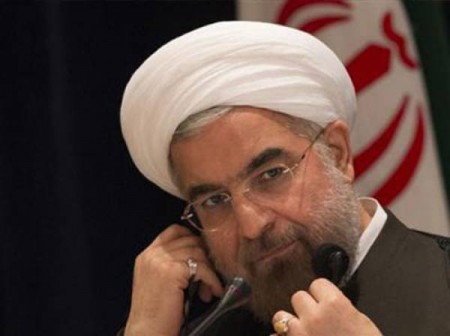
iran-s-rouhani-phones-pm-nawaz-after-soldier-s-killing-1395854702-4802-450x336

Rouhani and the moderate camp have persuaded Ayatollah Ali Khamenei that superficial diplomatic ties with the Obama administration will, in fact, empower the Islamic Republic, further its hegemonic ambitions, and raise Tehran’s economic status without the need for the Iranian leaders to give up on their revolutionary principles, anti-Americanism and anti-Semitism.

****************

There is a crucial Machiavellian (but not a strategic) tactical shift in the Islamic Republic’s foreign policy and its pursuit of regional preeminence.

First of all, Iranian leaders have realized that by superficially showing the Obama administration that the Islamic Republic is willing to restore diplomatic ties with his administration, they can in fact further advance their ideological and national interests.

Second, knowing that President Obama is desperate for a “historic” nuclear deal and the establishment of diplomatic ties with the Islamic Republic, Iranian leaders have played the role very well by attempting to satisfy President Obama’s empty goals.

Third, the ruling clerics of the Islamic Republic became cognizant of the fact that dealing with the Obama administration does not necessarily mean that they have to give up anything with respect to its domestic suppression, revolutionary Islamist principles, human rights abuses, regional hegemonic ambitions, anti-Americanism, hatred towards Israel, and foreign policy objectives.

The tactical shift, currently, is to satisfy President Obama’s personal and shallow objectives by allowing him to project that he is making historic moves (such speaking on the phone with the Iranian leaders), while simultaneously pursuing their own ideological objectives.

For example, most recently, Rouhani and the Obama administration agreed on opening new diplomatic offices in Tehran and Washington. For President Obama, opening diplomatic offices can be viewed as another “historic move” cited in his records or on his Wikipedia page. From the perspective of Iranian leaders, it is a crucial pillar for the advancement of Iran’s foreign policy and ideological objectives in the region without pressure from the US.

To pursue their objectives more efficiently, Iranian leaders have agreed to meet frequently with the diplomats at the highest level of the Obama administration, “negotiating,” and having some of their interactions publicly televised on American and Western media. In addition, the American and the Iranian flags are repeatedly shown next to each other in the high level meetings.

These moves, in fact, give legitimacy to the theocratic regime to further its ambitions.

The president was also delighted to make another “historic move” by speaking on the phone with his Iranian counterpart, President Hassan Rouhani. (One would wonder what a great accomplishment it is to pick up a phone and call another president.)

Washington and Tehran broke diplomatic ties in 1979. After the hostage crisis, high American officials and diplomats have not set foot on the Iranian soil due to Iran’s continuous violation of international norms and anti-Americanism.

Nevertheless, President Obama and Secretary of State John Kerry have decided to turn a blind eye on Iran’s egregious human rights abuses, aggressiveness and violations of international laws.

In another shallow move, Kerry claimed to be proud to set foot on Iranian “territory.” He met with Iran’s Foreign Minister, Mohammad Javad Zarif, at the residence of the Iranian ambassador to the United Nations, Gholamali Khoshroo, in New York.

Instead of attempting to change the behavior of the Ayatollahs and their revolutionary principles, President Obama and Kerry are satisfied with these superficial “historic moves.”

Since Iran’s political establishments and policies are driven, not solely by national and geopolitical interests, but also by ideological Islamist (Shiite) principles, hardliners and the office of the Supreme Leader will always view a real rapprochement with the US as taboo.

Restoring full diplomatic ties can also be analyzed as betraying the revolutionary principles of the Islamic Republic, which were based on anti-Americanism, as well as their opposition to Western models of socio-political and socio-economic landscapes.

From the perspective of Iran’s Supreme Leader, Ayatollah Ali Khamenei — who has the final say in foreign policy decisions — genuine diplomatic ties with the US will lead to the empowerment of Iranian civil society and secular factions. From the prism of the senior cadre of the IRGC, relationships with the American government might lead to the opening of the Iranian market, endangering the economic monopoly of IRGC institutions.

On the other hand, Rouhani and his technocrat team, who share the same objectives with the hardliners and want to preserve the interests of the Islamic Republic, came to the realizations that satisfying President Obama’s superficial and shallow objectives of “historic moves,” can indeed assist them in advancing their ambitions.

In conclusion, similar to the ongoing nuclear negotiations, Rouhani and the moderate camp have persuaded Ayatollah Ali Khamenei that superficial diplomatic ties with the Obama administration will, in fact, empower the Islamic Republic, further its hegemonic ambitions, and raise Tehran’s economic status without the need for the Iranian leaders to give up on their revolutionary principles, anti-Americanism and anti-Semitism.

The veneer of civilization

May 19, 2015

The veneer of civilization, Israel Hayom, Sarah N. Stern, May 19, 2015

Throughout the negotiations with Iran over its nuclear program, U.S. President Barack Obama frequently stated that “no deal is better than a bad deal” and that “all options are on the table.”

And then, on April 2, after a framework agreement was concluded in Lausanne, Switzerland (but without even a piece of paper to wave, Neville Chamberlain-like), Obama said, “Do you really think that this verifiable deal, if fully implemented … is a worse option than the risk of another war in the Middle East?”

As soon as the choice was altered from “a good deal or no deal” to “either this deal or war,” we witnessed a sudden surge in Iranian swagger and bravado, in both their words and their actions.

On May 7, Iranian Revolutionary Guard Corps Deputy Commander Brig. Gen. Hussein Salami told Fars television: “We welcome war with the United States, as we do believe that it will be the scene for our success, to display the real potential of our power. We have prepared ourselves for the most dangerous scenarios, and this is no big deal.”

On May 12, Mojtaba Zolnour, a member of the IRGC and a close personal friend of Supreme Leader Ali Khamenei, said: “The government of the Islamic Republic of Iran has divine permission to destroy Israel. The noble Quran permits the Islamic republic to destroy Israel. Even if Iran gives up its nuclear program, it will not weaken this country’s determination to destroy Israel.”

This Iranian saber rattling has been accompanied by renewed provocations. On April 28, in the Strait of Hormuz — a major oil route — an Iranian crew commandeered the Maersk Tigris, a cargo ship flying under the flag of the Marshall Islands, a U.S. protectorate. They held the ship for six days before releasing it and its crew members. And just a few days after that, Iranian gunboats opened fire on the Alpine Eternity, a Singaporean-flagged ship, and tried to force it into Iranian territorial waters.

The more the U.S. treats Iranians with kid gloves so as not to offend them and to keep them at the negotiating table, the more the Iranians feel a renewed sense of triumph, and disdain toward the United States and its allies. (One would think the Americans were the ones who needed sanctions lifted to help our ailing economy).

On May 6, Jason Rezaian, a Washington Post reporter who has been held in an Iranian prison since July 2014, was charged with espionage. This trumped-up charge was a direct rebuke to the United States, demonstrating just how much contempt the Iranians have for the U.S. It is clear that the Iranians believe that we are determined to give them their cake, and to let them eat it, too. And like a spoiled child in the midst of a temper tantrum, the more we give the Iranians, the more they demand.

The sad fact is that the American negotiating team is basing its entire strategy on little more than wishful thinking. While visiting Beijing at the weekend, U.S. Secretary of State John Kerry said that a deal with Iran “will have a positive influence on North Korea” (although he did add that he wasn’t sure that the North Koreans were capable of “internalizing the message”). One wonders whether the secretary of state also believes in unicorns and fairies.

History indicates that the nuclear negotiations with North Korea were precisely what led to their possession of a nuclear bomb. It is actually the Iranians who have taken note and learned from the North Koreans, and not the other way around.

It has become increasingly obvious that the Obama administration does not know how to negotiate. It seems that they are intent on making a deal, any deal, with the Iranians. And the more they grovel, the more contemptible the United States becomes in the eyes of the Iranians.

That is why the United States Senate needs to hold a free and open debate on the details of the negotiations. Over the last two weeks, the leadership of both the House and the Senate did no one any favors by putting the Iran Nuclear Review Act of 2015 (Corker-Cardin) on the suspension calendar. This means it requires a straight up or down vote, with no room for attaching amendments or for discussion.

The real danger in the Iran Nuclear Review Act of 2015 is that it has turned this negotiation, which has the standing of an international arms treaty, into a bill that would require a veto-proof majority to block. That means that it will become law even if only 34 Senate Democrats support it. While a treaty requires a positive action of two-thirds of the Senate to approve it, now it will take two-thirds of the Senate to veto it, which is much more difficult to achieve, particularly during the immediate aftermath of a euphoric deal-signing ceremony, probably on the White House Lawn, replete with lofty speeches of “peace in our time.”

The framers of the Constitution were prescient when they required two-thirds of the Senate to ratify a treaty. And these negotiations are nothing short of a nuclear arms treaty that will impact the order of the world for generations to come.

When the final deal is signed on June 30, the U.S. Senate must insist that it has the international standing of a treaty and demand that if it does not have the support of 67 senators, it is null and void.

In the meantime, those congressmen and senators who want to pretend that they are attentive to the genuine concerns of the Saudis, the Israelis and patriotic Americans wary of the Iranian negotiations, are now able to hide behind the Iran Nuclear Review Act, this piece of paper that they recently signed.

As the late Congressman Tom Lantos — the only Holocaust survivor in the U.S. House of Representatives — was fond of saying, “The veneer of civilization is paper thin.”

Kerry – North Korea can have a great nuke deal like Iran if it becomes as moderate

May 17, 2015

Kerry – North Korea can have a great nuke deal like Iran if it becomes as moderate, Dan Miller’s Blog, May 17, 2015

(The views expressed in this article are mine and do not necessarily reflect those of Warsclerotic or its other editors. — DM)

North Korea played those negotiating its denuclearization for fools, much as Iran has been doing more recently with Obama. It must not have been difficult to do. To continue the process with Iran, and to repeat it with North Korea, makes no sense.

Speaking in the People’s Republic of China on May 16th, Secretary Kerry offered North Korea a nuke deal

Kerry explained that an Iran deal could help in showing North Korea how “your economy can do better, your country can do better, and you can enter into good standing with the rest of the global community by recognizing — just like Iran — that there is a verifiable, irreversible, denuclearization for weaponization, even as you can have a peaceful nuclear power program.”

Iran has not agreed to “a verifiable, irreversible, denuclearization for weaponization” and likely never will. On April 15th, Iran disputed the accuracy of the Obama Administration’s April 2nd “fact sheet,” which had made such claims about the deal. In the highly unlikely event that Iran were it to claim to do accept such terms, it would “cheat” as it has done in the past. In this video, John Bolton speaks about the “deal” with Iran as well as the North Korean connection.

Nevertheless, Iran has already received many of the rewards of essentially irreversible sanctions relief, including augmented power, both military and financial, in the Middle East.

A deal like the one Iran is about to get by virtue of the Iran scam should be welcomed by North Korea. The countries have long cooperated on nukes and missile development, a matter apparently ignored during Obama’s P5+1 “negotiations” with Iran.

Kerry also said,

the United States will continue to work with its partners “to make it absolutely clear to the DPRK that their actions, their destabilizing behavior — unlike Iran’s — is unacceptable against any international standard.” [Emphasis added.]

Iran’s destabilization efforts and successes are, in Kerry’s view, apparently not “against any international standard.” Yet Iran does far more regional destabilizing than does North Korea — North Korea mainly relies upon bellicose bluster (with infrequent military actions against South Korea). Iran — a major if not the most active sponsor of terrorism —  sends its proxies throughout the Middle East while accusing America and others of destabilization. A likely “signing bonus” of up to fifty billion dollars for Iran if and when the “deal” is finalized will substantially further Iran’s hegemonic ambitions and power as well as its missile and nuclear weapons development.

Here’s a video of Iran having some fun:

According to Hossein Salami, Deputy Commander of the Iranian Revolutionary Guard, Iran welcomes war with the United States:

This North Korean propaganda video purports to displays North Korean military prowess:

Conclusions

The rogue nations of Iran and North Korea are both intent upon maximizing their nuclear weapon capabilities. Both are totalitarian and have obscene human rights records. To trust either would be a gross mistake; yet that appears to be what Obama intends to do.

The only thing notably missing from Kerry’s offer is a requirement that North Korea abandon the Religion of Kim and adopt the glorious “Religion of Peace” instead. That would help North Korea to fit even better than at present into Obama’s policy of supporting America’s enemies and rejecting her friends. If Kim Jong-un would merely recognize Allah as the superior power, perhaps he could become the first Korean Ayatollah. Obama would probably be thrilled were North Korea to become the Democratic Islamic Republic of Korea (DIRK).

Kerry: Iran Nuclear Deal Could Be Lesson for North Korea

May 16, 2015

Kerry: Iran Nuclear Deal Could Be Lesson for North Korea, ABC News, Matthew Lee, May 16, 2015

(Please say that you will stop destabilizing the region, have a good human rights record and become moderate like The Islamic Republic of Iran and we will grant all concessions you seek. Pretty please? — DM)

U.S. Secretary of State John Kerry said Saturday he is hopeful that the successful conclusion of a nuclear deal with Iran will send a positive message to North Korea to restart negotiations on its own atomic program.

Speaking at a joint news conference with Chinese Foreign Minister Wang Yi in Beijing, Kerry said he believed an Iran agreement could have “a positive influence” on North Korea, because it would show that giving up nuclear weapons improves domestic economies and ends isolation. He stressed, though, that there was no way to tell if North Korea’s reclusive leadership would be able to “internalize” such a message.

“I am sure Foreign Minister Wang would join me in expressing the hope that if we can get an agreement with Iran, … that agreement would indeed have some impact or have a positive influence” on North Korea, Kerry said.

Although Wang did not appear to respond, Kerry explained that an Iran deal could help in showing North Korea how “your economy can do better, your country can do better, and you can enter into good standing with the rest of the global community by recognizing that there is a verifiable, irreversible, denuclearization for weaponization, even as you can have a peaceful nuclear power program.”

“Hopefully that can be a message, but whether or not DPRK is capable of internalizing that kind of message or not, that’s still to be proved,” he said, referring to North Korea by the acronym of its official name, the Democratic People’s Republic of Korea.

International negotiators are rushing to finalize a nuclear deal with Iran by the end of June under which Iran’s program would be curbed to prevent it from developing atomic weapons in exchange for the lifting of international sanctions that have crippled its economy.

Nuclear talks with North Korea, which has already developed atomic weapons despite previous attempts to forestall it, broke down three years ago as it has continued atomic tests and other belligerent behavior, including ballistic missile launches.

North Korea conducted its first nuclear test in 2006 and is now believed to have at least 10 such weapons despite some of the toughest international sanctions in existence. It conducted its third nuclear test in February 2013, and U.S.-based experts forecast that it could increase its nuclear arsenal to between 20 and 100 weapons by 2020.

Kerry travels on Sunday to South Korea, where North Korea will be a major topic of discussion.

He said the United States will continue to work with its partners “to make it absolutely clear to the DPRK that their actions, their destabilizing behavior is unacceptable against any international standard.”

Obama’s Not-So-Ironclad Guarantee

May 15, 2015

Obama’s Not-So-Ironclad Guarantee, Commentary Magazine, May 15, 2015

Now that the nuclear deal makes an Iranian bomb only a matter of when rather than if, the Gulf nations were hoping for more than just a carefully worded expression of American indifference.

***********

This was supposed to be the week when President Obama put on a show of his desire to reaffirm America’s support for its Arab allies. Saudi Arabia and the other Gulf states have spent the last year in the unusual position of agreeing more with Israel than the United States, as Obama pushes for détente with Iran. Like the Israelis, the Arabs are pondering their future in a region dominated by an Iranian nuclear threshold state that appears to be the lynchpin of the president’s foreign policy legacy. So to demonstrate his good will, Obama invited these nations to a summit at which he would convince them they had nothing to fear. But with the U.S. putting nothing on the table of substance that would allay those concerns about the weak nuclear deal being negotiated with Iran, the Saudi king and other leaders snubbed the event, turning it into a fiasco even before it began. But it turned out King Salman didn’t miss much. Though Obama offered what he called an “ironclad guarantee’ of America’s support for the Arabs, it was phrased in the kind of ambiguous language that rendered it meaningless. The meeting and especially the statement epitomized an Obama administration foreign policy that puts a premium on appeasing foes and alienating friends.

The wording of the president’s “guarantee” is a marvel of lawyerly ambiguity that any connoisseur of diplomatic doubletalk must appreciate:

In the event of such aggression or the threat of such aggression, the United States stands ready to work with our GCC partners to determine urgently what action may be appropriate, using the means at our collective disposal, including the potential use of military force, for the defense of our GCC partners.

Let’s unpack this carefully so we’re clear about what the United States isn’t promising its Arab allies. As even Obama’s cheerleaders at the New York Times noted, this “carefully worded pledge that was far less robust than the mutual defense treaty the Gulf nations had sought.” In the event of aggression, the U.S. isn’t going to spring into action to defend them. Instead it will “work” with them to “determine” what they might do. That falls quite a bit short of a hard promise of collective action, let alone the drawing of a line in the sand across which the Iranians may not cross. In other words, if something bad happens, Obama will talk with the threatened parties but he won’t say what he will do in advance or if he will do anything at all. If that is an “ironclad guarantee,” I’d hate to see what a less binding promise might sound like.

To understate the matter, this is not the sort of pledge that will deter an Iran that is emboldened by its diplomatic victory in the negotiations that let them their nuclear infrastructure and continuing working toward a bomb. Iran’s push for regional hegemony has also been boosted by the triumph of their Syrian ally Bashar Assad with the help of Tehran’s Hezbollah terrorist auxiliaries. With the Iran-backed Houthi rebels threatening to take over Yemen and Iran also resuming its alliance with Hamas in Gaza, the axis of Iranian allies has Arab states understandably worried about their future. Now that the nuclear deal makes an Iranian bomb only a matter of when rather than if, the Gulf nations were hoping for more than just a carefully worded expression of American indifference.

That’s why the statement at the end of the summit made no mention of America’s chief worry about the Gulf states: the possibility that the Saudis will, either acting alone or in concert with their neighbors, seek to match Iran’s nuclear potential. As critics of the Iran deal foretold, far from saving the Middle East from an Iranian bomb, it has set off an arms race that has will make the world a fare more dangerous place.

This omission will likely make the Iranians even more reluctant to give in to U.S. demands about sanctions, Tehran’s military research and the disposition of its stockpile of enriched uranium in the final stages of the nuclear talks. A better guarantee for the Arabs might have convinced the Islamist state that the president really meant business about strengthening the deal. In its absence, they have no reason to think Obama won’t fold as he has at every other stage of the negotiations.

Under the circumstances, it’s little wonder that Bahrain’s King Hamad preferred to go to a horse show London rather than confer with Obama. Just as Israel has learned that the United States is more interested in a new Iran-centric policy than it backing its traditional allies, so, too, must the Arabs come to grips with a new reality in which their Iranian foe is no longer restrained by the United States.

FIG LEAVES FALLING

May 15, 2015

Fig leaves falling, Power LineScott Johnson, May 14, 2015

Certain impediments complicate Barack Obama’s selling of the arrangement with the Islamic Republic of Iran. Obama seeks to camouflage the arrangement as one that deters Iran from the acquisition of nuclear weapons. In reality, the arrangement will finance and expedite the mullahs’ acquisition of nuclear weapons.

John Kerry has issued ludicrous “guarantees” in connection with the arrangement. One such guarantee is categorical, but it’s not a money-back sort of a guarantee: “I say to every Israeli that today we have the ability to stop [the Iranians] if they decided to move quickly to a bomb and I absolutely guarantee that in the future we will have the ability to know what they are doing so that we can still stop them if they decided to move to a bomb.”

We may doubt the omniscience that is the predicate of Kerry’s guarantee. But this is strictly a limited warranty. Kerry doesn’t even “guarantee” that his boss would do anything about it if Iran were to break out. Kerry only guarantees that “we” could. Good to know. Kerry’s “guarantee” amounts to nothing more than meaningless verbiage two or three time over.

The arrangement will also provoke an equal and opposite reaction from the Sunni rivals of Iran such as Saudi Arabia. The Sunni rivals understand the nature of the arrangement in process. Their understanding accounts for Obama’s “lonely Arab summit.”

President Obama’s dubious fact-sheet setting forth Parameters for a Joint Comprehensive Plan of Action reflects the fig leaves with which the president seeks to cover the nuts of the deal. Senator Rubio couldn’t get to first base in his proposal requiring any final deal to include the fig leaves. (Eli Lake dubbed it “Rubio’s new and improved poison pill.”)

The fig leaves are falling. The official Farsnews outlet reports that inspection of military sites is not included in the arrangement in process — this according to Iranian envoy to the IAEA Reza Najafi and despite the alleged parameter requiring Iran “to grant access to the IAEA to investigate suspicious sites or allegations of a covert enrichment facility, conversion facility, centrifuge production facility, or yellowcake production facility anywhere in the country.”

The alleged parameters regarding sanctions provide that Iran “will receive sanctions relief, if it verifiably abides by its commitments” and that “•U.S. and E.U. nuclear-related sanctions will be suspended after the IAEA has verified that Iran has taken all of its key nuclear-related steps. If at any time Iran fails to fulfill its commitments, these sanctions will snap back into place.”

We have already learned that President Obama intends to reward Iran with a huge “signing bonus” at the outset of the arrangement. He will agree to the removal of all United Nations sanction on Iran at the same time. He will also waive our own statutory sanctions on Iran. Just about the last fig leaf remaining on this element of the deal is the (utterly meaningless) assertion: “If at any time Iran fails to fulfill its commitments, these sanctions will snap back into place.”

Now Bloomberg News reports that this fig leaf is falling too: “Russia rejects automatic sanctions return if Iran cheats on deal.” Bloomberg quotes Russia’s UN Ambassador Vitaly Churkin bluntly asserting yesterday, “There can be no automaticity, none whatsoever” in reimposing UN sanctions if Iran violates the terms of an agreement to curb its nuclear program.

Omri Ceren writes to comment this morning (footnotes omitted):

The statement really shouldn’t count as breaking news, even though it is. Reuters reported toward the very end of Lausanne that the Russians and Chinese were still rejecting the multilateral snapback. But then the Lausanne announcement happened, and President Obama declared from the Rose Garden that in fact “if Iran violates the deal, sanctions can be snapped back into place.” But then a week later the Associated Press reported that, no, “Russia and China are unlikely to accept any process that sees them sacrifice their veto power.”

At the end of April the American Enterprise Institute quoted Russian Deputy Foreign Minister Sergey Ryabkov saying the exact same thing that Churkin just told Bloomberg News: “in the hypothetical situation that Iran should fail to honour its commitments, then this process should not in any way be automatic.”

And yet the policy conversation has been proceeding as if multilateral snapback is actually a real thing that could happen in our reality.

Part of the reason is that snapback is all the Obama administration has left on the sanctions debate. White House officials had assured lawmakers for literally years that sanctions relief would be phased out only as Iran met a series of nuclear obligations. But after Lausanne, Supreme Leader Ayatollah Ali Khamenei set a new red line, in which he demanded that the relief must be immediate. The administration began trying to find ways to concede to his demand without violating its previous “phase out” promises, which is how the WSJ’s scoop about a $50 billion signing bonus came to be.

That apparently didn’t work, and so instead the administration went all-in on snapback. At his press conference with Renzi in the middle of April the President signaled the that he was prepared to cave on upfront sanctions relief because – he told journalists – what was actually important was snapback: “with respect to the issue of sanctions coming down, I don’t want to get out ahead of John Kerry and my negotiators… [o]ur main concern here is making sure that if Iran doesn’t abide by its agreement that we don’t have to jump through a whole bunch of hoops in order to reinstate sanctions. That’s our main concern.”

The arrangement’s alleged Iranian concession are, you might say, phony baloney all the way down.

Czechs stopped potential nuclear tech purchase by Iran

May 14, 2015

Czechs stopped potential nuclear tech purchase by Iran, Reuters via Ynet News, May 14, 2015

(But they won’t cheat after Obama gets his legacy deal. Right. — DM)

Czechs stopped potential nuclear tech purchase by Iran.UN report says Tehran attempted to buy centrifugal compressors from company in Czech Republic, using false documentation to hide destination of order.

UNITED NATIONS/PRAGUE – The Czech Republic blocked an attempted purchase by Iran this year of a large shipment of sensitive technology useable for nuclear enrichment after false documentation raised suspicions, UN experts and Western sources said.

The incident could add to Western concerns about whether Tehran can be trusted to adhere to a nuclear deal being negotiated with world powers under which it would curb sensitive nuclear work in exchange for sanctions relief.

The negotiators are trying to reach a deal by the end of June after hammering out a preliminary agreement on April 2, with Iran committing to reduce the number of centrifuges it operates and agreeing to other long-term nuclear limitations.

562262409915100640360noNuclear plant in Iran’s Bushehr (Photo: Reuters)

Some details of the attempted purchase were described in the latest annual report of an expert panel for the United Nations Security Council’s Iran sanctions committee, which has been seen by Reuters.

The panel said that in January Iran attempted to buy compressors – which have nuclear and non-nuclear applications – made by the US-owned company Howden CKD Compressors.

A Czech state official and a Western diplomat familiar with the case confirmed to Reuters that Iran had attempted to buy the shipment from Howden CKD in the Czech Republic, and that Czech authorities had acted to block the deal.

It was not clear if any intermediaries were involved in the attempt to acquire the machinery.

There was no suggestion that Howden CKD itself was involved in any wrongdoing. Officials at Prague-based Howden declined to comment on the attempted purchase.

The UN panel, which monitors compliance with the UN sanctions regime, said there had been a “false end user” stated for the order.

“The procurer and transport company involved in the deal had provided false documentation in order to hide the origins, movement and destination of the consignment with the intention of bypassing export controls and sanctions,” it added.

The report offered no further details about the attempted transaction. Iran’s UN mission did not respond to a query about the report.

Contract worth $61 million

The Czech state official said the party seeking the compressors had claimed the machinery was needed for a compressor station, such as the kind used to transport natural gas from one relay station to another.

The official declined to say exactly how the transaction was stopped, provide specifications of the compressors or confirm the intended purchaser. However, he made clear it was the Czech authorities who halted the deal

The official, who spoke on condition of anonymity, said the total value of the contract would have been about 1.5 billion Czech koruna ($61 million).

This was a huge amount for the company concerned, the previously named CKD Kompresory, a leading supplier of multi-stage centrifugal compressors to the oil and gas, petrochemical and other industries.

The firm was acquired by Colfax Corp. of the United States in 2013 for $69.4 million. A spokesman for Colfax declined to comment.

The United States and its Western allies say Iran continues to try to skirt international sanctions on its atomic and missile programs even while negotiating the nuclear deal.

The UN panel of experts also noted in its report that Britain informed it of an active Iranian nuclear procurement network linked to blacklisted firms.

While compressors have non-nuclear applications in the oil and gas industry, they also have nuclear uses, including in centrifuge cascades. Centrifuges purify uranium gas fed into them for use as fuel in nuclear reactors or weapons, if purified to levels of around 90 percent of the fissile isotope uranium-235.

“Such compressors can be used to extract enriched uranium directly from the cascades,” Olli Heinonen, former deputy director-general of the International Atomic Energy Agency and a nuclear expert currently at Harvard University, told Reuters.

“In particular, they are useful when working with higher enrichment such as 20 percent enriched uranium,” he said, adding that precise specifications of the compressors in question would be necessary to make a definitive assessment.

Iran has frozen production of 20 percent enriched uranium, a move that Western officials cite as one of the most important curbs on Iranian nuclear activities under an interim agreement in 2013.

Tehran rejects allegations by Western powers and their allies that it is seeking the capability to produce atomic weapons and says its nuclear program is for peaceful purposes.

The IAEA and the United States have said repeatedly that Tehran has adhered to the terms of the 2013 interim deal.


IRGC Deputy Commander Salami: “We Welcome War with the Americans”

May 14, 2015

IRGC Deputy Commander Salami: “We Welcome War with the Americans”, MEMRI via You Tube, May 14, 2015

(Does Iran really believe Obama’s “all option are on the table” nonsense, which hardly anyone credits? — DM)

In an Iranian TV interview, IRGC Deputy Commander Hossein Salami threatened the Americans, saying: “We welcome war with the Americans.” The U.S. aircraft carriers would be destroyed, its air bases in the region burned, and the skies set ablaze, he said. “We have built our strength for the purpose of long, extended wars… more than for the purpose of peace, compromise, and dialogue with them,” said Salami. The interview aired on the Iran TV’s Channel 1 on May 6, 2015.


