Archive for the ‘Iran scam’ category

Iran’s Stage-Managed Elections

April 15, 2017

Iran’s Stage-Managed Elections, American ThinkerReza Shafiee, April 15, 2017

(What can President Trump do to promote regime change in Iran? What can he do to support the resistance, in and outside Iran? What, if anything will he do?– DM)

Iran’s history has shown that people are willing to risk and speak openly when they have outside support and sympathy. The United States’ policies with regard to human rights have an instant effect in hearts and minds of ordinary citizens in Iran. What happened in Iran in 2009 is not a distant memory. The Obama administration’s flawed policy set off a chain reactions in the region which still reverberates in Syria, Yemen and Iraq. By focusing just on getting the nuclear deal done with the mullahs in Tehran, it actually left out other pressing issues such supporting the Iranian people and indirectly preventing the carnage in the neighboring countries. 

***************************

Every four years, Iranian citizen witness a show called ‘elections.’ These have nothing in common with genuine democratic elections; they’re facades. The upcoming May 19 elections are no exception.

A closer look at the candidates proves that they are no different from one another and all have a clear track record of participation in suppression of Iranian people over the past four decades. They have won the approval to enter the race by the mullahs for just this reason.

The two more serious ones are: Hassan Rouhani, the incumbent president; and Ebrahim Raisi, custodian of Iran’s wealthiest charity, Astan Quds Razavi in Iran’s holiest shrine of Imam Reza in Mashhad, northeastern Iran. Having charge of such vast amount of wealth, it’s a given that Raisi enjoys Supreme Leader Khamenei’s full trust. Both candidates are cut from the same cloth and are committed to principle to Supreme Guardianship (Velayat-e faqih), meaning, the rule of the ayatollahs

So who are they? Let’s start with the second one.

Ebrahim Raiai a member of “Death Commission” and close confident of Ali Khamenei

He was a low-level cleric who climbed the ladder in the mullahs’ hierarchy just for his undeniable services to the late Khomeini in slaughtering of 30,000 political prisoners in summer of 1988. (In Iran, we don’t refer to Khomeini as “Ayatollah,” just Khomeini is enough.  The title has been stolen and abused by the ruling mullahs in Iran.) The prisoners were mainly members and sympathizers of the Iranian opposition People’s Mojahedin Organizations of Iran (PMOI/MEK).

The “Death Commission” was a four-member body with the sole task of carrying out Khomeini’s fatwa against dissidents. In his hand-written decree, Khomeini openly ordered the commission to kill the political prisoners, the majority of whom had been already imprisoned.

Ayatollah Hossein-Ali Montazeri, Khomeini’s handpicked successor was later sacked over his quarrel with Khomeini for the indiscriminate killings. In a shocking 28-year-old audio file of one the meetings of Death Commission leaked in August by his son Ahmad, Montazeri called the killings a “crime that future generations will certainly not forget” and declared: “It is committed in the name of the Islamic Republic and carried out by you.”

Ahmad Montazeri has regarded Ebrahim Raisi’s standing for presidential elections a ‘joke’ and ‘an insult to Iranian people’. Raisi’s record does not stop at just his role in the massacre of political prisoners in 1988, but what he did overrides any other tasks he has undertaken in Islamic Republic’s killing machine.

Canada’s Parliament adopted the following motion on June 5th, 2013 on the events of 1988 in Iran: “That the House condemn the mass murder of political prisoners in Iran in the summer of 1988 as a crime against humanity, honors the memory of the victims buried in mass graves at Khavaran cemetery and other locations in Iran, and establishes Sept. 1 as a day of solidarity with political prisoners in Iran.”

Now let’s look at the other candidate:

Hassan Rouhani is no saint

Make no mistake about Rouhani being a saint by comparison. He is not far behind Raisi when it comes to cruelty. For starters, Mostafa Pour-Mohammadi, his justice minister, is none other than another member of the same notorious Death Commission. Last summer when Pour-Mohammadi was pressed to answer for the massacre of 1988, he proudly said: “I carried out God’s will and I have not lost sleep over what I did.”

The rate of executions during Rouhani’s presidency has been unprecedented in past 25 years in Iran, according to Ahmed Shaheed, who was Iran’s last UN Special Rapporteur for human rights. During Rouhani’s tenure, around 3000 executions were carried out.

When asked about hangings during his presidency, Rouhani simply said: “They were carried out according to God’s laws.”

Amnesty International’s report for 2016 indicates that with the exception of China, Iran carried out 55 percent of all executions worldwide.

Rouhani has always said that he has been in a decision making-position throughout the life of the Islamic Republic. He personally was in a commanding position when the 1999 student uprisings were crushed in Iran.

The European Union extended its sanctions on Iranian regime’s offices for participating in suppression of Iranian citizens.

EU documents state that they target persons complicit in “torture, cruel, inhuman and degrading treatment, or the indiscriminate, excessive and increasing application of the death penalty, including public executions, stoning, hangings or executions of juvenile offenders.”

As U.S. Ambassador to the UN Nikki Haley mentioned recently: “Peace and security cannot be achieved in isolation from human rights.” The long-suffering people of Iran, Syria, and Iraq bear witness that “human rights abuses are not the byproduct of conflict; they are the cause of conflict, or they are the fuel that feeds the conflict.”

There’s also a third candidate worth looking at:

Mahmoud Ahmadinejad is back in the race

The trio of Rouhani, Raisi and Ahmadinejad in Iran’s upcoming elections is more than a mere joke: It has a plain and clear message – that of Khamenei’s extreme weakness in controlling his goons. The humorous Iranian people have already made jokes about the three and this bagatelle called elections. Social media is full of them.

Khamenei ordered Ahmadinejad to stay away from elections. By disobeying his master’s direct order he is demonstrating the Supreme Leader’s unprecedented lack of control over his establishment. Khamenei offered an explicit warning in September that his candidacy would be a “polarizing situation” that would be “harmful to the country.”

That is a reference to the disputed election in 2009 which ignited massive street demonstrations and subsequent arrests of thousands of protesters and the killing of hundreds of others by the Revolutionary Guard Corps (IRGC).

Final thoughts     

Iran’s history has shown that people are willing to risk and speak openly when they have outside support and sympathy. The United States’ policies with regard to human rights have an instant effect in hearts and minds of ordinary citizens in Iran. What happened in Iran in 2009 is not a distant memory. The Obama administration’s flawed policy set off a chain reactions in the region which still reverberates in Syria, Yemen and Iraq. By focusing just on getting the nuclear deal done with the mullahs in Tehran, it actually left out other pressing issues such supporting the Iranian people and indirectly preventing the carnage in the neighboring countries.

The elections in Iran – for parliament or president – have been designed or “engineered,” as the word has been widely used, by the regime’s inner circles, for both internal and external consumption. However after the nuclear deal with the West, it has become a high priority for the regime to show popular support at home and project it as an image to the rest of the world as a regime fully in control and ready to do business. It is no secret that the regime has no popular support in Iran.

Ebrahim Rasis, Hassan Rounhani, Mahmoud Ahmadinejad and their likes should not be allowed to escape the consequences of their crimes against humanity. Known human rights criminals such as entire ruling mullah class in Iran should not go unpunished. They should soon see the inside of International Criminal Court.

Reza Shafiee is a member of Foreign Affairs Committee of the National Council of Resistance of Iran (NCRI) 


After Syrian Gassing, Trump Must Expose the Iran Deal

April 10, 2017

After Syrian Gassing, Trump Must Expose the Iran Deal, PJ Media, Roger L Simon, April 9, 2017

Among the more disturbing questions emerging from the renewed use of gas by Bashar Assad is whether Barack Obama and his loyal minions (Kerry, Rhodes, Rice, etc.) actually knew the Syrian leader still had chemical weapons, even though they trumpeted the opposite to the American public on numerous occasions. Either they lied or were so extraordinarily credulous they believed — apparently without verification — the Syrians had truly rid themselves of those WMDs, in which case Obama — not Trump — was Vladimir Putin’s personal “useful idiot.”

(It may even be time to take a second look at the contention of some that Saddam transferred his chemical weapons to Syria way back when, which would be a surprise vindication of Bush 43.)

Whatever the case, it’s “heavy water” under the bridge at this point, but should alert us even more to the absolute necessity of revealing everything known about the also Obama-instigated Iran Deal, all its myriad hidden codicils and clauses that remain mysterious to the citizens of this country in whose name they were allegedly signed. That agreement too could be the product of useful idiocy, a sucker punch from the mullahs.  The devil, in this case, is very much in the details, few of which we know, except that the Iranians refused to give a baseline development level for their nuclear weapons program in this first place. In a sense, that made everything else moot.

Nevertheless, Iran has been the beneficiary of this deal to the tune of billions of dollars, some evidently in cash, much of which has been and is being spent in Syria, if not directly on chemical weapons, on a war that no less than the former chief rabbi of Israel, himself a Holocaust survivor, has called another Holocaust.  Iran is also using the money to finance Hezbollah in that war, simultaneously arming those terrorist thugs with tons of modern weapons, including long range missiles, even while the mullahs use Hezbollah’s guerrillas as cannon fodder to spare Iran’s own quasi-terrorist Revolutionary Guard. The Islamic Republic’s obvious goal is to control both Syria and Iraq by proxies.  A victorious Assad would be Iran’s boy as much as Russia’s, possibly more.

The Trump administration should expose this deal in its entirety to public view now.  If that means Iran pulls out of the agreement — as they have warned — so be it.  The transparency is worth whatever minimal insurance against a nuclear-armed Iran might be inherent in these evanescent documents.  After seeing just how much insurance against chemical weapons was inherent in Obama’s deal with Putin over the crossing of our then-president’s “red line,” one could be skeptical that there is any at all.  Indeed, what little we know of the Iran Deal leads one to believe that it would be simple for the mullahs to be as busy as ever on their nuclear program.  That they are allied with North Korea makes this all the more likely.

Further to be investigated is Obama’s peculiar desire to make a deal with these same mullahs from the very beginning of his administration or even before. Indeed, Obama representatives have been accused of meeting with both Hamas and Iran during his first presidential campaign. These meetings are better documented than Trump’s supposed collusion with Putin, which seems so unlikely now.

In a continuation of that behavior, Obama later famously ignored the pleas for support by the Iranian pro-democracy demonstrators during the Green Revolution of 2009.  “Obama, you are either with us or are you with them!”  they chanted.  Obama was evidently with them. He didn’t want to disrupt his rapport with Ahmadinejad in order to make his dreamed-of deal. (You can see it all on YouTube here.  As we used to say in the sixties, “Which side are you on?”)

Obama and Kerry then welcomed the election of Hassan Rouhani, whom their cheering section in the willfully ignorant mainstream media ludicrously called a “moderate” when he was, if anything, worse than Ahmadinejad and has since been responsible for many more murders of political prisoners than his predecessor.  They made their deal with Rouhani, who is obviously now cooperating in the maintenance of peace…. Well, not exactly.

What’s behind all this? As I said at the outset, this is disturbing — liberalism and progressivism turned upside down, at least according to their own self-described principles. Everything is situational. That Democrats like Schumer and Pelosi were so positive about Trump’s actions in Syria is a sure sign that not so deep down they were more than a little uncomfortable when Obama did nothing after a similar gassing.  Like a lot of people I would imagine, they had to bury their feelings and opinions in the name of party loyalty, what the French called mauvaise foi.  They should have felt the same way yet more intensely after Obama’s execrable non-reaction to the Green Revolution.  Maybe they did, but we’ll never know until someone leaks it out in a memoir. We didn’t need to send in the Marines.  All Obama would have had to have done was to say a few words of encouragement echoed by the international community and the revolution might have happened.  It was close enough.

Thank God there’s a new sheriff in town. Maybe there will be some hope for the citizens of Iran, eventually, some support for regime change after eight years of kowtowing to the mullahs.  But for now lets at least clear up the terms of the mysterious deal, its provenance and its usefulness, if any.  No time like the present.

Iran Will Not Cancel The JCPOA – Because It Grants Iran Nuclear State Status And Is A Western Guarantee For The Regime’s Survival

April 7, 2017

Iran Will Not Cancel The JCPOA – Because It Grants Iran Nuclear State Status And Is A Western Guarantee For The Regime’s Survival, MEMRIA. Savyon and Yigal Carmon* April 6, 2017

(Cf. The Real War in ‘Syria’ and the Strategy for Long-Term Victory. — DM)

Introduction

The JCPOA grants the Iranian regime two historic achievements – the status of a nuclear state and immunity against a Western attack due to its nuclear development. This is effectively a Western guarantee of the Islamic Republic regime’s survival. These achievements cannot be cancelled unless the agreement itself is declared invalid.

Iranian spokesmen have stressed that even if President Trump’s administration cancels the agreement, the agreement cannot be cancelled – because Iran, in its prescience, involved the EU and the UN in backing the agreement. Even if the U.S. alone were to cancel the agreement, it would still remain in force – that is, Iran’s status as a nuclear state would remain.

Iranian President Hassan Rohani stressed, for example, at a November 11, 2016 cabinet meeting, the day after Trump was elected president, that there was no way to cancel the agreement. He said: “Iran’s wisdom in the nuclear agreement was in the fact that it had the JCPOA approved as a UN Security Council resolution, and not as a [bilateral] agreement with a particular country or administration. Therefore, it will not be changed by any decision by a particular administration.”[1]

Following the JCPOA’s Implementation Day, in January 2016, and even previously, Iranian regime officials repeatedly warned that if the U.S. violated the agreement, and especially if more sanctions were leveled against Iran, Iran would cancel the agreement and revert to the status quo that existed before the agreement, and would even advance beyond it?

For example, an October 21, 2015 letter of guidelines from Iranian Supreme Leader Ali Khamenei to President Rohani constituting “conditional approval” for the agreement stated: “Throughout the eight-year period, any imposition of sanctions at any level and under any pretext (including repetitive and reiterated pretexts of terrorism and human rights) on the part of any of the countries party to the agreement will constitute a violation of the JCPOA and the [Iranian] government would be obligated to take the necessary action as per Clause 3 of the Majlis resolution and stop the activities mandated by the JCPOA.”[2]

Iran Is Changing Its Policy – From Threats To Cancel The Agreement To Threats Of A Parallel Response

However, after the U.S. leveled additional sanctions against Iran, during both the Obama and Trump administrations, it became clear[3] that Iran was not going to implement its threats. Instead, Iran presented a new formula that does not obligate it to abrogate the agreement, as it previously threatened. The new formula determined that the Iranian regime would respond to any U.S. violation of the agreement with its own parallel violation.

Indeed, on March 26, 2017, after the U.S. State Department’s March 24, 2017 announcement of new sanctions against companies and individuals connected to Iran’s missile program, Iran’s Foreign Ministry announced counter-sanctions against 15 U.S. companies. Additionally, in response to the Countering Iran’s Destabilizing Activities Act of 2017, currently under consideration in the U.S. administration and the U.S. Senate designating Iran’s Islamic Revolutionary Guards Corps as a terrorist organization, Majlis National Security Committee chairman Ala Al-Din Boroujerdi announced, on March 25, 2017, that the committee would present to the Majlis a plan to designate the CIA and U.S. Armed Forces as terrorist organizations, to be carried out after the March 21 Iranian Norouz holiday.[4]

On April 3, 2017, Iranian Foreign Minister Javad Zarif reiterated: “If the moment comes that the Americans are not implementing the JCPOA, our reversion [to the pre-JCPOA situation] will be very swift, and we will arrive at even more than what we once had… We have enough guarantees for the day when the [Iranian] regime decides and feels that the level of America’s breaking of its promises is so high that we must revert to the pre-JCPOA [situation]. But it does not appear to me that this will happen.” [5]

It should be noted that in his threats about the possibility of Iran’s reversion to the status quo that existed prior to the agreement, Zarif does not set out any red line or specific condition whose violation will oblige Iran to cancel the agreement. Instead, he states that Iran will act “when it feels” that the U.S. is ratcheting up its level of violations against Iran. Furthermore, Zarif adds that such a situation, in his assessment, will not occur.

Iran’s backing down from its previous threats and warnings regarding the JCPOA’s continuing validity even if the U.S. cancels it is testimony to the agreement’s historic importance for the Iranian regime. In our assessment, Iran will not cancel the agreement even if the U.S. continues to level sanctions against the country, even if it is involved in military action against Iranian interests. Iran will not cancel an agreement that endows it with nuclear-state status and that constitutes a guarantee of the regime’s survival and provides immunity from a Western attack aimed at regime change. These historic achievements for Iran were granted to it by the Obama administration by means of the JCPOA.

Needless to say, the threat to revert to the pre-JCPOA situation is in itself an empty threat, because if the regime does this, it will bring itself back to a situation defined by then-U.S. Secretary of State John Kerry as “a two-month [nuclear] breakout time.”[6] By doing so, it will bring closer the risk of attack by the West.

The JCPOA – A Tool To Ensure The Survival Of The Iranian Regime

The Iranian regime is clinging to the JCPOA because this agreement guarantees its survival. President Obama promoted the Iranian regime from the status of a “defendant state”, subject to Security Council sanctions for its nuclear program, to the status of a legitimate nuclear state that can negotiate with the rest of the world powers over upgrading its nuclear activity.

The existential threat that led Supreme Leader Ali Khamenei to revive Iran’s nuclear project in 2002, (after the founder of the Iranian Revolution, Ayatollah Ruhollah Khomeini, stopped the country’s Shah-era nuclear project), was the threat to the regime’s survival. The regime was under threat both from being attacked directly by the West, with the aim of bringing about regime change, and indirectly by mobilizing opposition elements at home, which the regime labeled “fitna” – such as the fitna – i.e. civil unrest – following the 2009 presidential election, which it suppressed. For this reason, Khamenei, during the negotiations for the JCPOA, demanded that the U.S. stop the American broadcasts in Farsi to Iran, suspend its political and economic support for Iranian opposition groups, and stop criticizing Iranian censorship of the Internet – all three demands pertain to regime survival (see MEMRI Inquiry and Analysis No. 837, Khamenei’s Aim at the Nuclear Talks – Securing the Survival of His Regime, May 15, 2012).

With the JCPOA, Khamenei gained a double achievement, assuring both the survival of his regime and Iran’s membership in the nuclear club. The Iranian regime’s original aim in pursuing the JCPOA was to guarantee the survival of the regime in the face of all the possible threats, from within and without – and was not intended to obtain massive economic aid nor to bring Iran into the Western economy in order to ease its people’s economic distress – which Khamenei intends to do with the “resistance economy,” the main thrust of which is self-reliance and rejection of economic cooperation with the West and foreign investment in Iran.

Iran’s nuclear status, promised to Khamenei by the Obama administration in the agreement that is backed by Europe, allows him to both continue to repress the Iranian people and to continue exporting the Iranian Revolution in the region.

*A. Savyon is Director of the MEMRI Iranian Media Project; Yigal Carmon is President of MEMRI.

______________________

[1] ISNA (Iran), November 9, 2016.

[2] MEMRI Inquiry and Analysis No. 1196, Iranian Supreme Leader Khamenei’s Letter Of Guidelines To President Rohani On JCPOA Sets Nine Conditions Nullifying Original Agreement Announced July 14, 2015, October 22, 2015.

[3] Tasnim (Iran), March 26, 2017.

[4] IRIB (Iran), March 25, 2017.

[5] Farsnews (Iran), April 3, 2017.

[6] http://www.huffingtonpost.com/entry/john-kerry-iran-israel_us_55b22b45e4b0224d8831d360

Did the Obama Administration’s Abuse of Foreign-Intelligence Collection Start Before Trump?

April 5, 2017

Did the Obama Administration’s Abuse of Foreign-Intelligence Collection Start Before Trump?, Tablet MagazineLee Smith, April 5, 2017

The accusation that the Obama administration used information gleaned from classified foreign surveillance to smear and blackmail its political opponents at home has gained new traction in recent days, after reports that former National Security Adviser Susan Rice may have been rifling through classified transcripts for over a year that could have included information about Donald Trump and his associates. While using resources that are supposed to keep Americans safe from terrorism for other purposes may be a dereliction of duty, it is no more of a crime than spending all day on Twitter instead of doing your job. The crime here would be if she leaked the names of U.S. citizens to reporters. In the end, the seriousness of the accusation against Rice and other former administration officials who will be caught up in the “unmasking” scandal will rise or fall based on whether or not Donald Trump was actively engaged in a conspiracy to turn over the keys of the White House to the Kremlin. For true believers in the Trump-Kremlin conspiracy theories, the Obama “spying and lying” scandal isn’t a scandal at all; just public officials taking prudent steps to guard against an imminent threat to the republic.

But what if Donald Trump wasn’t the first or only target of an Obama White House campaign of spying and illegal leaks directed at domestic political opponents?

In a December 29, 2015 article, The Wall Street Journal described how the Obama administration had conducted surveillance on Israeli officials to understand how Prime Minister Benjamin Netanyahu and other Israeli officials, like Ambassador Ron Dermer, intended to fight the Iran Deal. The Journal reported that the targeting “also swept up the contents of some of their private conversations with U.S. lawmakers and American-Jewish groups.”

Despite this reporting, it seemed inconceivable at the time that—given myriad legal, ethical, political, and historical concerns, as well as strict National Security Agency protocols that protect the identity of American names caught in intercepts—the Obama White House would have actually spied on American citizens. In a December 31, 2016, Tablet article on the controversy, “Why the White House Wanted Congress to Think It Was Being Spied on By the NSA,” I argued that the Obama administration had merely used the appearance of spying on American lawmakers to corner opponents of the Iran Deal. Spying on U.S. citizens would be a clear abuse of the foreign-intelligence surveillance system. It would be a felony offense to leak the names of U.S. citizens to the press.

Increasingly, I believe that my conclusion in that piece was wrong. I believe the spying was real and that it was done not in an effort to keep the country safe from threats—but in order to help the White House fight their domestic political opponents.

“At some point, the administration weaponized the NSA’s legitimate monitoring of communications of foreign officials to stay one step ahead of domestic political opponents,” says a pro-Israel political operative who was deeply involved in the day-to-day fight over the Iran Deal. “The NSA’s collections of foreigners became a means of gathering real-time intelligence on Americans engaged in perfectly legitimate political activism—activism, due to the nature of the issue, that naturally involved conversations with foreigners. We began to notice the White House was responding immediately, sometimes within 24 hours, to specific conversations we were having. At first, we thought it was a coincidence being amplified by our own paranoia. After a while, it simply became our working assumption that we were being spied on.”

This is what systematic abuse of foreign-intelligence collection for domestic political purposes looks like: Intelligence collected on Americans, lawmakers, and figures in the pro-Israel community was fed back to the Obama White House as part of its political operations. The administration got the drop on its opponents by using classified information, which it then used to draw up its own game plan to block and freeze those on the other side. And—with the help of certain journalists whose stories (and thus careers) depend on high-level access—terrorize them.

Once you understand how this may have worked, it becomes easier to comprehend why and how we keep being fed daily treats of Trump’s nefarious Russia ties. The issue this time isn’t Israel, but Russia, yet the basic contours may very well be the same.

***

Two inquiries now underway on Capitol Hill, conducted by the Senate intelligence committee and the House intelligence committee, may discover the extent to which Obama administration officials unmasked the identities of Trump team members caught in foreign-intelligence intercepts. What we know so far is that Obama administration officials unmasked the identity of one Trump team member, Michael Flynn, and leaked his name to the Washington Post’s David Ignatius.

“According to a senior U.S. government official,” Ignatius wrote in his Jan. 12 column, “Flynn phoned Russian Ambassador Sergey Kislyak several times on Dec. 29, the day the Obama administration announced the expulsion of 35 Russian officials as well as other measures in retaliation for the hacking. What did Flynn say, and did it undercut the U.S. sanctions?”

Nothing, the Times and the Post later reported. But exposing Flynn’s name in the intercept for political purposes was an abuse of the national-security apparatus, and leaking it to the press is a crime.

This is familiar territory. In spying on the representatives of the American people and members of the pro-Israel community, the Obama administration learned how far it could go in manipulating the foreign-intelligence surveillance apparatus for its own domestic political advantage. In both instances, the ostensible targets—Israel and Russia—were simply instruments used to go after the real targets at home.

In order to spy on U.S. congressmen before the Iran Deal vote, the Obama administration exploited a loophole, which is described in the original Journal article. The U.S. intelligence community is supposed to keep tabs on foreign officials, even those representing allies. Hence, everyone in Washington knows that Israeli Ambassador Ron Dermer is under surveillance. But it’s different for his American interlocutors, especially U.S. lawmakers, whose identities are, according to NSA protocol, supposed to be, at the very least, redacted. But the standard for collecting and disseminating “intercepted communications involving U.S. lawmakers” is much less strict if it is swept up through “foreign-foreign” intercepts, for instance between a foreign ambassador and his capital. Washington, i.e. the seat of the American government, is where foreign ambassadors are supposed to meet with American officials. The Obama administration turned an ancient diplomatic convention inside out—foreign ambassadors were so dangerous that meeting them signaled betrayal of your own country.

During the long and contentious lead-up to the Iran Deal the Israeli ambassador was regularly briefing senior officials in Jerusalem, including the prime minister, about the situation, including his meetings with American lawmakers and Jewish community leaders. The Obama administration would be less interested in what the Israelis were doing than in the actions of those who actually had the ability to block the deal—namely, Senate and House members. The administration then fed this information to members of the press, who were happy to relay thinly veiled anti-Semitic conceits by accusing deal opponents of dual loyalty and being in the pay of foreign interests.

It didn’t take much imagination for members of Congress to imagine their names being inserted in the Iran deal echo chamber’s boilerplate—that they were beholden to “donors” and “foreign lobbies.” What would happen if the White House leaked your phone call with the Israeli ambassador to a friendly reporter, and you were then profiled as betraying the interests of your constituents and the security of your nation to a foreign power? What if the fact of your phone call appeared under the byline of a famous columnist friendly to the Obama administration, say, in a major national publication?

To make its case for the Iran Deal, the Obama administration redefined America’s pro-Israel community as agents of Israel. They did something similar with Trump and the Russians—whereby every Russian with money was defined as an agent of the state. Where the Israeli ambassador once was poison, now the Russian ambassador is the kiss of death—a phone call with him led to Flynn’s departure from the White House and a meeting with him landed Attorney General Jeff Sessions in hot water.

Did Trump really have dealings with FSB officers? Thanks to the administration’s whisper campaigns, the facts don’t matter; that kind of contact is no longer needed to justify surveillance, whose spoils could then be weaponized and leaked. There are oligarchs who live in Trump Tower, and they all know Putin—ergo, talking to them is tantamount to dealing with the Russian state.

Yet there is one key difference between the two information operations that abused the foreign-intelligence surveillance apparatus for political purposes. The campaign to sell the Iran deal was waged while the Obama administration was in office. The campaign to tie down Trump with the false Russia narrative was put together as the Obama team was on its way out.

The intelligence gathered from Iran Deal surveillance was shared with the fewest people possible inside the administration. It was leaked to only a few top-shelf reporters, like the authors of The Wall Street Journal article, who showed how the administration exploited a loophole to spy on Congress. Congressmen and their staffs certainly noticed, as did the Jewish organizations that were being spied on. But the campaign was mostly conducted sotto voce, through whispers and leaks that made it clear what the price of opposition might be.

The reason the prior abuse of the foreign-intelligence surveillance apparatus is clear only now is because the Russia campaign has illuminated it. As The New York Timesreported last month, the administration distributed the intelligence gathered on the Trump transition team widely throughout government agencies, after it had changed the rules on distributing intercepted communications. The point of distributing the information so widely was to “preserve it,” the administration and its friends in the press explained—“preserve” being a euphemism for “leak.” The Obama team seems not to have understood that in proliferating that material they have exposed themselves to risk, by creating a potential criminal trail that may expose systematic abuse of foreign-intelligence collection.

Iran: A “Paper Tiger”

April 1, 2017

Iran: A “Paper Tiger,” Iran Focus, March 31, 2017

(What would Russia do? Please see also, Iran’s Elections: A Breaking Crisis? — DM)

London, 31 Mar – While Iran calls for the destruction of Israel, according to some experts, an American or Israeli attack against the Islamic Republic’s nuclear and military sites would be fairly easy to execute. This is because, although Iran points to technological advancement in their military, it is actually has overextended itself in Syria.

A report published in March by the Middle East Media Research Institute (MEMRI), noted Iran has backed off their provocations against U.S. Navy vessels, and has even ceased their threats to sink these ships in the Persian Gulf. The report continued, “The slogan ‘death to America’ has disappeared almost entirely from the official discourse of regime spokesmen, including Iranian Supreme Leader Ali Khamenei himself, as have public burnings of the American flag.”

Fars News Agency reported on March 26, that deputy chief of staff of Iran’s armed forces, Brigadier General Masoud Jazayeri, warned the U.S. to be more careful about its warship movements in the Persian Gulf, which is a softer warning than we’ve heard in the past from Iranian leaders.

President and founder of MEMRI, Yigal Carmon, has stated that Iran’s claims of domestic development of military technologies are “complete nonsense,” but said that the country’s acquisition of North Korean missiles is concerning. Carmon said further, that Iran imports North Korean missiles and renames them to give the impression that they were domestically developed.

He explained that Iranian media publishes stories every few weeks about success of their military programs. One such story in January 2013, announced that Iran’s Space Agency had sent a monkey into space, yet pictures of the monkey before and after the “mission” failed to match up. “Iran does not create any quality military equipment, they only are able to buy from abroad. What do they invent to counter U.S. ships? All they are able to come up with is suicide speed boats,” he said.

Iran has also “displayed what they claimed to be domestically built submarines, but when we saw the picture that they put out, we saw that the size would be good for the Baltimore aquarium,” said Carmon.

The ballistics test Iran conducted in January failed. Carmon believes that Iran poses no real challenge to the U.S. “If the U.S. or Israel attack Iran’s nuclear sites and military targets, it will be a done deal,” he said.

A comparison of American and Iranian financial resources may bolster this argument. Fox News columnist Jonathan Adelman, an international studies professor at the University of Denver, wrote in February, “Look at the figures. The American GDP of over $18 trillion is more than 40 times the GDP of Iran ($450 billion)…. Given all this, the fear of Iran getting nuclear weapons still remains real. But, even more real is the notion that the biggest power in the world, plus three significant regional powers (Israel, Egypt and Saudi Arabia), could handle Iran if they would put their minds to it.”

Iran sank $6 billion annually of its resources into the Syrian Civil War, according to Bloomberg News.

Dr. Harold Rhode, a distinguished senior fellow at the Gatestone Institute, and a former U.S. Defense Department official, has stated that while America is strong both militarily and internally, Iran and North Korea “appear strong, but are weak and rotten inside.” Rhode said that while Iran is trying to develop nuclear weapons, it is destroying its country by inaction on domestic problems such as its water crisis. London-based NGO Small Media published a study in March 2016, saying that Iran “faces an unprecedented crisis of water resources that threatens to render vast swathes of the country near-uninhabitable within the coming decades.”

A dangerous opium drug problem is also facing Iran. Rhode speculated that Iranian authorities could crack down on drugs, but ignore it instead, in order “to keep the people preoccupied so they don’t concern themselves with overthrowing the government.”

Rhode believes the American or Israeli approach should be one of strength, but said, “Do we need to have a massive invasion [of Iran]? No. We must show that this regime cannot do what is necessary to keep themselves in power.”

There are alternatives to “actual physical attacks,” such as electronic warfare, when it comes to confronting Iran, according to MEMRI’s Carmon.

Rhode said other options should be considered before putting troops on the ground, including bringing about regime change. “We live in very stable societies, we expect changes to come slowly, but that is not how it works in totalitarian societies like Iran. The moment the people see the regime has lost its ability and willingness to keep itself in power, the regime will topple very quickly, as happened to the shah in 1979. The shah was not willing to do what was necessary to put down the rioting,” he said, and called Iran a “potentially a paper tiger” adding that it is “our job to encourage regime change—and we can.”

Iran’s Elections: A Breaking Crisis?

April 1, 2017

Iran’s Elections: A Breaking Crisis? American ThinkerShahriar Kia, April 1, 2017

(If and to the extent that this analysis is correct, we should provide clandestine assistance to the Iranian resistance, both in and outside Iran. In view of the hostility between the current Iranian regime and the Arab League, it might well be willing to do its part. — DM)

The 12th presidential election in Iran will be held on May 19th. These polls are taking place at a time when the regime in Tehran, and especially Supreme Leader Ali Khamenei, are facing three distinct crises.

a)  Khamenei, suffering from prostate cancer, sees his days as numbered and must designate a successor. From March 2015 he has held various sessions with senior regime and Revolutionary Guards (IRGC) officials for this very purpose. Khamenei insists that his successor be clarified prior to his death.

b)  A major policy overhaul in Washington following the end of Obama’s tenure. This has terrified Iran and placed this regime in intense isolation on the international stage and across the region in the face of Arab and Islamic countries.

c)  The presidential election crisis in May.

Khamenei, witnessing his establishment coming to its knees during the 2009 uprisings, is extremely concerned about a repeat scenario. In such circumstances, the possibility of his entire regime crumbling at the hands of a revolting population is very serious and even likely. Khamenei is weighing how to properly engineer the elections while not providing any pretext for popular upheaval.

In contrast to the viewpoints of various parties in the West, the rifts inside Khamenei’s faction and those supporting Iranian President Hassan Rouhani does not arise from a difference between two so-called “moderate” and/or “hardline” mentalities. The fact is that the sham election is a dispute over two solutions aimed at safeguarding and maintaining a religious dictatorship in power, furthering their expansionism and ambitions.

Both factions, including Khamenei and the current formerly represented by the influential Ali Akbar Hashemi Rafsanjani, believe in resorting to a domestic crackdown, obtaining nuclear weapons, meddling in the internal affairs of other countries such as Iraq and Syria, and using instability and terrorism leverage as a tool to pursue their foreign policy. The only difference is how to advance in their goal to realize these objectives. Therefore, when we are talking about two factions, we must not mistakenly compare the Iranian regime with today’s advanced democracies.

Khamenei is considered very weak due to the current crises his regime is facing. In contrast to last year, when he constantly lashed out at Rouhani for the deal sealed to curb Iran’s nuclear program and similar initiatives sought for other purposes, Khamenei refused to mention Iran’s current political crises. Furthermore, following the major U.S,-Iran policy change, Khamenei has set aside his stereotype threats against the U.S. and maintained a state of hesitancy in his remarks.

Khamenei and Election Engineering

Candidates for Iran’s presidential elections will register from April 11th to the 16th. The ultraconservative Guardian Council, a 12-man body directly and indirectly appointed by Khamenei himself, will weigh the candidates’ qualifications from April 17th to the 27th. The elections are scheduled for May 19th.

Iran’s presidential elections always feature a large number of candidates. However, the main candidates from the two main factions must receive Khamenei’s explicit or implicit approval.

“Rouhani’s candidacy was confirmed after gaining the approval of the establishment’s senior officials,” according to the Ebtekar daily.

By establishing the “Popular Party of Revolutionary Forces” and the membership of the same individuals who elevated firebrand Mahmoud Ahmadinejad as president from the ballot boxes back in 2005, Khamenei has revealed signs of how he has engineered the upcoming elections.

In his “Nowruz” message marking the Iranian calendar New Year, Khamenei came to admit his role in the results of the 2009 presidential election.

“I entered the 2009 [presidential election] and stood firm,” he said. In his remarks, Khamenei warned about the May election by stipulating, “I will stand firm and intervene.”

It is worth noting the IRGC command, and especially Quds Force chief Qassem Suleimani, are seeking the candidacy of Ibrahim Reisi, who is also considered one of Khamenei’s options as his successor. Khamenei has yet to reach a final decision over Reisi’s candidacy in the May elections. If he registers as a candidate and fails to become president, his chances of succeeding Khamenei will be severely undermined. And if Khamenei seeks to select Reisi as the next president at all costs, he faces the severe possibility of instigating nationwide uprisings.

What is the Forecast?

Naturally, due to the numerous different elements facing Khamenei and his regime’s factions, forecasting even the near future is quite a challenging task. However, there are three different scenarios facing Khamenei:

1) Eliminating Rouhani and selecting a candidate meeting his standards, and that of the IRGC.

2) Rouhani is severely weakened after losing Rafsanjani, considered a major pillar in the regime’s apparatus. He will be reappointed as president on the condition of succumbing to the hegemony of Khamenei and the IRGC.

3) Rouhani views Khamenei weak in the balance of power and stands as a major opponent against his faction.

Of course, Khamenei prefers to realize the first scenario. If concerns of nationwide uprisings cancel this possibility, he will give in to the second scenario.

Although Rouhani is in favor of the third scenario, considering the society’s powder keg conditions and losing the support of Rafsanjani, such a turn of events would be considered dangerous for both the regime’s factions. This outcome can bring an end to the public’s fear of the regime’s domestic crackdown machine and ignite a new nationwide uprising. This is a red line for both of Iran’s factions.

Those supporting Khamenei, and especially the IRGC, seek to eliminate Rouhani from these elections. However, Khamenei cannot take very bold measures and officially oppose Rouhani’s candidacy. When confirming Rouhani’s candidacy, Khamenei asked him to hold coordinating meetings with Sulemani and IRGC chief Mohammad Ali Jafari. This request brings us closer to the second scenario.

However, the Iranian people and their organized opposition, symbolized in the National Council of Resistance of Iran (NCRI), consider such elections under the mullahs’ regime as baseless and demand free and fair elections held under the United Nations auspices. Such polls are only possible through regime change in Iran and establishing a democratic system.

The Real Winner in the Russia Investigations Is Iran

March 31, 2017

The Real Winner in the Russia Investigations Is Iran, PJ MediaRoger L Simon, March 30, 2017

The best interests of the United States would be to woo Russia away from these maniacs — and we very well could have.  We are, at least for now, still the world’s biggest GNP and control a great deal of the global economy.  Greedy despots like Putin know that as well as anybody.  They may not feel good about it, but to some degree they might play with us.  And if they wanted to enough, if we sweetened the pot enough, they’d even disengage from the mullahs, leaving them with no ally of value, no substantial defender.

Trump — or some people close to him — may have had this in mind when they started speaking with the Russians way back in the Paleolithic Era of the transition days.  They’d have been fools not to.  They wouldn’t have been doing their duty to the United States or to the civilized world for that matter.

Now Trump or his people can no longer even consider making such inroads. They would be accused immediately of treason or something close. The possibility of separating the Russians from Iran has been destroyed by these investigations — first by the House, now by the Senate, and always by the media.

*****************************

While the Evil Party and the Stupid Party continue to bludgeon each other into extinction over whether Putin was manipulating our election, the real winner from our politicians’ current endless Russia-fixation is the Islamic Republic of Iran.

Sound like a stretch? Not at all. The reasons should be evident.

Russia is not rich. It currently ranks 12th  in overall GNP, about even with Australia, which has roughly one-seventh Russia’s population. It’s a dismal 47th in per capita GNP — unimpressive, to say the least, for the world’s largest country with immense natural resources spread over 11 time zones.

And things have not been looking up. Their population has been declining since 1991.  The price of oil — by far their largest export -0 is down.  Making matters worse, Donald Trump, allegedly Putin’s best friend, has opened the U.S. energy spigots, threatening to drive that price even lower. (Putin would have done a lot better with Hillary’s anti-fracking position, assuming that wasn’t a phony.)

Yes, they have a powerful nuclear arsenal with potent missiles to deliver them, but Russia needs friends, badly — especially to shore up its forces in the seemingly never-ending civil war in Syria. Enter Iran.  From Reuters Monday:

Iran’s president met Russia’s prime minister on Monday in a bid to develop a warming relationship that has been greatly strengthened by both sides’ involvement on the same side of the war in Syria.

Beginning a visit to Moscow, President Hassan Rouhani told Prime Minister Dmitry Medvedev: “I hope that a new turning-point in the development of our relations will be reached.”

Iranian arms purchases and Russian investment in the Iranian energy sector are likely talking points for Rouhani, less than two months before Iran’s May 19 presidential election.

Iranian media say he will discuss several economic agreements – potentially valuable prizes for the moderate leader [sic], who is keen to show his people that Iran is benefiting from its 2015 deal with world powers to rein back its nuclear programme in returning for an easing of international sanctions.

Aside from Reuters’ credulous nonsense that Rouhani is in any way moderate, where did all the mullahs’ new deal-making money come from in the first place?  Well, we know.  Iran, for reasons still unfathomable, received huge amounts — sometimes in cold, hard cash — from the Obama administration after the Iran deal and later apparently to preserve it. (The contents of that deal, unknown to all but a few, are what really deserve a congressional investigation, not the present kangaroo court.) What did the mullahs do with the cash? Help their impoverished citizens or buy $10 billion worth of modern weapons from the Russians? Well, we know that too. Obama’s deal helped create a match made in Hell.

And the worse part of this Hellish match is Iran, not Russia (although she’s no picnic).  Vladimir Putin is obviously a dictatorial plutocrat with massive ambitions, but he’s more or less sane.  The mullahs of Iran are also dictatorial plutocrats, but they’re not (sane).  Some of them believe absolutely delusional theories dreamed up in the seventh century and have set out to prove them true — in Iran, in Syria, in Yemen, in North Korea, in South America,  and on and on.  They are as crazy as ISIS and far more dangerous because they already have a large country from which to enact their imperialist/millennialist fantasies.

The best interests of the United States would be to woo Russia away from these maniacs — and we very well could have.  We are, at least for now, still the world’s biggest GNP and control a great deal of the global economy.  Greedy despots like Putin know that as well as anybody.  They may not feel good about it, but to some degree they might play with us.  And if they wanted to enough, if we sweetened the pot enough, they’d even disengage from the mullahs, leaving them with no ally of value, no substantial defender.

Trump — or some people close to him — may have had this in mind when they started speaking with the Russians way back in the Paleolithic Era of the transition days.  They’d have been fools not to.  They wouldn’t have been doing their duty to the United States or to the civilized world for that matter.

Now Trump or his people can no longer even consider making such inroads. They would be accused immediately of treason or something close. The possibility of separating the Russians from Iran has been destroyed by these investigations — first by the House, now by the Senate, and always by the media. They go on and on even though there has been no genuine evidence of collusion between the Trump team and the Russians. By now it’s like a bad mini-series that somehow wound its way onto your Netflix queue and you can’t get rid of it. Eventually, I suppose, someone, somewhere will be caught with his or her hand in the cookie jar.  It will be highly ambiguous and most likely for minor personal gain, but nevertheless he or she will will be endlessly excoriated in the press, ever anxious to prove themselves right.  But it will all be a meaningless waste of time in the end.

Meanwhile, Iran has won big.

Still, there has been one valuable piece of information to emerge from this pointless muddle.  Which leads me to a last question.  Who, in the final analysis, spied more on our government — Putin or Obama?  I bloviate. You decide.

Iran Faces Stricter Sanctions in Bipartisan House, Senate Bills

March 25, 2017

Iran Faces Stricter Sanctions in Bipartisan House, Senate Bills, Washington Free Beacon, March 25, 2017

Getty Images

Menendez told Reuters the bipartisan group “assiduously worked” to ensure the bill does not violate the Iranian nuclear pact enacted last year. The bill only applies to Iran’s non-nuclear activities.

**********************************

Legislation introduced Thursday in the House and Senate by a bipartisan group of lawmakers would hit Iran with tougher sanctions for the ongoing development of its ballistic missile program.

While Washington focused on the health care saga in the House, the chairman of the Senate Foreign Relations Committee, Sen. Bob Corker (R., Tenn.), quietly introduced a new bill that would impose mandatory sanctions on individuals involved with Iran’s ballistic missile program.

The legislation would expand terrorism-related sanctions to include the Islamic Revolutionary Guard Corps, Tehran’s elite military force. The bill would codify sanctions announced by the Treasury Department last month that applied to anyone tied to Iran’s support for terrorism.

The bill has support from more than a dozen senators, including Democratic co-sponsors Ben Cardin (Md.), Robert Menendez (N.J.), Bob Casey (Pa.), and Chris Coons (Del.). Republican backers include Sens. Marco Rubio (Fla.), Tom Cotton (Ark.), James Risch (Idaho), and Dan Sullivan (Alaska).

Menendez told Reuters the bipartisan group “assiduously worked” to ensure the bill does not violate the Iranian nuclear pact enacted last year. The bill only applies to Iran’s non-nuclear activities.

The bill is expected to pass through the Senate given its broad support.

The chairman and ranking member of the House Foreign Affairs Committee, Ed Royce (R., Calif.) and Eliot Engel (D., N.Y.), introduced a similar bill late Thursday in the lower chamber.

Like the Senate version, the House legislation would target individuals and entities involved in Iran’s ballistic missile development, including foreign companies and banks.

A staffer with the House Foreign Affairs Committee told the Washington Free Beacon on Friday that the legislation’s strong bipartisan support would likely propel it to the House floor. Majority Leader Kevin McCarthy (R., Calif.) and Minority Whip Steny Hoyer (D., Md.) are both cosponsoring the bill.

The staffer, who asked not to be named, said the bill was introduced in response to a recent committee hearing that detailed Tehran’s ongoing development of missiles capable of carrying nuclear weapons.

“Under the cover of a deeply-flawed nuclear deal, Iran has accelerated its ballistic missile development,” Royce said in a statement Thursday. “These tests—carried out in defiance of the U.N. Security Council—are aimed at perfecting the delivery system for a nuclear warhead.”

Both bills were introduced ahead of the annual conference in D.C. by the American Israel Public Affairs Committee, which begins Sunday. Iran has not commented on the bills, but has said in the past that any U.S. sanctions are a violation of the nuclear agreement.

The White House said in February it was “putting Iran on notice” before unveiling sanctions against 25 entities and individuals in Iran who have ties to terrorist groups, including Hezbollah. The sanctions were in response to a Jan. 29 missile test by Iran. Tehran immediately threatened retaliation.

Trump’s Greatest Deal

March 24, 2017

Trump’s Greatest Deal, Front Page MagazineCaroline Glick, March 24, 2017

(Before the Flynn debacle, Trump’s efforts to get Russia to divorce itself from Iran appeared to be proceeding well. Please see, Highly Classified National Security Information Must Not be Leaked. Part b of the article is titled “Flynn telephone conversations.” Part c is titled “General Flynn, Russia and Iran.” Flynn’s departure from the Trump administration and America’s current Russophobia do not augur well for future success in pushing for the divorce. — DM)

Originally published by the Jerusalem Post

If Trump can convince Russia to ditch Iran, then he has a chance of dismantling the regime in Tehran and so defusing the Iranian nuclear program and destroying Hezbollah without having to fight a major war.

The payoff to Russia for agreeing to such a deal would be significant. But if Trump were to adopt this policy, the US has a lot of bargaining chips that it can use to convince Putin to walk away from the ayatollahs long enough for the US to defuse the threat they pose to its interests.

The problem with the Russia strategy is that since Trump defeated Hillary Clinton in the presidential race, the Democrats, their allied media outlets and powerful forces in the US intelligence community have been beset by a Russia hysteria unseen since the Red scares in the 1920s and 1950s.

The fact that Obama bent over backward to cater to Putin’s interests for eight years has been pushed down the memory hole.

***************************************

What can be done about Iran? In Israel, a dispute is reportedly raging between the IDF and the Mossad about the greatest threat facing Israel. IDF Chief of General Staff Lt.-Gen. Gadi Eisenkot thinks that Hezbollah is the greatest threat facing Israel. Mossad Director Yossi Cohen thinks Iran’s nuclear program is the greatest danger facing the Jewish state.

While the media highlight the two men’s disagreement, the underlying truth about their concerns has been ignored.

Hezbollah and Iran’s nuclear program are two aspects of the same threat: the regime in Tehran.

Hezbollah is a wholly owned subsidiary of the regime. If the regime disappeared, Hezbollah would fall apart. As for the nuclear installations, in the hands of less fanatical leaders, they would represent a far less acute danger to global security.

So if you undermine the Iranian regime, you defeat Hezbollah and defuse the nuclear threat.

If you fail to deal with the regime in Tehran, both threats will continue to grow no matter what you do, until they become all but insurmountable.

So what can be done about Tehran? With each passing day we discover new ways Iran endangers Israel and the rest of the region.

This week we learned Iran has built underground weapons factories in Lebanon. The facilities are reportedly capable of building missiles, drones, small arms and ammunition. Their underground location protects them from aerial bombardment.

Then there is Hezbollah’s relationship to the Lebanese Armed Forces (LAF).

For more than a decade, the Americans have been selling themselves the implausible claim that the LAF is a responsible fighting force capable and willing to rein in Hezbollah. Never an easy claim – the LAF provided targeting information to Hezbollah missile crews attacking Israel in 2006 – after Hezbollah domesticated the Lebanese government in 2008, the claim became downright silly. And yet, over the past decade, the US has provided the LAF with weapons worth in excess of $1 billion. In 2016 alone the US gave the LAF jets, helicopters, armored personnel carriers and missiles worth more than $220 million.

In recent months, showing that Iran no longer feels the need to hide its control over Lebanon, the LAF has openly stated that it is working hand in glove with Hezbollah.

Last November, Hezbollah showcased US M113 armored personnel carriers with roof-mounted Russian anti-aircraft guns, at a military parade in Syria. The next month the Americans gave the LAF a Hellfire missile-equipped Cessna aircraft with day and night targeting systems.

Lebanon’s President Michel Aoun is a Hezbollah ally. So is Defense Minister Yaacoub Sarraf and LAF commander Gen. Joseph Aoun.

Last month President Aoun told Sen. Bob Corker, the chairman of the US Senate Foreign Affairs Committee, that Hezbollah serves “a complementary role to the Lebanese army.”

And yet the Americans insist that it continues to make sense – and to be lawful – to arm the LAF.

You can hardly blame them. Denial is an attractive option, given the alternatives.

For the past eight years, the Obama administration did everything in its power to empower Iran. To make Iran happy, Obama did nothing as hundreds of thousands of Syrians were killed and millions more were forced to flee their homes by Iran and its puppet Bashar Assad.

Obama allowed Iran to take over the Iraqi government and the Iraqi military. He sat back as Iran’s Houthi proxy overthrew the pro-US regime in Yemen.

And of course, the crowning achievement of Obama’s foreign policy was his nuclear deal with the mullahs. Obama’s deal gives Iran an open path to a nuclear arsenal in a bit more than a decade and enriches the regime beyond Ayatollah Khamenei’s wildest dreams.

Obama empowered Iran at the expense of the US’s Sunni allies and Israel, and indeed, at the expense of the US’s own superpower status in the region, to enable the former president to withdraw the US from the Middle East.

Power of course, doesn’t suffer a vacuum, and the one that Obama created was quickly filled.

For decades, Russia has been Iran’s major arms supplier. It has assisted Iran with its nuclear program and with its ballistic missile program. Russia serves as Iran’s loyal protector at the UN Security Council.

But for all the help it provided Tehran through the years, Moscow never presented itself as Iran’s military defender.

That all changed in September 2015. Two months after Obama cut his nuclear deal with the ayatollahs, Russia deployed its forces to Syria on behalf of Iran and its Syrian and Lebanese proxies.

In so doing, Russia became the leading member and the protector of the Iranian axis.

Russia’s deployment of forces had an immediate impact not only on the war in Syria, but on the regional power balance as a whole. With Russia serving as the air force for Iran and its Syrian and Hezbollah proxies, the Assad regime’s chances of survival increased dramatically. So did Iran’s prospects for regional hegemony.

For Obama, this situation was not without its advantages.

In his final year in office, Obama’s greatest concern was ensuring that his nuclear deal with Iran would outlive his presidency. Russia’s deployment in Syria as the protector of Iran and its proxies was a means of achieving this end.

Russia’s alliance with Iran made attacking Iran’s nuclear program or its Hezbollah proxy a much more dangerous prospect than it had been before.

After all, in 2006, Russia supported Iran and Hezbollah in their war against Israel. But Russia’s support for Iran and its Lebanese legion didn’t diminish Israel’s operational freedom. Israel was able to wage war without any fear that its operations would place it in a direct confrontation with the Russian military.

This changed in September 2015.

The first person to grasp the strategic implications of the Russian move was Prime Minister Benjamin Netanyahu. Netanyahu recognized that with Russian forces on the ground in Syria, the only way for Israel to take even remedial measures to protect itself from Iran and its proxies was to drive a wedge between President Vladimir Putin and the ayatollahs wide enough to enable Israel to continue its raids against weapons convoys to Hezbollah and other targets without risking a confrontation with Russia. This is the reason that Netanyahu boarded a flight to Moscow to speak to Putin almost immediately after the Russian leader deployed his forces to Syria.

Israel’s ability to continue to strike targets in Syria, whether along the border on the Golan Heights or deep within Syrian territory, is a function of Netanyahu’s success in convincing Putin to limit his commitment to his Iranian allies.

Since President Donald Trump entered the White House, Iran has been his most urgent foreign policy challenge. Unlike Obama, Trump recognizes that Iran’s nuclear program and its threats to US economic and strategic interests in the Persian Gulf and the Levant cannot be wished away.

And so he has decided to deal with Iran.

The question is, what is he supposed to do? Trump has three basic options.

He can cut a deal with Russia. He can act against Iran without cutting a deal with Russia. And he can do nothing, or anemically maintain Obama’s pro-Iran policies.

The first option has the greatest potential strategic payoff. If Trump can convince Russia to ditch Iran, then he has a chance of dismantling the regime in Tehran and so defusing the Iranian nuclear program and destroying Hezbollah without having to fight a major war.

The payoff to Russia for agreeing to such a deal would be significant. But if Trump were to adopt this policy, the US has a lot of bargaining chips that it can use to convince Putin to walk away from the ayatollahs long enough for the US to defuse the threat they pose to its interests.

The problem with the Russia strategy is that since Trump defeated Hillary Clinton in the presidential race, the Democrats, their allied media outlets and powerful forces in the US intelligence community have been beset by a Russia hysteria unseen since the Red scares in the 1920s and 1950s.

The fact that Obama bent over backward to cater to Putin’s interests for eight years has been pushed down the memory hole.

Also ignored is the fact that during her tenure as secretary of state, Clinton approved deals with the Russians that were arguably antithetical to US interests while the Clinton Foundation received millions of dollars in contributions from Russian businessmen and companies closely allied with Putin.

Since November 8, the Democrats and their clapping seals in the media and allies in the US intelligence community have banged the war drums against Russia, accusing Trump and his advisers of serving as Russian patsies at best, and Russian agents at worst.

In this climate, it would be politically costly for Trump to implement a Russian-based strategy for dismantling the Iranian threat.

This brings us to the second option, which is to confront Iran and Russia. Under this option, US action against Iran could easily cause hostilities to break out between the US and Russia. It goes without saying that the political fallout from making a deal with Russia would be nothing compared to the political consequences if Trump were to take the US down a path that led to war with Russia.

Obviously, the economic and human costs of such a confrontation would be prohibitive regardless of the political consequences.

This leaves us with the final option of doing nothing, or anemically continuing to implement Obama’s policies, as the Americans are doing today.

Although tempting, the hard truth is that this is the most dangerous policy of all.

You need only look to North Korea to understand why this is so.

Seemingly on a daily basis, Pyongyang threatens to nuke America. And the US has no good options for dealing with the threat.

As Secretary of State Rex Tillerson acknowledged during his recent trip to Asia, decades of US diplomacy regarding North Korea’s nuclear program did nothing to diminish or delay the threat.

North Korea has been able to develop nuclear weapons and intercontinental ballistic missiles while threatening the US with destruction because North Korea enjoys the protection of China. If not for the Chinese, the US would long ago have dealt a death blow to the regime.

Israel has moved Russia as far away from Iran as it can on its own. It is enough to stop convoys of North Korean weapons from crossing into Lebanon.

But it isn’t enough to cause serious harm to Tehran or its clients.

The only government that can do that is the American government.

Trump built his career by mastering the art of deal making. And he recognized that Obama’s deal with Iran is not the masterpiece Obama and his allies claim but a catastrophe.

The Iran deal Trump needs to make with the Russians is clear. The only question is whether he is willing to pay the political price it requires.

Dr. Majid Rafizadeh: Why the Islamist State of Iran is So Dangerous

March 22, 2017

Dr. Majid Rafizadeh: Why the Islamist State of Iran is So Dangerous, Clarion ProjectElliot Friedland, March 22, 2017

Dr. Majid Rafizadeh. (Photo: Supplied)

Dr. Majid Rafizadeh is a world-renowned Iranian-American political scientist,  businessman and author. He is a leading expert on Iran, Middle East, US foreign policy, and president of the International American Council on the Middle East and North Africa. Harvard-educated, Rafizadeh serves on the board on Harvard International Review. Born in Iran, Dr. Rafizadeh lived most of his life in Iran and Syria.

He can be reached on Twitter: @Dr_Rafizadeh or by email at Dr.Rafizadeh@Post.Harvard.Edu

He graciously agreed to speak with Clarion Project Dialogue Coordinator Elliot Friedland about Iran and why he feels so strongly about the threat posed by the regime. The views expressed below are those of Dr. Rafizadeh’s and not necessarily those of Clarion Project.

1. Clarion Project: What do you think is so dangerous about the regime of Iran?

Dr. Majid Rafizadeh: There are so many reasons why the Islamist state of Iran is extremely dangerous. They could fill an entire book.

Briefly speaking, I believe there are four major reasons, or what I will call, five concentric forces of extremism and fundamentalism:

First of all, from my perspective, the Iranian regime is far more dangerous than terrorist groups such as the Islamic State or Al Qaeda. On a daily basis, Iran tortures and executes people on a much larger scale than terrorist organizations such as ISIS. It is the top state sponsor of terrorism in the world. It supports militarily and financially hundreds of militia and terrorist groups all around the world. It regularly gives birth to terrorist groups. Only one country, the Islamist state of Iran single-handedly assists almost one quarter of world-designated terrorist groups. The Iranian regime contributes in terrorist attacks around the world. This means that the Iranian regime is responsible for blood spilled across many nations, for the slaughter of countless victims of terrorism. Iran has placed spies, lobbyists and agents across the globe, even in the U.S.

The Iranian regime is more dangerous than ISIS and Al Qaeda combined because the Islamist state of Iran operates under the “legitimacy” of the state system. Unlike ISIS or Al Qaeda, the Iranian regime has easily gotten away with its brutal actions for almost four decades because it is a “government” and supported by the United Nations when it comes to sovereignty. Since the ruling clerics rule a country, no one questions their actions.

Unlike terrorists groups such as ISIS and Al Qaeda, the Iranian regime has powerful ballistic missiles which can hit any country in the region; it has military institutions, it hires hundreds of thousands of militiamen, it freely controls the wealth of a large nation and wields all of the influence that comes with it. Instead of solely focusing on ISIS, the international community should also address the Iranian regime.

A military parade in Iran. (Photo: Getty Images)


Secondly, the Iranian regime is a radical theocracy. This means that its core pillars are anchored in radical Islamism and extreme interpretations of the religion of Islam. The Iranian regime imposes strict Shia sharia laws to suppress and control its population and export its ideology beyond its borders.  For nearly four decades, the ruling political establishment has exploited Islam and used their fundamentalist version of Islam in order to advance its parochial, religious, ideological, revolutionary and political interests. From the Iranian regime’s perspective, it is mandatory to commit any act of terrorism necessary to advance these religious and political goals.

Third, the Iranian regime ranks at the very top when it comes to human rights abuses according to Amnesty International and Human Rights Watch. This regime brutally cracks down on religious and ethnic minorities. It crushes all kinds of freedoms on a daily basis, engages in torture, and executes children.

Fourth, the Iranian regime’s objective is to spread its Shia radical Islamism across the globe. The Islamist state of Iran’s constitution clearly states that it is the mission of the Islamic state to export its ideology, religion and revolutionary principles beyond its borders. The functions of Iran’s Quds Force, proxies, lobbyists and agents among others, are to accomplish this goal. The constitution mandates an “Imam” or “Velyat-e Faqih” to rule people; which is another form of authoritarian theocracy. The regime believes that the world will be ruled under the power of the Islamic state of Iran and its Shia sharia law. It will do anything to achieve this religious and political objective.

Fifth, the Iranian regime aims at directly damaging the US and Israel’s national security interests in addition to any other country that opposes its authoritarian views. The regime has killed Americans and Westerners and it continues to fund efforts to harm the lives of American and Israeli people, as well as millions of other people.


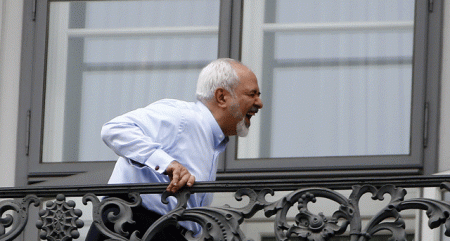
Iranian Foreign Minister Mohammed Javad Zarif laughs during the nuclear negotiations. (Photo: Reuters)


2. Clarion: The Iranian people are a lot more liberal than the regime. How can outside powers such as the United States reach out to and empower the people without emboldening the regime?

Rafizadeh: First of all, the U.S. government and other powers need to cooperate with those voices which oppose the theocratic and Islamist state of Iran. Powerful countries should stand on the right side of history.  There are many human rights groups and civil societies inside and outside of Iran that aim to democratize Iran and eliminate its violence. The U.S. specifically can help these people and unite the groups they form. It is in the long-term interest of any influential country that makes the effort to unify those that oppose the Islamic state and the human rights activists that struggle against it. Providing support to  opposition groups is an effective tool that will empower the Iranian people without emboldening the government. Seeing these groups strengthen and grow in numbers would frighten Iran’s government and weaken its grasp on the country as a whole.

Secondly, the U.S. and other powerful countries should cease all diplomatic, political, or economic ties with the Islamist state of Iran. They need to put pressure on the regime to respect human rights and to moderate its militaristic and ideological foreign policy. Four decades of diplomacy has not changed the violent behavior of the Islamist state of Iran.

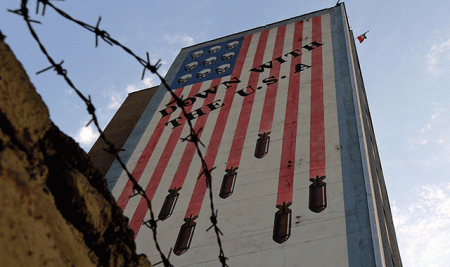
A building in Tehran emblazoned with anti-American graffiti. (Photo: ATTA KENARE/AFP/Getty Images)

3. Clarion: Now that the Iran Deal has gone through and will be upheld, what is the next step for those worried about the regime’s nuclear ambitions?

Rafizadeh: I strongly believe, and we should all be aware, that the Iranian regime will use every opportunity to acquire nuclear weapons. Nuclear weapons are the Iranian regime’s golden shield which can guarantee its rule for eternity and will ensure the achievement of its radical goals.

The nuclear deal is very dangerous. When it expires, it will allow Iran to legally become a nuclear state. It is already providing Iran with billions of dollars every year, wealth that is used for extremism, terrorism, damaging U.S. national interests, and killing Westerners and Americans.

The nuclear activities of the Iranian regime should be monitored by independent groups meticulously. History has shown us, that the International Atomic Energy Agency or the UN will not detect Iran’s undercover nuclear operations. They have failed to do so several times.  All violations should be brought to the attention of the public. In addition, sanctions (particularly the UN Security Council’s sanctions) should be re-imposed on the Iranian regime. The Iranian regime should be punished for its ballistic activities and violations of UN resolutions. Without consequences, they have no motivation to limit their activities or progress toward becoming a nuclear state.

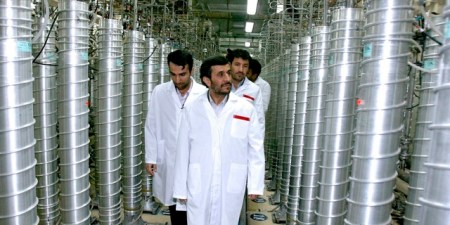
Then Iranian President Mahmoud Ahmadinejad tours the nuclear facility at Natanz. (Photo: Reuters)

4. Clarion: Should international activists who want to see the Iranian situation improve be using a policy of detente and engagement or isolation, boycotts and shaming?

Rafizadeh: The only policy that has resulted in success against the Iranian Regime was the application of pressure and boycotts. For example, in several cases, when there has been an international outcry and when the media paid attention to a victim of torture or execution in Iran, the Iranian regime has been forced to change its sentence. The economic boycotts successfully forced the Iranian regime to the negotiating table.

For the Islamic state of Iran, engagement and concessions signal weakness, not diplomacy. Negotiations only embolden and empower the regime. Applying pressure is the most effective, and likely only way, to create change within the regime.

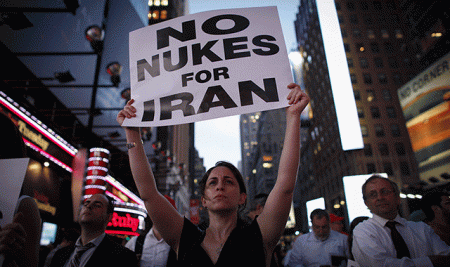
A woman protests against nuclear weapons for Iran at a rally in Times Square. (Photo: KENA BETANCUR/AFP/Getty Images

5.  Clarion: What is the most important thing people who want to eliminate extremism and see positive relations between Muslims and non Muslims should be doing?

Rafizadeh: The most important thing is to do what you [Clarion] are doing: to give a voice to those Muslims who strongly oppose radical Islam and attempt to create reforms from within Islam. Those silent moderate Muslims need to speak up, and need to be supported when they do. If we stay silent, radical Islam will continue winning and expanding. It is our job to strongly stand against radical Islam even if that endangers our life. People should know that there are truly some Muslims who want to forge genuine reformation in Islam and help eliminate radical Islam.

Many Muslims, including myself and my family, who have endured oppression under radical Islam in Muslim nations, would like to eliminate radical Islam, promote a peaceful moderate form of Islam and lead a reformation.

Finally, I describe in detail other important topics in this article “As a Muslim, I am shocked by Leftists and Liberals” as well as in my books.

I grew up between two authoritarian governments, the Islamic Republic of Iran and Syria, under the leadership of people such as Assad, Ayatollah Ali Khamenei, and Mahmoud Ahmadinejad. My youth was influenced by two major denominations of Islam in the Muslim world; the Shia and Sunni. I also studied Shia and Sunni Islam academically, and at one point I was a very devout Muslim. My parents, who still live in Iran and Syria, come from two different ethnic Muslim groups; Arab and Persian.

Unfortunately, in the West and particularly in the US I have witnessed that there are some groups, who have access to megaphones, including liberals, democrats, leftists and Western Muslim scholars (who have never experienced radical Islam first hand and have never lived under states ruled by sharia law) spread apologetic views toward radical Islam. They also criticize those Muslims who attempt to promote social justice and peace within Islam.

If liberals, leftists and many Western Muslim scholars truly stand for values which they call for, such as peace and social justice, they should be aware that their actions are actually contributing to the expansion of radical Islam, and they are hurting us and our efforts to lead reformation in Islam and weaken radical Islam.