Archive for the ‘Iran scam’ category

Nuclear watchdog holds up report on Iranian compliance

January 16, 2016

Nuclear watchdog holds up report on Iranian compliance, DEBKAfile, January 16, 2016 7:17 PM IDT

The International Atomic Energy Agency’s report on full Iranian compliance with the nuclear accord signed with the big powers was due to be released Saturday morning, and so trigger the lifting of international sanctions. However, by Saturday evening, the report was still held back in view of difficulties that remained to be ironed out over Tehran’s fulfillment of its obligations.

Anti-Iran Sanctions to Be Removed Today: Iran’s FM Zarif

January 16, 2016

Anti-Iran Sanctions to Be Removed Today: Iran’s FM Zarif, Tasnim News Agency, January 16, 2016

(Happy Implementation Day, Obama. — DM)

Implementation day

VIENNA (Tasnim) – Iranian Foreign Minister announced that the nuclear deal finalized by Tehran and world powers in July 2015 will be implemented today and anti-Iran sanctions will be removed after the release of IAEA report verifying that Iran has fulfilled its commitments as per the deal.

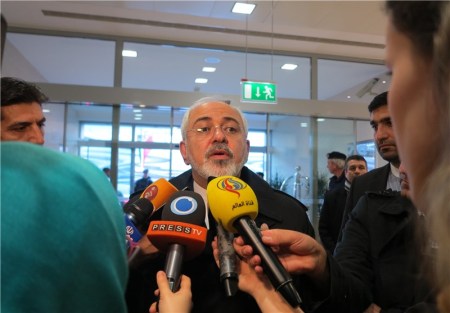
According to Tasnim dispatches, Mohammad Javad Zarif told reporters upon his arrival in the Austrian capital of Vienna on Saturday that the Director-General of International Atomic Energy Agency Yukiya Amano will release the verification report, and the nuclear deal (dubbed as JCPOA) will be implemented accordingly.

A joint statement will then be issued, which will announce the implementation of the Joint Comprehensive Plan of Action (the text of the nuclear deal), he added.

As regards his Saturday agenda, Zarif said he is scheduled to meet with Amano, announce the implementation of the nuclear deal, and hold bilateral meetings with European Union’s Foreign Policy Chief Federica Mogherini and possibly with other foreign ministers of the Group 5+1 (Russia, China, the US, Britain, France, and Germany) including US Secretary of State John Kerry.

The meetings are aimed at ensuring the correct implementation of JCPOA, the Iranian minister declared, noting that a meeting with his US counterpart is especially important considering “the extensive measures the Americans have declared to have taken.”

Implementation of the JCPOA is a good opportunity for the Iranian nation to see not only the termination of all cruel resolutions passed by the United Nations Security Council and the IAEA Board of Governors against Iran, but also the removal of all cruel sanctions imposed on the country due to its nuclear energy program, Zarif stressed.

This is a good day for the Iranian people, but it is also a very good day for the region, because the Middle East is now freed from an unnecessary conflict, which could cause concern for the region, the Iranian top diplomat noted.

“This day proves that we can resolve the world’s important problems through diplomacy. Problems are settled through dialog, not through threat of pressure and sanction,” he added.

Zarif arrived in the European capital along with a number of other Iranian officials including Deputy Foreign Minister Seyed Abbas Araqchi, Head of Atomic Energy Organization of Iran (AEOI) Ali Akbar Salehi, AEOI Spokesman Behrouz Kamalvandi, and Foreign Ministry Spokesman Hossein Jaberi Ansari.

Iran and the Group 5+1 (also known as E3+3 and P5+1) on July 14, 2015, reached a conclusion on a 159-page nuclear agreement that would terminate all sanctions imposed on Tehran over its nuclear energy program after coming into force.

Afterwards, the 15-memebr United Nations Security Council passed a resolution that endorsed the JCPOA.

According to the UNSC Resolution 2231, all previous UNSC sanctions imposed on Iran over its nuclear program will be terminated when the JCPOA takes effect.

The Real War on Women in a Nightmarish Islamic State

January 16, 2016

The Real War on Women in a Nightmarish Islamic State, Front Page MagazineDr. Majid Rafizadeh, January 15, 2016

(The “Islamic state” in the article is the Islamic Republic of Iran, our wonderful partner for peace — DM)

la-fg-iran-dress-code-protest-20140507-003

When it comes to executions, girls are systematically more vulnerable due to the Islamist penal code of Sharia law.

Let’s take a look at the Islamist state of Iran, which creates its laws from the legal codes of Sharia and Quran. The first type of discrimination is related to age: girls are held criminally accountable at the maturity age of 9 Lunar years. (This will automatically put girls at a higher risk of execution by the court.)

Iranian ruling politicians hold the highest record when it comes to the most executions per capita in the world. Intriguingly, in the last two years that the so-called moderate, Hassan Rouhani, has been in office, there have been more than 2000 executions conducted in Iran. That is nearly 3-4 executions a day.

More importantly, Iranian leaders are also the largest executioner of women and female juveniles. Some of these executions were carried out on the mullahs’ charge of ‘Moharebeh’ (enmity with Allah), or waging war against Allah, ifsad-i Fil Arz (Sowing Corruption on Earth), or Sab-i Nabi (Insulting the Prophet).

There are three methods of execution for women and female juveniles: 1. Stoning  2. Public hanging 3. Shooting. Some women are also beaten so severely in the prison that they die before reaching the execution. Shooting, which is the fastest method of the three for execution, has not been used since 2008. Instead, the most common method to execute women is public hanging or stoning. Some of these women are flogged right before they are hanged. Public hanging not only imposes fears in the society but also aims at dehumanizing and controlling women as second-class citizens. According to the Islamist penal code of Iran, women offenses are classified as: Hadd, Diyyih, Ta`zir, and Qisas.

Some of these women are stoned for adultery. But even in stoning, the Islamists and Sharia law differentiate between men and women. Women are buried to the neck while men are buried to the waist. This allows some men to be capable of running away from the stoning, while women do not have a chance for survival, at all. If women are still alive after hours of stoning, a large block normally is smashed over their head.

Women from ethnic and religious minorities, as well as political dissidents, have also been targets of these executions. Based on the latest report, Ahmed Shaheed, the U.N.’s special “rapporteur” on human rights in Iran, pointed out that executing individuals from religious and ethnic minority groups are carried out because those victims were “exercising their protected rights, including freedom of expression and association…..When the Iranian government refuses to even acknowledge the full extent of executions which have occurred, it shows a callous disregard for both human dignity and international human rights law.”

In the latest report, Amnesty International announced: “Execution of two juvenile offenders in just a few days makes a mockery of Iran’s juvenile justice system.” And the United Nations Secretary-General Ban Ki-moon condemned Iran and warned about the rise of executions in Iran which “reflect a worrying trend in Iran….Over 700 executions are reported to have taken place so far this year, including at least 40 public, marking the highest total recorded in the past 12 years.”

In many of these cases related to women and female juveniles, it is clear that they were executed for either self-defense against forced marriage or a rapist, or for charges such as freedom of expression. They often are forced to marry at a very young age to an older person, or someone they do not like, such as in the case of the child bride, Farzaneh (Razieh) Moradi – who was forced to marry at the age of 15 and was executed in the city of Esfahan. These women were beaten and raped, repeatedly, by their spouses or relatives until they could not take it anymore and defended themselves. Some of these girls are being imprisoned and executed based on the fabricated charges of possessing opium. For example, in the case of the 16-year-old Sogand, the police found opium in her father’s house, but because there was no one at home except her, they arrested her. She is still in prison as none of her family members have come forward to save her life.

Some of these executions are based on the issue of “honor.” For example, some of these girls follow their hearts and fall in love with someone they choose themselves. But since their brothers and fathers disagree with this, the females get punished. For example, in the case of Mahsa, a seventeen-year-old, her brothers are the ones seeking her execution. In addition, if an Iranian Muslim woman has sex with a Christian or Jewish person, she will be executed (but a Muslim man is allowed to have sex with non-Muslim women).

Some of these girls are raped, repeatedly, in the process of investigation and forced into “Sighah”- the Shiite Islamist law of temporary marriage – with a cleric, or a member of Etela’at (intelligence), or Revolutionary Guard Corps before they are executed. Amnesty International previously pointed out that there are a “considerable” number of reports regarding this issue.

While the West is looking to lift sanctions against Iranian leaders in a few days and normalize ties with Iran, it is critical to look at the egregious human rights violations that this country is allowing. Is being silent and turning a blind eye to these human rights abuses appropriate? Doesn’t normalizing ties with the Iranian leaders and releasing billions of dollars to them, facilitate their efforts of executing more people, including women and child girls?

______________________

Dr. Majid Rafizadeh, an Iranian-American political scientist and scholar, is president of the International American Council and serves on the board of the Harvard International Review at Harvard University. Rafizadeh is also a former senior fellow at the Nonviolence International Organization based in Washington, DC and is a member of the Gulf Project at Columbia University. He can be reached at Dr.Rafizadeh@post.harvard.edu. Follow Rafizadeh at @majidrafizadeh.

Arab Commentators On American Sailors Incident: This Is Iran’s Message On The Eve Of JCPOA ‘Implementation Day’

January 14, 2016

Arab Commentators On American Sailors Incident: This Is Iran’s Message On The Eve Of JCPOA ‘Implementation Day’ MEMRI, January 14, 2016

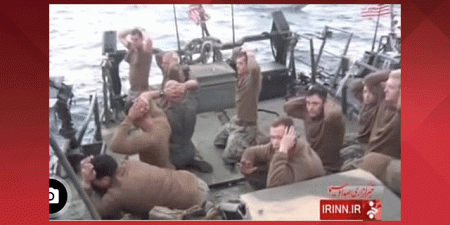
On January 12, 2016, Iranian authorities arrested 10 American sailors from two small U.S. naval craft that had strayed into Iranian territorial waters. Iran’s Islamic Revolutionary Guard Corps (IRGC) arrested and handcuffed the crew and held them at a military base, releasing them a short time later. Iranian authorities released photos of the sailors kneeling with their hands on their heads.

Following the incident, articles were published in the Arab press both by supporters of Iran and by its opponents, claiming that, with its actions, Iran had sent a message to the U.S. Tareq Al-Homayed, former editor of the London-based Saudi daily Al-Sharq Al-Awsat, stated that the IRGC had shamed U.S. President Obama and shown him to be weak on the eve of the JCPOA’s “Implementation Day.” The Lebanese daily Al-Akhbar, which is affiliated with Hizbullah and supports the resistance axis, argued that the IRGC was sending a message to the U.S. that Iran will be willing to clash with it if it has to, and at the same time telling other countries – that is, the Gulf states – not to mess with Iran. It should be noted that Al-Akhbar’s January 14, 2016 front page showed the photo of the American sailors kneeling with hands on their heads, under a headline reading “Tehran to Washington: I Control The Gulf.”

26432January 14 Cover of Al-Akhbar: “Tehran to Washington: I Control the Gulf”

Article In Lebanese Daily Close To Hizbullah: Iran Sent U.S. And Others A Message That It Is Ready For A Clash

The Lebanese daily Al-Akhbar, which is close to Hizbullah and the Iranian axis, published an article by columnist Hassan Haidar, who claimed that Iran wanted to use this incident to send a message to the U.S. that it would not hesitate to clash with it if necessary. He added that this was also a message to other countries, hinting at the Gulf states, specifically Saudi Arabia, that the rules of the game have changed and that they must acknowledge their own weakness.

He wrote: “This incident was a quiet yet an important battle, since it took place off the Saudi coast, targeted an American force, and triggered American [responses expressing] hope [that Iran would not hurt the sailors], which were akin to apologizing to Iran. Washington did not threaten war or raise its voice…

“The Revolutionary Guards, which are in charge of defending the Gulf, are known to ‘see but not be seen’ – a term coined by the head of their navy, General Ali Fadavi. This means that they watch [the goings on] in the Gulf without being noticed by anyone, and in an emergency, they suddenly appear.

“The Revolutionary Guards possibly wanted to send a message to all, that if Iran feels that its interests and security are at stake, it will be willing to enter any conflict, even with the U.S…. [Furthermore,] dealing with Washington in this way ensures that smaller [countries] understand that Tehran will never hesitate to respond to any violation of its sovereignty, and that the rules of the game have changed, and therefore certain [elements] should recognize the limits of their power.”[1]

Leading Saudi Writer: Iran Kidnapped Not Only The Sailors But Obama Himself As Well

Tareq Al-Homayed, former editor of the London-based Saudi daily Al-Sharq Al-Awsat, wrote on January 14, 2016 that the arrest of the American sailors just hours before President Obama’s final State of the Union address had cast a shadow over the address, and had in effect kidnapped the president himself. He noted that the kidnapping had proven that Iran has no intention of moderating its positions, and had exposed Obama, who wanted to present the nuclear agreement with it as a great achievement, in all his weakness. Al-Homayed wrote: “When Iran’s Revolutionary Guards seized two American naval craft in the Gulf on Tuesday evening [January 13, 2016], with ten American sailors on board, it was not the sailors who were the important point, but the fact that the Revolutionary Guards effectively kidnapped U.S. President Barak Obama [himself only] a few hours before he was to deliver his final State of the Union address, towards the end of his second term in office. The crisis of the American sailors [detained by] Iran ended [just] a few hours after their arrest, but it was Obama’s speech that was hijacked, since the Iranians deprived Obama of the opportunity to appear as the strong man who had forced Iran to capitulate on the nuclear dossier. The sailors’ arrest deprived Obama of the chance to boast of the legitimacy of the nuclear agreement and to tell America, which is divided on the Iranian issue, as is the entire world, that Iran has changed and will once again become an active member of the international community, [a country] that renounces violence and respects international treaties and agreements. Some may say that the Iranians’ conduct was foolish, and this is true – but so was placing faith in the Iranian regime!

“Hence, the arrest of the Iranian sailors [right] before Obama’s address exposed the weakness of the American president and sparked doubts even in those who defend his foreign policy, especially [his policy] towards Iran’s [behavior] in our region. Embarrassment was apparent even among the White House staff, as manifest in leaks and excuses conveyed by Obama’s staff to the U.S. media during the sailors’ detention. The biggest embarrassment was over Obama’s handling of the incident… and [the question of] whether or not he would refer to it in his pre-prepared speech. So what we witnessed was not so much the abduction of the sailors but the abduction of the American president himself. His ransom was the missed opportunity to present himself as a strong president enjoying the legitimacy of achieving the nuclear agreement with Iran.

“With the premeditated intent to abuse the American president and to present his weakness to all, the Revolutionary Guards arrested the American sailors, and in fact kidnapped Obama himself, [just] days before the expected implementation of the nuclear agreement they will not submit and that Obama is too weak to boast of victory over them. Likewise, the Revolutionary Guards seek to tell anyone, in Iran and outside it, that their hand is still uppermost in Tehran, despite everything that has happened to Iran recently, after the wild attack on the Saudi Embassy in Iran and Tehran’s apology to the [UN] Security Council for this. Additionally, the IRGC’s action [i.e. detaining the sailors] is a response that embarrasses the propaganda of the Iranian president [Rohani] and his men – particularly the wily foreign minister [Zarif] and others – who claim that they want peace and openness, as they market lies and corrupt accusations against Saudi Arabia.

“Obama’s predicament is not manifested only in his kidnapping, but [also] in that he wants to take a neutral stand vis-à-vis the recent Iranian hostility against Saudi Arabia and the entire region. But he himself became a victim of Iran when [Iran] kidnapped him [just] before his final State of the Union address, and wrecked his opportunity to present himself as an accomplished hero when [his accomplishments] are in fact not yet completed.”[2]


Endnotes:

[1] Al-Akhbar (Lebanon), January 14, 2016.

[2] Al-Sharq Al-Awsat (London), January 14, 2016.

Iran Captures and Releases US Sailors: the Back Story

January 14, 2016

Iran Captures and Releases US Sailors: the Back Story, Clarion Project, Meira Svirsky, January 14, 2016

Iran-Captures-US-Sailors-HPIranian footage of the capture of the 10 American sailors.

Although the government and news media seem to be adopting Shakespeare’s famous maxim, “All’s well that end’s well,” the back story behind the seizure and eventual release of 10 American sailors by Iran is not so simple.

Vice-President Joe Biden insisted “the Iranians picked up both boats — as we have picked up Iranian boats that needed to be rescued .. [they] realized they were there in distress and said they would release them, and released them — like ordinary nations would do.”

Yet Iran can hardly be called an “ordinary nation.” The Islamic Republic leveraged the incident to humiliate the U.S., forcing the sailors to apologize and acknowledge their “fantastic” treatment by Iran. Not just a typical “rescue.”

Iranian brinkmanship, an art unto itself, was played to perfection. Footage aired on Iranian Press TV in English (see below) showed uncomfortable U.S. sailors sitting on Persian carpets laden with food, the lone female sitting in a corner sequestered behind her male compatriots with a hijab covering her hair.

Films of their “surrender” — on their knees with their hands behind their heads –featured prominently in the Iranian press coverage as did all the weapons contained on the ship.

Still Biden insisted it was all in a normal day’s work. “When you have a problem with the boat, (do) you apologize the boat had a problem? No,” Biden said. “And there was no looking for any apology. This was just standard nautical practice.”

Others were more blunt. “This incident in the Persian Gulf, which probably will not be the American forces’ last mistake in the region, should be a lesson to troublemakers in the U.S. Congress,” said Major General Hassan Firouzabadi, head of Iran’s armed forces.

One wonders what the lesson might have been if Iran had already been granted the billions of dollars in sanctions relief instead of being just days away receiving it.

Watch Iranian TV coverage of the capture and apology (voices begin after three minutes):

Iran: Attack on US Boats is Warning to Congress on Sanctions

January 13, 2016

Iran: Attack on US Boats is Warning to Congress on Sanctions, Front Page Magazine, Daniel Greenfield, January 13, 2016

(Here’s an analysis of the Iranian actions:

— Oh well. — DM)


obama_tv

The official media narrative is that Obama’s great relationship with Iran enabled the release of the American sailors captured at gunpoint by Iran’s terrorist IRGC. The media is full of praise for Obama for letting ten American sailors be taken hostage… and then released.

That’s how low the bar is set.

Meanwhile Iran is making it clear that it’s sending a very different kind of message.

Iran’s army chief said on Wednesday the seizure of two US navy boats and their 10 sailors should be a lesson to members the US Congress trying to impose new sanctions on Tehran.

“This incident in the Persian Gulf, which probably will not be the American forces’ last mistake in the region, should be a lesson to troublemakers in the US Congress,” Major General Hassan Firouzabadi, head of Iran’s armed forces, was quoted as saying by Tasnim news agency.

Iran isn’t even bothering to threaten Obama. It just slaps him around. Instead it uses his weakness to threaten Congress which it now considers stronger than Obama.

When North Korea Tests a Nuke, Assume It’s Iran’s as Well

January 13, 2016

When North Korea Tests a Nuke, Assume It’s Iran’s as Well, Clarion ProjectRyan Mauro, January 13, 2016

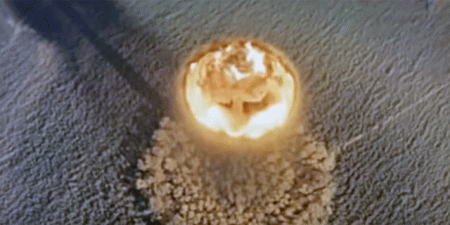
North-Korean-Nuclear-Test-HPA previous nuclear Test made by North Korea (Photo: Video screenshot)

Given the spotty record of U.S. intelligence assessments (to say the least), the West must operate under the assumption that there isn’t an Iranian WMD problem and a North Korean WMD problem, but an Iranian-North Korean WMD problem.

********************************

North Korea briefly reclaimed the global press’ attention again by claiming to have tested a hydrogen bomb. While coverage focused on whether that was an exaggeration, the press missed a much more important question: Was this test only for Kim Jong-Un or was it also for the Iranian regime?

The North Korean and Iranian nuclear and ballistic missile programs should be seen as a single entity, as should be their shared cyber warfare programs. The advance of one is an advance of the other. Differences in their activity should be seen as a common-sense division of labor. Gordon Chang, a prominent expert on Asian affairs, has written about the likelihood that this is the case.

Last May, an Iranian opposition group that has accurately identified hidden nuclear sites in the past reported that it had specific intelligence about North Korean nuclear and missile experts secretly visiting Iran. Intelligence analyst Ilana Freedman said in January 2014 that her sources said a relocation of major parts of Iran’s nuclear program to North Korea began as early as December 2012.

For Iran, it is best to let the North Koreans put the finishing touches on the most provocative nuclear and missile work. Whereas the Iranian regime does suffer from sanctions and must always keep the 2009 Green Revolution in the back of its mind, North Korea thrives off isolation and international provocation.

North Korea has nothing to lose and can only gain by such an arrangement. Kim Jong-Un’s regime has already crossed the nuclear pariah threshold, so it might as well let its Iranian allies take the lucrative deal offered by the West. It has been content to spend $1.1-$3.2 billion each year on it. Plus, the deal puts Iran in a more advantageous position  and its economic improvements can help it invest more in North Korea’s activity.

The good news is that this latest test—North Korea’s fourth— does not appear to be more powerful than its last one, indicating no significant advance in technology. RAND Corporation analyst Bruce Bennett says North Korea is still working on the “basics” of a nuclear fission bomb.

It is hard for some to accept that an Islamist theocracy like that in Iran would work with a cultish communist dictatorship like North Korea, but there is nothing in either one’s ideology that would prevent such cooperation. In fact, North Korea’s success in building a nuclear arsenal actually encourages Iran to see nuclear weapons as a key lesson for the Islamic Revolution.

“The entire world may well consider North Korea a failed state, but from the view point of [Iran], North Korea is a success story and a role model: A state which remains true to its revolutionary beliefs and defies the Global Arrogance,” Ali Alfoneh, an expert on the Iranian regime, told the Washington Free Beacon.

Given the spotty record of U.S. intelligence assessments (to say the least), the West must operate under the assumption that there isn’t an Iranian WMD problem and a North Korean WMD problem, but an Iranian-North Korean WMD problem.

Iran official denies report of nuclear reactor being sealed

January 12, 2016

Iran official denies report of nuclear reactor being sealed, Al Arabiya News, January 12, 2016

FILE -- In this Saturday, Jan. 15, 2011 file photo, a part of Arak heavy water nuclear facilities is seen, near the central city of Arak, 150 miles (250 kilometers) southwest of the capital Tehran, Iran. Iranian state television reported on Saturday, April, 19, 2014 that Vice President Ali Akbar Salehi has said a dispute between world powers and the country over its heavy water reactor at Arak has been “virtually resolved.” Iran and world powers are negotiating the terms of a permanent deal over its contested nuclear program. (AP Photo/Fars News Agency, Mehdi Marizad, File)

FILE — In this Saturday, Jan. 15, 2011 file photo, a part of Arak heavy water nuclear facilities is seen, near the central city of Arak, 150 miles (250 kilometers) southwest of the capital Tehran, Iran.  (AP Photo/Fars News Agency, Mehdi Marizad, File)

Iran’s deputy nuclear chief on Tuesday denied a report that the core of the country’s nearly finished heavy water reactor has been dismantled and filled it with concrete as part of Tehran’s obligations under the nuclear deal with the West.

Ali Asghar Zarean, in remarks to state TV said that Iran will first sign an agreement with China to modify the Arak reactor, a deal that is expected next week.

“Definitely, we will not apply any physical change in this field until a final agreement is finalized,” Zarean added, without specifically mentioning the Fars news agency report.

On Monday, Fars said that technicians had dismantled the core of the Arak reactor and filled it with concrete. The agency, which is close to Iranian hard-liners, cited unnamed sources for the report.

Under the landmark nuclear deal that commits Tehran to significant limits on its nuclear activities for over a decade in exchange for relief from crippling economic sanctions, Iran must redesign the Arak reactor so it can’t produce plutonium for nuclear weapons – though it will still produce small amounts of plutonium and heavy water.

Iran has insisted it needs the heavy water reactor for production of medical isotopes.

Hard-liners in Iran, who oppose Iranian President Hassan Rouhani and the nuclear deal with world powers, argue that the so-called “disabling” of Arak is a slap in the face of Iran and allegedly evidence of Rouhani having given too many concessions to the West in return to little.

It’s not clear what the modification process at Arak will involve, but officials in the past have said that some parts of the reactor need to be filled with cements because of safety concerns.

Zarean also said that once modifications are done and Arak goes online, Iran hopes to export excess heavy water produced there to the U.S. through a third country, for uses in research. He added that Savannah River National Laboratory near Jackson, South Carolina, has recently certified high purity of heavy water produced by Iran.

Iran is still expected to produce some 20 metric tons (22 tons) of heavy water at Arak a year. It has said it would domestically consume about 6 tons for medical isotopes and is looking to export the rest.

Israel and the Four Powers

January 9, 2016

Israel and the Four Powers, Algemeiner, Ben Cohen via JNS Org., January 8, 2016

download-4

JNS.org The rulers of the Arab Gulf states are, it seems, increasingly attentive to what Israel has to say about the balance of power in the region. As a rising Shi’a Iran faces off against a Sunni coalition led by Saudi Arabia, the core shared interest between Israel’s democracy and these conservative theocracies — countering Iran’s bid to become the dominant power and influence in the Islamic world — has rarely been as apparent.

Hence the interview given by a senior IDF officer to a Saudi weekly, Elaph, which laid out how Israel analyzes the present wretched state of the Middle East. In the Israeli view, there are, the officer said, four powers that have coalesced in the region. The first power centers on Iran and its allies and proxies, such as the Bashar al-Assad dictatorship in Syria, Shi’a rebels in Yemen and Iraq, and most pertinently for Israel, Hezbollah in Lebanon. The second power contains what the officer called “moderate” states with whom Israel has “a common language” — Egypt, Jordan and the Gulf countries. The third power, one that is obviously waning, is represented in the form of the Muslim Brotherhood, now vanquished in its Egyptian heartland but still reigning in Hamas-controlled Gaza. Finally, the fourth power is another non-state actor, the combined forces of jihadi barbarism like Al-Qaeda and Islamic State.

Israel’s goal in this situation is a modest one. As the IDF officer put it, “There is a danger that the strife will reach us as well if the instability in the region continues for a long time. Therefore, we need to take advantage of the opportunity and work together with the moderate states to renew quiet in the region.”

The key phrase here, it seems to me, is “renew quiet.” Foremost for the Israelis, that means counteracting Iran and especially its Lebanese proxy Hezbollah, and then minimizing the potential for jihadi terrorists to operate on or near Israeli-controlled territory. A broader strategic vision can also be detected here: Ultimately, both Israel and the conservative Arab states share the common interests of neutralizing Iran and eliminating the jihadi groups.

The partnership between Israel and these states is already in operation, at the levels of intelligence sharing and — not for the first time — cautious exploration of trade relations. That there is a strong military dimension as well to all this is entirely conceivable. And for the time being, it seems that neither side wants to expand or contract on their public ties with each other; Israel has long had embassies in Cairo and Amman, but that doesn’t mean there’ll be an Israeli ambassador in Riyadh anytime soon, much less a film festival or trade expo.

There’s another factor that has accelerated the formation of this undeclared, look-the-other-way alliance: the shift in American Middle East policy under President Barack Obama. Some readers will remember that back in 1991, the first Bush administration pointedly left Israel out of the coalition to expel Saddam Hussein from Kuwait, so as not to antagonize the Gulf states. Now, frustration with Obama has compelled these very same states to recognize that they have an existential interest in cooperating with Israel.

You might say that the president deserves credit for bringing about a situation, in the wake of the nuclear deal with Iran, which has compelled the Gulf states to grasp the reality and permanence of Israel as never before. Still, the visions and prophecies of a Middle Eastern equivalent of the European Union, much indulged during the Oslo Accords years in the late 1990s, are not now in evidence, and that’s welcome. For their own reasons, neither Israel nor the Arab states feel obliged to articulate a sense of what their region should look like in the event that the Iranian threat is overcome.

Indeed, there’s a case that doing so would be counterproductive — it would impose political pressures upon a discreet yet strategically vital relationship that above all requires, in the parlance of the IDF officer, the “moderate” states to remain as moderate states. With the reorientation of American policy towards a rapprochement with Tehran, along with Russia’s active involvement in the Tehran-Damascus axis, Israel is the nearest reliable, not to say formidable, power that these countries can turn to.

In the present Middle Eastern context, then, the realism and discretion which has always underwritten Israeli foreign policy continues to prevail. That realism presumably extends to recognizing that regimes like Saudi Arabia and Bahrain might eventually succumb to their internal instabilities, already exacerbated by the further collapse of the price of oil.

When you consider the alternatives, the region’s architecture could be much worse for Israel than it is currently. Long an anomaly as the only open society in the region, the target of Arab military and economic warfare throughout the latter half of the last century, Israel in this century is now a partner in a regional bloc. To be sure, this is a bloc based upon interests, not common values, and is therefore necessarily limited in scope. But in the present storm, and amidst the appalling human suffering generated by the clash of these rival interests in Syria, it’s the closest thing we have to progress.

American blackmail

January 8, 2016

American blackmail, Israel Hayom, Sarah N. Stern, January 8, 2016

Yossi Melman, noted Israeli author and security analyst, who is certainly no right-winger, wrote a piece in a recent edition of The Jerusalem Report which opens with: “The U.S administration is concerned about the possibility of a new confrontation with Prime Minister Benjamin Netanyahu following the International Atomic Energy Agency’s latest nuclear shenanigans. ‘We hope it won’t happen,’ a senior U.S. official tells The Jerusalem Report, ‘but if it does, it will be a completely different ball game. The administration will not sit idly by this time, and it will be vindictive.'”

This is akin to telling parents that a known child predator wants to abduct their children and has expressed the explicit desire to murder them, but if they notify the police, it will be a completely different ball game. The local government will not sit idly by this time, and it will be vindictive — against the parents who have the responsibility of protecting their children.

In actuality, the Obama administration’s outrage is completely legitimate, but it is directed at the wrong target: Israel. However, after seven years of the Orwellian world that we now inhabit, we have become conditioned to believe that this statement is almost normal.

Under international law, however, this is clearly upside-down and backward. It is Iran, after all, that violated U.N. Security Council Resolution 1929 (by firing missiles), the understandings reached in the July nuclear agreement and the United Nations Universal Declaration of Human Rights. Therefore, Iran should legitimately be the target of American as well as international outrage.

Iran is guilty of conspiracy to commit genocide. The IAEA is complicit in this guilt by closing the file on Iran’s nuclear program despite the fact that certain fundamental questions regarding prior military dimensions remain unanswered. The IAEA admitted as much on December 2, 2015, yet still decided to close the Iran file under what can only be explained as political pressure.

In 1948, in the immediate aftermath of the Holocaust, the U.N. passed United Nations General Assembly Resolution 260, the Convention on the Punishment and the Crime of Genocide. Article 3 of this convention lists crimes that should be punished as (a) genocide; (b) conspiracy to commit genocide; (c) direct and public incitement to commit genocide; (d) attempt to commit genocide and (e) complicity in genocide.

The Jerusalem Center for Genocide Prevention has compiled an outstanding collection of remarks made by Iranian Supreme Leader Ayatollah Ali Khamenei between 2000 and 2015. The center came up with a few significant findings, including the fact that “Iranian state incitement against Israel has been explicit in its calls for destruction of the Jewish state. Pre-war Nazi propaganda used euphemisms and never explicitly called for the destruction of the Jews.” Official Iranian threats and incitement have “lasted for more than 30 years, as compared with Nazi governmental incitement, which lasted 12 years.”

They also found that the frequency and the intensity of Iran’s incitement to commit genocide has only increased the more the international community eased sanctions.

In fact, shortly after the July 14 agreement was reached, Khamenei issued a book titled “Palestine,” outlining in painstaking detail the steps that should be taken to annihilate Israel, which he described as “a cancerous tumor” whose elimination would mean that “the threats and hegemony of the United States will be replaced by Iran.”

The book sketches out how to eliminate Israel through an eternal chain of low-intensity assaults that will eventually make life so unbearable for Israelis that they will pack their bags and leave. He also wrote that the Iranian nuclear bomb would inhibit the Israelis against any sort of retaliation.

Since the Joint Comprehensive Plan of Action was reached on July 14, both Iran and U.S. President Barack Obama have behaved in predictable ways. Iran has conducted two missile tests, one on Oct. 10 and one on Nov. 21, and on Dec. 29 fired a rocket within 1,500 yards of an American aircraft carrier, the USS Harry S. Truman in the Strait of Hormuz.

While Obama was trying to sell the JCPOA to Congress and a skeptical American public last summer, we were constantly assured of “immediate, snapback sanctions.”

According to a report in The Wall Street Journal last month, the U.S. Department of Treasury notified Congress that approximately a dozen companies or individuals in Hong Kong, the UAE and Iran were to face sanctions for working on the Iranian missile program, which not only violated the JCPOA but also U.N. Security Resolution 1929.

The Iranian government was quick to denounce the threat of new sanctions, calling them, “unilateral, arbitrary and illegal.” And just as swiftly and predictably, Obama caved under Iranian pressure and decided to delay imposing new sanctions, for an unspecified period of time. And now Iran has publicly unveiled a new underground missile site.

According to a report in The Washington Free Beacon, Democratic members of Congress who backed the deal are disappointed with the White House. Rep. Steny Hoyer of Maryland said: “We are always in a sensitive moment in our dealings with Iran, and there is never a perfect time to take such actions. … But Iran must know with certainty that violating U.N. Security Council resolutions, both inside and outside the scope of the Joint Comprehensive Plan of Action, will be met with serious consequences.”

Senator Chris Coons (D-Del.) told The Wall Street Journal: “I believe in the power of vigorous enforcement that pushes back on Iran’s bad behavior. If we don’t do that, we invite Iran to cheat.”

It appears that America’s moral backbone, the IAEA and all the Democratic members of Congress who believed Obama’s reassurances of “immediate snapback sanctions” are currently being blackmailed by Obama’s quest for a foreign policy legacy.

Yes, Obama will, indeed, have a foreign policy legacy, but it will prove to be the same as Neville Chamberlain’s.