Archive for the ‘Iran scam’ category

U.S., Iran Are Negotiating An Obama-Rohani Meeting

April 21, 2016

U.S., Iran Are Negotiating An Obama-Rohani Meeting, MEMRI, April 20, 2016

Following Khamenei’s recent harsh attacks on what he termed the U.S. administration’s misconduct and its failure to implement the economic and banking aspects of the JCPOA,[4] Khamenei’s representatives from Iran’s pragmatic camp have been openly talking with U.S. officials in order to extract from the U.S. more concessions that are not part of the JCPOA.

***************************

Intense U.S.-Iran negotiations appear to be underway at this time, on various levels. They have included meetings this week in New York between Iranian Foreign Minister Zarif and U.S. Secretary of State Kerry, and an April 14 Washington meeting between Central Bank of Iran governor Valiollah Seif and U.S. Secretary of the Treasury Jack Lew.[1]

According to an April 19 report on the Iranian website Sahamnews.org, which is affiliated with Iran’s Green Movement, President Obama asked to meet with Iranian President Hassan Rohani in two secret letters sent in late March to both Iranian Supreme Leader Ali Khamenei and President Rohani.

According to the report, Obama wrote in the letters that Iran has a limited-time opportunity to cooperate with the U.S. in order to resolve the problems in Syria, Iraq, and Yemen, and promised that if Iran agreed to a meeting between him and Rohani, he would be willing to participate in any conference to this end.

The Sahamnews report further stressed that Supreme Leader Khamenei discussed the request with President Rohani, that Rohani said that Iran should accept the request and meet with Obama, and that such a meeting could lead to an end to the crises in the region while increasing Iran’s influence in their resolution. Rohani promised Khamenei that any move would be coordinated with him and reported to him. According to the report, Khamenei agreed with Rohani.

The Sahamnews report also emphasized that Khamenei’s recent aggressively anti-U.S. speeches were aimed at maintaining an anti-U.S. atmosphere among the Iranian public, whereas in private meetings he expresses a different position.

Further hints regarding Obama’s wish to meet with Iranian officials could be found in both American[2] and Iranian[3] media.

Following Khamenei’s recent harsh attacks on what he termed the U.S. administration’s misconduct and its failure to implement the economic and banking aspects of the JCPOA,[4] Khamenei’s representatives from Iran’s pragmatic camp have been openly talking with U.S. officials in order to extract from the U.S. more concessions that are not part of the JCPOA.

After Secretary of State Kerry’s April 19 New York meeting with Foreign Minister Zarif, the two announced that their discussions would continue on April 22. Zarif said that the meeting had been aimed “to ensure that Iran obtains the interests that it anticipates [receiving] from the JCPOA… The main focus of the talks concerned the correct implementation of the JCPOA so that the sides, especially the Iranian people, will receive what is coming to them under this agreement.”[5]

Secretary of State Kerry said that progress had been made in several issues, and that the two would meet again on April 22: “We agreed to – we’re both working at making sure that the JCPOA, the Iran agreement – nuclear agreement – is implemented in exactly the way that it was meant to be and that all the parties to that agreement get the benefits that they are supposed to get out of the agreement. So we worked on a number of key things today, achieved progress on it, and we agreed to meet on Friday. After the signing of the climate change agreement, we will meet again to sort of solidify what we talked about today.”[6]


Endnotes:

[1] Wall Street Journal, April 15, 2016.

[2] See, for instance, an article in Foreign Affairs, March 7, 2016, by a representative of the National Iranian American Council.

[3] Kayhan (Iran), April 3, 2016. See also MEMRI Special Dispatch No. 6373, Power Struggle Between Iranian Supreme Leader Khamenei’s Ideological Camp And Rafsanjani’s Pragmatic Camp Intensifies – Part III: Iranian Supreme Leader Ali Khamenei Speaks Out Against Pragmatic Camp Leaders Rafsanjani, Rohani, April 5, 2016.

[4] See MEMRI Special Dispatch No. 6373, Power Struggle Between Iranian Supreme Leader Khamenei’s Ideological Camp And Rafsanjani’s Pragmatic Camp Intensifies – Part III: Iranian Supreme Leader Ali Khamenei Speaks Out Against Pragmatic Camp Leaders Rafsanjani, Rohani, April 5, 2016.

[5] ISNA (Iran), April 20, 2016.

[6] State.gov, April 19, 2016.

No S-300s or cash windfall for Iran

April 20, 2016

No S-300s or cash windfall for Iran, DEBKAfile, April 19, 2016

(How credible is Kerry? — DM)

S-300_command_vehicles_command_vehicles_17.4.16

Iran held its annual military parade on April 17 to mark National Army Day.DEBKAfile’s military and Iranian sources said it was the most unimpressive in recent years. Iran usually displays its most advanced missiles and other weapons systems, but this year it only showed components of the S-300 antiaircraft system acquired from Russia, demonstrating that Moscow had held back on the entire missiles and will apparently continue to do so in the near future.

On show only were parts of the S-300 radar system, an empty command structure without the launching systems, and a crane used to lift the missiles onto the launchers.

Western military experts who monitored the parade said no other country would display such a miserably inadequate collection of missile system parts, and it emphasizes that Iran did not receive the missiles but only useless components, of the supporting technical system.

The military experts said the other weapons systems displayed at the parade showed that the country’s two main fighting forces are tired and worn out. This follows three years of fighting in Syria by the Revolutionary Guard Corps, and only four months of fighting by units from Iran’s standing army that have had no significant achievements on the battlefield despite massive air support by Russia. It also seems like a very large percentage of those killed and wounded has come from the Revolutionary Guard.

DEBKAfile’s military sources report that during the Teharn parade, Iranian Gen.Mohamed Reda Zada was seriously wounded on the front near Aleppo in northern Syria. Zada was the latest of a long list of high-ranking Iranian casualties of the war. The Revolutionary Guard arranged for a special plane to fly him back to Tehran the same day, and he is now in a military hospital where doctors are fighting for his life.

Meanwhile, despite the lifting of sanctions following Iran’s nuclear deal with the world powers, Tehran has not only been unable to acquire advanced weapons, but has also failed to recover its frozen assets from US and European banks.

US Secretary of State John Kerry notice on April 19 shortly before his meeting in New York with Iranian Foreign Minister Mohammad Javad Zarif, that Tehran had only recovered about $3 billion of its frozen assets since the agreement was reached last year.

Kerry ridiculed the American politicians, particularly Republicans, as well as others, such as Israeli Energy Minister Yuval Steinitz, who estimated that Iran would enjoy a windfall of between $100 billion and $150 billion worth of assets.

DEBKAfile’s sources say that there are two reasons why Tehran has only recovered such a comparatively small amount of funds:

1. Although EU member states and the UN have lifted their sanctions, the US has not done so. The Obama administration is having difficulty passing bills in Congress for cancellation of the sanctions, while the Congress is preparing to impose new sanctions over Iran’s continuing tests of nuclear-capable ballistic missiles.

2. The majority of the Iranian funds are in banks outside the US. Since Washington has yet to lift its sanctions, these banks, which conduct the majority of their transactions in the US, are afraid to release the frozen funds and do business with the Iranians because the US could eventually take action against them.

In other words, the losses incurred by international banks for doing business with Iran would be grater than their profits.

Our World: Obama’s nuclear contrition

April 12, 2016

Our World: Obama’s nuclear contrition, Jerusalem Post, Caroline B. Glick, April 4, 2016

On Monday, State John Kerry visited Hiroshima. While there meeting with this G-7 counterparts, Kerry strongly hinted that his visit was a precursor to a visit to the site of the first nuclear bombing by President Barack Obama next month.

The irony of course is that for all his professed commitment to ridding the world of nuclear weapons, Obama is responsible for drastically increasing the chance of nuclear war. Indeed, Obama’s own actions lend easily to the conclusion that he wishes to do penance for America’s decision to attack Hiroshima and Nagasaki with nuclear bombs, (and so end World War II with far fewer dead than a land invasion of Japan would have required), by enabling America’s enemies to target the US and its allies with nuclear weapons.

Obama views his nuclear deal with Iran – the so-called Joint Comprehensive Plan of Action – as his greatest foreign policy achievement.

Unfortunately for his legacy building and for global security, for the past several weeks news stories have made clear that critics of Obama’s nuclear deal with Iran – who claimed that far from preventing Iran from acquiring nuclear weapons, the deal would enable Iran to develop them in broad daylight, and encourage Iran to step up its support for terror and regional aggression – were entirely correct.

All of the warnings sounded by Prime Minister Binyamin Netanyahu and other leaders have been borne out. All of the warnings sounded by the leaders of the Persian Gulf kingdoms were correct.

Every major commitment Obama made to Congress and to US allies in the wake of the deal have been shown in retrospect to have been false.

Obama told Congress that while the deal did require the US to drop its nuclear sanctions against Iran, the non-nuclear sanctions would remain in place. In recent weeks, media reports have made clear that the administration’s commitment to maintain non-nuclear sanctions on Iran has collapsed.

This collapse is most immediately apparent in the administration’s helpless response to Iran’s recent tests of ballistic missiles.

When Obama and his advisers sold the nuclear deal to Congress last summer, they promised that the binding UN Security Council resolution that Ambassador Samantha Power rushed to pass to anchor the nuclear deal maintained the previous UN ban on Iranian ballistic missile development.

This, it works out, was a lie. The resolution significantly waters down the language. Given the weak language, today the Russians convincingly argue that Iran’s recent tests of ballistic missiles did not violate the UN resolution.

Then and now, Obama and his advisers argued that ballistic missiles are not part of the mullahs’ nuclear project. This claim, which made little sense at the time, makes no sense whatsoever today.

Ballistic missiles of course are the Iranians’ delivery systems of choice for their nuclear warheads.

This fact was driven home last week when the Iranian media reported the opening of a high explosives factory in Tehran. Iranian Defense Minister Hossein Dehgan participated in the opening ceremony.

According to nuclear experts, HMX or octogen high explosives are suitable for building nuclear triggers. In other words, Tehran just built, in a very public manner, a new facility for its military nuclear program. As Iran’s Tasnim news service explained, HMX is a “high explosive used almost exclusively in military applications, including as a solid rocket propellant.”

Last week at his nuclear conference, Obama said that Iran has been abiding by the letter, but not the spirit of the nuclear deal. But this is another lie. Last summer Obama insisted that the deal would prevent Iran from developing and building nuclear weapons by imposing an intrusive, unlimited inspections regime on all of Iran’s nuclear sites.

But this was a lie. As Eli Lake noted in Bloomberg News last week, in contravention of Obama’s explicit commitments to Congress, Iran is refusing to permit UN nuclear inspectors access to its military nuclear sites.

Not only were UN inspectors barred last fall from visiting the Parchin nuclear military site where the Iranians are suspected of developing nuclear warheads. The UN’s International Atomic Energy Agency admitted recently that far from expanding its access to Iran’s nuclear sites, the deal severely limited it. Out of fear that Iran will walk away from the deal, the US is allowing Iran to block IAEA inspectors.

So while the US gave up its right to unlimited inspection of Iran’s nuclear installations, and consequently has little way of knowing what is happening inside them, the US stands back and allows Iran to develop the means to deliver nuclear warheads which the US cannot know whether or not Iran possesses because it cannot access Iran’s nuclear facilities.

But for Obama, none of this is a reason to stop canceling the sanctions on Iran’s nuclear program. Indeed, as Obama sees things, Iran’s non-compliance with the letter of the deal seems to be a reason to cancel the non-nuclear sanctions as well.

Take the dollarization of the Iranian economy.

Obama administration officials pledged to Congress that in the aftermath of the deal, Iran would remain barred from using US financial institutions and so barred from trading in the dollar.

Yet, in what Omri Ceren from the Israeli Project refers to as a “one-hop, two-hops” process, the administration is allowing Iran to use foreign banks to gain access to the US dollar and dollarize is transactions.

Following his visit to Hiroshima, Kerry traveled to the Persian Gulf where the US’s spurned Arab allies and commanders of the US navy’s Fifth Fleet demonstrated to him how Iran has been emboldened by the deal.

Since it was concluded, they noted, Iran has stepped up its support for terrorism and its regional aggression. The leaders of Saudi Arabia, Bahrain, the UAE and other states told Kerry that since the deal was concluded Iran’s support for terrorism and insurgencies has expanded in Yemen and Syria. Naval commanders reported on the four shipments of illicit Iranian arms the navy commandeered en route to Yemen.

Although slightly embarrassed, Kerry was unmoved. He merely maintained Obama’s line that Iran is keeping the letter of the agreement if ignoring its spirit. He insisted that there are moderates in the regime that support the deal – although they have no power.

Then, as The New York Times reported, Kerry said the US would “continue to lift the economic sanctions against Iran that it agreed to as part of the nuclear accord, even while imposing new ones to counter Tehran’s missile launches, an effort now underway at the UN Security Council.”

But again, Russia has blocked further sanctions against Iran. Moreover Russia is doubling down on its deal to sell advanced SU-30 fighters to the Iranian air force. With the S-30, Iran will be able to end Israel’s air superiority and threaten all of its neighbors in the Persian Gulf.

As to air forces, Iran’s Hezbollah proxy have inherited a US-trained one.

According to testimony Middle East expert Tony Badran gave before the House Foreign Affairs Committee last week, the Lebanese Military Forces, generously supported by the US, is now a junior partner to Hezbollah.

As Badran put it, “The partnership between the Lebanese Armed Forces (LAF) and Hezbollah has grown to such an extent that it is now meaningful to speak of the LAF as an auxiliary force in Hezbollah’s war effort.”

At Hiroshima Monday, Kerry and his fellow foreign ministers signed a declaration reaffirming their “commitment to seeking a safer world for all and to creating the conditions for a world without nuclear weapons.”

They went on to pat themselves on the back for their nuclear deal with Iran, which they insisted showed that the Nuclear Non-Proliferation Treaty – which the Iran deal effectively gutted – remains “the cornerstone of the international non-proliferation architecture.”

Several commentators have urged Obama not to visit Hiroshima. But really, what would it matter? Obama’s lies about his nuclear deal launched the world on a course where the worst regimes now know that all they need to do to get immunity for their aggression is to develop nuclear weapons while the Obama administration hectors US allies to deplete their own nuclear arsenals.

Visiting Hiroshima and symbolically apologizing for the US strikes that ended World War II would be far less devastating to the cause of international peace than the war Obama ensured by permitting the world’s most prolific sponsor of terrorism to acquire a nuclear arsenal.

Iran to Build High-Powered Explosives Used for Nuclear Arms

April 11, 2016

Iran to Build High-Powered Explosives Used for Nuclear Arms, Clarion Project, April 11, 2016

(Obama will act decisively by sending a letter to Khamenei explaining “that’s not who you are.” — DM)

Iran-Defense-Min-Gen-Hossein-Dehqan-IPIranian Defense Minister Brigadier-General Hossein Dehqan

The U.S. administration claimed the agreement would mean that Iran’s break-out timeline to build a nuclear weapon would be at least one year for the next 10 years. With a nuclear detonator in place, that timeline would become significantly shorter.

*********************

Three months after the nuclear agreement with Iran was implemented, Iran just announced that it would be producing a powerful explosive that could be used to detonate nuclear weapons.

Iranian Defense Minister Brigadier General Hossein Dehqan announced plans to build a plant which produces Octogen (also known as HMX — High-velocity military explosive) to improve the penetration and destructive power of missile payloads while increasing their precision.

“Concurrently with its efforts to increase the precision-striking power of its weapons systems, the defense ministry has also paid attention to boosting the destructive and penetration power of different weapons’ warheads and has put on its agenda the acquisition of the technical know-how to produce Octogen explosive materials and Octogen-based weapons,”  Dehqan said at the plant’s inauguration ceremony.

While Octogen can be used in non-nuclear applications, one of its main purposes is that of a detonator of atomic weapons. The production of the chemical does not violate the agreement, which failed to mention the issue of nuclear detonators, but raises a red flag concerning the timetable used to sell the agreement to Western countries.

The U.S. administration claimed the agreement would mean that Iran’s break-out timeline to build a nuclear weapon would be at least one year for the next 10 years. With a nuclear detonator in place, that timeline would become significantly shorter.

In addition, there is concern Iran will sell the explosive to any number of terrorist groups that the Islamic Republic supports. A 2004 report by The New York Times regarding the disappearance of 380 tons of HMX and RDX (rapid detonation explosive, another chemical explosive) from a Sadadam Hussein/al-Qaeda facility notes that HMX’s  “benign appearance makes it easy to disguise as harmless goods, easily slipped across borders,” and that it is “used in standard nuclear weapons design.”

The new effort by Iran is part of a strategy outlined by Iran’s Supreme Leader Ayatollah Ali Khamenei on March 20, the beginning of the Iranian new year, in which Khamenei called for a concerted effort to increase the country’s power to confront its enemies while at the same time helping its economy.

“The main issue is that the Iranian nation should be able to do something to bring its vulnerabilities to zero point, and we should have the art of using opportunities and turning threats into opportunities,” Khamenei said

Echoing that sentiment, Dehqan said at the time, “We should strengthen ourselves to the level that we can prevent failure and acquire victory over our enemies.”

Just the day before the opening of the HMX plant, Iranian Revolutionary Guards Corps (IRGC) Commander Major-General Mohammad Ali Jafari, announced, “For years, we have been building power on the presumption of a widespread war with the US and its allies, and have developed all our capacities and capabilities for decisive victories over such enemies.”

“Before political and diplomatic options, we have gotten prepared for a military option,” he continued.

Jafari also bragged that If there is a military confrontation, the U.S. will not be able “to do a damn thing” about it.

Iran Continues Needling U.S. Over Navy Boat Seizure

April 8, 2016

Iran Continues Needling U.S. Over Navy Boat Seizure, Front Page Magazine, Ari Lieberman, April 8, 2016

ws_1

Pentagon remains mute.

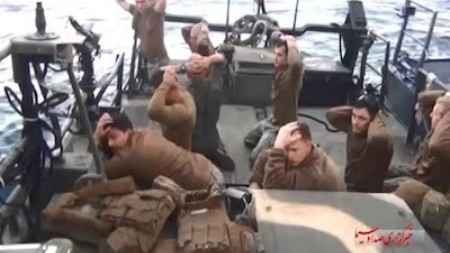
On January 12, at approximately 9:23 a.m., a pair American navy riverine command boats or RCBs, set sail south from Kuwait to Bahrain, headquarters of the U.S. 5th Fleet. At 2:10 p.m., the navy received a report that the RCBs had been intercepted by the Iranians. At 2:45 p.m., the military reported that all communication with the RCB flotilla was severed. At 6:15 p.m., the U.S. Navy cruiser USS Anzio received a communication from the Iranians that the sailors were being detained. Coincidentally, their detention coincided with Obama’s scheduled State of the Union Address, which predictably, made absolutely no mention of the event.

The Pentagon claimed that the RCBs strayed into Iranian territorial waters as a result of a “navigation error” and thereafter, one of the RCBs experienced engine trouble. They were then greeted by a pair of Iranian speed boats. Photos and video of the incident released by the Iranians show that the Iranian boats were armed with nothing more than forward mounted Russian 14.5mm DShK machine guns of Korean War vintage.

At gunpoint, the Iranians transferred the boats and their crew to Farsi Island where they maintain a military base. The boats and crew members were released some 16 hours later during which time, the Iranians thoroughly inspected the RCBs. Two satellite phone sim cards were stolen by the Iranians and the Pentagon has not divulged what, if any, information they contained. The groveling John Kerry thanked his Iranian counterpart profusely for releasing the illegally detained sailors.

Aside from these bare facts, the Pentagon has not released any new information concerning the embarrassing incident, a humiliation unparalleled in modern U. S. naval history. As I previously noted, several troubling questions still remain unanswered.

First, how did an experienced naval crew, equipped with sophisticated navigational equipment and traveling a well-charted, straight forward path, encounter a “navigational error” that led them into the territorial waters of an extremely hostile entity? In the absence of additional information, the Pentagon’s explanation makes absolutely no sense.

There has been speculation that the Iranians employed a device that spoofed or tricked the RCB’s on-board GPS devices with fake signals, leading the sailors into believing that they were on a correct course when they had in fact, substantially deviated. If the Iranians had in fact employed such a device, it would not have been the first time. In 2011, they reportedly misdirected a U.S. drone operating in Afghanistan by hacking into its GPS. The drone and all of its technology fell into Iranian hands relatively intact. The Pentagon has not issued any comment on this theory and notably, has not issued any denial of this troublesome scenario.

Second, and even more troubling, is how did 10 American sailors surrender their heavily armed and armored RCBs to a vastly inferior Iranian force without firing a single shot? Why weren’t readily available military assets immediately deployed and dispatched after the military was notified of the hostile encounter? Who gave the commander the order to surrender and was the decision to surrender influenced by political considerations, notably Obama’s State of the Union Address?

While the Pentagon continues to remain mute on these and other crucial issues surrounding the seizure of the RCBs, the Iranians have been extremely talkative, missing no opportunity to humiliate the “Great Satan.”  The list of outrages includes the following:

  • The sailors were forced to kneel at gunpoint with their hands interlocked behind their heads. The display was videotaped.
  • The commander was forced to apologize and acknowledge his “navigational error” and the graciousness of his Iranian captors on Iranian TV.
  • The Iranians reenacted the surrender spectacle during one of their annual “Death to America” demonstrations.
  • The sailors were subjected to rather intense interrogation.
  • Iranian TV aired footage purporting to show an American sailor crying.
  • A female sailor endured further humiliation and was forced into Sharia compliance by being made to wear a head covering.
  • Iran’s supreme leader, Ayatollah Ali Khamenei, publicly issued the Iranians responsible for capturing the RCB sailors with “medals of conquest.”
  • Approximately two weeks after the sailors were freed; Iran released footage of one its drones shadowing the U.S. aircraft carrier Harry S. Truman. The drone incident occurred on the very day the sailors were captured. A U.S. Navy spokesman called the flyover “abnormal and unprofessional.”
  • As noted, two satellite phone sim cards, likely containing classified information, were stolen by the Iranians.
  • In mid-March, naval commander Gen. Ali Razmjou of the Iranian Revolutionary Guards announced that Iran had retrieved thousands of pages of information from laptops, GPS devices and maps used by U.S. Navy sailors.

It is likely that we have not heard the last from the Iranians on this humiliating saga. In fact, Razmjou said that the IRG will publish a book about the incident. The Iranian bombast stands in marked contrast to the Pentagon’s demurred, almost docile stance. The reasons for the Pentagon’s silence are not hard to fathom. Something happened in the Arabian Gulf on January 12 that if revealed, would likely cause considerable embarrassment to the Obama administration.

In mid-February, Sen. John McCain threatened to subpoena the sailors if the Pentagon was not more forthcoming about the details surrounding the incident. He correctly noted that it did not take that long to debrief the sailors, accused the administration of “dragging [its] feet” and gave the administration a deadline of March 1 to present more information. That deadline has come and gone but the public still remains in the dark thanks to the Obama administration’s attempts to obfuscate.

In the meantime, Iran continues to test ballistic missiles in defiance of UNSC resolution 2231 and flush with $150 billion, continues to operate as a malignant regional influence by providing sophisticated weapons to Hezbollah, the Houthi rebels and other assorted terrorist organizations. More ominously, Iran and its proxy Hezbollah have constructed a ballistic missile base in Syria near the Israeli border, greatly magnifying an already explosive situation.

Obama will ignore these and other Iranian transgressions because he recognizes that the JCPOA, his crowning foreign policy achievement, is on thin ice. For the very same reason, he will continue to order the Pentagon to obfuscate and remain silent on the circumstances surrounding the seizure of U.S. personnel in the Arabian Gulf because it will likely embarrass the administration and add to further congressional calls to toughen sanctions against the Islamic Republic.

Funding Iran

April 8, 2016

Funding Iran, Power LineScott Johnson, April 8, 2016

I think it’s fair to say that the Islamic Republic Iran is a serious enemy of the United States. The powers that be in Iran regularly proclaim their ardent desire for the death of the United States, and they take action aimed at bringing it about in one way or another.

With the Joint Comprehensive Plan of Action, President Obama has teamed up with the mullahs to finance their nuclear program and delay its fruition for a modest period of years if everything works out as indicated. Iran takes the money and dissolution of the sanctions regime up front. It can pull the plug on the deal at any time it sees fit.

Moreover, the deal holds no promise of appeasing Iran; the regime’s goals remain unaffected in every material respect. For a recent example, see the FARS report “Iran working to increase penetration power of military warheads” and the related IBD editorial “Under nuclear deal Iran can have nuclear detonators.”

Disparagement of the deal as appeasement would be off-base. It is something more misguided, something weirder and worse than that. Even Obama administration spokesmen are reluctant to proclaim the administration’s concessions to Iran and the efforts to benefit Iran in connection with the deal. It is the deal that dares not speak its name.

Obama administration officials and spokesmen have demonstrated their willingness to say anything to support the deal. They nevertheless seem to understand that some shame attaches, perhaps as a result of the numerous misrepresentations made to Congress on its behalf.

The Washington Free Beacon’s Jenna Lifhits reports that the Obama administration is now advising foreign banks how to bypass existing U.S. sanctions when dealing with Iran, according to the State Department, which disclosed that officials are offering guidance on how the regime can secure access to billions of dollars in frozen assets. In the video below, AP diplomatic correspondent Matt Lee presses State Department spokesman Mark Toner.

Quotable quote: “It is incumbent on us to live up to our end of this deal. Part of that is to, you know, is to advise these banks and governments.”

Report: US army building secret missile-proof base in Israel

April 7, 2016

Report: US army building secret missile-proof base in Israel, Israel National News, David Rosenberg, April 7, 2016

img682871US officers at missile battery near Tel Aviv Ziv Koren flash90

Iran’s recent ballistic missiles tests, which have led to concern and consternation in Israel, apparently have the United States military worried as well.

In late February the US military took part in a five day joint military exercise with Israel code named “Juniper Cobra”.

The central focus of the exercise was coordinating responses to a potential ballistic missile attack.

Since then, however, security officials have revealed that the US military has serious concerns about the possibility of missile attacks by Iran, Hezbollah, or Hamas, and is taking additional precautions to protect American assets in Israel.

Speaking to Walla News, these officials said the US is constructing a secret army base in central Israel.

The new base, which is being built in response to the Iranian missile threat, is reportedly designed to withstand ballistic missile attacks.

According to the report the base, which is already in advanced stages of construction, will be fully manned at all times and prepared for emergency situations.

The base is linked to the US army’s radar facility in Dimona.

In March Iran conducted a series of ballistic missile tests, the first since October 2015.

Iran’s ballistic missiles, which are capable of reaching Israel and can be fitting with nuclear warheads, have prompted partial American sanctions, with some American lawmakers calling for harsher measures to punish the Iranian regime.

The Perils of Not Listening to Iran

April 7, 2016

The Perils of Not Listening to Iran, Gatestone InstituteShoshana Bryen, April 7, 2016

♦ The Iranian firing of a missile within 1500 yards of U.S. aircraft carrier Harry S. Truman in December, and the kidnapping and photographing of a U.S. Navy ship and crew (the photographs were a violation of the Geneva Convention) were test cases. Other than an apparent temper tantrum by Secretary Kerry, there was no American response. Oh, actually, there was. Mr. Kerry absolved his friend Iranian Foreign Minister Javad Zarif of responsibility.

♦ The Iranians were confident that the Americans could be counted on not to collapse the whole discussion over violations along the edges. Their model was American behavior in the Israeli-Palestinian “peace process.” The Palestinians violate agreements and understandings with impunity because they know the Administration is more firmly wedded to the process than the specific issues on the table.

Supporters of President Obama’s Iran deal (JCPOA) are starting to worry — but that is because they believed him when his lips moved. They heard “snapback sanctions” and pretended those were an actual “thing.” They are not, and never were. They heard Treasury Secretary Jack Lew say the U.S. would never allow Iran access to dollar trading because of the corruption of the Iranian banking system and Iranian support for terrorism — and they wanted to believe him. And sanctions? The administration said that sanctions related to non-nuclear Iranian behavior — support for terrorism, ballistic missile development, and more — would be retained.

Supporters believed Secretary Kerry when he said sanctions on Iran would be lifted only by a “tiny portion,” which would be “very limited, temporary and reversible… So believe me, when I say this relief is limited and reversible, I mean it.” They all but heard him stamp his loafer.

The mistake was not just listening to the administration say whatever it was Democrats in Congress wanted to hear, while knowing full well that once the train left the station it would never, ever come back. The bigger mistake was not listening to Iran. The Iranians have been clear and consistent about their understanding of the JCPOA.

Days before Congress failed to block the JCPOA, Maj. Gen. Hassan Firouzabadi, Chief of Staff of the Iranian Armed Forces, outlined Iran’s red lines.

  • To block “infiltration” of “Iran’s defense and security affairs under the pretext of nuclear supervision and inspection… Iranian military officials are not allowed to let the foreigners go through the country’s security-defense shield and fence.”
  • “Iran’s military officials are not at all allowed to stop the country’s defense development and progress on the pretext of supervision and inspection and the country’s defense development and capabilities should not be harmed in the talks.”
  • “Our support for our brothers in the resistance [Hezbollah, Assad, Yemeni Houthis, Hamas, Shiites in Iraq] in different places should not be undermined.”
  • A final deal should be a “comprehensive one envisaging the right for Iran to rapidly reverse its measures in case the opposite side refrains from holding up its end of the bargain.”
  • “Iran’s national security necessitates guaranteed irreversibility of the sanctions removal and this is no issue for bargaining, trade, or compromise.”
  • “Implementation… should totally depend on the approval of the country’s legal and official authorities and the start time for the implementation of undertakings should first be approved by the relevant bodies.”
  • Iran would not be limited in transferring its nuclear know-how to other countries of its choosing.

The Iranians deliberately and openly conflated what the Administration claimed would be limited sanctions relief related to specific Iranian actions on the nuclear program with the larger issues of sanctions for other Iranian behavior. The Iranians were confident that the Americans could be counted on not to collapse the whole discussion over violations along the edges. Their model was American behavior in the Israeli-Palestinian “peace process.” The Palestinians violate agreements and understandings with impunity because they know the Administration is more firmly wedded to the process than the specific issues on the table.

The Iranian firing of a missile within 1500 yards of U.S. aircraft carrier Harry S. Truman in December, and the kidnapping and photographing of a U.S. Navy ship and crew (the photographs were a violation of the Geneva Convention) were test cases. Other than an apparent temper tantrum by Secretary Kerry, there was no American response. Oh, actually, there was. Mr. Kerry absolved his friend, Iranian Foreign Minister Javad Zarif, of responsibility, noting, “it was clear” that the footage did not come from the Iranian Ministry of Foreign Affairs. He blamed the Iranian military, as if they do not work together.

Iran’s announcement that it would pay $7,000 to each family of Palestinian terrorists killed by Israel “to enable the Palestinian people to stay in their land and confront the occupier,” elicited the disclosure that Mr. Kerry was “extremely disturbed.”

Iran’s ballistic missile test in November, in violation of UN Security Council Resolutions, prompted U.S. Ambassador to the UN Samantha Power to say, “The U.S. is conducting a serious review of the reported incident,” and if the reports were confirmed, the Obama administration would bring the issue to the UN and “seek appropriate action.”

By February, however — after yet another ballistic missile test, in which the missiles carried explicit threats to Israel, Mr. Kerry said he was prepared to let the matter drop. “We’ve already let them know how disappointed we are.”

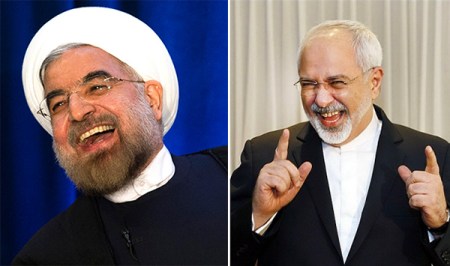
1323 (1)Iran’s firing of a missile within 1500 yards of a U.S. aircraft carrier in December, and its kidnapping and photographing of a U.S. Navy crew were test cases. Other than an apparent temper tantrum by Secretary of State John Kerry, there was no American response, except that Kerry absolved his friend Iranian Foreign Minister Javad Zarif of responsibility. Pictured above: Iranian President Hassan Rouhani (left) and Foreign Minister Javad Zarif (right).

Responding to Senator Lindsay Graham’s suggestion that Congress might increase sanctions against Iran, Mr. Kerry replied, “I wouldn’t welcome [that] at this time given the fact that we’ve given them a warning and if they decide to do another launch then I think there’s a rationale.”

Kerry may not have to wait long.

Just this week, Iranian Deputy Chief of Staff Brig-Gen Maassoud Jazzayeri was quoted by the FARS News Agency reiterating, “The White House should know that defense capacities and missile power, specially at the present juncture where plots and threats are galore, is among the Iranian nation’s red lines and a backup for the country’s national security and we don’t allow anyone to violate it.”

Now, he is believable.

Congress is beginning to breathe fire, but it is not yet clear what it can or will do in the face of the Obama Administration’s executive actions. Last week, angry congressmen were reduced to threatening to “name and shame” American companies that do business with Iran because they cannot figure out how to stem the tide of the Obama Administration’s indulgence of Iranian provocations. That reaction is not even close to good enough.

The Mullahs’ Plan to Hit Israel

April 7, 2016

The Mullahs’ Plan to Hit Israel, Front Page MagazineDr. Majid Rafizadeh, April 7, 2016

ws (2)

The Islamist state of Iran’s blatant aggression and provocative attitudes have reached an unprecedented level.

After the nuclear deal, and Obama’s appeasement policies towards Iran, the ruling Islamists of the country have become very public and vocal about their ideological objectives.

Most recently, the Fars News Agency, the Islamic Republic’s state-controlled news outlet, quoted Iranian Deputy Chief of Staff, Brigadier General Maassoud Jazzayeri, warning the United States to stay away from Iran’s redlines―one of which is Iran’s ballistic missiles.

In addition, Brigadier General Amir Ali Hajizadeh was also quoted by the ISNA agency as stating, “The reason we designed our missiles with a range of 2000 km is to be able to hit our enemy the Zionist regime from a safe distance.” Iran has increased its short–and medium–range ballistic missiles, and currently boasts the largest ballistic missile stockpile in the Middle East.

But what will Obama’s response to these threats be? Most likely there would be more bowing to the ruling clerics of Iran and giving them more carrots. Iranian theocrats have learned that intransigence works with Obama.

There is a simple rule that if you reward a student or your kid for bullying and breaking the rules, you will be encouraging his/her bad behavior, which can ultimately become dangerous for everyone around that person. In addition, if you show students your weakness–such as being willing to give them extra points so that they give you good reviews at the end of the year–they will take advantage of that, or as the Persian proverbs goes: “they will milk you to the end.”

And this is exactly what Iran is doing and how President Obama is encouraging the Islamic Republic’s aggression. Iranian leaders have become cognizant of the fact that intransigence absolutely works with the White House, and threatening Obama with pulling out of the nuclear deal will lead to Obama offering more concessions to the mullahs.

There is a basic rule in Iran’s politics and in Iran’s Supreme Leader’s philosophy: concessions means weakness.  Once someone shows you his/her weakness, you have to speed up getting more concessions from him or her until there is nothing left to get from them.

Here is a chain of events that can easily help us understand how we got here with Iran. It also helps predict how President Obama and the White House will respond to Iran’s recent aggression and threats to the US and Israel.

When the nuclear negotiations were initiated, Obama announced his terms. Iran’s Supreme Leader, Khamenei, gave an inflammatory speech, lashing out at the US. Obama’s response was to increase the number of centrifuges that Iran can hold and give Tehran more leverage in uranium enrichment. Obama also agreed not to include issues such as Iran’s ballistic missiles, human rights or the fate of those Americans imprisoned in Iran during the negotiations.

Now Khamenei knew the game. He used another shrewd tactic by giving another speech threatening the US that he will pull out of the negotiations if certain conditions were not met. Obama’s response was to immediately allow the Islamic Republic to receive all sanctions relief (including the removal of United Nations Security Council’s sanctions), even before Iran finishes its 10-year obligations. Obama also gave Iran a green light to become a nuclear state by enriching uranium at a level that they desire, spinning as many centrifuges as they like, and buying arms with no limits, after the 10-year period.

Khamenei and the IRGC leaders wanted to more forcefully milk the cow, as the Persian proverb goes. Iran launched its ballistic missiles in violation of the JCPOA (UNSCR 2231 Annex II, paragraph three), which states that Iran should not undertake any ballistic missiles activity “until the date eight years after the JCPOA Adoption Day or until the date on which the IAEA submits a report confirming the Broader Conclusion, whichever is earlier.”

President Obama ignored it. Iran launched ballistic missiles several times more. President Obama issued a superficial statement criticizing Iran. Khamenei immediately gave his Nowruz speech heavily lashing out at the United States, the “Great Satan,” and implying that he will pull out of the nuclear deal.

To appease the ruling clerics of Iran, Obama immediately backed off his statements by breaking the promises that he made to the Congress when he was trying to get his nuclear deal through. In other words, he is now preparing to give Iran access to the US’s banking and financial system, and he has already lifted sanctions against Iran that are not related to the nuclear program, but to Iran’s ballistic missiles, terrorism and human rights violations. Iran was also removed from the list of countries for which there is a travel ban, although it is prominent sponsor of terrorism.

Thanks to Obama’s weak leadership and appeasement policies towards the mullahs, Iran is already publicly attacking several countries in the region directly or through its proxies Hamas, Hezbollah, Badr, Kataeb Imam Al Ali, Harakat Al Islam, etc. Iran would have never dared to be so intransigent and aggressive when the UNSC sanctions were previously imposed on Iran. However, sanctions are being completely lifted, thanks to Obama.

Iran has a history spanning over 2,500 years and it goes without saying that that the mullahs are among the shrewdest politicians. They can smell weakness from thousands of miles away and they know how to exploit it. Obama’s weakness–that he fears his so-called crowning foreign policy achievement (the nuclear deal) might fall apart–has led to Iran’s bullying, and has driven his carrots-but-no-stick policy towards Tehran. It appears that Obama is indeed focused on scoring superficial records in his name, such as the nuclear deal or visiting Cuba. But there is no doubt that his so-called “accomplishments” will be forgotten soon. The things that are important are the lives that have been lost, the human rights violations, and the escalation of regional conflicts on the part of Iranian leaders thanks to Obama’s decisions.

Primary distractions from Iran

April 5, 2016

Primary distractions from Iran, Israel Hayom, Ruthie Blum, April 5, 2016

Ahead of Tuesday’s Wisconsin presidential primaries, U.S. Speaker of the House Paul Ryan was in Israel, the destination he chose for his first foreign trip since assuming his post at the end of October.

In meetings with Israeli leaders — and in an interview with Times of Israel editor David Horovitz — Ryan reaffirmed his commitment to the Jewish state and his opposition to the nuclear deal with Iran. He also stated, in no uncertain terms, that — contrary to increasing rumor and pressure — he is not going to end up becoming the Republican nominee at what threatens to be a contested GOP convention. Nobody really believes he means it, however, because he had been equally adamant about not wanting the position he is currently occupying.

But, while distraught Americans from both parties are obsessing over whether Donald Trump can win the nomination — and if he does, whether he can beat likely Democratic rival Hillary Clinton — the Obama administration is being given a free pass to get away with murder, figuratively. More literally, it is enjoying the benefit of the doubt caused by the distraction of the public away from the havoc the White House and State Department are continuing to wreak, which is enabling the actual death of a lot of people in the present, and a whole lot more in the future.

The terrorism of the Islamic State group is only a tiny part of this, though it seems to be the only jihadist organization that gets a rise out of Westerners, whom it makes no bones about targeting for mass murder. Indeed, as the suicide bombings in Brussels on March 22 indicated, Europeans and Americans only wake up when a lot of people with whom they can identify get slaughtered senselessly. That this kind of thing is going on routinely everywhere else in the world barely elicits a yawn.

But as evil as ISIS is, it is still small fry compared to the Islamic Republic of Iran, the world’s greatest state sponsor of terrorism, with tentacles reaching far and wide. And now, thanks to the Obama administration, it also has multibillions of dollars at its disposal with which to build its nuclear arsenal. Nor does it hide its ambitions to wipe Israel off the map and its loathing for America, the “great Satan.”

Iran’s supreme leader, Ayatollah Ali Khamenei, has made this clear to the point of warning his own underlings to follow suit.

“Those who say the future is in negotiations, not in missiles, are either ignorant or traitors,” he said last week.

How has the Obama administration responded to this and previous Iranian muscle-flexing, abduction of American sailors, celebration of U.S. abdication and assertion that nothing Tehran does violates the nuclear agreement?

It has conceded to Iran on every point. Or worse.

As was revealed in a piece by Adam Kredo in The Washington Free Beacon on Monday, “Congress is investigating whether the Obama administration misled lawmakers last summer about the extent of concessions granted to Iran under the nuclear deal, as well as if administration officials have been quietly rewriting the deal’s terms in the aftermath of the agreement.”

Rep. Mike Pompeo (R-Kansas) told Kredo that “the gap between [the administration’s] promises … and today’s scary reality continues to widen. We are now trying to determine whether this was intentional deception on the part of the administration or new levels of disturbing acquiescence to the Iranians.”

He was referring to issues such as Iran’s ballistic missile testing, which the administration initially said constituted a violation of nuclear-deal codifier U.N. Resolution 2231, and then backtracked. Perhaps even more disturbing were statements from the Treasury Department indicating that international business transactions with Iran could be done in dollars — releasing the ban in place on Iran’s access to the U.S. financial system.

In other words, not only was the deal America made with the devil a dangerous one to begin with, but apparently, we don’t know the half of it.

This sentiment was expressed in an op-ed in The Wall Street Journal on Sunday by United Arab Emirates Ambassador to the U.S. Yousef Al Otaiba, who wrote that, in spite of President Barack Obama’s claim about the world being safer place as a result of the nuclear deal, “The Iran we have long known — hostile, expansionist, violent — is alive and well, and as dangerous as ever.”

It is this sorry situation, and the Democrats who brought us here, that Americans must keep in mind come November, no matter who the Republican candidate is.