Archive for the ‘Iran scam’ category

Will Team Trump Air Obama’s Iran Secrets?

November 21, 2016

Will Team Trump Air Obama’s Iran Secrets? Power Line, Paul Mirengoff, November 21, 2016

For years, Republicans and conservatives have charged that President Obama has shielded embarrassing intelligence and other information regarding Iran in order to limit opposition to the Iran nuclear deal and Obama’s conciliatory approach to Tehran. The charge seems well-founded. After all, it took Sens. Tom Cotton and Rep. Mike Pompeo to discover secret side agreements attached to the nuclear deal.

Eli Lake suggests that the Trump administration may well stop covering for the mullahs. Certainly, as Lake argues, Trump’s early high level personnel picks suggest so.

Trump’s nominee for CIA Director is none other than Mike Pompeo. Not only did he and Sen. Cotton uncover side deals to the nuclear agreement, he also pressed hard for answers about the cash payments the U.S. delivered to the mullahs in exchange for the release of hostages.

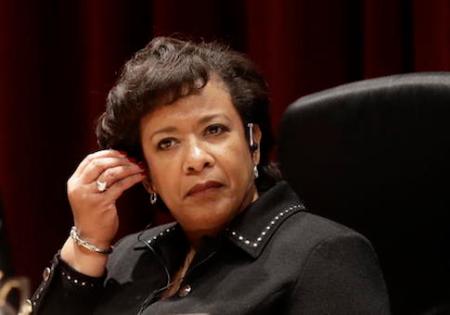
Pompeo wrote to Attorney General Lynch asking for answers as to how the cash payments were approved by the Justice Department. Lynch stonewalled him. Perhaps Jeff Sessions will be more cooperative.

Mike Flynn is the other key appointment for purposes of airing Obama’s Iran secrets. Lake points out that in 2011 General Flynn ran a team at the Office of the Director of National Intelligence that reviewed the troves of material captured in the 2011 Osama bin Laden raid.

Under Obama, only a small fraction of these documents have been declassified and released. After he retired from the military, Flynn charged that the disclosures were selective.

Flynn noted, for example, that some documents captured in the bin Laden raid show a much tighter relationship between Iran and al-Qaeda than previously disclosed. In The Field of Fight: How We Can Win the Global War Against Radical Islam and Its Allies (written with Micheal Ledeen), Flynn states: “One letter to bin Laden reveals that al-Qaeda was working on chemical and biological weapons in Iran.”

Given Obama’s desire to deal with Iran and, indeed, for a rapprochement, you can see why the administration shielded such intelligence. Given the well-deserved contempt by Pompeo and Flynn for Obama’s Iran policy, you can see why they might want relevant facts to come to light. As a general matter, these are facts the public has a right to know.

If such facts are made public, Obama won’t have much standing to complain. Lake reminds us:

Obama himself in 2008 campaigned against the sitting president’s policies on waterboarding and enhanced interrogation. One of the first things his government did when he took office was to declassify and release the legal memos that justified and revoked these practices.

It looks like the Republicans are about to return the favor.

Kredo Discusses House Bill That Forbids US Gov From Funding Boeing Sale to Iran

November 19, 2016

Kredo Discusses House Bill That Forbids US Gov From Funding Boeing Sale to Iran, Washington Free Beacon via YouTube, November 18, 2016

The New York Times’ Dishonest Reporting on the Iran Nuclear Deal

November 18, 2016

The New York Times’ Dishonest Reporting on the Iran Nuclear Deal, Center for Security Policy, Fred Fleitz, November 17, 2016

nyslimes1

You may have read that in response to criticism about its biased coverage of the Trump campaign, the New York Times has rededicated itself to honest reporting.

After you get up off the floor from laughing hysterically, consider this story that ran days after the Times’ renewed commitment to ethical journalism: On November 14, the New York Times ran an article with the headline: “76 Experts Urge Donald Trump to Keep Iran Deal.” In the second paragraph, the article claims this report was signed by “former officials from both major political parties.”

Not until the sixth paragraph does the story mention that this report was issued by the National Iranian American Council (NIAC).

This is the kind of dishonest reporting we have come to expect from the New York Times.

NIAC, well known as the head of the Iran lobby in the United States, aggressively campaigned for the Iran nuclear deal. The Times misleadingly describes it as “a Washington group that has advocated improved relations with Iran, even while sharply criticizing Iranian leaders over human rights issues.”

The NIAC report reads like it was written by the Iranian foreign ministry. Not only does it call for President Trump to stick with the Iran deal and not impose new sanctions, the report ignores a sharp increase in belligerent behavior by Iran since the nuclear agreement was announced, suggests the U.S. should ignore Iran’s ballistic-missile program, and calls for close U.S.–Iran cooperation on Iraq, Syria, and Afghanistan.

According to the report, U.S.–Iran relations have reached their highest point in 37 years due to the nuclear agreement. I don’t think the crews of U.S. ships in the Persian Gulf and the Red Sea who have been harassed by Iranian ships and had missiles fired at them from Yemen would agree.

On Iran’s gross human-rights violations, the report essentially calls for the Trump administration to ignore them and instead makes the bizarre recommendation that President Trump take steps to show that America does not seek to harm innocent Iranians by speeding up the sale of civilian airliners to Iran.

The 76 “experts” who signed the NIAC report are mostly on the far left, including Noam Chomsky, Joseph Cirincione, Juan Cole, and John Esposito.

The article identified Lawrence Korb, Lawrence Wilkerson, Chas Freeman, and Gary Sick as experts who signed the report and served in Republican administrations. The Times did not mention that these men are now firmly on the left.

Korb may have been a Republican at one time but now works for the George Soros-funded Center for American Progress and was a surrogate for Bernie Sanders and Hillary Clinton.

Wilkerson, Secretary of State Colin Powell’s chief of staff, joined the far Left as a fierce critic of the Republican party after Powell stepped down. He has called for George W. Bush and Dick Cheney to be charged with war crimes over the Iraq War.

Freeman, a former ambassador to Saudi Arabia and assistant defense secretary for international affairs in Republican administrations, blamed the “Israel Lobby” for forcing him to withdraw from accepting a top intelligence post in the Obama administration.

And then there is Gary Sick, who the Times identifies as “a Columbia University scholar who served on the National Security Council under Reagan as well as Presidents Gerald Ford and Jimmy Carter.” Sick is better known for circulating a false story in 1980 that that the Reagan campaign persuaded the Iranian government to not free U.S. hostages until after the 1980 election to ensure President Carter’s defeat.

How could the Times fail to mention this report was issued by a group that is essentially Iran’s main lobbying arm in the United States? How could it ignore the strong pro-Iran bias in this report? How could the Times not mention the troubling backgrounds of the signatories like Wilkerson, Freeman, Sick, and others?

Most importantly, why did the Times article not admit the NIAC report has zero credibility and will be completely ignored by the Trump administration?

The answer to these questions is that the New York Times has no interest in changing its ways and doing honest reporting. It remains a propaganda organ of the Left. Fortunately, the Timeshas lost so much credibility that few take articles such as its NIAC-report story seriously.

For a fair and balanced discussion of how President Trump should deal with Iran, see my November 14, 2016, National Review article, “Yes, Trump’s Going to Dump the Iran Deal.”

Responses In Iran To Trump’s Presidential Win

November 18, 2016

Responses In Iran To Trump’s Presidential Win, Memri, By: A. Savyon, E. Kharrazi, and U. Kafash*, November 17, 2016

Introduction

While the Iranian regime’s official position is that there is no difference between a Democrat or a Republican in the White House because both of them will be anti-Iran, there are a number of notable trends in Iranian reactions to Donald Trump’s election:

Reactions Common To Both The Ideological And Pragmatic Camps  

  • Trump’s win was a protest against the U.S. administration’s policies of slaughter, violence, and oppression both in and outside the U.S. Despite the Obama administration’s extraordinary efforts to end Iran’s international isolation, speakers from both Iranian camps attacked Obama and gloated over the Democrats’ loss.
  • Trump is better for Iran than Clinton. In spite of the regime’s official policy of not preferring either candidate, some Iranians have said that a President Trump is better for Tehran for a number of reasons:

o Trump seeks better relations, not conflict, with Russian President Vladimir Putin, so Iran expects that he will let Putin deal with Syria, which is controlled by Iran.

o Trump is unpopular in the West, and will therefore find it difficult to form an international coalition against Iran – which Clinton could have easily done.

o Trump will need some time to identify his Republican allies in Congress before he can act against Iran.

o Since Trump is a businessman, there is cautious hope that his actions will be business-oriented, not purely ideology-oriented.

Reactions From The Pragmatic Camp

  • Fear that the JCPOA will now be cancelled – particularly among those who labored to achieve the agreement, including President Hassan Rohani, Foreign Minister Javad Zarif, and members of the negotiating team. These representatives of the pragmatic camp were quick to stress that the U.S. must adhere to its commitments and implement the agreement with Iran, due to their apprehensions that President Trump would follow through on his campaign promise to reverse it. Others expressed cautious optimism that Trump as president would be different than Trump as candidate, as evinced by his victory speech, which they said was more measured and moderate than his campaign rhetoric.

Reactions From The Ideological Camp

  • Threats against the U.S. are toned down, and instead there are vague threats that are less specific than in the past about an appropriate Iranian response to any move the U.S. might make against Iran.
  • Recommendations that Trump focus on rebuilding at home rather than taking anti-Iran measures.
  • Calling on Iranians to adhere to the regime’s official stance by refraining completely from issuing any pro- or anti-Trump statements.
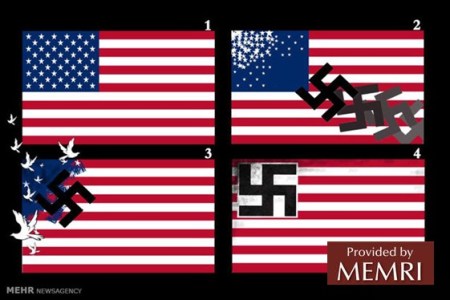
30714Cartoon published November 16, 2016 by the Iranian news agency Mehr. Note the two Hitler serpents behind Trump.

MEMRI’s Assessment

It appears that Iran’s military-political elite prefers to deal with a male president, not a female one.[1] Furthermore, in a November 2 speech ahead of the anniversary of the U.S. Embassy takeover in Tehran, Supreme Leader Ali Khamenei, in an unusual statement, explained Trump’s popularity among the American public as due to the fact that he speaks “honestly.” Moreover, unlike Clinton, Trump is seen by the Iranian leadership as not committed to democratic values or human rights because of his past remarks on women and minorities, and as a dominant ruler with whom Iran can find common ground. Iran has actually chosen to cooperate with Republican administrations that demonstrated strength and determination.

In this context, it is important to note that it is with Republican administrations that have demonstrated strength and determination that Iran has chosen to cooperate. For instance, when the U.S. military operated in Iraq and Afghanistan during the George W. Bush administration, Iran cooperated with U.S. forces and even stopped enriching uranium of its own accord, fearing an American attack. Also, during the Reagan administration, it was the Iranian regime that initiated dialogue with the U.S. on the Iran-Contra affair.

A contemporary example is the announcement by an Iranian diplomatic source, immediately after Trump’s win was declared, that Iran intends to remove from its territory a quantity of heavy water that puts it above the limits set by the JCPOA. An International Atomic Energy Agency (IAEA) report from early November 2016 warned that Iran possessed too much heavy water, but it was only after Trump’s win that Iran hastened to announce its intention to rectify the violation.

It should also be noted that Trump, who was critical of the JCPOA, need not take measures to cancel the agreement. He can take another tack to do this, by this by strictly implementing all sections of the agreement as it already exists, upholding Congress’ initial sanctions on Iran for its human rights violations and support for terrorism, and passing additional sanctions, for example on Iran’s ballistic missile program which the Obama administration did not include in the JCPOA. In fact, in recent months, the Obama administration had been working to help Iran,[2] in direct violation of the JCPOA and of Congress’s initial sanctions.

Such moves could restructure the relationship between Iran and the U.S. administration, making it into one based on cooperation and mutual understanding – in contrast to the Iranian regime’s contempt for and ridicule of the Obama administration. This scenario would be like the Reagan presidential win, after which Iran immediately released the Americans it had been holding hostage for over a year during the Carter administration.

Even more important than the future of the JCPOA, and much more urgent, is what Trump will do about the military and political empire that Iran is building in the Middle East – in Iraq, Syria, Lebanon, and Yemen – with the encouragement of the Obama administration, which sought to shift the region’s Sunni-Shi’ite power balance towards the Shi’ites.[3] What action will he take against the Iran-led Shi’ite axis that is standing against the Sunnis, led by Saudi Arabia and Turkey? What will he do about Iran’s strategic partner, Putin’s Russia?
30715Mehr, November 16, 2016.

Following are excerpts from Iranian reactions to Trump’s win, from both the pragmatic and ideological camps:

Iran’s Pragmatic Camp

Iranian Foreign Minister Javad Zarif said, during a visit to Romania: “We do not interfere in the internal affairs of other countries. This is the choice of the American people. Anyone who will be president in America should recognize the reality in the region and the world, and address it realistically. Iran and America have no political ties, but America must meet its international obligations [under] the JCPOA, along with other parties.”[4]

Iranian Foreign Ministry spokesman Bahram Qassemi said: “The Iranian people and the Islamic Republic of Iran have bad and bitter memories from the previous policies and approach of American administration officials. What is important to Iran, and the Iranian people – whom [we] consider a touchstone – is how the next American administration will act and conduct itself. These things are more important than [Trump’s] statements and the policies he expressed during his election campaign.

“The main cause of the escalating violence, extremism, and provocations of Muslims in the region is the policies of the previous American administrations, and their interference in the affairs of the countries in the region. The instability in the strategic regions of the Middle East, the Persian Gulf, the Gulf of Aden, and the Red Sea, and the threats stemming from the violence, extremism, spread of deviant and dangerous thought, and terrorism of groups such as ISIS – which Iran is at the forefront of combatting – indicate that America must reexamine its regional policy.”[5]

Iranian President Hassan Rohani stated, at a government meeting on November 9, that the JCPOA cannot be cancelled: “Iran’s wisdom in the nuclear agreement was to ratify the JCPOA as a Security Council resolution, and not a [bilateral] agreement with a particular country or administration. Therefore, [the JCPOA] cannot be changed according to the whims of a particular administration… The results of the American election will not influence Iranian policy.” He added: “Because of its mistaken policies, America’s status in international society and in global public opinion has waned, and its growing rift with the global society and with Europe damages this status even further… The American election results attest to domestic worry and instability, which will remain for a long time. It will also take a long time until these domestic disagreements and problems are sorted out.

“America today can no longer take advantage of Iranophobia to create a global anti-Iran coalition. Iran’s policy is based on constructive cooperation with the world, on breaking the nuclear sanctions, and on economic ties with the entire world. [This policy] is now emerging, and can no longer be reversed.”[6]

Reformist intellectual Prof. Sadegh Zibakalam explained on November 10 why Iran’s ideological camp preferred Trump to Clinton: “After the American election, there is surely much rejoicing among the streams hostile to America, and among those in Iran who persist in remaining hostile to America, because when Trump enters the White House there will be no more opportunity to ease Iran-U.S. tensions or to bring the [two] closer together… The extremists will exploit Trump’s positions and tell the moderates ‘See how wrong you were? Do you see we were right and that America can absolutely not be trusted? Look at Trump’s anti-Iran stances – do you see why we said that we cannot be fooled by America and that we shouldn’t take its friendly smile seriously?’

“It won’t be long before many in Iran long for the days when Obama was in the White House and John Kerry ran the U.S. State Department. Then they will realize how good we had it, and that we could have reached understandings with America and moved towards removing the tension – but we missed that golden opportunity.

“The Russians are also glad that an extremist is now in the White House, because they believe that they can handle extremists, but not Democrats. They believe that it is possible to get along with Reagan, Trump, and George Bush, but that it is always difficult to deal with the Democrats. Therefore, the Russians, much like our own extremists, welcome Trump’s election, while moderate liberal streams in Europe that support human rights and such do not.”[7]

Responding to Zibakalam’s argument that Iran would welcome Trump, but not an Obama or a Clinton,the pragmatic website Asr-e Iran wrote: “Many believe that Trump’s victory will damage Iran and that Iran will encounter many problems in the post-Obama era. But in this article we will state not only that Trump’s victory will not harm Iran, but that Iran will benefit it.

“Unlike Obama and Clinton, Trump is more inclined [to deal with] domestic affairs, and does not wish to occupy himself with foreign affairs and regional crises. In his speeches, Trump openly stated that he opposes the attacks in Iraq and Afghanistan and does not want to bring America into other countries’problems. Obama and Clinton desperately wanted to create hegemony in the region and outside it, but because America is now weaker at home, Trump wants to improve its domestic situation, and it can therefore be said that he does not wish to deal with Iran and the Middle East region.

“The most important Trump opponents now are European governments. The Europeans did not want Trump in power. But this is today’s reality, and we can say that Trump’s arrival has opened up a yawning chasm between Europe and America. The American presidents who preceded Trump had global leadership strength, because the world, and especially Europe, recognized them as world leaders. But today, not even the American elite, let alone European countries, recognize Trump as a global powerbroker. This means that Trump cannot form an international coalition against Iran or against countries that oppose America.

“Certainly, Europe in the Trump era will try to engage in its own interests, and will no longer make efforts for American interests. This is Iran’s best opportunity to take advantage of this possible Europe-U.S. gap. The Europeans have expressed interest in economic and political cooperation with Iran, and during these years [i.e. the Obama years], America was the only obstacle. In the Trump era, Iran could strengthen its ties with Europe.

“Trump is an economic player; for him, policy is determined by economic profit. Those who seek economic windfalls are never interested in wars or political crises, which can create market panic, unless the war benefits their economic interests.

“Trump’s America will be a country focused on matters that are marginal and on mere noise. This is the best time for Iran to promote its policy on the regional and international levels. The JCPOA under Trump could be the JCPOA of Iran and Europe, and because of the red-headed American president, America might slowly drift away from the JCPOA with Iran. Of course, we must stress that nothing is certain or predictable, especially with regard to Trump, and therefore the world and Iran should keep a close eye on the 45th American president.”[8]

Foad Izadi, an assistant professor in the American Studies department at Tehran University who has a degree from Louisiana State University, claimed that the biggest gift that Trump’s win is giving Iran is that Trump will find it difficult to mobilize international support against Iran – unlike Clinton, who could have easily done so. He added that Trump would also work against Iran in Congress, as Clinton would have, but that it will take Trump a while to identify his allies in Congress, unlike Clinton who would easily have gained support for whatever she chose to do.

Iran’s Ideological Camp

Deputy Majlis Speaker Ali Motahari said: “There will be a difference between Trump’s positions during the election campaign and [those he will adopt] during his presidency. I will summarize his election positions by saying that his presidency will be better for Iran than Clinton’s would have been, because the Democrats advance [toward their goals] more meticulously and they behead you with cotton wool.

“Trump is more honest and has better positions on Syria. Additionally, he does not view Saudi Arabia positively, and he wants good relations with Russia. I believe Trump’s opposition to the JCPOA is good for Iran. In effect, they [the Americans] can do nothing. Ultimately, I think Trump’s presidency will benefit Iran.”[9]

Mocking Western democracy, the Kayhan daily, on its November 10 front page, called Trump’s victory “Another Win For Liberal Democracy: The Madman Defeats The Mendacious Woman.”[10] That day’s editorial explained: “The whites who voted for Trump, being mostly educated [sic], and not from the upper classes, are greatly inclined to clash with racial minorities. Yesterday, immediately after Trump’s victory, in one state, young people who support him [congregated] and chanted anti-black and anti-Muslim slogans. The domestic situation in America is not so great, and daily events, such as what happened in Ferguson, deprive citizens of security. The Trump era could be anything but a time to heal the wounds opened by racial discrimination…

“Trump’s America will absolutely not be a new America with new capabilities, and therefore his anti-Iran declarations will not come to fruition. What is certain is that in the current situation, most Republicans in today’s House and Senate wish to reduce America’s extra-regional conflicts, and will abandon the rash policies of Obama, [who sought] to solve the [crisis] dossiers of the Middle East.

“Trump cannot reinvigorate America’s weary army, and the region is also lacking forces that can seriously replace those who are interfering there on behalf of America [i.e. rebel groups]. That is, the Trump era will see a decline in the wars waged by those who fight in America’s name.

“An interesting point in the American election was crediting Russia [with influencing the result]… Now there is talk of Russia’s influence in the American elections. Donald Trump not only does not deny allegations that he depends on Russia, but his [campaign] statements regarding U.S.-Russia cooperation brought him votes. He said that if he were elected, he would consider Crimea to be under Russian rule.”[11]

Iranian Army chief of staff Mohammad Bagheri said on November 10: “With regard to statements by the American president-elect and what he said during the election campaign – this man, who has now come to power, was too boastful. I have a suggestion for him: ‘Relax, and ask your naval commanders and officers how your forces on that [U.S.] vessel ended up [i.e. captured by Iran, in January 2016].’ Threatening Iran in the Strait of Hormuz and the Persian Gulf is a joke. The might of Iran’s navy also exists in the IRGC’s land [branch], air [branch], passive defense, and Qods Force.”[12]

Ala Al-Din Boroujerdi, chairman of the Majlis National Security and Foreign Policy Committee, said on November 9: “Trump’s victory shows the America people’s reaction to the [U.S.] policy of warmongering, which caused thousands of Americans to lose their lives and squandered hundreds of millions of U.S. dollars in vain… It seems that American public opinion expects the people’s problems to be addressed [now]… We must wait and see what Trump’s policy vis-à-vis the region and the Islamic world will be…

“As for implementing the JCPOA, there is a difference between Trump campaigning for election and Trump the president. It is natural that when someone is elected U.S. president, they must place themselves within the framework of laws and international relations, including the JCPOA, and must remain committed to them. Any step or action [by Trump] will be met with an appropriate [Iranian] reaction.

“If Trump wants to act according to the positions he expressed during his campaign, he must end America’s cooperation with Saudi Arabia in the evil slaughter of the Yemeni people, because Saudi Arabia cannot drown tens of thousands of oppressed Yemenis in blood and ashes without American support. Trump should, at the very least, stop the [American] shipment of weapons to Saudi Arabia.”[13]

Yadollah Javani, senior advisor to Khamenei’s representative in the IRGC, indicated that Trump’s election campaign was different from previous campaigns, and that this has to do with the domestic situation in the U.S.: “Although Trump himself is seen as a wealthy businessman, in his election campaign he defended the poor, blacks, and the lower classes, and challenged the White House’s discriminatory and corrupt policy. Therefore, his message was popular.” Javani added that Trump becoming president was unlikely to radically shift American policy: “Neither Trump nor Clinton nor anyone else can save America, whose power is dwindling, and which has reached the end of the line as a superpower and an empire… American hostility towards [Iran’s] Islamic Revolution, its Islamic regime, and the Iranian nation lies in the arrogance of the American political regime. Thus, there is no difference between Democrats and Republicans… The clearer the enemy’s hostility becomes, the easier it is to deal with. Based on experience over the past 37 years, the Republicans’ hostility towards the Islamic Revolution and the Iranian nation has been more out in the open [than the Democrats’].”[14]

Hossein Naqavi Hosseini, spokesman for the Majlis National Security and Foreign Policy Committee, said on November 9 that Trump had won because the Americans “were displeased with their rulers.” U.S. foreign policy, he said, “is fixed, and is based on interference, aggression, control, usurpation, and the beheading of nations. [But the difference is that] Democrats loot and behead with cotton wool, while Republicans [do it] cruelly with a knife.” About the JCPOA, he said: “Trump only has two options: [Either] act within the framework of the agreement, since it is not an agreement with America [only]. [Or,] if the Americans tear up the agreement, then Iran will be ready to burn it, as the leader [Khamenei] has said.”[15]

In his main official Friday sermon, on November 11, Ayatollah Ahmad Khatami, Assembly of Experts member and Tehran Friday prayer leader, rebuked all those in Iran who expressed hope for a Trump presidency, contradicting the regime’s official line, and advised Trump to focus on U.S. affairs rather than seek adventures overseas: “Before the election, Iran’s policy [vis-à-vis the candidates] was logical and neutral, because our regime said that as far as that is concerned ‘they are all the same,’ and [all the candidates] take orders from somewhere else – that is, they are servants of the Zionist regime. But some websites and newspapers [in Iran] were biased, and even before the election they welcomed a particular candidate’s win. This was unwise, and it would have been better for them to adhere to the regime’s policy…

“The candidate who won the American presidency said, ‘Our country needs new roads, tunnels, and hospitals, but we do not have the necessary funds.’ Where do the [American] tax dollars go? They are spent on slaughter. I want to preach to the new president who has just come to power in America: If you continue in the path of your predecessors, be certain that your fate will be the same as theirs. They had particular characteristics, and you should not repeat their mistakes.

“The American president-elect must know that the Iranian nation exhausted previous American presidents… You called the Iranian people terrorists. If you have any decency and courage, you will apologize to them.

“Take care, because playing with the Iranian nation is like playing with a lion’s tail. I hope these words will reach your ears. You should know that Iran has a single character and a single slogan. Our character is resisting to the final man and final breath, and our slogan is that of the Imam Hussein: ‘Humiliation and disgrace are far from us.’

“I hope that the new American president is wise enough to carry out what he said when he said ‘I do not want tense [relations] with any country.’ If he does not carry this out, he will soon get to know the Iranian people…”[16]

Majlis speaker Ali Larijani called for restraint, saying, on November 13: “The analyses and editorializing regarding the American president-elect should be more mature. We must refrain from making rash judgments and from judging prematurely. We must wait and allow [Iran’s] diplomatic apparatus to take a clear stance.”[17]   

*A. Savyon is director of the MEMRI Iran Studies Project; E. Kharrazi, and U. Kafash are Research Fellows at MEMRI*


Endnotes:

[1] Due in part to a preference by Iran’s political and cultural leadership, which ideologically excludes women in key roles, to not deal directly with a woman, especially one who in the past has openly worked against Iran.

[2] According to Western media reports, the Obama administration, and particularly Secretary of State John Kerry, are pressuring European companies and banks to invest in Iran despite Congress’s sanctions. See, for example, State.gov/secretary/remarks/2016/04/256536.htm, April 23, 2016; State.gov/secretary/remarks/2016/05/257116.htm,  May 12, 2016.  See also article by Stuart Levey, chief legal officer of HSBC Holdings, and former undersecretary for terrorism and financial intelligence at the U.S. Treasury Department (2004-11), “Kerry’s Peculiar Message About Iran For European Banks: Why is Washington pushing banks like mine to do what is still illegal for American banks?”,” Wsj.com/articles/kerrys-peculiar-message-about-iran-for-european-banks-1463093348, May 12, 2016; Finance.yahoo.com/news/uk-working-resolve-banking-concerns-093933912.html; and Bloomberg.com/view/articles/2016-10-26/clinton-s-allies-promise-a-tougher-line-on-iran.

[3] Saudi Prince Turki Al-Faisal also said that Trump should not cancel the JCPOA and instead should focus on thwarting Iran, “which is working to destabilize” the Middle East. Reuters.com, November 11, 2016.

[4] Tasnim (Iran), November 9, 2016. Behrouz Kamalvandi, spokesman for the Atomic Energy Organization of Iran (AEOI) also said that “Iran is prepared for any development. Iran is attempting to continue implementing the JCPOA” and “it has a long term plan.” Tasnim (Iran), November 9, 2016.

[5] ISNA (Iran), November 9, 2016.

[6] ISNA (Iran), November 9, 2016.

[7] Asr-e Iran (Iran), November 10, 2016.

[8] Asr-e Iran (Iran), November 10, 2016.

[9] ISNA (Iran), November 9, 2016.

[10] Kayhan (Iran), November 10, 2016.

[11] Kayhan (Iran), November 10, 2016.

[12] Tasnim (Iran), November 10, 2016.

[13] ISNA (Iran), November 9, 2016.

[14] Javan (Iran), November 10, 2016.

[15] Javan (Iran), November 9, 2016.

[16] Fars (Iran), November 11, 2016.

[17] ISNA (Iran), November 13, 2016.
Yes, Trump’s Going to Dump the Iran Deal

November 15, 2016

Yes, Trump’s Going to Dump the Iran Deal, Center for Security Policy, Fred Fleitz, November 15, 2016

(Interesting food for thought. — DM)

iranscam

Source: National Review

In the days following Donald Trump’s victory, a variety of experts — mostly Trump critics — pronounced that, despite Trump’s frequent statements during the presidential campaign that the July 2015 nuclear deal with Iran is one of “the worst deals ever made by any country in history,” he has no choice but to stick with the agreement after he assumes office.

Iranian foreign minister Javad Zarif was one of the first to insist as much, claiming a Trump administration cannot back out of the nuclear deal because it is not a bilateral agreement between the United States and Iran but “an international understanding annexed to a Security Council resolution.”

Trita Parsi, president of the National Iranian American Council (which The Weekly Standard’s Lee Smith once described as “the tip of the spear of the Iran lobby” in the United States) echoed Zarif’s statement. In a November 11 Foreign Policy article, he argued Trump can undermine the Iran deal but cannot directly dismantle it because the JCPOA is a multilateral agreement “codified by the UN Security Council.” Any attempt by a Trump administration to renegotiate the deal would violate international law and isolate the United States, Parsi said.

Even some conservative experts have suggested Trump probably won’t try to significantly modify or discard the nuclear agreement, but will instead try to goad Iran into withdrawing by strictly enforcing the deal.

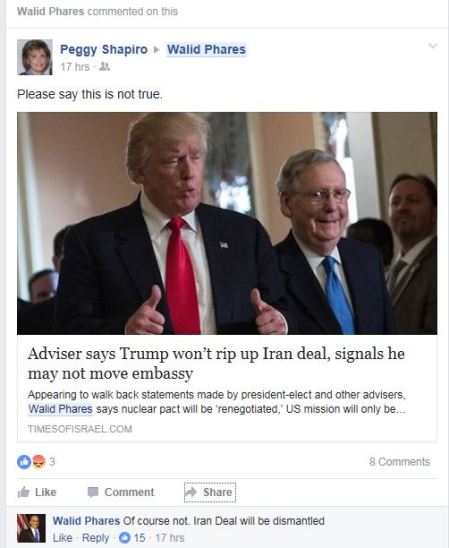
But Trump senior national-security adviser Walid Phares poured cold water on speculation that Trump plans to walk back his statements about the Iran deal, when he commented on Facebook over the weekend that the “Iran Deal will be dismantled.”

phares-iran-deal

This firm statement by Phares confirmed previous statements he and Mr. Trump have made that the deal is a dangerous agreement that needs to be either significantly renegotiated or abandoned. As an expert who has followed the Iran nuclear program for many years inside and outside of government, I would like to expand on their statements by offering three key points about the nature of the deal and ten guidelines for renegotiating it.

1. The Iran deal is a dangerous fraud.

Donald Trump was exactly right when he called the Iran deal a “horrible” and “disastrous” agreement. The U.S. agreed to huge concessions to get this agreement, from no restrictions on Iran’s sponsorship of terrorism to no inspections of military facilities. There were secret side deals withheld from Congress that permitted Iran to inspect itself for past nuclear-weapons work and receive secret planeloads of cash in exchange for freeing U.S. hostages. To get the $150 billion in sanctions relief Iran wanted, there was another secret side deal — also withheld from the U.S. Congress — which granted Tehran exemptions for failing to meet some of the agreement’s key requirements.

So what did the United States get for these concessions?

Not much. The Obama administration claims the deal keeps Iran a year away from a nuclear deal for ten to 15 years. But in fact, the time to an Iranian nuclear bomb will drop dramatically under the deal, since Iran will be able to enrich uranium, develop advanced centrifuges, and, with Chinese assistance, finish construction of a heavy-water nuclear reactor that will produce one-quarter of a weapon’s worth of plutonium per year.

It will be very hard to verify the agreement since military sites — where Iran is likely to conduct covert nuclear-weapons work — are off limits to inspectors. The deal dumbed down the IAEA’s quarterly Iran reports, making it difficult for the world to know the true extent of Iran’s compliance. Certainly, there already have been reports of significant Iranian cheating.

Further, the deal was supposed to improve Iran’s international behavior.

Instead, from ballistic-missile tests to increased support to Hezbollah, Bashar al-Assad, and the Houthi rebels in Yemen, Tehran’s behavior in the Middle East has significantly worsened. Just in the last year, Iran has captured and held at gunpoint ten U.S. sailors and fired anti-ship missiles at American and UAE ships. Is this what a new era of cooperation with Iran was supposed to look like?

2. The deal is not legally binding on us.

Knowing that a bipartisan majority of Congress opposed the nuclear deal and that the U.S. Senate would never ratify it as a treaty, the Obama administration arranged to go around the Senate by negotiating the deal as an executive agreement endorsed by the U.N. Security Council. Because Security Council resolutions are binding on all U.N. members, it could therefore be argued that the nuclear deal was binding on the United States even though it had not been ratified by the Senate.

But that is not how our constitutional order works. American presidents historically have decided which international agreements are to be treated as treaties, but the Iran deal specified that it be ratified by the Iranian parliament.

If President Obama wanted to make a long-term international agreement binding on the United States, he needs consent from Congress. Anything else is a serious affront to the Constitution, and no U.N. endorsement changes that.

(This is not the only example of President Obama’s lawless approach to international agreements: The Paris climate-change agreement was deliberately negotiated to make it binding on the United States without Senate ratification and difficult for a future U.S. president to cancel. The same principles apply, however, and I expect President Trump pull out of the climate agreement as soon as possible.)

3. It’s not a true multilateral agreement.

The Obama administration also attempted to entrench the Iran deal making it a multilateral agreement, but this was just window-dressing.

The deal is technically a multilateral pact agreed to by Iran, the United States, Russia, China, France, the United Kingdom, and Germany, but it is actually a bilateral agreement negotiated almost entirely between the United States and Iran. Iran has only looked to the United States for additional concessions since the deal was announced, and if we want to end the deal, we can.

So it is clear the deal must be either discarded or substantially renegotiated, and that we have every right to do so.

The first steps to renegotiation should be (1) assembling a new anti-Iran coalition of our European allies, Israel, and the Gulf states, and (2) imposing new sanctions on Iran in response to its nuclear program, ballistic-missile program, sponsorship of terrorism, and belligerent behavior. Russia and China could be allowed into the new coalition, but they should not be given a veto over any new agreement. This coalition also must be kept out of the United Nations.

Building the new coalition and renegotiating the agreement won’t be the easiest task, but given Iran’s belligerent behavior and the power new U.S. sanctions can have, a strong president and secretary of state can do it.

An agreement that truly addresses the threat from Iran’s nuclear program and the wider threats Iran poses will require reversing all of the irresponsible concessions made to Iran by the Obama administration.

Such negotiations must start from the following ten guidelines:

  1. Iran must cease all uranium enrichment and uranium-enrichment research.
  2. Iran cannot have a heavy-water reactor or a plant to produce heavy water.
  3. Iran agrees to robust verification, including “anytime, anywhere” inspections by IAEA inspectors of all declared and suspect nuclear sites.
  4. Iran must fully and truthfully answer all questions about its past nuclear-weapons-related work.
  5. Iran must agree to limitations on its ballistic-missile program.
  6. Sanctions will only be lifted in stages, in response to Iranian compliance with the agreement.
  7. Iran must agree to end its meddling in regional conflicts and its sponsorship of terror.
  8. Threats by Iran to ships in the Persian Gulf, U.S. naval vessels, and American troops must stop.
  9. Iran must cease its hostility toward Israel.
  10. Iran must release all U.S. prisoners.

Renegotiating or terminating the Iran deal will not just end the threat from a dangerous international agreement.

It will signify that this agreement was an aberration by an incompetent U.S. president who tried to subvert the U.S. Constitution, and it would send a powerful message to the world that the Obama administration’s policies of American weakness and appeasement are over.

Trump critics have argued that renegotiating or terminating the nuclear deal would isolate the United States and hurt America’s global stature. But in reality, President Obama’s foreign policy has already undermined America’s reputation around the world.

Fixing or killing the Iran nuclear deal will be President Trump’s first step toward restoring America’s global leadership.

Trump’s first ME military action may target Iran

November 12, 2016

Trump’s first ME military action may target Iran, DEBKAfile, November 12, 2016

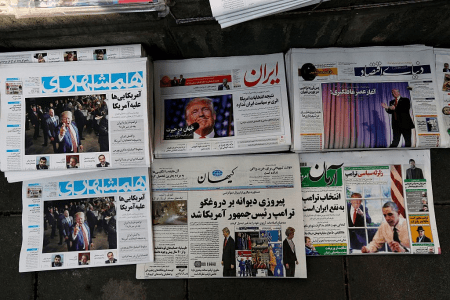
trump_election_iran_9-11-16Donald Trump’s ratings soar in Iranian media too

In more than one campaign speech, President elect Donald Trump declared that his number priority was “to dismantle the disastrous deal” with Iran, which he said was “the worst deal ever” He was referring to the 2015 accord negotiated with Iran by the 5P+1 (five Permanent Security Council members plus Germany), which the Obama administration presented as putting the lid on Iran’s nuclear weapons program.

Trump vowed to use force if necessary to prevent Tehran from acquiring the bomb.

So does Tehran have more to fear from Donald Trump than from Barack Obama in the way of US military intervention? They can’t be sure that he will not set out to show the world – and especially the Iranians – that under his presidency, they can no longer “mess with America.”

DEBKAfile’s Iranian sources report that the ayatollahs are concerned enough to seriously contemplate the following scenario.

The incoming president, after he takes office in the White House on Jan. 20, will act to raise America’s lame image in the Middle East by a surgical strike against an Iranian nuclear facility. One option projected is the blowing up of the Arak heavy water plant for plutonium production at the military complex city of Arak; another would be destroying an Iranian ballistic missile base.

Trump and the Republican-ruled Congress would certainly not tolerate Iranian breaches after America coughed up $150 billion in eased sanctions and released frozen assets.

A Trump administration would be able to marshal seven arguments to justify military action:

1. On Nov. 2, a week before the presidential election, the International Atomic Energy Agency (IAEA) in Vienna reported Iran in violation of the nuclear deal by producing 130.1 tons of heavy water at the Arak plant, one ton more than allowed. In past cases, the Iranians quickly exported the excess amount. But with a new US president on the way, they may try to use it as a one-ton test of his resolve.

2. In another challenge, Iran is threatening to renege unless more economic benefits are forthcoming.

2. The nuclear restrictions imposed under the deal end in about seven years, when Iran can start going back to its weapons program.

3.  Tehran never actually signed the 2014 nuclear deal in the first place. It has remained on paper on three pages as “The Joint Comprehensive Plan of Action Regarding the Islamic Republic of Iran’s Nuclear Program” announced in Lausanne on July 14, 2015 by US Secretary of State John Kerry and Iran’s Foreign Minister Muhammed Javad Zarif.

Three days later, Iran’s supreme leader Ayatollah Ali Khamenei commented: “Our policy will not change with regard to the arrogant US government.”

4. The document was eventually endorsed by the UN Security Council. This obliged the IAEA to follow up it its presumed commitments by inspections on the ground to confirm Iran’s compliance. However, because much of its content was kept under wraps, American and Iranian obligations have been hard to pin down.

5. The deal’s omissions are a lot clearer. Tehran is not committed to release information on its nuclear program prior to the date of the deal – including how far it had progressed towards a weapon.

6. The nuclear deal did not cover Iran’s long-range ballistic missile program, which continues to develop apace.

Ten months ago, the Obama administration tried to correct this omission by imposing fresh sanctions on Iran unless the program was curtailed. There is no information available up until now as to whether this deterrent worked.

7. US military action against Iran’s nuclear or missile programs may also serve the Trump administration to drive a wedge in the partnership between Moscow and Tehran and draw a new line in the sands of the Middle East. The Russians would certainly not step in by force in Iran’s defense, except for possibly sharing some intelligence. Moscow would be shown as failing to back its ally and therefore secure the gains Vladimir Putin managed to  amass in the Middle East  when Obama was president.

Iran’s Threats Louder after Obama Appeasement

November 10, 2016

Iran’s Threats Louder after Obama Appeasement, Gatestone InstituteMajid Rafizadeh, November 10, 2016

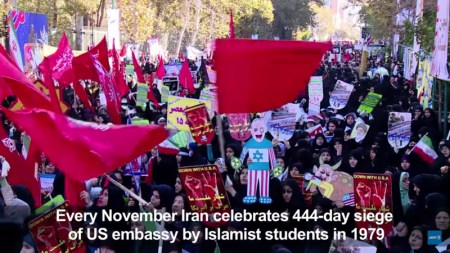
Chants of “Death to America” and “Death to Israel” were heard across Iranian cities as thousands of Iranians marked the anniversary of the seizure of the U.S. Embassy in Tehran and the taking of 52 American hostages for 444 days by militant students.

The State Department’s reaction is classic: ignoring these developments and continuing with appeasement policies.<

These anti-American demonstrations are not rhetoric, but are the cornerstone of Iran’s revolutionary principles and foreign policies, which manifest themselves in Iran’s support for terrorist proxies, support for Assad’s regime, and the scuttling of US and Israeli foreign policies in the region.

Many other Iranian officials who were engaged in attacks against the US currently serve in high positions. Hossein Salami, who enjoys one of these high-level positions, is the deputy commander in chief of the Islamic Revolutionary Guards Corps. He stated at the rally: “America should know that if they do not honor their agreement in the nuclear deal, we will resume uranium enrichment…”


After eight years of President Barack Obama’s policies of appeasement, Iran’s threats, such as “Death to America,” and “Death to Israel,” have grown even louder.

This week, the Iranian government orchestrated one the largest anti-American and anti-Israeli demonstrations, since 1979, echoing Iran Supreme Leader, Ayatollah Ali Khamenei’s recent messages.

The government provided facilities for the protesters. Chants of “Death to America” and “Death to Israel” were heard across Iranian cities as thousands of Iranians marked the anniversary of the seizure of the U.S. Embassy in Tehran and the taking of 52 American hostages for 444 days by militant students.

According to the Tehran-based bureau of the Los Angeles Times,

“The demonstrators brought by buses to the former embassy complex included young and old, university students, military staff and employees of state-run companies who voiced opposition to the nuclear deal Iran signed with the United States and world powers… Many echoed Iran’s Supreme Leader, Ayatollah Ali Khamenei…. Almost 1 in every 10 demonstrators at the former embassy — now widely dubbed a “den of espionage” — carried placards with Khamenei’s words: ‘We do not trust America.'”

2034Iranians protest outside the former US embassy in Tehran, on the anniversary of its storming by student protesters in 1979. (Image source: AFP video screenshot)

The chants were accompanied by burning American and Israeli flags, and Stars of David. This all is occurring in a country that is presided over by the so-called “moderate” president of Iran, Hassan Rouhani and his foreign minister, Javad Zarif; both continue to argue that Iran is a constructive state actor, does not hold hostility against any country, and that Tehran is looking to improve ties with the West and the international community — so long as Iran’s objectives are met.

The State Department’s reaction is classic: ignoring these developments and continuing with appeasement policies. State Department spokesman Mark Toner stated that the White House is not going to change its policies towards Iran:

“Like any country, there’s heated political rhetoric that comes out, and I’m just not going to respond to every instance of that in this case. No one likes to see this kind of hyper-charged rhetoric on the part of any government anywhere, and anti-American sentiments expressed. But again, we’re not going to base our whole relationship going forward … on these kind of heated political remarks.”

However, these large-scale anti-American demonstrations are not rhetoric, but are the cornerstone of Iran’s revolutionary principles and foreign policies, which manifest themselves in Iran’s support for terrorist proxies, support for Assad’s regime, and the scuttling of US and Israeli foreign policies in the region.

In fact, alleging crimes against the US plays very well within the political establishment of Iran. For example, one of the hostage takers who occupied the US embassy, Masoumeh Ebtekar, has climbed the political ladder remarkably. She was first the editor-in-chief of Keyhan International, an Iranian state-owned newspaper, and close advisor to the Supreme Leader. Later she was appointed as the head of the Environment Protection Organization of Iran during the “reformist” administration of President Mohammad Khatami. Afterwards the “moderate” President Rouhani appointed her as the Vice President of Iran, the first woman to serve such position.

The Agence France-Presse (AFP) news agency scored an interview with her during the “Death to America” rally. She boasted about taking US hostages and US documents from the embassy: “Revealing these documents was very similar to what WikiLeaks is doing these days. It was the WikiLeaks of that time.” According to the AFP,

“She now regrets the diplomatic isolation that followed the embassy siege, but she is still proud of their work in releasing documents found in the CIA’s files — some painstakingly reassembled after embassy staff frantically shredded as many as possible when the students stormed the building.”

Many other Iranian officials who were engaged in attacks against the US currently serve in high positions.

Hossein Salami, who enjoys one of these high-level positions, is the deputy commander in chief of the Islamic Revolutionary Guards Corps (IRGC). He stated at the rally, in reference to the role of the IRGC in the bombing of the U.S. Marines barracks in Lebanon, “In 1983, the flames of Islamic revolution flared among Lebanese youth for the first time, and in a courageous act, a young Muslim buried 260 United States Marines under the rebels east of Mediterranean Sea.”

Last week, Ayatollah Ali Khamenei reasserted his stance against the US more firmly, saying, “The US system is far away from values of humanity, death to America means death to a system which has nothing to do with humanitarian values.” Khamenei also dismissed diplomacy with the United States, arguing that these negotiations “will not resolve our problems… We should resolve the problems ourselves and with reliance on our capabilities and the young forces inside the country.”

Iran’s anti-American policies are buttressed and supported by Iran’s powerful military institutions, domestic militia groups such as the Basij, Iran’s proxies such as Hezbollah, and the hundreds of thousands of people who join these kinds of “Death to America” demonstrations. Iranian leaders evidently enjoy powerful loyalist employees and supporters.

As a passionate protestor told the Euronews, “We are here to chant slogans, and our slogans are a strong punch in the face of America. America can never touch our country, and as our leader said, America can’t do a damn thing.”

In addition, Hossain Salami, the acting commander of the IRGC, pointed out at the rally that: “America should know that if they do not honor their agreement in the nuclear deal, we will resume uranium enrichment and send the agreement … to the museum.”

Accordingly, “crowds chanted support for the Syrian government and other Shiite Muslim-led regimes in the Middle East, saying, “We will never give it up.”

For eight years, Washington pursued total appeasement policies with Iran. The four rounds of crippling UN Security Council sanctions, which took decades to put in place, were lifted immediately. Iran’s ballistic missile ambitions and test firings of missiles, in violation of the UN resolutions, were ignored. The expanding militaristic role of the Revolutionary Guard was taken lightly.

None of these appeasement policies changed the political calculations of Iranian leaders towards the US and Israel. In fact, based on these developments, Iranian leaders became more emboldened and empowered, to the extent that they repeatedly harass naval ships of the world’s superpower without fearing any repercussions. Iran uses its proxies to attack US ships.

“Death to America” and Iran’s anti-American policies will not change if the US continues to appease Iranian leaders. For Iran, appeasement policies do not mean diplomatic initiatives; concessions mean only weakness.

Obama Gave Iran Money that Belonged to Iran’s Terror Victims

November 3, 2016

Obama Gave Iran Money that Belonged to Iran’s Terror Victims, Counter Jihad, November 2, 2016

iranmoney

Once again, it seems as if neither the law nor the American interest are of great concern to this administration.  When Iran is involved, at least, both the law and our national interests are always set aside.

****************

Here at CounterJihad, we have covered the transfer by the Obama administration of $1.7 billion in giant pallets of cash to the terrorist elements within Iran’s government.  None of the administration’s stories justifying this transfer of wealth to the main state sponsor of terrorism have made sense.  It was not necessary to transfer the money in cash, for example.  The transfer really was a hostage ransom payment, in spite of their denials, to take a second example.

Today, we learned that another aspect of their justification was flawed.  The Obama administration has claimed that the money transferred to Iran belonged to Iran anyway, as a kind of refund for weapons sales that did not happen.  This was always a highly questionable claim, as the government that paid us the money was not the same government that now rules over Iran.  It is unclear why the Iranian revolutionary government would be entitled to moneys advanced by the Shah of Iran.  This makes no more sense than if a homeowner had overpaid property taxes, and the government responded by sending the overpaid money not to him but to the squatters who had forcibly occupied his home over his protest.  Of course, the Shah was no longer in a position to receive a refund, so it wasn’t clear that the money should go to anyone.

What we have learned most recently, however, is that the money did have a proper owner:  victims of Iran’s support of terror.

Alisa Flatow, a twenty-year-old Brandeis University honors student spending her junior year abroad in Israel, boarded a bus in Jerusalem bound for a popular resort area in Gaza. It was the height of the “peace process,” celebrated the year before with Nobel Peace prizes. As the bus entered Gaza, a van filled with explosives slammed into it. Eight people, including Alisa, were killed, and more than 40 others were injured. The attack was carried out by a faction of Islamic Jihad controlled, financed, and directed by the highest levels of Iran’s government….  A federal district court issued a 35-page opinion, Flatow v. Islamic Republic of Iran (1998), awarding a total of $20 million in compensatory damages as well as punitive damages, with both types of damages specifically authorized by the U.S. Congress….

In all, sixteen cases were decided against Iran by courts in the United States between 1998 and 2004, with awards of compensatory damages totaling some $400 million and punitive damages totaling $3.5 billion.

Of course, the problem faced by each victorious plaintiff was collecting the judgment. Stephen Flatow, after unsuccessfully seeking to have the damages paid out of various Iranian assets held in the United States, learned of the $400 million in the FMS fund. The Clinton administration had supported the legislation that allowed suits such as Flatow’s, but then strenuously opposed any effort to have the judgments satisfied from that fund.

In other words, the money was spoken for before the Obama administration elected to transfer it to the IRGC.  It belonged, by the authorization of Congress and the decision of Federal courts, to victims of terrorism sponsored by the Iranian government.  Iran owes them all that money, and a great deal more.

The Obama administration has not rethought its position on sending Iran more and more money, whatever the law may say.  The State Department been busy recently trying to drum up investment for Iran instead.  Secretary of State John F. Kerry has been telling unlikely stories about the sanctions still in place on Iran in order to try to convince bankers to send Iran even more cash.  On this question, it should be noted by anyone thinking of investing, the State Department and the Treasury are very much at odds.

Once again, it seems as if neither the law nor the American interest are of great concern to this administration.  When Iran is involved, at least, both the law and our national interests are always set aside.

If you love America and Israel, vote against the system

October 31, 2016

If you love America and Israel, vote against the system, Israel National News, Naomi Ragen, October 31, 2016

I can certainly see why women, including Jewish women, would prefer a seemingly well-spoken, mature senior stateswoman, to a brash, loud-mouthed political neophyte who has made so many off-handed offensive locker-room comments about women.

This would be your instinct.

How lovely, how easy, it would be then, to vote in a woman running against a man like that.

And how disastrously wrong.

I’ll give you the facts, but honestly, past experience does not leave me hopeful. Eight years ago, to tried to deter people from following their instinct
and voting in Barack Hussein Obama, the most anti-Israel president in U.S. history. But even after I made people aware he spent twenty years in an
anti-Semitic church, and was being advised by the likes of Rashid Khalidi, Zbigniew Brzezinski (Jimmy Carter’s National Security Advisor), pro-Hamas negotiator Robert Malley, UN Ambassador Samantha Power (who once suggested using American troops to guard Palestinians from Israelis), most Jews still voted for Obama.

Why? because they were brainwashed by lying, anti-Israel media to the extent that their instinct told them that what was important above all else was to elect a Black man: Their “instinct” told them how noble, how liberal to cast that vote! And if they didn’t, they were racists. In fact, many people lambasted me for writing “Barack Hussein Obama”. “Hussein,” why did you write that!!

Because it was his name, I answered.I wonder how that worked out for them. I can tell you how it worked out for us in Israel: our biggest enemy and the world’s foremost supporter of terror is now unimpeded in its rush towards nuclear weapons to destroy the next six million Jews.

I wonder sometimes, how these voters live with these consequences.  And now, Barack Hussein Obama and all the EXACT SAME PEOPLE are urging you to vote for Hillary Clinton, who proudly bragged online that she was the true author of the Iran deal, making you feel like a racist, a woman-hater, an idiot, and worse if you don’t.

Repentance is being in exactly the same situation and acting differently. For those who continue down the same road, there is no hope.

So, I’m going to give you some reasons to take a different path. For the sake of the safety and security of the State of Israel, and for the love of what was once the world’s greatest democracy, our beloved United States of America, I hope to change your mind from  possibly making the biggest mistake of
your life.

Hillary Clinton isn’t a friend of Israel

In November 1999, Clinton publicly appeared with Yasir Arafat’s wife Suha and listening quietly while the token bride of the world’s biggest terrorist scumbag accused Israel of using poison gas and chemical contaminants on the water supply wells against Palestinians. In response, Clinton hugged and kissed Suha. Days later, after outraged fallout, Clinton called ‘FOR ALL SIDES to refrain from ‘INFLAMMATORY RHETORIC.”Although Clinton had to please pro-Israel voters when running for the Senate in New York, hints about her real mindset can be gleaned from a careful reading of her book Hard Choices: “When we left the city and visited Jericho in the West Bank, I got my first glimpse of life under occupation for Palestinians, who were denied the dignity and self-determination that Americans take for granted. [p.302] …There has been nearly a decade of terror, arising from the second intifada…Three times as many Palestinians were killed and thousands more were injured in the same period [as Israelis].”

This equating of murderers and murderees, victims and perpetrators has long been the code speak of The New York Times and other anti-Semitic and anti-Israel bigots.

And before you point to this or that pro-Israel thing she said, please check the dates: Was it, by chance, between 2001-2009 when she needed the votes of New York Jews?

Because when she left the Senate and became Secretary of State for the most anti-Israel President in the history of our country, the façade got dropped like a hot potato. The first thing she did was throw out an agreement with Israel during the Bush administration, calling for new restrictions on building Jewish homes in existing neighborhoods in Jerusalem, Judea and Samaria.

Hillary Clinton is funded by Israel-haters.

But like the chicken and the egg, what came first, Hillary’s anti-Israel perspective, or the money that Israel-haters have been pouring into Clinton Foundation coffers? Or perhaps, she and her husband will take money from anyone, and it was just a lucky coincidence her funders shared
her views?

Saudi Arabia donated ten million dollars to the Clinton Library in 2007 and another $25 million to the Clinton Foundation in June 2016, while individuals close to the Saudi family Nasir Rashid and Friends of Saudi Arabia donated millions more. Clinton’s State Department approved a $29 billion sale of fighter jets to Israel’s enemy Saudi Arabia against Israel’s vociferous objections. Coincidence?

Dubai – The Clinton Foundation has established Dubai Study departments in major U.S. and British Universities.Qatar gave millions to the
Clinton Foundation.In 2014, President Shimon Peres accused Qatar of being “the world’s largest funder of terror: Qatar does not have the right to send money for rockets and tunnels which are fired at innocent civilians,” Peres told UN Secretary General Ban Ki-moon in Jerusalem. Just this past August, Qatar pledged and additional $31 million to Gaza.

On August 15, 2016 Senator Charles Grassley, Chairman of the Committee on the Judiciary to the Attorney General Loretta Lynch revealed that Qatar was the recipient of approximately $271 million in military related export deals. During Clinton’s tenure Qatar was the recipient of approximately $4.3 billion altogether – a 1,482 % increase [in military exports] while Saudi Arabia saw a 97% increase in military exports.

In August 2014 Hillary Clinton wrote to her campaign manager John Podesta that the governments of Saudi Arabia and Qatar have been “providing clandestine financial and logistic support to ISIL [ISIS] and other radical Sunni groups in the area.”

Clinton advisors are anti -Israel

Clinton’s advisors, like Obama’s, have always been uniformly and virulently anti-Israel. They have her ear.

Sidney Blumenthal, Observer’s Ken Sliverstein, wrote recently, is the “ most dishonest, amoral political hatchet man of modern political times.” He is also one of Hillary’s closest friends and a highly paid advisor to her about Israel.

In 2010 he wrote her to “hold Bibi’s feet to the fire….” He told Clinton to “remind AIPAC…that it does not have a monopoly over American Jewish opinion.” Soros-funded anti-Israel J Street should be praised, he offers. In May Blumenthal wrote her, hinting that the raid on the Gaza flotilla was
deliberately organized to kill the peace process and embarrass Obama. Hillary forwarded this message with the words: “FYI and I told you so,” to her deputy chief of staff Jake Sullivan at the State Department.

Blumenthal’s son Max is an even more self-hating Jew. In 2013, Max appeared in ninth place on that year’s Simon Wiesenthal Center list of
anti-Semitic and anti-Israel slurs, for equating Israel with the Nazi regime and “approving characterizations of Israeli soldiers as ‘Judeo-Nazis.’” This is what Hillary had to say in e-mails about Max and his work:

8.17/2010  Pls congratulate Max for another impressive piece. He’s so good.”

4/7/2011  Will Max’s piece be posted anywhere else? It is powerful and touching.”

9/13/2012  “Your Max is a mitzvah.”

This is what the “mitzvah” wrote when Elie Wiesel died:  “Elie Wiesel went from a victim of war crimes to a defender of those who commit them. He did more harm than good and should not be honored.”

As most of you know, because even the mainstream media couldn’t hide it, Hillary Clinton deliberately ignored her responsibility and the rules, and created a private e-mail server that left highly sensitive, classified security documents vulnerable to hacking by America’s enemies.

But Kimberly Strassel of the Wall Street Journal wrote something which has mostly been overlooked: “The Democratic nominee obviously didn’t set up her server with the express purpose of exposing national secrets – that was incidental. She set up the server to keep secret the details of the Clinton’s private life – a life built around an elaborate and sweeping money-raising and self-promoting entity known as the Clinton Foundation. Had Secretary Clinton kept the Foundation at arm’s length while in office –as obvious ethical standards would have dictated – there would never have been any need for a private server or even private email.”

She had much to hide. Other leaked emails make it clear that under Hillary, the State Department took SPECIAL CARE OF DONORS TO THE CLINTON FOUNDATION. In 2010 a senior State Department aide to Clinton asked a Foundation official to let her know which groups offering assistance with Haitian earthquake victims were FOB (Friends of Bill) or WJC VIPS (William Jefferson Clinton VIPs) “Those who made the cut appear to have been teed up for contracts. Those who weren’t? Routed to a standard government website,” Strassel concludes.

Trump is the only one with the guts to have publicly stated she should be in jail for these things.

We could forgive Mrs. Clinton many things, though, if we were convinced she had any core values at all. As she cheerfully admitted in a paid speech to Goldman Sachs, she takes two positions, public and private, on every issue, depending on her audience. She is for and against trade agreements that will lose Americans jobs. She is for and against Wall Street corruption.

Hillary’s Immigration Policy endangers your family

Hillary Clinton supports unlimited immigration of unvetted Muslim immigrants, which will fundamentally change the character of the US, and will endanger Jews, Christians, and ordinary citizens by exposing them to increased levels of anti-Semitism, ethnic hatred, and acts of random, hate-based violence.

All you need to do to verify that statement, is to study the statistics of other Western countries that have allowed themselves to accept a huge influx of Muslim immigrants.

In the British capital alone, anti-Semitic incidents increased by more than 60 percent over the past year, while worldwide anti-Semitism was up by 40%.

“Many refugees come from countries where Israel is an enemy; this resentment is often transferred to Jews in general,” a delegation of German Jews told Chancellor Angela Merkel late last year.For American Jews, who have much to fear both as an individual community, and as part of the larger American population, this is the last chance to actually influence this process. As an Israeli who got brainwashed by progressives to paint doves and let Arafat arm “police” and pull down border checks, and then almost got blown up during the Passover Seder at the Park Hotel, I am telling you this is a life or death issue for you and your families. If you let yourself become brainwashed and complacent, which is what we Israelis did, and vote for this policy and this politician with her appalling track record, the consequences could be horrible. Believe me, I know.

Hillary Clinton is part of an immoral establishment that is destroying America and endangering Israel

Let me admit upfront: I loathe and mistrust The New York Times, NPR, CNN, LA Times, Washington Post Politico, etc. all of whom have lied about Israel, lied about terrorism, lied about Wall Street, lied and covered up Barack Hussein Obama’s incompetence.

A victory for Hillary Clinton is a victory for them and the system they support and the America they’ve created: a weak, bankrupt, racially divided nation of too many homeless, jobless, hopeless people, weighted down by bureaucracy, preyed upon by white collar criminals, unsafe in their cities and homes and schools and unprotected from brazen murdering, raping thugs and terrorists – both homegrown and imported.

It has become a place where veterans are neglected and police are attacked and hounded by the country they give their lives to protect every day. A place where health care is endangered for all by a system that simply doesn’t work.

The establishment that created this chaos would like nothing better than a citizenry that is complacent and stupid, easily swayed by epithets and ugly but irrelevant sound bites .

I prefer Trump because he has never been part of that system. He isn’t a politician. He isn’t afraid to say the things we all believe about the rigged
media, the backroom money deals, the pay for play, Islamic terrorism, unvetted immigration, a border wall, and despicable late term abortions.

A vote for him is a vote against what has happened to America under Barack Hussein Obama and against the political, corporate, and media empires that backed him and brought him to power and want Hillary to take his place.

Look at the facts. Don’t be part of the Punch and Judy show, manipulated by the puppet-masters. Vote against the system. Vote against corruption. Vote for real democracy and real, not fake, change.

Congress: Attorney General Lynch ‘Pleads Fifth’ on Secret Iran ‘Ransom’ Payments

October 28, 2016

Congress: Attorney General Lynch ‘Pleads Fifth’ on Secret Iran ‘Ransom’ Payments, Washington Free Beacon, October 28, 2016

US attorney general, Loretta E. Lynch attends a conference on organised crime in Rome, Thursday, Oct. 20, 2016. (AP Photo/Gregorio Borgia)

US attorney general, Loretta E. Lynch, AP Photo/Gregorio Borgia

Attorney General Loretta Lynch is declining to comply with an investigation by leading members of Congress about the Obama administration’s secret efforts to send Iran $1.7 billion in cash earlier this year, prompting accusations that Lynch has “pleaded the Fifth” Amendment to avoid incriminating herself over these payments, according to lawmakers and communications exclusively obtained by the Washington Free Beacon.

Sen. Marco Rubio (R., Fla.) and Rep. Mike Pompeo (R., Kan.) initially presented Lynch in October with a series of questions about how the cash payment to Iran was approved and delivered.

In an Oct. 24 response, Assistant Attorney General Peter Kadzik responded on Lynch’s behalf, refusing to answer the questions and informing the lawmakers that they are barred from publicly disclosing any details about the cash payment, which was bound up in a ransom deal aimed at freeing several American hostages from Iran.

The response from the attorney general’s office is “unacceptable” and provides evidence that Lynch has chosen to “essentially plead the fifth and refuse to respond to inquiries regarding [her] role in providing cash to the world’s foremost state sponsor of terrorism,” Rubio and Pompeo wrote on Friday in a follow-up letter to Lynch, according to a copy obtained by the Free Beacon.

The inquiry launched by the lawmakers is just one of several concurrent ongoing congressional probes aimed at unearthing a full accounting of the administration’s secret negotiations with Iran.

“It is frankly unacceptable that your department refuses to answer straightforward questions from the people’s elected representatives in Congress about an important national security issue,” the lawmakers wrote. “Your staff failed to address any of our questions, and instead provided a copy of public testimony and a lecture about the sensitivity of information associated with this issue.”

“As the United States’ chief law enforcement officer, it is outrageous that you would essentially plead the fifth and refuse to respond to inquiries,” they stated. “The actions of your department come at time when Iran continues to hold Americans hostage and unjustly sentence them to prison.”

The lawmakers included a copy of their previous 13 questions and are requesting that Lynch provide answers by Nov. 4.

When asked about Lynch’s efforts to avoid answering questions about the cash payment, Pompeo told the Free Beacon that the Obama administration has blocked Congress at every turn as lawmakers attempt to investigate the payments to Iran.

“Who knew that simple questions regarding Attorney General Lynch’s approval of billions of dollars in payments to Iran could be so controversial that she would refuse to answer them?” Pompeo said. “This has become the Obama administration’s coping mechanism for anything related to the Islamic Republic of Iran—hide information, obfuscate details, and deny answers to Congress and the American people.”

“They know this isn’t a sustainable strategy, however, and I trust they will start to take their professional, and moral, obligations seriously,” the lawmaker added.

In the Oct. 24 letter to Rubio and Pompeo, Assistant Attorney General Kadzik warned the lawmakers against disclosing to the public any information about the cash payment.

Details about the deal are unclassified, but are being kept under lock and key in a secure facility on Capitol Hill, the Free Beacon first disclosed. Lawmakers and staffers who have clearance to view the documents are forced to relinquish their cellular devices and are barred from taking any notes about what they see.

“Please note that these documents contain sensitive information that is not appropriate for public release,” Kadzik wrote to the lawmakers. “Disclosure of this information beyond members of the House and Senate and staff who are able to view them could adversely affect the diplomatic relations of the United States, including with key allies, as well as the State Department’s ability to defend [legal] claims against the United States [by Iran] that are still being litigated at the Hague Tribunal.”

“The public release of any portion of these documents, or the information contained therein, is not authorized by the transmittal of these documents or by this communication,” Kadzik wrote.

Congressional sources have told the Free Beacon that this is another part of the effort to hide details about these secret negotiations with Iran from the American public.

One senior congressional source familiar with both the secret documents and the inquiry into them told the Free Beacon that the details of the negotiations are so damning that the administration’s best strategy is to ignore lawmakers’ requests for more information.

“Every Obama administration official and department involved in the Iran Deal appear to be running for cover,” the source said. “Like we feared, the [Iran deal] is turning out to be a disaster and Iran is emboldened in its aggression. Evidently Attorney General Lynch and the Department of Justice have decided ‘refusal to cooperate’ is their best strategy. But this is dangerous and ultimately won’t protect them from anything.”

Update: The headline has been updated to more accurately characterize the story.