In responding forcibly to North Korean and Syrian outrages, President Trump has taken a major step towards restoring America’s deterrence power. His determination to redress the flaws in the JCPOA and to stand up to Iran will greatly accelerate that process. The US, Israel and the world will all be safer.
**************************
The US has signed agreements with three rogue regimes strictly limiting their unconventional military capacities. Two of those regimes — Syria and North Korea — brazenly violated the agreements, provoking game-changing responses from Donald Trump. But the third agreement — with Iran — is so inherently flawed that Tehran doesn’t even have to break it. Honouring it will be enough to endanger millions of lives.
The framework agreements with North Korea and Syria, concluded respectively in 1994 and 2013, were similar in many ways. Both recognised that the regimes already possessed weapons of mass destruction or at least the means to produce them. Both assumed that the regimes would surrender their arsenals under an international treaty and open their facilities to inspectors. And both believed these repressive states, if properly engaged, could be brought into the community of nations.
All those assumptions were wrong. After withdrawing from the nuclear non-proliferation treaty, Pyongyang tested five atomic weapons and developed intercontinental missiles capable of carrying them. Syrian dictator Bashar al-Assad, less than a year after signing the framework, reverted to gassing his own people. Bolstered by the inaction of the US and backed by other powers, North Korea and Syria broke their commitments with impunity.
Or so it seemed. By ordering a Tomahawk missile attack on a Syrian air base, and a US Navy strike force to patrol near North Korea’s coast, the Trump administration has upheld the frameworks and placed their violators on notice. This reassertion of power is welcomed by all of America’s allies, Israel among them. But for us the most dangerous agreement of all is the one that may never need military enforcement. For us, the existential threat looms in a decade, when the agreement with Iran expires.
Like the frameworks with North Korea and Syria, the Joint Comprehensive Plan of Action of 2015 assumed that Iran would fulfil its obligations and open its facilities to inspectors. The JCPOA assumed that Iran would moderate its behaviour and join the international community. Yet unlike its North Korean and Syrian allies, Iran was the largest state sponsor of terror and openly vowed to destroy another state: Israel. Unlike them, Iran systematically lied about its unconventional weapons program for 30 years. And unlike Damascus and Pyongyang, which are permanently barred from acquiring weapons of mass destruction, Tehran can look forward to building them swiftly and legitimately in the late 2020s, once the JCPOA expires.
This, for Israel and our neighbouring Sunni states, is the appalling flaw of the JCPOA. The regime most committed to our destruction has been granted a free pass to develop military nuclear capabilities. Iran could follow the Syrian and North Korean examples and cheat. Or, while enjoying hundreds of billions of dollars in sanctions relief, it can adhere to the agreement and deactivate parts of its nuclear facilities rather than dismantle them. It can develop new technologies for producing atomic bombs while testing intercontinental ballistic missiles. It can continue massacring Syrians, Iraqis and Yemenis, and bankrolling Hamas and Hezbollah. The JCPOA enables Iran to do all that merely by complying.
A nuclear-armed Iran would be as dangerous as “50 North Koreas”, Israeli Prime Minister Benjamin Netanyahu told the UN in 2013, and Iran is certainly many times more dangerous than Syria. Yet Iran alone has been granted immunity for butchering civilians and threatening genocide. Iran alone has been guaranteed a future nuclear capability. And the Iranian regime — which brutally crushed a popular uprising in 2009 — has amassed a million-man force to suppress any future opposition. Rather than moderating, the present regime promises to be more radical yet in another 10 years.
How can the US and its allies pre-empt catastrophe? Many steps are possible, but they begin with penalising Iran for the conventions it already violates, such as UN restrictions on missile development. The remaining American sanctions on Iran must stay staunchly in place and congress must pass further punitive legislation. Above all, a strong link must be established between the JCPOA and Iran’s support for terror, its pledges to annihilate Israel and overthrow pro-American Arab governments, and its complicity in massacres. As long as the ayatollahs oppress their own population and export their tyranny abroad, no restrictions on their nuclear program can ever be allowed to expire.
In responding forcibly to North Korean and Syrian outrages, President Trump has taken a major step towards restoring America’s deterrence power. His determination to redress the flaws in the JCPOA and to stand up to Iran will greatly accelerate that process. The US, Israel and the world will all be safer.
Michael Oren is Israel’s deputy minister for diplomacy, a member of the Knesset and a former ambassador to Washington.
In fact, the U.S. and Israel should reach an accord on a basket of responses to Iranian violations and aggressions, including the placement of a military option against Iran’s nuclear program back on the table.
Trump and Netanyahu must together promulgate an approach for combating the malign influence and hegemonic ambitions of Iran.
*********************************
Prime Minister Benjamin Netanyahu has made it clear that one of the top items on his agenda for consultation with U.S. President Donald Trump in Washington next month is countering Iranian aggression. With good reason. The net result of the Joint Comprehensive Plan of Action has been to foster Iran’s rise to regional hegemon.
While the JCPOA suspended a part of Iran’s nuclear weapons program for a few years, the ayatollahs see it as providing time to advance their centrifuge capability and regional sway.
In a Hoover Institution paper published this month, Professor Russell Berman and Ambassador Charles Hill call Iran a “de facto Islamic caliphate,” and the Islamic Revolutionary Guard Corps an “Iranian expeditionary force for invading strategic Arab spaces.”
They call former President Barack Obama’s declared goal — of finding and bolstering so-called moderates in Tehran via the JCPOA — an “illusion.” Iran is not a polity of moderates and hard-liners, they write. It is a revolutionary theocracy masquerading as a legitimate state actor. So the first thing Trump must do is recognize the consistently hostile character of the regime.
Alas, Obama was obsessed from the advent of his presidency with making nice to Iran, and was willing to subordinate much of American foreign policy in service of that goal. He sent many secret letters to Supreme Leader Ayatollah Ali Khamenei that recognized the prerogatives of the Islamic republic and foreswore regime change. He cut funding to anti-regime groups and abandoned Iranian moderates during the early days of the Green Revolution in 2009, after the regime fixed an election. He effectively conceded Syria as within Iran’s sphere of influence.
In his penetrating book, “The Iran Wars: Spy Games, Bank Battles, and the Secret Deals That Reshaped the Middle East,” Wall Street Journal reporter Jay Solomon exposes the money trail that accompanied this strategic sellout to Iran. In exchange for talking, Obama gave the Iranians hundreds of millions of dollars monthly, stabilizing their economy. And in the end, Obama offered Iran a deal that legalized full-blown uranium, plutonium, and ballistic missile work on a timeline, and did not force the country to disclose its previous nuclear cheating. The deal also released roughly a hundred billion dollars to Iran; had American officials traveling to drum up business for Iran; and removed restrictions on a range of Iranian terrorists.
Along the way, the administration abandoned the powerful sanctions leverage it had over Iran. Solomon chronicles the ramp-up of severe banking sanctions on Iran that were having a disastrous impact on the Iranian economy. “Iran’s economy was at risk of disintegrating, the result of one of the most audacious campaigns in the history of statecraft. The country was months away from running short on hard currency. The budget had a $200 billion black hole. And the U.S. Treasury Department had made sure Iran had no way to recover. Iranian ships and airplanes were not welcome beyond Iran’s borders, and oil revenue was frozen in overseas accounts.”
And then, behold, Obama backed off. Administration officials all of a sudden claimed that tightening the noose on the Iranian economy would cause the sanctions policy to collapse! And Secretary of State John Kerry was sent to cut a sweet deal with Iran; a deal that squandered — and then reversed — a decade’s worth of effort to constrain Iran.
Now Trump must act to constrain Iran all over again.
Over the past year, Iran has intensified a pattern of aggression and increased its footprint across the region. Iranian advisers with Shiite militias from as far away as Afghanistan have flooded Syria, giving Tehran a military arc of influence stretching to the Mediterranean.
Khamenei says that Iran’s massive military presence (alongside Hezbollah) in Syria is a supreme security interest for the regime — a front line against Israel — and that Iran has no plans to leave.
This has grave implications for Israel. Netanyahu must demand of Trump (and Putin) to include the removal of all foreign forces, especially Iran, in any future agreement regarding Syria. This will be very difficult — especially since Russia has just signed a long-term agreement to greatly enlarge its military presence in Syria, including the port in Tartus and air base in Latakia.
Iran, too, is aggressively expanding its naval presence in the Red Sea region and eastern Mediterranean. Since 2011, it has been sending warships through the Suez Canal, and has used maritime routes to send arms shipments to Hizballah and Hamas. (Israel has intercepted five of these armament ships.) And in the Strait of Hormuz, IRGC speedboats have repeatedly engaged in provocative encounters with American warships, including the conduct of surprise live rocket fire exercises in proximity to U.S. Navy vessels.
Then there is Iranian terrorism. IRGC agents have been caught planning attacks on Israeli, American, British and Saudi targets in Kenya. Over the past five years, Iranian agents were exposed while planning to attack Israeli diplomats in Azerbaijan, Cyprus, Georgia, India, Nigeria, Thailand and Turkey. Hezbollah operatives supported by Iran carried out the bus bombing of Israeli tourists at the Burgas airport.
Also: The detailing of Iranian terrorism in Arab countries such as Egypt, Jordan and Saudi Arabia could fill this entire newspaper.
Then there is Iran’s ballistic missile program. In December, U.S. Senator Ted Cruz sent a seven-page letter to three senior officials of the Obama administration, detailing his well-founded concerns that North Korea and Iran might be working together on developing nuclear missiles. (Not surprisingly, the Obama officials never answered.)
Cruz’s basic question was: Why does Iran, having promised not to make nuclear weapons, continue to pour resources into developing long-range ballistic missiles, including numerous missile tests this past year? If not for nuclear weapons, then for what?
The intrepid analyst Claudia Rosett continually has raised the suspicion that North Korea’s nuclear program is secretly doubling as a nuclear backshop for Iran. It’s very possible that the $1.7 billion in air-freighted cash that Obama granted Iran is being used to finance nuclear weapons and missile research in North Korea. It’s even possible that Iran may be bold enough to buy warheads from North Korea.
Only Washington can stop this, by re-isolating and pressuring Iran. Netanyahu should travel to Trump with a comprehensive plan to influence U.S. policy toward Iran, as well as plans for joint action against Tehran.
This should include an end to the secrecy surrounding many sections of the JCPOA. All side agreements should be disclosed relating to Iranian technology acquisitions, raw material quantities, uranium and plutonium enrichment levels, sanctions relief and financial transfers. Loopholes and exceptions made surreptitiously by Obama should be closed.
Penalties should be set firmly in place for Iran’s prohibited missile programs. (Such penalties do not exist in the JCPOA or in U.N. Security Council Resolution 2231.)
U.S. and Israeli resources should be pooled, in a renewed and formal U.S.-Israel agreement, to uncover and eliminate any undisclosed sites within Iran connected to nuclear weapons technology; to counter Iranian terror threats across the region; and to subvert any Iranian bases in Syria and Lebanon.
In fact, the U.S. and Israel should reach an accord on a basket of responses to Iranian violations and aggressions, including the placement of a military option against Iran’s nuclear program back on the table.
Trump and Netanyahu must together promulgate an approach for combating the malign influence and hegemonic ambitions of Iran.
If one hypothesized that President Obama’s object in entering into the JCPOA was to block Iran from acquiring a nuclear arsenal, one might conclude that the man is madder than King George III in the Regency Crisis. Indeed, so it seems, more evidence emerges every day to support the hypothesis. You begin to think you might be on to something.
In the alternative, one might hypothesize that President Obama seeks to facilitate and finance Iran’s acquisition of a nuclear arsenal, and to protect its program from disruption until such team as Iran seeks to go for it forthrightly. In this case, although one shrinks from the conclusion, Obama’s actions appear rationally calculated to achieve their objective.
Today’s news brings us additional evidence in the form of the AP exclusive reporting that Iran is to obtain a massive batch of natural uranium from Russia with the blessing of President Obama. The AP reports:
Two senior diplomats said the transfer recently agreed by the U.S. and five other world powers that negotiated the nuclear deal with Iran foresees delivery of 116 metric tons (nearly 130 tons) of natural uranium. U.N. Security Council approval is needed but a formality, considering five of those powers are permanent Security Council members, they said.
The AP helpfully explains:
Uranium can be enriched to levels ranging from reactor fuel or medical and research purposes to the core of an atomic bomb. Iran says it has no interest in such weapons and its activities are being closely monitored under the nuclear pact to make sure they remain peaceful.
Tehran already got a similar amount of natural uranium in 2015 as part of negotiations leading up to the nuclear deal, in a swap for enriched uranium it sent to Russia. But the new shipment will be the first such consignment since the deal came into force a year ago.
The AP adds this for those of us trying to sort out the madness or not of King Barry:
The natural uranium agreement comes at a sensitive time. With the incoming U.S. administration and many U.S. lawmakers already skeptical of how effective the nuclear deal is in keeping Iran’s nuclear program peaceful over the long term, they might view it as further evidence that Tehran is being given too many concessions.
The diplomats said any natural uranium transferred to Iran after the deal came into effect would be under strict surveillance by the U.N.’s International Atomic Energy Agency for 25 years after implementation of the deal.
Let me add: “…for 25 years after implementation of the deal or until such time as Iran chooses to pull the plug on the phony baloney JCPOA.”
Back to the diplomats speaking to the AP:
They said Tehran has not said what it would do with the uranium but could choose to store it or turn it into low-enriched uranium and then export it for use as reactor fuel.
Despite present restrictions on its enrichment program, the amount of natural uranium is significant should Iran decide to keep it in storage, considering its potential uses once some limits on Tehran’s nuclear activities start to expire in less than a decade.
Here the AP goes outside Obama’s circle of love for informed comment:
David Albright, whose Institute of Science and International Security often briefs U.S. lawmakers on Iran’s nuclear program, says the shipment could be enriched to enough weapons-grade uranium for more than 10 simple nuclear bombs, “depending on the efficiency of the enrichment process and the design of the nuclear weapon.”
Omri Ceren adds these comments by email (footnotes omitted):
The 2015 nuclear deal obligated Iran to keep no more than 130 metric tonnes of heavy water, a material used in the production of weapons-grade plutonium.
But the Iranians have continued to produce heavy water, and they exceeded the cap in February and November. The violations functionally blackmailing the Obama administration: either someone would purchase the excess heavy water, allowing Iran to literally profit from violating the deal, or the Iranians would go into formal noncompliance, endangering the deal.
After the Iranians violated the deal in February the Obama administration purchased the excess heavy water for $8.6 million. After they violated the deal in November State Department spokesperson Toner refused to call the overproduction a violation — “I’m not going to use the V word necessarily in this case” — and the Iranians eventually found someone else to purchase the excess.
The Associated Press just revealed that in addition to getting millions of dollars, the Iranians are also getting 116 metric tons of uranium in exchange for their heavy water. That’s enough for more than 10 nuclear bombs. The Obama administration has approved those terms [reported in the AP story]…
There are no diplomatic or technical reasons Iran needs to sell excess heavy water to avoid violating the deal: the Iranians could 1st, stop producing heavy water or 2nd, dump the excess in a river, since it’s just water. Obama officials have separately suggested that Iranian over-production is a win-win because there are shortages in the global market, but: there are no shortages, even if there were the Iranians are substandard suppliers, and using the Iranians may create actual shortages by kneecapping the existing legitimate suppliers.
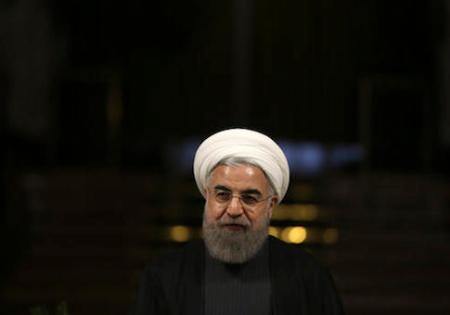
Iranian President Hassan Rouhani (AP Photo/Vahid Salemi)
“But the Obama administration counted on Iran waiting until the next president before revealing the game, and the Iranians sprung the trap early,” the source added. “So now the administration will do everything it can to look the other way and get through the next few weeks, so they can blame the inevitable collapse on Trump.”
***************************
Senior Iranian officials vowed on Wednesday to continue moving forward with nuclear weapons work and other banned activities as retaliation against the United States for breaching last year’s nuclear accord, according to reports in the country’s state-controlled media.
Iranian leaders instructed the country’s atomic energy organization to move forward with sensitive nuclear work, including the construction of nuclear-powered ships and submarines.
Further provocative actions will be announced in the coming days, according to these Iranian leaders, who described the country’s actions as revenge for recent moves by the U.S. Congress to extend sanctions on Iran, a move the Islamic Republic claims is a breach of the nuclear deal.
Iran’s latest moves have not elicited concern from Obama administration officials, who continue to pursue a series of measures meant to decrease international pressure on Tehran and provide it with greater financial resources.
“Considering that the US administration has ignored and delayed compliance with its undertakings under the [nuclear agreement] and given the recent extension of the Iran Sanctions Act (ISA) that had already been declared as a violation of the nuclear deal by the Islamic Republic of Iran… the Atomic Energy Organization of Iran is ordered to develop the country’s peaceful nuclear program within the framework of the Islamic Republic of Iran’s international undertakings as defined in the following missions,” Iranian President Hassan Rouhani wrote in a letter Tuesday to the country’s top nuclear agency.
Iran will move forward with a “plan for designing and building propulsion systems to be used in marine transportation in cooperation with scientific and research centers,” according to Rouhani’s letter.
It also will engage in the “production of fuel for nuclear propulsion systems,” Rouhani wrote.
This is the first in a range of responses planned by Tehran, according to Ali Akbar Velayati, a senior aide to Iran’s Supreme Leader Ali Khamenei.
The renewed nuclear work is “the first but not the last measures to be taken by Iran,” Velayati was quoted as saying on Wednesday.
Iran’s announcement did not draw a sharp response from Obama administration officials, who declined to say whether the nuclear work would constitute a breach of the deal.
“This announcement itself does not constitute a violation,” State Department spokesman John Kirby told reporters. “I think there’s a lot we just don’t know. I mean, this announcement just got made. There’s a lot we don’t know about it and what it means. And so I think we’d have to reserve some judgment here about the degree to which this could present any kind of problem.”
Kirby expressed faith in international nuclear inspectors, telling reporters that they would likely catch a breach of the deal.
Michael Rubin, a former Pentagon adviser and expert of rogue regimes, told the WashingtonFree Beacon that Iran is using the renewal of sanctions as an excuse to ramp up its illicit research activities
“The JCPOA [Joint Comprehensive Plan of Action], which they have never officially signed, was a gift made possible by Obama’s ego and Kerry’s naiveté,” Rubin said. “If they disagree with the United States, they can follow a legal process to pursue that but the fact that they are having a temper tantrum shows their insincerity. Especially because no new sanctions have been applied to Iran. After all, the U.S. president can waive any sanctions so long as Iran complies with its commitments.”
One senior foreign policy consultant who has worked with Republican and Democratic offices in Congress on the issue told the Free Beacon that Iran always planned to breach the deal once it received promised economic relief.
“The Iran deal was deliberately structured to prevent American leaders from pressuring Iran. Kerry and his Iranian counterparts wrote the deal so that Iran would get most of the benefits immediately, so that they could blackmail American lawmakers by threatening to costlessly walk away, which is exactly what they’re doing,” the source said.
“But the Obama administration counted on Iran waiting until the next president before revealing the game, and the Iranians sprung the trap early,” the source added. “So now the administration will do everything it can to look the other way and get through the next few weeks, so they can blame the inevitable collapse on Trump.”
For years, Republicans and conservatives have charged that President Obama has shielded embarrassing intelligence and other information regarding Iran in order to limit opposition to the Iran nuclear deal and Obama’s conciliatory approach to Tehran. The charge seems well-founded. After all, it took Sens. Tom Cotton and Rep. Mike Pompeo to discover secret side agreements attached to the nuclear deal.
Eli Lake suggests that the Trump administration may well stop covering for the mullahs. Certainly, as Lake argues, Trump’s early high level personnel picks suggest so.
Trump’s nominee for CIA Director is none other than Mike Pompeo. Not only did he and Sen. Cotton uncover side deals to the nuclear agreement, he also pressed hard for answers about the cash payments the U.S. delivered to the mullahs in exchange for the release of hostages.
Pompeo wrote to Attorney General Lynch asking for answers as to how the cash payments were approved by the Justice Department. Lynch stonewalled him. Perhaps Jeff Sessions will be more cooperative.
Mike Flynn is the other key appointment for purposes of airing Obama’s Iran secrets. Lake points out that in 2011 General Flynn ran a team at the Office of the Director of National Intelligence that reviewed the troves of material captured in the 2011 Osama bin Laden raid.
Under Obama, only a small fraction of these documents have been declassified and released. After he retired from the military, Flynn charged that the disclosures were selective.
Flynn noted, for example, that some documents captured in the bin Laden raid show a much tighter relationship between Iran and al-Qaeda than previously disclosed. In The Field of Fight: How We Can Win the Global War Against Radical Islam and Its Allies (written with Micheal Ledeen), Flynn states: “One letter to bin Laden reveals that al-Qaeda was working on chemical and biological weapons in Iran.”
Given Obama’s desire to deal with Iran and, indeed, for a rapprochement, you can see why the administration shielded such intelligence. Given the well-deserved contempt by Pompeo and Flynn for Obama’s Iran policy, you can see why they might want relevant facts to come to light. As a general matter, these are facts the public has a right to know.
If such facts are made public, Obama won’t have much standing to complain. Lake reminds us:
Obama himself in 2008 campaigned against the sitting president’s policies on waterboarding and enhanced interrogation. One of the first things his government did when he took office was to declassify and release the legal memos that justified and revoked these practices.
It looks like the Republicans are about to return the favor.
Omri Ceren writes to comment on Jay Solomon’s page-one Wall Street Journal article“Uranium provides new clue on Iran’s past nuclear arms work.” I thought that readers who have been following the story of our partnership with, and funding of, the Islamic Republic of Iran would appreciate this update, provided by Omri with the usual footnotes.
Readers may recall Obama’s assertions at the time he announced the deal: “Because of this deal, inspectors will also be able to access any suspicious location. Put simply, the organization responsible for the inspections, the IAEA, will have access where necessary, when necessary. That arrangement is permanent. And the IAEA has also reached an agreement with Iran to get access that it needs to complete its investigation into the possible military dimensions of Iran’s past nuclear research.” These assertions are now revealed to be something less than the truth, not that you didn’t know that already:
The Obama administration is now admitting that Iran did nuclear weapons work at its military facility at Parchin, based on a December IAEA report that described two particles of man-made uranium at the site. But the evidence is too sparse to figure out what kind of work the Iranians were doing, just that they were doing some kind of nuclear weapons work:
Current and former U.S. officials asked about the uranium finding said the working assumption now is that it is tied to nuclear weapons development… “The existence of two particles of uranium there would be consistent with our understanding of the involvement of Parchin in a past weapons program, but by themselves don’t definitively prove anything,” said a senior administration official briefed on the evidence.
One reason the IAEA can’t determine what happened is because – as part of the nuclear deal – the U.S. collapsed on long-standing demands that the Iranians fully come clean on their past weapons work, the so-called possible military dimensions (PMDs) of their nuclear program. Instead the Iranians were allowed to deny the Agency access to top nuclear scientists and to self-inspect at Parchin, passing on soil samples from pre-selected locations. That wasn’t enough for the IAEA to make a determination:
Iran didn’t allow the agency to interview top nuclear scientists believed to have overseen nuclear weapons development… Iran did allow IAEA inspectors to collect soil samples from Parchin in October that were tested for the presence of nuclear materials. The agency found two particles of man-made uranium… The amount of uranium was so small that the IAEA couldn’t conclude for certain that nuclear materials had been at the base.
Normally if the IAEA doesn’t have enough evidence about likely weapons work, it just goes back and gets more. But the nuclear deal blocks further inspections:
Normally, the IAEA requires additional samples to be taken when there are irregularities found in their tests… But under last year’s nuclear agreement, Tehran was only required to allow the IAEA’s inspectors to visit the Parchin facility once… Under the nuclear deal, Iran has committed to allowing the IAEA access to all of its suspected nuclear sites. But it isn’t clear if Iran would allow inspectors back into Parchin because it is a military base. Iranian officials have said last year’s visit wouldn’t be repeated.
So the Iranians were doing weapons work, the IAEA doesn’t know what kind of work it was, and the deal doesn’t force the Iranians to clarify. The result guts verification of the deal: IAEA inspectors can’t confirm Iran has halted its illicit weapons work, because inspectors don’t know what kind of illicit weapons work Iran was doing. There is no baseline to work from:
Critics of the nuclear deal have cited the presence of uranium at Parchin as evidence the Obama administration didn’t go far enough in demanding Iran answer all questions concerning its past nuclear work before lifting international sanctions in January. They also argue that it is hard to develop a comprehensive monitoring regime without knowing everything Iran has done.
Last June Secretary Kerry had previously argued that the U.S. didn’t even need Iran to come clean because the U.S. had “absolute knowledge with respect to the certain military activities they were engaged in” [a]. The claim was widely criticized by lawmakers and analysts for being false [b][c]. The AP subsequently revealed the self-inspection arrangement in August [d]. Defenders of the deal responded with an organized public attack on the outlet’s credibility, up to and including suggestions that the AP was running forged Israeli documents [e]. Administration officials separately argued that the Iranian inspections would be adequate to resolve the nature of the country’s past weapons work [f].
In a sane world, this wouldn’t even be a news story.
Iran is an energy power. It had no need for nuclear research except for a weapons program. It has blown through fortunes on its nuclear program that make no sense in a country with low energy prices.
Despite this the media insisted on believing the “fatwa” nonsense that Iran considered a bomb un-Islamic, even though the program began due to the Iran-Iraq War. The entire nuclear deal is premised on the bizarre idea that Iran wants a peaceful nuclear energy program. And now Obama Inc. is haltingly admitting that Iran did have a weapons program, but promising that this time it’ll be really peaceful.
The Obama administration has concluded that uranium particles discovered last year at a secretive Iranian military base likely were tied to the country’s past, covert nuclear weapons program, current and former officials said, a finding that contradicts Tehran’s longstanding denials that it was pursuing a bomb.
Traces of man-made uranium were found at the Parchin facility, southeast of Tehran, by investigators from the International Atomic Energy Agency, the United Nations’ nuclear watchdog, as part of an investigation tied to the landmark nuclear deal reached last July between Iran and global powers.
The Iranians have claimed that the site was used for developing and testing conventional weapons. The particles were the first physical evidence — on top of satellite imagery and documents from defectors — to support the charge that Iran had been pursuing a bomb there.
The Obama administration didn’t comment about the uranium in December when the IAEA released its report; the finding got only one brief mention in the 16 pages. But in recent interviews, current and former U.S. officials asked about the uranium finding said the working assumption now is that it is tied to nuclear weapons development that Iran is believed to have pursued more than a decade ago.
Administration officials also said the discovery hasn’t altered the assessment by U.S. intelligence that Tehran suspended its bomb-making efforts in 2003.
2003 isn’t “decades” ago. And the working assumption is whatever Obama Inc. finds convenient at any given time.
So Iran rather blatantly lied about its weapons program. But now we’re pretending that it’s telling the truth. And the original WSJ story should be viewed with a grain of salt as the White House has focused on leaking its Iran spin, particularly damaging information, such as its spying on Israel to protect Iran’s weapons program, through the Wall Street Journal. So think of this as more narrative. Ben Rhodes sitting and chuckling to himself while pushing this story to avoid the latest damaging revelations coming down the pike.
Iranian and Russian officials are discussing building several new nuclear power plants in Iran, according to an article published Thursday by the news agency Trend.
The two countries are working together to build as many as eight new nuclear power plants as well as modernize existing reactors, according to Trend.
Hillary Clinton, the Democratic presidential frontrunner, declared Thursday June 2 in a major foreign policy address: ‘We are now safer than we were before this agreement (the International-Iran nuclear deal).”
A short while before her speech, the State Department, published its yearly report on world terror, and determined, as in past years, that Iran remains “the leading state sponsor of terrorism, on account of its support for designated terrorist groups and proxy militias in Lebanon, Syria, and Iraq.”
Three days earlier, on May 31, scientists at the Institute for Science and International Security, published an extensive analysis of the second report of the IAEA in Vienna, whose job it is to monitor the Iranian nuclear program and establish whether Tehran’s is complying with its commitments.
Their report is titled: IAEA’s Second JCPOA Report: Key Information Still Missing.
The American scientists found oversights in the international watchdog’s report, suggesting collaboration between the Obama administration and the IAEA to conceal Iranian violations.
The scientists offered some examples of these omissions:
Data is lacking on the number of centrifuges, including advanced models, operating in Natanz enrichment facilities as well as the Fordo underground plant. There is no information on what happened to the 20 percent-enriched uranium still remaining in Iran.
Another example is the lack of information on the Iran’s heavy water which is provisionally stored in Oman. Who does it belong to and who oversees it?
These are just a few examples of the blanks in the promised oversight over Iran’s nuclear program, not to mention Iran’s banned ballistic missile program which is geared to design missiles able to reach the US.
The Obama administration had based his detente with Tehran, capped by the nuclear deal, on producing a breakthrough in US-Iran relations. It was intended to strengthen the moderate, reformist and liberal political elements in Iran. ButDEBKAfile sources and Iranian experts report that the exact opposite happened, as is evident in two important elections held in Iran in the past two weeks.
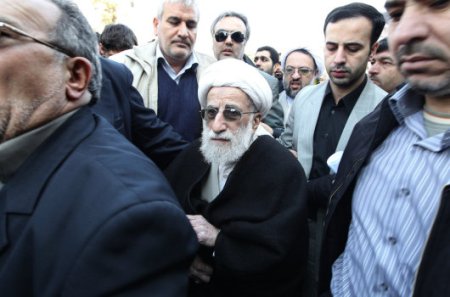
In the elections to the Assembly of Experts, the body which chooses Iran’s top leader, the 91-year-old Ayatollah Ahmad Janati was elected. He is one of the most extreme hardliners in Iran.
A few days later, Ali Larijani was re-elected as Speaker of the Iranian Parliament. Larijani is close to Ayatollah Ali Khamenei. He won by a land slide over the reformist candidate put forward by President Hassan Rouhani.
Five months ago, when the first results of the Iranian elections to the Majlis and to the Assembly of Experts came in, there were cries of joys in the Obama administration. US Secretary of State John Kerry and Iranian Foreign Minister Muhammad Jawad Zarif proclaimed it at the time a victory for the moderates.
Where did these ‘moderates’ disappear in the interim and how did they become supporters of the extremists?
On Friday, June 3, less than 24 hours after Clinton’s foreign policy speech, Iran’s leader Ayatollah Khamenei celebrated his victory over American policy saying: Iran has many small and big enemies, but foremost among them are America and Britain. “Any cooperation with the US,” he stressed, “is an act against Iran’s independence.”
Editor’s Note: The National Interest and the Heritage Foundation have partnered for a multi-part occasional series examining various aspects of the Iran nuclear agreement. The below is part four of the series. You can read previous parts here: one, two and three.
Last summer’s Iran nuclear deal has been roundly criticized for a number of solid reasons, ranging from Tehran’s ability under the deal to continue advanced centrifuge research to lingering questions about the possible military dimensions of its nuclear program.
That’s all well established.
One issue that has been largely ignored—wittingly or unwittingly—is this: What if Iran were able to find a suitable partner to collude with on an ‘‘underground” nuclear weapons program, all while seemingly staying within the restrictions of the July 2015 nuclear deal?
In other words, Tehran could by all public accounts adhere to the P5+1’s (China, France, Germany/European Union, Russia, the United Kingdom and the United States) Joint Comprehensive Plan of Action (JCPOA). But concurrently, Iran could work clandestinely with another country to advance its nuclear weapons program, essentially circumventing the International Atomic Energy Agency’s inspections and monitoring of the nuclear program inside Iran.
What better candidate for covert cooperation than cagey North Korea?
First, there’s no doubt that North Korea has a nuclear weapons capability. It has conducted four—maybe soon five—tests (2006, 2009, 2013 and 2016), possibly using both plutonium and uranium as fissile material.
Next, some analysts believe Pyongyang may have already “miniaturized” or “weaponized” the underground testing device into a nuclear warhead, capable of being mated to a ballistic missile. Even if North Korea hasn’t achieved it yet, it’s working on it.
Pyongyang has also expanded its missile testing beyond land-based launches. It now has conducted at least two subsurface ballistic missile tests that may also be related eventually to its nuclear weapons program. Clearly, these North Korean capabilities—though not all proven—would benefit an Iranian nuclear weapons program.
Also important is that Pyongyang seems willing to share its nuclear know-how with others, as evidenced by its building of a nuclear facility for Damascus that was destroyed in an Israeli air strike in 2007. Though public evidence is scarce and, if available, gauzy, it’s quite reasonable to conclude with some confidence that Pyongyang and Tehran already have some sort of established security or defense relationship. For instance, in 2012, Iran and North Korea reportedly signed a science and technology (S&T) agreement. It’s fair to assume that any cooperation is defense-related.
Indeed, considering the sorry state of their respective economies, research and industrial bases, it’s hard to conceive of what sort of civilian S&T Pyongyang might offer Tehran—and vice versa, of course.
Lending credence to this idea is the report that, at the time of the S&T agreement’s signing, Iran’s Supreme Leader, Ayatollah Ali Khamenei, spoke of how Tehran and Pyongyang had “common enemies.” The United States quickly—and clearly—comes to mind.
The idea of collaboration should come as no real surprise, as it’s seemingly well-known that the Iran and North Korea are reported to have been cooperating at some level on ballistic missiles going back to at least the late 1990s. For instance, it’s long been asserted that some Iranian ballistic missiles (e.g., the Shahab) are based on North Korean ballistic-missile technology (e.g., the Nodong) or transfers (e.g., the Scud).
Equally alarming is the New York Times report suggesting that the 2013 North Korean nuclear test may have been conducted “for two countries.” That notion was raised by unattributed U.S. government sources and gives support to concerns that Pyongyang and Tehran may be cooperating on more than ballistic missiles. This wouldn’t be the first time such an allegation has been leveled at Tehran and Pyongyang informally, but perhaps the first time it’s been acknowledged by Washington, taking into account a source not willing to be identified.
Of course, the situation has changed dramatically with the JCPOA now in force. Iran now has more than a passing interest in moving forward with its nuclear weapons program—especially considering the evolving regional security situation—without losing the benefits that the agreement provides, such as the removing of crippling economic sanctions. From Iran’s perspective, the need for “nuclear networking” with North Korea is greater than ever.
Of course, it’s not just Tehran that is in need. Pyongyang is also needy for its own reasons, such as its self-imposed, collectivist economic woes and the increasing international economic sanctions it faces over nuclear and missile tests.
In addition, North Korea could use some technical assistance with its space launch program, where Iran is arguably more advanced, but which is integral—and critical—to Pyongyang’s intercontinental ballistic missile (ICBM) program.
Lastly, both countries despise the United States and some of its allies (e.g., South Korea and Israel). Accordingly, Iran and North Korea would benefit from the existence of another state that threatens America with nuclear-tipped ICBMs.
In other words, there’s plenty of political and military motivation for these two rogue states to get together on nuclear and/or missile matters, arguably even more so today than last summer, before the JCPOA came into effect.
(The views expressed in this article are mine and do not necessarily reflect those of Warsclerotic or any of its other editors. — DM)
A recent article by David Samuels at the New York Times Magazine, based on an interview with Obama’s foreign policy guru Ben Rhodes, purported to explain how, and about what, the Obama administration lied to get public support for the Iran Scam. According to the article, the principal Obama lie involved who was the Iranian president when the negotiations with Iran began. It’s much deeper and worse than that. As Paul Harvey would say, “Here’s “the rest of the story.”
Iranian President Rouhani was elected on June 15, 2013 and assumed office on August 3d. According to Rhodes,
negotiations started when the ostensibly moderate Hassan Rouhani was elected president, providing an opening for the administration to reach out in friendship. In reality, as Samuels gets administration officials to admit, negotiations began when “hardliner” Mahmoud Ahmadinejad was still president. [Emphasis added.]
There is no necessary inconsistency — about a month and a half elapsed between Rouhani’s election and becoming the Iranian president. However, that is of little if any consequences.
Mr. Rosen, interviewed in the above video, touches, very briefly, on other problems with the Iran scam. Back in the world of reality, “we” had been negotiating with Iran during Ahmadinejad’s presidency for a couple of years, during which “we” gave Iran everything it requested. This article is intended to provide substantially more information and analysis of what happened and why during “our” secret bilateral negotiations with Iran.
The Negotiations
According to interviews with Iranian vice president and Atomic Energy Organization head Ali Akbar Salehi, translated and published by the Middle East Media Research Institute (MEMRI) on August 17, 2015, secret bilateral negotiations between the Obama and Iranian regimes had begun much earlier and included Obama’s Assistant Secretary of State, William Burns. During those negotiations, the U.S. conceded that Iran’s right to Uranium enrichment would be respected, that Iran’s missile programs would be left out of any deal and that its efforts to develop nuclear warheads and other devices would be ignored. Obama had essentially caved in to Iran’s demands even before the existence of negotiations was acknowledged.
In an interview published in the daily Iran on August 4, 2015 under the title “The Black Box of the Secret Negotiations between Iran and America,” Iranian vice president and Atomic Energy Organization head Ali Akbar Salehi, who is a senior member of Iran’s negotiation team and was foreign minister under president Ahmadinejad, revealed new details on the secret bilateral talks between Iran and the U.S. that started during Ahmadinejad’s second presidential term. According to Salehi, U.S. Secretary of Energy Dr. Ernest Moniz, whom Salehi knew from his period as a doctoral student at MIT, was appointed to the American negotiation team at Salehi’s request, a request which the Americans met within hours. [Emphasis added.]
Salehi added that Khamenei agreed to open a direct channel of negotiations between Iran and the U.S. on the condition that the talks would yield results from the start and would not deal with any other issue, especially not with U.S.-Iran relations. Following this, Salehi demanded, via the Omani mediator Sultan Qaboos, that the U.S. recognize Iran’s right to enrich uranium, and received a letter from Qaboos expressing such American recognition, which he relayed to Ahmadinejad. [Emphasis added.]
The secret bilateral Iran-US negotiations had begun with a letter for Iran delivered to an Omani official. Salehi told an Omani intermediary.
‘I am not sure how serious the Americans are, but I will give you a note. Tell them that these are our demands. Deliver it on your next visit to Oman.’ I wrote down four clear issues, one of which was official recognition of rights to [uranium] enrichment. I figured that if the Americans were sincere in their offer, then they must agree to these four demands. Mr. Suri gave this short letter to the mediator, and stressed that these were Iran’s demands. [He added that]if the Americans wished to solve this issue, they were welcome to, otherwise dealing with White House proposals would be useless and unwarranted…
“All the demands in the letter were related to the nuclear challenge. These were issues we have always come against, such as closing the nuclear dossier [in the Security Council], official recognition of [Iran’s] right to enrich [uranium], and resolving the issue of Iran’s actions under the PMD [Possible Military Dimensions]. After receiving the letter, the Americans said: ‘We are certainly willing and able to easily solve the issues Iran has brought up.’ [Emphasis added.]
The first meeting between the Iranian and American negotiating teams began following eight months of coordination. Iran
sent a team to Oman that included the deputy foreign minister for European and American affairs, Mr. [Ali Asghar] Khaji, as well as several CEOs. The Americans were surprised in the first meeting and said, ‘We cannot believe this is happening. We thought Oman was joking. We aren’t even prepared for these talks with you.’
“Q: What was the level of the team that the Americans dispatched?
“A: It included Assistant Secretary of State William Burns. They said: ‘We only came to see if Iran was truly willing to negotiate.’ Our representative gave them the required response and eventually there were talks on this issue. The initial result was achieved and the ground was prepared for further coordination. [Emphasis added.]
“Q: How were the Americans convinced that the Iranian diplomats who were dispatched had the necessary authority?
“A: [Until] that phase, Iran and America had not been allowed to sit opposite each other at the negotiating table. The fact that Iran had sent a deputy foreign minister to the talks indicated its seriousness. The Americans also noticed how seriously [Iran was taking] the issue. At that meeting, Khaji pressed the Americans to set up a roadmap for the negotiations, and eventually the talks of a roadmap were postponed to the second meeting. At the second meeting, Khaji warned the Americans: ‘We did not come here for lengthy negotiations. If you are serious, you must officially recognize enrichment, otherwise we cannot enter into bilateral talks. But if you officially recognize enrichment, then we too are serious and willing to meet your concerns on the nuclear matter as part of international regulations.‘
International regulations were later agreed upon by the P5+1 negotiators, in the form of the Iran – IAEA secret deals concerning nuke inspections and a UN resolution dealing with Iranian missiles. Neither was included in the Joint Cooperative Plan of Action.
“Of course, at that time we were [still] exchanging various information with the Americans via the [Omani] mediation, and this is documented at the Foreign Ministry. We did not do it in the form of official letters, but rather unofficially and not on paper. The Omani mediator later came to Iran, held talks with us, and then later spoke to the Americans and told them our positions, so that the ties were not severed. But there was no possibility for direct talks.
“Thus, a real opportunity was squandered because, at the time, the Americans were genuinely prepared to make real concessions to Iran. Perhaps it was God’s will that the process progressed like that and the results were [eventually] in our favor. In any case, several months passed and Obama was reelected in America [in November 2012]. I thought that, unlike the first time, we must not waste time in coordinating [within regime bodies], so with the leader’s backing and according to my personal decision, I dispatched our representatives to negotiate with the Americans in Oman. [Emphasis added.]
“Q: Didn’t you have another meeting with the leader about the process and content of the talks?
“A: No. Obviously during the process I wrote a letter to the leader detailing the problems. He said ‘try to solve them.’ He was always supportive but told me to ‘act in a manner that includes necessary coordination [within the regime]. In this situation, I dispatched Khaji to the second meeting in Oman (around March 2013) and it was a positive meeting. Both sides stayed in Oman for two or three days and the result was that the Omani ruler sent a letter to Ahmadinejad saying that the American representative had announced official recognition of Iran’s enrichment rights. Sultan Qaboos sent the same letter to the American president. When Ahmadinejad received the letter, several friends said that this move would be fruitless and that the Americans do not keep [their] commitments. [But] we had advanced to this stage. [Emphasis added.]
. . . . We [then ] prepared ourselves for the third meeting with the Americans in order to set up the roadmap and detail the mutual commitments. All this happened while Iran was nearing the presidential elections [in June 2013]. At that time, the leader’s office told me that I had to cease negotiations and let the next government handle the talks after the results of the elections were known.
. . . .
“Q: What was the Americans’ position in the first meetings between Iran and the P5+1 held during the Rohani government [era]?
“A:After the Rohani government began to operate – along with the second term of President Obama – the new negotiations between Iran and the P5+1 were started. By then, Kerry was no longer an American senator but had been appointed secretary of state. As a senator, Kerry had been appointed by Obama to be in charge of handling the nuclear dossier, and then [in December 2012] he was appointed secretary of state. [Emphasis added.]
“Before that, the Omani mediator, who had close relations with Kerry, told us that Kerry would soon be appointed [U.S.] secretary of state. During the period when the secret negotiations with the Americans were underway in Oman, there was a situation in which it was easier to obtain concessions from the Americans. After the Rohani government and the American administration [of Obama’s second term] took power, and Kerry become secretary of state, the Americans spoke from a more assertive position. They no longer showed the same degree of eagerness to advance the negotiations. Their position became harder, and the threshold of their demands rose. At the same time, on the Iranian side, the situation [also] changed, and a most professional negotiating team took responsibility for negotiating with the P5+1. [Emphasis added.]
As to the reluctance of the American side to make concessions after Kerry had replaced Clinton as the Secretary of State, it must be remembered that “we” had already made all or most of the concessions Iran sought.
Another positive point was that [President] Rohani oversaw the dossier, knew its limits, and as a result succeeded in producing a good strategy to advance the nuclear dossier. At the same time, Rohani took responsibility for everything. Many may have reservations and ask why we were putting ourselves in danger, but Rohani’s willingness to take responsibility was very high. There are those who say, from a political standpoint, that he was willing to take a very great risk, because, had the negotiations not achieved certain results, and had the best results not been achieved, he would have faced waves of criticism. But he took upon himself the risk of [such] criticism. In any event, he agreed to take this responsibility, and, God be praised, even God helped him, and he emerged [from the negotiations] with his head held high.” [Emphasis added.]
At some point, the negotiations broke down over “technical issues.” Salehi, a technical expert as well as a diplomat, found a way to resolve those issues.
A . . . condition was that American experts would come to Iran and talk to me. I said that as vice president I would not enter into a discussion with their experts, because as far as the protocol was concerned, this would create a bad situation and they would say that Iran would capitulate in any situation. This was not good for Iran, but I was willing to quit and to come to the talks not as vice president but as the foreign minister’s scientific advisor. Larijani said ‘he’s right.’ The next day, Fereydoun asked me to come to his office and asked me who my [American] counterpart was. I said, the [U.S.] Department of Energy. Fereydoun called Araghchi and said, ‘Tell [U.S. Under Secretary of State for Political Affairs] Ms. [Wendy] Sherman that Salehi is joining the negotiations provided that the American secretary of energy also joins the negotiators.‘ Araghchi and Sherman were the liaison between Iran and America. Araghchi said in this conversation with Fereydoun that on such short notice it was unlikely that they [i.e. the Americans] would send their secretary of energy. I heard [Fereydoun’s conversation with Araghchi]. In short, Fereydoun asked and Araghchi contacted Sherman and a few hours later a report that they welcomed Iran’s proposal arrived. [Emphasis added.]
“Q: How many hours did it take before they [the Americans] said yes?
“A: It didn’t take long. I went to see Fereydoun in the evening and the next day they responded. This was because of the time difference [between Tehran and Washington].
“Q: The general perception was that because Moniz was brought into the negotiating team, you were brought into the Iranian team?
“A: [On the contrary,] Moniz came because of me. In any case, in February [2015] I joined [the negotiations], and praise God, matters moved forward with Moniz.
“Q: Did you and Moniz study together?
“A: Moniz knew me more than I knew him. I saw him at the annual IAEA meeting. When I was a doctoral student at MIT, he had just been accepted as a staff member. He is five years older than me.
“Q: Did you take one of his classes?
“A: No. He knew me because my doctoral studies advisor was his close friend and right hand man in scientific fields. Even now he is an advisor on many of Moniz’s scientific programs. Many of my fellow students are now experts for Moniz. One of them was Mujid Kazimi, who is of Palestinian origin. He recently died. He was two years older than me but we were friends in college. After graduating, he became the head of the MIT Department of Nuclear Science and was a prominent figure who carried out many programs with Moniz.
“Q: How did Moniz treat you initially?
“A: In light of our prior acquaintance, he was excited. We’ve known each other for years and he treated [me] very well. Our first meeting was in public.
“Q: How did you feel when you heard Moniz was coming [to the talks]?
“A: I was very happy. I was assured. I said that the prestige of the Islamic Republic remained intact [because] an Iranian official would not speak to an American expert but rather would negotiate with a high-ranking American official. This was very important. Second, as I said before, he could make a decision [while] an expert could not. We had a very interesting group meeting. The American experts were same ones who had dealt with disarmament vis-à-vis the Soviet Union.
“I said [to Moniz]: ‘I cannot accept your offer for various reasons.’ One American expert said, ‘We do not accept the basic assumption of your calculations.’ I said, ‘Tell us what is the basic assumption of [your] calculations so we can work from there.’ He said ‘we can’t do that.’ I said to them, ‘If you don’t accept our estimation, then tell us [yours]. You say that you cannot because this [exposes] your process. If we show [our] calculation, you will know our working secrets.’ So then I said ‘ok, what do we do now?’ The meeting stagnated.
“Later I thought about it… and said ‘Mr. Moniz, I am here with full authority from my country. Anything I sign will be acceptable to my country. Do you have full authority as well, or does any result achieved here need to be asked and clarified with officials from other countries?’ He said ‘no, I have full authority.’
“Q: Did you have full authority?
“A: Yes. In the scientific discussions, I knew the level of [Iran’s] demands. I said, ‘Mr. Moniz, you made an offer to Iran, and Iran rejects it. I want to ask you a question. If you can answer it [then] I will have no problem with your offer.’ I continued and said: ‘Show me one place on earth where enrichment is taking place using the method you are demanding of us. If you can give me even a single example then I will sign on the spot and we will become the second country to enrich in this method.’ He looked [at me] and then announced that the meeting was over, and we spoke. We had the first private meeting that lasted two or three hours. He said: ‘Mr. Salehi, when I was called [out of the negotiating room, it was because] Obama wanted to speak to me. Now I am free [to continue]. What you said is acceptable [but] there are practical problems with your offer.’ I said, ‘Do you agree? Then I relinquish that proposal.’ Eventually. we reached mutual understandings on this issue. I said ‘let’s start from the top.’ This diplomatic challenge should be published in a memoir so that everyone can understand how we reached 6,000 centrifuges. It is a very nice story… [Emphasis added.]
The Aftermath
Ultimately, Iran’s right to enrich Uranium was fully recognized in the Joint Plan of Action (JPOA) and in the subsequent Joint Cooperative Plan of Action (JCPOA). As to the missile aspects of the “possible military dimensions” of Iran’s nuclear program, neither document dealt with Iranian missiles. That was left up to the United Nations Security Council to deal with in its resolution approving the nuke “deal.” In light of Russia’s warm relations with Iran, Russia would most likely veto any proposed Security Council resolution finding Iran in violation of its missile provisions.
The “verification” mechanism was included only in separate and secret “side deal(s)” solely between Iran and the IAEAwhich members of the U.S. Congress were not permitted to see during the pseudo-approval process. According to Kerry, he was not permitted to see them either, but the details were “fully explained” to him.
Here’s a video of Secretary Kerry under questioning about the side deals:
Questions might have been better directed to this Kerry clone; more candid answers might have been provided.
Any pretense that the IAEA will have “any time, anywhere” access to Iran’s military sites was mere rhetoric, as acknowledged by US Under Secretary of State Wendy Sherman on July 16th
“I think this is one of those circumstances where we have all been rhetorical from time to time,” Sherman said in a conference call with Israeli diplomatic reporters. “That phrase, anytime, anywhere, is something that became popular rhetoric, but I think people understood that if the IAEA felt it had to have access, and had a justification for that access, that it would be guaranteed, and that is what happened.” [Emphasis added.]
Ms. Sherman was right about the rhetorical nature of administration assertions, but wrong about IAEA access, of which there will apparently be little or none pursuant to the secret deals between Iran and the IAEA.
In an interview on Al Jazeera TV last week Ali Akbar Velayati, Security Adviser to Iran’s Supreme Leader, stated that
United Nations nuclear inspectors from the International Atomic Energy Agency would not be given access to Tehran’s sensitive military nuclear sites.
. . . .
“First, allow me to emphasize that the issue of the missiles and of Iran’s defensive capabilities were not part of the negotiations to begin with,” Velayati said. [Emphasis added.]
“No matter what pressure is exerted, Iran never has negotiated and never will negotiate with others – America, Europe, or any other country – about the nature and quality of missiles it should manufacture or possess, or about the defensive military equipment that it needs. This is out of the question.” [Emphasis added.]
. . . .
Reza Najafi, Iran’s ambassador and permanent envoy to the IAEA, stated over the weekend that “no country is permitted to know the details of future inspections conducted by the IAEA.” [Emphasis added.]
Najafi’s statement could mean (a) that no details about inspection methodology will be disclosed, (b) that no details about inspection results will be disclosed or (c) both. If inspection methodologies — who did the inspections as well as when, where and how, are not disclosed, what useful purpose will they serve, other than for Iran? If details of the results of inspections are not disclosed, that will also be the case. How, in either or both cases, will the members of the P5+1 negotiating teams have sufficient information to decide whether to “snap back” sanctions — if doing so is now even possible — or anything else? [Emphasis added.]
Conclusions
One can only hope that our next president will dispose of the Iranian “deal” as a treaty which Obama refused to submit to the Congress as the Constitution requires or at least ostentatiously ignore it and grant no more concessions.
Otherwise, be not afraid; Obama the Great One — the smartest person in any room and the best President ever — has made us safe. How can one possibly be safer alive than dead?




 anneinpt
 artaxes
 danmillerinpanama
 davidking1530
 Peter Hofman
 Joseph Wouk
 Peter
Peter Louisiana Steve
 WarSclerotic
Recent Comments