Archive for the ‘Iran – human rights’ category

Iran Targets Its Largest Minority

August 5, 2016

Iran Targets Its Largest Minority, Gatestone Institute via YouTube, August 5, 2016

The blurb beneath the video states,

The Iranian regime that hangs and imprisons peace-loving people for their beliefs is today a major threat to the free world. Iran is building a massive arsenal of nuclear weapons and ballistic missiles. Does it not seem perverse that the UN, the EU and the US administration smile fondly on the persecutors and defame the protectors?

Lashing and Flogging: Islam and Iran

August 1, 2016

Lashing and Flogging: Islam and Iran, Front Page MagazineDr. Majid Rafizadeh, August 1, 2016

happy times in Iran

[D]espite all the [international] laws banning flogging, the Islamic Republic of Iran continues to use these kinds egregious punishments without feeling any pressure from the media or from international organizations. This highlights the fact that Iran is actually widening its crackdown as it is receiving sanctions relief and gaining more revenue.

********************

The ruling clerics of Iran are increasing their reliance on public flogging not only for punishing people, but also for threatening those who are violating minor Islamic and Sharia laws. 

Public lashing is orchestrated for several reasons, including to punish the person who has violated Sharia laws, impose fear in the society, humiliate the victims and cause psychological harms to the individuals.

Holding a girlfriend/boyfriend’s hand, kissing in public (even for a married couple), listening to music, drinking alcohol and wearing non-Islamic dress can all be grounds for flogging under the Islamic law of Iran. As an Iranian prosecutor, Esmail Sadeghi Niaraki, who recently arrested people for “dancing and jubilating,” said, “We hope this [flogging] will be a lesson for those who break Islamic norms in private places.”

Yesterday, according to Iran’s state-owned news agency, Tasnim, Iranian officials arrested 150 young people for being at a mixed-gender birthday party in the city of Islamshahr, close to the capital of Tehran. Young people who are arrested for attending mixed-gender parties are often fined, flogged, beaten and sometimes raped.

According to Colonel Mohsen Khancherli, Iran’s police commander for the west of Tehran Province:

“After we obtained a report about a mixed-gender party in a garden in the vicinity of Islamshahr in the west of Tehran Province, an operation was carried out by the police and another organization, leading to the arrest of dozens of boys and girls.”

He added:

“Some 150 boys and girls had gathered at the mixed-gender party under the guise of a birthday party in this garden which is situated next to a studio where unlawful music was produced and recorded. Upon arrival of the police, all those present were arrested and sent before the judiciary.”

A few weeks ago, more than 30 college students were arrested, and within 24 hours the judge ordered each to receive 99 lashes for attending a graduation party. In the last two months, approximately 600 people have been arrested, fined and lashed for celebrating.

In this video, a teenager is being lashed for helping a girl whom the moral police were attempting to arrest for wearing bad hijab. He can be heard begging for mercy.

According to Ismaeil Sadeqi Niaraki, a top Iranian cleric, Iran will not tolerate “freedom” or “having fun.” He praised the moral police for arresting and punishing those who break the Islamic laws: “Thanks [sic] God that the police questioning, investigation, court hearing, verdict and implementation of the punishment all took place in less than 24 hours.”

According to Chapter III of the Iranian Islamic constitution, Enforcement of Sentences of Flogging, Article 27:  “Flogging will be administered by a woven leather belt of approximately one meter in length and one-and-a-half centimeter in width.” The penal code goes on detailing how one should be flogged:

Article 32: Enforcement of hadd for female convicts will be carried out while the convict is in a sitting position with her body fully covered by clothing.

Article 33: Flogging for male convicts will be administered while the convict is in a standing position.  For adultery, sodomy, and consumption of alcohol, there will be no clothing other than coverage of private organs, and for qazf or pandering, flogging will be administered over regular clothing.

Flogging is banned according to international law. The Universal Declaration on Human Rights, the International Covenant on Civil and Political Rights and the Convention Against Torture prohibit torture and “cruel, inhuman, or degrading treatment or punishment.” Various organizations within the United Nations, such as the UN High Commissioner for Human Rights) and the UN Human Rights Committee, equate flogging with inhumane and cruel punishments.

Nevertheless, despite all the laws banning flogging, the Islamic Republic of Iran continues to use these kinds egregious punishments without feeling any pressure from the media or from international organizations. This highlights the fact that Iran is actually widening its crackdown as it is receiving sanctions relief and gaining more revenue.

Enforcing ‘God’s Commandments’: Heightened Mass Executions in Iran

June 17, 2016

Enforcing ‘God’s Commandments’: Heightened Mass Executions in Iran, Front Page MagazineDr. Majid Rafizadeh, June 17, 2016

hangings_in_iran

While the Obama administration is continuing its appeasement policies and romance with the ruling mullahs of Iran, the scale of executions has reached an unprecedented level. The Iranian regime is resorting to more and more mass executions. How is the Islamic Republic of Iran different from the Islamic State or those who commit terrorist acts by mass murdering people? 

Most recently, the ruling clerics of Iran hanged 16 people in one day in several cities, including in Gohardasht (Rajai Shahr) and Ghezel-Hessar prisons in Karaj (western part of Tehran) and Adelabad Prison in Shiraz (southern part of Iran).

One of those executed was 16 years old at time of allegedly committing a crime. President Obama, Hillary Clinton or the several European governments, which are following in the footsteps of the Obama administration, have issued no robust condemnation or criticism. These egregious human rights violations and acts of mass executions committed by a state — in the name of Islam — have been totally ignored.

Prior to the above-mentioned mass executions, the Iranian regime hanged 13 prisoners on May 17 in three cities of Yazd, Urmia and Mashhad. Twelve individuals were executed collectively. A few weeks ago, the Iranian regime executed five Kurdish rights activists in the northwestern city of Urmia. The five Kurds — Naji Kiwan, Ali Kurdian, Haidar Ramini, Nadir Muhamadi and Ruhman Rashidi — were hanged publicly on charges of “conspiring against the Islamic Republic of Iran.” Dara Natiq, a member of the Kurdistan Democratic Party in Iran, said to ARA News, “The victims were human rights activists who used to document violations by Iranian security forces against civilians in the Kurdish city of Urmia.”Reportedly, the Iranian government executes approximately seven Kurdish civilians and activists every week.

The Iranian president has publicly endorsed the executions and described them as “God’s commandments” carried out under the “laws of the parliament that belong to the people.” What is more appalling is that the mainstream liberal media and the Obama administration depict the Iranian president, Hassan Rouhani, and his team as diplomatic, rational, and “moderate.” What definition of “moderate” politician means someone who endorses mass executions of human rights activists, political activists, children, innocent women, etc.?

So far, under the “moderate” presidency of Rouhani, more than 2,400 people, including men, women, and children, have been executed. As Ahmed Shaheed, the UN special rapporteur for human rights in Iran, pointed out, in spite of the arguments being made that Rouhani is a moderate figure “the overall situation has worsened” when it comes to human rights issues in the Islamic Republic.

In comparison to the executions being carried out in neighboring countries, Iran carried out 82 percent of the all executions in the region. As the Amnesty International pointed out in its latest report, “Iran put at least 977 people to death in 2015, compared to at least 743 the year before…. Iran alone accounted for 82% of all executions recorded in the region.”

In addition, the Iranian regime continues to be the sole country that executes children. Amnesty International added, “Iran is also one of the world’s last executioners of juvenile offenders, in flagrant breach of international law. The country put to death at least four people who were under 18 at the time of the crime for which they were convicted in 2015.”

The executions committed by the Iranian regime, which are being imposed by Sharia and Islamist law, can also be politically driven to preserve control over people and ensure the survival of the mullahs’ rule. There exists no doubt that the justifications for these executions do not meet any due process standard. People are often executed by a simple subjective order from a cleric who can make vague charges against the victims such as “enmity with Allah (God),” “ corruption on earth,” “war against Allah and the state,” and so on.

The international community has neglected Iran’s use of brute force to carry out these mass executions.

More fundamentally, the nuclear agreement and the Western appeasement policies towards Iran have increased Iran’s legitimacy. Consequently, this has emboldened and empowered the Iranian leaders and mullahs to more forcefully and effectively execute more people and to crack down on domestic opposition with brute force, without fearing international outcry, pressure, sanctions and condemnations.

Escalation In Political – And Perhaps Also Physical – Threats To Iranian Expediency Council Head Rafsanjani

June 8, 2016

Escalation In Political – And Perhaps Also Physical – Threats To Iranian Expediency Council Head Rafsanjani, MEMRI, June 8, 2016

In recent weeks, Iran’s ideological camp has stepped up its threats against pragmatic camp leader and Expediency Council chairman Hashemi Rafsanjani. The threats have included calls for prosecuting him – as it is, relatives of his are frequently imprisoned – and for defining him as a deviant, a traitor, and an accessory to, and torch-bearer today of, what the ideological camp terms “the 2009 fitna,” that is, the civil unrest following the presidential elections. It will be recalled that the leaders of this movement – former prime minister Mir-Hossein Mousavi and his wife, and former Majlis speaker Mehdi Karroubi – have been under house arrest since 2011.

When discussing Rafsanjani, ideological camp members’ statements are harsh, even violent.[1] This tone attests to the escalation in the regime’s antipathy towards the man considered to be the leader of the move towards openness vis-à-vis the U.S. and the West, which brought about the JCPOA – in contrast to the position of Supreme Leader Ali Khamenei, who considers the U.S. to be an enemy that Iran must not come to terms with it. It should be mentioned that the ideological camp considers the JCPOA a tool used by the pragmatic camp and by the U.S. to remove it from power.

Rafsanjani is perceived by the ideological camp as an existential threat to its regime and as constantly undermining the foundation of its control of the country’s institutions.[2] The current struggle between the ideological and pragmatic camps, and particularly the personal struggle between these camps’ respective leaders, has been ongoing for at least three years, and is currently at a high point (see MEMRI Inquiry & Analysis No. 1137, The Power Struggle Between Khamenei And His Camp And Rafsanjani And His Camp – Part XIV, January 21, 2015, and MEMRI Special Dispatch No. 5794, The Rafsanjani-Khamenei Struggle Escalates Into Open, Direct Confrontation, July 13, 2014).

Recently, Rafsanjani’s daughter Faezeh Hashemi was photographed meeting with a Baha’i activist with whom she had previously shared a prison cell. The meeting between the two women prompted the ideological camp to take immediate legal measures against Rafsanjani himself. The regime considers Bahaism to be a deviant and illegitimate cult, and its practitioners are persecuted and are denied civil and religious rights. It also considers Baha’is to be collaborators with Israel and the U.S. Although Rafsanjani distanced himself from his daughter’s actions, the ideological camp still considers them valid proof of his own treason.[3]

Due to the tremendous pressure on him, and the threats against him,[4] it appears that Rafsanjani had to relinquish his candidacy for head of the Assembly of Experts, even though he won the general elections for the assembly in February 2016.[5]

Even after his rival, Ayatollah Ahmad Jannati, was chosen to head the assembly, the attacks on Rafsanjani did not stop. The Tasnim news agency, which is affiliated with the IRGC, published an article predicting the death of Rafsanjani, describing him as the pawn of the British and of the BBC. It added that since he was not chosen assembly head and can no longer serve the British, they no longer need him, and he would be more useful to them dead.[6]

In light of these developments, MEMRI assesses that the Iranian regime may no longer stop at harassing Rafsanjani’s relatives and associates,[7] and that there is a possibility that it will now move to harming Rafsanjani directly.

Following are threatening comments and actual threats made against Rafsanjani in recent days:

IRGC Commander Threatens Rafsanjani

On May 24, 2016, at a cadet graduation ceremony attended by Supreme Leader Khamenei, Mohammad Ali Jafari, commander of Iran’s Islamic Revolutionary Guard Corps (IRGC), said: “Thanks to the Islamic Revolution and the awakening of mankind, monotheistic beliefs have spread in the region and in the world in this new age, and the garbage dump of Western culture has been set on the path of assured destruction. Nevertheless, some in the country who think a certain way are stealing glances at foreigners and speaking [highly] of the rotting values of Western cultures, in comparison with Iran’s noble religious values and culture.

“These [people] should know that the religious public in Iran, which is revolutionary and which nurtures martyrs, will not tolerate these thoughts, or those who have them, in Iran’s politics and culture. They must know that if they persist in their deviant path, they will meet with the same catastrophe as did those who preceded them in deviating from the straight path of the leader [Khamenei] and the Imam [Ayatollah Ruhollah Khomeini] and who remain infamous in the memory of the Iranian nation.

“The IRGC and the Basij accompany the spirit of revolution and values of the great Iranian nation, and will never allow some of the infiltration camps that are influenced by the West, that can be found within the apparatuses of the regime, to carry out deceptions or to force their foolish view on, and tarnish, the blessed life of the Islamic Revolution.”[8]

Kayhan Editorial: “The Baha’i And The New Infiltrators”

The May 18, 2016 editorial of the daily Kayhan, titled “The Baha’i and the New Infiltrators,” stated: “Ms. What’s-her-name [Rafsanjani’s daughter] travels with ease to America and England. While a BBC Persia reporter encounters visa problems with America, this lady does not. A few days before the election, she travels to America. Why? Do not assume the worst. Maybe she simply craved a McDonald’s sandwich.

“In July 2012, she pops over to England, saying that she is going to the Olympic Games, but her lawyer says that she went to visit her son, who was studying there… Something happens and her brother also arrives in London, remaining for several years on the pretext of visiting a certain university. Later, there come reports that he was involved in stepping up the sanctions [on Iran] as fuel for the green fitna…

“After her recent visit with one of the leaders of the Zionist-Baha’i channel, Mr. Hashemi Rafsanjani expressed – in three lines, no more – that Faezeh had made a mistake and must rectify it. She said that she had made no mistake, and that she had no regrets… [and Rafsanjani] distanced himself from the Baha’i cult… [that is] crooked and colonialist and that joined the leaders of the fitna in a collective project…

“Is it now time for you [addressing Rafsanjani] to renounce Baha’ism… or is it time for you to renounce those who are an organic part of the Baha’i [i.e. your daughter]… They [the Baha’i] denied [the existence of] the Mahdi [the Hidden Imam]… and, in London, they operated a computer room for the Green Movement…

“What should be done about a camp lacking in all cultural, political, and economic honor, which engages in forming [spy] rings and [political] parties, and in amassing capital? …

“We are currently in all-out cultural, political, and economic war with the historic enemies of the Iranian nation… The enemy came to the arena without fear… We must understand what operation is being planned by the enemy, and come to the arena without delay and without pleasantries.”[9]

Basij Commander Attacks Rafsanjani

On May 16, 2016, Basij commander Mohammad Reza Naqdi said: “Infiltration elements [meaning Rafsanjani] are amassing a fortune and creating [socioeconomic] classes, increasing poverty, and then pop up to express concern for the poor. These people are behind the unnecessary large-scale imports, and when [Iranian] companies go bankrupt and when national production grinds to a halt, they say we must facilitate relations with the foreigners and compromise with America so that our problems will be solved.

“They meet with Sunnis [referring to Rafsanjani’s past good relations with the Saudis] and create many expectations for them, and then approach a camp that has does not believe in Sunni-Shi’ite unity and collaborate with it against the regime.

“This group of infiltration elements sits down with the Baha’i at the expense of Islam, while at the same time asking, ‘What has the [Islamic] Revolution done for Islam?’ …

“This group calls Basij members extremists because they zealously defended Islam or because they shouted their criticism. Yet it recognizes America as good despite its evil, interprets its crimes favorably, and says that we must compromise and make friends with [the Americans].

“This group of infiltration elements is attempting to blur the difference between truth and lies, and to present someone else as the main enemy. For example, it has a plan to paint Saudi Arabia as the main enemy, while compromising with America and maintaining relations with it.”[10]

Judiciary Spokesman And Prosecutor General Criticizes Rafsanjani’s Daughter

On May 18, 2016, Judiciary spokesman and prosecutor-general Gholam-Hossein Mohseni-Eje’i said: “Faezeh Hashemi’s meeting with a member of the Baha’i cult is an ugly and condemnable act. We will deal with her in accordance with the law. As per my understanding, many people, including senior clerics and other known figures, have condemned this act. Even uglier was that her father spoke about this but that she did not apologize.”[11]

Assembly Of Experts Member And Tehran Friday Prayer Leader Criticizes Rafsanjani’s Daughter

In an interview with the Tasnim news agency, which is close to the IRGC, Assembly of Experts member and Tehran Friday prayer leader Ayatollah Ahmad Khatami said: “In fact, Baha’i is not a religion, but an espionage party. The world of arrogance has completely supported this espionage cult, and still does. A fatwa by all the ayatollahs regarding Baha’ism is clear and unequivocal – [according to this fatwa,] it is a deviant cult that is outside the Shi’a and must be treated as foreign.

“Recently, a certain political figure met one of the leaders of this cult. We must condemn any behavior that will cause a break in the barrier against relations with this devious cult. In the Islamic regime [of Iran], no one must bring about the revival of this hated cult, neither on the pretext of human rights or on any other [pretext]. Certainly, meeting with a member of this cult is complete deviation and cannot be acknowledged as just a mistake.”[12]


Endnotes:

[1] See, for example, statements by Combatant Clergy Assembly member Jafar Shajuni, who said that Rafsanjani and his relatives are “anti-revolutionary and burned.” Entekhab (Iran), May 18, 2016.

[2] See, for example, statements by Assembly of Experts member Ayatollah Heshmatzadeh Harisi, who, defending Rafsanjani prior to the assembly’s election of a new chairman, said he was not a traitor and that he did not seek to harm the Islamic Revolution. He added that even if Rafsanjani were to be elected Assembly of Experts head, he would not have the authority to enact constitutional changes regarding the status of the supreme leader. Entekhab (Iran), May 18, 2016.

[3] Many regime clerics have issued fatwas against the Baha’i.

[4] Combatant Clergy Assembly member Jafar Shajuni said on May 18, 2016: “The chairmanship of the Assembly of Experts should not fall into the hands of anti-revolutionists. Rest assured that it will not fall into the hands of Rafsanjani.” Entekhab(Iran), May 18, 2016.

[5] The Assembly of Experts chairmanship was ultimately given to Ayatollah Ahmad Jannati, who also heads the Guardian Council, even though he received the fewest votes in the Tehran constituency in the general elections for the assembly.

[6] Tasnim (Iran), June 6, 2016.

[7] See Rafsanjani’s harsh response following negative reports by Iran’s broadcast authority on him and the Islamic Azad University, which he owns. ILNA (Iran), May 19, 2016.

[8] ILNA (Iran), May 24 2016.

[9] Kayhan (Iran), May 18, 2016.

[10] Mehr (Iran), May 16, 2016.

[11] ISNA (Iran), May 18, 2016.

[12] Tasnim (Iran), May 18, 2016.

John Kerry, The Islamic Republic’s New Lobbyist

June 2, 2016

John Kerry, The Islamic Republic’s New Lobbyist, Front Page MagazineAri Lieberman, June 2, 2016

(Please see also, Is Obama’s Iran Deal a ‘Dhimmi’ Contract? — DM)

john_kerry_senator_from_ma-2 (2)

Iran, the nation that has built a well-deserved reputation as the world’s premier state-sponsor of terrorism has a new lobbyist and he is none other than U.S. Secretary of State John Kerry. Since the Obama administration inked the Joint Comprehensive Plan of Action in January, Kerry has been busying himself with ensuring that European banks start doing business with the Iranians. Yes, you read that correctly. Not only has the United States and its European allies agreed to lift sanctions against the Islamic Republic, the administration is now encouraging the private banking sector to do the same. It appears however, that their intense lobbying efforts are being received with a healthy dose of skepticism.

HSBC’s chief legal officer, Stuart Levey confirmed that Kerry had requested that HSBC start opening its banking doors to the Iranians and transact business with them. Levey criticized Kerry’s misguided initiative noting that the U.S. still maintains other non-nuclear related sanctions against the Islamic Republic and that doing business with Iran runs the risk of running afoul of those sanctions. HSBC has had prior negative experience with the U.S. Treasury and Justice departments. In 2012, the bank was forced to fork over $1.9 billion to U.S. authorities to settle allegations involving money laundering for Mexican drug barons.

Levey also noted that the Iranian Revolutionary Guard Corps, which controls large swaths of the Iranian economy, has been slapped with sanctions by both the U.S. and Europe because of the central role it plays in illicit regional and international activities. Doing business with Iran will almost certainly result in facilitating IRGC operations. Adding to the uncertainty, Iran has over the years developed a penchant for hiding money, engaging in shady deals and money laundering thus making it difficult, if not impossible for banking institutions to engage the Iranians in legitimate business transactions without being complicit in their illegal dealings.

Kerry has assured the banks that they have nothing to fear if they perform their due diligence but banking representatives have expressed other legitimate concerns. Iran is one of the most corrupt nations on the planet and ranks poorly in the categories of transparency and ease of doing business. Banking institutions and large businesses are naturally reluctant to deal with such an opaque entity.

Practical matters and banking concerns aside, it is disturbing to witness the zeal in which Kerry is conducting his lobbying campaign on behalf of an enemy country whose national pastime involves chants of “Death to America” and “Down, Down U.S.A.” Even more disturbing is the fact that despite signing the JCPOA, Iran continues to act in defiance of United Nations Security Council resolution 2231 which calls on Iran to cease all research and testing activities relating to its ballistic missile program.

Since the conclusion of the Iran deal, the Islamic Republic has test-fired eight ballistic missiles. The Iranians boasted that some of their missiles were capable of reaching targets 1,200 miles away. Israel is only 1,000 miles away from Iran placing it well within the target radius. Emblazoned on the side of at least one test-fired missile was an ominous threat; “Israel must be wiped out from the face of the earth.”

The Iranians are continuously attempting to increase the range and accuracy of their ballistic missiles. Iran’s illicit ballistic missile program has only one aim, to deliver weapons of mass destruction (WMDs). That apocalyptic prospect does not seem to worry Kerry who seems more interested in propping up the Islamic Republic rather than ensuring that it lives up to its international obligations and stops behaving like a pariah state. Indeed, in an effort to prevent derailment of the JCPOA, the administration asked the Iranians not to publicize their launches. Iran’s illicit ballistic missile program doesn’t seem to bother the Obama administration so long as the Iranians keep their activities below the radar.

Iran’s nefarious undertakings extend far beyond its illicit ballistic missile program. The IRGC, the group that runs Iran in partnership with the ayatollahs, represents the life-blood of Hezbollah. Both Hezbollah and the IRGC are engaged in a full-fledged operation to destabilize the region. From Syria to Yemen, Iranian and Hezbollah operatives are fomenting chaos and bloodshed with the aim of establishing a Shiite arc extending from Iran through Syria and Lebanon as well as securing control of two of the region’s most important chokepoints, the Strait of Hormuz and the Bab-el-Mandeb Strait.

Hezbollah’s main source of funding comes from Iran, which trains, arms and pays the salaries of its operatives. Its other sources, though minor in comparison to Iranian assistance, include drug trafficking and extortion. Last week, Adam Szubin, the acting Treasury undersecretary for terrorism and financial intelligence, noted that Hezbollah was “in its worst financial shape in decades.” It’s hard to take that near-comical boast seriously in light of the $150 billion cash infusion the Obama administration injected into the anemic Iranian economy. It’s hard to imagine that Iran will spend any of that money on improving the quality of life of its citizens and promoting human rights. Iran will almost certainly channel a large portion of those funds to its proxy stooges in Syria, Lebanon, Iraq, Yemen and elsewhere.

Kerry’s lobbying efforts on behalf of Iran in connection with the banking industry will make Iran’s ability to transfer funds to these terrorist groups less difficult. The lengths to which the Obama administration will go to indulge the Iranians is beyond shocking, it’s frightening. But we should expect no more from an administration that expressed gratitude to the Islamic Republic after its naval pirates kidnapped and humiliated 10 American sailors when their craft encountered mechanical difficulties in the Arabian Gulf. Sadly, the Obama administration continues to lose the trust of its allies, while emboldening its enemies and has given new meaning to the term appeasement.

What Washington Doesn’t Get about Iran

June 1, 2016

What Washington Doesn’t Get about Iran, The National Interest, Lincoln P. Bloomfield Jr.Ramesh Sepehrrad, May 31, 2016

(It’s a very long article. That’s necessary when trying to analyze the mess Washington has made through its dealings with Iran. — DM)
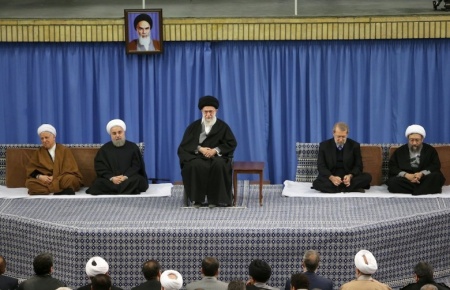
ayatollah (1)

Obscured by the drama of America’s presidential campaign, one major foreign policy issue—the future direction of the U.S. approach to Iran—is at a crossroads. President Obama stood before world leaders at the UN General Assembly in September 2013 and stated, “If we can resolve the issue of Iran’s nuclear program, that can serve as a major step down a long road towards a different relationship, one based on mutual interests and mutual respect.” Yet in the aftermath of the July 2015 nuclear accord, statements by Iran’s Supreme Leader Ali Khamenei and Iranian actions have provided little indication that U.S.-Iran relations are moving in a direction more respectful of American interests.

“It is now clear,” writes UAE Ambassador to the United States Yousef al-Otaiba, “that one year since the framework for the deal was agreed upon, Iran sees it as an opportunity to increase hostilities in the region.” Internally, executions of prisoners is at a twenty-year high. Still, the occasion of national elections in February for Iran’s parliament and Assembly of Experts—like the June 2013 election of President Hassan Rouhani—generated widespread commentary by policy experts in the United States that a process of meaningful change was at hand, as “reform” candidates outpolled their hard-line opponents in Tehran.

Testifying before the Senate on April 5, Under Secretary of State for Political Affairs Thomas Shannon asserted that “the extent to which reformers. . . swept the board” in polling for parliamentary seats in Tehran “highlights the fact that President Rouhani, and his intent on opening Iran to the world and addressing the fundamental stumbling blocks, has resonated in a positive way.” Under Secretary Shannon cited the difficulty in determining the impact of these electoral results on “how Iran behaves strategically” because, as he explained, Iran is “a mix of conflictive entities and groups, with hard-liners aligning themselves both with religious. . . and security leadership to prevent reformists from moving too fast, too far.” Part of the supreme leader’s work, said Mr. Shannon, “is to balance forces inside of Iran.”

Factionalism and jockeying for influence and position occur quite naturally in leadership ranks of democracies and dictatorships alike, including Iran. The key question Under Secretary Shannon could not answer definitively is whether regime politics would ever allow for real change in Iran’s “strategic” behavior. His remarks, however, reflected a long-standing belief by policymakers and advisors that the clerical circle in power since the 1979 revolution is capable of empowering political stewards who are inclined to reform Iran and fulfill President Obama’s hopeful vision, reciprocating his administration’s solicitude and forbearance toward Tehran.

Decades of Chasing the Elusive Promise of Reform

U.S. policymakers have experienced cycles of hope and disappointment with Tehran. After being singed by scandal in the mid-1980s, when President Reagan’s arms-for-hostages dealings were exposed, U.S. officials anticipated positive change in Iran when Akbar Hashemi Rafsanjani gained the presidency in 1990 with the promise of rebuilding an economy weakened after eight years of war with Iraq. However, terror attacks in Germany and Argentina ensued, along with assassinations of exiled regime opponents, tied directly to Rafsanjani and Khamenei. The June 25, 1996, bombing of Khobar Towers in Saudi Arabia killed nineteen U.S. airmen, as the Clinton administration maintained a “dual containment” approach toward both Iran and Iraq, backed by mounting sanctions.

When Mohammad Khatami took office as president in 1997 and proposed a “Dialogue of Civilizations,” again Washington judged that he was a reasonable interlocutor signaling a departure from Iran’s pattern of repression at home and terrorism abroad. The wave of domestic oppression that followed, including what came to be known as the “chain murders” of dissidents by Iran’s intelligence ministry, appeared to many as a hard-line reaction to Khatami’s agenda; nevertheless, for the Iranian people, hopes for reform under Khatami gave way to “fears of darker times ahead.”

Not even the fact that Iran’s nuclear program advanced dramatically in secret under President Khatami would shake Washington’s durable conviction that progressive elements within the Tehran ruling elite might one day ascend to power, as keen to see Iran adhere to international norms and uphold universal rights as are Western governments and citizens.

Listening to most Iran analysts at policy gatherings in Washington, two themes will be apparent. First, any mention of Iran’s status as the leading state sponsor of terrorism, its domestic human rights abuses or the destructive activities of the Islamic Revolutionary Guard Corps (IRGC), including its elite Quds Force, will be at once acknowledged and dismissed with a figurative hand-wave. This is old news; Iran has for years been sanctioned over it. Since there is no new story here, only unenlightened warmongers would harp on these aspects of Iranian affairs which, while condemnable, only stifle consideration of the possibilities for U.S. policy with Iran looking forward.

Second, the topic that animates the policy cognoscenti, and comports with the aspirations of the Obama White House, is the dynamic ebb-and-flow of political factions competing within Iranian leadership circles: “principlists” versus “reformers,” “conservatives” versus “moderates,” the hard-line Khamenei group versus the Rafsanjani group that seeks to integrate Iran more with the outside world. At a time when America’s own presidential election process has featured candidates channeling popular discontent toward the country’s political and economic elites, media coverage of Iran’s most recent elections—encouraged by the administration’s own rhetoric—has amplified the theme of grassroots rebellion at the polls. Given the lack of details reported about Iran’s managed electoral process, the average American would be forgiven for assuming that 79 million Iranian citizens were freely exercising popular sovereignty.

Iran’s wrongful behavior, other than actions seen as possible violations of the Joint Comprehensive Plan of Action (JCPOA), is reported, but not debated, as the policy community seems devoid of confidence that it could constructively influence the regime organs overseeing terrorism, paramilitary operations, judicial abuse, monopoly control of economic and financial assets, restraints on journalism, communications monitoring and censorship, arms trafficking to violent nonstate actors, propaganda and intelligence deception operations. This drumbeat of undesirable Iranian actions, now well into its fourth decade, has continued unabated despite the nuclear deal. Yet much more attention is paid to President Rouhani and Foreign Minister Mohammad Javad Zarif, the lead figures in Tehran’s diplomatic overture to the West, because they are perceived as agents of hoped-for change that might, at long last, end the negative drumbeat.

Is the administration’s hope justified or misplaced? Granted that factions rise and fall inside Iran’s clerical elite, the implications of these dynamics, like so much of Iran’s post-1979 history, offer reasonable grounds for debate. Debate is needed, as President Obama presented his diplomatic project with Iran last year as a fait accompli, accusing any detractors of courting war. Is it impolitic to suggest that neither Supreme Leader Ali Khamenei nor former president Rafsanjani would press their rival tendencies within the governing structure to the point of empowering other political forces and destabilizing the regime’s collective hold on power in Iran? Where has the case been made that clerical “reformers” will effect strategically significant change?

The central policy issue—how meaningful change in Iran can occur—has not been seriously explored. The administration’s and its supporters’ energies have largely been directed toward defending the JCPOA against political critics whose knowledge of Iranian affairs they regard as inferior. A top advisor to President Obama has recently admitted that the administration’s narrative “of a new political reality in Iran, which came about because of elections that brought moderates to power in that country. . .  was largely manufactured for the purpose for [sic] selling the deal.”

Nevertheless, by underscoring reformist challenges to the conservative order and touting electoral “upsets,” policy experts are acknowledging differences within the regime, and tensions between government and governed in Iran. What direction and scenario should the United States wish to see unfold from here? With the U.S. presidency transitioning in 2017, a proper understanding of the Tehran regime’s challenges, priorities and choices is needed now as the predicate to a realistic, principled and forward-looking “post-JCPOA” Iran policy.

Overlooked Clues from the Regime’s History

Americans of a certain age are familiar with scenes reported from Iran since 1979, where crowds gathered to chant “Death to America”; news in recent years has signaled the existence of dissent against the status quo, manifested in the rise and suppression of the Green uprising during the June 2009 elections, and the popular demonstrations against election fraud that followed, during which twenty-six-year-old philosophy student Neda Agha-Soltan was shot to death in the streets of Tehran by regime enforcers. But the reality behind these and other political events merits closer examination.

In a system where political authority is permanent and nonnegotiable, the narrative of both current and past events is vigilantly managed by the rulers, as an essential tool of regime survival. What with Foreign Minister Zarif’s artful appeals to Western opinion in which he proclaims Iran’s peaceful intent and devotion to international law, and laments its unfair victimization by “threats, sanctions and demonization” by the United States in particular, one can only imagine what effect thirty-seven years of managed media have had on the population, the penetration of internet and satellite television notwithstanding.

In Iran today, where the loyalty of aspirants to political office is closely monitored and overt dissent is severely punished, there is no credible measurement of the population’s true level of attachment to, or desire to be rid of, the constitutional caliphate fashioned in 1979 by Ayatollah Khomeini. Khomeini’s fusing of politics and religion via a new constitution codifying a “guardianship of the Islamic jurist” (velayat-e faqih) drew upon the religious devotion of Iran’s Muslims as the basis for his exercise of temporal power. For many Iranians at the time, Muslims included, religious dictatorship was a far cry from the participatory democracy they had anticipated after enduring the excesses of the shah.

Confronted with growing resistance in the spring of 1981 to the restrictive new order that culminated in massive pro-democracy demonstrations across the country invoked by MEK leader Massoud Rajavi on June 20—twenty-eight years to the day before Neda famously met her death under similar circumstances—Khomeini’s reign was secured at gunpoint with brute force, driving Iran’s first and only freely elected president, Abolhassan Bani-Sadr, underground and into permanent exile. This fateful episode was described by historian Ervand Abrahamian as a “reign of terror”; Professor Marvin Zonis called it “a campaign of mass slaughter.”

President Obama, reflecting a view common among analysts and journalists in America, has made imprecise reference to “the theocrats who overthrew the Shah.” The reality is that in the late 1970s the shah lost his mandate with many segments of the Iranian population, and his departure sparked a dramatic outburst of electoral competition, even while Khomeini was requiring office seekers to accept his constitutional formula, elevating religious authority over all politics. As the incompatibility of democratic principles with velayat-e faqih became increasingly evident, the regime was, as Professor Abrahamian described it, “clearly. . . losing control in the streets.” What Iranians today know all too well, and Americans would profit by better understanding, is that the “theocrats” secured control of Iran not by bringing down the shah, but by bringing down the revolution.

It is not the only historical misperception that has stood uncorrected. Speculation has surrounded the Obama administration’s Iran diplomacy that some kind of gesture by the United States—if not an outright apology, then an acknowledgement of past mistakes—would be extended as atonement for the CIA coup that deposed nationalist Prime Minister Mohammad Mossadegh in 1953. Indeed, Tehran has repeatedly demanded it. Yet, for historical justice to be served, a representative of the supreme leader would need to affix his signature to any such mea culpa alongside that of the president’s representative, reflecting the fact that the leading clerics at the time, including Khomeini’s mentor Ayatollah Abol-Ghasem Kashani, openly colluded with the Pahlavi dynasty and backed the ouster of Mossadegh.

Kashani later pronounced Mossadegh guilty of betraying the jihad, and said he deserved the death penalty. Khomeini himself expressed satisfaction with Mossadegh’s downfall. Here again, the clerics have airbrushed their place in Iran’s turbulent political evolution for the West’s edification.

June 1981—a cataclysmic event in Iran’s modern political history, second only perhaps to the shah’s demise—is relevant to understanding why the clerics responded with deadly force to the challenge of the Green uprising and the return of citizens to the streets en masse in 2009, demanding democratic accountability. Nor was the closed (and rigged) electoral process the only longstanding source of disaffection: Khomeini’s fundamentalist forces early on had targeted Iran’s universities with their “cultural revolution” to suppress mainly leftist critics, whose appeal among students and intellectuals further highlighted their lack of political legitimacy.

Despite their comprehensive efforts to silence intellectual dissent, the torch of antiauthoritarian resistance carried through the 1980s to the next generation, resurfacing in public protests during July of 1999. People took to the streets after regime forces closed a student paper and violently attacked a dormitory at Tehran University, reportedly throwing students from windows.

Fear of the “street,” consequently, was almost certainly a central consideration behind Iran’s costly (and continuing) intervention in Syria after pro-democracy Arab Spring demonstrations first arose there in 2011. More than any other partisan in the Syria conflict, Iran is credited with keeping a minority secular dictatorship in power, in defiance of President Obama’s vow that Bashar al-Assad must go, a determined if ill-equipped Syrian resistance, and UN-backed efforts to foster a national reconciliation process entailing a transition to new leadership.

Similarly in Iraq, the Quds Force’s active direction of client Shia parties and militias, reported to be “carrying out kidnappings and murders and restricting the movement of Sunni Arab civilians,” has impeded that country’s efforts toward a functioning multiethnic constitutional system, and further imperiled Iraq’s fragile national unity.

Islamic State may be a concern to Iran, but successful, multiethnic constitutional republics replacing the Baathist dictatorships in Syria and Iraq would be a much greater concern. For Tehran, the potential that an eastward-spreading Arab Spring could ignite a new Persian Spring was, and remains, a constant danger to the Islamic Republic’s grip on the reins of power, to be prevented at all costs.

The deficit of legitimacy underlying the mullahs’ claim to power remains a blind spot in Washington’s collective understanding of the Iranian revolution, overlooked in the wake of the hostage crisis. It may account for the absence of critical thinking to challenge, for example, the regime’s narrative of its eight-year war with Saddam Hussein’s Iraq, never questioning why Khomeini, after regaining by mid-1982 all the Iranian territory seized by Iraq in 1980, prosecuted the war for six more years, during which Iran suffered 90 percent of its casualties and depleted its economy.

Just as the seizure of the U.S. embassy in 1979 had empowered the clerics against contending political forces, the war with Iraq provided the supreme leader with an emergency mandate to crush growing internal dissent, impose religious and cultural requirements, and appropriate all necessary resources to assure the regime’s primacy and control. While every Iranian schoolchild and adult throughout the 1980s was fed the jingoistic line justifying these extreme sacrifices, Khomeini’s role in perpetuating the war is by no means universally recalled by Iranians in a favorable light.

A similar lack of skepticism has left U.S. policymakers with no insight as to why a hojatoleslam—a cleric with religious status well below others at the time—belatedly became Khomeini’s chosen successor as supreme leader rather than the broadly respected Grand Ayatollah Hossein Ali Montazeri; no benign explanation as to why Iran would choose to pursue major nuclear infrastructure investments instead of far more accessible and cost-effective energy options, given its meager national uranium supplies; and no reflection on whether considerations other than sanctions-induced financial duress may have led Iran to the P5+1 negotiating table.

Similarly, one saw no speculation in Washington that factors other than personal legal transgressions could have lain behind the arrest and imprisonment of the Washington Post’s correspondent Jason Rezaian—or curiosity about what the regime hoped to hide by deterring Western correspondents from seeking visas to report from Iran at that time. A clue may be found in the emerging story of another U.S. hostage, former CIA contractor Robert Levinson (still held by Iran), whom the Iranians reportedly offered via the French government in 2011 to release in exchange for conclusions, in a pending IAEA report, that Iran’s nuclear program was “peaceful” in nature.

This credulous U.S. approach to Iranian affairs has not been helped by what might delicately be termed self-censorship on the part of Western correspondents and media companies, who know they would be shut out of Iran if their reporting sufficiently displeased the regime. For too long, U.S. policy has reacted to Iranian government actions and words without a credible functional understanding of the nature of this important international actor.

The Regime’s “Job One”: Maintain Control

During the regime’s formative years, the man who would in 1989 succeed Khomeini as supreme leader, Ali Khamenei, worked in partnership with Rafsanjani to implement Khomeini’s doctrine of bast (expansion) and hefz (preservation), the two facets assuring continuity of the Islamic revolution. Their work was at the center of Khomeini’s velayat-e faqih project. While both figures are today identified with conflicting political tendencies and loyalists, the larger reality is that bast and hefz remain core tenets of the Islamic Republic of Iran.

What Washington describes in straight factual terms—destabilization of neighboring countries, propping up a dictator in Damascus guilty of grave crimes against his country, arming extremist nonstate actors, fomenting sectarian warfare that undermines Iraq’s fragile hopes for rights-based governance—the clerics in Tehran call bast. The revolution, said Khomeini, requires energetic efforts to advance Tehran’s agenda well beyond the country’s borders.

Similarly, the surreptitious and aggressive buildup at home of Iran’s uranium enrichment capacity, and associated “possible military dimensions” of its nuclear program, combined with widely condemned and worsening human rights abuses, restrictions on journalists, monitoring and propaganda imposed within the information space, and seizure of control over much of the functioning economy—all these and other domestic measures fulfill the doctrine of hefz. To stay in power, the regime must monopolize the levers of power within the country.

As two of the original officers of the velayat-e faqih operation from the outset of Ayatollah Khomeini’s tenure, Ali Khamenei and Hashemi Rafsanjani understood, as few others did, the dynamic nature of the revolutionary enterprise. Both recognized that the Islamic Republic would not long survive without continually demanding respect and pursuing influence externally while requiring sacrifice and enforcing subservience internally. In 1989, after Ali Khamenei succeeded Khomeini, Rafsanjani worked in partnership with the new supreme leader to enhance the authority of the office as compensation for his lack of religious and political stature and charisma.

The velayat-e faqih has always operated on two fronts. Domestically, it maintains a focus on image-building propaganda for the leader of the revolution, ever promoting the stature of its “heroic” godfather, Ayatollah Khomeini. Propaganda is used to rally and unify the Revolutionary Guards, mobilize paramilitary forces such as the Basij for public crackdowns, and organize the religious sector across the nation for Friday prayers in accordance with prescribed policy themes.

Internationally, the office sustains the narrative of leadership over Shia Muslims around the region, and the Islamic world generally. Khomeini’s mantra that the new Islamic republic would conquer “Quds via Karbala” makes clear that he set out to create a dominion of influence unbounded by Iran’s borders. As the embodiment of the Twelfth Imam succeeding the Prophet Muhammad, Iran’s Supreme Leader poses a challenge to the Sunni world, asserting its own claim to Islam’s most holy sites in defiance of the Saudi king (“Guardian of the Two Holy Mosques” at Mecca and Medina) and the Hashemites of Jordan, who trace their lineage to the Prophet and are considered the overseers of the Al Aqsa mosque in Quds (Jerusalem), Islam’s third holiest site.

In both its internal and external dimensions, the revolutionary project spawned by Khomeini has confounded Western efforts to understand it, and thus to engage diplomatically with confidence in a predictable outcome. Why did the clerical regime from its earliest years, consumed with extinguishing democratic impulses at home and repelling Iraq’s incursions on their shared border, repeatedly target U.S. and European forces, embassies, hostages and airline passengers, starting in Lebanon? What was the purpose of arming and supporting proxy nonstate militias abroad and staging spectacular acts of terror as far afield as Argentina?

While Iran’s abuse of sovereign privilege—running terror operations under the cover of diplomatic secrecy and immunity in such capitals as Ankara, Damascus, Bonn and Buenos Aires—has long branded it a serial violator of international law and norms, these hostile acts abroad are better understood for their intended effect on regime cohesion and the loyalty of its footsoldiers, as manifestations of Khomeini’s bast doctrine, his unique theory of empowerment through religious extremism, pursued at the direct expense of the Westphalian system.

The one goal the international community has sought in all its dealings with Tehran—a readiness to adhere to accepted norms of state conduct, including respect for universally recognized rights at home—is the very condition that the Islamic Republic of Iran could least tolerate. The acceleration of both bast and hefz since 2013 under President Rouhani, at the same time that Iran was garnering international goodwill, relief from economic sanctions and legal recognition of its nuclear rights at the negotiating table, may have been a response to popular discontent inside Iran. It was not, however, a move toward any version of reform that would comport with American principles or ideals.

Signs of Failure and Desperation

A compelling case can be made, and should be the subject of policy debate today, that Iran’s exertions around the Middle East are falling well short of Khomeini’s doctrinal requirements calling for export of its revolution and leadership of the Muslim world against the West, particularly the United States. In 2016, much of the Muslim world rejects Iran’s brand of revolution. Even the fifty-seven-member Organization of Islamic Cooperation has formally “deplored Iran’s interference in the internal affairs of the States of the region and other member states. . . and its continued support for terrorism.”

With the exceptions of Syria’s secular dictatorship and some Shia factions in Iraq, states surrounding Iran continue to defy and resist Tehran’s pretensions of religious hegemony. Tehran’s overt attempts to influence Shia populations within Arab Gulf states have only served to poison relations with those governments, which to date have refrained from reciprocal meddling on behalf of 18 million Sunni Iranians, to whom the mullahs have denied a single mosque. Influential Shia figures, including Ayatollah Sistani in Iraq, refuse to accept the system of velayat-e faqih or endorse Khamenei’s leadership among Muslims. Iran’s funding, training and sponsoring of warring factions in Iraq, Syria, Yemen and Afghanistan could as rightfully be assessed a losing as a winning effort by the regime’s own metrics.

The costs of these campaigns, particularly casualties suffered by the IRGC and the Quds Force, which have struggled to replenish their ranks and their leadership cadres from today’s young generation, would likely prove unsustainable over time. Recent losses reportedly suffered by the IRGC along the Iran-Iraq border, and claims by the Democratic Party of Iranian Kurdistan and the Kurdistan Freedom Party that they have recently resumed “armed resistance” against the revolutionary republic, reinforce perceptions that the momentum of the ambitious crusade launched thirty-seven years ago by Khomeini is now in retreat.

The supreme leader’s office has therefore viewed the nuclear weapons program as a game-changing substitute for Tehran’s unproductive paramilitary efforts—hence Khamenei’s denial (without further explanation) that the JCPOA leaves Iran stripped of nuclear deterrence. In recent years his office has lauded the “jihad spirit” of Iran’s nuclear scientists in their drive to stand up to foreign powers “like a lion.” He earlier declared the program an essential aspect of Iran’s “national identity” and “dignity,” all part of a narrative intended to compensate for, and obscure, Khamenei’s diminishing power at home and in the region.

Recall that the nuclear program began during Rafsanjani’s presidency; it was institutionalized during Khatami’s time, and expanded to a multitrack program during Ahmadinejad’s presidency. Whatever Washington analysts may believe about the June 2013 elections, the clerics made clear months beforehand that they would “engineer” the electoral process to succeed Ahmadinejad. Khamenei’s expectation of his one-time nuclear negotiator, Hassan Rouhani, was that he would deliver the program despite all the external and internal pressures.

Rouhani’s pursuit of a nuclear deal entailing sanctions relief, far from representing a policy split from Khamenei’s embrace of the nuclear program, was done with the supreme leader’s full support. While the P5+1 secured arrangements to inhibit and detect any near-term nuclear weapons breakout efforts by Iran, the many statements by Khamenei are consistent with the conclusion that Rouhani’s diplomatic approach was deemed more likely to enable the Islamic Republic to maintain the posture of nuclear deterrence than a policy of escalating confrontation and defiance of the West.

Two years of high diplomacy—extended repeatedly without complaint from any side, despite the absence of agreement—by the regime, sharing the global spotlight with the world’s leading powers, rehabilitated Iran’s image after a period of growing isolation, threats of military confrontation and, yes, economic pain from targeted sanctions, falling oil prices and a weakening currency in 2012. Such considerations lay behind Iran’s success in shaping the JCPOA as a nonbinding agreement in which the language and process to enable the “snap-back” of sanctions is convoluted—the term never appears—and thus hard to portray within Iran as a concession.

At the same time he was calling publicly for “heroic flexibility” in Iran’s foreign policy, Khamenei clearly intended that Rouhani and Iran’s negotiators secure the maximum flexibility to continue the militarization of the nuclear program, including ballistic missile development, as was seen with the March 2016 missile tests. While the United States responded by sanctioning the IRGC Aerospace and Missile Force, and Secretary Kerry suggested a new arrangement with Iran to address concerns about the missile tests, Foreign Minister Zarif called his complaints “baseless”; Defense Minister Hossein Dehghan called them “nonsense.” The commander of the missile force claimed that the U.S. government had quietly urged Iran not to publicize its missile tests, presumably to avoid complicating the larger relationship.

Regime Preservation or Change from Within?

If Iran’s strategic behavior, in Under Secretary Shannon’s parlance, is not fundamentally different under either hard-line or “reformist” management, what to make of the factional differences within the regime? Khamenei’s focus has been on hefz and the sustainment of Iran’s nuclear and conventional military modernization programs. For self-proclaimed reformers, including Rouhani and Rafsanjani, the priority order is the reverse. Their view is that by easing international sanctions they can better defuse the public’s push for meaningful political reform and thereby preserve the system of velayat-e faqih.

Rouhani, like Khatami before him, has pledged domestic reform yet presided over repression. Even his explicit 2013 pledge, to release from house arrest the leaders of the Green uprising and all who were imprisoned following the 2009 protests within one year, has gone unfulfilled years later. While the regime’s internal fissures may inspire hope in the West for positive change, the evidence for that is lacking.

The perennial perception in the U.S. policy community that “reformist” equates to true moderation is belied by, for example, “reformist” Mohammad Khatami’s role as minister of Islamic Culture and Guidance early in the Iran-Iraq War, when he generated propaganda to recruit children to sacrifice themselves by crossing minefields ahead of military forces. An estimated forty thousand died. Despite worldwide condemnation of this practice, Khatami as recently as 2007 lauded the wartime role of youth in “the proud years of the Sacred Defense.” The use of child soldiers by Tehran has now apparently been revived by his “reformist” successor Hassan Rouhani.

For all the talk about reform and betterment of the people’s lot, in Iran today one finds no equivalent to glasnost or perestroika, no clerical Deng Xiaoping ready to strike a grand bargain freeing the people economically and socially in return for continued political subservience to the supreme leader.

The relevant fault line within Iran’s leadership, for many years now, has been a difference over how best to carry forward Khomeini’s Islamic republic, not how to end it. Differences in regime priorities manifested themselves in the recent parliamentary elections, and more factionalism and clashing rhetoric is predictable in the political arena. Still, as competition over priorities and tactics to preserve velayat-e faqih has become personal—and public—for both sides over the years, and some individuals have shifted alliances and rebranded themselves, the roster of leading players has remained strikingly consistent.

While many have moved seamlessly between so-called reformist and conservative patronage, the driving motive seems less to be ideology than competition for resources and leverage. Even such proven supporters of velayat-e faqih as the five Larijani brothers, who rose to positions of influence within the parliament, Guardian Council, judiciary, broadcasting (IRIB) and foreign ministry, are viewed with suspicion by Khamenei for this very reason.

Khamenei has survived by surrounding himself with a small and shrinking circle of trusted advisors, including his own son Mojtaba, who leads the Basij and oversees all his financial affairs operating beyond the reach of sanctions. Some have speculated that Mojtaba is being groomed to become his father’s successor, suggesting Khamenei’s misgivings about Khomeini’s own mechanism for leadership transition.

Ali Akbar Velayati, serving as his foreign-affairs advisor, once served under Prime Minister Mir Hossein Mousavi (the now-detained leader of the Green uprising) and Hashemi Rafsanjani. Yahya Safavi, head of the IRGC, serves as his special advisor in regional affairs and has recently touted the “alliance” of Iran, Russia, Iraq, Syria and Hezbollah. Mojtaba Zolnour also serves as his representative in the IRGC, and has recently claimed that even if Iran were to give up its nuclear program, it would not weaken “this country’s determination to destroy Israel.” Mohammad Salimi, formerly defense minister in the cabinet of Mir Hossein Mousavi, now serves as his commander of the Iranian Army.

As much as regime figures may jostle for primacy and influence over Iranian policy, all are charter members of an enterprise whose overriding mission is their collective survival in power. What recent trends reveal is that the supreme leader’s diminishing power is accompanied by, and likely further eroded by, the more open rivalries at play in Tehran.

How to Reform the Islamic Republic?

It may seem exhausting for the U.S. foreign-policy establishment, having devoted so much effort to closing off Iran’s “pathways to the bomb,” to be expected now to address an array of additional concerns about Iran, from political disenfranchisement to human-rights abuses, suppression of women and minorities, destabilization of neighboring countries, and support for terrorism. The list is long, and Washington’s record of tempering Tehran’s malignant behavior offers little grounds for optimism.

What makes these concerns more pertinent today is not the closing off of Iran’s illicit pathways to the bomb under the JCPOA, but the opening up of a new pathway to the bomb courtesy of the JCPOA itself: the right granted to Iran to become an internationally recognized nuclear power when the agreement’s restraints expire. Secretary Kerry emphasizes how far into the future that time will be. Can the United States be certain that the regime in Tehran will have “reformed” by then? And—crucially—what changes from today’s Iran would constitute “reform”?

If one were to poll experts on how the United States should measure reform in Iran, a consensus would likely be elusive. Ending the loyalty screening and disqualification by the Guardian Council of candidates for office would be an obvious metric; yet it has been more than two decades since the percentage of registered candidates ultimately permitted to run for president has exceeded 2 percent. Even with Rafsanjani’s two electoral victories, in 1989 and 1993, more than 96 percent of registered candidates were disqualified in advance.

Certainly a sharp reduction, and preferably the end, of executions in Iran would herald reform; yet here again, one has to question the likelihood of meaningful change. The State Department’s 2015 annual human rights report, released in April 2016, cites a long list of human rights abuses in Iran, noting that “Impunity remained pervasive throughout all levels of the government and security forces.” President Rouhani, upon being elected in 2013, nominated as his justice minister Mostafa Pour Mohammadi, a man personally implicated in the 1988 extrajudicial executions of as many as thirty thousand jailed dissidents. This was a crime “of greater infamy,” according to British-Australian human rights lawyer Geoffrey Robertson, whose 2009 inquiry brought the full story to light, than the World War II Japanese death marches or the 1995 Srebrenica genocide.

While a serious debate is needed on U.S. policy toward this troublesome, and troubled, regime, there is one act that more than any other would signal to the West, Iran’s neighbors and above all its 79 million citizens that reform is at hand. Iran’s rulers need to face the inescapable truth that in their quest to be at once a religious caliphate and a sovereign country, they have failed in both roles.

By removing from the constitution the writ of divine power—velayat-e faqih—that has corrupted both politics and religion in Iran with immeasurable human costs, the clerics can focus on repairing their religious reputation and return the revolution to its rightful owners, the Iranian people. The world will reward Iran for a national effort to pursue reconciliation without recrimination, a social contract enabling freely elected leaders to reflect the goodness of a great people. In time, an Iran so reformed will recover, and assume a position of honor and responsibility among nations.

Ambassador Lincoln Bloomfield Jr., a former U.S. defense and foreign policy official now serving as Chairman of the Stimson Center in Washington, has written and testified about the inaccuracies of narratives emanating from the regime in Iran. Dr. Ramesh Sepehrrad is a ranking executive for a major American technology company and a Scholar Practitioner at the George Mason University School of Conflict Analysis and Resolution. Her parents and sister were arrested by the fundamentalist regime in Iran during the 1980s for helping to publish pro-democracy literature; detained at the age of fourteen, her sister was kept in prison for two years.

5 Ways the Iranian Regime Is Crushing Dissent

May 29, 2016

5 Ways the Iranian Regime Is Crushing Dissent, Clarion Project, May 29, 2016

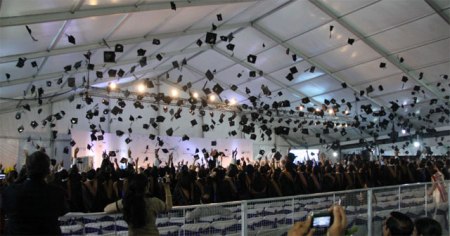
Graduation-Wikimedia-Commons-IP(Illustrative photo; Wikimedia Commons)

1. Iranian authorities arrested 30 young people (including one woman) at a private graduation party in a villa in Qazvin. In an unusual move, a special court was convened the next day where the defendants were sentenced to 99 lashes each and the punishment was carried out immediately.

In Karmon, another 23 people, including a famous artist, were arrested at a party in a park.

The Iranian authorities’ crack down on mixed parties – which often include alcohol and mixed dancing – is a response to a perceived “Westernization” of Iran’s strict Islamist culture imposed on the population after the 1979 Islamic revolution.

Extremists fear that the nuclear deal forged by Iran’s “moderate” president, Hassan, Rouhani, will open Iran to unwanted influences.

2. The campaign against house parties follows a similar campaign against beauty salons, which recently saw police raid these establishments in search of (forbidden) male workers as well as those giving and receiving “Western” haircuts.

3. An Iranian court announced the arrest of eight people and charged them with making and broadcasting inappropriate music videos, according to Al-Hayat newspaper. The videos were broadcast on a satellite TV channel based outside of Iran that is considered to be anti-regime.

4. Seventeen Iranian miners who protested losing their jobs were given 30-100 lashes each for instigating the demonstration. The miners were also fined and given prison sentences.

The men worked at a gold mine in the Western Azerbaijan Province and were part of a group of 350 employees who were fired from their jobs, prompting a large demonstration at the time.

Of the 17, five received 100 lashes, another five received 50 lashes, and the remaining seven received 30 lashes for their part in the protests.

5. Last week, Iran chose as head of the Assembly of Experts Ayatollah Ahmad Jannati . Described as the most radical hard-line cleric in Iran, Jannati will have the power to select the Ayatollah Khamenei’s successor, among other influential responsibilites. A few choice quotes from Jannati include:

“You cried: ‘Death to the Shah,’ and indeed, he died. You cried: ‘Death to Israel,’ and it is now on its deathbed. You cry: ‘Death to America,’ and before long, Allah willing, the prayer for the dead will be recited over it.”

“‘Death to America’ [is] the first option on our table… This is the slogan of our entire people without exception. This is our number one slogan.”

Iran Ramps Up Crackdown on Women

May 18, 2016

Iran Ramps Up Crackdown on Women, Front Page MagazineAri Lieberman May 18, 2016

women_in_shiraz_2

On Sunday, the Islamic Republic announced the arrest of eight women whose photographs were featured on Instagram. The models reportedly failed to adhere to stifling Islamic style dress codes rigorously enforced by Iran’s oppressive mullahs. More specifically, they posed without wearing religiously sanctioned head scarves designed to cover exposed hair.

Following her arrest, one of the models was forced to appear on Iranian TV in the presence of two prosecutors. Wearing a black head scarf and matching black gloves, she was recorded – almost certainly under duress – sanctioning the government’s Orwellian-like actions, warning other Iranian women that they “can be certain that no man would want to marry a model whose fame has come by losing her honor.” As an aside, when Iranian navy pirates operating off Farsi Island kidnapped 10 U.S. Navy sailors in the Arabian Gulf in January, they forced a female sailor into Sharia compliance, requiring her to don a hijab.

The arrests come in the midst of a yet another government crackdown on social media and dissent. The anti-social media operation, ominously codenamed “Spider II” has thus far netted dozens of models, photographers, makeup artists and other dangerous enemies of the state. Also arrested was Iranian blogger Mahdi Boutorabi who reportedly covered Iran’s rigged 2009 elections. It appears that periodically, the mullahs get bored or insecure and conjure up ways to make the lives of their citizens more miserable.

But the Islamic Republic’s absurdity doesn’t end there. Iran’s Revolutionary Guard bizarrely accused reality star (and not much else) Kim Kardashian-West of being behind the nefarious plot to undermine or otherwise taint the morals of Iran’s young women.

Mostafa Alizadeh, a spokesman for the Revolutionary Guard’s Organized Cyberspace Crimes Unit stated that, “Ms. Kim Kardashian is a popular fashion model so Instagram’s CEO tells her, ‘make this native.’” He added that “There is no doubt that financial support is involved as well. We are taking this very seriously.”

In February, Iranian authorities engaged in a similar crackdown, targeting a benign rock group known as “Confess.” Authorities charged the group’s members with “blasphemy,” writing “satanic” lyrics and meeting with forbidden foreign radio stations. The charge of “blasphemy” carries a punishment of execution. Others in the Islamic Republic have been arrested and sentenced to lashings for merely appearing in a YouTube video while dancing and lip syncing to Pharrell’s hit song “Happy.”

Conspiracy theories and political and religious oppression are the norm in the Islamic Republic. Let us dispel with the notion that there are “moderate” forces within the Iranian government working to change things for the better. Power in that tyrannical regime vests with two entities – Iran’s “Supreme Leader,” the Holocaust-denying Ayatollah Khamenei and his thuggish henchmen of the Iranian Revolutionary Guard Corps and the Basij militia.

The Obama administration and its “echo chamber” (as Obama shill Ben Rhodes puts it) would like us to think that there are moderate elements and reformers with whom we can deal. That notion is an absolute farce but continues to gain credence in some leftist circles with vested interests in propagating this false narrative. For example, while the New York Times reported the arrest of the Iranian models, it made sure to qualify its reportage by informing its readers that the crackdown was the work of “hard liners.”

In the meantime, while Ben Rhodes is creating his spin and John Kerry is thanking the Iranians for kidnapping and mistreating U.S. Navy sailors, the mullahs of the Islamic republic continue to crack down on dissent and execute human rights activists, continue to advance their ballistic missile program (in defiance of UNSC resolutions) and continue to cut a path of misery and destruction in the Mideast, from Syria to Yemen.

The administration has done its best to convince the American public that Iran can be trusted to keep agreements. This rests on the false and dangerous narrative that there exists a power struggle in Iran between moderate reformers who have the support of the people and an assortment of hard line religious extremists and anti-Western zealots. Narratives running counter to this fantasy-like version of events are dismissed by the administration.

Even worse, it has now come to light that the Obama administration has asked the Iranians not to publicize their illicit ballistic missile activities for fear of unsettling opponents of the Joint Comprehensive Plan of Action (JCPOA). Meanwhile John Kerry is quietly attempting to encourage various European banking institutions to do business with the Iranians despite the fact that the IRGC controls vast swaths of Iran’s economy.

No matter how much spin the Obama administration attempts to place on the merits of the JCPOA and no matter how much it attempts to cover its tracks, it cannot hide the fact that the Islamic Republic is a pernicious regime that cannot be trusted and represents a malignancy that sooner or later will have to be confronted. The only question that remains is whether Iran will have nuclear bombs when that time arrives.

Iranian Basij Militia to Infiltrate Civilian Life to Stamp Out Dissent

May 9, 2016

Iranian Basij Militia to Infiltrate Civilian Life to Stamp Out Dissent, Clarion Project, May 9, 2016

(With the Iran Scam firmly in place, The Islamic Republic again demonstrates how “moderate” it has become. — DM)

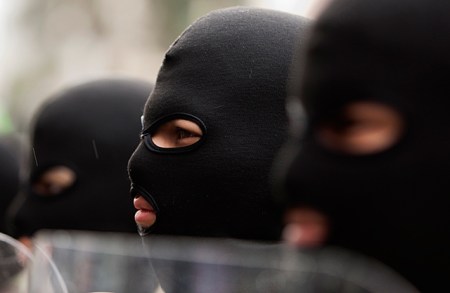
Iran-Basij-Hooded-Men-IP_3Members of the Basij voluntary militia (Photo: © Reuters)

Iran plans to use its volunteer Basij militia as an urban force to stamp out dissent in every aspect of life in the Islamic republic.

As reported in the Washington Times, the force will be dispersed from “villages to schools to sports clubs to factories” to push the ayatollah’s agenda.

The Times quotes a report by the U.S. Army’s foreign military studies office at Fort Leavenworth in Kansas.

“While the law enforcement forces might conduct more regular police work, Basij operations tend to focus more on countering ideological enemies and encouraging fealty to the Islamic Revolution through after-school programming and university organizations, and by policing morality,” writes analyst Michael Rubin.

The fact that 99 percent of reformist candidates for the recent parliamentary elections were disqualified “indicates a desire by the clerical hierarchy within Iran to consolidate more hard-line control,” he said, adding, “Should it be implemented, it suggests that the regime may be preparing for a new cultural revolution to weed out elements of reformism or moderation.”

At the same time, 7,000 male and female plain-clothed officers have begun patrolling the streets of Iran to insure, among other things, that women dress in a proper fashion.

The expanded “morality police” comes after pressure from conservative parliamentarians to further clamp down on women’s rights.

World Affairs Journal explains the new officers “blend in and mix with people as much as possible, then report the “criminals” they find, such as women who wear fingernail polish or have too much hair showing under their headscarves, to uniformed authorities.”

Khamenei’s Anti-Americanism

May 9, 2016

Khamenei’s Anti-Americanism, Gatestone InstituteMajid Rafizadeh, May 8, 2016

(Please see also, Dangerous illusions about Iran. — DM)

♦ Khamenei is sending a strong signal to Washington that Iran’s reintegration in global financial system does not mean that the Iranian regime will change its hostility towards the U.S. and Israel.

♦ “The Persian Gulf is the Iranian nation’s home and the Persian Gulf and a large section of the Sea of Oman belong to this powerful nation. Therefore, we be present in the region, hold war games and display our power.” – Iranian Supreme Leader Ali Khamenei

♦ In addition, Khamenei is sending a message to the Iranian people that the current process of implementing the nuclear agreement, lifting sanctions, and partial economic liberalization does not mean that Iran is going to liberalize its politics and allow freedom of speech, freedom of the press, and more political participation.

Some politicians and policy analysts argue that Iran’s sanctions relief and the continuing implementation of its nuclear program would push Iran towards moderation in dealing with the United States and Israel, as well as scaling down Iran’s expansionist and hegemonic ambitions. The realities on the ground suggest otherwise.

As Tehran’s revenues are rising, anti-American and anti-Semitic rhetoric by Iran’s Supreme Leader, Ayatollah Ali Khamenei, are escalating.

The Iranian regime continues to view the U.S. and Israel as their top geopolitical, strategic and ideological enemies. According to Iran’s Mehr News Agency, on May 1, Khamenei welcomed the Secretary General of Palestinian Islamic Jihad, Ramadan Abdullah Shalah, and his accompanying delegation in Tehran:

“Ayatollah Khamenei reaffirmed that with this perspective in regional issues, Iran sees the United States as the main enemy with the Zionist regime standing behind it. He pointed to extensive, unprecedented sanctions of the U.S. and its followers against the Islamic establishment in recent years and dubbed the objective of them as discouraging Iran from continuing its path; ‘but they failed to achieve their goals and will fail in future as well.’ “

Khamenei is sending a strong signal to Washington that Iran’s reintegration in the global financial system does not mean that the Iranian regime will change its hostility towards the U.S. and Israel.

In addition, Khamenei is sending a message to the Iranian people that the current process of implementing the nuclear agreement, lifting sanctions, and partial economic liberalization does not mean that Iran is going to liberalize its politics and allow freedom of speech, freedom of the press, and more political participation.

Khamenei is also making it clear that Iran is not going to fundamentally change its foreign policy objectives in the region.

Regarding Iran’s role in the Gulf, Iran’s Supreme Leader pointed out on May 2 that

“The Persian Gulf is the Iranian nation’s home and the Persian Gulf and a large section of the Sea of Oman belong to this powerful nation. Therefore, we should be present in the region, hold war games and display our power.”

When it comes to Syria, Iran’s Islamic Revolutionary Guard Corps (IRGC) has become more emboldened and empowered in supporting the Syrian regime financially, militarily, and in intelligence and advisory capacities. Even during the current peace talks, Iran is ramping up its presence in Syria to increase Bashar Assad’s leverage in the negotiations.

In Iraq, Iran’s sectarian agenda and support for Shiite militias continues to cause political instability. This week, hundreds of followers of the Iraqi Shia leader, Muqtada al-Sadr, stormed into the Iraqi parliament building, demanding its speaker halt the session. Prime Minister Haider al-Abadi warned that these protests could lead to the Iraqi state’s failure. After the protests, al-Sadr — who spent several years studying in Qom (Iran’s center of Islamic studies) — travelled to Iran.

Currently, some of the powerful Iraqi Shiite militias with which Iran has close connections, and in which it is investing its resources, are: Sadr’s Promised Day Brigade, the successor to the Mahdi Army; the Badr Organization, Asa’ib Ahl al Haqq (League of the Righteous) and Kata’ib Hezbollah (Battalions of Hezbollah).

In Yemen and Bahrain, Iran’s support for the Houthi rebels and Shiite groups continues to fuel the sectarian conflicts there.

Khamenei has also unleashed a series of anti-U.S. and anti-Israel tweets, including:

“Lebanon’s Hezbollah is strong enough not to be hurt by some pressures; today, no doubt Zionist regime is scared of Hezbollah more than past.” (1 May 2016)

“Shia-Sunni clash is colonialist, US plot. Top issue is to realize 2 sides of the extensive war & one’s stance to avoid being against Islam.” (1 May 2016)

Iran’s foreign policy is anchored in three areas: ideological principles (anti-Americanism and anti-Semitism), national interests (mainly economic gains), and nationalism.

Although Khamenei needed to emphasize Iran’s national and economic interests, there is no evidence that he is giving up on the revolutionary ideological norms. Khamenei is relying on the so-called moderates — President Hassan Rouhani and his U.S.-educated foreign minister, Javad Zarif — to continue the process of implementing the nuclear deal in order to benefit Iran economically and ensure the regime’s hold on power.

1590Iran’s Supreme Leader, Ayatollah Khamenei (left), is not giving up on the revolutionary ideological norms. He is relying on the so-called moderates, such as President Hassan Rouhani (right), to continue the process of implementing the nuclear deal in order to benefit Iran economically and ensure the regime’s hold on power.

Nevertheless, at the end of day, the key decision makers in Iran’s political establishments are Khamenei and the senior cadre of the IRGC, who prioritize Iran’s ideological and revolutionary principles. It is from them that Khamenei draws his legitimacy.

As long as the Supreme Leader is alive, one should not expect that Iran’s reintegration into the global economy to move the country to the moderate end of the spectrum, or that its anti-American, anti-Semitic sentiments and fundamentals of Tehran’s foreign policies will change.