Archive for the ‘Iran – human rights’ category

Iranian Officials Inconsistent in Describing Protestors’ Motives and Goals

December 30, 2017

Iranian Officials Inconsistent in Describing Protestors’ Motives and Goals, Iranian News Update, Edward Carney, December 30, 2017

Please see also, The First Anti-American President, the thrust of which is

Donald Trump is certainly the opposite of an anti-American president, and he has no affection for our enemies. He has enabled the Ukrainians to fight, perhaps effectively, against the Russians. So why can’t he enable the Iranians to fight against the ayatollahs?

In the Ukrainian case we’re talking about military weapons; in the Iranian conflict the weapons are political.

If the Iranians rose up against the regime when Obama entered the White House, you can be sure they are at least equally motivated to do it with Trump in office. There are many protests in Iran today, and the Khamenei/Rouhani regime has responded by executing half as many Iranians as in the past. We should relentlessly expose this mass murder, and we should publicize the ongoing protests.

The target audience for such exposes is the great mass of the population. Paradoxically, Iranians are better informed about events in Jerusalem and Washington than in Iranian Kurdistan, the southern oil regions, and cities like Mashad and Qom.

— DM)
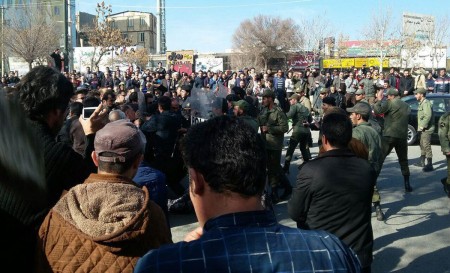
[T]he protest against foreign intervention has taken on a life of its own, with activists chanting such slogans as “forget about Syria; focus on us” and “no Gaza, no Lebanon; I will give my life only for Iran.” Despite the prevalence of these sorts of messages in social media and public accounts of the demonstrations, Iranian officials continue to maintain that the regional military prestige of the Islamic Republic remains broadly popular. For instance, the Huffington Post quotes hardline cleric Ahmad Alamolhoda as claiming that only about 50 protestors had expressed regional concerns within a gathering of several hundred.

**************************************

On Friday, mass protests continued throughout Iran after having started the previous day in reaction to rising rates of inflation and other uncontrolled economic conditions that had contributed, for instance, to a doubling of the price of eggs in just one week’s time.

Deutsche Welle quotes one Iranian lawmaker as blaming these problems on “illegal financial institutions” that had been established under the administration of former President Mahmoud Ahmadinejad. The closure of one such bank, called Mizan, reportedly had a particularly marked impact on Iran’s second most populous city, Mashhad, which has been the focal point of protests that spanned much of central and northern Iran as of Thursday.

The lawmaker’s account of the protests seemingly absolves the current government of responsibility for the conditions that are being protested by victims of a widening income gap in the Islamic Republic. But the DW article also points out that a major target of those protests has been current President Hassan Rouhani’s slow progress in following through on a promise to reimburse citizens whose investments were wiped out by the collapse of state-linked financial institutions.

https://www.youtube.com/watch?v=mGDCH3lWA3E


At the same time, DW and various other outlets have highlighted a trend toward broader focus in those protests, targeting not just rising prices and not just financial indicators as a whole but also the Rouhani administration’s failure to uphold a wide variety of promises regarding domestic reform. Insofar as the abandonment of these promises represents closure of the political gap between Rouhani’s political allies and those of hardline authorities like Supreme Leader Ali Khamenei, the protests seemingly double as an expression of opposition to the clerical system as a whole.

Indeed, the BBC refers to the demonstrations as “anti-government” protests in its reporting on Friday, as well as identifying them as the most serious and widespread such gatherings since the 2009 Green Movement, which emerged out of protests against Ahmadinejad’s disputed reelection. Those protests lasted for eight months and ended with a severe crackdown by government authorities, but many Iran watchers have observed that the resentments voiced by that movement continued to simmer under the surface in anticipation of another mass demonstration.

https://www.youtube.com/watch?v=JKrV_VJ-1Bk


This is not to say that there have been no major protests in the ensuing year. Indeed, the National Council of Resistance of Iran has identified thousands in the past year alone. But these have tended to be more geographically confined than the current demonstrations, and many have been focused not on politics but on specific demands such as the payment of overdue wages.

The content of Thursday’s and Friday’s protests was evidently broad enough in scope that even some Iranian officials were compelled to acknowledge the “anti-government” nature of chants and slogans, even while downplaying the scope of their appeal. The Associated Press reports that the governor of Tehran, Mohsen Hamedani, had acknowledged the spread of the protests to the Iranian capital, yet insisted that the gathering involved fewer than 50 people, most of whom dispersed after being warned by police.

Hamedani added that those who remained were “temporarily” arrested, and these remarks seemed also to downplay the severity of the government’s response to what might be regarded as a serious threat to its legitimacy. However, social media posts from various cities depicted peaceful protests being met with tear gas and water cannons, and the crowds in each of those gatherings numbered in the hundreds or in the thousands. By the end of Thursday, there had been at least 52 arrests in Mashhad alone, according to the BBC.

This is not to say that there have been no major protests in the ensuing year. Indeed, the National Council of Resistance of Iran has identified thousands in the past year alone. But these have tended to be more geographically confined than the current demonstrations, and many have been focused not on politics but on specific demands such as the payment of overdue wages.

The content of Thursday’s and Friday’s protests was evidently broad enough in scope that even some Iranian officials were compelled to acknowledge the “anti-government” nature of chants and slogans, even while downplaying the scope of their appeal. The Associated Press reports that the governor of Tehran, Mohsen Hamedani, had acknowledged the spread of the protests to the Iranian capital, yet insisted that the gathering involved fewer than 50 people, most of whom dispersed after being warned by police.

Hamedani added that those who remained were “temporarily” arrested, and these remarks seemed also to downplay the severity of the government’s response to what might be regarded as a serious threat to its legitimacy. However, social media posts from various cities depicted peaceful protests being met with tear gas and water cannons, and the crowds in each of those gatherings numbered in the hundreds or in the thousands. By the end of Thursday, there had been at least 52 arrests in Mashhad alone, according to the BBC.

https://www.youtube.com/watch?v=8LBt9pr-Vow


Political imprisonment is rampant in the Islamic Republic, and the BBC report also indicates that this was one of the topics that had been advanced by some protestors. But political focus of any given participant in the demonstrations might be different from those of any other, as evidenced by media reports identifying chants as targeting economic issues, political imprisonment, Iran’s paramilitary interventions in the surrounding region, and so on.

This latter topic is closely related to the economic issues that reportedly sparked the protests, since the Iranian government has spent billions of dollars in recent years on propping up the Syrian dictatorship of Bashar al-Assad, as well as on promoting the growth of the Houthi rebellion in Yemen and the various Shiite militias operating in Iraq. A recent editorial in Forbes points out that the new Iranian national budget, introduced by Rouhani in early December, includes the provision of 76 billion dollars to the Iranian Revolutionary Guard Corps and its foreign special operations Quds Force, at a time when tens of thousands of victims of a November earthquake are still awaiting basic shelter and government services.

https://www.youtube.com/watch?v=fPs6Z4N7R1M


But the protest against foreign intervention has taken on a life of its own, with activists chanting such slogans as “forget about Syria; focus on us” and “no Gaza, no Lebanon; I will give my life only for Iran.” Despite the prevalence of these sorts of messages in social media and public accounts of the demonstrations, Iranian officials continue to maintain that the regional military prestige of the Islamic Republic remains broadly popular. For instance, the Huffington Post quotes hardline cleric Ahmad Alamolhoda as claiming that only about 50 protestors had expressed regional concerns within a gathering of several hundred.

Interestingly, the same report also quotes Alamolhoda as advocating for an intensified crackdown on the protestors. In absence of this, he suggested, enemies of the regime would claim that the government had lost its “revolutionary base”. The Huffington Post indicates that Tehran security personnel have promised that any demonstrations in the capital would be “firmly dealt with”. This seems to be at odds with the Tehran governor’s commentary about temporary arrests and also with the initial reaction from Mashhad Governor Mohammad Rahim Norouzian, whom the AP quoted as saying that security forces had shown “great tolerance”

https://www.youtube.com/watch?v=ESosshsoUYc


Since that initial reaction, Iranian officials seem to have increasingly justified crackdowns through acceptance of the broader characterizations of the protests’ grievances and goals. Norouzian himself came to describe the protests as having been organized by “counter-revolutionaries”, according to DW. According to other sources, officials have also referred to the organizers as “hypocrites,” a term often applies to members of the leading Iranian opposition group the People’s Mojahedin Organization of Iran.

The PMOI has also been a driving force in a number of activist campaigns within the Islamic Republic, including the push for international attention and independent inquiry into the 1988 mass execution of political prisoners, which primarily targeted that same resistance organization. In a Huffington Post editorial on Friday, former US Ambassador Ken Blackwell sought to connect that massacre, which killed an estimated 30,000 people, to the current protests. He said that Thursday’s and Friday’s chants of “death to the dictator” emerged out of “a political climate punctuated by growing demands for justice for the regime’s massacre.”

But even if the initial economic focus of the latest protests had been voiced in isolation, there is an argument to be made that this also would constitute an expression of opposition to the continued rule of the clerical regime. In fact, this argument was made by historian Ellen Ward on Friday in an editorial published by Forbes. Ward observes that despite some officials’ efforts to blame the previous presidential administration for ongoing problems, it is really the underlying clerical system that is responsible for the economic future of the Iranian people.

This is to say that it is the clerical authorities, and not the elected branches of government, who establish and enforce policies with tremendous economic impact, including the interventionist foreign policy. Ward’s argument is reminiscent of the statement put out on Thursday by the PMOI’s parent coalition the National Council of Resistance of Iran. That statement quoted NCRI President Maryam Rajavi as saying that the economic prospects of the Iranian people cannot be expected to improve until the resistance movement has brought about the emergence of democratic governance in place of the theocratic dictatorship.
https://www.youtube.com/watch?v=LZxePyDYAcg


Cotton: We Should Support the Iranian People’s Protests Against ‘Hateful’ Ayatollahs

December 29, 2017

Cotton: We Should Support the Iranian People’s Protests Against ‘Hateful’ Ayatollahs, Washington Free Beacon, December 29, 2017

(Please see also, Iranian Protesters Hit the Streets Against President Rouhani, Ayatollah Khamenei. — DM)

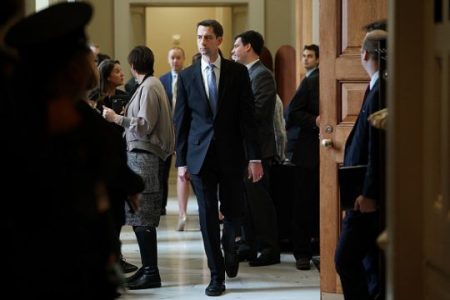
Sen. Tom Cotton (R-AR) leaves the weekly Senate Republican policy luncheon in the U.S. Capitol November 14, 2017 in Washington, DC. (Photo by Chip Somodevilla/Getty Images)
Sen. Tom Cotton (R., Ark.) issued a statement of support Thursday for Iranian citizens protesting the regime, condemning the government’s “hateful ideology” as more committed to regional conflicts than the needs of its people.

Hundreds of citizens protested Thursday in Mashad, Iran’s second-largest city, over high prices and economic mismanagement. According to Reuters, they shouted slogans like “death to (President Hassan) Rouhani” and “death to the dictator.”

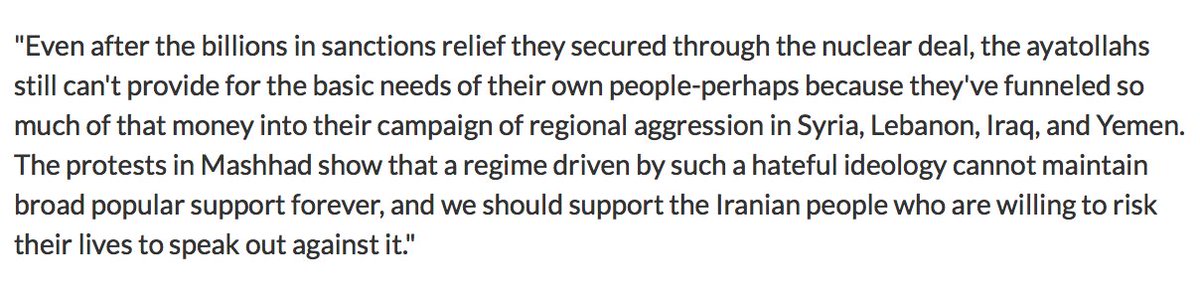
“Even after the billions in sanctions relief they secured through the nuclear deal, the ayatollahs still can’t provide for the basic needs of their own people—perhaps because they’ve funneled so much of that money into their campaign of regional aggression in Syria, Lebanon, Iraq, and Yemen,” Cotton said. “The protests in Mashhad show that a regime driven by such a hateful ideology cannot maintain broad popular support forever, and we should support the Iranian people who are willing to risk their lives to speak out against it.”

View image on Twitter

Cotton is a staunch critic of the Iranian regime and the Iran nuclear deal brokered by the Obama administration. He urged President Donald Trump to decertify Iranian compliance with the deal in October.

Iranians are frustrated with their economic situation and failure to gain benefits from the nuclear agreement, Reuters reported:

Unemployment stood at 12.4 percent in this fiscal year, according to the Statistical Centre of Iran, up 1.4 percent from the previous year. About 3.2 million Iranians are jobless, out of a total population of 80 million.

Some Protesters chanted “leave Syria, think about us,” referring to Iranian troops assisting Bashar al-Assad’s regime in the Syrian civil war.

Iranian Protesters Hit the Streets Against President Rouhani, Ayatollah Khamenei

December 29, 2017

Iranian Protesters Hit the Streets Against President Rouhani, Ayatollah Khamenei, Jewish PressDavid Israel, December 29, 2017

(Please see also The First Anti-American President which, after a brief discussion on the Iran scam, suggests what President Trump should do to get the Iranian people to rebel. Here are the guts of it:

There are many protests in Iran today, and the Khamenei/Rouhani regime has responded by executing half as many Iranians as in the past. We should relentlessly expose this mass murder, and we should publicize the ongoing protests.

The target audience for such exposes is the great mass of the population. Paradoxically, Iranians are better informed about events in Jerusalem and Washington than in Iranian Kurdistan, the southern oil regions, and cities like Mashad and Qom.

All Iranians need this information, which shows them that they are not alone. The technology for such a campaign exists. It is the same as it was when we deployed it against the Soviet Union with such powerful consequences: our broadcasting network, starting with the Voice of America. Today, Farsi-language VOA is often a vehicle for anti-American polemics, since personnel is virtually unchanged from the Obama years. We need a thorough housecleaning, but there are few signs that our national security team understands its urgency.

— DM)

https://www.youtube.com/watch?v=yWuQo27a8CU

Thousands of Iranians in several major cities, including Mashhad, Neyshabur, Shahroud, and Yazd, rallied in the streets on Thursday against poverty, unemployment, and the rising cost of living. They carried signs with the slogans “Death to Rouhani, and Death to the Dictator,” the term “dictator” referring to Supreme Leader Ali Khamenei. The protesters also denounced Iran’s promotion of violence around the Middle East.

The country is holding its breath in anticipation of events on Friday, the Muslim day of rest.

 People chant: “Akhoonds [Mullahs/ Shia clerics] be ashamed, and leave Iran”. Today when a Mullah popped up among crowd of people protesting financial corruptions of Islamic regime authorities in Mashhad, 2nd largest city of Iran
(Video at the link — DM)
 Journalist and author Babak Taghvaee tweeted on Thursday that when a Mullah (Shia cleric) popped up among crowd of people protesting financial corruption of Islamic regime authorities in Mashhad, the second largest city in Iran, people chanted, “Akhoonds (the Mullahs) be ashamed, and leave Iran.”

“Protesters in Iran chant ‘Reza Shah, Bless Your Soul’ – referring to Reza Shah the Great, the founder of the Pahlavi dynasty, the nemesis of the clerics, the modernizer of #Iran,” Taghvaee tweeted, adding, “People of Mashhad shout ‘Islamic revolution was our mistake’ during their protests against corrupted authorities of Iran Islamic regime today.”

According to Taghvaee, calls for peaceful rallies to protest poor living condition and the corruption of the regime can be found in Instagram. Not only in large cities of Iran such as Tehran, Shiraz, Isfahan, and Tabriz, but people in small towns also support people of Mashhad ahead of Friday’s rallies.

According to IranFocus.com, Thursday’s demonstrators pointed to the billions the regime has spent on the war to keep Assad in power, and chanted, “Leave Syria, think about us.”

President Rouhani expected the nuclear deal of 2015 to restore Iran’s economy, as most international sanctions were lifted. But those economic benefits did not trickle down to ordinary Iranians, who believe their desperate economic situation is the result of government corruption and mismanagement.

An estimated 3.2 million Iranians are unemployed, out of a population of 80 million, with unemployment rates rising to 12.4% in 2017.

Iran’s Supreme Leader Ali Khamenei blamed President Trump for Iran’s economic woes. Trump refused to certify that Tehran is complying with its nuclear deal and warned he would eventually terminate the deal. Trump also promised a more aggressive approach to Iran over its nuclear and ballistic missile programs, as well as its spreading terrorism in the Middle East.

Taghvaee tweeted Thursday that Iranian Police completely suppressed the protests in Mashhad people at 4 PM local time. Almost 50 people are arrested and tens of others were slightly injured. No one died.

The First Anti-American President

December 29, 2017

The First Anti-American President, PJ MediaMichael Ledeen, December 28, 2017

Donald Trump is certainly the opposite of an anti-American president, and he has no affection for our enemies. He has enabled the Ukrainians to fight, perhaps effectively, against the Russians. So why can’t he enable the Iranians to fight against the ayatollahs?

In the Ukrainian case we’re talking about military weapons; in the Iranian conflict the weapons are political. If the Iranians rose up against the regime when Obama entered the White House, you can be sure they are at least equally motivated to do it with Trump in office. There are many protests in Iran today, and the Khamenei/Rouhani regime has responded by executing half as many Iranians as in the past. We should relentlessly expose this mass murder, and we should publicize the ongoing protests.

The target audience for such exposes is the great mass of the population. Paradoxically, Iranians are better informed about events in Jerusalem and Washington than in Iranian Kurdistan, the southern oil regions, and cities like Mashad and Qom.

***************************************

Barack Obama will no doubt be chronicled, among other things, as the first anti-American president. No wonder; he’s the product of an educational system that has become increasingly radical and anti-American with each passing decade, and his mother was a stereotypical leftist anthropologist with a passion for the Third World.

The pattern is unmistakable. As Luis Fleischman notes, Obama wanted to make deals with our enemies, Iran being the most dramatic example. But just look at Latin America:

The Obama Administration tried to avoid confrontations with anyone it wanted to make a “historic deal” with. Most of these “historic deals” were intended to be made with enemies, as Obama desperately sought an agreement not only with Iran, but also with Cuba and reconciliation with Venezuela.

Thus, Obama failed to insist on the extradition of Venezuelan military and drug trafficker Hugo Carvajal from Aruba and the Syrian-born Venezuelan drug lord Walid Makled from Colombia. Carvajal was the chief of Venezuelan military intelligence and Makled is one of the most notorious drug traffickers in the Western Hemisphere. Makled himself disclosed his own cooperation with scores of the highest officials within Chavez’s government — including Carvajal himself, with the chiefs of the Venezuelan army and navy, as well as with dozens of Venezuelan generals.

The Obama people did not want to know the details of Venezuela’s collusion with the drug Mafiosi. If you have followed the story of the obstruction of the DEA investigation of Hezbollah, you will recognize the pattern. Indeed, it is part of the story.

It is also part of a bigger story: What is Trump going to do about Iran? The rhetoric on Iran is great. Inspirational, even. But as even “Mad Dog” Mattis says, there’s, well, more rhetoric, along with some sanctions:

U.S. Defense Secretary Jim Mattis says Washington will deal with Iran through a “diplomatically-led effort,” a day after a top U.S. diplomat said Tehran was supplying weapons to the Huthi rebels in Yemen.

So we still don’t have an Iran policy worthy of the name, despite the welcome clarity the Trump people have brought to the subject. “Everywhere you find turmoil,” Mattis said following our UN Ambassador Nikki Haley’s expose of Iran’s role in Yemen, “you find Iran’s hand in it.”

But then the secretary of Defense went on to embrace consciousness-raising.

Consciousness has long been suitably raised. There is no confusion about the nature of the Iranian regime or its intent to develop nuclear attack weapons or its savage repression of seventy-plus million people who would undoubtedly enter the ranks of the West if they could. But if we do not directly challenge the regime, no one else is going to do it.

Donald Trump is certainly the opposite of an anti-American president, and he has no affection for our enemies. He has enabled the Ukrainians to fight, perhaps effectively, against the Russians. So why can’t he enable the Iranians to fight against the ayatollahs?

In the Ukrainian case we’re talking about military weapons; in the Iranian conflict the weapons are political. If the Iranians rose up against the regime when Obama entered the White House, you can be sure they are at least equally motivated to do it with Trump in office. There are many protests in Iran today, and the Khamenei/Rouhani regime has responded by executing half as many Iranians as in the past. We should relentlessly expose this mass murder, and we should publicize the ongoing protests.

The target audience for such exposes is the great mass of the population. Paradoxically, Iranians are better informed about events in Jerusalem and Washington than in Iranian Kurdistan, the southern oil regions, and cities like Mashad and Qom.

All Iranians need this information, which shows them that they are not alone. The technology for such a campaign exists. It is the same as it was when we deployed it against the Soviet Union with such powerful consequences: our broadcasting network, starting with the Voice of America. Today, Farsi-language VOA is often a vehicle for anti-American polemics, since personnel is virtually unchanged from the Obama years. We need a thorough housecleaning, but there are few signs that our national security team understands its urgency.

Faster, please.

Ahmadinejad to Khamenei: There is Little Hope for Improvement in Regine’s Status

December 2, 2017

Ahmadinejad to Khamenei: There is Little Hope for Improvement in Regine’s Status, Iran News Update, Jazeh Miller, December 2, 2017

According to Ahmadinejad, “due to heavy economic, propaganda and emotional pressures as well as political and psychological ones, many people and families are subjected to serious harms and breakdown, and a bleak outlook has been formed in the minds of all people, the youth in particular. Considering the country’s current conditions, hope for a better future has reached bottom low.”

In another part of his letter, Ahmadinejad focuses on his conflict with regime’s judiciary, saying “irregular, unjustified, and unlawful insistence on sticking to personal and political stances and involving those viewpoints in judicial process while taking advantage of judicial power in political, personal, and family relations has stripped the judiciary of any chance to address and improve its status, avoid mistakes and injustice, attempt to resolve the country’s major problems and realize people’s rights.”

*******************************************

Revealing his recent letter to the regime’s Supreme Leader Ali Khamenei, Iranian regime’s former president has given new dimensions to the power struggle between regime’s rival factions while describing the country’s awkward situation.

On Monday November 27, Mahmoud Ahmadinejad revealed a letter he apparently wrote two weeks ago to Ali Khamenei.

The letter was released a few hours after regime judiciary’s spokesman ‘Mohseni Ejei’ referred to Ahmadinejad’s attacks on the judiciary, describing him as a ‘thug who talks big’.

Although Ahmadinejad’s letter gives detailed description about the country’s current conditions, but he doesn’t mention how much his government and policies are responsible for today’s situation.

“Due to authorities’ ignorance and effectiveness of enemies’ plans, such crises like unprecedented economic slowdown, liquidity, banking problems, unemployment, poverty, wide gap between the rich and poor and production fall have reached such a critical level that could at any moment hit the country and people with unpredictable and unmanageable consequences”, says Ahmadinejad.

According to Ahmadinejad, “due to heavy economic, propaganda and emotional pressures as well as political and psychological ones, many people and families are subjected to serious harms and breakdown, and a bleak outlook has been formed in the minds of all people, the youth in particular. Considering the country’s current conditions, hope for a better future has reached bottom low.”

In another part of his letter, Ahmadinejad focuses on his conflict with regime’s judiciary, saying “irregular, unjustified, and unlawful insistence on sticking to personal and political stances and involving those viewpoints in judicial process while taking advantage of judicial power in political, personal, and family relations has stripped the judiciary of any chance to address and improve its status, avoid mistakes and injustice, attempt to resolve the country’s major problems and realize people’s rights.”

Ahmadinejad says he’s against Larijani brothers and their dominance over the country’s (judicial and legislative) branches.

He then refers to judiciary’s performance as the source of public discontent in the country, saying “having 17 million judicial cases means that an overwhelming majority of Iranian families are somehow involved in lawsuits. It clearly and totally mirrors the country’s conditions and the performance of different entities, and yet by itself is a proof and a clear sign of the judiciary’s awkward situation, judicial officials’ incompetence and real problems in the branch. Public discontent towards the status of the country and judiciary is unprecedented, so much so that the majority of people are shouting against injustice and improper relations.”

Ahmadinejad’s fierce attack on the judiciary is despite the fact that the branch played a key role in oppressing the 2009 uprising during Ahmadinejad’s second term. Nonetheless, Ahmadinejad never questioned or criticized the judiciary’s record at the time, nor does he refer to it now. But only now that the branch, amid clashes between regime’s rival bands, has targeted Ahmadinejad and those around him, he has started criticizing.

Regime’s former president, who never seriously opposed limitations and violating individual and social freedoms, now writes “any kind of criticism, protest, or freedom of expression is harshly blocked for different excuses while a few groups and known families seek to exclusively take the power and major positions stemmed from people’s revolution, so they can consolidate the rule of factions and owners of wealth and power.”

Considering the escalation of conflicts between regime’s former president and judiciary over the past few weeks, the release of Ahmadinejad’s letter to Khamenei could lead to even more heated conflicts.

The Axis of Moderation vs. the Axis of Resistance in the Middle East

December 1, 2017

The Axis of Moderation vs. the Axis of Resistance in the Middle East, Gatestone InstituteNajat AlSaied, December 1, 2017

(Please see also, Saudis Fed Up: “Palestinians Milking Us for Decades.” — DM)

“We are just returning to the Islam we are used to… The moderate Islam”. — Saudi Crown Prince, Prince Mohammed bin Salman, at the Future Investment Initiative in Riyadh on October 26, 2017.

Saudi Arabia’s complaints against Iran’s interference and spreading extremism cannot sound credible if extremism is being practiced inside Saudi Arabia.

There urgently needs to be a unified American position to confront the Axis of Resistance. Iran continues to be the world’s leading sponsor of terrorism, empowering these armed militias and extremist groups — the basis of terrorism both in the region and across the world. It makes death threats, cooperates with a nuclearized North Korea, and all the while races toward nuclear weapons capability itself.

The dispute between the Arab states, often known as the Axis of Moderation, and the officially designated terrorist regime in Iran often known as the Axis of Resistance, is no longer just a political disagreement but a threat to the national security of Arab countries.

While the Arab states seem pro-statehood and work with other states, Iran and the Axis of resistance seems not to. Even though Iran calls itself Republic, it has a militia mentality and rarely deals with states. In general, rather than dealing with governments, it instead establishes militias, as it has in Lebanon and Yemen. Even in Iraq, where the government is considered its ally, Iran has established more than 15 militias. Qatar, by supporting Hamas and Hezbollah, as well as Syria under the Assad regime, seem to have the same mentality as Iran. If you trace the Axis of Resistance, all of them appear to have adopted the concept of supporting militias and extremist groups under the slogan of “resistance.”

The Iranian regime’s long history has now culminated in Saudi Arabia being targeted by Iranian missiles located in Yemen. They are coordinated in Lebanon by the Hezbollah militia, who train the Houthis in Yemen. It is important to understand that these violations and proxy wars carried out by the Iranian regime not only threaten the Arab Gulf states but also pose a threat to a regional and international security.

The Axis of Resistance is led by Iran, and includes Syria, Qatar, Hezbollah, Hamas, Arab Shiites loyal to Wilayat al-Faqih (“The Guardianship of the Islamic Jurist”) in Iran and Arab nationalists. Its slogans consist of fighting imperialism, empowering the (supposedly) vulnerable — mainly Muslim Shiites — and furthering “Arab nationalism,” which usually manifests itself in support for Palestinians against Israelis.

The expansionist objectives of the Axis of Resistance — in its drive to build a “Shiite Crescent” from Iran to the Mediterranean, are clear, compared to the objectives of the Axis of Moderation, which have not announced any specific aims, except to denounce Iran’s interference in the Arab countries’ affairs.

The Axis of Moderation comprises Saudi Arabia, Egypt, Jordan and the Arab Gulf countries, except for Qatar. The great mistake that the Axis of Moderation has made in confronting the Iranian regime — to try to curb its export of the its “Revolution” — has been to fall into the trap of propagating sectarianism. While Iran portrayed itself as the defender of all the Shiites in the world, Saudi Arabia, as a result, acted as the defender of all the Sunnis in the Muslim world — accordingly, sectarianism was propagated. This polarization, however, has only furthered the interests of the Iranian regime, whose chief objective seems to be to continue igniting this division in an apparent policy of divide and conquer. Instead of the members of the Axis of Moderation confronting Iran politically or militarily, they challenged it on religious and sectarian grounds, such as publishing countless books against Shiites that describe them as the enemies of Islam and labelling all Shiites as subordinate to Iran, as if all Shiites were Iran’s puppets, which not all of them are.

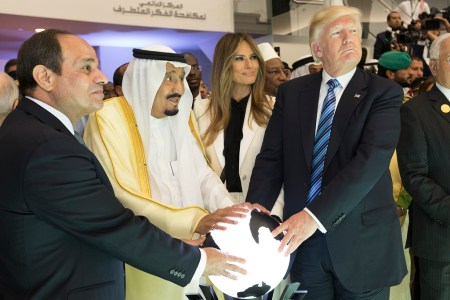
U.S. President Donald Trump and First Lady Melania Trump join King Salman bin Abdulaziz Al Saud of Saudi Arabia, and the President of Egypt, Abdel Fattah al-Sisi, in the inaugural opening of the Global Center for Combating Extremist Ideology, May 21, 2017. (Official White House Photo by Shealah Craighead)

This divisiveness has brought extremism and terrorism to the region, and has only harmed everyone.

Now the Axis of Moderation has become shrewder in its confrontation with the Iran and has employed a greater number of experts in Iranian affairs. The Axis of Moderation, especially Saudi Arabia, has realized that it cannot face down the threat of Iran without radical internal reforms. Saudi Arabia’s complaints against Iran’s interference and spreading extremism cannot sound credible if extremism is being practiced inside Saudi Arabia. These internal reforms, and liberalizing the society, are important internally: they will boost the economy by creating an attractive investment environment, especially for foreign investors. As importantly, reforms will stop any adversary from saying that Saudi Arabia is a state supporter of terrorism or a land that exports terrorists.

The most obvious changes are Saudi Arabia’s internal reforms that cover “social openness” in the form of concerts and festivals, coordinated by an entertainment body, and the country’s attempts to undermine clerical control, both by arresting extremists and establishing a committee at the Islamic University in Medina to codify the interpretation of Quranic verses that call for extremism, especially against other religions.

Saudi Arabia has also clamped down on corruption by arresting suspected businessmen, princes and former ministers. The kingdom has also raised the status of women by giving them more of their human rights, such as the recent lifting of the ban on women driving. In another important change, Saudi Arabia will also allow women to be clerics to confront all the patriarchal interpretations of verses in Quran related to women. Eventually, that could mean that lifting the ban requiring male guardians for women might also coming soon. The Saudi crown Prince, Mohammed bin Salman, has also said that he will allow women to take sports classes in school, attend sporting event for women and to permit music. His wish, he has said, is to “restore Islam.”

The most important matter of all was pointed out by the Saudi Crown Prince, at the Future Investment Initiative in Riyadh on October 26, 2017: “We are just returning to the Islam we are used to… The moderate Islam.” He also said, “We will not continue to be in the post-1979 era.”

This is essentially a confession that the approach that Saudi Arabia followed after 1979 to try to oppose the Khomeini Revolution was not helpful, and that now it is time for real reform to face both internal and external challenges.

What Saudi Arabia is doing will eventually contribute towards clarifying the aims of the Axis of Moderation, which will be to support countries whose primary objectives are development, modernity and stability. The most important goal is to stamp out terrorism by supporting a “moderate” Islam or, more specifically, supporting the approach that Saudi Arabia took before 1979. This approach was echoed by the UAE ambassador to the United States, Yousef Al Otaiba, who said that the moderate countries boycotting Qatar are heading towards secularism — in contrast to Qatar’s support for Islamist militias such as Hezbollah, and radical groups in the Axis of Resistance, such as the Muslim Brotherhood.

What has complicated the situation has been an exploitation of the conflict in the United States between the Republican Party and the Democratic Party over how to fight terrorism by countries in the Axis of Resistance such as Qatar.

The double face of Qatar is revealed in many ways. Al Jazeera in English, for instance — as mentioned the article, “Al Jazeera: Non-Arabs Should Not Be Fooled” — is totally different from Al Jazeera in Arabic.

Ahmed Mansour, for example, one of Al Jazeera’s anchors, tweeted about Hurricane “Irma” in Florida by citing a Koranic verse to say that what is happening in America is God’s curse: “Twenty million Americans fled out of fear from Hurricane Irma,” he wrote; then he cited a verse from Quran saying,

“And He shows you His signs. So which of the signs of Allah do you deny?” (40:81, Sahih International)

After his tweet in Arabic was read by American journalists, he apologized in a very sweet tweet in English.

Qatar also pretends to the US that it is supportive of its values, but in fact has close ties with all the enemies of the US. Sultan Saad Al-Muraikhi, Qatar’s permanent envoy to the Arab League, for example, has called Iran, which the US has officially designated as a terrorist state, an “honorable state”. Qatar also disagrees with designating Hamas and Hezbollah as terrorist organizations and calls them, instead, “resistance movements” against Israel.

Qatar has, moreover, used that dispute for its own ends by way of an alliance with the Democratic Party’s allies and supporters.

Many Qatari writers and Qatar’s supporters, especially the Muslim Brotherhood, have written articles against the Trump administration, as opposed to the previous administration which clearly had a soft spot for the Muslim Brotherhood. From the beginning, the administration of US President Barack Obama overruled Egypt’s President, Hosni Mubarak, by insisting that the Muslim Brotherhood attend Obamas speech in Cairo, thereby setting the stage for the fall of Mubarak; and also strongly supported the subsequent regime then Egyptian President Mohamed Morsi (who was a member of the Muslim Brotherhood). Obama also openly counted the Muslim Brotherhood-affiliated Turkish President, Recep Tayyip Erdogan, among his “best friends.”

These opinion-makers in the US, evidently nostalgic for the previous administration, and known, especially during the Iran Deal, as not exactly alignedwith the Axis of Moderation, seem to have been exploiting the rift between the Democrats and Republicans, apparently hoping for the impeachment of Donald Trump. As a Saudi academic and researcher, Ahmad Al-faraj, wrote in his article, “Qatar: The dream of isolating Trump!,” they possibly think that a Democrat President, like Obama, would again support them.

While Qatar makes itself out to be tolerant and a supporter of democratic Americans and Westerners, anyone who watches Al Jazeera in Arabic will find nothing other than pure hatred of Western values and enormous support for armed militias such as Hezbollah and terrorist groups such as Hamas.

There urgently needs, therefore, to be a unified American position to confront the Axis of Resistance. Iran continues to be the world’s leading sponsor of terrorism, empowering these armed militias and extremist groups — the basis of terrorism both in the region and across the world. It makes death threatscooperates with a nuclearized North Korea, and all the while races toward nuclear weapons capability itself. The United States would also do well to advocate a unified European position, and draw support from across the political spectrum. Unfortunately, European governments, for their own economic interests, have turned a blind eye to all the terrorism, extremism and sectarianism that Iran is fomenting. European countries should be warned that if they continue to put these economic interests ahead of global security, not only will the decision undermine the already-fragile national security of their own countries but also those of the region.

It is in the interest of the United States and world peace to support the pillars of an Axis of Moderation that would:

  • Eliminate political Islam because it exploits religion for radical political goals in both the Sunni and Shiite sects. The Shiite version of political Islam failed in Iraq and the Sunni version of the Muslim Brotherhood failed in Egypt and Tunisia. In both versions of political Islam, violence and terrorism are exacerbated.
  • Undermine Iran’s influence among armed militias in the region such as the militia Hezbollah in Lebanon, the Houthi in Yemen and the sectarian militias in Iraq. These should be classified as terrorist organizations. Hamas in the Gaza Strip has already been classified as such by the United States on October 31, 2001. Any country that supports Hamas or defends it, even in its media, should be classified as terrorist too.
  • Prevent the existence of armed militias operating as a state within a state; they are the beginning of the collapse of states and therefore a serious threat to peace and stability.
  • Consolidate the principles of secularism in internal and external dealings. Incitement to sectarian and racial hatred must be prevented as well as the use of Quranic verses to spread violence and extremism. To keep Iraq out of Iran’s control, non-sectarian neighborly relations need to be maintained.
  • Instill the principles of tolerance and respect for all religions and sects and guarantee the free practice of religions and the protection of minorities.

Moderate countries will not promote the rhetoric of a fight with Israel, as does the Axis of Resistance, led by Iran; instead, the Axis of Moderation is now committed to the principles of peace, which are based on the common interests of states to ensure the security and prosperity of all citizens.

The region and the world as a whole have suffered from the actions of the Iranian regime and its allies. There should be no justification for the existence of militias and extremist groups under the banner of resistance or similar pretexts. The international community needs to be firm in challenging states that allow or support such groups and should stress that states can only protect themselves with armies and armed forces, not with militias. A unified American and European position needs to help the Axis of Moderation to prevent countries in turmoil from becoming cantons of militias and extremist groups. That seems a more constructive way to fight terrorism and build global stability.

Najat AlSaied is a Saudi American academic and the author of “Screens of Influence: Arab Satellite Television & Social Development”. She is an Assistant Professor at Zayed University in the College of Communication and Media Sciences in Dubai-UAE.

This article was first published in Arabic at Al Hurra.

Domestic unrest: Iran’s worst nightmare

November 23, 2017

Domestic unrest: Iran’s worst nightmare, American Thinker, Keyvan Salami, November 23, 2017

President Donald Trump has in the United Nations General Assembly and his October 13th Iran policy speech communicated solidarity with the Iranian population, describing them as the first victims of the regime’s atrocities.

“…we stand in total solidarity with the Iranian regime’s longest-suffering victims: its own people. The citizens of Iran have paid a heavy price for the violence and extremism of their leaders. The Iranian people long to — and they just are longing, to reclaim their country’s proud history, its culture, its civilization, its cooperation with its neighbors.”

As seen on a daily basis, the Iranian people are voicing their discontent and defiance of this regime, and especially Rouhani’s hollow promises. A repeat of the 2009 uprising is a nightmare from the ruling regime’s point of view.

It is time for the international community to take advantage of this great opportunity and support the Iranian people’s demands to establish a true government based on freedom, human rights, and democracy.

******************************************

The threats posed by Iran in the Middle East through its support for terrorism, extremism and Islamic fundamentalism are undeniable. Its continued backing of various militias has established for Tehran a so-called Shiite crescent across the region. Growing domestic unrest, especially after the recent quake that shook western Iran, is plaguing the regime and showing the international community Iran’s main chink in the armor.

This was also witnessed on October 29th as the regime launched a massive crackdown effort to prevent any gathering marking International Cyrus Day, in memory of an ancient Persian ruler known to be the author of the world’s first human rights charter.

Reports indicate that Iran deployed thousands of Revolutionary Guards (IRGC), Basij, and Intelligence Ministry members alongside hordes of plainclothes agents to prevent any possible gathering mirroring the 2016 scenario on this same day.

Iran also resorted to a media campaign inside the country and abroad, claiming to have quelled a plot by “foreign-based dissidents and currents opposing the establishment,” as explained in a leaflet distributed by state police warning against any rallies.

Further domestic unrest is witnessed in the growing number of protests by ordinary investors seeing their life savings in state-run institutes plundered. Protests are mushrooming in cities across the country, responded to by the regime with arrests and harsh measures against crowds whose numbers are growing with each rally.

The Iranian regime has usurped billions from ordinary people’s investments to fuel its wars across the region. After 38 years, this has left the Iranian populace suffering tremendously with no light at the end of the tunnel.

“The middle-class in Iran has been all but extinguished,” a report indicates, adding that a large majority of Iran’s 80-million populace currently lives in poverty. City walls across the country are being filled with offers of people willing to sell various body parts, such as kidneys for $2,000, to literally make ends meet.

Iran is also widely known for its practice of repressing ethnic and religious minorities, involving harsh persecution, cruel discrimination, and ongoing cultural and economic marginalization. Tehran’s regime also resorts to a higher level of human rights violations in issuing long prison terms, imposing torture, public hangings, and even mass executions.

Iran’s “moderate” Hassan Rouhani is known to have carried out over 3,100 executions during his tenure as the regime’s president.

Iran is forced to such measures, knowing clearly it lacks any social base. One such case was witnessed when Rouhani’s top diplomat Mohammad Javad Zarif tweeted about all Iranians being IRGC following the force’s blacklisting by Washington.

The response by Iranians mostly inside the country was a display of sheer defiance against the regime, and how people view the IRGC as an entity terrorizing not only nations throughout the Middle East, but also Iranians at home.

Developments across the globe in the past year or so have made Iranians realize times are changing. For eight years Iran’s regime fed off the engagement policy adopted by the Obama administration. This gave a green light to Tehran for domestic crackdowns and foreign meddling. While Obama turned his back on the Iranian people, especially during the 2009 uprisings, the U.S. administration under President Donald Trump has time and again voiced their support and solidarity with Iranian people.

On three different occasions, U.S. Secretary of State Rex Tillerson has voiced the Iranian people’s desire for freedom.

“There are strong feelings and values inside of Iran that we want to promote in terms of one day the Iranian people being able to retake control of their government,” he said during his late October trip to India.

President Donald Trump has in the United Nations General Assembly and his October 13th Iran policy speech communicated solidarity with the Iranian population, describing them as the first victims of the regime’s atrocities.

“…we stand in total solidarity with the Iranian regime’s longest-suffering victims: its own people. The citizens of Iran have paid a heavy price for the violence and extremism of their leaders. The Iranian people long to — and they just are longing, to reclaim their country’s proud history, its culture, its civilization, its cooperation with its neighbors.”

As seen on a daily basis, the Iranian people are voicing their discontent and defiance of this regime, and especially Rouhani’s hollow promises. A repeat of the 2009 uprising is a nightmare from the ruling regime’s point of view.

It is time for the international community to take advantage of this great opportunity and support the Iranian people’s demands to establish a true government based on freedom, human rights, and democracy.

Looted and lied to, Iran’s people are protesting

October 28, 2017

Looted and lied to, Iran’s people are protesting, American ThinkerHassan Mahmoudi, October 28, 2017

Ever since the Obama administration signed the Joint Comprehensive Plan of Action (JCPOA) with Iran, commonly known as the Iran Deal, an influx of cash has rolled into the Iranian economy, and Tehran itself has grown emboldened in its oppression and terrorism. Sadly, its bad behavior has been ignored in the West, particularly in its press, even as its citizens have noticed. They have carried on a series of protests this week.

As President Trump outlined in his strategy, Iran’s offenses in this regard are not limited to its nuclear program. Ever since sanctions on Iran were lifted in 2016, Iran has invested in destabilizing many of its neighbors.

At home, Iran has adopted the policy of suppression and execution as its main domestic policy.

https://www.youtube.com/watch?v=h79vCNOXRt0

The Iranian people are frustrated with high unemployment, outlandish living costs, and the lack of public services. According to the report by the National Council of Iran Resistance, on Monday morning, Oct. 23, more than two thousand people, whose property was plundered by institutions affiliated with Islamic Revolutionary Guard Corps (IRGC), the mullahs’ judiciary and other state agencies, rallied in front of the regime’s parliament.

https://www.youtube.com/watch?v=qxHrnCaS9oY

Iran’s repressive police force, using batons, assaulted the demonstrators and beat them brutally. Then they tried to disperse the demonstration in which women played a very active role. But they were faced with the resistance of the people.

https://www.youtube.com/watch?v=KlDzCxOoDWA

Protestors chanted: “Shame! Shame on the police force! ” and “Cannon, machine gun, tank no longer works,” and “Death to the dictator.” When the police arrested some people, especially women, and wanted to take them by force, people chanted “You are ISIS, you are ISIS, death to ISIS, let them go,” and “Police, shame on you, let our fellow citizens go.”

https://www.youtube.com/watch?v=0O4SYFDWxdk

Some of the slogans were: “Death to Saif (head of the Central Bank),” “Shame on Rouhani,” “Larijani is apparently the judge but a thief’s accomplice,” “Theft is institutionalized, the hearts are full of hatred,” “For traveling to other countries, they have taken our money, ” “They had a budget deficit, but they have taken it from our money,” “Caspian Institute [a corrupt bank] has stolen, the government has supported it,” “Saif betrays, Parliament confirms,” ” I will not give up unless I get my rights,” and “Enough injustice!”

https://www.youtube.com/watch?v=qxHrnCaS9oY

When a number of participants in the demonstration, including women, were attacked by police forces, other people on the scene joined and defended them. People chanted “I kill, I kill whoever killed my brother” while throwing rocks, wood and other objects at the police.

Subsequently, the police encircled the protesters so that they could not leave the surrounded area, but the people broke out of the siege and started marching towards the Baharestan square. The repressive forces tried to control the population by bringing a motorized unit, but the people continue their rally while throwing rocks towards them. A large number of people joined the protesters.

Mrs. Maryam Rajavi, the President-elect of the National Council of Resistance of Iran, hailed her courageous compatriots who staged demonstrations in Tehran. She welcomed the protests by Iranians whose savings have been plundered by institutions affiliated with the mullahs’ Supreme Leader Ali Khamenei, and the Revolutionary Guard Corps (IRGC) with the complicity of government agencies under Rouhani and previous presidents.

She said, “The courageous chants in today’s demonstrations targeting the heads of the Judiciary and Executive Branch, as well as the suppressive State Security Force and intelligence forces, reflect the Iranian people’s desire for the overthrow of the mullahs’ religious dictatorship.”

Noting the chant “theft has become institutionalized under this regime,” Mrs. Rajavi added, “Institutionalized fraud along with institutionalized murder and belligerence constitute the pillars of the mullahs’ decadent regime. Ali Khamenei and his office hold the strings controlling all the depraved crimes taking place in the country. As long as this regime is in power, there will be no end to the astronomical embezzlement, poverty, unemployment and catastrophic economic conditions.”

https://www.youtube.com/watch?v=FJFvv0ULgR8

Khamenei has attained enormous wealth by plundering the people of Iran, devastated by poverty to the extent that they sell their children or organs, and by suppressing Iran’s youth who demand freedom. He has amassed this wealth in giant financial conglomerates such as the Staff Implementing Khomeini’s Order, the Qods Razavi Foundation, the IRGC and Bassij cooperatives, and the Mostaz’afan Foundation. He has delegated the administration of these institutes to officials who were in charge of the massacre of political prisoners in 1988, as well as other ruthless officials.

Mrs. Rajavi called on all Iranians, especially the youth, to support their plundered and deprived countrymen and women protesting in demand of their rights, and to help them expand their protests.


Hassan Mahmoudi is a human rights advocate, specializing in political and economic issues relating to Iran and the Middle East. @hassan_mahmou1


Newt Gingrich: State Dept. Has Listened to Iran More Than to ‘The Resistance’

October 24, 2017

Newt Gingrich: State Dept. Has Listened to Iran More Than to ‘The Resistance’, BreitbartPenny Starr, October 23, 2017

Paul Morigi/Getty Images for Dentons

Gingrich detailed the Iran’s aspirations in a chilling laundry list:

You have a repressive dictatorship which projects power now all the way to the Mediterranean, has plans to build a port in Lebanon that it would control, has plans to build missile factories in both Syria and Lebanon, ultimately designed to destroy Israel, already has helped Hezbollah get something on the order of 75,000 to 100,000 missiles, creating I think a much bigger problem on the northern front for Israel than anybody has come to grips with yet.

“And it’s all going to get worse,” he added.

Gingrich also praised President Donald Trump on his decision to decertify the JCPOA nuclear deal, calling it “just about exactly the right path” and said that the president’s public remarks about Iran have been bold.

***********************************

WASHINGTON, DC – Former House Speaker Newt Gingrich (R-GA) spoke to the National Council of Resistance of Iran (NCRI) on Friday about the danger posed by Iran and accused the U.S. State Department of listening to that dictatorship more than to those who seek a free and democratic Iran.

Gingrich said he has lobbied for the Iranian resistance movement in the U.S. and the People’s Mojahedin Organization of Iran (PMOI/MEK) since he was the top Republican in the House.

Gingrich said:

Because basically the Iranian dictatorship ran a false flag operation to set up a totally phony designation, which the State Department and bureaucracy went along with, so for a long period of time we were willing to listen to the actual dictatorship while not listening to the resistance, even though the resistance was trying to tell us the truth about the dictatorship, which was lying to us.

Gingrich acknowledged that Iranians have suffered in exile in Iraq at Camp Liberty and Camp Ashraf where thousands of members and sympathizers of MEK have been living for the past 25 years:

In my experience, the elements of the National Council of Resistance of Iran who are still inside Iran — and there are thousands of people who are obviously highly quiet about this otherwise they would be picked up by the secret police and killed — but they have been the best source of information on the nuclear program consistently, and have found things when the CIA has been telling us they didn’t exist.

Gingrich said, “And I hope that this administration will now be part of this process of beginning to unravel both the Iranian Revolutionary Guard Corps  (IRGC) and then, ultimately, the dictatorship.”

That unraveling should include the U.S. designating the IRGC a terrorist organization, which would have a direct impact on the Iranian economy, according to Gingrich.

Gingrich said in his remarks that the extent of the danger posed by Iran cannot be understated.

“As long as that dictatorship is in power, as long as it’s able to spend money, as long as it is able to project terrorism around the world, it is ultimately a mortal danger to the United States,” Gingrich said. “And of course, it was a terrible thing for the Iranian people.”

“A dictatorship which, in 1988, killed 30,000 people, something which for some reason The New York Times and The Washington Post don’t find to be horrifying,” Gingrich said.

Gingrich detailed the Iran’s aspirations in a chilling laundry list:

You have a repressive dictatorship which projects power now all the way to the Mediterranean, has plans to build a port in Lebanon that it would control, has plans to build missile factories in both Syria and Lebanon, ultimately designed to destroy Israel, already has helped Hezbollah get something on the order of 75,000 to 100,000 missiles, creating I think a much bigger problem on the northern front for Israel than anybody has come to grips with yet.

“And it’s all going to get worse,” he added.

Gingrich also praised President Donald Trump on his decision to decertify the JCPOAnuclear deal, calling it “just about exactly the right path” and said that the president’s public remarks about Iran have been bold.

That includes Trump’s speech to the United Nations, which Gingrich said was “probably the strongest condemnation of Iran, of the Iranian dictatorship, ever uttered in the United Nations.”

Maryam Rajavi, president-elect of NCRI, has welcomed the new U.S. policy to “condemn the IRGC’s gross violations of human rights” in Iran and “to deny the Iranian regime and especially the Islamic Revolutionary Guard Corps (IRGC) funding for its malign activities, and oppose IRGC activities that extort the wealth of the Iranian people.”

She said acknowledgment that supreme leader Ali Khamenei “oppresses its people, abuses their rights,” and “exports violence, destabilizes its neighbors, and sponsors terrorism abroad,” is a recognition of the illegitimacy of the Iranian regime.

The event was sponsored by the Organization of Iranian American Communities in the U.S.

Is the Argument for Regime Change in Iran Well Founded?

September 30, 2017

Is the Argument for Regime Change in Iran Well Founded? American ThinkerShahriar Kia, September 30, 2017

(Nearly all of the comments associated with the American Thinker article contend that Iran under its current regime is a wonderful, happy place, all opposition to which is a vile Jewish-Israeli conspiracy. — DM)

During his first address to the UN General Assembly in September, President Donald Trump offered a perspective on the people and the regime of Iran that starkly differed from that of his predecessors. He accurately attested that “The entire world understands that the good people of Iran want to change.” He described the Iran nuclear deal as “an embarrassment,” called off the Iranian regime for its export of “violence, bloodshed, and chaos,” and underlined that “Iran’s people are what their leaders fear most.”

These remarks from the president of the United States are a positive signal after three decades of failed appeasement toward the mullahs ruling Iran. And the testament to the fact are the reactions of Iranian officials, which betray their fear and consternation.

In a meeting with the Assembly of Experts, Ali Khamenei, the Supreme Leader of the Iranian regime called Trump’s speech “foolish, extremely ugly and hideous” and “gangster and cowboy language fraught with sheer lies.”

“Mr. Trump said the wrong things in the wrong place to the wrong people,” Rouhani said to the state television.

The question that remains is whether President Trump’s remarks at the UNGA were simply a reaction to the failure of the appeasement policy, or was it the result of the natural course of events and the geopolitical dynamics governing the Middle East? Has the explosion in connectivity and social media services been effective in conveying the message of the Iranian people, who want the world to know about their desire for freedom and human rights?

Without a doubt, all of these parameters have been effective. But what are the real foundations of Washington’s new approach to the desires of the Iranian people for regime change?

Uprisings

The first factor that challenges the power of the ruling regime is the looming threat of uprisings. From an economic and social perspective, there has always been a potential for nationwide uprisings in Iran.

The first big occurrence of widespread protests was in 1981 when more than 500,000 people took to the streets of Tehran and demanded the overthrow of the theocratic regime. The protest was brutally suppressed and ruthless executions of protestors and dissidents ensued.

In the summer of 1988 alone, 30,000 political prisoners, mostly members of the opposition group People’s Mojahedin Organization of Iran (PMOI/MEK), were executed in the span of a few months and were buried in secret graves.

In 1999 and 2009, uprisings erupted again. While the regime smothered both instances with a brutal crackdown, yet the potential for another uprising remains, and the ashes wait to be stirred once again.

Presently, sporadic protests are slowly building up across the country and gaining momentum. An example is the staged protests against the Arman and Caspian foundations, two financial organizations run by the Revolutionary Guards, which have been plundering the people’s wealth at an unprecedented scale. Following the start of Rouhani’s second term as president, social dissatisfaction with the current state of affairs has increased.

Infighting

The second factor that is weakening the regime is the ongoing power struggle between the Supreme Leader and other factions within the regime. So long as the country’s constitution is based on the “guardianship of the jurist,” every key decision will be made by the Supreme Leader. The Supreme Leader is also the commander in chief, which leaves the president with no substantial power.

This religious dictatorship is founded on fundamentalist interpretations of Islam and sees its survival as bound to domestic suppression and foreign terrorism. However, the mullahs’ crimes in the past four decades have intensified the hatred of the Iranian people toward them.

Earlier this year, the UN Special Rapporteur on the Human Rights Situation revisited the mass execution of 30,000 Iranian political prisoners in 1988 in her report to the Secretary-General. Moreover, activists and international human rights organizations have called for an independent investigation into this crime against humanity, placing the Iranian regime in another political and social dead end.

A War of Attrition in the Middle East

The Iranian regime is stuck in three long regional wars, involving Yemen, Syria, and Iraq. Some analysts and politicians perceive the Iranian regime’s meddling in these three countries as a sign of power and stability. However, contrary to what Khamenei and other regime officials have insisted on time and again, if they abandon their intervention in the countries of the Middle East, they’ll be fighting their wars in the streets of Tehran. Therefore, the sole purpose of the Iranian regime’s regional forays is to avoid its collapse. The regime’s nuclear and ballistic missile project is for the same purpose.

The Coalition of Arab Countries and U.S. Against Iran’s Regional Ambitions

The coalition of Arab countries and the U.S., the imposition of further sanctions against the Iranian regime’s regional meddling, and the end of the golden era of the Obama administration have faced the regime of Tehran with further challenges. Officials in the new U.S. administration rightly insist that the real threat of Iran comes not only from its nuclear ambitions but also from its ballistic missile program, its chaos mongering in the region and its human rights abuses. The only durable solution to those collective threats is regime change in Iran.

The Existence of a Reliable Alternative to Replace the Regime in Iran

What makes the replacement of a tyrannical regime viable is the presence of a recognized alternative that has a distinct political, social and economic platform for the future, which enjoys the support of the international community. The existence of such a resistance and its international recognition is one of the main parameters that will pave the way for uprisings against the ruling dictatorship.

Iran currently has a democratic alternative, led by Mrs. Maryam Rajavi, a Muslim woman who opposes fundamentalism and bases her faith on tolerance.Mrs. Rajavi’s ten-point plan has been praised and acknowledged by many political personalities, jurists, parliamentarians, and human rights activists across the world.

Three decades of appeasement toward Tehran has not moderated the behavior of the Iranian regime — it has made it worse. However, the foundations for change in Iran exist. What makes regime change in Iran unique is the fact that it requires no foreign intervention. The people of Iran and their organized resistance have the potential to bring about change from Inside Iran.