Archive for the ‘Iran and Israel’ category

Hizballah units regroup on Israel’s Golan border

September 7, 2016

Hizballah units regroup on Israel’s Golan border, DEBKAfile, September 7, 2016

qunetrafront

DEBKAfile’s military sources note that the Iranian media attached photos of Israel’s security force opposite Quneitra to their reporting on the new move, thereby framing the target of the Syrian-Iranian-Backed Hizballah build-

***********************

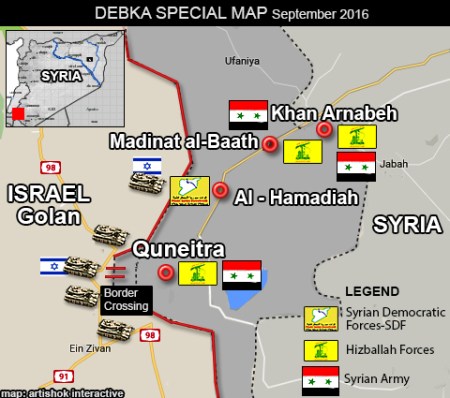
A large Hizballah force, backed by the Syrian army and pro-Iranian Shiite militias, is building up outside Quneitra, just 2km from Israel’s Golan border. The Lebanese Shiite fighters, under the command of Iranian Revolutionary Guards (IRGC) officers, are streaming into southern Syria, armed with tanks and artillery.

Monday night, Sept. 5, Iranian state-controlled media shed light on this movement, reporting that the combined force had “completed preparations necessary for an extensive operation in southern Syria,” adding, “Hizballah aims to put an end to the presence of armed men in the area close to the border.”

The nature of the “armed men” was not specified, but the goal of the new operation was clear: after evicting the assorted anti-Assad groups, including the Islamic State, holding territory “close to the border,” Hizballah and its backers planned to regroup on the Syrian-Israeli boundary.

This would position Iran and its Hizballah surrogate ready to realize their six-year old design, which is to open a second warfront against Israel.

Western and Mid East sources have toldl DEBKAfile that the triple army is in high spirits after last week’s successful operation in Aleppo. By snatching back parts of the city they lost in mid-August, the Syrian army and its allies managed to cut off the rebels’ supply lines from Turkey.

It was then that some Hizballah units were detached from the Aleppo arena and redirected to the Quneitra front in southern Syria to face the Israeli border.

israeliborder480

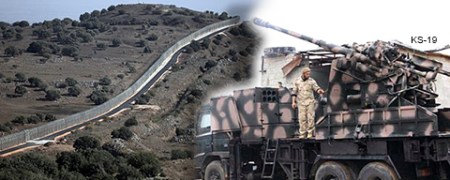
Those sources report that the incoming troops were sighted this week when they arrived at Madinat al-Baath and Khan Amabeh, the main Syrian army bases on the Syrian Golan. They came with tanks and heavy artillery. Seen for the first time in the Quentra sector were heavy, self-propelled KS-19 artillery batteries, which are Russian anti-air guns adapted to ground warfare. They have a range of 21km and a firing capacity of 15 shells per minute.

The newly-arrived Hizballah force appears to have set the capture of Syrian rebel-held al-Hamdiniyah 2km from the Israeli border, as its first objective.

DEBKAfile’s military sources note that the Iranian media attached photos of Israel’s security force opposite Quneitra to their reporting on the new move, thereby framing the target of the Syrian-Iranian-Backed Hizballah build-up.

This fast-approaching development poses two tough questions:

1. Will Israel lie down for the avowedly hostile Hizballah and Iran to occupy territory along its eastern border?Israel officials have repeatedly emphasized that these forces would not be allowed to take up positions on the Golan border, a message Russia most certainly passed on to Damascus.

If Hizballah and its allies go through with their planned offensive, Israel will have to consider serious military action to prevent them from reaching the border fence, i.e., an operation on a scale quite different from the small-shot IDF reprisals for rockets or shells straying across into the Golan from fighting on the other side.

2. Will the advancing Iranian-led force have Syrian air cover? If it does, the Israeli Air Force will also be involved in aerial combat over the Golan.

Column One: Obama’s greatest achievement

September 1, 2016

Column One: Obama’s greatest achievement, Jerusalem PostCaroline B. Glick, September 1, 2016

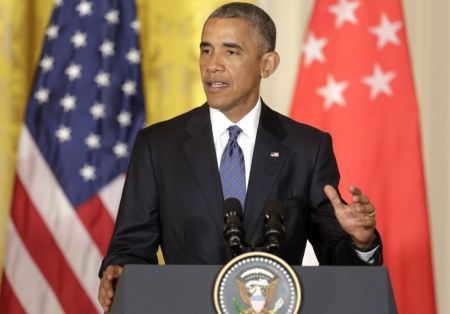
Obama lies on Iran scamU.S. President Barack Obama and Singapore Prime Minister Lee Hsien Loong (not pictured) speak during a press conference at the White House in Washington, U.S., August 2, 2016.  (photo credit:REUTERS)

The time for complaining about President Barack Obama’s nuclear deal with Iran has passed. The time has come to overcome the damage enormous damage his signature foreign policy accomplishment has caused.

To understand why this is the case, it is important to understand the breadth and depth of Obama’s failure.

On August 4, during the course of a press conference, Obama gave his interim assessment of his nuclear agreement with Iran.

“It worked,” he insisted.

A year after the deal was signed, Obama argued, events have proven that he was right and the deal’s critics were wrong.

“You’ll recall that there were all these horror stories about how Iran was going to cheat and this wasn’t going to work and Iran was going to get $150 billion to finance terrorism and all these kinds of scenarios, and none of them have come to pass,” he proclaimed.

Obama then snidely swiped at the deal’s opponents saying that it would be “impressive” if the people who criticized the deal would own up to their mistakes and admit that it worked.

As it works out, everything that Obama said about the deal with Iran during his press conference was a lie.

Some of his lies became apparent within hours.

For instance, Obama falsely claimed that Israel now “acknowledges this has been a game changer and Iran has abided by the deal and they no longer have the sort of short-term breakout capacity that would allow them to develop nuclear weapons.”

Hours later, the Defense Ministry issued a stinging rebuke of Obama’s claim, parroted more diplomatically by the Prime Minister’s Office.

Obama’s press conference took place the day after The Wall Street Journal reported that in January 2016, the US sent an unmarked plane to the Tehran airport filled with $400 million in cash, on the same day Iran released four US hostages.

Obama angrily rejected allegations that the cash payment was a ransom payment for the hostages’ release. He insisted that the US had made the payment as the first installment of a $1.7b. payment the administration made to settle an Iranian government lawsuit against America.

Obama claimed that the administration agreed to the settlement at the urging of the Justice Department.

He said his administration was able to settle the dispute only due to the nuclear deal which placed US officials in direct contact with their Iranian counterparts for the first time in decades.

Within a day, Obama’s claims were exposed as lies. It turns out that Justice Department lawyers opposed the cash payout to Iran.

One of the hostages released in January told the media that the Iranians refused to allow the hostages to leave Iran until the airplane with the cash landed in the airport.

The Iranians, for their part, contemptuously mocked Obama, and stated openly that the $400m.

was a ransom payment for the hostages.

Two weeks later, Obama’s State Department admitted that the $400m. was a payment for the hostages.

Obama’s principle claim is that due to his deal, Iran no longer has a short-term nuclear breakout capacity. He also says that in accordance with the deal, Iran has shipped its nuclear materials out of the country. These claims are both untrue and misleading.

On Thursday Reuters reported that Iran did not ship the quantities of low-enriched uranium out of the country in the quantities the deal required.

Last January, when the deadline arrived for Iran to comply with the deal’s clauses calling for it to move its uranium enriched to 3.5 percent and 20 percent out of the country and so enable the US and its European colleagues to cancel UN sanctions against it, it worked out that Iran had failed to comply.

Rather than acknowledge Iran’s failure and maintain the sanctions in accordance with their deal, the Americans and Europeans decided to move the goalpost closer to Iran.

They secretly decreased the amount of uranium the Iranians were required to part with. They then announced triumphantly that they were canceling UN sanctions because Iran had complied with the agreement.

Reuters reported that much of the low-enriched uranium Iran did remove from its territory wasn’t actually removed from its possession. Instead it was transferred to neighboring Oman, where it is held under Iranian guard and control.

Obama of course knows all of this. So his claims that the agreement “worked” are nothing more than a card trick meant to trick the American public.

Obama’s assertion that Iran’s breakout time to a nuclear arsenal has been slowed as a result of his deal is similarly a stretch of the imagination. The Iranians have suspended much of their prior centrifuge spinning. But that is only because they are now directing their efforts to developing and deploying more advanced centrifuges that will be able to enrich uranium to bomb grade material far more rapidly than the centrifuges they were required to retire.

Experts have already placed Iran’s post-deal nuclear breakout time at a mere six months. And Iran can leave the agreement – which it never actually signed or officially agreed to – anytime it wants.

While developing their next generation centrifuges, the Iranians are expanding the range and precision of their ballistic missiles, deploying them and increasing the size of their arsenals. Despite the fact that these actions are prohibited under US law and breach what was initially claimed about the ever-changing nuclear deal, the Obama administration has refused to impose sanctions against Iran, insisting that its actions merely breach the spirit, rather than substance, of the deal.

The administration has had a similar response to Iran’s recent deployment of Russia’s S-300 missile defense battery around its military nuclear site at Fordo. On Sunday Iranian television showed footage of the missiles being set up around the formerly secret site.

As Omri Ceren of the Israel Project noted this week, Iran’s deployment of the S-300 system places it in breach of three US sanctions laws. Despite this, the White House announced on Wednesday that it has no intention of enforcing US law and applying sanctions on Iran. The S-300 missiles can be used both as a defensive system and as an offensive one.

On Tuesday, Tehran announced that it will be launching three satellites in the coming months.

Satellite launches are widely viewed as a means through which Iran is covertly developing a longrange ballistic missile capability. Rather than censure Iran for its actions, the Obama administration insists that such actions, as well as Iran’s recent longrange rocket tests, do not violate the nuclear deal or warrant US action.

Taken separately and together, Iran’s actions since the nuclear deal was officially concluded make clear that it continues to pursue its nuclear program, and indeed, has become more brazen in its nuclear operations than it was before the agreement was announced last year.

In other words, not only has the deal not worked, contrary to Obama’s claims, it has been a colossal failure on every level. The deal’s opponents were entirely right about the dangers it posed and Obama was entirely wrong.

This is true as well in relation to the administration’s qualified promises that the deal would lead to better relations between the US and Iran. As Shoshana and Stephen Bryen noted last week following the Iranian naval assault on the USS Nitze in the Strait of Hormuz, with its repeated harassment of US naval ships traversing the Strait of Hormuz, Iran is clearly practicing its tactic of swarming US naval craft as a preparation for a real strike against them.

The main reason that Iran’s nuclear program is such a grave concern for Israel and for other Middle Eastern states is that the Iranian regime has hegemonic ambitions. It seeks to destroy Israel and dominate the entire region.

Since it concluded the deal with Washington, Iran has surged its forces and massively expanded its power projection throughout the region.

On Thursday the Daily Mail reported that the commonly held belief that Iran commands 16,000 troops in Syria is wrong. According to the National Council of Resistance in Iran, the regime actually commands 60,000 forces in Syria, deployed throughout the country. The entire Syrian army today numbers a mere 50,000 men.

On August 4, Obama mocked claims that Iran would spend its windfall profits of $100b.-$150b.

from the sanctions relief the nuclear deal offered to fund terrorism. Yet, according to the Daily Mail report, to date Iran has spent $100b. on the war in Syria.

The implications of the report are blood curdling.

They mean that despite Obama’s denials, the funds Iran has received as a result of the sanctions relief he brought about through his nuclear deal have paid for Iran’s war in Syria. That war has caused the death of nearly half a million people and forced more than 11 million people to flee their homes.

Obviously, it is important for Americans to know the truth about the Iran deal and its consequences as they consider their votes for Obama’s replacement.

One of Democratic nominee Hillary Clinton’s top candidates for secretary of state is Wendy Sherman.

Sherman was the chief negotiator of Obama’s nuclear deal with Iran.

For Israel, the question of what to do about Iran now is far more urgent than it is for Americans.

Today more and more commentators are voicing concern over the prospect that Obama will support an anti-Israel resolution at the UN Security Council as a parting shot at Israel.

But any such resolution will be small potatoes in comparison to the strategic devastation his nuclear deal, which is his main foreign policy legacy, has caused.

The rapidity of Iran’s advance makes clear that there is no justification for waiting to act until Obama has left office. If it doesn’t act soon, Israel is on the fast track to waking up one morning and discovering it has no means of thwarting the threat.

Indeed, with each passing month, its options for action become more and more limited.

After Israel’s security leadership undermined Prime Minister Benjamin Netanyahu’s plan to attack Iran’s nuclear installations in 2010 and 2012, Netanyahu settled on a strategy of blocking Obama’s moves to appease Tehran.

That strategy of course failed last summer. Since then, Netanyahu has worked to build an anti-Iranian alliance with the Sunni Arab states. His efforts in this area have clearly met with some measure of success, as witnessed by public statements from prominent Saudis and others.

Whatever that success may be, and whatever the status of that burgeoning alliance of spurned US allies, the fact is that it’s time Israel and its new allies do something more than send signals. Time is a-wasting.

Last spring Brig.-Gen. Hossein Salami, the deputy commander of Iran’s Revolutionary Guard Corps, said, “Today the grounds for the annihilation and collapse of the Zionist regime are more present than ever before.”

Thanks to Obama, he may be right.

It is time for Israel to make him eat his words.
Iranian Dissidents Visit Israel, View Iran after the Nuclear Deal

August 21, 2016

Iranian Dissidents Visit Israel, View Iran after the Nuclear Deal, Jerusalem Center via YouTube, August 21, 2016


Officials In Lebanese, Gazan Terror Organizations Confirm: Iran Funds Our Activity

August 11, 2016

Officials In Lebanese, Gazan Terror Organizations Confirm: Iran Funds Our Activity, MEMRI, August 11, 2016

Arab media have recently published statements by officials in the Lebanese Hizbullah and the Gazan Hamas and Islamic Jihad organizations, and by their supporters, confirming what has long been known – namely that these Lebanese and Gazan terror organizations receive substantial financial and military assistance from Iran. These statements join many reports, especially in the anti-Iranian media, regarding Iran’s funding of various terrorist organizations across the Arab world. According to these reports, the assistance comes mainly from the office of Iranian Supreme Leader Ali Khamenei and from the Islamic Revolutionary Guards Corps (IRGC).

The following are some examples of these statements and reports from the last two months:

Hizbullah Secretary-General Nasrallah: Hizbullah’s Entire Budget Is Provided By Iran

In a speech he delivered on June 24, 2016, marking 40 days after the killing of Mustafa Badr Al-Din, who was considered to be Hizbullah’s chief operations officer, and following the imposition of U.S. sanctions on Hizbullah that threaten its financial infrastructure and income, Hizbullah Secretary-General Hassan Nasrallah clarified: “Hizbullah’s budget – its salaries and expenditures, [the money that pays for] its food and drink, weapons and missiles – [all come from] Iran. Is that clear?… As long as Iran has money we have money. Do you require greater transparency than that[?] The funds earmarked for us do not reach us through the banks. We receive them the same way we receive our missiles, with which we threaten Israel.”[1]

Hamas Official Abu Marzouq: Iran’s Assistance To Hamas Is “Not Comparable” To Any Other Assistance

The deputy head of Hamas’s political bureau, Moussa Abu Marzouq, tweeted on June 15, 2016: “The aid extended by Iran to the Palestinian resistance, in provisions, training and funds, is not comparable [to any other aid], and most other countries cannot match it.”[2]

29502Abu Marzouq’s tweet

Former Lebanese Minister Wiam Wahhab: Iran Has Funded Resistance In Palestine

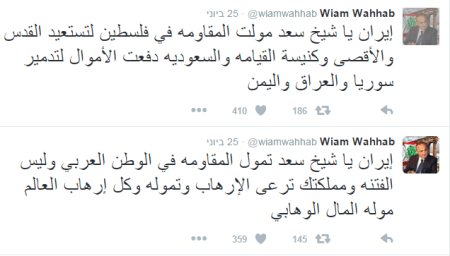
On June 25, 2016, in response to a remark by former Lebanese prime minister Sa’d Al-Hariri that Iran funds fitna(internecine strife) in the Arab world,[3] former Lebanese minister Wiam Wahhab, a known supporter of Hizbullah and the resistance axis, tweeted: “O Sheikh Sa’d [Al-Hariri], Iran has funded resistance in Palestine to restore Jerusalem, Al-Aqsa and the Church of the Sepulcher [to Palestinian hands, whereas] Saudi Arabia paid to destroy Syria, Iraq and Yemen.” In another tweet he wrote: ” O Sheikh Sa’d, Iran funded resistance in the Arab homeland rather than fitna, [whereas] your kingdom [Saudi Arabia, who supports Al-Hariri and his faction in Lebanon,] sponsors and funds terrorism. The funds of all the terrorist [organizations] in the world are Wahhabi [i.e., Saudi] funds.”[4]

29503Wiam Wahhab’s tweets

Saudi Daily Al-Sharq Al-Awsat: Hizbullah’s Weapons Come Directly From IRGC; Iran Has Renewed Regular Aid To Islamic Jihad Organization

The anti-Iranian press, such as the London-based Saudi daily Al-Sharq Al-Awsat, also reported on Iran’s funding of terrorist organizations in Lebanon and Gaza. On June 29, 2016, Al-Sharq Al-Awsat confirmed Nasrallah’s statements regarding the Iranian funding. The report stated that Hizbullah’s funds came from the office of Iranian Supreme Leader Ali Khamenei while its weapons are provided by the IRGC. It quoted the director of the Umam Research and Documentation center in Lebanon, Luqman Salim, a Shi’ite known for his opposition to Hizbullah, as saying that between 70% and 80% of Hizbullah’s funds come from Iran. According to Salim, Iran also invests about $400 million of the IRGC’s budget in the Islamic Radio and Television Union, a group of stations which includes the Iranian Al-Alam but also Hizbullah’s Al-Manar and Al-Mayadin and the Hamas-affiliated Al-Quds (all of which broadcast from Lebanon) and Hamas’s Al-Aqsa station, which broadcasts from Gaza.

The daily also cited a “knowledgeable source” as saying that until 2005 Iran transferred to Hizbullah between $200 million and $250 million annually, but since then the allocation has increased: After the 2006 Lebanon War it rose to $850 million, and since Hizbullah entered the Syria war its budget has become unlimited, because it has become part of Tehran’s war effort there.[5]

On May 25, 2016, the daily reported, citing sources close to the Islamic Jihad organization in Gaza, that Iran had renewed its regular financial aid to the organization after the two sides agreed to renew their mutual relations.[6] According to these sources, an Islamic Jihad delegation headed by the organization’s secretary-general Ramadan Shalah visited Iran in April 2016, and during this visit Tehran renewed its sponsorship of the organization after the latter accepted its terms. In meetings held by the delegation during this visit, including with IRGC commander Mohammad Ali Jafari and Qods Force commander Qassem Soleimani, Iran clarified its vision of Islamic Jihad’s course in the coming years. The sources claimed further that Soleimani decided, in coordination with the organization’s military and political bureaus, to grant $70 million a year out of the IRGC budget to Islamic Jihad’s military wing, Saraya Al-Quds, and to reorganize this body and appoint Khaled Mansour, who is close to Tehran, as its commander.[7]

Endnotes:

[1] Alahednews.com.lb, June 24, 2016.

[2] Twitter.com/mosa_abumarzook, June 15, 2016.

[3] Al-Mustaqbal (Lebanon), June 26, 2016; Al-Hariri’s remark was a response to Nasrallah’s  statement one day earlier that Hizbullah’s entire budget comes from Iran.

[4] Twitter.com/wiamwahhab, June 25, 2016.

[5] Al-Sharq Al-Awsat (Lebanon), June 29, 2016.

[6] Reports in the Arab media in the passing year indicated that Iran had suspended its assistance to Islamic Jihad following disagreements between them on the crisis in Yemen. According to these reports, the Islamic Jihad refused Iran’s demand to declare its opposition to the Arab Coalition’s activities in Yemen. See for example Aljazeera.net, May 26, 2016, Janoubia.com, April 3, 2016.

[7] Al-Sharq Al-Awsat (London), May 25, 2016.

Has the IDF hit the Basij forces commander General Naghdi?

July 30, 2016

Has the IDF hit the Basij forces commander General Naghdi? DEBKAfile, July 30, 2016

EinZivan2 (1)

Gen. Naghdi’s visit to Quneitra undoubtedly presaged some decisions in Tehran with regard to direct Hizballah-Syrian-Iranian action against Israel.

The Iranian, Syrian and Hizballah agencies accuse Israel of the attack because the say it was executed by two Nimrod anti-tank long-range missiles, manufactured by the Israeli Aerospace Industry, for use by the IDF against armored vehicles, ships, bunkers and troop concentrations.

*****************

Iranian, Syrian and Hizballah sources are intimating that the “Syrian officer” injured on July 26 in Quneitra by Israel’s double Nimrod’ missile shot was none other than Revolutionary Guards Gen. Muhammad Resa Naghdi, head of the paramilitary Organization for the Mobilization of the Oppressed, also known as the Basij, which falls under the Islamic Revolutionary Guard Corps (IRGC). The victim was earlier described officially as a Syrian officer.

If he was indeed hurt or killed by an Israeli rocket, Naghdi would become the highest-ranking IRGC general ever hit by the IDF.

On July 27, the semi-official Fars news agency reported that a top Iranian general recently visited the Israeli-Syrian border to tour Quneitra and the Golan demarcation lines between Syria and Israel – the first time the Tehran government had publicized a visit by a senior regime official to the area.

It may be presumed, DEBKAfile’s intelligence sources say, that someone at the IDF lookout posts spotted and reported on Gen. Naghdi’s arrival with an entourage in Quneitra on July 26 and saw him inspecting through binoculars the IDF defense positions. He was then quickly identified.

Any decision to go after a high-ranking Iranian would not have been left to local IDF commanders or even OC Northern Command Maj. Gen. Aviv Kohavi, but passed straight to Prime Minister Binyamin Netanyahu, Defense Minister Avigdor Lieberman and Chief of Staff Lt. Gen. Gady Eisenkot – especially in this case.

General Naghdi is not just another Iranian general. He heads the more than a million-strong Basij militia, which is a pillar of the ayatollahs regime in Tehran, and the backbone of the Iranian internal security forces which maintain the regime’s total control in every corner of the Islamic Republic.

Gen. Naghdi’s visit to Quneitra undoubtedly presaged some decisions in Tehran with regard to direct Hizballah-Syrian-Iranian action against Israel.

The IDF is holding its silence on reports of his injury, declining as usual to comment on reports by foreign publications.

The Iranian, Syrian and Hizballah agencies accuse Israel of the attack because the say it was executed by two Nimrod anti-tank long-range missiles, manufactured by the Israeli Aerospace Industry, for use by the IDF against armored vehicles, ships, bunkers and troop concentrations..

The missile has a semi-active laser guidance system, and is able to operate day and night. Its flight path can be below the clouds, while its operators far behind use a laser to guide it to target.

The launcher platform, with four missiles, can be installed on a Jeep, weapon-bearing vehicle, Abir, or armored vehicles. In addition, it is possible to send it from CH-53 ‘Yasur’ helicopter.

Israel has acted in the past against the establishment of an Iranian and/or Hizballah military presence on its Golan doorstep. On Jan. 19, 2015, an IDF air strike killed the Iranian Brig. Gen, Mohammad Ali Allahdadi and six Hizballah officers while they were on a tour of inspection near Quneitra.

Thursday, July 28, DEBKAfile ran an exclusive report on rising Israel-Russia tensions centering on southern Syria and the Golan.

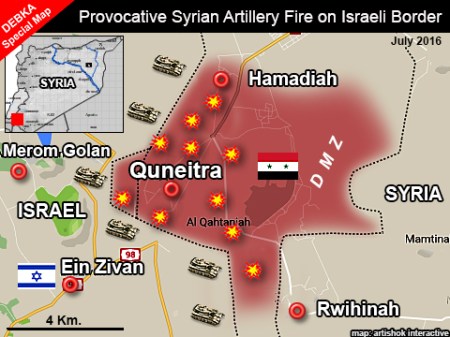
For four days since July 25, the Syrian army has been continuously firing artillery batteries – moved close to Israel’s defense lines on the Golan border – in a manner that comes dangerously close to provoking an Israeli response. This carefully orchestrated Syrian campaign goes on around the clock.

It is the first time in the six years of the Syrian war that Bashar Assad has ventured to come near to provoking Israel. But now he appears to be emboldened by his Russian ally.

The IDF is holding its fire for the moment. But Israeli military and government leaders know that the time is near for the IDF to be forced to hit back, especially since it is becoming evident that the Syrian army’s steps ae backed by Russia.

DEBKAfile’s military sources provide details of the Syrian steps:

  • The Syrian army’s 90th and 121nd battalions have been firing their artillery batteries non-stop across a 10km band along the Golan border from Hamadia, north of Quneitra, up to a point facing the Israeli village of Eyn Zivan. (See attacked map).
    This means that the Syrian army has seized the center of buffer zone between Israel and Syria and made it a firing zone.
  • This artillery fire fans out across a radius that comes a few meters short of the Israeli border and the IDF troops stationed there. It then recedes to a distance of 500 to 600 meters and sweeps across the outposts and bases of the Syrian rebel forces believed to be in touch with Israel or in receipt of Israeli medical aid.
  • The new Syrian attack appears to hold a message for Jerusalem: For six years, you supported the rebels against the Assad regime in southern Syria. That’s now over. If you continue, you will come face to face with Syrian fire.
  • Damascus is also cautioning those rebels:  For years, you fought us with Israel at your backs. But no longer. Watch us bring you under direct artillery fire, while the IDF sits on its hands.
  • On July 26, Russian media published an article revealing that Russia had delivered to the Syrian Air Force, advanced SU-24M2 front-line bombers, which is designed for attack on frontlines of battle. Israeli officials were unpleasantly taken aback by the news. Up until now, the Russians and Syrians refrained from deploying air strength in South Syria near the Israeli border. Now the Syrian air force has the means to do so.
  • DEBKAfile military sources report that the SU-24M2, following recent upgrades and modifications in Russian factories, is now capable of dropping smart bombs – ballistic bombs with a guidance system on their tails that enable them to hit targets with precision.This guidance system does not rely on US GPS satellites but rather the equivalent Russian GLONASS system which is linked to a network of 21 Russian satellites and partially encrypted for military usages.
    In addition, the SU-24M2 is equipped with a system that projects the information the pilot needs (flight details and battle details) on the plane’s windshield (head-up display) and on the pilot’s visor.
  • The Russians delivered to the Syrians two of these sophisticated airplanes this week, out of 10 that they will supply soon.

The IDF has concluded that it is only a matter of time before these planes appear in Southern Syria and so generate a new and highly combustible situation on Israel’s northern and northeastern borders.

The Russians are colluding with Damascus to inform Israel that it will no longer be allowed by either to continue backing the rebel forces in southern Syria or sustain the buffer zone which they man.

Israel may pay dear if Prime Minister Binyamin Netanyahu, Defense Minister Avigdor Lieberman, and Chief of Staff Lt. Gen. Gadi Eisenkot decide to continue to abstain from hitting back at the Syrian fire which is aimed every few hours at the vicinity of IDF posts or the impending arrival of Russian bombers. The price in store would be the weakening of the IDF’s hold on the Golan border.

Hezbollah’s Massive Arms Build-up in Lebanese Civilian Areas

July 19, 2016

Hezbollah’s Massive Arms Build-up in Lebanese Civilian Areas, Front Page MagazineJoseph Klein, July 19, 2016

hn

Every calendar quarter the United Nations Security Council holds an extensive debate on the Israeli-Palestinian “situation.” The Israeli and Palestinian UN representatives make speeches following the Secretary General’s report on the current status, which are normally predictable restatements of their respective positions. This time, however, Israel’s ambassador Danny Danon, addressing the Security Council at its July 12th meeting, presented new graphic evidence of Hezbollah’s alarming arsenal of rockets and missiles located in civilian areas of southern Lebanon.

Ten years ago, when Security Council Resolution 1701 was adopted, ending the war that had broken out between Israel and Hezbollah, the terrorist group was estimated to have had about 7000 rockets. The resolution called for Hezbollah and other armed groups not officially a part of the Lebanese government’s armed forces to relinquish their weapons. Instead, precisely the opposite has happened. Hezbollah never stopped its arms build-up, which has been funded and supplied principally from the world’s leading state sponsor of terror, Iran.

Hezbollah now has approximately 120,000 rockets and missiles aimed at Israeli civilian population centers.  By way of comparison, Ambassador Danon said that “more missiles are hidden underground in 10,000 square kilometers [of Lebanon] than the above-ground 4 million square kilometers” of the European North Atlantic Treaty Organization countries.

Referring to aerial satellite imagery, based on the latest Israeli intelligence, Ambassador Danon demonstrated to the members of the Security Council the location of rocket launchers and arms depots that Hezbollah had placed in civilian areas. “The village of Shaqra has been turned into a Hezbollah stronghold with one out of three buildings used for terror activities, including rocket launchers and arms depots,” Ambassador Danon said.  “Hezbollah has placed these positions next to schools and other public institutions putting innocent civilians in great danger.”

Hezbollah, aided and abetted by Iran, was “committing double war crimes,” the Israeli ambassador charged. “They are attacking civilians, and using Lebanese civilians as human shields,” he said. “We demand the removal of Hezbollah terrorists from southern Lebanon.”

Not surprisingly, Ambassador Danon’s presentation of irrefutable evidence of Hezbollah’s clear and present danger to Israeli and Lebanese civilians, and his demand for Security Council action, fell on deaf ears. In her own statement that followed Ambassador Danon’s remarks, U.S. Ambassador to the UN Samantha Power said not a word about what was just presented regarding Hezbollah. Instead, she stuck to her canned talking points that continue to draw a moral equivalence between acts of Palestinian terrorism and Israeli self-defense. “In recent months, there’s been a steady stream of violence on both sides of the conflict,” she said. Then Ambassador Power proceeded to criticize the building of Israeli settlements, as if again to draw a moral equivalence between housing construction and terrorism. She assailed what she called Israel’s “systematic process of land seizures, settlement expansions, and legalizations of outposts that is fundamentally undermining the prospects for a two-state solution.” All that Ambassador Power said about Lebanon was to decry the political stalemate in electing a new president and to state that “the United States is helping the Lebanese armed forces build the capabilities necessary to counter violent extremism and protect the Lebanese people.”  If the Obama administration were truly interested in countering “violent extremism” in Lebanon and protecting the Lebanese people, it would start by doing everything possible to eliminate the violent extremist threat posed by Hezbollah’s massive rearmament. That, in turn, would require the Obama administration to reverse its appeasement course towards Iran and tighten, not loosen, the financial screws on the regime.

There is no doubt where the bulk of Hezbollah’s funding and arms is coming from. Even Secretary of State John Kerry acknowledged last January Iran’s leading role in arming Hezbollah.

The terrorist organization’s chief Hasan Nasrallah boasted last month about Iran’s bankrolling its operations:

“We are open about the fact that Hezbollah’s budget, its income, its expenses, everything it eats and drinks, its weapons and rockets, are from the Islamic Republic of Iran,” Nasrallah was quoted by Hezbollah’s official Al Ahed newspaper as saying.  “As long as Iran has money we will have money. Hezbollah gets its money and arms from Iran, as long as Iran has money, so does Hezbollah. We extend gratitude to the Leader Imam, [His Eminence] Sayyed Khamenei, and to the leadership of the Islamic Republic and its government, president, scholars and people for their generous support which has never stopped.”

To add insult to injury, Nasrallah made his remarks while honoring the “martyrdom” of a top Hezbollah terrorist killed in Syria whom has been linked to the 1983 attack on the U.S. Marines barracks in Lebanon. That attack took the lives of 241 Americans. Now, Hezbollah is stronger than ever, with Iran’s “generous support.”

Iran continues to fund global terrorism, with its treasury being replenished thanks to the Obama administration’s largesse.

Why Iran Might WANT To Get Nuked After Nuking Israel

July 12, 2016

Why Iran Might WANT To Get Nuked After Nuking Israel, PJ MediaROBERT SPENCER, July 12, 2016

Nukes away

In all the controversy about the Iranian nuclear deal and Iran’s nuclear aspirations, it has been little noted that the leaders of the Islamic Republic may have reasons of their own actually to want to nuke Israel.

And their motivation is not in spite of the fact that Iran would almost certainly be nuked in retaliation … but because of it.

Sounds crazy? Of course. But once you enter into the wild and weird world of Shi’ite Muslim eschatology, it all begins to make sense. As I show in my new book The Complete Infidel’s Guide to Iran, there are specific conditions in Shi’ite tradition for the return to earth of their messiah-like figure — the Twelfth Imam.

Jafar al-Sadiq, the sixth Imam and central figure of Shia jurisprudence, prophesied that the Twelfth Imam would not return “till you are severely tested.” Jafar added:

At that time you shall be severely examined and you shall be differentiated and sieved. There will be famines. A person will become a ruler in the morning and put to death in the evening.

The return of the Twelfth Imam, Jafar went on, would come at a time when the Shi’ites were experiencing persecution to a terrible, unprecedented degree:

That which you look forward to will not be until you are tested … That which you look forward to will not be until you are sieved … That, which you look forward to, will not be until you are sifted. That which you look forward to will not be except after despair.

How severe would this test be? Jafar said that the Twelfth Imam’s return “will not occur till two-third population of the world is not destroyed.

Presumably, then the Twelfth Imam will return when one-third of the world’s population has been destroyed.

This time of massive death and destruction, however, will herald the consummation of all things. A prophecy attributed to no less an authority for Shi’ites than Ali ibn Abi Talib, the foundational figure of Shi’ite Islam, says:

In the last period of time, the Almighty Allah will raise a man among the illiterate masses whom he will support by his angels and protect his helpers, help him through his signs and he will conquer the whole world. All would enter the fold of religion willingly or unwillingly. He would fill the earth with justice, equity and proof. No disbeliever will remain without accepting faith.

The emphasis on the Twelfth Imam only returning at a time of immense persecution of the Shi’ites has given rise to speculation that the leaders of the Islamic Republic might try to hasten his return by provoking that persecution.

The Iranian leader Ali Akbar Hashemi Rafsanjani, who was President of Iran from 1989 to 1997 and remains influential in the Iranian government, said in December 2001:

“If a day comes when the world of Islam is duly equipped with the arms Israel has in possession, the strategy of colonialism would face a stalemate because application of an atomic bomb would not leave any thing [sic] in Israel but the same thing would just produce damages in the Muslim world.”

It could also, with millions of Muslim dead, bring back the Twelfth Imam.

The Cold War deterrence strategy of Mutually Assured Destruction has no teeth in a situation in which one side welcomes death. One side is sure not only that Allah will reward martyrdom, but that such large-scale carnage will hasten the final victory of their party over not just one, but all of its enemies.

The Iranian leadership clearly takes the prophecies regarding the Twelfth Imam very seriously.

Mahmoud Ahmadinejad, President of Iran from 2005 to 2013, had a highway built between Tehran and the Shi’ite holy city of Qom, approaching the Iraqi city of Samarra — the city in which the Twelfth Imam disappeared and from which he will return.

The highway is apparently intended for the Twelfth Imam himself, so that immediately after he does return, he can make his way to Tehran quickly to begin waging global war against the enemies of the Shi’ites.

The Supreme Leader of Iran, Ayatollah Ali Khamenei, said in June 2014: “The coming of Imam Zaman is the definite promise by Allah.” Imam Zaman is Imam of the Time, a title of the Twelfth Imam. But, Khamenei said, for the Twelfth Imam actually to return would require some changes, including “regional preparedness.” The Islamic Republic, in any case, “without a doubt will be connected to the worldwide revolution of Imam Mahdi.”

In light of former president Rafsanjani’s words about nuclear war and the prophecies about the persecution that would trigger the Twelfth Imam’s return, Khamenei’s term “regional preparedness” takes on a decidedly ominous cast.

Might the mullahs actually be willing to nuke Tel Aviv and take a retaliatory nuclear strike that could kill tens of millions of Iranians?

If it would hasten the Mahdi’s coming, why wouldn’t they?

Salami on Qods Day: Over 100,000 Missiles in Lebanon Alone Are Ready to Annihilate Israel

July 3, 2016

Salami on Qods Day: Over 100,000 Missiles in Lebanon Alone Are Ready to Annihilate Israel, MEMRI-TV via YouTube, July 3, 2016

The blurb beneath the video states,

Speaking at a sermon in Tehran prior to the Friday prayers marking Qods Day, IRGC Deputy Commander Hossein Salami said that the ground is ready today for the annihilation of the Zionist regime, elaborating that over 100,000 missiles were waiting in Lebanon alone and that tens of thousands of other missiles were placed throughout the Muslim world in order to wipe “the accursed black dot” from the map of the world. Salami also threatened Kurdish leaders in northern Iraq to keep their promises, saying that Iran would “completely destroy any place that constitutes a threat to our regime.”

Iran: Ayatollah Khamenei Plans Next Supreme Leader

May 31, 2016

Iran: Ayatollah Khamenei Plans Next Supreme Leader, Gatestone InstituteMajid Rafizadeh, May 31, 2016

♦ Since Khamenei took power in 1989, he has shown no deviation from Khomeini’s revolutionary ideologies. Opposing the United States, “the Great Satan,” and the rejection of Israel’s existence are two of the most critical pillars of Iran’s revolutionary ideals — what defines the raison d’être of the Iranian regime, as well as what shapes Khamenei’s ideological and foreign policy.

♦ Other revolutionary core values that Khamenei desires the next supreme leader to hold include supporting Palestinian and Lebanese armed groups against Israel, maintaining Iran’s nuclear program, and being the supreme leader of the entire Islamic world — not only the leader of the Shiites. Khamenei’s official website refers to him as “the Supreme Leader of Muslims,” not the Supreme Leader of “Iran.”

Iran’s Supreme Leader, Ayatollah Ali Khamenei, in the past did not seem to wish to discuss topics linked to his successor — — the next Supreme Leader. Nevertheless, recently the trend has altered. Khamenei has begun dictating his policies, preferences, and priorities in what kind of Supreme Leader he would rather the Iranian regime have, and who, after his death, the Assembly of Experts ought to choose.

In a recent meeting, the 76-year-old Ayatollah Khamenei met with some members of the Assembly of Experts, and pointed out that “a supreme leader has to be a revolutionary” and he advised that members not to “be bashful” in selecting the next Supreme Leader.

Iran’s constitution yields the Supreme Leader the greatest authority in the country. The Supreme Leader is the single most crucial figure, the highest-ranking political and religious authority in Iran. He directly or indirectly controls the three branches of the government; the judiciary, the legislature and the executive branch.

But what does a “revolutionary” exactly mean to Khamenei? From Khamenei’s perspective, a revolutionary supreme leader would be someone who forcefully pursues the ideological principles of Ayatollah Ruhollah Khomeini, the founder of the Islamic Republic, and the core ideals of Iran’s 1979 Revolution.

Since Khamenei took power in 1989, he has shown no deviation from Khomeini’s revolutionary ideologies. Opposing the United States, “the Great Satan,” and the rejection of Israel’s existence are two of the most critical pillars of Iran’s revolutionary ideals — what defines the raison d’être of the Iranian regime, as well as what shapes Khamenei’s ideological and foreign policy.

1632Who’s next? Ayatollah Ruhollah Khomeini (left) founded the Islamic Republic of Iran in 1979. He hand-picked Ayatollah Ali Khamenei (right) as his successor for Supreme Leader. Now Khamenei seems to be setting the stage to choose his own successor.

Khamenei believes that Iran would lose its Islamic character, its legitimacy, its appeal among its supporters and the essence of its revolution, as well as endanger the survival of its theocratic political establishment if it were to shift its stance and its policies towards the U.S. and Israel.

Khamenei is the second longest-ruling autocrat in the region. For him, his adherence to these revolutionary ideals are the real reasons behind his success in ruling for more than two decades. In addition, he sees that these are the underlying factors that made his regime immune from powerful opposition, popular uprisings and revolutions such as those in other countries in the region.

Other revolutionary core values that Khamenei desires the next supreme leader to hold include supporting Palestinian and Lebanese armed groups against Israel, maintaining Iran’s nuclear program, and being the vanguard of Islam and the supreme leader of the entire Islamic world — not only the leader of the Shiites. Khamenei’s official website refers to him as “the Supreme Leader of Muslims,” not the Supreme Leader of “Iran.”

Iran’s domestic and foreign policy is anchored in the three pillars of preserving the revolutionary ideology, national interests (regarding economic, strategic and geopolitical spheres) and Iranian nationalism. Khamenei is a firm advocate of prioritizing ideological norms over the other two backbones of the regime.

Khamenei is playing the same game that was played when he was chosen as the Supreme Leader. In this video, one can see how the former president and founder of the Iranian regime, Akbar Rafsanjani, and Ayatollah Khomeini chose Khamenei as the next Supreme Leader.

Unlike what the mainstream media depicts, the Assembly of Experts will not play a crucial role in determining who will be the successor to Khamenei. The Assembly of Experts is a ceremonial political body, with 86 members, who are said to determine the country’s next supreme leader.

It is important to point out that the Assembly of Experts is mainly a rubber-stamp organization; its 86 members were already vetted by the subjective decisions of the hardline political body; the Council of Guardians. The twelve members of the Council of Guardians are appointed directly by the Supreme Leader (six members), and indirectly (nominated by the head of the judiciary and appointed by the Supreme Leader).

The Islamic Revolutionary Guard Corps (IRGC), a hardline branch of the military that was once the child of Iran’s Islamic revolution and has since been transformed into the “Big Brother” of the Iranian regime, is another extremist organization that is acting hand-in-hand with Khamenei to choose the next Supreme Leader behind closed doors.

Khamenei’s efforts to direct the decision of the Assembly of Experts does not reflect the notion that he is concerned that this political body might elect a disqualified person as the next Supreme Leader.

Instead, Khamenei’s latest remarks highlight the notion that he and the senior cadre of the IRGC are setting the stage to elevate their favorite choice for the next Supreme Leader of the Iranian regime.

That Kissinger Promise and Obama’s Fulfillment

May 30, 2016

That Kissinger Promise and Obama’s Fulfillment, The Jewish PressVic Rosenthal, May 30, 2016

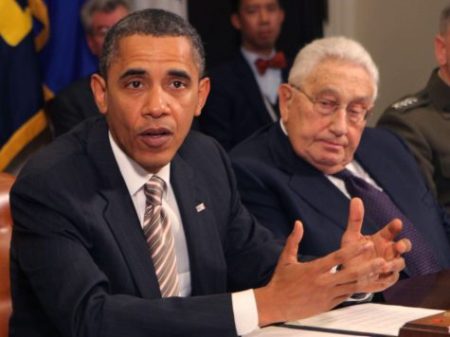
Obama-Kissinger-e1464550543436Pres. Obama seated with Henry Kissinger

{Originally posted to the author’s website, Abu Yehuda}

Old realpolitiker Henry Kissinger was in the news recently when he sat down with Donald Trump, to give him the benefit of his experience. It brought to mind Kissinger’s numerous attempts to get Israel out of the territories it conquered in 1967, before, during and – especially – after the Yom Kippur War.

Kissinger went to Iraq in December of 1975 to try to wean the regime away from the Soviet Union and improve relations with the US. In a discussion with Sa’dun Hammadi, the Iraqi Foreign Minister, Kissinger suggested that American support for Israel was a result of Jewish political and financial power, promised that the US would work to force Israel back to pre-1967 boundaries, and indicated that while the US would not support the elimination of Israel, he believed that its existence was only temporary. Here is an excerpt (the whole thing is worth reading):

I think, when we look at history, that when Israel was created in 1948, I don’t think anyone understood it. It originated in American domestic politics. It was far away and little understood. So it was not an American design to get a bastion of imperialism in the area. It was much less complicated. And I would say that until 1973, the Jewish community had enormous influence. It is only in the last two years, as a result of the policy we are pursuing, that it has changed.

We don’t need Israel for influence in the Arab world. On the contrary, Israel does us more harm than good in the Arab world. You yourself said your objection to us is Israel. Except maybe that we are capitalists. We can’t negotiate about the existence of Israel, but we can reduce its size to historical proportions. I don’t agree that Israel is a permanent threat. How can a nation of three million be a permanent threat? They have a technical advantage now. But it is inconceivable that peoples with wealth and skill and the tradition of the Arabs won’t develop the capacity that is needed. So I think in ten to fifteen years, Israel will be like Lebanon—struggling for existence, with no influence in the Arab world.  [my emphasis] …

Kissinger also promised that aid to Israel, which he presented as a result of Jewish political influence, would be significantly reduced. He indicated that legal changes in the US – he must have been referring to the creation of the Federal Electoral Commission in 1974 to regulate campaign contributions – would attenuate Jewish power and therefore American support for Israel. Naturally, he didn’t foresee the Israel-Egypt peace agreement, which permanently established a high level of military aid to both countries.

He further promised that the US would support a PLO-run Palestinian state if the PLO would accept UNSC resolution 242 and recognize Israel. This of course is what (supposedly) happened in the Oslo accords.

Kissinger insisted that “No one is in favor of Israel’s destruction—I won’t mislead you—nor am I.” But his hint that a smaller Israel might not survive is clear. Surely he understood that a pre-1967-sized Israel (within what Eban called “Auschwitz lines”) would have no chance of surviving, simply because of the strategic geography of the area.

Kissinger was wrong about the Arabs developing the capability to challenge Israel, but their place has been taken by soon-to-be-nuclear Iran and its proxies, who are significantly more dangerous than the Arab states ever were.

US policy, however, has kept more or less the same shape, except that the hypocrisy of insisting that the US supports the existence of Israel but in a pre-1967 size is even more glaring. The substitution of the PLO for the Arab states as the desired recipient of the land to be taken from Israel has barely made a ripple either in America or among the Arabs, suggesting that the policy is more about Israel giving up land than about the Arabs getting it.

The original motivation for Kissinger’s promises was supposedly the desire of the US to replace the Soviet Union as the patron of the Arab states. After the collapse of the USSR and the end of the Cold War in 1991, however, there was no change in policy. Although the Oslo Accords were initiated by left-wing Israelis, the US eagerly embraced them, and the so-called ‘peace process’ became a permanent stick to beat Israel with.

President Obama is especially adept at emphasizing support for Israel’s existence while at the same time demanding that Israel make concessions that would make her continued existence impossible. Apparently agreeing with Kissinger about Jewish power, Obama has worked to reduce the pro-Israel influence of American Jews in numerous ways, such as by providing access to the White House for groups like J Street and the Israel Policy Forum, while marginalizing traditional Zionist organizations like ZOA.

Kissinger’s almost anti-Semitic claim that US support for Israel is bought with Jewish money was probably untrue in 1975 and is even less so today, when a large proportion of American Jews, including wealthy ones, have chosen their liberal or progressive politics over Zionism. The coming struggle over the introduction of a pro-Palestinian plank into the Democratic platform is an indication that the party and with it, many of its Jewish supporters, is moving toward Obama’s position.

The Obama Administration’s program to extricate itself from the Middle East by empowering Iran as the new regional power has given a new impetus to the policy of shrinking Israel. Iran sees Israel as a major obstacle to its hegemony, for both geopolitical and religious/ideological reasons, and is committed to eliminating the Jewish state. Obama found it necessary to restrain Israel from bombing Iran’s nuclear facilities at least once (in 2012), and seems to be prepared to sacrifice Israel in order to achieve his goal of establishing Iranian regional dominance.

Some would go even further and say that Obama’s primary ideological goal is to eliminate Israel and the Iranian gambit is a means to this end, but that is highly speculative! Or maybe it’s a matter of two birds with one stone.

Henry Kissinger didn’t do us any favors, but I think the anti-Israel thread in American policy would have been strong enough without him, running from Truman’s Secretary of State George C. Marshall all the way to Obama’s stable of anti-Zionists like Rob Malley and Ben Rhodes.

Today Israel is long gone from the Sinai, more recently from Gaza, and probably only thanks to the disintegration of Syria, still holding the Golan Heights. I would like to believe that PM Netanyahu was correct when he said that Israel will never leave the Golan. Regarding Judea, Samaria and Jerusalem, I expect that we are about to begin a very difficult time, as the Obama Administration is likely to mount a campaign in its last days to fulfill Kissinger’s promise to the Arabs at long last.