Archive for the ‘Iran and Israel’ category

Dr. Majid Rafizadeh: Why the Islamist State of Iran is So Dangerous

March 22, 2017

Dr. Majid Rafizadeh: Why the Islamist State of Iran is So Dangerous, Clarion ProjectElliot Friedland, March 22, 2017

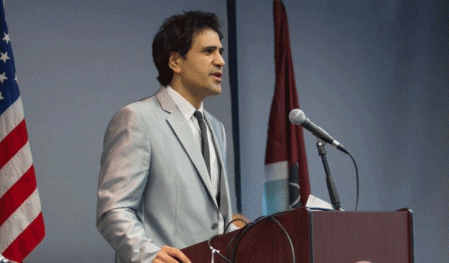
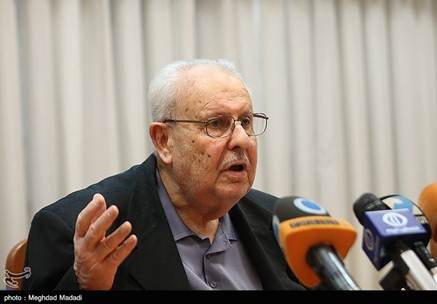
Dr. Majid Rafizadeh. (Photo: Supplied)

Dr. Majid Rafizadeh is a world-renowned Iranian-American political scientist,  businessman and author. He is a leading expert on Iran, Middle East, US foreign policy, and president of the International American Council on the Middle East and North Africa. Harvard-educated, Rafizadeh serves on the board on Harvard International Review. Born in Iran, Dr. Rafizadeh lived most of his life in Iran and Syria.

He can be reached on Twitter: @Dr_Rafizadeh or by email at Dr.Rafizadeh@Post.Harvard.Edu

He graciously agreed to speak with Clarion Project Dialogue Coordinator Elliot Friedland about Iran and why he feels so strongly about the threat posed by the regime. The views expressed below are those of Dr. Rafizadeh’s and not necessarily those of Clarion Project.

1. Clarion Project: What do you think is so dangerous about the regime of Iran?

Dr. Majid Rafizadeh: There are so many reasons why the Islamist state of Iran is extremely dangerous. They could fill an entire book.

Briefly speaking, I believe there are four major reasons, or what I will call, five concentric forces of extremism and fundamentalism:

First of all, from my perspective, the Iranian regime is far more dangerous than terrorist groups such as the Islamic State or Al Qaeda. On a daily basis, Iran tortures and executes people on a much larger scale than terrorist organizations such as ISIS. It is the top state sponsor of terrorism in the world. It supports militarily and financially hundreds of militia and terrorist groups all around the world. It regularly gives birth to terrorist groups. Only one country, the Islamist state of Iran single-handedly assists almost one quarter of world-designated terrorist groups. The Iranian regime contributes in terrorist attacks around the world. This means that the Iranian regime is responsible for blood spilled across many nations, for the slaughter of countless victims of terrorism. Iran has placed spies, lobbyists and agents across the globe, even in the U.S.

The Iranian regime is more dangerous than ISIS and Al Qaeda combined because the Islamist state of Iran operates under the “legitimacy” of the state system. Unlike ISIS or Al Qaeda, the Iranian regime has easily gotten away with its brutal actions for almost four decades because it is a “government” and supported by the United Nations when it comes to sovereignty. Since the ruling clerics rule a country, no one questions their actions.

Unlike terrorists groups such as ISIS and Al Qaeda, the Iranian regime has powerful ballistic missiles which can hit any country in the region; it has military institutions, it hires hundreds of thousands of militiamen, it freely controls the wealth of a large nation and wields all of the influence that comes with it. Instead of solely focusing on ISIS, the international community should also address the Iranian regime.
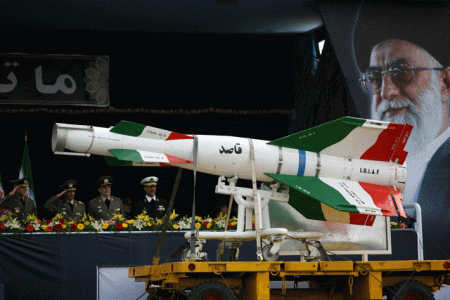
A military parade in Iran. (Photo: Getty Images)


Secondly, the Iranian regime is a radical theocracy. This means that its core pillars are anchored in radical Islamism and extreme interpretations of the religion of Islam. The Iranian regime imposes strict Shia sharia laws to suppress and control its population and export its ideology beyond its borders.  For nearly four decades, the ruling political establishment has exploited Islam and used their fundamentalist version of Islam in order to advance its parochial, religious, ideological, revolutionary and political interests. From the Iranian regime’s perspective, it is mandatory to commit any act of terrorism necessary to advance these religious and political goals.

Third, the Iranian regime ranks at the very top when it comes to human rights abuses according to Amnesty International and Human Rights Watch. This regime brutally cracks down on religious and ethnic minorities. It crushes all kinds of freedoms on a daily basis, engages in torture, and executes children.

Fourth, the Iranian regime’s objective is to spread its Shia radical Islamism across the globe. The Islamist state of Iran’s constitution clearly states that it is the mission of the Islamic state to export its ideology, religion and revolutionary principles beyond its borders. The functions of Iran’s Quds Force, proxies, lobbyists and agents among others, are to accomplish this goal. The constitution mandates an “Imam” or “Velyat-e Faqih” to rule people; which is another form of authoritarian theocracy. The regime believes that the world will be ruled under the power of the Islamic state of Iran and its Shia sharia law. It will do anything to achieve this religious and political objective.

Fifth, the Iranian regime aims at directly damaging the US and Israel’s national security interests in addition to any other country that opposes its authoritarian views. The regime has killed Americans and Westerners and it continues to fund efforts to harm the lives of American and Israeli people, as well as millions of other people.
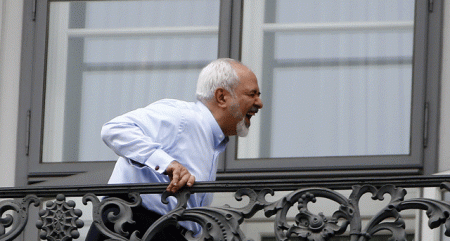
 

Iranian Foreign Minister Mohammed Javad Zarif laughs during the nuclear negotiations. (Photo: Reuters)


2. Clarion: The Iranian people are a lot more liberal than the regime. How can outside powers such as the United States reach out to and empower the people without emboldening the regime?

Rafizadeh: First of all, the U.S. government and other powers need to cooperate with those voices which oppose the theocratic and Islamist state of Iran. Powerful countries should stand on the right side of history.  There are many human rights groups and civil societies inside and outside of Iran that aim to democratize Iran and eliminate its violence. The U.S. specifically can help these people and unite the groups they form. It is in the long-term interest of any influential country that makes the effort to unify those that oppose the Islamic state and the human rights activists that struggle against it. Providing support to  opposition groups is an effective tool that will empower the Iranian people without emboldening the government. Seeing these groups strengthen and grow in numbers would frighten Iran’s government and weaken its grasp on the country as a whole.

Secondly, the U.S. and other powerful countries should cease all diplomatic, political, or economic ties with the Islamist state of Iran. They need to put pressure on the regime to respect human rights and to moderate its militaristic and ideological foreign policy. Four decades of diplomacy has not changed the violent behavior of the Islamist state of Iran.
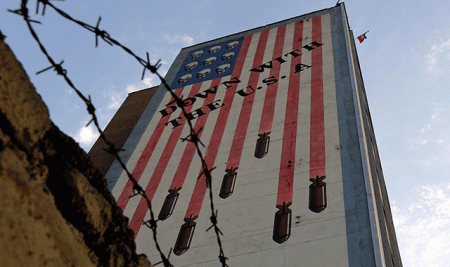
A building in Tehran emblazoned with anti-American graffiti. (Photo: ATTA KENARE/AFP/Getty Images)

3. Clarion: Now that the Iran Deal has gone through and will be upheld, what is the next step for those worried about the regime’s nuclear ambitions?

Rafizadeh: I strongly believe, and we should all be aware, that the Iranian regime will use every opportunity to acquire nuclear weapons. Nuclear weapons are the Iranian regime’s golden shield which can guarantee its rule for eternity and will ensure the achievement of its radical goals.

The nuclear deal is very dangerous. When it expires, it will allow Iran to legally become a nuclear state. It is already providing Iran with billions of dollars every year, wealth that is used for extremism, terrorism, damaging U.S. national interests, and killing Westerners and Americans.

The nuclear activities of the Iranian regime should be monitored by independent groups meticulously. History has shown us, that the International Atomic Energy Agency or the UN will not detect Iran’s undercover nuclear operations. They have failed to do so several times.  All violations should be brought to the attention of the public. In addition, sanctions (particularly the UN Security Council’s sanctions) should be re-imposed on the Iranian regime. The Iranian regime should be punished for its ballistic activities and violations of UN resolutions. Without consequences, they have no motivation to limit their activities or progress toward becoming a nuclear state.
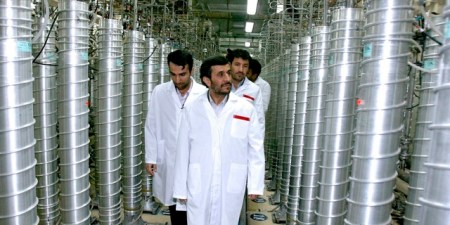
Then Iranian President Mahmoud Ahmadinejad tours the nuclear facility at Natanz. (Photo: Reuters)

4. Clarion: Should international activists who want to see the Iranian situation improve be using a policy of detente and engagement or isolation, boycotts and shaming?

Rafizadeh: The only policy that has resulted in success against the Iranian Regime was the application of pressure and boycotts. For example, in several cases, when there has been an international outcry and when the media paid attention to a victim of torture or execution in Iran, the Iranian regime has been forced to change its sentence. The economic boycotts successfully forced the Iranian regime to the negotiating table.

For the Islamic state of Iran, engagement and concessions signal weakness, not diplomacy. Negotiations only embolden and empower the regime. Applying pressure is the most effective, and likely only way, to create change within the regime.
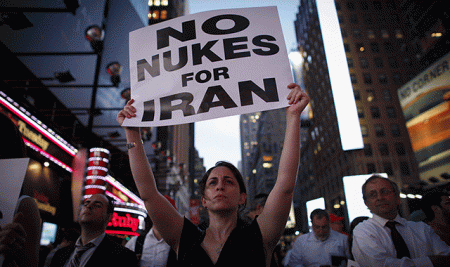
A woman protests against nuclear weapons for Iran at a rally in Times Square. (Photo: KENA BETANCUR/AFP/Getty Images

5.  Clarion: What is the most important thing people who want to eliminate extremism and see positive relations between Muslims and non Muslims should be doing?

Rafizadeh: The most important thing is to do what you [Clarion] are doing: to give a voice to those Muslims who strongly oppose radical Islam and attempt to create reforms from within Islam. Those silent moderate Muslims need to speak up, and need to be supported when they do. If we stay silent, radical Islam will continue winning and expanding. It is our job to strongly stand against radical Islam even if that endangers our life. People should know that there are truly some Muslims who want to forge genuine reformation in Islam and help eliminate radical Islam.

Many Muslims, including myself and my family, who have endured oppression under radical Islam in Muslim nations, would like to eliminate radical Islam, promote a peaceful moderate form of Islam and lead a reformation.

Finally, I describe in detail other important topics in this article “As a Muslim, I am shocked by Leftists and Liberals” as well as in my books.

I grew up between two authoritarian governments, the Islamic Republic of Iran and Syria, under the leadership of people such as Assad, Ayatollah Ali Khamenei, and Mahmoud Ahmadinejad. My youth was influenced by two major denominations of Islam in the Muslim world; the Shia and Sunni. I also studied Shia and Sunni Islam academically, and at one point I was a very devout Muslim. My parents, who still live in Iran and Syria, come from two different ethnic Muslim groups; Arab and Persian.

Unfortunately, in the West and particularly in the US I have witnessed that there are some groups, who have access to megaphones, including liberals, democrats, leftists and Western Muslim scholars (who have never experienced radical Islam first hand and have never lived under states ruled by sharia law) spread apologetic views toward radical Islam. They also criticize those Muslims who attempt to promote social justice and peace within Islam.

If liberals, leftists and many Western Muslim scholars truly stand for values which they call for, such as peace and social justice, they should be aware that their actions are actually contributing to the expansion of radical Islam, and they are hurting us and our efforts to lead reformation in Islam and weaken radical Islam.

Iran’s Islamic Revolutionary Guards now opposite Israeli troops on 1967 ceasefire line in Golan Heights

March 12, 2017

Iran’s Islamic Revolutionary Guards now opposite Israeli troops on 1967 ceasefire line in Golan Heights, Jihad Watch

(Please see also, Iranians at the gate. — DM)

Israeli Prime Minister Benjamin Netanyahu has stated:

The threat of Shia Islamic terror is directed not only against us, but against the region and the entire world.

Perhaps Israel, more than any other nation, fully understands what “radical Islamic terrorism” is, and its primary goal of obliterating Israel.

“We do not want to see Shia Islamic terrorism led by Iran step in to replace Sunni Islamic terrorism,” Mr Netanyahu told the Russian President.

Iran continues attempts to destroy the Jewish state. They speak of this openly and write this in black and white in their newspapers.

Iran is now in a strategic position to try to destroy Israel directly (instead of through its proxies) as it expands its Shia base into Iraq and Syria.

Netanyahu could also not be clearer in his message that replacing Sunni terrorism with Shia terrorism is counterintuitive. Netanyahu is right about the global danger of mainstream Shia and Sunni terrorism, which is normalized in all too many Islamic states, not just in the Islamic State.

Netanyahu also once stated:

Islamic terrorism is inundating the world and inciting millions in many countries, from Jakarta to Africa to California.

“Iranian Revolutionary Guards opposite Israeli troops on 1967 ceasefire line in Golan Heights as tensions mount,” by Lizzie Dearden, Independent, March 10, 2017:

Benjamin Netanyahu has accused Iran of using the Syrian civil war to “gain a foothold to fight Israel” amid fears over Iranian troops stationed along the border with the occupied Golan Heights.

Tehran is supporting Bashar al-Assad with deployments of the Revolutionary Guards (IRGC), Basij militia and funding to allied militias including Hezbollah.

The IRGC are now reported to be present in Syrian-government controlled territory along the 1967 ceasefire line in the Golan Heights, which has seen months of Israeli air strikes met with rockets fired towards the Israel Defence Forces (IDF).

Brigadier General Mohammad-Reza Naghdi, a commander in Iran’s Basij force, was pictured surveying the border, while a Shia paramilitary group has formed a “Golan Liberation Brigade”.

Harakat Hezbollah al-Nujaba, an Iraqi force backed by Iran, is “ready to take action to liberate Golan” from Israeli occupation, according to spokesman quoted by Iranian state media this week.

The deployments have made the Iranian government a major power broker in the Syrian civil war, meeting with Russian and Turkish representatives at ceasefire talks in Astana, Kazakhstan.

In a meeting with Vladimir Putin on Thursday, the Israeli Prime Minister said that any truce must not allow the continued presence of Iranian forces in Syria.

“We do not want to see Shia Islamic terrorism led by Iran step in to replace Sunni Islamic terrorism,” Mr Netanyahu told the Russian President.

“Iran continues attempts to destroy the Jewish state. They speak of this openly and write this in black and white in their newspapers.

“Today, we have our own country and our army, and we can defend ourselves. But I want to say that the threat of Shia Islamic terror is directed not only against us, but against the region and the entire world.”

He told reporters Iran was “arming itself and its forces against Israel including from Syria territory and is, in fact, gaining a foothold to continue the fight against Israel”.

After the meeting, the Israeli Prime Minister said the removal of Iranian forces from Syria were vital to “prevent misunderstandings”.

“I made it clear that regarding Syria, while Israel is not opposed that there should be an agreement there, we strongly oppose the possibility that Iran and its proxies will be left with a military presence in Syria under such an agreement,” Mr Netanyahu added.

A statement released by the Kremlin said he and Mr Putin discussed “joint efforts to combat international terrorism” and examined areas of bilateral cooperation.

Two years ago, Israel and Russia agreed to coordinate military actions over Syria in order to avoid accidentally trading fire but the risk of skirmishes is increasing as pro-Assad forces fight for more territory in the Golan Heights….

PLO Ambassador To Iran: We Will Liberate Palestine ‘From The River To The Sea’ – With Everything From Stabbing And Vehicular Attacks To Launching Rockets

March 2, 2017

PLO Ambassador To Iran: We Will Liberate Palestine ‘From The River To The Sea’ – With Everything From Stabbing And Vehicular Attacks To Launching Rockets, MEMRI, March 2, 2017

“Providing a political analysis of what is happening with the Palestinian cause today, Al-Zawawi said: ‘We are not facing an ordinary enemy, or a small-scale plan. Rather, we are fighting the most dangerous international plan, especially after the U.S. adopted the [idea the Palestinians must recognize Israel as] a Jewish state. The U.S. transitioned from one phase to the next, fully aware of what its next step will be, and we were deceived.’ He added: ‘The ethnic and sectarian conflicts taking place today – their purpose is to take over and dismantle the region’s resources and spark wars among the Arabs in order to distance them from Palestine – [all this] promotes the establishment of Greater Israel.’

******************************

A March 1, 2017 article in the Lebanese daily Al-Akhbar about PLO Ambassador to Iran Salah Al-Zawawi included excerpts of an interview with him focusing on the PLO-Iran relationship. Al-Zawawi also stressed in the interview that armed struggle using all means was a legitimate path to liberating Palestine “from the river to the sea.”

It should be noted that on February 19, the Palestinian news agency Wafa reported that “the ambassador of the state of Palestine in Iran, Salah Al-Zawawi” would be part of the Palestinian delegation to the Sixth International Conference in Support of the Palestinian Intifada, held in Tehran on February 21,[1] and that the Palestinian Ministry of Foreign Affairs website also lists him as Palestine’s ambassador to Iran.[2]

Following are excerpts from the article, including statements by Al-Zawawi:

alzawawiSalah Al-Zawawi at the the Sixth International Conference in Support of the Palestinian Intifada (image: Tasnim, Iran, February 21, 2017)

“In February 1981, the late [Palestinian Authority (PA)] president Yasser Arafat appointed Salah Al-Zawawi as PLO envoy to Tehran, after the late Hani Al-Hassan retired and left for Beirut. Following the signing of the Oslo Accords between the PLO and the Zionist enemy, Iran refused to recognize the PA that was born of this agreement, and also rejected the replacement of Al-Zawawi and the appointment of a new ambassador. Thus, Al-Zawawi remained in office, and has spent the past 32 years of his life in Tehran.

“Al-Zawawi reminisced about the opening of the [PLO] embassy [in Tehran], which was attended by Abu ‘Ammar [Arafat], [then-PLO ambassador to Tehran] Hani Al-Hassan, Ahmad Khomeini [son of the leader of the Iranian revolution, Ruhollah Khomeini], and former Iranian foreign minister Ebrahim Yazdi. During it, [he said], the Palestinian flag was raised over the former Israeli Embassy building. He expressed his pride in the fact that Arafat was the first official to visit Tehran, and added: ‘After the victory of the Imam Khomeini’s revolution, Arafat said: “Starting today, my front stretches from Tyre to Khorasan…” [Al-Zawawi added:] ‘Palestine-Iran relations run deeper than any political differences the two sides face, and even after the PLO’s recognition of Israel, ties between the two revolutions remain…’

“Underlining the [PLO-Iran] relations that have existed since time immemorial, Al-Zawawi said: ‘Our relationship with the Imam Khomeini began back when he was still in exile. The Imam’s revolution [i.e. Iran’s Islamic Revolution] was based on two main foundations: Islam, and Palestine [including Jerusalem, which is], the first direction of prayer [for Muslims, and the location of] the third-most important mosque [Al-Aqsa]. Once the Imam Khomeini’s revolution had triumphed, he said: Today Iran, and tomorrow Palestine, and added: Without restoring Palestine, Iran’s independence will remain lacking as well.’ Al-Zawawi added: ‘The Imam [Khomeini] adopted our [Palestinian] revolution when he was in the [Iraqi] city of Al-Najaf, which is holy [to Shi’ites], and it was then also that he issued his historic fatwa regarding the transfer of zakat [alms] and one-fifth [of a person’s income] to the Palestinian fighters who risk their lives.’

“Al-Zawawi speaks lovingly of Khomeini, saying: ‘The Imam would see in his mind’s eye the future of Palestine, and he declared the last Friday of Ramadan to be International Qods [Jerusalem] Day, [because] he could see what [ordinary] people do not see.’ [Al-Zawawi continues:]I look at the dark days we live in now: the Zionist enemy is attempting to swallow up the West Bank, annex Jerusalem, and see it as the capital of the Zionist entity. This is in addition to [the Zionists] stepping up settlement construction and allowing [themselves] to harm Al-Aqsa mosque.’

“The Palestinian ambassador likes repeating the history of [Palestinian-Iranian] ties even prior to the victory of the Islamic Revolution [in Iran]. He stresses that most Iranian commanders were trained at Fatah camps in Lebanon, that some of them died as martyrs fighting alongside Palestinian fighters and are still on the list of Palestinian martyr families, and that [Fatah] continues to pay allowances to their families in Iran.

“[Al-Zawawi continues:] ‘The Iranian ideological compass is linked to Palestine, so that wherever you go in Iran, you will find a street or monument named for Palestine. In the holiest site for [Shi’ite] Islam, that is, the seat of the [Eighth Shi’ite] Imam Ali Al-Ridha in Mashhad, there is a large courtyard, the Al-Quds Courtyard, that features a model of the Dome of the Rock, and after every prayer the Iranians chant anti-U.S. and anti-Israel slogans…’

“The Palestinian ambassador was careful to mention anything [that the Palestinians have] in common with Iran, saying: ‘We are facing a U.S.-run Western plan, which will not end except through combat and jihad, carried out by all means. The regime here was established on the basis of Islam and the Shi’ite sect, and we as a movement connect to it in the martyrdom aspects of Karbala and Hussein. The Imam Hussein’s rebellion is a fundamental matter in the Shi’ite conscience, and the principle of the victory of the bloody sword underlines that the few can also triumph [over the many], and that those with few weapons can defeat those with an abundance of them…’

“[Al-Zawawi], one of the most veteran Palestinian diplomats, does not deny [that there are Palestinian] disagreements with Iran, but [explains that] ‘every side has to understand the other side’s tendencies, and we must fight to liberate Palestine. For our people in the 1948 territories [meaning Israeli Arabs], a different kind of fighting is needed than the kind needed for the people of the West Bank, and the West Bank requires a different kind of fighting than Gaza. [Additionally,] there is the diplomatic struggle.’ He added: ‘Certainly, everyone should fight in their own way, from carrying out stabbing and vehicular attacks to launching rockets. That is how we will liberate Palestine from the river to the sea… Some [types of?] jihad aredictated by geography, and everyone should contribute from where they are, using the means at their disposal and in accordance with their various situations. All means of combat are legitimate in order to realize Allah’s promise for liberation: From [the traditional dance] Dabke to armed struggle.’

“Providing a political analysis of what is happening with the Palestinian cause today, Al-Zawawi said: ‘We are not facing an ordinary enemy, or a small-scale plan. Rather, we are fighting the most dangerous international plan, especially after the U.S. adopted the [idea the Palestinians must recognize Israel as] a Jewish state. The U.S. transitioned from one phase to the next, fully aware of what its next step will be, and we were deceived.’ He added: ‘The ethnic and sectarian conflicts taking place today – their purpose is to take over and dismantle the region’s resources and spark wars among the Arabs in order to distance them from Palestine – [all this] promotes the establishment of Greater Israel.’

“The Palestinian ambassador no longer believes in the Oslo Accords. Moreover, he says: ‘When the PLO signed the agreement, a Palestinian state was supposed to be established in the West Bank and Gaza in 1999, but it did not happen.’ Eighteen years have passed since then, and therefore Al-Zawawi determines that Israel and the U.S. will not allow the establishment of a Palestinian state. He said decisively: ‘Oslo is bankrupt. U.S. President Donald Trump is the Zionist face of this enterprise. Additionally, the futility of dialogue with the enemy is now becoming clear.’

“For the Palestinian ambassador, the internal [i.e. intra-Palestinian] division adds fuel to the fire: ‘Can you believe how divided we are and how we are unable to unite[?] I do not accept any excuses whatsoever [for this] from the factions.’ He added: ‘At this time, we have no choice but to unite because the enemy is taking advantage of our division to Judaize Palestine, which is slipping away before our very eyes.’

“As for the Sixth Conference to Support the Palestinian Intifada, he believes that it expresses Iran’s commitment to the Palestinians: ‘The belief of fellowship [between us and the Iranians] is known to all. [The Iranians] are the bearers of the black standard, who leave Khorasan for Jerusalem.’ He added: ‘If we see the conference as a political and media phenomenon, then it has achieved what it was expected to achieve under these harsh conditions, when everyone seeks to eliminate the Palestinian cause. The conference gave us a chance for dialogue amongst ourselves. Furthermore, it was attended by heads of parliament from Arab countries and around the world, who discussed the next phase of the Palestinian struggle.'”[3]

___________________________

[1] Wafa.ps, February 19, 2017.

[2] Mofa.gov.ps.

[3] Al-Akhbar (Lebanon), March 1, 2017.

Saudi spy chief visits Israel, Ramallah

February 22, 2017

Saudi spy chief visits Israel, Ramallah, DEBKAfile, February 22, 2017

riadhmissileseng_480

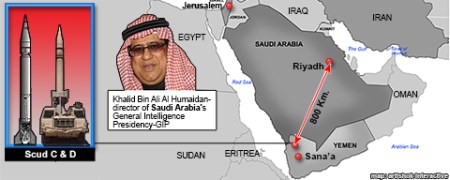
The director of Saudi Arabia’s General intelligence agency, Khalid Bin Ali Al Humaidan, paid surprise visits to Ramallah and Jerusalem on Tuesday and Wednesday, Feb. 21-22. Neither Palestinian nor Israeli officials have confirmed that the visit took place.

Last week, DEBKA Weekly carried an exclusive report that Iranian engineers were working round the clock on a project dubbed “Riyadh First,” for adding an extra 100km to the intermediate range of the Scud-C (600km) and Scud-D (700km) surface missiles, to enable them to reach the Saudi capital and explode in the center of Riyadh. The project, which is going forward at the Al Ghadi base in Big Ganesh, 48km west or Tehran, was ordered by supreme leader Ayatollah Ali Khamenei and President Hassan Rouhani.

This plan was behind the threat made by IRGC Air Force Commander Gen. Amir Ali Hajizadeh on Saturday, Feb. 11, at the start of an Iranian military exercise: “Should the enemy make a mistake, our roaring missiles will rain down on them,” he said.

Gen. Hajizadeh, who is in charge of the missile testing site, ordered all other work halted in order to concentrate on the fast-track “Riyadh First” Scud development project.

On Feb. 4, Iranian-backed Yemeni Houthis fired a missile which they claimed was a homemade Borkan with a range of 800km into Saudi Arabia. It struck the al-Mazahimiyah military camp west of Riyadh.

According to our military sources, the Houthis don’t possess a missile of that range. Their attack was in fact the first test of the newly-extended Iranian Scud, as a dress rehearsal for the real strike.

If the visit by the Saudi spy chief is confirmed, he will have come for several missions. In Ramallah, he would have warned the Palestinians not to go through with their bid to strengthen direct ties with Tehran (which was first revealed by DEBKAfile on Feb. 13). The first meeting of Iranian and Palestinian delegations has already taken place in Brussels.

In Jerusalem, Al-Huymaidan may have explored security issues related to the US-Israeli-Arab regional conference proposed by US President Donald Trump and Prime Minister Binyamin Netanyahu when they met in Washington on Feb. 15.

DEBKAfile’s sources note that the Saudi spy chief is a professional soldier and the first commoner to hold the post of Director of Saudi General Intelligence. Among his predecessors were high-ranking princes such as Bandar Bin Sultan, Turki Bin Faisal and Muqrin Bin Abdul Aziz.

Young Iranian chess grandmaster expelled from national team for not wearing hijab

February 22, 2017

Young Iranian chess grandmaster expelled from national team for not wearing hijab, Jihad Watch

Her brother Borna, 15, has also been banned after competing against Israeli player Alexander Huzman in the same tournament.

********************************

Dorsa Derakhshani is part of a new and growing movement within some Sharia states that is daring to challenge the brute strictures of Sharia, including the inferior status of women. The hijab is, of course, a symbol of that oppression and by law in the Islamic Republic of Iran, women must wear it.

The head of Iran’s Chess Federation, Mehrdad Pahlevanzadeh, was quoted as saying the Chess Federation will deal with the siblings in the “severest way possible.”

“The first step in dealing with them would be to deprive them from playing in Iran, and they won’t have a chance to be in the national team,” Pahlevanzadeh said, Azerbaijani news outlet Trend News Agency reported

dorsa-derakhshani

“Young Iranian chess grandmaster expelled from national team for not wearing hijab,” RT News, February 21, 2017:

Iran has banned 18-year-old chess grandmaster Dorsa Derakhshani from competing for the national chess team for not wearing a hijab – obligatory dress for women under Iranian law.

Derakhshani was expelled for not covering her hair with the garment – compulsory wear for women since the Islamic Revolution in 1979 – while competing as an independent player in the 2017 Tradewise Gibraltar Chess Festival.

Her brother Borna, 15, has also been banned after competing against Israeli player Alexander Huzman in the same tournament.

The siblings have subsequently been precluded from competing in future international competitions for the Islamic Republic. Dorsa obtained her International Master and Woman Grandmaster titles last year and currently lives in Barcelona, Spain, after taking up the offer of a year’s residency.

The head of Iran’s Chess Federation, Mehrdad Pahlevanzadeh, was quoted as saying the Chess Federation will deal with the siblings in the “severest way possible.”

“The first step in dealing with them would be to deprive them from playing in Iran, and they won’t have a chance to be in the national team,” Pahlevanzadeh said, Azerbaijani news outlet Trend News Agency reported.

Belgium-based Iranian gender discrimination activist Darya Safai tweeted a negative reaction about the move with the hashtag “forced hijab”

“Dorsa to me is the true feminist, not the Swedish government parading with the headscarf with [President of Iran Hassan] Rouhani,” Safai said in a Facebook post.

Safai was referring to members of the Swedish government – many of whom self-identify as feminists – who visited Iran in February.

The Swedish delegation received criticism from many observers who saw the move as a legitimization of an enforced law that violates women’s rights in Iran.

Under Iranian law, women are required to cover their hair and wear loose-fitting clothes when they appear in public and foreigners are obliged to dress modestly when entering the Islamic Republic for whatever length of time.

“By actually complying with the directives of the Islamic Republic, Western women legitimize the compulsory hijab law,” Masih Alinejad, CEO of human rights group UN Watch, wrote on Facebook.

It is the not the first time Iran’s insistence on female competitors to wear the hijab has caused controversy.

In September 2016, female players accused the World Chess Federation (FIDE) of failing to stand up for women’s rights after it said competitors must accept local law and wear hijabs during the world championship in Tehran, Iran.

Female grandmasters risked arrest if they did not cover their hair during the tournament…….

Iran’s Leader Urges Palestinians to Launch Violent Uprising

February 21, 2017

Iran’s Leader Urges Palestinians to Launch Violent Uprising, Investigative Project on Terrorism, February 21, 2017

EXCLUSIVE – Arab Intel Official Warns Israel, Jordan, Syria Borders at Risk of Becoming an Iranian Stronghold

February 18, 2017

EXCLUSIVE – Arab Intel Official Warns Israel, Jordan, Syria Borders at Risk of Becoming an Iranian Stronghold, BreitbartAaron Klein and Ali Waked, February 18, 2017

(Please see also, Can Trump rescue his Syria deal with Putin?. — DM)

jordan-border-640x480AP Raad Adayleh

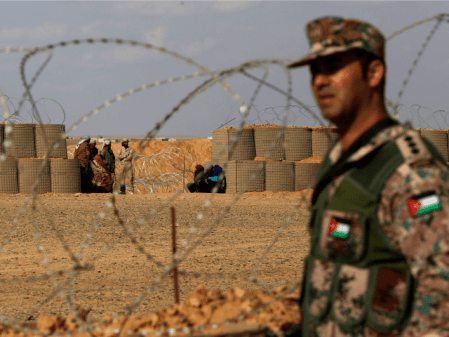
TEL AVIV — There is fear that further advances by the Syrian army, assisted by the Iran-backed Hezbollah and elite Iranian troops, may turn the Israel-Jordan-Syria border area into an Iranian proxy base, an Arab intelligence officer said.

“It’s not so much the possibility that it happens, but the prospects of an Israeli retaliation if Iranian forces come near its border,” he said. “Israel made it clear, publicly and behind the scenes, that it would not tolerate Hezbollah and Revolutionary Guards’ presence along its border.”

“Iran has exploited the campaign against Nusra Front and the Islamic State to take root in the border area,” he said. “Jordan and Israel too would like to see these organizations out, but not to the point that Hezbollah and Iran fill the void.”

Lately, Israel and Jordan have cooperated closely on the matter, he stated. “Israel knows that Jordan needs to act against extremist elements but both want to prevent Iran from taking advantage of it.”

“It is also in [Syrian President Bashar] Assad’s best interest to keep the Iranians out,” the official contended. “True, he has stated that the Golan Heights would be liberated by force, and he relies heavily on Hezbollah and Iran. But at some point he’d wish to rule over his own border areas, which is something Jordan can live with. But not Iran.”

He added that the Iranian Revolutionary Guards tried several times in the past to gain a foothold in Jordan. “But these cells were unveiled and dismantled before they became operational.”

He added that the joint operation room of the Syrian opposition groups has become almost completely inactive.

“Its activity has been dramatically reduced,” he said of the operation room. “There are no more operational and tactical plans and directives. The world wants first and foremost to remove the jihadist threat, but the elements in the region believe that the jihadi threat will be replaced by an Iranian one.”

He said that Jordan has rebuffed Iranian proposals to increase economic cooperation despite the financial dire straits in which the Kingdom finds itself. “They want to prevent Iran from having any kind of foothold in the kingdom.”

According To Iranian Officials, Obama Administration Gave Unwritten Consent In The Nuclear Talks And In The JCPOA Negotiations For Iran To Develop Ballistic Missiles With A Range Of Only 2,000 km – That Is, Capable Of Striking Israel But Not Europe

February 3, 2017

According To Iranian Officials, Obama Administration Gave Unwritten Consent In The Nuclear Talks And In The JCPOA Negotiations For Iran To Develop Ballistic Missiles With A Range Of Only 2,000 km – That Is, Capable Of Striking Israel But Not Europe, MEMRI, A. Savyon and Yigal Carmon and U. Kafash*, February 2, 2017

“Likewise, the Zionist regime is the most important enemy of Iran in the regionregion, and is less than 1,200 km away. Therefore, short- and medium-range missiles are sufficient to strike U.S. bases near Iran, and long-range missiles are sufficient to strike the occupied territories [Israel]. The diagram shows several of these American bases and [also] the missiles that are counting [down] to the moment [when they will be able to] strike them.”

*********************

Introduction

On January 30, 2017, U.S. sources announced that Iran had conducted a failed test of a new ballistic missile, the Khorramshahr. According to reports, the missile exploded after a 965-km flight.[1] Both Iranian Foreign Minister Zarif (on January 31) and Defense Minister Dehghan (on February 1) stressed that Iran “asks permission from no one in the matter of its defense program.”[2]

It should be emphasized that contrary to statements by Iranian regime spokesmen who say that Iran’s missile program is defensive, missiles with a 2,000-km range are strictly offensive and strategic. This is why Iran has faced constant demands to stop developing them.

In the years that preceded the U.S.-Iran nuclear talks, Iran developed ballistic missiles with ranges of 2,500-5,000 km that threaten Europe and even the U.S.

Dr. Hassan Abbasi, theoretician of Iran’s Islamic Revolutionary Guards Corps (IRGC) and director of the IRGC Center for Borderless Security Doctrinal Analysis, said in 2004: “We have a strategy drawn up for the destruction of Anglo-Saxon civilization and for the uprooting of the Americans and the English.

“Our missiles are now ready to strike at their civilization, and as soon as the instructions arrive from Leader [Ali Khamenei], we will launch our missiles at their cities and installations… And because of Khatami’s policies and dialogue between the civilizations, we have been compelled to freeze our plan… and now we are [again] about to carry out the program… The global infidel front is a front against Allah and the Muslims, and we must make use of everything we have at hand to strike at this front, by means of our suicide operations or by means of our missiles.”[3]

The London-based Saudi daily Al-Sharq Al-Awsat also reported, on June 14, 2004, that the Shihab 4 and Shihab 5 long-range missile projects had been revived, on orders from Iranian Supreme Leader Ali Khamenei.[4]

It should be noted that a December 14, 2013 report on Iran’s missile program published by the IRGC-affiliated Mehr news agency immediately following the Geneva Agreement provided details on the various Shihab models. According to the report, Shihab 3D missiles, with a range of 2,200-3,000 km, “can easily reach the occupied territories [Israel]… and cover their entire area.” The report also stated that the Shihab 4 has a range of 3,000 km and the ability to launch satellites into orbit, and that “very little information” has been published about the Shihab 5. The diagrams in the article also feature a Shihab 6 model.[5]

U.S. Approves Iranian Development Of Missiles With A Range Of Only 2,000 km – That Is, Capable Of Reaching Israel

However, after U.S.-Iran negotiations began, and at the end of their first stage, in Geneva in November 2013, Iranian officials began reporting that Iran’s missile program for missiles with ranges above 2,000 km was being restricted.

Thus, for example, immediately after the interim agreement was reached in Geneva, on December 10, 2013, and in reference to it, IRGC commander Mohammad Ali Jafari said that Iran is capable of producing missiles with a range of over 2,000 km but that Khamenei had restricted the IRGC to a 2,000-km range: “We want to increase the range of the IRGC’s missiles, but despite this, the Leader [Khamenei] has restricted us to a range of 2,000 km. We have the capability to increase the range of our missiles, and our missiles should obviously reach Israel… The regime’s red lines were not crossed during the nuclear talks with the P5+1 [Group] and in the Geneva Agreement.”[6]

Indeed, IRGC commanders stressed that the most important thing for the regime was missiles capable of striking Israel; see, for example, comments by IRGC Aerospace and Missile Division director Amir Ali Hajizadeh, who said following a 2016 missile launch: “For us, Israel’s evil is totally clear, and the 2,000-kilometer range of our missiles [is intended] to confront the distant Zionist regime.”[7]

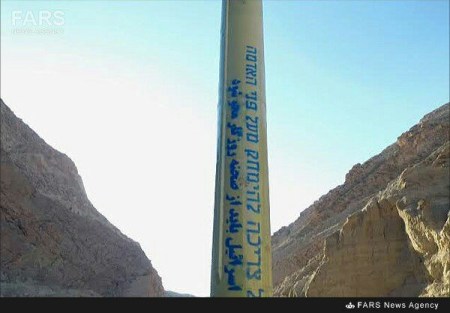
Extensive quotes regarding the Iranian regime’s explicit intent to target Israel with its missiles can be found in MEMRI Inquiry & Analysis No. 1135, Iranian IRGC Missile Unit Commanders: We’ve Developed 2,000-km Range Missiles And Equipped Hizbullah With 300-km Range Missiles; Fars News Agency: Israel’s Illusions About Its Natural Gas Fields Will Be Buried In The Mediterranean, December 3, 2014, and Special Dispatch No. 6349, Iran Launches Long-Range Missiles Emblazoned With Slogan: ‘Israel Should Be Wiped Off The Face Of The Earth’, March 16, 2016.

1298aIranian missile emblazoned with the slogan ‘Israel Should Be Wiped Off The Face Of The Earth” (Fars, Iran, March 9, 2016)

On November 17, 2014, the IRGC-affiliated Tasnim news agency posted a diagram explaining that Iran “makes do” with a range of 2,000 km, which it considers “desirable” and which covers all of Israel: “On the Firing Line – The commanders of the army of the Islamic Republic [of Iran] have said several times that with its attainment of long-range missiles with a range of up to 2,000 km, Iran has arrived at the range ceiling that it considers desirable, and that ‘in the meantime’ there is no need to increase this range. Although the U.S. is 11,000 km from Iran, in recent years it has approached the borders of Iran, [and therefore] its military bases, equipment, and forces are a target for Iran’s missiles.

“Likewise, the Zionist regime is the most important enemy of Iran in the region, and is less than 1,200 km away. Therefore, short- and medium-range missiles are sufficient to strike U.S. bases near Iran, and long-range missiles are sufficient to strike the occupied territories [Israel]. The diagram shows several of these American bases and [also] the missiles that are counting [down] to the moment [when they will be able to] strike them.”[8]

Additionally, Defense Minister Hossein Dehghan said on August 18, 2015 in response to a reporter’s question on the manufacture of missiles with a range greater than 2,000 km: “We do not produce missiles with ranges greater than 2,000 km.”[9]

Is U.S. Permission For Iran To Develop Missiles With Ranges Up To 2,000 km – Which Reach Israel – A Secret Annex Of The JCPOA, Or Simply Unwritten Consent?

In statements, IRGC officials hinted that restrictions on the range of Iranian missiles so that they reach Israel but not Europe were part of the Iran deal. Thus, for instance, IRGC commander Mohammad Ali Jafari referred to the IRGC’s November 2, 2015 consent to UN Security Council Resolution 2231, saying: “One of the points in this resolution was the matter of restrictions, which some military elements feared. Therefore, we held meetings in [Iran’s] Supreme National Security Council, and also went to the Leader [Khamenei]. The [Iranian] negotiating team told the Westerners that we do not agree to these restrictions. They [the Westerners] said that these issues must be included in the resolution. Even when I met with the Leader, he said that there were no restrictions on developing defensive capabilities. The only restriction relates to nuclear missiles, which, obviously, we never wanted.”[10]

The next day, on November 3, 2015, Iranian Army chief of staff Hassan Firouzabadi referred to Jafari’s remarks, saying: “I confirm statements by the IRGC commander that Iran’s missile activity is not restricted. We will follow two restrictions: The first is mentioned in the JCPOA, in the matter of no nuclear planning, and the second is the range of 2,000 km, which has already been noted previously by all elements in Iran.”[11]

It should be noted that the Hebrew version of this news, which IRIB published on November 4, 2015 explicitly mentioned, in both the headline and the text, that the JCPOA allows Iran to possess ballistic missiles of a range of 2,000 km. The Hebrew news item read:

Firouzabadi: The Nuclear Agreement Promises Iran Missiles With 2,000-km Range

“The chief of staff of Iran’s armed forces, Maj.-Gen. Hassan Firouzabadi, stressed that the state, under orders from the general commander [i.e. Khamenei] of the IRGC, undertakes, inter alia, to restrict nuclear planning, but that it is entitled to produce missiles with a range of 2,000 km.

“Firouzabadi made these statements yesterday (Tuesday) to a group of Islamic regime leaders and officials, and referred to [statements by] the IRGC general commander emphasizing that Iran would commit to the sections of the nuclear agreement with the West that include a restriction on nuclear planning, and that in addition, Iran is entitled to possess missiles with a range of 2,000 km.”[12]

These statements indicate that although the permission given to Iran to develop missiles capable of striking Israel is likely not a secret annex of the JCPOA, it still constitutes unwritten consent that is an integral part of the nuclear deal. It is convenient for both sides not to publish this understanding in written form – for Iran because it rejects any public reference to its missile program, which it defines as defensive but is in fact offensive; and for the Obama administration, because there would be repercussions if it were to be revealed that it had given Iran permission to develop missiles capable of striking Israel.

It should be noted that UN Security Council Resolution 2231 (2015) constitutes an additional concession by the Obama administration to Iran, in comparison with the previous resolution 1929 (2010). This concession has two components:

One, UNSCR 1929 banned Iran from conducting any activity concerning missiles capable of carrying nuclear warheads, while UNSCR 2231 replaced the word “capable,” which refers to objective specifications, with the word “intended,” which concerns fluid political matters.

Two, while UNSCR 1929 banned Iran from conducting any missile activity, UNSCR 2231 rescinds this ban.

Following Iran’s May 9, 2016 missile test, which took place after the JCPOA’s Implementation Day – and which embarrassed the Obama administration – IRGC Aerospace and Missile Division director Amir Ali Hajizadeh said: “The Americans are telling [us]: ‘Don’t talk about missile affairs, and if you conduct a test or maneuver, don’t mention it.'”[13]

*A. Savyon is Director of MEMRI’s Iran Media Project; Y. Carmon is President of MEMRI; U. Kafash is a Research Fellow at MEMRI.


[1] Foxnews.com, January 30, 2017.

[2] Yjc.ir, January 31, 2017; Tasnim (Iran), February 1, 2017.

[3] Shargh (Iran), June 5, 2004; Al-Sharq Al-Awsat (London), May 28, 2004. Also see MEMRI Inquiry & Analysis No. 181, The Internal Debate in Iran: How to Respond to Western Pressure Regarding Its Nuclear Program, June 17, 2004; MEMRI Special Dispatch No. 723, Iran’s Revolutionary Guards Official Threatens Suicide Operations: ‘Our Missiles Are Ready to Strike at Anglo-Saxon Culture… There Are 29 Sensitive Sites in the U.S. and the West…’, May 28, 2004; and MEMRI TV Clip No. 252, Iranian Revolutionary Guard Official In Tehran University Lecture (Part II): We Plan To Target US Nuclear Warheads On US Soil; Should Take Over England, May 22, 2004.

[4] A military source in the Iranian Defense Ministry stated: “In a meeting last week with Revolutionary Guards commanders, Khamenei said that Israel was planning to attack Iran’s nuclear installations and the Iranian military soon, and therefore defense and military preparedness should be boosted as soon as possible. Khamenei stressed that the increase in petroleum prices allowed Iran to allocate a larger budget to its military projects. [Iran’s] Ministry of Defense received $1 billion to resume its Shihab 4 and Shihab 5 project. It is known that in the past, Iran conducted an experiment with Shihab 3 missiles whose range is 1,200 kilometers [and which can reach Israel], but [President] Khatami halted the project of the Shihab 4, whose range is 2,800 [which covers Western Europe], and the Shihab 5, whose range is 4,900-5,300 km [and which can reach the U.S.], because he thought it was a project incompatible with Iran’s strategic interests and defense needs.” Al-Sharq Al-Awsat (London), June 14, 2004.

[5] Mehrnews.com, December 14, 2013.

[6] ISNA (Iran), December 10, 2013.

[7] Fars (Iran), March 9, 2016. See MEMRI Special Dispatch No. 6349, Iran Launches Long-Range Missiles Emblazoned With Slogan: ‘Israel Should Be Wiped Off The Face Of The Earth’, March 16, 2016.

[8] Tasnim (Iran), April 17, 2014. See MEMRI Inquiry & Analysis No. 1135, Iranian IRGC Missile Unit Commanders: We’ve Developed 2,000-km Range Missiles And Equipped Hizbullah With 300-km Range Missiles; Fars News Agency: Israel’s Illusions About Its Natural Gas Fields Will Be Buried In The Mediterranean, December 3, 2014.

[9] Yjc.ir, August 18, 2015.

[10] Fars (Iran), November 2, 2015.

[11] Mashregh (Iran), November 3, 2015.

[12] Hebrew.irib.ir, November 4, 2015.

[13] See MEMRI Special Dispatch No. 6430, IRGC Aerospace And Missile Force Commander: The Americans Are Telling Us ‘Don’t Talk About Missile Affairs, And If You Conduct A Test… Don’t Mention It’, May 15, 2016.

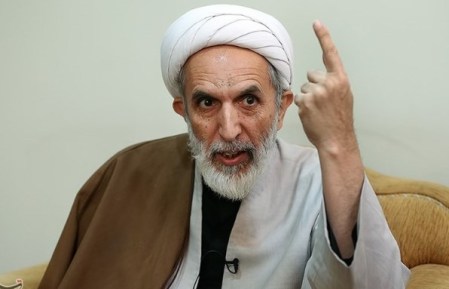
Khamenei Associate Mehdi Taeb: ‘The Jews… Are The Only Ones Who Need Weapons Of Mass Destruction In Order To Rule The World – Because There Are 1.4 Billion Muslims And None Of Them Agree To Jewish Supremacy’

January 27, 2017

Khamenei Associate Mehdi Taeb: ‘The Jews… Are The Only Ones Who Need Weapons Of Mass Destruction In Order To Rule The World – Because There Are 1.4 Billion Muslims And None Of Them Agree To Jewish Supremacy’, MEMRI, January 27, 2017

In speeches and lectures that have been uploaded to the Internet in the past year, Mehdi Taeb, who directs the Ammar Strategic Base that advises Iranian Supreme Leader Ali Khamenei, has expressed antisemitic views. In his statements, Taeb has claimed that the Jews aim to control the world and therefore are obligated to kill anyone who is not willing to accept this control, particularly Muslims. He reiterated the antisemitic canard about the Jews controlling the global economy and the media, and stated that they hatch plots and sow division, strife and wars, especially among Muslims, in addition to creating and taking advantage of terrorism worldwide so as to ensure their global dominance. The Jews, he implied, even have power over God Himself. He urged his audience to awaken and act against the Jews, as instructed in the Koran, and to remove the cancerous growth of Israel, as commanded by the father of Iran’s Islamic Revolution, Ayatollah Ruhollah Khomeini.

This report will focus on two of Taeb’s speeches, a 2011 audio recording[1] and a 2014 video,[2] that in the past few months have been posted online several times. The 2011 recording is part of a series of lectures by Taeb, and the 2014 clip is from a Friday sermon in which he referred to a video of statements by an Israeli rabbi with bogus Farsi subtitles added as “proof” of anti-Shi’ite Jewish plots and terrorist actions aimed at preventing the Mahdi – the Hidden Imam, who is the Shi’ite Messiah – from coming to save the world from the Jews.

6759aMehdi Taeb (image: nowruziran.wordpress.com)

Taeb In “Know Your Enemy” Lectures: “No One In The World Wants To Control It As Badly As The Jew, Who Says ‘Either Be My Servant Or Be Destroyed'”

In an hour-long audio recording dated September 23, 2011, which was part of a lecture series titled “Know Your Enemy,” Taeb explained why the Koran warned about the Jews and their global role. The Jews, he said, have special capabilities and they are using them to take over the world. To this end, the Jews have divided the world’s population into three categories: themselves, destined to control the world; another group, destined to serve the Jews; and a third group, comprising those who oppose Jewish rule, and which the Jews are working to exterminate. The Jews need atom bombs and weapons of mass destruction to destroy those who oppose them – that is, 1.4 billion Muslims – and they did not establish the State of Israel before conducting a nuclear test.

“He added that the Jews were keeping the Mahdi from arriving, saying: “The Koran speaks much of the Jews, and often warns about them… Surat Al-Maida [the fifth Surah of the Koran]… states that the Jews are your worst enemy… This surah says that you will ultimately realize this, whether you like it or not, but that if you are willing [to understand] and to avoid [falling for the Jewish deceit], then you will be saved. However, if you are remiss and are not willing [to understand], then one day they [the Jews] will awaken you. In the end, being remiss regarding [the Jews] will also bring about [your] awakening… but after you awaken, you will find yourselves in a grave already dug [for you] by the Jews… Why does the Koran warn so about the Jews? Why is it said that the world is a pawn in the hands of the Jews? … The reason the Koran warns so about the Jews is because they have [special] capabilities, and are the most hostile to us [Muslims, more so than] others. The Jews also know how to attack better than anyone else. They are No. 1 in four ways, and that is why Islam states that we must confront them…

“The Jews want the entire world [for themselves], saying ‘the whole world belongs to us’ and ‘God gave it to us and He cannot take it back.’ If you think about the Star of David, you will realize that the Jews want… to take over the world in three stages: The first stage is Jerusalem… the second stage is from the Nile to the Euphrates, and the third stage is the whole world. The Star of David has six points. This symbol is meant to shine in the [Jewish] Temple [in Jerusalem]. Its two upper lines symbolize [the territory] from the Nile to the Euphrates, [and once they control that] then the six points of the Star of David will spread across the world and connect up with each other… in controlling the whole world.

“They have divided humanity into three categories… The first class is the Jews, who are supposed to conquer the world… and as long as they do not take over the entire world, God’s hands are tied… The second class is those who are not descendants of Jacob, but who agree that the Jews are the first class… These people are entitled to live, but must serve the Children of Israel… The third class is those who are not Children of Israel and who do not agree to the supremacy of the Children of Israel, and reject their rule… The Talmud [of the Jews] states that such people should be killed as cheaply as possible – [that is], if you can kill them with a rock, don’t kill him with a sword, because that will dull the blade…

“According to this, under the global Jewish regime, the Muslims need to be killed… Who needs an atom bomb? … The Jews! They are the only ones who need weapons of mass destruction in order to control the world, because there are 1.4 billion Muslims and none of them agree to Jewish supremacy… In order to control the world, the Jews must kill 1.4 billion Muslims… and therefore need atom bombs… Until the Jews carried out an atomic bomb test, they did not establish the State of Israel… No one in the world wants to control it as badly as the Jew, who says ‘Either be my servant or be destroyed’… For 3,000 years, the Jews have been preparing the ground for this. Today, the world’s wealth is in Jewish hands… The world hates the Americans because of their relationship with the Zionists…

“The Imam [Khomeini] once said that the Jews say Iran purchased weapons from Israel – because [the Jews] know how lowly they are, and how they are hated, and know that anyone with a connection to Israel will be hated as well. They want Iran to be hated, so they say that it purchased weapons from Israel…

“America is not severing ties with Israel because 80% of American wealth belongs to Israel… Wherever there is fire and fighting in the world, such as in India and Pakistan, the reason for it should be investigated among the Jews. The same goes for Africa…

“Because three years ago Jacques Chirac supported Hizbullah, the Jews are causing chaos in France, so as to make trouble for him… If you Muslims want the Imam Mahdi to arrive, you must remove this stumbling block [to his arrival] – that is, the Jews… In order to control the world, the Jews create chaos…That is why it is said that the world is a pawn in the hands of the Jews…

“In order for you Muslims to attain world domination, you must remove this cancerous growth… That is why the Imam Khomeini said that Israel should be removed from the map of the world…

“The Koran said that the Jews must pay the jizya [poll tax], must deliver it with both hands, and must also present themselves [to the Muslim authorities] every week – because if you leave the Jews alone, they will scheme.”

Taeb On Video Of Israeli Rabbi Amnon Yitzhak And “The Jewish Deceit”: “This Is The First Time A Clip Of A Jewish Rabbi In A Jewish Synagogue Was Leaked… He Says That [The Jews] Should Do Something So That They [The Shi’ites] Cannot Bring Their Imam Mahdi”

A video dated July 18, 2014 and posted online several times in recent months shows Taeb giving a Friday sermon in which he refers to a July 8, 2014 video of Israeli rabbi Amnon Yitzhak giving a speech to a Jewish audience. Although in the video the rabbi is discussing the biblical story of Abraham’s hospitality to three visitors in Chapter 18 of Genesis, the Farsi subtitles show him talking about Jewish plans to sow divisions among the Shi’ites so as to delay the arrival of the Mahdi. Taeb says that the rabbi’s statements prove that a Jewish trick is preventing the arrival of the Mahdi.

Following are Taeb’s statements to his audience of worshippers about what he claims the rabbi is saying:

“The Koran states that the worst hostility towards the [Muslim] believers comes from the Jews… That is, if the Imam Mahdi cannot arrive, it is because of them. ‘Go break his [the Jew’s] hands’…

“This is the first time a clip of a Jewish rabbi in a Jewish synagogue has been leaked. He gives a speech, and [in it] says that [the Jews] should do something so that they [the Shi’ites] are not able to bring their Imam Mahdi [because the Jews fear]… that if their Imam Mahdi arrives, he will dismantle our entire [Jewish] enterprise…

“[This rabbi says:] We [Jews] created Sarkhi[3] so that [the Shi’ites] would be preoccupied. We promote world soccer, so do something in order for them [the Shi’ites] to be preoccupied with soccer, sports, and the like. Do something so that they fail and turn on each other…

“This [speech by the rabbi] reveals that they [the Jews] created ISIS so that we are preoccupied with each other and so that the coming of the Imam Mahdi will be delayed. These are the explicit statements by that Jewish rabbi.”

To watch the video, click the player below. For the translation of the Farsi subtitles, see Appendix A; for a translation of Amnon Yitzhak’s actual statements in the relevant segment, see Appendix B.

(Video at the link — DM)

APPENDIX A: Translation Of Farsi Subtitles Added To July 8, 2014 Clip Of Rabbi Amnon Yitzhak

“It is absolutely necessary to distance the Shi’a in Iraq from extremist elements, as well as from thoughts of assisting their co-religionists [elsewhere], as well as from the faith written in their books, and from their Imam Mahdi who [is supposed] to fight us – so that they [the Shi’ites] cannot help him [the Mahdi] in the end times.

“Therefore, a source [of religious guidance] must be created, in order to divert them [the Shi’ites] from their religion and faith, and keep them preoccupied with games, and lead them in the direction of sporting events. [Exploiting] their love of soccer is very important right now.

“Mahmud Al-Sarkhi, our agent in Iraq, whose projects we generally rely on – after Mahmoud Al-Sarkhi was assassinated, his brother became our agent, and we made him a mirror image of his brother. And his stupid friends confirmed that he was [indeed Sarkhi] himself, after we trained him, and now he attacks everyone to create division.

“I ask you to log onto Facebook, spread his words and attacks, and become his disciples.”

APPENDIX B: Translation Of Rabbi Amnon Yitzhak’s Statements

“It’s possible to enjoy this world and live a good and happy life, even in materialistic terms, but with blessings. You can eat delicious food and say a blessing over it, drink a delicious beverage and say a blessing over it. You can have fun, dance and celebrate – but always with a blessing, while [following the] religious commandments. Everything, even the most material things, can be [used as a chance to follow the] religious commandments. When our father Abraham hosted [the three visitors], he stood there, 99 years old, in the heat of the day, after his circumcision. It was the third day after the circumcision, which is the most painful. To make him go back into his tent [God] made the sun come out [and shine hot], but [Abraham] did not go back in. He sees three Arabians, who were [really] angels, approaching him. They looked like heathen Arabians to him, [yet] he invited into his home. He ran over to his cattle, slaughtered [a calf], did everything to be hospitable. He showed them charity, that is the Jewish [way]. What did he feed them? Three tongues of oxen in mustard. He took tongues from three oxen. [He could have] taken one tongue and divided it into three, because it is large, [but] no, he was 100% charitable. You know what was happening at the time? When those Arabians arrived, the Lord was with [Abraham]. ‘The Lord appeared to Abraham near the great trees of Mamre while he was sitting at the entrance to his tent.'”

__________________

[1] Media.rasekhoon.net, September 23, 2011; translation starts at 26:00.

[2] Aparat.com, July 18, 2014.

[3] Apparently a reference to Mahmud Al-Hasani al-Sarkhi, an Iraqi Shia cleric in Iraq whose followers attacked the Iranian consulate in Basra in protest over criticism of their leader that was broadcast on Iranian television.

Re-isolate Iran now

January 27, 2017

Re-isolate Iran now, Israel Hayom, David M. Weinberg, January 27, 2017

In fact, the U.S. and Israel should reach an accord on a basket of responses to Iranian violations and aggressions, including the placement of a military option against Iran’s nuclear program back on the table.

Trump and Netanyahu must together promulgate an approach for combating the malign influence and hegemonic ambitions of Iran.

*********************************

Prime Minister Benjamin Netanyahu has made it clear that one of the top items on his agenda for consultation with U.S. President Donald Trump in Washington next month is countering Iranian aggression. With good reason. The net result of the Joint Comprehensive Plan of Action has been to foster Iran’s rise to regional hegemon.

While the JCPOA suspended a part of Iran’s nuclear weapons program for a few years, the ayatollahs see it as providing time to advance their centrifuge capability and regional sway.

In a Hoover Institution paper published this month, Professor Russell Berman and Ambassador Charles Hill call Iran a “de facto Islamic caliphate,” and the Islamic Revolutionary Guard Corps an “Iranian expeditionary force for invading strategic Arab spaces.”

They call former President Barack Obama’s declared goal — of finding and bolstering so-called moderates in Tehran via the JCPOA — an “illusion.” Iran is not a polity of moderates and hard-liners, they write. It is a revolutionary theocracy masquerading as a legitimate state actor. So the first thing Trump must do is recognize the consistently hostile character of the regime.

Alas, Obama was obsessed from the advent of his presidency with making nice to Iran, and was willing to subordinate much of American foreign policy in service of that goal. He sent many secret letters to Supreme Leader Ayatollah Ali Khamenei that recognized the prerogatives of the Islamic republic and foreswore regime change. He cut funding to anti-regime groups and abandoned Iranian moderates during the early days of the Green Revolution in 2009, after the regime fixed an election. He effectively conceded Syria as within Iran’s sphere of influence.

In his penetrating book, “The Iran Wars: Spy Games, Bank Battles, and the Secret Deals That Reshaped the Middle East,” Wall Street Journal reporter Jay Solomon exposes the money trail that accompanied this strategic sellout to Iran. In exchange for talking, Obama gave the Iranians hundreds of millions of dollars monthly, stabilizing their economy. And in the end, Obama offered Iran a deal that legalized full-blown uranium, plutonium, and ballistic missile work on a timeline, and did not force the country to disclose its previous nuclear cheating. The deal also released roughly a hundred billion dollars to Iran; had American officials traveling to drum up business for Iran; and removed restrictions on a range of Iranian terrorists.

Along the way, the administration abandoned the powerful sanctions leverage it had over Iran. Solomon chronicles the ramp-up of severe banking sanctions on Iran that were having a disastrous impact on the Iranian economy. “Iran’s economy was at risk of disintegrating, the result of one of the most audacious campaigns in the history of statecraft. The country was months away from running short on hard currency. The budget had a $200 billion black hole. And the U.S. Treasury Department had made sure Iran had no way to recover. Iranian ships and airplanes were not welcome beyond Iran’s borders, and oil revenue was frozen in overseas accounts.”

And then, behold, Obama backed off. Administration officials all of a sudden claimed that tightening the noose on the Iranian economy would cause the sanctions policy to collapse! And Secretary of State John Kerry was sent to cut a sweet deal with Iran; a deal that squandered — and then reversed — a decade’s worth of effort to constrain Iran.

Now Trump must act to constrain Iran all over again.

Over the past year, Iran has intensified a pattern of aggression and increased its footprint across the region. Iranian advisers with Shiite militias from as far away as Afghanistan have flooded Syria, giving Tehran a military arc of influence stretching to the Mediterranean.

Khamenei says that Iran’s massive military presence (alongside Hezbollah) in Syria is a supreme security interest for the regime — a front line against Israel — and that Iran has no plans to leave.

This has grave implications for Israel. Netanyahu must demand of Trump (and Putin) to include the removal of all foreign forces, especially Iran, in any future agreement regarding Syria. This will be very difficult — especially since Russia has just signed a long-term agreement to greatly enlarge its military presence in Syria, including the port in Tartus and air base in Latakia.

Iran, too, is aggressively expanding its naval presence in the Red Sea region and eastern Mediterranean. Since 2011, it has been sending warships through the Suez Canal, and has used maritime routes to send arms shipments to Hizballah and Hamas. (Israel has intercepted five of these armament ships.) And in the Strait of Hormuz, IRGC speedboats have repeatedly engaged in provocative encounters with American warships, including the conduct of surprise live rocket fire exercises in proximity to U.S. Navy vessels.

Then there is Iranian terrorism. IRGC agents have been caught planning attacks on Israeli, American, British and Saudi targets in Kenya. Over the past five years, Iranian agents were exposed while planning to attack Israeli diplomats in Azerbaijan, Cyprus, Georgia, India, Nigeria, Thailand and Turkey. Hezbollah operatives supported by Iran carried out the bus bombing of Israeli tourists at the Burgas airport.

Also: The detailing of Iranian terrorism in Arab countries such as Egypt, Jordan and Saudi Arabia could fill this entire newspaper.

Then there is Iran’s ballistic missile program. In December, U.S. Senator Ted Cruz sent a seven-page letter to three senior officials of the Obama administration, detailing his well-founded concerns that North Korea and Iran might be working together on developing nuclear missiles. (Not surprisingly, the Obama officials never answered.)

Cruz’s basic question was: Why does Iran, having promised not to make nuclear weapons, continue to pour resources into developing long-range ballistic missiles, including numerous missile tests this past year? If not for nuclear weapons, then for what?

The intrepid analyst Claudia Rosett continually has raised the suspicion that North Korea’s nuclear program is secretly doubling as a nuclear backshop for Iran. It’s very possible that the $1.7 billion in air-freighted cash that Obama granted Iran is being used to finance nuclear weapons and missile research in North Korea. It’s even possible that Iran may be bold enough to buy warheads from North Korea.

Only Washington can stop this, by re-isolating and pressuring Iran. Netanyahu should travel to Trump with a comprehensive plan to influence U.S. policy toward Iran, as well as plans for joint action against Tehran.

This should include an end to the secrecy surrounding many sections of the JCPOA. All side agreements should be disclosed relating to Iranian technology acquisitions, raw material quantities, uranium and plutonium enrichment levels, sanctions relief and financial transfers. Loopholes and exceptions made surreptitiously by Obama should be closed.

Penalties should be set firmly in place for Iran’s prohibited missile programs. (Such penalties do not exist in the JCPOA or in U.N. Security Council Resolution 2231.)

U.S. and Israeli resources should be pooled, in a renewed and formal U.S.-Israel agreement, to uncover and eliminate any undisclosed sites within Iran connected to nuclear weapons technology; to counter Iranian terror threats across the region; and to subvert any Iranian bases in Syria and Lebanon.

In fact, the U.S. and Israel should reach an accord on a basket of responses to Iranian violations and aggressions, including the placement of a military option against Iran’s nuclear program back on the table.

Trump and Netanyahu must together promulgate an approach for combating the malign influence and hegemonic ambitions of Iran.