Archive for the ‘Intelligence’ category

The Texas ISIS attack was not averted owing to US “human intelligence” deficit

May 5, 2015

The Texas ISIS attack was not averted owing to US “human intelligence” deficit, DEBKAfile, May 5, 2015

Elton_Simpson_30.4.15Elton Simpson and Nadir Soofi, Texas

(“Racial” profiling? Why hasn’t anyone thought of that before? Oh. Wait. That would offend Islamists. — DM)


That Simpson and Soofi were permitted to get so far is best explained by a certain weakness in the human intelligence capabilities of US and Western intelligence, the shortage of undercover agents able to mingle in communities and populations with the potential for producing radical elements capable of committing terrorist murder and suicide in the name of their faith. These agents must be able to pass unnoticed in mosques, bazaars and cafes, and have an ear for local dialects, street talk and inflections, so as to catch onto dangers through innuendo.

*********************

The two American gunmen who Sunday, May 3, tried – and failed – to shoot up an exhibit of caricatures of the Prophet Mohammad at the Curtis Culwell Center in Garland, northeast of Dallas, sounded a wakeup call for US intelligence and counter-terrorism agencies – even before the Islamic State warned that this first attack on US soil would not be its last. The two homegrown terrorists, Elton Simpson, a Christian who converted to Islam, and Nadir Soofi, son of a Pakistani father and American mother, carried submachine guns and explosives and wore body armor – attesting to the existence of an organization behind the attack.

That organization is believed to be made up of small sleeper cells of two to three terrorists each, ready to spring into action on orders from distant controllers.

Both were young men in their mid-twenties. The half-Pakistani Muslim Soofi scraped a living from cleaning carpets, while Simpson was out of work. They failed to perpetrate mass murder because they made every possible mistake. And so after inflicting a scratch on one of the unarmed guards, both were shot dead by local police officers securing the “Muhammad Art Exhibit and Contest” at the Curtis Culwell Center, which offered a $10,000 prize for the best artwork or cartoon depicting the Prophet.

For the past two years, Simpson and Soofi have been running posts and images on Twitter, Facebook and Instagram extolling the Islamic State in Iraq and the Levant (ISIS) and all its works, threatening American Christians with revenge and declaring that terrorist attacks were coming.

Shortly before the Dallas event opened, an explicit threat to mete out punishment to those insulting the Prophet Mohammad in Texas, like in Denmark and Paris, appeared on a Twitter account (since de-activated) belonging to AbuHussainAlBritani, known to security services as an ISIS platform.

Simpson had been known as an FBI target since 2010. Then, he made no secret of his plans to travel to Somalia, take advanced studies in Islam and die as a martyr. He was arrested , convicted only of making a false statement to the forces of the law and released on probation. After that, a double agent persuaded him to talk for hundreds of hours on tape, candidly admitting that he intended one day in the future to take part in a deadly terrorist operation.

Yet Simpson was not detained, or even placed under extra surveillance.

Data flowing from Open Source Intelligence (OSINT) is critical in the war on terror: social networks like Twitter and Facebook serve terrorists around the world widely for passing information, arranging rendezvous, filling in the gaps of operational directives and, above all, disseminating their messages.
The US National Security Agency, as well as European and other agencies, maintain blanket surveillance of the social networks, transferring their content in almost real time to giant computers at agency headquarters for filtering and analysis. It is hard to understand how the radical online messages and outspoken tweets by Soofi and Simpson, which left no room to doubt their intentions, escaped interface by those computers with their past records and views.

The pair was therefore free to drive from Arizona to Texas in late April, in a car registered in one of their names, and armed with machine guns.

They pulled up at the Curtis Culwelll center, where the Mohammed cartoon exhibit opened in the presence of Pamela Geller, president of the American Freedom Defense Initiative (AFDI), which has sponsored anti-Islamic advertising campaigns across the country, and Geert Wilders, a Dutch politician and anti-Islamic campaigner who is on an al Qaeda hit list. When they reached their destination, they were not stopped until they actually started shooting – and only then thanks to the fast reflexes of a police guard on the spot.

That Simpson and Soofi were permitted to get so far is best explained by a certain weakness in the human intelligence capabilities of US and Western intelligence, the shortage of undercover agents able to mingle in communities and populations with the potential for producing radical elements capable of committing terrorist murder and suicide in the name of their faith. These agents must be able to pass unnoticed in mosques, bazaars and cafes, and have an ear for local dialects, street talk and inflections, so as to catch onto dangers through innuendo.

Digital intelligence, however extensive, is no substitute for human intelligence. It takes an undercover human agent on the ground to pick up on terrorist threats in time to thwart attacks.

Book review: The Islamic War

March 16, 2015

The Islamic War: Book review, Dan Miller’s Blog, March 16, 2015

(The views expressed in this article are mine and do not necessarily reflect those of Warsclerotic or its other editors. — DM)

The Islamic War, Martin Archer, 2014

The novel begins with a terror attack on a residential area in Israel, resulting in multiple causalities. It may, or may not, have involved members of the Iranian Revolutionary Guard. Menachem Begin is the Israeli Prime Minister and Ariel Sharon is the Defense Minister. The story begins immediately after the (postponed?) end of the Iran – Iraq war in 1988.

A massive armor, infantry, artillery and air attack on Israeli positions in the Golan follows the terrorist attack. The Israelis are outnumbered and suffer many thousands of casualties.

Israel had anticipated a simultaneous attack via Jordan, so most Israeli tank, infantry and air resources are deployed there, rather than in the Golan, to conceal themselves and await the arrival of Iranian, Iraqi and Syrian forces. They come and are defeated, most killed or fleeing. The Israeli forces then move into Syria and have similar successes there as well.

As the story evolves, it becomes evident that Israel must have known that the Iran – Iraq war had been allowed to fester to permit Iran, Iraq and Syria to develop a well coordinated plan to dispose of Israel, in hopes that a surprise attack could be made as soon as the Iran – Iraq war ended. Other events also suggest that Israel had prior notice:

Nuclear facilities of several hostile nations explode mysteriously.

The Israeli Navy had managed to infiltrate Iranian oil ports — apparently before the attack on the Golan — without being noticed. Then, at a propitious moment near the end of the fighting elsewhere, they destroyed all oil tankers in, entering or leaving port, along with all Iranian oil storage facilities.

The Israel Navy, which had suffered no losses, then moved to Saudi Arabia to protect her oil ports and ships coming to buy her oil and leaving.

As these events unfold, Israel, Egypt, Jordan, Saudi Arabia and Turkey* are negotiating a united front against Iran, Iraq and Syria, much to the displeasure of the U.S. Secretary of State, who wants a cease fire and return to the status quo ante. Fortunately, the U.S. President favors Israel and her coalition and generally ignores his SecState.

I won’t spoil the story by relating what happens at the end, but it’s very good for Israel, Egypt, Jordan, Saudi Arabia, Turkey and the Kurds, and very bad for Iran, Iraq and Syria. The novel is well worth reading, perhaps twice.

_____________

*Historical note: Turkey in 1988 was reasonably secular and also in other ways quite different from now. Egypt under President Al-Sisi is, in some but not all respects, similar to Egypt in 1988 under President Mubarak. Beyond a good relationship with Israel, Al-Sisi is working to modernize and reform Islam by turning it away from the violent jihad which drives both the Islamic State (Sunni) and the Islamic Republic of Iran (Shiite). Egypt remains under fire from the Obama administration due to the “coup” which ousted President Morsi, who had made Egypt essentially an arm of the Muslim Brotherhood. Egypt now helps to protect Israel with her military presence in the Sinai to oppose Hamas and Muslim Brotherhood activities there. Saudi Arabia and Jordan, like most countries in the Middle East, look out for the interests of their rulers first and are quite concerned about both the Islamic State and Iran.

US intel. scraps Iran, Hezbollah from terrorist threats list

March 16, 2015

US intel. scraps Iran, Hezbollah from terrorist threats list, Iran Daily, March 16, 2015

(True or false? I have seen nothing to confirm the report in the “legitimate media,” but that’s not surprising. Here, thanks LS, is a link to the cited report. Iran appears to remain on the list (at page 14). Hezbollah appears, but as a victim of Sunni “extremists” in Lebanon.– DM)

image_650_365

The US National Intelligence has removed Iran and the Lebanese resistance movement, Hezbollah, from its list of “terrorist threats.”

US Director of National Intelligence James Clapper scrapped Iran and Hezbollah from the list in an annual report recently delivered to the US Senate, citing their efforts in fighting terrorists, including the ISIL Takfiri group, Press TV reported.

The unclassified version of the report titled “Worldwide Threat Assessment of the US Intelligence Communities,” which was released on February 26, 2015, noted Iran’s efforts to battle extremists, including those of the ISIL terrorist group, who were perceived to constitute the greatest terrorist threat to American interests worldwide.

Highlighting Iran’s regional role, the report pointed to the Islamic Republic’s “intentions to dampen sectarianism, build responsive partners, and deescalate tensions with Saudi Arabia.”

Iran has “overarching strategic goals of enhancing its security, prestige, and regional influence [that] have led it to pursue capabilities to meet its civilian goals,” the report said.

The report also said that Hezbollah is countering ISIL Takfiri terrorists in Syria and Iraq.

The ISIL Takfiri terrorists have taken control of swathes of territory in Iraq and Syria since last year.

Iran has repeatedly stressed that it will not interfere militarily in Iraq and Syria, but the Islamic Republic continues to provide support to both countries against ISIL in the form of defense consultation and humanitarian aid.

The Odds Of A War Between Israel And Iran Just Went Way Up

February 26, 2015

The Odds Of A War Between Israel And Iran Just Went Way Up
The Economic Collapse By Michael Snyder, on February 25th, 2015


(I suspect Bibi will have something to say about this in his upcoming address to Congress. – LS)

Uh oh – Iran just got caught with both hands in the cookie jar.  It turns out that even while Iran has been negotiating a “historic peace deal” with the western world, it has been secretly operating a huge underground nuclear enrichment site that it didn’t tell anyone about.  But this is what the Iranians always do.  They lie, lie and then lie some more.  So how in the world can you make a deal with a government that absolutely refuses to tell the truth?  These revelations about a secret underground nuclear facility just outside Tehran come at a time when it looked like the Obama administration was about to cave in and give Iran just about everything that it wanted.  The “deal” that Obama was going to give them would have allowed the Iranians to keep all of the nuclear infrastructure that they have already constructed and would also give them permission to start building nuclear weapons in about a decade.  It would be a monstrously bad deal for the western world, and the Iranians should have jumped at it.  But now these new revelations could throw a wrench into those negotiations.  But much more importantly, knowledge of this secret nuclear facility has got to be extremely alarming to the Israelis.  Prime Minister Benjamin Netanyahu has always said that Israel will never, ever allow Iran to construct a nuclear weapon.  So what will happen if the Israelis determine that Iran is actually much closer to building a nuclear bomb that anyone originally suspected?  The truth is that the odds of a war between Israel and Iran just went way up thanks to these revelations, and that is not good news for any of us.

(more…)

Video: Steve Coughlin Counterterror Training Education and Analysis

January 24, 2015

Video: Steve Coughlin Counterterror Training Education and Analysis, Counter Jihad Report, January 24, 2015

(Long videos, well worth watching at leisure. — DM)

622022286

Center for Security Policy, September 13, 2012

Over more than a decade following 9/11, MAJ Stephen Coughlin was one of the US government’s most astute and objective analysts, and an expert in the connections between Islamic law, terrorism and the jihadist movement around the globe.

Through knowledge of published Islamic law, MAJ Coughlin had a demonstrated ability to forecast events both in the Middle East and domestically and to accurately assess the future threat posture of jihadist entities before they happen.

He has briefed at the Pentagon, for national and state law enforcement and intelligence agencies, and on Capitol Hill for Members of Congress. Today, he is a Senior Fellow at the Center for Security Policy. His book, Catastrophic Failure, will be released in late 2012.

With this series of presentations, the general public has access to a professional standard of intelligence training in order to better understand the jihadist threat.


Part 1: Lectures on National Security & Counterterror Analysis (Introduction)


Part 2: Understanding the War on Terror Through Islamic Law:


Part 3: Abrogation and the ‘Milestones’ Process:


Part 4: Muslim Brotherhood, Arab Spring & the ‘Milestones’ Process:


Part 5: The Role of the OIC in Enforcing Islamic Law:

Emerson on Fox’s Hannity: “No Go Zones and Sharia Courts…Europe is Finished.”

January 8, 2015

Emerson on Fox’s Hannity: “No Go Zones and Sharia Courts…Europe is Finished.” Investigative Project, January 7, 2014

(Which is more deadly? The white flag of surrender flown in the name of multiculturalism throughout Europe and elsewhere, or the (non-Islamic, as we have repeatedly been told) Islamic State flag? The white flag flutters as it celebrates the killing of our souls, while the flag of Islam merely celebrates the killing of our bodies while “enriching” local culture with the “blessings” of multicultural diversity.– DM)

Sean Hannity: Welcome back to “Hannity.” So France is on high alert at this hour following today’s deadly terrorist attack that left 12 people dead. Investigators working around the clock to put the pieces together. So could a similar terrorist attack happen here at home? Joining me now terrorism expert Steve Emerson. Steve, I want to talk about the growth in population of people moving to France from Muslim countries. You have these no-go zones. You have sharia courts that they’ve allowed. I assume the French, they wanted to be accepting and accommodating and have not insisted on assimilation. Has that played a part in this and is that something we’ve got to be on alert for now?

Steve Emerson: Well certainly throughout Europe, Sean, you have “no-go zones.” When I was in Brussels a year ago when I asked the police to take me to the Islamic zone or the Islamic community area they refused. They said we don’t go there. This goes on in Belgium, this goes on in Sweden, in the Netherlands, in France, it goes on in Italy. It goes on throughout Europe. So there are no-go zones.

Sean Hannity: Hang on. “No-go zone” means no non-Muslims, no police, no fire, their own court system. So basically these countries have allowed Muslims to take over parts of their country, entire portions, towns.

Steve Emerson: These are semiautonomous countries within countries in which the federal governments there have basically given up, surrendered their autonomy, surrendered their authority and goes against the entire grain of what social democracy was after World War II, was to integrate everybody into a socialist democracy, which is really a pluralistic experiment which worked. And everybody was supposed to be egalitarian; at least everyone was supposed to be equal in a pluralist society. What has happened however with migration of Muslims – and [although the problem] not all Muslims, the problem is the domination of Muslims [communities] within European countries, particularly in France…by radical Islamic groups. The mosques and Islamic centers… infuse the Islamic population with a militant strain of Islam that teaches them the infidel has to be killed and that the Crusaders like the French, Jews and Americans have to be killed or punished like [we saw] today. And this goes on and on and on. And the reaction unfortunately as we saw this morning from the President or from the President [Hollande]… of France or from [Prime Minister] Cameron of Britain is this has nothing to do with Islam, this is just a simple act of [non-religious] violence and that Islam is a religion of peace. And when they say those things they exonerate the leaders of Islamic communities throughout Europe and the militants themselves are given a free pass.

Sean Hannity: The next logical question then, Steve, is, okay, what about visas for people coming from Muslim countries? What about people that come to America that are Muslim? I’m sure the average American believes in freedom of religion, they don’t want to discriminate, they don’t want to be called Islamophobic, all of these things. How do you balance the two if people are coming from Muslim countries, how do you determine if they hold radical views, if they want sharia implemented in America like this guy Chaudary that I talked about?

Steve Emerson: Well you raise a very good question because that’s the role – you know there are DHS officers planted, placed overseas in US embassies in certain countries that have produced disproportionate numbers of terrorists like in Egypt or Saudi Arabia or elsewhere. Their role is to collect the intelligence on the visa applicants coming to the United States. The problem has been under this administration is that DHS has specifically instructed DHS agents overseas to basically not do their job, to not collect this intelligence. And when the intelligence has been collected, to show that the applicants coming to the United States with the visas in hand have radical backgrounds are either connected to the Muslim Brotherhood, connected to the Taliban, connected even [tangentially] to ISIS, they’ve been told to look away. I can tell you that personally. having had discussions with DHS officials and other agents from DHS who operate in an environment that’s Orwellian. And so you’re right, there’s a real problem here and our national security being violated.

Sean Hannity: Do you think France can get control of their country again and take over these no-go zones, stop sharia courts? I know prayer rugs are in just about every hotel if you go to Paris, according to a friend of mine who travels there quite often. Do they have the ability now to stop this, to say no you either assimilate or you have to go?

Steve Emerson: That’s a great question. I think they’ve reached critical mass, frankly. I’ve said this before, I think Europe is finished.

Sean Hannity: You think it’s finished? Well there’s a poll out there. One in six people in France actually support ISIS. Over 1,000 French have gone to join ISIS. So you’re saying you don’t think they can recover, that’s there’s too many radical Islamists that have taken over this portion of that country and it would be a war to take it back?

Steve Emerson: They [the European governments] wouldn’t take it back. They refuse to take it back. Sweden just engineered this artificial political coalition designed to stop any type of immigration prohibitions until the year 2022. So we’re talking about a situation throughout Europe where there’s a refusal to acknowledge the problem. And two, even if they did acknowledge the problem, what are they going to do if six to seven to eight to nine percent constitute a serious radical threat, not every single person but within that percentage, [there exist] no-go zones with sharia courts? Who are they hurting the most? They’re hurting Muslim women the most. They’re the ones who get subject to beatings, to death, to honor crimes.

Sean Hannity: So women who live in France are subject to sharia. They’re not subject to the laws of the country.

Steve Emerson: Not all Muslim women.

Sean Hannity: If they live in the no-go zone.

Steve Emerson: Absolutely. You’re 100% right. That’s the problem.

Sean Hannity: All right. That’s a big problem, and a warning I think.

Islamic State Cell Detained by IDF in Hebron‏, Special Unit Established to Track Activities

January 4, 2015

Islamic State Cell Detained by IDF in Hebron‏, Special Unit Established to Track Activities, Algemeiner, Dave Bender, January 4, 2015

ISIS-militants-300x266

ISIS Militants. Photo: Screenshot, Fox News Sunday

“The IDF is deeply concerned with the fact that IS’s videos affect the Palestinian public which is very frustrated with its leadership; we are following this potential phenomenon closely,” the senior official said.

**************

The Israel Security Agency (Shin Bet) and the IDF in November busted what it revealed Sunday was a three-member Islamic State (IS) terror cell in Hebron, Israel’s Walla News reported, as the army said it has ratcheted up surveillance of the growing regional threat.

Officials said they suspected the trio of planning to carry out attacks in Israel including bombings against the IDF. One of the detainees admitted to planning to kill a local Jewish resident at nearby “Abraham’s Well.”

Ahmed Wadeh Salah Shehadeh, 22, Muhammad Fayyad Abd al-Qader, 21, and Ktzai Ibrahim Dib Maswadeh, 23 admitted to interrogators that they had established the military cell, constructed several bombs, and plotted to kill an Israeli soldier and use his weapons and uniform in a shooting attack.

The cell had actually set off to perpetrate the attack, but did not follow through for reasons not detailed in the report.

Their cases were transferred to court in recent days for indictment on offenses of membership and activity in an unlawful association, and other, unspecified charges.

Also on Sunday, Israel’s Channel 2 News reported that army intelligence recently dedicated a separate force to exclusively focus on IS activities, particularly across social media.

“We have made adjustments inside the IDF’s intelligence-collecting units because we came to the understanding that IS is breaking historic boundaries,” the commander of the “Hatzav,” intelligence unit said.

“Most of the information we gather comes from the internet; IS does not belong to a particular region in which we may have sources,” he noted.

Previously, the IDF primarily tracked IS via its division in charge of Syria. However, senior officials soon began to understand that the organization was a unique phenomena.

“Once we saw the first beheading videos we understood IS was something new, never seen before,” according to the unit commander.

“The IDF is deeply concerned with the fact that IS’s videos affect the Palestinian public which is very frustrated with its leadership; we are following this potential phenomenon closely,” the senior official said.

The recent arrests in Hebron apparently bear out that warning about the emerging threat.

Obama’s Parallel Universe

November 26, 2014

Obama’s Parallel Universe, Front Page Magazine, November 26, 2014

obama_iran_0117-383x350

[T]here is not a single aspect of Iran’s nuclear program that has stopped advancing. On the contrary, they are making progress by leaps and bounds.

******************

You’ve got to hand it to Obama. He is no slouch when it comes to redefining reality.

He can look at an elephant and proclaim it a donkey without a bat of the eye. Or in the case of Iran, look at spinning centrifuges and see no threat.

Over the weekend he told George Stephanapolous that the nuclear deal with Iran, which his negotiators extended for another eight months on Monday without a single concession from Iran, has “definitely stopped Iran’s nuclear program from advancing.”

Welcome to Obama’s Parallel Universe.

Iran continues to spin centrifuges and expand its stockpiles of enriched uranium. It continues to develop new generations of centrifuges that will allow Iran to race to the bomb five times faster than it can today. As we learned earlier this month, the International Atomic Energy Agency even found that Iran was feeding uranium gas into some of these new generation centrifuges in violation of the interim nuclear deal. The U.S. declined to call out the Iranians for cheating.

Iran also continues work on the plutonium bomb plant at Arak, rather than dismantling it as the U.S. initially demanded. It continues to deny full scope inspections and to refuse inquiries from the IAEA to explain its past nuclear weapons-related activities, without which the United States and its allies cannot map the full scope of the Iranian program or verify it.

In fact, there is not a single aspect of Iran’s nuclear program that has stopped advancing. On the contrary, they are making progress by leaps and bounds.

When Stephanapolous played the sceptic and asked Obama whether he could get the deal through Congress, Obama said he was “confidant that if we reach a deal that is verifiable and assures that Iran does not have breakout capacity, not only can I persuade Congress but I can persuade the American people that it’s the right thing to do.”

The problem is, no one believes that is what this deal will accomplish, including the French and German foreign ministers who took part in the months-long farce in Vienna, Austria that gave birth to yet another extension of talks.

Former CIA Director General Michael Hayden told Congress last week that without an “invasive inspections regime” attached to any deal, “I am unwilling to guarantee American intelligence can sufficiently verify the agreement on its own.”

That’s a pretty damning admission. Given the track record so far – massive U.S. and Western concessions on sanctions relief and enrichment, and no meaningful concessions on Iran’s side – it’s unlikely such an inspection regime will ever exist.

Former U.S. Ambassador Eric Edelman told a Washington, DC conference last week that the Western powers have been in “serial retreat” on their negotiating demands toward Iran since the EU-3 first started unsuccessful talks in 2003.

At the start of the current process, one year ago, Secretary of State John Kerry was still talking about “dismantling” Iran’s centrifuge enrichment program.

But in the first stage of talks, the P5+1 (US., UK, France, Russia, China + Germany) swept that demand off the table, caving into Iran’s demand that the great powers recognize a supposed “right to enrich,” which I and others argue Iran forfeited in the mid-2000s when the United Nations Security Council passed resolutions condemning Iran for violating its commitments under the Nonproliferation treaty.

Why would Iran agree to make meaningful concessions when the United States continues to back off its demands and to throw away its trump card: the complex tissue of U.S. and multilateral sanctions that had crippled Iran’s economy and brought it to the negotiating table in the first place?

The Economist published a series of revealing economic charts on the impact of the Iran sanctions in its November 1st edition, drawing on sources from the Economist Intelligence Unit, the Energy Information Administration, the Statistical Centre of Iran, and the Central Bank of Iran.

Once crippling oil and financial sanctions imposed in 2010-2011 began to kick in, Iran’s economy went into a freefall. Iran’s GDP has been gradually expanding for several years. In 2012, the economy went into full recession, retracting by 6%. Consumer prices skyrocketed by 40%, as did the youth unemployment rate. Vehicle production plunged, the currency collapsed, while both imports and exports declined dramatically.

By all accounts, the halving of Iran’s oil exports – a much greater impact than most analysts had expected – resulted in bringing Iran to the table.

But now, all of that is changing.

Mark Dubowitz, of the Foundation for Defense of Democracies, estimates that real sanctions relief over the first year of negotiations was close to $20 billion – far more than the administration has claimed.

“The Geneva process has turned around Iran’s economy,” he told a Washington, DC conference last week. As a result, “their nuclear intransigence has increased, not decreased.”

Former IAEA nuclear safeguards chief Olli Heinonen told the same conference that the negotiations were “rewarding Iran for its past bad behavior,” and set a “bad example for future proliferators.”

The Iranians “will just lie their faces off to get a bomb,” Senator Mark Kirk (R,IL) added.

On Monday, Secretary of State John Kerry declared in Vienna that a final agreement, to be negotiated in the coming months, would “close off all the pathways for Iran to get fissile material for a nuclear weapon.”

The formula was designed to meet a key criterion set down by Democrats in the House and Senate, such as Florida Rep. Ted Deutch, who agree with their Republican colleagues that Congress must set a high threshhold for what an acceptable deal must look like.

For these security-minded Democrats, an acceptable nuclear deal “must dismantle Iran’s centrifuge program to prevent Iran from becoming a threshold nuclear state, create robust verification and monitoring mechanisms to prevent undetectable breakout, force Iran to come clean on its past nuclear activities including possible military dimensions and cover a long enough duration that the regime won’t simply ‘wait it out.’”

If a deal along these lines cannot be reached, “Congress must make clear to Iran that sanctions will be ratcheted up dramatically at the end of the extension period,” he added.

The problem is, Obama has no intention of letting that happen, and has made it clear he will remove additional sanctions by the stroke of his Executive Order pen or by issuing waivers to legislative sanctions. (On pages 5-7 of his excellent testimony before Congress last week, FDD’s Dubowitz outlines “the administration’s plan to circumvent Congress” through executive branch sanctions relief).

Die-hard Obama loyalists in Congress, such as Virginia Democrat Gerry Connolly, argue that a bad nuclear agreement is better than no agreement. “Beware making the perfect the enemy of the good,” he said last week. “Without an agreement, we are condemning the world to a conflict with Iran.”

That in the end is Obama’s hammer. He will accuse anyone who opposes his massive concessions to Iran as a war-mongerer – a charge that Rep. Ted Deutch has tried to tackle head on. “Those who oppose a bad deal do not support a ‘march to war,’ but refuse an agreement that allows Iran to acquire a nuclear weapon,” he said.

Want to bet what Obama will be saying about him when he and Kerry finally reveal the terms of the bad deal they want Congress to approve? “They’ve red-teamed this. They will paint their opponents as war-mongers,” Dubowitz says.

Get ready to enter Obama’s parallel universe.

Like Hassan ibn Saba, leader of the 11th century hashish cult fictionalized by novelist Vladimir Bartol, Obama believes himself to be a master of illusion. If you can make people believe the illusion, then the illusion becomes reality. Perception is everything.

So here we go. Obama wants us to watch his hands and repeat after him: Iran is not a threat. We have stopped Iran’s nuclear weapons development. Iran is our ally against ISIS. Iran is a rational regime.

It’s up to us and to Congress to break the spell. Don’t look at his hands but at the fire burning just behind him.

Inside the CIA’s Syrian Rebels Vetting Machine

November 11, 2014

Inside the CIA’s Syrian Rebels Vetting Machine, Newsweek, November 10, 2014

(The Obama administration’s vetting of “moderate” terrorists is consistent with its vetting of Iranian nuke intentions and progress. Both would be funny were the consequences not so dangerous. — DM)
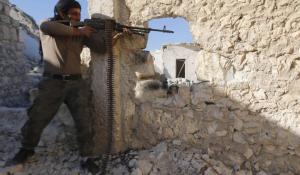
syrian-rebels-fsaA Free Syrian Army fighter in Aleppo. Hosam Katan/Reuters

Nothing has come in for more mockery during the Obama administration’s halting steps into the Syrian civil war than its employment of “moderate” to describe the kind of rebels it is willing to back. In one of the more widely cited japes, The New Yorker’s resident humorist, Andy Borowitz, presented a “Moderate Syrian Application Form,” in which applicants were asked to describe themselves as either “A) Moderate, B) Very moderate, C) Crazy moderate or D) Other.

After Senator John McCain unwittingly posed with Syrians “on our side” who turned out to be kidnappers, Jon Stewart cracked, “Not everyone is going to be wearing their ‘HELLO I’M A TERRORIST’ name badge.”

Behind the jokes, however, is the deadly serious responsibility of the CIA and Defense Department to vet Syrians before they receive covert American training, aid and arms. But according to U.S. counterterrorism veterans, a system that worked pretty well during four decades of the Cold War has been no match for the linguistic, cultural, tribal and political complexities of the Middle East, especially now in Syria. “We’re completely out of our league,” one former CIA vetting expert declared on condition of anonymity, reflecting the consensus of intelligence professionals with firsthand knowledge of the Syrian situation. “To be really honest, very few people know how to vet well. It’s a very specialized skill. It’s extremely difficult to do well” in the best of circumstances, the former operative said. And in Syria it has proved impossible.

Daunted by the task of fielding a 5,000-strong force virtually overnight, the Defense Department and CIA field operatives, known as case officers, have largely fallen back on the system used in Afghanistan, first during the covert campaign to rout the Soviet Red Army in the 1980s and then again after the 2001 U.S. invasion to expel Al-Qaeda: Pick a tribal leader who in turn recruits a fighting force. But these warlords have had their own agendas, including drug-running, and shifting alliances, sometimes collaborating with terrorist enemies of the United States, sometimes not.

“Vetting is a word we throw a lot around a lot, but actually very few people know what it really means,” said the former CIA operative, who had several postings in the Middle East for a decade after the 9/11 attacks. “It’s not like you’ve got a booth set up at a camp somewhere. What normally happens is that a case officer will identify a source who is a leader in one of the Free Syrian Army groups. And he’ll say, ‘Hey…can you come up with 200 [guys] you can trust?’ And of course they say yes—they always say yes. So Ahmed brings you a list and the details you need to do the traces,” the CIA’s word for background checks. “So you’re taking that guy’s word on the people he’s recruited. So we rely on a source whom we’ve done traces on to do the recruiting. Does that make sense?”

No, says former CIA operative Patrick Skinner, who still travels the region for the Soufan Group, a private intelligence organization headed by FBI, CIA and MI6 veterans. “Syria is a vetting nightmare,” he told Newsweek, “with no way to discern the loyalties of not only those being vetted but also of those bringing the people to our attention.”

A particularly vivid example was provided recently by Peter Theo Curtis, an American held hostage in Syria for two years. A U.S.-backed Free Syrian Army (FSA) unit that briefly held him hostage casually revealed how it collaborated with Al-Qaeda’s al-Nusra Front, even after being “vetted” and trained by the CIA in Jordan, he wrote in The New York Times Magazine.

“About this business of fighting Jabhat al-Nusra?” Curtis said he asked his FSA captors.

“Oh, that,” one said. “We lied to the Americans about that.”

Concerns about the CIA’s vetting system arose long before the Syrian civil war erupted in 2011, several CIA veterans told Newsweek. In Baghdad, one said, agency operatives had such thin faith in the system that they often had sweaty palms as they awaited a meeting with a newly recruited Iraqi spy—even though he had been cleared by CIA vetters—because they knew he might show up with a suicide vest under his jacket. That happened in Afghanistan on December 30, 2009, when a Jordanian physician recruited by the CIA on his claim to have access to Osama bin Laden turned out to be working for Al-Qaeda. He blew himself up at a CIA base, taking out seven agency operatives as well.

That double agent had been served up by Jordan’s General Intelligence Directorate, a longtime partner of the CIA in clandestine operations. Relying on close liaisons to vet spies might’ve worked well enough during the Cold War, when the CIA’s name files were meticulously updated by its small corps of Ivy-educated spies, but in the swirling chaos of the post-9/11 Middle East or South Asia, where Arabic (or Urdu, Farsi or Pashtun) names can be transliterated to English and back in endless varieties and where political allegiances are as blurry as the centuries-old colonial boundaries drawn up by bureaucrats in London and Paris, the CIA’s vetters are just not up to the task, say spy agency veterans with long experience in the region.

“For two years I managed a lot of those folks,” said one person not authorized to discuss the inner workings of the system. “A lot of them are contractors just coming out of college and don’t have a lot of experience under their belts—not in the Middle East, or the region or in Arabic.”

(The CIA declined comment on the vetting process. Navy commander Elissa Smith, speaking for the Defense Department, said in a statement that “the U.S. military has decades of experience screening foreign military forces for training. We also know the Syrian opposition better now than we did two years ago. While we cannot disclose the details of our sources and methods, we will screen thoroughly and conduct continuous monitoring.”)

American embassies around the world are open to just about anybody who wants to sign up for the FSA. “They fill out a form. You get their four-part name, their date of birth, and then their tribe and where they’re from and all that,” the former operative explained. “Their work history, if there is any. Then you take that and run your traces through all your databases—your HUMINT and SIGINT [agency acronyms for information from human spies and National Security Agency intercepts, called signals intelligence]. And then you take certain aspects of that information, and you sanitize it, and you send it by cable to your station in whatever country, and you ask for their traces on this individual, to see if anything comes up.

“The problem with that process,” the former operative continued, “is when you have a person sitting at a computer who doesn’t know how to standardize Arabic names.… They may translate it correctly, but the person typing it in may or may not know how to look for it with all the name variances that might already be in the system.”

When it came time to start vetting Syrian rebels, the CIA faced even more hurdles. When the Obama administration shuttered the American Embassy in Damascus in 2011, just as the civil war was exploding, the covert CIA station inside the building there was rolled up, too. The agency had to “make do,” as one former operative put it.

“The main problem with plans that arm and train the ‘moderates’—who ominously are moderate only in their fighting abilities,” said Skinner, “is that it assumes perfect knowledge, or ‘good enough’ knowledge, about the people being armed. When in fact there is nothing close to that.… The background info on these fighters is next to nothing and misleading, especially in Syria, where we don’t have a liaison relationship, and so the vast majority of even check-the-box vetting is by third parties [who are] out-of-the-country players with a stake in the game.

“As in Afghanistan, we can get scammed and misled at every stage with tragic results,” Skinner added. “One can’t simply build a loyal effective army thirdhand. It’s like running a want-ad that says, ‘Only Moderates Show Up for Free Weapons and Paid Training,’ and believing that is effective screening.”

“It’s one thing if you’re talking about a few dozen, or even a few hundred, individuals to run name checks or traces on,” agrees Martin Reardon, a former high-ranking FBI counterterrorism official. “But the first group of [Syrian] rebels to be trained [by the U.S.] is supposed to number upwards of 5,000. Assuming the administration can identify that many ‘moderate’ rebels to begin with, it would be virtually impossible to accomplish even minimal background checks with any degree of reliability.”

Another troubling lesson from the wars in Afghanistan, Iraq and now Syria is that today’s moderate can become tomorrow’s extremist. “Just because that guy may be moderate today—who may really and truly be a moderate and despise Al-Qaeda or whatever—what if that guy is seen walking into the Green Zone by his friend so-and-so at the checkpoint?” the former CIA vetting expert said. “And everybody knows those guys coming into the Green Zone are there to see the CIA, or at least that’s the assumption. So they grab his father, his son or his brother, and they take him captive. What’s to stop them from forcing him to strap a bomb to his body and walking back into the next meeting with an [improvised explosive device] on his chest?”

Or this: “What if you’re in Afghanistan and maybe you’re friends [with a contact], but tomorrow you drop a bomb on his cousin? You think he’s going to be your friend tomorrow? These things can change overnight. So this vetting idea—‘once vetted, things are all right, we’re good to go’—is crazy.”

Given such accounts, the odds of keeping loyal troops seems like panning for gold—or worse, an exercise in self-delusion. But the former CIA operative, who served in a variety of Middle Eastern posts as well as headquarters, said Obama administration officials aren’t fibbing about their faith in the system. They just may not realize it’s shot through with holes. “Most of them think they’re doing it pretty good, but they’re also not our best and brightest in terms of knowing how to vet,” this person said. “So I don’t think it’s a charade, I think it’s misguided. They don’t know how poor it actually is.”

So what? responds former senior CIA operations officer Charles Faddis, who led a covert team into Kurdistan in advance of the 2003 U.S. invasion of Iraq. He says it’s time to act, no matter how shaky the foundations of the CIA’s Syrian army. “You can’t run covert action without getting your hands dirty. We can’t sit on the sidelines and have discreet, antiseptic contacts with these guys and accomplish anything,” Faddis said. “If we’re going to do this, we need to wade in.”

Caution be damned. Hold our noses and pass the ammunition.

“We need to have people on the ground. We need to give them serious money and weaponry,” Faddis said. “Unless we do that, we are never really going to have any control over what’s going on, or any real idea who we should be in bed with.”

The War on ISIS: More Than One Battle

October 23, 2014

The War on ISIS: More Than One Battle, Wall Street Journal,  Max Boot, October 22, 2014

Kobani no longer looks to be in imminent danger of falling. It is even possible that ISIS will give up the fight and pull out. If this happens, it will certainly be good news. The remaining residents of Kobani would be saved from slaughter and their relief would give a moral boost to anti-ISIS efforts. But any celebration should be muted. Winning at Kobani will be no more devastating to ISIS than was the American victory at Khe Sanh to North Vietnam.

The problem is that ISIS can readily replace the fighters it loses in Kobani, and heavy weapons are not essential to its guerrilla style of warfare. Even as ISIS is losing a little ground at Kobani, it is gaining strength elsewhere.

Only 12 U.S. advisory teams have been deployed and only at the brigade level. The other 14 Iraqi brigades identified by the U.S. as “reliable partners” have no advisers at all. None of these advisers, moreover, is allowed to accompany Iraqi troops into combat, where they can be most effective. The U.S. also is not stepping in to offer direct assistance and training to the Sunnis of Anbar Province to allow them to fight back against ISIS, as they did against al Qaeda in Iraq in 2007-08.

Through the limited application of air power—a mere handful of daily strikes—the U.S. may achieve tactical progress to blunt ISIS’s momentum. But Khe Sanh showed the limits of tactical military victories if they are not married to larger strategic gains—and those are elusive in Iraq and Syria today

********************

On Jan. 21, 1968, North Vietnamese troops attacked the U.S. Marine garrison at Khe Sanh in South Vietnam near the border with Laos. A 77-day siege ensued, with the U.S. pouring in ever more firepower. The U.S. would drop 100,000 tons of bombs because Gen. William Westmoreland was determined that Khe Sanh not become another defeat like Dien Bien Phu, which had effectively ended France’s colonial presence in Vietnam 14 years earlier.

And it didn’t. Eventually the siege was relieved and the attacking forces melted away, having suffered more than 5,000 fatalities (while the defenders lost about 350 men).

Today, no one except some veterans and military historians remembers Khe Sanh because in the end it had scant strategic significance: Even though the U.S. won the battle, it lost the war. Not long after having “liberated” Khe Sanh, the U.S. dismantled the base because it served little purpose.

This history is worth mentioning because of the parallels, limited and inexact to be sure, between Khe Sanh and Kobani, a Kurdish town in northern Syria. Jihadist forces of Islamic State, also known as ISIS, have been besieging Kobani for weeks, and the U.S. has been ramping up efforts to prevent the town from falling. U.S. airstrikes have apparently taken a heavy toll, eliminating ISIS fighters, artillery, armored vehicles and other heavy weapons. Airstrikes have now been joined by airdrops of weapons and ammunition to the Kurdish defenders. Turkey, which had hitherto not lifted a finger to save Kobani, announced Monday that it would allow Iraqi Kurdish fighters to traverse Turkish territory to join in defending the town.

Kobani no longer looks to be in imminent danger of falling. It is even possible that ISIS will give up the fight and pull out. If this happens, it will certainly be good news. The remaining residents of Kobani would be saved from slaughter and their relief would give a moral boost to anti-ISIS efforts. But any celebration should be muted. Winning at Kobani will be no more devastating to ISIS than was the American victory at Khe Sanh to North Vietnam.

The problem is that ISIS can readily replace the fighters it loses in Kobani, and heavy weapons are not essential to its guerrilla style of warfare. Even as ISIS is losing a little ground at Kobani, it is gaining strength elsewhere.

Its fighters are advancing in Anbar Province with little resistance. They are poised on the outskirts of Baghdad; soon they may be within mortar range of Baghdad International Airport, whose closure would be a disaster. On Monday alone, its car bombs and suicide bombers in Baghdad and Karbala claimed at least 33 lives, a day after a suicide bomber in Baghdad killed at least 28 people in a Shiite mosque. The pattern is reminiscent of the terrorist atrocities perpetrated in 2006 by al Qaeda in Iraq, ISIS’s predecessor, aimed at rallying Sunnis to the terrorists’ side by provoking a civil war with Shiites.

As in those dark days, Sunni extremism is provoking an equally extreme response from Iranian-backed Shiites. The replacement of Nouri al-Maliki as Iraq’s prime minister with Haidar al-Abadi, an apparently less sectarian Shiite, was a small step in the right direction for which the Obama administration deserves credit. But there is little reason to think the Iranian hold over a substantial portion of the Iraqi state has been broken.

The Iraqi Parliament has approved ministers to run the two security ministries—Interior and Defense. While the Defense pick is Sunni technocrat Khalid al-Obedi, the Interior pick is far more worrisome: Mohammed Salem al-Ghabban is a member of the Badr Organization, one of the chief Iranian-backed Shiite militias that is further destabilizing Iraq with attacks on Sunni neighborhoods. The likelihood is that Mr. Ghabban will take orders from his ultimate sponsor, Gen. Qasem Suleimani, head of Iran’s Quds Force.

This means that the Interior Ministry, in charge of Iraq’s police forces, will become, if it is not already, a wholly owned subsidiary of the Shiite militias and their Iranian string-pullers. This happened in 2006 when the Iraqi police became notorious for kidnapping and torturing Sunnis. This helped bring Iraq to the brink of all-out civil war and will do so again if not checked.

The only way to counteract the Iranian capture of the Interior Ministry is to bolster the Iraqi army as an independent fighting force, but there is little sign of this occurring. Shiite sectarians have also deeply penetrated the army and the U.S. has little ability to counteract this insidious development because President Obama will not send a large number of “embedded” advisers to work alongside army units that remain more professional and less politicized.

Only 12 U.S. advisory teams have been deployed and only at the brigade level. The other 14 Iraqi brigades identified by the U.S. as “reliable partners” have no advisers at all. None of these advisers, moreover, is allowed to accompany Iraqi troops into combat, where they can be most effective. The U.S. also is not stepping in to offer direct assistance and training to the Sunnis of Anbar Province to allow them to fight back against ISIS, as they did against al Qaeda in Iraq in 2007-08.

In Syria the U.S. is also doing little to oppose the Assad dictatorship, leaving it free to continue attacks on areas held by moderate militias affiliated with the Free Syrian Army. This, too, is feeding the radicalization of Syria and Iraq by convincing many Sunnis, rightly or wrongly, that the U.S. is acquiescing to Iranian regional domination—and that ISIS is the only reliable defender that Sunnis have. That impression will be strengthened if the Obama administration reaches a deal with Iran next month that will allow Tehran to maintain its capacity to develop a nuclear weapon.

Through the limited application of air power—a mere handful of daily strikes—the U.S. may achieve tactical progress to blunt ISIS’s momentum. But Khe Sanh showed the limits of tactical military victories if they are not married to larger strategic gains—and those are elusive in Iraq and Syria today.